
 Submit an article

Search
- Page Path
- HOME > Search
Research Papers
- Development and evaluation of the Trauma-nursing Education and Skill Support program to enhance trauma nursing competencies: a quasi-experimental study
- Tae Yeong Yang, Myung Jin Jang, Ki Ung Kim, Min So, Mi Na Choi, Eun Jung Lee, Jin Su Jo, Ji Yun Lee, Kwang Kyun Lim, Kyoung Mi Kim, Hae Jun Baek, Sun Ho Wang, Jin Oh Choi
- J Korean Acad Nurs 2026;56(1):67-80. Published online February 24, 2026
- DOI: https://doi.org/10.4040/jkan.25134
-
 Abstract
 PDF
PDF ePub
ePub - Purpose
This study aimed to develop and evaluate the effectiveness of the Trauma-nursing Education and Skill Support (TESS) program based on the ADDIE model (Analysis, Design, Development, Implementation, Evaluation model). The program was designed to enhance trauma nurses’ clinical competencies, including trauma-related knowledge, self-efficacy, and problem-solving ability, through the integration of theoretical education and simulation-based practice.
Methods
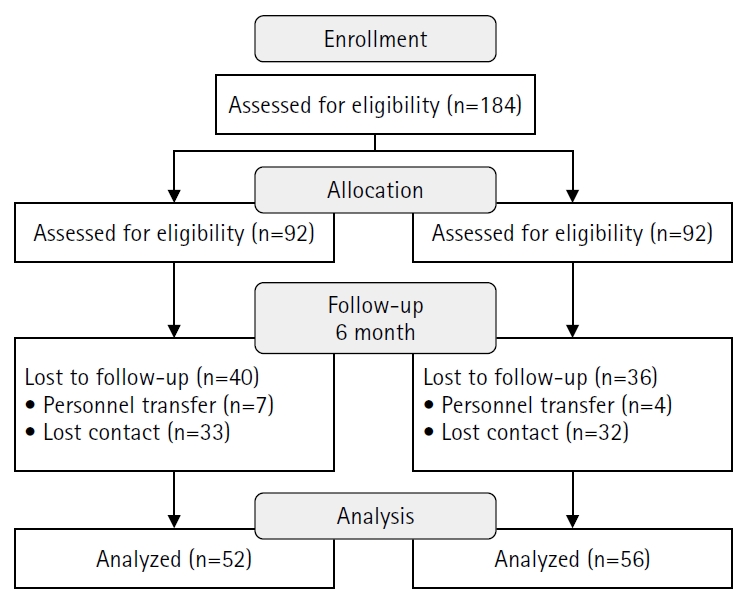
A quasi-experimental study using a non-equivalent control group pretest–posttest design was conducted. Participants included 108 trauma nurses from regional trauma centers, military trauma centers, and emergency care facilities, who were assigned to an experimental group (n=52) or a control group (n=56). The TESS program consisted of a 2-day, 14-hour blended-learning course that included eight lecture sessions and four simulation-based practice stations. Data were collected at baseline, immediately after the intervention, and at 6 months using validated instruments measuring trauma-related knowledge, self-efficacy, and problem-solving ability. Two-way repeated-measures analysis of variance was used for data analysis.
Results
The experimental group demonstrated significant improvements in trauma-related knowledge, self-efficacy, and problem-solving ability compared with baseline (all p<.001). These improvements were sustained at 6 months, although trauma-related knowledge scores showed a slight decline compared with immediate posttest levels. Between-group analyses confirmed significant group-by-time interaction effects for all outcomes: trauma-related knowledge (η2=0.12, p<.001), self-efficacy (η2=0.09, p=.002), and problem-solving ability (η2=0.08, p=.003).
Conclusion
The TESS program effectively enhanced trauma nurses’ trauma-related knowledge, self-efficacy, and problem-solving ability, with effects sustained for up to 6 months. Incorporating blended learning and simulation-based training into standardized trauma nursing education may strengthen clinical competencies and ultimately contribute to improved patient outcomes.
- 3,331 View
- 353 Download

- Development of a communication self-efficacy scale for nurses: a psychometric validation study
- Kuem Sun Han, Jihye Shin, Soo Yeon Lee
- J Korean Acad Nurs 2025;55(2):269-284. Published online May 27, 2025
- DOI: https://doi.org/10.4040/jkan.24129
-
Abstract
PDFePub
- Purpose
This methodological study was conducted to develop a scale to measure communication self-efficacy in nurses and examine its validity and reliability.
Methods
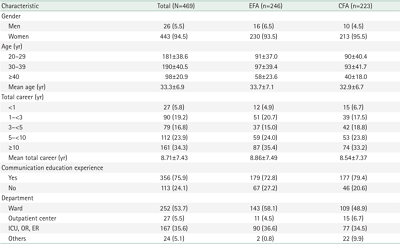
We selected 54 initial items from literature reviews and interviews with 10 clinical nurses. Thirty-two preliminary items were derived from consultations with 10 experts. To verify the scale’s factor structure, we conducted exploratory factor analysis (EFA), and confirmatory factor analysis (CFA) among 469 nurses. Data were analyzed using item analysis, EFA, CFA, discriminant validity, convergent validity, and internal consistency using IBM SPSS Statistics ver. 29.0 (IBM Corp.) and IBM SPSS AMOS ver. 20.0 (IBM Corp.).
Results
The scale consisted of 18 items with three factors (ability to apply therapeutic communication skills, crisis management capabilities, and communication competence), which explained 46.1% of the total variance. Convergent validity and discriminant validity were confirmed for the factors. CFA supported the fit of the measurement model comprising three factors (standardized root mean square residual=.04, root mean square error of approximation=.03, goodness of fit index=.92, Tucker-Lewis index=.97, comparative fit index=.98, normed fit index=.89, critical N=216). Internal consistency was confirmed by a Cronbach’s α coefficient of .91.
Conclusion
The communication self-efficacy scale for nurses is expected to measure communication self-efficacy among nurses. It will be useful for improving nurses’ professional communication abilities. -
Citations
Citations to this article as recorded by
- Factors Influencing Psychiatric Nursing Competency among Emergency Nurses: The Mediating Effect of Psychological Safety in a Cross-Sectional Study
Yu Jin Lee, Chung Hee Woo
Journal of Korean Academy of psychiatric and Mental Health Nursing.2026; 35(1): 53. CrossRef - Development and Validation of a Multidimensional Nursing Empowerment Scale (NES)
Fatma Cerit Soydan, Ayşe Nefise Bahçecik
Journal of Nursing Management.2026;[Epub] CrossRef
- Factors Influencing Psychiatric Nursing Competency among Emergency Nurses: The Mediating Effect of Psychological Safety in a Cross-Sectional Study
- 5,751 View
- 442 Download
- 1 Web of Science
- 2 Crossref
- Validity and Reliability of the Korean Version of the Occupational Coping Self-Efficacy Scale for Nurses
- Youngrye Park, Sunah Park, Hee Ran Kang
- J Korean Acad Nurs 2024;54(4):633-644. Published online November 30, 2024
- DOI: https://doi.org/10.4040/jkan.24094
-
Abstract
PDFePub
Purpose This study aimed to evaluate the validity and reliability of the Korean version of the occupational coping self-efficacy for nurses (K-OCSE-N) scale.
Methods The English version of the OCSE-N scale was translated into Korean using a translation and back-translation process. Data were gathered from 213 nurses employed in a general hospital in South Korea. The content validity was assessed using the content validity index. The construct validity was verified through exploratory and confirmatory factor analyses. Criterion validity was assessed using Pearson’s correlation coefficients with the job stress coping and general self-efficacy scales. Reliability was examined using item-total score correlation and Cronbach’s α coefficient for internal consistency.
Results The exploratory factor analysis identified two factors that explained 61.8% of the cumulative variance: occupational burden and relational difficulty. In confirmatory factor analysis, the model exhibited adequate fit (
χ 2/df = 2.07, GFI = .95, SRMR = .04, RMSEA = .07, CFI = .97, and TLI = .95), with both convergent and discriminant validity deemed acceptable. The criterion validity presented a positive correlation of the K-OCSE-N with both job stress coping (r = .72,p < .001) and general self-efficacy (r = .72,p < .001). The internal consistency of the scale using Cronbach’s α for the total items was .89.Conclusion The K-OCSE-N scale is a valid and reliable tool for measuring nurses’ occupational coping self-efficacy. This study suggests that various intervention studies can use the scale to assess and strengthen nurses’ occupational coping self-efficacy in nursing practice.
-
Citations
Citations to this article as recorded by- Patient Safety and Quality Improvement in Nursing Practice: Associations Among Workload, Occupational Coping Self-Efficacy and Medical Device-Related Pressure Injury Prevention
Hyun Suk Gwag, Jin Ah Kim
Healthcare.2026; 14(2): 270. CrossRef - Effects of the Nursing Work Environment, Patient-Centered Communication, Occupational Coping Self-Efficacy, and Professional Identity on Missed Nursing Care among General Hospital Nurses
Yuju Kim, Ju-Yeon Uhm
Journal of Fundamental Nursing Science.2026; 33(2): 277. CrossRef
- Patient Safety and Quality Improvement in Nursing Practice: Associations Among Workload, Occupational Coping Self-Efficacy and Medical Device-Related Pressure Injury Prevention
- 10,588 View
- 543 Download
- 1 Web of Science
- 2 Crossref
- The Effects of a Self-Efficacy Theory-Based Exercise Program for Patients Undergoing with Total Knee Arthroplasty
- Kyung-Hye Park, Hee-Young Kang
- J Korean Acad Nurs 2024;54(4):547-562. Published online October 22, 2024
- DOI: https://doi.org/10.4040/jkan.24027
-
Abstract
PDF
 Supplementary MaterialePub
 Purpose This study was performed to develop a self-efficacy theory-based exercise program for total knee arthroplasty (TKA) and to test the program’s efficacy in ameliorating knee pain and restoring function as measured by lower extremity muscle strength, 3 meter walking time, Korean Western Ontario McMaster Index (WOMAC), exercise self-efficacy, and length of hospital stay for TKA patients.
Methods This quasi-experimental study incorporating a non-equivalent control group and pretest-posttest non-synchronized design non-synchronous design was applied to assess self-efficacy reinforcement strategies based on self-efficacy theory. The exercise program consisted of the following steps: TKA, education to prevent postoperative complications, and muscle strength exercises. Respective exercise and control groups included 29 and 27 participants. The experimental group received eight sessions of the program from three weeks before TKA to four weeks after TKA. Collected data were analyzed using the chi-square test, Mann–Whitney U test, and ranked ANCOVA and t-tests using IBM SPSS Statistics 23.
Results Experimental group showed significant improvement in lower extremity muscle strength (F = 8.63,
p = .005), 3 meter walking time (z = - 5.02,p < .001), WOMAC index (z = - 2.22,p = .027), self-efficacy for exercise (z = - 3.29,p = .001), and length of hospital stay (t = - 2.11,p = .040) compared to the control group. No significant differences in knee pain and range of motion were observed.Conclusion These findings indicate that a self-efficacy theory-based exercise program can be an effective exercise strategy that patients undergoing TKA can easily follow at home without assistance. It is thus recommended as an exercise intervention for TKA patients.
-
Citations
Citations to this article as recorded by- Self-efficacy and implementation intentions in home rehabilitation of stroke patients: the parallel mediating role of recurrence risk perception and outcome expectations
Xiaowen Jiang, Qiuxue Sun, Rong Tang, Shuxian Liu, Xi Chen, Yumei Lv
Frontiers in Psychology.2025;[Epub] CrossRef - Factors Influencing Decision-Making and Rehabilitation Among Older Women Who Underwent Total Knee Replacement: A Qualitative Study in Taiwan
Ching Han Huang, Yun Yee Chen, Shu Wen Chen, Chen Ti Wang, Mei Hsiang Lin
Patient Preference and Adherence.2025; Volume 19: 3931. CrossRef
- Self-efficacy and implementation intentions in home rehabilitation of stroke patients: the parallel mediating role of recurrence risk perception and outcome expectations
- 5,423 View
- 399 Download
- 2 Web of Science
- 2 Crossref
- Effects of a Pre-Conception Care Program in Women with Inflammatory Bowel Disease: A Mixed-Methods Study Including a Randomized Controlled Trial
- Young Jin Lee, Hae Won Kim, Yeon Hee Kim, Suk-Kyun Yang, Ji-Yeon Kim
- J Korean Acad Nurs 2024;54(3):386-402. Published online August 31, 2024
- DOI: https://doi.org/10.4040/jkan.24010
-
Abstract
PDF
- Purpose
The purpose of this study was to conduct a pre-conception care program for women of childbearing age with inflammatory bowel disease (IBD) in Korea and verify its effects on self-efficacy for IBD management, IBD-related pregnancy knowledge, and IBD-related pregnancy anxiety. It also aimed to explore the changes in participants through the program.
Methods
A convergent mixed-methods study design was adopted. In the quantitative phase, 35 women (17 and 18 in the intervention and control group, respectively) participated. The intervention group attended a program that included small-group sessions and individual tele-coaching. To confirm the effects, data were collected before and one and four weeks after the intervention. In the qualitative stage, focus group interviews and tele-coaching were conducted with the intervention group.
Results
After the program ended, significant differences were observed over time between the intervention and control groups for self-efficacy for IBD management (Wald χ2 = 4.41, p = .036), IBD-related pregnancy knowledge (Wald χ2 = 13.80, p < .001) and IBD-related pregnancy anxiety (Wald χ2 = 8.61, p = .003). Qualitative data analysis revealed the following themes: (1) improving confidence in IBD management and awareness for planned pregnancy; (2) improving IBD awareness related to pregnancy and childbirth; and (3) relieving anxiety about and actively facing pregnancy.
Conclusion
This study is meaningful in that, to the best of our knowledge, it is the first to develop a pre-conception care program for women diagnosed with IBD and confirm its effectiveness. Furthermore, this program is expected to be suitable for patient counseling and education in clinical practice. -
Citations
Citations to this article as recorded by- Quality of healthcare delivery in inflammatory bowel disease pregnancy: a scoping review
Simone Chin, Kathryn Demase, Crispin Corte, Darren Wong, Ralley Prentice, Peter De Cruz
Inflammatory Bowel Diseases.2026;[Epub] CrossRef - Third N-ECCO Consensus Statements on the Nursing Roles in Caring for Patients with Inflammatory Bowel Disease
Susanna Jäghult, Michel Adamina, Dawn Farrell, Palle Bager, Wladyslawa Czuber-Dochan, Karen Kemp, Nynke Boontje, Ferdinando D’Amico, Goedele Dewitte, Ola Haj, Petra Hartmann, Daniel Lightowler, Regula Locher, Clarisse Maia, Francisca Murciano Gonzalo, Dan
Journal of Crohn's and Colitis.2026;[Epub] CrossRef - The experiences of fertility concerns in women with inflammatory bowel disease of childbearing age: a descriptive qualitative study
Lewei Tu, Qiaoyu Wu, Mengxiao Jiang, Meihao Wei, Ying Wang, Ying Xiao
BMC Gastroenterology.2025;[Epub] CrossRef - Health Literacy in Inflammatory Bowel Disease: A Systematic Review of Health Outcomes, Predictors and Barriers
Caterina Mercuri, Rita Nocerino, Vincenzo Bosco, Teresa Rea, Vincenza Giordano, Michele Virgolesi, Patrizia Doldo, Silvio Simeone
Journal of Clinical Medicine.2025; 14(23): 8577. CrossRef
- Quality of healthcare delivery in inflammatory bowel disease pregnancy: a scoping review
- 3,874 View
- 169 Download
- 4 Web of Science
- 4 Crossref
- Moderating Effect of General Self-Efficacy on the Relationship between Pregnancy Stress, Daily Hassles Stress, and Preterm Birth Risk in Women Experiencing Preterm Labor: A Cross-Sectional Study
- Hyun-Jeong Cho, Jeung-Im Kim
- J Korean Acad Nurs 2024;54(3):329-339. Published online August 31, 2024
- DOI: https://doi.org/10.4040/jkan.24008
-
Abstract
PDF
- Purpose
This study investigated the moderating role of general self-efficacy (GSE) on how stress caused by pregnancy and daily hassle affect the risk of preterm birth (PTB) in women experiencing preterm labor.
Methods
This cross-sectional study included 196 pregnant women experiencing preterm labor before 37 weeks of gestation. We used IBM SPSS Statistics 27 and employed Hayes process macro version 4 (model 1) and hierarchical regression to analyze the moderating effect of GSE on the relationship between pregnancy stress, daily hassle stress, and PTB risk.
Results
Stress caused by pregnancy and daily hassle was positively correlated to PTB risk (r = .54, p < .001; r = .25, p < .001, respectively). While GSE did not significantly correlate with pregnancy stress, it negatively correlated with daily hassle stress (r = - .19, p = .009). GSE significantly moderated the relationship between combined stressors and PTB risk. As GSE levels increased, escalation in PTB risk in response to increasing stress levels was a more pronounced, highlighting a complex interaction between higher GSE levels and response to escalating stress levels. This model accounted for 39.5% of the variance in the PTB risk.
Conclusion
Higher GSE may amplify the impact of stress on PTB risk, rather than mitigate it, which suggests a more nuanced role of GSE in the stress response of pregnant women at risk of preterm labor. GSE should be considered in care strategies, and managing its impact on stress perception and responses in pregnant women is crucial. -
Citations
Citations to this article as recorded by- Evaluating the Effectiveness of Digital Interventions for Stress Management in Pregnant Women: Systematic Review and Meta-Analysis
Jeung-Im Kim, Joo Yun Lee, So-Hee Park
JMIR mHealth and uHealth.2026; 14: e66267. CrossRef - Pregnancy stress in women at high risk of preeclampsia with their anxiety, depression, self-management capacity: a cross-sectional study
Xing Cong, Jinmei Wang, Liu Yang, Lingling Cui, Yurong Hua, Ping Gong
Frontiers in Psychology.2025;[Epub] CrossRef - Anxiety, Coping, and Self-Efficacy as a Psychological Adjustment in Mothers Who Have Experienced a Preterm Birth
Agata Białas, Karolina Kamecka, Paweł Rasmus, Dariusz Timler, Remigiusz Kozłowski, Anna Lipert
Journal of Clinical Medicine.2025; 14(12): 4174. CrossRef - Associations Among Pregnancy Stress, Childbirth Confidence, and COVID-19 Infection Experience in Pregnant Women in the Early Third Trimester (28–32 Weeks)
Yun-Sun Yang, Jeung-Im Kim
Journal of Korean Maternal and Child Health.2025; 29(3): 147. CrossRef
- Evaluating the Effectiveness of Digital Interventions for Stress Management in Pregnant Women: Systematic Review and Meta-Analysis
- 3,267 View
- 152 Download
- 3 Web of Science
- 4 Crossref
- Development and Effectiveness Evaluation of Comprehensive Mobile-Based, Breastfeeding Promotion Program for Mothers with Gestational Diabetes
- Eunju Kwak, Seungmi Park
- J Korean Acad Nurs 2024;54(2):224-236. Published online May 31, 2024
- DOI: https://doi.org/10.4040/jkan.23098
-
Abstract
PDF
- Purpose
This study aimed to evaluate the effects of a mobile-based breastfeeding promotion program (M-BFGDM) that helps mothers with gestational diabetes.
Methods
Forty-seven mothers participated in the study, of whom 22 were in the experimental group and 25 in the control group. To verify the effects, a lag design before and after the non-equivalence control group was used. The data collection for the experimental group was done before and after the intervention.
Results
In the results, breastfeeding knowledge showed a significant difference in the interaction between measurement period and group (χ2 = 8.14, p = .017), whereas breastfeeding intention did not show a significant difference in the interaction (χ2 = 4.73, p = .094). There was no difference in self-efficacy interaction (F = 0.13, p = .856). The breastfeeding method showed no difference in interaction (F = 0.04, p = .952), whereas cross-analysis showed a significant difference in breastfeeding practice rate between the experimental group and the control group at 1 month postpartum (χ2 = 7.59, p = .006).
Conclusion
A mobile-based breastfeeding promotion program was developed and applied for gestational diabetic mothers, resulting in an increase in breastfeeding knowledge and an improvement in breastfeeding practice rate one month after childbirth. In addition, M-BFGDM managed to create a breastfeeding practice environment with fewer time and place restrictions. A program study that complements motivation is needed to improve breastfeeding in pregnant diabetic mothers in the future. -
Citations
Citations to this article as recorded by- Long-Term Effectiveness of a Mobile-Based Breastfeeding Program for Women with Gestational Diabetes: 6-Month Follow-Up of a Quasi-Experimental Study
Seungmi Park, Young Mi Ryu, Eunju Kwak
Healthcare.2026; 14(7): 917. CrossRef - Breastfeeding and education in the puerperium
Elena Alfonso
SAP Community and Interculturality in Dialogue.2025; 5: 129. CrossRef - The Effect of Immediate Skin‐to‐Skin Contact on Exclusive Breastfeeding: An Instrumental Variable Approach
Sangyun Lee, Yongnam Kim
Acta Paediatrica.2025; 114(9): 2367. CrossRef
- Long-Term Effectiveness of a Mobile-Based Breastfeeding Program for Women with Gestational Diabetes: 6-Month Follow-Up of a Quasi-Experimental Study
- 4,596 View
- 288 Download
- 2 Web of Science
- 3 Crossref
- Structural Equation Modeling of Health Promotion Behavior on Migrant Workers: A Multi-Group Analysis Based on the Period of Residence
- Hanna Jeong, Youngsuk Kim
- J Korean Acad Nurs 2024;54(1):73-92. Published online February 29, 2024
- DOI: https://doi.org/10.4040/jkan.23101
-
Abstract
PDF
- Purpose
This study developed and tested a hypothetical model of health promotion behavior on migrant workers based on the Health Promotion Model and the Health Literacy Skills Framework.
Methods
Data were collected from 298 migrant workers in 9 regions across the country from December 2020 to March 2021. The exogenous variables were e-health literacy, occupational stress, acculturation, and social support. The endogenous variables were perceived benefits of action, self-efficacy, and health promotion behavior. Data were analyzed using SPSS/WIN 25.0, AMOS 20.0, and R-4.0.3 program.
Results
The model fit was appropriate. Social support had the most significant direct impact on the health promotion behavior of migrant workers. Perceived benefits of action and self-efficacy played a mediating role in the relationship among e-health literacy, social support, and health promotion behavior. Based on multi-group analysis, the migrant worker group with less than 5 years of residency had a more statistically significant effect on the relationship between perceived benefits of action and health promotion behavior than those with over 5 years.
Conclusion
Providing social support as a critical administrative strategy to enhance the health promotion behavior of migrant workers is necessary. Furthermore, when developing an intervention program utilizing the internal mechanism between social support and health promotion behavior, a self-efficacy-enhancing strategy is considered to be more effective. Additionally, educating migrant workers with short-term residence of less than 5 years about the benefits of health behaviors is essential. -
Citations
Citations to this article as recorded by- Influence of Health Literacy and Psychological Well-being on Health Promotion Behavior in Military Personnel
Dong Jun Lee, Eun Sun So
Research in Community and Public Health Nursing.2026; 37: 90. CrossRef - Factors influencing cardiovascular health behaviors among Korean-Chinese migrant workers with metabolic syndrome using mixed methods
Yu Zhu Zhang, Seon Young Hwang
Scientific Reports.2025;[Epub] CrossRef - Factors Associated With Physical Activity in Home‐Based Rehabilitation Patients With Ankylosing Spondylitis: A Prospective Longitudinal Study
Heng‐Ying Fang, Ying‐Hua Pan, Yi‐Heng Zhang, Yu‐Hua Deng, Xiao‐Wen Li, Lei Huang, Hui‐Ting Gu, Yue Ding, Xin‐Xin Hu, Mu Liu, Rui‐Chong Wang, MeiFen Zhang
Musculoskeletal Care.2025;[Epub] CrossRef
- Influence of Health Literacy and Psychological Well-being on Health Promotion Behavior in Military Personnel
- 4,438 View
- 146 Download
- 3 Web of Science
- 3 Crossref
- Psychometric Properties of the Korean Version of Self-Efficacy for HIV Disease Management Skills
- Gwang Suk Kim, Layoung Kim, Mi-So Shim, Seoyoung Baek, Namhee Kim, Min Kyung Park, Youngjin Lee
- J Korean Acad Nurs 2023;53(3):295-308. Published online June 30, 2023
- DOI: https://doi.org/10.4040/jkan.23016
-
Abstract
PDF
- Purpose
This study evaluated the validity and reliability of Shively and colleagues’ self-efficacy for HIV disease management skills (HIVSE) among Korean participants.
Methods
The original HIV-SE questionnaire, comprising 34 items, was translated into Korean using a translation and back-translation process. To enhance clarity and eliminate redundancy, the author and expert committee engaged in multiple discussions and integrated two items with similar meanings into a single item. Further, four HIV nurse experts tested content validity. Survey data were collected from 227 individuals diagnosed with HIV from five Korean hospitals. Construct validity was verified through confirmatory factor analysis. Criterion validity was evaluated using Pearson’s correlation coefficients with the new general self-efficacy scale. Internal consistency reliability and test-retest were examined for reliability.
Results
The Korean version of HIV-SE (K-HIV-SE) comprises 33 items across six domains: “managing depression/mood,” “managing medications,” “managing symptoms,” “communicating with a healthcare provider,” “getting support/help,” and “managing fatigue.” The fitness of the modified model was acceptable (minimum value of the discrepancy function/degree of freedom = 2.49, root mean square error of approximation = .08, goodnessof-fit index = .76, adjusted goodness-of-fit index = .71, Tucker-Lewis index = .84, and comparative fit index = .86). The internal consistency reliability (Cronbach’s α = .91) and test-retest reliability (intraclass correlation coefficient = .73) were good. The criterion validity of the K-HIV-SE was .59 (p < .001).
Conclusion
This study suggests that the K-HIV-SE is useful for efficiently assessing self-efficacy for HIV disease management. -
Citations
Citations to this article as recorded by- Providing 2 Types of mHealth Interventions to Support Self-Management Among People Living With HIV: Randomized Clinical Trial
Gwang Suk Kim, Layoung Kim, Seoyoung Baek, Sooyoung Kwon, Ji Min Kim, Jun Yong Choi, Jae-Phil Choi
JMIR mHealth and uHealth.2025; 13: e60905. CrossRef - Factors associated with health-related quality of life among people living with HIV in South Korea: Tobit regression analysis
Gwang Suk Kim, Layoung Kim, SangA Lee, Mi-So Shim, Youngjin Lee, Seoyoung Baek, Claus Kadelka
PLOS ONE.2024; 19(5): e0303568. CrossRef - Three cycles of mobile app design to improve HIV self-management: A development and evaluation study
Gwang Suk Kim, Layoung Kim, Seoyoung Baek, Mi-So Shim, SangA Lee, Ji Min Kim, Jong Yae Yoon, Jin Kim, JunYong Choi, Jae-Phil Choi
DIGITAL HEALTH.2024;[Epub] CrossRef
- Providing 2 Types of mHealth Interventions to Support Self-Management Among People Living With HIV: Randomized Clinical Trial
- 4,090 View
- 82 Download
- 3 Web of Science
- 3 Crossref
- Factors Related to Clinical Competence among Graduating Nursing Students during the COVID-19 Pandemic: A Cross-Sectional Study
- Su Kyoung Chung, Jinsook Kim, Pratibha Bhandari
- J Korean Acad Nurs 2023;53(2):145-154. Published online April 30, 2023
- DOI: https://doi.org/10.4040/jkan.22087
-
Abstract
PDF
- Purpose
This study investigated clinical competency, COVID-19-related anxiety, coping strategies, self-efficacy, and perceived stress among graduating nursing students during the COVID-19 pandemic.
Methods
We conducted a cross-sectional survey. Participants were recruited from universities located in four major cities in South Korea. General demographic information, clinical competency, self-efficacy, perceived stress, COVID-19-related anxiety, and coping strategies were assessed using reliable questionnaires. Descriptive statistics, correlations, and multiple regression tests were used to analyze the data.
Results
The mean clinical competency, self-efficacy, perceived stress, adaptive coping, and maladaptive coping were 138.16 ± 18.34, 83.85 ±14.02, 21.37 ± 5.79, 53.15 ± 4.64, and 30.98 ± 6.73, respectively. COVID-19-related anxiety was reported by 4.3% of participants. Clinical competency was significantly positively correlated with self-efficacy (r = .44, p < .001) and adaptive coping (r = .20, p = .035) and was significantly negatively correlated with maladaptive coping (r = .20, p = .035). The predictors of clinical competency were self-efficacy (β = .434, p < .001) and adaptive coping (β = .173, p < .039), which explained 23% of the variance in clinical competency.
Conclusion
Self-efficacy and adaptive coping strategies are significant predictors of clinical competence during the pandemic. Planning and implementing various curricular and non-curricular activities to increase senior students' self-efficacy and adaptive coping strategies will help prepare competent nursing graduates for the pandemic when they enter the nursing workforce. -
Citations
Citations to this article as recorded by- Exploring Educational Stress and Competence of Intern Nurses' Following Two Years of Online Education: A Cross-Sectional Study
Fatma Dursun Ergezen, Ayşe Yacan Kök, Emine Kol
Ordu Üniversitesi Hemşirelik Çalışmaları Dergisi.2026; 9(1): 83. CrossRef - The Effect of Internship Length on Self‐Efficacy and Clinical Competence: Accelerating Entry Into the Nursing Workforce in Saudi Arabia
Sitah S. Alshutwi, Majed Alamri
Journal of Nursing Management.2025;[Epub] CrossRef
- Exploring Educational Stress and Competence of Intern Nurses' Following Two Years of Online Education: A Cross-Sectional Study
- 4,457 View
- 95 Download
- 2 Web of Science
- 2 Crossref
- Effects of Clinical Nurses’ Job Crafting on Organizational Effectiveness Based on Job DemandsResource Model
- Eun Young Lee, Eungyung Kim
- J Korean Acad Nurs 2023;53(1):129-143. Published online February 28, 2023
- DOI: https://doi.org/10.4040/jkan.22138
-
Abstract
PDF
- Purpose
This study aimed to examine the mediating effects of clinical nurses’ job crafting on organizational effectiveness based on the job demands-resources model proposed by Bakker and Demerouti (2017).
Methods
The participants consisted of 393 nurses working in nursing units of a tertiary general hospital located in Cheongju region. The data, collected using questionnaire from August 9 to August 20, 2021, were analyzed using SPSS 23.0 and AMOS 27.0.
Results
The goodness-of-fit (GoF) test results on the modified model (χ 2 = 2.7, GFI = .94, SRMR = .03, RMSEA = .06, NFI = .92, CFI = .94, TLI = .92, AGFI = .90), indicated that the GoF index satisfied the recommended level. Regarding the effects of each variable on organizational effectiveness, job crafting showed statistically significant direct (β = .48, p < .001), indirect (β = .23, p < .001), and total effects (β = .71, p < .001). Burnout showed statistically significant direct effect (β = - .17, p < .001). Work engagement showed statistically significant direct (β = .41, p < .001) and total effects (β = .41, p < .001). The factors explaining organizational effectiveness were job crafting, burnout, and work engagement, which had an explanatory power of 76.7%.
Conclusion
Nurses’ job crafting is an important mediating factor for enhancing the organizational effectiveness of nursing organizations. Hospitals should develop job-crafting success cases and related education and training programs as a strategy for enhancing the job crafting of nurses and, consequently organizational effectiveness. -
Citations
Citations to this article as recorded by- Examining the status quo and related factors of clinical nurses’ spare-time planning
Nana Liang, Xiaoyan Wang, Jishun Ren, Yajun Zhang, Xiaohui Liu, Lihong Ka, Juan Zhao, HongXia Tao
Frontiers in Public Health.2026;[Epub] CrossRef - Regulatory Focus Mediates the Relationship Between Psychological Capital and Team Job Crafting: A Cross-Sectional Study
Shuo Wang, Jie Yuan, Xiaojie Fang, Yulian Wei, Junjie Ma, Xuebing Jing
Sage Open Nursing.2026;[Epub] CrossRef - Job crafting as an ex-ante burnout management strategy in healthcare organisations: an emerging market perspective
Poonam Pal, Rahul Bodhi, Shatrughan Yadav
Journal of Health Organization and Management.2026; : 1. CrossRef - Influence of Positive Nursing Organizational Culture and Job Self-Efficacy on Core Competency in Chemotherapy Nursing
Gie Ok Noh
Asian Oncology Nursing.2026; 26(3): 149. CrossRef - Hospital Nurses’ Professional Quality of Life Model: A Cross‐Sectional Study Based on the Expanded Job Demands‐Resources Model
Younghee Kim, Mi Yu, Jacopo Fiorini
Journal of Nursing Management.2025;[Epub] CrossRef - The impact of grit and job crafting on organizational commitment and job satisfaction among hospital nurses in Korea
Mi-Suk Hyun
Medicine.2025; 104(45): e45890. CrossRef - Effects of Attitude Toward Interdepartmental Transfer, Career Growth Opportunity, and Role Breadth Self-Efficacy on Job Crafting among Nurses with Transfer Experience
Yu Jin Lee, Chung Hee Woo
Journal of Korean Academy of Fundamentals of Nursing.2025; 32(4): 497. CrossRef - Job Crafting as the Missing Link: Understanding Its Role in Nurses’ Work Engagement
Kyungjin Lee, Ja Kyung Seo, Seung Eun Lee, Yunhong Liu
Journal of Nursing Management.2025;[Epub] CrossRef - Commitment to Organizational Change in Clinical Nurses: A Structural Model Applying Lewin's Change Theory
Mihwa Hong, Sujeong Han
Journal of Korean Academy of Fundamentals of Nursing.2024; 31(1): 38. CrossRef
- Examining the status quo and related factors of clinical nurses’ spare-time planning
- 5,569 View
- 236 Download
- 6 Web of Science
- 9 Crossref
- The Moderating Effect of Organizational Justice on the Relationship between Self-Efficacy and Nursing Performance in Clinical Nurses
- Ju-Ra Kim, Yukyung Ko, Youngjin Lee, Chun-Ja Kim
- J Korean Acad Nurs 2022;52(5):511-521. Published online October 31, 2022
- DOI: https://doi.org/10.4040/jkan.22076
-
Abstract
PDF
- Purpose
This study aimed to examine the moderating effect of organizational justice on the relationship between self-efficacy and nursing performance among clinical nurses.
Methods
In January 2021, a cross-sectional survey was conducted with 224 clinical nurses recruited from a university-affiliated hospital in Suwon, South Korea. Participants completed online-based, self-report structured questionnaires. Collected data were analyzed using multiple regression and a simple model of PROCESS macro with a 95% bias-corrected bootstrap confidence interval.
Results
Self-efficacy and organizational justice were found to be significant predictors of nursing performance. These two predictors explained the additional 34.8% variance of nursing performance in the hierarchical regression model, after adjusting the other covariates. In addition, organizational justice moderated the relationship between self-efficacy and nursing performance among the clinical nurses. In particular, at low self-efficacy level, participants with high organizational justice had higher nursing performance compared to those with low organizational justice.
Conclusion
Enhancing organizational justice can be used as an organizational strategy for improving the organizational culture in terms of distribution, procedure, and interaction. Ultimately, these efforts will contribute to the improvement of nursing performance through a synergistic effect on organizational justice beyond nurses’ individual competency and self-efficacy. -
Citations
Citations to this article as recorded by- Workplace spirituality and well-being: roles of organizational justice and thriving at work
Arjun Kumar Shrestha, Bhawana Tamrakar
Management Decision.2026; : 1. CrossRef - Transformational Leadership and Nurse Job Performance Through Self‐Efficacy in Chinese Tertiary Hospitals
Yuan Jiang
Nursing Open.2026;[Epub] CrossRef - The Effects of Self-Efficacy, Work Engagement, and Work–Life Balance on Job Embeddedness among Nurses in Public Health Institutions
Ji-eun Kim, Yongsuk Kim
Journal of Korean Public Health Nursing.2026; 40(2): 180. CrossRef - Balancing efficiency and fairness in an output-based agency relationship: an empirical investigation of the cognitive factors favouring a win–win situation
Filippo Ferrari
Evidence-based HRM: a Global Forum for Empirical Scholarship.2025; 13(5): 866. CrossRef - Work-family balance mediates self-efficacy and subjective well-being among nurses in Chinese intensive care units: A cross-sectional study
Lating Zhang, Xianzhen Jin, Na Cheng, Ruhua Wang, Xinhui Liang, Haiyan Fan, Xue Jiang
Applied Nursing Research.2025; 82: 151932. CrossRef - Relationship between resilience and self-efficacy among Iranian nurses: a cross-sectional study during the post-Corona era
Saeed Ghasempour, Ali Abbasi, Mohammad Hasan Basirinezhad, Ali Dadgari, Hossein Ebrahimi
BMC Nursing.2024;[Epub] CrossRef - Effects of Nurse-Nurse Collaboration and Nurse-Physician Collaboration on Nursing Performance in Nurses: The Mediating Effect of Patient Safety Management Activities
JaHyun Kim, Seok Hee Jeong, Hee Sun Kim, Sunmi Kim
Journal of Korean Academy of Nursing Administration.2024; 30(4): 343. CrossRef - The Impact of Self-Efficacy on Nurses’ Well-Being: Does Digital Competence Matter?
Yali Li, Qi Jing, Taiwen Feng, Xiaoling Yang
Journal of Korean Academy of Nursing.2023; 53(4): 385. CrossRef
- Workplace spirituality and well-being: roles of organizational justice and thriving at work
- 3,482 View
- 177 Download
- 7 Web of Science
- 8 Crossref
- Validity and Reliability of Korean Version of Self-Care Chronic Obstructive Pulmonary Disease Inventory (SC-COPD) and Self-Care Self-Efficacy Scale (SCES-COPD)
- Ja Yun Choi, So Young Yun
- J Korean Acad Nurs 2022;52(5):522-534. Published online October 31, 2022
- DOI: https://doi.org/10.4040/jkan.22062
-
Abstract
PDF
- Purpose
This study examined the validity and reliability of the Korean version of the Self-Care in Chronic Obstructive Pulmonary Disease Inventory (SC-COPDI) and the Chronic Obstructive Pulmonary Disease Self-Care Self-Efficacy Scale (SCES-COPD). The SC-COPDI consists of the Self-Care Maintenance Scale (SCMES), Self-Care Monitoring Scale (SCMOS), and Self-Care Management Scale (SCMAS).
Methods
The original tool was translated using a back-translation process. Participants were 241 patients with COPD at the Chonnam National University Hospital in Korea. The construct validity was verified through confirmatory factor analysis, and reliability was verified using Cronbach’s α.
Results
The SCMES consisted of 10 items of three factors―one of four factors was deleted from the original tool. In the SC-MOS, there were six items of two factors after two items were deleted from the original tool. The SCMAS consisted of the original 10 items of three factors. The SCES-COPD consisted of six items of two factors, with one item removed from the original tool. The model fit indices of all tools were good, and the construct validity was confirmed. Cronbach’s α of SCMES was .72, SCMOS was .90, SCMAS was .81, and SCES-COPD was .85.
Conclusion
The Korean version of SC-COPDI and SCES-COPD are valid and reliable instruments for measuring selfcare in people with COPD. These instruments can be used in self-care studies of COPD patients in Korea. -
Citations
Citations to this article as recorded by- Impact of Ruminative Thinking on Breathlessness Catastrophizing With Elderly COPD Patients: The Mediating Role of Self‐Efficacy
Yuye Zhang, Qiufang Li, Xiaokai Wang, Tianci Xiao, Chenmeng Wei, Na Song, Lamei Liu
Journal of Clinical Nursing.2025; 34(11): 4854. CrossRef - The influence of depression, social support, and uncertainty on self-management compliance in patients with chronic obstructive pulmonary diseases: A descriptive survey study
Han-na Jang, Jeong-soo Kim
Journal of Korean Gerontological Nursing.2025; 27(3): 318. CrossRef - Enhancing deep learning models for predicting smoking Status using clinical data in patients with chronic obstructive pulmonary disease
Sehyun Cho, Hyeonseok Jin, Kyungbaek Kim, Sola Cho, Ja Yun Choi
DIGITAL HEALTH.2025;[Epub] CrossRef - The Influences of Illness Uncertainty, Health Literacy, and Self-Care on Quality of Life in Patients with Chronic Obstructive Pulmonary Disease
Min Jin Chu, Hyojung Park
Journal of Korean Academy of Fundamentals of Nursing.2025; 32(4): 530. CrossRef - E-health literacy and attitudes toward internet health information in relation to self-care adherence among Korean patients with chronic obstructive pulmonary disease: a cross-sectional study
Na Yeong Park, Insook Lee
BMC Public Health.2025;[Epub] CrossRef - Psychometric testing of the cross-culturally adapted Thai version of the Self-Care Self-Efficacy Scale version 3.0 in individuals with chronic illnesses
Chennet Phonphet, Jom Suwanno, Chonchanok Bunsuk, Wanna Kumanjan, Ladda Thiamwong
International Journal of Nursing Sciences.2024; 11(4): 473. CrossRef
- Impact of Ruminative Thinking on Breathlessness Catastrophizing With Elderly COPD Patients: The Mediating Role of Self‐Efficacy
- 4,462 View
- 139 Download
- 5 Web of Science
- 6 Crossref
- Validity and Reliability of Korean Version of the Self-Efficacy for Managing Chronic Disease 6-Item Scale
- Sook-Nam Kim, Hyun-Ju Lee, So-Young Kim, Nayoon Lee
- J Korean Acad Nurs 2021;51(5):617-629. Published online October 31, 2021
- DOI: https://doi.org/10.4040/jkan.21069
-
Abstract
PDF
- Purpose
The aim of this study was to examine the validity and reliability of the Korean version of the self-efficacy for managing chronic disease 6-item scale (SECD-6-K).
Methods
The English version of the Self-Efficacy for Managing Chronic Disease 6-item Scale first underwent forward and backward translation procedures. The SECD-6-K was then used to collect data from 350 adults diagnosed with chronic diseases. Content, construct, convergent, discriminant, and criterion validity were all evaluated. Reliability was assessed using Cronbach’s α. SPSS 25.0 and the data were analyzed using AMOS 26.0 software.
Results
The SECD-6-K consists of six items in two domains: disease management and health behavior. The results for construct, convergent, and discriminant validity were good. Exploratory factor analysis produced eigen values between 2.27 and 3.28, with factors total explained cumulative variance of 91.1%. Confirmatory factor analysis supported goodness of fit and reliability for the modified SECD-6-K model. The criterion validity also showed significant correlation with both the Patient Health Questionnaire and 12-item Short-Form Health Survey version 2. Finally, reliability was found to be excellent.
Conclusion
This study identified the high reliability and validity of SECD-6-K. The SECD-6-K is an appropriate tool for determining Korean patients’ self-efficacy in managing their chronic conditions. Therefore, this scale may be used in clinical settings as well as in educational and research settings. -
Citations
Citations to this article as recorded by- Generic instruments for assessing self-management abilities and behaviors in patients with chronic diseases: a COnsensus-based standards for the selection of health measurement INstruments (COSMIN)-based systematic review
Ke Liu, Guangyan Meng, Caixia Li, Shuyi Wang, Xianwen Fan, Qirong Chen
Quality of Life Research.2026;[Epub] CrossRef - Predictors of Functional Improvement in Patients with Chronic Stroke Participating in Group-Based Telerehabilitation: A Post-hoc Analysis of a Randomized Controlled Trial
Hyo-Lyun Ro, HyoSun Lee, Kyeongbong Lee
NeuroRehabilitation.2026; 59(1): 149. CrossRef - Structural model of health-promoting behavior in middle-aged Korean women with hypertension based on the Information–Motivation–Behavioral Skills model: a cross sectional study
Eunju Mun, Jinhwa Park
Women's Health Nursing.2026; 32(2): 139. CrossRef - Factors Influencing Quality of Life in Pancreatic Cancer Patients Undergoing Home-Based Chemotherapy via Disposable Infusion Pumps
hyesun Kim, Inju Hwang, Miyeong Kim, Eunha Bae, Nayeon Lee, Minji Jung, minkyeong Jo
Journal of Fundamental Nursing Science.2026; 33(3): 334. CrossRef - Sociodemographic, Self-Efficacy, and Health-Related Factors According to the Stages of Change in Physical Activity and Dietary Management Among Patients with Metabolic Syndrome: A Secondary Analysis of a Cross-Sectional Study
Haejung Lee, DaeEun Lee
Nursing Reports.2026; 16(10): 347. CrossRef - Path Analysis of Factors Influencing Health-Related Quality of Life for Community-Dwelling Vulnerable Older Adults with Chronic Diseases in Korea
Hyun-Ju Lee
Research in Community and Public Health Nursing.2025; 36: 315. CrossRef - Development of a self-care scale for women with polycystic ovary syndrome: a methodological approach
Miok Kim
Frontiers in Public Health.2025;[Epub] CrossRef - Development and Validation of the Short Form of Core Competencies Scale of Nursing Care for Cancer Patients Undergoing Chemotherapy
Sung Hae Kim, Seyong Lee, Sang Hee Kim, Jung Ok Choi, Gie Ok Noh
Asian Oncology Nursing.2024; 24(4): 184. CrossRef - Factors influencing self-management behaviors in older people with multiple chronic conditions based on the individual and family self-management theory: A cross-sectional study
Youngji Seo, Sunyoung Jung
Journal of Korean Gerontological Nursing.2024; 26(3): 332. CrossRef - Psychometric property of the Japanese version of self-efficacy for managing chronic disease scale in individuals with chronic diseases
Megumi Hazumi, Mayumi Kataoka, Ayako Nakashita, Kentaro Usuda, Michi Miyake, Chiaki Kamikawa, Daisuke Nishi, Naoaki Kuroda
Heliyon.2024; 10(22): e40218. CrossRef - Psychometric properties of the self-efficacy scale for chronic disease management (SEMCD-S) in older Colombian adults
Lorena Cudris-Torres, Stefano Vinaccia Alpi, Álvaro Barrios-Núñez, Natali Gaviria Arrieta, Martha Luz Gómez Campuzano, Giselle Olivella-López, Juan Hernández-Lalinde, Valmore Bermúdez, Olaiza Lobato Pérez, Jorge Armando Niño-Vega, Jorge Navarro-Obeid, Rom
BMC Psychology.2023;[Epub] CrossRef - Effect of Ambulatory Chemotherapy (Portable Infusion Pump Use) Video Education on Knowledge, Self-efficacy and Anxiety of Colorectal Cancer Patients
Eun Hee Choi, Eun Young Park, Young A Park, You Hee Son, Myung Jin Jang
Asian Oncology Nursing.2022; 22(3): 193. CrossRef
- Generic instruments for assessing self-management abilities and behaviors in patients with chronic diseases: a COnsensus-based standards for the selection of health measurement INstruments (COSMIN)-based systematic review
- 6,208 View
- 290 Download
- 8 Web of Science
- 12 Crossref
- Effectiveness of Drinking Reduction Program Focused on Self-Determination Enhancement for College Students with Problematic Drinking
- Jin-Kyoung Ma, Moon-Sook Yoo
- J Korean Acad Nurs 2021;51(3):265-279. Published online June 30, 2021
- DOI: https://doi.org/10.4040/jkan.20247
-
Abstract
PDF
- Purpose
This study examined the impact of a drinking reduction program on drinking motivation, drinking refusal self-efficacy, and problematic drinking behaviors in college students with problematic drinking habits.
Methods
This study incorporated a non-equivalent control group prepost-test design. Study participants included 58 college students who scored 12 or more in the AUDIT-K test (Alcohol Use Disorders Identification Test-Korean version) (experimental group: 30; control group: 28). The intervention consisted of eight sessions and was conducted once a week. It was designed to promote autonomy, competence, and relatedness-the three elements of basic psychological needs in self-determination theory. The participants were assessed before the intervention, immediately after, and four weeks post intervention. Data were collected from October 12 to December 31, 2017. The analysis employed the chi-square test, Fisher’s exact test, independent t-test, and repeated measures ANOVA using SPSS/WIN 22.0.
Results
The mean age of participants was 21.8 years. There were 30 men (51.7%) and 28 women (48.3%). The differences in drinking motivation, drinking refusal self-efficacy, and problematic drinking behaviors were statistically significant for the group by time interaction (F = 42.56, p < .001; F = 54.96, p < .001; F = 39.90, p < .001, respectively). Conclusion: The findings indicate that the intervention effectively decreases drinking motivation, increases drinking refusal self-efficacy, and decreases problematic drinking behaviors. It can be an efficient strategy for college students with problematic drinking habits to enhance their self-determination ability. -
Citations
Citations to this article as recorded by- A Self-Determination Theory–Based Cardiovascular Disease Prevention Program for Community-Dwelling Middle-Aged Women
Yein Lee, Yunhee Kim
Journal of Community Health Nursing.2026; 43(3): 222. CrossRef - Effects of a Self-Determination Theory-Based Problem Drinking Prevention Program Using a Self-Management Application for College Students: A Nonequivalent Control Group Pretest-Posttest Design
Dallong Han
Journal of Korean Academy of psychiatric and Mental Health Nursing.2026; 35(3): 284. CrossRef - Effects of an intervention based on self-determination theory on self-health management capabilities of middle-aged women in rural areas through the concept of leisure cafeteria
Yang Jun Park, Heui Sug Jo, Hyang Hee Hwang, Yukyung Park
Korean Journal of Health Education and Promotion.2022; 39(1): 59. CrossRef - Development and Effects of a Self-Determination Improvement Program for Preventing Non-Suicidal Self-Injury in Adolescents: A Pilot Study
Jae Woon Lee, In Sook Kim, Ji Won Kim
Journal of Korean Academy of Fundamentals of Nursing.2022; 29(4): 506. CrossRef
- A Self-Determination Theory–Based Cardiovascular Disease Prevention Program for Community-Dwelling Middle-Aged Women
- 2,725 View
- 76 Download
- 1 Web of Science
- 4 Crossref
- Effect of Direct Breastfeeding Program for Premature Infants in Neonatal Intensive Care Unit
- Ji Hyun Kang, Hyunmi Son, Shin Yun Byun, Gyumin Han
- J Korean Acad Nurs 2021;51(1):119-132. Published online February 28, 2021
- DOI: https://doi.org/10.4040/jkan.20240
-
Abstract
PDF
- Purpose
This study aimed to identify the effects of a direct breastfeeding program for premature infants in neonatal intensive care units (NICUs).
Methods
This quasi-experimental study was conducted during August 2016 to April 2017. Sixty mothers of premature infants were assigned to the experimental (n = 31) or control groups (n = 29). The program was comprised of breastfeeding education and direct breastfeeding support. The experimental and control groups were provided with education and counseling on breastfeeding at the time of admission and discharge. In the experimental group, the mothers initiated oral feeding with direct breastfeeding and engaged in breastfeeding at least seven times during the NICU stay. The collected data were analyzed by the χ2 -test and repeated measures ANOVA using an SPSS program.
Results
The experimental group showed a higher direct breastfeeding practice rate (χ2 = 19.29, p < .001), breastfeeding continuation rate (χ2 = 3.76, p < .001), and self-efficacy (F = 25.37, p < .001) than the control group except for maternal attachment.
Conclusion
The direct breastfeeding program in the NICU has significant effects on the practice and continuation rate of breastfeeding and breastfeeding self-efficacy. Therefore, this program can be applied in the NICU settings where direct breastfeeding is limited. -
Citations
Citations to this article as recorded by- Critical Factors Influencing the Uptake of Breastfeeding Support Interventions in Neonatal Intensive Care Units: A Scoping Review
Shela Akbar Ali Hirani, Oladayo Nathaniel Awojobi
International Journal of Environmental Research and Public Health.2026; 23(6): 707. CrossRef - Exploration of Family-Centered Care in NICUs: A Grounded Theory Methodology
Young Ah Park, YeoJin Im
Qualitative Health Research.2025; 35(10-11): 1231. CrossRef - Fresh Parent’s Own Milk for Preterm Infants: Barriers and Future Opportunities
Carrie-Ellen Briere, Jessica Gomez
Nutrients.2024; 16(3): 362. CrossRef - Development and Effectiveness Evaluation of Comprehensive Mobile-Based, Breastfeeding Promotion Program for Mothers with Gestational Diabetes
Eunju Kwak, Seungmi Park
Journal of Korean Academy of Nursing.2024; 54(2): 224. CrossRef
- Critical Factors Influencing the Uptake of Breastfeeding Support Interventions in Neonatal Intensive Care Units: A Scoping Review
- 4,641 View
- 268 Download
- 3 Web of Science
- 4 Crossref
- Factors Influencing Health Behavior Compliance in Adult Moyamoya Patients
- Bo Eun Kim, Ju-Eun Song
- J Korean Acad Nurs 2021;51(1):80-91. Published online February 28, 2021
- DOI: https://doi.org/10.4040/jkan.20222
-
Abstract
PDF
- Purpose
The purpose of this study was to identify factors influencing health behavior compliance in adult patients with moyamoya.
Methods
A descriptive correlation study was conducted to investigate the factors influencing health behavior compliance. Participants were 142 adult patients diagnosed with moyamoya disease who were hospitalized or visited an outpatient clinic in the Gyeonggi province. Data were collected from December 16, 2019 to April 14, 2020 using self-report questionnaires and analyzed using the IBM SPSS 26.0 Win software.
Results
The hierarchical multiple regression analysis demonstrated that self-efficacy (β = .60, p < .001), social support (β = .13, p = .032), and age (β = .21, p = .005) affected the health behavior of adults with moyamoya disease. These 3 variables explained 62.0% of the variance of health behavior compliance, and the most influential factor was self-efficacy.
Conclusion
Based on the results of this study, it concludes that nursing interventions should be focused on self-efficacy and social support to improve health behavior compliance with adult patients diagnosed with moyamoya disease. For that, various strategies to enhance self-efficacy and social support should be developed and actively applied in the clinical setting for adult moyamoya patients. -
Citations
Citations to this article as recorded by- Effects of Health Literacy, Self-Efficacy, and Depression on Self Care Adherence in Patients with Ischemic Stroke
Min-Jin Jo, Eun-Mi Kim
Journal of Fundamental Nursing Science.2026; 33(3): 313. CrossRef - Predictors of self-care performance in patients with unruptured intracranial aneurysms
Hae-Na Woo, Yong-Cheol Lim, Joo Hee Lee, Sun Hyoung Bae
Scientific Reports.2024;[Epub] CrossRef
- Effects of Health Literacy, Self-Efficacy, and Depression on Self Care Adherence in Patients with Ischemic Stroke
- 2,394 View
- 40 Download
- 1 Web of Science
- 2 Crossref
Original Articles
- Development and Evaluation of the Life Respect Enhancement Program for Nursing Officers
- Sunyoung Hwang, Heeseung Choi
- J Korean Acad Nurs 2020;50(4):599-610. Published online August 31, 2020
- DOI: https://doi.org/10.4040/jkan.20055
-
Abstract
PDF
- Purpose
The present study was conducted to develop the Life Respect Enhancement Program and test its effectiveness on suicide knowledge, suicide intervention skills, self-efficacy in suicide prevention, and gatekeeper behaviors among nursing officers.
Methods
The program was developed according to the ADDIE model and finalized after practical need analysis, expert verification, and a preliminary study. The present study used a concurrent embedded mixed-method research design. To compare the effects of the Program and the control group on the outcome variables, a quantitative study was conducted using a nonequivalent control group with a pretest-posttest design. Quantitative data were analyzed using c 2 -tests, t-tests, and RM-ANOVA. A qualitative study was conducted using FGI with six members of the experimental group 3 months after intervention completion.
Results
In total, 56 nursing officers participated in the 3-month follow-up test. Compared to the control group, the experimental group showed significant improvements in suicide knowledge, suicide intervention skills, and self-efficacy in suicide prevention scores at post-test. The significant group differences in suicide knowledge and suicide intervention skills were maintained at 3 months. The gatekeeper behavior scores of the experimental group were also significantly higher than those of the control group at 3 months. Qualitative analysis of the participants’ experiences with the Program yielded two themes and seven sub-themes.
Conclusion
The newly developed Life Respect Enhancement Program demonstrates significant effects on suicide knowledge, suicide intervention skills, and gatekeeper behaviors. Thus, this program is recommended to promote suicide prevention competencies among nursing officers in military clinical settings. -
Citations
Citations to this article as recorded by- Application status of ADDIE Model in Nursing Field
海龙 郭
Nursing Science.2021; 10(06): 755. CrossRef
- Application status of ADDIE Model in Nursing Field
- 2,351 View
- 61 Download
- 1 Crossref
- Effect of Emotional Coaching Program for Clinical Nurses on Resilience, Emotional Labor, and Self-efficacy
- Kyung Ryu, Jong Kyung Kim
- J Korean Acad Nurs 2020;50(3):419-430. Published online June 30, 2020
- DOI: https://doi.org/10.4040/jkan.19194
-
Abstract
PDF
- Purpose
This study aimed to assess the effect of the emotional coaching program for hospital nurses.
Methods
The study used anon-equivalent control group pretest-posttest design, and participants included 60 nurses (30 in the experimental group and 30 in thecontrol group) who worked at a general hospital. The experimental group attended four sessions, one per week, with each session lastingtwo and a half hours. Collected data were analyzed using descriptive statistics, Fisher’s exact test, x2 test, t-test, paired t-test, and repeatedmeasures ANOVA using SPSS WIN 23.0 program.
Results
Significant differences were shown between the experimental and the controlgroups regarding emotional labor (F=68.40, p<.001), resilience (F=48.77, p<.001), and self-efficacy (F=15.31, p<.001).
Conclusion
Theemotional coaching program for nurses is useful for enhancing nurses’ emotional labor management, resilience, and self-efficacy. In addition,this program may serve as a basis for providing emotional coaching to nurses in the future. -
Citations
Citations to this article as recorded by- The Influence of Role Conflict, Emotional Labor, and Resilience on Burnout in Nurses: A Descriptive Correlational Study
Ahsil Lee, Kuem Sun Han, Soo Kyung Park, Sung Reul Kim, Soo Yeon Lee, Nari Lee, Siyoung Koak
STRESS.2026; 34(1): 25. CrossRef - The Relationship Between Perceived Self-Efficacy and Resilience Among Pediatric Nurses in Eastern Province of Saudi Arabia
Bushra Bawazier, Hebah Almulla, Mansour Mansour, Sama Hammad, Rana Alameri, Latifa Aldossary, Tahani AlShammari
Risk Management and Healthcare Policy.2025; Volume 18: 739. CrossRef - Analysis of the correlation between work stress and emotional labor in college counselors: the moderating effect of psychological resilience
Tianlin Chen, Shijian Sun, Lan Luo, Yongfei Chen
BMC Psychology.2025;[Epub] CrossRef - The Moderating Effect of Nursing Organizational Culture on the Relationship between Resilience and Clinical Competence of New Graduate Nurses
Hanna Lee, Eun-Jun Park
Journal of Korean Academy of Nursing Administration.2024; 30(5): 483. CrossRef - Impact of Emotional Labor and Positive Psychological Capital on the Turnover Intention of Nurses Caring for Patients with COVID-19: A Descriptive Survey Study
Mira Kwon, Yeoungsuk Song, Majd T. Mrayyan
Journal of Nursing Management.2024; 2024: 1. CrossRef - Mentorship in nursing: A review of approaches to defining the concept in international and Russian publications
K. V. Kuzmin, L. E. Petrova, V. S. Kharchenko
Kuban Scientific Medical Bulletin.2024; 31(4): 89. CrossRef - Effects of grit, calling, and resilience on the retention intention of general hospital nurses
Gi Ran Lee, Imsun Lee, Mihee Chung, Jiyeon Ha
International Nursing Review.2024; 71(4): 766. CrossRef - Effect of Transition Shock on Intention to Stay in Newly Graduated Nurses : The Mediating Effect of Positive Psychological Capital
Hyuna Kam, Chanhee Kim, Yeonok Yoon, Heeyoung Shin, Junghwa Lee, Myoungohk Kim
Journal of Korean Critical Care Nursing.2024; 17(3): 25. CrossRef - Psychological Intervention to Promote Resilience in Nurses: A Systematic Review and Meta-Analysis
Suk-Jung Han, Young-Ran Yeun
Healthcare.2023; 12(1): 73. CrossRef - The relationship between secondary traumatic stress and burnout in critical care nurses: The mediating effect of resilience
Yun Jeong Jeong, Sujin Shin
Intensive and Critical Care Nursing.2023; 74: 103327. CrossRef - Effects of the Resilience of Nurses in Long-Term Care Hospitals during on Job Stress COVID-19 Pandemic: Mediating Effects of Nursing Professionalism
Bom-Mi Park, Jiyeon Jung
International Journal of Environmental Research and Public Health.2021; 18(19): 10327. CrossRef
- The Influence of Role Conflict, Emotional Labor, and Resilience on Burnout in Nurses: A Descriptive Correlational Study
- 3,640 View
- 151 Download
- 7 Web of Science
- 11 Crossref
- Development and Effects of Smartphone App-Based Walking Exercise Program for Taxi Drivers: Based on Bandura’s Self Efficacy Theory
- Yun Ha Choi, Min-Jeong Chae
- J Korean Acad Nurs 2020;50(2):242-254. Published online April 30, 2020
- DOI: https://doi.org/10.4040/jkan.2020.50.2.242
-
Abstract
PDF
- Purpose
The purpose of this study was to examine the effects of smart-phone app-based walking exercise programs for taxi drivers on self-efficacy and outcome expectations for exercise, health-related quality of life, walking as an exercise, and physiological indexes.
Methods
A nonequivalent control group with a pre-post-test design was used. The subjects were recruited in G metropolitan city. Subjects were assigned to the experimental (n=31) or control groups (n=30). The smart phone app-based walking exercise program consisted of educations via the app, twelve short message services, and one individual telephone counseling session, which was spread over 12 weeks.
Results
Self-efficacy, outcome expectations, and health-related quality of life had significantly higher pre-post test differences in scores in the experimental group. Additionally, blood pressure, body mass index, and waist circumference had significantly decreased prepost- test difference levels in the experimental group. Walking as an exercise (which consisted of days walked, number of steps walked, and amount of time walked) had significantly increased in the experimental group after 7~12 weeks in the period following the intervention program rather than 1~6 weeks after the program.
Conclusion
The smart phone app-based walking exercise program based on the self-efficacy theory demonstrates a significant effect on improving self-efficacy, outcome expectations physical activities, and health-related quality of life for taxi drivers. Therefore, it is recommended to actively use the program as a tool to promote self-efficacy, physical activities, and health behaviors in taxi drivers. -
Citations
Citations to this article as recorded by- Exploring physical therapists’ approach to addressing home exercise program-related low self-efficacy: knowledge, strategies, and barriers
Mariana Wingood, Patricia M. Bamonti, Justin B. Moore, Kelsey J. Picha
Disability and Rehabilitation.2025; 47(8): 2065. CrossRef - Intervención educativa en la actividad física de médicos residentes durante la pandemia COVID-19. Estudio cuasiexperimental
Paola María Moreno-Pesquera, Clara Lilia Varela-Tapia, Hermelinda Hernández-Amaro, Daniel Martínez-Barro
Revista Mexicana de Medicina Física y Rehabilitación.2025; 37(1-2): 21. CrossRef - A Mobile App for Comprehensive Symptom Management in People With Parkinson’s Disease
JuHee Lee, Yujin Suh, Eunyoung Kim, Subin Yoo, Yielin Kim
CIN: Computers, Informatics, Nursing.2024; 42(4): 289. CrossRef - Development and Evaluation of a Mobile Application to Prevent Recurrent Stroke by Enhancing Self-management on Health Outcomes for Stroke Survivors
Young Ju Jeong, Hee Sun Kim, Hyun Goo Kang
CIN: Computers, Informatics, Nursing.2024; 42(1): 53. CrossRef - mHealth Interventions to Promote Physical Activity of Adults in Korea: Health Equity-Focused Systematic Review
Hana Kim, Jisan Lee
Journal of Health Informatics and Statistics.2023; 48(Suppl 1): S1. CrossRef - The Effectiveness of a mHealth Program Using Wearable Devices and Health Coaching among Bus Drivers for Promoting Physical Activity
Yeongmi Ha, Sang-Ho Lee, Suyeon Lee, Yeojoo Chae
Journal of Korean Academy of Community Health Nursing.2022; 33(3): 332. CrossRef - Effect of the SNS-Based Physical Activity-Related Psychological Intervention on Physical Activity and Psychological Constructs among Inactive University Students
Youngho Kim, Jonghwa Lee
International Journal of Clinical and Health Psychology.2022; 22(2): 100299. CrossRef - PERFORMANCE OF PHYSICAL EXERCISE IN SEDENTARY PEOPLE’S AUTONOMY
Zaiyong Shou
Revista Brasileira de Medicina do Esporte.2022; 28(6): 785. CrossRef - An eHealth intervention (ManGuard) to reduce cardiovascular disease risk in male taxi drivers: protocol for a feasibility randomised controlled trial
James McMahon, David R. Thompson, Kevin Brazil, Chantal F. Ski
Pilot and Feasibility Studies.2022;[Epub] CrossRef - Effectiveness of a Mobile Wellness Program for Nurses with Rotating Shifts during COVID-19 Pandemic: A Pilot Cluster-Randomized Trial
Yeongmi Ha, Sang-Ho Lee, Dong-Ha Lee, Young-Hun Kang, Woonjoo Choi, Jinung An
International Journal of Environmental Research and Public Health.2022; 19(2): 1014. CrossRef - Co-Design of an eHealth Intervention to Reduce Cardiovascular Disease Risk in Male Taxi Drivers: ManGuard
James McMahon, David R. Thompson, Kevin Brazil, Chantal F. Ski
International Journal of Environmental Research and Public Health.2022; 19(22): 15278. CrossRef
- Exploring physical therapists’ approach to addressing home exercise program-related low self-efficacy: knowledge, strategies, and barriers
- 3,354 View
- 62 Download
- 8 Web of Science
- 11 Crossref
- Applying Extended Theory of Planned Behavior for Lung Cancer Patients Undergone Pulmonary Resection: Effects on Self-Efficacy for Exercise, Physical Activities, Physical Function, and Quality of Life
- Yeonjung Lim, Haejung Lee, Do Hyung Kim, Yeong Dae Kim
- J Korean Acad Nurs 2020;50(1):66-80. Published online January 31, 2020
- DOI: https://doi.org/10.4040/jkan.2020.50.1.66
-
Abstract
PDF
Abstract Purpose: This study aims to examine the effects of nursing interventions based on the Extended Theory of Planned Behavior (ETPB) regarding self-efficacy for exercise (SEE), physical activity (PA), physical function (PF), and quality of life (QOL) in patients with lung cancer who have undergone pulmonary resection.
Methods: This quasi-experimental study was conducted between July 2015 and June 2018 in two university-affiliated hospitals. The intervention included pre-operative patient education, goal setting (action and coping planning), and feedback (behavior intention and perceived behavioral control). The intervention group (IG) (n=51) received nursing interventions from the day before surgery to 12 months after lung resection, while the comparison group (CG) (n=36) received usual care. SEE, PA, PF (dyspnea, functional status, and 6-minute walking distance [6MWD]), and QOL were measured before surgery and at one, three, six, and 12 months after surgery. Data were analyzed using the χ2 test, Fisher’s exact test, Mann-Whitney U test, t-test, and generalized estimation equations (GEE).
Results: There were significant differences between the two groups regarding SEE (χ2=13.53,
p =.009), PA (χ2=9.51,p =.049), functional status (χ2=10.55,p =.032), and 6MWD (χ2=15.62,p =.004). Although there were no time or group effects, the QOL mental component (Z=-2.78,p =.005) of the IG was higher than that of the CG one month after surgery. Interventions did not affect dyspnea or the QOL physical component.Conclusion The intervention of this study was effective in improving SEE, PA, functional status, and 6MWD of lung cancer patients after lung resection. Further extended investigations that utilize ETPB are warranted to confirm these results.
-
Citations
Citations to this article as recorded by- Effect of the advanced-practice-nurse–led postoperative self-management enhancement programme on self-efficacy, self-management, and pain after lung cancer resection: A randomised controlled trial
Ji Eun Han, Kwhanmien Kim, Sunjoo Boo, Sun Hyoung Bae, Minkyung Kang, Jin-Hee Park
European Journal of Oncology Nursing.2026; 84: 103318. CrossRef - [Retracted] Dynamic Changes and Influencing Factors for the Quality of Life in Nursing Care after Lung Cancer Resection
Shuzhen Hu, Aihong Fang, Mohammad Farukh Hashmi
Contrast Media & Molecular Imaging.2022;[Epub] CrossRef - Study on influence factors of public participation willingness in substation project based on integrated TPB-NAM model
Xin Ma, Junpeng Li, Fuli Guo, Caocao Cui, Tengfei Chen, Fan Xv, Wenbin Wang
Frontiers in Psychology.2022;[Epub] CrossRef
- Effect of the advanced-practice-nurse–led postoperative self-management enhancement programme on self-efficacy, self-management, and pain after lung cancer resection: A randomised controlled trial
- 3,794 View
- 134 Download
- 3 Web of Science
- 3 Crossref
- Development and Effects of Smartphone App-Based Exercise Program for Hemodialysis Patients
- Eun Jeong Ki, Hyang Sook So
- J Korean Acad Nurs 2020;50(1):52-65. Published online January 31, 2020
- DOI: https://doi.org/10.4040/jkan.2020.50.1.52
-
Abstract
PDF
Abstract Purpose: To examine the effects of a smartphone application-based exercise program on self-efficacy expectations (SEE) and outcome expectations regarding exercise (OEE), physical fitness, activity level, physiological indices, and health-related quality of life in a sample of hemodialysis patients.
Methods: A quasi-experimental control group pre-test post-test design was used. Subjects were recruited from two university hospitals in G city. The subjects were assigned randomly by coin toss: 33 participants to the experimental group and 30 to the control group. A literature review and the self-efficacy theory were used to develop the smartphone program. Experts designed and verified the program to be userfriendly and in consideration of user interaction. Data were collected through a self-report pre-test post-test questionnaire and online medical records.
Results: In the experimental group, the levels of physical fitness and physical activity were significantly improved post-test, but the scores on health-related quality of life and the physical indices did not improve. In the experimental group, the SEE and OEE post-test scores were also significantly higher than the pre-test scores, but the control group’s scores did not change.
Conclusion The smartphone application-based exercise program based on self-efficacy theory significantly improved the level of physical fitness and activity, SEE, and OEE for hemodialysis patients. The use of this application-based exercise program for hemodialysis patients might be an effective nursing intervention tool for improving SEE, OEE, level of physical fitness, and physical activity.
-
Citations
Citations to this article as recorded by- The effect of digital health interventions in older adults with frailty: a systematic review and meta-analysis
Meng-Yao Liang, Jin-Rui Cui, Xin Fan, Jun-Jie Zhang, Xiao-Ling Liu, Dong-Gui Liu
International Journal of Nursing Studies Advances.2026; 10: 100470. CrossRef - The impacts of a mHealth platform-enabled lifestyle-integrated multicomponent exercise program on reversing pre-frailty in community-dwelling older adults: A randomized controlled trial
Na Li, Nan Wang, Yuqing Xu, Siyang Lin, Yin Yuan, Feng Huang, Pengli Zhu
International Journal of Nursing Studies.2025; 167: 105072. CrossRef - A Prospective Study of Relation between Academic & Exercise Stress, Quality of Life and Mibyeong in the College Students Majoring Physical Education
Yeonju Woo, Soojin Lee
Journal of Physiology & Pathology in Korean Medicine.2025; 39(1): 36. CrossRef - The Mediating Effects of Symptom Experiences on the Relationship between Body Image and Quality of Life among Hemodialysis Patients in a Single Center
Yaki Yang
Healthcare.2024; 12(17): 1779. CrossRef - Effectiveness of a mHealth platform-based lifestyle integrated multicomponent exercise (PF-Life) program to reverse pre-frailty in community-dwelling older adults: a randomized controlled trial study protocol
Na Li, Feng Huang, Nan Wang, Siyang Lin, Yin Yuan, Pengli Zhu
Frontiers in Public Health.2024;[Epub] CrossRef - Digital Physical Activity and Exercise Interventions for People Living with Chronic Kidney Disease: A Systematic Review of Health Outcomes and Feasibility
Meg E. Letton, Thái Bình Trần, Shanae Flower, Michael A. Wewege, Amanda Ying Wang, Carolina X Sandler, Shaundeep Sen, Ria Arnold
Journal of Medical Systems.2024;[Epub] CrossRef - Lifestyle interventions delivered by eHealth in chronic kidney disease: A scoping review
Ffion Curtis, James O. Burton, Ayesha Butt, Harsimran K. Dhaliwal, Matthew M.P. Graham-Brown, Courtney J. Lightfoot, Rishika Rawat, Alice C. Smith, Thomas J. Wilkinson, Daniel S. March, Henry H.L. Wu
PLOS ONE.2024; 19(1): e0297107. CrossRef - The effect of an educational app on hemodialysis patients’ self-efficacy and self-care: A quasi-experimental longitudinal study
Amin Hosseini, Alun C Jackson, Najmeh Chegini, Mohsen Fooladzadeh Dehghan, Danyal Mazloum, Shima Haghani, Fatemeh Bahramnezhad
Chronic Illness.2023; 19(2): 383. CrossRef - Effects of an arteriovenous fistula stenosis prevention program in patients receiving hemodialysis
Haegyeong Lee, Gyuli Baek, Eunju Lee
Osong Public Health and Research Perspectives.2023; 14(4): 279. CrossRef - The effectiveness of structured educational programs for hemodialysis patients in Korea: an integrated literature review
Young Ran Chae, Jeong-Joo Choi, Min Sub Kim
Journal of Korean Biological Nursing Science.2023; 25(3): 143. CrossRef - Effect of the SNS-Based Physical Activity-Related Psychological Intervention on Physical Activity and Psychological Constructs among Inactive University Students
Youngho Kim, Jonghwa Lee
International Journal of Clinical and Health Psychology.2022; 22(2): 100299. CrossRef - Self-Management Micro-Video Health Education Program for Hemodialysis Patients
Qingli Ren, Suhua Shi, Chen Yan, Yang Liu, Wei Han, Min Lin, Honggu He, Qu Shen
Clinical Nursing Research.2022; 31(6): 1148. CrossRef - Mobile health platform based on user-centered design to promote exercise for patients with peripheral artery disease
Mihui Kim, Yesol Kim, Mona Choi
BMC Medical Informatics and Decision Making.2022;[Epub] CrossRef
- The effect of digital health interventions in older adults with frailty: a systematic review and meta-analysis
- 3,108 View
- 78 Download
- 12 Web of Science
- 13 Crossref
- Effects of a Web-Based Korean Triage and Acuity Scale Learning Program on Triage Self-Efficacy and Triage Performance Ability for Nurses in Emergency Department
- Hyo-Jin Kim, Hee-Young Kang
- J Korean Acad Nurs 2019;49(2):171-180. Published online April 30, 2019
- DOI: https://doi.org/10.4040/jkan.2019.49.2.171
-
Abstract
PDF
Purpose The Korean Triage and Acuity Scale (KTAS) is a tool used to classify the severity and urgency of emergency department (ED) patients, focusing on their symptoms. In consideration of the importance of the KTAS, a web-based learning program has emerged as a new mode of education; it enables ED triage nurses to access it anytime and anywhere, and according to their own learning abilities. This study aimed to develop a web-based KTAS learning program and evaluate its effects on self-efficacy and triage performance ability in ED nurses.
Methods A quasi-experimental design with a non-equivalent control group pretest-posttest was used. The conceptual framework was Bandura's self-efficacy theory. There were 30 participants in the experimental group and 29 in the control group. The experimental group attended an orientation and 4 sessions of a web-based KTAS learning program. The learning program lasted 280 minutes over five weeks, consisting of 40 minutes of orientation and four 60-minute sessions.
Results The scores of self-efficacy, triage performance ability in KTAS level, and chief complaints significantly increased in the experimental group compared to the control group. In addition, the numbers of under-triage in KTAS significantly decreased in the experimental group in comparison to the control group.
Conclusion The results suggest that the learning program was effective in improving ED nurses' level of self-efficacy and triage performance ability (KTAS level and KTAS chief complaint). Accordingly, the web-based KTAS learning program can be applied as an education intervention to improve ED nurses' triage skill.
-
Citations
Citations to this article as recorded by- Optimizing triage education for emergency room nurses: A scoping review
Hui Ju Shin, Subin Park, Hyun Joo Lee
Nurse Education Today.2025; 144: 106452. CrossRef - Strategies to improve the quality of nurse triage in emergency departments: A systematic review
Simon Ouellet, Maria Cécilia Gallani, Guillaume Fontaine, Éric Mercier, Alexandra Lapierre, Fabian Severino, Céline Gélinas, Mélanie Bérubé
International Emergency Nursing.2025; 81: 101639. CrossRef - Construction of learning objectives and content for emergency triage nurses in tertiary general hospitals: A Delphi study
Linyuan Zhang, Bo Gao, Fang He, Chao Wu, Juan Du, Li Zhang, Juan Liang, Hongjuan Lang
Nurse Education in Practice.2024; 80: 104145. CrossRef - Effectiveness of the Patient’s Severity Classification Competency Promotion Virtual Reality Program of Nursing Students during the COVID-19 Pandemic Period
Eunju Lee, Gyuli Baek, Yeonhui Hwang
Healthcare.2023; 11(8): 1122. CrossRef - Effects on Triage Competency Based on Nursing Task Performance and Self-Efficacy of Nurses in Regional Emergency Medical Institutions
Su Jin Kim, Su Ol Kim
Korean Journal of Adult Nursing.2022; 34(3): 304. CrossRef - The Effect of Competency-Based Triage Education Application on Emergency Nurses’ Triage Competency and Performance
Sun-Hee Moon, In-Young Cho
Healthcare.2022; 10(4): 596. CrossRef - Factors Influencing Patient Satisfaction in an Emergency Department Based on the Use of the Korea Triage and Acuity Scale
Keun Hee Park, Min Yoon, Myoung Soo Kim
Korean Journal of Adult Nursing.2022; 34(3): 338. CrossRef - Factors associated with the undertriage of patients with abdominal pain in an emergency room
Boo Young Oh, Kisook Kim
International Emergency Nursing.2021; 54: 100933. CrossRef - Facilitators and Barriers of the Triage Process based on Emergency Nurses’ Experience with the Korean Triage and Acuity Scale: A Qualitative Content Analysis
Sun-Hee Moon, Mi-Kyeong Jeon, Deok Ju
Asian Nursing Research.2021; 15(4): 255. CrossRef - Effect of problem-based learning on severity classification agreement by triage nurses
Kyeongmin Jang, Eunmi Jo, Kyoung Jun Song
BMC Nursing.2021;[Epub] CrossRef - Remote Diagnosis System of Uremia Complicated with Sleep Disorder and Effectiveness of Nursing Intervention
Yiqian Wang, Jing Zhu, Jun Cao, Dan Zheng, Lihua Wang, Yuvaraja Teekaraman
Contrast Media & Molecular Imaging.2021; 2021: 1. CrossRef - Comparing the Effect of Web-based Networking Education and Lectures on Learning of Hospital Triage in Nursing Students in Armed Forces Universities of the Islamic Republic of Iran in the Covid-19 Pandemic
Ashkan Morovati, Zahra Farsi, Nahid Rajai, Seyede Azam Sajadi
Military Caring Sciences.2021; 8(2): 127. CrossRef
- Optimizing triage education for emergency room nurses: A scoping review
- 3,520 View
- 80 Download
- 9 Web of Science
- 12 Crossref
- Effects of a Daily Life-Based Physical Activity Enhancement Program for Middle-Aged Women at Risk for Cardiovascular Disease
- Kyung Ae Kim, Seon Young Hwang
- J Korean Acad Nurs 2019;49(2):113-125. Published online April 30, 2019
- DOI: https://doi.org/10.4040/jkan.2019.49.2.113
-
Abstract
PDF
Purpose The purpose of this study was to examine the effects of a daily life-based physical activity enhancement program performed by middle-aged women at risk for cardiovascular disease.
Methods This study used a randomized control group pretest-posttest design. Middle-aged women aged 45 to 64 were recruited from two outpatient cardiology departments, and randomly assigned to an experimental group (n=28) and a control group (n=30). For the experimental group, after providing one-on-one counseling and education, we provided customized text messages to motivate them in daily life. To monitor the practice of physical activity, they also used an exercise diary and mobile pedometer for 12 weeks. Subjects' physical activities (MET-min/week) were measured using the International Physical Activity Questionnaire (IPAQ). Their physiological data were obtained by blood tests using a portable analyzer, and the data were analyzed using the SPSS 21.0/WIN program.
Results There were significant differences in exercise self-efficacy, health behavior, IPAQ score, body fat, body muscle, and fasting blood sugar between the two groups. However, there were no significant differences in total cholesterol, hemoglobin A1c, high-density lipoprotein cholesterol, and waist-to-hip ratio.
Conclusion Strengthening physical activity in daily life without being limited by cost burden and time and space constraints. Therefore, it is essential to motivate middle-aged women at risk for cardiovascular disease to practice activities that are easily performed in their daily lives.
-
Citations
Citations to this article as recorded by- Development and effectiveness of a mobile-based autonomy support program for the prevention of metabolic syndrome in middle-aged women
Miseon Seo, Eun-Young Jun, Hyunjin Oh
Frontiers in Public Health.2024;[Epub] CrossRef - Effects of a Remote Physical Activity Improvement Program on Male Office Workers with Metabolic Syndrome in Their 30s and 40s with Sedentary Behavior: A Randomized Controlled Trial
Kyong Sil Park, Seon Young Hwang
Asian Nursing Research.2024; 18(2): 81. CrossRef - Effects of Breathing Exercises Using Virtual Reality and Schroth Breathing Exercises on the Lung Function of Adults in Their 20s
Byung-Kon Kim, Wook-Jin Lee
The Journal of Korean Physical Therapy.2024; 36(2): 67. CrossRef - Effectiveness of physical activity monitors in adults: systematic review and meta-analysis
Rasmus Tolstrup Larsen, Vibeke Wagner, Christoffer Bruun Korfitsen, Camilla Keller, Carsten Bogh Juhl, Henning Langberg, Jan Christensen
BMJ.2022; : e068047. CrossRef - Trajectories of subjective health status among married postmenopausal women based on the ecological system theory: a longitudinal analysis using a latent growth model
Eun Jin Kim, Ju-Hee Nho
Korean Journal of Women Health Nursing.2022; 28(2): 123. CrossRef - Effect and mechanism of tai chi on blood pressure of patients with essential hypertension: a randomized controlled study
Bo LIN, Qiu JIN, Chunhua LIU, Wenhui ZHAO, Runyuan JI
The Journal of Sports Medicine and Physical Fitness.2022;[Epub] CrossRef - The effect of behaviour change interventions on changes in physical activity and anthropometrics in ambulatory hospital settings: a systematic review and meta-analysis
Stephen Barrett, Stephen Begg, Paul O’Halloran, Owen Howlett, Jack Lawrence, Michael Kingsley
International Journal of Behavioral Nutrition and Physical Activity.2021;[Epub] CrossRef - Factors related to the Identification of Middle-Aged Women Who are Disadvantaged by Cardio-cerebrovascular Disease
Moon Jung Kang, Jee Seon Yi, Chang Seung Park
Korean Journal of Women Health Nursing.2018; 24(2): 185. CrossRef
- Development and effectiveness of a mobile-based autonomy support program for the prevention of metabolic syndrome in middle-aged women
- 3,743 View
- 67 Download
- 7 Web of Science
- 8 Crossref
- Effectiveness of Health Promotion Program Using Action Planning Strategy for Young Adults
- Su Hyun Kim, Min Ji Kim, Sang Hee Kim, So Yeon Kim, Chae Yeon Park, Jee Yun Bang
- J Korean Acad Nurs 2019;49(4):461-471. Published online January 15, 2019
- DOI: https://doi.org/10.4040/jkan.2019.49.4.461
-
Abstract
PDF
Abstract Purpose The purpose of this study was to evaluate the effectiveness of a health promotion program utilizing action planning strategy for young adults.
Methods A non-equivalent control group pre-post-test design was used. One hundred three university students participated in the study. Participants in the experimental group (n=51) were provided the health promotion program utilizing action planning strategy for five weeks. The program consisted of weekly sessions that included action planning and group feedback. The control group (n=52) was provided with health information every week for 5 weeks. Program outcomes, including self-efficacy, physical activity health behaviors, total exercise time per week, daily cigarette consumption, frequency of alcohol drinking per month, nutritional health behaviors, and subjective health status, were assessed at baseline and at follow-up after 5 weeks.
Results The participants in the experimental group demonstrated significant increases in self-efficacy, physical activity health behaviors, weekly exercise time, and nutritional health behaviors and significant decreases in daily cigarette consumption than those in the control group.
Conclusion The health promotion program utilizing action planning strategy is a brief and effective intervention to promote health behaviors among young adults. Further investigation is warranted to assess the program's effectiveness among other age groups and populations at high risk for chronic illness.
-
Citations
Citations to this article as recorded by- Meta-Analysis of Implementation Intentions Interventions in Promoting Physical Activity among University Students
Sanying Peng, Ahmad Tajuddin Othman, Ahmad Zamri Khairani, Zhuang Zhou, Xiaogang Zhou, Fang Yuan, Jinghong Liang
Sustainability.2023; 15(16): 12457. CrossRef - Validation of Types of Body Pain Areas and Related Factors in the Korean Aged Using Latent Class Analysis
Sang Ye Shin, Eun Suk Lee
Research in Community and Public Health Nursing.2023; 34: 22. CrossRef - E-Questionnaire on health knowledge, attitudes and practices (KAP-Health) for Brazilian students in distance learning
Jane Biscaia Hartmann, Amanda Tribulato Rego, Julia Vieira Khoury, Marcelo Picinin Bernuci, Mirian Ueda Yamaguchi
Global Health Action.2023;[Epub] CrossRef
- Meta-Analysis of Implementation Intentions Interventions in Promoting Physical Activity among University Students
- 3,079 View
- 77 Download
- 2 Web of Science
- 3 Crossref
- Mediation Effect of Self-Efficacy on the Relationship between Perceived Self-Management Support and Health-Related Quality of Life among Cancer Survivors
- Bo Gyeong Lee, Tae Sook Lee, Soo Hyun Kim
- J Korean Acad Nurs 2019;49(3):298-306. Published online January 15, 2019
- DOI: https://doi.org/10.4040/jkan.2019.49.3.298
-
Abstract
PDF
Abstract Purpose This study aimed to examine the levels of perceived self-management support, self-efficacy for self-management, and health-related quality of life (HRQoL) in cancer survivors, and to identify the mediating effect of self-efficacy in the relationship between perceived self-management support and HRQoL.
Methods This study used a descriptive correlational design. Two hundred and four cancer survivors who had completed treatment participated in the study. Measurements included the Patient Assessment of Chronic Illness Care Scale, the Korean version of the Cancer Survivors’ Self-Efficacy Scale, and the Medical Outcomes Study Short Form-36. Data were analyzed using descriptive statistics, Pearson's correlation coefficient analysis, and multiple regression analysis using Baron and Kenny's method for mediation.
Results The mean score for perceived self-management support was 3.35 out of 5 points, self-efficacy was 7.26 out of 10 points, and HRQoL was 65.90 out of 100 points. Perceived self-management support was significantly positively correlated with self-efficacy (r=.29,
p <.001) and HRQoL (r=.27,p <.001). Self-efficacy was also significantly correlated with HRQoL (r=.59,p <.001). Furthermore, self-efficacy (β=.55,p <.001) had a complete mediating effect on the relationship between perceived self-management support and HRQoL (Z=3.88,p <.001).Conclusion The impact of perceived self-management support on HRQoL in cancer survivors was mediated by self-efficacy for self-management. This suggests that strategies for enhancing self-efficacy in cancer survivors should be considered when developing self-management interventions for improving their HRQoL.
-
Citations
Citations to this article as recorded by- Effect of the advanced-practice-nurse–led postoperative self-management enhancement programme on self-efficacy, self-management, and pain after lung cancer resection: A randomised controlled trial
Ji Eun Han, Kwhanmien Kim, Sunjoo Boo, Sun Hyoung Bae, Minkyung Kang, Jin-Hee Park
European Journal of Oncology Nursing.2026; 84: 103318. CrossRef - Factors Influencing Quality of Life in Pancreatic Cancer Patients Undergoing Home-Based Chemotherapy via Disposable Infusion Pumps
hyesun Kim, Inju Hwang, Miyeong Kim, Eunha Bae, Nayeon Lee, Minji Jung, minkyeong Jo
Journal of Fundamental Nursing Science.2026; 33(3): 334. CrossRef - Factors Associated With Quality of Life Among Posttreatment Cancer Survivors in Korea
Soo Hyun Kim, Yu Hyeon Choe, Jingyeong Choi, Ji Young Park, Eun Yi
Cancer Nursing.2025; 48(1): E47. CrossRef - Effects of Symptom Burden, Self-Efficacy, and Stigma on Cancer Coping in Patients with primary Non-Small Cell Lung Cancer Undergoing Chemotherapy
Ah-Reum Han, Euna Park
Asian Oncology Nursing.2025; 25(3): 158. CrossRef - Mediating Effect of Self-Efficacy on the Relationship between Symptom Experience and Health-Related Quality of Life in Patients with Chronic Obstructive Pulmonary Disease
Enhee Jo, Ju-Young Park, Young Jun Jang
Journal of Korean Academy of Fundamentals of Nursing.2024; 31(3): 315. CrossRef - An Integrated Review of Health Care in Child and Adolescent Cancer Survivors Based on Roy’s Adaptation Model
Hye Jin Kim, Eunjoo Lee
Asian Oncology Nursing.2024; 24(2): 82. CrossRef - Trajectories of quality of life in breast cancer survivors during the first year after treatment: a longitudinal study
Jin-Hee Park, Yong Sik Jung, Ji Young Kim, Sun Hyoung Bae
BMC Women's Health.2023;[Epub] CrossRef - Effect of perceived chronic illness management support, health literacy, and social support on the care burden of families caring for older people with multiple chronic conditions at home: A cross-sectional study
Eun Sil Lee, Mi Young Kim
Journal of Korean Gerontological Nursing.2023; 25(1): 76. CrossRef - Effects of Uncertainty, Appraisal of Uncertainty, and Self-Efficacy on the Quality of Life of Elderly Patients with Lung Cancer Receiving Chemotherapy: Based on Mishel’s Theory of Uncertainty
Min-Kyung Hwang, Hee-Kyung Kim, Ki-Hyeong Lee
Medicina.2023; 59(6): 1051. CrossRef - Between Personality Traits and Postpartum Depression: The Mediated Role of Maternal Self-Efficacy
Lingli Han, Ji Zhang, Jingxuan Yang, Xiaoyu Yang, Hua Bai
Neuropsychiatric Disease and Treatment.2022; Volume 18: 597. CrossRef - A Structural Model of Quality of Life in Patients after Colorectal Cancer Surgery
Jeong Won Yeom, Yeon Ok Suh
International Journal of Environmental Research and Public Health.2022; 19(5): 2564. CrossRef - The influence of Digital Informatization Level, Self-efficacy, and Social Support on Digital Health Literacy in the Elderly with Cancer
Hye Su Kim, Ji Hyun Sung
Asian Oncology Nursing.2022; 22(4): 255. CrossRef - The Correlation Between Quality of Life and Positive Psychological Resources in Cancer Patients: A Meta-Analysis
Xinxin Zhao, Siqi Tong, Ye Yang
Frontiers in Psychology.2022;[Epub] CrossRef - Integrated, cross-sectoral psycho-oncology (isPO): a new form of care for newly diagnosed cancer patients in Germany
Michael Kusch, Hildegard Labouvie, Vera Schiewer, Natalie Talalaev, Jan C. Cwik, Sonja Bussmann, Lusine Vaganian, Alexander L. Gerlach, Antje Dresen, Natalia Cecon, Sandra Salm, Theresia Krieger, Holger Pfaff, Clarissa Lemmen, Lisa Derendorf, Stephanie St
BMC Health Services Research.2022;[Epub] CrossRef - Self-efficacy, post-traumatic growth, and quality of life of pediatric cancer survivors: A cross-sectional study
Yeunhee Kwak, Yoonjung Kim, Eun Seok Choi, Ho Joon Im
European Journal of Oncology Nursing.2021; 54: 102019. CrossRef - Determinants of quality of life in women immediately following the completion of primary treatment of breast cancer: A cross-sectional study
Jin-Hee Park, Yong Sik Jung, Ji Young Kim, Sun Hyoung Bae, Ka Ming Chow
PLOS ONE.2021; 16(10): e0258447. CrossRef - Psychometric evaluation of patient assessment of chronic illness care among Korean cancer survivors
Soo Hyun Kim, Bo Gyeong Lee, Yu Hyeon Choe, Francesca Chiesi
PLOS ONE.2021; 16(8): e0256119. CrossRef - Mediating and Moderating Factors of Adherence to Nutrition and Physical Activity Guidelines, Breastfeeding Experience, and Spousal Support on the Relationship between Stress and Quality of Life in Breast Cancer Survivors
Nam Mi Kang, Won-Ho Hahn, Suyeon Park, Jung Eun Lee, Young Bum Yoo, Chung Ja Ryoo
International Journal of Environmental Research and Public Health.2020; 17(20): 7532. CrossRef
- Effect of the advanced-practice-nurse–led postoperative self-management enhancement programme on self-efficacy, self-management, and pain after lung cancer resection: A randomised controlled trial
- 3,297 View
- 67 Download
- 16 Web of Science
- 18 Crossref
- Development and Effects of Combined Exercise Program for Older Adults with Sarcopenia Based on Transtheoretical Model
- Seoyoun Park, Mee Ock Gu
- J Korean Acad Nurs 2018;48(6):656-668. Published online January 15, 2018
- DOI: https://doi.org/10.4040/jkan.2018.48.6.656
-
Abstract
PDF
Abstract Purpose The purpose of this study was to develop and examine the effects of combined exercise program for older adults with sarcopenia based on transtheoretical model (TTM).
Methods A non-equivalent control group with a pretest-posttest design was used. The subjects consisted of 43 older adults with sarcopenia in precontemplation stage, contemplation stage and preparation stage of TTM (experimental group: 22, control group: 21). The developed program consisted of 36 sessions for 12 weeks including combined exercise (60 minutes) and TTM based strategies for enhancing exercise behavior (10 minutes) per session. Data were collected before, immediately after the program between July 31 to October 27, 2017. The data were analyzed using independent t-test, Mann-Whitney U test with SPSS/WIN 18.0.
Results Compared with their counterparts in the control groups, older adults with sarcopenia in the experimental group showed a significantly greater improvement in process of exercise behavior change, pros and cons of decisional balance for exercise behavior, exercise self-efficacy, parameters of muscle, and the level of physical performance.
Conclusion The study findings indicate that this combined exercise program for older adults with sarcopenia based on TTM model was effective and can be recommended as a nursing intervention for older adults with sarcopenia.
-
Citations
Citations to this article as recorded by- Effects of Exercise Programs for Caregivers of the Elderly: Short-Term Effects of a Combined Gym Ball and TheraBand Exercise Program
Hyunjoo Kim, BeomCheol Jeong, Kyungtae Yoo, Kyoungmi Kim
Journal of The Korean Society of Physical Medicine.2026; 21(3): 145. CrossRef - Current status of nutrition education media and its utilization in providing customized nutrition information for older adults in Korea: a scoping review based on the transtheoretical model and food literacy
Seojin Yun, Jiwon An, Kirang Kim
Korean Journal of Community Nutrition.2025; 30(3): 175. CrossRef - Research Progress of Body Composition Changes in Type 2 Diabetes Patients
鹏霞 张
Advances in Clinical Medicine.2022; 12(08): 7181. CrossRef - Systematic Review of Diagnostic Tools and Interventions for Sarcopenia
Moon Joo Cheong, Yeonseok Kang, Sungchul Kim, Hyung Won Kang
Healthcare.2022; 10(2): 199. CrossRef - Research of Home-Based Exercise Program Development and Effect Analysis: Prevention of Sarcopenia in Hemiplegic Disorder
Myung Nam Ha, Gyoo Yeong Cho
The Korean Journal of Rehabilitation Nursing.2021; 24(2): 97. CrossRef - Effects of a 12-Week Transtheoretical Model–Based Exercise Training Program in Chinese Postoperative Bariatric Patients: a Randomized Controlled Trial
Ziqi Ren, Hanfei Zhu, Tianzi Zhang, Hongxia Hua, Kang Zhao, Ningli Yang, Hui Liang, Qin Xu
Obesity Surgery.2021; 31(10): 4436. CrossRef - Development and Effects of a Physical Activity Promotion Programs for Elderly Patients Hospitalized in Long-term Care Hospital
Se In Ryu, Aekyung Kim
Journal of Korean Academy of Fundamentals of Nursing.2020; 27(4): 400. CrossRef - Study on the Relationship between Hand Grip Strength, Depression, Somatic Symptoms and Health-related Quality of Life of the Elderly in Rural Area
Sun-Sook Moon, Chang Hee Kim
The Korean Journal of Rehabilitation Nursing.2020; 23(1): 80. CrossRef
- Effects of Exercise Programs for Caregivers of the Elderly: Short-Term Effects of a Combined Gym Ball and TheraBand Exercise Program
- 4,513 View
- 121 Download
- 8 Crossref
- The Effects of an Acceptance-Commitment Therapy Based Stress Management Program on Hospitalization Stress, Self-Efficacy and Psychological Well-Being of Inpatients with Schizophrenia
- Jae Woon Lee, Jae Hyun Ha
- J Korean Acad Nurs 2018;48(4):443-453. Published online January 15, 2018
- DOI: https://doi.org/10.4040/jkan.2018.48.4.443
-
Abstract
PDF
Abstract Purpose The purpose of this study was to construct an acceptance-commitment therapy (ACT)-based stress management program for inpatients with schizophrenia and to examine its effects on hospitalization stress, self-efficacy, and psychological well-being.
Methods A non-equivalent control group pretest-posttest design was used. Participants were 44 inpatients with a diagnosis of schizophrenia. The experimental group (n=22) received the ACT-based stress management program twice a week for a total of four weeks. The control group (n=22) received the usual care from their primary health care providers. The study was carried out from August 7 to September 1, 2017, and data were analyzed using IBM SPSS/WIN 22.0 with a Chi-square test, Fisher's exact test, and an independent t-test.
Results The experimental group showed a significant decrease in hospitalization stress (t=5.09,
p <.001) and an increase in self-efficacy (t=2.44,p =.019). However, there was no significant difference in psychological well-being between the two groups (t=0.13,p =.894).Conclusion The results of this study suggest that the ACT-based stress management program can be used as an effective mental health nursing intervention for hospitalization stress and self-efficacy for inpatients with schizophrenia.
-
Citations
Citations to this article as recorded by- Factors that influence hospitalization stress in patients with chronic schizophrenia: A cross‐sectional study in psychiatric hospitals
Sumin Chai, Goun Kim
Journal of Psychiatric and Mental Health Nursing.2025; 32(1): 102. CrossRef - Positive mental health interventions for people with schizophrenia: A scoping review
Catarina Nogueira, Emanuel Dias Pereira, Joana Catarina Ferreira Coelho, Antonio Rafael Moreno-Poyato, Carlos Alberto Cruz Sequeira
Schizophrenia Research.2025; 276: 40. CrossRef - Effects of entrapment, anger, psychological flexibility, and self-compassion on the ward climate and reactive aggression in forensic psychiatric hospital patients
Sul Hwan Kim, ChongNak Son
International Journal of Law and Psychiatry.2024; 94: 101986. CrossRef - The effect of Treatment based on Acceptance and Commitment on Pathological Worry and Death Anxiety in Nurses with the Experience of Complicated Grief Caused by COVID-19
V Aghaei, R Kazemi, S Taklovi, V Nazari
Journal of Health and Care.2024; 26(1): 52. CrossRef - The Effectiveness of Acceptance and Commitment Therapy on Pain
Coping Strategies and Pain Self-efficacy in Chronic Neuropathic Pain
Patients
farzaneh Dehestani, Bahram mirzaian, ramazan hassanzadeh, payam saadat
Scientific Journal of Kurdistan University of Medical Sciences.2023; 27(6): 97. CrossRef - Effects of Structured Group Acceptance and Commitment Therapy for Psychological Acceptance and Recovery Among Inpatients With Psychotic Disorder: A Pilot Study
Narae Jeong, Hyesu Jeon, Dowon You, Yu Sang Lee
Korean Journal of Schizophrenia Research.2022; 25(2): 32. CrossRef - The Effectiveness of Acceptance and Commitment Therapy (ACT) on Sexual Self-Efficacy and Sexual Quality of Life in Reproductive-Age Women: A Randomized Controlled Trial
Behnaz Enjezab, Marzieh Rejaezadeh, Mahshid Bokaie, Hajar Salimi
Journal of Sex & Marital Therapy.2021; 47(8): 764. CrossRef - Training coping skills and coping with stress self-efficacy for successful daily functioning and improved clinical status in patients with psychosis: A randomized controlled pilot study
Débora Godoy Izquierdo, María Luisa Vázquez Pérez, Raquel Lara Moreno, Juan F Godoy García
Science Progress.2021;[Epub] CrossRef - Development and Effect of a Smartphone Overdependence Prevention Program for University Students Based on Self-Determination Theory
Myung Soon Kwon, Jeong Soon Yu
Journal of Korean Academy of Nursing.2020; 50(1): 116. CrossRef - Effects of Acceptance Commitment Therapy Based Recovery Enhancement Program on Psychological Flexibility, Recovery Attitude, and Quality of Life for Inpatients with Mental Illness
In Sook Kim, Jae Woon Lee
Journal of Korean Academy of Psychiatric and Mental Health Nursing.2019; 28(1): 79. CrossRef - Development and Effects of an Acceptance Commitment-based Cognitive Behavioral Program for Patients with Schizophrenia
Jae Woon Lee, Hyun Sook Park
Journal of Korean Academy of Psychiatric and Mental Health Nursing.2018; 27(4): 342. CrossRef
- Factors that influence hospitalization stress in patients with chronic schizophrenia: A cross‐sectional study in psychiatric hospitals
- 2,669 View
- 61 Download
- 11 Crossref
- Testing a Model to Predict Problem Gambling in Speculative Game Users
- Hyangjin Park, Suk-Sun Kim
- J Korean Acad Nurs 2018;48(2):195-207. Published online January 15, 2018
- DOI: https://doi.org/10.4040/jkan.2018.48.2.195
-
Abstract
PDF
Abstract Purpose The purpose of the study was to develop and test a model for predicting problem gambling in speculative game users based on Blaszczynski and Nower's pathways model of problem and pathological gambling.
Methods The participants were 262 speculative game users recruited from seven speculative gambling places located in Seoul, Gangwon, and Gyeonggi, Korea. They completed a structured self-report questionnaire comprising measures of problem gambling, negative emotions, attentional impulsivity, motor impulsivity, non-planning impulsivity, gambler's fallacy, and gambling self-efficacy. Structural Equation Modeling was used to test the hypothesized model and to examine the direct and indirect effects on problem gambling in speculative game users using SPSS 22.0 and AMOS 20.0 programs.
Results The hypothetical research model provided a reasonable fit to the data. Negative emotions, motor impulsivity, gambler's fallacy, and gambling self-efficacy had direct effects on problem gambling in speculative game users, while indirect effects were reported for negative emotions, motor impulsivity, and gambler's fallacy. These predictors explained 75.2% problem gambling in speculative game users.
Conclusion The findings suggest that developing intervention programs to reduce negative emotions, motor impulsivity, and gambler's fallacy, and to increase gambling self-efficacy in speculative game users are needed to prevent their problem gambling.
- 1,574 View
- 11 Download
- Actor and Partner Effects of Health Status, Marital Satisfaction and Self Efficacy on Retirement Preparation of Middle Aged Couples: Actor-Partner Interdependence Model Analysis
- Eun Hee Jung, Sung Hee Shin
- J Korean Acad Nurs 2018;48(2):154-166. Published online January 15, 2018
- DOI: https://doi.org/10.4040/jkan.2018.48.2.154
-
Abstract
PDF
Abstract Purpose This study aimed to identify the actor and partner effects of health status, marital satisfaction, and self efficacy on retirement preparation in middle aged couples using the Actor-Partner Interdependence Model.
Methods Participants were 121 middle aged couples living in Seoul, Gyeonggi-do and Daegu City, Korea. All measures were self-administered. The collected data were analyzed using SPSS 20.0 and AMOS 20.0.
Results 1) Wife's self efficacy and marital satisfaction showed direct actor and partner effects on retirement preparation in middle aged couples. Wife's health status showed an indirect actor effect through wife's self efficacy and marital satisfaction on wife's retirement preparation, and showed an indirect partner effect through husband's self efficacy on husband's retirement preparation. 2) Husband's self efficacy and marital satisfaction showed only direct actor effect on retirement preparation. Health status among the husbands showed an indirect actor effect on husband's retirement preparation through their self efficacy and marital satisfaction, and an indirect partner effect through wife's marital satisfaction on wife's retirement preparation. 3) The actor effect size of health status on self efficacy and marital satisfaction was larger among husband's than wife's. Additionally, the partner effect size of health status on self efficacy and marital satisfaction was different between the two groups; however, the actor and partner effect size of self efficacy and marital satisfaction on retirement preparation was the same for husband and wife.
Conclusion The results of this study indicate that nursing intervention strategies for improving self efficacy and marital satisfaction are strongly needed to enhance retirement preparation of middle aged couples in Korean community.
-
Citations
Citations to this article as recorded by- Relational Dynamics and Financial Preparedness for Old Age Among Immigrant Spouses in South Korea: Focusing on Gender Differences
Nayoung Heo, YoonKyung Kwak
International Migration.2026;[Epub] CrossRef - Dyadic Research of Patients and Their Family Caregivers in the Context of Chronic Illness: Current Status and Challenges
Youn-Jung Son
Korean Journal of Adult Nursing.2021; 33(5): 415. CrossRef - The Effects of Climacteric Symptom Cognition, Self-efficacy on Aging Anxiety in Middle-Aged Couples: Actor and Partner Interdependence Mediation Model
Yeon-Suk Kim, Myung-Haeng Hur
Korean Journal of Adult Nursing.2021; 33(3): 247. CrossRef - Actor and Partner Effects of Couple's Daily Stress and Dyadic Coping on Marital Satisfaction
Su Kyung Won, Kyoung Ok Seol
Journal of Korean Academy of Nursing.2020; 50(6): 813. CrossRef
- Relational Dynamics and Financial Preparedness for Old Age Among Immigrant Spouses in South Korea: Focusing on Gender Differences
- 2,135 View
- 16 Download
- 4 Crossref
- Effects of a Memory and Visual-Motor Integration Program for Older Adults Based on Self-Efficacy Theory
- Eun-Hwi Kim, Soon-Rim Suh
- J Korean Acad Nurs 2017;47(3):431-444. Published online June 30, 2017
- DOI: https://doi.org/10.4040/jkan.2017.47.3.431
-
Abstract
PDF
Purpose This study was conducted to verify the effects of a memory and visual-motor integration program for older adults based on self-efficacy theory.
Methods A non-equivalent control group pretest–posttest design was implemented in this quasi-experimental study. The participants were 62 older adults from senior centers and older adult welfare facilities in D and G city (Experimental group=30, Control group=32). The experimental group took part in a 12-session memory and visual-motor integration program over 6 weeks. Data regarding memory self-efficacy, memory, visual-motor integration, and depression were collected from July to October of 2014 and analyzed with independent t-test and Mann-Whitney U test using PASW Statistics (SPSS) 18.0 to determine the effects of the interventions.
Results Memory self-efficacy (t=2.20,
p =.031), memory (Z=-2.92,p =.004), and visual-motor integration (Z=-2.49,p =.013) increased significantly in the experimental group as compared to the control group. However, depression (Z=-0.90,p =.367) did not decrease significantly.Conclusion This program is effective for increasing memory, visual-motor integration, and memory self-efficacy in older adults. Therefore, it can be used to improve cognition and prevent dementia in older adults.
-
Citations
Citations to this article as recorded by- Exploring the Association Between Physical Fitness Components and Cognitive Function in Older Korean Adults: The SUPERBRAIN Exploratory Sub-study
Da Ae Kim, Buongo Chun, Muncheong Choi, Kyunghwa Sun, Jee Hyang Jeong, Yoo Kyoung Park, Chang Hyung Hong, Hae Ri Na, Seong Hye Choi, So Young Moon, Hong-sun Song, Sun Min Lee
Dementia and Neurocognitive Disorders.2026; 25(1): 13. CrossRef - Health beliefs model to explore older adults’ dementia prevention and health promotion from 2021 to 2022 in Taiwan: A cross-sectional survey study
Fu-Ju Tsai, Sheng-Wei Shen, Yih-Jin Hu, Chie-Chien Tseng
Medicine.2024; 103(42): e39744. CrossRef - Investigating predictors of self‐care behavior among homebound older adults: The role of self‐efficacy, eHealth literacy, and perceived social support
Arkers Kwan Ching Wong, Jonathan Bayuo, Frances Kam Yuet Wong
Journal of Nursing Scholarship.2022; 54(3): 278. CrossRef - Avaliação da Autoeficácia e da Memória em Idosos: Uma Análise Exploratória
Angela Maria Sacramento, Isabelle Patriciá Freitas Soares Chariglione, Gislane Ferreira de Melo, Carmen Jansen de Cárdenas
Psicologia: Teoria e Pesquisa.2021;[Epub] CrossRef - Improving Cognitive Visual-Motor Abilities in Individuals with Down Syndrome
Pablo V. Torres-Carrión, Carina S. González-González, Pedro A. Toledo-Delgado, Vanesa Muñoz-Cruz, Rosa Gil-Iranzo, Nuria Reyes-Alonso, Selene Hernández-Morales
Sensors.2019; 19(18): 3984. CrossRef - Effect of interactive cognitive-motor training on eye-hand coordination and cognitive function in older adults
Pi-Tuan Chan, Wen-Chi Chang, Huei-Ling Chiu, Ching-Chiu Kao, Doresses Liu, Hsin Chu, Kuei-Ru Chou
BMC Geriatrics.2019;[Epub] CrossRef
- Exploring the Association Between Physical Fitness Components and Cognitive Function in Older Korean Adults: The SUPERBRAIN Exploratory Sub-study
- 2,822 View
- 25 Download
- 6 Crossref
- Development and Effects of a Children's Sex Education Program for the Parents of Lower Elementary Grade Students
- Eun Mi Lee, Hyunlye Kim
- J Korean Acad Nurs 2017;47(2):222-232. Published online April 28, 2017
- DOI: https://doi.org/10.4040/jkan.2017.47.2.222
-
Abstract
PDF
Purpose This study was done to develop a children's sex education program for the parents of lower elementary grade students and to evaluate its effects on sexual knowledge, gender role attitude, parent efficacy for child's sex education, and marital consistency.
Methods A quasi-experimental with a non-equivalent control group pretest-posttest design was used. The participants were 29 couples (58 parents, experimental group=28, control group=30) from G city. The 5-week (5-session) program was developed based on ‘A theory of protection: parents as sex educators’ and used the case-based small group learning method. Data were collected during July and August 2015. The characteristics of the program developed in the present study were a theoretical-based, client-centered, multi-method.
Results After the intervention, the experimental group showed a significant improvement in sexual knowledge, gender role attitudes, parent efficacy for child's sex education, and marital consistency, compared to the control group. The effect sizes of the program were .64 (knowledge), .65 (gender role attitudes), and .68 (parent efficacy).
Conclusion The results of this study provided implications for the parents as effective sex educator and the role expansion of school health nurses.
-
Citations
Citations to this article as recorded by- Parental Attitude Towards Sex Education: A Study of Demographic and Socio-Cultural Determinants in Rural Nigeria
Abdullateef Raji, Lanre Abdul-Rasheed Sulaiman, Moshood Issa, Abubakar Yunusa Muhammed, Ridwan Olabisi Yusuff, Salihu Zakariyyah Abdulbaqi, Sunday Joseph Akor
Sexuality Research and Social Policy.2026; 23(1): 217. CrossRef - School nurses’ role and challenges in sexuality education in primary schools: a systematic review
Sofia Psarouli, Alexandros-Stamatios Antoniou, Apostolos Vantarakis, Evangelia Mavrikaki
Sex Education.2026; : 1. CrossRef - A study on the reliability and validity of the Korean version of the parenting outcome expectancy scale for parents of elementary school students
Yoonjung Kim, Jungmin Lee, Ratchneewan Ross
Frontiers in Psychology.2023;[Epub] CrossRef - Role of parents in hygienic and sexual education of children and adolescents
NO Demchenkov, ED Krasilnikova, NI Sheina, VV Korolik
Российский вестник гигиены.2023;[Epub] CrossRef - The Effect of Children’s Sexual Health Education Program on Knowledge and Attitude of Primary School Health Care Providers
Zahra Barimani Aboksari, Jila Ganji, Nouraddin Mousavinasab, Soghra Khani
Journal of Child Sexual Abuse.2021; 30(5): 563. CrossRef - Comparison of the Effects of Sex Education with Two Methods of Educational Pack and Group Discussion on Awareness in Mothers of Pre-school Children
F Alaee karahroudy, Z Aryaeefar, S Maleki
Journal of Health and Care.2021; 22(4): 339. CrossRef - The significance of understanding psychosexual development and sexuality education for Vietnamese adolescents
Nguyen Thi Lan, Nguyen Huy Huong
International Journal of Research Studies in Education.2021;[Epub] CrossRef
- Parental Attitude Towards Sex Education: A Study of Demographic and Socio-Cultural Determinants in Rural Nigeria
- 3,498 View
- 39 Download
- 7 Crossref
- Structural Equation Modeling on Smoking Cessation Intention in Male Technical High School Students
- Eun Su Do, Eunsuk Choi
- J Korean Acad Nurs 2017;47(2):211-221. Published online April 28, 2017
- DOI: https://doi.org/10.4040/jkan.2017.47.2.211
-
Abstract
PDF
Purpose This study was done to develop and test a structural model on smoking cessation intention in technical high school men. The conceptual model was based on the theory of reasoned action and health promotion model.
Methods From May 29 to April 13, 2015, 413 technical high school students who smoked completed a structured questionnaire. Data were analyzed to calculate the direct and indirect effects of factors affecting smoking cessation intention. The SPSS WIN 20.0 and AMOS 21.0 programs were used.
Results The hypothetical model was a good fit for the data. The model fit indices were χ2/df=2.36, GFI=.95, AGFI=.92, NFI=0.97, and RMSEA=.05. Self-esteem had direct and indirect effects on smoking cessation intention. Attitude, subjective norm, and self-efficacy had direct effects on smoking cessation intention. Smoking knowledge and environmental factor had indirect effects on smoking cessation intention. This model explained 87.0% of the variance in smoking cessation intention.
Conclusion These results indicate that technical high school students' intention to stop smoking can be improved through an increase in self-esteem, negative environmental factors, attitude toward smoking cessation, subjective norm about smoking cessation, and self-efficacy for smoking cessation.
-
Citations
Citations to this article as recorded by- Modelo de Nola Pender para promoção da saúde do adolescente
Daniela Bulcão Santi, Iara Sescon Nogueira, Vanessa Denardi Antoniassi Baldissera
REME-Revista Mineira de Enfermagem.2023;[Epub] CrossRef - Effectiveness of Integrated Change Model-based Smoking Cessation Program for High School Students
Hae Seon Lee, Su Hyun Kim
Journal of Korean Academy of Fundamentals of Nursing.2021; 28(2): 195. CrossRef - The Structural Equation Model of Intention to Discontinue Drinking Highly Caffeinated Beverage of Undergraduate Students
Kyu Eun Lee, Yunsoo Kim
Child Health Nursing Research.2020; 26(1): 35. CrossRef
- Modelo de Nola Pender para promoção da saúde do adolescente
- 1,896 View
- 15 Download
- 3 Crossref
- Effects of a Strength Based I-Change Smoking Cessation Program for Smoking Middle School Boys
- Jung Hee Kim, Yeon Hee Choi
- J Korean Acad Nurs 2017;47(2):164-177. Published online April 28, 2017
- DOI: https://doi.org/10.4040/jkan.2017.47.2.164
-
Abstract
PDF
Purpose This study was done to develop a strength based I-change smoking cessation program for middle school boys and identified its effects.
Methods The study design was a nonequivalent control group pre-post test design. The participants were 97 middle school students from D city, who were in school from April 6 to September 25, 2015. The experimental group participated in the strength based I-change smoking cessation program, while the comparative group participated in a general smoking cessation program. The control group did not participate in any program. Data analyses involved χ2-test, Fishers' exact test, Bonferroni test, and Repeated measures ANOVA, with the IBM SPSS for Windows (version 20.0) program.
Results Compared to the comparison and control groups, the experimental group showed significant improvement in knowledge, attitude, self-efficacy, behavior change. Also cotinine in urine and modeling of social influence in the experimental group significantly decreased after the strength based I-change smoking cessation program.
Conclusion These findings indicate that the strength based I-change smoking cessation program is an effective intervention for middle school boys who smoke. The findings suggest that such programs can be used at public health centers or through school health education to decrease smoking in adolescents.
-
Citations
Citations to this article as recorded by- A Metaverse Program to Prevent E-Cigarette Use Among Adolescents: Pilot Mixed Methods Study
Hyunmi Son, Gyumin Han
JMIR mHealth and uHealth.2026; 14: e65817. CrossRef - Effects of Adler's Theory‐Based nudge volunteer program on middle school students
Eunae Kim, Jongeun Lee
Psychology in the Schools.2025; 62(1): 136. CrossRef - The development and evaluation of an I-message smoking prevention program for high school students: A randomized controlled trial
Song Hwa Chae, Bu Kyung Park
The Journal of Korean Academic Society of Nursing Education.2025; 31(2): 161. CrossRef - Association of Smoking Media Literacy with Vietnamese and South Korean Adolescents’ Susceptibility to Smoking
Sun Young Shim, Hyeonkyeong Lee, Sookyung Kim, Nguyen Thi Thanh Huong, Young-Me Lee, Phương Lê Thị, Bui Thi Thanh Loan
The Journal of School Nursing.2024; 40(4): 391. CrossRef - Effectiveness of a media literacy‐based smoking prevention program in female adolescents
Sookyung Kim, Hyeonkyeong Lee, Sanghee Kim, Kyung Hee Lee, Seunghyun Yoo, Jin Eui Hong
Public Health Nursing.2024; 41(3): 525. CrossRef - Adolescents and youths’ opinions about the factors associated with cannabis use: a qualitative study based on the I-Change model
María González-Cano-Caballero, María-Carmen Torrejón-Guirado, María Dolores Cano-Caballero, Isotta Mac Fadden, María-Del-Carmen Barrera-Villalba, Marta Lima-Serrano
BMC Nursing.2023;[Epub] CrossRef - The Effects of the Smoking Cessation Program of Life Skill Training Using Flipped Learning for Middle School Male Students
Eun Hee Seo, Eun Suk Choi
Journal of Korean Academy of Community Health Nursing.2021; 32(3): 268. CrossRef - The effects of smoking cessation program using breath-mindfulness meditation
Hyeon-Ah Cho
Korean Journal of Health Education and Promotion.2021; 38(3): 23. CrossRef - Effectiveness of Integrated Change Model-based Smoking Cessation Program for High School Students
Hae Seon Lee, Su Hyun Kim
Journal of Korean Academy of Fundamentals of Nursing.2021; 28(2): 195. CrossRef
- A Metaverse Program to Prevent E-Cigarette Use Among Adolescents: Pilot Mixed Methods Study
- 2,104 View
- 21 Download
- 9 Crossref
- Psychometrics of Task Self-Efficacy Scale for Korean Elderly
- Young Rhan Um, Rhayun Song, Yean Ok Suh, Kyung Ja June, Beverly L Roberts
- Journal of Nurses Academic Society 1997;27(4):831-842. Published online March 30, 2017
- DOI: https://doi.org/10.4040/jnas.1997.27.4.831
-
Abstract
PDF
The purpose of the study was to test the reliability and validity of the Korean version of Task Self-Efficacy Scale for activities of daily living(ADL). The Task Self-Efficacy Scale was developed by Roberts(1996) for low-intensity exercise study with older people to predict their performance of ADL. The scale was translated and back translated by bilingual persons, and then was modified to resolve variations in the translations. The Korean version of Self-efficacy Scale of ADL was then administered to 193 elderly people including 95 hospitalized patients and 98 outpatients or healthy people. Face to face interview was used to fill out the structured questionnaire, and each interview took approximately 30 minutes. The subjects for the study were 80 women and 112 men with an age range of 65 to 95 years(M=71 years) of whom 82.6% classified themselves as moderate or quite active. Most subjects(80.2%) had an education level of elementary school or less. The Self-Efficacy Scale for ADL is measured on a 0 to 10 VAS, assessing three areas of ADL : self care activities, household tasks, and motor tasks. The higher the score is the higher person's confidence in performing ADL. Psychometric testing revealed that the scale was found to be internally consistent, showing a Cronbach's alpha of .97. The scale was significantly correlated with subjects' level of activity and subjective assessment of their health status. Moderate correlation with health-related hardiness scale also supported the validity. Factor analysis was performed to confirm whether the scale represents the three sub-areas as suggested in the literature. The results of the factor analysis led to a three factor solution according to Kaiser's criterion, but the items were not strongly and cleanly loaded for the third factor. This can be explained in that, among the three sub-ADL ares of the self-efficacy scale, the areas of self care activities and household tasks seem to have similar levels of difficulty in performance with not enough differences for the self-efficacy scale to distinguish between the two areas. Therefore, one factor solution was suggested since ADL can be seen a unit of activities as similar level of difficulty in performance. One factor solution explained 68.1% of variance of the 19-item scale and all items all correlated over .6 with the factor, showing that the selected factor solution fits the model. The results indicated that the Korean version of Task Self-Efficacy Scale for ADL was reliable and valid in producing useful information to evaluate the effects of various interventions toward promoting health and quality of life for elderly people.
- 841 View
- 3 Download
- Effects of a Program to Promote Self-Efficacy and Hope on the Self: Care Behaviors and the Quality of Life in Patients with Leukemia
- Pok Ja Oh, Eun Ok Lee, Young Sook Tae, Dong Choon Um
- Journal of Nurses Academic Society 1997;27(3):627-638. Published online March 30, 2017
- DOI: https://doi.org/10.4040/jnas.1997.27.3.627
-
Abstract
PDF
Most patients having leukemia suffer severely from emotional turmoil due to the generalized perception that cancer will be fatal. The conventional chemotherapy results in side effects such as severe bone marrow depression which interfere with self-care management, vital for improvement in their condition. Bandura's theory of the self-efficacy suggests that self-efficacy can be enforced by performance attainments, vicarious experiences, verbal persuasion and the release of emotional arousal. Self-efficacy can be enforced by a program of vicarious experiences and verbal persuasion, while the emotional arousal can be relieved through a hope promotion program. If once self-efficacy increases, the patient's self-care behaviors and the quality of life will also increase. The purpose of this study was to empirically test the effects of a program, to promote self-efficacy and hope, on self-care behaviors and quality of life in patients having leukemia. In this study, three types of approaches to enhance self-efficacy and hope were used : 1) a 20-minute long slide/tape for vagarious experiences ; 2) a 10-minute long telephone call coaching for verbal persuasion ; and 3)two booklets for information about the symptoms of leukemia and treatment modalities and hope promotion. Thirsty one patients were recruited in the experimental group and 29 in the control group with a nonequivalent pretest-posttest design. The subjects were patients with leukemia undergoing chemotherapy. Sherer and Maddux's self-efficacy scale, Nowotny's hope scale, and Padilla's quality of life scale were employed with some modifications. A self-care behavior scale was developed by the researchers. Statistical analyses including paired t-test, Chi-square, ANCOVA and ANOVA, were used. The results are as follows : The levels of self-efficacy, self-care behavior and quality of life were higher in the experimental group than in the control group after four weeks of intervention(F=28.71, P=.0001 ; F=63.35, P=.0001 ; F=16.57, P=.0001). After ten weeks of intervention, all of the dependent variables(self-efficacy, self-care behavior, hope and quality of life) in the experimental group were higher than in the control group(F=74.12, P=.0001 ; F=108.34, P=.0001 ; F=13.11, P=.001 ; F=43.52, P=.0001). In conclusion, self-care behavior and quality of life increased mainly through an increase an increase in self-efficacy, while increases in hope took more time and effort.
-
Citations
Citations to this article as recorded by- Latent Class‐Specific Psychosocial and Behavioral Determinants of Preventive Behavioral Intentions for Emerging Infectious Diseases Among Korean Adults: A Mixture Regression Model Approach
Yong‐Hyun Moon, Jihea Choi
Public Health Nursing.2026; 43(3): 722. CrossRef - Self-efficacy as a mediator between digital health literacy and self-care behaviors in older adults with cancer undergoing chemotherapy
Ji Hee Seo, Su Jung Lee
Asia-Pacific Journal of Oncology Nursing.2026; 13: 100971. CrossRef - The development and initial validation of the self-care belief and behavior questionnaire
Julia A. Najm, Diana M. Morelen
Journal of Human Behavior in the Social Environment.2025; 35(6): 936. CrossRef - Fatigue, Self-Care Behavior, and Quality of Life in Patients Undergoing Home-Based Chemotherapy with a Disposable Elastomeric Infusion Pump
Koh-Woon Choi, Suk-Jung Han
Asian Oncology Nursing.2025; 25(4): 229. CrossRef - The Effects of Chemotherapy Education Reflecting Educational Needs on Self-Care Knowledge and Performance in Female Cancer Patients: A Non-Equivalent Control Group Pretest-Posttest Design
Jin Hee Jun, Se-Na Lee
Asian Oncology Nursing.2024; 24(3): 103. CrossRef - Validation of the Korean Version of the Health Care Climate Questionnaire among Cancer Survivors
Hyun-E Yeom, Jungmin Lee, Young-Joo Kim
Healthcare.2024; 12(3): 323. CrossRef - Relationship between Health Literacy and Self-care Behavior in Patients with Stomach Cancer after Gastrectomy: Mediating Effects of Subjective Health Status and Specific Self-efficacy
Min Jung Kim, Yong Soon Shin
Korean Journal of Adult Nursing.2021; 33(3): 259. CrossRef - The Development and Evaluation of a Health Literacy-Adapted Self-Management Intervention for Elderly Cancer Patients Undergoing Chemotherapy
Yoon Sun Kim, Young Sook Tae, Kwuy-Im Jung
Journal of Korean Academy of Nursing.2019; 49(4): 472. CrossRef - Factors Influencing Quality of Life of Cancer Patients Hospitalized in Long-term Care Hospitals
A Young Jang, Jeong Sook Park
Journal of Korean Gerontological Nursing.2018; 20(1): 35. CrossRef - The Effect of Patient Education Interventions on Distress, Self-Care Knowledge and Self-Care Behavior of Oncology Patients: A Meta-Analysis
Pok-Ja Oh, Hyeong-Ji Choi
Asian Oncology Nursing.2012; 12(4): 257. CrossRef - Effects of Self-Efficacy Promotion Program on Self-Efficacy, Self-Care Behavior, and Quality of Life in Breast Cancer Patients Receiving Radiotherapy
Hea-Kyoung Ko, Geum Ja Park
Journal of Korean Oncology Nursing.2011; 11(2): 136. CrossRef
- Latent Class‐Specific Psychosocial and Behavioral Determinants of Preventive Behavioral Intentions for Emerging Infectious Diseases Among Korean Adults: A Mixture Regression Model Approach
- 1,475 View
- 22 Download
- 11 Crossref
- The Study on Health Promoting Lifestyle of the Elderly
- Young Shin Song, Mi Ra Lee, Eun Kyong Ahn
- Journal of Nurses Academic Society 1997;27(3):541-549. Published online March 30, 2017
- DOI: https://doi.org/10.4040/jnas.1997.27.3.541
-
Abstract
PDF
This study was done to describe health promoting lifestyle and determine affecting factors in elderly based on the Heath Promotion Model by Pender. Cognitive-perceptual factors that were included in this study were self-efficacy and hardiness. Modifying factors were demographic characteristics(sex, age, partner, previous illness, education level, income and religion). The specific purpose of this study was to examine the relationships of self-efficacy, hardiness and the demographic chasteristics to health promoting lifestyle and to determine causal factors affecting the elderly. The subjects were a volunteer sample of 98 elderly in one city in? The instruments for this study were Health Promoting Lifestyle Profile(47items, 4scale), Health Related Hardiness Scale(22items, 6scale), general Self-Efficacy Scale((13items, 5scale). Frequency, percentage, t-test, ANOVA, Pearson's correlation coefficient and Stepwise Multiple regression technique with SAS program were used to analyze the data. The Results of the study are follows ; 1) The average item score for the health promoting lifestyle was 2.63, the highest score on the subscales was interpersonal support(M=3.3), followed by self-actualization(M=2.9), nutrition (M=2.8), stress management(M=2.7), health responsibility(m=2.1) with the lowest being exercise(M=2.0). 2) A significant difference between education level, income, religion and health promoting lifestyle were found. 3) All of the subscales on health promoting lifestyle were positively related to total hardiness(r=0.330, p<0.001). The hardiness subscale of control was positively related to self-actualization(r=0.276, p<0.01), and commitment was positively related to self-actualization(r=0.315, p<0.001), exercise/nutrition(r=0.245, p<0.01), interpersonal support(r=0.278, p<0.01), stress management(r=0.250, p<0.01). Challenge was positively related to self-actualization(r=0.315, p<0.001), exercise/nutrition((r=0.245, p<0.01). There was no significant correlation between self-efficacy and all of the subscales of health promoting lifestyle. Self-efficacy showed a significant correlation only with control(r=0.469, p<0.001), committment(r=0.507, p<0.001), Challenge(r=0.489, p<0.001). 4) Committment, self-efficacy and income explained 25.01% of the variance for the total health promoting lifestyle. The results of this study show that commitment, self efficacy and income predicted the health promoting lifestyle of the elderly. So health promoting programs that increase committment and self-efficacy should be developed to promote a healthy lifestyle of the elderly, especially those who have low income.
-
Citations
Citations to this article as recorded by- Ego Integrity of the Elderly - Focusing on Mediator of Self-actualization -
김고은, 신은주
Korean Journal of Gerontological Social Welfare.2016; 71(3): 109. CrossRef
- Ego Integrity of the Elderly - Focusing on Mediator of Self-actualization -
- 1,184 View
- 2 Download
- 1 Crossref
- The Effect of Behavior Modification on Enhancing Patient Adherence to Tuberculosis Treatment Regimens
- Eun Lee Chung
- Journal of Nurses Academic Society 1996;26(3):697-708. Published online March 30, 2017
- DOI: https://doi.org/10.4040/jnas.1996.26.3.697
-
Abstract
PDF
Most efforts to improve tuberculosis treatment adherence target the patient and his or her behavior. This study examined the effects of behavioral modification training for these patients. Based on Bandura's behavioral principles of modeling, intervention strategies using a video program were devised to elicit specific patient target behaviors considered to improve patients' adher ence to tuberculosis treatment regimens. A random assignment, two-group (experimental group and control group) research design including 81 subjects was used. The main outcomes measured were pill taking measured with the Medication Event Monitaring System(MEMS) Medication Cap, patients' self-efficacy, and their knowledge of tuberculosis. The findings are as follows: 1) There was a significant difference between the experimental group and the control group in patients' feelings of self-efficacy. That is, the patients who received the behavior modification program showed greater feeling of self-efficacy to initiate and change their behavior for the tuberculosis treatment regimen than the patients who did not receive the program(t=3.51, p=0. 01). 2) There was a significant difference between the experimental group and the control group in patients' knowledge of tuberculosis. That is, the patients who received the behavior modification program showed higher level of knowledge of tuberculosis than the patients who did not receive the program(t=2.15, p=0.03). 3) There was a significant difference between the experimental group and the control group in patients' adherence to tuberculosis treatment regimens. That is, the patients who received the behavior modification program showed greater adherence to the treatment regimens than the patients who did not receive the program(t=5.11, P=0.00). The study findings provided useful insights into nursing practice, particularly in planning intervention strategies aimed at enhancing patients' adherence in tuberculosis that may also be relevant to other chronic diseases with patient adherence problems.
-
Citations
Citations to this article as recorded by- A Study on Multicultural Mothers’ Comprehension and Satisfaction with Language Screening Test Applications by Type of Information Provision
Eun Jin Lee, Ji-Hye Jeon, Ki-Hyung Hong, Young Tae Kim
Communication Sciences & Disorders.2023; 28(2): 386. CrossRef
- A Study on Multicultural Mothers’ Comprehension and Satisfaction with Language Screening Test Applications by Type of Information Provision
- 1,162 View
- 3 Download
- 1 Crossref
- A Structural Model for Health Promotion and Quality of Life in People with Cancer
- Pok Ja Oh
- Journal of Nurses Academic Society 1996;26(3):632-652. Published online March 30, 2017
- DOI: https://doi.org/10.4040/jnas.1996.26.3.632
-
Abstract
PDF
It has been noted that a genetic alteration of cells influenced by unhealthy lifestyle in addition to a series of other carcinogens increases the incidence of various neoplasmic diseases. Therefore the importance of a lifestyle that minimizes such an impact on health should be emphasized. Since stomach cancer, the most common neoplasmic disease in Korea, is related to personal lifestyle and as there is a possibility of its recurrence, patients with stomach cancer need to lead a healthy lifestyle. Also the quality of life which patients experience is negatively affected by the side effects of treatments and the possibility of recurrence. Therefore an effective nursing intervention to enhance quality of life and encourage healthy lifestyle is needed. The purpose of this study is to provide a basis for nursing intervention strategies to promote health and thus enhance quality of life. A hypothetical model for this purpose was constructed based on Pender's Health Promotion Model and Becker's Health Belief Model, with the inclusion of some influential factors such as hope for quality of life and health promoting behavior. The aims of study were to: 1) evaluate the effectiveness of patient's cognitive-perceptual factors on health promoting behaviors and quality of life; 2) examine the causal relationships among perceived benefit, perceived barrier, perceived susceptibility and severity, internal locus of control, perceived health status, hope, health concept, self efficacy, self esteem, health promoting behaviors and quality of life; 3) build and test a global hypothetical model. The subjects for this study were 164 patients who were being treated for stomach cancer were approached in the outpatient clinic on a University Hospital. The data from the completed questionnaires were analyzed using Linear Structural Relationships (LISREL). The results of research are as follows: 1) Hypothetical model and the modified model showed a good fit to the empirical data, revealing considerable explanational power for health promoting behaviors(54.9%) and quality of life(87.6%) 2) Self efficacy and hope had significant effects on health promoting behaviors. Of these, hope was affected indirectly through self efficacy and self esteem. 3) Perceived health status, hope and self esteem had significant direct effect on the quality of life. Of these variables, perceived health status was the most essential factor affecting general satisfaction in life. 4) Self-efficacy, as a mediating variable, was positively affected by perceived benifit and hope. 5) Self-esteem, as a mediating variable, was positively affected by perceived health status and hope. 6) Hope was the main variable affecting self efficacy, self esteem, health promoting behaviors and quality of life. The derived model in this study could effectively be used as a reference model for further study and could suggests a direction for nursing practices.
-
Citations
Citations to this article as recorded by- Tailored psychoeducation for multiple myeloma patients: a step toward enhancing quality of life and health outcomes
Yoorin Cho, Yang Sook Yoo
Health Education Research.2026;[Epub] CrossRef - Quality of life patterns and its association with predictors among non-muscle invasive bladder cancer survivors: A latent profile analysis
Jeongok Park, Young Deuk Choi, Kyoungjin Lee, Miae Seo, Ahyoung Cho, Sejeong Lee, Keum-hee Nam
Asia-Pacific Journal of Oncology Nursing.2022; 9(6): 100063. CrossRef - Posttraumatic Growth and Health Promotion Behavior in Patients with Cancer: The Mediating Effect of Spiritual Well-Being
Shunji Piao, Pok Ja Oh
Asian Oncology Nursing.2021; 21(1): 33. CrossRef - Factors Influencing Posttraumatic Growth of Gynecologic Oncology Patients Undergoing Chemotherapy
Sun Jeong Yun, Hye Young Kim
Korean Journal of Women Health Nursing.2019; 25(4): 409. CrossRef - Psychosocial Adjustment in Korean Colorectal Cancer Survivors
Hyejin Sun, Jia Lee
Journal of Korean Academy of Nursing.2018; 48(5): 545. CrossRef - A Comparative Study on the Characteristics of Cancer Patients and Cancer Survivors
So Young Baek, Ja Yun Choi
Asian Oncology Nursing.2018; 18(1): 11. CrossRef - Self-Efficacy, Self-Care Behavior, Posttraumatic Growth, and Quality of Life in Patients with Cancer according to Disease Characteristics
Jinho Choi, Sunyoung Lee, Byungduck An
The Korean Journal of Hospice and Palliative Care.2016; 19(2): 170. CrossRef - A Predictive Model of Quality of Life for Stomach Cancer Patients with Gastrectomy
Young Suk Kim, Young Sook Tae
Korean Journal of Adult Nursing.2015; 27(6): 613. CrossRef - The Effects of Posttraumatic Growth and Meaning in Life on Health Promotion Behavior in Cancer Patients
Sun-Hee Jang, Hae-Rang Lee, Hyung-Nam Yeu, Soon-Ock Choi
Asian Oncology Nursing.2014; 14(2): 100. CrossRef - The Influencing Factors on Quality of Life among Breast Cancer Survivors
Yoon Sun Kim, Young Sook Tae
Journal of Korean Oncology Nursing.2011; 11(3): 221. CrossRef
- Tailored psychoeducation for multiple myeloma patients: a step toward enhancing quality of life and health outcomes
- 1,583 View
- 12 Download
- 10 Crossref
- An Effect of Muscle Strengthening Exercise Program on Muscle Strength, Pain, Depression, Self-efficacy, and Quality of Life of Patients with Knee Osteoarthritis
- Mi Ra Lee
- Journal of Nurses Academic Society 1996;26(3):556-575. Published online March 30, 2017
- DOI: https://doi.org/10.4040/jnas.1996.26.3.556
-
Abstract
PDF
In an attempt to investigate the effect of a muscle strengthening exercise program on muscle strength, pain, depression, self-efficacy and quality of life of patients with knee osteoarthritis, a pre-experiment, one group pre-test and post-test design, was planned. Muscle strengthening exercise was carried out from May 22 through August 14, 1995 at isokinetic exercise room in rehabilitation department of University Hospital in Taejon. The subjects were seven female clients conveniently sampled from University Hospital located in Taejon, between 39 and 61 years of age, who had a osteoarthritis in knee. Muscle strengthening exercise program was composed of three sessions per week, one isokinetic exercise at angular velocity of 60degrees and 180degrees with Cybex isokinetic dynamometer and two resistance home exercise sessions with elastic band. Data were analyzed with frequency, percentage of change, Friedman test, Duncan test using SAS program. Results were obtained as follows: 1) Flexion and extension muscle strength at angular velocity of 60degrees and 180degrees were increased after 12weeks' exercise than those of before experiment. But exept flexion muscle strength at angular velocity of 180degrees (F=3.34, P=0.0261), there was no statistically significant difference among muscle strengths, which is measured every 3 weeks. 2) Pain was decreased after 6weeks' exercise than that of before experiment, and after 12weeks' exercise than that of 6weeks' exercise. There was statistically significant difference(F=4.28, P= 0.0396). 3) Depression was increased after 6weeks' exercise than that of before experiment, and after 12weeks' execise than that of 6weeks' exercise. There was no statistically significant difference between before experiment and after 6weeks' exercise. But, there was statistically significant difference between after 6weeks' exercise and 12weeks' exercise (F=9.38, P=0.0035). 4) Self-efficacy was decreased after 6weeks' exercise than that of before exercise. But, it was increased after 12weeks' exercise than that of before exercise and after 6weeks' exercise. But there was no statistically significant difference (F=1.46, P=0.2706). 5) Quality of life was increased after Gweeks' exercise than that of before exercise, and after 6weeks' exercise than that of 12weeks' exercise. But there was no statistically significant differ-ence(F=1.06, P=0.3816). Thus, the significant of muscle strengthening exercise for the improvement of muscle strength, pain, depression, is verified. But, this study was a preexperiment with small size subjects. So, controlled experimental study is necessary to determine the effect of this muscle strengthening exercise program on muscle strength, pain, depression, self-efficacy, and quality of life of patients with knee osteoarthritis.
-
Citations
Citations to this article as recorded by- The effects of elastic band exercises and nutritional education on frailty, strength, and nutritional intake in elderly women
Yena Bong, Wook Song
Physical Activity and Nutrition.2020; 24(1): 37. CrossRef - The Relationship between Job Stress and Depression in Opticians in Seoul, Korea
Semi Kim, Jihye Ahn, Moonsung Choi
Journal of Korean Ophthalmic Optics Society.2019; 24(3): 223. CrossRef - Retracted:Effects of Exercise Program on Physical Fitness, Depression, and Self‐Efficacy of Low‐Income Elderly Women in South Korea
Kyung Rim Shin, Younhee Kang, Hyo Jung Park, Margaret Heitkemper
Public Health Nursing.2009; 26(6): 523. CrossRef
- The effects of elastic band exercises and nutritional education on frailty, strength, and nutritional intake in elderly women
- 1,390 View
- 2 Download
- 3 Crossref
- The Study of the Development of Efficacy Expectation Promoting Program and it's Effect for Cervical Spinal Cord Injury Patients
- Ok Nam Hwang
- Journal of Nurses Academic Society 1996;26(3):544-555. Published online March 30, 2017
- DOI: https://doi.org/10.4040/jnas.1996.26.3.544
-
Abstract
PDF
The Study of the Development of Efficacy Expectation Promoting Program and it's Effect for Cervical Spinal Cord Injury Patients. This study was conducted to develop on Efficacy Expectation Promoting Program (EEPP) based on the Self-Efficacy Theory of Bandura for Cervical Spinal Cord Injury Patient(CSCIP), and invesgated it's effects. The research process of this study was done in three phases. The first phase was an analysis of the patient's life experience. The second phase was to develop an Efficacy Expectation Promoting VTR Tape Program(EEPP) that reflected the life experience of the CSCIPs. EEPP was composed Performance Accomplishment and Vicarious Experience with a home visitation program based on Verbal Persuation, which are all induction modes of efficacy expectation of Bandura. The third phase was an experimental stage. The experimental design was an AB Single Experimental Design. Research subjects were three CSCIPs(cer-vical area 5-7). The data was collected from 24th June to 22th Oct, 1995. The result of the experimentation showed great increase self-efficacy score, subject self-care score, all competence of daily living score, and social activities. In conclusion, it was found that an EEPP is an effective home nursing intervention technique for rehabilitation of CSCIPs.
- 766 View
- 0 Download
- Determinants of Health Promoting Behavior of Middle Aged Women in Korea
- Sook Ja Lee, Eun Sook Park, Young Joo Park
- Journal of Nurses Academic Society 1996;26(2):320-336. Published online March 30, 2017
- DOI: https://doi.org/10.4040/jnas.1996.26.2.320
-
Abstract
PDF
Health promoting behaviors of an individual are affected by various variables. Recently, there has been a growing concern over important health problems of the middle aged women. Physiological changes in the middle aged women and their responsibility for family care can result in physical and psychological burden experienced by middle aged women. This study was designed to test Pender's model and thus purpose a model that explains health promoting behaviors among middle-aged women in Korea. The hypothetical model was developed based on the Pender's health promoting model and the findings from past studies on women's health. Data were collected by self-reported questionnaires from 863 women living in Seoul, between 20th, April and 15th, July 1995. Data were analyzed using descriptive statistics and correlation analysis. The Linear Structural Relationship (LISREL) modeling process was used to find the best fit model which assumes causal relationships among variables. The results are as follows; 1. The overall fit of the hypothetical model to the data was good expect chi -square value (GFI=.96, AGFI=.91, RMR=.04). 2. Paths of the model were modified by considering both its theoretical implication and statistical significance of the parameter estimates. Compared to the hypothetical model, the revised model has become parsimonious and had a better fit to the data expect chi-square value (GFI=. 95, AFGI=.92, RMR=.04). 3. Some of modifying factors, especially age, occupation, educational levels and body mass index (BMI) are revealed significant effects on health promoting behaviors. 4. Some of cognitive -perceptual factors, especially internal health locus of control, self-efficacy and perceptive health status are revealed significant effects on health promoting behaviors. 5. All predictive variables of health promoting behaviors, especially age, occupation, educational levels, body mass index(BMI), internal health locus of control, self-efficacy and perceptive health status are explained 20.0% of the total variance in the model.
- 852 View
- 5 Download
- A Study on the Relationship of Perceived Self-efficacy and Sick-role behavioral Compliance in Diabetic children
- Yeon Hee Choi
- Journal of Nurses Academic Society 1996;26(1):127-137. Published online March 30, 2017
- DOI: https://doi.org/10.4040/jnas.1996.26.1.127
-
Abstract
PDF
This study was designed to identify the relationship of perceived self-efficacy and sick-role behavioral compliance in diabetic children. The forty-two diabetic children participating in this study were selected from outpatients. The period of data collection was August 8 to December 9, 1994. Collected data were analyzed by means of chi-square test, t-test, Pearson correlation using SPSS/PC+. The result are summarized as follows: 1. The mean score of perceived self-efficacy was 3. 21 that of sick-role behavioral compliance 3.17. 2. Perceived self-efficacy and sick-role behavioral compliance had a positive correlation which was statistically significant (r=0.77, P<0.001). 3. There were statistically significant difference in perceived self-efficacy according to age(p<0. 01) and acknowledgment of prescribed calories in the diabetic diet (p<0.001). 4. There were statistically significant difference in sick-role behavioral compliance according to age(p<0.01) and acknowledgment of prescribed calories in the diabetic diet (p<0.001). These results suggest that perceived self-efficacy is an important variable in the compliance of diabetic children. Nursing intervention needs to be directed at promoting perceived self-efficacy to maintain sick ?role behavioral compliance for diabetic children. Therefore programs of nursing intervention should be revised in order to promote perceived self ?efficacy in diabetic children.
- 808 View
- 1 Download
- A Study on the Relationships between Osteoporosis Knowledge, Self-efficacy and Health Belief of Women in an Island
- Kyung Rim Shin, Young Mi Kang
- Journal of Korean Academy of Nursing 2002;32(1):89-99. Published online March 29, 2017
- DOI: https://doi.org/10.4040/jkan.2002.32.1.89
-
Abstract
PDF
PURPOSE: This study was to examine the relationships between knowledge, health belief and self-efficacy of osteoporosis with the women residents in an island. METHOD: The subjects were 64 women who lived in an island located in Incheon metropolitan city. Data collection was performed by using questionnaire that included Osteoporosis Knowledge Test, Osteoporosis Self-Efficacy Scale and Osteoporosis Health Belief Scale by Kim, Horan & Gendler (1991). The Data were analyzed using SAS computer program that included descriptive statistics, t-test, ANOVA, Pearson correlation coefficient. RESULT: 1) The mean of osteoporosis knowledge was 10.03 in the range of 0 to 24, shows the relatively lower score than mean score. The mean of osteoporosis health belief variables were susceptibility 18.95, seriousness 19.05, benefits of exercise 22.35, benefits of calcium 21.81, barriers to exercise 16.95, barriers to calcium 13.13, and health motivation 19.75 in every range of 6 to 30. The mean of osteoporosis self-efficacy was 37.95 in the range of 12 to 60, shows a relatively higher score than mean score. 2) There were statistically significant differences in the degree of osteoporosis knowledge according to age, education. But There was no significant difference in the degree of osteoporosis and self-efficacy according to general characteristics. There were statistically significant differences in the degree of susceptibility according to religion, family income. There were statistically significant differences in the degree of seriousness, health motivation according to family income. There was statistically significant difference in the degree of barriers to exercise according to education. 3) There were statistically significant positive correlations between osteoporosis knowledge and benefits to exercise, benefits of calcium intake. There was statistically no significant correlation between osteoporosis knowledge and osteoporosis self-efficacy. There was statistically a significant positive correlation between osteoporosis self-efficacy and barriers to exercise. There was statistically a significant negative correlation between osteoporosis self-efficacy and health motivation. CONCLUSION: According to the result, osteoporosis education program including exercise, calcium intake should be operated to increase benefits to exercise and calcium intake for osteoporosis prevention. In addition, the program of improving self-efficacy should be designed and operated to decrease the perception of barriers to exercise and to increase the perception of health motivation of women in island.
-
Citations
Citations to this article as recorded by- Cross‐Contextual Variability in Children's Early Understanding of Visual Media
Rebecca Zhu, Tabitha Nduku Kilonzo, Lily Zihui Zhu, Judith E. Fan, Michael C. Frank
Topics in Cognitive Science.2026;[Epub] CrossRef - Home visit-based baby tailored support program for infants
Hyeji Shin, Yoonjung Kim, Jeonghyun Choi
Journal of Pediatric Nursing.2025; 80: 1. CrossRef - The Development of Picture Comprehension Across Early Environments: Evidence From Urban and Rural Toddlers in Western Kenya
Rebecca Zhu, Helen O. Pitchik, Tabitha Nduku Kilonzo, Jan Engelmann, Lia C. Fernald, Alison Gopnik
Developmental Science.2025;[Epub] CrossRef - A preliminary study on the effects of an osteoporosis prevention program based on an Information-Motivation-Behavioral skill model in older adult women: A cluster randomized controlled trial
Yeongsuk Lee, Dong-Hee Kim
Geriatric Nursing.2022; 45: 55. CrossRef - Influencing Factors of Behavior for Reducing Exposure to Endocrine Disrupting Chemicals and Demand for Related Education
Chae-Min Yoon, Hye-Jin Kim
European Journal of Investigation in Health, Psychology and Education.2022; 12(3): 295. CrossRef - Comparison of Factors Related to Health Behavior for Cardiocerebrovascular Disease Prevention in Middle-Aged Women with and without Depression
Eun Ko, Hyukjoon Kim
Journal of Korean Academy of Fundamentals of Nursing.2022; 29(4): 543. CrossRef - Related Factors and Osteoporosis Health Beliefs and Self-Efficacy of Women
Nülüfer ERBİL
Middle Black Sea Journal of Health Science.2019; 5(1): 16. CrossRef - A Validation Study of the Gross Motor Scale of Korean Version of Bayley Scales of Infant and Toddler Development, Third Edition
So-Hyun Ahn, Eun-Young Yoo, Soon-Hang Lee
Journal of Korean Society of Occupational Therapy.2018; 26(2): 81. CrossRef - General Characteristics, Self-Efficacy, and Diet Control of Hypertension Patients at a Diabetes Admission Control Center in the Jeollanma-do Area
Su Jeong Yeo, In Woo Shin, Bok Hee Kim
The Korean Journal of Community Living Science.2015; 26(4): 731. CrossRef - A Study of the Practical Knowledge Regarding Osteoporosis and Health Promoting Behavior Among University Students
Hyun Sook Hwang
Journal of International Academy of Physical Therapy Research.2014; 5(2): 772. CrossRef - Relationship of dietary self-efficacy and illness beliefs, perceived benefits and perceived barriers for the reduction of sodium intake in the elderly
Yoonsuk Suh, Yun-Hee Seok, Young-Jin Chung
Korean Journal of Nutrition.2012; 45(4): 324. CrossRef - A Study on Osteoporosis Knowledge, Health Beliefs and Health Behaviors among Female College Students
Hyejin Min, Hee Young Oh
Journal of Korean Academy of Community Health Nursing.2011; 22(2): 111. CrossRef - A Study on the Level of Awareness and Self-Efficacy of Osteoporosis in Young Women
Euysoon Choi, Ju Young Lee
Korean Journal of Women Health Nursing.2010; 16(2): 204. CrossRef - The Relationship between Knowledge, Health Beliefs, and Prevention Behaviors of Osteoporotic Fracture in Patients receiving Osteoporosis Treatment
Eun-Suk Moon, Eun Sook Lee
Korean Journal of Women Health Nursing.2010; 16(2): 147. CrossRef - Development & Validation of a Checklist for Infant and Child Developmental Screening
Hyeon-Ok Ju, Nae-Young Lee, In-Sook Park, Sun-Ok Lee, So-Hee Kim
Journal of Korean Academy of Child Health Nursing.2009; 15(1): 34. CrossRef - Development of an Osteoporosis Awareness Scale for Women
Euysoon Choi, Juhu Kim, Miyoung Chung, Kyunghye Hwang
Journal of Korean Academy of Nursing.2008; 38(6): 813. CrossRef
- Cross‐Contextual Variability in Children's Early Understanding of Visual Media
- 1,526 View
- 5 Download
- 16 Crossref
- A Predictive Model Comparison by Sex for Alcohol Consumption Behavior among Korea University Students
- Myung Sook Choi, Mee Young Im, Young Mi Yoon
- Journal of Korean Academy of Nursing 2002;32(1):77-88. Published online March 29, 2017
- DOI: https://doi.org/10.4040/jkan.2002.32.1.77
-
Abstract
PDF
The purpose of this study was designed to develope and test the structural model that explains alcohol consumption behaviors among university students in Republic of Korea. The hypothetical model was constructed on the basis of the literature review and Pender's Health promotion model. Data was collected from questionnaires from 512 university students in Republic of Korea, from August to September, 2000. The reliability of instruments was adequate (Cronbach's alpha= .69-.90). Data analysis was done with SAS 6.12 for descriptive statistics and LISREL 8.13 program for covariance structural analysis. The results are as follows;1. The overall fit of the hypothetical model to the data was moderate. Thus it was modified by male and female models.2. The revised model has become parsimonious and had a better fit to the empirical data (male: x2=87.21 p=.00, GFI=.97, AGFI= .94, NFI=.99, NNFI=1.0, CN=619.17, female: x2=49.29 p=.31, GFI=.45, AGFI= .95, NFI=.99, NNFI=1.0, CN=370.02).3. Self-efficacy was most significant factor and personality of novelty seeking, reward compensation, alcohol expectancy and drinking attitude have significant effects on male alcohol consumption behavior. 4. Personality of novelty seeking was most significant factor and personality of harm avoidance, friend influence, self-efficacies, alcohol expectancy and drinking attitude have significant effects on female alcohol consumption behavior.
-
Citations
Citations to this article as recorded by- Structural Equation Model for the Analysis of Alcohol-related Problem of Alcohol Use Disorders
Hee Jung Son, Won Kee Lee, Young Shin Park, Hae Sook Hong
Journal of Health Informatics and Statistics.2017; 42(2): 192. CrossRef - Affecting factors of the Drinking Behavior of Liver Cirrhosis Patients The Aspects of Convergence of Drinking Behavior and Disease-related of factors
Young-Sook Seo, Eun-Su Do
Journal of Digital Convergence.2015; 13(7): 249. CrossRef - The Reliability and Validity of a Drinking Refusal Self-Efficacy Questionnaire-Revised (DRSEQ-R) in Korean College Students
Young-Ran Tak, Ji-Yeon An, Hae-Young Woo
Journal of Korean Academy of Nursing.2008; 38(2): 344. CrossRef - The Reliability and Validity of a Drinking Refusal Self-Efficacy Questionnaire-Revised (DRSEQ-R) in Korean College Students
Young-Ran Tak, Ji-Yeon An, Hae-Young Woo
Journal of Korean Academy of Nursing.2008; 38(2): 344. CrossRef - Challenges in Coming of Age in Korea
Mihyoung Lee, Miok Lee, Steven L. Baumann
Nursing Science Quarterly.2005; 18(1): 71. CrossRef
- Structural Equation Model for the Analysis of Alcohol-related Problem of Alcohol Use Disorders
- 1,345 View
- 1 Download
- 5 Crossref
- A Study on the Correlation Between Self-efficacy and Self-regulation Behavior in Obese College Wo
- Heasook Kim, Ranhee Hwang
- Journal of Korean Academy of Nursing 2001;31(7):1210-1216. Published online March 29, 2017
- DOI: https://doi.org/10.4040/jkan.2001.31.7.1210
-
Abstract
PDF
The purpose of this study was to examine the correlation between self-efficacy and self -regulation behavior in obese college women. Subjects included 52 college women with a Body Mass Index (BMI) score above 25 at Gwang Ju Women's University. Data was analyzed using SPSS/PC. The frequency, percentage, mean, standard deviation, t-test, ANOVA, and Pearson Correlation Coefficient tests were used to describe the data and for statistical comparisons. Results of this study showed that the mean scores for general self-efficacy and specific self-efficacy of obese college women were 3.37(1 to 5 point scale) and 60.16 (10 to 100 point scale) respectively. Significant differences for general and specific self-efficacy based on economic status were seen. The mean score for self-regulation behavior of obese college women was 2.55(1 to 5 point scale) with significant differences seen for both economic status and obesity of the mother. General self-efficacy was positively correlated with specific self-efficacy (P=.009) and specific self-efficacy with self-regulation behavior (P=.000). This study revealed the level of self-efficacy and self-regulation behavior, and the positive correlation between specific self-efficacy and self-regulation behavior in obese college women. Intervention is needed to promote selfefficacy for self-regulation behavior of obese college women. Further research needs to focus on the role of health promotion, diet and stress management in developing self-efficacy programs for obese college women.
-
Citations
Citations to this article as recorded by- Specificity vs. generalizability of self-regulation and self-efficacy measurement within exercise and dietary behavior-change contexts in women participating in a behavioral obesity treatment
James J. Annesi, Sara M. Powell
Performance Enhancement & Health.2026; 14(5): 100452. CrossRef - Impact of a University-based Program on Obese College Students' Physical Activity Behaviors, Attitudes, and Self-efficacy
Melinda J. Ickes, Jennifer McMullen, Courtney Pflug, Philip M. Westgate
American Journal of Health Education.2016; 47(1): 47. CrossRef
- Specificity vs. generalizability of self-regulation and self-efficacy measurement within exercise and dietary behavior-change contexts in women participating in a behavioral obesity treatment
- 1,199 View
- 2 Download
- 2 Crossref
- A Study on Self-Efficacy and Quality of Life in Schizophrenic Patients
- Eun Sun Rho, Hye Jin Kwon, Eun Jung Ryu
- Journal of Korean Academy of Nursing 2001;31(5):912-920. Published online March 29, 2017
- DOI: https://doi.org/10.4040/jkan.2001.31.5.912
-
Abstract
PDF
PURPOSE: The purpose of this study is to identify the correlation that exists between quality of life and self-efficacy of schizophrenic patients, focusing on the influence of related factors on these varables. METHOD: The subjects of this study were 151 schizophrenic patients. The data were collected using questionnaires. The instruments used for this study were the general self-efficacy scale developed by Sherer & Maddex (1982), the specific self-efficacy scale modified and complemented by these co-researchers on the basis of the past studies and modified SIP by Voruganti (1996). The period of data collection was from July. 2000 to Jan. 2001. Data analysis was done by SPSS, t-test, ANOVA and the Pearson Correlation Coefficient. RESULT: 1. The level of self-efficacy showed a mean score of 60.0 and the level of quality of life, a mean score of 47.0. 2. The general characteristics affecting the self-efficacy of schizophrenic patients were staying with family (p=0.05) and employment (p=0.00). 3. The general characteristics affecting the quality of life of schizophrenic patients were staying with family (p=0.04), employment (p=0.05) and duration of illness (0.03). 4. A positive correlation was identified between self-efficacy and quality of life (r=-0.469, p=0.000). CONCLUSION: The study suggests that nursing intervention strategy should be worked out to develop a psychiatric rehabilitation program that can promote self-efficacy and thus enhance the quality of life of schizophrenic patients.
-
Citations
Citations to this article as recorded by- Development and Evaluation of an Integrated Health Management Program for Psychiatric Patients with Metabolic Syndrome
Yun Bock Kwak, Ji Young Kim
Journal of Korean Academy of Nursing.2022; 52(3): 261. CrossRef - Factors Influencing Quality of Life in People with Mental Disabilities using Mental Health Centers
Eun Kyung Byun, Seong-Sook Jun
Journal of Korean Academy of Psychiatric and Mental Health Nursing.2011; 20(2): 157. CrossRef - The Effects of Psychosocial Rehabilitation Programs on the Levels of Self-Efficacy for Mentally Disabled Persons
Hyun Sook Park, Sung-Woo Bae, Yi Young Kim
Journal of Korean Academy of Nursing.2008; 38(5): 704. CrossRef
- Development and Evaluation of an Integrated Health Management Program for Psychiatric Patients with Metabolic Syndrome
- 1,210 View
- 6 Download
- 3 Crossref
- Prediction Model of Exercise Behavior in Patients with Rheumatoid Arthritis
- Eun Ok Lee, In Ja Kim, Jong Im Kim, Hyun Sook Kang, Sang Cheol Bae
- Journal of Korean Academy of Nursing 2001;31(4):681-691. Published online March 29, 2017
- DOI: https://doi.org/10.4040/jkan.2001.31.4.681
-
Abstract
PDF
PURPOSE: The exercise status in patients with rheumatoid arthritis, associations between exercise behavior and personal factors, and associations between exercise behavior and exercise-specific cognitions and their effects were assessed. METHOD: Four hundred thirty nine outpatients with rheumatoid arthritis were studied. The exercise status was measured by a single item. The intensity was multiplied by the frequency and duration of each exercise. The product of these intensity values for all exercises was defined as exercise behavior. Based on the Pender's revised health promotion model, exercise benefit, barrier, self-efficacy, enjoyment and social support were chosen as exercise specific cognitions and affect variables. Path analysis was used to identify the predictors of exercise behavior. Results: Compared to the duration before being diagnosed, the number of subjects who exercised regularly increased after being diagnosed. However over half of the subjects refrain from any sort of exercise and the type of exercise is very limited. Among the variables, exercise barrier, self-efficacy, and social support were found to be significant predictors of exercise behavior, and only previous exercise experience was found to be significant predictors of all behavior specific cognitions and affect variables. CONCLUSION: These findings suggest that studies should explore exercise behaviors and strategies to emphasize the cognitive-motivational messages to promote exercise behaviors.
- 855 View
- 1 Download
- A Study on Causal Attribution and Self-Efficacy in the Patients with Cancer
- Eun Jung Ryu, Eun Ja Yeun
- Journal of Korean Academy of Nursing 2001;31(2):232-243. Published online March 29, 2017
- DOI: https://doi.org/10.4040/jkan.2001.31.2.232
-
Abstract
PDF
When people undergo stressful situations such as a cancer diagnosis, they ask, "why me?" The causal attributions people make about cancer influence what kind of coping strategies are chosen. Weiner (1979) suggested three dimensions of causal attributions: focus of causality, stability, and controllability. The purpose of the present study was to test the relation between causal attributions and self-efficacy in patients with cancer. The subjects were 194 patients who had been diagnosed cancer one year ago and attended an outpatient clinic. 1. Each mean score of causal attribution dimensions (focus of control, stability, controllability) that each patient made about cancer was 2.47, 2.73, 2.86, 3.35, and 3.28. The mean score of self-efficacy was 71.03. 2. There was a significant negative correlation between self efficacy and controllability. Particularly, there was a significant negative relationship between self efficacy and external controllability. Based upon these results, it is recommended that the developing nursing interventions to change causal attribution and self-efficacy is necessary. A number of theoretical relationships and empirical finding are confirmed by this data, and future proposals in research is suggested.
-
Citations
Citations to this article as recorded by- Development and Validation of Self-Efficacy Scale for Self-Management of Breast Cancer (SESSM-B)
Ran Lee, Soo Hyun Kim, Keun Sook Lee, Myung Kyung Seo
Journal of Korean Academy of Nursing.2012; 42(3): 385. CrossRef
- Development and Validation of Self-Efficacy Scale for Self-Management of Breast Cancer (SESSM-B)
- 1,333 View
- 0 Download
- 1 Crossref
- Continence Self-Efficacy to Increase PFM Exercise Adherence in SUI
- Jeung Im Kim
- Journal of Korean Academy of Nursing 2000;30(7):1743-1751. Published online March 29, 2017
- DOI: https://doi.org/10.4040/jkan.2000.30.7.1743
-
Abstract
PDF
Stress urinary incontinence is most common type in urinary incontinence. Most women had been suffering with stress urinary incontinence for more than a year in the community without seeking medical help. Under the assumption that stress urinary incontinence will be treated or improved by keeping PFM exercise with his/her continence confidence, this study was conducted. This study examined Continence self-efficacy effect on PFM exercise adherence. Subject were in 48 women aged 20 to 75 years with stress urinary incontinence and were recommended by their doctor to attempt PFM exercise as one treatment method.. Data were collected by self-administered report using Continence Self-Efficacy Scale, PFM exercise adherence check sheet. Telephone support was used as a method of CEIP to increase Continence self-efficacy. Continence self-efficacy score was higher in the intervention group than in control group (T=-3.23, P<.01), PFM exercise adherence was better in the intervention group than in control group (T=-4.03, P<.001). Through this research, it was also found that there were three types in attitude toward treatment; those who want to be treated completely, those who want to be relieved, and those who think urine loss is no problem. It can be concluded that to increase Continence self-efficacy was useful to the PFM exercise adherence of women with stress urinary incontinence.
- 877 View
- 2 Download
 First
First Prev
Prev


