
 Submit an article

Search
- Page Path
- HOME > Search
Research Papers
- Illness experience of head and neck cancer patients: an interpretative phenomenological analysis
- Min Ryu, Suhye Kwon
- J Korean Acad Nurs 2026;56(3):408-420. Published online August 18, 2026
- DOI: https://doi.org/10.4040/jkan.26027
-
 Abstract
 PDF
PDF ePub
ePub - Purpose
Head and neck cancer is frequently diagnosed at an advanced stage and is associated with substantial mortality. Patients also experience major physical limitations and psychosocial distress. This study explored the subjective meaning of illness experiences among patients with head and neck cancer using interpretative phenomenological analysis (IPA).
Methods
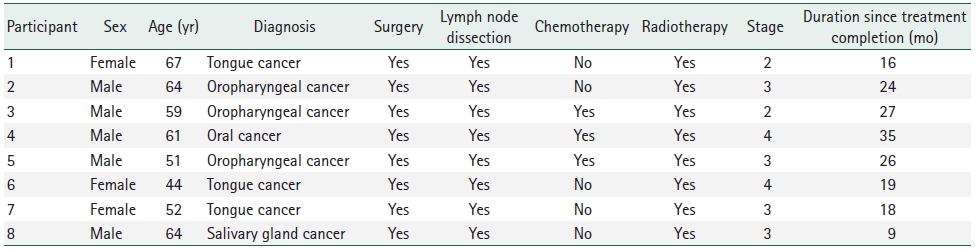
This qualitative study used IPA to examine the experiences of eight adults with stage II–IV head and neck cancer recruited from two university hospitals. All participants had undergone surgery followed by radiotherapy or chemoradiotherapy at least 6 months before data collection. Data were collected through in-depth interviews conducted from February to June 2022 and were analyzed using the cyclical IPA procedure.
Results
Four superordinate themes were identified: (1) being overwhelmed by lamentation and fear when confronting a late-diagnosed illness; (2) confronting human limitations during treatment undertaken for survival; (3) losing daily life and selfhood while living in a body that had not recovered; and (4) reconstructing life beyond the fear of recurrence. Participants experienced diagnosis and treatment as traumatic and described persistent functional impairments and painful sequelae.
Conclusion
These findings provide an in-depth understanding of the illness experiences of patients with head and neck cancer and offer evidence to inform nursing interventions that support adaptation and quality of life.
- 722 View
- 39 Download

- Concept mapping study of positive patient experiences among family members of nursing home residents in South Korea
- Hyoungshim Choi, InJa Choi, Jui Kim
- J Korean Acad Nurs 2026;56(3):318-330. Published online July 29, 2026
- DOI: https://doi.org/10.4040/jkan.26021
-
Abstract
PDFePub
- Purpose
This study focused on identifying key components and dimensions of positive patient experiences perceived by family members of nursing home residents in South Korea, which may inform strength-based quality improvement in nursing home care.
Methods
Data were collected from May 8, 2023, to July 18, 2023, through interviews with 19 family members of nursing home residents aged 65 years or older who had lived in the facility for at least 30 days. Interview data were used to develop empirical statements on the nature of residents’ experiences as perceived by family members. These data were then analyzed using concept mapping to identify components of positive patient experiences from the perspectives of family members of nursing home residents in Korea.
Results
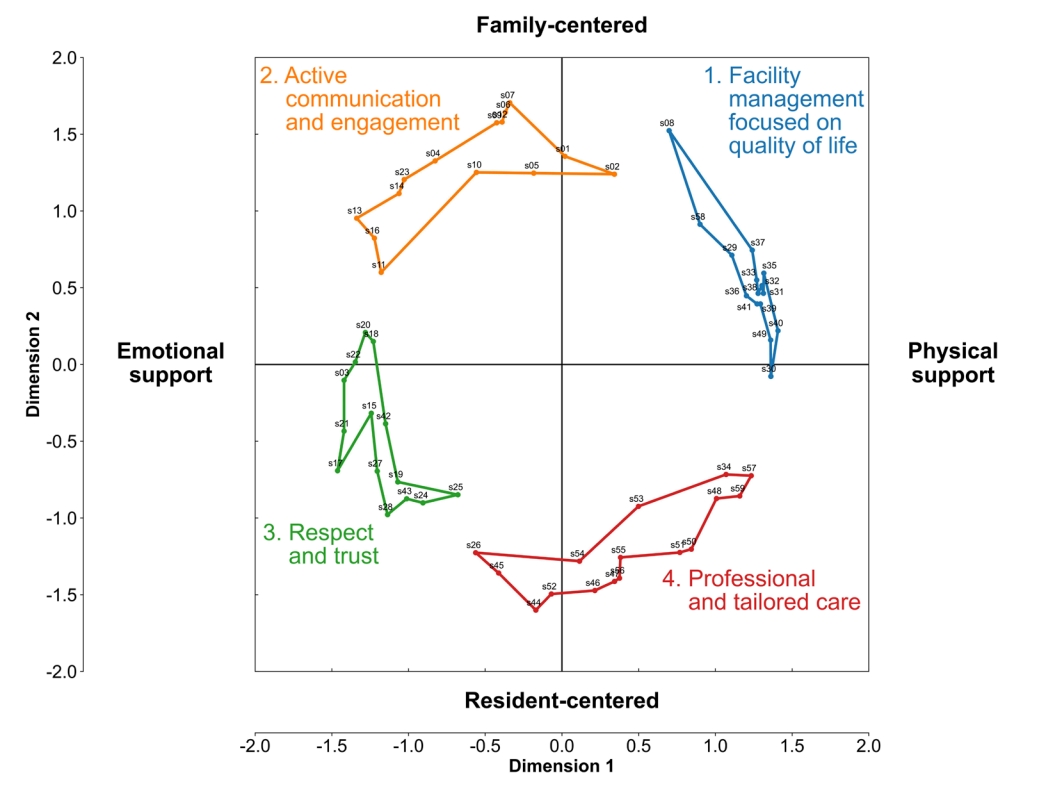
Multidimensional scaling and hierarchical cluster analysis yielded 59 core statements, two dimensions, and four clusters of positive patient experiences. The two dimensions were type of support (physical vs. emotional) and centrality of care (resident-centered vs. family-centered). The four clusters of positive patient experiences were “facility management focused on quality of life,” “active communication and engagement,” “respect and trust,” and “professional and personalized care.”
Conclusion
These findings provide insight into the experiences valued by family members of older adults in nursing homes. The concept map may inform development of a patient experience index tailored to family members of nursing home residents.
- 858 View
- 52 Download
Review Paper
- Variables influencing digital health literacy in older adults: a systematic review and meta-analysis
- Jin Hwa Park, Eun Ju Mun
- J Korean Acad Nurs 2025;55(4):651-667. Published online November 27, 2025
- DOI: https://doi.org/10.4040/jkan.25112
-
Abstract
PDFePub
- Purpose
This study aimed to synthesize existing evidence on digital health literacy (DHL) among older adults and to estimate the associations between related influencing factors through a systematic literature review and meta-analysis.
Methods
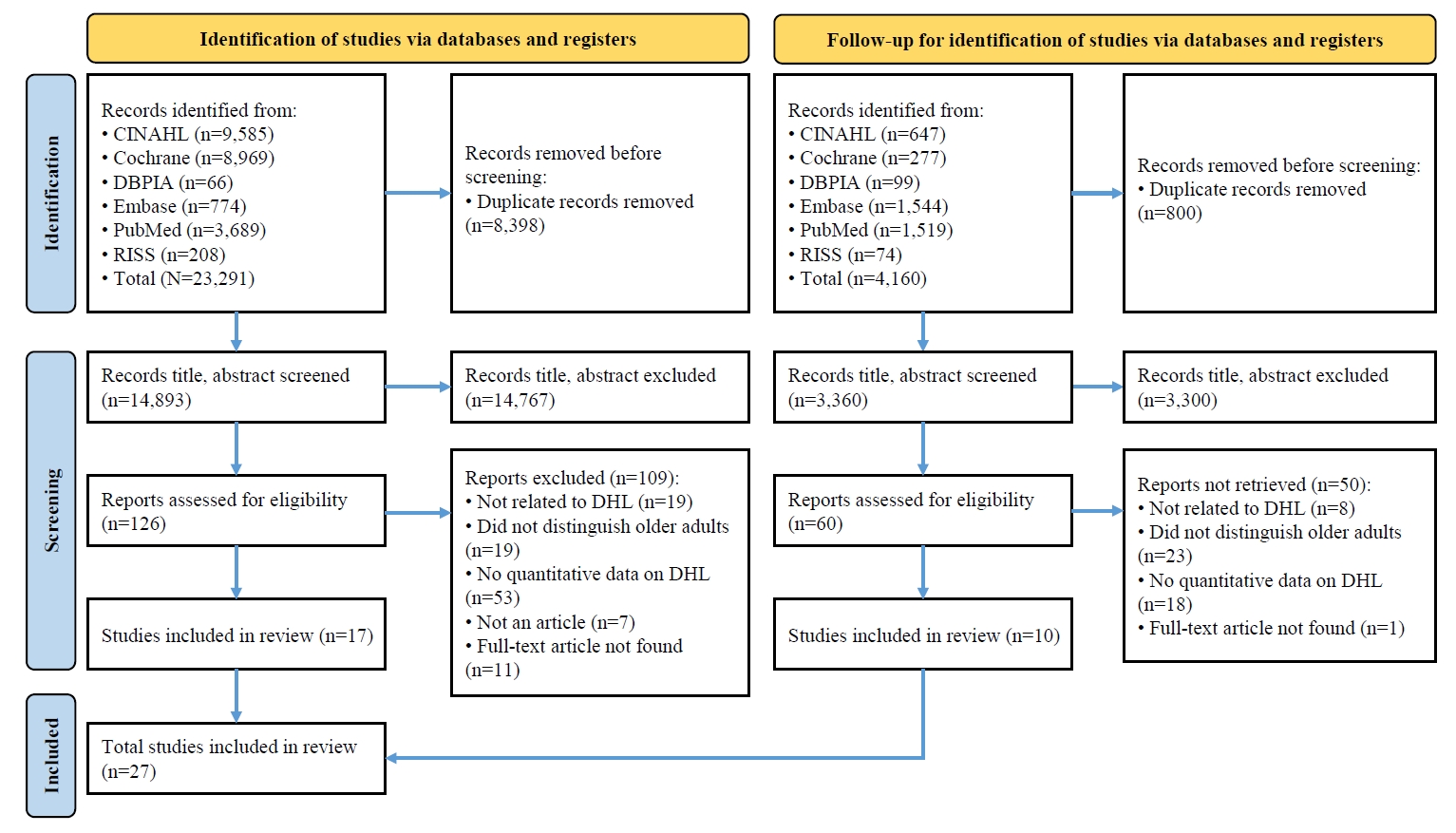
A systematic review and meta-analysis were conducted in accordance with the Preferred Reporting Items for Systematic Reviews and Meta-Analyses (PRISMA) and Meta-Analysis of Observational Studies in Epidemiology (MOOSE) guidelines. Literature searches were performed across PubMed, EMBASE, Cochrane Library, CINAHL, RISS, and DBPIA. The search and screening process was conducted from December 24, 2023, to March 31, 2025. Effect sizes (ESr) using correlation coefficient for each variable were calculated, and meta-analyses were performed using Microsoft Excel and R version 4.3.1.
Results
Forty-seven variables were identified, including two demographic, six physical, six behavioral, 23 psychosocial, and 10 cognitive factors. Meta-analysis results showed that physical, behavioral, psychosocial, and cognitive factors had significant effects on DHL. Among these, digital information level (ESr=.62; 95% confidence interval [CI], 0.55 to 0.69) within the cognitive domain and technophobia (ESr=−.55; 95% CI, −0.47 to −0.40) within the psychosocial domain demonstrated the largest ESr.
Conclusion
Among factors influencing DHL, digital information level and technophobia showed the strongest associations. These findings suggest that improving DHL in older adults requires a dual approach targeting both cognitive and psychosocial dimensions—enhancing digital information skills while reducing technophobia—to effectively support digital engagement and health empowerment in this population (PROSPERO registration number: CRD42023487486). -
Citations
Citations to this article as recorded by
- 고령자를 위한 디지털 헬스 리터러시 측정척도의 적합도 검증
소윤 이
The Korean Journal of Physical Education.2026; 65(2): 157. CrossRef
- 고령자를 위한 디지털 헬스 리터러시 측정척도의 적합도 검증
- 4,787 View
- 380 Download
- 1 Crossref
Research Papers
- Multidimensional factors influencing the completion of advance directives among community-dwelling older Koreans
- Hee-Ju Ji, Soong-Nang Jang
- J Korean Acad Nurs 2025;55(4):543-556. Published online November 18, 2025
- DOI: https://doi.org/10.4040/jkan.25098
-
Abstract
PDFePub
- Purpose
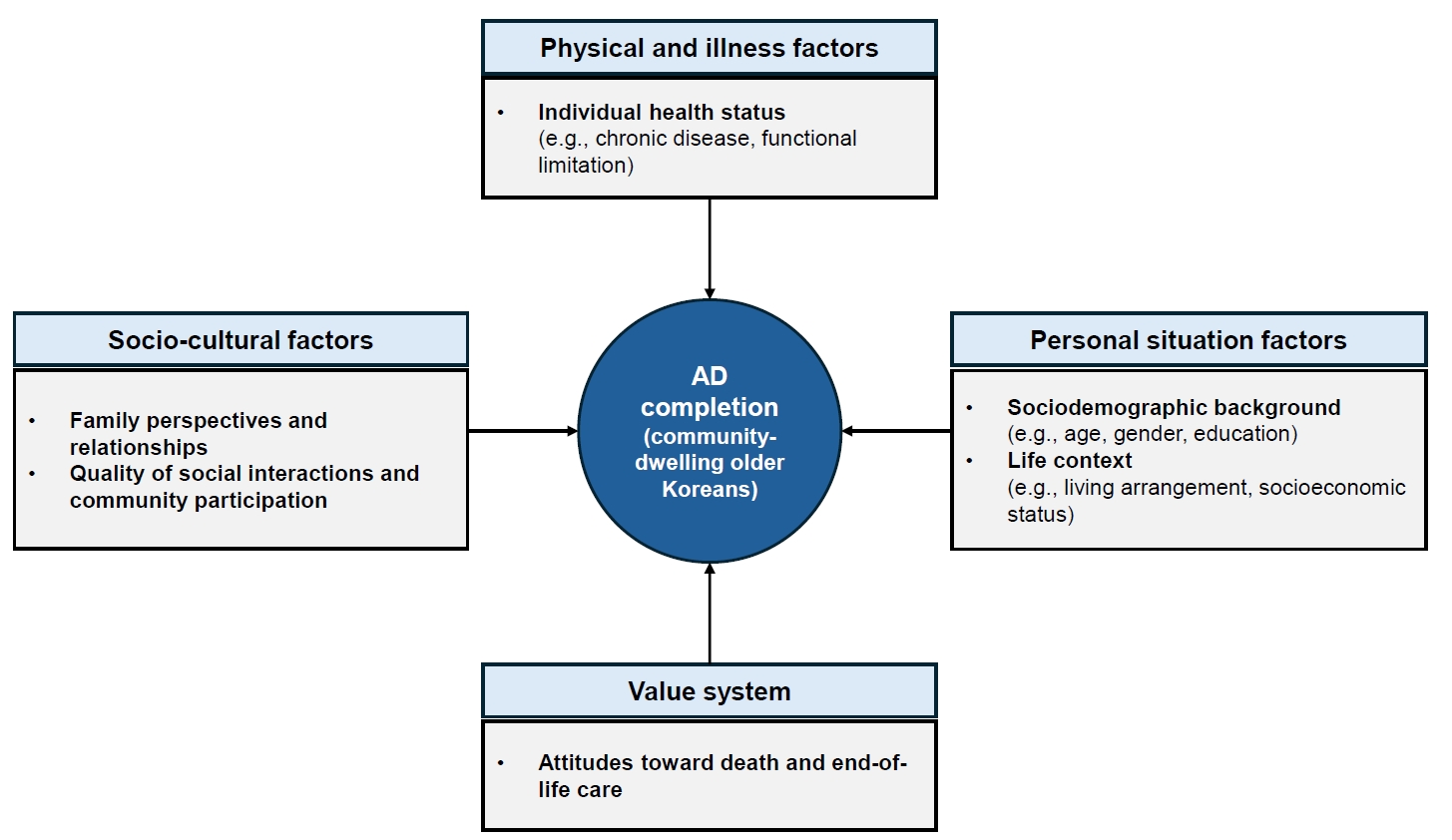
This study aimed to examine the multidimensional factors associated with the completion of advance directives (ADs) among community-dwelling older Koreans, guided by conceptual frameworks developed in Asian contexts.
Methods
Data from the 2023 National Survey of Older Koreans (sixth wave) were analyzed for 9,951 community-dwelling older Koreans aged 65 years or older. Complex sample cross-tabulation and binary logistic regression analyses were conducted.
Results
In total, 11.1% of community-dwelling older Koreans had completed an AD. Significant factors associated with AD completion were identified across four domains—personal situation: age, educational level, religion, and housing preference in the event of poor health; socio-cultural: presence of children, participation in social activities and satisfaction with social relationships; physical and illness: the number of chronic diseases; and value system: awareness of hospice and palliative services, participation in death preparedness education, and documentation of organ donation.
Conclusion
Among older Koreans, AD completion represents more than a documentation process; it reflects a complex decision-making process shaped by their values and life circumstances, underscoring the need for supportive interventions. As the highest AD completion rates are found among older adults, related policies should be aligned with older adult-centered policy frameworks.
- 2,722 View
- 235 Download
- Effects of an agro-healing program on depression, stress, and cognitive function in older adults: a quasi-experimental study
- Gyu Yeon Park, Kwang Ok Lee
- J Korean Acad Nurs 2025;55(3):342-352. Published online August 21, 2025
- DOI: https://doi.org/10.4040/jkan.25058

-
Abstract
PDFePub
- Purpose
This study aimed to evaluate the effects of an agro-healing program on depression, stress, and cognitive function in older adults.
Methods
A quasi-experimental, nonequivalent control group pretest–posttest design was used. The study was conducted from July 16 to September 6, 2024. Sixty-two individuals aged 65 or older residing in Gimcheon, Gyeongsangbuk-do, were recruited according to the selection criteria (31 in the experimental group and 31 in the control group). The final analysis included 30 participants in each group. The program was delivered by one main instructor (a healing farmer) and three assistants. The pretest assessed general characteristics, the Geriatric Depression Scale Short Form-Korean Version, Stress Response Inventory-Modified Form, and Cognitive Impairment Screening Test. The experimental group participated in the agro-healing program once a week for 90 minutes over 8 weeks. The posttest included the same measurements as the pretest. Data were analyzed using IBM SPSS ver. 23.0.
Results
The experimental group, which participated in the healing agriculture program, showed reduced depression (F=7.97, p=.007) and stress (F=282.70, p<.001) and improved cognitive function (F=10.12, p=.002) compared to the control group.
Conclusion
The findings suggest that the agro-healing program is an effective intervention for reducing depression and stress and improving cognitive function in older adults. We propose its use to promote health and prevent dementia in this population. -
Citations
Citations to this article as recorded by- The concept and characteristics of agro-healing foods: results from focus group interviews and a Delphi survey among experts
Dahye Han, Chae-Ryeon Kim, Jaesin Lee, Kyeong-a Jang, Sohyun Park
Journal of Nutrition and Health.2026; 59(3): 303. CrossRef
- The concept and characteristics of agro-healing foods: results from focus group interviews and a Delphi survey among experts
- 4,842 View
- 403 Download
- 1 Crossref
- Development of a scale to measure fear of falling in older adults: a psychometric validation study
- Dayeon Lee, Sunghee H Tak
- J Korean Acad Nurs 2025;55(3):413-424. Published online August 21, 2025
- DOI: https://doi.org/10.4040/jkan.25036
-
Abstract
PDFePub
- Purpose
This study aimed to develop a scale to measure fear of falling in older adults and to validate its reliability and validity.
Methods
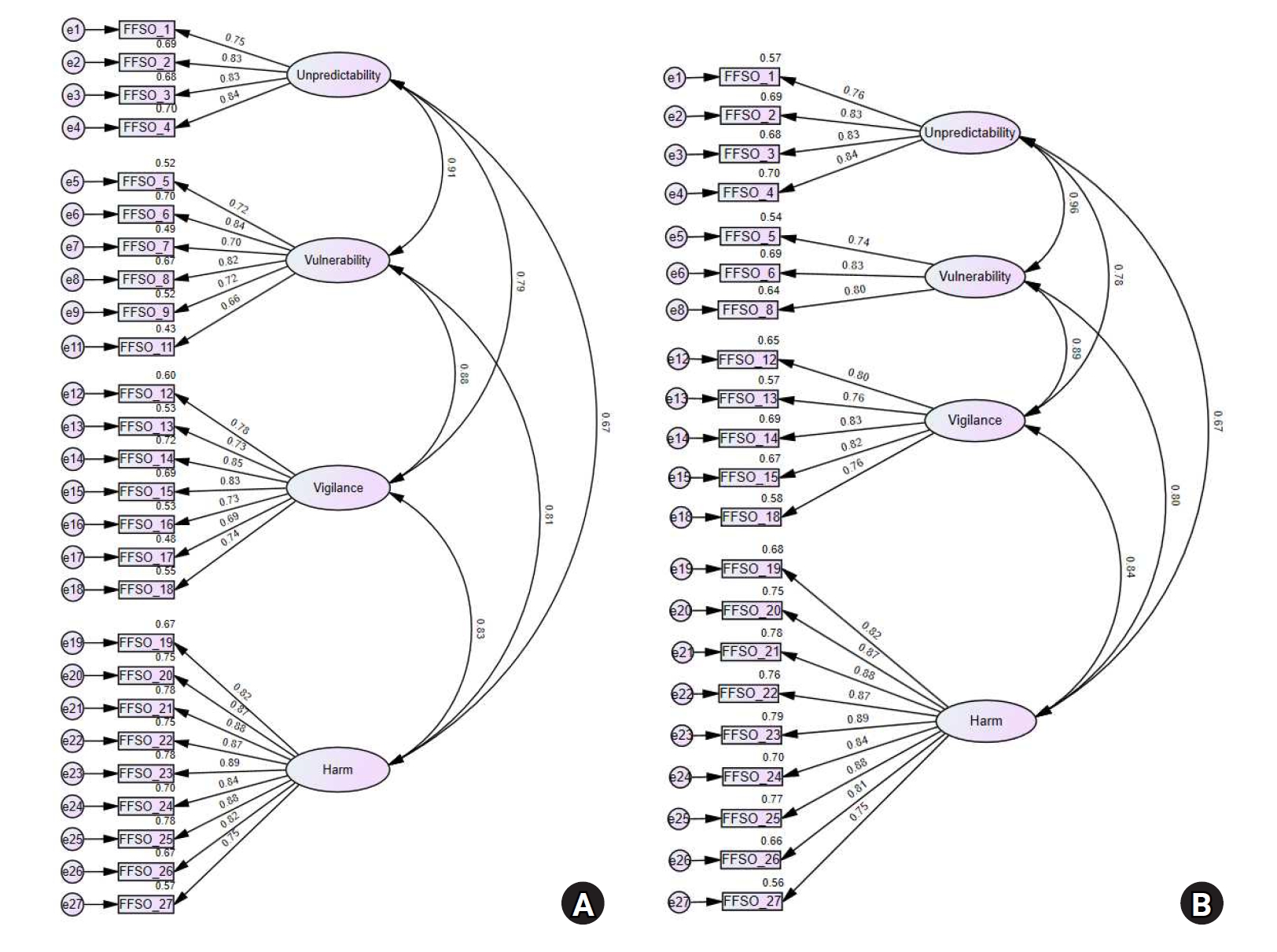
In total, 31 initial items were developed by referring to expressions from previous studies and items from existing instruments. After verifying content validity through expert evaluation, the remaining 27 items were used to construct a survey. Data from 252 participants recruited at three senior welfare centers in the metropolitan area were analyzed to examine item analysis, construct validity, convergent validity, discriminant validity, and reliability. Confirmatory factor analysis (CFA) was conducted to test construct validity. The correlation with the Korean version of the Falls Efficacy Scale-International (KFES-I) was used to assess convergent validity. Cronbach’s alpha was calculated to determine reliability.
Results
The final instrument consisted of 21 items. CFA confirmed acceptable model fit. Convergent validity was also acceptable and discriminant validity was partially supported. Correlations with the KFES-I ranged from .54 to .63. The Cronbach’s alpha coefficients for the total score and all factors ranged from .84 to .97.
Conclusion
The Fear of Falling Scale for Older Adults developed in this study is a validated tool capable of measuring various dimensions of fear of falling. It provides a foundation for accurately assessing fear of falling in older adults and addressing its specific aspects.
- 2,450 View
- 233 Download
- Successful aging among the elderly with mild cognitive impairment facing the crisis of old age: a grounded theory study
- Haeyun Shin, Suhye Kwon
- J Korean Acad Nurs 2025;55(2):301-316. Published online May 27, 2025
- DOI: https://doi.org/10.4040/jkan.24114
-
Abstract
PDFePub
- Purpose
The purpose of this study was to understand experiences of successful aging experience in older adults with mild cognitive impairment.
Methods
The participants were 15 older adults with mild cognitive impairment who had experienced successful aging. Data were collected from January to October 2021 through individual deep, unstructured interviews. Data analysis was performed using Charmaz’s grounded theory method. In addition, the consolidated criteria for reporting qualitative research checklist was used to ensure the quality of the study.
Results
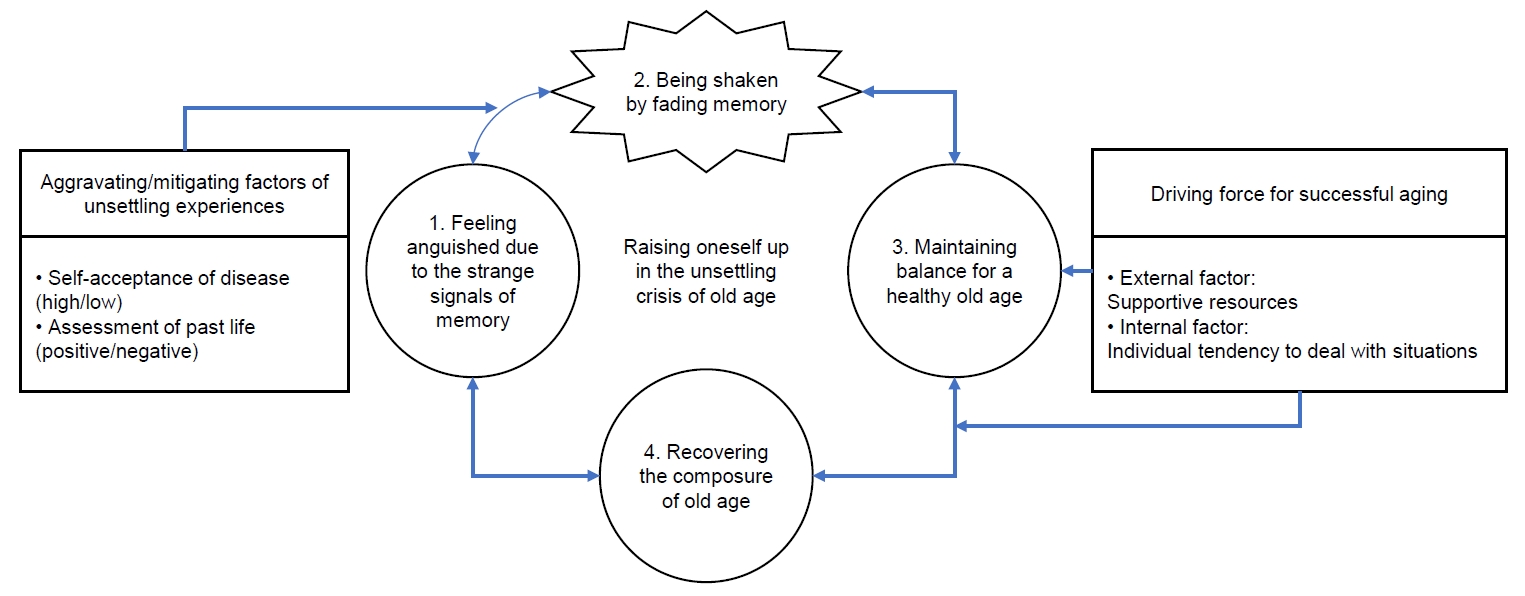
The key category representing experiences of successful aging experience in older adults with mild cognitive impairment was “raising oneself up in the unsettling crisis of old age.” Four stages were derived: “feeling anguished due to the strange signals of memory,” “being shaken by fading memory,” “maintaining balance for a healthy old age,” and “recovering the composure of old age.”
Conclusion
Participants tried to successfully achieve aging while implementing their own plans and strategies in the midst of the challenges of old age, when the mind and body were unsettled by mild cognitive impairment. The results of this study provide a deep understanding of experiences of successful aging in older adults with mild cognitive impairment, potentially contributing to the development and implement of nursing intervention programs to promote the successful pursuit of aging in this population.
- 3,600 View
- 173 Download
- Development of a well-dying awareness scale for middle-aged adults in Korea: a mixed-methods study
- Yu Jin Jung, Eun Joung Choi
- J Korean Acad Nurs 2025;55(2):285-300. Published online March 28, 2025
- DOI: https://doi.org/10.4040/jkan.24121
-
Abstract
PDFePub
- Purpose
This study aimed to develop a valid and reliable tool to measure awareness of well-dying among middle-aged adults.
Methods
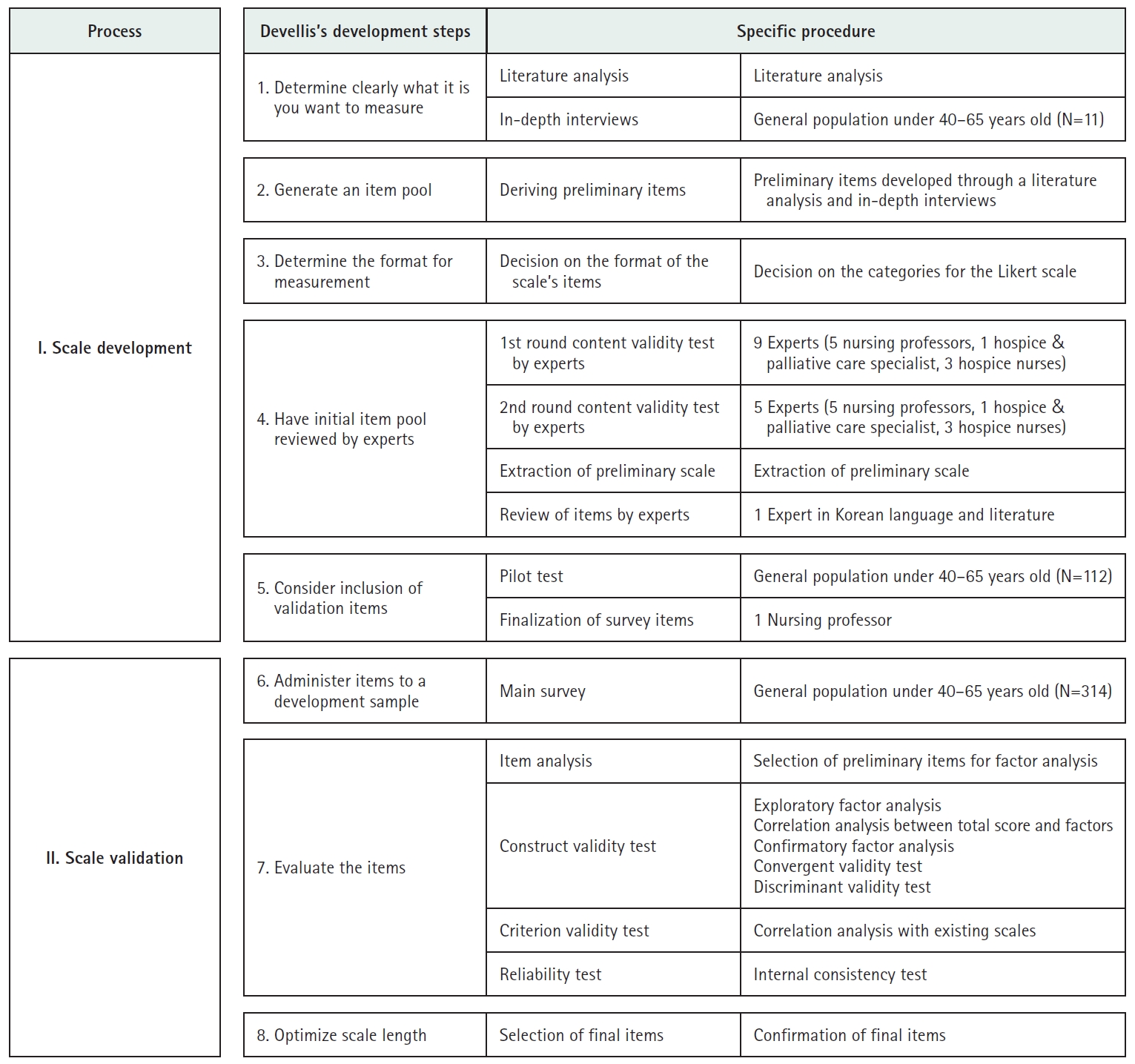
A mixed-methods approach was adopted, consisting of a qualitative phase to identify the characteristics of well-dying and a quantitative phase to validate the instrument with middle-aged participants. Initially, 76 items were generated through a literature review and in-depth interviews, and these were reduced to 35 items through expert validation. A pilot survey was conducted with 112 individuals aged 40–65, selected via quota sampling from 17 administrative regions in South Korea. Based on the pilot survey results, the instrument was refined to 32 items for the main survey. The main survey included 314 participants recruited through quota sampling in Busan and Ulsan Metropolitan Cities and Gyeongsang Region. Exploratory factor analysis (EFA), confirmatory factor analysis (CFA), and reliability testing were performed to validate the instrument.
Results
The final scale comprised 23 items across six factors. EFA demonstrated an explanatory power of 69.1%, with factor loadings ranging from 0.53 to 0.88. CFA confirmed the instrument’s validity, and reliability was established with a Cronbach’s α of .93.
Conclusion
This instrument is a validated and reliable tool for measuring middle-aged individuals’ awareness of well-dying. It can serve as an effective resource for evaluating and assessing well-dying awareness in the middle-aged population. -
Citations
Citations to this article as recorded by- The Influence of Self-Esteem and Attitudes toward Organ Donation and Euthanasia on Attitudes toward Advance Directives in Married Middle-Aged Adults:
A Cross-Sectional Study
Eun-Ho Ha
Research in Community and Public Health Nursing.2026; 37: 136. CrossRef
- The Influence of Self-Esteem and Attitudes toward Organ Donation and Euthanasia on Attitudes toward Advance Directives in Married Middle-Aged Adults:
A Cross-Sectional Study
- 4,502 View
- 278 Download
- 1 Crossref
- Nomogram for predicting changes in cognitive function in community dwelling older adults with mild cognitive impairment based on Korea Longitudinal Study of Ageing Panel Data: a retrospective study
- Hyuk Joon Kim, Hye Young Kim
- J Korean Acad Nurs 2025;55(1):50-63. Published online February 7, 2025
- DOI: https://doi.org/10.4040/jkan.24059
-
Abstract
PDFePub
- Purpose
This study aimed to identify factors associated with normal cognitive reversion and progression to dementia in older adults with mild cognitive impairment (MCI) residing in the community and to develop a nomogram.
Methods
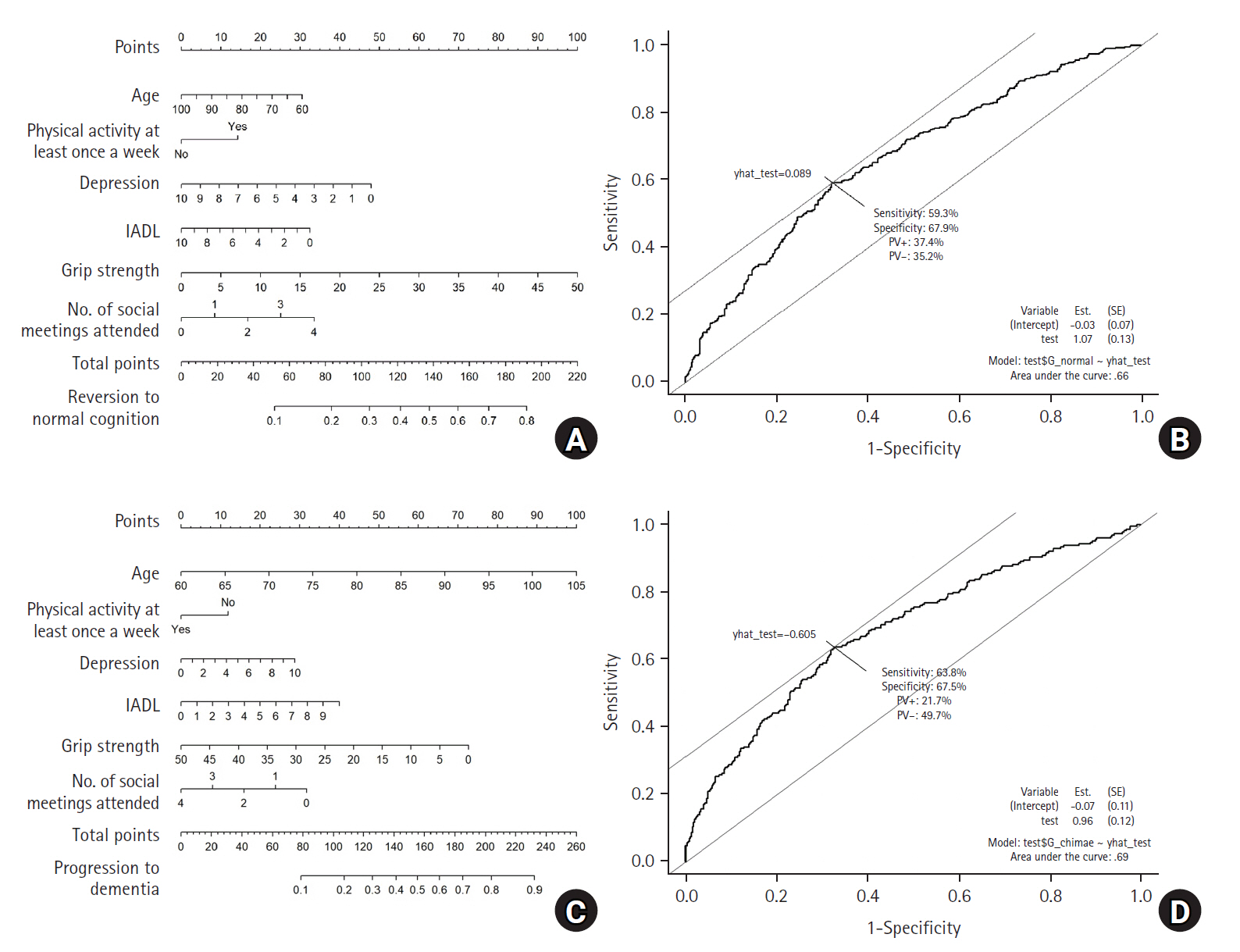
This longitudinal study used secondary data from the Korea Longitudinal Study of Ageing Panel Data (2006–2018). The study included 1,262 participants aged 60 or older, with initial Mini-Mental State Examination scores ranging from 18 to 23. Data were analyzed using the Rao-Scott chi-square test, panel binary logistic regression, and receiver operating characteristic (ROC) curve in Stata ver. 17.0 (Stata Corp.).
Results
The rate of reversion from MCI to normal cognition was 37.0% after 2 years and 32.9% after 12 years. The rate of progression to dementia was 18.0% after 2 years and 30.2% after 12 years. In the nomogram for reversion to normal cognition, the most significant influences were grip strength, depression, number of meetings, age, and regular exercise, with an area under the ROC curve (AUC) of .66. In contrast, in the nomogram for progression to dementia, the most significant influences were age, grip strength, instrumental activities of daily living, number of social meetings attended, depression, and regular exercise, with an AUC of .69.
Conclusion
These nomograms can serve as an effective intervention tool for preventing dementia in the field of community health care since they can serve as a visual technique for presenting information on risk to individuals with MCI. -
Citations
Citations to this article as recorded by- The Longitudinal Relationship Between Physical Functions and Cognitive Functions Among Middle-Aged and Older Adults in Primary Care
Nan Hu, Wupeng Yin, Rabeya Illyas Noon, Noof Alabdullatif
International Journal of Environmental Research and Public Health.2025; 22(6): 908. CrossRef - Development and Validation of a Nomogram Predicting Sarcopenia in Community-Dwelling Older Adults
Sook Kyoung Park, Hyuk Joo Kim, Young-Me Lee, Hye Young Kim
INQUIRY: The Journal of Health Care Organization, Provision, and Financing.2025;[Epub] CrossRef - Effects of Emotional Labor on Burnout in Nurses: Focusing on the Moderating Effects of Social Intelligence and Emotional Intelligence
Kyung Ran Lee, Jeoung Mi Kim
Journal of Korean Academy of Nursing Administration.2016; 22(1): 22. CrossRef
- The Longitudinal Relationship Between Physical Functions and Cognitive Functions Among Middle-Aged and Older Adults in Primary Care
- 5,311 View
- 278 Download
- 1 Web of Science
- 3 Crossref
- An Investigation of the Cumulative Effects of Depressive Symptoms on the Cognitive Function in Community-Dwelling Older Adults: Analysis of the Korean Longitudinal Study of Aging
- Eunmi Kim, Jinkyung Oh, Iksoo Huh
- J Korean Acad Nurs 2023;53(4):453-467. Published online August 31, 2023
- DOI: https://doi.org/10.4040/jkan.23018
-
Abstract
PDF
- Purpose
This study investigated the cumulative effects of depressive symptoms on cognitive function over time in community-dwelling older adults. Methods: Data were investigated from 2,533 community-dwelling older adults who participated in the Korean Longitudinal Study of Aging (KLoSA) from the 5th (2014) to the 8th wave (2020). The association between cumulative depressive symptoms and cognitive function was identified through multiple regression analysis. Results: When the multiple regression analysis was conducted from each wave, the current depressive symptoms scores and cognitive function scores were negatively associated, regardless of the waves (B5th = - 0.26, B6th = - 0.26, B7th = - 0.26, and B8th = - 0.27; all p < .001). Further, when all the previous depressive symptoms scores were added as explanatory variables in the 8th wave, the current one (B8th = - 0.09, p < .001) and the previous ones (B5th = - 0.11, B6th = - 0.09, and B7th = - 0.13; all p < .001) were also negatively associated with the cognitive function score. The delta R2 , which indicates the difference between the model’s R2 with and without the depressive symptoms scores, was greater in the model with all the previous and current depressive symptoms scores (6.4%) than in the model with only the current depressive symptoms score (3.6%). Conclusion: Depressive symptoms in older adults have a long-term impact. This results in an accumulated adverse effect on the cognitive function. Therefore, to prevent cognitive decline in older adults, we suggest detecting their depressive symptoms early and providing continuous intervention to reduce exposure to long-term depressive symptoms. -
Citations
Citations to this article as recorded by- Factors associated with cognitive function among community-dwelling older adults in Korea
Hye Kyung Lee, Go Un Lee
Medicine.2026; 105(40): e50970. CrossRef - Systematic identification and quantification of factors and their interactions with age, sex, and panel wave influencing cognitive function in Korean older adults
Eunmi Kim, Jinkyung Oh, Jungsoo Gim, Iksoo Huh
Frontiers in Public Health.2025;[Epub] CrossRef
- Factors associated with cognitive function among community-dwelling older adults in Korea
- 3,306 View
- 80 Download
- 2 Web of Science
- 2 Crossref
- Association between Visual Impairment and Nutritional Risk among Older Adults with Diabetes: A Population-Based Cross-Sectional Study
- Eunjin Yang, Kyung Hee Lee
- J Korean Acad Nurs 2023;53(2):167-176. Published online April 30, 2023
- DOI: https://doi.org/10.4040/jkan.22141
-
Abstract
PDF
- Purpose
Despite the high prevalence of visual impairment caused by diabetic retinopathy and nutritional problems among older adults with diabetes, evidence regarding factors related to nutritional risk in this population is limited. Therefore, this study aimed to identify the correlates of nutritional risk among older adults with diabetes, focusing on visual impairment.
Methods
This study was a secondary data analysis of the 2020 National Survey of Older Koreans aged 65 years and above. The sample comprised 2,376 older adults with diabetes, and complex sample ANOVA and Rao–Scott chi-square tests were used to compare the groups according to visual impairment. Complex-sample logistic regression analyses were conducted to verify the association between visual impairment and nutritional risk.
Results
Older adults with diabetes, who also have severe visual impairment, are more likely to have nutritional risk status than those without impairment after controlling for covariates (odds ratio [OR] = 2.44, 95% confidence interval [CI] 1.16~5.13). Among the covariates, depression (OR = 3.58, 95% CI 2.60~4.94), dependent activities of daily living status (OR = 2.79, 95% CI 1.60~4.86), and experience of hospitalization during the past year (OR = 2.51, 95% CI 1.57~4.03) were strongly associated with nutritional risk.
Conclusion
Severe visual impairment increases the nutritional risk among older adults with diabetes. Therefore, it is essential to prevent visual impairment due to exacerbation of diabetes through appropriate management. Additionally, tailored nutritional interventions for visually impaired older adults with diabetes that consider visual characteristics are required. -
Citations
Citations to this article as recorded by- Culinary Skills of Visually Impaired People and Associated Factors: A Cross-Sectional Study
Flavia Barbosa Rizzo, Helena Silva Nascimento, Paula Thais dos Santos Soares, Thais Salema Nogueira de Souza, Simone Augusta Ribas
Journal of Nutrition Education and Behavior.2026; 58(7): 619. CrossRef - Prevalence and risk factors of malnutrition in elderly patients with diabetes mellitus: a meta-analysis and systematic review
Lingling Tang, Yushan Shen, Run Li, Jiajia Jia, Fangmin Cao
Frontiers in Nutrition.2026;[Epub] CrossRef - Associations of Alcohol Drinking with Chronic Diseases among Korean Men with Severe Vision Disorders
Sunmee YUN-WELCH, Sunhee KIM, Jeehoon LEE, Mieun YUN, Geumseon LEE
Korean Journal of Health Promotion.2025; 25(4): 147. CrossRef - Insights into the associated risk factors of malnutrition among nursing home residents: A longitudinal study
Johanna de Almeida Mello, Emilie Schoebrechts, Patricia Ann Ivonne Vandenbulcke, Anja Declercq, Jan De Lepeleire, Christophe Matthys, Dominique Declerck, Joke Duyck
Clinical Nutrition.2024; 43(11): 166. CrossRef - Frailty and Visual Impairment in Elderly Individuals: Improving Outcomes and Modulating Cognitive Decline Through Collaborative Care Between Geriatricians and Ophthalmologists
Daniel Dinarvand, Johann Panthakey, Ahmed Hassan, Mohamed H. Ahmed
Diseases.2024; 12(11): 273. CrossRef - Malnutrition Risk in Community-Dwelling Older Adults with Dual Sensory Declines: Focusing on Social Determinants of Health
Ha Na Jeong
Research in Community and Public Health Nursing.2024; 35: 325. CrossRef
- Culinary Skills of Visually Impaired People and Associated Factors: A Cross-Sectional Study
- 3,937 View
- 89 Download
- 4 Web of Science
- 6 Crossref
- Lived Experience of Middle-Aged Patients with Complex Regional Pain Syndrome
- Young-suk Seo, Sunhee Lee
- J Korean Acad Nurs 2022;52(6):598-607. Published online December 31, 2022
- DOI: https://doi.org/10.4040/jkan.22086
-
Abstract
PDF
- Purpose
This qualitative study aimed to explore the lived and true meaning of experiences of middle-aged patients with complex regional pain syndrome.
Methods
The participants were 10 men and women aged 40 to 60 years who received outpatient treatment at a university hospital, could communicate, and agreed to participate in the study. Data were collected through individual interviews using open and semi-structured questions from September 2019 to July 2021 and were analyzed using the content analysis method suggested by Hsieh and Shannon (2005).
Results
As a result of this study, 42 summarized semantic units related to life experience, 15 subthemes, and seven themes were derived. The seven themes were “pressed by severe pain,” “frustrated because I cannot be part of the community,” “distressed because people do not recognize my disease,” “sad about conflicts with family,” “unmotivated because of desperate life,” “appreciating for support,” and “putting oneself together and living daily life.” Conclusion: The vivid experiences of the participants derived in this study are the basic data for developing treatment guidelines. In the future, we propose a study on life and family care experiences according to the developmental characteristics of the life cycle of patients with complex regional pain syndrome and develop and apply programs to support patients and their families. -
Citations
Citations to this article as recorded by- Experiences of diagnosis and treatment for upper limb Complex Regional Pain Syndrome: a qualitative analysis
Grace S Griffiths, Bronwyn L Thompson, Deborah L Snell, Jennifer A Dunn
Pain Medicine.2023; 24(12): 1355. CrossRef
- Experiences of diagnosis and treatment for upper limb Complex Regional Pain Syndrome: a qualitative analysis
- 2,863 View
- 66 Download
- 1 Web of Science
- 1 Crossref
- A Longitudinal Study of the Reciprocal Relationship between Depression and Income among Korean Older Men and Women
- Jeong Lee, Gyeong-Suk Jeon
- J Korean Acad Nurs 2022;52(4):451-463. Published online August 31, 2022
- DOI: https://doi.org/10.4040/jkan.22052
-
Abstract
PDF
- Purpose
This study examined the reciprocal relationships between depression and income, and gender differences in these relationships among older adults in South Korea.
Methods
Using 2015 to 2019 of the Korea Welfare Panel Study (KoWePS), we studied 6,070 older adults (2,394 men and 3,676 women) aged 60 years over in 2015. The generalized estimating equation was employed to explore the effect of an individual income on depression and the reverse causal link-that of depression on income.
Results
The study found the reciprocal relationships between income and depression. Income has a significant impact on depression. Higher-income was linked to decreased risks of the Center for Epidemiologic Studies Depression (CES-D) scores among older adults (B = - 0.121, p < 0.001). Estimates of the reverse causal link show that higher CES-D scores were also linked to income reduction among Korean older adults (B = - 0.007, p < 0.001). In addition, we also observed gender differences in the impact of income on depression but not in the reverse causal link. Income has more detrimental to psychological consequence for older men (B = - 0.108, p < 0.001) than older women (B = - 0.057, p < 0.001).
Conclusion
The finding implies that both psychological and social protection policies for the elderly are needed in view of gender perspective. -
Citations
Citations to this article as recorded by- Risk factors of depression among the baby boomer generation: A cross-sectional study using the 2022 Korean Community Health Survey
Kyoung Mi Kim, Hye Jung Jun
Journal of Korean Gerontological Nursing.2025; 27(3): 308. CrossRef
- Risk factors of depression among the baby boomer generation: A cross-sectional study using the 2022 Korean Community Health Survey
- 3,005 View
- 50 Download
- 1 Crossref
- Influence of Social Capital on Depression of Older Adults Living in Rural Area: A Cross-Sectional Study Using the 2019 Korea Community Health Survey
- Minho Jung, Jinhyun Kim
- J Korean Acad Nurs 2022;52(2):144-156. Published online April 30, 2022
- DOI: https://doi.org/10.4040/jkan.21239
-
Abstract
PDF
- Purpose
This study aimed to investigate the influence of social capital on the depression of older adults living in rural areas.
Methods
Data sets were obtained from the 2019 Korea Community Health Survey. The participants were 39,390 older adults over 65 years old living in rural areas. Indicators of social capital included trust, reciprocity, network, and social participation. Depression—the dependent variable—was measured using the Patient Health Questionnaire-9 (PHQ-9). Hierarchical ordinal logistic regression was conducted to identify factors associated with depression after adjusting the data numbers to 102,601 by applying the Synthetic Minority Oversampling Technique (SMOTE).
Results
The independent variables—indicators of social capital—exhibited significant association with the depression of older adults. The odds ratios of depression were higher in groups without social capital variables.
Conclusion
To reduce depression, we recommend increasing social capital. Factors identified in this study need to be considered in older adult depression intervention programs and policies. -
Citations
Citations to this article as recorded by- The Effects of Perceived Stress on Depression among Middle-aged Adults with Diabetes Mellitus in Korea: Exploring the Mediating Role of Social Capital through a Descriptive Correlational Study
Kyung Ae Kim, Mi Ran Bang
Korean Journal of Adult Nursing.2025; 37(1): 50. CrossRef - An Observational Study on the Association Between Nutritional Intake and Mental Health Among Older Adults in Rural Areas
Kyeongmin Jang
Nursing & Health Sciences.2025;[Epub] CrossRef - Modelo de regresión ordinal para pronóstico de la depresión en el adulto mayor peruano
Lilian Roxana Paredes López
UCV Hacer.2025; 14(2): 32. CrossRef - Moderating effects of social capital on the relationship between fear of falling and depressive symptoms among community-dwelling older adults
Yeong-Mi Seo, Eun Sook Lee
Archives of Public Health.2025;[Epub] CrossRef - Prediction model of weight control experience in men with obesity in their 30 s and 40 s using decision tree analysis
Myeunghee Han
Scientific Reports.2024;[Epub] CrossRef - The relationship between human capital and depression among middle-aged rural adults: The multiple-parallel mediating effects of social capital
Soo Mi Jang, Hyung Mi Ha
Korean Journal of Health Education and Promotion.2023; 40(1): 33. CrossRef
- The Effects of Perceived Stress on Depression among Middle-aged Adults with Diabetes Mellitus in Korea: Exploring the Mediating Role of Social Capital through a Descriptive Correlational Study
- 3,772 View
- 135 Download
- 4 Web of Science
- 6 Crossref
- Willingness to Use and Appropriate Payable Cost for Visiting Nurse Service for the Elderly in the Community
- Soyoung Seo, Soong-nang Jang
- J Korean Acad Nurs 2022;52(1):105-119. Published online February 28, 2022
- DOI: https://doi.org/10.4040/jkan.21193
-
Abstract
PDF
- Purpose
This study aimed to measure willingness to use (WTU) and appropriate payable cost of visiting nurse service for the elderly and explore their impact factors.
Methods
The study included 752 participants selected from data that were completed in 2017 for the elderly aged over 60 nationwide. Logit and Tobit regression analysis were performed to confirm the influencing factors.
Results
The study found that 39.1% of the elderly in the community were WTU the visiting nurse service, and they reported that the cost per visit was 12,650 Korean Won. The factors influencing WTU were having less than moderate subjective health status (OR = 1.63, p = .011), being part of a social participating groups (OR = 1.50, p = .046), or participation in senior health promotion programs (SHPPs) (OR = 1.96, p = .003). The cost was also influenced by less than moderate subjective health status (β = 4.37, p = .021), being part of a social participating groups (β = 4.41, p = .028), or participation in SHPPs (β = 4.87, p = .023). Additionally, elderly people living alone who were used as covariates were highly WTU (OR = 2.20, p = .029).
Conclusion
This study provides evidence to predict demand for visiting nurse service and reflects consumer value in setting the service cost. This is the first study to derive cost from consumers' perspective regarding the service for the elderly. As it is the result of an open-ended survey, follow-up studies are needed to estimate more reliable and reasonable results. -
Citations
Citations to this article as recorded by- A study on the Feasibility of a University-Based Multi-Disciplinary Collaborative Service Program Model through Beauty Welfare Services for the Elderly
Se-Hee Lee, Kwang-Young Song, Jin-Na Yu, Bong-Geun Choi, Hae-Jin Park, Sang-In Park
Journal of the Korean Society of Cosmetology.2026; 32(3): 693. CrossRef - Health and Environmental Monitoring Services for Smart Healthy Cities : Current Practices and Challenges in Local Government Plans
Dong-ah Choi, Yun-jeong Song, Andy Hong
Journal of Korea Planning Association.2024; 59(5): 147. CrossRef
- A study on the Feasibility of a University-Based Multi-Disciplinary Collaborative Service Program Model through Beauty Welfare Services for the Elderly
- 3,592 View
- 62 Download
- 2 Crossref
Invited Paper
- Healthcare Considerations for Special Populations during the COVID-19 Pandemic: A Review
- Jeung-Im Kim, YeoJin Im, Ju-Eun Song, Sun Joo Jang
- J Korean Acad Nurs 2021;51(5):511-524. Published online October 31, 2021
- DOI: https://doi.org/10.4040/jkan.21156
-
Abstract
PDF
- The coronavirus disease 2019 (COVID-19) has emerged as a threat to human health and public safety. People of all ages are susceptible to severe acute respiratory syndrome coronavirus 2 infection. However, the clinical manifestations of this infection differ by age. This study purposes to describe healthcare considerations for special populations, such as children, pregnant and lactating women, and older adults, who may have unique healthcare needs, in the pandemic situation. To realize the research purpose, we conducted a review of the practice guidelines of public documents and qualified studies that were published online/offline during a specific period. The review identified current knowledge on care for newborns, children in schools, pregnant women (from antenatal to postpartum care), and older adults suffering from high-risk conditions. Subsequently, we summarize vaccination guidance for special populations and, finally, discuss the issues currently affecting special populations. Therefore, this current knowledge on care for special populations helps nurses to provide accurate information on vaccinations aimed at preventing COVID-19 and protecting the masses from infection. Currently, the scarcity of information on COVID-19 variants necessitates further research on measures to reduce pandemic spread.
-
Citations
Citations to this article as recorded by- Camel Milk as a Functional Food: Nutritional Composition, Health‐Promoting Benefits, and Safety Considerations
Gudisa Bereda, Subasini Uthirapathy, Javed Ahamad
Food Science & Nutrition.2026;[Epub] CrossRef - Global and Regional Burden of Vaccine‐Associated Transverse Myelitis and Potentially Associated With Vaccines From 1967 to 2023: An Analysis of the International Pharmacovigilance Data
Jae E. Lee, Hyesu Jo, Hanseul Cho, Jiyeon Oh, Yi Deun Jeong, Sooji Lee, Jaeyu Park, Hyeon Jin Kim, Yejun Son, Soeun Kim, Hayeon Lee, Louis Jacob, Damiano Pizzol, Ho Geol Woo, Jiyoung Hwang, Dong Keon Yon
Journal of Medical Virology.2025;[Epub] CrossRef - A Preliminary Exploratory Bibliometric Study on COVID-19 and Pregnancy
Fatima Aguirre-Vegas, Jakeline Ramos-Aliaga, Maria E Guerrero, Juan Alvitez, Abigail Temoche, Frank Mayta-Tovalino
Journal of South Asian Federation of Obstetrics and Gynaecology.2025; 17(5): 618. CrossRef - The Use of Therapeutic Plasma Exchange in the Treatment of a Pregnant Woman with COVID-19 Induced Acute Respiratory Distress Syndrome
Sy Duong-Quy, Duc Huynh-Truong-Anh, Thanh Nguyen-Thi-Kim, Tien Nguyen-Quang, Thanh Nguyen-Chi, Nhi Nguyen-Thi-Y, Van Duong-Thi-Thanh, Carine Ngo, Timothy Craig
Pulmonary Therapy.2022; 8(2): 233. CrossRef
- Camel Milk as a Functional Food: Nutritional Composition, Health‐Promoting Benefits, and Safety Considerations
- 3,269 View
- 6 Download
- 3 Web of Science
- 4 Crossref
Research Papers
- Face Mask Usage, Knowledge and Behavior of Face Mask Usage in Older Adults Living Alone in the COVID-19 Era
- A-Reum Han, Yeon-Hwan Park
- J Korean Acad Nurs 2021;51(2):203-216. Published online April 30, 2021
- DOI: https://doi.org/10.4040/jkan.20252
-
Abstract
PDF
- Purpose
This study analyzed the current status of face mask usage. It also identified factors related to the knowledge and behavior regarding the same among older adults living alone during the COVID-19 pandemic.
Methods
This descriptive study was conducted via a telephone survey involving 283 older adults living alone in S City from March to April 2020. Knowledge and behavior pertaining to face mask usage were measured using Hilda Ho’s Face Mask Use Scale; reliability of the measurement was Kuder-Richardson formula-20 = .62, Cronbach’s α = .92. Data were analyzed using descriptive analysis, independent t-test, Pearson’s correlation coefficient, and multiple linear regression.
Results
Older adults used one mask for 3.55 days on an average. The knowledge level was 9.97 (± 1.84) out of 12 and behavior level was 15.49 (± 1.55) out of 16. Level of education (β = - .31, p < .001), living region (β = .13, p = .017), personal income (β = .12, p = .041) significantly affected the face mask usage-related knowledge, and living region (β = .15, p = .010) significantly affected the face mask usage-related behavior.
Conclusion
Older adults living alone are aware of the effects of using face masks. However, their mask usage is inappropriate, for example, the prolonged use of the same mask. Considering the low level of face mask usage-related knowledge, it is necessary to develop customized education programs and infectious disease prevention strategies for older adults possessing low educational levels living alone in urban-rural complex areas. -
Citations
Citations to this article as recorded by- Relationship between nursing needs and nursing satisfaction of older adult patients in a geriatric hospital: A cross-sectional study
Minkyung Gu, Hyun Baek, Nam Kyung Oh, Sohyune Sok
Geriatric Nursing.2026; 70: 104030. CrossRef - Path analysis of subjective health status, healthy lifestyle habits, and successful aging in Korean older adults: path differences by age
Saekyae Shin, Minkyung Gu, Eun Seo Sun, Sohyune Sok
BMC Geriatrics.2026;[Epub] CrossRef - A comparative cross-cultural study of fear of COVID-19 in Persian and Turkmen elderly populations
Maliheh Makhtum, Naser Behnampour, Akram Sanagoo, Hossein Nasiri, Leila Jouybari
Journal of Research Development in Nursing and Midwifery.2023; 20(1): 11. CrossRef - Influencing factors on self-care of older adults living alone in a community during COVID-19: A cross-sectional study
Heeyoung Woo, Minkyung Gu
Journal of Korean Gerontological Nursing.2023; 25(1): 1. CrossRef - The association between depression and non‐compliance with COVID‐19 preventive behaviors in South Korean older adults stratified by sex
Jae Jun Lee, Namhee Kim, Min Kyung Park, Hyunju Ji, Gwang Suk Kim
International Journal of Geriatric Psychiatry.2023;[Epub] CrossRef - Factors Associated with Depression in Older Adults Living Alone during the COVID-19 Pandemic
Eun Hye Hong, Kyung Hee Lee
Journal of Korean Academy of Community Health Nursing.2022; 33(4): 418. CrossRef
- Relationship between nursing needs and nursing satisfaction of older adult patients in a geriatric hospital: A cross-sectional study
- 2,602 View
- 26 Download
- 3 Web of Science
- 6 Crossref
- Family’s Perception of Proxy Decision Making to Authorize Do Not Resuscitate Order of Elderly Patients in Long Term Care Facility: A Q-Methodological Study
- Hyeon Jin Cho, Jiyeon Kang
- J Korean Acad Nurs 2021;51(1):15-26. Published online February 28, 2021
- DOI: https://doi.org/10.4040/jkan.20188
-
Abstract
PDF
- Purpose
This study aimed to distinguish and describe the types of perceptions of do not resuscitate (DNR) proxy decisions among families of elderly patients in a long-term care facility.
Methods
This exploratory study applied Q-methodology, which focuses on individual subjectivity. Thirty-four Q-statements were selected from 130 Q-populations formed based on the results of in-depth interviews and literature reviews. The P-samples were 34 families of elderly patients in a long-term care hospital in Busan, Korea. They categorized the Q-statements using a 9-point scale. Using the PC-QUANL program, factor analysis was performed with the P-samples along an axis.
Results
The families’ perceptions of the DNR proxy decision were categorized into three types. Type I, rational acceptance, valued consensus among family members based on comprehensive support from medical staff. Type II, psychological burden, involved hesitance in making a DNR proxy decision because of negative emotions and psychological conflict. Type III, discreet decisions, valued the patients’ right to self-determination and desire for a legitimate proxy decision. Type I included 18 participants, which was the most common type, and types II and III each included eight participants.
Conclusion
Families’ perceptions of DNR proxy decisions vary, requiring tailored care and intervention. We suggest developing and providing interventions that may psychologically support families. -
Citations
Citations to this article as recorded by- Subjectivity study on health conservation of elderly hemodialysis patients
Eunji Yim, Mijin Yun, Sohyune Sok
BMC Geriatrics.2024;[Epub] CrossRef - Types of Empathy Among Certified Caregivers of Older Adults with Dementia
So-Hyeong Sim, Geun Myun Kim, Eun Joo Kim, Soo Jung Chang
Journal of Multidisciplinary Healthcare.2023; Volume 16: 2715. CrossRef
- Subjectivity study on health conservation of elderly hemodialysis patients
- 2,239 View
- 46 Download
- 2 Web of Science
- 2 Crossref
- Predictive Model for Quality of Life of the Older Men Living Alone
- Su Jin Kim, Gyeong-Suk Jeon
- J Korean Acad Nurs 2020;50(6):799-812. Published online December 31, 2020
- DOI: https://doi.org/10.4040/jkan.20087
-
Abstract
PDF
- Purpose
This study aimed to construct and test a predictive model that explains and predicts the quality of life in older men living alone.
Methods
A self-report questionnaire was used to collect data from 334 older adult men living along aged 65 years or over living in Jeollanam-do provinces. The endogenous variables were depression, self-rated health, instrumental activity of daily life, health promotion behaviors, the number of social participation activities and quality of life. Data were analyzed using the SPSS 21.0 and AMOS 21.0 programs.
Results
The final model with 14 of the 8 analysed paths showed a good fit to the empiri cal data: χ2= 173.26(p < .001, df = 53),normed χ2= 3.27, GFI = .92, NFI = .90, CFI = .93, TLI = .89, RMSEA = .08 and SRMR = .06. Activities had direct effect on quality of life of older men living alone and social support had both direct and indirect effects. Meanwhile, function and socioeconomic status showed only indirect effects.The variables included in the eight significant paths explained 83.7% of variance in the prediction model.
Conclusion
Instrumental activities of daily living and social support effect directly on quality of life in the older men living alone. Findings suggest that health care providers including community nurses need to provide social support as well as empowerment programs of instrumental activities of daily living and health promotion for improving quality of life of the older men living alone. -
Citations
Citations to this article as recorded by- Relationship between nursing needs and nursing satisfaction of older adult patients in a geriatric hospital: A cross-sectional study
Minkyung Gu, Hyun Baek, Nam Kyung Oh, Sohyune Sok
Geriatric Nursing.2026; 70: 104030. CrossRef - Factors Related to Quality of Life Among Older Adults with Family Care Vulnerability in Semi-Urban Areas of Thailand
Arun Boonsang, Laksanee Boonkhao, Nittaya Chakhamrun, Aree Butsorn, Sanga Tubtimhin, Pongsak Rattanachaikunsopon, Sanguansin Ratanalert
Journal of Multidisciplinary Healthcare.2026; Volume 19: 1. CrossRef - Path analysis of subjective health status, healthy lifestyle habits, and successful aging in Korean older adults: path differences by age
Saekyae Shin, Minkyung Gu, Eun Seo Sun, Sohyune Sok
BMC Geriatrics.2026;[Epub] CrossRef - Changes in the health status and health-related quality of life of community-dwelling older adults living alone: one-year follow-up from a cohort study
Hana Ko, Belong Cho, Kyung-Choon Lim, Soong-Nang Jang, Sun Ju Chang, Yu Mi Yi, Hye Ryung Cho, So Im Ryu, Eun-Young Noh, Yeon-Hwan Park
Frontiers in Public Health.2023;[Epub] CrossRef - Influencing factors on self-care of older adults living alone in a community during COVID-19: A cross-sectional study
Heeyoung Woo, Minkyung Gu
Journal of Korean Gerontological Nursing.2023; 25(1): 1. CrossRef - A novel nomogram to stratify quality of life among advanced cancer patients with spinal metastatic disease after examining demographics, dietary habits, therapeutic interventions, and mental health status
Yue Li, Ze Long, Xiuju Wang, Mingxing Lei, Chunzi Liu, Xiaolin Shi, Yaosheng Liu
BMC Cancer.2022;[Epub] CrossRef - Associated Factors with Health-related Quality of Life among Older Adults with Diabetes in Korea
Eun-Kyung Lee, Sun-Young Jung
The Korean Journal of Rehabilitation Nursing.2022; 25(2): 61. CrossRef
- Relationship between nursing needs and nursing satisfaction of older adult patients in a geriatric hospital: A cross-sectional study
- 2,908 View
- 55 Download
- 5 Web of Science
- 7 Crossref
Original Articles
- Effects of BeHaS Program on Health Behavior, Physiologic Index and Self-Esteem of the Elderly Living Alone with Metabolic Syndrome Based on Community Based Participatory Research
- Jong Im Kim, Sun Ae Kim, Keumok Park, Jiyoung Kim, Lina Lee, Si Wan Choi, Bon Jeong Ku
- J Korean Acad Nurs 2020;50(4):571-582. Published online August 31, 2020
- DOI: https://doi.org/10.4040/jkan.19261
-
Abstract
PDF
- Purpose
This study aimed to determine the effects of a 12-week metabolic syndrome BeHaS (Be Happy and Strong) program in elderly people with metabolic syndrome living alone, based on a community-based participatory research (CBPR).
Methods
A nonequivalent control group pre-posttest design was used, and the participants were 43 elderly people living alone (experimental group 24, control group 19). The experimental group received a one-hour program per week and two individual health consultations during 12 weeks. The control group received two sessions about the metabolic syndrome and two individual health consultations. The effects of health behavior, blood pressure, blood sugar levels, abdominal circumference, triglycerides, and self-esteem were evaluated. The data were analyzed using the independent t-test and Mann-Whitney U test.
Results
The health behavior with respect to the metabolic syndrome in the experimental group increased significantly (t = - 3.19, p = .002). Both diastolic blood pressure and abdominal circumference decreased in the experimental group (t = 2.00, p = .028 and t = 3.91, p < .001). No significant differences were observed between the groups in systolic blood pressure, fasting blood sugar levels, triglycerides, and self-esteem.
Conclusion
The 12-week metabolic syndrome BeHaS program using community resources improves the health of elderly people with metabolic syndrome living alone. Based on these findings, further studies on the effectiveness of the metabolic syndrome BeHaS program and the experiences of those who participated in the CBPR are warranted. -
Citations
Citations to this article as recorded by- Development and effects of a customized integrated health management program for older adults living alone: A nonequivalent control-group pre-posttest design
Mooyong Cho
Journal of Korean Gerontological Nursing.2025; 27(3): 295. CrossRef - Exploring the Impact of Smart Mobility and ICT Solutions on Older Adults’ Mobility: A Systematic Literature Review
Chengyuan An
IEEE Access.2024; 12: 159056. CrossRef - 노인 대사증후군에 효과적인 중재: 체계적 문헌고찰과 메타분석
서현 이, 슬 구, 유미 서, 선화 반
Public Health Weekly Report.2023; 16(48): 1633. CrossRef - Comparison of the Effects of Education Only and Exercise Training Combined with Education on Fall Prevention in Adults Aged 70 Years or Older Residing in Elderly Residential Facilities
Chahwa Hong, Haejung Lee, Misoon Lee
Journal of Korean Academy of Nursing.2021; 51(2): 173. CrossRef
- Development and effects of a customized integrated health management program for older adults living alone: A nonequivalent control-group pre-posttest design
- 2,516 View
- 50 Download
- 2 Web of Science
- 4 Crossref
- Development and Validation of the Self-Care for Aspiration Pneumonia Prevention Scale in the Community Dwelling Elderly with Risk of Dysphasia
- Eun Young Yang, Shin-Young Lee
- J Korean Acad Nurs 2020;50(3):474-486. Published online June 30, 2020
- DOI: https://doi.org/10.4040/jkan.20041
-
Abstract
PDF
- Purpose
The purpose of this study was to develop and validate a Korean version of the Self-Care for Aspiration Pneumonia Prevention(SCAPP-K) scale in older adults at risk of dysphasia.
Methods
The Hertz and Baas model of scale development and validation was used. Inthe development stage, items were generated via literature review and interviews with medical experts, older adults, and caregivers. Tenexperts assessed the items for content validity. Subsequently, 12 older adults participated in a pilot test to determine the comprehensibilityand appropriateness of the SCAPP-K scale. The validation stage involved a cross-sectional survey with 203 older adults for exploratoryfactor analysis (EFA) and 200 older adults for confirmatory factor analysis (CFA) and to determine convergent and discriminant validity. Totest the validity and reliability of the scale, EFA using principal component analysis with varimax rotation and CFA were conducted, andconvergent and discriminant validity as well as internal consistency reliability were determined.
Results
As a result of EFA, three self-carefactors (knowledge, resources, behaviors) with 21 items were validated. The CFA and convergent and discriminant validity indicated theapplicability of the three-factor self-care scale. The reliability of the SCAPP-K scale was acceptable, with Cronbach’s a=.87~.91.
Conclusion
The SCAPP-K scale has acceptable validity and reliability and can contribute to clinical practice, research, and education to improveself-care for the prevention of aspiration pneumonia in older adults at risk of dysphasia. -
Citations
Citations to this article as recorded by- Cause-specific mortality in Korea during the first year of the COVID-19 pandemic
Jinwook Bahk, Kyunghee Jung-Choi
Epidemiology and Health.2022; 44: e2022110. CrossRef - Translation of the Chinese version of the Self‐Care for Aspiration Pneumonia Prevention Scale and its validation among Chinese community dwelling elderly with risk of dysphasia
Zhen Yang, Fengmin Chen, Yibo Zhang, Sien Pan, Yingying Lu, Huijun Zhang
Nursing Open.2022; 9(3): 1902. CrossRef - Development and validation of a self-care scale for older adults undergoing hip fracture surgery: the HFS-SC
Eun-Jeong Jeon, Kyeong-Yae Sohng, Hye-Ah Yeom
BMC Nursing.2022;[Epub] CrossRef - Study on the characterization, biocompatibility and efficacy of sponge brush products for oral care
Song-Yi Yang, Ji-Won Choi, Sang-Hwan Oh
Korean Journal of Dental Materials.2021; 48(1): 27. CrossRef
- Cause-specific mortality in Korea during the first year of the COVID-19 pandemic
- 3,272 View
- 101 Download
- 3 Web of Science
- 4 Crossref
- Factors Influencing Health Behavior Related to Particulate Matter in Older Adults
- Min Kyung Park, Gwang Suk Kim
- J Korean Acad Nurs 2020;50(3):431-443. Published online June 30, 2020
- DOI: https://doi.org/10.4040/jkan.19201
-
Abstract
PDF
- Purpose
This study aimed to investigate health behavior related to particulate matter (PM) in older adults and examine the factors affectingit.
Methods
A cross-sectional survey design was used. Data were collected from 150 voluntary older adult participants from Songpa-gu inSeoul. The survey questions measured service perception and experience related to PM, risk perception related to PM, attitude toward riskof PM, and health behavior related to PM.
Results
The average score for health behavior related to PM was 79.37, ranging from 51 to 115.There was a significant positive correlation between health behavior related to PM and risk perception related to PM (r=.58, p <.001) as wellas between health behavior related to PM and attitude toward risk of PM (r=.70, p<.001). Multiple linear regression revealed that healthbehavior related to PM was predicted by levels of the existence of disease related to PM (β=.14, p=.019), service experience related to PM(b=.20, p=.021), risk perception related to PM (b=.20, p=.019), and attitude toward risk of PM (b=.44, p<.001). The model including thesevariables accounted for 47.0% of health behavior related to PM.
Conclusion
Korean older adults have the low level of health behaviorrelated to PM. The findings of this study emphasize that risk perception and attitude toward risk of PM should be evaluated, and theunderlying diseases related to PM and their service experience should be considered in developing intervention to improve health behaviorrelated to PM. -
Citations
Citations to this article as recorded by- Development and Validation of the Dust Exposure Reduction Behavior Scale
Sung Woo Hwang, Hyun Kyoung Kim
Sage Open.2024;[Epub] CrossRef - Factors Influencing Nursing Graduate Students’ Perception and Behavior Related to Climate Change and Health: A Secondary Data Analysis
Min Kyung Park, Seoyoung Baek, Da Woon Jeong, Gwang Suk Kim
Korean Journal of Adult Nursing.2023; 35(1): 71. CrossRef - The association between depression and non‐compliance with COVID‐19 preventive behaviors in South Korean older adults stratified by sex
Jae Jun Lee, Namhee Kim, Min Kyung Park, Hyunju Ji, Gwang Suk Kim
International Journal of Geriatric Psychiatry.2023;[Epub] CrossRef - Comparative Evaluation between Particulate Matter Concentrations in Rural Villages in Wanju-gun and the Air Pollution Monitoring Network
Minji Lee, Dongphil Choi, Kyungsu Kim
The Korean Journal of Community Living Science.2022; 33(1): 139. CrossRef - Effectiveness of Augmented Reality-Based Education on Fine Dust for the Elderly
Jung-Rim Huh, Kon-Joon Bhang
Journal of Digital Contents Society.2021; 22(6): 979. CrossRef - An Exploratory Study on the Policy for Facilitating of Health Behaviors Related to Particulate Matter: Using Topic and Semantic Network Analysis of Media Text
Hye Min Byun, You Jin Park, Eun Kyoung Yun
Journal of Korean Academy of Nursing.2021; 51(1): 68. CrossRef - Environmental Factors Related to Non-compliant Health Behaviors in Urban-Dwelling Elderly
Minkyung Park, Jisu Park, Sunhye Moon, Heejung Kim
Journal of Korean Gerontological Nursing.2021; 23(4): 361. CrossRef - Factors Affecting Particulate Matter-Related Health Behaviors of Patients with Pulmonary Disease
Joohee Ham, SeungHye Choi, Smi Choi-Kwon
Korean Journal of Adult Nursing.2020; 32(5): 504. CrossRef
- Development and Validation of the Dust Exposure Reduction Behavior Scale
- 2,159 View
- 49 Download
- 5 Web of Science
- 8 Crossref
- Development and Effect of a Fall Prevention Program Based on the King's Goal Attainment Theory for Fall High-Risk Elderly Patients in Long-Term Care Hospital
- Bom Mi Park, Ho Sihn Ryu, Kyeung Eun Kwon, Chun Young Lee
- J Korean Acad Nurs 2019;49(2):203-214. Published online April 30, 2019
- DOI: https://doi.org/10.4040/jkan.2019.49.2.203
-
Abstract
PDF
Purpose The purpose of this study to develop a fringed fall prevention program based on King's goal attainment theory and education. This study is applied to the personal, interpersonal, and social systems of fall high-risk patients to test its effects.
Methods This study was a nonequivalent control group pre- and post-test design. There were 52 fall high-risk patients in the experimental group and 45 in the control group. The experimental group received six sessions, with the group sessions lasting 60 minutes and the individual sessions lasting 20~30 minutes. Data were analyzed using descriptive statistics, an χ2-test, a paired sample t-test, and a Wilcoxon signed-ranks test utilizing IBM SPSS software.
Results For the 3-month intervention period, the fall prevention program was found to be particularly effective for patients in the experimental group (from 3.38 to 1.69 per 1000 patient days;
p =.044), as opposed to the control group (from 1.94 to 1.49 per 1000 patient days;p =.300). For the 6-month follow up period, the fall prevention program was again found to be effective for patients in the experimental group (from 3.26 to 0.76 per 1000 patient days;p =.049) compared to the control group (from 1.98 to 1.01 per 1000 patient days;p =.368).Conclusion These results indicate that the fringed fall prevention program is very effective in reducing falls, not only during the intervention period, but also after the intervention period has ended. We can therefore recommend this program for use concerning fall high-risk patients in long-term care hospitals.
-
Citations
Citations to this article as recorded by- THE ADOPTION RESEARCH OF TWO-STREAM CONVOLUTIONAL NEURAL NETWORK IN THE RECOGNITION OF FALLS IN THE ELDERLY HEALTHY
SHUANGSHUANG CHEN
Journal of Mechanics in Medicine and Biology.2026;[Epub] CrossRef - Development of an immersive fall management program for nursing students: A usability study
Mi Ok Song, So Young Yun, Domna Banakou
PLOS One.2026; 21(8): e0357026. CrossRef - Recent advances in the identification of related factors and preventive strategies of hip fracture
Yaohui Yu, Yudan Wang, Xiaoli Hou, Faming Tian
Frontiers in Public Health.2023;[Epub] CrossRef - Falls in Patients of Medical Institutions in South Korea: A Literature Review
Jongwon Choi, Woochol Joseph Choi
Physical Therapy Korea.2023; 30(1): 1. CrossRef - Effects of a Fall Prevention Program Based on Goal Attainment Theory for Homebound Older Adults With Osteoarthritis of the Lower Extremities
Chunhee Lee, Heeok Park
Orthopaedic Nursing.2022; 41(6): 414. CrossRef - Effects of Nurse-Led Intervention Programs Based on Goal Attainment Theory: A Systematic Review and Meta-Analysis
Bom-Mi Park
Healthcare.2021; 9(6): 699. CrossRef - EFFECTIVENESS OF EDUCATIONAL INTERVENTIONS FOR FALL PREVENTION: A SYSTEMATIC REVIEW
Maria Aline Moreira Ximenes, Maria Girlane Sousa Albuquerque Brandão, Thiago Moura de Araújo, Nelson Miguel Galindo Neto, Lívia Moreira Barros, Joselany Áfio Caetano
Texto & Contexto - Enfermagem.2021;[Epub] CrossRef - Application Value of Rehabilitation Nursing in Patients with Stroke Based on the Theory of Interactive Standard: A Randomized Controlled Study
Ningning Li, Jun Wang, Mei Zheng, Qunying Ge, Mozaniel Oliveira
Evidence-Based Complementary and Alternative Medicine.2021; 2021: 1. CrossRef - A prospective cohort study of the risk factors for new falls and fragility fractures in self-caring elderly patients aged 80 years and over
Jian Zhou, Bo Liu, Ming-Zhao Qin, Jin-Ping Liu
BMC Geriatrics.2021;[Epub] CrossRef - Development and Effect of a Fall Prevention Program Based on King’s Theory of Goal Attainment in Long-Term Care Hospitals: An Experimental Study
Bom-Mi Park
Healthcare.2021; 9(6): 715. CrossRef - Development of Fall Inducement System based on Pedestrian Biological Data for Fall Reproduction
Jong-il Lee, Jong-Boo Han, Jae Wan Koo, Seokjae Lee, Dong-Seop Sohn, Kap-Ho Seo
Journal of Korea Robotics Society.2020; 15(3): 286. CrossRef
- THE ADOPTION RESEARCH OF TWO-STREAM CONVOLUTIONAL NEURAL NETWORK IN THE RECOGNITION OF FALLS IN THE ELDERLY HEALTHY
- 4,567 View
- 176 Download
- 8 Web of Science
- 11 Crossref
- Latent Class Analysis for Health-Related Quality of Life in the Middle-Aged Male in South Korea
- Youngsuk Cho, Dong Moon Yeum
- J Korean Acad Nurs 2019;49(1):104-112. Published online February 28, 2019
- DOI: https://doi.org/10.4040/jkan.2019.49.1.104
-
Abstract
PDF
Purpose This study aimed to identify types of quality of life (QoL) based on the 5 dimensions of EQ-5D and predict factors affecting types of QoL.
Methods This study was a secondary analysis using data from the Korean Health Panel Survey- II(2012). Participants were 2,071 middle-aged men who had completed the additional survey in 2012 and the data were analyzed using SPSS 20.0 and Mplus 5.21 for latent analysis.
Results Three latent classes of QoL were identified: serious (2.4% of the sample), threatened (15.5%), and stable types (82.0%). The types and characteristics of QoL among the latent classes differed. On comparing latent type 1 with latent type 2, the socioeconomic status (
p <.05), employment status (p <.05), and subjective health status (p <.001) were found to be significant. On comparing latent type 1 with latent type 3, the socioeconomic status (p <.05), current smoking status (p <.001), and subjective health status (p <.001) were found to be significant. On comparing latent type 2 with latent type 3, the socioeconomic status (p <.05), subjective health status (p <.001), stress (p <.001) were found to be significant.Conclusion The results showed significant heterogeneity in types of QoL and the predictors of QoL by types were different. These findings provide basic information for developing nursing interventions to improve QoL. Specific characteristics depending on the subtypes should be considered during the development of interventions.
-
Citations
Citations to this article as recorded by- Heterogeneity and associated factors of patients with polycystic ovary syndrome health behaviors: a latent class analysis
Ying liu, Yunmei Guo, Rui Ding, Xin Yan, Huiwen Tan, Xueting Wang, Yousha Wang, LianHong Wang
BMC Endocrine Disorders.2023;[Epub] CrossRef - Sociodemographic and Health Characteristics Associated with Metabolic Syndrome in Men and Women Aged ≥50 Years
Goeun Chung, Hye-Sun Jung, Hye-Jin Kim
Metabolic Syndrome and Related Disorders.2021; 19(3): 159. CrossRef - Health related quality of life in patient with type 2 diabetes: The role of household food insecurity on latent class membership
Abbas Abbasi-Ghahramanloo, Hamid Reza Baradaran, Masoudreza Sohrabi, Kamyar Mansori, Ali Gholami
Diabetes & Metabolic Syndrome: Clinical Research & Reviews.2020; 14(4): 473. CrossRef - Analysis of the Types and Affecting Factors of Older People's Health-related Quality of Life, Using Latent Class Analysis
Sun-Hee Jang, Dong-Moon Yeum
Journal of Korean Academy of Community Health Nursing.2020; 31(2): 212. CrossRef
- Heterogeneity and associated factors of patients with polycystic ovary syndrome health behaviors: a latent class analysis
- 2,045 View
- 30 Download
- 4 Web of Science
- 4 Crossref
- Development of the Korean Geriatric Loneliness Scale (KGLS)
- Si Eun Lee
- J Korean Acad Nurs 2019;49(5):643-654. Published online January 15, 2019
- DOI: https://doi.org/10.4040/jkan.2019.49.5.643
-
Abstract
PDF
Abstract Purpose The purpose of this study was to develop and psychometrically test the Korean Geriatric Loneliness Scale (KGLS).
Methods The initial items were based on in-depth interviews with 10 older adults. Psychometric testing was then conducted with 322 community-dwelling older adults aged 65 or older. Content, construct, and criterion-related validity, classification in cutoff point, internal consistency reliability, and test-retest reliability were used for the analysis.
Results Exploratory factor analysis showed three factors, including 15 items explaining 91.6% of the total variance. The three distinct factors were loneliness associated with family relationships (34.3%), social loneliness (32.4%), and a lack of belonging (24.9%). As a result of confirmatory factor analysis, 14 items in the three-factor structure were validated. Receiver operating characteristic analysis demonstrated that the KGLS’ cutoff point of 32 was associated with a sensitivity of 71.0%, specificity of 80.2%, and area under the curve of .83. Reliability, as verified by the test-retest intraclass correlation coefficient, was .89, and Cronbach's α was .90.
Conclusion As its validity and reliability have been verified through various methods, the KGLS can contribute to assessing loneliness in South Korean older adults.
-
Citations
Citations to this article as recorded by- The Effects of Loneliness and Mental Health in The Elderly on Their Quality of Life
Eun Jin Lim, Yunyoung Kim
Journal of Korean Public Health Nursing.2026; 40(1): 36. CrossRef - Effects of the Smawell Mobile App on Psychological and Biological Factors in the Middle Aged and Older Adults Living Alone
Kyung Sook Kim, Miok Kim, Mi Hee Han
Journal of Korean Academy of psychiatric and Mental Health Nursing.2022; 31(2): 171. CrossRef - Impact of Frailty, Depression, and Loneliness on Ego-Integrity in Community-Dwelling Elderly
Seon Ju Song, Sung Hee Ko, Ji Young Kim, Hyun Kyung Kim
STRESS.2022; 30(3): 139. CrossRef - A Structural Model of Life Satisfaction for Middle Aged or Older People Living Alone
Kyung Sook Kim, Miok Kim
Journal of Korean Gerontological Nursing.2021; 23(1): 96. CrossRef - Impacts of the Depression among the Elderly in the South Korea Community in COVID-19 Pandemic
Boo Deuk Suh, Kyoung Hee Kwon
Journal of Health Informatics and Statistics.2021; 46(1): 54. CrossRef - Applying Latent Profile Analysis to Identify Lifestyle Profiles and Their Association with Loneliness and Quality of Life among Community-Dwelling Middle- and Older-Aged Adults in South Korea
Kang-Hyun Park, Eun-Young Yoo, Jongbae Kim, Ickpyo Hong, Jae-Shin Lee, Ji-Hyuk Park
International Journal of Environmental Research and Public Health.2021; 18(23): 12374. CrossRef
- The Effects of Loneliness and Mental Health in The Elderly on Their Quality of Life
- 5,271 View
- 161 Download
- 1 Web of Science
- 6 Crossref
- The Development and Evaluation of a Health Literacy-Adapted Self-Management Intervention for Elderly Cancer Patients Undergoing Chemotherapy
- Yoon Sun Kim, Young Sook Tae, Kwuy-Im Jung
- J Korean Acad Nurs 2019;49(4):472-485. Published online January 15, 2019
- DOI: https://doi.org/10.4040/jkan.2019.49.4.472
-
Abstract
PDF
Abstract Purpose This study aimed to develop and evaluate the effectiveness of an adapted health literacy self-management intervention for elderly cancer patients undergoing chemotherapy.
Methods The intervention in this study was systematically developed through the six stages of Intervention Mapping Protocol and was based on Fransen et al's causal pathway model. A quasi-experimental trial was conducted on a total of 52 elderly patients (26 in an experimental group and 26 in a control group) undergoing chemotherapy in Korea. The intervention consisted of seven sessions over 5 weeks. The experimental tool for this study was an adapted health literacy self-management intervention, which was designed to promote a reduction in the symptom experience and distress of elderly cancer patients through the promotion of self-management behavior. To develop efficient educational materials, the participants’ health literacy was measured. To educate participants, clear communication and the teach-back method were used. In addition, for the improvement of self-efficacy, four sources were utilized. For the promotion of self-management behavior, five self-management skills were strengthened. Data were collected before and after the intervention from June 4 to September 14, 2018. The data were analyzed with SPSS/WIN 21.0.
Results Following the intervention, self-management knowledge and behavior and, self-efficacy significantly improved in experimental group. Symptom experience and distress decreased in the experimental group compared to the control group.
Conclusion The self-management intervention presented in this study was found to be effective in increasing self-management knowledge and behavior and, self-efficacy, and ultimately in reducing symptom experience and distress for elderly patients undergoing chemotherapy.
-
Citations
Citations to this article as recorded by- Self-efficacy as a mediator between digital health literacy and self-care behaviors in older adults with cancer undergoing chemotherapy
Ji Hee Seo, Su Jung Lee
Asia-Pacific Journal of Oncology Nursing.2026; 13: 100971. CrossRef - Effectiveness of Self‐Management Education for Deaf Individuals With Hypertension: A Quasi‐Experimental Study
Gi Won Choi, Hee Jung Kim, Yujin Park, Ha Na Jeong, Sun Ju Chang
Research in Nursing & Health.2025; 48(6): 724. CrossRef - The Effect of Group Education Reflecting Unmet Needs on Knowledge of Chemotherapy for Patients and Their Families Undergoing Chemotherapy: A One Group Pre-Post Design
Seyoung Lee, Hoyoung Kim, Nayeon Kim, Misun Yi, Ayoung Lee, Seonmi Cho, Minsun Nam, Juhee Cho
Asian Oncology Nursing.2024; 24(1): 42. CrossRef - Health Information Seeking Pathways and Factors Influencing Health Literacy Among Cancer Patients: Based on Data from the 2nd Korean Health Panel 2021
Yun-La Hur, Eun-Jeong Hong
Asian Oncology Nursing.2024; 24(3): 155. CrossRef - The Effects of Chemotherapy Education Reflecting Educational Needs on Self-Care Knowledge and Performance in Female Cancer Patients: A Non-Equivalent Control Group Pretest-Posttest Design
Jin Hee Jun, Se-Na Lee
Asian Oncology Nursing.2024; 24(3): 103. CrossRef - Effectiveness of teach‐back for chronic kidney disease patient education: A systematic review
Hemamali M. H. Jagodage, Amanda McGuire, Charrlotte Seib, Ann Bonner
Journal of Renal Care.2024; 50(2): 92. CrossRef - Effects of Telephone-based Self-care Intervention for Gynecologic Cancer Patients Receiving Chemotherapy: A Quasi-Experimental Study
Boyeon Lee, Hyojung Park
Journal of Korean Academy of Fundamentals of Nursing.2023; 30(2): 216. CrossRef - Analysis of Telephone Counseling of Patients in Chemotherapy Using Text Mining Technique
Seoyeon Kim, Jihyun Jung, Heiyoung Kang, Jeehye Bae, Kayoung Sim, Miyoung Yoo, Eunyoung, E. Suh
Asian Oncology Nursing.2022; 22(1): 46. CrossRef - Evaluating a theory-based intervention for improving eHealth literacy in older adults: a single group, pretest–posttest design
Sun Ju Chang, Kyoung-eun Lee, Eunjin Yang, Hyunju Ryu
BMC Geriatrics.2022;[Epub] CrossRef - Effects of the teach-back method among cancer patients: a systematic review of the literature
Seonhwa Choi, Jahyun Choi
Supportive Care in Cancer.2021; 29(12): 7259. CrossRef
- Self-efficacy as a mediator between digital health literacy and self-care behaviors in older adults with cancer undergoing chemotherapy
- 4,272 View
- 159 Download
- 9 Web of Science
- 10 Crossref
- Experiences of Ego Integrity Recovery in Elderly Cancer Patients: Grounded Theory Approach
- Han-Gyo Choi, Hye-Ah Yeom
- J Korean Acad Nurs 2019;49(3):349-360. Published online January 15, 2019
- DOI: https://doi.org/10.4040/jkan.2019.49.3.349
-
Abstract
PDF
Abstract Purpose This study was conducted to derive a substantive theory on lived experiences of elderly cancer patients.
Methods The data were collected from February to March 2018 through in-depth personal interviews with 14 elderly cancer patients. The collected data were analyzed based on Corbin and Strauss's grounded theory.
Results The core category was “the journey to find balance in daily lives as a cancer patient by recovering disturbed ego integrity.” The core phenomenon was “shattered by suffering from cancer,” and the causal conditions were “physical change” and “limitations in daily life.” The contextual conditions were “decreased self-esteem,” “feelings of guilt toward the family,” and the sense of “economic burden.” The participants’ action and interaction strategies were “maintaining or avoiding social relations,” “seeking meaning of the illness,” “falling into despair,” and “strengthening the willingness to battle the cancer.” The intervening conditions were “support from health care providers and family,” “dissatisfaction with health care providers,” “spiritual help from religion,” and “the improvement or worsening of health conditions.” The consequences were “having a new insight for life,” “living positively along with cancer illness,” and “the loss of willingness to live.” A summary of the series of processes includes the “crisis stage,” “reorganizing stage,” and the “ego integration stage.”
Conclusion This study explored the holistic process of ego integrity impairment and the recovery experience of elderly cancer patients. This study is expected to be used as a basis for the development of nursing interventions that can support patients when coping with all stages of their cancer illness trajectory.
-
Citations
Citations to this article as recorded by- Decision-making experiences regarding kidney transplant among older adults in South Korea: A qualitative descriptive study
Hye Jin Chong, Min Kyeong Jang, Hyun Kyung Kim
Patient Education and Counseling.2024; 119: 108044. CrossRef - Living experiences of older patients with cancer amid the COVID-19 pandemic: A phenomenological study
Yong Hwan Hyeon, Kyoung Ja Moon
Journal of Korean Gerontological Nursing.2024; 26(1): 54. CrossRef - Relationship between Communication Competence, Empathy and Geriatric Nursing Practice of Nurses Caring for Elderly Cancer Patients at a General Hospital: Focusing on Veterans Hospital
Eun Sil Park, Jeong Hye Kim
Asian Oncology Nursing.2024; 24(2): 94. CrossRef - Qualitative Research in Healthcare: Data Analysis
Dasom Im, Jeehye Pyo, Haneul Lee, Hyeran Jung, Minsu Ock
Journal of Preventive Medicine and Public Health.2023; 56(2): 100. CrossRef - Decision-Making Experience of Older Patients with Cancer in Choosing Treatment: A Qualitative Meta-Synthesis Study
Eun Young Kim, Se Jin Hong
Journal of Korean Gerontological Nursing.2021; 23(4): 418. CrossRef - Identifying optimal care coordination strategies for older adults with cancer
Han-Gyo Choi, Hye-Ah Yeom
Geriatric Nursing.2021; 42(6): 1349. CrossRef - Hermeneutic Phenomenological Study on the Lived Experience of Illness among Older Females with Cancer in South Korea
Miseon Bang, Suhye Kwon, Seonnyeo Kim, Haeyun Shin, Eunyoung Seo
Asian Oncology Nursing.2020; 20(2): 110. CrossRef - Experiences of Inpatients Living with Lung Cancer in South Korea
Hae Ok Kim, Hyeon Jeong Kim
Asian Oncology Nursing.2020; 20(1): 28. CrossRef - Good Nursing Experience of Patients with Cancer in a Korean Cancer Hospital
Eunyoung E. Suh, Hye Jin Yoo, Jeong Hee Hong, In Gak Kwon, Hyunju Song
Journal of Korean Critical Care Nursing.2020; 13(3): 51. CrossRef
- Decision-making experiences regarding kidney transplant among older adults in South Korea: A qualitative descriptive study
- 2,539 View
- 35 Download
- 6 Web of Science
- 9 Crossref
- Reversals in Decisions about Life-Sustaining Treatment and Associated Factors among Older Patients with Terminal Stage of Cardiopulmonary Disease
- Jung-Ja Choi, Su Hyun Kim, Shin-Woo Kim
- J Korean Acad Nurs 2019;49(3):329-339. Published online January 15, 2019
- DOI: https://doi.org/10.4040/jkan.2019.49.3.329
-
Abstract
PDF
Abstract Purpose The purpose of this study was to investigate the frequency, patterns, and factors of reversals in decisions about life-sustaining treatment (LST) among older patients with terminal-stage chronic cardiopulmonary disease.
Methods This was a retrospective correlational descriptive study based on medical chart review. De-identified patient electronic medical record data were collected from 124 deceased older patients with terminal-stage cardiopulmonary disease who had made reversals of LST decisions in an academic tertiary hospital in 2015. Data were extracted about the reversed LST decisions, LST treatments applied before death, and patients’ demographic and clinical factors. Multivariate logistic regression analysis was used to identify the factors associated with the reversal to higher intensity of LST treatment.
Results The use of inotropic agents was the most frequently reversed LST treatment, followed by cardiopulmonary resuscitation, intubation, ventilator therapy, and hemodialysis. Inconsistency between the last LST decisions and actual treatments occurred most often in hemodialysis. One-third of the reversals in LST decisions were made toward higher intensity of LST treatment. Patients who had lung diseases (vs. heart diseases); were single, divorced, or bereaved (vs. married); and had an acquaintance as a primary decision maker (vs. the patients themselves) were significantly more likely to reverse the LST decisions to higher intensity of LST treatment.
Conclusion This study demonstrated the complex and turmoil situation of the LST decision-making process among older patients with terminal-stage cardiopulmonary disease and suggests the importance of support for patients and families in their LST decision-making process.
-
Citations
Citations to this article as recorded by- Characteristics of Life-Sustaining Treatment Decisions: National Data Analysis in South Korea
Jiyeon Choi, Heejung Jeon, Ilhak Lee
Asian Bioethics Review.2024; 16(1): 33. CrossRef - Decision and Practice of End-of-Life Care in Lung Disease Patients with Physicians Orders for Life Sustaining Treatment
Yu Mi Oh, Yoon Na Kang, Soo Jung Han, Jeong Hye Kim
The Korean Journal of Hospice and Palliative Care.2023; 26(1): 7. CrossRef - Same, same, but different? A longitudinal, mixed-methods study of stability in values and preferences for future end-of-life care among community-dwelling, older adults
Malin Eneslätt, Gert Helgesson, Carol Tishelman
BMC Palliative Care.2021;[Epub] CrossRef - Preferences for life-sustaining treatment in Korean adults: a cross-sectional study
HyunChul Youn, Suk-young Lee, Han-yong Jung, Shin-Gyeom Kim, Seung‑Hyun Kim, Hyun-Ghang Jeong
BMJ Open.2021; 11(1): e039470. CrossRef - Life-Sustaining Treatment in End-Stage Liver Disease Patients: Patients’ Decisions and Results
Hyun Jung Jung, Jeong Yun Park
The Korean Journal of Hospice and Palliative Care.2020; 23(2): 85. CrossRef
- Characteristics of Life-Sustaining Treatment Decisions: National Data Analysis in South Korea
- 1,812 View
- 10 Download
- 4 Web of Science
- 5 Crossref
- Prediction Modeling on Family Life Satisfaction of Old Adults Living at Home
- Young Mi Huh, Sohyune Sok
- J Korean Acad Nurs 2018;48(5):534-544. Published online October 31, 2018
- DOI: https://doi.org/10.4040/jkan.2018.48.5.534
-
Abstract
PDF
Purpose This study was conducted to construct and test a structural model on family life satisfaction of aged individuals living at home. The conceptual model was based on Bandura's self-efficacy and social cognitive theories (1977; 1986) and Bowen's (1976) family systems theory.
Methods From January 25 to March 5, 2016, 227 older adults living at home completed a structured questionnaire. Data were analyzed to calculate the direct and indirect effects of factors affecting family life satisfaction. SPSS WIN 20.0 and AMOS 20.0 were used.
Results The hypothetical model was a good fit for the data. The model fit indices were χ2=78.05, χ2/df=1.35, RMSR=.02, GFI=.98, AGFI=.96, NFI=.94, CFI=.98, and RMSEA=. 05. Family life satisfaction was positively affected by perceived collective family efficacy, status of physical health, family communication, and family support. Depression resulted in a significant negative effect. Family differentiation had a significant indirect effect on family life satisfaction. The model explained 76% of variance in family life satisfaction.
Conclusion Perceived collective family efficacy, status of physical health, depression, family differentiation, family communication, and family support were significant factors explaining family life satisfaction among older adults staying at home. Further research should be conducted to seek intervention strategies to improve family life satisfaction among older adults living at home by focusing on the respective contributing factors.
-
Citations
Citations to this article as recorded by- The relationship between family support and life satisfaction in hypertensive patients: the multiple mediating roles of self-esteem and self-care
Han Wu, Haijun Zhang, Congzhi Wang, Tian Pan, Yue Zhao, Xiang Chen, Lin Zhang
Geriatric Nursing.2026; 69: 103799. CrossRef - The Effect of Pain Catastrophizing on Depression among Older Korean Adults with Chronic Pain: The Mediating Role of Chronic Pain Interference and Sleep Quality
Kyoung-eun Lee, Hyunju Ryu, Sun Ju Chang
International Journal of Environmental Research and Public Health.2020; 17(23): 8716. CrossRef
- The relationship between family support and life satisfaction in hypertensive patients: the multiple mediating roles of self-esteem and self-care
- 1,828 View
- 18 Download
- 2 Crossref
- Development and Effects of Combined Exercise Program for Older Adults with Sarcopenia Based on Transtheoretical Model
- Seoyoun Park, Mee Ock Gu
- J Korean Acad Nurs 2018;48(6):656-668. Published online January 15, 2018
- DOI: https://doi.org/10.4040/jkan.2018.48.6.656
-
Abstract
PDF
Abstract Purpose The purpose of this study was to develop and examine the effects of combined exercise program for older adults with sarcopenia based on transtheoretical model (TTM).
Methods A non-equivalent control group with a pretest-posttest design was used. The subjects consisted of 43 older adults with sarcopenia in precontemplation stage, contemplation stage and preparation stage of TTM (experimental group: 22, control group: 21). The developed program consisted of 36 sessions for 12 weeks including combined exercise (60 minutes) and TTM based strategies for enhancing exercise behavior (10 minutes) per session. Data were collected before, immediately after the program between July 31 to October 27, 2017. The data were analyzed using independent t-test, Mann-Whitney U test with SPSS/WIN 18.0.
Results Compared with their counterparts in the control groups, older adults with sarcopenia in the experimental group showed a significantly greater improvement in process of exercise behavior change, pros and cons of decisional balance for exercise behavior, exercise self-efficacy, parameters of muscle, and the level of physical performance.
Conclusion The study findings indicate that this combined exercise program for older adults with sarcopenia based on TTM model was effective and can be recommended as a nursing intervention for older adults with sarcopenia.
-
Citations
Citations to this article as recorded by- Effects of Exercise Programs for Caregivers of the Elderly: Short-Term Effects of a Combined Gym Ball and TheraBand Exercise Program
Hyunjoo Kim, BeomCheol Jeong, Kyungtae Yoo, Kyoungmi Kim
Journal of The Korean Society of Physical Medicine.2026; 21(3): 145. CrossRef - Current status of nutrition education media and its utilization in providing customized nutrition information for older adults in Korea: a scoping review based on the transtheoretical model and food literacy
Seojin Yun, Jiwon An, Kirang Kim
Korean Journal of Community Nutrition.2025; 30(3): 175. CrossRef - Research Progress of Body Composition Changes in Type 2 Diabetes Patients
鹏霞 张
Advances in Clinical Medicine.2022; 12(08): 7181. CrossRef - Systematic Review of Diagnostic Tools and Interventions for Sarcopenia
Moon Joo Cheong, Yeonseok Kang, Sungchul Kim, Hyung Won Kang
Healthcare.2022; 10(2): 199. CrossRef - Research of Home-Based Exercise Program Development and Effect Analysis: Prevention of Sarcopenia in Hemiplegic Disorder
Myung Nam Ha, Gyoo Yeong Cho
The Korean Journal of Rehabilitation Nursing.2021; 24(2): 97. CrossRef - Effects of a 12-Week Transtheoretical Model–Based Exercise Training Program in Chinese Postoperative Bariatric Patients: a Randomized Controlled Trial
Ziqi Ren, Hanfei Zhu, Tianzi Zhang, Hongxia Hua, Kang Zhao, Ningli Yang, Hui Liang, Qin Xu
Obesity Surgery.2021; 31(10): 4436. CrossRef - Development and Effects of a Physical Activity Promotion Programs for Elderly Patients Hospitalized in Long-term Care Hospital
Se In Ryu, Aekyung Kim
Journal of Korean Academy of Fundamentals of Nursing.2020; 27(4): 400. CrossRef - Study on the Relationship between Hand Grip Strength, Depression, Somatic Symptoms and Health-related Quality of Life of the Elderly in Rural Area
Sun-Sook Moon, Chang Hee Kim
The Korean Journal of Rehabilitation Nursing.2020; 23(1): 80. CrossRef
- Effects of Exercise Programs for Caregivers of the Elderly: Short-Term Effects of a Combined Gym Ball and TheraBand Exercise Program
- 4,524 View
- 121 Download
- 8 Crossref
- An Ethnography on the Healthy Life of the Aged Women Participating the Senior Centers
- Eunha Kim, Jinhyang Yang
- J Korean Acad Nurs 2018;48(3):349-361. Published online January 15, 2018
- DOI: https://doi.org/10.4040/jkan.2018.48.3.349
-
Abstract
PDF
Abstract Purpose This ethnography was performed to explore patterns and meanings of healthy life among aged women using senior centers.
Methods The informants were 21 individuals aged 65 years and older at 2 community-based senior centers. Data were collected from iterative fieldwork through in-depth interviews and participant observations and analyzed using text analysis and taxonomic methods developed by Spradley. Field notes were used with follow-up interviews and dialogue between authors to enhance interpretation.
Results Patterns of healthy life among aged women using senior centers were categorized by age groups within the context of the four cultural elements of taking care of the body, relationality, temporality, and spatiality: active and passive control, maintenance of interdependence and individuality, expansion and maintenance of the daily routine, unity of peer relations and sustenance of family relations, spending time productively and tediously, and complementary and alternative space of the family relations.
Conclusion The informants in this study demonstrated healthy life by maintaining and strengthening continuous relationships developed in the senior centers without being isolated from the family and society. Patterns of their healthy life differed across age groups within the socio-cultural context. Therefore, interventions should be tailored to address age groups and community needs.
-
Citations
Citations to this article as recorded by- Qualitative Study on the Exercise Experiences and Health Perceptions of Older Women
Young Hye Jeong
The Korean Journal of Community Living Science.2025; 36(4): 645. CrossRef
- Qualitative Study on the Exercise Experiences and Health Perceptions of Older Women
- 2,279 View
- 17 Download
- 1 Crossref
- The Effects of a Health Mentoring Program in Community-dwelling Vulnerable Elderly Individuals with Diabetes
- Ki wol Sung, Hye Seung Kang, Ji Ran Nam, Mi Kyung Park, Ji Hyeon Park
- J Korean Acad Nurs 2018;48(2):182-194. Published online January 15, 2018
- DOI: https://doi.org/10.4040/jkan.2018.48.2.182
-
Abstract
PDF
Abstract Purpose This study aimed to estimate the effects of a health mentoring program on fasting blood sugar, total cholesterol, triglyceride, physical activity, self care behavior and social support changes among community-dwelling vulnerable elderly individuals with diabetes.
Methods A non-equivalent control group pre-post-test design was used. Participants were 70 community-dwelling vulnerable elderly individuals with diabetes. They were assigned to the experimental (n=30) or comparative (n=30) or control group (n=28). The experimental group participated in the health mentoring program, while the comparative group participated in health education program, the control group did not participate in any program. Data analyses involved a chi-square test, Fisher's exact test, a generalized linear model, and the Bonferroni correction, using SPSS 23.0.
Results Compared to the control group, the experimental and comparative groups showed a significant decrease in fasting blood sugar, total cholesterol, and triglyceride. Compared to the comparative and control groups, the experimental group showed significant improvement in self care behavior. However, there were no statistical differences in physical activity or social support among the three groups.
Conclusion These findings indicate that the health mentoring program is an effective intervention for community-dwelling vulnerable elderly individuals with diabetes. This program can be used as an efficient strategy for diabetes self-management within this population.
-
Citations
Citations to this article as recorded by- The Moderating Effect of Social Networks on Health-Promoting Behaviors Among Korean Older Adults
Hyewon Shin, William N. Dudley, Minjoo Hong, Jennie C. De Gagne
Sage Open.2024;[Epub] CrossRef - The Association between the Low-density Lipoprotein-Cholesterol to High-density Lipoprotein-Cholesterol Ratio and the Incidence of Type 2 Diabetes Mellitus in Korean Adults: A Secondary Data Analysis Using a Community-based Cohort Study in Korea
Bo-Kyoung Cha
Journal of Korean Academy of Fundamentals of Nursing.2023; 30(1): 66. CrossRef - Story Telling Problem Based Learning (ST-PBL): A Program for Rural Elderly with Chronic Diseases
Jeong-Hyeon Kong, Eun-Young Jung, Ji-Hye Seo, Jeong-Ja Im
Journal of Problem-Based Learning.2022; 9(1): 37. CrossRef - Effects of a Physical Exercise Program on Physiological, Psychological, and Physical Function of Older Adults in Rural Areas
Sunmi Kim, Eun-Jee Lee, Hyeon-Ok Kim
International Journal of Environmental Research and Public Health.2021; 18(16): 8487. CrossRef
- The Moderating Effect of Social Networks on Health-Promoting Behaviors Among Korean Older Adults
- 2,633 View
- 51 Download
- 4 Crossref
- Actor and Partner Effects of Health Status, Marital Satisfaction and Self Efficacy on Retirement Preparation of Middle Aged Couples: Actor-Partner Interdependence Model Analysis
- Eun Hee Jung, Sung Hee Shin
- J Korean Acad Nurs 2018;48(2):154-166. Published online January 15, 2018
- DOI: https://doi.org/10.4040/jkan.2018.48.2.154
-
Abstract
PDF
Abstract Purpose This study aimed to identify the actor and partner effects of health status, marital satisfaction, and self efficacy on retirement preparation in middle aged couples using the Actor-Partner Interdependence Model.
Methods Participants were 121 middle aged couples living in Seoul, Gyeonggi-do and Daegu City, Korea. All measures were self-administered. The collected data were analyzed using SPSS 20.0 and AMOS 20.0.
Results 1) Wife's self efficacy and marital satisfaction showed direct actor and partner effects on retirement preparation in middle aged couples. Wife's health status showed an indirect actor effect through wife's self efficacy and marital satisfaction on wife's retirement preparation, and showed an indirect partner effect through husband's self efficacy on husband's retirement preparation. 2) Husband's self efficacy and marital satisfaction showed only direct actor effect on retirement preparation. Health status among the husbands showed an indirect actor effect on husband's retirement preparation through their self efficacy and marital satisfaction, and an indirect partner effect through wife's marital satisfaction on wife's retirement preparation. 3) The actor effect size of health status on self efficacy and marital satisfaction was larger among husband's than wife's. Additionally, the partner effect size of health status on self efficacy and marital satisfaction was different between the two groups; however, the actor and partner effect size of self efficacy and marital satisfaction on retirement preparation was the same for husband and wife.
Conclusion The results of this study indicate that nursing intervention strategies for improving self efficacy and marital satisfaction are strongly needed to enhance retirement preparation of middle aged couples in Korean community.
-
Citations
Citations to this article as recorded by- Relational Dynamics and Financial Preparedness for Old Age Among Immigrant Spouses in South Korea: Focusing on Gender Differences
Nayoung Heo, YoonKyung Kwak
International Migration.2026;[Epub] CrossRef - Dyadic Research of Patients and Their Family Caregivers in the Context of Chronic Illness: Current Status and Challenges
Youn-Jung Son
Korean Journal of Adult Nursing.2021; 33(5): 415. CrossRef - The Effects of Climacteric Symptom Cognition, Self-efficacy on Aging Anxiety in Middle-Aged Couples: Actor and Partner Interdependence Mediation Model
Yeon-Suk Kim, Myung-Haeng Hur
Korean Journal of Adult Nursing.2021; 33(3): 247. CrossRef - Actor and Partner Effects of Couple's Daily Stress and Dyadic Coping on Marital Satisfaction
Su Kyung Won, Kyoung Ok Seol
Journal of Korean Academy of Nursing.2020; 50(6): 813. CrossRef
- Relational Dynamics and Financial Preparedness for Old Age Among Immigrant Spouses in South Korea: Focusing on Gender Differences
- 2,143 View
- 16 Download
- 4 Crossref
- Effects of a Memory and Visual-Motor Integration Program for Older Adults Based on Self-Efficacy Theory
- Eun-Hwi Kim, Soon-Rim Suh
- J Korean Acad Nurs 2017;47(3):431-444. Published online June 30, 2017
- DOI: https://doi.org/10.4040/jkan.2017.47.3.431
-
Abstract
PDF
Purpose This study was conducted to verify the effects of a memory and visual-motor integration program for older adults based on self-efficacy theory.
Methods A non-equivalent control group pretest–posttest design was implemented in this quasi-experimental study. The participants were 62 older adults from senior centers and older adult welfare facilities in D and G city (Experimental group=30, Control group=32). The experimental group took part in a 12-session memory and visual-motor integration program over 6 weeks. Data regarding memory self-efficacy, memory, visual-motor integration, and depression were collected from July to October of 2014 and analyzed with independent t-test and Mann-Whitney U test using PASW Statistics (SPSS) 18.0 to determine the effects of the interventions.
Results Memory self-efficacy (t=2.20,
p =.031), memory (Z=-2.92,p =.004), and visual-motor integration (Z=-2.49,p =.013) increased significantly in the experimental group as compared to the control group. However, depression (Z=-0.90,p =.367) did not decrease significantly.Conclusion This program is effective for increasing memory, visual-motor integration, and memory self-efficacy in older adults. Therefore, it can be used to improve cognition and prevent dementia in older adults.
-
Citations
Citations to this article as recorded by- Exploring the Association Between Physical Fitness Components and Cognitive Function in Older Korean Adults: The SUPERBRAIN Exploratory Sub-study
Da Ae Kim, Buongo Chun, Muncheong Choi, Kyunghwa Sun, Jee Hyang Jeong, Yoo Kyoung Park, Chang Hyung Hong, Hae Ri Na, Seong Hye Choi, So Young Moon, Hong-sun Song, Sun Min Lee
Dementia and Neurocognitive Disorders.2026; 25(1): 13. CrossRef - Health beliefs model to explore older adults’ dementia prevention and health promotion from 2021 to 2022 in Taiwan: A cross-sectional survey study
Fu-Ju Tsai, Sheng-Wei Shen, Yih-Jin Hu, Chie-Chien Tseng
Medicine.2024; 103(42): e39744. CrossRef - Investigating predictors of self‐care behavior among homebound older adults: The role of self‐efficacy, eHealth literacy, and perceived social support
Arkers Kwan Ching Wong, Jonathan Bayuo, Frances Kam Yuet Wong
Journal of Nursing Scholarship.2022; 54(3): 278. CrossRef - Avaliação da Autoeficácia e da Memória em Idosos: Uma Análise Exploratória
Angela Maria Sacramento, Isabelle Patriciá Freitas Soares Chariglione, Gislane Ferreira de Melo, Carmen Jansen de Cárdenas
Psicologia: Teoria e Pesquisa.2021;[Epub] CrossRef - Improving Cognitive Visual-Motor Abilities in Individuals with Down Syndrome
Pablo V. Torres-Carrión, Carina S. González-González, Pedro A. Toledo-Delgado, Vanesa Muñoz-Cruz, Rosa Gil-Iranzo, Nuria Reyes-Alonso, Selene Hernández-Morales
Sensors.2019; 19(18): 3984. CrossRef - Effect of interactive cognitive-motor training on eye-hand coordination and cognitive function in older adults
Pi-Tuan Chan, Wen-Chi Chang, Huei-Ling Chiu, Ching-Chiu Kao, Doresses Liu, Hsin Chu, Kuei-Ru Chou
BMC Geriatrics.2019;[Epub] CrossRef
- Exploring the Association Between Physical Fitness Components and Cognitive Function in Older Korean Adults: The SUPERBRAIN Exploratory Sub-study
- 2,832 View
- 26 Download
- 6 Crossref
- Determinants of Health Promoting Behavior of Middle Aged Women in Korea
- Sook Ja Lee, Eun Sook Park, Young Joo Park
- Journal of Nurses Academic Society 1996;26(2):320-336. Published online March 30, 2017
- DOI: https://doi.org/10.4040/jnas.1996.26.2.320
-
Abstract
PDF
Health promoting behaviors of an individual are affected by various variables. Recently, there has been a growing concern over important health problems of the middle aged women. Physiological changes in the middle aged women and their responsibility for family care can result in physical and psychological burden experienced by middle aged women. This study was designed to test Pender's model and thus purpose a model that explains health promoting behaviors among middle-aged women in Korea. The hypothetical model was developed based on the Pender's health promoting model and the findings from past studies on women's health. Data were collected by self-reported questionnaires from 863 women living in Seoul, between 20th, April and 15th, July 1995. Data were analyzed using descriptive statistics and correlation analysis. The Linear Structural Relationship (LISREL) modeling process was used to find the best fit model which assumes causal relationships among variables. The results are as follows; 1. The overall fit of the hypothetical model to the data was good expect chi -square value (GFI=.96, AGFI=.91, RMR=.04). 2. Paths of the model were modified by considering both its theoretical implication and statistical significance of the parameter estimates. Compared to the hypothetical model, the revised model has become parsimonious and had a better fit to the data expect chi-square value (GFI=. 95, AFGI=.92, RMR=.04). 3. Some of modifying factors, especially age, occupation, educational levels and body mass index (BMI) are revealed significant effects on health promoting behaviors. 4. Some of cognitive -perceptual factors, especially internal health locus of control, self-efficacy and perceptive health status are revealed significant effects on health promoting behaviors. 5. All predictive variables of health promoting behaviors, especially age, occupation, educational levels, body mass index(BMI), internal health locus of control, self-efficacy and perceptive health status are explained 20.0% of the total variance in the model.
- 857 View
- 5 Download
- A phenomenological perspective and discovery of meaning in mid-aged women's experience of mastectomy
- Kyung Rim Shin
- Journal of Nurses Academic Society 1995;25(2):295-315. Published online March 30, 2017
- DOI: https://doi.org/10.4040/jnas.1995.25.2.295
-
Abstract
PDF
This qualitative nursing research used a hermeneutic phenomenological approach to discover meaning in mid-aged women's experience of mastectomy. The ultimate aim of the inquiry was to discover the essence of mid-aged women's experience and promote understanding. The study was guided by Van Manen's method for doing research. The method of inquiry included: turning to phenomenon of interest; inquiring and investigating experience as it was lived rather than as conceptualized; reflecting and analyzing essential themes which characterize phenomenon; and describing phenomenon through art of writing and rewriting. Multiple strategies for data collecting were needed: in depth face-to-face interview; analysis of women's writings; artistic works; and analysis of examples of phenomenon in art, literature, and drama. Although the experience was different for all of the women interviewd, essential themes of experience emerged; Self-discovering of vicious disease, Divining punishment-unfortunate women, loss of self though the scar, a nightmare, change of life values and attitudes, rediscovering living alone, living through with fearing of death. Findings from artistic and creative inquiry further validated findings and meaning descovered. The study illuminated meaning and simultaneously validated the phenomenological research process. Essential themes for understanding women's experience, implications for education, research, and practice, direction and need for continuing inquiry were identified.
-
Citations
Citations to this article as recorded by- Survey of Brassiere Related Clothing Tendency for Mastectomy Patients
Youn Joo Kim, Da Som Koo, Yun Ja Nam, Kwan Sik Seo, Eun Shin Lee, Dong Young Noh, Kyu Jin Cho
Fashion & Textile Research Journal.2019; 21(6): 800. CrossRef - Life Experience of Inpatients with Recurrent Breast Cancer
Young Ju Kim
Journal of Korean Academy of Nursing.2011; 41(2): 214. CrossRef
- Survey of Brassiere Related Clothing Tendency for Mastectomy Patients
- 1,268 View
- 2 Download
- 2 Crossref
- The Age at Menopause and Related Factors in Korean Women
- Young Joo Park, Hesook Suzie Kim, Hyun Choel Kang
- Journal of Korean Academy of Nursing 2002;32(7):1024-1031. Published online March 29, 2017
- DOI: https://doi.org/10.4040/jkan.2002.32.7.1024
-
Abstract
PDF
This cross-sectional design was to identify the age at menopause of Korean women using a national sample, and to examine relationships between age at menopause and the anthropometric, sociodemographic, biological and life style behavioral factors. Two thousand eight hundred seven naturally postmenopausal women aged between 41-65 years were recruited by self-selection from 7 metropolitans and 6 provinces in Korea from Dec. 20, 1998 to April 30, 1999. The age at menopause of Korean women was 49.2 years (mean) and 50.0 years (median). The range of age at menopause was 33.0 to 61.0 years. The significant influencing factors on age at menopause were body mass index, mother's and sister's age at menopause, alcohol use, physical activity, coffee preference, and residential area. The menopausal age of Korean women has slightly increased compared to a previous study.
-
Citations
Citations to this article as recorded by- Exposure to the one-child policy and fertility among chinese immigrants to the US
Siyuan Lin, Laura Argys, Susan Averett
Review of Economics of the Household.2025; 23(3): 969. CrossRef - Menopause Across Asia: A Comprehensive Meta-analysis of Age and Influencing Factors
Prabhat Kumar Agrawal, Amit Varshney, Siddhant Dev, Ruchika Garg, Ashish Gautam, Nikhil Pursnani, Sandipta Kumar Panda, Nidhi Agastya
Journal of Mid-life Health.2025; 16(3): 257. CrossRef - Functional Effects of Sericin on Bone Health and D-Serine Regulation in Estrogen-Deficient Rats
Hyun-Seung Kim, Xiangguo Che, Shihyun Kim, Jongho Choi, Joon Ha Lee, You-Young Jo, Seong-Gon Kim, Je-Yong Choi, Ji-Hyeon Oh
Applied Sciences.2025; 15(18): 10247. CrossRef - Nonpharmacological Intervention Effects on Middle-Aged Women with Menopausal Symptoms: A Systematic Review and Meta-Analysis
Ji-Hyun Kim, Hea-Jin Yu
Healthcare.2025; 13(24): 3206. CrossRef - Longitudinal patterns and group heterogeneity of depressive symptoms during menopausal transition in middle-aged Korean women
Yoonyoung Jang, Yoosoo Chang, Junhee Park, Sang Won Jeon, Byungtae Seo, Jae Ho Park, Jeonggyu Kang, Ria Kwon, Ga-young Lim, Kye-Hyun Kim, Hoon Kim, Yun Soo Hong, Jihwan Park, Di Zhao, Juhee Cho, Eliseo Guallar, Seungho Ryu
Epidemiology and Psychiatric Sciences.2025;[Epub] CrossRef - Association between Regular Use of Analgesics before Cancer Diagnosis and Occurrence of Mood Disorders
Hyun Sook Oh, Subin Noh, Hwa Jeong Seo
Nursing Reports.2024; 14(3): 1828. CrossRef - Study on depletion of ovarian function and late‐life chronic diseases in India
Sampurna Kundu, Sanghmitra Sheel Acharya
International Journal of Gynecology & Obstetrics.2023; 162(3): 1057. CrossRef - Exposure to the One-Child Policy and Fertility Among Chinese Immigrants to the Us
Siyuan Lin, Laura Argys, Susan Averett
SSRN Electronic Journal.2023;[Epub] CrossRef - Iron Deficiency in Korean Patients With Heart Failure
Jin Joo Park, Minjae Yoon, Hyoung-Won Cho, Sang-Eun Lee, Jin-Oh Choi, Byung-Su Yoo, Seok-Min Kang, Dong-Ju Choi
Journal of Korean Medical Science.2023;[Epub] CrossRef - Impact of early age at menopause on disease outcomes in postmenopausal women with rheumatoid arthritis: a large observational cohort study of Korean patients with rheumatoid arthritis
Eun Hye Park, Eun Ha Kang, Yun Jong Lee, You-Jung Ha
RMD Open.2023; 9(1): e002722. CrossRef - Osteoporosis Associated with Breast Cancer Treatments Based on Types of Hormonal Therapy: A Cross-Sectional Study Using Korean National Sample Data
Yen Min Wang, Yu-Cheol Lim, Deok-Sang Hwang, Yoon Jae Lee, In-Hyuk Ha, Ye-Seul Lee
Medicina.2023; 59(9): 1505. CrossRef - Measured sodium excretion is associated with cardiovascular outcomes in non-dialysis CKD patients: results from the KNOW-CKD study
Seong Cheol Kang, Minjung Kang, Hyunjin Ryu, Seonmi Kim, Ji Hye Kim, Eunjeong Kang, Yujin Jeong, Jayoun Kim, Yong-Soo Kim, Soo Wan Kim, Yeong Hoon Kim, Kook-Hwan Oh
Frontiers in Nephrology.2023;[Epub] CrossRef - Effects of tiotropium on the risk of coronary heart disease in patients with COPD: a nationwide cohort study
Jiyoung Shin, Jin Hwa Lee
Scientific Reports.2022;[Epub] CrossRef - Combined Effects of Unhealthy Lifestyle Behaviors on Metabolic Syndrome among Postmenopausal Women
Jin-Suk Ra, Hyesun Kim
Healthcare.2021; 9(7): 848. CrossRef - Ovarian Function Preservation in Patients With Cervical Cancer Undergoing Hysterectomy and Ovarian Transposition Before Pelvic Radiotherapy
Wonguen Jung, Yun H. Kim, Kyung S. Kim
Technology in Cancer Research & Treatment.2021;[Epub] CrossRef - The Clinical Impact of Body Mass Index on Breast Cancer in Korea: A Nationwide Population-Based Cohort Study
Jae Hwan Jeong, Hak Min Lee, Hai Young Son, Ilkyun Lee
Journal of Breast Disease.2020; 8(1): 51. CrossRef - Beneficial Effects of Breastfeeding on the Prevention of Metabolic Syndrome Among Postmenopausal Women
Jin Suk Ra, Soon Ok Kim
Asian Nursing Research.2020; 14(3): 173. CrossRef - Neck Circumference and Cerebral Gray Matter Volume
Chol Shin, Regina E.Y. Kim, Robert J. Thomas, Chang-Ho Yun, Seung Ku Lee, Robert D. Abbott
Alzheimer Disease & Associated Disorders.2020; 34(4): 306. CrossRef - Inhaled corticosteroids in COPD and the risk for coronary heart disease: a nationwide cohort study
Jiyoung Shin, Hee-Young Yoon, Yu Min Lee, Eunhee Ha, Jin Hwa Lee
Scientific Reports.2020;[Epub] CrossRef - Trends of Premature and Early Menopause: a Comparative Study of the US National Health and Nutrition Examination Survey and the Korea National Health and Nutrition Examination Survey
Seung-Ah Choe, Joohon Sung
Journal of Korean Medical Science.2020;[Epub] CrossRef - Urinary bisphenol A, phthalate metabolites, and obesity: do gender and menopausal status matter?
Jung-eun Lim, BongKyoo Choi, Sun Ha Jee
Environmental Science and Pollution Research.2020; 27(27): 34300. CrossRef - Association between lower urinary tract symptoms and cardiovascular risk scores in ostensibly healthy women
Hyun Young Lee, Ji Eun Moon, Hwa Yeon Sun, Seung Whan Doo, Won Jae Yang, Yun Seob Song, So‐Ryoung Lee, Byoung‐Won Park, Jae Heon Kim
BJU International.2019; 123(4): 669. CrossRef - Higher Pro-Inflammatory Dietary Score is Associated with Higher Hyperuricemia Risk: Results from the Case-Controlled Korean Genome and Epidemiology Study_Cardiovascular Disease Association Study
Hye Sun Kim, Minji Kwon, Hyun Yi Lee, Nitin Shivappa, James R. Hébert, Cheongmin Sohn, Woori Na, Mi Kyung Kim
Nutrients.2019; 11(8): 1803. CrossRef - Association between obesity type and obstructive coronary artery disease in stable symptomatic postmenopausal women: data from the KoRean wOmen'S chest pain rEgistry (KoROSE)
Jun Hwan Cho, Hack-Lyoung Kim, Myung-A Kim, Sohee Oh, Mina Kim, Seong Mi Park, Hyun Ju Yoon, Mi Seung Shin, Kyung-Soon Hong, Gil Ja Shin, Wan-Joo Shim
Menopause.2019; 26(11): 1272. CrossRef - Obesity and colorectal adenomatous polyps: A cross-sectional study in Korean adults
Ji Young Lee, Sang Mi Kwak, Seung-Kwon Myung, Sun Ha Jee
Obesity.2014; 22(2): 518. CrossRef - Gender Differences in Risk Factors for Intracranial Cerebral Atherosclerosis Among Asymptomatic Subjects
Young-Suk Kim, Jin-Woo Hong, Woo-Sang Jung, Seong-Uk Park, Jung-Mi Park, Sung-Il Cho, Young-min Bu, Sang-Kwan Moon
Gender Medicine.2011; 8(1): 14. CrossRef - Cortisol, estradiol-17β, and progesterone secretion within the first hour after awakening in women with regular menstrual cycles
Ryun S Ahn, Jee H Choi, Bum C Choi, Jung H Kim, Sung H Lee, Simon S Sung
Journal of Endocrinology.2011; 211(3): 285. CrossRef
- Exposure to the one-child policy and fertility among chinese immigrants to the US
- 4,673 View
- 32 Download
- 27 Crossref
- Lived Experience with Aging in Middle-Aged Woman
- K R Shin, E S Kong, G B Kim, N C Kim, C H Kim, C K Kim, H K Kim, Y J Ro, M S Song, S Y Ahn, K J Lee, Y W Lee, S O Chang, S J Chon, N O Cho, M O Cho, K S Choi
- Journal of Korean Academy of Nursing 2002;32(6):878-887. Published online March 29, 2017
- DOI: https://doi.org/10.4040/jkan.2002.32.6.878
-
Abstract
PDF
PURPOSE: This study was to explore lived experience of middle-aged women with aging. The ultimate purpose of this inquiry was to discover the essence of middle-aged women's experience of aging and to promote understanding. METHOD: This inquiry was performed by using Van Manen's hermeneutical phenomenological approach to make more plausible interpretation of experience. First-handed experiences were explored through multi-stage in-depth interview with 6 women aged between 40 and 64. Second- handed experiences were explored with text such as essay, novel, and photographs. RESULT: As the process of reflecting and analysing the data of experience were performed, essential themes were emerged: striking onset of event, discomfort and tired body and mind, everything in ones mind, age of harvest gaining much more than loss. CONCLUSION: This inquiry would be a cornerstone for humanistic nursing care for the mid-aged women.
-
Citations
Citations to this article as recorded by- Concept Analysis of Middle-aged Women's Seogeulpeum
Hye-Ja Gu, Young Eun
Korean Journal of Women Health Nursing.2010; 16(4): 381. CrossRef - Korean Older Adults' Perceptions of the Aging Process
Yeon-Gang Chung, Kyung-Hee Kim, Kyung-Sook Choi, Hye-Jin Kwon, Kyung-Sook Park, Mi-Hye Choi, Young-Hee Yom
Journal of Gerontological Nursing.2008; 34(5): 36. CrossRef
- Concept Analysis of Middle-aged Women's Seogeulpeum
- 1,260 View
- 1 Download
- 2 Crossref
- Factors Influencing on Quality of Life in Aged Women with Chronic Pain
- Jung Tae Son, Sun Rim Suh
- Journal of Korean Academy of Nursing 2002;32(5):735-742. Published online March 29, 2017
- DOI: https://doi.org/10.4040/jkan.2002.32.5.735
-
Abstract
PDF
PURPOSE: This study was conducted to identify the pain characteristics, family support and physical functioning and to determine predictors of the quality of life in aged women with chronic pain. METHOD: The questionnaires were collected through direct interview by a trained research assistant from July 2 to August 24, 2001. Subjects were 108 women clients with chronic pain over 65 years of age. Data analyzed frequency, percentage, mean, Pearson's correlation, ANOVA and stepwise multiple regression by SAS. RESULT: Care providers were mostly spouses and daughters in law. Care providers who took care of elderly for a few hours a day had the highest percentile. Aged women had persistently had chronic pain of moderate intensity and was moderately satisfied with pain management. The mean score of disability due to pain was 3 on a 10 point scale. The mean scores of physical function and quality of life were moderate and there were negative correlations between pain characteristics, physical functioning, and quality of life at the range from r=-.46 to r=-.83. Satisfaction with care, duration of pain, disability due to pain, and physical functioning accounted for 56% of the variance in perceived quality of life for aged women with chronic pain. Disability due to pain was the most predictable variable of quality of life and physical function was the second . CONCLUSION: The results suggest that care by family, education in pain control, prevention of disability, and maintenance of physical function are important to improve and maintain quality of life in aged women with chronic pain. Therefore, there is a need for program development that enhance family support and nursing intervention that focuses on active pain control.
-
Citations
Citations to this article as recorded by- Effects of Liquid Soap Manufactured with Vegetable Fatty Acid and Essential Oil by Hand on the Foot Skin of the Elderly
Mi-Young Gu, Soo-Yean Oh, Hwa-Jung Choi
Journal of the Korean Society of Cosmetology.2022; 28(2): 233. CrossRef - Pain, Wisdom and Health Conservation in Older Adults with Chronic Diseases
Kiwol Sung
Journal of Korean Gerontological Nursing.2014; 16(1): 85. CrossRef - Effects of Tai Chi Exercise on Physical Fitness and Quality of Life in Elderly Women
Jung Ah Park, Sook Young Kim
The Korean Journal of Rehabilitation Nursing.2014; 17(1): 38. CrossRef - Factors contributing to the use of complementary and alternative medicine in rural older women with chronic pain in South Korea
Saunjoo L. Yoon, Jeong-Hee Kim
Applied Nursing Research.2013; 26(4): 186. CrossRef - Relationship between Low Back Pain and Health-Related Quality of Life among Some Elderly
Kyeong-Ae Oh, Jong Park, Dae-Jung Jeon, Mi-Ah Han, Seong-Woo Choi
Journal of agricultural medicine and community health.2012; 37(3): 156. CrossRef - Relationships among the Pain Belief, Pain Coping, and Pain Disability of Patients with Chronic Musculoskeletal Pain
Sung-Nam Choi, Jeong-Hwa Kim
The Korean Journal of Rehabilitation Nursing.2012; 15(1): 30. CrossRef - Alternative View of Health Behavior: The Experience of Older Korean Women
Jin Hyang Yang, Bok Sun Yang
Qualitative Health Research.2011; 21(3): 324. CrossRef - EFFICACY OF QI-THERAPY (EXTERNAL QIGONG) FOR ELDERLY PEOPLE WITH CHRONIC PAIN
KYUNG HEE YANG, YOUNG HEE KIM, MYEONG SOO LEE
International Journal of Neuroscience.2005; 115(7): 949. CrossRef
- Effects of Liquid Soap Manufactured with Vegetable Fatty Acid and Essential Oil by Hand on the Foot Skin of the Elderly
- 1,381 View
- 2 Download
- 8 Crossref
- A Study on Health Behavior Experience of Middle-aged Women in Rural Area
- Jin Hyang Yang
- Journal of Korean Academy of Nursing 2002;32(5):694-705. Published online March 29, 2017
- DOI: https://doi.org/10.4040/jkan.2002.32.5.694
-
Abstract
PDF
PURPOSE: The purpose of this study is to describe the health behavior experience of middle-aged Korean women in rural areas, and to help understand their health practice, perceive their nursing needs and provide guidelines to developing appropriate nursing interventions. METHOD: The participants were 18 healthy middle-aged women living in rural areas, with no serious illness that require hospitalization. The data was collected through interviews and participant observation, analyzed by the grounded theory methodology of Strauss and Corbin(1997). The data collection period was from April to November of 2001. RESULT: Depending on the paradigm model, the central phenomenon was family-oriented pursuing of yangsaeng. The causal condition was less confidence on one's own health, responsibilities in caring for family. The contexts were cultural system. The intervening condition was information system, support system, limitation of approaching a medical institution. The action/ interaction strategies were yangsaeng through dietary practice, yangsaeng through promoting clothing and housing, yangsaeng through exercise, practice of folk therapy, yangsaeng through mental hygiene, and use of medical institution. The consequences were stabilization of body and mind, and stabilization of family. CONCLUSION: It is recommended for nurses to understand health behavior experience of middle-aged women, and provide nursing intervention with theoretical scheme and practical principles so that these women can pursue the family-oriented process of yangsaeng.
-
Citations
Citations to this article as recorded by- An Ethnographic Study on the Health related Lifestyles for Sea Women of Jeju
김필환, Kim,Yeong-Kyeong
Qualitative Research.2017; 18(1): 114. CrossRef - Evaluation of Anthropometric Characteristics, Bone Density, Food Intake Frequency, Nutrient Intakes, and Diet Quality of Preand Postmenopausal Women : Based on 2008∼2011 Korean National Health and Nutrition Examination Survey
Soon Nam Choi, Kwang Hyun Jho, Nam Yong Chung
Journal of the East Asian Society of Dietary Life.2017; 27(5): 500. CrossRef - Content Analysis of Hwa-byung Awareness in Middle-Aged Women
Sun-Jung Park, Eun-Young Choi
Journal of the Korea Academia-Industrial cooperation Society.2015; 16(2): 1304. CrossRef - A Korean Version of the Appraisal of Diabetes Scale (ADS-K)
Eun-Hyun Lee, Young Whee Lee, Kwan-Woo Lee, Moonsuk Nam, Yong Seong Kim, Seung Jin Han
Journal of Transcultural Nursing.2015; 26(3): 270. CrossRef - The relationship between Intake of Health Foods and Dietary Behavior in Middle-Aged Women
Mi-Hee Kim, Hye-Jin Lee, Mi-Jeong Kim, Kyung-Hea Lee
Korean Journal of Community Nutrition.2014; 19(5): 436. CrossRef - Evaluation of Diet Quality according to Self-Rated Health Status of Korean Middle-Aged Women -Based on 2008~2009 Korean National Health and Nutrition Examination Survey-
Hye-Jin Lee, Kyung-Hea Lee
Journal of the Korean Society of Food Science and Nutrition.2013; 42(9): 1395. CrossRef - The Related Factors Influencing on Self-rated Health Level of Middle-aged Women
Hyejin Lee, Kyung-Hea Lee, Eunkyung Kim, Mi-Jung Kim, Suk-Man Hwang
Korean Journal of Community Nutrition.2012; 17(3): 290. CrossRef - Effects of Aroma Self-Foot Reflexology Massage on Stress and Immune Responses and Fatigue in Middle-Aged Women in Rural Areas
Ja Ok Kim, In Sook Kim
Journal of Korean Academy of Nursing.2012; 42(5): 709. CrossRef - Climacteric and Menopausal Women's Beliefs on Daily Meals and Food Supplements - A Focus Group Interview Study -
Jeong-Soon Pyun, Mi Jeong Kim, Kyung-Hea Lee
Korean Journal of Community Nutrition.2011; 16(2): 239. CrossRef - Effects of Self-Efficacy Promotion Program on Self-Efficacy, Self-Care Behavior, and Quality of Life in Breast Cancer Patients Receiving Radiotherapy
Hea-Kyoung Ko, Geum Ja Park
Journal of Korean Oncology Nursing.2011; 11(2): 136. CrossRef - Do the determinants of physical activity change by physical activity level?
Hyun Kyung Kim, Mi Ja Kim, Chang Gi Park, Hyeon Ok Kim
Journal of Advanced Nursing.2009; 65(4): 836. CrossRef
- An Ethnographic Study on the Health related Lifestyles for Sea Women of Jeju
- 1,451 View
- 1 Download
- 11 Crossref
- A Study of Quality of Life in Middle-aged Men
- Young Whee Lee
- Journal of Korean Academy of Nursing 2002;32(4):539-549. Published online March 29, 2017
- DOI: https://doi.org/10.4040/jkan.2002.32.4.539
-
Abstract
PDF
PURPOSE: This study was undertaken to examine the degree of quality of life and to analyze the factors affecting those quality of life in middle-aged men. METHOD: The subjects of this study were 208 men aged by 35-55 from 3 business enterprises located in Seoul and Incheon. Data collection was conducted through the use of 5 questionnaire. RESULT: There were significant differences in the quality of life according to marital status, religion, educational level, number of children and total house income. A positive correlation was found between quality of life and all independent variables i.e., health promoting behaviors, health perception, social support, self-esteem and self-efficacy. Stepwise Multiple Regression Analysis revealed that the most powerful predictor was self-esteem. Self- esteem, health perception, health promoting behaviors, marriage, and social support accounted for 65% of the variance in quality of life in middle-aged men. CONCLUSION: All independent variables i.e., health promoting behaviors, health perception, social support, self-esteem and self-efficacy were related with quality of life in middle-aged men. Therefore it is necessary to develop the nursing intervention with these variables to increase the quality of life for middle-aged men.
-
Citations
Citations to this article as recorded by- Factors Influencing on Health-Related Quality of Life among Men Osteoporosis Patients over 50 Years
Ji Young Kim, Youngran Yang
Korean Journal of Adult Nursing.2020; 32(2): 145. CrossRef - Stigma, Adjustment, and Quality of Life of Middle-aged Male Patients with Lung Cancer
Miyoung Yoo, Eunyoung E. Suh
Korean Journal of Adult Nursing.2020; 32(5): 494. CrossRef - Effect of Inhalation Aromatherapy on Pain, Anxiety, Comfort, and Cortisol Levels During Trigger Point Injection
Kadriye Sayin Kasar, Yasemin Yildirim, Fisun Senuzun Aykar, Meltem Uyar, Ferhan Girgin Sagin, Sevcan Atay
Holistic Nursing Practice.2020; 34(1): 57. CrossRef - Change of the Self-care Agency and Quality of Life after Craniotomy among Patients with Brain tumor according to time
Su Youn Lee, Se Na Jung, Su Min Jung, Hyun Jin Cho, Hye Kyung Kim
Asian Oncology Nursing.2019; 19(3): 117. CrossRef - Factors Affecting Health-related Quality of Life in Middle-aged Male Patients with Benign Prostatic Hyperplasia
Dohyung Kim, Soo-Kyoung Lee
Korean Journal of Health Promotion.2017; 17(3): 199. CrossRef - The Effect of Family Support, Social Support and Workplace Spirituality of Quality of Life on Middle Aged-male
Young-sook Seo, Chu-young Jeong
Journal of Korean Clinical Health Science.2016; 4(4): 782. CrossRef - Related Factors of Quality of Life in Middle-male with Chronic Liver Disease
Eun-Su Do, Sun-Mi Lee, Young-Sook Seo
Journal of Digital Convergence.2015; 13(2): 267. CrossRef - The Influence on Health-related Quality of Life in Diabetes Mellitus Patients over 50 Years Old by Stress Recognition, Depression, and Suicidal Thinking
Sang-Sook Bea
The Korean Journal of Health Service Management.2015; 9(2): 57. CrossRef - The Relationships among Quality of Life and Stress, Health-related Habits and Food Intake in Korean Healthy Adults Based on 2013 Korea National Health and Nutrition Examination Survey
Su Bin Lee, Hyun Jin Choi, Mi Joung Kim
Korean Journal of Community Nutrition.2015; 20(6): 411. CrossRef - Factors Influencing Subjective Quality of Life in Male Baby Boom Generation Men
Hee Sook Kim, Kwang Za Yu
Journal of Korean Academy of Community Health Nursing.2013; 24(4): 461. CrossRef - Menopausal Symptoms and Quality of Life according to Hormone Replacement Therapy in Rural Postmenopausal Women
Young-Ji Kim, Keum-Soon Kim, Jeong-Sig Kim
The Korean Journal of Rehabilitation Nursing.2013; 16(1): 18. CrossRef - Quality of Life in the Urban Adults by Age
Jung Sook Choi, EunHee Lee, AeYoung So, Kyung-Sook Lee
Journal of muscle and joint health.2012; 19(3): 362. CrossRef - A Predictive Model of Workers' Quality of Life
Bok-Im Lee, Hye-Sun Jung
Korean Journal of Occupational Health Nursing.2011; 20(1): 35. CrossRef - Depression, Self-esteem, and Quality of Life in a Community Population.
So Young Min
Journal of Korean Academy of psychiatric and Mental Health Nursing.2010; 19(1): 1. CrossRef - A Study of Irritable Bowel Syndrome, Self-esteem, Depression, and Physical Health in Female University Students
Dukyoo Jung, Hyojung Park, Miyoung Kim
Korean Journal of Women Health Nursing.2008; 14(4): 306. CrossRef
- Factors Influencing on Health-Related Quality of Life among Men Osteoporosis Patients over 50 Years
- 1,443 View
- 3 Download
- 15 Crossref
- Subjectivity on Stressful Life Events of Middle-aged Women: A Q Methodology Approach
- Hye Sook Shin
- Journal of Korean Academy of Nursing 2002;32(3):406-415. Published online March 29, 2017
- DOI: https://doi.org/10.4040/jkan.2002.32.3.406
-
Abstract
PDF
PURPOSE: This study measures the subjectivity on stressful life events of middle- aged women. METHOD: Q-Methodological method was used for that purpose. As for the research method, Q-statements were collected reliminary to the study of through in-depth interviews and a literature review. For the study 38 Q-statements were selected. There were 28 middle aged women as subjects for the research. Q-Factor Analysis by using PC Quanl Program to supply the material. RESULT: Through the result of this study, the stressful life events of middle-aged women could be identified by 4 types. The type I is called the conflict in relationship with husband's family members. The type II is called lack of marital intimacy. The type III is called low self-esteem. The type IV is called changing life cycle itself. CONCLUSION: Therefore, identifing the subjectivity on the stressful life events of middle-aged women would be a basic step for the understanding of middle aged women.
-
Citations
Citations to this article as recorded by- Effects of transformative tourism activity on the mitigation of menopause symptoms and life satisfaction
Bomi Hazel Kim, Haeok Liz Kim
International Journal of Tourism Research.2024;[Epub] CrossRef - Influence of the Perception of Aging Symptoms as a Mediator and Moderator on the Relationship between Family Function and Stress in Middle-Aged Adults
Hyun-E Yeom, Kyoung Ok Ju
Korean Journal of Adult Nursing.2020; 32(2): 175. CrossRef - Influencing Factors on Mid-Life Crisis
Hae Kyung Chang
Korean Journal of Adult Nursing.2018; 30(1): 98. CrossRef - Factors Influencing Adaptation to Menopause in Middle-aged Women
Eun Joo Lee
Korean Journal of Women Health Nursing.2018; 24(4): 336. CrossRef - Factors Influencing Depression in Middle Aged Women: Focused on Quality of life on Menopause
Jung Nam Sohn
Journal of Health Informatics and Statistics.2018; 43(2): 148. CrossRef - Factors Related to Obesity of Mid-year Korean American Women and Their Prevalence of Chronic Diseases
Sukyong Seo
Journal of Korean Biological Nursing Science.2013; 15(1): 8. CrossRef
- Effects of transformative tourism activity on the mitigation of menopause symptoms and life satisfaction
- 1,399 View
- 3 Download
- 6 Crossref
- The Experiences of the Middle: Aged Women's Crisis
- Kwuy Bun Kim, Jae Hee Yoo, Eun Ja Lee
- Journal of Korean Academy of Nursing 2002;32(3):305-316. Published online March 29, 2017
- DOI: https://doi.org/10.4040/jkan.2002.32.3.305
-
Abstract
PDF
PURPOSE: This study examined the crisis experiencing by middle - aged women and tried to understand their lived experiences also explored the nature of their crisis. METHOD: The data was collected from 7 participants living in Incheon and Seoul from Sep. 2000 to Feb. 2001. The analysis of the data was made the phenomenological analytic method suggested by Giorgi. RESULT: The meanings of the lived experiences of the middle - aged women's crisis ; Impatience about decreased physical function : an attack of a disease, decreased strength, decreased quickness, decreased desire, increased concern of health, poor memory, easy fatigue, change of appearance, change of conjugal relations, sense of loss. Psychological, emotional disturbances : sense of emptiness, regret, sharpness, feeling gloomy, fear of dying, loneliness, feeling the want, loss of confidence. Attitude of active life : reinforcement of self experience, enrichment of understanding, search of self satisfaction, search of self development, development of support system, management of independent life. Envy feeling from relative comparison : feeling of comfort, unsatisfaction to the husband, yearning for youth. CONCLUSION: Therefore, the program should be developed for the program of physical, psychological, and emotional health and expansion of social role of the middle - aged women.
-
Citations
Citations to this article as recorded by- Subjectivity on Experience of Middle-aged Women Who Attend Self-help Group to Overcome Midlife Crisis: Q Methodology Approach
Hyun Jung Doo
journal of east-west nursing research.2013; 19(2): 78. CrossRef - Effects of Self-Foot Reflexology on Stress, Fatigue and Blood Circulation in Premenopausal Middle-Aged Women
Soo Hyun Jang, Kye Ha Kim
Journal of Korean Academy of Nursing.2009; 39(5): 662. CrossRef - A Study on Exercise Behavior, Exercise Environment and Social Support of Middle-Aged Women
Myoung-Ae Choe, Yang Sook Hah, Keum Soon Kim, Myungsun Yi, Jung-An Choi
Journal of Korean Academy of Nursing.2008; 38(1): 101. CrossRef
- Subjectivity on Experience of Middle-aged Women Who Attend Self-help Group to Overcome Midlife Crisis: Q Methodology Approach
- 1,392 View
- 3 Download
- 3 Crossref
- Physical Health Status and Depression of a Community-Dwelling Elderly Group
- Nam Cho Kim, Soo Yang
- Journal of Korean Academy of Nursing 2001;31(6):1012-1020. Published online March 29, 2017
- DOI: https://doi.org/10.4040/jkan.2001.31.6.1012
-
Abstract
PDF
PURPOSE: The purpose of this study was to describe physical health and depression status, as well as to assessing factors that influence the physical health status.
METHOD
The data was collected from July to August 2000. Study participants were 252 community-dwelling elderly who were recruited from 10 senior centers located in Seoul, Korea. Their physical health status was measured using the Physical Health Status Measurement Scale developed by Choi and Jung (1991), and depression was measured using BDI-II developed by Beck et al. (1996).
RESULTS
1) The physical health status score was 4.00 +/-0.68 (range :1-5). The sub-dimension that showed the highest score was personal hygiene ability at 4.62+/-0.95, and the lowest score was sexual function at 2.20+/-1.38. 2. The depression score was 17.99+9.79 (range : 0-63). Regarding the sub-dimensions, the depression scores were higher in the domain of interest with sexuality, general weakness, difficulty in concentration, and fatigue. 3. Deeper levels of depression were correlated with a declining physical health status. 4. The most influential factor on physical health was depression, and the explaining variance was 31.68%.
CONCLUSION
It is concluded that elder subjects in senior centers had fairly good physical health and self-care ability. Also, they did not have significantly high levels of depression. Therefor, health promotion of elderly, it is recommended that elder individuals should be regarded as a respectful and useful segment of our society. Along with this basic concept, there should be a social milieu that does not snow prejudice. Moreover, health care professionals should give more attention to helping the elderly achieve a minimal level of ALD, and, particularly, to raise sexuality and help energize the lives of elder individuals.-
Citations
Citations to this article as recorded by- Developing a Predictive Model for Depressive Disorders Using Stacking Ensemble and Naive Bayesian Nomogram: Using Samples Representing South Korea
Haewon Byeon
Frontiers in Psychiatry.2022;[Epub] CrossRef - Health Perception and Family Support as Influencing Factors on Depression in Hospitalized Elderly Patients
Sun-Ok Lee, Moon-Jeong Kim
The Korean Journal of Health Service Management.2015; 9(4): 145. CrossRef - The Effects of a Health Management Program on Health-promoting Lifestyle and Depression in Older Adults Living at Home
Young Rye Park, Yang Gyeong Yoo
The Korean Journal of Rehabilitation Nursing.2013; 16(1): 71. CrossRef - A comparison of the factors influencing life satisfaction between Korean older people living with family and living alone
S.H. Shin, S.R. Sok
International Nursing Review.2012; 59(2): 252. CrossRef - Gender Differences in the Relationships between Physical Activity and the Psychological and Physical Self-Reported Conditionof the Elderly in a Residential Care Facility
Emanuela Rabaglietti, Monica Emma Liubicich, Silvia Ciairano
Psychology.2011; 02(01): 35. CrossRef - Factors Influencing Life Satisfaction of Korean Older Adults Living with Family
Sohyune R. Sok
Journal of Gerontological Nursing.2010; 36(3): 32. CrossRef - Residential status and depression among Korean elderly people: a comparison between residents of nursing home and those based in the community
Soondool Chung
Health & Social Care in the Community.2008; 16(4): 370. CrossRef - 10.5932/JKPHN.2012.26.1.072
CrossRef Listing of Deleted DOIs.2000;[Epub] CrossRef
- Developing a Predictive Model for Depressive Disorders Using Stacking Ensemble and Naive Bayesian Nomogram: Using Samples Representing South Korea
- 1,288 View
- 1 Download
- 8 Crossref
- Effects of Motivation-Enhancing Program on Health Behaviors, Cardiovascular Risk factors, and Functional status for Institutionalized Elderly Women
- Rhayun Song, Kyung Ja June, You Ja Ro, Chun Gill Kim
- Journal of Korean Academy of Nursing 2001;31(5):858-870. Published online March 29, 2017
- DOI: https://doi.org/10.4040/jkan.2001.31.5.858
-
Abstract
PDF
This study was to compare changes in health behaviors, motivational factors, cardiovascular risk factors, and functional status (SIP) after implementing the 6-month motivation-enhancing program to institutionalized elderly women.
METHODS
Sixty-four elderly women participated. Face to face interviews with blood sampling and anthropometric assessment were conducted at the pretest, 10 weeks and 6 months during the program.
RESULTS
1. The program participants showed significantly better health behaviors over 6 months. The mean motivational level was also significantly improved, especially for perceived benefits, perceived barriers, and emotional salience. 2. The mean of cardiovascular risk factors for the participants was 21.8 at the level of low to moderate risk. After completing the program, total risk score was significantly decreased to 18.7 at 10 weeks, and further to 17.7 at 6 months. A significant reduction was also found in HDL and LDL-cholesterol levels, blood pressure, obesity, inactivity, and stress. 3. The functional status (SIP) was 11% at the baseline and significantly changed in positive direction at 10 weeks (M=9.3) and at 6 month (M=6.3). The significant improvement was also found in physical and psychosocial dimensions and sleep/rest dimension.
CONCLUSION
The motivation enhancing program was effective to reduce cardiovascular risks and to improve the functional status of institutionalized elderly women by motivating them to perform better health behaviors.-
Citations
Citations to this article as recorded by- Mobile App–based Self-monitoring of Health Behaviors in Middle-aged Men After Myocardial Infarction: A One-year Randomized Controlled Trial
Sun Hwa Kim, Seon Young Hwang, In Ae Uhm, Hyungdon Kook, Woohyeun Kim, Young-Hyo Lim
Asian Nursing Research.2026; 20(3): 270. CrossRef - The Influence of e-Health Literacy, Technostress, and Subjective Health Status on Health Promotion Behaviors among Older Adults
Whang Sun A
Journal of Korea Society for Simulation in Nursing.2025; 13(1): 71. CrossRef - The Effects of Health Literacy, Social Support, and Health-Promoting Behaviors on Metabolic Syndrome Among Middle-Aged and Older Women Living in Rural Areas of Republic of Korea
Eun-Kyung Lee, Yong-Sook Eo
Healthcare.2025; 13(24): 3279. CrossRef - The effects of self-efficacy, a health-promoting lifestyle, and social support on resilience of patients receiving percutaneous coronary intervention: A descriptive survey study
Su-Jin Kim, Jeong-soo Kim
Journal of Korean Gerontological Nursing.2024; 26(4): 403. CrossRef - The Role of Health Empowerment on Digital Health Technology Literacy by Generation
Yoongi Chung, Hyerine Shin, Hyejin Kim, Ji-Su Kim
American Journal of Health Behavior.2024; 48(4): 967. CrossRef - Effects of Accelerated Rehabilitation Exercise on the Senior Fitness Test (SFT), Isometric Muscle strength, and Blood Profile in Older Adult Women with Degenerative Knee Osteoarthritis
Ju-ri Lee, Hong-sun Song, Tae-beom Seo, Jong-baek Lee
Korean Journal of Sport Science.2024; : 81. CrossRef - Effects of BeHaS Program on Health Behavior, Physiologic Index and Self-Esteem of the Elderly Living Alone with Metabolic Syndrome Based on Community Based Participatory Research
Jong Im Kim, Sun Ae Kim, Keumok Park, Jiyoung Kim, Lina Lee, Si Wan Choi, Bon Jeong Ku
Journal of Korean Academy of Nursing.2020; 50(4): 571. CrossRef - Validation of the cardiac health behavior scale for Korean adults with cardiovascular risks or diseases
Rhayun Song, Hyunkyoung Oh, Sukhee Ahn, Sue Moorhead
Applied Nursing Research.2018; 39: 252. CrossRef - Motivation Factors for Stages of Behavioral Change among Individuals with Metabolic Syndrome
Rhayun Song, Moonkyoung Park
Korean Journal of Adult Nursing.2018; 30(1): 60. CrossRef - A structural model of health behavior modification among patients with cardiovascular disease
Hwasoo Goong, Seungmi Ryu, Lijuan Xu
Applied Nursing Research.2016; 29: 70. CrossRef - A Study on IADL, Stress and Motivation on Healthy Lifestyle among Elderly People with Arthritis
Jong Gun Kim, Kyeung Hee Moon, Eun Sun Lim, Jang Hak Yoo
Journal of the Korea Academia-Industrial cooperation Society.2016; 17(3): 209. CrossRef - The Relationship between Health Belief and Exercise Compliance among Elderly Adults at Senior Centers
Kyung Im Lee, Young Eun
Journal of Korean Academy of Community Health Nursing.2015; 26(2): 79. CrossRef - Development of Job Standards for Clinical Nutrition Therapy for Dyslipidemia Patients
Min-Jae Kang, Jung-Sook Seo, Eun-Mi Kim, Mi-Sun Park, Mi-Hye Woo, Dal-Lae Ju, Gyung-Ah Wie, Song-Mi Lee, Jin-A Cha, Cheong-Min Sohn
Clinical Nutrition Research.2015; 4(2): 76. CrossRef - The intake of food and nutrient by the elderly with chronic disease in the Seoul area
Yoo Kyung Park, Yeon Joo Lee, Sang Sun Lee
Korean Journal of Nutrition.2012; 45(6): 531. CrossRef - Effects of a problem‐solving counseling program to facilitate intensified walking on Koreans with type 2 diabetes
Haejung LEE, Myoung‐Soo KIM, Kyung‐Yeon PARK, Hyoung‐Sook PARK, In‐Joo KIM
Japan Journal of Nursing Science.2011; 8(2): 129. CrossRef - The Effects of Aerobic Exercise Therapy on Physical Functions in the Elderly
Sook Hee Jung, Kyung Hee Chung
Journal of Korean Academy of Community Health Nursing.2010; 21(2): 252. CrossRef - Health Literacy and Health Status of Korean-Chinese Elderly People Living in Yanbian, China
Chun Yu Li, Ogcheol Lee, Gi Soo Shin, Xian Wen Li
Journal of Korean Academy of Nursing.2009; 39(3): 386. CrossRef - Effects of the Nutrition Education Program on Self-efficacy, Diet Behavior Pattern and Cardiovascular Risk Factors for the Patients with Cardiovascular Disease
Kyoungok Ju, Heeyoung So
Journal of Korean Academy of Nursing.2008; 38(1): 64. CrossRef - Effects of Nutrition Education and Exercise Programs on Perceived Dietary Behaviors, Food Intake and Serum Lipid Profiles in Elderly Korean Women Living in Residential Homes
Hee-Seon Kim, Kyung-Ja June, Rhayun Song
Asian Nursing Research.2007; 1(1): 35. CrossRef - Effects of a health-promotion program on cardiovascular risk factors, health behaviors, and life satisfaction in institutionalized elderly women
Chun-Gill Kim, Kyung-Ja June, Rhayun Song
International Journal of Nursing Studies.2003; 40(4): 375. CrossRef
- Mobile App–based Self-monitoring of Health Behaviors in Middle-aged Men After Myocardial Infarction: A One-year Randomized Controlled Trial
- 1,676 View
- 31 Download
- 20 Crossref
- A Study on ADL and Dementia of Aged Person with Medicaid in Korea
- Ho Sihn Ryu
- Journal of Korean Academy of Nursing 2001;31(1):139-149. Published online March 29, 2017
- DOI: https://doi.org/10.4040/jkan.2001.31.1.139
-
Abstract
PDF
The purpose of this study was to analyze characteristics related to the activity of Daily Living (ADL) and dementia among the elderly people who have Medicaid. The cross-sectional descriptive survey study was a nationwide randomization sampling among the population of elderly families who have Medicaid. The data were collected during the month of October, 1999 and total sample was 1,027 elderly people. There were major findings according to the studies. In the results of the ADL assessment most of elderly people were within the 24 to 45 point range. Also, 63.3% of elderly people who made 45 points do not need help when performing daily activities according to the 15 areas of activity components, and 4.9% of these people couldn't do their daily activities. The results of the Dementia assessment were 70.6% of elderly people were in the normal range, 21.7% have a mild case, and 2.8% have severe case of dementia. These were found by using instruments for mental states, which simplified to items of detection of early dementia. In the result of these tests, there was a significantly positive correlation between ADL and degree of dementia with the pearson correlation coefficients. As a result of these studies, the author recommend to strengthen function and organization of public health like a visiting nurse center for elderly people who are over 65 years old. In addition, the government should apply early detection and management system for dementia in the community continuously and cost-effectively, especially for elderly people who live alone and are vulnerable elderly as our priority.
-
Citations
Citations to this article as recorded by- Depressive symptoms in individuals with family members requiring ADL assistance
Junhyun Kwon, Eun-Cheol Park, Woorim Kim, Dong-Woo Choi, Sung-In Jang
Environmental Health and Preventive Medicine.2019;[Epub] CrossRef - The Effects of a Multimodal Interventional Program on Cognitive Function, Instrumental Activities of Daily Living in Patients With Mild Alzheimer’s Disease
Min-Joo Ham, Su-Kyoung Kim, Doo-han Yoo, jae Shin Lee
Journal of Korean Society of Occupational Therapy.2018; 26(1): 91. CrossRef - The Effects of Activity in Rhythem Movement on Depressive Mood, Behavioral and Psychological Symptoms in Elderly with Mild Alzheimer’s Disease
홍혜전
Official Journal of the Koeran Society of Dance Science.2016; 33(2): 97. CrossRef - A Comparison of the Factors Influencing the Life Satisfaction of the Elderly According to their Cognitive Impairment Level
Rah Il Hwang, Ji Young Lim, Young Whee Lee
Journal of Korean Academy of Nursing.2009; 39(5): 622. CrossRef - Activity Intolerance and Impaired Physical Mobility in Elders
Hea‐Kung Hur, So‐Mi Park, So‐Sun Kim, Margaret J. Storey, Gi‐Yon Kim
International Journal of Nursing Terminologies and Classifications.2005; 16(3-4): 47. CrossRef
- Depressive symptoms in individuals with family members requiring ADL assistance
- 1,416 View
- 1 Download
- 5 Crossref
- Influencing Factors on Symptoms of Stress of Middle Aged Women
- Kuem Sun Han, Pyoung Sook Lee, Yong Mi Lee
- Journal of Korean Academy of Nursing 2000;30(6):1427-1436. Published online March 29, 2017
- DOI: https://doi.org/10.4040/jkan.2000.30.6.1427
-
Abstract
PDF
The purpose of this study was to identify the influencing factor on Symptoms of Stress of Middle Aged Women. The subjects of this study were 35 middle aged women who lives in Seattle, Washington in U.S, and 74 middle aged women who lives in Seoul. Data collection was performed at the University of Washington and Seoul from Oct. 1998 to May. 1999. Data collected through 4 types of questionnaires : SOS, Ways of Coping, Mood Status, Perceived Stress. The results of this study are as follows: 1. The stress symptoms showed positive correlation with emotion-oriented coping, mood status, and perceives stress. 2. Stepwised multiple regression analysis revealed that most powerful predictor of Stress Symptoms was mood status. A combination of perceived stress, mood status and ways of coping account for 64% of the variance in Symptoms of stress in Middle aged women. From the results of the study, the following recommendations are presented as follow: 1. It is necessary to replicate this study with a larger sample. 2. It is necessary to develop a stress management program focused on ways of coping, mood status, perceived stress for middle aged women.
-
Citations
Citations to this article as recorded by- Menopausal stage transitions and associations with overall and domain-specific perceived stress in middle-aged Korean women
Yoonyoung Jang, Yoosoo Chang, Sang Won Jeon, Junhee Park, Byungtae Seo, Jeonggyu Kang, Ria Kwon, Ga-young Lim, Kye-Hyun Kim, Hoon Kim, Yun Soo Hong, Jihwan Park, Di Zhao, Juhee Cho, Eliseo Guallar, Seungho Ryu
Maturitas.2025; 200: 108660. CrossRef - The relationship between psychological distress, depressive symptoms, emotional eating behaviors and the health-related quality of life of middle-aged korean females: a serial mediation model
Jihyun Oh, Sunghee Kim
BMC Nursing.2023;[Epub] CrossRef - Effects of Forest Therapy on Health Promotion among Middle-Aged Women: Focusing on Physiological Indicators
Bum-Jin Park, Chang-Seob Shin, Won-Sop Shin, Chung-Yeub Chung, Si-Hyung Lee, Dong-Jun Kim, Youn-Hee Kim, Chang-Eun Park
International Journal of Environmental Research and Public Health.2020; 17(12): 4348. CrossRef - The Effect of walking exercise on the improvement of housewives' Self-esteem, Stress, Depression in terms of convergence
Hae-Mi Kim
Journal of Digital Convergence.2015; 13(12): 453. CrossRef - Development of the Perceived Stress Inventory: A New Questionnaire for Korean Population Surveys
Eon Sook Lee, Ho Cheol Shin, Jun Hyung Lee, Yun Jun Yang, Jung Jin Cho, Gwiyeoroo Ahn, Yeong Sook Yoon, Eunju Sung
Korean Journal of Family Medicine.2015; 36(6): 286. CrossRef - Study of on Academic Stress Responses According to Sasang Constitutions of Oriental Medicine College Students
Jun-Yong Chang, Kyoung-Shin Kim, Byoung-Soo Kim
Journal of Oriental Neuropsychiatry.2012; 23(3): 77. CrossRef
- Menopausal stage transitions and associations with overall and domain-specific perceived stress in middle-aged Korean women
- 1,440 View
- 2 Download
- 6 Crossref
- The Psychological Effect of Hand and Arm Massage on Middle-Aged Women
- Hee Jung Jang
- Journal of Korean Academy of Nursing 2000;30(6):1389-1399. Published online March 29, 2017
- DOI: https://doi.org/10.4040/jkan.2000.30.6.1389
-
Abstract
PDF
Massage therapy is a traditional, alternative and nonphamacological means of promoting rest and relaxation. However, nursing intervention by massage for middle-aged women is rarely practiced by nurses. The purpose of this research was to examine the effects of the hand and arm massage as an independent nursing intervention tool for middle- aged women. The data used in this research were collected from forty-nine subjects using a nonequivalent control group non- synchronized design. Twenty-four persons for the experimental group and Twenty-five persons for the control group were selected from D city and C city from July 1997 to September 2000. Subjects' ages were between forty and fifty-six years old with mean the age of 45.6. Hand and arm massage developed by Cayce and Reilly was applied to the experimental group for a session of 15 minutes two or three times a week for four weeks. The instruments used for the measurement of the subjects' stress, anxiety, depression and the middle-life crisis were Langners's 22-item Screening Score, Spielberger's State Anxiety Inventory, Zung's Self-rating Depression Scale, and Kim's Middle Life Crisis Scale(1988). These psychological factors were measured before and after the implementation of hand and arm massage. The data were analyzed with mean+/-s.d, percent, t-test, and a paired t-test. The results were summarized as follows; 1. Before the treatment, there were no significant differences between the two groups. 2. After the treatment, there were significant differences in the stress and the occurrence of mid life crisis between the two groups. The findings suggest that the use of the hand and arm massage for middle-aged women made significant changes in the level of stress and middle life crisis. Therefore, it is recommended that hand and arm massage be used as an independent nursing intervention tool for middle-aged women. For further research, is needed replication of this concept of research with different subjects in a larger population. Also, it is recommended to investigate the effects of massage with aroma therapy for the berefit of decreasing womens' stress level further.
-
Citations
Citations to this article as recorded by- Effects of Sorusangzi Massage on Stress, Fatigue, and Depression in Middle-aged Working Women
Ji On Park, Yun Hee Son, Eun-Hwa Ju
Asian Journal of Beauty and Cosmetology.2017; 15(1): 55. CrossRef - Research Trend on Aromatherapy for Korean Middle-aged Women
Hee-Jung Yong, Hyun Hee Jang, Sung Nae Lee, Soo-Yeon Kim, Young-Sam Kim
Asian Journal of Beauty and Cosmetology.2017; 15(1): 113. CrossRef - Analysis of Studies on Hand Massage Published in Korea: On the Effects of Sleep, Pain, Anxiety and Depression
In-Ja Kim, Yu-Na Cho
The Korean Journal of Rehabilitation Nursing.2012; 15(1): 47. CrossRef - Effects of Hand Holding on Self-esteem and Assertiveness in Women Patients with Depression
Mi-Hae Sung, Mi Young Choi, Ok Bong Eum
Journal of Korean Academy of Psychiatric and Mental Health Nursing.2010; 19(2): 154. CrossRef
- Effects of Sorusangzi Massage on Stress, Fatigue, and Depression in Middle-aged Working Women
- 1,694 View
- 1 Download
- 4 Crossref
- Predicting Exercise Behavior in Middle-aged Women: An Application of the Theory of Planned Behavior
- Mi La Lee
- Journal of Korean Academy of Nursing 2000;30(3):537-548. Published online March 29, 2017
- DOI: https://doi.org/10.4040/jkan.2000.30.3.537
-
Abstract
PDF
The objectives of this study were to verify the effectiveness of the Theory of Planned Behavior in predicting exercise intention and exercise behavior, and to examine the determinants of exercise intention and exercise behavior in the sample of middle-aged women. The subjects who participated in this study were 263 middle-aged women. The instruments used for this study was a survey of general characteristics, attitude (18 items), subjective norm (2 items), perceived behavioral control (19 items), intention (3 items), and exercise behavior (7 items and 23 items for each). Analysis of data was done by use of descriptive statistics and correlation analysis with SAS PC program. The hypothetical model based on the Theory of Planned Behavior was tested by use of LISREL 8.12a program. 1) The overall fit of the hypothetical model to the data was good(chi-square=11.76, p=0.03, RMSEA=0.07, standardized RMR= 0.03, GFI=0.99, AGFI=0.94, NFI=0.97, NNFI=0.95). 2) Perceived behavioral control, attitude, and subjective norm were significant determinants of exercise intention, and these variables explained 35% of the total variance of exercise intention. 3) Perceived behavioral control, intention, and attitude were significant determinants of exercise behavior. But, subjective norm was not a significant determinants. These four variables explained 69% of the total variance of exercise behavior. In conclusion, this study shows the applicability of the Theory of Planned Behavior in explaining exercise behavior of middle-aged women, and suggests that health care providers should focus on perceived behavioral control and attitude rather than subjective norm to improve exercise behavior of middle-aged women.
-
Citations
Citations to this article as recorded by- Factors Influencing Performance of Exercise Behavior of Middle-Aged Men with Chronic Disease Based on the Information–Motivation–Behavioral Skill-Revealed-Related Variables (IMBR) Model
Hee-Kyung Kim, Hyoungtae Kim, Jeong-Hyo Seo
Healthcare.2022; 11(1): 100. CrossRef - Factors Associated with Nurses' Nursing Intention toward COVID-19 Patients
Do Eun Kyung, Yong Soon Shin
Korean Journal of Adult Nursing.2021; 33(4): 376. CrossRef - Verification of Predictive Model of Mutual Cooperative Behavior of Disabilities without Disability for Students with Disability in Inclusive Physical Education Setting Using the Theory of Planned Behavior
박수경, Lee Hyun Su
Journal of adapted physical activity and exercise.2012; 20(1): 15. CrossRef - A Study on the Effect of Adult Female's Personality Type on Health Control Behavior and Obesity Stress
In Kyung Han
The Korean Journal of Nutrition.2009; 42(4): 358. CrossRef - The Stages of Physical Activity and Exercise Behavior: An Integrated Approach to the Theory of Planned Behavior
Byung-Ha Park, Moo-Sik Lee, Jee-Young Hong, Seok-Hwan Bae, Eun-Young Kim, Kwang-Kee Kim, Dae-Kyoung Kim
Asia Pacific Journal of Public Health.2009; 21(1): 71. CrossRef
- Factors Influencing Performance of Exercise Behavior of Middle-Aged Men with Chronic Disease Based on the Information–Motivation–Behavioral Skill-Revealed-Related Variables (IMBR) Model
- 1,449 View
- 3 Download
- 5 Crossref
- A Study on the Patterns of Alternative Therapy Experienced by the Aged
- Kang Yi Lee, Soon Yi Kim
- Journal of Korean Academy of Nursing 1999;29(2):336-345. Published online March 29, 2017
- DOI: https://doi.org/10.4040/jkan.1999.29.2.336
-
Abstract
PDF
This study looks at the various alternative therapy methods used in day to day life by elderly, over 60 years of age. The elderly have come to know and practice these methods for the following reasons : it is good for the health ; it is the method used in the olden days when there wesn't modern medicine ; it has been passed down from generations ; it can be done at home without having the need to go to the hospital ; acupuncture or poulticing can be used ; it can be done at home, which was an important factor in rural areas where hospitals are few and far between ; and [herbal] medicine could be prepared at home at no cast ; it derives from experience ; it is impossible to ignore tradition passed down through the generations. Diet control and plants(herbs) are methods most often used, as they are easy to find and can be readily used in critical situations. Other methods include oriental medicine practices of moxibustion with moxa cone, negative therapy, hand and finger acupunture, finger press method, ordinary acupunture, finger press method, ordinary acupunture, manual healing methods of massage, diaphoretic therapy and meditation to reach a state of calm, and qigong dirigation. The reasons for its use are as follows : it has been used before ; it is effective ; there is some improvement after the treatment ; it is not harmful to the body ; medicine cannot be obtained and it is the only thing available ; it is not good for an old person to go to the hospital everyday, the symptoms are not serious enough to go to a hospital ; and acupuncture is for these things. The means that the elderly have come to practice these methods are ; it has been used since the past ; it has been told by the elders ; they have been told by friends ; it was part of their knowledge ; and they have come to know by watching their mother. Further, to regain vitality lost through old age, the elderly have relied on hot soup, a hearty meal, brewed honey water, pumpkin, or ginseng. Humans, by instinct, would rub or massage the areas that caused pain. These actions, combined with a breathing technique have been recognized in Tong-Eui-Bo-Gam(the essential of eastern medicine), the complete work of early modern medicine, are a useful means to revive chi. This knowledge is thought to have greatly affected our healthy lifestyle. Furthermore, though the demand for medical services would increase with age, the elderly have not always been able to tend to their needs at the hospital for reasons economic or other. Hence, these alternative therapy methods seem to have been practiced as a temporary means of relief. The excellence of our traditional therapeutic custom has not received full recognition due to the argument relating to its scientific merits. As a result, it has become vital to prove their effectiveness through scientific and other experimental means. The potency of moxibustion with moxa cone and hand and finger acupunture have been proven scientifically, but diet and herbal methods appear to be practiced as a result of customs passed down from generations. In addition, it is submitted that the effectiveness of the traditional methods of disease control and our heathy lifestyle that are easily found in the nursing field must be verified.
-
Citations
Citations to this article as recorded by- Development and Characterization of Wearable Film-heaters Used in Thermotherapy for Senior Citizens
Kyungwhan Yang, Kyoungah Cho, June-Seek Choi, Kiju Im, Sangsig Kim
Journal of IKEEE.2016; 20(4): 412. CrossRef
- Development and Characterization of Wearable Film-heaters Used in Thermotherapy for Senior Citizens
- 1,201 View
- 0 Download
- 1 Crossref
 First
First Prev
Prev


