
 Submit an article

Search
- Page Path
- HOME > Search
Research Papers
- Psychological reactance to anti-smoking campaigns in designated smoking areas among female smokers in their 20s and 30s: a quasi-experimental study
- Hyeonji Mun, Soontae An, Hyekyeong Kim
- J Korean Acad Nurs 2026;56(3):294-305. Published online August 10, 2026
- DOI: https://doi.org/10.4040/jkan.25177
-
 Abstract
 PDF
PDF ePub
ePub - Purpose
This study aimed to determine whether placing anti-smoking campaign messages in designated smoking areas elicits psychological reactance among female smokers and to assess whether message framing (controlling vs. non-controlling) moderates the association between psychological reactance and intention to quit smoking.
Methods
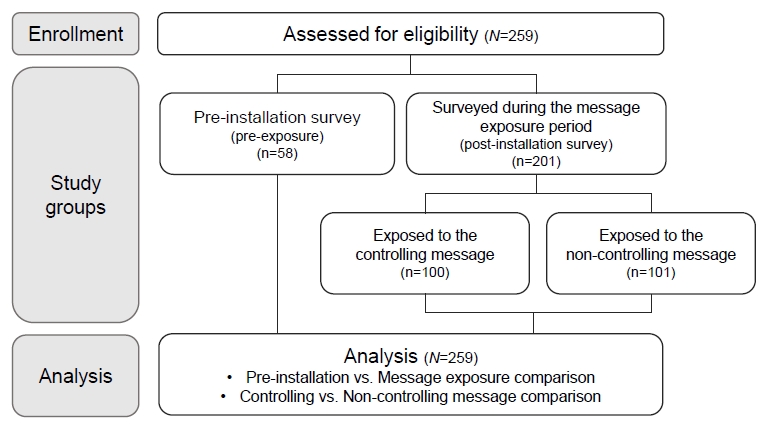
A quasi-experimental survey was conducted with 259 female smokers. Of these, 58 participants completed the survey before exposure to smoking-cessation messages, and 201 completed the survey after exposure. Among the exposed participants, 100 were assigned to the controlling condition and 101 to the non-controlling condition. Measures included psychological reactance, intention to quit smoking, trait reactance, smoking disclosure, and smoking-related covariates. Data were analyzed using analysis of covariance and Hayes’ PROCESS Model 1, with statistical significance set at p<.05.
Results
Smokers exposed to anti-smoking messages within designated smoking areas reported higher psychological reactance (mean±standard deviation: 2.10±0.94) than those not exposed (1.81±0.77), with a significant between-group difference (p=.017). Simple slope analysis revealed that psychological reactance was negatively associated with quit intention under controlling messages (B=–0.20, p=.031), but not under non-controlling messages (B=–0.05, p=.591).
Conclusion
Exposure to anti-smoking messages within designated smoking areas was associated with increased psychological reactance toward smoking cessation. In contrast, autonomy-supportive, non-controlling messages attenuated this effect. These findings suggest that smoking areas may serve as strategic behavioral intervention points when campaigns employ context-sensitive, autonomy-supportive message framing. This study was registered with the Clinical Research Information Service (CRIS) of the Republic of Korea (KCT0012514) on 27 August 2026.
- 562 View
- 36 Download

- Life changes following trauma in female burn survivors: a narrative inquiry
- Riah Kim, Inyoung Choe, Ji-Su Yun, Heeseung Choi
- J Korean Acad Nurs 2025;55(3):425-439. Published online August 1, 2025
- DOI: https://doi.org/10.4040/jkan.25003
-
Abstract
PDFePub
- Purpose
Burn survivors endure repeated exposure to intense pain and face recurring trauma throughout social adaptation. This study explored how female burn survivors construct the meaning of their traumatic experience of a burn accident and the subsequent changes in their lives.
Methods
A qualitative study was conducted using narrative inquiry. Participants were recruited through purposive sampling, and each engaged in three in-depth interviews, resulting in a total of 21 interviews between April 18, 2024, and August 1, 2024. Each interview lasted 90 minutes on average and was conducted in a comfortable location preferred by the participants. The collected data were analyzed through Connelly and Clandinin’s approach.
Results
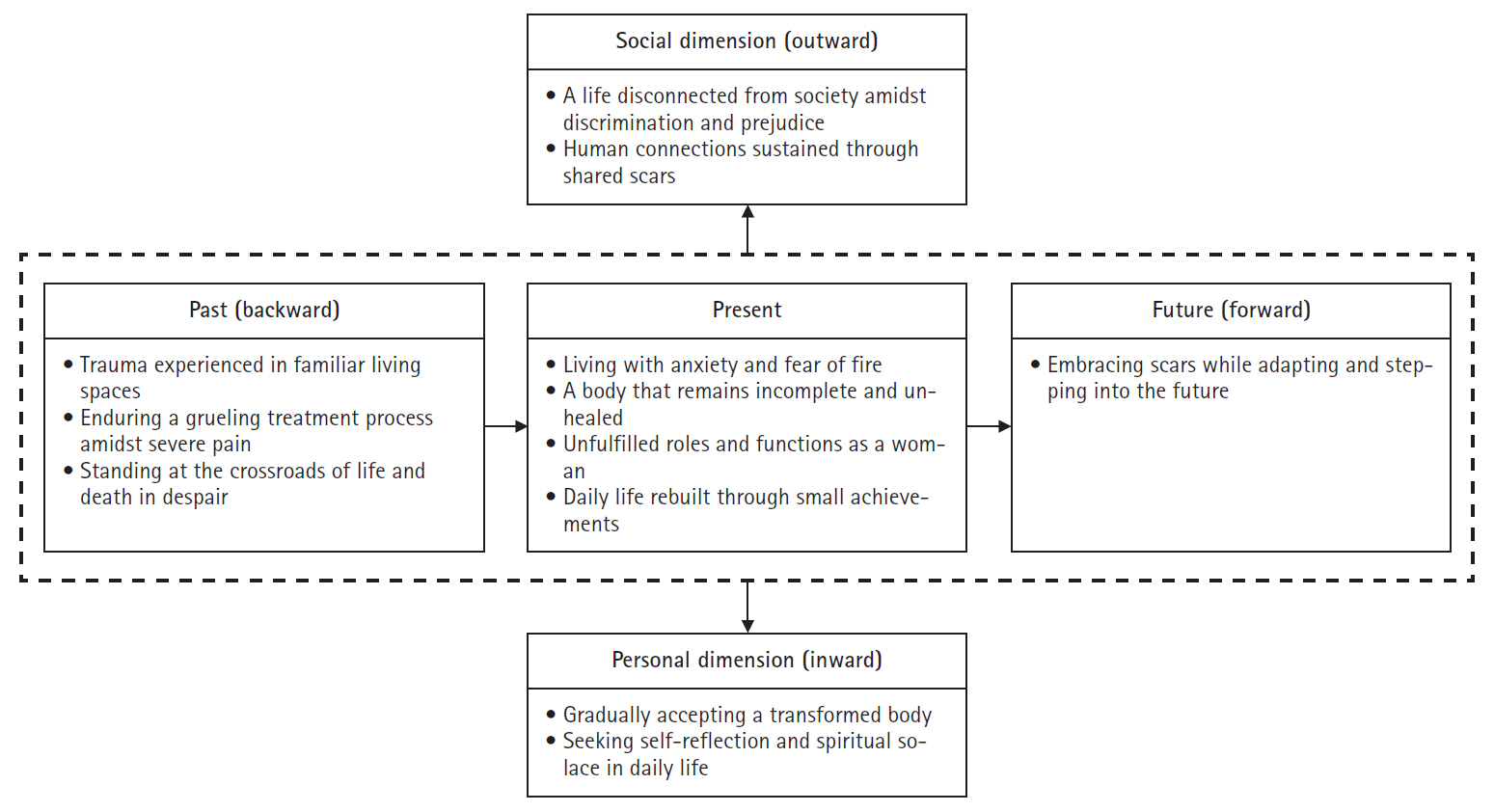
The participants were seven women with burns on the full body, face-upper limbs, or face-torso. All burns were third- to fourth-degree, and most participants had lived with these injuries for over 10 years. From the significant statements, five themes and 12 subthemes were extracted. The five themes were “unforeseen catastrophe,” “burn scars encroaching upon daily life,” “navigating life as an incomplete woman,” “exclusion from social integration,” and “the meaning of life deepened by suppressed pain.”
Conclusion
Female burn survivors experienced immense hardships following their accidents. However, through their recovery efforts, they found new meaning in life, experienced a renewed sense of being alive, and achieved inner growth and maturity. This study highlights the need for social support and underscores the importance of providing various opportunities and policy assistance for female burn survivors dealing with trauma.
- 3,385 View
- 168 Download
Review Paper
- Effectiveness of non-pharmacological interventions to reduce internalized stigma in people with severe mental illness: a systematic review and meta-analysis
- Soyoung Kim, Sun Hyoung Bae, Myung-Sun Hyun
- J Korean Acad Nurs 2025;55(1):1-18. Published online February 25, 2025
- DOI: https://doi.org/10.4040/jkan.24072
-
Abstract
PDFePub
- Purpose
This study systematically reviewed and analyzed the effects of non-pharmacological interventions on internalized stigma among people with severe mental illness.
Methods
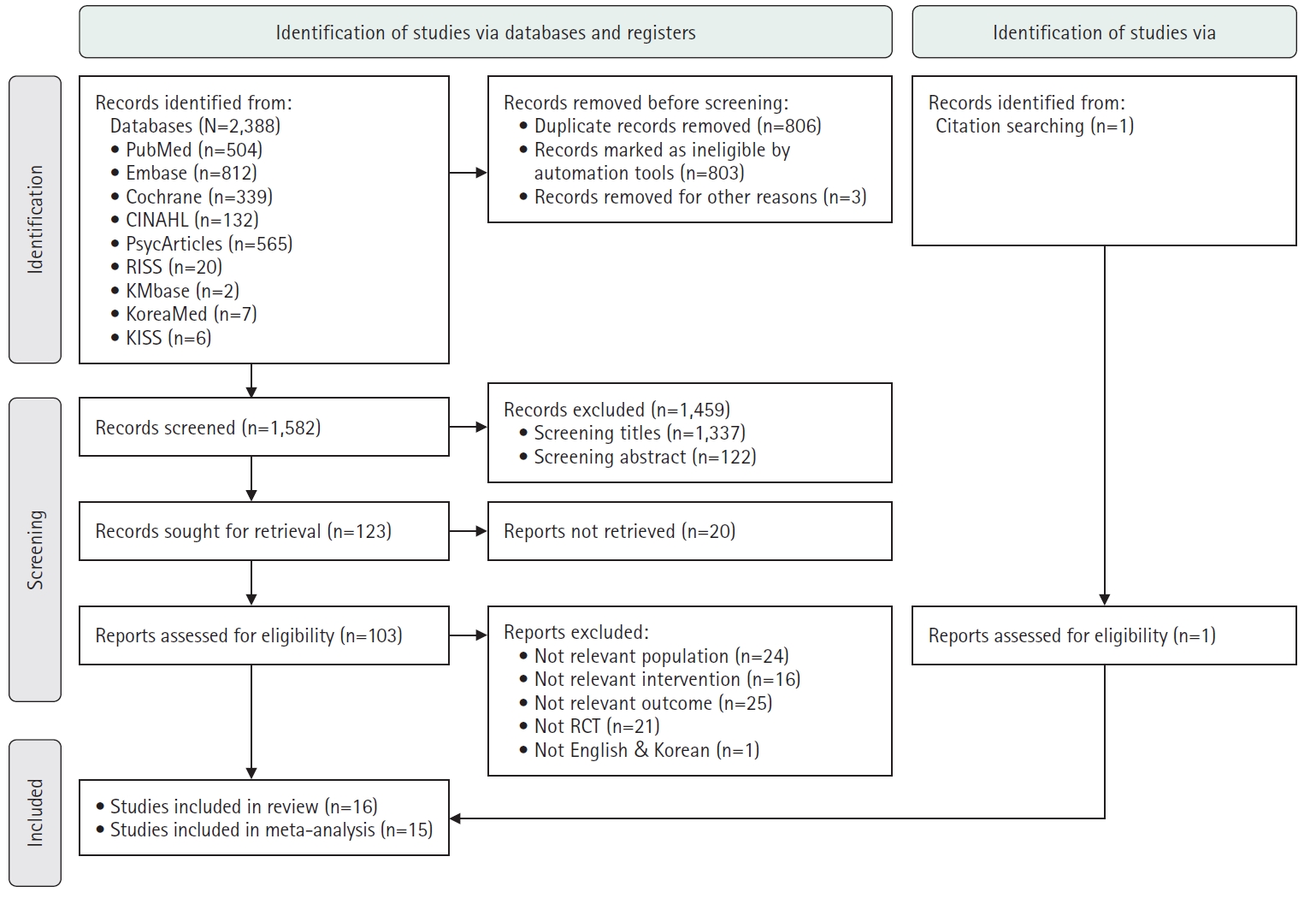
A systematic review and meta-analysis were conducted following the Cochrane Intervention Research Systematic Review Manual and Preferred Reporting Items for Systematic Review and Meta-Analysis guidelines. This study targeted people with severe mental illness as the population, interventions aimed at reducing internalized stigma, comparisons with control groups, and internalized stigma as the outcome. A literature search was performed across multiple databases, including PubMed, EMBASE, the Cochrane Library, CINAHL, PsycArticles, RISS, KMbase, and KoreaMed. The risk of bias was evaluated using the Cochrane Risk of Bias 2.0 tool. Effect sizes were computed using Hedges’s g, and subgroup analyses were conducted with Comprehensive Meta-Analysis software version 4.0.
Results
Of 2,388 papers, 15 were included in the meta-analysis. The overall effect size (Hedges’s g) of the intervention was –0.60 (95% confidence interval, –1.01 to –0.19), indicating a statistically significant reduction in internalized stigma (Z=–2.88, p=.004). Subgroup analyses revealed that the intervention type (p=.008) and session length (p=.011) were significant moderators influencing the effectiveness of the interventions.
Conclusion
Tailoring interventions by considering variables such as the intervention type and session length could enhance the effectiveness of non-pharmacological interventions for reducing internalized stigma among people with severe mental illness (PROSPERO: CRD42023418561). -
Citations
Citations to this article as recorded by
- Determinants of Mental Health Help-Seeking Behavior Among Korean Adults: A Population-Based Study Using the 2023 Korea National Health and Nutrition Examination Survey
Moonhee Gang, Ga-Ae Kim, Joonyeong Lee, Farhatun Nisaa Shoeb
Journal of Psychosocial Nursing and Mental Health Services.2026; : 1. CrossRef - Effectiveness of a Rational Emotive Behavior Therapy-Based Recovery Promotion Program for Psychiatric Inpatients: A Quasi-Experimental Study
Ju Yeon Kim, Hyun Mee Cho, Won Hee Jun
Journal of the American Psychiatric Nurses Association.2026;[Epub] CrossRef
- Determinants of Mental Health Help-Seeking Behavior Among Korean Adults: A Population-Based Study Using the 2023 Korea National Health and Nutrition Examination Survey
- 6,559 View
- 479 Download
- 1 Web of Science
- 2 Crossref
Research Papers
- Mediating effect of grit on the influence of nurses’ silence behavior on medication safety competence: a cross-sectional study
- Haengsuk Kim, Wanju Park
- J Korean Acad Nurs 2025;55(1):81-92. Published online February 20, 2025
- DOI: https://doi.org/10.4040/jkan.24088
-
Abstract
PDFePub
- Purpose
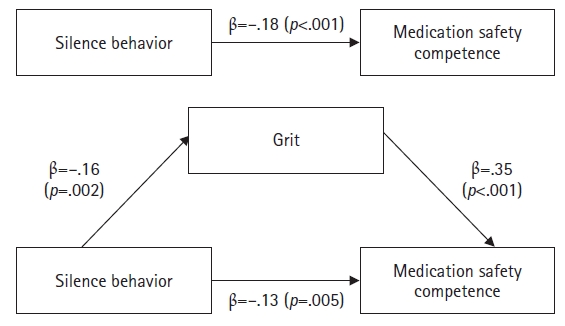
This study investigated the mediating effect of grit in the relationship between silence behavior and medication safety competence among nurses.
Methods
The study included 166 nurses from four university hospitals and general hospitals in Seoul and Gyeonggi-do, South Korea. Data were collected from March 1 to 10, 2024, using self-report questionnaires. Data were analyzed using the t-test, analysis of variance, Scheffé’s test, and Pearson’s correlation coefficients with IBM SPSS Statistics ver. 23.0 (IBM Corp.). A mediation analysis was performed using Hayes’s PROCESS macro model 4 and the bootstrapping method.
Results
Medication safety competence showed significant correlations with silence behavior (r=–.21, p=.008) and grit (r=.43, p<.001). Furthermore, grit partially mediated the relationship between silence behavior and medication safety competence.
Conclusion
This study indicates that grit is a significant mediator in the relationship between silence behavior and medication safety competence. Therefore, an integrated approach that reduces silence behavior and promotes grit is essential for strengthening nurses’ medication safety competence. Ultimately, these strategies will help ensure patient safety by improving medication safety competence.
- 7,775 View
- 598 Download
- The Mediating Role of Psychological Resilience in Chinese Nursing Students’ Professional Identity and Learning Burnout
- Liu Zhang, Qin Zhang, ShuWen Li, YuHong Li, GuoCui Wu, Ying Chen, YunNa Zhou
- J Korean Acad Nurs 2024;54(4):509-518. Published online November 25, 2024
- DOI: https://doi.org/10.4040/jkan.24044
-
Abstract
PDFePub
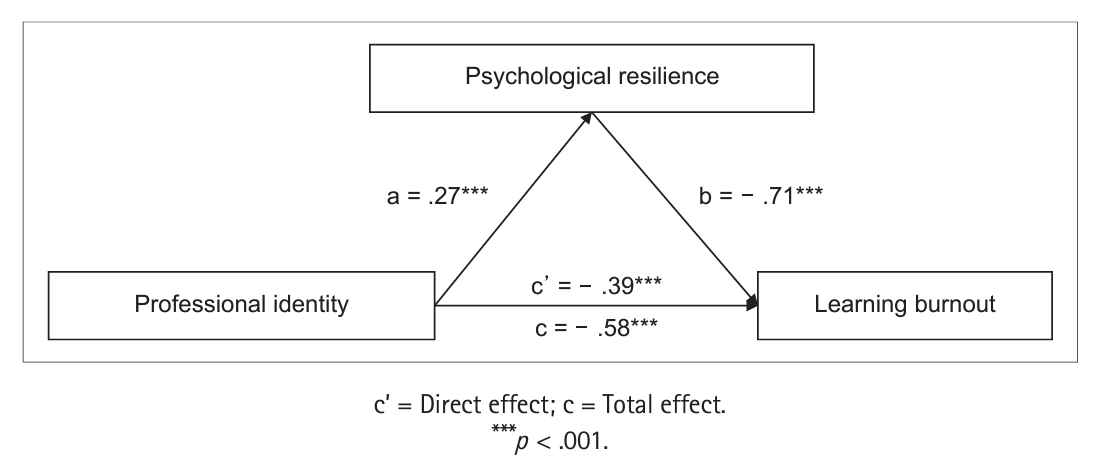
Purpose This study investigated whether professional identity predicts learning burnout among Chinese nursing students, and whether resilience moderates this relationship.
Methods This cross-sectional study recruited 635 students from a nursing college at a medical university in Hefei, China. Data were collected using the professional identity questionnaire, learning burnout scale for college students, and 10-item Connor-Davidson Resilience Scale. Pearson’s correlation analysis was used to investigate the relationships between variables. The mediation effect was evaluated using linear regression and the bootstrap method in SPSS.
Results Nursing students exhibited intermediate learning burnout levels (score: 54.95 ± 10.42). Professional identity was positively correlated with psychological resilience (r = .42,
p < . 001), whereas learning burnout was negatively correlated with professional identity (r = - .54,p < . 001) and psychological resilience (r = - .57,p < . 001). Psychological resilience mediated the relationship between professional identity and learning burntout to the tune of 32.8%.Conclusion Psychological resilience mediates the relationship between professional identity and learning burnout. Thus, nursing educators can mitigate student burnout by developing their students' professional identities and psychological resilience.
-
Citations
Citations to this article as recorded by- The mediating role of sleep quality in the relationship between professional identity and anxiety symptoms among emergency nurses: a cross-sectional study
Siyu Cao, Hong Li, Tao Cheng
Frontiers in Public Health.2026;[Epub] CrossRef - How can I face death? Exploring the role of resilience in shaping nursing students’ meaning in life, professional identity and coping skills
Xuancheng Chen, Linan Cheng, Xiaoyan Guo, Yuhua Xie, Yangyi Cheng
Journal of Health Psychology.2026;[Epub] CrossRef - A phenomenological study on psychological resilience among medical vocational college freshmen
Zhefu Zhang, Chunxiao Xu, Lipin Ye, Yue Yang, Ying Mao, Wan Cheng, Qiyuan Huang
Frontiers in Psychiatry.2026;[Epub] CrossRef - Psychological resilience, metacognition, post-traumatic growth, and rumination among undergraduate nursing interns: A cross-sectional study
Hui Jiang, Xiangqi Xu, Yushang Li, Jingwen Zhang, Baojian Wei
International Journal of Nursing Studies Advances.2026; 10: 100561. CrossRef - Professional Identity and Career Planning of Nursing Students in the First Year: The Mediating Role of Willing Acceptance and Striving Based on Social Cognitive Career Theory
Rong Wu, Linyu Zhou, Nianfei Tang, Fangyi Li, Huiru Zeng, Ao Tang, Biao He, Xiaoju Chen, Harleen Khatra
Nursing Forum.2026;[Epub] CrossRef - The impact of creative anxiety on professional identity among master’s nursing students: a chain mediation effect of psychological resilience and achievement motivation
Yao Ding, Xiaolan Guo, Ruifeng Wang, Lu Xu, Shajie Hou, Fengjiao Chang
BMC Nursing.2025;[Epub] CrossRef - Sense of Coherence and Perceived Academic Stress Among Nursing Students: A Multicenter Cross-Sectional Study
David Ballester-Ferrando, Esther Cáceres-Malagelada, Carolina Rascón-Hernán, Teresa Botigué, Ana Lavedán, Olga Masot, Dolors Burjalés, Luis González-Osorio, Ximena Osorio-Spuler, Eva Serrat-Graboleda, Concepció Fuentes-Pumarola
Nursing Reports.2025; 15(8): 288. CrossRef
- The mediating role of sleep quality in the relationship between professional identity and anxiety symptoms among emergency nurses: a cross-sectional study
- 7,385 View
- 241 Download
- 7 Web of Science
- 7 Crossref
- Exploring Traumatic Experiences and Posttraumatic Growth among Korean Veterans: A Photovoice Study
- Riah Kim, Heese Choi, Minsung Kim
- J Korean Acad Nurs 2024;54(4):519-533. Published online October 14, 2024
- DOI: https://doi.org/10.4040/jkan.24049
-
Abstract
PDFePub
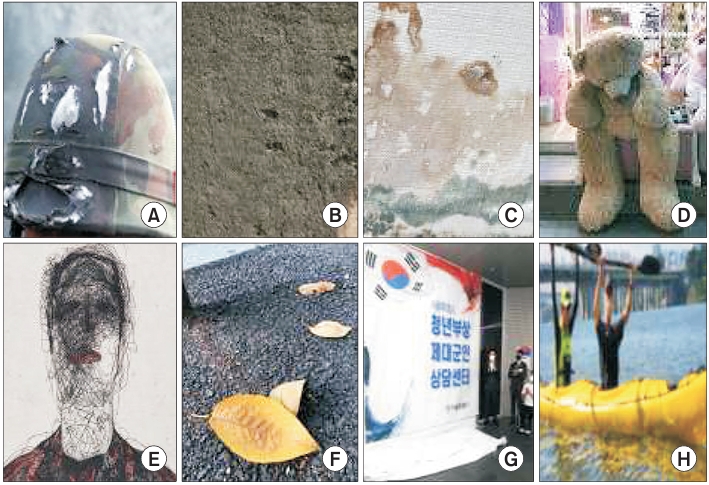
Purpose This study aimed to explore traumatic experiences and posttraumatic growth among Korean veterans.
Methods A qualitative study was conducted using photovoice. Purposive sampling strategies yielded five veterans who had experienced traumatic events. Participants engaged in three discussion sessions between August 5, 2023, and October 28, 2023. The collected data were analyzed using photovoice document analysis and thematic analysis.
Results Study results identified the following themes: ‘The collapse of my life as a result massive trauma,’ ‘Sinking into endless isolation and disconnection,’ ‘The process of finding myself through reflection,’ and ‘My life journey moving forward together.’ Despite the irreversible damage caused by traumatic experiences during military service, the participants continuously reflected on the meaning of their trauma and posttraumatic growth, thereby recovering their authentic selves.
Conclusion Veterans who have experienced traumatic events face severe difficulties, however through their efforts at recovery, they recognize the individuals they are now. This study suggests the need for social support and highlights the necessity of providing various opportunities and policy assistance to traumatized veterans.
- 5,305 View
- 153 Download
- Moderating Effect of General Self-Efficacy on the Relationship between Pregnancy Stress, Daily Hassles Stress, and Preterm Birth Risk in Women Experiencing Preterm Labor: A Cross-Sectional Study
- Hyun-Jeong Cho, Jeung-Im Kim
- J Korean Acad Nurs 2024;54(3):329-339. Published online August 31, 2024
- DOI: https://doi.org/10.4040/jkan.24008
-
Abstract
PDF
- Purpose
This study investigated the moderating role of general self-efficacy (GSE) on how stress caused by pregnancy and daily hassle affect the risk of preterm birth (PTB) in women experiencing preterm labor.
Methods
This cross-sectional study included 196 pregnant women experiencing preterm labor before 37 weeks of gestation. We used IBM SPSS Statistics 27 and employed Hayes process macro version 4 (model 1) and hierarchical regression to analyze the moderating effect of GSE on the relationship between pregnancy stress, daily hassle stress, and PTB risk.
Results
Stress caused by pregnancy and daily hassle was positively correlated to PTB risk (r = .54, p < .001; r = .25, p < .001, respectively). While GSE did not significantly correlate with pregnancy stress, it negatively correlated with daily hassle stress (r = - .19, p = .009). GSE significantly moderated the relationship between combined stressors and PTB risk. As GSE levels increased, escalation in PTB risk in response to increasing stress levels was a more pronounced, highlighting a complex interaction between higher GSE levels and response to escalating stress levels. This model accounted for 39.5% of the variance in the PTB risk.
Conclusion
Higher GSE may amplify the impact of stress on PTB risk, rather than mitigate it, which suggests a more nuanced role of GSE in the stress response of pregnant women at risk of preterm labor. GSE should be considered in care strategies, and managing its impact on stress perception and responses in pregnant women is crucial. -
Citations
Citations to this article as recorded by- Evaluating the Effectiveness of Digital Interventions for Stress Management in Pregnant Women: Systematic Review and Meta-Analysis
Jeung-Im Kim, Joo Yun Lee, So-Hee Park
JMIR mHealth and uHealth.2026; 14: e66267. CrossRef - Pregnancy stress in women at high risk of preeclampsia with their anxiety, depression, self-management capacity: a cross-sectional study
Xing Cong, Jinmei Wang, Liu Yang, Lingling Cui, Yurong Hua, Ping Gong
Frontiers in Psychology.2025;[Epub] CrossRef - Anxiety, Coping, and Self-Efficacy as a Psychological Adjustment in Mothers Who Have Experienced a Preterm Birth
Agata Białas, Karolina Kamecka, Paweł Rasmus, Dariusz Timler, Remigiusz Kozłowski, Anna Lipert
Journal of Clinical Medicine.2025; 14(12): 4174. CrossRef - Associations Among Pregnancy Stress, Childbirth Confidence, and COVID-19 Infection Experience in Pregnant Women in the Early Third Trimester (28–32 Weeks)
Yun-Sun Yang, Jeung-Im Kim
Journal of Korean Maternal and Child Health.2025; 29(3): 147. CrossRef
- Evaluating the Effectiveness of Digital Interventions for Stress Management in Pregnant Women: Systematic Review and Meta-Analysis
- 3,036 View
- 139 Download
- 3 Web of Science
- 4 Crossref
- Association between Resilience, Professional Quality of Life, and Caring Behavior in Oncology Nurses: A Cross-Sectional Study
- Misun Jeon, Sue Kim, Sanghee Kim
- J Korean Acad Nurs 2023;53(6):597-609. Published online December 31, 2023
- DOI: https://doi.org/10.4040/jkan.23058
-
Abstract
PDF
- Purpose
The degree of caring behavior of oncology nurses is a crucial factor in the care provided to patients with cancer. In this study, we aimed to investigate factors related to oncology nurses’ caring behavior, including their resilience and professional quality of life.
Methods
A cross-sectional descriptive study was conducted with 107 oncology nurses at an urban tertiary hospital from May 18 to 24, 2015. We used a self-report questionnaire to measure resilience, professional quality of life, and degree of caring behavior. Data analysis included descriptive statistics, correlations, and multiple regression analysis using SPSS/WIN 20.0.
Results
Oncology nurses presented with low levels of resilience and caring behavior, and high levels of compassion satisfaction, burnout, and secondary traumatic stress. There was a statistically significant relationship between the degree of caring behavior, resilience (r = .43, p < .001), compassion satisfaction (r = .51, p < .001), and burnout (r = - .42, p < .001), as well as between secondary traumatic stress and burnout (r = .34, p < .001). Factors associated with oncology nurses’ degree of caring behavior were compassion satisfaction (t = 6.00, p < .001) and educational level (t = 3.45, p = .001).
Conclusion
This study demonstrates that oncology nurses’ degree of caring behavior is related to their professional quality of life and education. These findings suggest that enhancing oncology nurses’ healthy coping strategies at both the individual and organizational levels can further develop holistic nursing care. Additionally, it is necessary to examine the factors affecting nurses’ compassion satisfaction and to try to promote this aspect. -
Citations
Citations to this article as recorded by- The Impact of the Quranic Teachings on the Resilience and Caring Behaviors of Nursing Students Amid Crises Such as the COVID-19 Pandemic
Maryam Shaygan, Fatemeh Vizeshfar, Azadeh Amiri, Marzieh Kargar Jahromi
International Perspectives in Psychology.2026; 15(1): 5. CrossRef - Connectedness to Nature and Professional Quality of Life Among Nurses in South Korea in the Context of COVID-19
Hyeon Sik Chu, Young Ran Tak, Hanyi Lee
HERD: Health Environments Research & Design Journal.2026; 19(2): 276. CrossRef - The Mediating Role of Resilience Between Empathy and Professional Competence Among Emergency Nurses in the West Bank, Palestine: Partial Least Squares Structural Equation Modeling
Anas Shehadeh, Ahmad Shuhaiber, Malakeh Z. Malak, Ahmad Ayed, Hisham Zahran
International Nursing Review.2026;[Epub] CrossRef - Factors Influencing Terminal Care Performance in Korean Hospitals: A Cross-Sectional Study
Jiwon Oh, Jooyoung Cheon
OMEGA - Journal of Death and Dying.2026;[Epub] CrossRef - Prevalence of secondary traumatic stress and its associated factors among oncology nurses: a multicenter cross-sectional study
Li Wang, Xiaorong Xu, Xue Yang, Ting Wang
Frontiers in Public Health.2026;[Epub] CrossRef - Factors Influencing Caring Behaviours Among Nurses Working in Hospital Setting: A Scoping Review
Nant Thin Thin Hmwe, Ping Lei Chui, Ranita Hisham Shunmugam
Scandinavian Journal of Caring Sciences.2026;[Epub] CrossRef - The relationship between aging anxiety, job stress and psychological resilience in oncology nurses: a cross-sectional study
Nilüfer Eroğlu, Nilgün Kuru Alici
BMC Psychology.2026;[Epub] CrossRef - Burnout Syndrome Among Psychiatric Unit Nurses: Prevalence and Associated Correlates in Capital Territory Hospitals
Arsalan Haider, Zahid Ullah, Li Hong, Justin Fontenot
Journal of Nursing Management.2026;[Epub] CrossRef - Resilience of Emergency Nurses During Disasters: A Qualitative Study
Yasemin Özhanlı, Şükriye Şahin, Ayşegül Güneş
Journal of Emergency Nursing.2026;[Epub] CrossRef - Burnout among health professionals working in oncology: current evidence and challenges for future research
Javier Martinez-Calderon, Cristina García-Muñoz
Current Opinion in Oncology.2025; 37(4): 302. CrossRef - Personal and work-related factors associated with nurse resilience: An updated systematic review using meta-analysis and narrative synthesis
Fiona Yu, Deborah Raphael, Lisa Mackay, Melody Smith, Ritin Fernandez
International Journal of Nursing Studies.2025; 166: 105054. CrossRef - Impact of an oncology training program on nursing personnel knowledge: A pilot study
Sara Gabriela Yeverino-Castro, Francisco Zamora-Rosales, Rodrigo Álvarez-Calderon , Oswaldo Enrique Sánchez-Dávila , Erika Evangelina Coronado-Cerda , Sonia Esquivel Ochotorena
Revista de Estudios e Investigación en Psicología y Educación.2025;[Epub] CrossRef - Compassion fatigue, psychological resilience, moral sensitivity, and humanistic caring ability in clinical nurses: a structural equation model
Shuqi Zhai, Qinqin Liu, Congcong Dai, Yifan Lu, Huanhuan Zhang, Jie Liu, Chaoran Chen
BMC Nursing.2025;[Epub] CrossRef - Exploring the Impact of Resilience on Professional Quality of Life Among Oncology Nurses
Asma Al Yahyaei, Wafa Al Jabri, Nabiha Al Hasni, Zainab Al Kindi, Sulaiman Al Sabei, Omar Al Omari, Joshua Muliira, Foroozan Atashzadeh-Shoorideh
Nursing Forum.2025;[Epub] CrossRef - Professional Quality of Life in Nursing: The Role of Psychological Resources—A Cross-Sectional Study
Lovorka Brajković, Dora Korać, Vanja Kopilaš
Nursing Reports.2025; 15(12): 434. CrossRef - A Study on Moral Distress, Compassion Fatigue, Compassion Satisfaction, and Their Predictors among Nurses Caring for Patients with Cancer
Soomin Hong, Yesol Kim, Mi Sook Jung, Yoonjung Lee, Hyunju Hong, Mijin Jeon, Mee-Young Cho, Jiyeon Lee
Asian Oncology Nursing.2025; 25(4): 217. CrossRef - Mindful self-care among oncology nurses in China: a latent profile analysis
Yan Shi, Peng Wang, Lamei Liu, Mengmeng Li
BMC Nursing.2024;[Epub] CrossRef - The mediating role of compassion fatigue between perceived organization support and caring behavior among outpatient nurses in China: a cross-sectional study
Xingxing Liu, Fang He, Tian Tian, Jun Zhang, Yuanjiao Ji, Yuexia Zhong
BMC Nursing.2024;[Epub] CrossRef - The Critical Role of Nursing in Identifying and Managing Care Fatigue Among Hospitalized Patients
Haya Semah D Alreshidi, Alanazi, Maryam Munadi, May Farhan Salem Alanazi, Hamidah Matrouk Alruwaili, Alruwaili, Rehab Mulhi A, Awatif Rakyan Murayr Alruwaili, Huda Alshawi J Alruwaili, Adhwaa Alohaylim Aldaghmani, Almatrafi, Rawan Wadi S, Hana M
International Journal of Computational and Experimental Science and Engineering.2024;[Epub] CrossRef - RELATIONSHIP BETWEEN TYPE D PERSONALITY AND COMPASSION SATISFACTION, BURNOUT AND COMPASSION FATIGUE
IN SURGICAL NURSES
Müslüm Gün, Yasemin Eda Tekin
Health Problems of Civilization.2024;[Epub] CrossRef
- The Impact of the Quranic Teachings on the Resilience and Caring Behaviors of Nursing Students Amid Crises Such as the COVID-19 Pandemic
- 6,423 View
- 287 Download
- 15 Web of Science
- 20 Crossref
- The Impact of Self-Efficacy on Nurses’ Well-Being: Does Digital Competence Matter?
- Yali Li, Qi Jing, Taiwen Feng, Xiaoling Yang
- J Korean Acad Nurs 2023;53(4):385-396. Published online August 31, 2023
- DOI: https://doi.org/10.4040/jkan.23037
-
Abstract
PDF
- Purpose
Drawing on person–environment fit theory and social cognitive theory, this study aimed to examine how self-efficacy affects nurses’ workplace well-being via person-job fit and the moderating role of digital competence.
Methods
A two-wave survey was conducted to collect data. Data were collected from six hundred and ninety-five nurses at three Chinese hospitals between May 2022 and September 2022. We employed hierarchical regression analysis and bootstrapping to analyze the data.
Results
Self-efficacy positively influenced person-job fit (β = .55, p < .001), which positively affected nurses’ workplace well-being (β = .32, p < .001). Person-job fit mediated the effect of self-efficacy on nurses’ workplace well-being. Additionally, digital competence strengthened the positive impact of self-efficacy on person-job fit (β = .12, p < .001).
Conclusion
Recruiting nurses with both self-efficacy and digital competence benefits hospitals. It is critical for nurses to improve their digital competence for achieving person-job fit and attaining workplace well-being in the post-coronavirus disease 2019 (COVID-19) era. -
Citations
Citations to this article as recorded by- The impact of group-based arts activity participation on community residents’ psychological well-being: the roles of emotional intelligence and servant organizers
Yibei Ran, Yunxi Feng
BMC Psychology.2026;[Epub] CrossRef - Digital Competence and Career Adaptability Among Nurses: The Parallel Mediating Roles of Technological Self‐Efficacy and Learning Agility
Ibrahim Abdullatif Ibrahim, Samar Atef Mounib, Eman Saad Eldesoky, Reda Shehata Elsayed, Mennat Allah G. Abou Zeid, Hala Gaber Elatroush, Matthew Vandermeulen
Journal of Nursing Management.2026;[Epub] CrossRef - Digital literacy, psychological resilience, and work stress among nurses: the moderating role of ward environment
Yan Wu, Wanbin She, Qiyan Peng, Jile Li, Chenghong She
Frontiers in Psychology.2026;[Epub] CrossRef - The effect of career efficacy, digital health literacy, family support, and digital health competencies on the Future Readiness Career
Cici Dea Permata Exsti, Elza Rofiatul Adawiyah, Lesly Chamelia Masitaningrum, Sarah Hilalya, Irfan An Naufal, Olivia Fachrunnisa
Industry and Higher Education.2026;[Epub] CrossRef - Exploring the Correlation Between Work Engagement and Self-Efficacy in Nurse Case Managers: A Cross-Sectional Study
Ke Yuan, Duoduo Hou, Jie Zhu, Huimin Li, Caihong Li, Fengli Gao
Professional Case Management.2026; 31(4): 168. CrossRef - Antecedents and Staff Outcomes Related to Multiple Dimensions of Perceived Person–Environment Fit Among Nurses: A Scoping Review
Maho Inoue, Tamaki Isobe, Yoshie Takahashi, Kojiro Morita, Mari Ikeda, Saba Noor
Journal of Nursing Management.2026;[Epub] CrossRef - Work-family balance mediates self-efficacy and subjective well-being among nurses in Chinese intensive care units: A cross-sectional study
Lating Zhang, Xianzhen Jin, Na Cheng, Ruhua Wang, Xinhui Liang, Haiyan Fan, Xue Jiang
Applied Nursing Research.2025; 82: 151932. CrossRef - Translation and psychometric evaluation of the Chinese version of the Digital Competence Questionnaire for clinical nurses
Zhengang Wei, Hongli Liu, Jicheng Zhang, Yan Chen, Lixia Chang, Huiyu Cheng, Xue Bai, Xiaohua Wang, Su Li
DIGITAL HEALTH.2025;[Epub] CrossRef - The impact of high involvement work systems on nurses team creative performance in the public service industry of Pakistan
Abdul Waheed, Salma Waheed, Shahid Mahmood, El-Sayed M. El-Kenawy, Amal H. Alharbi, Marwa M. Eid
Scientific Reports.2025;[Epub] CrossRef - Clinical Nurses' Perceptions of Digital Nursing Technology: A Qualitative Analysis Using the Theory of Planned Behaviour (TPB)
Young‐Eun Jang, Hwa‐Mi Yang
Nursing Open.2025;[Epub] CrossRef - Assessing digital competencies of Slovenian nurses in clinical practice: A pilot study
Melita Peršolja, Svetlin Grmšek
Annals of Nursing.2025; 3(2): 26. CrossRef - The Effect of Digital Competence on Nurses’ Career Sustainability: A Cross‐Sectional Study
Zeyu Zhang, Shuang Zhao, Yujiao Shao, Xiaocui Duan, Ping Sun, Lingling Chen, Fei Wang, Changjiang Yuan, Xiumu Yang, Lesley Barr
Journal of Nursing Management.2024;[Epub] CrossRef
- The impact of group-based arts activity participation on community residents’ psychological well-being: the roles of emotional intelligence and servant organizers
- 6,629 View
- 201 Download
- 11 Web of Science
- 12 Crossref
- A Structural Equation Model for Posttraumatic Growth among Cured Patients with COVID-19
- Soo Young An, Heejung Choi
- J Korean Acad Nurs 2023;53(3):309-323. Published online June 30, 2023
- DOI: https://doi.org/10.4040/jkan.22118
-
Abstract
PDF
- Purpose
This study aimed to develop and test a model for posttraumatic growth among cured patients with COVID-19. This model was based on Calhoun and Tedeschi’s Posttraumatic Growth model and a literature review.
Methods
The participants comprised 223 patients cured from COVID-19 who were ≥ 19 years of age. The data were collected through an online questionnaire from March 21 to 24, 2022. The assessment tools included the Impact of Event Scale: Revised Korean version, the Connor-Davidson Resilience Scale, the Distress Dis-closure Index, the Multidimensional Scale of Perceived Social Support, the Korean version of the Event-related Rumination Inventory, and the Korean version of the Post-traumatic Growth Inventory. Data were analyzed using the IBM SPSS version 24.0 and IBM AMOS 26.0.
Results
The modified model showed appropriate goodness of fit (χ 2 = 369.90, χ 2 /degree of freedom = 2.09, SRMR = .09, RMESA = .07, CFI = .94, TLI = .93). The post-traumatic growth of cured patients with COVID-19 was explained through distress perception, self-disclosure, and deliberate rumination, with the explanatory power being 70.0%.
Conclusion
This study suggests preparing a disaster psychology program involving experts who can activate deliberate rumination is necessary. Further, this study may serve as basic data for developing a program to enhance the post-traumatic growth of patients cured from COVID-19.
- 2,870 View
- 58 Download
- Development and Psychometric Evaluation of the Ischemic Stroke Distress Scale (ISDS)
- Jaejin Kang, Yang-Sook Yoo
- J Korean Acad Nurs 2023;53(1):12-27. Published online February 28, 2023
- DOI: https://doi.org/10.4040/jkan.22090
-
Abstract
PDF
- Purpose
This study aimed to develop a scale to measure distress in patients with ischemic stroke and verify its validity and reliability.
Methods
Preliminary items were developed from literature review and in-depth interviews. The final preliminary scale was confirmed through a content validity test of eight experts and a preliminary survey of 10 stroke patients. The participants for psychometric testing were 305 stroke patients in the outpatient clinic. Validity and reliability analyses included item analysis, exploratory and confirmatory factor analysis, convergent validity, known-group validity, and internal consistency of the scale.
Results
The final scale consisted of 17 items and 3 factors. The three distinct factors were ‘self-deprecation, worry about future health, and withdrawal from society’ and this structure was validated using a confirmatory factor analysis. Convergent validity was supported by comparison with the Center for Epidemiologic Studies Depression Scale (r = .54, p < .001) and Brief Illness Perception Questionnaire (r = .67, p < .001). Known-groups validity was verified by dividing groups according to ‘duration since diagnosis’ (t = 2.65, p = .009), ‘presence of sequela’ (t = 10.16, p < .001), and ‘awareness of distress’ (t = 12.09, p < .001). The internal consistency of the scale using Cronbach’s α for the total items was .93.
Conclusion
The Ischemic Stroke Distress Scale is a valid and reliable tool that reflects stroke distress effectively. It is expected to be used as a basic tool to develop various intervention strategies to reduce distress in ischemic stroke patients.
- 2,408 View
- 98 Download
- A Predictive Model of Resilience in Mothers of Children with Developmental Disabilities
- Youyoung Cho, Hyeonok Kim
- J Korean Acad Nurs 2022;52(4):407-420. Published online August 31, 2022
- DOI: https://doi.org/10.4040/jkan.21235
-
Abstract
PDF
- Purpose
This structural model study was constructed and verified a hypothetical model to examine the effects of parenting stress, social resources, family resources, and positive coping on resilience among mothers of children with developmental disabilities.
Methods
Data were collected using self‐report structured questionnaires, from October 19 to October 30, 2018, with 214 mothers caring for chil-dren with developmental disabilities under the age of 20 years.
Results
In the fitness test results of the hypothesis model, with the fit index χ 2 (p) = 69.27 (< .001), and the normed fit indices (χ 2 = 1.87, GFI = .94, CFI = .97, NFI = .93, and TLI = .95, RMSEA = .06, SRMR = .06), this study satisfies the good fitness in standards. There are seven statistically significant paths among the 10 paths set in the hypotheti-cal model. The explanatory power of parenting stress and social resources, which affects the family resources was 41.4%, the explanato-ry power of parenting stress, social resources, and family resources affecting the positive coping was 58.9%, and the explanatory power of parenting stress, social resources, family resources, and positive coping affecting resilience was 55.5%.
Conclusion
Positive coping, family resources, and social resources of mothers of children with developmental disabilities directly affect their resilience, and parenting stress indirectly affects it. Therefore, to improve the resilience of mothers of children with developmental disabilities, it is necessary to develop a systematic nursing intervention that considers parenting stress, social resources, family resources, and positive coping. -
Citations
Citations to this article as recorded by- ÖZEL GEREKSİNİMLİ ÇOCUK ANNELERİ: MUĞLA-MENTEŞE ÖRNEĞİ
Ebru Açık Turguter
Dokuz Eylül Üniversitesi Edebiyat Fakültesi Dergisi.2025; 12(1): 320. CrossRef - Factors influencing the family management of children with atopic dermatitis: an integrative review
Sunyeob Choi, Hyewon Shin
Child Health Nursing Research.2025; 31(4): 187. CrossRef
- ÖZEL GEREKSİNİMLİ ÇOCUK ANNELERİ: MUĞLA-MENTEŞE ÖRNEĞİ
- 3,638 View
- 100 Download
- 2 Crossref
- Relationships among Knowledge and Skills about Suicide Prevention, Attitudes toward Suicide, and Burnout of Suicide Prevention Work of Nurses at Mental Health Welfare Centers: A Mixed Methods Study
- Hee-Ra Dong, Ji Min Seo
- J Korean Acad Nurs 2022;52(1):92-104. Published online February 28, 2022
- DOI: https://doi.org/10.4040/jkan.21189
-
Abstract
PDF
- Purpose
This study aimed to identify relationships among knowledge and skills about suicide prevention, attitudes toward suicide, and burnout of suicide prevention work of nurses at mental health welfare centers.
Methods
An explanatory sequential mixed-method research was conducted. For the quantitative study, the subjects (nurses) were 133 nurses executing suicide prevention work. The data were analyzed using the SPSS 25.0 program. For the qualitative research, 13 nurses with high burnout scores were interviewed. The data were analyzed using theme analysis method.
Results
Quantitative results showed the average burnout of suicide prevention work was 54.62 ± 12.51. The burnout of suicide prevention work had significant correlations with attitudes toward suicide (r = .30, p < .001) and suicide prevention skills (r = - .18,p = .037). Qualitative results showed six themes related to burnout of suicide prevention work. They were ‘feeling a lack of confidence in one’s suicide counselling skills’, ‘feeling of the limits of one’s ability to cope with a suicide crisis’, ‘feeling regret for not being able to help the clients’, ‘being over-empathetic to the clients’, ‘Not being able to understand the clients because the subjects (nurses) opposes committing suicide’, and ‘thinking that the suicidal thoughts of suicide attempters do not improve’.
Conclusion
To reduce burnout of nurses’ suicide prevention work at mental health welfare centers, there is a need to develop an educational program considering nurses' attitudes toward suicide and one to enhance their confidence in suicide prevention skills. -
Citations
Citations to this article as recorded by- Adolescentes con conductas autolesivas en servicios de urgencias: una mirada a la atención integral
Janiely Aparecida Senne de Sousa Leite, Ana Paula Miranda de Araújo Soares, Nathalia Vitória de Carvalho Martinez, Aline Conceição Silva, Angelina Lettiere-Viana, Tauani Zampieri Fermino, Diene Monique Carlos
Revista da Escola de Enfermagem da USP.2025;[Epub] CrossRef - Adolescents with self-injurious behavior in emergency services: a look at comprehensive care
Janiely Aparecida Senne de Sousa Leite, Ana Paula Miranda de Araújo Soares, Nathalia Vitória de Carvalho Martinez, Aline Conceição Silva, Angelina Lettiere-Viana, Tauani Zampieri Fermino, Diene Monique Carlos
Revista da Escola de Enfermagem da USP.2025;[Epub] CrossRef - Adolescentes com comportamentos autolesivos em serviços de urgência e emergência: um olhar pela integralidade do Cuidado
Janiely Aparecida Senne de Sousa Leite, Ana Paula Miranda de Araújo Soares, Nathalia Vitória de Carvalho Martinez, Aline Conceição Silva, Angelina Lettiere-Viana, Tauani Zampieri Fermino, Diene Monique Carlos
Revista da Escola de Enfermagem da USP.2025;[Epub] CrossRef - Influence of Self-leadership, Managers’ Authentic Leadership, and Nurses' Organizational Culture Relationships on Hospital Nurses’ Organizational Silence: A Mixed Method Study
Hyun-Ju Lee, So-Young Kang
Journal of Korean Academy of Nursing Administration.2024; 30(4): 404. CrossRef - Evaluation of Internet-Based Training in Trauma Care for Nurses in Mental Health Welfare Centers: A Cluster Randomized Controlled Trial
Sunah Kim, Go-Un Kim, Jinyoung Park
Journal of Primary Care & Community Health.2023;[Epub] CrossRef
- Adolescentes con conductas autolesivas en servicios de urgencias: una mirada a la atención integral
- 3,652 View
- 156 Download
- 2 Web of Science
- 5 Crossref
- Effects of Second Victim Experiences after Patient Safety Incidents on Nursing Practice Changes in Korean Clinical Nurses: The Mediating Effects of Coping Behaviors
- Seohee Jeong, Seok Hee Jeong
- J Korean Acad Nurs 2021;51(4):489-504. Published online August 31, 2021
- DOI: https://doi.org/10.4040/jkan.21089
-
Abstract
PDF
- Purpose
This study was investigated the mediating effect of coping behaviors in the relationship between the second victim experiences after patient safety incidents and the nursing practice changes.
Methods
A cross-sectional survey was performed using structured questionnaires. Participants were 218 clinical nurses in general tertiary hospitals in South Korea. Data were collected through an online survey and snowball sampling from August 11 to September 6 2020. Data were analyzed using SPSS 23.0 program. A mediation analysis was performed using multiple regression and a simple mediation model applying the PROCESS macro with 95% bias-corrected bootstrap confidence interval.
Results
The mean scores of second victim experiences was 3.41/5. Approach coping (β = .55, p < .001) and the avoidant coping (β = - .23, p = .001) showed mediation effects in the relationship between second victim experiences and constructive change in nursing practice. Avoidant coping (β = .29, p < .001) showed a mediation effect in the relationship between second victim experiences and defensive change in nursing practice.
Conclusion
Coping behaviors has a mediating effect on the relationship between second victim experiences and nursing practice changes. To ensure that nurses do not experience second victim, medical institutions should have a culture of patient safety that employs a systematic approach rather than blame individuals. They also need to develop strategies that enhance approach coping and reducing avoidant coping to induce nurses’ constructive practice changes in clinical nurses in experiencing second victims due to patient safety incidents. -
Citations
Citations to this article as recorded by- Influences of Clinical Nurses’ Second Victim Experience after Patient Safety Incidents, Individual and Organizational Support, and Job Satisfaction on Turnover Intention
Hyeran Kang, Jeong-Hee Kim
Journal of Korean Academy of Nursing Administration.2026; 32(1): 58. CrossRef - Factors influencing negative outcomes for nurses who experience patient safety incidents: An integrative review
Hanseulgi Lee, Nam‐Ju Lee, Nari Kim
International Nursing Review.2025;[Epub] CrossRef - How does just culture reduce negative work outcomes through second victim distress and demand for support in clinical nurses? A path analysis
Seohee Jeong, Sunmi Kim, Hyoung Eun Chang, Seok Hee Jeong
BMC Nursing.2025;[Epub] CrossRef - Changes in Nursing Practice Among Clinical Nurses After Experiencing a Patient Safety Incident: Partial Least Squares Structural Equation Modeling
Sunmi Kim, Seohee Jeong, Seok Hee Jeong, Majd Mrayyan
Journal of Nursing Management.2025;[Epub] CrossRef - Predictors of Nurses' Reporting Level by the Types of Patient Safety Incidents
Ju-Hee Kang, Yeojin Yi
Journal of Korean Academy of Nursing Administration.2025; 31(4): 434. CrossRef - The Relationship of Medication Safety Competence, Second Victim Experiences, Second Victim Support, and Negative Work Outcomes among Clinical Nurses
Ahlim Chang, Youngjin Lee, Minkyung Kang, Ji Yea Lee
Journal of Korean Academy of Nursing Administration.2025; 31(5): 493. CrossRef - “Learn from Errors”: Post-traumatic growth among second victims
Huanhuan Huang, Tong Liu, Ying Peng, Xingyao Du, Qi Huang, Qinghua Zhao, Mingzhao Xiao, Yetao Luo, Shuangjiang Zheng
BMC Public Health.2024;[Epub] CrossRef - Nurse Leader Perspectives and Experiences on Caregiver Support Following a Serious Medical Error
Marie M. Prothero, Madeline Sorhus, Katherine Huefner
JONA: The Journal of Nursing Administration.2024; 54(12): 664. CrossRef - Prevalence of the second victim phenomenon among intensive care unit nurses and the support provided by their organizations
Maria Kappes, Pilar Delgado‐Hito, Verónica Riquelme Contreras, Marta Romero‐García
Nursing in Critical Care.2023; 28(6): 1022. CrossRef - The mediating role of coping styles in the relationship between second victim experience and professional quality of life among nurses: a cross-sectional study
Xizhao Li, Chong Chin Che, Yamin Li, Ling Wang, Mei Chan Chong
BMC Nursing.2023;[Epub] CrossRef - Associations among workplace incivility, stress coping, and nursing performance in hospital nurses: A path analysis
Eun Ha Kim, Yeojin Yi
Journal of Nursing Scholarship.2023; 55(4): 834. CrossRef - Influence of Clinical Nurses’ Second-Victim Experience and Second-Victim Support in Relation to Patient Safety Incidents on Their Work-Related Outcomes
Su Jin Jung, Youngjin Lee, Sun Hyoung Bae
Journal of Korean Academy of Nursing Administration.2022; 28(4): 331. CrossRef - Profiles of second victim symptoms and desired support strategies among Korean nurses: A latent profile analysis
Eun Young Choi, Jeehee Pyo, Minsu Ock, Haeyoung Lee
Journal of Advanced Nursing.2022; 78(9): 2872. CrossRef
- Influences of Clinical Nurses’ Second Victim Experience after Patient Safety Incidents, Individual and Organizational Support, and Job Satisfaction on Turnover Intention
- 4,843 View
- 141 Download
- 10 Web of Science
- 13 Crossref
- Development and Evaluation of Resilience Enhancement Program Applying Mindfulness Meditation in Patients with Ileostomy
- Jee Hye Shin, Ja Yun Choi
- J Korean Acad Nurs 2021;51(3):334-346. Published online June 30, 2021
- DOI: https://doi.org/10.4040/jkan.21019
-
Abstract
PDF
- Purpose
The purpose of this study was to develop a resilience enhancement program applying mindfulness meditation (REP-MM) and evaluate the effects of the program on post-traumatic stress (PTS), resilience, and health-related quality of life (HRQoL) in patients with ileostomy.
Methods
The REP-MM was developed by combining the resilience enhancement program with mindfulness meditation according to four patterns. The program was developed through identifying patients’ needs, reviewing relevant literature, developing a preliminary program, and testing content validity and user evaluation. The participants were 55 patients with ileostomy. We conveniently assigned 27 patients to the experimental group and 28 to the control group. The study was conducted in conducted in a hospital from January 22 to May 30, 2019. The REPMM was provided to the experimental group, and conventional ileostomy care was provided to the control group using a nonequivalent control-group pretest-posttest design. Results: ANCOVA revealed that the levels of PTS (F = 321.64, p < .001), resilience (F = 111.86, p < .001), and HRQoL (F = 31.08, p < .001) in the experimental group were higher than those in the control group when comparing pretest to posttest changes.
Conclusion
The REP-MM is effective in PTS, resilience, and HRQoL in patients suffering from post-stoma creation crisis. The REP-MM can induce positive self-recognition changes in patients with ileostomy through dispositional, situational, relational, and philosophical interventions. We suggest nurses reduce PTS and improve resilience and HRQoL in patients with ileostomy. -
Citations
Citations to this article as recorded by- Development and Validation of a Chinese Marital Intimacy Scale for Colorectal Cancer Survivors With an Ostomy (Ch‐MIS‐CRCO)
Xixi Du, Suchira Chaiviboontham, Bualuang Sumdaengrit, Sasivimol Rattanasiri, Shashank Kaushik
European Journal of Cancer Care.2026;[Epub] CrossRef - Ostomy Care Education in Nursing Training: A Systematic Review
Mina Alvandipour, Asal Khodabakhsh
Journal of Nursing and Midwifery Sciences.2026;[Epub] CrossRef - Effectiveness of Meditation Techniques in Treating Post-Traumatic Stress Disorder: A Systematic Review and Meta-Analysis
David W. Orme-Johnson, Vernon A. Barnes, Brian Rees, Jean Tobin, Kenneth G. Walton
Medicina.2024; 60(12): 2050. CrossRef - The experiences of Chinese colorectal cancer survivors in marital intimacy after ostomy creation: A qualitative study
Xixi Du, Suchira Chaiviboontham, Bualuang Sumdaengrit
Belitung Nursing Journal.2024; 10(2): 222. CrossRef - Analysis on effect of psychological nursing combined with extended care for improving negative emotions and self-care ability in patients with colorectal cancer and enterostomy: A retrospective study
Fang Liu, Kun Yao, Xiaoxiang Liu
Medicine.2024; 103(21): e38165. CrossRef - Development and Evaluation of a Healthcare Empowerment Program for Patients with Temporary Ileostomy
Jin Mi Kim, Jeong Sook Park
Korean Journal of Adult Nursing.2021; 33(6): 616. CrossRef
- Development and Validation of a Chinese Marital Intimacy Scale for Colorectal Cancer Survivors With an Ostomy (Ch‐MIS‐CRCO)
- 2,698 View
- 66 Download
- 5 Web of Science
- 6 Crossref
- Influence of Self-care on Burnout in Primary Family Caregiver of Person with Dementia
- Jeong Hwa Kwon, Gwi-Ryung Son Hong
- J Korean Acad Nurs 2021;51(2):217-231. Published online April 30, 2021
- DOI: https://doi.org/10.4040/jkan.20274
-
Abstract
PDF
- Purpose
The purpose of this study was to identify the influence of self-care on burnout experienced by primary family caregivers of persons with dementia.
Methods
The subjects of the study were 156 primary family caregivers of persons with dementia at home in Korea. Data were analyzed using descriptive statistics, independent t-test, one-way ANOVA, Pearson correlation coefficient, and hierarchical multiple regression using IBM SPSS Statistics ver. 24.0 for Windows.
Results
The mean scores for self-care and burnout were 42.35 and 61.60, respectively. Self-care, subjective health status, living with a person with dementia, and behavioral and psychological symptoms of dementia were significant factors affecting burnout in family caregivers. Self-care was identified as the strongest factor affecting burnout, explaining 13.9% of burnout with controlling factors in caregivers and care receivers.
Conclusion
To prevent burnout in primary family caregivers of persons with dementia, self-care of family caregivers should be emphasized. In nursing education, family caregivers should be recognized and approached as nursing clients who are responsible for taking care of their health. In nursing practice and research, digital self-care or self-care improvement intervention programs should be designed to help family caregivers, and further studies on self-care centered on health of family caregivers should be conducted. -
Citations
Citations to this article as recorded by- Factors associated with family caregiver stress related to behavioral and psychological symptoms of dementia: A stress process model-based path analysis
Eunkyo Kim, Minhee Yang
Journal of Korean Gerontological Nursing.2026; 28(2): 134. CrossRef - The coping strategies and needs of caregiving burnout among family caregivers of elderly stroke survivors
Tao Zou, Jun Zhang, Wenmiao Qi, Lianjun Liu, Meishan Chen
Geriatric Nursing.2026; 71: 104129. CrossRef - Effect of mobile hoist on psychosocial and physical burden of caregivers of older adults
Yong-Soon Shin, Min-Jung Kim
Assistive Technology.2026; : 1. CrossRef - Development of a Tool to Measure Slow Nursing for Older Adults in Long-term Care Hospitals: A Methodological Study
Hyeon Mi Woo
Korean Journal of Adult Nursing.2024; 36(3): 212. CrossRef - Factors influencing the care burden among family caregivers using dementia care centers for older adults with dementia in Korea: a cross-sectional descriptive study
Ja Eun Kim, Soo Jin Lee
Journal of Korean Biological Nursing Science.2024; 26(4): 382. CrossRef - Effects of stress on burnout among infection control nurses during the COVID-19 pandemic: the mediating effects of social support and self-efficacy
Su-jin Lee, Ju-Young Park, Seo-Hyeon Kim
BMC Nursing.2024;[Epub] CrossRef - Survey on Tele-Rehabilitation Therapy Awareness Among Primary Caregivers of Dementia Patients
Ae-Lyeong Kwon, Hye-Jin Jang, Ki-Jeon Kim
The Journal of Korean Physical Therapy.2024; 36(6): 190. CrossRef - Time usage analysis according to occupational area and satisfaction level in family caregivers of dementia patients
Woo-Hyuk Jang, Jong-Sik Jang, Jong-Hwi Park
PeerJ.2023; 11: e15178. CrossRef - Self-Care Experiences of Family Members of Mentally Ill Patients
Won Hee Jun, Eun Ju Cho, Eun Joung Choi
Journal of Korean Academy of psychiatric and Mental Health Nursing.2022; 31(4): 458. CrossRef
- Factors associated with family caregiver stress related to behavioral and psychological symptoms of dementia: A stress process model-based path analysis
- 5,228 View
- 227 Download
- 4 Web of Science
- 9 Crossref
- Actor and Partner Effects of Couple’s Daily Stress and Dyadic Coping on Marital Satisfaction
- Su Kyung Won, Kyoung Ok Seol
- J Korean Acad Nurs 2020;50(6):813-821. Published online December 31, 2020
- DOI: https://doi.org/10.4040/jkan.20162
-
Abstract
PDF
- Purpose
This study aimed to identify the actor and partner effects of daily stress and dyadic coping on marital satisfaction using the Actor-Partner Interdependence Mediational Model (APIeM).
Methods
Participants were 314 couples who met the study’s eligibility criteria. Data were collected from March to April 2016 through apartment and cooperative company communities in Seoul. Two APIeMs of positive and negative dyadic coping were analyzed using SPSS 20.0 and Mplus 7.4. All measures were self-administered.
Results
Daily stress and positive and negative dyadic coping in both spouses had direct actor effects on their marital satisfaction. Daily stress in both spouses had an indirect actor effect on marital satisfaction through their positive and negative dyadic coping. The husband’s daily stress had an indirect partner effect on the wife’s marital satisfaction through his positive dyadic coping, while the wife’s positive dyadic coping had a direct partner effect on the husband’s marital satisfaction. The husband’s daily stress had an indirect partner effect on the wife’s marital satisfaction through his negative dyadic coping, while the wife’s negative dyadic coping had a direct partner effect on the husband’s marital satisfaction.
Conclusion
Dyadic coping is an effective way to deal with couple’s daily hassles as it increase their satisfaction in marriage. -
Citations
Citations to this article as recorded by- When Your Emotions Drain My Flexibility: A Dyadic Analysis of Emotion Regulation, Cognitive Flexibility, and Life Satisfaction in Marriage
Osman Söner, M. Furkan Tunç, Erhan Tunç
The American Journal of Family Therapy.2026; : 1. CrossRef - The actor-partner interdependence mediation model of infertility-related stress and subjective happiness in infertile couples: the mediating role of dyadic coping
Eun Jin Kim, Ju-Hee Nho
Journal of Korean Academy of Nursing.2026; 56(3): 421. CrossRef - Analysis of risk factors for co-morbid anxiety and depression in pregnant women
Wei Zhang, Ling Li, Xiabidan Tuxunjiang, Bahedana Sailike, Xiaoting Wang, Weicui Meng, Sufeila Shalayiding, Ting Jiang
Psychiatry Research.2025; 344: 116323. CrossRef - Pregnant Women’s Dyadic Coping and Associated Factors: A Cross-Sectional Study Utilizing Latent Profile Analysis
Shiqiong Yan, Wenzhuo Fan, Yonghong Ma, Sijia Xie, Rong Li, Yao Lan, Linli Xie, Jie Jing
International Journal of Women's Health.2024; Volume 16: 1009. CrossRef - Spouse Burnout and Marriage Satisfaction in Married Individuals: The Mediating Role of Psychologıcal Well-being
Bülent Şen, Nergüz Bulut Serin, Kadriye Karagülmez
Batı Anadolu Eğitim Bilimleri Dergisi.2024; 15(2): 1266. CrossRef - Dyadic coping and associated factors in women with high-risk pregnancy and their spouses: Do they interact?
Mengjie Liu, Yu Fang, Mengshi Liu, Min Wu, Jingshuo Zhang, Tianchen Niu, Xiaoman Zhang
Midwifery.2024; 134: 104006. CrossRef - 중년부부의 문제해결 유형과 결혼만족도의 관계
수산나 주, 미선 강, 인혜 정, 서진 조
Journal of Family Relations.2023; 28(1): 33. CrossRef - Relationship between Chinese middle-aged and old couples' Confucian coping thinking and marital quality
Zhiguang Fan, Hanwei Wu, Min Tao, Lei Chen
Frontiers in Public Health.2022;[Epub] CrossRef - The impact of avoidant attachment on marital satisfaction of Chinese married people: Multiple mediating effect of spousal support and coping tendency
Lian Xiong, Caihua Zhou, Liangshi Yan, Pan Zhao, Mengting Deng, Yan Hu
Acta Psychologica.2022; 228: 103640. CrossRef - Interrelation of Attachment and Coping Behavior In Adults
E.V. Kuftyak
Counseling Psychology and Psychotherapy.2021; 29(1): 28. CrossRef
- When Your Emotions Drain My Flexibility: A Dyadic Analysis of Emotion Regulation, Cognitive Flexibility, and Life Satisfaction in Marriage
- 2,432 View
- 74 Download
- 8 Web of Science
- 10 Crossref
Original Articles
- Relationship of Workplace Violence to Turnover Intention in Hospital Nurses: Resilience as a Mediator
- Hyun-Jung Kang, Jaeyong Shin, Eun-Hyun Lee
- J Korean Acad Nurs 2020;50(5):728-736. Published online October 31, 2020
- DOI: https://doi.org/10.4040/jkan.20147
-
Abstract
PDF
- Purpose
This study aimed to identify the relationship between workplace violence and turnover intention, and the mediation effect of resilience on the relationship in hospital nurses.
Methods
This was a cross-sectional study. A total of 237 registered nurses were recruited from three hospitals in South Korea from April to May 2019. Participants were invited to complete self-reported questionnaires that measure workplace violence, turnover intention, resilience, and demographic information. The data obtained were analyzed using multiple regression and a simple mediation model applying the PROCESS macro with 95% bias-corrected bootstrap confidence interval (5,000 bootstrap resampling).
Results
After controlling demographic covariates, workplace violence significantly accounted for the variance of turnover intention. It was also demonstrated that resilience partially mediated the relationship between workplace violence and turnover intention in hospital nurses. A 73.8% of nurses had experienced workplace violence (such as attack on personality, attack on professional status, isolation from work, or direct attack). Conclusion: Workplace violence directly influences turnover intention of nurses and indirectly influences it through resilience. Therefore, hospital administrators need to develop and provide a workplace violence preventive program and resilience enhancement program to decrease nurses’ turnover intention, and leaving. -
Citations
Citations to this article as recorded by- Mediator Effect of Work Overload Between Fear of Future Violence at Work and Turnover Intention in Nurses
Ebru Dığrak, İrfan Akkoç, Yağmur Şenlier, Ezgi Başer
International Journal of Nursing Practice.2026;[Epub] CrossRef - Concept analysis of nurses’ violence response competency
Yu Jin Lee, Chung Hee Woo
The Journal of Korean Academic Society of Nursing Education.2026; 32(2): 147. CrossRef - The mediating role of psychological resilience in the relationship between mobbing and turnover intentions among nurses
Pınar Nur Dalgıç, Fatma Mansur
Journal of Workplace Behavioral Health.2026; : 1. CrossRef - The impact of nurses’ caring behaviors and personality traits on workplace violence
Hongjuan Chang, Xin Liu, Mengmeng Hu, Rui Zeng, Chun Zhang, Huanhuan Luo
Frontiers in Psychology.2025;[Epub] CrossRef - The mediating role of psychological resilience in the relationship between workplace violence and job stress among healthcare workers
Vasfiye Bayram Değer, Sema Çifçi, Havva Kaçan
BMC Public Health.2025;[Epub] CrossRef - Hemşirelerin İş Yerinde Yaşadıkları Psikolojik Şiddet ile Psikolojik Sağlamlılıkları Arasındaki İlişki
Fatma GÜNDOGDU, Aybüke ULAŞ, Ecem TAŞ, Vildan ÇARDAK, İrem Yaren ŞANDIR, Muhammed DURMAZ, Mehmet Salim ECER
Ordu Üniversitesi Hemşirelik Çalışmaları Dergisi.2023; 6(3): 608. CrossRef - The relationship between workplace violence, emotional exhaustion, job satisfaction and turnover intention among nurses during the COVID-19 pandemic
Özlem Gedik, Refika Ülke Şimdi, Şerife Kıbrıs, Derya Kara (Sivuk)
Journal of Research in Nursing.2023; 28(6-7): 448. CrossRef - Associations among the workplace violence, burnout, depressive symptoms, suicidality, and turnover intention in training physicians: a network analysis of nationwide survey
Je-Yeon Yun, Sun Jung Myung, Kyung Sik Kim
Scientific Reports.2023;[Epub] CrossRef - Assessing the effect of nursing stress factors on turnover intention among newly recruited nurses in hospitals in China
Lulin Zhou, Arielle Doris Kachie Tetgoum, Prince Ewudzie Quansah, Joseph Owusu‐Marfo
Nursing Open.2022; 9(6): 2697. CrossRef - The influence of experienced violence and the clinical learning environment on vocational identity in nursing students
Mira Lee, Hee Ok Park, Insook Lee
The Journal of Korean Academic Society of Nursing Education.2021; 27(3): 321. CrossRef - Factors Affecting on Turnover Intentions of Emergency Department Nurses who have Experienced Verbal Abuse
Gyoo-Yeong CHO, Mi-Kyung SEO
JOURNAL OF FISHRIES AND MARINE SCIENCES EDUCATION.2021; 33(2): 314. CrossRef - Effects of the Resilience of Nurses in Long-Term Care Hospitals during on Job Stress COVID-19 Pandemic: Mediating Effects of Nursing Professionalism
Bom-Mi Park, Jiyeon Jung
International Journal of Environmental Research and Public Health.2021; 18(19): 10327. CrossRef - Nurses' Voices: Autumn 2020
Jeung-Im Kim
Journal of Korean Academy of Nursing.2020; 50(5): 644. CrossRef
- Mediator Effect of Work Overload Between Fear of Future Violence at Work and Turnover Intention in Nurses
- 3,864 View
- 77 Download
- 8 Web of Science
- 13 Crossref
- Effect of Emotional Coaching Program for Clinical Nurses on Resilience, Emotional Labor, and Self-efficacy
- Kyung Ryu, Jong Kyung Kim
- J Korean Acad Nurs 2020;50(3):419-430. Published online June 30, 2020
- DOI: https://doi.org/10.4040/jkan.19194
-
Abstract
PDF
- Purpose
This study aimed to assess the effect of the emotional coaching program for hospital nurses.
Methods
The study used anon-equivalent control group pretest-posttest design, and participants included 60 nurses (30 in the experimental group and 30 in thecontrol group) who worked at a general hospital. The experimental group attended four sessions, one per week, with each session lastingtwo and a half hours. Collected data were analyzed using descriptive statistics, Fisher’s exact test, x2 test, t-test, paired t-test, and repeatedmeasures ANOVA using SPSS WIN 23.0 program.
Results
Significant differences were shown between the experimental and the controlgroups regarding emotional labor (F=68.40, p<.001), resilience (F=48.77, p<.001), and self-efficacy (F=15.31, p<.001).
Conclusion
Theemotional coaching program for nurses is useful for enhancing nurses’ emotional labor management, resilience, and self-efficacy. In addition,this program may serve as a basis for providing emotional coaching to nurses in the future. -
Citations
Citations to this article as recorded by- The Influence of Role Conflict, Emotional Labor, and Resilience on Burnout in Nurses: A Descriptive Correlational Study
Ahsil Lee, Kuem Sun Han, Soo Kyung Park, Sung Reul Kim, Soo Yeon Lee, Nari Lee, Siyoung Koak
STRESS.2026; 34(1): 25. CrossRef - The Relationship Between Perceived Self-Efficacy and Resilience Among Pediatric Nurses in Eastern Province of Saudi Arabia
Bushra Bawazier, Hebah Almulla, Mansour Mansour, Sama Hammad, Rana Alameri, Latifa Aldossary, Tahani AlShammari
Risk Management and Healthcare Policy.2025; Volume 18: 739. CrossRef - Analysis of the correlation between work stress and emotional labor in college counselors: the moderating effect of psychological resilience
Tianlin Chen, Shijian Sun, Lan Luo, Yongfei Chen
BMC Psychology.2025;[Epub] CrossRef - The Moderating Effect of Nursing Organizational Culture on the Relationship between Resilience and Clinical Competence of New Graduate Nurses
Hanna Lee, Eun-Jun Park
Journal of Korean Academy of Nursing Administration.2024; 30(5): 483. CrossRef - Impact of Emotional Labor and Positive Psychological Capital on the Turnover Intention of Nurses Caring for Patients with COVID-19: A Descriptive Survey Study
Mira Kwon, Yeoungsuk Song, Majd T. Mrayyan
Journal of Nursing Management.2024; 2024: 1. CrossRef - Mentorship in nursing: A review of approaches to defining the concept in international and Russian publications
K. V. Kuzmin, L. E. Petrova, V. S. Kharchenko
Kuban Scientific Medical Bulletin.2024; 31(4): 89. CrossRef - Effects of grit, calling, and resilience on the retention intention of general hospital nurses
Gi Ran Lee, Imsun Lee, Mihee Chung, Jiyeon Ha
International Nursing Review.2024; 71(4): 766. CrossRef - Effect of Transition Shock on Intention to Stay in Newly Graduated Nurses : The Mediating Effect of Positive Psychological Capital
Hyuna Kam, Chanhee Kim, Yeonok Yoon, Heeyoung Shin, Junghwa Lee, Myoungohk Kim
Journal of Korean Critical Care Nursing.2024; 17(3): 25. CrossRef - Psychological Intervention to Promote Resilience in Nurses: A Systematic Review and Meta-Analysis
Suk-Jung Han, Young-Ran Yeun
Healthcare.2023; 12(1): 73. CrossRef - The relationship between secondary traumatic stress and burnout in critical care nurses: The mediating effect of resilience
Yun Jeong Jeong, Sujin Shin
Intensive and Critical Care Nursing.2023; 74: 103327. CrossRef - Effects of the Resilience of Nurses in Long-Term Care Hospitals during on Job Stress COVID-19 Pandemic: Mediating Effects of Nursing Professionalism
Bom-Mi Park, Jiyeon Jung
International Journal of Environmental Research and Public Health.2021; 18(19): 10327. CrossRef
- The Influence of Role Conflict, Emotional Labor, and Resilience on Burnout in Nurses: A Descriptive Correlational Study
- 3,458 View
- 145 Download
- 7 Web of Science
- 11 Crossref
- Adaptation to Motherhood in Central Asian-Korean Immigrants to Korea: A Grounded Theory Study
- Su Hyun Kim, Hyang-In Cho Chung
- J Korean Acad Nurs 2019;49(6):677-689. Published online December 30, 2019
- DOI: https://doi.org/10.4040/jkan.2019.49.6.677
-
Abstract
PDF
Purpose This qualitative study aimed to develop a substantive theory of the process of adaptation to motherhood in Central Asian-Korean immigrants to Korea.
Methods Individual, in-depth interviews were conducted from July to September 2017, with 18 women who emigrated of Korean ethnicity from Central Asia to Korea, and took care of their baby for at least a year after their first delivery in Korea. The interviews were audio-recorded and transcribed verbatim. Data from the transcriptions were analyzed through Strauss and Corbin's grounded theory method, and data analysis was conducted simultaneously with data collection.
Results As a result of categorizing the interview data through the process of open coding, 10 categories, with 31 subcategories and 102 concepts were drawn, and “growth as a Central Asian-Korean mother in an unfamiliar, historical hometown” was found to be the core category of the process of adaptation to motherhood in Central Asian-Korean immigrants to Korea.
Conclusion A characteristic of the process of adaptation to motherhood in Central Asian-Korean immigrants to Korea, drawn from this study, is that it differs according to the level of initiative to carry out interaction strategies, and the use of various supportive social resources. The findings indicate the need for Medicare eligibility adjustment for antenatal care, the extension of the visa renewal period during childbirth, the development of web- or mobile application-based educational programs in Russian language, and the establishment of integrated visiting healthcare services, community service resources, and policy support to enable these women to utilize various supportive social resources.
-
Citations
Citations to this article as recorded by- Web-based program for sexual and reproductive health education of immigrant women: A scoping review protocol
Suhyun Kim, Aeri Jang, Ileana B. Heredia-Pi
PLOS ONE.2024; 19(5): e0298551. CrossRef - Effects of Maternal Adjustment Enhancement Program Using Mobile-Based Education for Chinese Immigrant Women in Korea: A Quasi-Experimental Study
Ju-Eun Song, Eun Ha Roh, Youn-Jeong Kim, Jeong-Ah Ahn
Journal of Transcultural Nursing.2022; 33(6): 685. CrossRef - Adaptation in pregnant women: a descriptive phenomenological study using Giorgi’s approach
Minseon Koh, Jisoon Kim, Sukhee Ahn
Korean Journal of Women Health Nursing.2020; 26(4): 346. CrossRef - Influence of Stress and Anxiety on Depression in Central Asian Koreans in Korea
Hyun-Bok Lee, Myeong-Suk Cho, Hyo-Ja An, Jeong-A Ko
Journal of Korean Academy of psychiatric and Mental Health Nursing.2020; 29(4): 339. CrossRef
- Web-based program for sexual and reproductive health education of immigrant women: A scoping review protocol
- 2,243 View
- 33 Download
- 3 Web of Science
- 4 Crossref
- Factors Affecting Clinical Practicum Stress of Nursing Students: Using the Lazarus and Folkman's Stress-Coping Model
- Sung Hae Kim, JuHee Lee, MiRa Jang
- J Korean Acad Nurs 2019;49(4):437-448. Published online August 29, 2019
- DOI: https://doi.org/10.4040/jkan.2019.49.4.437
-
Abstract
PDF
Purpose This study was conducted to test a path model for the factors related to undergraduate nursing students' clinical practicum stress, based on Lazarus and Folkman's stress-coping model.
Methods This study utilized a path analysis design. A total of 235 undergraduate nursing students participated in this study. The variables in the hypothetical path model consisted of clinical practicum, emotional intelligence, self-efficacy, Nun-chi, and nursing professionalism. We tested the fit of the hypothetical path model using SPSS/WIN 23.0 and AMOS 22.0.
Results The final model fit demonstrated a satisfactory statistical acceptance level: goodness-of-fit-index=.98, adjusted goodness-of-fit-index=.91, comparative fit index=.98, normed fit index=.95, Tucker-Lewis index=.92, and root mean square error of approximation=.06. Self-efficacy (β=−.22,
p =.003) and Nun-chi behavior (β=−.17,p =.024) were reported as significant factors affecting clinical practicum stress, explaining 10.2% of the variance. Nursing professionalism (β=.20,p =.006) and self-efficacy (β=.45,p <.001) had direct effects on emotional intelligence, explaining 45.9% of the variance. Self-efficacy had indirect effects on Nun-chi understanding (β=.20,p <.001) and Nun-chi behavior (β=.09,p =.005) through emotional intelligence. Nursing professionalism had indirect effects on Nun-chi understanding (β=.09,p =.005) and Nun-chi behavior (β=.09,p =.005) through emotional intelligence. The variables for self-efficacy and nursing professionalism explained 29.1% of the Nun-chi understanding and 18.2% of the Nun-chi behavior, respectively.Conclusion In undergraduate nursing education, it is important to identify and manage factors that affect clinical practicum stress. The findings of this study emphasize the importance of Nun-chi, self-efficacy, emotional intelligence, and nursing professionalism in the development of an educational strategy for undergraduate nursing students.
-
Citations
Citations to this article as recorded by- Predictive influence of Perceived Stress Scale domains on psychological well-being among nursing students in Ghana during clinical practice
Prince O Adoma, Jinghua Li
Research Connections.2026;[Epub] CrossRef - Relationships between demographic variables and stress coping strategies in sample of Iranian teenage girls
Nasibe Farmani Qasabe, Gholamreza Garmaroudi, Ehsan Kazemnezhad Leyli, Hassan Farrahi
BMC Public Health.2025;[Epub] CrossRef - The role of professional identity, psychological resilience, and coping styles in mitigating compassion fatigue among geriatric services and management interns
Li-Hong Fan, Guo-Hao Wang, Jin-Mei Lei, Chao Shi, Li-Juan Yi
Geriatric Nursing.2025; 64: 103372. CrossRef - The Impact of Dietary Habits and Nutrition Knowledge on Harmful Alcohol Use and Nicotine Dependence Among Medical Students: A Single-Center, Cross-Sectional Study
Aureliusz Andrzej Kosendiak, Bartosz Bogusz Adamczak, Zofia Kuźnik, Szymon Makles, Weronika Hariasz
Nutrients.2025; 17(11): 1788. CrossRef - Cerrahi Klinik Uygulamasına Çıkan Hemşirelik Öğrencilerinde Klinik Stres Düzeyi ve Etkileyen Faktörler
Tuğba Çam Yanık, Canan Kanat, Merve Nur Tanrıverdi, Hatice Ural
Mersin Üniversitesi Tıp Fakültesi Lokman Hekim Tıp Tarihi ve Folklorik Tıp Dergisi.2025; 15(2): 721. CrossRef - Environmental and Individual Factors Associated with Clinical Practice Stress in Korean Nursing Students: A Scoping Review
Ui Rim Song
Korean Journal of Adult Nursing.2025; 37(4): 355. CrossRef - Effect of structured community-based older people education program on empathy, emotional intelligence, and caring behavior among nursing students
Jing Ma, PingLei Chui, Mei Chan Chong, Jingru Yuan, Yongyan Zhu, Luyao Liu, Zhenqing Sun
Frontiers in Medicine.2025;[Epub] CrossRef - Effects of stress on burnout among infection control nurses during the COVID-19 pandemic: the mediating effects of social support and self-efficacy
Su-jin Lee, Ju-Young Park, Seo-Hyeon Kim
BMC Nursing.2024;[Epub] CrossRef - The effect of verbal violence, clinical practice stress, and coping with stress on nursing students’ major satisfaction during clinical practice
Heejung Heo, Yeoungsuk Song
The Journal of Korean Academic Society of Nursing Education.2023; 29(2): 190. CrossRef - Examining Students’ Experience with the Nursing Management Practicum Based on the Service Design
Yoomi Jung, Myungja Kim
Journal of Korean Academy of Nursing Administration.2022; 28(3): 214. CrossRef - Effects of a group poetry therapy program on stress, anxiety, ego-resilience, and psychological well-being of nursing students
Jung Hyun Park, Ji Young Kim, Hyeon Ok Kim
Archives of Psychiatric Nursing.2022; 41: 144. CrossRef - The mediating effect of media usage on the relationship between anxiety/fear and physician–patient trust during the COVID-19 pandemic
Yidi Chen, Jianhui Wu, Jinjin Ma, Huanya Zhu, Wenju Li, Yiqun Gan
Psychology & Health.2022; 37(7): 847. CrossRef - A Cross-Sectional Study: What Contributes to Nursing Students’ Clinical Reasoning Competence?
Soomin Hong, JuHee Lee, Yeonsoo Jang, Yoonju Lee
International Journal of Environmental Research and Public Health.2021; 18(13): 6833. CrossRef
- Predictive influence of Perceived Stress Scale domains on psychological well-being among nursing students in Ghana during clinical practice
- 4,890 View
- 226 Download
- 8 Web of Science
- 13 Crossref
- Motherhood Ideology and Parenting Stress according to Parenting Behavior Patterns of Married Immigrant Women with Young Children
- So-Hyun Moon, Miok Kim, Hyeun Na
- J Korean Acad Nurs 2019;49(4):449-460. Published online January 15, 2019
- DOI: https://doi.org/10.4040/jkan.2019.49.4.449
-
Abstract
PDF
Abstract Purpose This study aims to provide base data for designing education and counseling programs for child-raising by identifying the types, characteristics and predictors of parenting behaviors of married immigrant women.
Methods We used a self-report questionnaire to survey 126 immigrant mothers of young children, who agreed to participate, and who could speak Korean, Vietnamese, Chinese, Filipino, or English, at two children's hospitals and two multicultural support centers. Statistical analysis was conducted using descriptive analysis, K-means clustering, χ 2 test, Fisher's exact test, one-way ANOVA, Schéffe's test, and multinominal logistic regression.
Results We identified three clusters of parenting behaviors: ‘affectionate acceptance group’ (38.9%), ‘active engaging group’ (26.2%), and ‘passive parenting group’ (34.9%). Passive parenting and affectionate acceptance groups were distinguished by the conversation time between couples (
p =.028, OR=5.52), ideology of motherhood (p =.032, OR=4.33), and parenting stress between parent and child (p =.049, OR=0.22). Passive parenting was distinguished from active engaging group by support from spouses for participating in multicultural support centers or relevant programs (p =.011, OR=2.37), and ideology of motherhood (p =.001, OR=16.65). Ideology of motherhood was also the distinguishing factor between affectionate acceptance and active engaging groups (p =.041, OR=3.85).Conclusion Since immigrant women's parenting type depends on their ideology of motherhood, parenting stress, and spousal relationships in terms of communication and support to help their child-raising and socio-cultural adaptation, it is necessary to provide them with systematic education and support, as well as interventions across personal, family, and community levels.
-
Citations
Citations to this article as recorded by- Effects of Maternal Adjustment Enhancement Program Using Mobile-Based Education for Chinese Immigrant Women in Korea: A Quasi-Experimental Study
Ju-Eun Song, Eun Ha Roh, Youn-Jeong Kim, Jeong-Ah Ahn
Journal of Transcultural Nursing.2022; 33(6): 685. CrossRef - Parenting Stress in Preterm and Full-term Infant Mothers by Their Children’s Developmental Stages
Kieun Kim, Hyejung Lee
Journal of The Korean Society of Maternal and Child Health.2020; 24(3): 162. CrossRef
- Effects of Maternal Adjustment Enhancement Program Using Mobile-Based Education for Chinese Immigrant Women in Korea: A Quasi-Experimental Study
- 1,916 View
- 24 Download
- 2 Web of Science
- 2 Crossref
Review Article
- Effect of Autogenic Training for Stress Response: A Systematic Review and Meta-Analysis
- Eunju Seo, Soukyoung Kim
- J Korean Acad Nurs 2019;49(4):361-374. Published online January 15, 2019
- DOI: https://doi.org/10.4040/jkan.2019.49.4.361
-
Abstract
PDF
Abstract Purpose This study was conducted to evaluate the effectiveness of autogenic training on stress responses through a systematic review and meta-analysis.
Methods A systematic search was conducted using eight core electronic databases (Embase, CENTRAL, Medline, CINAHL, PsycInfo, DBpia, KISS, and RISS). To estimate the effect size, a meta-analysis of the studies was performed using RevMan 5.3.5 program.
Results A total 21 studies out of 950 studies were included in the review, and 11 were included for meta-analysis. These studies showed that autogenic training decreased anxiety and depression, and increased the high frequency of heart rate variability. Calculations to understand the effect of autogenic training on anxiety, through a meta-analysis, observed a reduction effect of anxiety score by 1.37 points (n=85, SMD=-1.37: 95% CI -2.07 to -0.67), in the studies on short-term intervention targeting healthy adults. On the other hand, similar calculations to understand the effect of autogenic training on depression observed, a reduction effect on the depression score by 0.29 point (n=327, SMD=-0.29: 95% CI -0.50 to -0.07), in the studies on long term intervention targeting the patient group.
Conclusion Autogenic training is effective for adults’ stress management, and nurses will be able to effectively perform autogenic training programs for workers’ stress relief at the workplace.
-
Citations
Citations to this article as recorded by- Virtual Reality Interventions for Stress Reduction in the General Population: Systematic Review and Meta-Analysis of Randomized Controlled Trials
Hannah Strauch, Isabel Schuil, Stefan Simm, Jens Grubert, Snehanjali Kalamkar, Karin Meissner
Journal of Medical Internet Research.2026; 28: e78212. CrossRef - A peer-led group intervention based on relaxation (soRELAX) to improve well-being and mental health in nursing students: A mixed method pilot study
Maria Pilar Ramirez Garcia, Jérôme Leclerc-Loiselle, Christine Genest, Etienne Paradis-Gagné, Caroline Larue, Marikim Poitras-Crête, Sylvie Corbeil, Camille Saseville
Journal of Professional Nursing.2025; 57: 8. CrossRef - Effects of Autogenic Training on Pain Modulation in Burning Mouth Syndrome: A Preliminary Study
Keita Takizawa, Kana Ozasa, Kohei Shimizu, Noboru Noma
Cureus.2025;[Epub] CrossRef - Strengthening psychological resilience: The effectiveness of autogenic training of community pharmacists
Dragana Jocic
Vojnosanitetski pregled.2024; 81(11): 696. CrossRef - Ampliación del Informe de Sanidad: Evidencia Sobre la Seguridad y Eficacia del Entrenamiento Autógeno
Juan Manuel Guiote, Miguel Angel Vallejo Pareja, Blanca Mas
Papeles del Psicólogo - Psychologist Papers.2024; 45(3): 172. CrossRef - Autogenic Training in Mental Disorders: What Can We Expect?
Dagmar Breznoscakova, Milana Kovanicova, Eva Sedlakova, Maria Pallayova
International Journal of Environmental Research and Public Health.2023; 20(5): 4344. CrossRef - The effects of online enactive education on secondary school students
Deborah R. Vivo
The Journal of Educational Research.2023; 116(4): 230. CrossRef - Self-reported symptom burden in postural orthostatic tachycardia syndrome (POTS): A narrative review of observational and interventional studies
Iris Knoop, Federica Picariello, Emma Jenkinson, Nicholas Gall, Claudia Chisari, Rona Moss-Morris
Autonomic Neuroscience.2023; 244: 103052. CrossRef - Efficacy of Individualized Sensory-Based mHealth Interventions to Improve Distress Coping in Healthcare Professionals: A Multi-Arm Parallel-Group Randomized Controlled Trial
Hannes Baumann, Luis Heuel, Laura Louise Bischoff, Bettina Wollesen
Sensors.2023; 23(4): 2322. CrossRef - A Validation Study of the German Versions of the Feeling Scale and the Felt Arousal Scale for a Passive Relaxation Technique (Autogenic Training)
Kristin Thorenz, Andre Berwinkel, Matthias Weigelt
Psychology.2023; 14(06): 1070. CrossRef - The Effect of Autogenic Training in a Form of Audio Recording on Sleep Quality and Physiological Stress Reactions of University Athletes—Pilot Study
Kamila Litwic-Kaminska, Martyna Kotyśko, Tadeusz Pracki, Monika Wiłkość-Dębczyńska, Błażej Stankiewicz
International Journal of Environmental Research and Public Health.2022; 19(23): 16043. CrossRef - Combined effect of autogenic relaxation and aerobic exercise on postmenopausal hypertension: A randomized clinical trial
Shreen R Aboelmagd, Afaf M Botla, Hossam ELdine Hussein, Sahar M. Ali, Nehad A. Abo-Zaid
International journal of health sciences.2022; 6(S10): 2314. CrossRef - Temporomandibular Myofascial Pain Syndrome—Aetiology and Biopsychosocial Modulation. A Narrative Review
Paulina Golanska, Klara Saczuk, Monika Domarecka, Joanna Kuć, Monika Lukomska-Szymanska
International Journal of Environmental Research and Public Health.2021; 18(15): 7807. CrossRef - To stress or not to stress: Brain-behavior-immune interaction may weaken or promote the immune response to SARS-CoV-2
Eva M.J. Peters, Manfred Schedlowski, Carsten Watzl, Ulrike Gimsa
Neurobiology of Stress.2021; 14: 100296. CrossRef - Non‐pharmacologic treatment of insomnia in primary care settings
Laura Hrehová, Kamal Mezian
International Journal of Clinical Practice.2021;[Epub] CrossRef - A Single Session of Heart Rate Variability Biofeedback Produced Greater Increases in Heart Rate Variability Than Autogenic Training
I-Mei Lin, San-Yu Wang, Sheng-Yu Fan, Erik Peper, Sui-Pi Chen, Ching-Yu Huang
Applied Psychophysiology and Biofeedback.2020; 45(4): 343. CrossRef - A Multimodal Stress-Prevention Program Supplemented by Telephone-Coaching Sessions to Reduce Perceived Stress among German Farmers: Results from a Randomized Controlled Trial
Marita Stier-Jarmer, Cornelia Oberhauser, Dieter Frisch, Götz Berberich, Thomas Loew, Carina Schels-Klemens, Birgit Braun, Angela Schuh
International Journal of Environmental Research and Public Health.2020; 17(24): 9227. CrossRef
- Virtual Reality Interventions for Stress Reduction in the General Population: Systematic Review and Meta-Analysis of Randomized Controlled Trials
- 5,812 View
- 243 Download
- 14 Web of Science
- 17 Crossref
Original Articles
- Structural Equation Model for Sleep Quality of Female Shift Work Nurses
- Ji Yeong Jeong, Mee Ock Gu
- J Korean Acad Nurs 2018;48(5):622-635. Published online October 31, 2018
- DOI: https://doi.org/10.4040/jkan.2018.48.5.622
-
Abstract
PDF
Purpose This study aimed to develop and test a structural model for sleep quality in female shift work nurses. The hypothetical model was constructed on the basis of Spielman's 3P model of insomnia and previous research related to the sleep quality of shift nurses.
Methods This cross-sectional study used structural equation modeling and recruited 285 female shift work nurses from four general and university hospitals with over 300 beds located in C and J cities in Gyeongsangnamdo. Data were collected from September 27 to October 20, 2016, and then analyzed using descriptive statistics, Pearson's correlation, and structural equation modeling. The study used SPSS/Win 18.0 and AMOS 18.0 in processing the data.
Results The final model showed good fit to the empirical data: χ2/df=2.19, SRMR=.07, RMSEA=.07, AGFI=.85, TLI=.91, GFI=.93, GFI=.89, NFI=.87. The factors that influenced sleep quality were sleep hygiene (β=.32), perceived shift work status (β=−.16), stress response (β=.16), shift work experience (β=.15), perceived health status (β=−.14), and circadian rhythm (β=−.13) explaining 36.0% of the variance.
Conclusion The model of sleep quality of the shift work nurses constructed in this study is recommended as a model to understand and predict the sleep quality of shift work nurses. The results suggest that strategies for improving the sleep quality of shift work nurses should focus on sleep hygiene, perceived health status, stress response, circadian rhythm, perceived shift work status, and shift work experience.
-
Citations
Citations to this article as recorded by- Resilience Serves as a Protection Against Depression and Sleep Problems among Hemodialysis Nurses in Indonesia
Tri Hapsari Retno Agustiyowati , Linlin Lindayani, Susi Kusniasih
Journal of Health Sciences and Medical Development .2026; 5(01): 12. CrossRef - Relationship Between Occupational Characteristics and Telomere Length in Female Nurses Aged 20–39 Years: A Cross-Sectional Study
Jeonghye Yun, Hyunjung Lee
Healthcare.2026; 14(12): 1657. CrossRef - Exploring Pathways Linking Work and Nonwork Factors to Sleep, Fatigue, and Health in Night Shift Nurses: A Structural Equation Modeling Analysis
Bo Min Jeon, Su Hyun Kim, Juan Gómez-Salgado
Journal of Nursing Management.2025;[Epub] CrossRef - The influence of COVID-19-related resilience on depression, job stress, sleep quality, and burnout among intensive care unit nurses
Sojin Hwang, Jungmin Lee
Frontiers in Psychology.2023;[Epub] CrossRef - Holistic sleep improvement strategies for frontline nurses served during a public health emergency (COVID‐19) in Wuhan, China: A quasi‐experimental study
Yanli Zhang, Manli Tang, Yanrong Zhou
Nursing Open.2023; 10(3): 1471. CrossRef - Associations between the Timing and Nutritional Characteristics of Bedtime Meals and Sleep Quality for Nurses after a Rotating Night Shift: A Cross-Sectional Analysis
Jung Hoon Park, Hyuntae Park, Seongryu Bae, Jiyeon Kang
International Journal of Environmental Research and Public Health.2023; 20(2): 1489. CrossRef - Predictors of dropout in university students participating in an 8-week e-mail-based cognitive-behavioral therapy for insomnia intervention
Hyojin Nam, Jinyoung Chang, Mickey Trockel, Isa Okajima, Chien-Ming Yang, Ngan Yin Chan, Shirley Li, Sooyeon Suh
Sleep and Breathing.2023; 27(1): 345. CrossRef - Factors Associated with Gastrointestinal Symptoms among Rotating Shift Nurses in South Korea: A Cross-Sectional Study
Sun-Kyung Hwang, Yun-Ji Lee, Min-Eun Cho, Bo-Kyoung Kim, Yea-In Yoon
International Journal of Environmental Research and Public Health.2022; 19(16): 9795. CrossRef - Psychosocial factors affecting sleep quality of pre-employed firefighters: a cross-sectional study
MyeongSeob Lim, Solam Lee, Kwanghyun Seo, Hyun-Jeong Oh, Ji-Su Shin, Sung-Kyung Kim, Hee-Tae Kang, Kyeong-Sook Jeong, Sung-Soo Oh, Sang-Baek Koh, Yeon-Soon Ahn
Annals of Occupational and Environmental Medicine.2020;[Epub] CrossRef - Secondary Data Analysis on the Quality of Sleep and Related Factors of Novice and Experienced Shift Work Nurses
Minjeong Yu, Smi Choi-Kwon
Journal of Korean Academy of Nursing.2020; 50(5): 646. CrossRef - Sleep quality among shift-work nurses: A systematic review and meta-analysis
Jiwon Kang, Wonjung Noh, Youngjin Lee
Applied Nursing Research.2020; 52: 151227. CrossRef - Work-related Characteristics and Sleep Quality of Nurses in Comprehensive Nursing Care Units of Small-medium Sized Hospitals
Sujin Shin, Inyoung Lee, Jeonghyun Kim, Sung-Heui Bae
Journal of Korean Academy of Fundamentals of Nursing.2019; 26(4): 260. CrossRef
- Resilience Serves as a Protection Against Depression and Sleep Problems among Hemodialysis Nurses in Indonesia
- 3,159 View
- 62 Download
- 9 Web of Science
- 12 Crossref
- Psychoeducational Approach to Distress Management of Newly Diagnosed Patients with Breast Cancer
- Jin-Hee Park, Mison Chun, Yong Sik Jung, Sun Hyoung Bae, Young-Mi Jung
- J Korean Acad Nurs 2018;48(6):669-678. Published online January 15, 2018
- DOI: https://doi.org/10.4040/jkan.2018.48.6.669
-
Abstract
PDF
Abstract Purpose The purpose of this study was to examine the effects of integrated psychoeducational program for distress management of newly diagnosed patients with breast cancer.
Methods A quasi-experimental trial was conducted. The participants consisted of 47 female patients with breast cancer assigned to an intervention group (n=25) and control group (n=22). The intervention group participated in integrated psychoeducational program, consisting of individual face-to-face education and telephone-delivered health-coaching sessions. Data were collected at three time points: pre-intervention (T1), post-intervention (T2), and 6-month follow-up (T3). Study instruments were Distress thermometer, Supportive Care Needs Survey Short Form 34 and Functional Assessment of Cancer Therapy-Breast.
Results Compared with the control group, breast cancer patients in the intervention group reported lower distress and supportive care needs than the control group. The intervention group reported higher quality of life (QOL) overall and higher emotional well-being than the control group.
Conclusion These findings indicate that the integrated psychoeducational program is an effective intervention for reducing distress and supportive care needs and increasing QOL of newly diagnosed patients with breast cancer. Oncology nurses need to provide psychoeducational intervention to support patients with breast cancer in managing their distress and helping them adjust to their life.
-
Citations
Citations to this article as recorded by- Nurse Coaching in Oncology Care to Reduce Stress: A Systematic Review and Meta-Analysis
Elsa Vitale, Lorenza Maistrello, Karen Avino, Giuseppe Colonna, Ivan Rubbi, Roberto Lupo
Healthcare.2026; 14(7): 840. CrossRef - Breast Cancer Nursing Competencies for General Nurses Caring For Breast Cancer Patients: A Delphi Study
Young-Hee Je, Hee-Jung Kang
Asian Oncology Nursing.2026; 26(1): 1. CrossRef - Analysis of Breast Cancer Nursing Education Content and Educational needs for Breast Cancer Patient Nursing Perceived by Nurses
Young-Hee Je, Kyoung-Ah Kang
Asian Oncology Nursing.2025; 25(1): 1. CrossRef - Effectiveness of a Tailored Psychoeducational Intervention for Patients With Advanced Cancer in Indonesia: A Randomized Controlled Trial
Nurul Huda, Made Satya Nugraha Gautama, Wan Nishfa Dewi, Agung Waluyo, Hsiu Ju Chang, Malissa Kay Shaw
Journal of Nursing Scholarship.2025; 57(5): 848. CrossRef - Evidence on the benefits of mind-body Qigong exercise in women with breast cancer
Michel Marcos Dalmedico, Jackson Adriano Canavarro Ribeiro, Juliana Londero Silva Avila, Prisley Pereira de Oliveira, Paula Karina Hembecker, Sergio Ossamu Ioshii
Fisioterapia em Movimento.2025;[Epub] CrossRef - Psychological Distress and Influencing Factors in Newly Diagnosed Patients with Breast Cancer: A Cross-Sectional Study
Jin-Hee Park, Yong Sik Jung, Min Hee Hur, Yu Jin Jeong
Korean Journal of Adult Nursing.2024; 36(4): 311. CrossRef - Effects of Psychosocial Interventions for Patients with Breast Cancer: A Meta-analysis
Kyu-Sic Hwang, Kuy-Haeng Lee, Chan-Mo Yang, Hye-Jin Lee, Sang-Yeol Lee
Clinical Psychopharmacology and Neuroscience.2023; 21(1): 118. CrossRef - The development of a lifestyle modification mobile application, “Health for You” for overweight and obese breast cancer survivors in Korea
Su-Jin Seo, Ju-Hee Nho, Youngsam Park
Korean Journal of Women Health Nursing.2021; 27(3): 243. CrossRef - Development and Effect of the Integrated Health Promotion Program for Cancer Survivors Living at Home
Hee Sang Yoon, Eun A Hwang
Journal of Korean Academy of Community Health Nursing.2021; 32(1): 51. CrossRef - Adjustment to life with metastatic cancer through psychodrama group therapy: A qualitative study in Turkey
Songül Kamışlı, Bahar Gökler
Perspectives in Psychiatric Care.2021; 57(2): 488. CrossRef - Integration of longitudinal psychoeducation programmes during the phases of diagnosis, management and survivorship of breast cancer patients: A narrative review
Athena Michaelides, Constantina Constantinou
Journal of Cancer Policy.2020; 23: 100214. CrossRef - Quality of Life in Patients Undergoing Mastectomy for Breast Cancer
Kavitha Konnakkaparambil Ramakrishnan, Sreekumar Damodaran
Journal of Evidence Based Medicine and Healthcare.2020; 7(28): 1368. CrossRef - Mediating and Moderating Factors of Adherence to Nutrition and Physical Activity Guidelines, Breastfeeding Experience, and Spousal Support on the Relationship between Stress and Quality of Life in Breast Cancer Survivors
Nam Mi Kang, Won-Ho Hahn, Suyeon Park, Jung Eun Lee, Young Bum Yoo, Chung Ja Ryoo
International Journal of Environmental Research and Public Health.2020; 17(20): 7532. CrossRef - Uncertainty and unmet care needs before and after surgery in patients with gastric cancer: A survey study
Ji Yea Lee, Yeonsoo Jang, Sanghee Kim, Woo Jin Hyung
Nursing & Health Sciences.2020; 22(2): 427. CrossRef - Effects of Different Exercise Interventions on Quality of Life in Breast Cancer Patients: A Randomized Controlled Trial
Tetiana Odynets, Yuriy Briskin, Valentina Todorova
Integrative Cancer Therapies.2019;[Epub] CrossRef
- Nurse Coaching in Oncology Care to Reduce Stress: A Systematic Review and Meta-Analysis
- 2,705 View
- 56 Download
- 15 Crossref
- Impact of Parents’ Problem Drinking on Suicidal Ideation of Their University Student Children : The Multiple Mediating Effects of Childhood Trauma, Experiential Avoidance and Depression
- Eun Sook Lee, Eun Ju Bong
- J Korean Acad Nurs 2018;48(5):565-577. Published online January 15, 2018
- DOI: https://doi.org/10.4040/jkan.2018.48.5.565
-
Abstract
PDF
Abstract Purpose The purpose of this study was to construct and test a hypothetical model about impact of parents’ problem drinking on suicidal ideation of their children who are university students and the multiple mediating effects of childhood trauma, experiential avoidance, and depression based on stress-vulnerability model.
Methods A purposive sample of 400 university students was recruited from three universities in provincial areas and the data were collected between October and November 2016. The collected data were then analyzed using SPSS 20.0 and AMOS 20.0 programs. For data analysis, descriptive statistics, factor analysis, and structural equation modeling were performed. Multiple mediating effects analysis using phantom variable and bootstrapping were implemented to verify the mediating effect of the research model.
Results We found no significant direct effect on depression and suicidal ideation of parents’ problem drinking, but multiple mediating effects of childhood trauma and experiential avoidance between parents’ problem drinking and depression (B=.38,
p =.001). The path from parents’ problem drinking to suicidal ideation was significantly mediated by childhood trauma and depression (B=.02,p =.016) and by childhood trauma, experiential avoidance, and depression (B=.05,p =.011), but experiential avoidance did not have a significant direct effect on suicidal ideation (B=.02,p =.616). Conclusions: Based on the results of this study, it can be suggested that in order to decrease depression and prevent suicide of university students, considering of parents’ problem drinking and childhood trauma, intervention methods that decreased chronic use of experiential avoidance and strengthen acceptance should be developed and made available to them.-
Citations
Citations to this article as recorded by- Experiential Avoidance and Psychoactive Substance Use: Systematic Review
Gabriela Sequeda, Sandra Durán-Rondón, Johan E. Acosta-López, Eduardo-Andrés Torres-Santos, Diego Rivera-Porras
European Journal of Investigation in Health, Psychology and Education.2026; 16(2): 22. CrossRef - Unraveling the Complex Pathways: A Conditional Process Analysis of Adverse Childhood Experiences and Internalizing Problems in Late Adolescence
Nooshin Majlesi, Shahram Mohammadkhani, Jafar Hasani, Maryam Moghadasin
Adversity and Resilience Science.2025; 6(4): 579. CrossRef - Psychological Trauma Predicts Obesity in Welsh Secure Mental Health Inpatients
Joseph Lloyd Davies, Daniel Lawrence, Ruth Bagshaw, Andrew Watt, Shane Mills, Catherine Heidi Seage
International Journal of Forensic Mental Health.2024; 23(3): 241. CrossRef - Associations between Suicidal Ideation and Relatives’ Physical and Mental Health among Community Residents: Differences between Family Members and Lineal Consanguinity
Caifeng Li, Zhen Wei, Yifan Wang, Long Sun
International Journal of Environmental Research and Public Health.2022; 19(23): 15997. CrossRef
- Experiential Avoidance and Psychoactive Substance Use: Systematic Review
- 2,332 View
- 30 Download
- 4 Crossref
- Factors Influencing Psychosocial Well-Being in Family Caregivers of People with Amyotrophic Lateral Sclerosis
- Hyeon Sik Chu, Young Ran Tak, Seung Hyun Kim
- J Korean Acad Nurs 2018;48(4):454-464. Published online January 15, 2018
- DOI: https://doi.org/10.4040/jkan.2018.48.4.454
-
Abstract
PDF
Abstract Purpose The purpose of this study was to identify factors influencing psychosocial well-being in family caregivers of patients with amyotrophic lateral sclerosis (ALS).
Methods A descriptive correlational design was used. The transactional model of stress and coping was used to investigate the psychosocial well-being of 137 family caregivers of patients with ALS. Data were collected through self-reported questionnaires from January to November 2016. Data were analyzed using an independent t-test, one-way ANOVA, Pearson's correlation, and hierarchical multiple regression analysis with the SPSS WIN 21.0 program.
Results The regression model had an adjusted R2 of .49, which indicated that meaning-focused coping, social support, ALS patient-family caregiver relationship (especially a spousal relationship), and tracheostomy were significant predictors of caregivers’ psychosocial well-being.
Conclusion Meaning-focused coping and social support significantly influenced caregivers’ psychosocial well-being. Therefore, interventions to improve caregivers’ psychosocial well-being must focus on increasing meaning-focused coping and social support resources.
-
Citations
Citations to this article as recorded by- Educational Intervention for the Management of Nonspecific Lower Back Pain in Nonprofessional Caregivers (TRANSFE Program): A Quasi-Experimental Study
Víctor Ortiz-Mallasén, Eloy Claramonte-Gual, Águeda Cervera-Gasch, Desirée Mena-Tudela, María Jesús Valero-Chillerón, Laura Andreu-Pejó, Irene Llagostera-Reverter, Víctor Manuel González-Chordá
Nursing Reports.2024; 14(3): 1570. CrossRef - Analysing the influencing factors on caregivers’ burden among amyotrophic lateral sclerosis patients in China: a cross-sectional study based on data mining
Ling Lian, Minying Zheng, Ruojie He, Jianing Lin, Weineng Chen, Zhong Pei, Xiaoli Yao
BMJ Open.2022; 12(9): e066402. CrossRef - Evaluación de la efectividad de un programa de intervención en cuidadores no profesionales de personas dependientes en el ámbito de la atención primaria
Víctor Ortiz-Mallasén, Eloy Claramonte-Gual, Águeda Cervera-Gasch, Esther Cabrera-Torres
Atención Primaria.2021; 53(1): 60. CrossRef - Family Caregiver Suffering in Caring for Patients with Amyotrophic Lateral Sclerosis in Korea
Juyeon Oh, Jung-A Kim, Min Sun Chu
International Journal of Environmental Research and Public Health.2021; 18(9): 4937. CrossRef - Psychometric properties of the Korean version of the positive aspects of caregiving scale for family caregivers of people with amyotrophic lateral sclerosis
Hyeon Sik Chu, Young Ran Tak
Palliative and Supportive Care.2020; 18(6): 699. CrossRef - Theme 13 Clinical management and support
Amyotrophic Lateral Sclerosis and Frontotemporal Degeneration.2019; 20(sup1): 327. CrossRef
- Educational Intervention for the Management of Nonspecific Lower Back Pain in Nonprofessional Caregivers (TRANSFE Program): A Quasi-Experimental Study
- 2,323 View
- 26 Download
- 6 Crossref
- The Effects of an Acceptance-Commitment Therapy Based Stress Management Program on Hospitalization Stress, Self-Efficacy and Psychological Well-Being of Inpatients with Schizophrenia
- Jae Woon Lee, Jae Hyun Ha
- J Korean Acad Nurs 2018;48(4):443-453. Published online January 15, 2018
- DOI: https://doi.org/10.4040/jkan.2018.48.4.443
-
Abstract
PDF
Abstract Purpose The purpose of this study was to construct an acceptance-commitment therapy (ACT)-based stress management program for inpatients with schizophrenia and to examine its effects on hospitalization stress, self-efficacy, and psychological well-being.
Methods A non-equivalent control group pretest-posttest design was used. Participants were 44 inpatients with a diagnosis of schizophrenia. The experimental group (n=22) received the ACT-based stress management program twice a week for a total of four weeks. The control group (n=22) received the usual care from their primary health care providers. The study was carried out from August 7 to September 1, 2017, and data were analyzed using IBM SPSS/WIN 22.0 with a Chi-square test, Fisher's exact test, and an independent t-test.
Results The experimental group showed a significant decrease in hospitalization stress (t=5.09,
p <.001) and an increase in self-efficacy (t=2.44,p =.019). However, there was no significant difference in psychological well-being between the two groups (t=0.13,p =.894).Conclusion The results of this study suggest that the ACT-based stress management program can be used as an effective mental health nursing intervention for hospitalization stress and self-efficacy for inpatients with schizophrenia.
-
Citations
Citations to this article as recorded by- Factors that influence hospitalization stress in patients with chronic schizophrenia: A cross‐sectional study in psychiatric hospitals
Sumin Chai, Goun Kim
Journal of Psychiatric and Mental Health Nursing.2025; 32(1): 102. CrossRef - Positive mental health interventions for people with schizophrenia: A scoping review
Catarina Nogueira, Emanuel Dias Pereira, Joana Catarina Ferreira Coelho, Antonio Rafael Moreno-Poyato, Carlos Alberto Cruz Sequeira
Schizophrenia Research.2025; 276: 40. CrossRef - Effects of entrapment, anger, psychological flexibility, and self-compassion on the ward climate and reactive aggression in forensic psychiatric hospital patients
Sul Hwan Kim, ChongNak Son
International Journal of Law and Psychiatry.2024; 94: 101986. CrossRef - The effect of Treatment based on Acceptance and Commitment on Pathological Worry and Death Anxiety in Nurses with the Experience of Complicated Grief Caused by COVID-19
V Aghaei, R Kazemi, S Taklovi, V Nazari
Journal of Health and Care.2024; 26(1): 52. CrossRef - The Effectiveness of Acceptance and Commitment Therapy on Pain
Coping Strategies and Pain Self-efficacy in Chronic Neuropathic Pain
Patients
farzaneh Dehestani, Bahram mirzaian, ramazan hassanzadeh, payam saadat
Scientific Journal of Kurdistan University of Medical Sciences.2023; 27(6): 97. CrossRef - Effects of Structured Group Acceptance and Commitment Therapy for Psychological Acceptance and Recovery Among Inpatients With Psychotic Disorder: A Pilot Study
Narae Jeong, Hyesu Jeon, Dowon You, Yu Sang Lee
Korean Journal of Schizophrenia Research.2022; 25(2): 32. CrossRef - The Effectiveness of Acceptance and Commitment Therapy (ACT) on Sexual Self-Efficacy and Sexual Quality of Life in Reproductive-Age Women: A Randomized Controlled Trial
Behnaz Enjezab, Marzieh Rejaezadeh, Mahshid Bokaie, Hajar Salimi
Journal of Sex & Marital Therapy.2021; 47(8): 764. CrossRef - Training coping skills and coping with stress self-efficacy for successful daily functioning and improved clinical status in patients with psychosis: A randomized controlled pilot study
Débora Godoy Izquierdo, María Luisa Vázquez Pérez, Raquel Lara Moreno, Juan F Godoy García
Science Progress.2021;[Epub] CrossRef - Development and Effect of a Smartphone Overdependence Prevention Program for University Students Based on Self-Determination Theory
Myung Soon Kwon, Jeong Soon Yu
Journal of Korean Academy of Nursing.2020; 50(1): 116. CrossRef - Effects of Acceptance Commitment Therapy Based Recovery Enhancement Program on Psychological Flexibility, Recovery Attitude, and Quality of Life for Inpatients with Mental Illness
In Sook Kim, Jae Woon Lee
Journal of Korean Academy of Psychiatric and Mental Health Nursing.2019; 28(1): 79. CrossRef - Development and Effects of an Acceptance Commitment-based Cognitive Behavioral Program for Patients with Schizophrenia
Jae Woon Lee, Hyun Sook Park
Journal of Korean Academy of Psychiatric and Mental Health Nursing.2018; 27(4): 342. CrossRef
- Factors that influence hospitalization stress in patients with chronic schizophrenia: A cross‐sectional study in psychiatric hospitals
- 2,508 View
- 55 Download
- 11 Crossref
- Reliability and Validity of the Korean Version of the Coping and Adaptation Processing Scale–Short-Form in Cancer Patients
- Chi Eun Song, Hye Young Kim, Hyang Sook So, Hyun Kyung Kim
- J Korean Acad Nurs 2018;48(3):375-388. Published online January 15, 2018
- DOI: https://doi.org/10.4040/jkan.2018.48.3.375
-
Abstract
PDF
Abstract Purpose This study was conducted to assess the reliability and validity of the Korean version of the Coping and Adaptation Processing Scale-Short-Form in patients with cancer.
Methods The original scale was translated into Korean using Brislin's translation model. The Korean Short-Form and the Functional Assessment Cancer Therapy-General were administered to 164 Korean patients with cancer using convenience sampling method. The collected data were analyzed using SPSS 23.0 and AMOS 23.0. Construct validity, criterion validity, test-retest reliability, and internal consistency reliability of the Korean Coping and Adaptation Processing Scale-Short-Form were evaluated.
Results Exploratory factor analysis supported the construct validity with a four-factor solution that explained 60.6% of the total variance. Factor loadings of the 15 items on the four subscales ranged .52~.86. The four-subscale model was validated by confirmatory factor analysis (Normed χ 2=1.38 (
p =.013), GFI=.92, SRMR=.02, RMSEA=.05, TLI=.94, and CFI=.95), and criterion validity was demonstrated with the Functional Assessment Cancer Therapy-General. Cronbach's alpha for internal consistency of the total scale was .83 and ranged .68~.81 for all subscales, demonstrating sufficient test-retest reliability.Conclusion The Korean version showed satisfactory construct and criterion validity, as well as internal consistency and test-retest reliability.
-
Citations
Citations to this article as recorded by- Colombian validation of the short-form coping and adaptation processing scale in caregivers
Carolina Gutiérrez-López, Gustavo Ordoñez-Sierra, Ricardo Borda Hernández, Marcia Andrea Quiñonez-Mora
International Journal of Nursing Studies Advances.2026; 10: 100497. CrossRef - Disease Activity and Psychosocial Factors Associated with Heath-Related Quality of Life in Patients with Crohn’s Disease: A Cross-Sectional Study
YoonJi Roh, Hye-Ah Yeom
Healthcare.2026; 14(4): 432. CrossRef - Risk factors for inadequate and excessive gestational weight gain during pregnancy among women
Ju Sun Cho, Sook Jung Kang
Midwifery.2025; 144: 104345. CrossRef - A cross-sectional study of Malaysian low-income drug addict wives: Relationship between family impact, coping and mental wellbeing
Haikal Anuar Adnan, Zarinah Arshat, Nurul Saidatus Shaja’ah Ahmad Shahril
F1000Research.2025; 11: 683. CrossRef - Mental health in female breast cancer survivors post-mastectomy: A structural model based on Roy's adaptation model
Hyeng Sook Yoon, Eunjung Ryu
Asia-Pacific Journal of Oncology Nursing.2025; 12: 100820. CrossRef - North Korean defectors with PTSD and complex PTSD show alterations in default mode network resting-state functional connectivity
Byung-Hoon Kim, Jiwon Baek, Ocksim Kim, Hokon Kim, Minjeong Ko, Sang Hui Chu, Young-Chul Jung
BJPsych Open.2024;[Epub] CrossRef - Coping and adaptation of adults with cancer: the art of nursing care
Lina Marcela Cepeda-Trujillo, Jesús Miguel Mosquera-Aguirre, Daniela Yurani Rojas-Atehortua, Alix Yaneth Perdomo-Romero
Aquichan.2022; 22(1): 1. CrossRef - A cross-sectional study of Malaysian low-income drug addict wives: Relationship between family impact, coping and mental wellbeing
Haikal Anuar Adnan, Zarinah Arshat, Nurul Saidatus Shaja’ah Ahmad Shahril
F1000Research.2022; 11: 683. CrossRef - Relationship between cancer stigma, social support, coping strategies and psychosocial adjustment among breast cancer survivors
No Eul Kang, Hye Young Kim, Ji Young Kim, Sung Reul Kim
Journal of Clinical Nursing.2020; 29(21-22): 4368. CrossRef - Psychometric Testing of the Chinese Version of the Coping and Adaptation Processing Scale-Short Form in Adults With Chronic Illness
Xiyi Wang, Leiwen Tang, Doris Howell, Jing Shao, Ruolin Qiu, Qi Zhang, Zhihong Ye
Frontiers in Psychology.2020;[Epub] CrossRef - A Simple Framework of Smart Geriatric Nursing considering Health Big Data and User Profile
Shijie Li, Yongchuan Tang, Mirian C. D. Pinheiro
Computational and Mathematical Methods in Medicine.2020; 2020: 1. CrossRef - Factors Influencing Psychosocial Adjustment in Hemodialysis Patients
Kang Sun Lee, Hye Young Kim, Myung Ha Lee
Korean Journal of Adult Nursing.2019; 31(1): 38. CrossRef
- Colombian validation of the short-form coping and adaptation processing scale in caregivers
- 3,065 View
- 70 Download
- 12 Crossref
- The Effects of Laughter Therapy Program on Perceived Stress, and Psycho-Neuro-Endocrino-Immuno Responses in Obese Women
- Do Young Lee, Myung Sun Hyun
- J Korean Acad Nurs 2018;48(3):298-310. Published online January 15, 2018
- DOI: https://doi.org/10.4040/jkan.2018.48.3.298
-
Abstract
PDF
Abstract Purpose The purpose of this study was to examine the effects of the laughter therapy program on perceived stress and psycho-neuro-endocrine-immune responses in obese women.
Methods A nonequivalent control group with a pretest-posttest design was used. The participants (n=60), whose age ranged from 30 to 50 years (pre-menopausal and body mass index of over 25 kg/m2), were assigned to the experimental group (n=24) or control group (n=26). The experimental group was provided with the laughter therapy program (12 sessions) for 6 weeks.
Results There were significant differences in perceived stress, psychological stress response, fasting blood sugar, interleukin-6, and tumor necrosis factor alpha between the two groups after the program. However, there were no significant differences in normalized low frequency (norm LF), normalized high frequency (norm HF), LF/HF ratio, and cortisol between the two groups after the program.
Conclusion It was found that the laughter therapy program had positive effects on some variables in terms of perceived stress and psycho-neuro-endocrine-immuno responses. It is suggested that the laughter therapy in this study can provide the direction for developing a program for obese women.
-
Citations
Citations to this article as recorded by- Effect of laughter therapy on chronic head and neck pain
Joseph R. Cohen, Ann Eshenaur Spolarich, R. Curtis Bay, Nima Modiri
CRANIO®.2026; 44(5): 1052. CrossRef - The Effects of Laughter Yoga on Happiness and Stress in Nursing Students Going into Clinical Practice for the First Time
Betul Bal, Canan Demirci, Gamze Gulsum Kilicli
Journal of Holistic Nursing.2025; 43(2): 159. CrossRef - The Effect of Laughter Yoga on Vasomotor Symptoms and Sleep Quality in Menopausal Women
Ahu Aksoy-Can, Tuba Güner-Emül, Filiz Değirmenci, Aysu Buldum, Aslıhan Aksu, Duygu Vefikuluçay-Yılmaz
Holistic Nursing Practice.2025; 39(4): 192. CrossRef - The effects of acupressure, laughter yoga, and a mindfulness-based stress reduction program applied to postmenopausal women for menopause symptoms and quality of life
Hacer U. Koca, Didem S. Kucukkelepce, Gulcin Nacar, Nurdilan S. Çetin, Sermin T. Taşhan
Menopause.2024; 31(10): 879. CrossRef - Development and Effects of a Laughter Therapy Program for Middle-aged Women Hospitalized in Psychiatric Wards
Do Young Lee, Ju Hyun Woo
Journal of Korean Academy of psychiatric and Mental Health Nursing.2024; 33(3): 273. CrossRef - Effects of Short-term Urban Forest Experiences by Season on Stress and Affective Response of University Students
Eunjin Kim, Hwayong Lee
Journal of People, Plants, and Environment.2023; 26(4): 433. CrossRef - Laughter as medicine: A systematic review and meta-analysis of interventional studies evaluating the impact of spontaneous laughter on cortisol levels
Caroline Kaercher Kramer, Cristiane Bauermann Leitao, Fares Alahdab
PLOS ONE.2023; 18(5): e0286260. CrossRef - Seasonal Forest Changes of Color and Temperature: Effects on the Mood and Physiological State of University Students
Eunjin Kim, Hwayong Lee
International Journal of Environmental Research and Public Health.2023; 20(14): 6338. CrossRef - Effects of a laughter programme with entrainment music on stress, depression, and health-related quality of life among gynaecological cancer patients
Yong Jin Lee, Myung Ah Kim, Hye-Ja Park
Complementary Therapies in Clinical Practice.2020; 39: 101118. CrossRef - Effects of aromatherapy on stress, fructosamine, fatigue, and sleep quality in prediabetic middle-aged women: A randomised controlled trial
Myung-Haeng Hur, Jun Hwa Hong, SeongHee Yeo
European Journal of Integrative Medicine.2019; 31: 100978. CrossRef
- Effect of laughter therapy on chronic head and neck pain
- 3,358 View
- 40 Download
- 10 Crossref
- Symptom Distress and Coping in Young Korean Breast Cancer Survivors: The Mediating Effects of Social Support and Resilience
- Ji Hyun Lee, Hye Young Kim
- J Korean Acad Nurs 2018;48(2):241-253. Published online January 15, 2018
- DOI: https://doi.org/10.4040/jkan.2018.48.2.241
-
Abstract
PDF
Abstract Purpose The purpose of this study was to test the mediating effect of social support and resilience on the relationship between symptom distress and coping in young Korean breast cancer survivors.
Methods A purposive sample of 209 young breast-cancer survivors (mean age 39.9) was recruited for a cross-sectional survey, and the data were collected between June and October 2015. The instruments used in this study were the Memorial Symptom Assessment Scale-Short Form, the Multidimensional Scale of Perceived Social Support, 10-item Connor-Davidson Resilience Scale, and Cancer Coping Questionnaire. The collected data were then analyzed using the SPSS 23.0 and AMOS 23.0 programs.
Results Symptom distress was found to have a significant indirect effect on coping (beta=-.32,
p =.002), but not a significant direct effect (beta=.06,p =.577). Additionally, based on the values obtained for the squared multiple correlation, symptom distress, social support, and resilience were found to explain 46.4% of the total variance of coping.Conclusion Based on the results of this study, it can be suggested that in order to enhance young breast cancer survivors’ ability to cope with the distress they commonly feel, intervention methods that strengthen resilience and provide social support should be developed and made available to them.
-
Citations
Citations to this article as recorded by- Sexual well-being in cancer care services: the role of body image and coping strategies
Judith Partouche-Sebban, Saeedeh Rezaee Vessal, Youssef Souak, Aymen Ammari, Alain Toledano
Journal of Services Marketing.2026; 40(5): 598. CrossRef - Family Functioning and Environmental Mastery among Breast Cancer Survivors: Serial Mediation by Motivation and Healthy Behaviors
Hyun-E Yeom, Sunui Shin, Haerim Lee
Korean Journal of Adult Nursing.2026; 38(2): 193. CrossRef - Latent transition analysis of resilience in breast cancer patients and its association with sense of meaning in life: a longitudinal follow - up study
Huiping Tian, Yue Wang, Song Guo
Frontiers in Oncology.2026;[Epub] CrossRef - Influence of psychosocial adaptation on existential distress among young breast cancer survivors in the rehabilitation period: An analysis of the chain mediating effects of social support and psychological resilience
Lin Tao, Mitao Li, Jieying Lv, Qiuzhou Wang, Lan Fu, Junying Li, Marcelo Simões Mendes
PLOS One.2026; 21(8): e0354635. CrossRef - How Online Patient-Provider Communication Alleviates Psychological Distress Among Patients with Chronic Diseases: The Role of Perceived Patient-Centered Communication and Adaptive Coping Strategies
Bingqing Ling, Yu Zheng
Health Communication.2025; 40(8): 1559. CrossRef - Factors Associated With Not Returning to Work Among Breast Cancer Survivors
Leni Merdawati, Hui-Chen Lin, Chieh-Hsin Pan, Hui-Chuan Huang
Workplace Health & Safety.2025; 73(5): 216. CrossRef - Factors affecting resilience among young breast cancer survivors: A cross-sectional study
Hye Young Min, Yoonjung Kim, Hae Jeong An
European Journal of Oncology Nursing.2025; 75: 102837. CrossRef - Latent classes of health‐promoting lifestyle in breast cancer patients undergoing chemotherapy in China: A cross‐sectional survey
Meixuan Song, Qiuyao He, Juan Yang, Jinyu Zhang
Nursing Open.2024;[Epub] CrossRef - Postmastectomy Pain Syndrome: A Narrative Review
Sajad Ahmad Salati, Lamees Alsulaim, Mariyyah H Alharbi, Norah H Alharbi, Thana M Alsenaid, Shoug A Alaodah, Abdulsalam S Alsuhaibani, Khalid A Albaqami
Cureus.2023;[Epub] CrossRef - Effects of the CALM intervention on resilience in Chinese patients with early breast cancer: a randomized trial
Shaochun Liu, Runze Huang, Anlong Li, Sheng Yu, Senbang Yao, Jian Xu, Lingxue Tang, Wen Li, Chen Gan, Huaidong Cheng
Journal of Cancer Research and Clinical Oncology.2023; 149(20): 18005. CrossRef - Perceived social support and depressive symptoms in Chinese patients with ovarian cancer and the mediating role of resilience:a cross-sectional study
Xiaoyan Pang, Fangmei Li, Lei Dou, Yichang Tian, Yi Zhang
Current Psychology.2023; 42(24): 20485. CrossRef - Resilience-related Breast Cancer: A Concept Analysis
Fitria Endah Janitra, Nur Aini, Anggi Lukman Wicaksana
Nurse Media Journal of Nursing.2023; 13(1): 31. CrossRef - Factors influencing the coping strategies of liver cancer patients undergoing transarterial chemoembolization
Su‐Chih Chen, Shu‐Fang Wu, Tsae‐Jyy Wang, John Rosenberg, Yu‐Ying Lu, Shu‐Yuan Liang
International Journal of Nursing Practice.2022;[Epub] CrossRef - Perceived social support and coping style as mediators between resilience and health-related quality of life in women newly diagnosed with breast cancer: a cross-sectional study
Kaina Zhou, Fan Ning, Xiao Wang, Wen Wang, Dongfang Han, Xiaomei Li
BMC Women's Health.2022;[Epub] CrossRef - Determinants of quality of life in women immediately following the completion of primary treatment of breast cancer: A cross-sectional study
Jin-Hee Park, Yong Sik Jung, Ji Young Kim, Sun Hyoung Bae, Ka Ming Chow
PLOS ONE.2021; 16(10): e0258447. CrossRef - A Mobile Healing Program Using Virtual Reality for Sexual Violence Survivors: A Randomized Controlled Pilot Study
Mi‐ran Lee, Chiyoung Cha
Worldviews on Evidence-Based Nursing.2021; 18(1): 50. CrossRef - Factors related to the resilience and mental health of adult cancer patients: a systematic review
Saori Tamura, Kumi Suzuki, Yuri Ito, Akiko Fukawa
Supportive Care in Cancer.2021; 29(7): 3471. CrossRef - Resilience in women with breast cancer: A systematic review
Ibane Aizpurua-Perez, Joana Perez-Tejada
European Journal of Oncology Nursing.2020; 49: 101854. CrossRef - Individual resilience in adult cancer care: A concept analysis
Dan Luo, Manuela Eicher, Kate White
International Journal of Nursing Studies.2020; 102: 103467. CrossRef - Relationship between cancer stigma, social support, coping strategies and psychosocial adjustment among breast cancer survivors
No Eul Kang, Hye Young Kim, Ji Young Kim, Sung Reul Kim
Journal of Clinical Nursing.2020; 29(21-22): 4368. CrossRef - Effects of cyclic adjustment training delivered via a mobile device on psychological resilience, depression, and anxiety in Chinese post-surgical breast cancer patients
Kaina Zhou, Jin Li, Xiaomei Li
Breast Cancer Research and Treatment.2019; 178(1): 95. CrossRef
- Sexual well-being in cancer care services: the role of body image and coping strategies
- 3,098 View
- 38 Download
- 21 Crossref
- The Effects of Neurofeedback Training on Physical, Psychoemotional Stress Response and Self-Regulation for Late Adolescence: A Non-Randomized Trial
- Moon-Ji Choi, Wan-Ju Park
- J Korean Acad Nurs 2018;48(2):208-220. Published online January 15, 2018
- DOI: https://doi.org/10.4040/jkan.2018.48.2.208
-
Abstract
PDF
Abstract Purpose The aim of this study was to analyze the effects of neurofeedback training for reducing stress and enhancing self-regulation in late adolescence to identify the possibility of use for nursing intervention.
Methods A nonequivalent control group pre-post quasi-experimental design was used. Participants were 78 late adolescents assigned to the experimental group (n=39) that received the neurofeedback training and the control group (n=39). Data were collected on heart rate variability (HRV) and skin conductance level (SCL) to assess stress-biomarker response. The questionnaire contained 164 items from: Positive and Negative Affect Schedule (PANAS), Symptom Checklist-90-Revised (SCL-90-R) and Self-regulatory Ability scale. The neurofeedback training was based on the general adaptation syndrome and body-mind medicine. The intervention was conducted in a total of 10 sessions for 30 minutes per session with high-beta, theta and sensory motor rhythm training on scalp at central zero.
Results There were significant difference in standard deviation of normal to normal interval (
p =.036) in HRV and SCL (p =.029) of stress-biomarker response between the two groups. Negative affect (p =.036) in PANAS and obsessive compulsive (p =.023) and depression (p <.001) in SCL-90-R were statistically significant. Self-regulation mode (p =.004) in self-regulation ability scale showed a significant difference between the two groups.Conclusion The results indicated that the neurofeedback training is effective in stress-biomarkers, psy-choemotional stress response and self-regulation. Therefore, neurofeedback training using neuroscientific approach based on brain-mind-body model can be used as an effective nursing intervention for late adolescents in clinics and communities for effective stress responses.
-
Citations
Citations to this article as recorded by- Effects of Stepwise Combined Biofeedback Training on Attention and Self-control of High School Students Based on the Reflection and Reflexion Model
Shin-Jeong Park, Wanju Park
Journal of Korean Academy of psychiatric and Mental Health Nursing.2024; 33(4): 442. CrossRef - The Effect of Biofeedback Training on Attention, Affect Balance, Academic Delay Behavior, and Problem-Solving Ability of Korean College Students
Jungmin Lee, Youngkyoung Kim, Wanju Park
Journal of Korean Public Health Nursing.2024; 38(2): 150. CrossRef - Vagally-mediated heart rate variability and depression in children and adolescents - A meta-analytic update
Luise Baumeister-Lingens, Roxana Rothe, Lena Wolff, Alexander L. Gerlach, Julian Koenig, Christine Sigrist
Journal of Affective Disorders.2023; 339: 237. CrossRef - Comparison of QEEG Findings before and after Onset of Post-COVID-19 Brain Fog Symptoms
Marta Kopańska, Danuta Ochojska, Renata Muchacka, Agnieszka Dejnowicz-Velitchkov, Agnieszka Banaś-Ząbczyk, Jacek Szczygielski
Sensors.2022; 22(17): 6606. CrossRef - Effects of Electroencephalogram Biofeedback on Emotion Regulation and Brain Homeostasis of Late Adolescents in the COVID-19 Pandemic
Wanju Park, Mina Cho, Shinjeong Park
Journal of Korean Academy of Nursing.2022; 52(1): 36. CrossRef - The Effects of the Combined Biofeedback and Brief Emotion Regulation Nursing Intervention Based on the Gross Model for Sexually Abused Adolescents
Jieun Kim, Wanju Park
Journal of Korean Academy of Nursing.2022; 52(6): 608. CrossRef
- Effects of Stepwise Combined Biofeedback Training on Attention and Self-control of High School Students Based on the Reflection and Reflexion Model
- 2,638 View
- 32 Download
- 6 Crossref
- Factors Influencing Burnout among Mothers of Children with Cerebral Palsy
- Ji-Young Seo, Hae-Jin Lee, Mi-Ae You
- J Korean Acad Nurs 2017;47(2):233-241. Published online April 28, 2017
- DOI: https://doi.org/10.4040/jkan.2017.47.2.233
-
Abstract
PDF
Purpose The purpose of this study was to examine the effects of parental stress, social support, and coping behavior on burnout among mothers caring for children with cerebral palsy.
Methods Participants in this cross-sectional, descriptive study were 185 mothers who completed a self-report structured questionnaire. The data were analyzed using descriptive statistics, t-test, one-way ANOVA, correlation and multiple linear regression analyses with IBM SPSS Win 22 program.
Results Parental stress and coping behavior were strong predictors of burnout among mothers of children with cerebral palsy. These variables explained 50.0% of the variance in burnout. Social support was not a predictor of burnout. A higher level of burnout was associated with higher levels of parental stress and lower levels of social support and coping behavior.
Conclusion Mothers of children with cerebral palsy are vulnerable to burnout. These results show that effective strategies for reducing parental stress and improving positive coping behavior are needed to reduce burnout in these mothers.
-
Citations
Citations to this article as recorded by- Interactions among parental burnout, care needs, and social support in childhood brain tumor care: A network analysis
Qianqian Yang, Dandan Tang, Yuliang Xiang, Binu Koirala, Rebecca Wright, Qi Zhang
Journal of Psychosomatic Research.2026; 211: 112925. CrossRef - Relationship between Dyadic Coping and Parental Burnout: The Chain Mediation Effect of Marital Satisfaction and Co-Parenting
都尼戈·库尔班 库
Advances in Psychology.2024; 14(04): 661. CrossRef - Characteristics of the parent-child relationship in families of children with cerebral palsy and multiple sclerosis (literature review)
E. A. Boiko, V. L Malygin, E. I. Glushchenko
Neurology, Neuropsychiatry, Psychosomatics.2024; 16(6): 83. CrossRef - Factors Influencing Burnout in Primary Family Caregivers of Hospital-based Home Care Patients
Ju Ok Yang, Hye Kyung Lee
Journal of Korean Academy of Community Health Nursing.2018; 29(1): 54. CrossRef
- Interactions among parental burnout, care needs, and social support in childhood brain tumor care: A network analysis
- 1,808 View
- 25 Download
- 4 Crossref
- Fatigue and its Related Factors in Patients on Hemodialysis
- Hye Ryoung Kim
- Journal of Nurses Academic Society 1996;26(1):53-72. Published online March 30, 2017
- DOI: https://doi.org/10.4040/jnas.1996.26.1.53
-
Abstract
PDF
The Purpose of this study was to identify characteristics of fatigue and the relationship between fatigue and related factors in patients on hemodialysis. This study was a survey study using a cross-sectional design. The subjects for this study were 101 patients on hemodialysis who were registered in the six hemodialysis clinics among a total of eleven clinics in Seoul. The period of data collection was from February 28, 1995 to May 2, 1995. Data were collected through an interview with a structured packet and the physiological data. The tools used in this study were the Visual Analogue Scale-Fatigue developed by Lee et al(1990) and translated by Lee (1991), the fatigue interview schedule developed by this reseacher, Zung's self rating depression scale (Zung, 1965), the self-efficacy scale developed by Sherer et al(1982) and the Norbeck Social Support Questionnaire (NSSQ) translated by Oh (1984). The collected data were analyzed using descriptive statistics (mean, standard deviation, frequency, range), Pearson correlation coefficients and Stepwise multiple regression. The results were as follows: 1. Characteristics of Fatigue of hemodialysis patients: 1) 79 of 101 hemodialysis patients complained fatigue. 2) The mean fatigue score as measured by the VAS-F was 36.2mm. 3) The mean duration of fatigue was 2.9 hours 2. Characteristics of fatigue related factors: 1) The physiologic factor which included Hgb, Hct, BUN, creatinine, potassium and inter-dialytic weight gain deviated from normal range. 2) The psychological factor which included depression and self-efficacy was about the same level as for patients with other chronic diseases. 3) The environmental factor which included social support had wide variation. 3. The relationship between fatigue and related factors: 1) Interdialytic weight gain in the physiological factor was the only valuable with fatigue (p<.05) 2) The relationship between fatigue and the psychological factor of depression showed a positive and strong correlation (p<.05). According to the findings of this study, fatigue was highly correlated with the depression, This indicates that nurses should try to assess and control psychological factors when patients complain of fatigue rather than just considering physiological factors. Nursing has to develop effective nursing interventions to reduce fatigue in patients with chronic diseases using the relationship between fatigue and physiological, psychological and environmental factors.
-
Citations
Citations to this article as recorded by- The Effect of Dialysate Flow Rate on Dialysis Adequacy and Fatigue in Hemodialysis Patients
Sun Mi Cha, Hye Sook Min
Journal of Korean Academy of Nursing.2016; 46(5): 642. CrossRef
- The Effect of Dialysate Flow Rate on Dialysis Adequacy and Fatigue in Hemodialysis Patients
- 1,165 View
- 1 Download
- 1 Crossref
- The Effect of the Dan-Jun Breathing Exercise Program on pulmonary function and psychological Health of Women in Midlife
- Kyung Sun Hyun
- Journal of Korean Academy of Nursing 2002;32(4):459-469. Published online March 29, 2017
- DOI: https://doi.org/10.4040/jkan.2002.32.4.459
-
Abstract
PDF
PURPOSE: This study was to examine the effects of the Dan-Jun Breathing Exercise Program on pulmonary function and psychological health promotion of women in midlife. METHOD: Experimental group(20) was matched to control group(20) according to age, education, religion and marital status. The Dan-Jun Breathing Exercise Program was carried out for 80 minutes a day, 3 times a week for 12 weeks. FVC and FEV1.0/FVC(%) were measured by using the Health Management System developed by the Korean Physical Science Institution. The scores of depression, anxiety and hostility were measured by the Korean Manual of Symptoms-Checklist -90 revision. RESULT: 1) FVC of the experimental group was higher than that of the control group, FEV1.0/FVC(%) was not higher than that of the control group. 2) The scores for depression, anxiety and hostility in the experimental group were lower than those of the control group. 3) FVC of 6 weeks and 12 weeks experiment in the experimental group was higher than that of pre-experimental group. CONCLUSION: The Dan-Jun Breathing Exercise Program promotes the Pulmonary function and psychological health of women in midlife.
-
Citations
Citations to this article as recorded by- Research Trend on Aromatherapy for Korean Middle-aged Women
Hee-Jung Yong, Hyun Hee Jang, Sung Nae Lee, Soo-Yeon Kim, Young-Sam Kim
Asian Journal of Beauty and Cosmetology.2017; 15(1): 113. CrossRef
- Research Trend on Aromatherapy for Korean Middle-aged Women
- 1,198 View
- 1 Download
- 1 Crossref
- The Psychological Effect of Hand and Arm Massage on Middle-Aged Women
- Hee Jung Jang
- Journal of Korean Academy of Nursing 2000;30(6):1389-1399. Published online March 29, 2017
- DOI: https://doi.org/10.4040/jkan.2000.30.6.1389
-
Abstract
PDF
Massage therapy is a traditional, alternative and nonphamacological means of promoting rest and relaxation. However, nursing intervention by massage for middle-aged women is rarely practiced by nurses. The purpose of this research was to examine the effects of the hand and arm massage as an independent nursing intervention tool for middle- aged women. The data used in this research were collected from forty-nine subjects using a nonequivalent control group non- synchronized design. Twenty-four persons for the experimental group and Twenty-five persons for the control group were selected from D city and C city from July 1997 to September 2000. Subjects' ages were between forty and fifty-six years old with mean the age of 45.6. Hand and arm massage developed by Cayce and Reilly was applied to the experimental group for a session of 15 minutes two or three times a week for four weeks. The instruments used for the measurement of the subjects' stress, anxiety, depression and the middle-life crisis were Langners's 22-item Screening Score, Spielberger's State Anxiety Inventory, Zung's Self-rating Depression Scale, and Kim's Middle Life Crisis Scale(1988). These psychological factors were measured before and after the implementation of hand and arm massage. The data were analyzed with mean+/-s.d, percent, t-test, and a paired t-test. The results were summarized as follows; 1. Before the treatment, there were no significant differences between the two groups. 2. After the treatment, there were significant differences in the stress and the occurrence of mid life crisis between the two groups. The findings suggest that the use of the hand and arm massage for middle-aged women made significant changes in the level of stress and middle life crisis. Therefore, it is recommended that hand and arm massage be used as an independent nursing intervention tool for middle-aged women. For further research, is needed replication of this concept of research with different subjects in a larger population. Also, it is recommended to investigate the effects of massage with aroma therapy for the berefit of decreasing womens' stress level further.
-
Citations
Citations to this article as recorded by- Effects of Sorusangzi Massage on Stress, Fatigue, and Depression in Middle-aged Working Women
Ji On Park, Yun Hee Son, Eun-Hwa Ju
Asian Journal of Beauty and Cosmetology.2017; 15(1): 55. CrossRef - Research Trend on Aromatherapy for Korean Middle-aged Women
Hee-Jung Yong, Hyun Hee Jang, Sung Nae Lee, Soo-Yeon Kim, Young-Sam Kim
Asian Journal of Beauty and Cosmetology.2017; 15(1): 113. CrossRef - Analysis of Studies on Hand Massage Published in Korea: On the Effects of Sleep, Pain, Anxiety and Depression
In-Ja Kim, Yu-Na Cho
The Korean Journal of Rehabilitation Nursing.2012; 15(1): 47. CrossRef - Effects of Hand Holding on Self-esteem and Assertiveness in Women Patients with Depression
Mi-Hae Sung, Mi Young Choi, Ok Bong Eum
Journal of Korean Academy of Psychiatric and Mental Health Nursing.2010; 19(2): 154. CrossRef
- Effects of Sorusangzi Massage on Stress, Fatigue, and Depression in Middle-aged Working Women
- 1,557 View
- 1 Download
- 4 Crossref
- An Effect of Qi Gong Gymnastics Program on the Physiopsychological Parameter in Essential Hypertension
- Myoung Suk Lee, Euy Soon Choi
- Journal of Korean Academy of Nursing 1998;28(4):856-868. Published online March 29, 2017
- DOI: https://doi.org/10.4040/jkan.1998.28.4.856
-
Abstract
PDF
The purpose of this study is to evaluate the effects of QiGong gymnastics exercise program in the physiopsychological parameter inessential hypertension. The design of the research was a one group pretest-posttest design. A total of 20 patients with hypertension who were from forty to sixty-five years old participated in the study. The Qi Gong gymnastics program was carried out twice a week for thirty minutes or forty minutes for six weeks from 22, Sep. to 31, Oct. in 1997. In order to evaluate the effect of the QiGong gymnastics program physiological parameter(blood pressure, pulse rate, FVC, FEV1, Epinephrine, Norepinephrine, Cortisol) and psychological parameter(self-efficacy, Life satisfaction) were measured before and after the exercise program. Collected data was analyzed by the paired t-test with SAS package. The result are as follows: 1) There were significant decrease in systolic blood pressure and diastolic pressure, but there was no significant change in pulse rate. 2) There were no significant difference in FVC and FEV1. 3) There were significant decrease in epinephrine, norepinephrine and cortisol. 4) There were significant improved in general self-efficacy and life satisfaction. 5) The effect of QiGong gymnastics program by measurement time on blood pressure and pulse rate were as follows: In a systolic blood pressure was gradually significant decreased from 1 week to 6 weeks and diastolic blood pressure was significantly decreased after 4 weeks. But there was no significant in pulse rate. This results suggest that QiGong gymnastics are an appropriate nursing intervention for clients with hypertension. For further research is necessary to reevaluate the effect with a letter experimental design and longer period than 8 weeks for the QiGong gymnastics program.
-
Citations
Citations to this article as recorded by- Effect of Qigong Exercise on Joint Range of Motion in Middle-Aged Women
June-Hong Kim, Soon-Gook Hong
Journal of Korean Association of Physical Education and Sport for Girls and Women.2026; 40(1): 185. CrossRef - The Effects of Hypertension Health School Program on Hypertension-related Knowledge, Self-efficacy, Self-care Behavior and Physiological Parameters in Hypertensive Patients
Koung Oh Chang
Journal of muscle and joint health.2016; 23(1): 49. CrossRef - The Effects of Health Qigong Training of Elderly Single Women on Pain Consciousness and Depression
Liang Dong, 김용국, 김영숙, 이재범
IJASS(International Journal of Applied Sports Sciences).2013; 25(2): 118. CrossRef - The Effects of Hypertension Self-help Program on Hypertension-related Knowledge, Self-efficacy, Self-management Compliance and Physiological Parameters in Workers
Mi-Young Gi, Young-Hae Park
Korean Journal of Occupational Health Nursing.2012; 21(1): 1. CrossRef
- Effect of Qigong Exercise on Joint Range of Motion in Middle-Aged Women
- 2,106 View
- 0 Download
- 4 Crossref
- Factors Influencing Post Traumatic Stress Disorder in Crime Scene Investigators
- Seon Mi Nho, Eun A Kim
- J Korean Acad Nurs 2017;47(1):39-48. Published online February 28, 2017
- DOI: https://doi.org/10.4040/jkan.2017.47.1.39
-
Abstract
PDF
Purpose The purpose of this study was to verify the relationships among social support, resilience and post traumatic stress disorder (PTSD), and especially to identify factors influencing PTSD in police crime scene investigators.
Methods A cross-sectional design was used, with a convenience sample of 226 police crime scene investigators from 7 Metropolitan Police Agencies. Data were collected through self-report questionnaires during July and August, 2015. Data were analyzed using t-test, χ2-test, Fisher's exact test, and binary logistic regression analysis with SPSS/WIN 21.0 program.
Results The mean score for PTSD in police crime scene investigators was 13.69. 11 points. Of the crime scene investigators 181 (80.1%) were in the low-risk group and 45 (19.9%) in high-risk group. Social support (t=5.68,
p <.001) and resilience (t=5.47,p <.001) were higher in the low-risk group compared to the high-risk group. Logistic regression analysis showed that resilience (OR=4.74, 95% CI: 1.57~14.35), and social support (OR=2.13, 95% CI: 1.23~3.69) are effect factors for PTSD low group.Conclusion For effective improvement of PTSD in police crime scene investigators, intervention programs including social support and strategies to increase should be established.
-
Citations
Citations to this article as recorded by- Factors influencing nursing students' attitudes toward autopsies in South Korea: a cross-sectional descriptive study
Seonmi Nho, Hanna Choi
Journal of Korean Biological Nursing Science.2025; 27(1): 85. CrossRef - An Exploration of the Personal Experiences of Forensic Scene Investigators’ Daily Work: An Interpretative Phenomenological Analysis
Zoe Alexander, Juliane A. Kloess, Michael Larkin
Journal of Police and Criminal Psychology.2025; 40(3): 529. CrossRef - A price paid? A review of the research on the impact of investigating serious crime on the wellbeing of police staff
Ashley Cartwright, Jason Roach
The Police Journal: Theory, Practice and Principles.2022; 95(1): 109. CrossRef - Factors Influencing Post-Traumatic Stress Disorder in Critical Care Nurses based on Lazarus & Folkman's Stress, Appraisal-Coping Model
Hye Gyeong Kim, Ja Yun Choi
Korean Journal of Adult Nursing.2020; 32(1): 88. CrossRef - Emotions and Cognition in International Criminal Justice: An Exploration from Cognitive Biases to Emotional Intelligence
Moa Lidén
Forensic Science International: Mind and Law.2020; 1: 100037. CrossRef - PTSD Symptoms Experienced and Coping Tactics Used by Crime Scene Investigators in the United States
Joseph A. Rosansky, Jeffery Cook, Harold Rosenberg, Jon E. Sprague
Journal of Forensic Sciences.2019; 64(5): 1444. CrossRef - Influence of Post-traumatic Stress Disorders on Quality of Life among Patients with Ostomy: Focused on the Mediating Effect of Resilience
Jee Hye Shin, Hyang Sook So, Eun A Kim
Korean Journal of Adult Nursing.2017; 29(6): 657. CrossRef
- Factors influencing nursing students' attitudes toward autopsies in South Korea: a cross-sectional descriptive study
- 2,412 View
- 31 Download
- 7 Crossref
- Effects of a Positive Psychotherapy Program on Positive Affect, Interpersonal Relations, Resilience, and Mental Health Recovery in Community-Dwelling People with Schizophrenia
- Jinhee Kim, Hyunjoo Na
- J Korean Acad Nurs 2017;47(5):638-650. Published online January 15, 2017
- DOI: https://doi.org/10.4040/jkan.2017.47.5.638
-
Abstract
PDF
Abstract Purpose Recently, the interest in positive psychotherapy is growing, which can help to encourage positive relationships and develop strengths of people. This study was conducted to investigate the effects of a positive psychotherapy program on positive affect, interpersonal relations, resilience, and mental health recovery in community-dwelling people with schizophrenia.
Methods The research was conducted using a randomized control group pretest-posttest design. A total of 57 adults with schizophrenia participated in this study. The study participants in experimental group received a positive psychotherapy program (n=28) and the participants in control group received only the usual treatment in community centers (n=29). The positive psychotherapy program was provided for 5 weeks (of 10 sessions, held twice/week, for 60 minutes). The study outcomes included positive affect, interpersonal relations, resilience, and mental health recovery. The collected data were analyzed using repeated measures ANOVA for examining study hypothesis.
Results Results showed that interpersonal relations (F=11.83,
p =.001) and resilience (F=9.62,p =.003) significantly increased in the experimental group compared to the control group. Although experimental group showed a slight increase in positive affect, it was not significant.Conclusion The study findings confirm that the positive psychotherapy program is effective for improving interpersonal relations and resilience of community-dwelling people with schizophrenia. Based on the findings, we believe that the positive psychotherapy program would be acceptable and helpful to improve recovery of mental health in schizophrenia.
-
Citations
Citations to this article as recorded by- Factors that influence hospitalization stress in patients with chronic schizophrenia: A cross‐sectional study in psychiatric hospitals
Sumin Chai, Goun Kim
Journal of Psychiatric and Mental Health Nursing.2025; 32(1): 102. CrossRef - Positive mental health interventions for people with schizophrenia: A scoping review
Catarina Nogueira, Emanuel Dias Pereira, Joana Catarina Ferreira Coelho, Antonio Rafael Moreno-Poyato, Carlos Alberto Cruz Sequeira
Schizophrenia Research.2025; 276: 40. CrossRef - The effects of positive psychology theory in the rehabilitation nursing of Chinese patients with schizophrenia: a systematic review and meta-analysis of randomized controlled trials
Yu Hong, Yanjun Huang, Junhong Jiang, Qiuhua Liu, Jing Hu, Wenfei Tan, Jinying Deng, Xintian Wang
Frontiers in Psychiatry.2025;[Epub] CrossRef - Stigma and Self-Management in Patients Undergoing Hemodialysis: A Cross-Sectional Study
Seulgi Ryu, Yeon-Hwan Park
Korean Journal of Adult Nursing.2025; 37(4): 425. CrossRef - The Effect of Resiliency Training on Mental Health and Resilience of Pregnant Women with Unwanted Pregnancy: A Randomized Clinical Trial
Marjan Naderpour, Maryam Moradi, Sedigheh Shariat Moghani, Seyed Ali Kimiaei, Jamshid Jamali, Masoumeh Hashemian, Mahla Salarfard
Iranian Journal of Nursing and Midwifery Research.2024; 29(2): 231. CrossRef - The power of virtual connections: A randomized controlled trial of online positive psychotherapy training on effective communication skills of nursing students
Kübra Gülırmak Güler, Serap Güleç Keskin, Eda Albayrak
Nurse Education in Practice.2024; 77: 103967. CrossRef - The Mediating Role of Positive Thinking on the Relationship Between Depression and Functional Recovery in Community-Dwelling People With Schizophrenia
Won Hee Jun, Hyunjoo Na
Journal of Psychosocial Nursing and Mental Health Services.2023; 61(2): 44. CrossRef - The Effects of Positive Psychological Capital and Organizational Justice on Job Embeddedness of Clinical Nurses
Youn Shin Lee, Heeyoung Kim
Journal of Korean Academy of Nursing Administration.2022; 28(3): 228. CrossRef - Effects of cultural adaptation resilience promotion program for mothers-in-law in multicultural families
Sang-Hwa Lee, Dong-Hee Kim, Kyoungrim Kang, Omnia Samir El Seifi
PLOS ONE.2022; 17(9): e0274224. CrossRef - Positive psychology interventions to improve well-being and symptoms in people on the schizophrenia spectrum: a systematic review and meta-analysis
Isabela Pina, Catarina de M. Braga, Túlio F.R. de Oliveira, Camila N. de Santana, Rodrigo C. Marques, Leonardo Machado
Brazilian Journal of Psychiatry.2021; 43(4): 430. CrossRef - Effects of a mental fitness positive psychology intervention program on inpatients with schizophrenia in South Korea: A feasibility study
Se Jin Kang, Sung Hee Ko, Ji Young Kim, Sung Reul Kim
Perspectives in Psychiatric Care.2020; 56(1): 6. CrossRef - Recovery from schizophrenia
Antonio Vita, Stefano Barlati
Current Opinion in Psychiatry.2018; 31(3): 246. CrossRef
- Factors that influence hospitalization stress in patients with chronic schizophrenia: A cross‐sectional study in psychiatric hospitals
- 3,888 View
- 89 Download
- 12 Crossref
- A Model for Predicting Career Satisfaction of Nurses Experiencing Rotation
- Sook Shin, Mi Yu
- J Korean Acad Nurs 2017;47(4):551-561. Published online January 15, 2017
- DOI: https://doi.org/10.4040/jkan.2017.47.4.551
-
Abstract
PDF
Abstract Purpose This study aimed to present and test a structural model for describing and predicting the factors affecting subjective career satisfaction of nurses experiencing rotation and to develop human resources management strategies for promoting their career satisfaction related to rotation.
Methods In this cross-sectional study, we recruited 233 nurses by convenience sampling who had over 1 year of career experience and who had experienced rotation at least once at G university hospital. Data were collected from August to September in 2016 using self-reported questionnaires. The exogenous variables consisted of rotation perception and rotation stress. Endogenous variables consisted of career growth opportunity, work engagement, and subjective career satisfaction. A hypothetical model was tested by asymptotically distribution-free estimates, and model goodness of fit was examined using absolute fit, incremental fit measures.
Results The final model was approved and had suitable fit. We found that subjective career satisfaction was directly affected by rotation stress (b=.20,
p =.019) and work engagement (b=.58,p <.001), indirectly affected by rotation perception (b=.43,p <.001) through career growth opportunity and work engagement. However, there was no total effect of rotation stress on subjective career satisfaction (b=-.09,p =.270). Career growth opportunity directly and indirectly affected subjective career satisfaction (b=.29,p <.001; b=.28,p <.001). These variables accounted for 65% of subjective career satisfaction.Conclusion The results of this study suggest that it is necessary to establish systematic and planned criteria for rotation so that nurses can grow and develop through sustained work and become satisfied with their career.
-
Citations
Citations to this article as recorded by- Job rotation among Moroccan radiographers: A qualitative study
Maroine Tahiri, Mina Azeddou, Mounir Benmessaoud, Mounir Mkimel, Hassan khajmi
Journal of Medical Imaging and Radiation Sciences.2026; 57(2): 102168. CrossRef - Experiences With a Substitution System for Clinical Nurses' Leave of Absence: A Qualitative Study
Ae R. Kim, Jeong H. Hong, Seieun Oh, Sangwoon Cho, Hye J. Baek
Research in Nursing & Health.2025; 48(1): 63. CrossRef - Effects of social support on organizational commitment among experienced nurses experiencing department rotation: the mediating effect of organizational socialization
Young Jun Jang, Jeong A Jeong, Yu Seung Ban, Seon Hwa Park, Eun Jee Lee
Journal of Korean Academy of Nursing.2025; 55(3): 364. CrossRef - The Impact of Difficulties in End-of-Life Care and Emotional Intelligence on Burnout among Intensive Care Unit Nurses
Suk Hee Kim, Myoung-Ju Jo
Journal of Korean Critical Care Nursing.2025; 18(3): 51. CrossRef - Effects of Attitude Toward Interdepartmental Transfer, Career Growth Opportunity, and Role Breadth Self-Efficacy on Job Crafting among Nurses with Transfer Experience
Yu Jin Lee, Chung Hee Woo
Journal of Korean Academy of Fundamentals of Nursing.2025; 32(4): 497. CrossRef - The Influence of Attitude toward Job Rotation, Professional Self-concept and Organizational Commitment on Patient Safety Nursing Activities: A Cross-Sectional Study
Minji Park, Hyojung Park
Journal of Korean Academy of Fundamentals of Nursing.2023; 30(3): 303. CrossRef - Impact of Job Rotation Stress on Nursing Work Performance among Clinical Nurses: Mediating Effects of Job Embeddedness and Moderated Mediating Effects of Resilience
Jeong A Jeong, Seok Hee Jeong, Hyun Kyung Kim, Hee Sun Kim
Journal of Korean Academy of Nursing Administration.2023; 29(5): 503. CrossRef - Effects of Job Crafting and Job Engagement on Career Management Behavior among Public Institution Nurses: Mediating Effect of Job Engagement
Seohyun Kwon, Taewha Lee
Journal of Korean Academy of Nursing Administration.2022; 28(3): 261. CrossRef - Factors Affecting Psychological Burnout in Nurses Caring for Terminal Cancer Patients
Na-Ri Seo, Hyun-E Yeom
The Korean Journal of Hospice and Palliative Care.2022; 25(4): 159. CrossRef - Effects of Career Management and Organizational Justice on Job Rotation Attitude among Hospital Nurses
Eunkyung Kim, Taewha Lee
Journal of Korean Academy of Nursing Administration.2021; 27(5): 390. CrossRef - A predictive model on the hospital nurses' psychological well‐being
Jung Min Kim, Jeong‐Won Han
Japan Journal of Nursing Science.2020;[Epub] CrossRef
- Job rotation among Moroccan radiographers: A qualitative study
- 2,130 View
- 43 Download
- 11 Crossref
- The Effects of Violence Coping Program Based on Middle-Range Theory of Resilience on Emergency Room Nurses’ Resilience, Violence Coping, Nursing Competency and Burnout
- Seung Min Lee, Kyung Mi Sung
- J Korean Acad Nurs 2017;47(3):332-344. Published online January 15, 2017
- DOI: https://doi.org/10.4040/jkan.2017.47.3.332
-
Abstract
PDF
Abstract Purpose The purpose of this study was to examine the effects of a violence coping program (VCP) based on Polk's middle-range theory of resilience on nursing competency, resilience, burnout, and the ability to cope with violence in nurses working in emergency rooms.
Methods A quasi-experimental study, with a nonequivalent control group and a pretest-posttest design, was conducted. Participants were 36 nurses who worked in emergency rooms and had experienced violence; 18 nurses from D hospital and 18 nurses from C hospital were assigned to the experimental and control groups, respectively. The experimental group received the VCP twice per week for 8 weeks.
Results Levels of resilience,
F =59.41,p <.001, active coping behavior, c2=33.09,p <.001, and nursing competency,F =59.41p <.001, increased significantly and levels of passive coping behavior, c2=22.92,p <.001, and burnout,F =52.74,p <.001, decreased significantly in the experimental group.Conclusion The results suggest that the VCP could be an effective strategy for reducing burnout and improving resilience, active coping behavior, and nursing competency. Therefore, it would be a useful intervention for improving the quality of nursing care provided in emergency rooms.
-
Citations
Citations to this article as recorded by- Associations Between Workplace Violence and Work Performance Among Nurses: A Longitudinal Study Based on Affective Events Theory
Yifei Pei, Yiping Xiao, Xuan Zhang, Yan'e Lu, Meng Sun, Ran Lyu, Fenglin Cao
Journal of Clinical Nursing.2026; 35(2): 756. CrossRef - Concept analysis of nurses’ violence response competency
Yu Jin Lee, Chung Hee Woo
The Journal of Korean Academic Society of Nursing Education.2026; 32(2): 147. CrossRef - The Influence of Organizational Silence and Organizational Communication Satisfaction on Violence Coping among Emergency Department Nurses
Ryu-Hyeon Kang, Hyung-eun Seo
Journal of Korean Academy of Nursing Administration.2026; 32(3): 210. CrossRef - ОСОБЛИВОСТІ ПСИХОЛОГІЧНОЇ СТІЙКОСТІ МЕДСЕСТЕР РІЗНИХ ВІДДІЛЕНЬ
Н. Д. Дейнека, М. І. Марущак, О. Є. Оксенюк, В. М. Стернік, О. П. Мялюк
Медсестринство.2025; (1): 16. CrossRef - Effects of a Remote Videoconferencing-based Expressive Writing Program on Posttraumatic Stress, Resilience, and Post-traumatic Growth among Traumatized Nurses
Nam Hee Chae, Ji Young Kim
Journal of Korean Academy of Nursing Administration.2024; 30(2): 152. CrossRef - Relationship Between Illness Uncertainty and Family Resilience Among Caregivers of Stroke Patients in Chinese Nuclear Families: The Mediating Role of Perceived Stress
Qian Li, Caifeng Luo, Jianqin Ye, Zekun Bian, Weiyi Sun, Man Zhou, Mingzhu Rong
Patient Preference and Adherence.2024; Volume 18: 1095. CrossRef - Mixed‐methods study protocol for exploring the perception of nurses' resilience in the COVID‐19 pandemic: Designing, implementing and evaluation of intervention
Tooba Hoseini Azizi, Nahid Dehghan Nayeri, Alun C. Jackson, Fatemeh Bahramnezhad
Nursing Open.2023; 10(6): 4111. CrossRef - Psychological Intervention to Promote Resilience in Nurses: A Systematic Review and Meta-Analysis
Suk-Jung Han, Young-Ran Yeun
Healthcare.2023; 12(1): 73. CrossRef - The Influence of Infection Control Knowledge, Emergency Nursing Competency, and Infection Prevention Environment on Burnout among Psychiatric Nurses Caring for Patients with COVID-19
Hyeran Cho, Suyon Baek
Journal of Korean Academy of psychiatric and Mental Health Nursing.2023; 32(4): 482. CrossRef - Interventions to reduce burnout among clinical nurses: systematic review and meta-analysis
Miran Lee, Chiyoung Cha
Scientific Reports.2023;[Epub] CrossRef - Needs assessment of a home-visit safety management training program for visiting nurses
Eunjoo Kim, Hyori Kim
The Journal of Korean Academic Society of Nursing Education.2023; 29(2): 138. CrossRef - Exploring Work-Related Stress and Coping Strategies among Omani Nurses Working in Tertiary Governmental Hospitals at Muscat: A Cross-Sectional Study
Safiya Al-Yaqoubi
Open Journal of Nursing.2023; 13(06): 368. CrossRef - Relationships between Violence Experience, Resilience, and the Nursing Performance of Emergency Room Nurses in South Korea
Sarang Kim, Minkyung Gu, Sohyune Sok
International Journal of Environmental Research and Public Health.2022; 19(5): 2617. CrossRef - Verbal violence and turnover intention among new nurses in Korea: A time‐lagged survey
Ae Kyung Chang, Ah Young Kim
Journal of Nursing Management.2022; 30(6): 1823. CrossRef - Clinical nurses’ experiences of workplace verbal violence: a phenomenological study
Min Soo Woo, Hyoung Suk Kim, Jeung-Im Kim
Korean Journal of Women Health Nursing.2022; 28(2): 154. CrossRef - Recent advancements in microfluidic chip biosensor detection of foodborne pathogenic bacteria: a review
Fang Mi, Cunming Hu, Ying Wang, Li Wang, Fei Peng, PengFei Geng, Ming Guan
Analytical and Bioanalytical Chemistry.2022; 414(9): 2883. CrossRef - Factors Affecting Psychological Burnout in Nurses Caring for Terminal Cancer Patients
Na-Ri Seo, Hyun-E Yeom
The Korean Journal of Hospice and Palliative Care.2022; 25(4): 159. CrossRef - Predictors of compassion fatigue, burnout, and compassion satisfaction among emergency nurses: A cross-sectional survey
Hairong Yu, Anhua Qiao, Li Gui
International Emergency Nursing.2021; 55: 100961. CrossRef - Effects of Hospital-Based Violence-Prevention and Coping Programs on Nurses' Violence Experience, Violence Responses, Self-Efficacy, and Organizational Commitment
Yu Jeong Yang, Jeong-Hee Kim
Journal of Korean Academy of Nursing Administration.2020; 26(5): 550. CrossRef - Relationship of Workplace Violence to Turnover Intention in Hospital Nurses: Resilience as a Mediator
Hyun-Jung Kang, Jaeyong Shin, Eun-Hyun Lee
Journal of Korean Academy of Nursing.2020; 50(5): 728. CrossRef - Impact of Traumatic Events and Resilience on the Professional Quality of Life among Clinical Nurses
Dan-Bi Yoo, Hye-Ja Park, Phill-Ja Kim
The Korean Journal of Rehabilitation Nursing.2019; 22(1): 27. CrossRef - Effectiveness of interventions to reduce occupational stress among emergency department staff: a systematic review protocol
Hui (Grace) Xu, Kathryn Kynoch, Anthony Tuckett, Robert Eley, Peter Newcombe
JBI Database of Systematic Reviews and Implementation Reports.2019; 17(4): 513. CrossRef - Mediating effects of workplace violence on the relationships between emotional labour and burnout among clinical nurses
Hyejin Kim, Ji‐Su Kim, Kwisoon Choe, Yeunhee Kwak, Jae‐seok Song
Journal of Advanced Nursing.2018; 74(10): 2331. CrossRef - Resilience and Coping After Hospital Mergers
Cynthia Russo, Oriana Calo, Georgia Harrison, Kathleen Mahoney, Kathleen Evanovich Zavotsky
Clinical Nurse Specialist.2018; 32(2): 97. CrossRef - Mediating Effects of Empathy and Resilience on the Relationship between Terminal Care Stress and Performance for Nurses in a Tertiary Hospital
Heui Yeoung Kim, Keum Hee Nam, Su Hye Kwon
The Korean Journal of Hospice and Palliative Care.2017; 20(4): 253. CrossRef
- Associations Between Workplace Violence and Work Performance Among Nurses: A Longitudinal Study Based on Affective Events Theory
- 2,545 View
- 89 Download
- 25 Crossref
- Development and Validation of the Cancer-Specific Posttraumatic Growth Inventory
- Young-Mi Jung, Jin-Hee Park
- J Korean Acad Nurs 2017;47(3):319-331. Published online January 15, 2017
- DOI: https://doi.org/10.4040/jkan.2017.47.3.319
-
Abstract
PDF
Abstract Purpose The purpose of this study was to develop a scale to evaluate posttraumatic growth in patients with cancer and to examine the validity and reliability of the scale.
Methods A literature review, semi-structured patient interviews and an expert panel consultation produced a 27 preliminary item questionnaire. Participants were 150 cancer patients recruited to test the reliability and validity of the preliminary scale. Data were analyzed using item analysis, exploratory factor analysis, convergent validity and internal consistency.
Results Item reduction and exploratory factor analysis led to 23 items, grouped into five subscales which were labelled new possibilities (6 items), coping skills (5 items), preciousness of life (5 items), relating to others (4 items), and personal strength (3 items). Convergent validity was evaluated by total correlation with the Functional Assessment of Cancer Therapy-General (r=.45,
p <.001). The final scale demonstrated satisfactory internal consistency (Cronbach's a =.94).Conclusion Findings from this study indicate that the Cancer-Specific Posttraumatic Growth Inventory has validity and reliability and is considered to be appropriate for assessing posttraumatic growth in patients with cancer.
-
Citations
Citations to this article as recorded by- Transcultural adaptation and Mexican validation of the posttraumatic growth inventory (PTGI-X-Mx) in a palliative oncology population
Leticia Ascencio Huertas, Fernando Austria Corrales, Claudia Iveth Astudillo García, Carlos Alejandro García Benitez, Silvia Allende-Pérez
Palliative and Supportive Care.2026;[Epub] CrossRef - Efecto de un nuevo modelo de gestión de la organización de enfermería basado en la investigación apreciativa en pacientes con tumores ginecológicos en el periodo perioperatório
Chuntao Fang, Jing Yang
Revista da Escola de Enfermagem da USP.2025;[Epub] CrossRef - Effect of a new nursing organization management mode constructed by appreciative inquiry on gynecological tumor patients in the perioperative period
Chuntao Fang, Jing Yang
Revista da Escola de Enfermagem da USP.2025;[Epub] CrossRef - Cancer Coping, Family Support, and Posttraumatic Growth in Female Genital Cancer Patients
Hee Nam An, Jeong Hye Kim
Asian Oncology Nursing.2023; 23(1): 38. CrossRef - Factors Associated with Post-Traumatic Growth in Patients with Breast Cancer Based on a Model of Post-Traumatic Growth
Hee Yeon Park, Ja Yun Choi
Asian Oncology Nursing.2022; 22(2): 65. CrossRef - Psychometric property of an instrument 1: content validity
Eun-Hyun Lee
Korean Journal of Women Health Nursing.2021; 27(1): 10. CrossRef - Impact of Posttraumatic Growth and Health Promoting Behavior on Quality of Life in Patients with Gastrointestinal Cancer
Mi-Ae Kim, Hyun-Ju Lee
Journal of Korean Academy of Fundamentals of Nursing.2021; 28(1): 32. CrossRef - The Development and Validation of a Perceived Nursing Support Scale for Mothers of Preterm Infants
Mihae Im, Jina Oh
Asian Nursing Research.2021; 15(5): 317. CrossRef - Factors Influencing Posttraumatic Growth of Gynecologic Oncology Patients Undergoing Chemotherapy
Sun Jeong Yun, Hye Young Kim
Korean Journal of Women Health Nursing.2019; 25(4): 409. CrossRef - Psychosocial Adjustment in Korean Colorectal Cancer Survivors
Hyejin Sun, Jia Lee
Journal of Korean Academy of Nursing.2018; 48(5): 545. CrossRef - Development of a revised model of posttraumatic growth in the contexts of leisure and sport
Se-Hyuk Park
Korean Journal of Sport Science.2018; : 237. CrossRef
- Transcultural adaptation and Mexican validation of the posttraumatic growth inventory (PTGI-X-Mx) in a palliative oncology population
- 3,180 View
- 53 Download
- 11 Crossref
- Adaptation Process to Group Home Living by Older Adults
- Hee Sook Yoon, Sohyune Sok
- J Korean Acad Nurs 2016;46(6):858-870. Published online December 30, 2016
- DOI: https://doi.org/10.4040/jkan.2016.46.6.858
-
Abstract
PDF
Purpose The purpose of the study was to explore and describe the adaptation process of older people to group homes.
Methods Participants were twenty older adults aged 65 or older who were living in group homes. Data were collected from January to April, 2015. In-depth unstructured interviews were conducted with individual participants. Data were analyzed using Strauss and Corbin's grounded theory method.
Results From open coding, 100 concepts, 38 sub-categories, and 14 categories were identified. Analysis showed that the central phenomenon of the adaptation process of older people to group homes was ‘gradually giving up’. Causal conditions were ‘good-for-nothing body’, contextual conditions were ‘pushed’, ‘beleaguered’. Intervening conditions were ‘reliable pillar: children’, ‘having affection (情) more than having it from family: facility workers’, ‘comfort - like feeling at home’, ‘relieved: system’. Action/interaction strategies were ‘facing the unfamiliar reality’, ‘building relationships with other people’, ‘accepting reality’. Consequences were ‘a good place, more than expected’, ‘hope for the remaining days’, ‘waiting for a peaceful death’.
Conclusion The results of this study provide an in-depth understanding of the experience of the adaptation process of older people to group homes. The findings from this study can be used as basic data to establish policies to increase the number of small scale facilities which can help older adults adapt easily to the facilities.
-
Citations
Citations to this article as recorded by- Recovery experience of older adults with COVID-19: A grounded-theory study
Hee-Sook Kim, Jae Wan Park
Journal of Korean Gerontological Nursing.2024; 26(1): 66. CrossRef
- Recovery experience of older adults with COVID-19: A grounded-theory study
- 1,727 View
- 11 Download
- 1 Crossref
- Development of a Psychological Insulin Resistance Scale for Korean Patients with Diabetes
- Youngshin Song, Younghee Jeon, Jeonghwa Cho, Bohyun Kim
- J Korean Acad Nurs 2016;46(6):813-823. Published online December 30, 2016
- DOI: https://doi.org/10.4040/jkan.2016.46.6.813
-
Abstract
PDF
Purpose This study was done to develop and validate a measure to evaluate the Korean version of psychological insulin resistance (K-PIR) in patients with diabetes in Korea.
Methods Items were initially generated from literature reviews and interviews with 19 patients with diabetes. The content validity of the items was evaluated by experts. Participants were 424 patients with diabetes recruited through convenience sampling. A cross-sectional survey was designed for item-analysis, exploratory factor analysis with principal axis factoring, and confirmatory factor analysis. Cronbach's alpha was calculated to measure the internal consistency.
Results For the 24 items of the Korean version of psychological insulin resistance, six items were eliminated because of low correlation with the other items. Exploratory factor analysis with 18-item showed that two factors (psycho-cognitive factor and supportive factor) explained 41.8% of the variance, and the factor structure of K-PIR model had a good fit. Internal consistency of K-PIR with 18 items revealed good reliability.
Conclusion The findings show that the K-PIR is reliable for measuring the psychological resistance to insulin therapy for Korean patients with diabetes. However, further study is needed to evaluate the validation because the proportion of variation of K-PIR was low in this study.
-
Citations
Citations to this article as recorded by- Associations of psychological insulin resistance, diabetes-related stress, and intention to use complementary and alternative diets with self-management among older adults with type 2 diabetes: A cross-sectional study
Kyung Min Kim, Hwal Lan Bang
Journal of Korean Gerontological Nursing.2026; 28(2): 161. CrossRef - Tip 2 Diyabetli Yetişkinlerin Psikolojik İnsülin Direnci: Kesitsel Çalışma
Vahide Semerci Çakmak, Ebru Sönmez Sarı, Zahide Akeren, Servet Kalyoncuo
Bandırma Onyedi Eylül Üniversitesi Sağlık Bilimleri ve Araştırmaları Dergisi.2026; 8(2): 385. CrossRef - Development and validation of a Chinese insulin medication literacy scale for patients with diabetes mellitus
Fangying Si, Tao Feng, Xiangfen Shi, Sufang Chen
Frontiers in Pharmacology.2025;[Epub] CrossRef - Using Motivational Interviewing to Overcome Psychological Insulin Resistance
Sung-Chul Lim
The Journal of Korean Diabetes.2023; 24(4): 227. CrossRef - Factors Influencing the Subjective Health Status of Men with Insulin-treated Type 2 Diabetes Mellitus: A Secondary Analysis Using Quantile Regression Analysis
Kang Sun Lee, Hyuk Joon Kim, Young Man Kim, Hye Young Kim
Journal of Korean Academy of Fundamentals of Nursing.2023; 30(4): 530. CrossRef - Factors affecting the health status of patients with type 2 diabetes mellitus receiving insulin treatments: A multi‐mediation path analysis
Kang Sun Lee, Hye Young Kim, Heung Young Jin
Journal of Clinical Nursing.2022; 31(9-10): 1285. CrossRef - Psychological Insulin Resistance: Key Factors and Intervention
Yeon Jeong Jang
The Journal of Korean Diabetes.2021; 22(3): 192. CrossRef - Diyabetli Hastalarda Psikolojik İnsülin Direnci Ölçeğinin Türkçeye Uyarlanması
Kevser IŞIK, Hilal YILDIRIM, Zeliha CENGİZ
Turkish Journal of Family Medicine and Primary Care.2021; 15(4): 726. CrossRef - The role of psychological insulin resistance in diabetes self‐care management
Ancho Lim, Youngshin Song
Nursing Open.2020; 7(3): 887. CrossRef - Psychological Insulin Resistance and Low Self-efficacy as Barriers to Diabetes Self-care Management in Patients with Type 2 Diabetes
Bohyun Kim, Youngshin Song, Jong Im Kim
Korean Journal of Adult Nursing.2019; 31(1): 61. CrossRef - Factors influencing psychological insulin resistance in type 2 diabetes patients
Ji Hyeon Yu, Hye Young Kim, Sung Reul Kim, Eun Ko, Heung Yong Jin
International Journal of Nursing Practice.2019;[Epub] CrossRef - Assessing Psychological Insulin Resistance in Type 2 Diabetes: a Critical Comparison of Measures
E. Holmes-Truscott, F. Pouwer, J. Speight
Current Diabetes Reports.2017;[Epub] CrossRef
- Associations of psychological insulin resistance, diabetes-related stress, and intention to use complementary and alternative diets with self-management among older adults with type 2 diabetes: A cross-sectional study
- 1,938 View
- 32 Download
- 12 Crossref
- Influences of Oral Health Behaviors, Depression and Stress on Periodontal Disease in Pregnant Women
- Hae-Jin Park, Hae Jung Lee, Soo Hyun Cho
- J Korean Acad Nurs 2016;46(5):653-662. Published online October 31, 2016
- DOI: https://doi.org/10.4040/jkan.2016.46.5.653
-
Abstract
PDF
Purpose The purpose of this study was to identify the influences of oral health behaviors, depression, and stress on periodontal disease in pregnant women.
Methods The participants in this study were 129 pregnant women. Data were collected using questionnaires which included individual characteristics, oral health care behaviors, the Center for Epidemiological Studies-Depression scale (CES-D), a global measure of perceived stress, and pregnancy stress. A dentist measured periodontal probing depth and classified stages of periodontal disease according to the Community Periodontal Index (CPI). Data were analyzed using descriptive statistics, Pearson correlation, and multiple regression.
Results Periodontal disease had significant correlations with oral health care behaviors (r=-.56,
p <.001), perceived stress (r=.44p <.001), pregnancy stress (r=.37p <.001), diet (r=-.33,p <.001) and depression (r=.18p =.046). Factors influencing periodontal disease for these pregnant women were being in the 2nd (β=.27,p <.001) or 3rd trimester (β=.45,p <.001), having a pregnancy induced disease (β=.20,p =.002), performing higher oral health behaviors (β=-.30,p <.001), and having higher perceived stress (β=.17,p =.028). The explanation power of this regression model was 61.6% (F=15.52,p <.001).Conclusion The findings of this study indicated that periodic assessment of periodontal disease is essential for pregnant women who are in 2nd or 3rd trimester and have pregnancy induced diseases. Enhancing oral health care behaviors and reducing perceived stress are indicated as effective strategies to reduce periodontal disease in pregnant women.
-
Citations
Citations to this article as recorded by- Oral Health, Anxiety, Depression, and Stress in Pregnancy: A Rapid Review of Associations and Implications for Perinatal Care
Abiola A. Adeniyi, Swathi Ramachandran, Cecilia Marie Jevitt
International Journal of Environmental Research and Public Health.2024; 22(1): 32. CrossRef - Effects of depression and stress on oral self‐care among perinatal women in Appalachia: A longitudinal study
Jeongwi An, Christa Lilly, John R. Shaffer, Betsy Foxman, Mary L. Marazita, Daniel W. McNeil
Community Dentistry and Oral Epidemiology.2024; 52(6): 871. CrossRef - Dental caries and depression in pregnant women: The role of oral health self‐perception as mediator
Mariana G. Cademartori, Flavio F. Demarco, Mariangela Freitas da Silveira, Fernando C. Barros, Marcos B. Corrêa
Oral Diseases.2022; 28(6): 1733. CrossRef - Comparison of Diagnosed Depression and Self-Reported Depression Symptom as a Risk Factor of Periodontitis: Analysis of 2016–2018 Korean National Health and Nutrition Examination Survey Data
Seon-Rye Kim, Seoul-Hee Nam
International Journal of Environmental Research and Public Health.2021; 18(3): 871. CrossRef - Factors Related to Maternal Oral Health Status: Focus on Pregnant and Breastfeeding Women
Eun Gyeong Kim, Sook Kyoung Park, Ju-Hee Nho
Healthcare.2021; 9(6): 708. CrossRef - Factors contributing to unmet needs for dental health care in adult population of Serbia
Milica Veličković, Snežana Radovanović, Vesna Dimitrijević, Danijela Gračić, Sanja Krulj, Jasna Milosavljević, Tanja Milićević, Ana Marinković, Tatjana Kanjevac
Zdravstvena zastita.2020; 49(1): 1. CrossRef - The Impact of Oral Health on Work Performance of Japanese Workers
Takashi Zaitsu, Tomoya Saito, Akiko Oshiro, Takeo Fujiwara, Yoko Kawaguchi
Journal of Occupational & Environmental Medicine.2020; 62(2): e59. CrossRef - Predictive Model of Clinical Attachment Loss and Oral Health-Related Quality of Life through Depressive Symptomatology, Oral Hygiene Habits, and Proinflammatory Biomarkers: A Pilot Study
Norma Idalia Rodríguez Franco, José Moral de la Rubia, Andrea Guadalupe Alcázar Pizaña
Dentistry Journal.2020; 8(1): 20. CrossRef - Stress, allostatic load, and periodontal diseases
Wael Sabbah, Noha Gomaa, Aswathikutty Gireesh
Periodontology 2000.2018; 78(1): 154. CrossRef - Comparison of Effects of Oral Health Program and Walking Exercise Program on Health Outcomes for Pregnant Women
Hae-jin Park, Haejung Lee
Journal of Korean Academy of Nursing.2018; 48(5): 506. CrossRef - Periodontal Disease and Health Related Quality of Life (HRQoL) in Pregnant Women
Hae-jin Park, Haejung Lee, Soohyun Cho
Korean Journal of Women Health Nursing.2016; 22(4): 191. CrossRef
- Oral Health, Anxiety, Depression, and Stress in Pregnancy: A Rapid Review of Associations and Implications for Perinatal Care
- 1,943 View
- 19 Download
- 11 Crossref
- Factors Influencing Musculoskeletal Symptoms in Military Personnel during Basic Combat Training
- Jeong Min Yi, Gwang Suk Kim
- J Korean Acad Nurs 2016;46(4):523-533. Published online August 31, 2016
- DOI: https://doi.org/10.4040/jkan.2016.46.4.523
-
Abstract
PDF
Purpose This study was done to examine physical, psycho-social, and individual factors influencing musculoskeletal symptoms among Korean military trainees.
Methods Using a correlation study design, military trainees who had completed almost of all the basic combat training (BCT) days were recruited from two military training units selected by convenience sampling. Data from 415 participants were analyzed.
Results Prevalence of musculoskeletal symptoms was 29.6% defined as a participant having pain or discomfort in one or more body parts during training hours for more than seven consecutive days. Back/pelvic (10.8%), knees (10.1%), shoulders (7.7%), feet/toes (5.6%), ankles (4.8%) were prone to musculoskeletal symptoms. Musculoskeletal symptoms appeared to be related to physical exertion during BCT, stress during BCT, social support from fellow trainees, or previous musculoskeletal injuries. In the logistic regression model, physical exertion during BCT (OR=2.27, 95% CI: 1.42~3.65), stress during BCT (OR=1.79, 95% CI: 1.15~2.78), and previous musculoskeletal injuries (OR=1.58, 95% CI: 1.01~2.47) were the significant factors affecting prevalence of musculoskeletal symptoms.
Conclusion Findings indicate that physical exertion and psycho-social stress should be managed to prevent musculoskeletal symptoms in military trainees with more attention being given to trainees having a history of musculoskeletal injuries.
- 1,477 View
- 12 Download
- Development and Effects of Assertiveness Training applying Dongsasub Training for Nursing Students in Clinical Practice
- Myoungsuk Kim
- J Korean Acad Nurs 2016;46(4):490-500. Published online August 31, 2016
- DOI: https://doi.org/10.4040/jkan.2016.46.4.490
-
Abstract
PDF
Purpose This study was conducted to develop assertiveness training applying Dongsasub training for junior nursing students, and to verify effectiveness of the training on assertiveness behavior, self-esteem, clinical practice stress, and clinical competence.
Methods The study design was a non-equivalent control group non-synchronized design. Participants were 63 nursing students in clinical training (31 students in the experimental group and 32 students in the control group). The assertiveness training applying Dongsasub training consisted of four sessions. Outcome variables included assertiveness behavior, self-esteem, clinical practice stress, and clinical competence. Data were analyzed using Chi-square, Fisher's exact test and independent samples t-test with SPSS/WIN 21.0.
Results Scores of assertiveness behavior (t=-2.49,
p =.015), self-esteem (t=-4.80,p <.001) and clinical competence (t=-2.33,p =.023) were significantly higher and clinical practice stress (t=4.22,p <.001) was significantly lower in the experimental group compared to the control group.Conclusion Results indicate that the assertiveness training applying Dongsasub training can be used as a nursing intervention to lower clinical practice stress and improve the clinical competence of nursing students.
-
Citations
Citations to this article as recorded by- The effect of verbal violence, clinical practice stress, and coping with stress on nursing students’ major satisfaction during clinical practice
Heejung Heo, Yeoungsuk Song
The Journal of Korean Academic Society of Nursing Education.2023; 29(2): 190. CrossRef - Imagine All the People: A Guided Internet-Based Imagery Training to Increase Assertiveness among University Students—Study Protocol for a Randomized Controlled Trial
Micaela Di Consiglio, Jessica Burrai, Emanuela Mari, Anna Maria Giannini, Alessandro Couyoumdjian
Healthcare.2023; 11(13): 1874. CrossRef - A structural model of nursing students’ performing communication skills
Cho Rong Gil, Kyung Mi Sung
The Journal of Korean Academic Society of Nursing Education.2023; 29(2): 148. CrossRef - Effect of Clinical Practice Stress and Anger Expression on Assertive Behavior in Nursing Students
Eun-Ju LEE, Gyu-Li BAEK
JOURNAL OF FISHRIES AND MARINE SCIENCES EDUCATION.2022; 34(1): 104. CrossRef - Effectiveness of assertiveness training, SBAR, and combined SBAR and assertiveness training for nursing students undergoing clinical training: A quasi-experimental study
Gie Ok Noh, Myongsuk Kim
Nurse Education Today.2021; 103: 104958. CrossRef - Educational Needs of Communication among Nursing Students
Min Young Jung, Jeongyee Bae
Journal of Korean Academy of Psychiatric and Mental Health Nursing.2019; 28(1): 91. CrossRef - The Impacts of Assertiveness on Attitudes toward Nurse-Physician Collaboration in Nursing Students
Sang Min Lee, Young Ho Ryu, Ju Hyun Kim
Journal of Korean Academic Society of Nursing Education.2018; 24(4): 326. CrossRef
- The effect of verbal violence, clinical practice stress, and coping with stress on nursing students’ major satisfaction during clinical practice
- 2,164 View
- 37 Download
- 7 Crossref
- Factors Influencing Posttraumatic Growth in Survivors of Breast Cancer
- Jin-Hee Park, Yong-Sik Jung, Youngmi Jung
- J Korean Acad Nurs 2016;46(3):454-462. Published online June 30, 2016
- DOI: https://doi.org/10.4040/jkan.2016.46.3.454
-
Abstract
PDF
Purpose Posttraumatic growth (PTG) is defined as 'positive psychological change experienced as a result of a struggle with highly challenging life circumstances'. The purpose of this study was to identify the level of PTG and its correlates in Korean patients with breast cancer.
Methods A sample of 120 participants was recruited from outpatients, who had successfully completed primary treatment of breast cancer at a university hospital., Data were collected from June to December, 2014 using Posttraumatic Growth Inventory, lllness Intrusiveness Rating Scale, Cancer Coping Questionnaire, Revised Life Orientation Test and The Multidimensional Scale of Perceived Social Support.
Results Total score for the PTG was 79.18±17.54 in patients surviving breast cancer. Bivariate analyses indicated that PTG was positively associated with having a religion, perceived social support, greater optimism, cancer coping, and illness intrusiveness. Results of the regression analysis showed that cancer coping (β=.29,
p =.001), optimism (β=0.28,p =.001) and illness intrusiveness (β=0.17,p =.037) were statistically significant in patients' PTG.Conclusion The research findings show that the variables of cancer coping, optimism and illness intrusiveness significantly explain PTG and these psychological variables can be used to provide improvement in PTG for patients with breast cancer
-
Citations
Citations to this article as recorded by- The influence of locus of control, coping strategies and time perspective on post-traumatic growth in survivors with primary breast cancer
Alexandra-Cristina Paunescu, Marina Kvaskoff, Cyrille Delpierre, Lidia Delrieu, Guillemette Jacob, Myriam Pannard, Marie Préau
BMC Psychology.2025;[Epub] CrossRef - Do caregivers of traumatic brain injury survivors experience post-traumatic growth? A mixed-methods study exploring the positive experiences of informal caregivers
Molly Hillyard, Ryan Westley, Jade Kettlewell, Melissa Brunner
Brain Impairment.2025;[Epub] CrossRef - Post-traumatic growth and its influencing factors in first-episode stroke patients: a cross-sectional study
Minli Hu, Yue Ban, Zhihui Li, Yu He, Liping Deng, Xiaohua Xie
BMC Psychology.2025;[Epub] CrossRef - Factors Influencing Resilience in Patients with Multiple Myeloma: A Cross-Sectional Study
Hae-Lyeon Jeon, Hye-Ah Yeom
Korean Journal of Adult Nursing.2024; 36(1): 41. CrossRef - Post-traumatic Growth Experiences of Breast Cancer Survivors: A Grounded Theory Approach
Seung-Kyoung Yang, Young-Suk Park, Eun-Joo Lee
Journal of Korean Association for Qualitative Research.2024; 9(2): 79. CrossRef - Social Reintegration Experiences of Young Adult Cancer Survivors
Ji Seong Yi, Song Yi Lee
Behavioral Sciences.2024; 14(11): 1101. CrossRef - A Structural Equation Model for Posttraumatic Growth among Cured Patients with COVID-19
Soo Young An, Heejung Choi
Journal of Korean Academy of Nursing.2023; 53(3): 309. CrossRef - Effects of Post Traumatic Growth on Successful Aging in Breast Cancer Survivors in South Korea: The Mediating Effect of Resilience and Intolerance of Uncertainty
Su Jeong Yi, Ku Sang Kim, Seunghee Lee, Hyunjung Lee
Healthcare.2023; 11(21): 2843. CrossRef - Pathways to post-traumatic growth in Korean female cancer patients: the mediation effects of coping strategies and resilience
Sumi Choi, Dongil Kim, Ahyoung Cho, Sohyun An, Changhyun Kim, Inhwa Yoo
European Journal of Psychotraumatology.2023;[Epub] CrossRef - Structural Equation Model for Psychosocial Adjustment of Breast Cancer Survivors Based on Family Resilience Model
Jiyoung Seo, Myungsun Yi
Korean Journal of Adult Nursing.2022; 34(2): 178. CrossRef - Cancer coping, healthcare professionals’ support and posttraumatic growth in brain-tumor patients
Jiyoung Kim, Nayeon Shin
Psychology, Health & Medicine.2022; 27(4): 780. CrossRef - Factors Associated with Post-Traumatic Growth in Patients with Breast Cancer Based on a Model of Post-Traumatic Growth
Hee Yeon Park, Ja Yun Choi
Asian Oncology Nursing.2022; 22(2): 65. CrossRef - Factors influencing posttraumatic growth in ovarian cancer survivors
Jeong Min Oh, Yoonjung Kim, Yeunhee Kwak
Supportive Care in Cancer.2021; 29(4): 2037. CrossRef - Factors Influencing Supportive Care Needs of Colorectal Cancer Survivors
Hyekyung Kim, Yang-Sook Yoo
Asian Nursing Research.2021; 15(1): 60. CrossRef - Factors associated with post-traumatic growth in male patients with rectal cancer: A cross-sectional study
Yuri Kim, Yoonjung Kim, Yeunhee Kwak
European Journal of Oncology Nursing.2021; 54: 102028. CrossRef - A Structural Model on the Post-Traumatic Growth of Police Officers
Seung Woo Han, Eun Suk Choi
Journal of Korean Academy of Community Health Nursing.2020; 31(3): 348. CrossRef - Stacking Ensemble Technique for Classifying Breast Cancer
Hyunjin Kwon, Jinhyeok Park, Youngho Lee
Healthcare Informatics Research.2019; 25(4): 283. CrossRef - Factors Influencing Posttraumatic Growth in Cancer Survivors
Jeong-Sook Park, You-Jeong Kim, Young-Seun Ryu, Mi-Hyang Park
Asian Oncology Nursing.2018; 18(1): 30. CrossRef - The relationship between cancer‐related worry and posttraumatic growth in adolescent and young adult cancer survivors
Glynnis A. McDonnell, Alice W. Pope, Tammy A. Schuler, Jennifer S. Ford
Psycho-Oncology.2018; 27(9): 2155. CrossRef - The Influence of Spiritual Well-Being, Self-Esteem, and Perceived Social Support on Post-Traumatic Growth among Breast Cancer Survivors
Eun Young Seo, Suhye Kwon
Asian Oncology Nursing.2018; 18(4): 232. CrossRef
- The influence of locus of control, coping strategies and time perspective on post-traumatic growth in survivors with primary breast cancer
- 2,321 View
- 25 Download
- 20 Crossref
- Concept Analysis for Psychological Insulin Resistance in Korean People with Diabetes
- Youngshin Song
- J Korean Acad Nurs 2016;46(3):443-453. Published online June 30, 2016
- DOI: https://doi.org/10.4040/jkan.2016.46.3.443
-
Abstract
PDF
Purpose The purpose of this study was to define the concept for psychological insulin resistance in the Korean population with diabetes.
Methods The Hybrid model was used to perform the concept analysis of psychological insulin resistance. Results from both the theoretical review with 26 studies and a field study including 19 participants with diabetes were included in final process.
Results The preceding factors of psychological insulin resistance were uncontrolled blood glucose and change in daily life. The concept of psychological insulin resistance was found to have three categories with 8 attributes such as emotional factors (negative feeling), cognitive factors (low awareness and knowledge, low confidence for self-injection) and supportive factors (economic burden, dependency life, embarrassing, feeling about supporters, feeling of trust in, vs mistrust of health care providers). The 8 attributes included 30 indicators.
Conclusion The psychological insulin resistance of population with diabetes in Korea was defined as a complex phenomenon associated with insulin therapy that can be affected by emotional factors, cognitive factors, and supportive relational factors. Based on the results, a tool for measuring psychological insulin resistance of Koreans with diabetes and effective programs for enhancing insulin adherence should be developed in future studies.
-
Citations
Citations to this article as recorded by- Associations of psychological insulin resistance, diabetes-related stress, and intention to use complementary and alternative diets with self-management among older adults with type 2 diabetes: A cross-sectional study
Kyung Min Kim, Hwal Lan Bang
Journal of Korean Gerontological Nursing.2026; 28(2): 161. CrossRef - Development and validation of a distress measurement for insulin injections among patients with diabetes
Eujin Choi, Min-Sun Kim, Juhee Cho, Sooyeon Kim, Eun Kyung Kwon, Youngha Kim, Danbee Kang, Sung Yoon Cho
Scientific Reports.2023;[Epub] CrossRef - The Mediating Effect of Experiential Avoidance on the Relationship between Diabetes Distress and Self-Stigma in People with Diabetes Mellitus Type 2 in Republic of Korea
Kawoun Seo
Healthcare.2023; 11(20): 2773. CrossRef - The Mediating Effect of Acceptance Action in the Relationship between Diabetes Distress and Self-stigma among Old Adults with Diabetes in South Korea
Hyesun Kim, Kawoun Seo
Journal of Korean Academy of Community Health Nursing.2022; 33(4): 446. CrossRef - Psychological Insulin Resistance: Key Factors and Intervention
Yeon Jeong Jang
The Journal of Korean Diabetes.2021; 22(3): 192. CrossRef - The role of psychological insulin resistance in diabetes self‐care management
Ancho Lim, Youngshin Song
Nursing Open.2020; 7(3): 887. CrossRef - Effect of Psychological Insulin Resistance, Diabetes Distress, and Diabetes Self-Efficacy on the Insulin Therapy Adherence of Patients with Type 2 Diabetes: An Analysis Based on the Actor-Partner Interdependence Model
Ji-Soon Kang, Jun-Hee Park, Jeong-Won Han
Korean Journal of Adult Nursing.2020; 32(2): 167. CrossRef - Willingness of people with Type 2 diabetes to start insulin therapy: Evidence from the South African Tshwane Insulin Project (TIP)
Patrick Ngassa Piotie, Paola Wood, Elizabeth M. Webb, Tessa S. Marcus, Paul Rheeder
Diabetes Research and Clinical Practice.2020; 168: 108366. CrossRef - Predictors of glycemic control after decline of insulin therapy by patients with type 2 diabetes
Luisa Florez, Maria Shubina, Alexander Turchin
Journal of Diabetes and its Complications.2019; 33(11): 107418. CrossRef - Psychological Insulin Resistance and Low Self-efficacy as Barriers to Diabetes Self-care Management in Patients with Type 2 Diabetes
Bohyun Kim, Youngshin Song, Jong Im Kim
Korean Journal of Adult Nursing.2019; 31(1): 61. CrossRef - Factors influencing psychological insulin resistance in type 2 diabetes patients
Ji Hyeon Yu, Hye Young Kim, Sung Reul Kim, Eun Ko, Heung Yong Jin
International Journal of Nursing Practice.2019;[Epub] CrossRef - Development of a Psychological Insulin Resistance Scale for Korean Patients with Diabetes
Youngshin Song, Younghee Jeon, Jeonghwa Cho, Bohyun Kim
Journal of Korean Academy of Nursing.2016; 46(6): 813. CrossRef
- Associations of psychological insulin resistance, diabetes-related stress, and intention to use complementary and alternative diets with self-management among older adults with type 2 diabetes: A cross-sectional study
- 1,916 View
- 23 Download
- 12 Crossref
- The Structural Equation Model on Resilience of Breast Cancer Patients Receiving Chemotherapy
- Jeong Ha Yang, Ok Soo Kim
- J Korean Acad Nurs 2016;46(3):327-337. Published online June 30, 2016
- DOI: https://doi.org/10.4040/jkan.2016.46.3.327
-
Abstract
PDF
Purpose The purpose of this study was to construct and test a structural equation model on resilience of breast cancer patients receiving chemotherapy.
Methods Participants were 204 patients with breast cancer who received chemotherapy treatment. They participated in a structured interview, which included social support, depression, symptom experience, self-efficacy, hope, resilience, and infection prevention behaviors. Data were analyzed using SPSS/WIN 20.0 and AMOS 18.0.
Results Lower depression (γ=-.33,
p =.020) and symptom experience (γ=-.31,p =.012) and higher self-efficacy (γ=.32,p =.005) and hope (γ=.48,p =.016) were influenced by higher social support. Greater resilience was influenced by lower symptom experience (β=-.18,p =.016), higher self-efficacy (β=.49,p =.023), and higher hope (β=.46,p =.012), and these predictors explained 66.7% of variance in resilience. Greater resilience (β=.54,p =.009) made an impact on greater infection prevention behaviors. Resilience mediated the relations of symptom experience (β=-.10p =.013), self-efficacy (β=.27,p =.006) and hope (β=.25,p =.009) with infection prevention behaviors. These predictors explained 24.9% of variance in infection prevention behaviors.Conclusion The findings of the study suggest that breast cancer patientsw ith greater resilience who are receiving chemotherapy participate in increased infection prevention behaviors. Further research should be conducted to seek intervention strategies that improve breast cancer patients' resilience.
-
Citations
Citations to this article as recorded by- Understanding Intention Triggers in Early Autism Screening Promotion: The Role of Narrative and Framing
Lingfei Wang, Will Grant, Xinyi Jin, Guoyan Wang
Health Communication.2026; 41(6): 1017. CrossRef - A Structural Equation Model of Resilience in Patients Undergoing Lung Cancer Surgery During the Acute Survival Phase: A Cross-Sectional Study
Miri Kim
Journal of Korean Academy of Fundamentals of Nursing.2025; 32(2): 174. CrossRef - Effects of Telephone-based Self-care Intervention for Gynecologic Cancer Patients Receiving Chemotherapy: A Quasi-Experimental Study
Boyeon Lee, Hyojung Park
Journal of Korean Academy of Fundamentals of Nursing.2023; 30(2): 216. CrossRef - Adaptación a la enfermedad, resiliencia y optimismo en mujeres con cáncer de mama
Marlen Simancas Fernández, Carla Zapata Rueda, Gonzalo Galván Patrignani, Jose Carlos Celedón Rivero, Juan Hernández Padilla
Revista Colombiana de Psiquiatría.2023; 52(4): 280. CrossRef - Adaptation to the disease, resilience and optimism in woman with breast cancer
Marlen Simancas Fernández, Carla Zapata Rueda, Gonzalo Galván Patrignani, Jose Carlos Celedón Rivero, Juan Hernández Padilla
Revista Colombiana de Psiquiatría (English ed.).2023; 52(4): 280. CrossRef - Positive personal resources and psychological distress during the COVID-19 pandemic: resilience, optimism, hope, courage, trait mindfulness, and self-efficacy in breast cancer patients and survivors
Francesca Chiesi, Deborah Vizza, Moira Valente, Rosy Bruno, Chloe Lau, Maria Rosita Campagna, Melania Lo Iacono, Francesco Bruno
Supportive Care in Cancer.2022; 30(8): 7005. CrossRef - A menopausal transition model based on transition theory
Jisoon Kim, Sukhee Ahn
Korean Journal of Women Health Nursing.2022; 28(3): 210. CrossRef - Development and Effect of the Integrated Health Promotion Program for Cancer Survivors Living at Home
Hee Sang Yoon, Eun A Hwang
Journal of Korean Academy of Community Health Nursing.2021; 32(1): 51. CrossRef - Resilience in Patients With Lung Cancer
Jie Zhang, Yizhen Yin, Anni Wang, Hui Li, Juan Li, Silan Yang, Yuchen Wu, Jingping Zhang
Cancer Nursing.2021; 44(6): 465. CrossRef - Mediator Roles of Social Support and Hope in the Relationship Between Body Image Distress and Resilience in Breast Cancer Patients Undergoing Treatment: A Modeling Analysis
Hsin-Tien Hsu, Chiung-Hui Juan, Jyu-Lin Chen, Hsiu-Fen Hsieh
Frontiers in Psychology.2021;[Epub] CrossRef - Structure Equation Modeling for Resilience in Patients with Breast Cancer
Dong Rim Hyun, So Yeun Jun, Chang Wan Jun, Sue Kyung Sohn
Korean Journal of Adult Nursing.2021; 33(2): 87. CrossRef - Factors Influencing Resilience among Korean adolescents and young adult survivors of childhood cancer
Yoon Jung Shin, Eui Geum Oh
European Journal of Oncology Nursing.2021; 53: 101977. CrossRef - Self-efficacy, Hope as Mediators Between Positive Coping and Resilience Among Patients With Gastric Cancer Before the First Chemotherapy
Xiaoting Wu, Haibo Xu, Xiaomin Zhang, Shiyu Han, Liuna Ge, Xiaohui Li, Xinqiong Zhang
Cancer Nursing.2021; 44(1): 79. CrossRef - The relationship between resilience, anxiety and depression among patients with mild symptoms of COVID‐19 in China: A cross‐sectional study
Jie Zhang, Zhen Yang, Xiao Wang, Juan Li, Lili Dong, Fusheng Wang, Yifei Li, Ruihong Wei, Jingping Zhang
Journal of Clinical Nursing.2020; 29(21-22): 4020. CrossRef - Relationship between Self-efficacy and Resilience among Patients with Colorectal Cancer with Stoma: Mediating Effects of Family Support and Medical Staff Support
Mi Na Yun, Kyoung Mi Kim
Korean Journal of Adult Nursing.2020; 32(6): 599. CrossRef - Relationship between cancer stigma, social support, coping strategies and psychosocial adjustment among breast cancer survivors
No Eul Kang, Hye Young Kim, Ji Young Kim, Sung Reul Kim
Journal of Clinical Nursing.2020; 29(21-22): 4368. CrossRef - Resilience and Its Predictors Among Chinese Liver Cancer Patients Undergoing Transarterial Chemoembolization
Caixia Li, Huijuan Lu, Wei Qin, Xiaorong Li, Jingxian Yu, Fang Fang
Cancer Nursing.2019; 42(5): E1. CrossRef - Resilience in Koreans With Cancer
Shin-Young Lee, Haeok Lee, Jacqueline Fawcett, Jeong-Hwan Park
Journal of Hospice & Palliative Nursing.2019; 21(5): 358. CrossRef - Examining spiritual support among African American and Caucasian Alzheimer's caregivers: A risk and resilience study
Scott E. Wilks, Wanda R. Spurlock, Sandra C. Brown, Bettina C. Teegen, Jennifer R. Geiger
Geriatric Nursing.2018; 39(6): 663. CrossRef - Factors Influencing Resilience in Hospitalized Patients with Stroke
Jong Kyung Lee, Ji Yeong Yun
Korean Journal of Adult Nursing.2018; 30(4): 385. CrossRef - Effects of a Group Coaching Program on Depression, Anxiety and Hope in Women with Breast Cancer Undergoing Chemotherapy
So Ryoung Seong, Moon-kyung Cho, Jeeyoon Kim, Yeo Ok Kim
Asian Oncology Nursing.2017; 17(3): 188. CrossRef
- Understanding Intention Triggers in Early Autism Screening Promotion: The Role of Narrative and Framing
- 2,379 View
- 31 Download
- 21 Crossref
 First
First Prev
Prev


