
 Submit an article

Search
- Page Path
- HOME > Search
Research Papers
- Effects of a practitioner-led empowerment program for low-income social service recipients in South Korea: a quasi-experimental study
- Myung Sun Hyun, Eunyoung Park, Hyuncheol Kang, Mi-hye Kim
- J Korean Acad Nurs 2026;56(2):276-288. Published online May 26, 2026
- DOI: https://doi.org/10.4040/jkan.26015
-
 Abstract
 PDF
PDF ePub
ePub - Purpose
This study aimed to evaluate the effects of a practitioner-led empowerment program on self-sufficiency motivation, self-esteem, and self-efficacy among low-income service recipients at self-sufficiency centers.
Methods
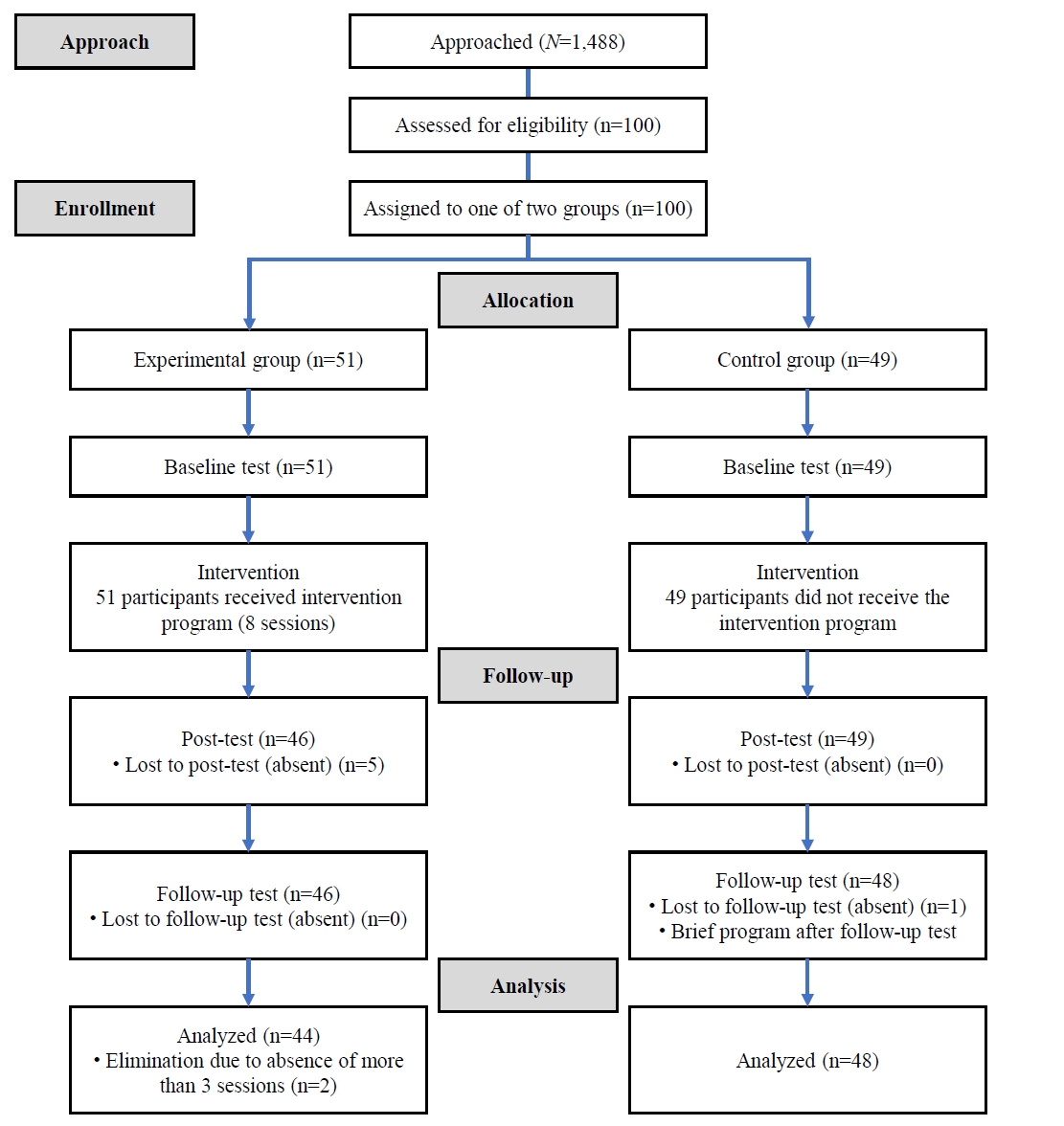
A quasi-experimental repeated-measures design was used. Participants were recipients of social services from 11 local self-sufficiency centers in Gyeonggi-do, South Korea. In total, 100 participants were recruited, with 51 assigned to the experimental group and 49 assigned to the control group. The experimental group received an eight-session program delivered by center practitioners who had been trained by mental health nurses, whereas the control group received usual services. Self-sufficiency motivation, self-esteem, and self-efficacy were assessed at three time points: baseline (pretest: T0), immediately after the intervention (post-test: T1), and 4 weeks after the intervention (follow-up: T2).
Results
Using generalized estimating equations, participants in the experimental group showed significantly greater improvements than those in the control group at both T1 and T2 in self-sufficiency motivation (T1: B=1.61, p=.030; T2: B=2.88, p<.001), self-esteem (T1: B=2.77, p<.001; T2: B=2.78, p<.001), and self-efficacy (T1: B=3.95, p=.004; T2: B=4.19, p<.001).
Conclusion
The practitioner-led program is associated with significant short-term improvements in psychosocial determinants of self-sufficiency among low-income service recipients. These findings may inform the development of community nursing interventions that support the psychosocial foundations of independent living in this population and provide a basis for training programs designed to strengthen the capacity of practitioners at local self-sufficiency centers (Clinical Research Information Service of Korea registration number: KCT0010027; registration date: December 12, 2024).
- 1,253 View
- 146 Download

- Effects of an integrated healthcare program for postpartum women: a quasi-experimental study
- Eun Suk Hwang, Ju-Hee Nho
- J Korean Acad Nurs 2025;55(4):506-518. Published online November 7, 2025
- DOI: https://doi.org/10.4040/jkan.25076
-
Abstract
PDFePub
- Purpose
This study aimed to develop and evaluate an integrated healthcare program for postpartum mothers based on Cox’s interaction model of client health behavior.
Methods
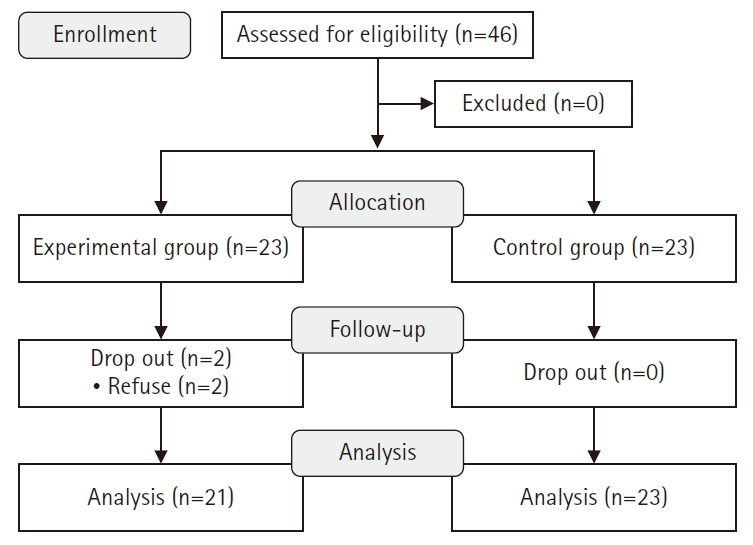
A non-equivalent control group pretest-posttest design was used. The integrated healthcare program was administered 6 times over 2 weeks to postpartum mothers in the experimental group (n=21), while the control group (n=23) received standard care. Data were collected from June 3 to July 15, 2024, through structured questionnaires measuring postpartum fatigue, depression, marital intimacy, and mother-infant attachment. Analyses were conducted using IBM SPSS ver. 23.0.
Results
The experimental group showed significantly lower postpartum fatigue (Z=–2.00, p=.023), a significantly proportion of improvement in postpartum depression (χ2=10.32, p=.012), and a significant increase in mother-infant attachment (t=1.70, p=.048) compared to the control group. However, there was no significant difference in marital intimacy between groups (Z=–0.46, p=.326).
Conclusion
These results suggest that an integrated health management program including physical health, psychological stability, and relational support can be used as an effective nursing intervention to promote health in postpartum mothers. Therefore, additional research is warranted that expands and applies integrated programs for postpartum mothers in various environments in postpartum care centers and communities.
- 4,257 View
- 528 Download
- Effects of a nursing leadership program on self-leadership, interpersonal relationships, clinical performance, problem-solving abilities, and nursing professionalism among nursing students in South Korea: a quasi-experimental study
- Sunmi Kim, Young Ju Jeong, Hee Sun Kim, Seok Hee Jeong, Eun Jee Lee
- J Korean Acad Nurs 2025;55(1):137-151. Published online February 25, 2025
- DOI: https://doi.org/10.4040/jkan.24110
-
Abstract
PDFePub
- Purpose
This study investigated the effects of a nursing leadership program on self-leadership, interpersonal relationships, clinical performance, problem-solving abilities, and nursing professionalism among nursing students in South Korea.
Methods
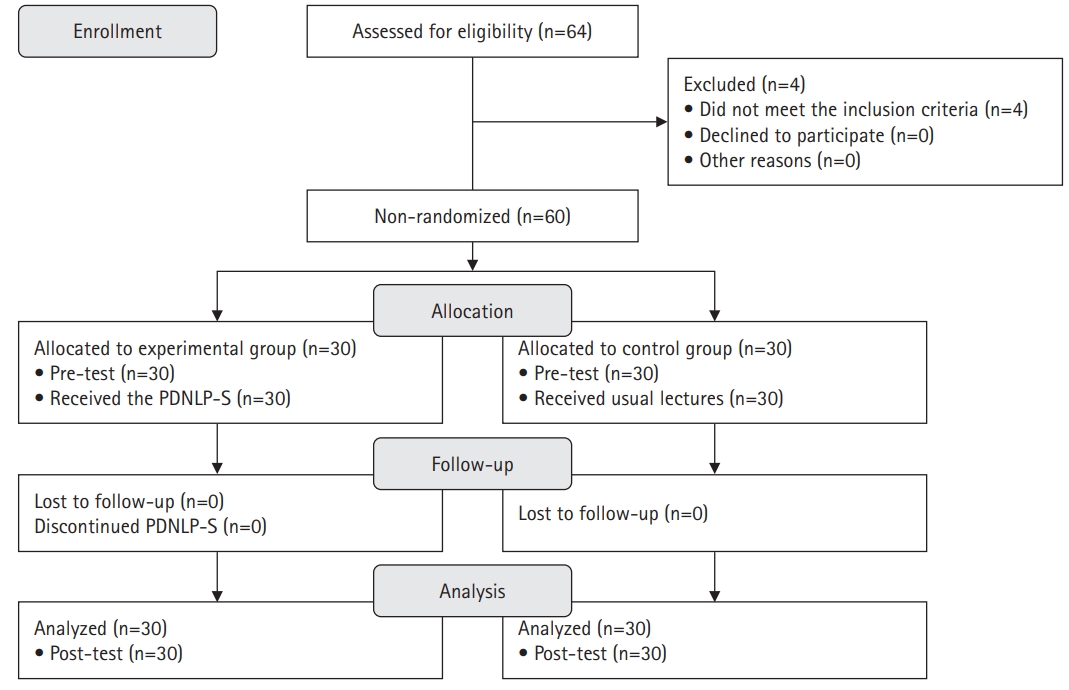
A quasi-experimental study was conducted. The Practice-Driven Nursing Leadership Program for Students (PDNLP-S) was developed based on the ADDIE model (analysis, design, development, implementation, and evaluation). This quasi-experimental study design included 60 nursing students. The experimental group (n=30) participated in the PDNLP-S for 120-minute sessions over 5 weeks, while the control group (n=30) received usual lectures. The PDNLP-S included lectures, discussions, and individual and group activities to cultivate core nursing leadership competencies such as individual growth, collaboration, nursing excellence, creative problem-solving, and influence. Data were analyzed using descriptive statistics, the Mann-Whitney U-test, and the independent t-test with IBM SPSS Windows ver. 26.0.
Results
The experimental group demonstrated significant improvements in self-leadership (t=3.28, p=.001), interpersonal relationships (t=3.07, p=.002), clinical performance (U=268.50, p=.004), and problem-solving abilities (t=2.20, p=.017) compared to the control group. No significant difference was observed in nursing professionalism (t=0.50, p=.311).
Conclusion
This study demonstrates that the PDNLP-S improved nursing students’ self-leadership, interpersonal relationships, clinical performance, and problem-solving abilities. The PDNLP-S can play a significant role in cultivating future nurse leaders by enhancing these nursing leadership competencies among nursing students. -
Citations
Citations to this article as recorded by
- Psychosocial Predictors of Developmentally Supportive Care Competency Among NICU Nurses in South Korea: Self-Leadership, Emotional Intelligence, and Nursing Professionalism
So Jin Lee, Haeryun Cho
Advances in Neonatal Care.2026;[Epub] CrossRef - Self‐Leadership and Caring as Foundations of Relational Accountability in Nursing Clinical Judgement: A Conceptual Analysis
Mahmud Ady Yuwanto, Iyus Yosep, Iqbal Pramukti, Ati Surya Mediawati
Nursing Open.2026;[Epub] CrossRef - Efficacy of structured spiritual care education program on nurses’ spiritual well-being and clinical competence: a randomized controlled trial
Mehrvash Hemati, Azita Jaberi, Naval Heydari, Marzieh Momennasab
BMC Nursing.2026;[Epub] CrossRef - Leadership Development Needs of Novice and Advanced Beginner Nurses: A Nationwide Cross-sectional Study Using Proportional Quota Sampling
Sunmi Kim, Seok Hee Jeong
Journal of Korean Academy of Nursing Administration.2026; 32(4): 275. CrossRef - Self-Determination Theory in Return to Work Interventions: A Scoping Review
Kexin Chen, Ling Yang, Jiajia Tu
Journal of Multidisciplinary Healthcare.2025; Volume 18: 7539. CrossRef
- Psychosocial Predictors of Developmentally Supportive Care Competency Among NICU Nurses in South Korea: Self-Leadership, Emotional Intelligence, and Nursing Professionalism
- 11,706 View
- 460 Download
- 4 Web of Science
- 5 Crossref
- Effect of the Spinning Babies Program on Birth Outcomes and Satisfaction during Labor: A Non-Randomized Controlled Trial
- Mi-Yeon Jeong, Hyang Mi Jung
- J Korean Acad Nurs 2024;54(4):607-619. Published online November 20, 2024
- DOI: https://doi.org/10.4040/jkan.24097
-
Abstract
PDFePub
Purpose This study evaluated the effects of the Spinning Babies program applied during labor on birth outcomes and satisfaction among pregnant women.
Methods This non-equivalent control group, non-synchronized post-test only design study included 42 participants (22 in the experimental group and 20 in the control group). The Spinning Babies program was conducted four times in the experimental group during the first and second stages of delivery for 50 min per session. The program comprised performing pelvic circles on a birth ball, followed by wide squatting and adopting of open knee-chest and side-lying positions.
Results Compared with those in the control group, pregnant women in the experimental group had a significantly shorter labor time (t = - 6.64,
p < .001), a higher success rate for normal vaginal delivery (χ 2 = 4.86,p = .043), improved Apgar scores of newborns (z 2 = - 2.18,p = .029), differences in neonatal oxygen therapy use (χ 2 = 4.86,p = .043), and improved birth satisfaction (t = 11.99,p < .001).Conclusion The Spinning Babies program improves the birth environment by increasing the normal vaginal delivery success rate, as well as pregnant women’s birth satisfaction, and promotes neonatal health.
-
Citations
Citations to this article as recorded by- A systematic review of pulmonary rehabilitation nursing interventions for patients with chronic obstructive pulmonary disease
Da-Jung Kim
Journal of Exercise Rehabilitation.2025; 21(5): 234. CrossRef
- A systematic review of pulmonary rehabilitation nursing interventions for patients with chronic obstructive pulmonary disease
- 11,058 View
- 496 Download
- 1 Web of Science
- 1 Crossref
- Development and Effectiveness of Progressive Simulation Education Program on Medication Safety for Nursing Students
- Se-Young Jung, Eun-Young Kim
- J Korean Acad Nurs 2024;54(4):563-576. Published online October 14, 2024
- DOI: https://doi.org/10.4040/jkan.24054
-
Abstract
PDFePub
Purpose This study aimed to develop and verify a progressive simulation education program aimed at enhancing nursing students’ medication safety competency.
Methods A non-equivalent control group pretest-posttest design was adopted. The participants were 40 third-year nursing students with no prior simulation education experience, comprising 20 each in the experimental and control groups. The experimental treatment utilized a hybrid simulation approach incorporating both full-body mannequins and standardized patients and was, conducted over three sessions with durations of 65, 80, and 95 minutes for the first, second, and third sessions, respectively, for a total of 240 minutes. The program was constructed based on Jeffries’ simulation model.
Results The levels of medication safety competencies, communication self-efficacy, learning self-efficacy, and problem-solving abilities of the experimental group were significantly higher than that of the control group.
Conclusion Our results confirm that the program effectively improves nursing students’ medication safety competence, communication self-efficacy, learning self-efficacy, and problem-solving ability. Therefore, this program can serve as a basis for developing educational strategies related to medication safety for nursing education institutions. Furthermore, the program is anticipated to have a positive impact on novice nurses’ education and practice in clinical settings.
-
Citations
Citations to this article as recorded by- Safety-centered simulation education using the 360-degree video room of errors: A mixed-methods study
Jiyoung Kim, Yeji Kim, Hyunji Park, Jiyeong Won, Jiwon Yun, Yuran Lee
Clinical Simulation in Nursing.2026; 111: 101899. CrossRef - Efficacy of Simulation Systems in Educational Interventions for New Graduate Nurses
Moon-Hee Kang, Eunju Seo
Journal of information and communication convergence engineering.2026; 24(3): 327. CrossRef
- Safety-centered simulation education using the 360-degree video room of errors: A mixed-methods study
- 7,210 View
- 570 Download
- 1 Web of Science
- 2 Crossref
- The Effects of the Infant Health Promotion Program for Mothers with Their Firstborn Infants
- Chae-Min Yoon, Mi-Ae You
- J Korean Acad Nurs 2023;53(6):666-677. Published online December 31, 2023
- DOI: https://doi.org/10.4040/jkan.23056
-
Abstract
PDF
- Purpose
This study was intended to evaluate the effects of an Infant Health Promotion Program (IHPP) for mothers with their firstborn infants.
Methods
This study employed a non-equivalent control group pretest-posttest design. The participants consisted of 17 mothers with their firstborn infants in the experimental group and 17 in the control group from two women’s hospitals. The experimental group received eight sessions of the program for four weeks. The collected data were analyzed using the chi-square test and repeated-measures ANOVA using an SPSS/WIN ver. 22.0.
Results
The experimental group receiving the program had statistically significant higher levels of infant health promotion knowledge (F = 22.91, p < .001), social support (F = 27.64, p < .001), maternal role confidence (F = 8.25, p = .005) and health promotion behavior for infants (F = 16.85, p < .001) than the control group. The experimental group had a statistically significant lower level of parenting stress than the control group (F = 29.93, p < .001).
Conclusion
The study’s findings indicate that the IHPP is effective in improving health promotion knowledge, social support, and maternal role confidence and decreasing parenting stress among mothers with their firstborn infants. A method of delivering intervention, focused on readily accessible online platforms, coupled with intervention strategies grounded in the theory of self-efficacy, proves to be an advantageous approach for this particular target group. -
Citations
Citations to this article as recorded by- The Impact of Mothers’ Smartphone Use, eHealth Literacy, Maternal Role Performance Confidence, and Online Social Support on Health Promotion Behavior for Infants and Toddlers
Se-Young JUNG, So Yeon PARK
Korean Journal of Health Promotion.2024; 24(3): 134. CrossRef - A qualitative study on the oral health of mobile platform workers: focus on tooth brushing experience
Jae-In Ryu, Na-Yeon Tak
Journal of Korean Academy of Oral Health.2024; 48(2): 40. CrossRef
- The Impact of Mothers’ Smartphone Use, eHealth Literacy, Maternal Role Performance Confidence, and Online Social Support on Health Promotion Behavior for Infants and Toddlers
- 2,238 View
- 54 Download
- 2 Crossref
- A Caring Program for Health Promotion among Women Who Have Experienced Trauma: A QuasiExperimental Pilot Study
- Goun Kim, Heejung Kim, Jeongok Park, Hee Sun Kang, Soojin Kim, Sunah Kim
- J Korean Acad Nurs 2023;53(5):500-513. Published online October 31, 2023
- DOI: https://doi.org/10.4040/jkan.22120
-
Abstract
PDF
- Purpose
Women are more vulnerable to post-traumatic stress (PTS) than men, causing several health problems. Nurses should understand and work with women who have experienced trauma and provide interventions to promote their physical, social, and mental health.
Methods
This quasi-experimental pilot study used a one-group pre-test/post-test design. Data were collected from 14 women recruited between December 2019 and May 2020 from a self-sufficiency support center in South Korea for sexually-exploited women who had experienced trauma. The program consisted of six one-on-one intervention sessions per week for six weeks. Each session averaged 60~120 minutes. Participants were assessed at pre-test, post-test, and one-month follow-up. Changes in outcome variables over time were analyzed using the Wilcoxon signed-rank and Friedman tests.
Results
The caring program for health promotion was divided into six sessions: understanding the self, sharing traumatic events and negative emotions, reframing the meaning of traumatic events, identifying thoughts and physical and emotional responses, developing health promotion activities, and maintaining a positive attitude during the process of change. As a result of the caring program, PTS (F = 36.33, p < .001), depression (F = 24.45, p < .001), health-promoting behaviors (F = 7.06, p = .004), and self-esteem (F = 19.74, p < .001) among the participants differed significantly at pre-test, post-test, and follow-up.
Conclusion
This study provides foundational information for the implementation of a theory-driven program by nurses in clinical and community settings to provide comprehensive care for women who have experienced trauma. -
Citations
Citations to this article as recorded by- Development and Effectiveness of an Interpersonal Relationship Improvement Program for Inpatients with Chronic Schizophrenia: Quasi-experimental/Non-randomised Evaluation
Jae-Eun Choi, Jeongyee Bae
Journal of Korean Academy of psychiatric and Mental Health Nursing.2025; 34(2): 188. CrossRef - Prediction and Feature Selection of Mastectomy-Related Post Traumatic Stress Disorder (PTSD) Using Machine Learning Among Breast Cancer Patients in Bangladesh
Syed Billal Hossain, Md. Mizanoor Rahman, Kapashia Binte Giash, Md. Hazrat Ali, Mst. Asma Akter, A.B.M. Alauddin Chowdhury
Cancer Informatics.2025;[Epub] CrossRef
- Development and Effectiveness of an Interpersonal Relationship Improvement Program for Inpatients with Chronic Schizophrenia: Quasi-experimental/Non-randomised Evaluation
- 7,108 View
- 89 Download
- 1 Web of Science
- 2 Crossref
- Development and Evaluation of an Integrated Health Management Program for Psychiatric Patients with Metabolic Syndrome
- Yun Bock Kwak, Ji Young Kim
- J Korean Acad Nurs 2022;52(3):261-277. Published online June 30, 2022
- DOI: https://doi.org/10.4040/jkan.21222
-
Abstract
PDF
- Purpose
This study developed an integrated health management program for metabolic syndrome in psychiatric patients and examined its effects on self-efficacy, healthy lifestyle, physiological indicators, knowledge of metabolic syndrome, attitudes toward healthy behavior, and social support.
Methods
A non-equivalent control group pretest posttest design was used. The participants were 65 psychiatric patients with metabolic syndrome in psychiatric rehabilitation centers, with 33 in the experimental group and 32 in the control group. The experimental group participants engaged in daily mobile application and walking exercises three times a week for more than 40 minutes over 8 weeks, while those in the control group were provided education booklets. The outcomes were measured using self-report questionnaires, anthropometrics, and blood analyses. Intervention effects were analyzed using the independent t-test, Mann—Whitney U test, ANCOVA, and Ranked ANCOVA.
Results
The experimental group showed a significant increase in self-efficacy (F = 8.85, p = .004, ηp2 = .13) and knowledge of metabolic syndrome (t = 2.60, p = .012, d = 0.60) compared to the control group. Additionally, the experimental group demonstrated a significant decrease in waist circumference (Z = - 2.34, p = .009, d = 0.58) and body mass index (Z = - 1.91, p = .028, d = 0.47) compared to the control group.
Conclusion
The integrated health management program for psychiatric patients with metabolic syndrome is effective in improving self-efficacy and knowledge of metabolic syndrome and decreasing physiological indicators such as waist circumference and body mass index. -
Citations
Citations to this article as recorded by- User evaluation of a mobile education application for the management of metabolic syndrome among cancer survivors
Ji-Su Kim, Minhae Kim, Yeji Seo
European Journal of Oncology Nursing.2023; 63: 102276. CrossRef - Development and Evaluation of a Web-Based Self-Management Program for Korean Adult Patients with Irritable Bowel Syndrome Based on the Information–Motivation–Behavioral Skills Model
Seohyeon Hwang, Woori Na, Dayoung Oh, Cheongmin Sohn
Applied Sciences.2023; 13(12): 6915. CrossRef - Effect of Patient Safety Training Program of Nurses in Operating Room
Peijia Zhang, Xin Liao, Jie Luo
Journal of Korean Academy of Nursing.2022; 52(4): 378. CrossRef
- User evaluation of a mobile education application for the management of metabolic syndrome among cancer survivors
- 3,829 View
- 150 Download
- 4 Web of Science
- 3 Crossref
- Development and Effects of Head-Mounted Display-Based Home-Visits Virtual Reality Simulation Program for Nursing Students
- Min Kweon Ahn, Chong Mi Lee
- J Korean Acad Nurs 2021;51(4):465-477. Published online August 31, 2021
- DOI: https://doi.org/10.4040/jkan.21051
-
Abstract
PDF
- Purpose
This study aimed to evaluate the effects of head monted display based home-visits virtual reality simulation (HVRS) program developed for undergraduate nursing students.
Methods
A nonequivalent control group with a non-synchronized design was utilized and 84 participants (experimental group, 44; control group, 40) were recruited from August 31, 2020 to November 8, 2020 in Gwangju metropolitan city. The HVRS program consisted of scenarios of three nursing cases, hypertension, diabetes mellitus, and stroke. Data were analyzed SPSS version 25.0 for Windows.
Results
At the completion of HVRS, significant differences were found between groups in knowledge of home-visits (t = 4.73, p < .001), self-confidence (t = 6.63, p < .001), self-efficacy (t = 3.13, p = .002), and clinical competency (t = 4.13, p < .001). No significant difference was shown between groups in nursing knowledge about strokes, a subcategory of knowledge pertaining to home visits.
Conclusion
The HVRS program developed for undergraduate nursing students is effective in improving knowledge of home-visits, self-confidence, self-efficacy, and clinical competency for nursing students. -
Citations
Citations to this article as recorded by- Icarus new rising? A narrative review on virtual reality-based motor interventions in older adults
André Ramalho, Pedro Duarte-Mendes, Rui Paulo, João Serrano, João Petrica
Human Movement.2026;[Epub] CrossRef - Effects of a Standardized Patient-Based Home Nursing Simulation on Learning Self-Efficacy, Problem-Solving Process, and Practicum Satisfaction in Nursing Students
Young Hee Kim, Minjae Lee
Journal of Korea Society for Simulation in Nursing.2026; 14(1): 77. CrossRef - Room of errors simulation for improving patient safety knowledge, attitudes, and performance confidence among nursing students: a quasi-experimental study
Sunmi Jeon, Minyoung Kim
Frontiers in Medicine.2026;[Epub] CrossRef - The Effectiveness of Simulation‐Based Versus Patient‐Based Clinical Education in Nursing: A Systematic Review and Meta‐Analysis
Louise Prothero, Naim Abdulmohdi, Siân Shaw, Mary Edmonds, Catherine Meads
Nursing Open.2026;[Epub] CrossRef - Comparison between virtual reality and traditional lecture methods in educating respiratory therapy on pediatric airway diseases
Wen-Jing Hsu, Yi-Hsuan Tang, Wei-Chih Chen, Yu-Sheng Lee, Pei-Chen Tsao, Wei-Yu Chen, Ying-Ying Yang, Hsin-Kuo Ko, Sheng-Wei Pan, Yu-Fen Ting, Shih-Hsing Yang, Mei-Jy Jeng
Journal of the Chinese Medical Association.2025; 88(3): 205. CrossRef - Effects of Community Nursing Simulation Education on Nursing Core Competencies, Clinical Judgment, and Clinical Performance of Nursing College Students
Hoo-Jeung Cho, Kyong-Sun Chong
European Journal of Investigation in Health, Psychology and Education.2025; 15(6): 92. CrossRef - Effectiveness of the IPE-Sim based dementia management (IPE-SDM) program on community-dwelling elders for nursing and medical students
Sooyoung Jun
Clinical Simulation in Nursing.2025; 106: 101790. CrossRef - Immersive virtual reality in nursing education: A scoping review of components, outcome variables, and interaction modes
Sunghwa Na, Jihyung Son, Hyun Joo Lee
Nurse Education Today.2025; 155: 106877. CrossRef - Effects of virtual reality-based disaster simulation education on nursing students
Kyeng-Jin Kim, Moon-Ji Choi, MinJi Kim, Yong-Hong Kuo
PLOS One.2025; 20(10): e0329563. CrossRef - A VR-Based Trauma Nursing Education Program for Clinical Nurses: Integrating Jeffries’ Model and the 5E Learning Cycle
Heeyeon Kim, Gyuli Baek, Eunju Lee
Healthcare.2025; 13(19): 2542. CrossRef - Effects of Diabetes Home-Visiting Healthcare Simulation Education on Nursing Students Using Virtual Reality
Young-Sun Ha, Yong-Kyung Park, Hye-Sun Byun, Kyeng-Jin Kim, Moon-Ji Choi
Journal of Digital Contents Society.2025; 26(9): 2501. CrossRef - Exploring the effects of extended reality head-mounted display nervous system assessment training for nursing students: A pilot feasibility study
Jiyoung Kim, Hyunjung Shin
Nurse Education Today.2024; 133: 106089. CrossRef - Are virtual reality intravenous injection training programs effective for nurses and nursing students? A systematic review
Jin Young Kim, Juri Kim, Mikyoung Lee
Nurse Education Today.2024; 139: 106208. CrossRef - Enhancing nursing competency through virtual reality simulation among nursing students: a systematic review and meta-analysis
Mi-Kyoung Cho, Mi Young Kim
Frontiers in Medicine.2024;[Epub] CrossRef - Effects of Immersive Technology–Based Education for Undergraduate Nursing Students: Systematic Review and Meta-Analysis Using the Grading of Recommendations, Assessment, Development, and Evaluation (GRADE) Approach
Subin Park, Hui Ju Shin, Hyoeun Kwak, Hyun Joo Lee
Journal of Medical Internet Research.2024; 26: e57566. CrossRef - Development and Effects of Metaverse-Based Intradermal Injection Content for Nursing Students
Min-Kweon Ahn
Journal of Digital Contents Society.2024; 25(9): 2543. CrossRef - Pressure Ulcer Management Virtual Reality Simulation (PU-VRSim) for Novice Nurses: Mixed Methods Study
Soo Youn Jung, Kyoung Ja Moon
JMIR Serious Games.2024; 12: e53165. CrossRef - Effect of virtual reality head-mounted display on academic motivation and skills of millennial nursing students in teaching infection prevention and control
Andri Nugraha, Iin Patimah, Engkus Kusnadi, Wikky Fawwaz Al Maki
Journal of Research Development in Nursing and Midwifery.2024; 21(3): 3. CrossRef - Effect of Augmented Reality Smart Glasses-based Nursing Skills Training for Nursing Students’ Medication Administration Safety Competency: A Quasi-experimental Study
Jiyoung Kim, Narae Heo
Journal of Korean Academy of Fundamentals of Nursing.2023; 30(4): 449. CrossRef - Instructor's Experience of Extended Reality Applied to Nursing Education
Jiyoung Kim, Hyeoncheol Jeong
Clinical Simulation in Nursing.2023; 84: 101450. CrossRef - Validity and reliability of positive attitudes toward and perceived importance of wearable display technology as an effective learning tool among nursing students
Jiyoung Kim, Narae Heo, Hyuncheol Kang
Nurse Education in Practice.2023; 73: 103812. CrossRef - A Study on the Feasibility of Introducing XR in Nursing Education Core Fundamental Nursing Skills
Yunja Hwang, Jaeyeon Jeong, Yoo Mi Jeong
Journal of Digital Contents Society.2023; 24(4): 775. CrossRef - Virtual Reality Simulation for Advanced Infection Control Education in Neonatal Intensive Care Units: Focusing on the Prevention of Central Line-Associated Bloodstream Infections and Ventilator-Associated Infections
Jimin Ryu, Mi Yu
Healthcare.2023; 11(16): 2296. CrossRef - A Delphi study on the Needs for the Development of a Customized Program based on Augmented Reality for Preterm infants and their Families in the Neonatal Intensive Care Unit
Jae Eun Sin, Ah Rim Kim
Journal of Digital Contents Society.2022; 23(3): 455. CrossRef - The development and effects of metaverse-based core nursing skill contents of vital signs measurements and subcutaneous injections for nursing students
Min Kweon Ahn
The Journal of Korean Academic Society of Nursing Education.2022; 28(4): 378. CrossRef - Nurses’ behavioral intention in using virtual clinical simulation training: By structural equation modeling
Hyein Choi, Sunghee H. Tak
Nurse Education in Practice.2022; 65: 103492. CrossRef
- Icarus new rising? A narrative review on virtual reality-based motor interventions in older adults
- 3,752 View
- 180 Download
- 17 Web of Science
- 26 Crossref
- Effectiveness of Drinking Reduction Program Focused on Self-Determination Enhancement for College Students with Problematic Drinking
- Jin-Kyoung Ma, Moon-Sook Yoo
- J Korean Acad Nurs 2021;51(3):265-279. Published online June 30, 2021
- DOI: https://doi.org/10.4040/jkan.20247
-
Abstract
PDF
- Purpose
This study examined the impact of a drinking reduction program on drinking motivation, drinking refusal self-efficacy, and problematic drinking behaviors in college students with problematic drinking habits.
Methods
This study incorporated a non-equivalent control group prepost-test design. Study participants included 58 college students who scored 12 or more in the AUDIT-K test (Alcohol Use Disorders Identification Test-Korean version) (experimental group: 30; control group: 28). The intervention consisted of eight sessions and was conducted once a week. It was designed to promote autonomy, competence, and relatedness-the three elements of basic psychological needs in self-determination theory. The participants were assessed before the intervention, immediately after, and four weeks post intervention. Data were collected from October 12 to December 31, 2017. The analysis employed the chi-square test, Fisher’s exact test, independent t-test, and repeated measures ANOVA using SPSS/WIN 22.0.
Results
The mean age of participants was 21.8 years. There were 30 men (51.7%) and 28 women (48.3%). The differences in drinking motivation, drinking refusal self-efficacy, and problematic drinking behaviors were statistically significant for the group by time interaction (F = 42.56, p < .001; F = 54.96, p < .001; F = 39.90, p < .001, respectively). Conclusion: The findings indicate that the intervention effectively decreases drinking motivation, increases drinking refusal self-efficacy, and decreases problematic drinking behaviors. It can be an efficient strategy for college students with problematic drinking habits to enhance their self-determination ability. -
Citations
Citations to this article as recorded by- A Self-Determination Theory–Based Cardiovascular Disease Prevention Program for Community-Dwelling Middle-Aged Women
Yein Lee, Yunhee Kim
Journal of Community Health Nursing.2026; 43(3): 222. CrossRef - Effects of a Self-Determination Theory-Based Problem Drinking Prevention Program Using a Self-Management Application for College Students: A Nonequivalent Control Group Pretest-Posttest Design
Dallong Han
Journal of Korean Academy of psychiatric and Mental Health Nursing.2026; 35(3): 284. CrossRef - Effects of an intervention based on self-determination theory on self-health management capabilities of middle-aged women in rural areas through the concept of leisure cafeteria
Yang Jun Park, Heui Sug Jo, Hyang Hee Hwang, Yukyung Park
Korean Journal of Health Education and Promotion.2022; 39(1): 59. CrossRef - Development and Effects of a Self-Determination Improvement Program for Preventing Non-Suicidal Self-Injury in Adolescents: A Pilot Study
Jae Woon Lee, In Sook Kim, Ji Won Kim
Journal of Korean Academy of Fundamentals of Nursing.2022; 29(4): 506. CrossRef
- A Self-Determination Theory–Based Cardiovascular Disease Prevention Program for Community-Dwelling Middle-Aged Women
- 2,720 View
- 76 Download
- 1 Web of Science
- 4 Crossref
- Effects of Program to Promote Obesity Prevention Behaviors on Pre-Schoolers: Focused on Kindergartener in Korea
- Inju Hwang, Kyung-Sook Bang
- J Korean Acad Nurs 2021;51(2):188-202. Published online April 30, 2021
- DOI: https://doi.org/10.4040/jkan.20217
-
Abstract
PDF
- Purpose
This study aimed to develop a program to promote obesity prevention behaviors for pre-schoolers and to confirm the effectiveness of the program in Korea.
Methods
The program comprised 8 sessions for 4 weeks including combined classroom lectures and physical activities. A non-equivalent control group pre-post test study design was used, and seventy two children, aged 5 to 6 years (experimental group: 33, control group: 39) and their parents participated in the study. To examine the effectiveness of the program, children’s knowledge, intake of sugar-added beverages and fruits & vegetables, time of outdoor play and screen time, and parental self-efficacy were measured. Data were analyzed with SPSS/WIN ver. 22.0 and R 4.0.2, using descriptive analysis, chi-square test, Fisher’s exact test, the independent t-test, and Analysis of covariance (ANCOVA).
Results
The results showed that the experimental group reported significantly increased knowledge (p < .001) and longer time of outdoor play on weekends (p = .033). However, there were no significant differences in the intake of sugar-added beverages and fruits & vegetables, screen time, and parental self-efficacy in the two groups.
Conclusion
This study confirms the applicability of an obesity prevention intervention at kindergartens in Korea. The results can be used as basic data for the study of childhood obesity prevention in Korea. -
Citations
Citations to this article as recorded by- Development of health literacy education program for early childhood to prevent smoking hazards
Sangah Lee, Jiye Kim, Jiyoung Lee, Hyekyeong Kim
Korean Journal of Health Education and Promotion.2022; 39(4): 55. CrossRef - The Let’s Eat Healthy and Move at School program for adolescents in South Korea: Program design, implementation, and evaluation plan using intervention mapping
Jiyoung Park, Gill A. Ten Hoor, Seolhyang Baek, Sochung Chung, Yang-Hyun Kim, Gahui Hwang
Child Health Nursing Research.2021; 27(3): 225. CrossRef
- Development of health literacy education program for early childhood to prevent smoking hazards
- 3,904 View
- 136 Download
- 2 Crossref
- Effect of Direct Breastfeeding Program for Premature Infants in Neonatal Intensive Care Unit
- Ji Hyun Kang, Hyunmi Son, Shin Yun Byun, Gyumin Han
- J Korean Acad Nurs 2021;51(1):119-132. Published online February 28, 2021
- DOI: https://doi.org/10.4040/jkan.20240
-
Abstract
PDF
- Purpose
This study aimed to identify the effects of a direct breastfeeding program for premature infants in neonatal intensive care units (NICUs).
Methods
This quasi-experimental study was conducted during August 2016 to April 2017. Sixty mothers of premature infants were assigned to the experimental (n = 31) or control groups (n = 29). The program was comprised of breastfeeding education and direct breastfeeding support. The experimental and control groups were provided with education and counseling on breastfeeding at the time of admission and discharge. In the experimental group, the mothers initiated oral feeding with direct breastfeeding and engaged in breastfeeding at least seven times during the NICU stay. The collected data were analyzed by the χ2 -test and repeated measures ANOVA using an SPSS program.
Results
The experimental group showed a higher direct breastfeeding practice rate (χ2 = 19.29, p < .001), breastfeeding continuation rate (χ2 = 3.76, p < .001), and self-efficacy (F = 25.37, p < .001) than the control group except for maternal attachment.
Conclusion
The direct breastfeeding program in the NICU has significant effects on the practice and continuation rate of breastfeeding and breastfeeding self-efficacy. Therefore, this program can be applied in the NICU settings where direct breastfeeding is limited. -
Citations
Citations to this article as recorded by- Critical Factors Influencing the Uptake of Breastfeeding Support Interventions in Neonatal Intensive Care Units: A Scoping Review
Shela Akbar Ali Hirani, Oladayo Nathaniel Awojobi
International Journal of Environmental Research and Public Health.2026; 23(6): 707. CrossRef - Exploration of Family-Centered Care in NICUs: A Grounded Theory Methodology
Young Ah Park, YeoJin Im
Qualitative Health Research.2025; 35(10-11): 1231. CrossRef - Fresh Parent’s Own Milk for Preterm Infants: Barriers and Future Opportunities
Carrie-Ellen Briere, Jessica Gomez
Nutrients.2024; 16(3): 362. CrossRef - Development and Effectiveness Evaluation of Comprehensive Mobile-Based, Breastfeeding Promotion Program for Mothers with Gestational Diabetes
Eunju Kwak, Seungmi Park
Journal of Korean Academy of Nursing.2024; 54(2): 224. CrossRef
- Critical Factors Influencing the Uptake of Breastfeeding Support Interventions in Neonatal Intensive Care Units: A Scoping Review
- 4,635 View
- 268 Download
- 3 Web of Science
- 4 Crossref
Original Articles
- Effect of Emotional Coaching Program for Clinical Nurses on Resilience, Emotional Labor, and Self-efficacy
- Kyung Ryu, Jong Kyung Kim
- J Korean Acad Nurs 2020;50(3):419-430. Published online June 30, 2020
- DOI: https://doi.org/10.4040/jkan.19194
-
Abstract
PDF
- Purpose
This study aimed to assess the effect of the emotional coaching program for hospital nurses.
Methods
The study used anon-equivalent control group pretest-posttest design, and participants included 60 nurses (30 in the experimental group and 30 in thecontrol group) who worked at a general hospital. The experimental group attended four sessions, one per week, with each session lastingtwo and a half hours. Collected data were analyzed using descriptive statistics, Fisher’s exact test, x2 test, t-test, paired t-test, and repeatedmeasures ANOVA using SPSS WIN 23.0 program.
Results
Significant differences were shown between the experimental and the controlgroups regarding emotional labor (F=68.40, p<.001), resilience (F=48.77, p<.001), and self-efficacy (F=15.31, p<.001).
Conclusion
Theemotional coaching program for nurses is useful for enhancing nurses’ emotional labor management, resilience, and self-efficacy. In addition,this program may serve as a basis for providing emotional coaching to nurses in the future. -
Citations
Citations to this article as recorded by- The Influence of Role Conflict, Emotional Labor, and Resilience on Burnout in Nurses: A Descriptive Correlational Study
Ahsil Lee, Kuem Sun Han, Soo Kyung Park, Sung Reul Kim, Soo Yeon Lee, Nari Lee, Siyoung Koak
STRESS.2026; 34(1): 25. CrossRef - The Relationship Between Perceived Self-Efficacy and Resilience Among Pediatric Nurses in Eastern Province of Saudi Arabia
Bushra Bawazier, Hebah Almulla, Mansour Mansour, Sama Hammad, Rana Alameri, Latifa Aldossary, Tahani AlShammari
Risk Management and Healthcare Policy.2025; Volume 18: 739. CrossRef - Analysis of the correlation between work stress and emotional labor in college counselors: the moderating effect of psychological resilience
Tianlin Chen, Shijian Sun, Lan Luo, Yongfei Chen
BMC Psychology.2025;[Epub] CrossRef - The Moderating Effect of Nursing Organizational Culture on the Relationship between Resilience and Clinical Competence of New Graduate Nurses
Hanna Lee, Eun-Jun Park
Journal of Korean Academy of Nursing Administration.2024; 30(5): 483. CrossRef - Impact of Emotional Labor and Positive Psychological Capital on the Turnover Intention of Nurses Caring for Patients with COVID-19: A Descriptive Survey Study
Mira Kwon, Yeoungsuk Song, Majd T. Mrayyan
Journal of Nursing Management.2024; 2024: 1. CrossRef - Mentorship in nursing: A review of approaches to defining the concept in international and Russian publications
K. V. Kuzmin, L. E. Petrova, V. S. Kharchenko
Kuban Scientific Medical Bulletin.2024; 31(4): 89. CrossRef - Effects of grit, calling, and resilience on the retention intention of general hospital nurses
Gi Ran Lee, Imsun Lee, Mihee Chung, Jiyeon Ha
International Nursing Review.2024; 71(4): 766. CrossRef - Effect of Transition Shock on Intention to Stay in Newly Graduated Nurses : The Mediating Effect of Positive Psychological Capital
Hyuna Kam, Chanhee Kim, Yeonok Yoon, Heeyoung Shin, Junghwa Lee, Myoungohk Kim
Journal of Korean Critical Care Nursing.2024; 17(3): 25. CrossRef - Psychological Intervention to Promote Resilience in Nurses: A Systematic Review and Meta-Analysis
Suk-Jung Han, Young-Ran Yeun
Healthcare.2023; 12(1): 73. CrossRef - The relationship between secondary traumatic stress and burnout in critical care nurses: The mediating effect of resilience
Yun Jeong Jeong, Sujin Shin
Intensive and Critical Care Nursing.2023; 74: 103327. CrossRef - Effects of the Resilience of Nurses in Long-Term Care Hospitals during on Job Stress COVID-19 Pandemic: Mediating Effects of Nursing Professionalism
Bom-Mi Park, Jiyeon Jung
International Journal of Environmental Research and Public Health.2021; 18(19): 10327. CrossRef
- The Influence of Role Conflict, Emotional Labor, and Resilience on Burnout in Nurses: A Descriptive Correlational Study
- 3,637 View
- 151 Download
- 7 Web of Science
- 11 Crossref
- Development and Evaluation of Suicide Prevention Nursing Competency Programs for Visiting Nurses
- Jung Eun Kim, Suk-Sun Kim
- J Korean Acad Nurs 2020;50(1):14-25. Published online January 31, 2020
- DOI: https://doi.org/10.4040/jkan.2020.50.1.14
-
Abstract
PDF
Abstract Purpose: The purpose of this study was to develop a suicide prevention nursing competency program for visiting nurses, and to examine the effect of this program on suicide prevention-related knowledge, attitudes, and behaviors.
Methods: A total of 66 visiting nurses were recruited from 10 public health centers and divided equally into the experimental and control group. For the experimental group, the suicide prevention nursing competency program was provided twice a week for 120 minutes across 3 weeks. Participants were asked questions related to suicide prevention knowledge, attitudes, and behaviors at pre, post, and 1 month after the intervention. Data were analyzed using descriptive statistics, a t-test, repeated measure ANOVA, and Friedman test.
Results: There were significant differences in knowledge and behaviors at the measured time periods, and significant differences in attitudes and behaviors between the two groups. There were also significant interactions between groups and times in attitudes and behaviors. These results suggest that the effects of the program were persistent until the 1-month follow-up.
Conclusion The developed suicide prevention nursing competency program is effective in evidence-based education for visiting nurses to increase suicide prevention-related knowledge, attitudes, and behaviors.
-
Citations
Citations to this article as recorded by- Effectiveness of Chungcheongnam-do Suicide Prevention Gatekeeper Training Program
Hyun Woo Jung, Ok Kim, Seungjin Lee, Sujin Lee, Ji young Jung, Sangeun Lee, Mijin Lee, Eunhye Gil, Jung Jae Lee
Journal of Korean Neuropsychiatric Association.2026; 65(2): 84. CrossRef - Effects of a health literacy program on COVID-19 awareness and preventive behaviors among older adults in Bangkok, Thailand: a quasi-experimental study
Walaya Tupanich, Sasawan Attaworakun, Suteekarn Chaiyalap, Nattanan Wattanawikan
Journal of Korean Academy of Nursing.2026; 56(3): 306. CrossRef - Development and Effectiveness of a School-Based Gatekeeper Training Program for Suicide Prevention in Elementary School Students
Su Won Song, Min Ji Kim, Mi Hwa Kim, Mi Nam Bae, Woo Hwi Ahn, Ju Hee Park, Seung-Gul Kang
Korean Journal of Child Studies.2026; 47(3): 39. CrossRef - Effects of an online suicide crisis nursing education program on suicide prevention information literacy, attitudes toward suicide, and suicide prevention behaviors among general ward nurses in general hospitals
Ji Yeon Park, Hee Sook Kim
The Journal of Korean Academic Society of Nursing Education.2026; 32(3): 382. CrossRef - Gatekeeper competencies for suicide prevention among Korean social work students: a path model of the relationship between education and gatekeeper intention
Jungyai Ko
Frontiers in Public Health.2025;[Epub] CrossRef - Evaluating the Longitudinal Efficacy of Suicide CARE (a Korean Standard Gatekeeper Training Program) in a General Community Sample: A Randomized Controlled Trial
Jinmi Seol, Hwa-Young Lee, Sang Min Lee, Seon Wan Ki, Sung Joon Cho, Kang Seob Oh, Jong-Woo Paik
Psychiatry Investigation.2024; 21(12): 1329. CrossRef - Factors Related to Nursing Practices of General Visiting Nurses for Clients With Suicidal Ideation in Japan
Tomoko Chijiiwa, Kayoko Ishimura, Mutsuo Deguchi
Journal of Psychosocial Nursing and Mental Health Services.2023; 61(1): 47. CrossRef - Effectiveness of Gatekeeper Training for Families of People With Mental Disorders in Korea: A Randomized Controlled Trial
Deuk-Kweon You, Jeoung-Mo Son, Tae-Yeon Hwang
Psychiatry Investigation.2023; 20(12): 1185. CrossRef - Effectiveness of an Educational Intervention on Clinical Competency among Mental Health Nurses Working at a Government Mental Health Hospital: A Quasi-experimental Study
Manal S.J. Alzahrani, Loujain S. Sharif
The Open Nursing Journal.2023;[Epub] CrossRef - Relationships among Knowledge and Skills about Suicide Prevention, Attitudes toward Suicide, and Burnout of Suicide Prevention Work of Nurses at Mental Health Welfare Centers: A Mixed Methods Study
Hee-Ra Dong, Ji Min Seo
Journal of Korean Academy of Nursing.2022; 52(1): 92. CrossRef - How Should We Approach Nurse Suicide in Korea: With the Aspect of Prevention-Intervention-Postvention Management
Hyoung Suk Kim, Hyun Ji Bae, Kyeong Hwa Kang
Journal of Korean Academy of Nursing.2021; 51(4): 408. CrossRef
- Effectiveness of Chungcheongnam-do Suicide Prevention Gatekeeper Training Program
- 3,991 View
- 117 Download
- 8 Web of Science
- 11 Crossref
- The Effect of Behavior Modification on Enhancing Patient Adherence to Tuberculosis Treatment Regimens
- Eun Lee Chung
- Journal of Nurses Academic Society 1996;26(3):697-708. Published online March 30, 2017
- DOI: https://doi.org/10.4040/jnas.1996.26.3.697
-
Abstract
PDF
Most efforts to improve tuberculosis treatment adherence target the patient and his or her behavior. This study examined the effects of behavioral modification training for these patients. Based on Bandura's behavioral principles of modeling, intervention strategies using a video program were devised to elicit specific patient target behaviors considered to improve patients' adher ence to tuberculosis treatment regimens. A random assignment, two-group (experimental group and control group) research design including 81 subjects was used. The main outcomes measured were pill taking measured with the Medication Event Monitaring System(MEMS) Medication Cap, patients' self-efficacy, and their knowledge of tuberculosis. The findings are as follows: 1) There was a significant difference between the experimental group and the control group in patients' feelings of self-efficacy. That is, the patients who received the behavior modification program showed greater feeling of self-efficacy to initiate and change their behavior for the tuberculosis treatment regimen than the patients who did not receive the program(t=3.51, p=0. 01). 2) There was a significant difference between the experimental group and the control group in patients' knowledge of tuberculosis. That is, the patients who received the behavior modification program showed higher level of knowledge of tuberculosis than the patients who did not receive the program(t=2.15, p=0.03). 3) There was a significant difference between the experimental group and the control group in patients' adherence to tuberculosis treatment regimens. That is, the patients who received the behavior modification program showed greater adherence to the treatment regimens than the patients who did not receive the program(t=5.11, P=0.00). The study findings provided useful insights into nursing practice, particularly in planning intervention strategies aimed at enhancing patients' adherence in tuberculosis that may also be relevant to other chronic diseases with patient adherence problems.
-
Citations
Citations to this article as recorded by- A Study on Multicultural Mothers’ Comprehension and Satisfaction with Language Screening Test Applications by Type of Information Provision
Eun Jin Lee, Ji-Hye Jeon, Ki-Hyung Hong, Young Tae Kim
Communication Sciences & Disorders.2023; 28(2): 386. CrossRef
- A Study on Multicultural Mothers’ Comprehension and Satisfaction with Language Screening Test Applications by Type of Information Provision
- 1,160 View
- 3 Download
- 1 Crossref
- The Study of the Development of Efficacy Expectation Promoting Program and it's Effect for Cervical Spinal Cord Injury Patients
- Ok Nam Hwang
- Journal of Nurses Academic Society 1996;26(3):544-555. Published online March 30, 2017
- DOI: https://doi.org/10.4040/jnas.1996.26.3.544
-
Abstract
PDF
The Study of the Development of Efficacy Expectation Promoting Program and it's Effect for Cervical Spinal Cord Injury Patients. This study was conducted to develop on Efficacy Expectation Promoting Program (EEPP) based on the Self-Efficacy Theory of Bandura for Cervical Spinal Cord Injury Patient(CSCIP), and invesgated it's effects. The research process of this study was done in three phases. The first phase was an analysis of the patient's life experience. The second phase was to develop an Efficacy Expectation Promoting VTR Tape Program(EEPP) that reflected the life experience of the CSCIPs. EEPP was composed Performance Accomplishment and Vicarious Experience with a home visitation program based on Verbal Persuation, which are all induction modes of efficacy expectation of Bandura. The third phase was an experimental stage. The experimental design was an AB Single Experimental Design. Research subjects were three CSCIPs(cer-vical area 5-7). The data was collected from 24th June to 22th Oct, 1995. The result of the experimentation showed great increase self-efficacy score, subject self-care score, all competence of daily living score, and social activities. In conclusion, it was found that an EEPP is an effective home nursing intervention technique for rehabilitation of CSCIPs.
- 765 View
- 0 Download
- The Effect of Walking Exercise Program on Cardiorespiratory Function and Flexibility in Elderly Women
- Yun Hee Shin, Young Hee Choi
- Journal of Nurses Academic Society 1996;26(2):372-386. Published online March 30, 2017
- DOI: https://doi.org/10.4040/jnas.1996.26.2.372
-
Abstract
PDF
Recently, the ratio of elderly in the population are fastly growing due to socio-economical development and the better medical service. Proportionally, the health problems in elderly are increasing, too. Medical professionals must try so that the elderly have the better life through health promotion and disease prevention as well as disease treatment. This study evaluated the effect of walking exercise program on the cardiorespiratory function and the flexibility in the elderly women. The design of research was one group pretest -posttest design. The subjects were eleven elderly women over sixty years old to live in K-city, Kyonggi-do. The type of exercise was walking, which was the most popular exercise in questionnaire. The exercise intensity was 40%~60% of the target heart-rate by Karvonen's method and maintained by the heart-rate monitor. The exercise period was five weeks and the exercise frequency was three times per week. The exercise duration was forty minites at first and gradually increased up to a hour. In order to evaluate the effect of walking exercise, we measured VO2 max, resting heart-rate, systolic/diastolic blood pressure, FVC, FEV1, the flexibility before and after the five week's exercise program. The data are analyzed by the paired t-test and Wilcoxon signed rank test using SAS package. The results are as follows: 1) The hypothesis that cardiorespiratory function will be improved was partly supported. In VO2 max(p=0.0001), resting heart-rate(p=0. 0030), systolic/diastolic blood-pressure (p=0.0387/p=0.0024), there was significant difference. FVC and FEV1 were increased after the exercise, but there were no significant difference. 2) The hypothesis that the flexibility will be improved was supported. There was significant difference in the flexibility (p=0.0140). As the further study, it is necessary to reevaluate the effect with more refined design. We also need to try meta-analysis about the results of previous studies obtained in the experimental setting and compare our result obtained in the field setting with them.
-
Citations
Citations to this article as recorded by- 여성 노인과 여가 스포츠
재윤 배
The Korean Journal of Physical Education.2024; 63(3): 403. CrossRef - Effect of a Home-based Exercise Program on Elderly Women’s Health
Hyo-Lyun Roh, Dae-Hee Lee
Journal of Physical Therapy Science.2012; 24(5): 449. CrossRef - The Effects of Aerobic Exercise Therapy on Physical Functions in the Elderly
Sook Hee Jung, Kyung Hee Chung
Journal of Korean Academy of Community Health Nursing.2010; 21(2): 252. CrossRef
- 여성 노인과 여가 스포츠
- 1,186 View
- 0 Download
- 3 Crossref
- A Preliminary Study on Development and Evaluation of Home Health Care Nurse Clinical Practice Program: Focused on Postoperative Orthopedic Patients
- Young Sook Suh
- Journal of Nurses Academic Society 1996;26(1):15-32. Published online March 30, 2017
- DOI: https://doi.org/10.4040/jnas.1996.26.1.15
-
Abstract
PDF
The clinical practice program for home care nurses was implemented in June 1994, to help to set up a hospital-based home care system in the Kwangju City area as a collaborative work between the Department of Orthopedic Surgery at Chunnam University Hospital and Chunnam University School of Nursing. Under the developed clinical practice strategy, the eight week training was given to five licensed home care nurses who had completed Part I and II of the home health care nursing practicum from June 1994. The purpose of this descriptive evaluation study was to identify the effectiveness of the clinical practice program for home care nurses specialized in the area of patient care for people with musculoskeletal function impairment. As a method in data analysis, data triangulation was used in the five home care nurse case evaluations. The variety of data analyzed included confidence score by home care nurse self-evaluation, patient and family member satisfaction scores, and competency score by preceptor evaluation. The study findings revealed that an increase rate in nursing performance didrate necessarily coincide with an increase not in competency score and also, not with the patient/family member satisfaction scores. And an order derived from the clinical performance scores of five home care nurses corresponded to those from three measurements-competency score, patient satisfaction score, and family member satisfaction score. However, it differed from the order associated with the confidence score. Consistency derived from the three objective evaluation methods may lead to the possibility that the level of competency measured by educator can be further explained by the levels of patient/family member satisfaction. The salient finding of this study was that, in case of nurse A who had had little clinical experience in the orthopedic patient care, there was a significant increase in the level of confidence and competency in subscale of professional skill with the home care clinical practice. Therefore, the effect of the clinical practice program would be successful for nurses who have had little experience in the area of specialization. The study results suggest that there might be some time difference in the development of cognitive sense (confidence) in performance and actual clinical performance (competency). In future research, relationships between the confidence and competency score, and between the confidence score and the patient satisfaction score should to be measured in different time frame to achieve a better explanation power of the study outcome.
- 747 View
- 0 Download
- A Study on Postoperative Pain Perception by Effects of the Video Program as Preoperative Nursing Intervention
- Mee Kyung Joo
- Journal of Nurses Academic Society 1995;25(2):210-221. Published online March 30, 2017
- DOI: https://doi.org/10.4040/jnas.1995.25.2.210
-
Abstract
PDF
The purpose of this study was to identify relationships between a preoperative video program as nursing intervention and the perception of postoperative pain. The subjects consisted of an experimental group of 17 children and a control group of 13 children, for a total of 30 patients who were admitted the ENT Department for tonsilectomies. Data were collected from August 1, 1993 to September 31. The video program was made by the pediatric operating theater nursing staff. Postoperative pain was measured using the Face Pain Rating Scales devised by Beyer in 1984. The data were analyzed by a SPSS using frequencies, means, percentages, t-test and ANOVA to analyze the variables and demographic characteristics. The results of this study are as follows: The hypothesis, "Score of the experimental group which was shown the preoperative video program as a nursing intervention will be lower than the control group which did not see the video in postoperative pain perception." was rejected by t= -.42, p>.05. No significant difference was found between the experimental group and the control group according demographic characteristics. From the above findings, this study suggests the following: 1. Further studies as randomized control-group pretest-posttest design are needed to control the extraneous variables. 2. A review will be suggested to be done by the preoperative video program as nursing intervention and an exploration to improve preoperative nursing care for pediatric patients with the inclusion such activities as preoperative visiting, operation theater tour etc.
- 853 View
- 0 Download
- Discussion on Expansion and Establishment of Home Nursing Care
- Jeong Ho Park, Soon Young Yun, Mae Ja Kim, Kyoung Ja Han, Kyoung Ja Hong, Seong Ae Park, Na Mi Whang, Jeong Soon Heo
- Journal of Korean Academy of Nursing 2002;32(6):855-866. Published online March 29, 2017
- DOI: https://doi.org/10.4040/jkan.2002.32.6.855
-
Abstract
PDF
PURPOSE: The purpose of study is to develop a home nursing care project model suitable for Korea's heath care system and policy directions for expansion and establishment of home nursing care. METHOD: The first, status of home nursing care program in medical institution and public health center was evaluated respectively in view of structure, process and performance. And then, issues of the program were analyzed in view of accessibility, safety, and sufficient supply. The second, demand projection of home nursing care according to income level and technical level of service that is needed to the subject was tried. In addition, the level of supply for home nursing care at present was estimated. The third, home nursing care program in advanced countries (Japan and U.S.A.) was examined. RESULT AND CONCLUSION: Community-based home nursing care program is developed into public-operation model and private-operation model from above the sub-subject result. Functional network for referral system among related institutions is built up to meet various needs, regardless of accessibility to distance and economy. And prior settlements and policy directions for expansion and establishment of home nursing care are suggested.
-
Citations
Citations to this article as recorded by- An analysis on performance of visiting health care services by general characteristics of visiting nurse in public health center
Jeong Sook Park, Yun Jung Oh
Journal of Digital Convergence.2014; 12(12): 381. CrossRef - An Economic Evaluation of the Home Nursing Care Services: Public Health Center Versus Private Hospital
Jinhyun Kim, In Sook Lee, Mee Kyoung Joo
Journal of Korean Academy of Nursing Administration.2010; 16(4): 409. CrossRef - Developing an Electronic Nursing Record System for Clinical Care and Nursing Effectiveness Research in a Korean Home Healthcare Setting
EUN JOO LEE, MIKYOUNG LEE, SUE MOORHEAD
CIN: Computers, Informatics, Nursing.2009; 27(4): 234. CrossRef
- An analysis on performance of visiting health care services by general characteristics of visiting nurse in public health center
- 1,349 View
- 0 Download
- 3 Crossref
- The Effect of the Dan-Jun Breathing Exercise Program on pulmonary function and psychological Health of Women in Midlife
- Kyung Sun Hyun
- Journal of Korean Academy of Nursing 2002;32(4):459-469. Published online March 29, 2017
- DOI: https://doi.org/10.4040/jkan.2002.32.4.459
-
Abstract
PDF
PURPOSE: This study was to examine the effects of the Dan-Jun Breathing Exercise Program on pulmonary function and psychological health promotion of women in midlife. METHOD: Experimental group(20) was matched to control group(20) according to age, education, religion and marital status. The Dan-Jun Breathing Exercise Program was carried out for 80 minutes a day, 3 times a week for 12 weeks. FVC and FEV1.0/FVC(%) were measured by using the Health Management System developed by the Korean Physical Science Institution. The scores of depression, anxiety and hostility were measured by the Korean Manual of Symptoms-Checklist -90 revision. RESULT: 1) FVC of the experimental group was higher than that of the control group, FEV1.0/FVC(%) was not higher than that of the control group. 2) The scores for depression, anxiety and hostility in the experimental group were lower than those of the control group. 3) FVC of 6 weeks and 12 weeks experiment in the experimental group was higher than that of pre-experimental group. CONCLUSION: The Dan-Jun Breathing Exercise Program promotes the Pulmonary function and psychological health of women in midlife.
-
Citations
Citations to this article as recorded by- Research Trend on Aromatherapy for Korean Middle-aged Women
Hee-Jung Yong, Hyun Hee Jang, Sung Nae Lee, Soo-Yeon Kim, Young-Sam Kim
Asian Journal of Beauty and Cosmetology.2017; 15(1): 113. CrossRef
- Research Trend on Aromatherapy for Korean Middle-aged Women
- 1,322 View
- 1 Download
- 1 Crossref
- The Evaluation of a Health Promotion Program for the Community resident Older Adults
- Mee Ock Gu, Young Sil Kang, Eun Sim Kim, Hoang Lan Ahn, Hyun Sook Oh, Young Eun
- Journal of Korean Academy of Nursing 2002;32(3):384-394. Published online March 29, 2017
- DOI: https://doi.org/10.4040/jkan.2002.32.3.384
-
Abstract
PDF
PURPOSE: This study was conducted to evaluate the process & outcome of a Health promotion program(Growing Younger & More Active) for the community resident older adults from March to December, 2001. METHOD: A quasi experimental research(one group pretest-posttest design) was used in this study. The subjects were 82 older adults(but 40 older adults 4 weeks after the program). Program had 5 sessions(10 hours) once a week. Data were collected before the program, immediately after & 4 weeks after the program and were analyzed with paired t-test. RESULT: The levels of Satisfaction, Interest & Understanding of the Program were high. Significant differences were found in health knowledge, health promoting behaviors, perceived health status and life satisfaction between before program and immediately after program as well as between before program and 4 weeks after program, but no significant differences in Health attitude. Self efficacy has significant difference only between before program and immediately after program , but no significant differences between before program and 4 weeks after the program. CONCLUSION: This results suggest that a Health promotion program for the community resident older adults developed this study is effective. So this program can be recommended as an effective nursing intervention for the health promotion of the older adults living in community.
-
Citations
Citations to this article as recorded by- The Effects of a Health Management Program on Health-promoting Lifestyle and Depression in Older Adults Living at Home
Young Rye Park, Yang Gyeong Yoo
The Korean Journal of Rehabilitation Nursing.2013; 16(1): 71. CrossRef - The Effects of Exercise in the Frail Elderly
Young-Im Park, Kang-Yi Lee, Tae-Im Kim, Moung-Hee Jeon, Dong-Oak Kim, Ji-Hyun Kim
Journal of Korean Academy of Community Health Nursing.2012; 23(1): 91. CrossRef - The Effects of an Aerobic Exercise Program on Mobility, Fall Efficacy, Balance, and Stress in the Elderly at Senior Centers
Su Kyung Chu, Chung Yul Lee, Jang Hak Yoo
Journal of Korean Academy of Community Health Nursing.2012; 23(1): 22. CrossRef - Effects of an Elder Health Promotion Program using the Strategy of Elder Health Leader Training in Senior Citizen Halls
Mee Ock Gu, Young Eun, Eun Sim Kim, Hwang Ran Ahn, In Soo Kwon, Hyun Sook Oh, Young-Sil Kang, Myun Sook Jung, So Young Choi, Kyung Mi Sung, Hye Yeon Kang
Journal of Korean Academy of Nursing.2012; 42(1): 125. CrossRef
- The Effects of a Health Management Program on Health-promoting Lifestyle and Depression in Older Adults Living at Home
- 1,421 View
- 3 Download
- 4 Crossref
- Development and the Effect of Adolescent Smoking Prevention Video
- Sung Rae Shin, Na Sun Ha
- Journal of Korean Academy of Nursing 2002;32(3):336-343. Published online March 29, 2017
- DOI: https://doi.org/10.4040/jkan.2002.32.3.336
-
Abstract
PDF
Recently the rate of adolescent smoking in Korea has increased rapidly, and various health problems related to smoking can be expected to increase in the future. Studies on smoking behavior report that assertiveness is important factor influencing on the adolescent smoking. PURPOSE: This study was conducted to develope a educational video for the purpose of adolescent's smoking prevention. METHOD: The 533 participating subjects, 269 in experimental group and 264 control group, in the study were 7th grade students. The content of video introduces three smoke tempting situations. The experimental group received 17 minute video education, and the control group did not receive any treatments. RESULT: The results show that the student's assertiveness was increased significantly in the experimental group after the video education. Student's attitude on smoking became more negative in the experimental group. However, in the control group, the intention, assertiveness, attitude was not changed. CONCLUSION: This assertiveness video can be useful educational resource for the smoking prevention program for adolescents. Also further study on longitudinal effect and application on drinking, drug abuse are needed.
-
Citations
Citations to this article as recorded by- Effectiveness of a Secondhand Smoking Prevention Program on Adolescents
Min Ah Park, Mi Ye Kim, Young Sun Ha
Journal of Korean Academy of Community Health Nursing.2014; 25(1): 44. CrossRef
- Effectiveness of a Secondhand Smoking Prevention Program on Adolescents
- 1,244 View
- 0 Download
- 1 Crossref
- Effects of a Occupational Health Promotion Program for Prevention of Cardiovascular Disease
- Jee Won Park, Yong Soon Kim, Gi Yon Kim
- Journal of Korean Academy of Nursing 2002;32(2):196-205. Published online March 29, 2017
- DOI: https://doi.org/10.4040/jkan.2002.32.2.196
-
Abstract
PDF
PURPOSE: The purposes of this study was to evaluate an occupational health promotion program for the prevention of cardiovascular disease. METHOD: This study employed a quasi-experimental non-equivalent pre and post test to evaluate the program. The subjects of this study were 48 employees selected by convenience sampling who were suspected of having hypertension and hyperlipidemia in routine physical examinations and who were working in A University Hospital in Suwon. 25 subjects were assigned to the experimental group and 23 to the control group. Data collection was done using questionnaries before and after the subjects used the program. RESULTS: The results of this study showed that systolic blood pressure, ALT, gamma-GTP in the experimental group was lower than that of the control group. There were significant differences between two groups in the percentage of 'irregularity of diet' and in health behavior compliance. There were significant differences between the two groups in the number of complaints of symptoms after using the program. CONCLUSION: This study shows that there were no obvious differences between the two groups in all areas, but this program had a positive effect on health behavior changes. It is expected that employees' lifestyles can be changed through continuous health promotion programs.
-
Citations
Citations to this article as recorded by- Effects of a Comprehensive Lifestyle Improvement Program for Middle-aged Women with Cardio-cerebrovascular Disease-related Risk Factors
Mi-Kyoung Park, Jeong-Hee Kim
Journal of Korean Academy of Community Health Nursing.2013; 24(2): 111. CrossRef - Effects of a Tailored Health Promotion Program to Reduce Cardiovascular Disease Risk Factors Among Middle-Aged and Advanced-Age Bus Drivers
Gyu-Seok Hwang, Jae-Wook Choi, Seoung-Hyung Choi, Seoung-Gil Lee, Kyung-Hee Kim, Yong-Min Cho, Chungsik Yoon
Asia Pacific Journal of Public Health.2012; 24(1): 117. CrossRef - The Effects of a Worksite On-line Health Education Program on Metabolic Syndrome Risk Factors and Nutrient Intakes of Male Workers
Ji-Yeon Kang, Sang-Woon Cho, Ji-Young Lee, Sook-Hee Sung, Yoo-Kyoung Park, Yun-Mi Paek, Tae-In Choi
The Korean Journal of Nutrition.2010; 43(1): 57. CrossRef
- Effects of a Comprehensive Lifestyle Improvement Program for Middle-aged Women with Cardio-cerebrovascular Disease-related Risk Factors
- 1,445 View
- 3 Download
- 3 Crossref
- Effects of Cardiac Rehabilitation Teaching Program on Knowledge Level and Compliance of Health Behavior for Patients with Myocardial Infarction
- Hye Sun Jeong, Hee Seung Kim, Yang Sook Yoo, Jung Soon Moon
- Journal of Korean Academy of Nursing 2002;32(1):50-61. Published online March 29, 2017
- DOI: https://doi.org/10.4040/jkan.2002.32.1.50
-
Abstract
PDF
PURPOSE: The purpose of this study was to investigate the effects of cardiac rehabilitation teaching program on knowledge level and compliance of health behavior for the patients with myocardial infarction.
METHOD
The subjects were 47 patients 23 were assigned to the experimental group and 24 were for the control. The cardiac rehabilitation teaching program is a individualized teaching program which was delivered to the experimental group during hospitalization period by present researcher. Data were collected through questionnaire surveys for knowledge level and compliance of health behavior from September 15, 1999 to December 31, 2000. The collected data was analyzed by using the SAS program.
RESULTS
1. With regard to the knowledge scores 1) The total knowledge level in the experimental group was significantly higher than in the control group. 2) As to the knowledge domains, nature of disease, risk factors, diet, medication, exercise, and daily activities were significantly higher in score in the experimental group than in the control group. 2. With regard to the compliance of health behavior 1) The average compliance with good health behavior was significantly higher in the experimental group than in the control group. 2) As to the health behavior domains smoking cessation, diet, stress management, regular exercise, and other measures for lifestyle modification were significantly higher in score in the experimental group than in the control group. 3. The pre-treatment knowledge score was positively correlated to the post-treatment knowledge score and post-treatment knowledge score was positively correlated to the post-treatment compliance of health behaviors.
CONCLUSION
The above findings indicate that the cardiac rehabilitation teaching program for the experimental group was effective in increasing level of knowledge and improvement f compliance with good health behavior of patients with myocardial infarction.-
Citations
Citations to this article as recorded by- Factors influencing health behavior practice in patients with coronary artery diseases
Ho Gi Jung, Ya Ki Yang
Health and Quality of Life Outcomes.2021;[Epub] CrossRef - Effects of Video Program by Tablet PC on Anxiety, Vital Signs, Pain, and Knowledge Level among Patients Undergoing Percutaneous Coronary Intervention
Hyun Hee Park, Gye Seon Jeong
Korean Journal of Adult Nursing.2021; 33(2): 102. CrossRef - The Effects of Smart Program for Patients Who Underwent Percutaneous Coronary Intervention (SP-PCI) on Disease-Related Knowledge, Health Behavior, and Quality of Life: A Non-Randomized Controlled Trial
Jueun Lee, Haejung Lee
Journal of Korean Academy of Nursing.2017; 47(6): 756. CrossRef - Effects of an Individualized Cardiac Rehabilitation Education Program on Knowledge about Coronary Artery Disease, Compliance of Sick Role, and Vascular Health Status in Patients of Percutaneous Coronary Intervention
Kyung Sim Lee, Kyung Mi Sung
The Korean Journal of Rehabilitation Nursing.2015; 18(2): 135. CrossRef - Development and Application of a Self-management Program based on Prothrombin INR Monitoring for Patients with Cardiac Valve Replacement
Hyun Rye Jeon, Jeong Sook Park
Journal of Korean Academy of Nursing.2015; 45(4): 554. CrossRef - The Analysis of Trends and Contents of Nursing Intervention Research for Stroke Patients in Korea
Myung-Sun Hong, Hyun-Sook Jo, Young-Hee Yom, Geun-Myun Kim
Journal of Korean Academy of Fundamentals of Nursing.2012; 19(1): 109. CrossRef - Factors Influencing Health Behavior Compliance of Patients with Metabolic Syndrome
Ji-Soon Kang, Hyun-Sook Kang, Eun-Kyoung Yun, Hyun-Rim Choi
Korean Journal of Adult Nursing.2012; 24(2): 191. CrossRef
- Factors influencing health behavior practice in patients with coronary artery diseases
- 1,440 View
- 6 Download
- 7 Crossref
- Analysis of the Nursing Curricula in Graduate Programs in Korea
- Eun Sook Park, Soon Ok Yang, So Sun Kim, Soo Yang, Young Joo Park, Na Sun Ha, Kyung Hee Kim
- Journal of Korean Academy of Nursing 2002;32(1):100-113. Published online March 29, 2017
- DOI: https://doi.org/10.4040/jkan.2002.32.1.100
-
Abstract
PDF
This study was designed to analyze the nursing curricula in graduate programs and suggest the direction of future nursing curricula. Thirty-two nursing curricula for a master's degree and fifteen curricula for a doctoral degree from general graduate programs, fifteen nursing curricula for a master's degree from fifteen educational graduate programs, eight nursing curricula for master degree from eight out of twelve public health graduate programs, three nursing curricula for a master's degree from three administrative graduate programs, and four nursing curricula for a master's degree from four clinical nursing graduate programs, were analyzed. Consequently, It was hard to find a clear difference between the educational goals and objectives, the subjects open in nursing curricula for a master's degree and those for a doctoral degree of graduate programs. The educational graduate programs, public health graduate programs, administrative graduate programs, and clinical nursing graduate programs, each program showed ittle diffrent in each educational goal and objective. However, because the various kinds of subjects open in each program were not based on the core curricula, the quality of the nursing curricula need to be evaluated and develope the curricula to difference are the goal and objective. Accordingly, future studies need to be focused on developing core nursing curricula reflecting the characteristics of each graduate program.
-
Citations
Citations to this article as recorded by- Development of Caring as a Human Science: 50 Years of History of the Korean Society of Nursing Science
Jeung-Im Kim, Eunyoung E Suh, Ju-Eun Song, YeoJin Im, Jin-Hee Park, Soyoung Yu, Sun Joo Jang, Da-Hee Kim
Journal of Korean Academy of Nursing.2020; 50(3): 313. CrossRef - Study on Current Curriculum Analysis of Clinical Dental Hygiene for Dental Hygiene Students in Korea
Yong-Keum Choi, Yang-Keum Han, Soo-Myoung Bae, Jin Kim, Hye-Jin Kim, Se-Youn Ahn, Kun-Ok Lim, Hee Jung Lim, Sun-Ok Jang, Yun-Jung Jang, Jin-Ah Jung, Hyun-Sun Jeon, Ji-Eun Park, Hyo-Jin Lee, Bo-Mi Shin
Journal of Dental Hygiene Science.2017; 17(6): 523. CrossRef - A Historical Trends of Doctoral Nursing Education in Korea
Kasil Oh, Young Sook Park, Ja Hyung Lee, Kyong-Ok Oh, Yang Heui Ahn, Jiyoung Lim
The Journal of Korean Academic Society of Nursing Education.2014; 20(1): 93. CrossRef - Quality of nursing doctoral education in Korea: towards policy development
Mi Ja Kim, Chang Gi Park, Minju Kim, Hyeonkyeong Lee, Yang‐Heui Ahn, Euisook Kim, Soon‐Nyoung Yun, Kwang‐Ja Lee
Journal of Advanced Nursing.2012; 68(7): 1494. CrossRef
- Development of Caring as a Human Science: 50 Years of History of the Korean Society of Nursing Science
- 1,429 View
- 1 Download
- 4 Crossref
- The Effect on the Self-Esteem Promotion Program on Self-Esteem and Mental Health of Adolescents with Minor Delinquency
- Eun Young Choi, Eun Joo Oh
- Journal of Korean Academy of Nursing 2001;31(7):1181-1188. Published online March 29, 2017
- DOI: https://doi.org/10.4040/jkan.2001.31.7.1181
-
Abstract
PDF
This research was performed to investigate the effectiveness of self-esteem promotion program(SEPP) to adolescents with minor delinquency on self-esteem and mental health. Samples of this study were 36 adolescents with signs of minor delinquency in the third grade of middle schools who reside in K city. Data analysis was conducted by chi-square test which tests the general homogeneity between the experiment group and the control group. To test hypothesis how SEPP affects on self-esteem, mental health, and delinquency, paired t-test was performed. The results were summarized as follow; 1. After the experimental treatment, self-esteem score was not statistically significant. 2. After the experimental treatment, mental health score was statistically significant. 3. After the experimental treatment, self reported delinquency score was statistically significant. As the result of this research, the SEPP increased the degree of mental health and decreased that of delinquency of the adolescents who committed minor delinquency. Self-esteem is difficult to be changed by itself in number for a short time, but there is potential effect, which can be expected the preceding changes of mental health and behavior of participants.
- 843 View
- 1 Download
- The Development of a CD-ROM and an Educational Program for the Prevention Sexual Harassment and Sexual Violence in Preschool Children
- Kyung Hye Lee, Ja Hyung Lee, Il Ok Kim, Jeong Yi Bae
- Journal of Korean Academy of Nursing 2001;31(6):1067-1076. Published online March 29, 2017
- DOI: https://doi.org/10.4040/jkan.2001.31.6.1067
-
Abstract
PDF
PURPOSE: This study was to developed to create a CD-ROM and an educational program for the prevention of sexual harassment and violence and to contribute to the perception and add to the coping of the victims of sexual harassment and violence as well as the child, parents, and teachers.
METHOD
The study's methods were literature reviews, surveys, and assessments of the negotiation process for educational needs of sexual harassed and abused children.
RESULT
The sexual harassment and violence prevention program will contain four subjects : 1) sexual development of a preschool child, 2) characteristics of sexual harassment and violence of a preschool child, 3) safe sex, early detection of sexual violence syndrome, and coping strategies. The CD-RON was composed from three sites. The first was a child site, the second was a parent/teacher site, and the third was a game site for evaluations. The child site consisted of 10 possible scenarios of sexual harassment and violence that a child could experience. The parent/teacher site consisted of knowledge and information for prevention and coping strategies for sexual harassment and violence. At the end of each situation question and answer sections that were used for formative evaluation. Also, the game site could be a summative evaluation.
CONCLUSION
The effects of this program and the CD-ROM were based of the promotion of reverence for humanity and gender equality for preschool childen. Eventually, children, parents, and teachers will have prevention and coping ability that will reduce the occurrence of sexual harassment and violence in Korea.
- 827 View
- 2 Download
- The Analysis of the Effects of Intervetion Program of Sensory Stimulation for Comatous Patients on Their Consciousness Status
- Hyun Soo Oh
- Journal of Korean Academy of Nursing 2001;31(5):885-896. Published online March 29, 2017
- DOI: https://doi.org/10.4040/jkan.2001.31.5.885
-
Abstract
PDF
PURPOSE: This study was to examine the rate of recovery from the consciousness impairment from two sessions of comprehensive consciousness stimulation program. Which was developed for this study, was higher than the one which was obtained naturally with only conventional care.
METHOD
The subjects were selected among the patients who were admitted in the Intensive Care Unit or in the Sub-Intensive Care Unit in one of the university hospital, located in Inchon. For the treatment of the deterioration of his/her consciousness level resulting from neurological causes.
RESULTS
The effect of the first intervention on consciousness state began to appear two weeks the intervention initiation and to disappear two weeks after the end of the intervention. The significant effect of the second session of the consciousness stimulation program also began to appear two weeks the second intervention initiation and persisted until 4 months after intervention was terminated.
CONCLUSION
It appeared that the first intervention effect had gradual onset and gradual decay, while the second intervention effect had gradual onset and permanent duration.
- 942 View
- 5 Download
- The Study on the Effect of Stage Based Exercise Motivational Intervention Program for the Elderly
- Pyoung Sook Lee, Sung Ok Chang
- Journal of Korean Academy of Nursing 2001;31(5):818-834. Published online March 29, 2017
- DOI: https://doi.org/10.4040/jkan.2001.31.5.818
-
Abstract
PDF
PURPOSE: This study aims at confirming exercise effects on obesity, mobility, self-efficacy, process of change, and decisional component by stage based exercise motivational intervention program for the elderly. The stage based exercise intervention program was constructed based on Transtheoretical Model.
METHODS
The design of this study is nonequivalent control group with repeated measuring by quasi-experimental study. The subjects of this study, composing of experimental group of 32 and control group of 28 were selected at one institution for the aged in Seoul.
RESULTS
1) The body fat (weight, BMI and circumference of waist), of the intervention group was significantly decreased than the control group. 2) The mobility of the intervention group was not significantly increased than control group. 3) The self-efficacy, Pros, Process of Change for exercise of the intervention group was not significantly increased than the control group. 4) The Cons for exercise of intervention group was not significantly decreased than the control group.
CONCLUSION
The above result have informed us that a stage-based exercise motivational intervention program for the elderly has the effect of decreasing old persons' body fat and has value as an effective means of nursing for the elderly.-
Citations
Citations to this article as recorded by- Effectiveness of a Self-Management Program for Patients Undergoing Lumbar Spinal Stenosis Surgery: A Quasi-Experimental Study
Mi Kyung Seo, Gyoo Yeong Cho
Korean Journal of Adult Nursing.2025; 37(3): 307. CrossRef - Effects of a Sustainable Physical Activity Promotion Program for Older Women with Osteoarthritis
Hye Sim Seo, Young Eun, Miyang Jeon
Physical Therapy Rehabilitation Science.2025; 14(4): 455. CrossRef - Can healthcare apps and smart speakers improve the health behavior and depression of older adults? A quasi-experimental study
Dasom Kim
Frontiers in Digital Health.2023;[Epub] CrossRef - The association between self-efficacy and self-care in essential hypertension: a systematic review
Felicia Clara Jun Hui Tan, Prawira Oka, Hajira Dambha-Miller, Ngiap Chuan Tan
BMC Family Practice.2021;[Epub] CrossRef - Factors affecting on stages of change in exercise behavior of local government officials based on Transtheoretical Model
Min-ju Je, Bohyun Park
Korean Journal of Health Education and Promotion.2021; 38(5): 21. CrossRef - Effects of a Physical Activity Program based on Social Cognitive Theory for Old-Old Women with Knee Osteoarthritis
Soon Rim Suh, Jeong Hwa Lee
Journal of Korean Academy of psychiatric and Mental Health Nursing.2021; 30(3): 278. CrossRef - Effect of Exercise Stage-Matched Intervention for Elderly Women with Chronic Back Pain in the Contemplation and Preparation Stage
Hyun-Ju Oh, Soon-Rim Suh, Mihan Kim
Korean Journal of Adult Nursing.2019; 31(4): 414. CrossRef - Effects of Obesity Management Program Provided by Occupational Health Nurse in Worksite
Sohyune R. Sok, Ok Sun Kim, Mi Hee Park
Western Journal of Nursing Research.2019; 41(5): 728. CrossRef - Development and Effects of Combined Exercise Program for Older Adults with Sarcopenia Based on Transtheoretical Model
Seoyoun Park, Mee Ock Gu
Journal of Korean Academy of Nursing.2018; 48(6): 656. CrossRef - Affecting Factors of Physical Activity among Elderly Patients with Type 2 Diabetes
Eun-Ju LEE
JOURNAL OF FISHRIES AND MARINE SCIENCES EDUCATION.2017; 29(5): 1331. CrossRef - Factors Associated With Medication Adherence Among Medical-Aid Beneficiaries With Hypertension
Yang Heui Ahn, Ok Kyung Ham
Western Journal of Nursing Research.2016; 38(10): 1298. CrossRef - Sports injuries and the changes in physical activity, perceived health state and exercise self-efficacy according to the sports injuries of the elderly who participate in physical activities
Kyung Hee Seo, Young Eun, Mi Yang Jeon
Journal of Korean Biological Nursing Science.2016; 18(2): 102. CrossRef - Converged Influencing Factors on the Stages of Change of Exercise in Middle Aged Women
Hyea-Kyung Lee, Eun-Hee Shin, Yeon-Kyung Kim
Journal of the Korea Convergence Society.2015; 6(5): 187. CrossRef - Dyadic Effects of Individual and Friend on Physical Activity in College Students
Gwang Suk Kim, Chung Yul Lee, In Sook Kim, Tae Hwa Lee, Eunhee Cho, Hyeonkyeong Lee, Linda L. McCreary, Su Hee Kim
Public Health Nursing.2015; 32(5): 430. CrossRef - The Relationship between Health Belief and Exercise Compliance among Elderly Adults at Senior Centers
Kyung Im Lee, Young Eun
Journal of Korean Academy of Community Health Nursing.2015; 26(2): 79. CrossRef - Effects of the New Version of the Arthritis Self-management Program in Patients with Osteoarthritis
Eun Nam Lee, Kyung-Sook Lee, Inok Lee, Won-Sook Bak, Hee Kwon Choi, Kyung-Sook Cho, Young Eun, Mi-Kyung Choi, Hye Sook Min, Rhayun Song, Gyeyoung Shin, Minju Kim, Myung Sook Lee, Ju Sung Kim, Yeo Sook Chung
Journal of muscle and joint health.2015; 22(2): 105. CrossRef - The Level of Body Perception, Obesity, and Factors associated with Stages of Exercise and Dietary Habits Change in University Students: Application of the Transtheoretical Model
Insun Jang, Yujeong Kim
Journal of muscle and joint health.2015; 22(3): 167. CrossRef - Predictors of Maintenance of Physical Activity among Hypertensive Older Adults in Korea
Jin Yi Choi, Ae Kyung Chang, Eunju Lee
Journal of muscle and joint health.2015; 22(3): 228. CrossRef - The Effects of a Progressive Lower-extremity Exercise Program on Pain, Self-efficacy of Exercise, and Life Satisfaction among Older Women with Total Knee Replacement Arthroplasty (TKRA)
Gui Suck Yang, Young Eun, Gyung Hee Moon, Sun Kyung Lee
Journal of muscle and joint health.2014; 21(3): 215. CrossRef - Effects of a Health Promotion Program on Perception of Health Behavior, Physical Fitness and Body Composition in Child Care Helpers
Young-Ran Lee, Min Sun Chu, Sun-Nam Park, Hong-In Kim, Hee-Sook Choi
Journal of Korean Public Health Nursing.2014; 28(1): 138. CrossRef - Factors Related to Stages of Exercise Behavior Change among University Students Based on the Transtheoretical Model
Dae-Jung Jeon, Ki-Jong Kim, Myoung Heo
Journal of Physical Therapy Science.2014; 26(12): 1929. CrossRef - Factors Associated With Screen Time Among School-Age Children in Korea
Ok Kyung Ham, Kyung Mi Sung, Hee Kyung Kim
The Journal of School Nursing.2013; 29(6): 425. CrossRef - Construction of a Physical Activity Model for the Elderly
Nam-Hee Kim, Hyoung-Sook Park, Myunghan Choi
Korean Journal of Health Education and Promotion.2013; 30(1): 27. CrossRef - Assessing Correlates of Physical Activity Levels in Female University Students
Gwang Suk Kim, Chung Yul Lee, In Sook Kim, Tae Hwa Lee, Eunhee Cho, Hyeonkyeong Lee, Kyongeun Lee, Sinhye Kim, Seok Hyun Gwon, Sun Hye Moon, Sarah Lim, Su Hee Kim
Journal of Korean Public Health Nursing.2013; 27(3): 466. CrossRef - A Study on Physical Activity and Related Factors to Physical Activity for the Elderly with Diabetes Mellitus
Hye-Yeon Kang, Mee-Ock Gu
Journal of muscle and joint health.2012; 19(1): 57. CrossRef - Application of the Transtheoretical Model to Exercise Behavior Change Stages of Women in Nursing College and Factors Affecting the Stages
Phil-Won Bae
Journal of Korean Public Health Nursing.2012; 26(1): 147. CrossRef - The Effects of Muscle Strengthening Exercise for Postoperative Lumbar Spinal Surgery on Pain, Exercise Self-Efficacy, Activities of Daily Living
Hwa-Young Kim, Young Eun, Myoung-Eun Song
Journal of muscle and joint health.2011; 18(2): 238. CrossRef
- Effectiveness of a Self-Management Program for Patients Undergoing Lumbar Spinal Stenosis Surgery: A Quasi-Experimental Study
- 1,685 View
- 24 Download
- 27 Crossref
- The Study on the Effects of a Respiratory Rehabilitation Program for COPD Patients
- Ae Kyung Kim
- Journal of Korean Academy of Nursing 2001;31(2):257-267. Published online March 29, 2017
- DOI: https://doi.org/10.4040/jkan.2001.31.2.257
-
Abstract
PDF
It is known that a pulmonary rehabilitation program improves dyspnea and exercise tolerence in patients with chronic obstructive pulmonary disease. However, it is also known that although it does not improve pulmonary function. This study was performed to evaluate the effect of a 4 week pulmonary rehabilitation on pulmonary function, gas exchange, and exercise tolerance in patients with chronic obstructive pulmonary disease. The pulmonary rehabilitation programs included breathing exercises, such as pursed-lip breathing and diaphragmatic breathing, upper-limb exercises, and inspiratory muscle training. These activities were performed for 4 weeks in twenty one patients with chronic obstructive pulmonary disease. Pre and post-rehabilitation pulmonary function and exercise capacities were compared after the 4 week period. Results are as follows: 1) Before the rehabilitation, the predicted value of FVC and FEV1 of the patients were 70.3+/-16.7% and 41.1+/-11.9% respectively. These pulmonary functions did not change after pulmonary rehabilitation. 2) Aloility of walking a 6 minute distance (325.29+/-122.24 vs 363.03+/-120.01 p=.01) and dyspnea (p=.00) were significantly improved after rehabilitation. Thus showing that pulmonary rehabilitation for 4 weeks can improve exercise performance and dyspnea in patients with chronic obstructive pulmonary disease.
-
Citations
Citations to this article as recorded by- An intelligent case-based knowledge management system for quality improvement in nursing homes
King Lun Tommy Choy, Kai Yuet Paul Siu, To Sum George Ho, C.H. Wu, Hoi Yan Lam, Valerie Tang, Yung Po Tsang
VINE Journal of Information and Knowledge Management Systems.2018; 48(1): 103. CrossRef - The effect of the inspiratory muscle training on functional ability in stroke patients
Nam-Jin Jung, Sang-Su Na, Seung-Kyu Kim, Gak Hwangbo
Journal of Physical Therapy Science.2017; 29(11): 1954. CrossRef - The Efficacy of Pulmonary Rehabilitation Using a Mechanical In-Exsufflator and Feedback Respiratory Training for Cervical Cord Injury Patients
Yeonseop Lee, Jinsang Kim, Yusin Jin
Journal of Physical Therapy Science.2012; 24(1): 89. CrossRef - The effects of home-based pulmonary rehabilitation in patients with chronic lung disease
Eui-Geum Oh
International Journal of Nursing Studies.2003; 40(8): 873. CrossRef
- An intelligent case-based knowledge management system for quality improvement in nursing homes
- 1,541 View
- 7 Download
- 4 Crossref
- The Development of a Continuing Nursing Care Program for Cancer Patients after Discharge
- In Soo Kwon, Young Eun
- Journal of Korean Academy of Nursing 2001;31(1):81-93. Published online March 29, 2017
- DOI: https://doi.org/10.4040/jkan.2001.31.1.81
-
Abstract
PDF
The purpose of this study was to develop a continuing nursing care program for cancer patients and the caregivers staying at their home and to test its effects on patients' symptom distress, caregiver burden, and satisfaction of life. The continuing nursing care program was based on the homecare needs of cancer patients, and was provided by three clinical nurses who took care of the patients while they were hospitalized. The program consisted of discharge education about selfcare using education materials(book and handout) and provisions of direct care. These were counselling and education during which visiting patients' home one week after discharge and telephone counseling two weeks after discharge. Counseling by telephone was always available during the research period. A quasi-experimental research design was used to test the effects of the program. Subjects for this study were 53 cancer patients discharged from the hospital and caregivers. These subjects were assigned to an experimental group (n=23) receiving continuous nursing care, or to a control group (n=30) not receiving continuous nursing care. Data from control group was collected first to protect from contamination. Data collection was done from October of 1998 to February of 2000. The collected data was analysed using mean, t-test, and chi-square test computed by SPSS software. The summary of results was as follows: 1) The symptom distress was a little decreased at posttest, but there were no significant differences between the experimental and the control group in symptom distress. 2) The score of caregiver burden was significantly decreased in experimental group at posttest, but no differences in control group. 3) There were no significant differences between the experimental and control group in the satisfaction of life. 4) The score of satisfaction of continuing nursing care program in experimental group at posttest was 2.321 of 3. In conclusion, even though this study did not obtain evidence of effectiveness of continuing nursing care program on patients, such as. It is still expected to be effective by a more improved program. Therefore we want to give some suggestions for further studies. 1) It is needed to make a communication channel with the patient's doctor to response promptly and appropriately to patient's conditions. 2) The research is necessary on patients in terminal stage or early stage of cancer diagnosis who have many nursing needs. 3) It is needed to readjust the roles and job assignment of clinical nurse to implement effectively as a program provider.
-
Citations
Citations to this article as recorded by- The study on developing the self care tool for the elderly cancer patient undergoing hemotherapy : Focusing on the effect of Health Monitoring Diary
Yeon Ok Lim, Yojin Kim, Hyunsook Yoon, Dae Young Zang, Dae Ro Choi, Kyoungwon Choi
Korean Journal of Health Education and Promotion.2018; 35(2): 73. CrossRef - The Effect of Caregiver Reaction on Psychological Well-being among Family Caregivers of Cancer Patients
Kyoung Hee Kim, Yong Soon Shin
Korean Journal of Adult Nursing.2017; 29(6): 647. CrossRef - Analysis of Nursing Needs of Home-dwelling Breast Cancer Patients Based on Counselling Contents
Eun Ja Kim, Jin Sook Hyun, Jung Hwa Han, Nahyun Kim
Journal of Korean Public Health Nursing.2016; 30(3): 420. CrossRef - The Effect of Education and Communication for Self-Oral Care in Cancer Patients Undergoing Chemotherapy
Joung Hee Cheon,, Hye-Ran Lee
Health Communication, the Official Journal of Korean Academy on Communication in Healthcare.2013; 8(2): 87. CrossRef - Understanding on Chemotherapy and Self-Care in Cancer Patients after an Individual Education
Eun Mi Kim, Hee Jin Kim, Soo Jin Kim, Bo Kyung Kim
Journal of Korean Oncology Nursing.2010; 10(2): 163. CrossRef
- The study on developing the self care tool for the elderly cancer patient undergoing hemotherapy : Focusing on the effect of Health Monitoring Diary
- 1,294 View
- 1 Download
- 5 Crossref
- The Effects of Planned Exercise Program on Metabolism, Cardiopulmonary Function and Exercise Compliance in Type 2 Diabetes Mellitus Patients
- Ae Ran Hwang, Ji Soo Yoo, Chun Ja Kim
- Journal of Korean Academy of Nursing 2001;31(1):20-30. Published online March 29, 2017
- DOI: https://doi.org/10.4040/jkan.2001.31.1.20
-
Abstract
PDF
This study was conducted to identify the effects of a planned exercise program based on Bandura's self efficacy model on metabolism, and the exercise compliance in type 2 diabetes mellitus patients. The study design was a nonequivalent pre-test post-test control design. Thirty four type 2 diabetes mellitus patients, who received follow-up care regularly through the diabetic out-patient clinic, were randomly sampled for this study. Twenty patients were assigned to the experimental group and fourteen patients were assigned to the control group. In the experimental group, a planned exercise program is composed of an individualized exercise prescription for 12 weeks, an individual education, and even a telephone coach program. In the case of the control group, they were instructed to continue with their usual schedules. The data collection period was from March 1999 to February 2000 Data were analyzed using SPSS/WINDOW 10.0program. The results were as follows. 1. In the experimental group, the level of fasting blood sugar has significantly decreased from 188.20 mg/dl to 155.55 mg/dl after planned exercise program (F= 16.86, p=.000). For lipid metabolism, body fat per cutaneous decreased from 27.16% to 26.57% after planned exercise program. The score of self efficacy has increased from 64.20 to 66.65 after planned exercise program and it was statistically significant (F=4.850, p=.040) The functional vital capacity has increased from 3.28 liter to 3.37 liter and it was statistically significant(F=7.300, p=.020). 2. In an after effect of a planned exercise program, 35 percent of the subjects who participated in a planned exercise program continued to exercise for another six months. In conclusion, the planned exercise program can improve cardiopulmonary function, glucose, and lipid metabolism. This program was show a positive effect on the self efficacy and exercise compliance.
-
Citations
Citations to this article as recorded by- Effectiveness of Exercise Intervention in Reducing Body Weight and Glycosylated Hemoglobin Levels in Patients with Type 2 Diabetes Mellitus in Korea: A Systematic Review and Meta-Analysis
Ji-Eun Jang, Yongin Cho, Byung Wan Lee, Ein-Soon Shin, Sun Hee Lee
Diabetes & Metabolism Journal.2019; 43(3): 302. CrossRef - Analysis of Reported Study on Intervention Programs for Patients with Diabetes Mellitus
Gab-Sun Song, Ho-Jin Kim, Jum-Yi Jun
Journal of Digital Convergence.2015; 13(9): 541. CrossRef - Effect of Nutrition and Exercise Modification Therapy on Metabolism Efficiency of Middle-aged Women Through Convergence
Su-In Chea, Sang-Nam Nam, In-Dong Kim
Journal of Digital Convergence.2015; 13(5): 393. CrossRef - Effects of a Cardiovascular Risk Reduction Intervention With Psychobehavioral Strategies for Korean Adults With Type 2 Diabetes and Metabolic Syndrome
Chun-Ja Kim, Dae-Jung Kim, Hyung-Ran Park
Journal of Cardiovascular Nursing.2011; 26(2): 117. CrossRef - Effects of a problem‐solving counseling program to facilitate intensified walking on Koreans with type 2 diabetes
Haejung LEE, Myoung‐Soo KIM, Kyung‐Yeon PARK, Hyoung‐Sook PARK, In‐Joo KIM
Japan Journal of Nursing Science.2011; 8(2): 129. CrossRef - Application of the Transtheoretical Model
Chun-Ja Kim, Bom-Taeck Kim, Sun-Mi Chae
Journal of Cardiovascular Nursing.2010; 25(4): 323. CrossRef - Utility of a Web-based Intervention for Individuals With Type 2 Diabetes
CHUN-JA KIM, DUCK-HEE KANG
CIN: Computers, Informatics, Nursing.2006; 24(6): 337. CrossRef - The impact of a stage-matched intervention to promote exercise behavior in participants with type 2 diabetes
Chun-Ja Kim, Ae-Ran Hwang, Ji-Soo Yoo
International Journal of Nursing Studies.2004; 41(8): 833. CrossRef
- Effectiveness of Exercise Intervention in Reducing Body Weight and Glycosylated Hemoglobin Levels in Patients with Type 2 Diabetes Mellitus in Korea: A Systematic Review and Meta-Analysis
- 1,357 View
- 7 Download
- 8 Crossref
- Continence Self-Efficacy to Increase PFM Exercise Adherence in SUI
- Jeung Im Kim
- Journal of Korean Academy of Nursing 2000;30(7):1743-1751. Published online March 29, 2017
- DOI: https://doi.org/10.4040/jkan.2000.30.7.1743
-
Abstract
PDF
Stress urinary incontinence is most common type in urinary incontinence. Most women had been suffering with stress urinary incontinence for more than a year in the community without seeking medical help. Under the assumption that stress urinary incontinence will be treated or improved by keeping PFM exercise with his/her continence confidence, this study was conducted. This study examined Continence self-efficacy effect on PFM exercise adherence. Subject were in 48 women aged 20 to 75 years with stress urinary incontinence and were recommended by their doctor to attempt PFM exercise as one treatment method.. Data were collected by self-administered report using Continence Self-Efficacy Scale, PFM exercise adherence check sheet. Telephone support was used as a method of CEIP to increase Continence self-efficacy. Continence self-efficacy score was higher in the intervention group than in control group (T=-3.23, P<.01), PFM exercise adherence was better in the intervention group than in control group (T=-4.03, P<.001). Through this research, it was also found that there were three types in attitude toward treatment; those who want to be treated completely, those who want to be relieved, and those who think urine loss is no problem. It can be concluded that to increase Continence self-efficacy was useful to the PFM exercise adherence of women with stress urinary incontinence.
- 876 View
- 2 Download
- A Study of the Effects on the Korean Adolescents' Sexual Role Identity and Attitude by the Audio-Visual Program for Sexual Education
- Young Hae Kim
- Journal of Korean Academy of Nursing 2000;30(6):1556-1568. Published online March 29, 2017
- DOI: https://doi.org/10.4040/jkan.2000.30.6.1556
-
Abstract
PDF
The aims of this study were to identify the effects on sexual role identity and sexual attitude of the A-V programed sexual education on Oct. 1. 1997 through Sep. 30, 2000. The program was focused on the formation of the desirable sexual activity, attitude and androgyny sexual role identity of the Korean adolescents, and that was the 25 minute VTR media "Our sexuality is healthful". This study was non equivalent post-test only quasi-experimental design, and the subjects were 530 middle school boys in Busan, Korea. After the manipulation, the change of sexual role identity and sexual attitude was analysed. Outcome measures were middle school boys' sexual role identity toward KSRI on a seven-point Likert scale and sexual attitudes toward SAS on a five-point Likert scale. The data was analysed by SPSS WIN. The results were summarized as follows: 1) The experimental group who was exposed to the A-V media produced by the author showed the higher score of androgyny sexual role identity than the control group who didn't watch the A-V program. 2) The experimental group showed the higher rate of the androgyny than the control group, On the other hand, their rate of the masculinity turned out to be lower than the latter group. 3) The experimental group didn't show the difference of SAS score from the control group. In conclusion, "Our sexuality is Healthful" A-V program for sexual education brought about the significant change of sexual role identity of the middle school boys, but didn't affect their attitude toward sexual activity.
-
Citations
Citations to this article as recorded by- A Typology: Older Women and Gender Role Identity
Myung-Ae Kim, Euna Park, Sung-Hee Ko
Korean Journal of Adult Nursing.2013; 25(3): 289. CrossRef - Effects of a CD-ROM Educational Program on Sexual Knowledge and Attitude
YOUNG-HEE YOM, LEE KYU EUN
CIN: Computers, Informatics, Nursing.2005; 23(4): 214. CrossRef
- A Typology: Older Women and Gender Role Identity
- 1,329 View
- 1 Download
- 2 Crossref
- The Effect of a Self-Regulation Program for Hypertensives in Rural Areas
- Young Im Park, Myung Hee Jun
- Journal of Korean Academy of Nursing 2000;30(5):1303-1317. Published online March 29, 2017
- DOI: https://doi.org/10.4040/jkan.2000.30.5.1303
-
Abstract
PDF
This study was conducted to identify a effect of the comprehensive self-regulation program for hypertensives as a nursing intervention on self-care performance and the physiologic parameters in rural areas. For this purpose, a nonequivalent control group and a pre and post-test quasi- experimental design was used. Fifty-four were evaluated subjects from two Community Health Practitioner Posts in the suburbs of Taejon City. The subjects of the control and experimental groups were matched for age and sex. The self-regulation program developed by author given to the experimental group. The program consisted of group education on hypertension and self-care, self-regulation including the blood pressure self-monitoring, recording of self-care activities, and encouraging and reinforcing self-efficacy. The whole program was carried out from September to November of 1999. The data were analyzed by repeated measure ANCOVA, t-test, and ANCOVA. The results were as follows; There was significant improvement in the scores on knowledge (F=.68, P=.004), perceived self-efficacy (F=26.39, P=.000), self-care performance (F=26.11, P=.000) of the experimental group compared with those of the control group. There was no significant change on the score of locus of control, perceived benefits and perceived barrier, blood cholesterol level, body weight between two groups (P>.05). From these results, it can be concluded that the self-regulation program is an effective nursing strategy to promote self-care performance of hypertensives in rural area.
-
Citations
Citations to this article as recorded by- Effects of Self-management Program applying Dongsasub Training on Self-efficacy, Self-esteem, Self-management Behavior and Blood Pressure in Older Adults with Hypertension
Myoungsuk Kim, Misoon Song
Journal of Korean Academy of Nursing.2015; 45(4): 576. CrossRef - Effects of Individual and Group Education Programs on Coping and Self-care Behaviors in Cancer Patients
Young Mi Kim, Won Ock Kim, Sang Sook Han
Journal of East-West Nursing Research.2014; 20(1): 1. CrossRef - Prediction of Hypertension Complications Risk Using Classification Techniques
Wonji Lee, Junghye Lee, Hyeseon Lee, Chi-Hyuck Jun, Il-Su Park, Sung-Hong Kang
Industrial Engineering and Management Systems.2014; 13(4): 449. CrossRef - Effects of a community‐based intervention on cardio‐metabolic risk and self‐care behaviour in older adults with metabolic syndrome
Chun‐Ja Kim, Jee‐Won Park, Hyung‐Ran Park
International Journal of Nursing Practice.2014; 20(2): 212. CrossRef - The Effect of Case Management Program for Hypertensive Patient
Jung-Soon Chung, Sun-Ock Lee
The Journal of Korean Academic Society of Nursing Education.2014; 20(2): 321. CrossRef - Self-management programs based on the social cognitive theory for Koreans with chronic disease: A systematic review
Yeonsoo Jang, Hyera Yoo
Contemporary Nurse.2012; 40(2): 147. CrossRef - Self-Care Behaviors and Depressive Symptoms of Low-Income Elderly Women with Hypertension
Ki Wol Sung, Mi Han Kim
Journal of Korean Academy of Nursing.2008; 38(4): 593. CrossRef
- Effects of Self-management Program applying Dongsasub Training on Self-efficacy, Self-esteem, Self-management Behavior and Blood Pressure in Older Adults with Hypertension
- 1,322 View
- 2 Download
- 7 Crossref
- The Effect of the Self Efficacy Promotion and Exercise Training Program of Kidney Transplant Recipients
- Jae Hyun Ahn
- Journal of Korean Academy of Nursing 2000;30(5):1181-1194. Published online March 29, 2017
- DOI: https://doi.org/10.4040/jkan.2000.30.5.1181
-
Abstract
PDF
This study was attempted to evaluate how the self efficacy promotion and exercise training program effect on the postoperative general conditions of transplant recipients after kidney transplantations. The subjects were selected randomly among the patients who underwent renal trans- plantations at three major transplantation hospitals in Seoul, Korea. This study was carried out between November 1999 and March 2000. The observed subjects in this study consisted of 56 patients. The exercise training group(n=16) received the self efficacy promotion and exercise training program for 12 weeks which contained general knowledge for compliance instruction, exercise training and self efficacy promotion education. The self efficacy group(n=18) received general knowledge for compliance instruction and self efficacy promotion education but no exercise training was given. The control group(n=22) were not offered any education. The knowledge for compliance, self efficacy, physical conditions(weight, muscle strength, muscle endurance, flexibility), lab studies (hemoglobin, creatinine, cholesterol), activities of daily living and quality of life were evaluated 3 times, before the experiment, at 8 weeks and at 12 weeks. The data were analyzed with mean, standard deviation, Chi-square test, ANOVA and Scheff test. The results were as follows: 1. The knowledge and self efficacy score of the exercise training group and self efficacy group were significantly increased than those of the control group(p=.0001). 2. The weight of the exercise training group was significantly decreased compared to those of the self efficacy group and the control group(p=.0001). Muscle strength (grip strength, back lift strength), and flexibility of all 3 groups were significantly changed(p=.0001). However, muscle endurance in all 3 groups showed no significant differences. 3. The hemoglobin level of the exercise training group and the self efficacy group were significantly increased compared to that of the control group(p=.0001) and the cholesterol levels of the exercise training group and the self efficacy group were significantly decreased compared to that of the control group(p=,0001). However, the creatinine levels in all 3 groups showed no significant differences. 4. The activities of daily living scores of the exercise training group was significantly increased than that of the control group (p=.0003), and the quality of life scores of the exercise training group and the self efficacy group were significantly better than that of the control group(p=.0001). It would be expected that this self efficacy promotion and exercise training program could be applied widely as an effective nursing intervention for kidney transplant recipients.
-
Citations
Citations to this article as recorded by- Effects of Self-efficacy and Transplant-related Knowledge on Compliance with a Therapeutic Regimen for Recipients of Liver Transplant
So Jung Moon, Hyun-Ju Kim
Journal of Korean Academy of Fundamentals of Nursing.2019; 26(3): 166. CrossRef - A Study on Self-efficacy, Coping, and Compliance in Patients with Kidney Transplantation
Jeong Lan Lee, Hyojung Park
Korean Journal of Adult Nursing.2015; 27(1): 11. CrossRef - Development of a Comprehensive Self-Management Program Promoting Self Efficacy for Type 2 Diabetic Patients
Ju-Young Park, Il-Sun Ko
Journal of Korean Academy of Fundamentals of Nursing.2012; 19(1): 74. CrossRef - Exercise training for adults with chronic kidney disease
Susanne Heiwe, Stefan H Jacobson
Cochrane Database of Systematic Reviews.2011;[Epub] CrossRef
- Effects of Self-efficacy and Transplant-related Knowledge on Compliance with a Therapeutic Regimen for Recipients of Liver Transplant
- 1,506 View
- 9 Download
- 4 Crossref
- Effects of a Memory Training Program Using Efficacy Sources on Memory Improvement in Elderly People
- Jeong Hwa Kim
- Journal of Korean Academy of Nursing 2000;30(5):1170-1180. Published online March 29, 2017
- DOI: https://doi.org/10.4040/jkan.2000.30.5.1170
-
Abstract
PDF
This study was a quasi-experimental study to confirm the effects of a memory training program using efficacy sources. The purpose was to develop an effective memory training program for elderly people and to identify the effects of the memory training program. This study was carried out between February 24 and July 18, 1999 and the subjects of the study were 102 elderly people who were participants at a welfare institute in Seoul. The experimental group (51) and the control group (51) were assigned by means of participation order. The control group was matched to the experimental group and was selected considering age, sex, and religion. The experimental group participated in the memory training program. The memory training program was based on the literature of Fogler & Stern (1994), Wang & Lee (1990), Lee (1991) and Lee (1993). The memory training program was given twice a week for two weeks with each program lasting two hours. Task centered memory self-efficacy was measured using the Memory Self-Efficacy Scale developed by Berry & Dennehey (1989) and Meta Memory was measured by the MIA developed by Dixon et al. (1988) Memory performance was measured by the Data were analyzed by SPSS PC and the results are described below. 1. The experimental group which participated in the Memory Training Program showed higher task centered memory self-efficacy scores as compared to the control group (t=4.354, P=.0001). 2. The experimental group which participated in the Memory Training Program showed higher metamemory scores as compared to the control group (t=4.733, P=.0001). 3. The experimental group which participated in the Memory Training Program showed higher memory performance scores as compared to the control group (t=7.500, P=.0001). The memory performance involved an immediate word recall task, a delayed word recall task, a word recognition task, and the face recognition task. 4. In the experimental group, there was significant correlation between the task centered memory self-efficacy scores and the metamemory scores (r=.382, P=.006), but the correlation between the task centered memory self-efficacy scores and the memory performance scores and between the metamemory scores and the memory performance scores were not significant. The results showed that task centered memory self-efficacy, meta memory and memory performance improved following the Memory Training Program including the memory process, changes in memory with aging, and appropriate use of memory strategies. Memory Training Program is an effective nursing intervention for improving memory in elderly people and, also, in people with complaints of memory loss. word list developed by Cho Sung Won (1995) and the face recognition task (Face Recognition Task developed for this study).
-
Citations
Citations to this article as recorded by- Improving cognitive and functional outcomes in rural older adults living with dementia through paper-and-pencil training
Jung Mi Sook, Chung Eunyoung
Geriatric Nursing.2026; 67: 103718. CrossRef - Application of a cognitive program with a comprehensive strategy feedback for Korean older adults
Mi Kyeong Kim, Ji-Hyuk Park, Dae-Sung Han, Hae Yean Park
Geriatric Nursing.2024; 55: 213. CrossRef - Simultaneous cognitive-physical dual task training based on fairy tales in older adults with mild cognitive impairment: A pilot study
Younkyoung Kim, Myeongjeong Chae, Hyunju Yang
Geriatric Nursing.2021; 42(5): 1156. CrossRef - A Comparison of Memory Beliefs, Cognitive Activity, and Depression Among Healthy Older Adults, Amnestic Mild Cognitive Impairment, and Patient with Alzheimer’s Disease
JongSik Park, Jooyeon Jamie Im, In-Uk Song, Yeonwook Kang
Annals of Geriatric Medicine and Research.2019; 23(1): 16. CrossRef - Effects of a Memory and Visual-Motor Integration Program for Older Adults Based on Self-Efficacy Theory
Eun-Hwi Kim, Soon-Rim Suh
Journal of Korean Academy of Nursing.2017; 47(3): 431. CrossRef - The Effects of a Cognitive Enhancement Group Training Program for Community-dwelling Elders
Young Ran Han, Mi Sook Song, Ji Young Lim
Journal of Korean Academy of Nursing.2010; 40(5): 724. CrossRef
- Improving cognitive and functional outcomes in rural older adults living with dementia through paper-and-pencil training
- 1,470 View
- 9 Download
- 6 Crossref
- The Development and Effect of a Group Counseling Program for Unemployed Matriarchs
- Jeong Ji Lee, Kyung Il Shin, Soon Ock Choi, Sook Nam Kim, Boo Hyeon Lee
- Journal of Korean Academy of Nursing 2000;30(4):982-994. Published online March 29, 2017
- DOI: https://doi.org/10.4040/jkan.2000.30.4.982
-
Abstract
PDF
This study was designed to develop a program for unemployed matriarchs and show if the program affected their view on the meaning in life. The subjects were women registered in an occupational training program for unemployed matriarchs, which is being practiced in the 'Working Women Center' located in Busan. The researchers selected 44 persons from the group who agreed to our program. This study was done from the 10th of March, 1999 to the 9th of October. The researchers used the measurement tools, The Purpose in Life, Self-esteem, Hope and Meaning in Life which was composed of 63 items developed by them. Their Cronbach's alpha were .88, .79, .76 and .95. The researchers analyzed the data with frequency, percentage, Mean, S.D, Wilcoxon signed ranks test which were deduced from SPSS 10.0 WIN program. The results of this study were as follows: 1) The program is composed of 'becoming intimate', 'open-minded', 'exploration on self', 'relax of repressed emotion', 'self- acceptance', 'establishing the life-goal', 'enrichment of human relationship' and closing. It took 20 hours for this program to come into practice. 2) According to the analysis of the general traits of all subjects, average age was 39.36. High school graduates were 86%, college graduates were 14% and divorce were 57%, bereavement were 18%, and the rest were 25%. 3) The result of 1st progam showed self-esteem during the program was high. 4) The result of 2nd progam showed self-esteem during the program was high. 5) The result of 3rd progam showed the sum scores of meaning in life, creative meaning, and attitudinal meaning during the program was high. 6) The result of 4th progam showed the sum scores of meaning in life and creative meaning during the program was high. On the viewpoint of above results, we convinced that 'a program for unemployed matriarch is effective to establish a stronger meaning in life. Therefore, it is demanded that support for unemployed matriarchs should not only be economic help such as technical training and help of living expenses, but also psychological, professional and systematic support.
- 881 View
- 1 Download
- A Review of Health Promotion Program for the Elderly
- Mee Ock Gu
- Journal of Korean Academy of Nursing 2000;30(4):932-947. Published online March 29, 2017
- DOI: https://doi.org/10.4040/jkan.2000.30.4.932
-
Abstract
PDF
The purpose of this study was to suggest directions for developing a Health Promotion Program for the elderly in Korea for the future. For this, twenty previously developed & implemented health promotion programs were reviewed and analyzed in terms of target population of the program, components of the program, measurement variables for effects of program, the effects of the program. The results were as follows. 1. Most of the target populations were older adults living independently in the community. 2. Components of the program were health education, health assessment and counseling and exercise program. - Health education was done in most of programs. The topics of health education that were often included in the programs were life style changes, medical knowledge, independent living, the concept of health promotion and changes related to aging. - In health assessment and counseling, health professionals discovered their health problems through health assessment or health risk appraisal. Then they developed health recommendations on each health problem and encouraged the elderly to implement the recommendations. 3. Variables measuring the direct effects of the program were health behavior, knowledge, attitude, skill, use of medical/health reference book. Variables measuring the indirect effects, biometric outcome, health status, functional status, medical service utilization, medical cost and wellbeing. 4. The analysis showed that health education was effective for changing health behaviors, improving knowledge, skill and attitude in the elderly. Those results were suggested to be used as guidelines for developing a health promotion program for the elderly in Korea for the future.
-
Citations
Citations to this article as recorded by- Effects of a Health Promotion Program on Healthy Aging Preparation for Late Middle Aged Women
Hee-Jung Choi, Soon-Rim Suh
Korean Journal of Adult Nursing.2015; 27(5): 594. CrossRef - The Effectiveness of Health Promotion Program for the Elderly
Mee Young Im, Young-Hee Mun
Journal of Korean Public Health Nursing.2013; 27(2): 384. CrossRef - Effects of a health-promotion program on cardiovascular risk factors, health behaviors, and life satisfaction in institutionalized elderly women
Chun-Gill Kim, Kyung-Ja June, Rhayun Song
International Journal of Nursing Studies.2003; 40(4): 375. CrossRef
- Effects of a Health Promotion Program on Healthy Aging Preparation for Late Middle Aged Women
- 1,379 View
- 3 Download
- 3 Crossref
- The Development and Test of Self-Efficacy Promotion Program on Self-care of Hemodialysis Patients
- Mi Ryeong Song
- Journal of Korean Academy of Nursing 2000;30(4):1066-1077. Published online March 29, 2017
- DOI: https://doi.org/10.4040/jkan.2000.30.4.1066
-
Abstract
PDF
The purpose of this study is to develop self-efficacy promotion program and to test its effects on self-efficacy, self-care, physiologic index of hemodialysis patients after applying this program to them. Preliminary study was carried out to identify the levels and types of self-care, self-efficacy of hemodialysis patients. To develop self-efficacy promoting program, several discussions with nursing professors and nurse specialists on hemodialysis patients were made after in-depth literature review on the area. Through these processes, the self-efficacy promoting program including 20 minutes long videotape and other counciling documents were completed. This videotape consisted of specific self-care techniques for hemodialysis patients including management of fistula, measurement of blood presure and body weight, special diets, medications, exercise and rest, management of physical problems and social adjustment. Two group equivalent pre and post test quasai-experimental research design was used in this study. The total subjects were 34 hemodialysis patients who received hemodialysis three time per week at 1 university hospital. Seventeen experimental group subjects were matched with control group subjects in sex and age. Data were analysed with the SPSS window program. Homogeniety between experimental and control group pretest data was tested by 2 and t-test. There were no significanct differences in general characteristics, illness history, specific self-efficacy and self-care between the two groups. The differences of general self-efficacy of two groups were tested with the Repeated Measure ANCOVA because of significant differences of pretest data of general self efficacy between two groups. The differences of self-efficacy and self-care of two groups were tested with Repeated Measure ANOVA and the differences of physiologic indecies including blood potassium level and blood phosphorus level and interdialytic weight gain were tested by t-test. The results were as follows: 1. There was no significant difference in general self-efficacy between the two groups over four different time, and no interaction by groups and by time. 2. There was significant difference in specific self-efficacy between the two groups over four different time, and interaction by groups and by time. 3. There was significant difference in self-care between the two groups over four different time, and interaction by groups and by time. 4. There were no significant differences of blood potassium level and blood phosphorus level, but there was significant difference of interdialytic weight gain between the two groups. From the results above, it can be concluded that the self-efficacy promotion program for hemodialysis patients was effective to improve degree of specific self-efficacy and self-care and to decrease interdialytic weight gain. Considering results, the followings are recommended: 1) Repeated studies are needed for another hemodialysis patients. 2) This program can be used for improving degree of self-efficacy and self-care of hemodialysis patients by nurse practitioner and nurse educator.
-
Citations
Citations to this article as recorded by- Development and Effectiveness of Dietary Self-care Promotion Program Using Online Community for Hemodialysis Patients: A Pilot Randomized Controlled Trial
Hana Kim, Mi-Kyoung Cho
Asian Nursing Research.2025; 19(2): 126. CrossRef - Factors Affecting Cypriot Nurses’ Roles in the Care and Education of Patients with CKD: An Interpretive Phenomenological Study
Evangelos Latzourakis, Panayiotis Angelides, Marianna Diomidous, Monica Nikitara, Costas S. Constantinou
Healthcare.2025; 13(13): 1601. CrossRef - Health‐Related Quality of Life of Patients Undergoing Haemodialysis: A Structural Equation Modelling Approach
Moonja Kang, Younhee Jeong, Hyungran Lee
Nursing Open.2025;[Epub] CrossRef - Stigma and Self-Management in Patients Undergoing Hemodialysis: A Cross-Sectional Study
Seulgi Ryu, Yeon-Hwan Park
Korean Journal of Adult Nursing.2025; 37(4): 425. CrossRef - Effects of a mobile application on improving self‐management of adult patients receiving peritoneal dialysis: A randomized controlled trial
Yoon Jung Chae, Hee Sun Kim
Japan Journal of Nursing Science.2024;[Epub] CrossRef - The Effects of Spiritual Well-being on Self-care Practices in People Undergoing Hemodialysis: The Mediating Effect of Hope
Bu Kyung Kim, Pok-Ja Oh
Korean Journal of Adult Nursing.2022; 34(6): 592. CrossRef - The Effect of Uncertainty on the Physiological Indexes of Hemodialysis Patients: Serial Mediating Effects of Uncertainty Appraisal and Self-care Behavior
Mi Kyung Kim, Eun Hee Jang
Korean Journal of Adult Nursing.2022; 34(1): 51. CrossRef - The Effects of Tailored Dietary Education among Role Failure Hemodialysis Patients on Self-care Compliance, Self-efficacy and Physiologic Indices
Sangsuk Kim, Youngsil Choi
The Korean Journal of Rehabilitation Nursing.2021; 24(1): 46. CrossRef - Factors Influencing Self-Care Behavior and Treatment Adherence in Hemodialysis Patients
Hana Kim, Mi-Kyoung Cho
International Journal of Environmental Research and Public Health.2021; 18(24): 12934. CrossRef - Effects of a Mobile-App-Based Self-Management Support Program For Elderly Hemodialysis Patients
Youngsoon Min, Myonghwa Park
Healthcare Informatics Research.2020; 26(2): 93. CrossRef - Effects of a Repeated Hemodialysis Diet Education Program for Older Adults
Sangsuk Kim, Youngsil Choi
Korean Journal of Adult Nursing.2020; 32(5): 515. CrossRef - Factors Influencing Self-Care Behaviors of Renal Dialysis Patients
Yoonjung Kim, Sanggeon Park
STRESS.2019; 27(4): 320. CrossRef - Development and effect of a rational‐emotive‐behaviour‐therapy‐based self‐management programme for early renal dialysis patients
Eun Sook Kim
Journal of Clinical Nursing.2018; 27(21-22): 4179. CrossRef - Psychometric Evaluation of Self-management Scale for Hemodialysis Patients with Arteriovenous Fistula
Kyungmi Lee, Semi Lim, Younhee Kang
Korean Journal of Adult Nursing.2017; 29(6): 637. CrossRef - Effect of health contract intervention on renal dialysis patients in Korea
Mi‐Kyoung Cho
Nursing & Health Sciences.2013; 15(1): 86. CrossRef - Effects of a Face-to-face Self-management Program on Knowledge, Self-care Practice and Kidney Function in Patients with Chronic Kidney Disease before the Renal Replacement Therapy
Eun Sung Choi, Jia Lee
Journal of Korean Academy of Nursing.2012; 42(7): 1070. CrossRef
- Development and Effectiveness of Dietary Self-care Promotion Program Using Online Community for Hemodialysis Patients: A Pilot Randomized Controlled Trial
- 1,718 View
- 55 Download
- 16 Crossref
- An Application Effect of Rhythmic Movement Program for the Health Promotion in the Elderly
- Sook Ja Lee
- Journal of Korean Academy of Nursing 2000;30(3):776-790. Published online March 29, 2017
- DOI: https://doi.org/10.4040/jkan.2000.30.3.776
-
Abstract
PDF
Every year the number of the elderly increases in Korea thanks to the improvement of social and economical levels and the development of medicine. However, many problems such as insufficent care and the isolation of the elderly have been commonplace. This trend exists not only because of increased lifespan but also the changing social structure of the nuclear family. Accordingly, inspite of the development of medicine, geriatric diseases including circulatory diseases are increasing in proportion of elderly population, as well as the severity. Therefore, it is important to emphasize that health care programs provide the best possible health care and functional capacities in terms of healthy elderly lifestyles. Especially, the phenomena of aging and geriatric diseases taking place with the elderly naturally are affected by lifestyle and the drastic changes in exercise patterns. This study aims to improve geriatric health by introducing a rhythmic movement program for the elderly to estabilish a health-promoting self-care system and by developing quality of life, perceived health status, their physical and physiological functions and emotional state. The theoretical framework used in this dissertation is derived from the Health-Promoting Self-Care System Model (Simmons, 1990), which integrates the Self-Care Deficit Nursing Theory (Orem, 1985), the interaction model of Client Health Behavior (Cox, 1982) and the Health Promotion Model (Pender, 1987). As a quasi-experimental design, the nonequivalent control group pretest-posttest design is utilized for this study. The subjects of this study consist of 64 people, over 65 years old who live in 2 nursing homes for the aged located in S city , Kyong-gi province and volunteered for this study from July, 12, 1999 to September, 17, 1999. They are divided into two groups: 33 in the experimental group and 31 in the control group. The experimental group particpated in the Rhythmic Movement Program at the nursing home, which was comprised of 45 minutes a session, 5 sessions a week during 9 weeks. In order to measure the results of the Rhythmic Movement Program, aspects of perceived health status, balance, flexibility, grip strength, leg strength, heart rate, blood pressure, depression, anxiety and the quality of life were measured before and after participating in the Rhythimic Movement Program for the experimental group after 9 weeks, as well as the control group. The collected data were processed by SPSS PC+ and analyzed by the X2 test, t-test, ANCOVA and the Pearson Correlation Coefficient. The results of this study are as follows: 1. The perceived health status conditions in the experimental group show statistically significant improvement when compared to the control group (F=17.51, p=.000). 2. The physical and physiological functions, that is, balance (F=17.51, p=.000), flexibility (F=8.01, p=.006), grip strength (F=3.21, p=.018) and leg strength (F=25.78, p=.000) in the experimental group are higher than the control group. The vital signs, that is, the number of heart rate (F=.022, p=.884), systolic pressure (F=1.73 p=.193), and diastolic pressure (F=2.74, p=.103) in the experimental group compared to the control group decreased, but doesn't show statistically significant differences. Immune responses (F=5.13, p=.003) showed statistically significant increases in the experimental group when compared to the control group. 3. The emotional state are improved, that is, degree of depression (F=11.56, p=.001) and degree of anxiety (F=9.14, p=.004) in the experimental group showed statistically significant decreases. 4. The quality of life in the experimental group (F=3.03, p=.037) showed statistically significant differences compared to the control group. 5. The observations of the relationships among the perceived health status, emotional state , the quality of life, the relationships between the perceived health status, the degree of depression (r=-.653, p=.000) and the degree of anxiety (r=-.786, p=.000) were in contrary propotions, while the relationships between the perceived health status and the quality of life (r=.234, p=.008) were in direct propotion. In conclusion, the Rhythmic Movement Program used in this study for geriatric nursing care is simple and safe for application to the elderly and shows significant effects by implementing 5 sessions a week for 9 weeks. The Rhythmic Movement Program improves the quality of life, maintains as well as improves the physical and physiological fuctions and emotional state, therefore this program is strongly recommended for positive applications for independant geriatric nursing health care.
-
Citations
Citations to this article as recorded by- The Effect of Dance Sports Program on Physical Function, Cognition, Depression and Quality of Life in Rural Elderly Women
Yun-Hee An, Nam-Soo Hong, Hee-Jung Yoon
Journal of Health Informatics and Statistics.2020; 45(4): 385. CrossRef - The Effects of Self-Care Intervention Programs for Elderly with Mild Cognitive Impairment
Myung-Suk Kim, Moonhee Gang, Jihye Lee, Eunyoung Park
Issues in Mental Health Nursing.2019; 40(11): 973. CrossRef - The Effects of Qi-gong Exercise on the Health of the Elderly - With Respect to the Physical Health Status, the Fear of Falling, Balance Efficacy, and Hwa-Byung -
Kum-Sook Park, Heon-Young Jeong, Young-Hee Kim
Journal of Oriental Neuropsychiatry.2016; 27(4): 207. CrossRef - Impact Factors for Health of Family Caregivers of Hospice Patients
Bok Yae Chung, Hyeon Sook Park
The Korean Journal of Hospice and Palliative Care.2014; 17(2): 75. CrossRef - The Effects of a Health Management Program on Health-promoting Lifestyle and Depression in Older Adults Living at Home
Young Rye Park, Yang Gyeong Yoo
The Korean Journal of Rehabilitation Nursing.2013; 16(1): 71. CrossRef - The Effects of an Aerobic Exercise Program on Mobility, Fall Efficacy, Balance, and Stress in the Elderly at Senior Centers
Su Kyung Chu, Chung Yul Lee, Jang Hak Yoo
Journal of Korean Academy of Community Health Nursing.2012; 23(1): 22. CrossRef - The Effects of Aerobic Exercise Therapy on Physical Functions in the Elderly
Sook Hee Jung, Kyung Hee Chung
Journal of Korean Academy of Community Health Nursing.2010; 21(2): 252. CrossRef - Relations among Depression, Life Satisfaction and Health Promoting Behavior in the Elderly
Ji-Hye Seo, Hyun-Sook Ryu
Journal of Korean Academy of Community Health Nursing.2010; 21(2): 169. CrossRef - Effects of Music Therapy and Rhythmic Exercise on Quality of Life, Blood Pressure and Upper Extremity Muscle Strength in Institution-Dwelling Elderly Women
Eun Young Jeon, Sook Young Kim, Hyun Suk Yoo
Journal of Korean Academy of Nursing.2009; 39(6): 829. CrossRef - Effects of Aroma Hand Massage On Sleep, Depression and Quality of Life in the Institutionalized Elderly Women
Soon Yi Seo, So Young Chang
Korean Journal of Women Health Nursing.2009; 15(4): 372. CrossRef - The effect of modified jazz dance on balance, cognition, and mood in older adults
Patricia T Alpert, Sally K Miller, Harvey Wallmann, Richard Havey, Chad Cross, Theresa Chevalia, Carrie B Gillis, Keshavan Kodandapari
Journal of the American Academy of Nurse Practitioners.2009; 21(2): 108. CrossRef - Effects of a Strengthening Program for Lower Back in Older Women with Chronic Low Back Pain
Hee-Kyoung Hyoung
Journal of Korean Academy of Nursing.2008; 38(6): 902. CrossRef - Comparisons of Motivation, Health Behaviors, and Functional Status Among Elders in Residential Homes in Korea
Rhayun Song, Kyung Ja June, Chun Gill Kim, Mi Yang Jeon
Public Health Nursing.2004; 21(4): 361. CrossRef
- The Effect of Dance Sports Program on Physical Function, Cognition, Depression and Quality of Life in Rural Elderly Women
- 1,420 View
- 6 Download
- 13 Crossref
- Development of the Education Program and It Effect on Osteoporosis and Life Style among Women
- Young Soon Byun, Ok Soo Kim
- Journal of Korean Academy of Nursing 2000;30(3):764-775. Published online March 29, 2017
- DOI: https://doi.org/10.4040/jkan.2000.30.3.764
-
Abstract
PDF
The purpose of this study was to develop the educational program based on the self-efficacy theory of Bandura(1986) and to identify the effect of the program among women. For this purpose a non-equivalent control group, and a pretest- posttest design was used between the experimental and the control group. The subjects in this study were female and were over the age 40, 37 in the experimental group and 46 in the control group. In this study, the educational program was developed to increase the level of osteoporosis self efficacy and to prevent osteoporosis. The program consisted of watching, videotapes, telephone contact, lectures, and small group discussions. This study was conducted to determine whether the 6 month educational program would increase osteoporosis self- efficacy, thus modifying life styles related to osteoporosis increas BMD. The instruments utilized in this study were the Lifestyle Questionnaire, and the Osteoporosis Self-Efficacy Scale. Also, bone marrow density (BMD) on the left wrist was measured by DTX-200. The findings are as follows: 1. A significant decrease in BMD was observed in the control group. By contrast, no significant change in BMD was observed in the experimental group. 2. The Osteoporosis Self-Efficacy was not significantly changed in both the experimental and control groups. 3. In the experimental group, the number of exercise participants and their exercise times were significantly increased. Also the amount of caffeine intake was significantly decreased.
-
Citations
Citations to this article as recorded by- A Study of Factors Influencing the Bone Mineral Density on Premenopausal Women: Using the 2011 Korean National Health and Nutrition Examination Survey Data
Young-Mi Chun, Sun-Hee Lee
Journal of the Korea Academia-Industrial cooperation Society.2013; 14(12): 6246. CrossRef - Structural Model for Osteoporosis Preventive Behaviors in Postmenopausal Women: Focused on their Own BMD Awareness
Young Joo Park, Sook Ja Lee, Nah Mee Shin, Hyun Cheol Kang, Sun Haeng Kim, Tak Kim, Song I Jeon, In hae Cho
Korean Journal of Adult Nursing.2013; 25(5): 527. CrossRef - Decreased Bone Mineral Density and Fractures in Low-Income Korean Women
Kyunghee Yang, Beverly J. McElmurry, Chang G. Park
Health Care for Women International.2006; 27(3): 254. CrossRef
- A Study of Factors Influencing the Bone Mineral Density on Premenopausal Women: Using the 2011 Korean National Health and Nutrition Examination Survey Data
- 1,326 View
- 5 Download
- 3 Crossref
- The Analysis of the Effects of Comprehensive Health Promotion Program for RA on Changes in Health Promotion Strategies, Knowledge, and Health Status
- Hyun Soo Oh
- Journal of Korean Academy of Nursing 2000;30(3):619-631. Published online March 29, 2017
- DOI: https://doi.org/10.4040/jkan.2000.30.3.619
-
Abstract
PDF
This study was conducted to test whether a comprehensive health promotion program for rheumatoid arthritis (CHPRRA) affected patients' health promotion strategies and knowledge about the disease, thus leading to the improvement of health status by using repeated measure of quasi- experiment design. Eighteen RA patients who visited the RA clinic of an university hospital located in Inchon were invited to participate in the CHPPRA. According to the study results, it was shown that the CHPPRA had significant effects on the patients' health status such as pain, depression, and functional disability. Also, that the improvement of health status was achieved by a positive change in the four health promotion strategies, which consisted of goal setting, positive thinking, exercise, and knowledge about the disease. Goal setting, positive thinking, and knowledge about the disease could also affect the patients' depression. Thus it can be interpreted that the improvement of these strategies may result in a remarkable decrease of depression. In addition, alleviation of functional disability may be due to increase of exercise. However although the strategies which were directly associated with pain management were not significantly improved, pain was significantly reduced. On the other hand, the study result showed that the other health promotion strategies included in CHPPRA such as pain management, positive thinking, stress management, asking for assistance and communication were not significantly increased. although the health status such as pain, depression, and functional disability, which are final goals of the program, were significantly improved through the exposition of patients to those health promotion strategies.
- 828 View
- 0 Download
- The Effects of a Cardiac Rehabilitation Program on Health Behavior Compliance, Cardiovascular Function, and Quality of Life for the Patients with Ischemic Heart Disease
- Hyun Sook Jo, Kwang Joo Kim
- Journal of Korean Academy of Nursing 2000;30(3):560-570. Published online March 29, 2017
- DOI: https://doi.org/10.4040/jkan.2000.30.3.560
-
Abstract
PDF
This study is aimed at developing a cardiac rehabilitation program and enlightening the effects of the program on patient's health behavior compliance, cardiovascular functional capacity, and quality of life. Using a quasi-experimental approach the nonequivalent control group pretest - posttest design was accepted for this study. The subjects of this study consisted of 55 patients with ischemic heart disease at the Cardiac Center of 'G' Hospital located in Inchon from May 1, 1998 to April 30, 1999. The patients were divided into two groups: the experimental group, which participated in the cardiac program with 30 patients and 25 patients of a control group were not involved in the program. There were two phases in the cardiac rehabilitation program: the first phase was a team approach education. It focused on reducing the risk of ischemic heart problems. The second phase was individual training by using a home based exercise program, which was comprised of 8 weeks, three sessions per week, 40-60 minutes per session, and followed by consultation. Every session involved 20-40 minutes of aerobic exercise at 40-60% of heart rate reserve, 11~13 RPE and 10 minutes of warm-up and 10 minutes of cool-down exercises. The experimental tools for the study were the health behavior compliance scale developed by Lee, Yoon-hee (1992), and quality of life scale developed by McGirr et al.(1990). RPPsubmax were measured by the treadmill. The collected data was processed by SPSS and analyzed by X2test and t-test. The results of this study were as follows: 1. The health behavior compliance in experimental group was significantly increased (t=5.091, p=.000) when compared to the control group. 2. RPPsubmax also decreased significantly in the experimental group when compared to the control group(t=-2.109, p=.040). 3. The quality of life significantly improved in the experimental group (t=3.853, p=.000) as compared to the control group. As the above results of this study revealed, the effectiveness of the cardiac rehabilitation program of the study was confirmed. It increased the health behavior compliance for reducing the risk of further coronary events, enhanced the cardiovascular functional capacity, and eventually improved the patient's quality of life.
-
Citations
Citations to this article as recorded by- Development and Application of a Self-management Program based on Prothrombin INR Monitoring for Patients with Cardiac Valve Replacement
Hyun Rye Jeon, Jeong Sook Park
Journal of Korean Academy of Nursing.2015; 45(4): 554. CrossRef - Development and Evaluation of a Web-based Education Program to Prevent Secondary Stroke
Chul-Gyu Kim, Hyeoun-Ae Park
Journal of Korean Academy of Nursing.2011; 41(1): 47. CrossRef - Factors explaining Quality of Life in Individuals with Coronary Artery Disease
In Sook Park, Rhayun Song, Sukhee Ahn, Hee Young So, Hyun Li Kim, Kyung Ok Joo
Journal of Korean Academy of Nursing.2008; 38(6): 866. CrossRef
- Development and Application of a Self-management Program based on Prothrombin INR Monitoring for Patients with Cardiac Valve Replacement
- 1,195 View
- 1 Download
- 3 Crossref
- Effects of Postpartum Massage Program on Stress response in the Cesarean section Mothers
- Sung Hee Lee
- Journal of Korean Academy of Nursing 2000;30(2):488-497. Published online March 29, 2017
- DOI: https://doi.org/10.4040/jkan.2000.30.2.488
-
Abstract
PDF
The purpose of this study was to explore the effect of a postpartum massage program on stress response in the Cesarean section mothers. The study focused on evaluating the effect of postpartum massage program on mood, anxiety, skin temperature and concentration of saliva and breast milk immunoglobulin A in the Cesarean section mothers. This study was designed as a nonequivalent control group pretest-posttest quasi-experimental study. Twenty-eight Cesarean section mothers were selected as experimental group, whereas twenty- seven were control group. The postpartum massage program consisted of 20 minutes of warm-up, massage and ending phases and used once a day. During each program, there were 4 minutes of warm-up, 14 minutes of massage on back, axillary and breasts, and 2 minutes of ending. Massage were used for the experimental group by the same investigator 20 times per minute. The massage technique used were efflurage, petrissage, accupressure, kneading and vibration. Skin temperature was monitored with YSI Tele-thermometer(Simpson electric Co., USA) before and after massage program. The concentration of immunoglobulin A in saliva and breast milk was analyzed by immunoturbididimeter assay(Cobas INTEGRA, Roche, Swiss) before and after massage program. Also at this time mood and anxiety were measured by self-report. The data were analyzed using SPSS version 7.5 and hypothesis was tested with ANCOVA analysis and Pearson coefficient correlation. The results were as follows : 1) Score of mood increased significantly after use of postpartum massage program. 2) Level of anxiety decreased significantly after use of postpartum massage program. 3) Skin temperature increased significantly after use of postpartum massage program. 4) Concentration of saliva immunoglobulin A increased significantly after use of postpartum massage program. 5) Concentration of breast milk immunoglobulin A did not change significantly after use of postpartum massage program. 6) After use of postpartum massage program, there was significant correlation between psychological stress response and physiological stress response. The results suggest that postpartum massage program can be effective nursing intervention to reduce stress response in the postpartum mothers under stress.
-
Citations
Citations to this article as recorded by- Effects of Meridian Acupressure Massage on Body Composition, Edema, Stress, and Fatigue in Postpartum Women
Geum-Sook Jung, In-Ryoung Choi, Hee-Young Kang, Eun-Young Choi
The Journal of Alternative and Complementary Medicine.2017; 23(10): 787. CrossRef - Effects of Laughter Therapy on Immune Responses in Postpartum Women
Kyung Hee Ryu, Hye Sook Shin, Eun Young Yang
The Journal of Alternative and Complementary Medicine.2015; 21(12): 781. CrossRef
- Effects of Meridian Acupressure Massage on Body Composition, Edema, Stress, and Fatigue in Postpartum Women
- 1,419 View
- 10 Download
- 2 Crossref
- Effects of the Inpatient Cardiac Rehabilitation Program on Behavioral Modification and Quality of Life in Patients with Coronary Artery Disease
- Rha Yun Song, Hae Jung Lee
- Journal of Korean Academy of Nursing 2000;30(2):463-475. Published online March 29, 2017
- DOI: https://doi.org/10.4040/jkan.2000.30.2.463
-
Abstract
PDF
The purpose of the study was to identify the effects of inpatient cardiac rehabilitation programs on motivation, the performance of health behavior, and quality of life in patients with coronary artery disease. The subjects consisted of 31 patients who participated in the rehabilitation program during their hospital stay, and were compared with 34 patients who did not participate. The study results are as follows: 1. The mean of cardiac risk factor scores for the subjects was 22.5 (SD = 5.5) at the level of low to moderate risk with some possibility to improve. The physiological and behavioral risk factors for the subjects were also in the normal range or slightly above the normal range. 2. The motivation level to preform health behaviors for both groups was improved after discharge. Also, perceived self-efficacy was significantly higher for the program participants than for the comparison group at the post-test. 3. The performance of cardiac related health behaviors improved for both groups after discharge, but there were no significant differences between the two groups. The program participants reported better performance in most health behaviors at the post-test, but the results failed to reach a statistical significant level. 4. As for motivation and health behavior, the subjects in the both groups showed an improved quality of life after the discharge. In addition, the program participants produced significantly higher scores in health and functioning dimension than the comparison group during the post-test. In conclusion, the study partially supported the effects of the inpatient cardiac rehabilitation program to motivate and improve the quality of life, and provide the need to apply early rehabilitation interventions for the patients after cardiac events. Further study with a longitudinal design is also suggested to verify the effect of cardiac rehabilitation program from hospitalization to discharge and subsequently to fully recover to the level of pre-hospitalized state.
-
Citations
Citations to this article as recorded by- The Effect of Digital Health Literacy, Self-Efficacy on Self-Care Behaviors among Community-Dwelling Elderly: Focusing on Gyeongsangbuk-do
Hyojin Son, Youngran Han
Research in Community and Public Health Nursing.2025; 36: 59. CrossRef - A Structural Model Explaining the Health Behaviors among Adults with Metabolic Syndrome: Theory of Planned Behavior Approach
Taejeong Jang, Rhayun Song
Korean Journal of Adult Nursing.2020; 32(1): 98. CrossRef - Validation of the cardiac health behavior scale for Korean adults with cardiovascular risks or diseases
Rhayun Song, Hyunkyoung Oh, Sukhee Ahn, Sue Moorhead
Applied Nursing Research.2018; 39: 252. CrossRef - Effect of goal attainment theory based education program on cardiovascular risks, behavioral modification, and quality of life among patients with first episode of acute myocardial infarction: Randomized study
Moonkyoung Park, Rhayun Song, Jin-Ok Jeong
International Journal of Nursing Studies.2017; 71: 8. CrossRef - Comparison of Vessel Elasticity according to Risk Factors for Coronary Artery Disease, and the Mediating Effects of Treatment Compliance among Patients with Percutaneous Coronary Intervention
Ga Ram Yeo, Kyung Mi Sung
Journal of East-West Nursing Research.2016; 22(1): 32. CrossRef - The Effects of Low Intensity Exercise Program with Telephone coaching on Physical Fitness and Physiological Index in the Elderly Women in Home Visiting Health Program
Ji Hyun Lee, Sang-Hee Kim
The Journal of Korean Academic Society of Nursing Education.2016; 22(3): 345. CrossRef - A structural model of health behavior modification among patients with cardiovascular disease
Hwasoo Goong, Seungmi Ryu, Lijuan Xu
Applied Nursing Research.2016; 29: 70. CrossRef - Development and Application of Motivation-enhancing Self-management Program for Rural Aged with Hypertension
Hailian Zhang, Hyunli Kim
Journal of agricultural medicine and community health.2016; 41(3): 152. CrossRef - Comparison of Health Behavior Change Before and After the Percutaneous Coronary Intervention among Coronary Artery Disease Patients
Jung-Hun Lee, Kyeong-Soo Lee, Tae-Yoon Hwang
Journal of agricultural medicine and community health.2016; 41(3): 140. CrossRef - Effects of Health Diet Lifestyle and Health Improvement Motivation on the Healing-Experience Demand
Sang-Min Lee, Jiyoung Yoon, Hee Sun Jeong
Korean journal of food and cookery science.2015; 31(4): 413. CrossRef - Comparison in nursing needs of heart disease patients depending on whether or not readmitted
Young-Sil Choi
Journal of Digital Convergence.2014; 12(6): 519. CrossRef - The Effects of individual Characteristics and Health Beliefs on North Korean Refugees' Health Behavior
Jeung Hee Jeon, Youngsuk Park
Journal of Korean Academy of Community Health Nursing.2012; 23(1): 82. CrossRef - Factors Influencing Health Behavior Compliance of Patients with Metabolic Syndrome
Ji-Soon Kang, Hyun-Sook Kang, Eun-Kyoung Yun, Hyun-Rim Choi
Korean Journal of Adult Nursing.2012; 24(2): 191. CrossRef - Analyses of Studies on Cardiac Rehabilitation for Patients with Cardiovascular Disease in Korea
Yeoungsuk Song
Journal of Korean Academy of Nursing.2009; 39(3): 311. CrossRef - Factors explaining Quality of Life in Individuals with Coronary Artery Disease
In Sook Park, Rhayun Song, Sukhee Ahn, Hee Young So, Hyun Li Kim, Kyung Ok Joo
Journal of Korean Academy of Nursing.2008; 38(6): 866. CrossRef - Effects of Nutrition Education and Exercise Programs on Perceived Dietary Behaviors, Food Intake and Serum Lipid Profiles in Elderly Korean Women Living in Residential Homes
Hee-Seon Kim, Kyung-Ja June, Rhayun Song
Asian Nursing Research.2007; 1(1): 35. CrossRef - Structural Model for Quality of Life of Patients With Chronic Cardiovascular Disease in Korea
Kuem Sun Han, Sook Ja Lee, Eun Sook Park, Young-Joo Park, Kang Hyun Cheol
Nursing Research.2005; 54(2): 85???96. CrossRef - Comparisons of Motivation, Health Behaviors, and Functional Status Among Elders in Residential Homes in Korea
Rhayun Song, Kyung Ja June, Chun Gill Kim, Mi Yang Jeon
Public Health Nursing.2004; 21(4): 361. CrossRef - Effects of a health-promotion program on cardiovascular risk factors, health behaviors, and life satisfaction in institutionalized elderly women
Chun-Gill Kim, Kyung-Ja June, Rhayun Song
International Journal of Nursing Studies.2003; 40(4): 375. CrossRef - Managing health habits for myocardial infarction (MI) patients
Rhayun Song, Haejung Lee
International Journal of Nursing Studies.2001; 38(4): 375. CrossRef
- The Effect of Digital Health Literacy, Self-Efficacy on Self-Care Behaviors among Community-Dwelling Elderly: Focusing on Gyeongsangbuk-do
- 1,613 View
- 31 Download
- 20 Crossref
- The Effect of Life Smoking Cessation Program- multidisciplinary approach
- Sung Rae Shin, Dong Sup Lee, Jung Hwan Park
- Journal of Korean Academy of Nursing 2000;30(1):110-121. Published online March 29, 2017
- DOI: https://doi.org/10.4040/jkan.2000.30.1.110
-
Abstract
PDF
This study was designed to develop the life moking cessation program with multidisciplinary approach using the Bandura's theory of self-efficacy and confirm the effect of it on the self-efficacy and smoking amount in college students. For this purpose non-equivalent control group, pretest-posttest design was used. The participating subjects in this study were 46 male college freshmen, 23 in experimental and 23 in control group. The experimental group received the 8 sessions of lecture and small group discussions for 4 weeks and a telephone coaching program for a period of 8 weeks. The control group received 5 sessions of lecture without further treatments. The data was collected from March 15 to June 11, 1999, and analysed by SAS/PC program with X2 test, simple t, paired t test. The results were as follows. 1. The score of self-efficacy was significantly increased over time in the experimental group than those of the control group. 2. The amount of urine cotinine was decreased over time in the experimental group, number of cigarettes smoked a day were significantly decreased, and they were significantly less than those of the control group. In conclusion it was found that the Life Smoking Cessation Program with Multidisciplinary Approach was an effective nursing intervention for increasing self efficacy and reducing the amount of smoking in male college students. Therefore, future smoking cessation programs should always consider the concept of self-efficacy and ways to positively reinforce it.
-
Citations
Citations to this article as recorded by- The Effects of Knowledge about the Harmfulness of Smoking and Attitude Toward Smoking Temptation for Middle School Students
Koung Oh Chang, Eun Kyung Byun, Nae Young Lee, So-Young Choi
Journal of Korean Academy of Community Health Nursing.2010; 21(4): 522. CrossRef - Construction of the Structural Equation Model on Substance Use in Adolescents
Jeongyee Bae, Panuncio Rosel
Journal of Korean Academy of Nursing.2009; 39(3): 446. CrossRef - Multidisciplinary Practice Experience of Nursing Faculty and Their Collaborators for Primary Health Care in Korea
Mi Ja Kim, Hyang-In Cho Chung, Yang Heui Ahn
Asian Nursing Research.2008; 2(1): 25. CrossRef
- The Effects of Knowledge about the Harmfulness of Smoking and Attitude Toward Smoking Temptation for Middle School Students
- 1,409 View
- 0 Download
- 3 Crossref
- Model Development of Korean Professional Hospice Care Education
- Euy Soon Choi, You Ja Ro, Sung Suk Han, Nam Cho Kim, Hee Seung Kim, Ho Ran Park, Sung Hee Ahn
- Journal of Korean Academy of Nursing 1999;29(5):1011-1020. Published online March 29, 2017
- DOI: https://doi.org/10.4040/jkan.1999.29.5.1011
-
Abstract
PDF
This study was conducted to develop an education program of hospice care for the professional in order to care for nurses for terminally ill patients facing death and their families. The Modified Tyler-Type Ends-Means model was used to guide the curriculum development of the study. The curriculum include a philosophical conception of hospice education, fundamental concepts, purpose, objective and the educational contents. The content was developed based upon a 70% or more demand in educational demand analysis. The education program has a total of 360 hours consisting of 172 hours of theoretical study and 188 hours of practice including fundamental nursing care for hospice.
-
Citations
Citations to this article as recorded by- Hospice and Hospice Care in Korea: Evolution, Current Status, and Challenges
Bok Yae Chung, Yu Xu, Chanyeong Kwak
Home Health Care Management & Practice.2005; 18(1): 73. CrossRef
- Hospice and Hospice Care in Korea: Evolution, Current Status, and Challenges
- 1,248 View
- 2 Download
- 1 Crossref
- The Effect of Supportive Nursing Education Program on Burden and Quality of Life in Mothers of Children with Nephrotic Syndrom
- Seung Nam Paik, Mi Hae Sung, Kyoul Ja Cho, Chang Ja Byun
- Journal of Korean Academy of Nursing 1999;29(3):721-731. Published online March 29, 2017
- DOI: https://doi.org/10.4040/jkan.1999.29.3.721
-
Abstract
PDF
The purpose of this study was to identify the effect of the supportive nursing intervention program on Burden and Quality of Life in Mothers of Children with Nephrotic Sybdrome. The data were collected from a group of 67 mothers of nephrotic syndrome patients(34 in the intervention group, 33 in the control group) from July 1, 1998 to Dec, 30, 1988, Measurements were burden and quality of life from both groups at pre and post intervention. The supportive nursing educational program consists of individual lectures and discussion at the individual level. Listed are the summarized result: 1. The intervention group had a lower level of burden (p<0.05) than the control group intervention. 2. The level of quality of life was not significant during the intervention. According to this study a developed supportive musing intervention program is effective for reduction of the burden. For future research, it is necessary that experiments concerning quality of life in mothers of children with nephrotic syndrome, be conducted.
- 827 View
- 0 Download
 First
First Prev
Prev


