 KSNS
KSNS
 Submit an article
Search
- Page Path
- HOME > Search
Research Papers
- Development of a predictive model for exclusive breastfeeding at 3 months using machine learning : a secondary analysis of a cross-sectional survey
- Hyun Kyoung Kim
- J Korean Acad Nurs 2025;55(4):519-527. Published online October 28, 2025
- DOI: https://doi.org/10.4040/jkan.25086
-
 Abstract
 PDF
PDF ePub
ePub - Purpose
This study aimed to develop a machine learning model to predict exclusive breastfeeding during the first 3 months after birth and to explore factors affecting breastfeeding outcomes.
Methods
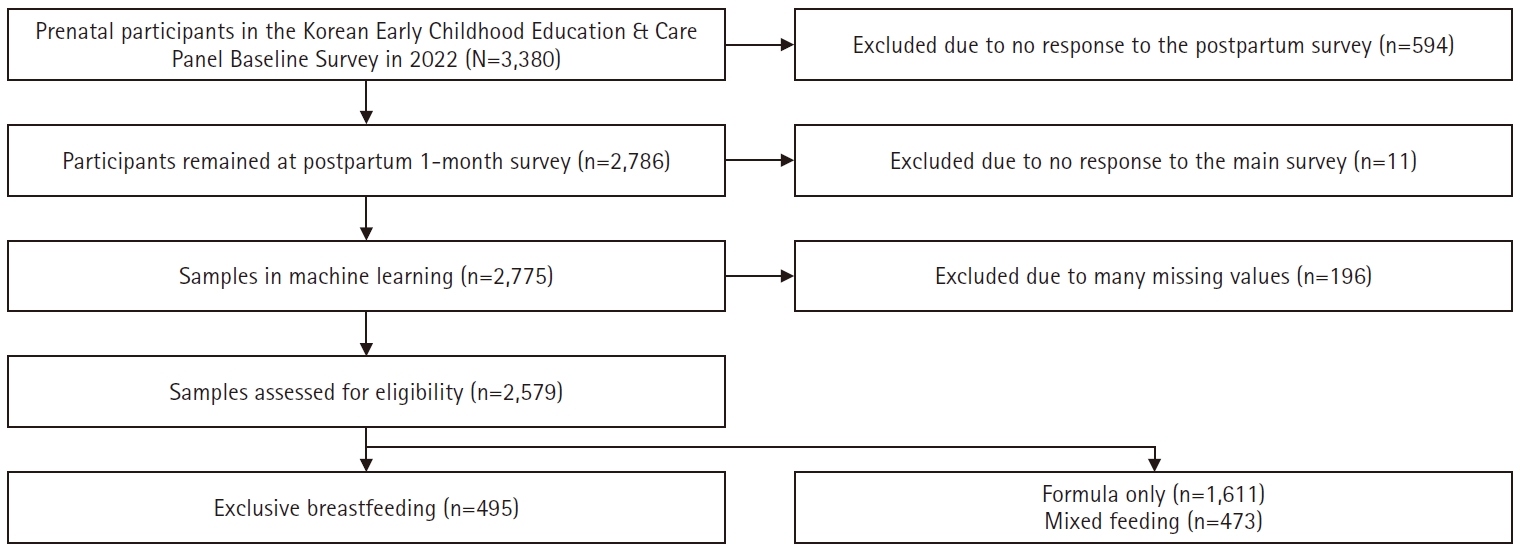
Data from 2,579 participants in the Korean Early Childhood Education & Care Panel between March 1 and June 3, 2025 were analyzed using Python version 3.12.8 and Colab. The dataset was split into training and testing sets at an 80:20 ratio, and five classifiers (random forest, logistic regression, decision tree, AdaBoost, and XGBoost) were trained and evaluated using multiple performance metrics and feature importance analysis.
Results
The confusion matrix of the random forest classifier model demonstrated strong performance, with a precision of 86.6%, accuracy of 84.8%, recall of 96.8%, F1-score of 91.9%, and an area under the curve of 86.0%. Twenty-one features were analyzed, from which feeding plan, breastfeeding at 1 month, marriage period, maternal prenatal weight, self-respect, alcohol consumption, grit, value placed on children, maternal age, and depression emerged as important predictors of exclusive breastfeeding in the first 3 months.
Discussion
A robust model was developed to predict exclusive breastfeeding that identified feeding planning and breastfeeding at 1 month as the most influential predictors. The model could be implemented in clinical and community settings to guide tailored breastfeeding support strategies, coupled with the integration of maternal self-respect, grit, and the value placed on children in counseling programs to promote exclusive breastfeeding.
- 2,658 View
- 217 Download

- Effectiveness of a mobile application for tracking symptoms and enhancing symptom management among breast cancer patients receiving chemotherapy in Bangkok, Thailand: a non-randomized controlled trial
- Duangrat Kaveenuntachai, Supawan Jaiboon, Bualuang Sumdaengrit, Chureeporn Silaguntsuti, Arveewan Vittayatigonnasak, Pornchan Sailamai
- J Korean Acad Nurs 2025;55(2):178-190. Published online May 27, 2025
- DOI: https://doi.org/10.4040/jkan.25011
-
Abstract
PDFePub
- Purpose
This study evaluated the effectiveness of a mobile application in tracking symptoms and improving symptom management and quality of life (QoL) among breast cancer patients undergoing chemotherapy in Thailand.
Methods
A non-randomized controlled trial was used, with 25 participants in the intervention group and 25 in the control group. Research instruments included a demographic data form, the NCI-PRO-CTCAE Items-Thai-Thailand version 1.0, and the European Organization for Research and Treatment of Cancer Quality of Life Core Questionnaire and Breast Cancer-Specific Module.
Results
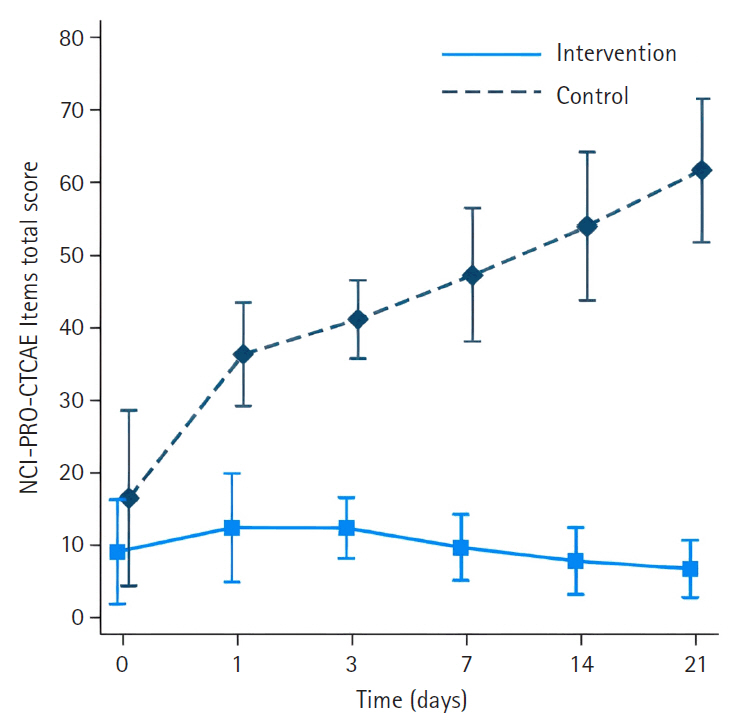
The intervention group had significantly less severe side effects than the control group, with mean differences of –23.33 (95% confidence interval [CI], –27.82 to –18.83) on day 1, –28.18 (95% CI, –33.22 to –23.14) on day 3, –34.63 (95% CI, –40.18 to –29.08) on day 7, –42.56 (95% CI, –48.72 to –36.40) on day 14, and –51.31 (95% CI, –58.13 to –44.48) on day 21 (p<.001 for all). On day 21, participants in the intervention group reported significantly higher scores in the Global Health QoL and Functional Scales compared to the control group (p<.001). Additionally, intervention group participants reported lower scores on the Symptom Scales and higher scores on the Functional Scales than those in the control group (p<.001).
Conclusion
The ChemoPro application helped manage chemotherapy-related symptoms and was associated with improved symptom monitoring and QoL. Nonetheless, the study was limited by a small sample size and restriction to Android users. Future research with larger and more diverse populations is recommended before broader implementation in clinical practice. -
Citations
Citations to this article as recorded by
- Effectiveness of a digital health intervention on the supportive care needs and quality of life in Mexican patients with breast cancer: a randomized clinical trial
Saúl Eduardo Contreras-Sánchez, Svetlana V. Doubova, Rocío Grajales-Álvarez, Ricardo Villalobos-Valencia, Abdel Karim Dip-Borunda, José Gustavo Nuñez-Cerrillo, Alma Diana Huerta-López, Álvaro José Montiel-Jarquín, Arturo García-Galicia, Enrique Isay Talam
BMC Cancer.2026;[Epub] CrossRef - Systematic review of patient-reported outcome item libraries in cancer research: an EORTC Quality of Life Group study
Rosemary Peacock, Christopher Bedding, Bonnie Pacheco, Hayat Hamzeh, Claire Piccinin, Alexandra Gilbert
JNCI: Journal of the National Cancer Institute.2026; 118(6): 971. CrossRef - Digital PRO collection methods during chemotherapy: A scoping review of tools, platforms, and psychometric properties
G. Hari Prakash, Tejaswini BD, Sony Sequeira, Mohammed Mujaheed Hussain, Anush Nayak
Measurement and Evaluations in Cancer Care.2026; 4: 100036. CrossRef
- Effectiveness of a digital health intervention on the supportive care needs and quality of life in Mexican patients with breast cancer: a randomized clinical trial
- 5,563 View
- 287 Download
- 2 Web of Science
- 3 Crossref
- Development and Evaluation of an App-Based Self-Management Program for Exercise Practice of Breast Cancer Survivors: A Non-Randomized Controlled Trial
- Suyoun Maeng, Jungok Yu
- J Korean Acad Nurs 2024;54(2):250-265. Published online May 31, 2024
- DOI: https://doi.org/10.4040/jkan.23119
-
Abstract
PDF
- Purpose
This study aimed to develop an app-based self-management program based on the transtheoretical model (TTM) for breast cancer survivors’ exercise practice, as well as to investigate the program’s effects on the stage of change for exercise, exercise self-efficacy, exercise decisional balance, exercise amount, and body composition.
Methods
This non-randomized controlled study included 52 participants (26 in each of the experimental and control groups, respectively). An app-based self-management program based on the TTM was conducted with the experimental group for a 12-week period. The program comprised three components: individual coaching for each stage of change for exercise based on TTM, amount of exercise and body composition monitoring, and online self-help meetings.
Results
Compared with the control group, the experimental group had significantly higher stages of change for exercise (p < .001), exercise self-efficacy (p < .001), exercise decisional balance (p = .002), exercise amount (p < .001), and body composition (body weight [p = .006], body mass index [p = .005], and body fat percentage [p = .010]) immediately and four weeks after the intervention.
Conclusion
An appbased self-management program based on the TTM improves exercise behaviors in breast cancer survivors and provides physical benefits. -
Citations
Citations to this article as recorded by- Feasibility and acceptability of ExerciseGuideUK for those living with and beyond lung cancer: a mixed methods study
Jordan Curry, Mark Pearson, Camille E. Short, Corneel Vandelanotte, Holly E. L. Evans, Michael Lind, Cynthia C. Forbes
Supportive Care in Cancer.2026;[Epub] CrossRef - Trajectories of behavior change motivation among general hospital patients following proactive automatized multi-behavior change intervention
Maike Kuehnel, Anne Moehring, Anika Tiede, Filipa Krolo-Wicovsky, Caroline Timm, Sophie Baumann, Ulrich John, Jennis Freyer-Adam
General Hospital Psychiatry.2026; 102: 51. CrossRef - Effects of a mobile health coaching intervention on symptom experience, self-management, and quality of life in breast cancer survivors: A quasi-experimental study
Jin-Hee Park, Sun Hyoung Bae, Yong Sik Jung, Min Hee Hur, Ji Young Kim, Su Jin Jung
Medicine.2025; 104(12): e41894. CrossRef
- Feasibility and acceptability of ExerciseGuideUK for those living with and beyond lung cancer: a mixed methods study
- 5,233 View
- 270 Download
- 3 Web of Science
- 3 Crossref
- Development and Effectiveness Evaluation of Comprehensive Mobile-Based, Breastfeeding Promotion Program for Mothers with Gestational Diabetes
- Eunju Kwak, Seungmi Park
- J Korean Acad Nurs 2024;54(2):224-236. Published online May 31, 2024
- DOI: https://doi.org/10.4040/jkan.23098
-
Abstract
PDF
- Purpose
This study aimed to evaluate the effects of a mobile-based breastfeeding promotion program (M-BFGDM) that helps mothers with gestational diabetes.
Methods
Forty-seven mothers participated in the study, of whom 22 were in the experimental group and 25 in the control group. To verify the effects, a lag design before and after the non-equivalence control group was used. The data collection for the experimental group was done before and after the intervention.
Results
In the results, breastfeeding knowledge showed a significant difference in the interaction between measurement period and group (χ2 = 8.14, p = .017), whereas breastfeeding intention did not show a significant difference in the interaction (χ2 = 4.73, p = .094). There was no difference in self-efficacy interaction (F = 0.13, p = .856). The breastfeeding method showed no difference in interaction (F = 0.04, p = .952), whereas cross-analysis showed a significant difference in breastfeeding practice rate between the experimental group and the control group at 1 month postpartum (χ2 = 7.59, p = .006).
Conclusion
A mobile-based breastfeeding promotion program was developed and applied for gestational diabetic mothers, resulting in an increase in breastfeeding knowledge and an improvement in breastfeeding practice rate one month after childbirth. In addition, M-BFGDM managed to create a breastfeeding practice environment with fewer time and place restrictions. A program study that complements motivation is needed to improve breastfeeding in pregnant diabetic mothers in the future. -
Citations
Citations to this article as recorded by- Long-Term Effectiveness of a Mobile-Based Breastfeeding Program for Women with Gestational Diabetes: 6-Month Follow-Up of a Quasi-Experimental Study
Seungmi Park, Young Mi Ryu, Eunju Kwak
Healthcare.2026; 14(7): 917. CrossRef - Breastfeeding and education in the puerperium
Elena Alfonso
SAP Community and Interculturality in Dialogue.2025; 5: 129. CrossRef - The Effect of Immediate Skin‐to‐Skin Contact on Exclusive Breastfeeding: An Instrumental Variable Approach
Sangyun Lee, Yongnam Kim
Acta Paediatrica.2025; 114(9): 2367. CrossRef
- Long-Term Effectiveness of a Mobile-Based Breastfeeding Program for Women with Gestational Diabetes: 6-Month Follow-Up of a Quasi-Experimental Study
- 4,055 View
- 247 Download
- 2 Web of Science
- 3 Crossref
- Validity and Reliability of the Korean Version of Assessment of Health Literacy in Breast and Cervical Cancer Screening
- Hye Sook Shin, Eunlim Chi, Hae-Ra Han
- J Korean Acad Nurs 2021;51(6):769-781. Published online December 31, 2021
- DOI: https://doi.org/10.4040/jkan.21108
-
Abstract
PDF
- Purpose
Health literacy is a significant determinant of health and health behaviors such as cancer screening. Despite its significance, there are limited instruments available to assess health literacy targeting Koreans. The purpose of this study was to test the psychometric properties of Korean translation of a validated health literacy instrument in cancer screening—Korean version of assessment of health literacy in breast and cervical cancer screening (K-AHL-C).
Methods
A total of 555 women aged 20~65 participated in the online survey study. Of 52 items addressing five domains included in the original version, we focused on 36 items addressing three key domains closely associated with cancer screening: familiarity, health navigation, and comprehension.
Results
During content validation, two items from the health navigation domain were removed, yielding 34 items. Using Rasch analysis and confirmatory factor analysis, we found the evidence of construct validity of K-AHL-C. The Korean version was also significantly correlated with measures of Functional Health Literacy scale, cancer prevention behaviors, and subjective health status, suggesting convergent validities respectively. Finally, K-AHL-C had acceptable reliability coefficients (α) ranging from 0.71 to 0.92 for each domain and the total scale.
Conclusion
These psychometric properties support the K-AHL-C is a valid and reliable instrument for measuring Koreans’ health literacy in cancer screening. Also it is expected to use the instrument to detect breast and cervical cancer early and improve the screening rate, and ultimately to contribute to the promotion of women's health and women's health nursing practice. -
Citations
Citations to this article as recorded by- Web-Based Delivery of an Effective Church-Based Intervention Program to Promote Cancer Screening (Community-based Health litEracy-focused intervention for breast and cervical Cancer Control) Among Korean Immigrant Women in the United States: Randomized Co
Hae-Ra Han, Yoon-Jae Lee, Deborah Min, Joyline Chepkorir, DaSol Amy Hwang, Steve Chae
JMIR Human Factors.2025; 12: e66092. CrossRef - Associations and gender differences between OHI-seeking behaviors and eHealth literacy among Chinese university students
Jie Chen, Hua Tian
Revista da Escola de Enfermagem da USP.2024;[Epub] CrossRef - Health Information Seeking Pathways and Factors Influencing Health Literacy Among Cancer Patients: Based on Data from the 2nd Korean Health Panel 2021
Yun-La Hur, Eun-Jeong Hong
Asian Oncology Nursing.2024; 24(3): 155. CrossRef - A Psychometric Validation of the Korean Version of Disaster Response Self-Efficacy Scale for Nursing Students
Sung Hae Kim
International Journal of Environmental Research and Public Health.2023; 20(4): 2804. CrossRef - Health literacy measures in South Korea: A scoping review
Heeran Chun, Su Hyun Kim, Eunja Park
Korean Journal of Health Education and Promotion.2022; 39(4): 39. CrossRef - Validity and Reliability of the Korean Version of the Climate, Health, and Nursing Tool
Da Woon Jeong, Gwang Suk Kim, Min Kyung Park
Journal of Korean Academy of Nursing.2022; 52(2): 173. CrossRef
- Web-Based Delivery of an Effective Church-Based Intervention Program to Promote Cancer Screening (Community-based Health litEracy-focused intervention for breast and cervical Cancer Control) Among Korean Immigrant Women in the United States: Randomized Co
- 3,817 View
- 65 Download
- 4 Web of Science
- 6 Crossref
- The Lived Experience of Body Alteration and Body Image with Regard to Immediate Breast Reconstruction among Women with Breast Cancer
- Jeonghee Ahn, Eunyoung E. Suh
- J Korean Acad Nurs 2021;51(2):245-259. Published online April 30, 2021
- DOI: https://doi.org/10.4040/jkan.21028
-
Abstract
PDF
- Purpose
The purpose of this study was to explore the lived experience of body alteration and body image with regard to immediate breast reconstruction among women with breast cancer.
Methods
Data were collected from July to December 2020 through individual in-depth interviews with 15 women who had undergone immediate breast reconstruction due to breast cancer. Verbatim transcripts were analyzed using Colaizzi’s phenomenological analysis.
Results
The following four theme clusters emerged. First, “revalued meaning of breasts due to cancer” illustrated the fact that cancer removal surgery brought the participants to reconsider the meaning of their breasts. Second, “had no choice but breast reconstruction” demonstrated the participants’ decision-making process of not wanting to lose breasts. Third, “unsatisfied breasts despite reconstruction” portrayed the distress due to the unexpected surgical outcomes. Finally, “restarted everyday routines with the altered body” described the healing process of the participants by accepting their changed body.
Conclusion
In Korea, where family-centeredness and fidelity are highly valued, women perceived their breasts not only as a symbol of femininity but as the mediator connecting the self to family. Despite the distress related to imperfect breasts, the participants were thankful for their reconstructed breasts. Breast reconstruction helped them return to daily life as the psychological trauma of breast cancer was healed. The participants rebuilt their body image by accepting their scarred new body. This may allow health professionals to provide constructive and culturally appropriate counseling in advance by providing insight into women’s perception of their body image with regard to breast reconstruction. -
Citations
Citations to this article as recorded by- A systematic review and meta−analysis on the prepectoral and partial subpectoral immediate single−stage Implant-Based Breast Reconstruction Using ADM
Tingjian Zhang, Yuyao Liu, Liang Huang, Qiang Zhang, Ying Li, Lingyan Du, Xueyun Zhao
Frontiers in Oncology.2026;[Epub] CrossRef - The Efficacy of Self‐Management Interventions Based on E‐Health in Quality of Life in Patients With Cancer: A Meta‐Analysis of Randomized Controlled Trials
Jialin Zhang, Shu Zhang, Linna Li, Liyang Duan, Xiaolin Hu
Worldviews on Evidence-Based Nursing.2026;[Epub] CrossRef - Mental health in female breast cancer survivors post-mastectomy: A structural model based on Roy's adaptation model
Hyeng Sook Yoon, Eunjung Ryu
Asia-Pacific Journal of Oncology Nursing.2025; 12: 100820. CrossRef - Categorising Subjective Perceptions of Middle-Aged Breast Cancer Patients Using Q Methodology
Min-Jeung Shim, Song-Yi Lee, Oh-Sun Ha
Healthcare.2024; 12(18): 1873. CrossRef - Body Acceptance Scale for Women with Breast Cancer: Development and Validation of a Measurement
Jeonghee Ahn, Eunyoung E. Suh
Seminars in Oncology Nursing.2023; 39(5): 151486. CrossRef - Influence of body image on quality of life in breast cancer patients undergoing breast reconstruction: Mediating of self‐esteem
Yunhee Jang, Mihyeon Seong, Sohyune Sok
Journal of Clinical Nursing.2023; 32(17-18): 6366. CrossRef - Body acceptance in women with breast cancer: A concept analysis using a hybrid model
Jeonghee Ahn, Eunyoung E. Suh
European Journal of Oncology Nursing.2023; 62: 102269. CrossRef - A systematic review and meta-analysis on the prepectoral single-stage breast reconstruction
Jiameng Liu, Xiaobin Zheng, Shunguo Lin, Hui Han, Chunsen Xu
Supportive Care in Cancer.2022; 30(7): 5659. CrossRef
- A systematic review and meta−analysis on the prepectoral and partial subpectoral immediate single−stage Implant-Based Breast Reconstruction Using ADM
- 3,852 View
- 125 Download
- 9 Web of Science
- 8 Crossref
- Information Resource Network Analysis of Factors Influencing Breastfeeding Planning and Duration
- Eunyoung Lee, Insook Cho, Seong Jin Cho, Eunju Lee
- J Korean Acad Nurs 2021;51(2):232-244. Published online April 30, 2021
- DOI: https://doi.org/10.4040/jkan.20280
-
Abstract
PDF
- Purpose
This study aimed to identify the modifiable factors affecting breastfeeding planning and duration among healthy mothers and their use of breastfeeding information resources.
Methods
A cross-sectional survey was conducted in a community setting. Four hundreds participants were recruited at five pediatric clinics and three community health centers located in Paju-si and Goyang-si, Gyeonggi-do, between January and May 2019. Based on the breastfeeding decision-making model, driven by Martens and Young’s work, the survey items consisted of demographics, childbirth and breastfeeding characteristics, and breastfeeding information resources. In the analysis, 389 responses were used in the t-test, ANOVA, and logistic regression. Information resource networks were compared before and after childbirth including a subgroup analysis depending on the breastfeeding duration.
Results
The modifiable factors affecting breastfeeding planning and duration were antenatal and postpartum breastfeeding education and the provision of information in the hospital. The frequency of Internet use and websites visited were notable and potentially modifiable factors, which were also observed in the networks showing different relationship patterns according to participant subgroups and times. The childbirth event increased the centralization of the network in the planned group, while the network of the non-planned group was more diffused after childbirth. The network of the short-term breastfeeding group was characterized by a more centralized pattern and the resources of high betweenness centrality than the long-term group.
Conclusion
Breastfeeding education is a consistent factor that affects breastfeeding behavior. A well-designed internet-based approach would be an effective nursing intervention to meet the needs of women seeking breastfeeding information and changing their behaviors. -
Citations
Citations to this article as recorded by- Survey on the Status of Breastfeeding in Korean Medical Institution Workers
Tae Hyeong Kim, Sung-Hoon Chung, Jun Hwan Kim, Youngmin Ahn, Son Moon Shin, Woo Ryoung Lee, Eui Kyung Choi, Juyoung Lee, Hye-Jung Shin, Euiseok Jung, Ju Sun Heo, Jin A Lee, Soon Min Lee, Seong Phil Bae, Jeonglyn Song, Chae-Young Kim, Dae Yong Yi
Journal of Korean Medical Science.2022;[Epub] CrossRef - A Multi-Center Educational Research Regarding Breastfeeding for Pediatrics Residents in Korea
Yong-Sung Choi, Sung-Hoon Chung, Eun Sun Kim, Eun Hee Lee, Euiseok Jung, So Yeon Lee, Wooryoung Lee, Hye Sun Yoon, Yong Joo Kim, Ji Kyoung Park, Son Moon Shin, Ellen Ai-Rhan Kim
Neonatal Medicine.2022; 29(1): 28. CrossRef - Breastfeeding Success Experience of Primiparas
Sun Ok Lee, Sung Soon Na, Hee Sook Kim, Kyung Eui Bae, Mi Sun Youn, Eun Ju Oh
Journal of The Korean Society of Maternal and Child Health.2022; 26(4): 254. CrossRef - Breastfeeding experiences of women with gestational diabetes
Seungmi Park, Soo-Young Yu
The Journal of Korean Academic Society of Nursing Education.2021; 27(3): 274. CrossRef
- Survey on the Status of Breastfeeding in Korean Medical Institution Workers
- 2,130 View
- 33 Download
- 1 Web of Science
- 4 Crossref
- Effect of Direct Breastfeeding Program for Premature Infants in Neonatal Intensive Care Unit
- Ji Hyun Kang, Hyunmi Son, Shin Yun Byun, Gyumin Han
- J Korean Acad Nurs 2021;51(1):119-132. Published online February 28, 2021
- DOI: https://doi.org/10.4040/jkan.20240
-
Abstract
PDF
- Purpose
This study aimed to identify the effects of a direct breastfeeding program for premature infants in neonatal intensive care units (NICUs).
Methods
This quasi-experimental study was conducted during August 2016 to April 2017. Sixty mothers of premature infants were assigned to the experimental (n = 31) or control groups (n = 29). The program was comprised of breastfeeding education and direct breastfeeding support. The experimental and control groups were provided with education and counseling on breastfeeding at the time of admission and discharge. In the experimental group, the mothers initiated oral feeding with direct breastfeeding and engaged in breastfeeding at least seven times during the NICU stay. The collected data were analyzed by the χ2 -test and repeated measures ANOVA using an SPSS program.
Results
The experimental group showed a higher direct breastfeeding practice rate (χ2 = 19.29, p < .001), breastfeeding continuation rate (χ2 = 3.76, p < .001), and self-efficacy (F = 25.37, p < .001) than the control group except for maternal attachment.
Conclusion
The direct breastfeeding program in the NICU has significant effects on the practice and continuation rate of breastfeeding and breastfeeding self-efficacy. Therefore, this program can be applied in the NICU settings where direct breastfeeding is limited. -
Citations
Citations to this article as recorded by- Critical Factors Influencing the Uptake of Breastfeeding Support Interventions in Neonatal Intensive Care Units: A Scoping Review
Shela Akbar Ali Hirani, Oladayo Nathaniel Awojobi
International Journal of Environmental Research and Public Health.2026; 23(6): 707. CrossRef - Exploration of Family-Centered Care in NICUs: A Grounded Theory Methodology
Young Ah Park, YeoJin Im
Qualitative Health Research.2025; 35(10-11): 1231. CrossRef - Fresh Parent’s Own Milk for Preterm Infants: Barriers and Future Opportunities
Carrie-Ellen Briere, Jessica Gomez
Nutrients.2024; 16(3): 362. CrossRef - Development and Effectiveness Evaluation of Comprehensive Mobile-Based, Breastfeeding Promotion Program for Mothers with Gestational Diabetes
Eunju Kwak, Seungmi Park
Journal of Korean Academy of Nursing.2024; 54(2): 224. CrossRef
- Critical Factors Influencing the Uptake of Breastfeeding Support Interventions in Neonatal Intensive Care Units: A Scoping Review
- 4,127 View
- 224 Download
- 3 Web of Science
- 4 Crossref
Original Articles
- The Effects of Utilizing Smartphone Application Peer Support on Health Behavior and Body Mass Index among Breast Cancer Survivors
- Gaeun Park, Haejung Lee, Hyun Yul Kim
- J Korean Acad Nurs 2019;49(5):550-561. Published online January 15, 2019
- DOI: https://doi.org/10.4040/jkan.2019.49.5.550
-
Abstract
PDF
Abstract Purpose This study aimed to identify the effects of utilizing Smartphone Application Peer Support (SAPS) on health behavior and body mass index (BMI) among overweight or obese breast cancer survivors (BCS).
Methods A nonequivalent control group with a non-synchronized design was utilized and 36 participants (experimental group 14, control group 22) were recruited from August 2017 to September 2018. Participants were 40~65 years old, overweight or obese, had completed primary cancer treatment within the 12 months prior to the study, and had not done regular exercise during the last 6 months. The 3-month SAPS consisted of exercise and diet education (once p/2 weeks), peer support (once p/week), and self-monitoring using smartphone applications (5 times p/week). All participants underwent assessments at baseline, right after SAPS, and at 3 months after SAPS. Data were analyzed using repeated measures ANOVA.
Results At the completion of SAPS significant differences were found between groups in motivation for exercise (t=-3.24,
p =.005), physical activity (t=-4.15,p <.001), total calorie intake (t=3.42,p =.002), calories from fat (t=-3.01,p =.005), intake of vegetables (t=-2.83,p =.008), and BMI (t=5.21,p <.001). Significant differences in BMI (t=4.13,p <.001) remained up to 3 months after SAPS completion. No significant differences was shown between groups in self-efficacy for exercise, either immediately after or 3 months after SAPS.Conclusion The SAPS has the potential to improve motivation for exercise, health behavior, and BMI of BCS. However, special efforts are required to encourage participants to complete the intervention and maintain long-term effects for future trials.
-
Citations
Citations to this article as recorded by- EHealth intervention for quality of life in long-term breast cancer survivors: randomized controlled trial
Gustavo Adolfo Pimentel-Parra, Nelia Soto-Ruiz, Paula Escalada-Hernández, Leticia San Martín-Rodríguez, Cristina García-Vivar
JNCI: Journal of the National Cancer Institute.2026; 118(6): 1025. CrossRef - Efficacy of Mobile App–Based Dietary Interventions Among Cancer Survivors: Systematic Review and Meta-Analysis
Krista Ching Wai Chung, Naomi Takemura, Wendy Wing Tak Lam, Mandy Man Ho, Antoinette Marie Lee, Wynnie Yuen Yee Chan, Daniel Yee Tak Fong
JMIR mHealth and uHealth.2025; 13: e65505. CrossRef - Development and Evaluation of an App-Based Self-Management Program for Exercise Practice of Breast Cancer Survivors: A Non-Randomized Controlled Trial
Suyoun Maeng, Jungok Yu
Journal of Korean Academy of Nursing.2024; 54(2): 250. CrossRef - Effects of an integrated lifestyle intervention for overweight and obese breast cancer survivors: A quasi-experimental study
Su Jin Seo, Ju-Hee Nho
European Journal of Oncology Nursing.2024; 73: 102714. CrossRef - User evaluation of a mobile education application for the management of metabolic syndrome among cancer survivors
Ji-Su Kim, Minhae Kim, Yeji Seo
European Journal of Oncology Nursing.2023; 63: 102276. CrossRef - Effectiveness of Digital Health on the Quality of Life of Long-Term Breast Cancer Survivors: A Systematic Review
Gustavo Adolfo Pimentel-Parra, M. Nelia Soto-Ruiz, Leticia San Martín-Rodríguez, Paula Escalada-Hernández, Cristina García-Vivar
Seminars in Oncology Nursing.2023; 39(4): 151418. CrossRef - Effectiveness of a virtual reality application‐based education programme on patient safety management for nursing students: A pre‐test–post‐test study
Jae Woo Oh, Ji Eun Kim
Nursing Open.2023; 10(12): 7622. CrossRef - Effects of smart-care services program for breast cancer survivors
Bok Yae Chung, Sung Jung Hong
The Journal of Korean Academic Society of Nursing Education.2021; 27(2): 95. CrossRef - The development of a lifestyle modification mobile application, “Health for You” for overweight and obese breast cancer survivors in Korea
Su-Jin Seo, Ju-Hee Nho, Youngsam Park
Korean Journal of Women Health Nursing.2021; 27(3): 243. CrossRef - Peer‐supported lifestyle interventions on body weight, energy intake, and physical activity in adults: A systematic review and meta‐analysis
Siew Lim, Wai Kit Lee, Andy Tan, Mingling Chen, Chau Thien Tay, Surbhi Sood, Stephanie Pirotta, Lisa J. Moran, Meena Daivadanam, Ljoudmila Busija, Helen Skouteris, Mamaru A. Awoke, Briony Hill
Obesity Reviews.2021;[Epub] CrossRef - Application and evaluation of mobile nutrition management service for breast cancer patients
Ji Hee Choi, Seon-Joo Park, Hee Kwon, Hae-Jeung Lee
Journal of Nutrition and Health.2020; 53(1): 83. CrossRef
- EHealth intervention for quality of life in long-term breast cancer survivors: randomized controlled trial
- 2,076 View
- 33 Download
- 10 Web of Science
- 11 Crossref
- A Structural Model for Chemotherapy Related Cognitive Impairment and Quality of Life in Breast Cancer Patients
- Jung Ran Lee, Pok Ja Oh
- J Korean Acad Nurs 2019;49(4):375-385. Published online January 15, 2019
- DOI: https://doi.org/10.4040/jkan.2019.49.4.375
-
Abstract
PDF
Abstract Purpose This study aimed to develop and test a structural model for chemotherapy-related cognitive impairment of breast cancer patients based on a literature review and Hess and Insel's chemotherapy-related cognitive change model.
Methods The Participants consisted of 250 patients who were ≥19 years of age. The assessment tools included the Menopause Rating Scale, Symptom Experience Scale, Hospital Anxiety and Depression Scale, Everyday Cognition, and Functional Assessment of Cancer Therapy-Breast Cancer. Data were analyzed using the SPSS 21.0 and AMOS 21.0 programs.
Results The modified model was a good fit for the data. The model fit indices were χ 2=423.18 (
p <.001), χ 2/df=3.38, CFI=.91, NFI=.91, TLI=.89, SRMR=.05, RMSEA=.09, and AIC=515.18. Chemotherapy-related cognitive impairment was directly influenced by menopausal symptoms (β=.38,p =.002), depression and anxiety (β=.25,p =.002), and symptom experiences (β=.19,p =.012). These predictors explained 47.7% of the variance in chemotherapy-related cognitive impairment. Depression and anxiety mediated the relations among menopausal symptoms, symptom experiences, and with chemotherapy related cognitive impairment. Depression and anxiety (β=-.51,p =.001), symptom experiences (β=-.27,p =.001), menopausal symptoms (β=-.22,p =.008), and chemotherapy-related cognitive impairment (β=-.15,p =.024) had direct effects on the quality of life and these variables explained 91.3%.Conclusion These results suggest that chemotherapy-related toxicity is highly associated with cognitive decline and quality of life in women with breast cancer. Depression and anxiety increased vulnerability to cognitive impairment after chemotherapy. Nursing intervention is needed to relieve chemotherapy-related toxicity and psychological factor as well as cognitive decline for quality of life in patients undergoing chemotherapy.
-
Citations
Citations to this article as recorded by- Efficacy of Cognitive Training for Treating Cancer-related Cognitive Impairment: Systematic Review and Meta-analysis by Cognitive Domain
Cristina Salgado-Blanco, Ana F. Oliveira, María Teresa Carrillo-de-la-Peña, Carina Fernandes
Neuropsychology Review.2026;[Epub] CrossRef - Analysis of Breast Cancer Nursing Education Content and Educational needs for Breast Cancer Patient Nursing Perceived by Nurses
Young-Hee Je, Kyoung-Ah Kang
Asian Oncology Nursing.2025; 25(1): 1. CrossRef - Impact of social support on cognitive function in patients with breast cancer undergoing chemotherapy: The chain-mediating role of fatigue and depression
Yuanqi Ding, Qingmei Huang, Fulei Wu, Yang Yang, Ling Wang, Xuqian Zong, Xiaoyan Yu, Changrong Yuan
Asia-Pacific Journal of Oncology Nursing.2025; 12: 100743. CrossRef - Factors Influencing Oncofertility in Gynecological Cancer Patients: Application of Mixed Methods Study
Minji Kim, Juyoung Ha
Journal of Korean Academy of Nursing.2024; 54(3): 418. CrossRef - Relationships Between Chemotherapy-Related Cognitive Impairment, Self-Care Ability, and Quality of Life in Breast Cancer Survivors: A Cross-Sectional Study
Nan Wu, Ze Luan, Zijun Zhou, He Wang, Shiyuan Du, Yulu Chen, Xinxin Wang, Jiong Li, Xin Peng
Seminars in Oncology Nursing.2024; 40(5): 151690. CrossRef - Effects of different exercise interventions on chemotherapy-related cognitive impairment in patients with breast cancer: a study protocol for systematic review and network meta-analysis
Yu Dong, Hao Huang, Aiping Wang
BMJ Open.2024; 14(4): e078934. CrossRef - Factors Associated with Self-reported Memory Problems of Adult Cancer Survivors Based on the Korea National Health and Nutrition Examination Survey 2019
Sangjin Ko
Journal of Health Informatics and Statistics.2023; 48(1): 51. CrossRef - Impact of nonpharmacological interventions on cognitive impairment in women with breast cancer: A systematic review and meta-analysis
Jin-Hee Park, Su Jin Jung, Lena J. Lee, Junghyun Rhu, Sun Hyoung Bae
Asia-Pacific Journal of Oncology Nursing.2023; 10(4): 100212. CrossRef - Impact of discriminant factors on the comfort-care of nurses caring for trans-arterial chemoembolisation patients
Myoung Soo Kim, Ju-Yeon Uhm
Supportive Care in Cancer.2022; 30(9): 7773. CrossRef - Brain morphological alterations and their correlation to tumor differentiation and duration in patients with lung cancer after platinum chemotherapy
Pin Lv, Guolin Ma, Wenqian Chen, Renyuan Liu, Xiaoyan Xin, Jiaming Lu, Shu Su, Ming Li, ShangWen Yang, Yiming Ma, Ping Rong, Ningyu Dong, Qian Chen, Xin Zhang, Xiaowei Han, Bing Zhang
Frontiers in Oncology.2022;[Epub] CrossRef - The Influence of Rehabilitation on Quality of Life in Breast Cancer Survivors: A Clinical Study
Teresa Paolucci, Aristide Saggino, Francesco Agostini, Marco Paoloni, Andrea Bernetti, Massimiliano Mangone, Valter Santilli, Raoul Saggini, Marco Tommasi
International Journal of Environmental Research and Public Health.2021; 18(16): 8585. CrossRef
- Efficacy of Cognitive Training for Treating Cancer-related Cognitive Impairment: Systematic Review and Meta-analysis by Cognitive Domain
- 2,550 View
- 32 Download
- 11 Web of Science
- 11 Crossref
- Psychoeducational Approach to Distress Management of Newly Diagnosed Patients with Breast Cancer
- Jin-Hee Park, Mison Chun, Yong Sik Jung, Sun Hyoung Bae, Young-Mi Jung
- J Korean Acad Nurs 2018;48(6):669-678. Published online January 15, 2018
- DOI: https://doi.org/10.4040/jkan.2018.48.6.669
-
Abstract
PDF
Abstract Purpose The purpose of this study was to examine the effects of integrated psychoeducational program for distress management of newly diagnosed patients with breast cancer.
Methods A quasi-experimental trial was conducted. The participants consisted of 47 female patients with breast cancer assigned to an intervention group (n=25) and control group (n=22). The intervention group participated in integrated psychoeducational program, consisting of individual face-to-face education and telephone-delivered health-coaching sessions. Data were collected at three time points: pre-intervention (T1), post-intervention (T2), and 6-month follow-up (T3). Study instruments were Distress thermometer, Supportive Care Needs Survey Short Form 34 and Functional Assessment of Cancer Therapy-Breast.
Results Compared with the control group, breast cancer patients in the intervention group reported lower distress and supportive care needs than the control group. The intervention group reported higher quality of life (QOL) overall and higher emotional well-being than the control group.
Conclusion These findings indicate that the integrated psychoeducational program is an effective intervention for reducing distress and supportive care needs and increasing QOL of newly diagnosed patients with breast cancer. Oncology nurses need to provide psychoeducational intervention to support patients with breast cancer in managing their distress and helping them adjust to their life.
-
Citations
Citations to this article as recorded by- Nurse Coaching in Oncology Care to Reduce Stress: A Systematic Review and Meta-Analysis
Elsa Vitale, Lorenza Maistrello, Karen Avino, Giuseppe Colonna, Ivan Rubbi, Roberto Lupo
Healthcare.2026; 14(7): 840. CrossRef - Breast Cancer Nursing Competencies for General Nurses Caring For Breast Cancer Patients: A Delphi Study
Young-Hee Je, Hee-Jung Kang
Asian Oncology Nursing.2026; 26(1): 1. CrossRef - Analysis of Breast Cancer Nursing Education Content and Educational needs for Breast Cancer Patient Nursing Perceived by Nurses
Young-Hee Je, Kyoung-Ah Kang
Asian Oncology Nursing.2025; 25(1): 1. CrossRef - Effectiveness of a Tailored Psychoeducational Intervention for Patients With Advanced Cancer in Indonesia: A Randomized Controlled Trial
Nurul Huda, Made Satya Nugraha Gautama, Wan Nishfa Dewi, Agung Waluyo, Hsiu Ju Chang, Malissa Kay Shaw
Journal of Nursing Scholarship.2025; 57(5): 848. CrossRef - Evidence on the benefits of mind-body Qigong exercise in women with breast cancer
Michel Marcos Dalmedico, Jackson Adriano Canavarro Ribeiro, Juliana Londero Silva Avila, Prisley Pereira de Oliveira, Paula Karina Hembecker, Sergio Ossamu Ioshii
Fisioterapia em Movimento.2025;[Epub] CrossRef - Psychological Distress and Influencing Factors in Newly Diagnosed Patients with Breast Cancer: A Cross-Sectional Study
Jin-Hee Park, Yong Sik Jung, Min Hee Hur, Yu Jin Jeong
Korean Journal of Adult Nursing.2024; 36(4): 311. CrossRef - Effects of Psychosocial Interventions for Patients with Breast Cancer: A Meta-analysis
Kyu-Sic Hwang, Kuy-Haeng Lee, Chan-Mo Yang, Hye-Jin Lee, Sang-Yeol Lee
Clinical Psychopharmacology and Neuroscience.2023; 21(1): 118. CrossRef - The development of a lifestyle modification mobile application, “Health for You” for overweight and obese breast cancer survivors in Korea
Su-Jin Seo, Ju-Hee Nho, Youngsam Park
Korean Journal of Women Health Nursing.2021; 27(3): 243. CrossRef - Development and Effect of the Integrated Health Promotion Program for Cancer Survivors Living at Home
Hee Sang Yoon, Eun A Hwang
Journal of Korean Academy of Community Health Nursing.2021; 32(1): 51. CrossRef - Adjustment to life with metastatic cancer through psychodrama group therapy: A qualitative study in Turkey
Songül Kamışlı, Bahar Gökler
Perspectives in Psychiatric Care.2021; 57(2): 488. CrossRef - Integration of longitudinal psychoeducation programmes during the phases of diagnosis, management and survivorship of breast cancer patients: A narrative review
Athena Michaelides, Constantina Constantinou
Journal of Cancer Policy.2020; 23: 100214. CrossRef - Quality of Life in Patients Undergoing Mastectomy for Breast Cancer
Kavitha Konnakkaparambil Ramakrishnan, Sreekumar Damodaran
Journal of Evidence Based Medicine and Healthcare.2020; 7(28): 1368. CrossRef - Mediating and Moderating Factors of Adherence to Nutrition and Physical Activity Guidelines, Breastfeeding Experience, and Spousal Support on the Relationship between Stress and Quality of Life in Breast Cancer Survivors
Nam Mi Kang, Won-Ho Hahn, Suyeon Park, Jung Eun Lee, Young Bum Yoo, Chung Ja Ryoo
International Journal of Environmental Research and Public Health.2020; 17(20): 7532. CrossRef - Uncertainty and unmet care needs before and after surgery in patients with gastric cancer: A survey study
Ji Yea Lee, Yeonsoo Jang, Sanghee Kim, Woo Jin Hyung
Nursing & Health Sciences.2020; 22(2): 427. CrossRef - Effects of Different Exercise Interventions on Quality of Life in Breast Cancer Patients: A Randomized Controlled Trial
Tetiana Odynets, Yuriy Briskin, Valentina Todorova
Integrative Cancer Therapies.2019;[Epub] CrossRef
- Nurse Coaching in Oncology Care to Reduce Stress: A Systematic Review and Meta-Analysis
- 2,493 View
- 55 Download
- 15 Crossref
- Symptom Distress and Coping in Young Korean Breast Cancer Survivors: The Mediating Effects of Social Support and Resilience
- Ji Hyun Lee, Hye Young Kim
- J Korean Acad Nurs 2018;48(2):241-253. Published online January 15, 2018
- DOI: https://doi.org/10.4040/jkan.2018.48.2.241
-
Abstract
PDF
Abstract Purpose The purpose of this study was to test the mediating effect of social support and resilience on the relationship between symptom distress and coping in young Korean breast cancer survivors.
Methods A purposive sample of 209 young breast-cancer survivors (mean age 39.9) was recruited for a cross-sectional survey, and the data were collected between June and October 2015. The instruments used in this study were the Memorial Symptom Assessment Scale-Short Form, the Multidimensional Scale of Perceived Social Support, 10-item Connor-Davidson Resilience Scale, and Cancer Coping Questionnaire. The collected data were then analyzed using the SPSS 23.0 and AMOS 23.0 programs.
Results Symptom distress was found to have a significant indirect effect on coping (beta=-.32,
p =.002), but not a significant direct effect (beta=.06,p =.577). Additionally, based on the values obtained for the squared multiple correlation, symptom distress, social support, and resilience were found to explain 46.4% of the total variance of coping.Conclusion Based on the results of this study, it can be suggested that in order to enhance young breast cancer survivors’ ability to cope with the distress they commonly feel, intervention methods that strengthen resilience and provide social support should be developed and made available to them.
-
Citations
Citations to this article as recorded by- Sexual well-being in cancer care services: the role of body image and coping strategies
Judith Partouche-Sebban, Saeedeh Rezaee Vessal, Youssef Souak, Aymen Ammari, Alain Toledano
Journal of Services Marketing.2026; 40(5): 598. CrossRef - Family Functioning and Environmental Mastery among Breast Cancer Survivors: Serial Mediation by Motivation and Healthy Behaviors
Hyun-E Yeom, Sunui Shin, Haerim Lee
Korean Journal of Adult Nursing.2026; 38(2): 193. CrossRef - Latent transition analysis of resilience in breast cancer patients and its association with sense of meaning in life: a longitudinal follow - up study
Huiping Tian, Yue Wang, Song Guo
Frontiers in Oncology.2026;[Epub] CrossRef - How Online Patient-Provider Communication Alleviates Psychological Distress Among Patients with Chronic Diseases: The Role of Perceived Patient-Centered Communication and Adaptive Coping Strategies
Bingqing Ling, Yu Zheng
Health Communication.2025; 40(8): 1559. CrossRef - Factors Associated With Not Returning to Work Among Breast Cancer Survivors
Leni Merdawati, Hui-Chen Lin, Chieh-Hsin Pan, Hui-Chuan Huang
Workplace Health & Safety.2025; 73(5): 216. CrossRef - Factors affecting resilience among young breast cancer survivors: A cross-sectional study
Hye Young Min, Yoonjung Kim, Hae Jeong An
European Journal of Oncology Nursing.2025; 75: 102837. CrossRef - Latent classes of health‐promoting lifestyle in breast cancer patients undergoing chemotherapy in China: A cross‐sectional survey
Meixuan Song, Qiuyao He, Juan Yang, Jinyu Zhang
Nursing Open.2024;[Epub] CrossRef - Postmastectomy Pain Syndrome: A Narrative Review
Sajad Ahmad Salati, Lamees Alsulaim, Mariyyah H Alharbi, Norah H Alharbi, Thana M Alsenaid, Shoug A Alaodah, Abdulsalam S Alsuhaibani, Khalid A Albaqami
Cureus.2023;[Epub] CrossRef - Effects of the CALM intervention on resilience in Chinese patients with early breast cancer: a randomized trial
Shaochun Liu, Runze Huang, Anlong Li, Sheng Yu, Senbang Yao, Jian Xu, Lingxue Tang, Wen Li, Chen Gan, Huaidong Cheng
Journal of Cancer Research and Clinical Oncology.2023; 149(20): 18005. CrossRef - Perceived social support and depressive symptoms in Chinese patients with ovarian cancer and the mediating role of resilience:a cross-sectional study
Xiaoyan Pang, Fangmei Li, Lei Dou, Yichang Tian, Yi Zhang
Current Psychology.2023; 42(24): 20485. CrossRef - Resilience-related Breast Cancer: A Concept Analysis
Fitria Endah Janitra, Nur Aini, Anggi Lukman Wicaksana
Nurse Media Journal of Nursing.2023; 13(1): 31. CrossRef - Factors influencing the coping strategies of liver cancer patients undergoing transarterial chemoembolization
Su‐Chih Chen, Shu‐Fang Wu, Tsae‐Jyy Wang, John Rosenberg, Yu‐Ying Lu, Shu‐Yuan Liang
International Journal of Nursing Practice.2022;[Epub] CrossRef - Perceived social support and coping style as mediators between resilience and health-related quality of life in women newly diagnosed with breast cancer: a cross-sectional study
Kaina Zhou, Fan Ning, Xiao Wang, Wen Wang, Dongfang Han, Xiaomei Li
BMC Women's Health.2022;[Epub] CrossRef - Determinants of quality of life in women immediately following the completion of primary treatment of breast cancer: A cross-sectional study
Jin-Hee Park, Yong Sik Jung, Ji Young Kim, Sun Hyoung Bae, Ka Ming Chow
PLOS ONE.2021; 16(10): e0258447. CrossRef - A Mobile Healing Program Using Virtual Reality for Sexual Violence Survivors: A Randomized Controlled Pilot Study
Mi‐ran Lee, Chiyoung Cha
Worldviews on Evidence-Based Nursing.2021; 18(1): 50. CrossRef - Factors related to the resilience and mental health of adult cancer patients: a systematic review
Saori Tamura, Kumi Suzuki, Yuri Ito, Akiko Fukawa
Supportive Care in Cancer.2021; 29(7): 3471. CrossRef - Resilience in women with breast cancer: A systematic review
Ibane Aizpurua-Perez, Joana Perez-Tejada
European Journal of Oncology Nursing.2020; 49: 101854. CrossRef - Individual resilience in adult cancer care: A concept analysis
Dan Luo, Manuela Eicher, Kate White
International Journal of Nursing Studies.2020; 102: 103467. CrossRef - Relationship between cancer stigma, social support, coping strategies and psychosocial adjustment among breast cancer survivors
No Eul Kang, Hye Young Kim, Ji Young Kim, Sung Reul Kim
Journal of Clinical Nursing.2020; 29(21-22): 4368. CrossRef - Effects of cyclic adjustment training delivered via a mobile device on psychological resilience, depression, and anxiety in Chinese post-surgical breast cancer patients
Kaina Zhou, Jin Li, Xiaomei Li
Breast Cancer Research and Treatment.2019; 178(1): 95. CrossRef
- Sexual well-being in cancer care services: the role of body image and coping strategies
- 2,835 View
- 36 Download
- 20 Crossref
- Impact of Uncertainty on the Quality of Life of Young Breast Cancer Patients: Focusing on Mediating Effect of Marital Intimacy
- Yeong Kyong Oh, Seon Young Hwang
- J Korean Acad Nurs 2018;48(1):50-58. Published online January 15, 2018
- DOI: https://doi.org/10.4040/jkan.2018.48.1.50
-
Abstract
PDF
Abstract Purpose The purpose of this study was to examine the mediating effect of marital intimacy on the impact of uncertainty on the quality of life (QoL) of young breast cancer patients.
Methods This study used a pathway analysis with 154 young breast cancer cases in their early diagnosis stage at a medical center in Korea. Data were collected from November 2016 to February 2017 and analyzed using correlation analysis and pathway analysis.
Results Uncertainty, marital intimacy, and 4 sub-scales of QoL showed a significant correlation. Marital intimacy was directly affected by uncertainty (b=-.39,
p =.013) and 4 sub-scales of QoL were also affected by uncertainty. Among the 4 sub-scales of QoL, physical well-being (PWB) (b=.17,p =.026), social well-being (SWB) (b=.49,p =.010), and functional well-being (FWB) (b=.38,p =.009) were affected by marital intimacy but emotional well-being (EWB) was not affected by it. The mediating effect of marital intimacy on the impact of uncertainty on QoL was confirmed. Marital intimacy showed a significant indirect effect on PWB (b=-.07,p =.024), SWB (b=-.19,p =.008), and FWB (b=-.15,p =.005), and it means that marital intimacy has a partial mediating effect on the impact of uncertainty on PWB, SWB, and FWB.Conclusion Effects of uncertainty on QoL was mediated by marital intimacy of young breast cancer patients in their early diagnosis stage. It suggests that marital intimacy needs to be considered in providing nursing intervention for young breast cancer patients.
-
Citations
Citations to this article as recorded by- Sexual well-being in cancer care services: the role of body image and coping strategies
Judith Partouche-Sebban, Saeedeh Rezaee Vessal, Youssef Souak, Aymen Ammari, Alain Toledano
Journal of Services Marketing.2026; 40(5): 598. CrossRef - Incertidumbre en mujeres diagnosticadas con cáncer de mama: estudio transversal
Rosa Herminia Pastuña-Doicela, Olivia Inés Sanhueza-Alvarado
Escola Anna Nery.2024;[Epub] CrossRef - Uncertainty in women diagnosed with breast cancer: a cross-sectional study
Rosa Herminia Pastuña-Doicela, Olivia Inés Sanhueza-Alvarado
Escola Anna Nery.2024;[Epub] CrossRef - Body change stress, sexual function, and marital intimacy in korean patients with breast cancer receiving adjuvant chemotherapy: A cross-sectional study
Hyesoon Lee, Hyeon Gyeong Yoon
Asia-Pacific Journal of Oncology Nursing.2023; 10(5): 100228. CrossRef - Factors influencing the supportive care needs of female patients with genital cancer in South Korea
Yu-Jung Son, Keum-Hee Nam, JaeLan Shim
Medicine.2023; 102(51): e36650. CrossRef - An explanatory model of quality of life in high-risk pregnant women in Korea: a structural equation model
Mihyeon Park, Sukhee Ahn
Korean Journal of Women Health Nursing.2023; 29(4): 302. CrossRef - Impacts of Uncertainty and Social Support on the Quality of Life of Breast Cancer Survivors after Chemotherapy: Based on Self-help Group Participants
Hyenam Hwang, Yoonshin Lee
Asian Oncology Nursing.2023; 23(4): 177. CrossRef - A hermeneutic phenomenological study on the disease experience among young women with breast cancer
Jeonghee Ahn, Kyoung-eun Lee
Asia-Pacific Journal of Oncology Nursing.2023; 10(10): 100310. CrossRef - Psychological variables associated with quality of life in patients with head and neck cancer: the role of body image distress
Silvia Cerea, Maria Sansoni, Giovanni Scarzello, Elena Groff, Marta Ghisi
Supportive Care in Cancer.2022; 30(11): 9127. CrossRef - Relationships among sexual function, marital intimacy, type D personality and quality of life in patients with ovarian cancer, with spouses
Ju‐Hee Nho, Sung Reul Kim, Won Ku Choi
European Journal of Cancer Care.2022;[Epub] CrossRef - The Relationships among Social Support, Bowel Function Symptoms and Uncertainty in Rectal Cancer Patients
Kyungmi Lee, Semi Lim
Journal of Korean Academy of Fundamentals of Nursing.2021; 28(4): 421. CrossRef - The development of a lifestyle modification mobile application, “Health for You” for overweight and obese breast cancer survivors in Korea
Su-Jin Seo, Ju-Hee Nho, Youngsam Park
Korean Journal of Women Health Nursing.2021; 27(3): 243. CrossRef - Mediating and Moderating Factors of Adherence to Nutrition and Physical Activity Guidelines, Breastfeeding Experience, and Spousal Support on the Relationship between Stress and Quality of Life in Breast Cancer Survivors
Nam Mi Kang, Won-Ho Hahn, Suyeon Park, Jung Eun Lee, Young Bum Yoo, Chung Ja Ryoo
International Journal of Environmental Research and Public Health.2020; 17(20): 7532. CrossRef - Effects of uncertainty and spousal support on infertility-related quality of life in women undergoing assisted reproductive technologies
Hye Shin Lee, Sunjoo Boo, Jeong-Ah Ahn, Ju-Eun Song
Korean Journal of Women Health Nursing.2020; 26(1): 72. CrossRef - Impact of Psycho-Social Factors on Fatigue among Breast Cancer Patients Who Are Currently Undergoing Radiotherapy
Hyesun Park, Kisook Kim
International Journal of Environmental Research and Public Health.2020; 17(17): 6092. CrossRef - Health care Utilization of Cancer patient Women at Nursing Hospital
Hye-Sun Park, Kyung-Sook Park
Journal of Digital Contents Society.2018; 19(11): 2139. CrossRef
- Sexual well-being in cancer care services: the role of body image and coping strategies
- 1,915 View
- 18 Download
- 16 Crossref
- The Effect of Supportive Nursing on the Stress Reaction of Breast Cancer Patients Undergoing Chemotherapy
- Jum Hee Park
- Journal of Nurses Academic Society 1997;27(4):912-922. Published online March 30, 2017
- DOI: https://doi.org/10.4040/jnas.1997.27.4.912
-
Abstract
PDF
The purpose of this study was to examine the effect of supportive nursing one stress reaction of breast cancer patients undergoing chemotherapy. The nonequivalent control group pre-test/post-test design was used for this experimental study. The subjects were 32 patients who were receiving chemotherapy after mastectomies at K hospital in Taegu from June, 1994 to June 1995. Among 32 subjects, 16 were placed in the experimental group and 16 in the control group. The experimental and control groups were tested for general characteristics, trait anxiety, health locus of control, family support, state anxiety, hopelessness, physical stress, and anxiety behavior. Collected data was analyzed by means of a chisquare test and a t-test for the comparative analysis of the general characteristics and homogeneity of subjects. ANOVA, and MANOVA were used for testing the hypothesis. Reliability of the tools were analyzed using the Pearson Correlation coefficient. The results of this study were as follows : 1. The hypothesis ; The stress reaction of the experimental group which took supportive nursing was lower than the stress reaction of the control group ; this was supported statistically. The main variable influenced in stress reaction was hopelessness. Supportive nursing for breast cancer patients, who are receiving chemotherapy, was especially effective in the reduction of hopelessness compared to state anxiety, physical stress, and anxiety behavior. 2. An analysis of the difference on stress reaction, according to the frequency of supportive nursing between the control and experimental group showed the level of hopelessness of the experimental group was lower than the control group after four supportive meeting sessions. But there was no statistical difference in state anxiety, physical stress, and anxiety behavior. In conclusion, this study supported utilization of supportive care as well as demonstrating the effectiveness of the System-Developmental Stress Model developed by Chrisman and Riehl-Sisca.
- 596 View
- 1 Download
- Prediction of Breastfeeding Intentions and Behavior: An Application of the Theory of Planned Behavior
- Hea Sook Kim, Eun Sook Nam
- Journal of Nurses Academic Society 1997;27(4):796-806. Published online March 30, 2017
- DOI: https://doi.org/10.4040/jnas.1997.27.4.796
-
Abstract
PDF
The majority of studies on breastfeeding consists of descriptive correlational studies identifying the incidence and correlates of breastfeeding. The theory of planned behavior has been shown to yield great predictive power for behavioral goals over which individuals have only limited control such as improving school grades and weight loss. The purpose of this study was to test the "theory of planned behavior" in the prediction of breastfeeding of mothers who delivered vaginally. One hundred mothers who delivered vaginally in one general hospital in Seoul and one general hospital and three private hospitals in Taejeon participated in this study. The instruments used for data collection in this study were developed by the researchers following the guidelines suggested by Ajzen and Fishbein(1980) and Ajzen and Madden(1986). The instruments included measurement of attitude, subjective norm, perceived behavioral control and intention. The collected data were analyzed using descriptive statistics, Pearson product moment correlation, hierachical multiple regression and logistic regression. The results are as follows : 1. Intention to breastfeed correlated significantly with attitude, subjective norm and perceived behavioral control. Both attitude and subjective norm did not make a significant contribution to the prediction of intention, but the addition of perceived behavioral control to the regression equation greatly improved the model's predictive power, increasing the R(2) from .05 to .52. 2. Intention to breastfeed alone had a significant predictive effect on actual breastfeeding, resulting in a regression coefficient of .16(x2=8.60, p<.01), but when perceived behavioral control was added to the equation, intention was not a significant predictive variable and only perceived behavioral control showed significant predictive power on actual breastfeeding, resulting in a regression coefficient of .12(x2=4.68, p<.05). In sum, breastfeeding behavior lent only partial support to the second version of the theory of planned to the second version of the theory of planned behavior, and because perceived behavioral control had a strong effect on intention to breastfeed and actual breastfeeding, it would be desirable to develop nursing intervention programs which focus on strengthening the perceived behavioral control for the promotion of breastfeeding.
-
Citations
Citations to this article as recorded by- Examination of Predicting Factors for COVID-19 Vaccination Behaviors of University Students Utilizing the Theory of Planned Behavior
Yeon Jeong Heo, Hye-Jin Hyun
Journal of Korean Academy of Nursing.2024; 54(2): 178. CrossRef - The Factors related to Mothers' Intention to Vaccinate against Hepatitis A: Applying the Theory of Planned Behavior
Kyeong-Sook Cha, Kyung Mi Kim
Child Health Nursing Research.2019; 25(1): 1. CrossRef - Factors associated with Maternal Attachment of Breastfeeding Mothers
Sun-Hee Kim
Child Health Nursing Research.2019; 25(1): 65. CrossRef - A Structural Model for Primiparas' Breastfeeding Behavior
Hyun-Joo Yang, Ji-Min Seo
Journal of Korean Academy of Nursing.2013; 43(3): 399. CrossRef
- Examination of Predicting Factors for COVID-19 Vaccination Behaviors of University Students Utilizing the Theory of Planned Behavior
- 1,183 View
- 3 Download
- 4 Crossref
- A Study of Primiparous Womens' Breastfeeding Experience
- Shin Jeong Kim, Sook Ja Yang
- Journal of Nurses Academic Society 1997;27(3):477-488. Published online March 30, 2017
- DOI: https://doi.org/10.4040/jnas.1997.27.3.477
-
Abstract
PDF
The purpose of this study was to understand the subjective breastfeeding experience of primiparous women to identify how breastfeeding was started and to explore the process of breastfeeding. The Grounded theory methodology was used. Data was collected from 6 primiparous women who had breastfeed their infants for at least over 8 weeks, recently breastfeeding or having breatfeed their infants within the last 6 months. With the permission of the subjects, the interviews were recorded and transcribed. The data were analysed in the framework of grounded theory method as mapped out by Strauss and Corbin(1990). 105 concepts and 21 subcategories were of data analysis. In the process of data analysis, "Identity as a mother" was found to be the core phenomenon. The 21 sub-categories were as follows : natural food, neighbour inducement, self purpose, good feeling, tenderness, breast pain, change of breast shape, physical discomfort, loss of physical energy, confirmation of adhesion, one body through coupling, tie, capacity, role performance, mental comfort, healthy mother, healthy infant, confidence of breast milk, feeling of satisfaction. The sub-categories were again grouped into 14 categories including infant nutritious food, formation of breastfeeding opportunity, feeling of satisfaction, injury of the breast, physical suffering, awareness of mothering, formation of maternal affection, connecting, coupling, acceptance, effort, emotional stability, mother and child health and feeling of achievement.
-
Citations
Citations to this article as recorded by- Breastfeeding Success Experience of Primiparas
Sun Ok Lee, Sung Soon Na, Hee Sook Kim, Kyung Eui Bae, Mi Sun Youn, Eun Ju Oh
Journal of The Korean Society of Maternal and Child Health.2022; 26(4): 254. CrossRef
- Breastfeeding Success Experience of Primiparas
- 1,014 View
- 1 Download
- 1 Crossref
- Information and Social Support Regarding Breastfeeding: A Survey of Mothers in Seoul, South Korea
- Heasook Kim, Andrea Crivelli Kovach
- Journal of Korean Academy of Nursing 2001;31(7):1151-1159. Published online March 29, 2017
- DOI: https://doi.org/10.4040/jkan.2001.31.7.1151
-
Abstract
PDF
BACKGROUND: Pediatric societies throughout the world recommend breastfeeding as the optimal form of infant nutrition. This recommendation is based on extensive epidemiologic research that documents the health, developmental, psychological, social, economic, and environmental benefits to infants, mothers, families, and society. The purpose of this study was to examine breastfeeding information and emotional support received by mothers prenatally, hospital breastfeeding practices, and the relationship between information and support received and breastfeeding initiation and planned feeding method post discharge from the hospital.
METHODS
A 36-item questionnaire was distributed during the Spring 2000 to mothers who delivered babies at maternity centers in Seoul, South Korea. A sample of 52 mothers was surveyed at the time of hospital discharge. The questionnaire was developed based on the literature and reviewed by experts including internationally board certified lactation consultants, a nutritionist, and perinatal nurses. The survey instrument consists of five components: sociodemographic information, breastfeeding information received by mothers prenatally, emotional support regarding the mothers' infant feeding choice, breastfeeding initiation and supplementation, and hospital breastfeeding practices.
RESULTS
Fifty-two breastfeeding mothers at three hospitals completed the survey. The majority of the mothers were 26 to 35 years of age, college graduates, married, had uncomplicated vaginal or planned cesarean deliveries, and primiparas. Forty-nine mothers responded that they decided to breastfeed during their pregnancy. Mothers reported that the information they received during pregnancy was provided primarily by their mothers, or friends and other relatives. The majority of mothers reported that others influenced their infant-feeding decision. Forty mothers reported receiving emotional support for their infant feeding choice during their pregnancy with mothers or mothers-in-law and friends providing the greatest support.
DISCUSSION
Women obtain information prenatally about breastfeeding from many sources-family, friends, written materials, prenatal classes, and health care professionals. There are benefits and drawbacks to information received from multiple sources. Additionally, research has shown that a woman's infant-feeding decision is affected by the type of professional and social support the mother receives. Postpartum professional support for new breastfeeding mothers encompasses multiple dimensions ranging from a follow-up telephone call from the hospital nursing staff to referral to a community resource. Prenatal breastfeeding education on a community-wide basis can provide essential information for future mothers, families, and community support networks. Additional research needs to be done exploring the impact of prenatal, postpartum, and post-discharge support for women on breastfeeding initiation and duration rates.-
Citations
Citations to this article as recorded by- The Effect of Immediate Skin‐to‐Skin Contact on Exclusive Breastfeeding: An Instrumental Variable Approach
Sangyun Lee, Yongnam Kim
Acta Paediatrica.2025; 114(9): 2367. CrossRef - Postnatal women’s breastfeeding beliefs, practices, and support during the COVID-19 pandemic: a cross-sectional comparative study across five countries
K. P. Coca, E. Y. Lee, L. Y. Chien, A. C. P. Souza, P. Kittikul, S. A. Hong, Y. S. Chang
International Breastfeeding Journal.2022;[Epub] CrossRef - Effect of Postpartum Breast-feeding Support by Nurse on the Breast-feeding Prevalence
Gun Ja Jang, Sun Hee Kim, Kyung Soon Jeong
Journal of Korean Academy of Nursing.2008; 38(1): 172. CrossRef
- The Effect of Immediate Skin‐to‐Skin Contact on Exclusive Breastfeeding: An Instrumental Variable Approach
- 1,102 View
- 0 Download
- 3 Crossref
- Effects of Exercise on Cardiopulmonary Functions and Shoulder Joint Functioning in Breast Cancer Patients undergoing Radiation Therapy after Breast Surgery
- Young Ran Chae, Myoung Ae Choe
- Journal of Korean Academy of Nursing 2001;31(3):454-466. Published online March 29, 2017
- DOI: https://doi.org/10.4040/jkan.2001.31.3.454
-
Abstract
PDF
PURPOSE: The purpose of this study was to determine the effects of exercise program on cardiopulmonary functions and shoulder joint functioning in breast cancer patients who under- went radiation therapy after surgery. METHOD: Subjects in the experimental group(N=12) participated in an exercise program for eight weeks. The Exercise program consisted of shoulder stretching, arm weight training, and walking on treadmill. Maximal oxygen uptake(o2max), maximal running time, shoulder joint range of motion, and shoulder functional assessment were determined before and after the exercise program. Baseline sociodemographic and medical data were compared between experimental group and control group using the Fisher's exact test and Mann- Whitney U test. For effects of the exercise program, repeated measures ANOVA were used. RESULT: 1) Following the exercise program for eight weeks, both o2 max and maximal running time tended to increase in experimental group comparing with the control group. 2) Shoulder abduction, extension and flexion of the operated upper extremity in the experimental group comparing with control significantly increased after the exercise program(p<0.05). 3) Shoulder flexion of the normal upper extremity in the experimental group comparing with control significantly increased after the exercise program(p<0.05). CONCLUSION: The
results
suggest that the exercise program for breast cancer patients undergoing radiation therapy after breast surgery can improve shoulder functions and increase cardiopulmonary functions, which are maximal oxygen uptake and maximal running time.-
Citations
Citations to this article as recorded by- Short-term effects of a new resistance exercise approach on physical function during chemotherapy after radical breast cancer surgery: a randomized controlled trial
Ming Huo, Xin Zhang, Jialin Fan, Hao Qi, Xuemei Chai, Minghui Qu, Yuqi Shan, Hualong Xie, Chao Wang
BMC Women's Health.2024;[Epub] CrossRef - Pre-post analysis of a social capital-based exercise adherence intervention for breast cancer survivors with moderate fatigue: a randomized controlled trial
Sue Kim, Yun Hee Ko, Yoonkyung Song, Min Jae Kang, Hyojin Lee, Sung Hae Kim, Justin Y. Jeon, Young Up Cho, Gihong Yi, Jeehee Han
Supportive Care in Cancer.2020; 28(11): 5281. CrossRef - Effects of Resistance Exercise using Elastic Band on Range of Motion, Function and Shoulder Pain among Patients with Rotator Cuff Repair
Jae Ok Sim
Korean Journal of Adult Nursing.2016; 28(5): 491. CrossRef - The Effect of a PNF Technique Program after Mastectomy on Lymphedema Patients’ Depression and Anxiety
Kyungjin Ha, Seungjun Choi
Journal of Physical Therapy Science.2014; 26(7): 1065. CrossRef - Effects of a Rehabilitation Program on Quality of Life, Cardiopulmonary Function and Fatigue During Radiotherapy for Breast Cancer Patients
Jung-Hwa Do, Jun-Hyuk Seong, Jun-Su Ahn, Young-Ki Cho
Physical Therapy Korea.2012; 19(1): 56. CrossRef - Exercise interventions for upper-limb dysfunction due to breast cancer treatment
Margaret L McNeely, Kristin Campbell, Maria Ospina, Brian H Rowe, Kelly Dabbs, Terry P Klassen, John Mackey, Kerry Courneya
Cochrane Database of Systematic Reviews.2010;[Epub] CrossRef - Efficacy of comprehensive group rehabilitation for women with early breast cancer in South Korea
Ok‐Hee Cho, Yang‐Sook Yoo, Nam‐Cho Kim
Nursing & Health Sciences.2006; 8(3): 140. CrossRef
- Short-term effects of a new resistance exercise approach on physical function during chemotherapy after radical breast cancer surgery: a randomized controlled trial
- 1,205 View
- 3 Download
- 7 Crossref
- Effect of Aromatherapy Massage on the Mood, the Milk ejection Reflex, and the Immunoglobulin A of the Breast Milk of Mothers with a Cesarean Section Delivery
- Sung Hee Lee
- Journal of Korean Academy of Nursing 2000;30(5):1357-1367. Published online March 29, 2017
- DOI: https://doi.org/10.4040/jkan.2000.30.5.1357
-
Abstract
The purpose of this quasi-experimental study was to explore the effect of aromatherapy massage on the mood, the milk ejection reflex, and the immunoglobulin A of the breast milk of mothers who gave birth through a Cesarean section delivery. Twenty mothers who had Cesarean section were selected as an experimental group, and twenty-two were in the control group. Lavander and Rosemary oil mixed with Jojova carrier oil was used to massage the back, both axillar and breasts. Aromatherapy massage was done once a day for 20 minutes by the researcher. Each session consisted of 4 minutes for warm-up, 14 minutes for massage and 2 minutes for closure. The levels of IgA within the breast milk was analyzed by an immunoturbidimeter assay (Cobas INTEGRA, Roche, Swiss) before and after aromatherapy massage. Mood and milk ejection reflex were measured by self-reports at the same time. The data were analyzed using SPSS 7.5 and the hypotheses were tested by ANCOVA and the Pearson coefficient correlation. The results were as follows: 1) Score of mood increased significantly after the use of aromatherapy massage. 2) Score of milk ejection reflex increased significantly after the use of aromatherapy massage. 3) Level of IgA of breast milk did not change significantly after the use of aromatherapy massage. 4) After the use of aromatherapy massage, there wasn't any correlation among mood, milk ejection reflex, and level of IgA of breast milk. In conclusion, the results suggest that aromatherapy massage is an effective nursing intervention to enhance the mood and the milk ejection reflex and to increase the rate of breastfeeding in the breastfeeding mothers under stresses like a Cesarean section.
- 812 View
- 0 Download
- Mediation Effect of Hope between Fatigue and Psychosoical Adjustment in Women with Breast Cancer
- Eun Hyun Lee
- Journal of Korean Academy of Nursing 2000;30(4):857-868. Published online March 29, 2017
- DOI: https://doi.org/10.4040/jkan.2000.30.4.857
-
Abstract
PDF
The purpose of the present study is to identify the mediation effect of hope between fatigue and psychosocial adjustment in women with breast cancer. The framework for this study was guided by concepts and propositions derived from the theoretical and empirical literature on fatigue, hope and adjustment. The design of this study is a descriptive correlation study using a cross-sectional design. One hundred and twenty two outpatients with early breast cancer, receiving post-surgical radiation therapy or chemotherapy, were selected from three major medical centers in Seoul, Korea. A packet including PABCF (Psychosoical Adjustment to Breast Cancer Factor), revised RPFS (Revised Piper Fatigue Scale), HHI (Herth Hope Index), and self-addressed return envelope was given to the participants at seven to eight weeks post surgery. The questionnaires were to be completed at home and returned to the researcher by mail. The obtained data were analyzed using three regression equations guided by Baron and Kenny (1986); first, hope was regressed on fatigue; second, psychosocial adjustment was regressed on fatigue; and third, psychosocial adjustment was regressed on fatigue and hope, simultaneously. In the first equation, fatigue explained 4% of the variance in hope. In the second equation, fatigue explained 47% of the variance in psychosocial adjustment. In the last equation, hope and fatigue significantly explained the variance in psychosocial adjustment. Therefore, all conditions for the test of mediation effect of hope were satisfied. For the test of the mediation effect, the beta coefficients of fatigue on psychosocial adjustment on the second and third regression equations were compared. The beta coefficients were decreased from .69 (p < .001) on the second regression equation to .63 (p < .001) on the third regression equation. Thus, the hypothesis of this study was supported. As a result of this study, the negative Influence of fatigue on psychosocial adjustment is dampened through the mediator effect of hope in women with breast cancer. Therefore, when planning care for the adverse effect of fatigue on psychosocial adjustment, oncology nurses should consider hope as a mediator between fatigue and psychosocial adjustment to breast cancer.
-
Citations
Citations to this article as recorded by- Relationship of Spiritual Well-being, Hope on Fatigue in Cancer Patients on Chemotherapy
So Yeun Jun, Il Sun Ko
Korean Journal of Adult Nursing.2012; 24(6): 557. CrossRef
- Relationship of Spiritual Well-being, Hope on Fatigue in Cancer Patients on Chemotherapy
- 966 View
- 1 Download
- 1 Crossref
- The Relationship of Bone Mineral Densities and Period of Breast feeding in Premenopausal Women
- Eun Nam Lee, Eun Ok Lee, Gwang Hae Lee
- Journal of Korean Academy of Nursing 2000;30(1):29-38. Published online March 29, 2017
- DOI: https://doi.org/10.4040/jkan.2000.30.1.29
-
Abstract
PDF
To determine whether personal history of lactation in premenopausal women influence bone mineral density, a cross-sectional study was conducted. One hundred eighty-four premenopausal women were selected from women who had been checked for bone mineral density by dual energy x-ray absortiometry in lumbar spine, femoral neck, Ward's triangle, and trochanteric site at general hospitals in Seoul and Pusan. They completed a questionnaire including life style factors and reproductive history. In the data analysis, Pearson correlation coefficients were used to test any association between individual variables and bone mineral density and a statistical comparisons between long term lactation(>24 months) and short term lactation(<24 months) were made by one way analysis of covariance. The results were summarized as follows: 1) There was no significant difference in the bone mineral density of the lumbar vertebrae in premenopausal women between the long term lactation group(>24months) and the short term lactation group(<24months). 2) There was no significant difference in the bone mineral density of the femur neck, Ward's triangle, and trochanteric site in premenopausal women between the long term lactation group (>24months) and the short term lactation group (<24months). Considering these results, we suggest prospective studies that measure bone mineral density before and after, in addition to those during lactation. We also suggest the further study with premenopausal women less than 35 who have achieved peak adult bone mass.
-
Citations
Citations to this article as recorded by- Uncomfortable Breast Experiences of Breast feeding Mothers
노승옥, Insook Park, 조광남
Qualitative Research.2012; 13(2): 131. CrossRef - The Role of Salicornia herbacea in Ovariectomy-Induced Oxidative Stress
Bae Jin Ha, Sang Hun Lee, Hee Jin Kim, Jin Young Lee
Biological & Pharmaceutical Bulletin.2006; 29(7): 1305. CrossRef
- Uncomfortable Breast Experiences of Breast feeding Mothers
- 1,091 View
- 0 Download
- 2 Crossref
- The Meaning of Breastfeeding in Korean Mothers
- Shin Jeong Kim, Geum Hee Jeong
- Journal of Korean Academy of Nursing 1999;29(5):1042-1048. Published online March 29, 2017
- DOI: https://doi.org/10.4040/jkan.1999.29.5.1042
-
Abstract
PDF
The Purpose of this study was to explore the meaning of breastfeeding using a phenomenological research methodology. The sample consisted of 9 primiparous mothers who had breastfed their babies at least for 3 consecutive months. Data were collected from January 10 to February 28, 1998 through interviewing. The research question was "What was the meaning of breastfeeding to breastfeeding mothers?" Responses to non-structured open-ended question was audio-recorded during the interview. Data were analyzed using the phenomenological method of Colazzi. From the protocols, significant statements about meaning of breastfeeding were clustered into 8 themes. Mothers perceived meaning of breastfeeding as feeling of unification through tie, expression of love, gift, nutritional supplement, duty as a mother, nurturing, mystery, and identity. From the results of this study, breastfeeding mothers perceived breastfeeding positively, so nurses need to encourage mothers to breastfeed her baby and develop program which can promote successful breastfeeding.
- 673 View
- 1 Download
- The Effects of Education on Breast Self-Examination Practices
- Kyung Ock Choi, Yeon Ok Suh
- Journal of Korean Academy of Nursing 1998;28(3):718-728. Published online March 29, 2017
- DOI: https://doi.org/10.4040/jkan.1998.28.3.718
-
Abstract
PDF
Breast self-examination is the most effective and easiest way for women to increase the responsible consciousness about their health. The purpose of this study was to test the variables impacted to promote breast self-examination practice. The research design used in this study was a nonequivalent control group of a non-synchronized design. The sample that was assembled consisted of 124 women. A purposive sample consisted of 124 omen. Each subject was given to assessed on the following the demographic data relate to the breast self-examination, knowledge of self-examination, accuracy, in performing self-examination, self-efficacy about breast cancer and breast self-examination, and the number of subjects who found a mass. The result of this study may be summarized as follows : 1. To examine the theoretical model fit to the data, chi square test statistics and goodness of fit index were identified(x2=2.30, df=2, GFI=0.99, AGFI=0.94 RMSR=0.02, NFI=0.99, NNFI=0.99, Critical Number=439). 2. The direct effects of education of breast self- examination were knowledge, self-efficacy, accuracy, number finding a mass. But the indirect effect of education in breast self-examination was frequency of breast self-examination. 3. Knowledge, as direct paths to the breast self-examination practices, was removed in the theoretical model. The parsimonious best fit model included self-efficacy, accuracy, the number finding mass, frequency of breast self-examination practices. 4. The final model produced a chi-square=5.58(p=0.35) with df=5, and GFI=0.99 AGFI=0.94, NFI=0.03, NFI=0.99, NNFI=0.99, CN=339 indicating very a good fit. Based on the result of this study, education of breast self-examination is very effective for increasing the competency of the breast self-examination through the knowledge and self-efficacy. Resources to promote self-examination may be helpful to increase the frequency of self-examination because self-efficacy is a direct effort on it. These findings suggest the need t develop nursing strategy to promote the self- efficacy of breast self-examination.
-
Citations
Citations to this article as recorded by- Effects of an Education Program using a Narrative Approach for Women with Breast Cancer
Myungsun Yi, Young Mi Ryu, Jieun Cha
Perspectives in Nursing Science.2014; 11(1): 39. CrossRef - Effects of Tailored Message Education About Breast Cancer Risk Appraisal for Obese Korean Women
SoMi Park, ChaeWeon Chung, Barbara B. Cochrane
Oncology Nursing Forum.2013; 40(6): E382. CrossRef - Effects of breast health education conducted by trained breast cancer survivors
Myungsun Yi, Eun Young Park
Journal of Advanced Nursing.2012; 68(5): 1100. CrossRef - Development of an Integrated Breast Health Program for Prevention of Breast Cancer among Middle-aged Women
Hea Kung Hur, So Mi Park, Chang Hee Kim, Jong-Ku Park, Sang Baek Koh, Gi Yon Kim
Korean Journal of Women Health Nursing.2009; 15(1): 54. CrossRef
- Effects of an Education Program using a Narrative Approach for Women with Breast Cancer
- 1,229 View
- 0 Download
- 4 Crossref
- Attitudes of Pregnant women's husbands to Breast Feeding
- Hae Kyung Chung, Kyung Hee Kim
- Journal of Korean Academy of Nursing 1998;28(2):392-402. Published online March 29, 2017
- DOI: https://doi.org/10.4040/jkan.1998.28.2.392
-
Abstract
PDF
By using Q-methodology, this study examines the attitudes of pregnant womens' husbands toward breastfeeding. Also, the research provides basic data necessary to develop a strategy for recommending breastfeeding. A total of 112 items for the Q-population were collected from related literature and interviews with the general public, specialists, pregnant women and the general public, specialists, pregnant women and their husbands. Finally, 38 statements were selected. Twenty one husbands of pregnant women classified these statements on each card on a 1 to 9 point scale(forced normal distribution) and wrote the reasons for both the most supported and the mos resisted statements. The materials collected were analyzed by using pc QUANL program. The analysis drew down following fact that even though the attitudes of the husbands of pregnant were very similar, they could be classified to three types according to the motivation and recognition the degree of choosing breastfeeding. Type 1 is the mother's duty supporter, who insists that breastfeeding is completely natural and the proper duty of the mother. Type 2 is the emotional value supporter, who thinks that breastfeeding emotionally affects both the baby and the mother in a positive way. Type 3 is the conditional choice supporter, who chooses the most proper suckling way of feeding according to given conditions.
- 581 View
- 0 Download
- Predictors of Participation in Support Groups among Women with Breast Cancer
- Jina Oh
- Journal of Korean Academy of Nursing 2007;37(5):635-644. Published online March 28, 2017
- DOI: https://doi.org/10.4040/jkan.2007.37.5.635
-
Abstract
PDF
Purpose This study examined what characteristics and variables predict participation in support groups for women with breast cancer.
Method 282 women with breast cancer from 4 hospitals located in Busan were included in the study. Data was measured on each participant from September 2006 to February 2007. Data was collected using structured researcheradministered sheets and analyzed by descriptive statistics, t-test, chi-square test and logistic regression analysis.
Results The clients reported medium levels of illness perception, anxiety and depression, stress with coping, social support and self-efficacy. 48.9% of women with breast cancer participated in support groups. Significant influencing factors on the participation in support groups were 'operation time(+)', 'illness perception(+)', 'social support(-)', and 'self-efficacy(+)' Those variables explained 73.4%.
Conclusion It is necessary to develop a strategy or promoting program for promotion of illness perception and self-efficacy of women with breast cancer. Thus, it is essential to provide participation to a support group to a women with breast cancer.
-
Citations
Citations to this article as recorded by- Effects of stress appraisal on the quality of life of adult patients with multiple myeloma and their primary family caregivers in Korea
In Seo La, Eun Kyoung Yun
Psycho-Oncology.2017; 26(10): 1640. CrossRef - Effect of empowerment on the quality of life of the survivors of breast cancer: The moderating effect of self‐help group participation
Sunhwa Shin, Hyojung Park
Japan Journal of Nursing Science.2017; 14(4): 311. CrossRef - The Experience of Self-help Group Activities among Women with Breast Cancer in Korea
Myungsun Yi, Young Mi Ryu, Eunkyung Hwang
Korean Journal of Adult Nursing.2014; 26(4): 466. CrossRef - Factors influencing health-promoting behaviors in Korean breast cancer survivors
Myungsun Yi, Jeongeun Kim
European Journal of Oncology Nursing.2013; 17(2): 138. CrossRef
- Effects of stress appraisal on the quality of life of adult patients with multiple myeloma and their primary family caregivers in Korea
- 1,133 View
- 4 Download
- 4 Crossref
- Predictors of Quality of Life in Women with Breast Cancer
- Yeon Ok Suh
- Journal of Korean Academy of Nursing 2007;37(4):459-466. Published online March 28, 2017
- DOI: https://doi.org/10.4040/jkan.2007.37.4.459
-
Abstract
PDF
Purpose This study was to identify predictors of quality of life in breast cancer patients. Physical and pscyhological factors like stress, mood, and fatigue with sociodemographic factors like education, income, job and stage of disease were used to predict quality of life.
Methods One hundred eleven patients with breast cancer participated in this study? The functional Assessment of Cancer Therapy-Breast(FACT-B) was used to assess quality of life.
Results The mean age of the patients was 46.7 years. The FACT-B mean score was 89.89 (SD:17.31) Education, income, job and stage of disease were significantly associated with QOL. In a regression analysis, mood, income, and fatigue were significant predictors for QOL: where as, stress was not significant. Among the subscales of QOL, physical well-being, functional well-being, emotional well-being, and the breast cancer subscale were included as predictors of QOL
Conclusion Physical and psychological factors were strong predictors of QOL. These results demonstrate the need for interventions to improve QOL in breast cancer survivors.
-
Citations
Citations to this article as recorded by- The effect of myofascial release in patients with breast cancer-related lymphedema: a cross-over randomized controlled trial
Yena KIM, Eun Y. PARK, Haneul LEE
European Journal of Physical and Rehabilitation Medicine.2023;[Epub] CrossRef - Relationships Among Self-Efficacy, Social Support, and Community Participation in Breast Cancer Survivors
Hye-Mi Kim, Gyeong-A Park, Jin-Ju Park, Myung-Hwa Oh
Journal of Korean Society of Occupational Therapy.2019; 27(4): 69. CrossRef - Factors influencing quality of life in patients with multiple myeloma
Hee-Young Kang, Eun-Young Choi
Contemporary Nurse.2019; 55(2-3): 109. CrossRef - Effect of Nutrition Education on the Eating Habits and Quality of Life of Gastric Cancer Outpatients Undergoing Gastrectomy
YoonHee Jung, Joomin Lee
Korean Journal of Community Nutrition.2018; 23(2): 162. CrossRef - Effect of empowerment on the quality of life of the survivors of breast cancer: The moderating effect of self‐help group participation
Sunhwa Shin, Hyojung Park
Japan Journal of Nursing Science.2017; 14(4): 311. CrossRef - Impact of socioeconomic status and subjective social class on overall and health-related quality of life
Jae-Hyun Kim, Eun-Cheol Park
BMC Public Health.2015;[Epub] CrossRef - Factors Influencing Quality of Life during Chemotherapy for Colorectal Cancer Patients in South Korea
Yongae Baek, Myungsun Yi
Journal of Korean Academy of Nursing.2015; 45(4): 604. CrossRef - Fatigue, Sleep Disturbance, and Quality of Life among Breast Cancer Patients Receiving Radiotherapy
Ran Young Kim, Hyojung Park
Korean Journal of Adult Nursing.2015; 27(2): 188. CrossRef - Analysis of Characteristics and Symptoms in Home-Based Hospice-Palliative Care Patients Registered at Local Public Health Centers
Soon-Ock Choi, Sook-Nam Kim
The Korean Journal of Hospice and Palliative Care.2015; 18(4): 329. CrossRef - Effects of Resilience, Post-traumatic Stress Disorder on the Quality of Life in Patients with Breast Cancer
Boo Young Ha, Eun Jung Jung, So Young Choi
Korean Journal of Women Health Nursing.2014; 20(1): 83. CrossRef - Impacts of the Mood State on the Quality of Life in Breast Cancer Survivors
Jeong-Hwa Lee, Hye-Sun Byun, Gyung-Duck Kim
The Journal of the Korea Contents Association.2014; 14(7): 356. CrossRef - Anxiety, Depression and Uncertainty in Cancer Patients Participating in Clinical Trial of Anticancer Drugs
Haejin Kim, Myungsun Yi
Korean Journal of Adult Nursing.2013; 25(1): 53. CrossRef - The Factors Influencing Quality of Life in Women with Breast Cancer
Young Mi Ryu, Myungsun Yi
Asian Oncology Nursing.2013; 13(3): 121. CrossRef - Husbands' Caring Experiences for Women with Breast Cancer in Korea
Eun Jin Kwon, Myungsun Yi
Asian Oncology Nursing.2013; 13(1): 18. CrossRef - Distress and Quality of Life in Breast Cancer Survivors in Korea
Eun Jin Kwon, Myungsun Yi
Asian Oncology Nursing.2012; 12(4): 289. CrossRef - Effects of Symptom Severity and Symptom Interference on Sleep Disturbance in Cancer Patients
Kyunghee Kim, Da Hye Park, Darlee Park, Eunjung Ryu
Asian Oncology Nursing.2012; 12(4): 339. CrossRef - Impacts of Fatigue, Pain, Anxiety, and Depression on the Quality of Life in Patients with Breast Cancer
Hye Sun Byun, Gyung Duck Kim
Asian Oncology Nursing.2012; 12(1): 27. CrossRef - The Influencing Factors on Quality of Life among Breast Cancer Survivors
Yoon Sun Kim, Young Sook Tae
Journal of Korean Oncology Nursing.2011; 11(3): 221. CrossRef - Life Experience of Inpatients with Recurrent Breast Cancer
Young Ju Kim
Journal of Korean Academy of Nursing.2011; 41(2): 214. CrossRef - Needs of Hospice Care and Quality of Life for Cancer Patients
In Sun Suh, Mi Hwa Shin, Se Hwa Hong
The Korean Journal of Hospice and Palliative Care.2010; 13(2): 89. CrossRef - Biopsychosocial Predictors of the Quality of Life in Breast Cancer Patients
Eun Hye Ha, Sun Hee Lee, Joon Jeong, Hy De Lee, Jeong Eon Lee, Seok Jin Nam, Jung Hyun Yang
Journal of Breast Cancer.2010; 13(2): 219. CrossRef - Relationships of Lymphedema, the Shoulder Range of Motion, Fatigue and Social Support to the Health Related Quality of Life in Patients with Breast Cancer
Eun-Hyun Lee, Seongmi Moon, Yeongsuk Song, Mison Chun
Journal of Breast Cancer.2010; 13(2): 212. CrossRef - A Structural Equation Model on Mental Health of Korean Immigrants in Canada
Jeongyee Bae, Youngsuk Park
Journal of Korean Academy of Nursing.2010; 40(3): 389. CrossRef - Health-Related Quality of Life in Women With Breast Cancer in Korea: Do Sociodemographic Characteristics and Time Since Diagnosis Make a Difference?
Young Ran Chae, Kumin Seo
Oncology Nursing Forum.2010; 37(4): E295. CrossRef - Fatigue and Quality of Life of Korean Cancer Inpatients
Hye Sun Byun, Gyung Duck Kim, Bok Yae Chung, Kyung Hye Kim
The Korean Journal of Hospice and Palliative Care.2010; 13(2): 98. CrossRef - Transition of Symptoms and Quality of Life in Cancer Patients on Chemotherapy
Min Young Kim
Journal of Korean Academy of Nursing.2009; 39(3): 433. CrossRef - Symptom Experience and Quality of Life in Breast Cancer Survivors
Jin Hee Park, Eun-Young Jun, Mi-Young Kang, Yong-Sik Joung, Gu-Sang Kim
Journal of Korean Academy of Nursing.2009; 39(5): 613. CrossRef - Factors Influencing Quality of Life in Patients with Gastrointestinal Neoplasms
Eun Ok Lee, Aeyong Eom, Rhayun Song, Young Ran Chae, Paul Lam
Journal of Korean Academy of Nursing.2008; 38(5): 649. CrossRef
- The effect of myofascial release in patients with breast cancer-related lymphedema: a cross-over randomized controlled trial
- 1,236 View
- 4 Download
- 28 Crossref
- Korean Immigrant Women's Meanings of Breast, Breast Cancer, and Breast Cancer Screenings
- Eunyoung Eunice Suh
- Journal of Korean Academy of Nursing 2006;36(4):604-611. Published online March 28, 2017
- DOI: https://doi.org/10.4040/jkan.2006.36.4.604
-
Abstract
PDF
Purpose Koreans are one of the fastest growing Asian populations in the U.S. since 1960s. In Korean immigrant women (KIW), breast cancer was reported as the most frequently diagnosed cancer. However, their screening rates for breast cancer are lower than national guidelines; it is assumed that underlying cultural schemas of breast, breast cancer, and its screening modalities exist and need to be studied. This study was aimed to investigate cultural meanings of breast, breast cancer, and breast cancer screenings in KIW.
Methods Using cultural models theory from cognitive anthropology, naturalistic qualitative methodology was utilized. Three focus group interviews with fifteen KIW were conducted. Thematic analysis with constant comparison technique was performed eliciting units of meaning, categories, and themes.
Results The cultural schema of the meaning of breast is “mother who is breast-feeding her baby,” with two themes of “balance in size,” and “shyness.” Regarding breast cancer, three themes, i.e., “indifference,” “fear,” and “uncertainty” are emerged. “Lack of information about screening modalities” is the overarching schema with reference to breast cancer screenings.
Conclusions The findings of this study demonstrate unique cultural models of KIW related to breast cancer and its screenings, which are critical to understand and penetrate their barriers to breast cancer screening.
-
Citations
Citations to this article as recorded by- The Lived Experience of Body Alteration and Body Image with Regard to Immediate Breast Reconstruction among Women with Breast Cancer
Jeonghee Ahn, Eunyoung E Suh
Journal of Korean Academy of Nursing.2021; 51(2): 245. CrossRef - Understanding breast cancer screening behaviors of Korean American women in sociocultural contexts
Ga-Young Choi, Eun Koh, Sam Choi, Ji-Young Cho
Social Work in Health Care.2017; 56(1): 45. CrossRef - Effectiveness of an Ongoing, Community-Based Breast Cancer Prevention Program for Korean American Women
Eun Koh, Ga-Young Choi, Ji Young Cho
Health & Social Work.2016; 41(1): 51. CrossRef - Cultural Competence in Qualitative Interview Methods with Asian Immigrants
Eunyoung E. Suh, Sarah Kagan, Neville Strumpf
Journal of Transcultural Nursing.2009; 20(2): 194. CrossRef
- The Lived Experience of Body Alteration and Body Image with Regard to Immediate Breast Reconstruction among Women with Breast Cancer
- 1,301 View
- 4 Download
- 4 Crossref
- The Effects of a Rehabilitation Program on Physical Health, Physiological Indicator and Quality of Life in Breast Cancer Mastectomy Patients
- Hyoung Sook Park, Gyoo Yeong Cho, Kyung Yeon Park
- Journal of Korean Academy of Nursing 2006;36(2):310-320. Published online March 28, 2017
- DOI: https://doi.org/10.4040/jkan.2006.36.2.310
-
Abstract
PDF
Purpose The purpose of this study was to investigate the effects of a rehabilitation program on physical health, physiological indicators and quality of life in breast cancer mastectomy patients.
Methods The subjects included thirty-one patients with breast cancer (17 in the experimental group and 14 in the control group). The subjects in the experimental group participated in a rehabilitation program for 10 weeks, which was composed of an exercise program, teaching, counseling and support for 2 sessions per week.
Results There was a significant increase in flexion, internal rotation and external rotation but no significant increase in extension in the experimental group compared to the control group. The total cholesterol, triglyceride, HDL, LDL, and CD56 in the experimental group compared to the control group was not significantly decreased after the rehabilitation program. Compared to the control group, quality of life in the experimental group was significantly improved and fatigue in that group was significantly decreased after the rehabilitation program.
Conclusion The 10-week rehabilitation program showed a large affirmative effect on physical health, physiological indicators and quality of life in breast cancer mastectomy patients.
-
Citations
Citations to this article as recorded by- Understanding the Influence of Window Views, Plantscapes, and Green Décor in Virtual Reality Hospital Rooms on Simulated Acute-Care Patients’ Stress Recovery and Relaxation Responses
Courtney Suess, Jay Maddock
HERD: Health Environments Research & Design Journal.2025; 18(3): 165. CrossRef - The Role of Rehabilitation Nurses in Empowering Mastectomised Women for Self-Care: A Scoping Review
Madalena Rodrigues, Inês Deus, Pedro Bengalinha, Raquel Duro, David Carpinteiro, Rogério Ferreira, Celso Silva, César Fonseca
International Journal of Environmental Research and Public Health.2025; 22(6): 957. CrossRef - Relationships Among Self-Efficacy, Social Support, and Community Participation in Breast Cancer Survivors
Hye-Mi Kim, Gyeong-A Park, Jin-Ju Park, Myung-Hwa Oh
Journal of Korean Society of Occupational Therapy.2019; 27(4): 69. CrossRef - The effectiveness of a rehabilitation programme for Chinese cancer survivors: A pilot study
Hui Zhang, Yuqiu Zhou, Yuxia Cui, Jinwei Yang
International Journal of Nursing Practice.2016; 22(1): 79. CrossRef - The Effect of home education convergence program on arm functions, occupational performance, quality of life, and depression in mastectomy patients with arm function impairment
Ko-Un Kim, Hye-Won Oh
Journal of Digital Convergence.2016; 14(9): 515. CrossRef - The Effects of Sensory Motor Training Using Ball Exercise on Shoulder Functions and Quality of Life in Breast Cancer Women After Mastectomy
Ji-Yoon Seo, Jong-Duk Choi
Journal of the Korean Society of Physical Medicine.2016; 11(4): 147. CrossRef - An Analysis of Cancer Survival Narratives Using Computerized Text Analysis Program
Dal Sook Kim, Ah Hyun Park, Nam Jun Kang
Journal of Korean Academy of Nursing.2014; 44(3): 328. CrossRef - An exploratory study on clothing benefits sought by breast cancer survivors
YoungJu Rhee, EunOk Lee
The Research Journal of the Costume Culture.2014; 22(5): 823. CrossRef - Effects of a Home-based Exercise Program for Patients with Stomach Cancer Receiving Oral Chemotherapy after Surgery
Jin Yi Choi, Hyun Sook Kang
Journal of Korean Academy of Nursing.2012; 42(1): 95. CrossRef - Effects of Laughter Therapy on Depression, Quality of Life, Resilience and Immune Responses in Breast Cancer Survivors
Eun A Cho, Hyun Ei Oh
Journal of Korean Academy of Nursing.2011; 41(3): 285. CrossRef - Effects of a Nurse-Led Cognitive-Behavior Therapy on Fatigue and Quality of Life of Patients With Breast Cancer Undergoing Radiotherapy
Haejung Lee, Yeonjung Lim, Myung-Sook Yoo, Yongsuk Kim
Cancer Nursing.2011; 34(6): E22. CrossRef
- Understanding the Influence of Window Views, Plantscapes, and Green Décor in Virtual Reality Hospital Rooms on Simulated Acute-Care Patients’ Stress Recovery and Relaxation Responses
- 1,214 View
- 9 Download
- 11 Crossref
- Effects of Educational Program of Manual Lymph Massage on the Arm Functioning and the Quality of Life in Breast Cancer Patients
- Eun Sook Lee, Sung Hyo Kim, Sun Mi Kim, Jeong Ju Sun
- Journal of Korean Academy of Nursing 2005;35(7):1390-1400. Published online March 28, 2017
- DOI: https://doi.org/10.4040/jkan.2005.35.7.1390
-
Abstract
PDF
Purpose The purpose of this study was to determine the effect of EPMLM(educational program of manual lymph massage) on the arm functioning and QOL(quality of life) in breast cancer patients with lymphedema.
Method Subjects in the experimental group(n=20) participated in EPMLM for 6 weeks from June to July, 2005. The EPMLM consisted of training of lymph massage for 2 weeks and encourage and support of self-care using lymph massage for 4 weeks. The arm functioning assessed at pre-treatment, 2weeks, and 6weeks using Arm functioning questionnaire. The QOL assessed at pre-treatment and 6 weeks using SF-36. The outcome data of experimental group was compared with control group(n=20). The collected data was analyzed by using SPSS 10.0 statistical program.
Result The arm functioning of experimental group was increased from 2 weeks after(W=.224, p=.011) and statistically differenced with control group at 2 weeks(Z=-2.241, p=.024) and 6 weeks(Z=-2.453, p=.013). Physical function of QOL domain increased in experimental group(Z=-1.162, p=.050), also statistically differenced with control group(Z=-2.182, p= .030) at 6weeks.
Conclusion The results suggest that the educational program of manual lymph massage can improve arm functioning and physical function of QOL domain in breast cancer patients with lymphedema.
-
Citations
Citations to this article as recorded by- Analysis of Domestic Manual Lymph Drainage (MLD)-related Research Trend
Ji-Hyun Mun, Min-Hee Kim
Fashion & Textile Research Journal.2022; 24(5): 636. CrossRef - Changes in Upper Extemity Sensation and the Quality of Life for Patients Following Mastectomy
Suk Jeong Lee, Young Mi Park, Jiyoung Kim
Journal of Korean Oncology Nursing.2011; 11(3): 229. CrossRef
- Analysis of Domestic Manual Lymph Drainage (MLD)-related Research Trend
- 1,269 View
- 6 Download
- 2 Crossref
- Effects of Abdominal Breathing Training Using Biofeedback on Stress, Immune Response and Quality of Life in Patients with a Mastectomy for Breast Cancer
- Keum Soon Kim, So Woo Lee, Myoung Ae Choe, Myung Sun Yi, Smi Choi, So Hi Kwon
- Journal of Korean Academy of Nursing 2005;35(7):1295-1303. Published online March 28, 2017
- DOI: https://doi.org/10.4040/jkan.2005.35.7.1295
-
Abstract
PDF
Purpose This study was to determine the effects of abdominal breathing training using biofeedback on stress, immune response, and quality of life.
Methods The study design was a nonequivalent control group pretest-posttest, quasi-experimental design. Twenty-five breast cancer patients who had completed adjuvant chemotherapy were enrolled. The experimental group(n=12) was provided with abdominal breathing training using biofeedback once a week for 4 weeks. State anxiety, cancer physical symptoms, serum cortisol, T cell subsets(T3, T4, T8), NK cell and quality of life were measured both before and after the intervention.
Results Though state anxiety, cancer physical symptoms, and serum cortisol were reduced after 4 weeks of abdominal breathing training using biofeedback, there was no statistical significance. It showed, however, improvement in quality of life (p=.02), and T3(p=.04).
Conclusion Abdominal breathing training using biofeedback improves quality of life in breast cancer patients after a mastectomy. However, the mechanism of this beneficial effect and stress response requires further investigation with special consideration in subject selection and frequency of measurement. Nurses should consider this strategy as a standard nursing intervention for people living with cancer.
-
Citations
Citations to this article as recorded by- A Review of Commercial and Medical-Grade Physiological Monitoring Devices for Biofeedback-Assisted Quality of Life Improvement Studies
Pedro Nogueira, Joana Urbano, Luís Paulo Reis, Henrique Lopes Cardoso, Daniel Castro Silva, Ana Paula Rocha, Joaquim Gonçalves, Brígida Mónica Faria
Journal of Medical Systems.2018;[Epub] CrossRef - The Effects of Rehabilitation Treatment on the Immune Cells and Cortisol Levels of Stroke Patients
Dong Sun Oh
Korean Journal of Clinical Laboratory Science.2015; 47(2): 90. CrossRef - Effects of BeHaS Exercise Program on Flexibility, Grip Strength, Stress and Self-esteem in Breast Cancer Survivors
Sun Young Park, Jong Im Kim
Journal of muscle and joint health.2013; 20(3): 171. CrossRef - The Effects of Laughter Therapy on Stress Responses in Patients with Preoperative Breast Cancer
Hae Jeong Han, Aris Park, Hyun Sun Kim, HanKyung Moon, Yeon-Hwan Park
Journal of Korean Oncology Nursing.2011; 11(2): 93. CrossRef - Effects of a Nurse-Led Cognitive-Behavior Therapy on Fatigue and Quality of Life of Patients With Breast Cancer Undergoing Radiotherapy
Haejung Lee, Yeonjung Lim, Myung-Sook Yoo, Yongsuk Kim
Cancer Nursing.2011; 34(6): E22. CrossRef - Effects of Laughter Therapy on Depression, Quality of Life, Resilience and Immune Responses in Breast Cancer Survivors
Eun A Cho, Hyun Ei Oh
Journal of Korean Academy of Nursing.2011; 41(3): 285. CrossRef - The Effects of Relaxation Therapy on Anxiety and Stress of Pregnant Women with Preterm Labor
Myung Sook Choi, Young Joo Park
Korean Journal of Women Health Nursing.2010; 16(4): 336. CrossRef - Effects of Abdominal Breathing on State Anxiety, Stress, and Tocolytic Dosage for Pregnant Women in Preterm Labor
Woo-Jeong Yu, Ju-Eun Song
Journal of Korean Academy of Nursing.2010; 40(3): 442. CrossRef - Complementary Therapy for Improvement of Quality of Life in Cancer Patients
Jun-Young Choi
Journal of the Korean Medical Association.2008; 51(5): 435. CrossRef
- A Review of Commercial and Medical-Grade Physiological Monitoring Devices for Biofeedback-Assisted Quality of Life Improvement Studies
- 1,244 View
- 16 Download
- 9 Crossref
- Relationships of Mood Disturbance, Symptom Experience, and Attentional Function in Women with Breast Cancer Based upon the Theory of Unpleasant Symptoms
- Eun Hyun Lee
- Journal of Korean Academy of Nursing 2005;35(4):728-736. Published online March 28, 2017
- DOI: https://doi.org/10.4040/jkan.2005.35.4.728
-
Abstract
Purpose The purpose of this study was to identify direct, mediating, and moderating relationships of mood disturbance, symptom experience, and attentional function in Korean women with breast cancer based upon a middle-range theory of unpleasant symptoms.
Methods This study used a cross-sectional, correlational design. A convenience sample of 125 women receiving chemotherapy for breast cancer was recruited from a university hospital in South Korea. The women completed questionnaires on mood disturbance, symptom experience, and attentional function using the Linear Analogue Self-Assessment Scale, the Symptom Experience Scale, and the Attentional Function Index, respectively.
Results Each mood disturbance and symptom experience showed a significant relationship with attentional function. Symptom experience did not act as a mediator between mood disturbance and attentional function, but it did act as a moderator: patients with a higher level of mood disturbance exhibited a lower level of attentional function when their symptoms were at the level of medium, but not when their symptoms were either high or low.
Conclusion This suggests that clinical interventions for attenuating the influence of mood disturbance on attentional function may be effective only in women experiencing medium level of symptoms.
-
Citations
Citations to this article as recorded by- Pre-Surgery Demographic, Clinical, and Symptom Characteristics Associated with Different Self-Reported Cognitive Processes in Patients with Breast Cancer
Yu-Yin Allemann-Su, Marcus Vetter, Helen Koechlin, Steven M. Paul, Bruce A. Cooper, Kate Oppegaard, Michelle Melisko, Jon D. Levine, Yvette Conley, Christine Miaskowski, Maria C. Katapodi
Cancers.2022; 14(13): 3281. CrossRef - Effects of Chemotherapy-Induced Peripheral Neuropathy in Women With Breast Cancer: A Structural Equation Approach With the Theory of Unpleasant Symptoms
Mijung Kim, Mi Sook Jung
Cancer Nursing.2021; 44(2): 145. CrossRef - The Theory of Unpleasant Symptoms in Pediatric Oncology Nursing: A Conceptual and Empirical Fit?
Fernanda Machado Silva-Rodrigues, Pamela S. Hinds, Lucila Castanheira Nascimento
Journal of Pediatric Oncology Nursing.2019; 36(6): 436. CrossRef - Cognitive Deficits in Korean Women Treated With Chemotherapy for Breast Cancer
Mi Sook Jung, Bernadine Cimprich
Cancer Nursing.2014; 37(3): E31. CrossRef - Factors Affecting Symptom Experiences of Breast Cancer Patients: Based on the Theory of Unpleasant Symptoms
HyoJin Kim, Sanghee Kim, Hyangkyu Lee, SangEun Oh
Asian Oncology Nursing.2014; 14(1): 7. CrossRef - Association between sleep duration and psychological health in overweight and obese children in Korea
Hee Soon Kim, Ok Kyung Ham, Jong Wook Kim, Ji Young Park
Nursing & Health Sciences.2012; 14(2): 238. CrossRef - The Attentional Function Index—a self‐report cognitive measure
Bernadine Cimprich, Moira Visovatti, David L. Ronis
Psycho-Oncology.2011; 20(2): 194. CrossRef
- Pre-Surgery Demographic, Clinical, and Symptom Characteristics Associated with Different Self-Reported Cognitive Processes in Patients with Breast Cancer
- 1,234 View
- 0 Download
- 7 Crossref
- The Factors Influencing the Compliance of Breast Self-Examination of Middle-Aged Womem
- Yeon Hee Choi
- Journal of Korean Academy of Nursing 2005;35(4):721-727. Published online March 28, 2017
- DOI: https://doi.org/10.4040/jkan.2005.35.4.721
-
Abstract
Purpose This cross-sectional survey was conducted to described the compliance of Breast Self-Examination of middle-aged women using a convenient sample, and to examine relationships between the compliance of BSE and Health Beliefs, and the influencing factors on the compliance of BSE.
Methods The subjects were 373 literate volunteers who were from 41 to 60 years of age who visited 6 public health centers. From June 7, 2004 to August 20, 2004, data were collected by 5 research assistants using a self-report questionnaire. The questionnaire was used to obtain information on the general characteristics, knowledge, health beliefs, and compliance of BSE.
Results The findings of this study suggested that there were significant differences in the scores of the perceived susceptibility and severity between compliers and non-compliers of the BSE. BSE compliance was significantly correlated with knowledge, perceived susceptibility, and perceived severity. The most powerful predictor of BSE compliance was the perceived susceptibility. The perceived susceptibility, the perceived severity, the knowledge and educational level accounted for 41.8% of the variance in middle aged women's BSE compliance.
Conclusion Increase in knowledge about breast cancer, with a concomitant increase in both perceived susceptibility and perceived severity could produce a subtle cue or motivating force sufficient to affect a behavior change. Further research is needed to examine the qualitative difference between BSE and other early detection behaviors.
-
Citations
Citations to this article as recorded by- Factors associated with the use of preventive services by women in Greece
E. Simou, E. Foundoulakis, G. Kourlaba, N. Maniadakis
The European Journal of Public Health.2011; 21(4): 512. CrossRef
- Factors associated with the use of preventive services by women in Greece
- 1,144 View
- 0 Download
- 1 Crossref
- Effects of a Workbook Program on the Perceived Stress Level, Maternal Role Confidence and Breast Feeding Practice of Mothers of Premature Infants
- Yung Sook Jang
- Journal of Korean Academy of Nursing 2005;35(2):419-427. Published online March 28, 2017
- DOI: https://doi.org/10.4040/jkan.2005.35.2.419
-
Abstract
PDF
Purpose The purpose of this study was to identify the effects of a workbook program on percieved stress levels, maternal role confidence and breastfeeding practices of mothers of premature infants.
Method This study employed a quasi-experimental non-equivalent pre-and-post test to compare the two groups. Data was collected from 32 subjects from March 10. to September 5, 2003 at an NICU located in S. city. In the sample, fifteen mothers were in the experimental group and seventeen were in the control group. A workbook program was provided twice during a period from two-three days after the baby's admission to one week after the first intervention. The instruments used were the PSS and self confidence scale. Data was analyzed by means of frequency, SD, χ2-test, Fisher's exact test, Mann-Whitney test, and the Wilcoxon signed rank test.
Result There was a significant difference in perceived stress levels between the experimental and control group (U=2.366, p=.018). There was not a significant difference in maternal role confidence between the two groups (U=1.002, p=.316). There was a significant difference in breastfeeding practice between the two groups (χ2= 4.910, p=.035).
Conclusion It is concluded that a program using a workbook has a positive effect on decreasing the perceived stress level and increasing breastfeeding practice.
-
Citations
Citations to this article as recorded by- Effects of Systematic Discharge Education Program on Anxiety and Parenting Confidence in Mothers of Premature Infants
Eunyoung Kim, Aeran Jo, Meenam Hwang, Hyunjin Moon, Daeun Jeong, Myungjin Jang, Choyeon Lim
Journal of The Korean Society of Maternal and Child Health.2023; 27(2): 71. CrossRef - Effects of a newborn care education program using ubiquitous learning on exclusive breastfeeding and maternal role confidence of first-time mothers in Vietnam: a quasi-experimental study
Tran Thi Nguyet, Nguyen Vu Quoc Huy, Yunmi Kim
Korean Journal of Women Health Nursing.2021; 27(4): 278. CrossRef - Effects of an Infant Care Education Program for Mothers of Late-preterm Infants on Parenting Confidence, Breastfeeding Rates, and Infants' Growth and Readmission Rates
Eun Hye Jang, Hyeon Ok Ju
Child Health Nursing Research.2020; 26(1): 11. CrossRef - Effects of a Maternal Role Adjustment Program on First-time Mothers
Su Jeong Kim, Ji Min Seo
Korean Journal of Women Health Nursing.2018; 24(3): 322. CrossRef - Development and Evaluation of a Video Discharge Education Program focusing on Mother-infant Interaction for Mothers of Premature Infants
Jin Suk Ra, Jiyoung Lim
Journal of Korean Academy of Nursing.2012; 42(7): 936. CrossRef - A Study on the Experience of Breastfeeding Education for Women with Children 24 Months of Age and Younger
Ji-Eun Kim, Dong-Yean Park
The Korean Journal of Community Living Science.2012; 23(4): 523. CrossRef - Effects of a Discharge Education Program Using On-line Community for Parents of Premature Infants
Jeong Soon Kim, Hee Sun Shin
Journal of Korean Academy of Child Health Nursing.2010; 16(4): 344. CrossRef - Effects of a Breast-Feeding Empowerment Program on Exclusive Breast-Feeding
Yunmi Kim
Journal of Korean Academy of Nursing.2009; 39(2): 279. CrossRef
- Effects of Systematic Discharge Education Program on Anxiety and Parenting Confidence in Mothers of Premature Infants
- 1,209 View
- 17 Download
- 8 Crossref
- The Effects of Foot Reflexology on Nausea, Vomiting and Fatigue of Breast Cancer Patients Undergoing Chemotherapy
- Jin Hyang Yang
- Journal of Korean Academy of Nursing 2005;35(1):177-185. Published online March 28, 2017
- DOI: https://doi.org/10.4040/jkan.2005.35.1.177
-
Abstract
PDF
Purpose The purpose of this study was to identify the effects of foot reflexology on nausea, vomiting and fatigue in breast cancer patients undergoing chemotherapy.
Method The research was a quasi-experimental study using a non-equivalent pre-post design and was conducted from Jan. 26, to Mar. 20, 2004. The subjects consisted of 34 patients with 18 in the experimental group and 16 in control group. A pretest and 2 posttests were conducted to measure nausea, vomiting and fatigue. For the experimental group, foot reflexology, which was consisted of 4 phases for 40 minutes, was given by a researcher and 4 research assistants. The collected data were analyzed by repeated measures ANOVA using the SPSS WIN 10.0 program.
Results There was a statistically significant decrease in nausea, and vomiting in the experimental group compared to the control group over two different times. In addition, there was a statistically significant decrease in fatigue in the experimental group compared to the control group over two different times.
Conclusion Foot reflexology was effective on nausea, vomiting and fatigue in breast cancer patients receiving chemotherapy in this study. Therefore, foot reflexology can be usefully utilized as a nursing intervention in the field of cancer nursing for breast cancer patients receiving chemotherapy.
-
Citations
Citations to this article as recorded by- Effects of foot-massage in pregnant women with hyperemesis gravidarum on severity of nausea-vomiting and anxiety
Nilay Gökbulut, Yeşim Aksoy Derya
Journal of Reproductive and Infant Psychology.2025; 43(4): 859. CrossRef - The Effectiveness of Reflexology on Fatigue, Constipation, Nausea and Vomiting During Pregnancy: A Narrative Review
Niloofar Nezhadahmad, Fereshteh Khoshkhoo, Mansour Arad, Zahra Zarei
Journal of Health Reports and Technology.2025;[Epub] CrossRef - Patients’ experiences of clinical foot reflexology in a hospital cancer service
Abbigail Langstone-Wring, Judith Whatley
Cancer Nursing Practice.2024; 23(1): 22. CrossRef - The Impact of Foot Reflexology on Nausea-Vomiting and Sleep Quality for Lung Cancer Patients Receiving Chemotherapy in Turkey
Hilal Pekmezci, Sevilay Hintistan
Cyprus Journal of Medical Sciences.2022; 7(5): 614. CrossRef - Determining the Effect of Reflexology on Nausea, Vomiting and Anxiety in Patients with Breast Cancer Receiving Chemotherapy: A Randomized Controlled Study
Neriman Yükseltürk Şimşek, Bariş Nacir, Ayten Demir
Complementary Medicine Research.2022; 29(5): 382. CrossRef - The effect of massage therapy on fatigue after chemotherapy in gastrointestinal cancer patients
Javad Alizadeh, Mohammad Reza Yeganeh, Moluk Pouralizadeh, Zahra Atrkar Roushan, Cyrus Gharib, Sara Khoshamouz
Supportive Care in Cancer.2021; 29(12): 7307. CrossRef - The Effect of Foot Reflexology on Chemotherapy-Induced Nausea and Vomiting in Patients With Digestive or Lung Cancer: Randomized Controlled Trial
Audrey Murat-Ringot, Pierre Jean Souquet, Fabien Subtil, Florent Boutitie, Marie Preau, Vincent Piriou
JMIR Cancer.2021; 7(4): e25648. CrossRef - The Effects of Foot Reflexology on the Physical Symptoms of Cancer Patients
Young-Ran Yeun, Yi-Sub Kwak, Hye-Young Kim
Exercise Science.2021; 30(1): 8. CrossRef - The effects of foot reflexology on back pain after coronary angiography: A randomized controlled trial
Mojgan Kardan, Bahare Zarei, Hamidreza BahramiTaghanaki, Seyyed Abolfazl Vagharseyyedin, Nahid Azdaki
Complementary Therapies in Clinical Practice.2020; 38: 101068. CrossRef - The Effects of Foot Reflexology on Chemotherapy-Induced Nausea and Vomiting in Patients with Digestive System or Lung Cancer: Protocol for a Randomized Controlled Trial
Audrey Murat-Ringot, Pierre Jean Souquet, Marion Chauvenet, Charlotte Rentler, Fabien Subtil, Anne-Marie Schott, Marie Preau, Vincent Piriou
JMIR Research Protocols.2020; 9(7): e17232. CrossRef - The effects of sleep hygiene education and reflexology on sleep quality and fatigue in patients receiving chemotherapy
Leyla Zengin, Rukuye Aylaz
European Journal of Cancer Care.2019;[Epub] CrossRef - The effect of reflexology on the quality of life with breast cancer patients
Afitap Özdelikara, Mehtap Tan
Complementary Therapies in Clinical Practice.2017; 29: 122. CrossRef - The effect of reflexology on chemotherapy-induced nausea, vomiting, and fatigue in breast cancer patients
Afitap Özdelikara, Mehtap Tan
Asia-Pacific Journal of Oncology Nursing.2017; 4(3): 241. CrossRef - Effects of foot massage applied in two different methods on symptom control in colorectal cancer patients: Randomised control trial
Neşe Uysal, Sevinç Kutlutürkan, Işıl Uğur
International Journal of Nursing Practice.2017;[Epub] CrossRef - Inhibitory Effects of Flavonoids on Growth of HT-29 Human Colon Cancer Cells
Young Cho, Mi-Yong Choi
Journal of the Korean Society of Food Science and Nutrition.2015; 44(3): 338. CrossRef - The Effects of Foot Reflexology on Arthralgia, Ankylosis, Depression, and Sleep in Community-dwelling Elderly Women with Osteoarthritis
Chung Soon Kim, Kwang Soo Yoo, Se Hwa Hong
Journal of Korean Academy of Community Health Nursing.2014; 25(3): 207. CrossRef - Healing Art of Hand: Reflexology
H. Dilek Doğan
European Journal of Basic Medical Sciences.2014; 4(4): 89. CrossRef - Effects of Aroma Massage on Pruritus, Skin pH, Skin Hydration and Sleep in Elders in Long-term Care Hospitals
So Young Roh, Kye Ha Kim
Journal of Korean Academy of Nursing.2013; 43(6): 726. CrossRef - The Meta-Analysis of the Effect of Acupressure for Nausea and Vomiting in Cancer Patients Receiving Chemotherapy
Soon Yang Jang, Jeong Sook Park
Journal of Korean Oncology Nursing.2011; 11(2): 116. CrossRef - The Effects of Foot Reflexology on Sleep, Depression and Skin Temperature of the Female Elderly at Home
Chung Soon Kim, Se Hwa Hong, Se Ryeong Kim, Yeo Jin Kim
Journal of Korean Academy of Community Health Nursing.2011; 22(4): 409. CrossRef - Effects of a Nurse-Led Cognitive-Behavior Therapy on Fatigue and Quality of Life of Patients With Breast Cancer Undergoing Radiotherapy
Haejung Lee, Yeonjung Lim, Myung-Sook Yoo, Yongsuk Kim
Cancer Nursing.2011; 34(6): E22. CrossRef - Effects of Foot Reflexology on Fatigue, Sleep and Pain: A Systematic Review and Meta-analysis
Jeongsoon Lee, Misook Han, Younghae Chung, Jinsun Kim, Jungsook Choi
Journal of Korean Academy of Nursing.2011; 41(6): 821. CrossRef - Meta-Analysis of the Effectiveness on Foot-Reflexo-Massage for Cancer Patients
Min Young Kim, Pok-Ja Oh
Journal of Korean Oncology Nursing.2011; 11(2): 127. CrossRef - Effects of Progressive Muscle Relaxation on Nausea, Vomiting, Fatigue, Anxiety, and Depression in Cancer Patients Undergoing Chemotherapy
Young-Jae Kim, Nam-Sook Seo
Journal of Korean Oncology Nursing.2010; 10(2): 171. CrossRef
- Effects of foot-massage in pregnant women with hyperemesis gravidarum on severity of nausea-vomiting and anxiety
- 1,922 View
- 60 Download
- 24 Crossref
- The Relationship of Uncertainty, Hope and Quality of Life in Patients with Breast Cancer
- Kae Hwa Jo, Bo Kyung Son
- Journal of Korean Academy of Nursing 2004;34(7):1184-1193. Published online March 28, 2017
- DOI: https://doi.org/10.4040/jkan.2004.34.7.1184
-
Abstract
PDF
Purpose The purpose of this study was to explore the relationship of uncertainty, hope and quality of life in patients with breast cancer.
Method The subjects of the study were 113 breast cancer patients treated at 3 university hospitals in Daegu and Busan from June 1 to September 30, 2003. Uncertainty was measured by the Mishel Uncertainty in Illness Scale (MUIS), Hope was measured by Nowotny's Hope Scale, and quality of life by Ro's Korean Quality of Life(QOL). Data was analyzed with the SPSS program by t-test, ANOVA, Spearman's rank correlation and Multiple Regression Analysis.
Result The scores of uncertainty were negatively correlated with hope and QOL(all p's<0.05). Uncertainty revealed that there was a negative correlation among subitems of hope such as confidence, relationship with others, possibility of future, and inner motivation(r=-.333, p=.000; r=-.230, p=.015; r=-.260, p=.006; r=-.291, p=.003). Uncertainty also showed a negative correlation among subitems of QOL such as emotional status, self esteem, and relationship with family(r=-.29, p=.004; r=-.326, p=.000; r=-.197, p=.044), whereas hope revealed a positive correlation among subitems of QOL such as emotional status, self esteem, relationship with neighbor, and relationship with family(r=.243, p=.011; r=.487, p=.000; r=.29, p=.001; r=.29, p=.001). The score of uncertainty was low in graduate school students and subjects using problem solving as a coping method. However, the score of hope was high in college students and subjects using a problem solving method, and the score of QOL was high in professionals.
Conclusion Based on the study results, breast cancer patients experienced living with uncertainty and maintaining hope. Thus the study's findings can be useful in directing a comprehensive nursing care plan to improve QOL of breast cancer patients.
-
Citations
Citations to this article as recorded by- Breast cancer in the cycle of hope and hopelesness: A qualitative research
Behice Belkıs Çalışkan, Figen Şengün İnan, Reyhan Doğan, Yasemin Nazlı
European Journal of Oncology Nursing.2025; 79: 103024. CrossRef - Hope, meaning in life and religious/spiritual struggle predicts the quality of life in cancer patients with early and advanced malignancy: a structural equation modeling approach
Fauzia Nazam, Akbar Husain
Health Psychology and Behavioral Medicine.2024;[Epub] CrossRef - Pandemi Sürecinde Kemoterapi Tedavisi Gören Kadın Hastalarda Endişe ve Umut Düzeyi İlişkisi
Kübra Korkmaz, Kerime Derya Beydağ
Fenerbahçe Üniversitesi Sağlık Bilimleri Dergisi.2024; 4(1): 13. CrossRef - Factors That Influence Quality of Life in People Experiencing Homelessness: A Systematic Mixed Studies Review
Kimberlee Flike, Teri Aronowitz
Journal of the American Psychiatric Nurses Association.2022; 28(2): 128. CrossRef - The Influence of Anxiety, Uncertainty, and Cancer Coping on the Quality of Life in Breast Cancer Patients Receiving Neoadjuvant Chemotherapy
Dong-Rim Hyun, Young Suk Kim
Asian Oncology Nursing.2022; 22(1): 37. CrossRef - A path analysis model of spiritual well-being and quality of life in Iranian cancer patients: a mediating role of hope
Hamid Sharif Nia, Rebecca H. Lehto, Naiemeh Seyedfatemi, Mobin Mohammadinezhad
Supportive Care in Cancer.2021; 29(10): 6013. CrossRef - Structure Equation Modeling for Resilience in Patients with Breast Cancer
Dong Rim Hyun, So Yeun Jun, Chang Wan Jun, Sue Kyung Sohn
Korean Journal of Adult Nursing.2021; 33(2): 87. CrossRef - Experience of Hope in Terminal Cancer Patients: Applying Parse' s Human Becoming Methodology
Jung Ee Kim, Hyang Sook So
Asian Oncology Nursing.2019; 19(2): 55. CrossRef - Factors influencing quality of life in patients with multiple myeloma
Hee-Young Kang, Eun-Young Choi
Contemporary Nurse.2019; 55(2-3): 109. CrossRef - Quality of Life and Supportive Care Needs of Back-to-Work Breast Cancer Survivors
Su Jeong Han, Hye Won Kim, Dae Sung Yoon, Mi Ran Kim
Korean Journal of Adult Nursing.2019; 31(5): 552. CrossRef - Impact of Uncertainty on the Quality of Life of Young Breast Cancer Patients: Focusing on Mediating Effect of Marital Intimacy
Yeong Kyong Oh, Seon Young Hwang
Journal of Korean Academy of Nursing.2018; 48(1): 50. CrossRef - A Phenomenological Study on Breast Cancer Survivors' Experiences of Mind Subtraction Meditation
Mi Ra Yun
Asian Oncology Nursing.2016; 16(3): 158. CrossRef - Changes of Symptom Distress and Quality of Life in Breast Cancer Patients Receiving Adjuvant Therapy
Jin-Hee Park, Sun Hyoung Bae, Young-Mi Jung
Asian Oncology Nursing.2015; 15(2): 67. CrossRef - A Prediction Model for the Resilience and the Quality of Life in Cancer Patients with Radiotherapy
So Yeun Jun, Hyeon Jeong Ju, Je Sang Yu, Ji Hyun Lee
Asian Oncology Nursing.2015; 15(4): 228. CrossRef - Factors related to Hope and Relationships between Hope, Physical Symptoms, Depressive Mood and Quality of Life in Young Adult and Prime-aged Patients with Hemodialysis
Jieun Cha, Dallong Han
Journal of Korean Academy of Psychiatric and Mental Health Nursing.2014; 23(4): 250. CrossRef - The Factors Influencing Quality of Life in Women with Breast Cancer
Young Mi Ryu, Myungsun Yi
Asian Oncology Nursing.2013; 13(3): 121. CrossRef - Level and Correlation Factors of Uncertainty in Members of Families of a Patient with Mental Illness
In-Ohg Oh, Eui Geum Oh, Sunah Kim
Journal of Korean Academy of Psychiatric and Mental Health Nursing.2012; 21(2): 158. CrossRef - Factors Affecting Post-operative Uncertainty of the Patients Undergone Lumbar Spinal Surgery
Myunghee Jun, Jiyoung Jung, Minsuk Kim
Journal of muscle and joint health.2012; 19(3): 294. CrossRef - The Influencing Factors on Quality of Life among Breast Cancer Survivors
Yoon Sun Kim, Young Sook Tae
Journal of Korean Oncology Nursing.2011; 11(3): 221. CrossRef - Development and Evaluation of 「Hospice Smart Patient」 Service Program
Chai-Soon Park, Yang-Sook Yoo, Dong-Won Choi, Hyun-Jeong Park, Ji-In Kim
Journal of Korean Academy of Nursing.2011; 41(1): 9. CrossRef - Life Experience of Inpatients with Recurrent Breast Cancer
Young Ju Kim
Journal of Korean Academy of Nursing.2011; 41(2): 214. CrossRef
- Breast cancer in the cycle of hope and hopelesness: A qualitative research
- 1,480 View
- 14 Download
- 21 Crossref
- Effects of a Comprehensive Rehabilitation Program for Mastectomy Patients
- Ok Hee Cho
- Journal of Korean Academy of Nursing 2004;34(5):809-819. Published online March 28, 2017
- DOI: https://doi.org/10.4040/jkan.2004.34.5.809
-
Abstract
PDF
Purpose The purpose of this study was to investigate the effect of a comprehensive rehabilitation program on physical function, immune response, fatigue and quality of life in mastectomy patients.
Method The subjects included fifty-five patients with breast cancer (27 in the control group and 28 in the experimental group). The subjects in the experimental group participated in a comprehensive rehabilitation program for10 weeks, which was composed of 1 session of education, 2 sessions of stress management, 2 sessions of exercise, and 1 session of peer support group activity per week.
Result The results revealed anincrease in shoulder extension, abduction, external rotation, and internal rotation of the affectedupper extremity, and in shoulder extension and abduction of the healthy upper extremity. Also an increase in quality of life and a decrease in fatigue were significantly higher in the experimental group than the control group. However, the results revealed that the natural killer cell ratio of the experimental group increased but there was no significant difference from that of the control group.
Conclusion The 10-week comprehensive rehabilitation program showed a large affirmative effect on physical function, fatigue and quality of life of breast cancer patients after a mastectomy.
-
Citations
Citations to this article as recorded by- The Effect of Comprehensive Care Program for Ovarian Cancer Survivors
Kyung-Hye Hwang, Ok-Hee Cho, Yang-Sook Yoo
Clinical Nursing Research.2016; 25(2): 192. CrossRef - Review of Rehabilitation Programs for Cancer survivors
Jong Hee Han
Journal of the Korea Academia-Industrial cooperation Society.2016; 17(12): 307. CrossRef - Effect of a 12-week walking exercise program on body composition and immune cell count in patients with breast cancer who are undergoing chemotherapy
Ji Jeong Kim, Yun A Shin, Min Hwa Suk
Journal of Exercise Nutrition & Biochemistry.2015; 19(3): 255. CrossRef - Effects of BeHaS Exercise Program on Flexibility, Grip Strength, Stress and Self-esteem in Breast Cancer Survivors
Sun Young Park, Jong Im Kim
Journal of muscle and joint health.2013; 20(3): 171. CrossRef - Relationships among Pain, Upper Extremity Function, and Anxiety in the Breast Cancer Survivors
Jeong-Sun Lim, Jong-Im Kim
Journal of muscle and joint health.2012; 19(1): 37. CrossRef - Effects of Laughter Therapy on Depression, Quality of Life, Resilience and Immune Responses in Breast Cancer Survivors
Eun A Cho, Hyun Ei Oh
Journal of Korean Academy of Nursing.2011; 41(3): 285. CrossRef - Developing a Rehabilitation Model of Breast Cancer Patients Through Literature Review and Hospital Rehabilitation Programs
Bok-Yae Chung, Yu Xu
Asian Nursing Research.2008; 2(1): 55. CrossRef
- The Effect of Comprehensive Care Program for Ovarian Cancer Survivors
- 1,289 View
- 37 Download
- 7 Crossref
- Breast Cancer Screening and Repeat Screening
- Sung Hee Kim, Ihn Sook Jeong, Jung Soon Kim
- Journal of Korean Academy of Nursing 2004;34(5):791-800. Published online March 28, 2017
- DOI: https://doi.org/10.4040/jkan.2004.34.5.791
-
Abstract
PDF
Purpose This study was to investigate the characteristics and related factors of breast cancer screening and repeat screening, and to propose nursing interventions to increase the rate of breast cancer screening and repeat screening.
Method Study subjects was 236 women residing in the community, teachers and nurses who were older than 45 were recruited. Data was collected with self administered questionnaires from July 1st to August 31st, 2003 and analysed using SPSS/WIN 10.0 with X2test, t-test, and stepwise multiple logistic regression at a significant level of =.05.
Result The breast cancer screening rate was 57.2%, and repeat screening rate was 15.3%. With the multiple logistic regression analysis, factors associated with mammography screening were age and perceived barriers of action, and factors related to the repeat mammography screening were education level and other cancer screening experience.
Conclusion Based on the results, we recommend the development of anintervention program to decrease the perceived barrier of action, to regard mammography as an essential test in regular check-up, and to give active advertisement and education to the public to improve the rates of breast cancer screening and repeat screening.
-
Citations
Citations to this article as recorded by- Factors related to the Performance of Mammography Screening among Women with a Family History of Breast Cancer in Korea
Jina Oh, Taehyun Kim, Youngok Park
Korean Journal of Women Health Nursing.2011; 17(5): 439. CrossRef - Mammography Use and Its Demographic Correlates Among Women in South Korea
Eunyoung E. Suh, Sunhee Park
Asian Nursing Research.2009; 3(2): 71. CrossRef - Breast Cancer Screening Beliefs Among Older Korean American Women
Young Eun, Eunice E. Lee, Mi Ja Kim, Louis Fogg
Journal of Gerontological Nursing.2009; 35(9): 40. CrossRef - Predictors of mammography uptake in Korean women aged 40 years and over
Eunjung Ryu, Okhee Ahn, Sun‐Sook Baek, Mi‐Soon Jeon, Seung‐Eui Han, Young‐Rye Park, Mi‐Young Ham
Journal of Advanced Nursing.2008; 64(2): 168. CrossRef - Implications of Systematic Review for Breast Cancer Prediction
Sun-Mi Lee, Jin-Hee Park, Han-Jong Park
Cancer Nursing.2008; 31(5): E40. CrossRef - Predictors of Perceived Barriers to Mammography in Korean Women
Jung-Hee Kim, Oksoo Kim
Asian Nursing Research.2008; 2(2): 74. CrossRef
- Factors related to the Performance of Mammography Screening among Women with a Family History of Breast Cancer in Korea
- 1,090 View
- 0 Download
- 6 Crossref
- A Comparative Study of Korean and Korean-American Women in Their Health Beliefs related to Breast Cancer and the Performance of Breast Self-Examination
- Young Whee Lee, Eun Hyun Lee, Kong Bum Shin, Mi Sook Song
- Journal of Korean Academy of Nursing 2004;34(2):307-314. Published online March 28, 2017
- DOI: https://doi.org/10.4040/jkan.2004.34.2.307
-
Abstract
PDF
Purpose This cross-sectional survey was undertaken to examine the differences of BSE (breast-self examination) performance and health beliefs between Korean and Korean-American women and to identify which factors influence the BSE based on the HBM variables.
Method The study subjects were recruited from both Korea(189 women) and Cleveland in Ohio, USA(146 women). The HBM variables were measured using a reliable and valid Health Belief Model Scale. The subjects were also asked whether or not they did a BSE in the last year.
Result The Korean-American women who performed the BSE was statistically higher than that of Korean women. Regarding to the BSE-related health belief, the scores of benefits, confidence, and health motivation was significantly higher in Korean-American. After controlling for living places, age, education, and job, barriers and confidence variables significantly explained the BSE performance of Korean and Korean-American women.
Conclusion There was a differences in BSE-related health belief and performance between Korean and Korean-American women. Among health belief variables, barriers and confidence were core variables predicting the BSE performance of Korean and Korean-American women together.
-
Citations
Citations to this article as recorded by- A Study on Breast Cancer Patients’ Commitment to a Plan for Exercise based on Health Beliefs
Hyoung Sook Park, Yun Seo Jung, Young Mi Kim, Jae Hyun Hwang
Journal of Korean Academy of Fundamentals of Nursing.2020; 27(1): 64. CrossRef - Factors predicting young women’s willingness to conduct vulvar self-examinations in Korea
Jeong Sil Choi, Mijeong Park
Health Care for Women International.2019; 40(6): 653. CrossRef - Afghan immigrant women's knowledge and behaviors around breast cancer screening
Mehra Shirazi, Joan Bloom, Aida Shirazi, Rona Popal
Psycho-Oncology.2013; 22(8): 1705. CrossRef - Age-Related Differences in Health Beliefs Regarding Cervical Cancer Screening Among Korean American Women
Eunice E. Lee, Young Eun, Shin-Young Lee, Karabi Nandy
Journal of Transcultural Nursing.2012; 23(3): 237. CrossRef - Effects on Nursing Students of Cognition-Behavior Integrated Breast Cancer Prevention Education Using an Interchangeable Nodule Model
So Mi Park, Bo Hwan Kim, Mi Jeong Park, Yang Heui Ahn, Chae Weon Chung
Korean Journal of Women Health Nursing.2010; 16(2): 166. CrossRef - The Factors Associated with Changes in the Stage of Breast Cancer Screening Behavior among the Woman who are Eligible for the Korean National Cancer Screening Program
Hyo-Kyung Son, Sin Kam, Ki-Soo Park, Jang-Rak Kim, Rock-Bum Kim, Sun-Kyun Park
Journal of Preventive Medicine and Public Health.2009; 42(2): 109. CrossRef - Do cultural factors predict mammography behaviour among Korean immigrants in the USA?
Hanju Lee, Jiyun Kim, Hae‐Ra Han
Journal of Advanced Nursing.2009; 65(12): 2574. CrossRef - Knowledge and Beliefs Related to Cervical Cancer and Screening Among Korean American Women
Eunice E. Lee, Louis Fogg, Usha Menon
Western Journal of Nursing Research.2008; 30(8): 960. CrossRef
- A Study on Breast Cancer Patients’ Commitment to a Plan for Exercise based on Health Beliefs
- 1,070 View
- 4 Download
- 8 Crossref
- Evaluation of a Community-Based Program for Breast Self-Examination Offered by the Community Health Nurse Practitioners in Korea
- Chung Yul Lee, Hee Soon Kim, Il Sun Ko, Ok Kyung Ham
- Journal of Korean Academy of Nursing 2003;33(8):1119-1126. Published online March 28, 2017
- DOI: https://doi.org/10.4040/jkan.2003.33.8.1119
-
Abstract
PDF
Background Breast cancer is the most common form of cancer among Korean women. Only 14% of urban women and 10% of rural women in Korea, however, participated in breast cancer screening behavior in 1998 (Korean Ministry of Health & Welfare, 1999).
Purpose The aim of this study was to evaluate the effect of community-based breast self-examination (BSE) education programs in Korea.
Methods First, breast cancer risk appraisals were done with 1,977 rural women. Of the 1,977 women, nearly 30% (n= 494) had a higher or equal to borderline risk of developing breast cancer. This quasi-experimental study was conducted to target these women with a high or equal to borderline risk of breast cancer. The risk appraisal feedback and breast self-examination education were used as an intervention for breast cancer prevention and early detection.
Results After a 3-month follow-up, 30.5% of the women in the intervention group performed regular BSE compared to 10.2% of women in the control group. The mean knowledge score related to breast cancer and BSE was significantly higher for the women in the intervention group than that in the control group.
-
Citations
Citations to this article as recorded by- Effectiveness of an Ongoing, Community-Based Breast Cancer Prevention Program for Korean American Women
Eun Koh, Ga-Young Choi, Ji Young Cho
Health & Social Work.2016; 41(1): 51. CrossRef - Effects of Tailored Message Education About Breast Cancer Risk Appraisal for Obese Korean Women
SoMi Park, ChaeWeon Chung, Barbara B. Cochrane
Oncology Nursing Forum.2013; 40(6): E382. CrossRef - The effectiveness of a nurse-delivered breast health promotion program on breast cancer screening behaviours in non-adherent Turkish women: A randomized controlled trial
Selda Secginli, Nursen O. Nahcivan
International Journal of Nursing Studies.2011; 48(1): 24. CrossRef - Effects on Nursing Students of Cognition-Behavior Integrated Breast Cancer Prevention Education Using an Interchangeable Nodule Model
So Mi Park, Bo Hwan Kim, Mi Jeong Park, Yang Heui Ahn, Chae Weon Chung
Korean Journal of Women Health Nursing.2010; 16(2): 166. CrossRef - Development of an Integrated Breast Health Program for Prevention of Breast Cancer among Middle-aged Women
Hea Kung Hur, So Mi Park, Chang Hee Kim, Jong-Ku Park, Sang Baek Koh, Gi Yon Kim
Korean Journal of Women Health Nursing.2009; 15(1): 54. CrossRef - Factors Affecting Mammography Behavior and Intention Among Korean Women
Ok Kyung Ham
Oncology Nursing Forum.2006; 33(1): 113. CrossRef - The Intention of Future Mammography Screening Among Korean Women
Ok Kyung Ham
Journal of Community Health Nursing.2005; 22(1): 1. CrossRef
- Effectiveness of an Ongoing, Community-Based Breast Cancer Prevention Program for Korean American Women
- 1,056 View
- 2 Download
- 7 Crossref
- Factors Influencing on the Compliance of Breast Self-Examination of Nurses in a Local Area
- Eun Kyeung Kim, Hae Jung Lee, Suk Hee Ahn, Eun Soon Chung
- Journal of Korean Academy of Nursing 2003;33(7):1047-1056. Published online March 28, 2017
- DOI: https://doi.org/10.4040/jkan.2003.33.7.1047
-
Abstract
PDF
Purpose The purpose of this study was to identify the influencing factors on the compliance of breast self-examination (BSE) among nurses who work at three general hospitals in Kyung-Nam areas.
Method 258 hospital nurses were included in the study. Data were collected using structured self-administered questionnaires and analyzed by descriptive statistics, t-test, x2 test and logistic regression analysis.
Result Nurses reported medium levels of knowledge, self efficacy and health believes about breast cancer and BSE, and 26% of the nurses performed the BSE at least once during the last 6 months. Compliers of BSE perceived significantly higher levels of self-efficacy, susceptability and health motivation, and lower level of barrier compared to non-compliers. Significant influencing factors on BSE compliance were ‘experience of getting recommendation for breast self-examination’, ‘susceptibility’, ‘barrier’, and ‘self-efficacy’ and those variables explained 22.5% of variance in compliance of BSE.
Conclusion Nurses, who must play as a role model for health promoting behaviors, did not have enough knowledge of breast cancer and BSE. Also, their performance rate of BSE was quite low. Thus, it is essential to provide an educational program for breast cancer and BSE to nurses in order to enhance nurses' performance rate of BSE.
-
Citations
Citations to this article as recorded by- Intrinsic Motivation Factors Based on the Self-Determinant Theory for Regular Breast Cancer Screening
Su Mi Jung, Heui-Sug Jo
Asian Pacific Journal of Cancer Prevention.2015; 15(23): 10101. CrossRef - Effects of breast health education conducted by trained breast cancer survivors
Myungsun Yi, Eun Young Park
Journal of Advanced Nursing.2012; 68(5): 1100. CrossRef - Predictors of Compliance in Hypertensive Patients
Eun Sil Min, Myung-Haeng Hur
Journal of Korean Academy of Fundamentals of Nursing.2012; 19(4): 474. CrossRef - Knowledge, Attitude, and Practice of Obstetric Nurses in Relation to Breast Cancer and Breast Self-examination
Miok Kim, Youngmi Park
Korean Journal of Women Health Nursing.2011; 17(1): 88. CrossRef - The Comparison of Factors related to Performance of Breast Self-examination by Age Group in the Middle and Mature Aged Woman
Kyung-Yeon Park, So Hee Kim
Korean Journal of Women Health Nursing.2010; 16(1): 37. CrossRef - Factors Affecting Periodic Screening Behaviors for Breast Cancer among Hospital Nurses
Suk Ok Lee, Eun Soon Sim, Sukhee Ahn
Korean Journal of Women Health Nursing.2010; 16(4): 390. CrossRef
- Intrinsic Motivation Factors Based on the Self-Determinant Theory for Regular Breast Cancer Screening
- 1,132 View
- 0 Download
- 6 Crossref
Review Article
- Effects of Breastfeeding Interventions on Breastfeeding Rates at 1, 3 and 6 Months Postpartum: A Systematic Review and Meta-Analysis
- Seol Hui Park, Seang Ryu
- J Korean Acad Nurs 2017;47(6):713-730. Published online January 15, 2017
- DOI: https://doi.org/10.4040/jkan.2017.47.6.713
-
Abstract
PDF
Abstract Purpose This study was a systematic review and meta-analysis designed to evaluate the effects of breastfeeding intervention on breastfeeding rates.
Methods Based on the guidelines of the Preferred Reporting Items for Systematic Reviews and Meta-analyses (PRISMA), a systematic search was conducted using eight core electronic databases and other sources including gray literature from January 9 to 19, 2017. Two reviewers independently select the studies and assessed methodological risk of bias of studies using the Cochrane criteria. The topics of breastfeeding interventions were analyzed using descriptive analysis and the effects of intervention were meta-analyzed using the Review Manager 5.2 software.
Results A total of 16 studies were included in the review and 15 were included for meta-analysis. The most frequently used intervention topics were the importance of good latch-on and frequency of feeding and determining adequate intake followed. The pooled total effect of breastfeeding intervention was 1.08 (95% CI 1.03~1.13). In the subgroup analysis, neither pre-nor post-childbirth intervention was effective on the breastfeeding rates at 1, 3, and 6 months, and neither group nor individual interventions had an effect. Only the 1 month breastfeeding rate was found to be affected by the individual intervention with the persistent strategies 1.21 (95% CI 1.04~1.40).
Conclusion Effective breastfeeding interventions are needed to help the mother to start breastfeeding after childbirth and continue for at least six months. It should be programmed such that individuals can acquire information and specific breastfeeding skills. After returning home, there should be continuous support strategies for breastfeeding as well as managing various difficulties related to childcare.
-
Citations
Citations to this article as recorded by- Beyond Intentions: The Breastfeeding Intention-Practice Gap in Tunisia- A Cross-Sectional Analysis of Initiation and Continuation among Post-Partum Women
Narjes karmous, Omar Oualha, Anouar Drira, Abdelwaheb Masmoudi, Badreddine Bouguerra, Abdennour Karmous
F1000Research.2025; 14: 881. CrossRef - Factors Associated with Breastfeeding Duration in Tunisia: A Cross-Sectional Analysis Highlighting the Role of Early Initiation
Narjes karmous, Omar Oualha, Anouar Drira, Abdelwaheb Masmoudi, Badreddine Bouguerra, Abdennour Karmous
F1000Research.2025; 14: 881. CrossRef - Intervenções de enfermagem para o diagnóstico NANDA-I: Amamentação Ineficaz
Thayane Ramos Pereira, Amanda Ferreira de Almeida Colombi, Ingred Lopes da Costa, Nicolli Ribeiro de Jesus, Lucas Dalvi Armond Rezende
Revista da Sociedade Brasileira de Enfermeiros Pediatras.2025;[Epub] CrossRef - Nursing interventions for the NANDA-I diagnosis: Ineffective Breastfeeding
Thayane Ramos Pereira, Amanda Ferreira de Almeida Colombi, Ingred Lopes da Costa, Nicolli Ribeiro de Jesus, Lucas Dalvi Armond Rezende
Revista da Sociedade Brasileira de Enfermeiros Pediatras.2025;[Epub] CrossRef - Postpartum Breastfeeding Practices and Attitudes in Parents: A Randomized Study to Evaluate the Effects of Individual and Group Breastfeeding Education of Mothers and Fathers
Yeşim Yeşil, Hafize Öztürk Can
Cureus.2023;[Epub] CrossRef - Social policies and breastfeeding duration in South Korea: A survival analysis of the national data
Jung Hee Yeo, Eun-Young Kim
Midwifery.2022; 107: 103282. CrossRef - Information Resource Network Analysis of Factors Influencing Breastfeeding Planning and Duration
Eunyoung Lee, Insook Cho, Seong Jin Cho, Eunju Lee
Journal of Korean Academy of Nursing.2021; 51(2): 232. CrossRef - A Structural Model for Breastfeeding Behavior of First-Time Mothers
Seol Hui Park, Seang Ryu
Journal of The Korean Society of Maternal and Child Health.2021; 25(3): 184. CrossRef - The Relationship of Previous Breastfeeding Experiences and Factors Affecting Breastfeeding Rates: A Follow-Up Study
Jun-Yan Li, Yi Huang, Hao-Qi Liu, Jing Xu, Lu Li, Sharon R. Redding, Yan-Qiong Ouyang
Breastfeeding Medicine.2020; 15(12): 789. CrossRef - Effects of galactagogue herbal tea containing Chrysanthemum indicum as the main component on milk production in postpartum rats
Jiyoung Choi, Yunjung Lee, Sunuk Choi, Eunju Park
Journal of Nutrition and Health.2020; 53(5): 445. CrossRef - A systematic review and meta-analysis of interventions incorporating behaviour change techniques to promote breastfeeding among postpartum women
Angelos P. Kassianos, Emma Ward, Antonio Rojas-Garcia, Allison Kurti, Fiona C. Mitchell, Dian Nostikasari, Jamie Payton, Julian Pascal-Saadi, Claire Adams Spears, Caitlin Notley
Health Psychology Review.2019; 13(3): 344. CrossRef
- Beyond Intentions: The Breastfeeding Intention-Practice Gap in Tunisia- A Cross-Sectional Analysis of Initiation and Continuation among Post-Partum Women
- 3,265 View
- 33 Download
- 11 Crossref
Original Articles
- Decision Making Experience on Breast Reconstruction for Women with Breast Cancer
- Myungsun Yi, Woo Joung Joung, Eun Young Park, Eun Jin Kwon, Haejin Kim, Ji Young Seo
- J Korean Acad Nurs 2016;46(6):894-904. Published online December 30, 2016
- DOI: https://doi.org/10.4040/jkan.2016.46.6.894
-
Abstract
PDF
Purpose The purpose of this study was to explore decision making experiences of Korean women with breast cancer who underwent breast reconstruction with/after a mastectomy.
Methods Data were collected during 2015-2016 through individual in-depth interviews with 10 women who had both mastectomy and breast reconstruction, and analyzed using phenomenological method to identify essential themes on experiences of making a decision to have breast reconstruction.
Results Five theme clusters emerged. First, “expected loss of sexuality and discovery of autonomy” illustrates various aims of breast reconstruction. Second, “holding tight to the reputation of doctors amid uncertainty” specifies the importance of a trust relationship with their physician despite a lack of information. Third, “family members to step back in position” describes support or opposition from family members in the decision making process. Fourth, “bewilderment due to the paradox of appearance-oriented views” illustrates paradoxical environment, resulting in confusion and anger. Lastly, “decision to be made quickly with limited time to oneself” describes the crazy whirling process of decision making.
Conclusion Findings highlight aims, worries, barriers, and facilitators that women with breast cancer experience when making a decision about breast reconstruction. Deciding on breast reconstruction was not only a burden for women in a state of shock with a diagnosis of breast cancer, but also an opportunity to decide to integrate their body, femininity, and self which might be wounded from a mastectomy. These findings will help oncology professionals provide effective educational counselling before the operation to promote higher satisfaction after the operation.
-
Citations
Citations to this article as recorded by- Experiences and challenges in implant based breast reconstruction decision making among young breast cancer patients: A qualitative study
Yanghong Gao, Su Liu, Yiwei Shen, Mengya Shen, Jian Liu, Li Ning, Lingzhi Cai
Acta Psychologica.2026; 267: 107002. CrossRef - Mental health in female breast cancer survivors post-mastectomy: A structural model based on Roy's adaptation model
Hyeng Sook Yoon, Eunjung Ryu
Asia-Pacific Journal of Oncology Nursing.2025; 12: 100820. CrossRef - Influence of body image on quality of life in breast cancer patients undergoing breast reconstruction: Mediating of self‐esteem
Yunhee Jang, Mihyeon Seong, Sohyune Sok
Journal of Clinical Nursing.2023; 32(17-18): 6366. CrossRef - Effects of decision aids on breast reconstruction: A systematic review and meta‐analysis of randomised controlled trials
Shu Yang, Lin Yu, Chunmiao Zhang, Mengmeng Xu, Qi Tian, Xuan Cui, Yantong Liu, Shuanghan Yu, Minglu Cao, Wei Zhang
Journal of Clinical Nursing.2023; 32(7-8): 1025. CrossRef - “Struggling to Accept the New Breast as Part of My Body” – The Challenge of Immediate Breast Reconstruction in Women With Breast Cancer
Jeehee Han, Juhye Jin, Sanghee Kim, Dong Won Lee, Sue Kim
Cancer Nursing.2022; 45(4): 262. CrossRef - Do COVID-19–Related Treatment Changes Influence Fear of Cancer Recurrence, Anxiety, and Depression in Breast Cancer Patients?
Soo Yeon Kim, Sue Kim
Cancer Nursing.2022; 45(2): E628. CrossRef - A Decision Tree Model for Breast Reconstruction of Women with Breast Cancer: A Mixed Method Approach
Eun Young Park, Myungsun Yi, Hye Sook Kim, Haejin Kim
International Journal of Environmental Research and Public Health.2021; 18(7): 3579. CrossRef - The Lived Experience of Body Alteration and Body Image with Regard to Immediate Breast Reconstruction among Women with Breast Cancer
Jeonghee Ahn, Eunyoung E Suh
Journal of Korean Academy of Nursing.2021; 51(2): 245. CrossRef - Factors Influencing Quality of Life Among Breast Cancer Patients Following Immediate Breast Reconstruction
A Young Kim, Jeong Hye Kim
Asian Oncology Nursing.2020; 20(1): 1. CrossRef - Korean Translation and Psychometric Evaluation of Korean Version EORTC QLQ-BRECON23
Soo-Kyung Bok, Youngshin Song, Ancho Lim, Hyunsuk Choi, Hyunkyung Shin, Sohyun Jin
International Journal of Environmental Research and Public Health.2020; 17(24): 9163. CrossRef - Operation Experiences of Women with Breast Cancer
Hyeon-Young Kim, Sun Hwa Shin
Journal of Korean Academy of Fundamentals of Nursing.2020; 27(2): 129. CrossRef - “Waiting for breast reconstruction”: An interpretative phenomenological analysis of heterosexual couples’ experiences of mastectomy for breast cancer
Kristopher Lamore, Cécile Flahault, Léonor Fasse, Aurélie Untas
European Journal of Oncology Nursing.2019; 42: 42. CrossRef - Breast reconstruction statistics in Korea from the Big Data Hub of the Health Insurance Review and Assessment Service
Jae-Won Kim, Jun-Ho Lee, Tae-Gon Kim, Yong-Ha Kim, Kyu Jin Chung
Archives of Plastic Surgery.2018; 45(05): 441. CrossRef
- Experiences and challenges in implant based breast reconstruction decision making among young breast cancer patients: A qualitative study
- 1,716 View
- 18 Download
- 13 Crossref
- Factors Influencing Posttraumatic Growth in Survivors of Breast Cancer
- Jin-Hee Park, Yong-Sik Jung, Youngmi Jung
- J Korean Acad Nurs 2016;46(3):454-462. Published online June 30, 2016
- DOI: https://doi.org/10.4040/jkan.2016.46.3.454
-
Abstract
PDF
Purpose Posttraumatic growth (PTG) is defined as 'positive psychological change experienced as a result of a struggle with highly challenging life circumstances'. The purpose of this study was to identify the level of PTG and its correlates in Korean patients with breast cancer.
Methods A sample of 120 participants was recruited from outpatients, who had successfully completed primary treatment of breast cancer at a university hospital., Data were collected from June to December, 2014 using Posttraumatic Growth Inventory, lllness Intrusiveness Rating Scale, Cancer Coping Questionnaire, Revised Life Orientation Test and The Multidimensional Scale of Perceived Social Support.
Results Total score for the PTG was 79.18±17.54 in patients surviving breast cancer. Bivariate analyses indicated that PTG was positively associated with having a religion, perceived social support, greater optimism, cancer coping, and illness intrusiveness. Results of the regression analysis showed that cancer coping (β=.29,
p =.001), optimism (β=0.28,p =.001) and illness intrusiveness (β=0.17,p =.037) were statistically significant in patients' PTG.Conclusion The research findings show that the variables of cancer coping, optimism and illness intrusiveness significantly explain PTG and these psychological variables can be used to provide improvement in PTG for patients with breast cancer
-
Citations
Citations to this article as recorded by- The influence of locus of control, coping strategies and time perspective on post-traumatic growth in survivors with primary breast cancer
Alexandra-Cristina Paunescu, Marina Kvaskoff, Cyrille Delpierre, Lidia Delrieu, Guillemette Jacob, Myriam Pannard, Marie Préau
BMC Psychology.2025;[Epub] CrossRef - Do caregivers of traumatic brain injury survivors experience post-traumatic growth? A mixed-methods study exploring the positive experiences of informal caregivers
Molly Hillyard, Ryan Westley, Jade Kettlewell, Melissa Brunner
Brain Impairment.2025;[Epub] CrossRef - Post-traumatic growth and its influencing factors in first-episode stroke patients: a cross-sectional study
Minli Hu, Yue Ban, Zhihui Li, Yu He, Liping Deng, Xiaohua Xie
BMC Psychology.2025;[Epub] CrossRef - Factors Influencing Resilience in Patients with Multiple Myeloma: A Cross-Sectional Study
Hae-Lyeon Jeon, Hye-Ah Yeom
Korean Journal of Adult Nursing.2024; 36(1): 41. CrossRef - Post-traumatic Growth Experiences of Breast Cancer Survivors: A Grounded Theory Approach
Seung-Kyoung Yang, Young-Suk Park, Eun-Joo Lee
Journal of Korean Association for Qualitative Research.2024; 9(2): 79. CrossRef - Social Reintegration Experiences of Young Adult Cancer Survivors
Ji Seong Yi, Song Yi Lee
Behavioral Sciences.2024; 14(11): 1101. CrossRef - A Structural Equation Model for Posttraumatic Growth among Cured Patients with COVID-19
Soo Young An, Heejung Choi
Journal of Korean Academy of Nursing.2023; 53(3): 309. CrossRef - Effects of Post Traumatic Growth on Successful Aging in Breast Cancer Survivors in South Korea: The Mediating Effect of Resilience and Intolerance of Uncertainty
Su Jeong Yi, Ku Sang Kim, Seunghee Lee, Hyunjung Lee
Healthcare.2023; 11(21): 2843. CrossRef - Pathways to post-traumatic growth in Korean female cancer patients: the mediation effects of coping strategies and resilience
Sumi Choi, Dongil Kim, Ahyoung Cho, Sohyun An, Changhyun Kim, Inhwa Yoo
European Journal of Psychotraumatology.2023;[Epub] CrossRef - Structural Equation Model for Psychosocial Adjustment of Breast Cancer Survivors Based on Family Resilience Model
Jiyoung Seo, Myungsun Yi
Korean Journal of Adult Nursing.2022; 34(2): 178. CrossRef - Cancer coping, healthcare professionals’ support and posttraumatic growth in brain-tumor patients
Jiyoung Kim, Nayeon Shin
Psychology, Health & Medicine.2022; 27(4): 780. CrossRef - Factors Associated with Post-Traumatic Growth in Patients with Breast Cancer Based on a Model of Post-Traumatic Growth
Hee Yeon Park, Ja Yun Choi
Asian Oncology Nursing.2022; 22(2): 65. CrossRef - Factors influencing posttraumatic growth in ovarian cancer survivors
Jeong Min Oh, Yoonjung Kim, Yeunhee Kwak
Supportive Care in Cancer.2021; 29(4): 2037. CrossRef - Factors Influencing Supportive Care Needs of Colorectal Cancer Survivors
Hyekyung Kim, Yang-Sook Yoo
Asian Nursing Research.2021; 15(1): 60. CrossRef - Factors associated with post-traumatic growth in male patients with rectal cancer: A cross-sectional study
Yuri Kim, Yoonjung Kim, Yeunhee Kwak
European Journal of Oncology Nursing.2021; 54: 102028. CrossRef - A Structural Model on the Post-Traumatic Growth of Police Officers
Seung Woo Han, Eun Suk Choi
Journal of Korean Academy of Community Health Nursing.2020; 31(3): 348. CrossRef - Stacking Ensemble Technique for Classifying Breast Cancer
Hyunjin Kwon, Jinhyeok Park, Youngho Lee
Healthcare Informatics Research.2019; 25(4): 283. CrossRef - Factors Influencing Posttraumatic Growth in Cancer Survivors
Jeong-Sook Park, You-Jeong Kim, Young-Seun Ryu, Mi-Hyang Park
Asian Oncology Nursing.2018; 18(1): 30. CrossRef - The relationship between cancer‐related worry and posttraumatic growth in adolescent and young adult cancer survivors
Glynnis A. McDonnell, Alice W. Pope, Tammy A. Schuler, Jennifer S. Ford
Psycho-Oncology.2018; 27(9): 2155. CrossRef - The Influence of Spiritual Well-Being, Self-Esteem, and Perceived Social Support on Post-Traumatic Growth among Breast Cancer Survivors
Eun Young Seo, Suhye Kwon
Asian Oncology Nursing.2018; 18(4): 232. CrossRef
- The influence of locus of control, coping strategies and time perspective on post-traumatic growth in survivors with primary breast cancer
- 2,125 View
- 22 Download
- 20 Crossref
- Effects of Breastfeeding Empowerment Program on Breastfeeding Self-efficacy, Adaptation and Continuation in Primiparous Women
- Seon Mi Song, Mi Kyung Park
- J Korean Acad Nurs 2016;46(3):409-419. Published online June 30, 2016
- DOI: https://doi.org/10.4040/jkan.2016.46.3.409
-
Abstract
PDF
Purpose The purpose of this study was to develop a breastfeeding empowerment program and to investigate the effects of the breastfeeding empowerment program on self-efficacy, adaptation and continuation of breastfeeding for primiparous women.
Methods The 5 session breastfeeding empowerment program was developed and a non-equivalent control group non-synchronized quasi-experiment design was used. Fifty-five participants were assigned to either the experimental group (n=27) or the control group (n=28). Effects were tested using repeated measures ANOVA and χ2-test.
Results Scores for self-efficacy, adaptation and continuation of breastfeeding of in the experimental group after program were significantly higher than 1week, 4weeks, 8weeks scores in control group.
Conclusion The effects of the breastfeeding empowerment program for elevating self-efficacy, adaptation and continuation of breastfeeding in primiparous women were validated. Therefore, this program can be recommended for vigorous use in clinical practice.
-
Citations
Citations to this article as recorded by- Comparison of the effectiveness of video and breastfeeding simulator support to mothers who could not breastfeed their babies in the neonatal intensive care unit: a randomized controlled study
Hatice Tetik Metin, Feride Yiğit
BMC Pregnancy and Childbirth.2025;[Epub] CrossRef - Development and Effectiveness Evaluation of Comprehensive Mobile-Based, Breastfeeding Promotion Program for Mothers with Gestational Diabetes
Eunju Kwak, Seungmi Park
Journal of Korean Academy of Nursing.2024; 54(2): 224. CrossRef - The effectiveness of prenatal breastfeeding education on breastfeeding uptake postpartum: A systematic review
Jennifer Kehinde, Claire O'Donnell, Annmarie Grealish
Midwifery.2023; 118: 103579. CrossRef - Effectiveness of distance education program on mothers’ empowerment in exclusive breastfeeding: A randomized clinical trial
Zeynab Taheri, Fatemeh Bakouei, Mouloud Agajani Delavar, Mahbobeh Faramarzi, Afsaneh Bakhtiari, Fatemeh Nasiri Amiri
Journal of Education and Health Promotion.2022;[Epub] CrossRef - Social policies and breastfeeding duration in South Korea: A survival analysis of the national data
Jung Hee Yeo, Eun-Young Kim
Midwifery.2022; 107: 103282. CrossRef - A Structural Model for Breastfeeding Behavior of First-Time Mothers
Seol Hui Park, Seang Ryu
Journal of The Korean Society of Maternal and Child Health.2021; 25(3): 184. CrossRef - Development and Evaluation of the Parenting Support Group Program for Mothers with Infants
Sun Hwa Park, Kyung Ja June
Journal of Korean Academy of Community Health Nursing.2021; 32(1): 40. CrossRef - Breastfeeding Adaptation Scale-Short Form for mothers at 2 weeks postpartum: construct validity, reliability, and measurement invariance
Sun-Hee Kim
Korean Journal of Women Health Nursing.2020; 26(4): 326. CrossRef - Knowledge of and Attitude toward Breastfeeding among Medical Staff Working in the Neonatal Intensive Care Unit and Obstetric Unit
Eun Sook Kim, Young Hee Cho, Hyejung Lee
Journal of The Korean Society of Maternal and Child Health.2020; 24(2): 102. CrossRef - Knowledge and health beliefs about gestational diabetes and healthy pregnancy's breastfeeding intention
Seungmi Park, Jung Lim Lee, Jang In Sun, Youngji Kim
Journal of Clinical Nursing.2018; 27(21-22): 4058. CrossRef
- Comparison of the effectiveness of video and breastfeeding simulator support to mothers who could not breastfeed their babies in the neonatal intensive care unit: a randomized controlled study
- 1,890 View
- 23 Download
- 10 Crossref
- The Structural Equation Model on Resilience of Breast Cancer Patients Receiving Chemotherapy
- Jeong Ha Yang, Ok Soo Kim
- J Korean Acad Nurs 2016;46(3):327-337. Published online June 30, 2016
- DOI: https://doi.org/10.4040/jkan.2016.46.3.327
-
Abstract
PDF
Purpose The purpose of this study was to construct and test a structural equation model on resilience of breast cancer patients receiving chemotherapy.
Methods Participants were 204 patients with breast cancer who received chemotherapy treatment. They participated in a structured interview, which included social support, depression, symptom experience, self-efficacy, hope, resilience, and infection prevention behaviors. Data were analyzed using SPSS/WIN 20.0 and AMOS 18.0.
Results Lower depression (γ=-.33,
p =.020) and symptom experience (γ=-.31,p =.012) and higher self-efficacy (γ=.32,p =.005) and hope (γ=.48,p =.016) were influenced by higher social support. Greater resilience was influenced by lower symptom experience (β=-.18,p =.016), higher self-efficacy (β=.49,p =.023), and higher hope (β=.46,p =.012), and these predictors explained 66.7% of variance in resilience. Greater resilience (β=.54,p =.009) made an impact on greater infection prevention behaviors. Resilience mediated the relations of symptom experience (β=-.10p =.013), self-efficacy (β=.27,p =.006) and hope (β=.25,p =.009) with infection prevention behaviors. These predictors explained 24.9% of variance in infection prevention behaviors.Conclusion The findings of the study suggest that breast cancer patientsw ith greater resilience who are receiving chemotherapy participate in increased infection prevention behaviors. Further research should be conducted to seek intervention strategies that improve breast cancer patients' resilience.
-
Citations
Citations to this article as recorded by- Understanding Intention Triggers in Early Autism Screening Promotion: The Role of Narrative and Framing
Lingfei Wang, Will Grant, Xinyi Jin, Guoyan Wang
Health Communication.2026; 41(6): 1017. CrossRef - A Structural Equation Model of Resilience in Patients Undergoing Lung Cancer Surgery During the Acute Survival Phase: A Cross-Sectional Study
Miri Kim
Journal of Korean Academy of Fundamentals of Nursing.2025; 32(2): 174. CrossRef - Effects of Telephone-based Self-care Intervention for Gynecologic Cancer Patients Receiving Chemotherapy: A Quasi-Experimental Study
Boyeon Lee, Hyojung Park
Journal of Korean Academy of Fundamentals of Nursing.2023; 30(2): 216. CrossRef - Adaptación a la enfermedad, resiliencia y optimismo en mujeres con cáncer de mama
Marlen Simancas Fernández, Carla Zapata Rueda, Gonzalo Galván Patrignani, Jose Carlos Celedón Rivero, Juan Hernández Padilla
Revista Colombiana de Psiquiatría.2023; 52(4): 280. CrossRef - Adaptation to the disease, resilience and optimism in woman with breast cancer
Marlen Simancas Fernández, Carla Zapata Rueda, Gonzalo Galván Patrignani, Jose Carlos Celedón Rivero, Juan Hernández Padilla
Revista Colombiana de Psiquiatría (English ed.).2023; 52(4): 280. CrossRef - Positive personal resources and psychological distress during the COVID-19 pandemic: resilience, optimism, hope, courage, trait mindfulness, and self-efficacy in breast cancer patients and survivors
Francesca Chiesi, Deborah Vizza, Moira Valente, Rosy Bruno, Chloe Lau, Maria Rosita Campagna, Melania Lo Iacono, Francesco Bruno
Supportive Care in Cancer.2022; 30(8): 7005. CrossRef - A menopausal transition model based on transition theory
Jisoon Kim, Sukhee Ahn
Korean Journal of Women Health Nursing.2022; 28(3): 210. CrossRef - Development and Effect of the Integrated Health Promotion Program for Cancer Survivors Living at Home
Hee Sang Yoon, Eun A Hwang
Journal of Korean Academy of Community Health Nursing.2021; 32(1): 51. CrossRef - Resilience in Patients With Lung Cancer
Jie Zhang, Yizhen Yin, Anni Wang, Hui Li, Juan Li, Silan Yang, Yuchen Wu, Jingping Zhang
Cancer Nursing.2021; 44(6): 465. CrossRef - Mediator Roles of Social Support and Hope in the Relationship Between Body Image Distress and Resilience in Breast Cancer Patients Undergoing Treatment: A Modeling Analysis
Hsin-Tien Hsu, Chiung-Hui Juan, Jyu-Lin Chen, Hsiu-Fen Hsieh
Frontiers in Psychology.2021;[Epub] CrossRef - Structure Equation Modeling for Resilience in Patients with Breast Cancer
Dong Rim Hyun, So Yeun Jun, Chang Wan Jun, Sue Kyung Sohn
Korean Journal of Adult Nursing.2021; 33(2): 87. CrossRef - Factors Influencing Resilience among Korean adolescents and young adult survivors of childhood cancer
Yoon Jung Shin, Eui Geum Oh
European Journal of Oncology Nursing.2021; 53: 101977. CrossRef - Self-efficacy, Hope as Mediators Between Positive Coping and Resilience Among Patients With Gastric Cancer Before the First Chemotherapy
Xiaoting Wu, Haibo Xu, Xiaomin Zhang, Shiyu Han, Liuna Ge, Xiaohui Li, Xinqiong Zhang
Cancer Nursing.2021; 44(1): 79. CrossRef - The relationship between resilience, anxiety and depression among patients with mild symptoms of COVID‐19 in China: A cross‐sectional study
Jie Zhang, Zhen Yang, Xiao Wang, Juan Li, Lili Dong, Fusheng Wang, Yifei Li, Ruihong Wei, Jingping Zhang
Journal of Clinical Nursing.2020; 29(21-22): 4020. CrossRef - Relationship between Self-efficacy and Resilience among Patients with Colorectal Cancer with Stoma: Mediating Effects of Family Support and Medical Staff Support
Mi Na Yun, Kyoung Mi Kim
Korean Journal of Adult Nursing.2020; 32(6): 599. CrossRef - Relationship between cancer stigma, social support, coping strategies and psychosocial adjustment among breast cancer survivors
No Eul Kang, Hye Young Kim, Ji Young Kim, Sung Reul Kim
Journal of Clinical Nursing.2020; 29(21-22): 4368. CrossRef - Resilience and Its Predictors Among Chinese Liver Cancer Patients Undergoing Transarterial Chemoembolization
Caixia Li, Huijuan Lu, Wei Qin, Xiaorong Li, Jingxian Yu, Fang Fang
Cancer Nursing.2019; 42(5): E1. CrossRef - Resilience in Koreans With Cancer
Shin-Young Lee, Haeok Lee, Jacqueline Fawcett, Jeong-Hwan Park
Journal of Hospice & Palliative Nursing.2019; 21(5): 358. CrossRef - Examining spiritual support among African American and Caucasian Alzheimer's caregivers: A risk and resilience study
Scott E. Wilks, Wanda R. Spurlock, Sandra C. Brown, Bettina C. Teegen, Jennifer R. Geiger
Geriatric Nursing.2018; 39(6): 663. CrossRef - Factors Influencing Resilience in Hospitalized Patients with Stroke
Jong Kyung Lee, Ji Yeong Yun
Korean Journal of Adult Nursing.2018; 30(4): 385. CrossRef - Effects of a Group Coaching Program on Depression, Anxiety and Hope in Women with Breast Cancer Undergoing Chemotherapy
So Ryoung Seong, Moon-kyung Cho, Jeeyoon Kim, Yeo Ok Kim
Asian Oncology Nursing.2017; 17(3): 188. CrossRef
- Understanding Intention Triggers in Early Autism Screening Promotion: The Role of Narrative and Framing
- 2,147 View
- 30 Download
- 21 Crossref
- Development and Validation of the Empowerment Scale for Woman with Breast Cancer
- Sun Hwa Shin, Hyojung Park
- J Korean Acad Nurs 2015;45(4):613-624. Published online August 31, 2015
- DOI: https://doi.org/10.4040/jkan.2015.45.4.613
-
Abstract
PDF
Purpose The purpose of this study was to develop a scale to evaluate empowerment in woman with breast cancer and to examine the validity and reliability of the scale.
Methods The development process for the initial items included a literature review, interviews, and construction of a conceptual framework. The identified items were evaluated for content validity by experts, resulting in 3 factors and 48 preliminary items. Participants were 319 women with breast cancer recruited to test reliability and validity of the preliminary scale. Data were analyzed using item analysis, confirmatory factor analysis, criterion related validity, internal consistency and test-retest reliability.
Results The final scale consisted of 30 items and 3 factors. Factors, including 'intrapersonal factor' (14 items), 'interactional factor' (8 items), and 'behavioral factor' (8 items), were drawn up after confirmatory factor analysis. Goodness of fit of the final research model was very appropriate as shown by χ2/df=1.86, TLI=.90, CFI=.92, SRMR=.06, and RMSEA=.05. Criterion validity was evaluated by total correlation with the Cancer Empowerment Questionnaire .78. Cronbach's alpha for total items was .93 and test-retest reliability was .69.
Conclusion Findings from this study indicate that the scale can be used in the development of nursing interventions to promote the empowerment of women having breast cancer.
-
Citations
Citations to this article as recorded by- Effect of depression and empowerment on medication adherence in patients with breast cancer: a descriptive survey
Sookyung Jeong, Eun Jeong Kim
BMC Nursing.2025;[Epub] CrossRef - Which Chemotherapy-Related Terms Were Difficult for Cancer Patients, and Who Would Have the Most Difficulties?
Mangyeong Lee, Nayeon Kim, Ho-Young Kim, Ayoung Lee, Junghee Yoon, Juhee Cho
Cancer Research and Treatment.2025; 57(3): 669. CrossRef - Empowerment mediates the impact of upper extremity function on posttraumatic growth in breast cancer survivors
Chaewon Yun, Yujin Jeong
Asia-Pacific Journal of Oncology Nursing.2025; 12: 100708. CrossRef - Patient Empowerment in Cancer Care
Soo Hyun Kim, Yu Hyeon Choe, Da Hye Kim
Cancer Nursing.2024; 47(6): 471. CrossRef - Development and Evaluation of Health Empowerment Scale for North Korean Women Defectors
Semi Lim, Younhee Kang
Journal of Korean Academy of Nursing.2022; 52(1): 80. CrossRef - Reliability and Validity of the Korean Version of the Health Care Empowerment Questionnaire (K-HCEQ)
Semi Lim, Kyungmi Lee
Journal of Korean Academy of Fundamentals of Nursing.2022; 29(2): 131. CrossRef - Effects of a partnership‐based, needs‐tailored self‐management support intervention for post‐treatment breast cancer survivors: A randomized controlled trial
Soo Hyun Kim, Yu Hyeon Choe, Young Up Cho, Seho Park, Moon Hee Lee
Psycho-Oncology.2022; 31(3): 460. CrossRef - Concept Analysis of the Empowerment of Patients With Coronary Artery Disease Using a Hybrid Model
Jiyoung Kim, Nayeon Shin
Advances in Nursing Science.2022; 45(1): E31. CrossRef - Application of empowerment education in health education for cancer patients
Yan PENG, Lin HAN, Fang-Fang AN, Li LI, Yue-Li HOU
Journal of Integrative Nursing.2021; 3(1): 46. CrossRef - Development and evaluation of the Coronary Artery Disease Empowerment Scale (CADES) in Korea
Jiyoung Kim, Nayeon Shin, Kyungmi Lee
Clinical Nursing Research.2021; 30(8): 1241. CrossRef - Design of a randomized controlled trial of a partnership-based, needs-tailored self-management support intervention for post-treatment breast cancer survivors
Soo Hyun Kim, Yu Hyeon Choe, Ah Reum Han, Gwui Jeong Yeon, Gyeong Hee Lee, Bo Gyeong Lee, Young Up Cho, Seho Park, Moon Hee Lee
BMC Cancer.2020;[Epub] CrossRef - Reliability and Validity of the Clinical Competency Scale for Nursing Students
Bo Young Kim, Myeong Jeong Chae, Yun Ok Choi
Journal of Korean Academy of Community Health Nursing.2018; 29(2): 220. CrossRef - Development and Validity Testing of an Arthritis Self-Management Assessment Tool
HyunSoo Oh, SunYoung Han, SooHyun Kim, WhaSook Seo
Orthopaedic Nursing.2018; 37(1): 24. CrossRef - Patient empowerment: a systematic review of questionnaires measuring empowerment in cancer patients
Nanna Bjerg Eskildsen, Clara Ruebner Joergensen, Thora Grothe Thomsen, Lone Ross, Susanne Malchau Dietz, Mogens Groenvold, Anna Thit Johnsen
Acta Oncologica.2017; 56(2): 156. CrossRef
- Effect of depression and empowerment on medication adherence in patients with breast cancer: a descriptive survey
- 1,912 View
- 24 Download
- 14 Crossref
- Associations of Breastfeeding Knowledge, Attitude and Interest with Breastfeeding Duration: A Cross-sectional Web-based Study
- Nam Mi Kang, Yoon Ji Choi, Taisun Hyun, Jung Eun Lee
- J Korean Acad Nurs 2015;45(3):449-458. Published online June 30, 2015
- DOI: https://doi.org/10.4040/jkan.2015.45.3.449
-
Abstract
PDF
Purpose Maternal knowledge, positive attitudes and interest toward breastfeeding may improve the sustainability of breastfeeding. This study examined the associations of knowledge, attitudes, and interest toward breastfeeding with the duration of breastfeeding in Korean mothers who used the internet.
Methods We conducted a cross-sectional study of 604 Korean mothers who breastfed their babies. Mothers were recruited through the internet and their knowledge, attitudes and interest toward breastfeeding were assessed using a web-based self-administered questionnaire. Geometric means and odds ratio (OR) with 95% confidence intervals were calculated.
Results Higher knowledge, attitudes, and interest toward breastfeeding were associated with longer duration of breastfeeding in Korean mothers. In particular, mothers who had optimal breastfeeding duration were more likely to be aware of the easiness of breast milk stimulation and breastfeeding, the development of attachment between mother and child, and pleasure from breastfeeding compared to those mothers with shorter duration. The association with optimal breastfeeding duration was more pronounced among mothers who graduated from high school for total attitude scores and total interest scores, compared to mothers who graduated from college or above.
Conclusion The results of this study suggest that it is important to improve maternal knowledge, attitudes, and interest toward breastfeeding in Korean mothers who use the internet as a source of knowledge. Also, the study results imply that the development of strategies to target mothers with relatively low education levels may improve breastfeeding rates.
-
Citations
Citations to this article as recorded by- Psychosocial Influences on Breastfeeding Duration: Maternal, Paternal, and Infant Contributors
Yuting Fan, Sharon M Donovan, Kelly F Bost
Current Developments in Nutrition.2025; 9(9): 107537. CrossRef - Reliability and validity of the German version of the Iowa infant feeding attitude scale (IIFAS-G) and relations to breastfeeding duration and feeding method
Debora Suppiger, Giancarlo Natalucci, Tilman Reinelt
International Breastfeeding Journal.2024;[Epub] CrossRef - The role of emotions and injunctive norms in breastfeeding: a systematic review and meta-analysis
Pascale Sophie Russell, Debbie M. Smith, Michèle D. Birtel, Kathryn H. Hart, Sarah E. Golding
Health Psychology Review.2022; 16(2): 257. CrossRef - Survey on the Status of Breastfeeding in Korean Medical Institution Workers
Tae Hyeong Kim, Sung-Hoon Chung, Jun Hwan Kim, Youngmin Ahn, Son Moon Shin, Woo Ryoung Lee, Eui Kyung Choi, Juyoung Lee, Hye-Jung Shin, Euiseok Jung, Ju Sun Heo, Jin A Lee, Soon Min Lee, Seong Phil Bae, Jeonglyn Song, Chae-Young Kim, Dae Yong Yi
Journal of Korean Medical Science.2022;[Epub] CrossRef - Survey of Korean pediatrician’s perceptions of barriers to and improvements in breastfeeding
Seong Phil Bae, Woo Ryoung Lee, Won-Ho Hahn, Hye-Jung Shin, Young Min Ahn, Son Moon Shin, Yong Joo Kim, Ellen Ai-Rhan Kim, Youn Jeong Shin, Dae Yong Yi, Soon Min Lee, Juyoung Lee, Jin A Lee, Sung-Hoon Chung, Euiseok Jung, Eui Kyung Choi, Ju Sun Heo
Clinical and Experimental Pediatrics.2022; 65(11): 540. CrossRef - Factors Associated with the Need for Breastfeeding Information Among Women with Gestational Diabetes Mellitus: A Cross-sectional Study
Seungmi Park, In Sun Jang, Deulle Min
Asian Nursing Research.2021; 15(3): 210. CrossRef - Integrative Review of Antenatal Milk Expression and Mother–Infant Outcomes During the First 2 Weeks After Birth
Nina A. Juntereal, Diane L. Spatz
Journal of Obstetric, Gynecologic & Neonatal Nursing.2021; 50(6): 659. CrossRef - Investigating Predictors of Prenatal Breastfeeding Self-Efficacy
Kathryn Corby, Debbie Kane, Deborah Dayus
Canadian Journal of Nursing Research.2021; 53(1): 56. CrossRef - Factors associated with exclusive breast-feeding: A cross-sectional survey in Kaiyuan, Yunnan, Southwest China
Yuan Ruan, Qiang Zhang, Juanjuan Li, Rong Wan, Jun Bai, Wenzhong Wang, Yutong Zhou, Qingqing Wan, Jiang Zhao, Siyang Yu, Min Peng, Zhitao Liu, Joann M. McDermid
PLOS ONE.2019; 14(10): e0223251. CrossRef - Prevalence of exclusive breastfeeding and barriers for its continuation up to six months in Kandy district, Sri Lanka
Himali Erandathie Ratnayake, Dhammica Rowel
International Breastfeeding Journal.2018;[Epub] CrossRef - Positive Effect of Baby-Friendly Hospital Initiatives on Improving Mothers' Intention for Successful Breastfeeding in Korea
Hyun Woo Park, Keun Ho Ryu, Yongjun Piao, Peipei Li, Jae Shik Hong, Hee Bum Kim, Hwanwook Chung, Jeong-Kyu Hoh, Yong Joo Kim
Journal of Korean Medical Science.2018;[Epub] CrossRef
- Psychosocial Influences on Breastfeeding Duration: Maternal, Paternal, and Infant Contributors
- 2,324 View
- 13 Download
- 11 Crossref
- Breastfeeding Initiation and Continuation by Employment Status among Korean Women
- Nam Mi Kang, Jung Eun Lee, Yeon Bai, Theo Van Achterberg, Taisun Hyun
- J Korean Acad Nurs 2015;45(2):306-313. Published online April 15, 2015
- DOI: https://doi.org/10.4040/jkan.2015.45.2.306
-
Abstract
PDF
Abstract Purpose The objective of this study was to examine the factors associated with initiation and continuation of breastfeeding among Korean women in relation to their employment status.
Methods Data were collected using a web-based self-administered questionnaire from 1,031 Korean mothers living in Seoul with babies younger than 24 months. Demographic characteristics, education on breastfeeding, rooming in, breastfeeding during hospital stay, and breastfeeding knowledge were examined. Multivariate logistic regression analyses were performed to identify factors associated with initiation and continuation at 1, 6 and 12 months according to mothers’ employment status.
Results Breastfeeding initiation rates were similar regardless of mothers’ employment status. Continuation rates decreased for both groups of mothers, but were significantly lower among employed mothers at all duration points. Unemployed mothers who were able to keep their babies in the same room during the hospital stay were more likely to initiate breastfeeding. The factor that was consistently associated with breastfeeding continuation for all duration points among unemployed mothers was whether the mother breastfed during the hospital stay. Higher knowledge scores and having an infant with atopic dermatitis were also associated with breastfeeding continuation at 6 months and 12 months, respectively for unemployed mothers, and receiving education on breastfeeding was associated with 12-month continuation for employed mothers.
Conclusion These results emphasize the significant roles of hospitals for breastfeeding initiation and continuation, with rooming-in, initial breastfeeding practice and education during hospital stay as important practices. In addition, for working mothers to continue their breastfeeding, significant support from the workplace is crucial.
-
Citations
Citations to this article as recorded by- Evaluating the Relationship Between Workplace Breastfeeding Support and Employment Guilt in Working Mothers
Hülya Türkmen, Nazan Tuna Oran, Serpil Gürol, Çiğdem Gök, Kübra Aydın İnce
Journal of Human Lactation.2025; 41(3): 332. CrossRef - Overcoming Barriers to Exclusive Breastfeeding in Lao PDR: Social Transfer Intervention Randomised Controlled Trial
Najmeh Karimian-Marnani, Elizabeth Tilley, Jordyn T. Wallenborn
Nutrients.2025; 17(15): 2396. CrossRef - The interplay between maternal employment dynamics and trends in breastfeeding practices over the past decade
Şeyma ÇİÇEK, Siddika Songül YALÇIN, Mehmet Ali ERYURT, Suzan YALÇIN
Italian Journal of Pediatrics.2024;[Epub] CrossRef - Exclusive breastfeeding among Indonesian working mothers: does early initiation of breastfeeding matter?
Isyatun Mardhiyah Syahri, Agung Dwi Laksono, Maya Fitria, Nikmatur Rohmah, Masruroh Masruroh, Mara Ipa
BMC Public Health.2024;[Epub] CrossRef - Investigating the Factors Affecting the Tendency Towards Exclusive Breastfeeding Based on the Theory of Planned Behavior in Mothers Referring to Comprehensive Health Centers
Moslem Sharifi, Mahshid Darabi, Bagher Pahlavanzadeh, Mohammad Mahboubi
Pajouhan Scientific Journal.2024; 22(1): 68. CrossRef - The Role of Work as a Social Determinant of Health in Mother’s Own Milk Feeding Decisions for Preterm Infants: A State of the Science Review
Tricia J. Johnson, Paula P. Meier, Daniel T. Robinson, Sumihiro Suzuki, Suhagi Kadakia, Andrew N. Garman, Aloka L. Patel
Children.2023; 10(3): 416. CrossRef - Employee lactation: A review and recommendations for research, practice, and policy
Candice L. Thomas, Lauren D. Murphy, Maura J. Mills, Jing Zhang, Gwenith G. Fisher, Rebecca L. Clancy
Human Resource Management Review.2022; 32(3): 100848. CrossRef - Survey on the Status of Breastfeeding in Korean Medical Institution Workers
Tae Hyeong Kim, Sung-Hoon Chung, Jun Hwan Kim, Youngmin Ahn, Son Moon Shin, Woo Ryoung Lee, Eui Kyung Choi, Juyoung Lee, Hye-Jung Shin, Euiseok Jung, Ju Sun Heo, Jin A Lee, Soon Min Lee, Seong Phil Bae, Jeonglyn Song, Chae-Young Kim, Dae Yong Yi
Journal of Korean Medical Science.2022;[Epub] CrossRef - Evaluation of breastfeeding patterns in the first 24 h of life and associated factors in south of Iran: A cross-sectional study
Alireza Mirahmadizadeh, Fariba Moradi, Soraya Zahmatkesh, Azam Abasi, Apameh Salari, Soheil Hassanipour, Ali Mohammad Mokhtari
Clinical Epidemiology and Global Health.2020; 8(1): 33. CrossRef - Risk Factors in Early Life for Preschool Children in Korea that are Associated with Being Overweight or Obese
Jin Suk Ra, Hyun Jung Yun
Osong Public Health and Research Perspectives.2020; 11(1): 15. CrossRef - Çalışan Kadınlarda Emzirmenin Başlatılma ve Sürdürülme Zamanıyla İlişkili Faktörler
Havva YEŞİLDERE SAĞLAM, Nebahat ÖZERDOĞAN, Elif GURSOY, Özlem ÇAĞAN
Mersin Üniversitesi Tıp Fakültesi Lokman Hekim Tıp Tarihi ve Folklorik Tıp Dergisi.2020; 10(3): 468. CrossRef - Association between Maternal Feeding Practices and Excessive Weight Gain in Infants
Jin Suk Ra
Journal of Korean Academy of Community Health Nursing.2019; 30(1): 90. CrossRef - Positive Effect of Baby-Friendly Hospital Initiatives on Improving Mothers' Intention for Successful Breastfeeding in Korea
Hyun Woo Park, Keun Ho Ryu, Yongjun Piao, Peipei Li, Jae Shik Hong, Hee Bum Kim, Hwanwook Chung, Jeong-Kyu Hoh, Yong Joo Kim
Journal of Korean Medical Science.2018;[Epub] CrossRef - Belief factors associated with breastfeeding intentions of single women: Based on the theory of planned behavior
Min Kyung Jang, Seung-Min Lee, Jin Mo Khil
Journal of Nutrition and Health.2017; 50(3): 284. CrossRef - Infant Formula Feeding at Birth Is Common and Inversely Associated with Subsequent Breastfeeding Behavior in Vietnam
Tuan T Nguyen, Mellissa Withers, Nemat Hajeebhoy, Edward A Frongillo
The Journal of Nutrition.2016; 146(10): 2102. CrossRef
- Evaluating the Relationship Between Workplace Breastfeeding Support and Employment Guilt in Working Mothers
- 1,776 View
- 8 Download
- 15 Crossref
- Prevalence and Characteristics of Chemotherapy-related Cognitive Impairment in Patients with Breast Cancer
- Jin-Hee Park, Sun Hyoung Bae, Yong-Sik Jung, Young-Mi Jung
- J Korean Acad Nurs 2015;45(1):118-128. Published online February 27, 2015
- DOI: https://doi.org/10.4040/jkan.2015.45.1.118
-
Abstract
PDF
Purpose Evidence suggests that some patients with breast cancer experience cognitive difficulties following chemotherapy. This longitudinal study was done to examine the prevalence of cognitive impairment and trajectory of cognitive function over time in women with breast cancer, who received adjuvant chemotherapy.
Methods Participants were 137 patients with breast cancer. They completed neuropsychological tests and the Functional Assessment of Cancer Therapy-Cognitive Function before adjuvant therapy (pretest), toward the end of adjuvant therapy (posttest), and 6 months after the completion of adjuvant therapy (follow-up test). Of the patients, 91 were treated with adjuvant chemotherapy and 46 patients who did not receive chemotherapy made up the comparison group. A reliable-change index and repeated-measure ANOVA were used for statistical analyses.
Results At the posttest point, over 30% of patients showed complex cognitive impairment and reported greater difficulty in subjective cognitive function. At the follow-up test point, 22.0% of patients exhibited complex cognitive impairment and 30.8% of patients complained of subjective cognitive impairment. Repeated-measure ANOVA showed significant decreases after receiving chemotherapy followed by small improvements 6 months after the completion of chemotherapy in cognitive domains of change for attention and concentration, memory, executive function, and subjective cognitive function.
Conclusion These results suggest that chemotherapy in patients with breast cancer may be associated with objective and subjective cognitive impairments. Further studies are needed to explore the potential risk factors and predictor of chemotherapy-related cognitive changes. Also nursing interventions for prevention and intervention of cognitive impairments should be developed and tested.
-
Citations
Citations to this article as recorded by- Impact of nonpharmacological interventions on cognitive impairment in women with breast cancer: A systematic review and meta-analysis
Jin-Hee Park, Su Jin Jung, Lena J. Lee, Junghyun Rhu, Sun Hyoung Bae
Asia-Pacific Journal of Oncology Nursing.2023; 10(4): 100212. CrossRef - Factors Associated with Self-reported Memory Problems of Adult Cancer Survivors Based on the Korea National Health and Nutrition Examination Survey 2019
Sangjin Ko
Journal of Health Informatics and Statistics.2023; 48(1): 51. CrossRef - Brain network deficits in breast cancer patients after early neoadjuvant chemotherapy: A longitudinal MRI study
Jing Yang, Yongchun Deng, Daihong Liu, Yong Tan, Meng Lin, Xiaoyu Zhou, Jing Zhang, Hong Yu, Yixin Hu, Yu Tang, Shixi Jiang, Jiuquan Zhang
Journal of Neuroscience Research.2023; 101(7): 1138. CrossRef - Frailty and its associated factors among older adults with cancer undergoing chemotherapy as outpatients: A cross-sectional study
Misun Jeon, Hyoeun Jang, Arum Lim, Sanghee Kim
European Journal of Oncology Nursing.2022; 60: 102192. CrossRef - The Experience of Chemotherapy Related Cognitive Impairment in Patients with Cancer
Pok Ja Oh, Ji Hyun Kim
Asian Oncology Nursing.2022; 22(1): 1. CrossRef - Distinct sleep disturbance and cognitive dysfunction profiles in oncology outpatients receiving chemotherapy
Vivian Huang, Lynda Mackin, Kord M. Kober, Steven M. Paul, Bruce A. Cooper, Yvette P. Conley, Marilyn J. Hammer, Jon D. Levine, Christine Miaskowski
Supportive Care in Cancer.2022; 30(11): 9243. CrossRef - Measurement, outcomes and interventions of cognitive function after breast cancer treatment: A narrative review
Miaomiao Jia, Xiaojun Zhang, Liyuan Wei, Jinnan Gao
Asia-Pacific Journal of Clinical Oncology.2021; 17(4): 321. CrossRef - Improving preoperative breast reconstruction consultations: a qualitative study on the impact of personalised audio-recordings
Josipa Petric, Bahara Sadri, Phillipa van Essen, Nicola Ruth Dean
BMC Women's Health.2021;[Epub] CrossRef - Study on Neurologic and Cognitive Dysfunction in Breast Cancer Patients Undergoing Chemotherapy with Resting State fMRI
Fenshan Zheng, Peiying Cao, Jie Zhou, Chunyu Li, John Norris
World Neurosurgery.2021; 149: 388. CrossRef - Changes of Cognitive Function and Fatigue following Chemotherapy in Patients with Gastrointestinal Cancer: A Prospective Controlled Study
Pok-Ja Oh, Sun Mi Moon
Asian Oncology Nursing.2019; 19(3): 126. CrossRef - Computerized programs for cancer survivors with cognitive problems: a systematic review
Yoonjung Kim, Sook Jung Kang
Journal of Cancer Survivorship.2019; 13(6): 911. CrossRef - Cancer treatment effects on cognition and depression: The moderating role of physical activity
Margaret F. Bedillion, Emily B. Ansell, Gwendolyn A. Thomas
The Breast.2019; 44: 73. CrossRef - Changes of Cognitive Function and Depression following Chemotherapy in Women with Breast Cancer: A Prospective Study
Pok Ja Oh, Jung Ran Lee, Hyun Ah Kim
Asian Oncology Nursing.2018; 18(2): 66. CrossRef - Mulheres Submetidas à Quimioterapia e suas Funções Cognitivas
Camila Vasconcelos Carnaúba Lima, Raner Miguel Ferreira Póvoa
Psicologia: Ciência e Profissão.2017; 37(4): 970. CrossRef - Chemotherapy-induced prospective memory impairment in breast cancer patients with different hormone receptor expression
Wen Li, Chen Gan, Yue Lv, Shanghu Wang, Huaidong Cheng
Medicine.2017; 96(13): e6514. CrossRef - Altered network efficiency of functional brain networks in patients with breast cancer after chemotherapy
Han Xuan, Chen Gan, Wen Li, Zhonglian Huang, Longsheng Wang, Qianqian Jia, Zhendong Chen, Huaidong Cheng
Oncotarget.2017; 8(62): 105648. CrossRef - Chemotherapy-related Cognitive Impairment and Quality of Life in People with Colon Cancer: The Mediating Effect of Psychological Distress
Pok Ja Oh, Jeong Hye Kim
Journal of Korean Academy of Nursing.2016; 46(1): 19. CrossRef - Effect of Cancer Symptoms and Fatigue on Chemotherapy-related Cognitive Impairment and Depression in People with Gastrointestinal Cancer
Pok Ja Oh, Jung Ran Lee
Journal of Korean Academy of Nursing.2016; 46(3): 420. CrossRef - A review of traditional Korean medical treatment for cancer-related cognitive impairment
Hye-Yoon Lee, Jung-Eun Kim, Mikyung Kim, Joo-Hee Kim
Journal of Korean Medicine.2016; 37(3): 74. CrossRef - Cognitive outcome after radiotherapy in brain tumor
Thomas Durand, Marie-Odile Bernier, Isabelle Léger, Hervé Taillia, Georges Noël, Dimitri Psimaras, Damien Ricard
Current Opinion in Oncology.2015; 27(6): 510. CrossRef - Changes of Symptom Distress and Quality of Life in Breast Cancer Patients Receiving Adjuvant Therapy
Jin-Hee Park, Sun Hyoung Bae, Young-Mi Jung
Asian Oncology Nursing.2015; 15(2): 67. CrossRef
- Impact of nonpharmacological interventions on cognitive impairment in women with breast cancer: A systematic review and meta-analysis
- 1,967 View
- 26 Download
- 21 Crossref
- Posttraumatic Growth, Dyadic Adjustment, and Quality of Life in Breast Cancer Survivors and Their Husbands
- Seunghee Song, Eunjung Ryu
- J Korean Acad Nurs 2014;44(5):515-524. Published online October 31, 2014
- DOI: https://doi.org/10.4040/jkan.2014.44.5.515
-
Abstract
PDF
Purpose The purpose of this study was to identify whether the couple perceived breast cancer as a traumatic event, to evaluate the association among posttraumatic growth, dyadic adjustment, and quality of life and to explore the predictors affecting quality of life of the couple.
Methods A cross-sectional comparative survey design was utilized. Participants were 57 couples recruited from a national cancer center in Korea. Data were analyzed using paired t-test, McNemar test and independent t-test. On the basis of variables found to be significantly associated with quality of life, multiple regression was used to examine the simultaneous influence of multiple predictors.
Results Breast cancers survivors and spouses perceived breast cancer as a traumatic event (43.9% and 24.6%, respectively). The global quality of life was explained by perception as trauma (β=-19.79) and posttraumatic growth (β=0.46) in survivors, and perception as trauma (β=-18.81) and dyadic adjustment (β=0.53) in spouses.
Conclusion Results suggest that future research should use qualitative methods to evaluate why contemplating reasons for cancer contributed to posttraumatic growth, examine other potential predictors of quality of life such as dyadic adjustment and intimacy, and identify links between posttraumatic growth and other psychological outcomes such as distress and well-being, using prospective analyses.
-
Citations
Citations to this article as recorded by- Disease Activity and Psychosocial Factors Associated with Heath-Related Quality of Life in Patients with Crohn’s Disease: A Cross-Sectional Study
YoonJi Roh, Hye-Ah Yeom
Healthcare.2026; 14(4): 432. CrossRef - Structural Equation Model for Psychosocial Adjustment of Breast Cancer Survivors Based on Family Resilience Model
Jiyoung Seo, Myungsun Yi
Korean Journal of Adult Nursing.2022; 34(2): 178. CrossRef - Relationship among Post-traumatic Stress Disorder, Resilience, and Retention Intention in Nurses who had Perceived Traumatic Events
Jin Young Lee, Ja Yun Choi
Korean Journal of Adult Nursing.2022; 34(4): 403. CrossRef - Factors Associated with Post-Traumatic Growth in Patients with Breast Cancer Based on a Model of Post-Traumatic Growth
Hee Yeon Park, Ja Yun Choi
Asian Oncology Nursing.2022; 22(2): 65. CrossRef - Factors influencing posttraumatic growth in ovarian cancer survivors
Jeong Min Oh, Yoonjung Kim, Yeunhee Kwak
Supportive Care in Cancer.2021; 29(4): 2037. CrossRef - The effect of web-based training on life quality and spousal adjustment for women with breast cancer and their spouses
Saadet Çömez, Özgül Karayurt
European Journal of Oncology Nursing.2020; 47: 101758. CrossRef - Influence of lifestyle, depression, and marital intimacy on quality of life in breast cancer survivors
Su-Jin Seo, Ju-Hee Nho, Myoungha Lee, Youngsam Park
Korean Journal of Women Health Nursing.2020; 26(1): 28. CrossRef - The Influence of Spiritual Well-Being, Self-Esteem, and Perceived Social Support on Post-Traumatic Growth among Breast Cancer Survivors
Eun Young Seo, Suhye Kwon
Asian Oncology Nursing.2018; 18(4): 232. CrossRef - Effects of stress appraisal on the quality of life of adult patients with multiple myeloma and their primary family caregivers in Korea
In Seo La, Eun Kyoung Yun
Psycho-Oncology.2017; 26(10): 1640. CrossRef - Effects of stress, dyadic communication and adaptation on prostatectomy patients' quality of life
Hae Sook Kim, Han Jong Ahn
International Journal of Urological Nursing.2017; 11(1): 13. CrossRef - Posttraumatic growth in breast cancer survivors and their husbands based on the actor‐partner interdependence model
MyoSuk Lee, Kyunghee Kim, Changwon Lim, Ji‐Su Kim
Psycho-Oncology.2017; 26(10): 1586. CrossRef - Influencing Factors for Post-traumatic Growth in Patients with Breast Cancer
Sung-Hee Choi, Young-Whee Lee
The Journal of the Korea Contents Association.2016; 16(11): 499. CrossRef - Breast Cancer Survivors’ Mental Health Related to Attachment Injury and Marital Satisfaction
서미아, Dong-Young Noh, 민준원
Health and Social Welfare Review.2015; 35(3): 278. CrossRef
- Disease Activity and Psychosocial Factors Associated with Heath-Related Quality of Life in Patients with Crohn’s Disease: A Cross-Sectional Study
- 1,627 View
- 15 Download
- 13 Crossref
 First
First Prev
Prev


