
 Submit an article

Search
- Page Path
- HOME > Search
Research Papers
- The mediating effects of perceived organizational support and coping strategies on the relationship between job stress and professional quality of life among nurse managers in tertiary and general hospitals
- Seo-In Yang, Min-Jung Choi
- J Korean Acad Nurs 2026;56(2):166-178. Published online April 6, 2026
- DOI: https://doi.org/10.4040/jkan.25099
-
 Abstract
 PDF
PDF ePub
ePub - Purpose
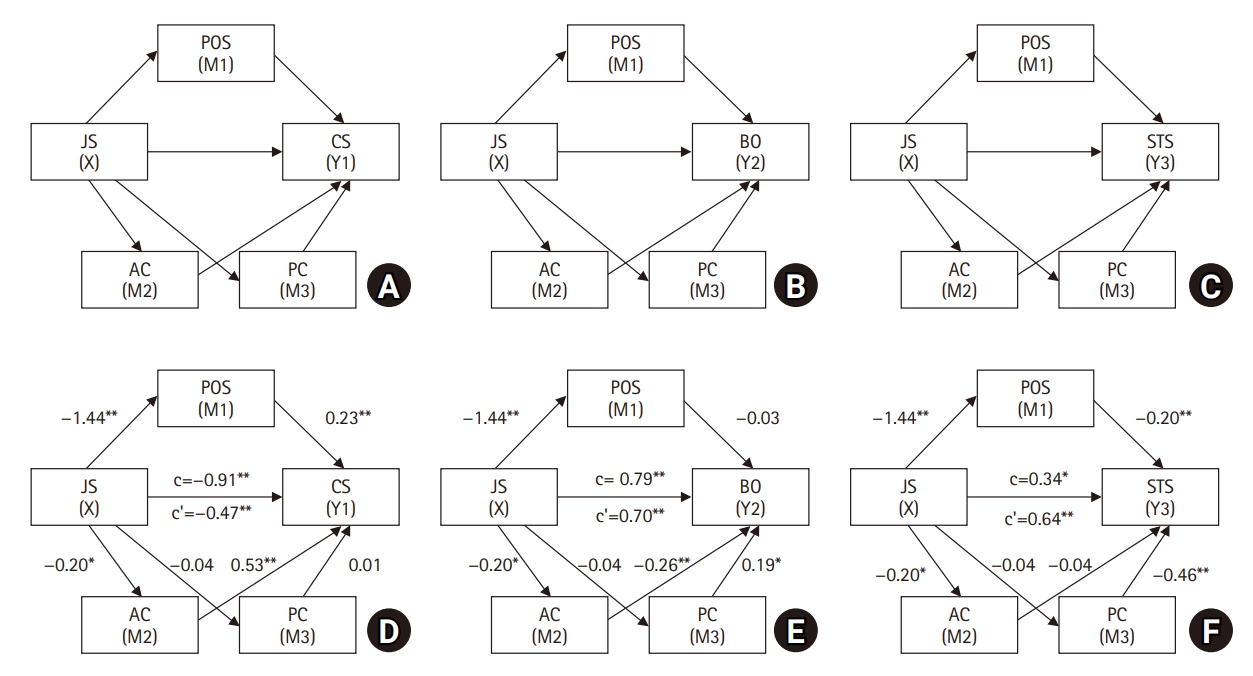
This study aimed to examine the mediating effects of perceived organizational support and coping strategies on the relationship between job stress and professional quality of life among nurse managers working in tertiary and general hospitals.
Methods
The participants were 299 nurse managers employed at tertiary and general hospitals located in Seoul and Gyeonggi Province. Data on job stress, perceived organizational support, coping strategies, and professional quality of life were collected using an online self-report questionnaire between June 28, 2024, and May 31, 2025. The collected data were analyzed using IBM SPSS Statistics ver. 27.0 and the PROCESS Macro ver. 4.0.
Results
Job stress was identified as a significant predictor of professional quality of life among nurse managers. Perceived organizational support and active coping demonstrated significant mediating effects on compassion satisfaction. Active coping showed a significant mediating effect on burnout, whereas perceived organizational support mediated secondary traumatic stress. Passive coping did not demonstrate a significant mediating effect on any of the three subdomains of professional quality of life.
Conclusion
Job stress is closely associated with compassion satisfaction, and this relationship is partially mediated by perceived organizational support and active coping. Accordingly, targeted interventions are required to reduce job stress, strengthen organizational support, and enhance coping competencies among nurse managers. Furthermore, reinforcing institutional- and policy-level support is essential to mitigate secondary traumatic stress and to ensure the sustainability of nurse managers’ professional roles.
- 2,407 View
- 248 Download

- Job stress levels and coping among hospital nurses: a latent profile analysis
- Myungji Kim, Hyunkyung Choi
- J Korean Acad Nurs 2025;55(3):377-387. Published online August 22, 2025
- DOI: https://doi.org/10.4040/jkan.25061
-
Abstract
PDFePub
- Purpose
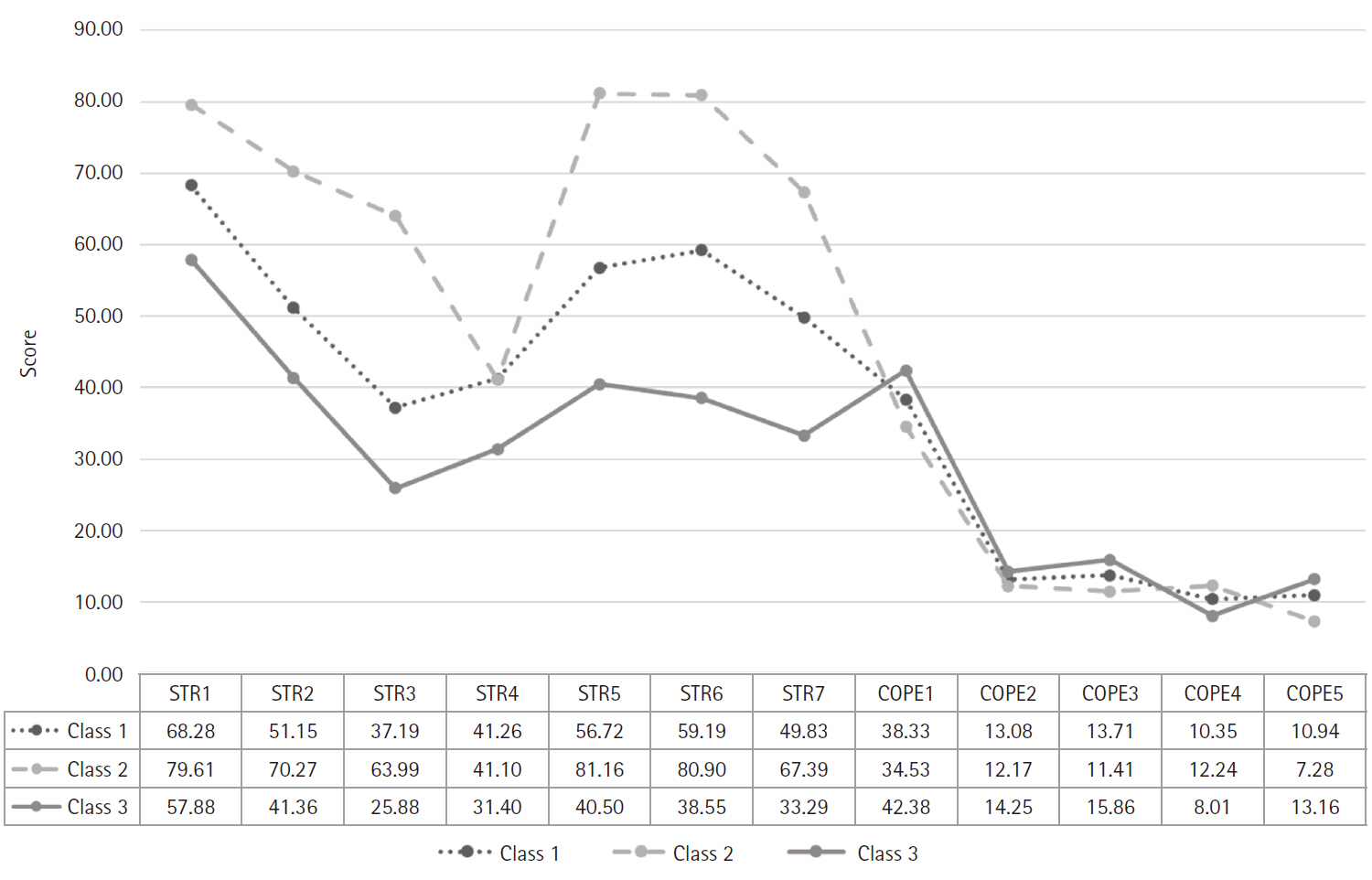
This study aimed to identify job stress levels and coping profiles among hospital nurses, explore the factors influencing profile classification, and determine whether levels of job embeddedness and happiness varied among the profiles.
Methods
Data were collected through an online survey of 325 hospital nurses, and latent profiles were identified via latent profile analysis. The R3STEP (three-step auxiliary variable approach) method was used to examine the factors influencing the latent profiles, and one-way analysis of variance was conducted to analyze differences in levels of job embeddedness and happiness.
Results
Three job stress and coping profiles were identified: (1) the “moderate stress-balanced coping group”, characterized by moderate levels of job stress and moderate use of all coping strategies; (2) the “high stress-emotional coping group”, with high job stress and primary use of emotional display strategies; and (3) the “low stress-adaptive coping group, with low job stress and the utilization of a variety of coping strategies. Workplace location and monthly income influenced the classification of latent profiles. Nurses working in metropolitan areas and those with lower monthly incomes were more likely to be classified into the high stress-emotional coping group than other groups. The levels of job embeddedness and happiness were highest in the low stress-adaptive coping group and lowest in the high stress-emotional coping group.
Conclusion
The results of this study indicate the need to develop strategies that offer diverse stress-coping programs and support nurses in effectively utilizing coping methods that best suit their individual needs.
- 3,965 View
- 329 Download
- Prenatal psychosocial factors and postpartum post-traumatic stress disorder in low-risk postnatal women: a longitudinal study
- Jung Hee Yeo, So Yeon Park
- J Korean Acad Nurs 2025;55(3):353-363. Published online August 21, 2025
- DOI: https://doi.org/10.4040/jkan.25027
-
Abstract
PDFePub
- Purpose
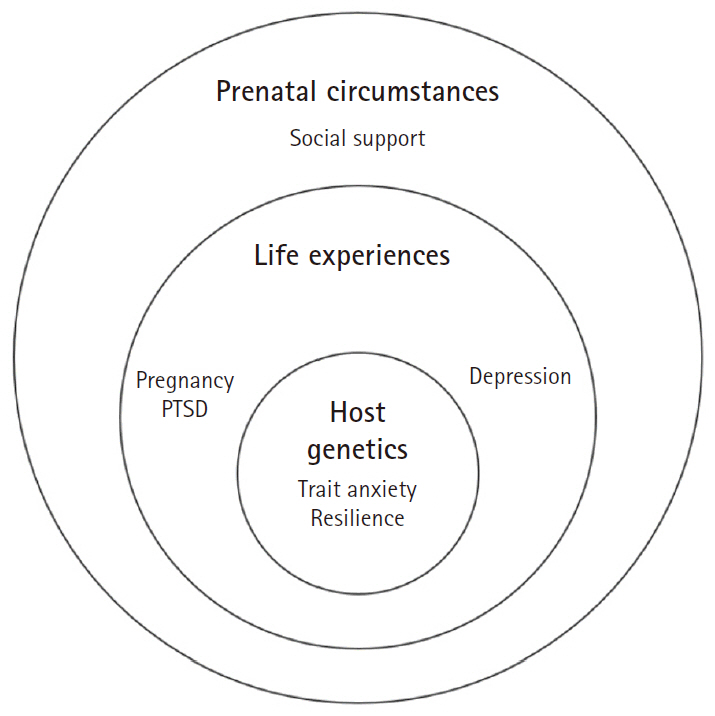
This study aimed to identify prenatal psychosocial factors influencing the development of postpartum post-traumatic stress disorder (PTSD) in both short-term (4–6 weeks postpartum) and long-term (4–6 and 14–18 weeks postpartum) assessments using the wheel model.
Methods
This study employed a longitudinal design with 359 women in their third trimester who received care at two maternity hospitals in City B. Surveys were used to measure depression, anxiety, resilience, and pregnancy-related PTSD during the third trimester (n=318). Postpartum PTSD was assessed at 4–6 weeks (n=198) and at 14–18 weeks postpartum (n=156). Data were analyzed using the t-test, chi-square test, and logistic regression.
Results
The prevalence of short-term postpartum PTSD was 32.7%, and that of long-term PTSD was 19.9%. The risk of short-term PTSD increased with higher pregnancy-related PTSD symptoms (odds ratio [OR], 1.04; 95% confidence interval [CI], 1.02–1.07), higher prenatal resilience (OR, 1.09; 95% CI, 1.00–1.18), and lower social support (OR, 0.93; 95% CI, 0.87–0.99). Similarly, the risk of long-term PTSD increased with higher pregnancy-related PTSD (OR, 1.09; 95% CI, 1.04–1.13), higher prenatal resilience (OR, 1.19; 95% CI, 1.06–1.34), and low educational attainment (OR, 6.75; 95% CI, 1.03–44.30).
Conclusion
The high prevalence of short- and long-term postpartum PTSD highlights the need for systematic screening and interventions for prenatal factors, including pregnancy-related PTSD, social support, resilience, and education level. Therefore, it is necessary to alleviate pregnancy-related PTSD and strengthen social support during prenatal care to prevent postpartum PTSD. Furthermore, women with high resilience should also be targeted in these interventions, because they can also develop postpartum PTSD.
- 2,604 View
- 208 Download
- 1 Web of Science
- Moderating Effect of General Self-Efficacy on the Relationship between Pregnancy Stress, Daily Hassles Stress, and Preterm Birth Risk in Women Experiencing Preterm Labor: A Cross-Sectional Study
- Hyun-Jeong Cho, Jeung-Im Kim
- J Korean Acad Nurs 2024;54(3):329-339. Published online August 31, 2024
- DOI: https://doi.org/10.4040/jkan.24008
-
Abstract
PDF
- Purpose
This study investigated the moderating role of general self-efficacy (GSE) on how stress caused by pregnancy and daily hassle affect the risk of preterm birth (PTB) in women experiencing preterm labor.
Methods
This cross-sectional study included 196 pregnant women experiencing preterm labor before 37 weeks of gestation. We used IBM SPSS Statistics 27 and employed Hayes process macro version 4 (model 1) and hierarchical regression to analyze the moderating effect of GSE on the relationship between pregnancy stress, daily hassle stress, and PTB risk.
Results
Stress caused by pregnancy and daily hassle was positively correlated to PTB risk (r = .54, p < .001; r = .25, p < .001, respectively). While GSE did not significantly correlate with pregnancy stress, it negatively correlated with daily hassle stress (r = - .19, p = .009). GSE significantly moderated the relationship between combined stressors and PTB risk. As GSE levels increased, escalation in PTB risk in response to increasing stress levels was a more pronounced, highlighting a complex interaction between higher GSE levels and response to escalating stress levels. This model accounted for 39.5% of the variance in the PTB risk.
Conclusion
Higher GSE may amplify the impact of stress on PTB risk, rather than mitigate it, which suggests a more nuanced role of GSE in the stress response of pregnant women at risk of preterm labor. GSE should be considered in care strategies, and managing its impact on stress perception and responses in pregnant women is crucial. -
Citations
Citations to this article as recorded by
- Evaluating the Effectiveness of Digital Interventions for Stress Management in Pregnant Women: Systematic Review and Meta-Analysis
Jeung-Im Kim, Joo Yun Lee, So-Hee Park
JMIR mHealth and uHealth.2026; 14: e66267. CrossRef - Pregnancy stress in women at high risk of preeclampsia with their anxiety, depression, self-management capacity: a cross-sectional study
Xing Cong, Jinmei Wang, Liu Yang, Lingling Cui, Yurong Hua, Ping Gong
Frontiers in Psychology.2025;[Epub] CrossRef - Anxiety, Coping, and Self-Efficacy as a Psychological Adjustment in Mothers Who Have Experienced a Preterm Birth
Agata Białas, Karolina Kamecka, Paweł Rasmus, Dariusz Timler, Remigiusz Kozłowski, Anna Lipert
Journal of Clinical Medicine.2025; 14(12): 4174. CrossRef - Associations Among Pregnancy Stress, Childbirth Confidence, and COVID-19 Infection Experience in Pregnant Women in the Early Third Trimester (28–32 Weeks)
Yun-Sun Yang, Jeung-Im Kim
Journal of Korean Maternal and Child Health.2025; 29(3): 147. CrossRef
- Evaluating the Effectiveness of Digital Interventions for Stress Management in Pregnant Women: Systematic Review and Meta-Analysis
- 3,283 View
- 153 Download
- 3 Web of Science
- 4 Crossref
- The Effects of Stress Vulnerability and Parental Burnout on Mental Health in Women with Early School-Age Children during the COVID-19 Pandemic: Mediating Effect of Spirituality
- Mijung Yeom, Min Kwon
- J Korean Acad Nurs 2024;54(1):106-117. Published online February 29, 2024
- DOI: https://doi.org/10.4040/jkan.23150
-
Abstract
PDF
- Purpose
This study examined the effects of stress vulnerability and parental burnout on the mental health of women with early schoolaged children, with a focus on the mediating role of spirituality.
Methods
A survey was conducted among 171 women with early schoolaged children in Gyeonggi Province, Gangwon Province, and Seoul. Data were collected from September to December 2022 using the Korean-Symptom Check List 95, the Parental Burnout Assessment, and the Spirituality Assessment Scale. The data were analyzed using structural equation modeling with SPSS/WIN 22.0 and AMOS 20.0.
Results
The study model demonstrated a good fit, explaining 40.5% of the variance in mental health through stress vulnerability, parental burnout, and spirituality. Spirituality had a significant direct impact on mental health. Additionally, participants’ spirituality directly influenced their mental health, while stress vulnerability and parental burnout indirectly affected their mental health and were mediated through spirituality.
Conclusion
Stress vulnerability and parental burnout are negatively associated with mental health, while spirituality partially mediates these effects. Implementing a program to promote spirituality is suggested to assist mothers in recognizing the value and meaning of parenting activities during nursing interventions for mental health. -
Citations
Citations to this article as recorded by- Interplay of the ENS and Microbiota With Murine Gut Epithelium‐Derived Organoids in Aging
Tinh Thi Nguyen, Dennis Schapelhouman, Katharina Fischer, Jia‐Xuan Chen, Mario Dejung, Fridolin Kielisch, Julia Varga, Johannes Piepgras, Matthew Ahn, Oliver Tüscher, Peter Baumann, Sandra Schick, Kristina Endres
Aging Cell.2026;[Epub] CrossRef
- Interplay of the ENS and Microbiota With Murine Gut Epithelium‐Derived Organoids in Aging
- 3,511 View
- 99 Download
- 1 Crossref
- A Caring Program for Health Promotion among Women Who Have Experienced Trauma: A QuasiExperimental Pilot Study
- Goun Kim, Heejung Kim, Jeongok Park, Hee Sun Kang, Soojin Kim, Sunah Kim
- J Korean Acad Nurs 2023;53(5):500-513. Published online October 31, 2023
- DOI: https://doi.org/10.4040/jkan.22120
-
Abstract
PDF
- Purpose
Women are more vulnerable to post-traumatic stress (PTS) than men, causing several health problems. Nurses should understand and work with women who have experienced trauma and provide interventions to promote their physical, social, and mental health.
Methods
This quasi-experimental pilot study used a one-group pre-test/post-test design. Data were collected from 14 women recruited between December 2019 and May 2020 from a self-sufficiency support center in South Korea for sexually-exploited women who had experienced trauma. The program consisted of six one-on-one intervention sessions per week for six weeks. Each session averaged 60~120 minutes. Participants were assessed at pre-test, post-test, and one-month follow-up. Changes in outcome variables over time were analyzed using the Wilcoxon signed-rank and Friedman tests.
Results
The caring program for health promotion was divided into six sessions: understanding the self, sharing traumatic events and negative emotions, reframing the meaning of traumatic events, identifying thoughts and physical and emotional responses, developing health promotion activities, and maintaining a positive attitude during the process of change. As a result of the caring program, PTS (F = 36.33, p < .001), depression (F = 24.45, p < .001), health-promoting behaviors (F = 7.06, p = .004), and self-esteem (F = 19.74, p < .001) among the participants differed significantly at pre-test, post-test, and follow-up.
Conclusion
This study provides foundational information for the implementation of a theory-driven program by nurses in clinical and community settings to provide comprehensive care for women who have experienced trauma. -
Citations
Citations to this article as recorded by- Development and Effectiveness of an Interpersonal Relationship Improvement Program for Inpatients with Chronic Schizophrenia: Quasi-experimental/Non-randomised Evaluation
Jae-Eun Choi, Jeongyee Bae
Journal of Korean Academy of psychiatric and Mental Health Nursing.2025; 34(2): 188. CrossRef - Prediction and Feature Selection of Mastectomy-Related Post Traumatic Stress Disorder (PTSD) Using Machine Learning Among Breast Cancer Patients in Bangladesh
Syed Billal Hossain, Md. Mizanoor Rahman, Kapashia Binte Giash, Md. Hazrat Ali, Mst. Asma Akter, A.B.M. Alauddin Chowdhury
Cancer Informatics.2025;[Epub] CrossRef
- Development and Effectiveness of an Interpersonal Relationship Improvement Program for Inpatients with Chronic Schizophrenia: Quasi-experimental/Non-randomised Evaluation
- 7,122 View
- 89 Download
- 1 Web of Science
- 2 Crossref
- Development and Psychometric Evaluation of the Ischemic Stroke Distress Scale (ISDS)
- Jaejin Kang, Yang-Sook Yoo
- J Korean Acad Nurs 2023;53(1):12-27. Published online February 28, 2023
- DOI: https://doi.org/10.4040/jkan.22090
-
Abstract
PDF
- Purpose
This study aimed to develop a scale to measure distress in patients with ischemic stroke and verify its validity and reliability.
Methods
Preliminary items were developed from literature review and in-depth interviews. The final preliminary scale was confirmed through a content validity test of eight experts and a preliminary survey of 10 stroke patients. The participants for psychometric testing were 305 stroke patients in the outpatient clinic. Validity and reliability analyses included item analysis, exploratory and confirmatory factor analysis, convergent validity, known-group validity, and internal consistency of the scale.
Results
The final scale consisted of 17 items and 3 factors. The three distinct factors were ‘self-deprecation, worry about future health, and withdrawal from society’ and this structure was validated using a confirmatory factor analysis. Convergent validity was supported by comparison with the Center for Epidemiologic Studies Depression Scale (r = .54, p < .001) and Brief Illness Perception Questionnaire (r = .67, p < .001). Known-groups validity was verified by dividing groups according to ‘duration since diagnosis’ (t = 2.65, p = .009), ‘presence of sequela’ (t = 10.16, p < .001), and ‘awareness of distress’ (t = 12.09, p < .001). The internal consistency of the scale using Cronbach’s α for the total items was .93.
Conclusion
The Ischemic Stroke Distress Scale is a valid and reliable tool that reflects stroke distress effectively. It is expected to be used as a basic tool to develop various intervention strategies to reduce distress in ischemic stroke patients.
- 2,569 View
- 100 Download
- Effect of Acculturative Stress on Multicultural Adolescents’ Life Satisfaction: Sequential Multiple Mediating Effects of Bicultural Acceptance Attitude, Self-Esteem, and Social Withdrawal -Using the 2016 Multicultural Adolescents Panel Study-
- Soo Mi Kim, Hyeon Ok Kim
- J Korean Acad Nurs 2022;52(3):324-340. Published online June 30, 2022
- DOI: https://doi.org/10.4040/jkan.22030
-
Abstract
PDF
- Purpose
This study determined acculturative stress’ effect on the life satisfaction of multicultural adolescents based on Roy’s Adaptation Model and some earlier studies. Further, it examined the sequential multiple mediating effects of bicultural acceptance attitude, self-esteem, and social withdrawal on life satisfaction.
Methods
Participants included 1,163 multicultural adolescents who participated in the sixth Multicultural Adolescents Panel Study. A hypothesis test was conducted using Hayes’ Process Macro Model 81.
Results
Life satisfaction increased with a decline in acculturative stress. Each of bicultural acceptance attitude, self-esteem, and social withdrawal had a single mediating effect on the relationship between acculturative stress and life satisfaction in multicultural adolescents. The sequential multiple mediating effects of bicultural acceptance attitude and self-esteem were confirmed significant after their impact on the relationship between acculturative stress and life satisfaction was analyzed. Bicultural acceptance attitude and social withdrawal were found to have a significant sequential multiple mediating effect on the relationship, as well.
Conclusion
This study’s results demonstrate that acculturative stress reduction is critical to improving multicultural adolescents’ life satisfaction. Bicultural acceptance attitude, self-esteem, and social withdrawal have a single mediating or sequential multiple mediating effect on the relationship between multicultural adolescents’ acculturative stress and life satisfaction. The findings, which highlight mediating effects, indicate that by increasing bicultural acceptance attitude and self-esteem, and reducing social withdrawal, multicultural adolescents’ life satisfaction can be improved. -
Citations
Citations to this article as recorded by- Dual mediating roles of friend support and self-esteem in the association between bicultural acceptance attitudes and life satisfaction among multicultural adolescents in South Korea: the moderating role of depression
Hai Lan Jin, Hua Mei Liu
Frontiers in Psychology.2026;[Epub] CrossRef - A Review of Parenting and Health Equity Among Multicultural Families
Soonyoung Shon
Journal of Korean Maternal and Child Health.2026; 30(2): 65. CrossRef - Association of smartphone overdependence with depression and suicidal ideation among multicultural adolescents: A propensity score matching study
Yeun Shin, Jeong Min Yang, Youbin Maeng, Heejoo Jung, Seoyun Lee, Jieun Hwang
Korean Journal of Health Education and Promotion.2026; 43(2): 59. CrossRef - Perceived Neglectful Parenting and Depressive Symptoms in Multicultural Adolescents: Bicultural Acceptance and Withdrawal as Mediators
Sangmi Lee
Family Relations.2026;[Epub] CrossRef - Association between parents’ country of birth and multicultural adolescents’ psychological well-being in South Korea: A study on depression, worries, life satisfaction, and social withdrawal
Abdullatif Ghafary, Jaeyong Shin, Sang Sook Beck, Jieun Jang, Rajaguru Vasuki, So Yoon Kim, Hanif Abdul Rahman
PLOS Mental Health.2025; 2(6): e0000356. CrossRef - Acculturative Stress and Psychosocial Well-Being of Multicultural Youth in South Korea: The Moderating Role of Host Culture Identity
Cheolwoo Park, Hannah B. Bayne
International Journal for the Advancement of Counselling.2024; 46(3): 465. CrossRef - Bicultural Acceptance Attitude as a Protective Factor Against the Effect of Acculturative Stress on Life Satisfaction Among Korean Multicultural Adolescents
Jong-Hye Park, Sung-Man Bae
Applied Research in Quality of Life.2024; 19(4): 1811. CrossRef - The influence of bullying victimization on acculturation and life satisfaction among children from multicultural families in South Korea
Jinho Kim, Eric Fong
Journal of Ethnic and Migration Studies.2024; 50(18): 4718. CrossRef - The Influence of Support Services for Multicultural Adolescents on
School Adjustment and the Moderated Mediation Effect of Bicultural Attitude
by Social Support
Rae-Hyuck Lee, Jae-Kyoung Lee
Korean Journal of family welfare.2024; 29(1): 149. CrossRef
- Dual mediating roles of friend support and self-esteem in the association between bicultural acceptance attitudes and life satisfaction among multicultural adolescents in South Korea: the moderating role of depression
- 4,382 View
- 168 Download
- 4 Web of Science
- 9 Crossref
- Validity and Reliability of the Turkish Version of the COVID Stress Scale
- Demirgöz Bal Meltem, Dişsiz Melike, Bayri Bingöl Fadime
- J Korean Acad Nurs 2021;51(5):525-536. Published online October 31, 2021
- DOI: https://doi.org/10.4040/jkan.21106
-
Abstract
PDF
- Purpose
The aim of this study was to assess the Turkish adaptation of the COVID Stress Scale (CSS) on the basis of determining the stress caused by the coronavirus disease (COVID-19) pandemic, and to test its validity and reliability.
Methods
The English CSS was translated into Turkish using forward and backward translation. Data were collected online from 360 participants. Construct validity was evaluated using confirmatory factor analysis, exploratory factor analysis, and content validity. Pearson product-moment correlation, Cronbach’s alpha reliability coefficient, and test-retest methods were used to evaluate reliability.
Results
The Turkish version of the CSS has 36 items consistent with the original scale and has five factors: COVID danger and contamination, socioeconomic consequences of COVID, COVID xenophobia, traumatic stress due to COVID, and compulsive checking for COVID. The construct validity of the Turkish version of the CSS was verified by the adjusted goodness of fit index > .85, and comparative fit index > .95. The content validity index of each item was 91%. The corrected item-total correlations of the scale ranged from .51 to .89. Internal consistency was reliable, with a Cronbach’s α of .93.
Conclusion
The Turkish version of the CSS is valid and reliable. It can be used as a measurement tool for the assessment of COVID-related stress. -
Citations
Citations to this article as recorded by- Digital equity in nursing research: A methodological review of nursing studies requiring internet connection
Matthew S. Farmer, Drew Herbert, Christa Torrisi, Arthur Zacharjasz, Gerard Castaneda, Takara Schomberg, Michelle Dardis, Nicole Montgomery, Mary E. Melvin
Nursing Outlook.2026; 74(1): 102667. CrossRef - Psychometric evaluation and item response theory analysis of the COVID Stress Scales in an older adult population
Kylie A. Arsenault, Ying C. MacNab, Gordon J. G. Asmundson, Thomas Hadjistavropoulos
Aging & Mental Health.2025; 29(4): 726. CrossRef - The long-term impact of the covid-19 pandemic on patients with obsessive–compulsive disorder
Büşra Uçar Bostan, Cana Aksoy Poyraz, Beril Kara Esen, Nazife Gamze Usta Sağlam
Medicine.2025; 104(7): e41562. CrossRef - Is there evidence for factorial invariance of the COVID Stress Scales? an analysis of North American and cross-cultural populations
Blake A. E. Boehme, Laura Kinsman, Steven Taylor, Gordon J. G. Asmundson
Frontiers in Psychiatry.2024;[Epub] CrossRef - Psychometric properties of a brief version of the COVID‐19 Stress Scales (CSS‐B) in young adult undergraduates
Tabatha Thibault, Kara Thompson, Matthew Keough, Marvin Krank, Patricia Conrod, Mackenzie Moore, Sherry H. Stewart
Stress and Health.2023; 39(1): 154. CrossRef - Pandemi Sonrası Yoğun Bakım Hemşirelerinde Covid-19 Stres Düzeyinin Belirlenmesi
Elif PAKLACI, Elif KAYA AYDOĞDU, Besey ÖREN
Yoğun Bakım Hemşireliği Dergisi.2023; 27(3): 138. CrossRef - Initial translation and validation of the Brief Version of the COVID-19 Stress Scales (CSS-B)
Razieh Bandari, Majideh Heravi- Karimooi, Mahsa Tebyanian, Hossein Shahcheragh
Payesh (Health Monitor) Journal.2023; 22(5): 617. CrossRef - Does COVID-19 related symptomatology indicate a transdiagnostic neuropsychiatric disorder? - Multidisciplinary implications
Sari Goldstein Ferber, Gal Shoval, Gil Zalsman, Aron Weller
World Journal of Psychiatry.2022; 12(8): 1004. CrossRef - The adaption of the Chinese version of the COVID Stress Scales as a screening instrument of stress: Psychometric properties during the COVID-19 pandemic
Lu Xia, Qiaoping Lian, Haibo Yang, Daxing Wu
Frontiers in Public Health.2022;[Epub] CrossRef
- Digital equity in nursing research: A methodological review of nursing studies requiring internet connection
- 2,186 View
- 11 Download
- 8 Web of Science
- 9 Crossref
- Effects of Second Victim Experiences after Patient Safety Incidents on Nursing Practice Changes in Korean Clinical Nurses: The Mediating Effects of Coping Behaviors
- Seohee Jeong, Seok Hee Jeong
- J Korean Acad Nurs 2021;51(4):489-504. Published online August 31, 2021
- DOI: https://doi.org/10.4040/jkan.21089
-
Abstract
PDF
- Purpose
This study was investigated the mediating effect of coping behaviors in the relationship between the second victim experiences after patient safety incidents and the nursing practice changes.
Methods
A cross-sectional survey was performed using structured questionnaires. Participants were 218 clinical nurses in general tertiary hospitals in South Korea. Data were collected through an online survey and snowball sampling from August 11 to September 6 2020. Data were analyzed using SPSS 23.0 program. A mediation analysis was performed using multiple regression and a simple mediation model applying the PROCESS macro with 95% bias-corrected bootstrap confidence interval.
Results
The mean scores of second victim experiences was 3.41/5. Approach coping (β = .55, p < .001) and the avoidant coping (β = - .23, p = .001) showed mediation effects in the relationship between second victim experiences and constructive change in nursing practice. Avoidant coping (β = .29, p < .001) showed a mediation effect in the relationship between second victim experiences and defensive change in nursing practice.
Conclusion
Coping behaviors has a mediating effect on the relationship between second victim experiences and nursing practice changes. To ensure that nurses do not experience second victim, medical institutions should have a culture of patient safety that employs a systematic approach rather than blame individuals. They also need to develop strategies that enhance approach coping and reducing avoidant coping to induce nurses’ constructive practice changes in clinical nurses in experiencing second victims due to patient safety incidents. -
Citations
Citations to this article as recorded by- Influences of Clinical Nurses’ Second Victim Experience after Patient Safety Incidents, Individual and Organizational Support, and Job Satisfaction on Turnover Intention
Hyeran Kang, Jeong-Hee Kim
Journal of Korean Academy of Nursing Administration.2026; 32(1): 58. CrossRef - Factors influencing negative outcomes for nurses who experience patient safety incidents: An integrative review
Hanseulgi Lee, Nam‐Ju Lee, Nari Kim
International Nursing Review.2025;[Epub] CrossRef - How does just culture reduce negative work outcomes through second victim distress and demand for support in clinical nurses? A path analysis
Seohee Jeong, Sunmi Kim, Hyoung Eun Chang, Seok Hee Jeong
BMC Nursing.2025;[Epub] CrossRef - Changes in Nursing Practice Among Clinical Nurses After Experiencing a Patient Safety Incident: Partial Least Squares Structural Equation Modeling
Sunmi Kim, Seohee Jeong, Seok Hee Jeong, Majd Mrayyan
Journal of Nursing Management.2025;[Epub] CrossRef - Predictors of Nurses' Reporting Level by the Types of Patient Safety Incidents
Ju-Hee Kang, Yeojin Yi
Journal of Korean Academy of Nursing Administration.2025; 31(4): 434. CrossRef - The Relationship of Medication Safety Competence, Second Victim Experiences, Second Victim Support, and Negative Work Outcomes among Clinical Nurses
Ahlim Chang, Youngjin Lee, Minkyung Kang, Ji Yea Lee
Journal of Korean Academy of Nursing Administration.2025; 31(5): 493. CrossRef - “Learn from Errors”: Post-traumatic growth among second victims
Huanhuan Huang, Tong Liu, Ying Peng, Xingyao Du, Qi Huang, Qinghua Zhao, Mingzhao Xiao, Yetao Luo, Shuangjiang Zheng
BMC Public Health.2024;[Epub] CrossRef - Nurse Leader Perspectives and Experiences on Caregiver Support Following a Serious Medical Error
Marie M. Prothero, Madeline Sorhus, Katherine Huefner
JONA: The Journal of Nursing Administration.2024; 54(12): 664. CrossRef - Prevalence of the second victim phenomenon among intensive care unit nurses and the support provided by their organizations
Maria Kappes, Pilar Delgado‐Hito, Verónica Riquelme Contreras, Marta Romero‐García
Nursing in Critical Care.2023; 28(6): 1022. CrossRef - The mediating role of coping styles in the relationship between second victim experience and professional quality of life among nurses: a cross-sectional study
Xizhao Li, Chong Chin Che, Yamin Li, Ling Wang, Mei Chan Chong
BMC Nursing.2023;[Epub] CrossRef - Associations among workplace incivility, stress coping, and nursing performance in hospital nurses: A path analysis
Eun Ha Kim, Yeojin Yi
Journal of Nursing Scholarship.2023; 55(4): 834. CrossRef - Influence of Clinical Nurses’ Second-Victim Experience and Second-Victim Support in Relation to Patient Safety Incidents on Their Work-Related Outcomes
Su Jin Jung, Youngjin Lee, Sun Hyoung Bae
Journal of Korean Academy of Nursing Administration.2022; 28(4): 331. CrossRef - Profiles of second victim symptoms and desired support strategies among Korean nurses: A latent profile analysis
Eun Young Choi, Jeehee Pyo, Minsu Ock, Haeyoung Lee
Journal of Advanced Nursing.2022; 78(9): 2872. CrossRef
- Influences of Clinical Nurses’ Second Victim Experience after Patient Safety Incidents, Individual and Organizational Support, and Job Satisfaction on Turnover Intention
- 5,066 View
- 151 Download
- 10 Web of Science
- 13 Crossref
- Development and Evaluation of Resilience Enhancement Program Applying Mindfulness Meditation in Patients with Ileostomy
- Jee Hye Shin, Ja Yun Choi
- J Korean Acad Nurs 2021;51(3):334-346. Published online June 30, 2021
- DOI: https://doi.org/10.4040/jkan.21019
-
Abstract
PDF
- Purpose
The purpose of this study was to develop a resilience enhancement program applying mindfulness meditation (REP-MM) and evaluate the effects of the program on post-traumatic stress (PTS), resilience, and health-related quality of life (HRQoL) in patients with ileostomy.
Methods
The REP-MM was developed by combining the resilience enhancement program with mindfulness meditation according to four patterns. The program was developed through identifying patients’ needs, reviewing relevant literature, developing a preliminary program, and testing content validity and user evaluation. The participants were 55 patients with ileostomy. We conveniently assigned 27 patients to the experimental group and 28 to the control group. The study was conducted in conducted in a hospital from January 22 to May 30, 2019. The REPMM was provided to the experimental group, and conventional ileostomy care was provided to the control group using a nonequivalent control-group pretest-posttest design. Results: ANCOVA revealed that the levels of PTS (F = 321.64, p < .001), resilience (F = 111.86, p < .001), and HRQoL (F = 31.08, p < .001) in the experimental group were higher than those in the control group when comparing pretest to posttest changes.
Conclusion
The REP-MM is effective in PTS, resilience, and HRQoL in patients suffering from post-stoma creation crisis. The REP-MM can induce positive self-recognition changes in patients with ileostomy through dispositional, situational, relational, and philosophical interventions. We suggest nurses reduce PTS and improve resilience and HRQoL in patients with ileostomy. -
Citations
Citations to this article as recorded by- Development and Validation of a Chinese Marital Intimacy Scale for Colorectal Cancer Survivors With an Ostomy (Ch‐MIS‐CRCO)
Xixi Du, Suchira Chaiviboontham, Bualuang Sumdaengrit, Sasivimol Rattanasiri, Shashank Kaushik
European Journal of Cancer Care.2026;[Epub] CrossRef - Ostomy Care Education in Nursing Training: A Systematic Review
Mina Alvandipour, Asal Khodabakhsh
Journal of Nursing and Midwifery Sciences.2026;[Epub] CrossRef - Effectiveness of Meditation Techniques in Treating Post-Traumatic Stress Disorder: A Systematic Review and Meta-Analysis
David W. Orme-Johnson, Vernon A. Barnes, Brian Rees, Jean Tobin, Kenneth G. Walton
Medicina.2024; 60(12): 2050. CrossRef - The experiences of Chinese colorectal cancer survivors in marital intimacy after ostomy creation: A qualitative study
Xixi Du, Suchira Chaiviboontham, Bualuang Sumdaengrit
Belitung Nursing Journal.2024; 10(2): 222. CrossRef - Analysis on effect of psychological nursing combined with extended care for improving negative emotions and self-care ability in patients with colorectal cancer and enterostomy: A retrospective study
Fang Liu, Kun Yao, Xiaoxiang Liu
Medicine.2024; 103(21): e38165. CrossRef - Development and Evaluation of a Healthcare Empowerment Program for Patients with Temporary Ileostomy
Jin Mi Kim, Jeong Sook Park
Korean Journal of Adult Nursing.2021; 33(6): 616. CrossRef
- Development and Validation of a Chinese Marital Intimacy Scale for Colorectal Cancer Survivors With an Ostomy (Ch‐MIS‐CRCO)
- 2,884 View
- 72 Download
- 5 Web of Science
- 6 Crossref
- Actor and Partner Effects of Couple’s Daily Stress and Dyadic Coping on Marital Satisfaction
- Su Kyung Won, Kyoung Ok Seol
- J Korean Acad Nurs 2020;50(6):813-821. Published online December 31, 2020
- DOI: https://doi.org/10.4040/jkan.20162
-
Abstract
PDF
- Purpose
This study aimed to identify the actor and partner effects of daily stress and dyadic coping on marital satisfaction using the Actor-Partner Interdependence Mediational Model (APIeM).
Methods
Participants were 314 couples who met the study’s eligibility criteria. Data were collected from March to April 2016 through apartment and cooperative company communities in Seoul. Two APIeMs of positive and negative dyadic coping were analyzed using SPSS 20.0 and Mplus 7.4. All measures were self-administered.
Results
Daily stress and positive and negative dyadic coping in both spouses had direct actor effects on their marital satisfaction. Daily stress in both spouses had an indirect actor effect on marital satisfaction through their positive and negative dyadic coping. The husband’s daily stress had an indirect partner effect on the wife’s marital satisfaction through his positive dyadic coping, while the wife’s positive dyadic coping had a direct partner effect on the husband’s marital satisfaction. The husband’s daily stress had an indirect partner effect on the wife’s marital satisfaction through his negative dyadic coping, while the wife’s negative dyadic coping had a direct partner effect on the husband’s marital satisfaction.
Conclusion
Dyadic coping is an effective way to deal with couple’s daily hassles as it increase their satisfaction in marriage. -
Citations
Citations to this article as recorded by- When Your Emotions Drain My Flexibility: A Dyadic Analysis of Emotion Regulation, Cognitive Flexibility, and Life Satisfaction in Marriage
Osman Söner, M. Furkan Tunç, Erhan Tunç
The American Journal of Family Therapy.2026; : 1. CrossRef - The actor-partner interdependence mediation model of infertility-related stress and subjective happiness in infertile couples: the mediating role of dyadic coping
Eun Jin Kim, Ju-Hee Nho
Journal of Korean Academy of Nursing.2026; 56(3): 421. CrossRef - Associations of subjective health status and spousal shared activities with depression among married postmenopausal women: a correlational study using data from the ninth wave of the Korean Longitudinal Survey of Women and Families
Ee Jee Jung, Yee Jung Jang, Ji Seon Lee
Women's Health Nursing.2026; 32(3): 269. CrossRef - Analysis of risk factors for co-morbid anxiety and depression in pregnant women
Wei Zhang, Ling Li, Xiabidan Tuxunjiang, Bahedana Sailike, Xiaoting Wang, Weicui Meng, Sufeila Shalayiding, Ting Jiang
Psychiatry Research.2025; 344: 116323. CrossRef - Pregnant Women’s Dyadic Coping and Associated Factors: A Cross-Sectional Study Utilizing Latent Profile Analysis
Shiqiong Yan, Wenzhuo Fan, Yonghong Ma, Sijia Xie, Rong Li, Yao Lan, Linli Xie, Jie Jing
International Journal of Women's Health.2024; Volume 16: 1009. CrossRef - Spouse Burnout and Marriage Satisfaction in Married Individuals: The Mediating Role of Psychologıcal Well-being
Bülent Şen, Nergüz Bulut Serin, Kadriye Karagülmez
Batı Anadolu Eğitim Bilimleri Dergisi.2024; 15(2): 1266. CrossRef - Dyadic coping and associated factors in women with high-risk pregnancy and their spouses: Do they interact?
Mengjie Liu, Yu Fang, Mengshi Liu, Min Wu, Jingshuo Zhang, Tianchen Niu, Xiaoman Zhang
Midwifery.2024; 134: 104006. CrossRef - 중년부부의 문제해결 유형과 결혼만족도의 관계
수산나 주, 미선 강, 인혜 정, 서진 조
Journal of Family Relations.2023; 28(1): 33. CrossRef - Relationship between Chinese middle-aged and old couples' Confucian coping thinking and marital quality
Zhiguang Fan, Hanwei Wu, Min Tao, Lei Chen
Frontiers in Public Health.2022;[Epub] CrossRef - The impact of avoidant attachment on marital satisfaction of Chinese married people: Multiple mediating effect of spousal support and coping tendency
Lian Xiong, Caihua Zhou, Liangshi Yan, Pan Zhao, Mengting Deng, Yan Hu
Acta Psychologica.2022; 228: 103640. CrossRef - Interrelation of Attachment and Coping Behavior In Adults
E.V. Kuftyak
Counseling Psychology and Psychotherapy.2021; 29(1): 28. CrossRef
- When Your Emotions Drain My Flexibility: A Dyadic Analysis of Emotion Regulation, Cognitive Flexibility, and Life Satisfaction in Marriage
- 2,607 View
- 78 Download
- 8 Web of Science
- 11 Crossref
Original Article
- Predictors of Blood and Body Fluid Exposure and Mediating Effects of Infection Prevention Behavior in Shift-Working Nurses: Application of Analysis Method for Zero-Inflated Count Data
- Jae Geum Ryu, Choi-Kwon Smi
- J Korean Acad Nurs 2020;50(5):658-670. Published online October 31, 2020
- DOI: https://doi.org/10.4040/jkan.20025
-
Abstract
PDF
- Purpose
This study aimed to identify the predictors of blood and body fluid exposure (BBFE) in multifaceted individual (sleep disturbance and fatigue), occupational (occupational stress), and organizational (hospital safety climate) factors, as well as infection prevention behavior. We also aimed to test the mediating effect of infection prevention behavior in relation to multifaceted factors and the frequency of BBFE.
Methods
This study was based on a secondary data analysis, using data of 246 nurses from the Shift Work Nurses’ Health and Turnover study. Based on the characteristics of zero-inflated and over-dispersed count data of frequencies of BBFE, the data were analyzed to calculate zero-inflated negative binomial regression within a generalized linear model and to test the mediating effect using SPSS 25.0, Stata 14.1, and PROCESS macro.
Results
We found that the frequency of BBFE increased in subjects with disturbed sleep (IRR = 1.87, p = .049), and the probability of non-BBFE increased in subjects showing higher infection prevention behavior (IRR = 15.05, p = .006) and a hospital safety climate (IRR = 28.46, p = .018). We also found that infection prevention behavior had mediating effects on the occupational stress-BBFE and hospital safety climate-BBFE relationships.
Conclusion
Sleep disturbance is an important risk factor related to frequency of BBFE, whereas preventive factors are infection prevention behavior and hospital safety climate. We suggest individual and systemic efforts to improve sleep, occupational stress, and hospital safety climate to prevent BBFE occurrence. -
Citations
Citations to this article as recorded by- Development of an infection control competency scale for clinical nurses: an instrument design study
Yong Hwan Hyeon, Kyoung Ja Moon
BMC Nursing.2024;[Epub] CrossRef - Work Characteristics and Needlestick-Injury Status of Dental Hygienists
Yeon-Soon Park, Jeong-Hyun Lee, Jin-Soo Kim, Kyoung-Ok Yun, Sung-Suk Bae
Journal of Dental Hygiene Science.2024; 24(3): 190. CrossRef - Smartphone‐based home workout program for shift‐work nurses working during the COVID‐19 pandemic
Yunmi Baek, Kihye Han, Jieun Kim, Hae Young Yoo
Nursing & Health Sciences.2022; 24(3): 708. CrossRef - Mediating Effects of Role Clarity between Clinical Decision-Making Abilities and Job Stress for Advanced Practice Nurses at Tertiary Hospitals
Min Young Kim, Jeong Hye Kim, Su Jung Choi
Journal of Korean Critical Care Nursing.2022; 15(2): 27. CrossRef
- Development of an infection control competency scale for clinical nurses: an instrument design study
- 2,427 View
- 59 Download
- 2 Web of Science
- 4 Crossref
Research Paper
- Secondary Data Analysis on the Factors Influencing Premenstrual Symptoms of Shift Work Nurses: Focused on the Sleep and Occupational Stress
- Jihyun Baek, Smi Choi-Kwon
- J Korean Acad Nurs 2020;50(4):631-640. Published online August 31, 2020
- DOI: https://doi.org/10.4040/jkan.19230
-
Abstract
PDF
- Purpose
This study aimed to examine premenstrual symptoms (PMS) of shift nurses and identify the association between PMS, sleep, and occupational stress.
Methods
This study was conducted with a secondary data analysis that used data from the Shift Work Nurse’s Health and Turnover study. The participants were 258 nurses who were working in shifts including night shifts. PMS, sleep patterns (sleep time and sleep time variability), sleep quality, and the occupational stress of each participant were measured using the Moos Menstrual Distress Questionnaire, a sleep diary, an actigraph, the Insomnia Severity Index, and the Korean Occupational Stress Scale, respectively. Data were analyzed using SPSS 23 and STATA 15.1 to obtain descriptive statistics, Pearson’s correlation coefficients, multiple linear regression with generalized estimating equations (GEE) and Baron and Kenny’s mediating analysis.
Results
The average PMS score, average sleep time, average sleep time variability, average sleep quality score, and average occupational stress score of the participants was 53.95 ± 40.45, 7.52 ± 0.89 hours, 32.84 ± 8.43%, 12.34 ± 5.95, and 49.89 ± 8.98, respectively. A multiple linear regression analysis with GEE indicated that sleep time variability (B = 0.86, p = .001), and sleep quality (B = 2.36, p < .001) had negative effects on nurses’ PMS. We also found that sleep quality had a complete mediating effect in the relationship between occupational stress and PMS.
Conclusion
These findings indicate that both sleep time variability and sleep quality are important factors associated with PMS among shift work nurses. To improve shift nurses’ PMS status, strategies are urgently needed to decrease sleep time variability and increase sleep quality. -
Citations
Citations to this article as recorded by- Hospital Nurses’ Professional Quality of Life Model: A Cross‐Sectional Study Based on the Expanded Job Demands‐Resources Model
Younghee Kim, Mi Yu, Jacopo Fiorini
Journal of Nursing Management.2025;[Epub] CrossRef - Premenstrual Symptoms Risk Factors Among Newly Graduated Nurses in Shift Work: A Prospective Longitudinal Study
Iksoo Huh, Smi Choi-Kwon, Jison Ki, Soyeon Kim, Jihyun Baek
Asian Nursing Research.2024; 18(5): 501. CrossRef - Premenstrual Syndrome’s Impact on Work-Related Quality of Life Among Jordanian Nurses
Yamamah Al-Hmaid, Othman Beni Yonis, Mais Alkhalili, Khalid Kheirallah
Cureus.2024;[Epub] CrossRef - Investigating influencing factors on premenstrual syndrome (PMS) among female college students
Su Jeong Yi, Miok Kim, Ina Park
BMC Women's Health.2023;[Epub] CrossRef - Development and validation of risk prediction model for premenstrual syndrome in nurses: results from the nurses-based the TARGET cohort study
Li Li, Xiaoyan Lv, Yuxin Li, Xinyue Zhang, Mengli Li, Yingjuan Cao
Frontiers in Public Health.2023;[Epub] CrossRef - Shift nurses’ social jetlag, anxiety, and premenstrual symptoms: A cross-sectional study
Taeyeon Kim, Sun Joo Jang
Collegian.2022; 29(4): 477. CrossRef - Depressive symptoms and menstrual distress according to the menstrual phase in nurses: the Korea Nurses’ Health Study
Oksoo Kim, Sue Kim, Hae Ok Jeon, Ahrin Kim, Chiyoung Cha, Bohye Kim
Journal of Psychosomatic Obstetrics & Gynecology.2022; 43(4): 541. CrossRef - Secondary Data Analysis on the Quality of Sleep and Related Factors of Novice and Experienced Shift Work Nurses
Minjeong Yu, Smi Choi-Kwon
Journal of Korean Academy of Nursing.2020; 50(5): 646. CrossRef
- Hospital Nurses’ Professional Quality of Life Model: A Cross‐Sectional Study Based on the Expanded Job Demands‐Resources Model
- 3,177 View
- 133 Download
- 10 Web of Science
- 8 Crossref
Original Articles
- Factors Affecting Clinical Practicum Stress of Nursing Students: Using the Lazarus and Folkman's Stress-Coping Model
- Sung Hae Kim, JuHee Lee, MiRa Jang
- J Korean Acad Nurs 2019;49(4):437-448. Published online August 29, 2019
- DOI: https://doi.org/10.4040/jkan.2019.49.4.437
-
Abstract
PDF
Purpose This study was conducted to test a path model for the factors related to undergraduate nursing students' clinical practicum stress, based on Lazarus and Folkman's stress-coping model.
Methods This study utilized a path analysis design. A total of 235 undergraduate nursing students participated in this study. The variables in the hypothetical path model consisted of clinical practicum, emotional intelligence, self-efficacy, Nun-chi, and nursing professionalism. We tested the fit of the hypothetical path model using SPSS/WIN 23.0 and AMOS 22.0.
Results The final model fit demonstrated a satisfactory statistical acceptance level: goodness-of-fit-index=.98, adjusted goodness-of-fit-index=.91, comparative fit index=.98, normed fit index=.95, Tucker-Lewis index=.92, and root mean square error of approximation=.06. Self-efficacy (β=−.22,
p =.003) and Nun-chi behavior (β=−.17,p =.024) were reported as significant factors affecting clinical practicum stress, explaining 10.2% of the variance. Nursing professionalism (β=.20,p =.006) and self-efficacy (β=.45,p <.001) had direct effects on emotional intelligence, explaining 45.9% of the variance. Self-efficacy had indirect effects on Nun-chi understanding (β=.20,p <.001) and Nun-chi behavior (β=.09,p =.005) through emotional intelligence. Nursing professionalism had indirect effects on Nun-chi understanding (β=.09,p =.005) and Nun-chi behavior (β=.09,p =.005) through emotional intelligence. The variables for self-efficacy and nursing professionalism explained 29.1% of the Nun-chi understanding and 18.2% of the Nun-chi behavior, respectively.Conclusion In undergraduate nursing education, it is important to identify and manage factors that affect clinical practicum stress. The findings of this study emphasize the importance of Nun-chi, self-efficacy, emotional intelligence, and nursing professionalism in the development of an educational strategy for undergraduate nursing students.
-
Citations
Citations to this article as recorded by- Functional connectivity theory-based neurophysiological profiles associated with emotional competence and clinical judgment in nursing students: A cluster analysis
Young Kyung Cho
Nurse Education Today.2027; 168: 107421. CrossRef - Predictive influence of Perceived Stress Scale domains on psychological well-being among nursing students in Ghana during clinical practice
Prince O Adoma, Jinghua Li
Research Connections.2026;[Epub] CrossRef - Relationships between demographic variables and stress coping strategies in sample of Iranian teenage girls
Nasibe Farmani Qasabe, Gholamreza Garmaroudi, Ehsan Kazemnezhad Leyli, Hassan Farrahi
BMC Public Health.2025;[Epub] CrossRef - The role of professional identity, psychological resilience, and coping styles in mitigating compassion fatigue among geriatric services and management interns
Li-Hong Fan, Guo-Hao Wang, Jin-Mei Lei, Chao Shi, Li-Juan Yi
Geriatric Nursing.2025; 64: 103372. CrossRef - The Impact of Dietary Habits and Nutrition Knowledge on Harmful Alcohol Use and Nicotine Dependence Among Medical Students: A Single-Center, Cross-Sectional Study
Aureliusz Andrzej Kosendiak, Bartosz Bogusz Adamczak, Zofia Kuźnik, Szymon Makles, Weronika Hariasz
Nutrients.2025; 17(11): 1788. CrossRef - Cerrahi Klinik Uygulamasına Çıkan Hemşirelik Öğrencilerinde Klinik Stres Düzeyi ve Etkileyen Faktörler
Tuğba Çam Yanık, Canan Kanat, Merve Nur Tanrıverdi, Hatice Ural
Mersin Üniversitesi Tıp Fakültesi Lokman Hekim Tıp Tarihi ve Folklorik Tıp Dergisi.2025; 15(2): 721. CrossRef - Environmental and Individual Factors Associated with Clinical Practice Stress in Korean Nursing Students: A Scoping Review
Ui Rim Song
Korean Journal of Adult Nursing.2025; 37(4): 355. CrossRef - Effect of structured community-based older people education program on empathy, emotional intelligence, and caring behavior among nursing students
Jing Ma, PingLei Chui, Mei Chan Chong, Jingru Yuan, Yongyan Zhu, Luyao Liu, Zhenqing Sun
Frontiers in Medicine.2025;[Epub] CrossRef - Effects of stress on burnout among infection control nurses during the COVID-19 pandemic: the mediating effects of social support and self-efficacy
Su-jin Lee, Ju-Young Park, Seo-Hyeon Kim
BMC Nursing.2024;[Epub] CrossRef - The effect of verbal violence, clinical practice stress, and coping with stress on nursing students’ major satisfaction during clinical practice
Heejung Heo, Yeoungsuk Song
The Journal of Korean Academic Society of Nursing Education.2023; 29(2): 190. CrossRef - Examining Students’ Experience with the Nursing Management Practicum Based on the Service Design
Yoomi Jung, Myungja Kim
Journal of Korean Academy of Nursing Administration.2022; 28(3): 214. CrossRef - Effects of a group poetry therapy program on stress, anxiety, ego-resilience, and psychological well-being of nursing students
Jung Hyun Park, Ji Young Kim, Hyeon Ok Kim
Archives of Psychiatric Nursing.2022; 41: 144. CrossRef - The mediating effect of media usage on the relationship between anxiety/fear and physician–patient trust during the COVID-19 pandemic
Yidi Chen, Jianhui Wu, Jinjin Ma, Huanya Zhu, Wenju Li, Yiqun Gan
Psychology & Health.2022; 37(7): 847. CrossRef - A Cross-Sectional Study: What Contributes to Nursing Students’ Clinical Reasoning Competence?
Soomin Hong, JuHee Lee, Yeonsoo Jang, Yoonju Lee
International Journal of Environmental Research and Public Health.2021; 18(13): 6833. CrossRef
- Functional connectivity theory-based neurophysiological profiles associated with emotional competence and clinical judgment in nursing students: A cluster analysis
- 5,270 View
- 253 Download
- 9 Web of Science
- 14 Crossref
- Motherhood Ideology and Parenting Stress according to Parenting Behavior Patterns of Married Immigrant Women with Young Children
- So-Hyun Moon, Miok Kim, Hyeun Na
- J Korean Acad Nurs 2019;49(4):449-460. Published online January 15, 2019
- DOI: https://doi.org/10.4040/jkan.2019.49.4.449
-
Abstract
PDF
Abstract Purpose This study aims to provide base data for designing education and counseling programs for child-raising by identifying the types, characteristics and predictors of parenting behaviors of married immigrant women.
Methods We used a self-report questionnaire to survey 126 immigrant mothers of young children, who agreed to participate, and who could speak Korean, Vietnamese, Chinese, Filipino, or English, at two children's hospitals and two multicultural support centers. Statistical analysis was conducted using descriptive analysis, K-means clustering, χ 2 test, Fisher's exact test, one-way ANOVA, Schéffe's test, and multinominal logistic regression.
Results We identified three clusters of parenting behaviors: ‘affectionate acceptance group’ (38.9%), ‘active engaging group’ (26.2%), and ‘passive parenting group’ (34.9%). Passive parenting and affectionate acceptance groups were distinguished by the conversation time between couples (
p =.028, OR=5.52), ideology of motherhood (p =.032, OR=4.33), and parenting stress between parent and child (p =.049, OR=0.22). Passive parenting was distinguished from active engaging group by support from spouses for participating in multicultural support centers or relevant programs (p =.011, OR=2.37), and ideology of motherhood (p =.001, OR=16.65). Ideology of motherhood was also the distinguishing factor between affectionate acceptance and active engaging groups (p =.041, OR=3.85).Conclusion Since immigrant women's parenting type depends on their ideology of motherhood, parenting stress, and spousal relationships in terms of communication and support to help their child-raising and socio-cultural adaptation, it is necessary to provide them with systematic education and support, as well as interventions across personal, family, and community levels.
-
Citations
Citations to this article as recorded by- Effects of Maternal Adjustment Enhancement Program Using Mobile-Based Education for Chinese Immigrant Women in Korea: A Quasi-Experimental Study
Ju-Eun Song, Eun Ha Roh, Youn-Jeong Kim, Jeong-Ah Ahn
Journal of Transcultural Nursing.2022; 33(6): 685. CrossRef - Parenting Stress in Preterm and Full-term Infant Mothers by Their Children’s Developmental Stages
Kieun Kim, Hyejung Lee
Journal of The Korean Society of Maternal and Child Health.2020; 24(3): 162. CrossRef
- Effects of Maternal Adjustment Enhancement Program Using Mobile-Based Education for Chinese Immigrant Women in Korea: A Quasi-Experimental Study
- 2,082 View
- 27 Download
- 2 Web of Science
- 2 Crossref
Review Article
- Effect of Autogenic Training for Stress Response: A Systematic Review and Meta-Analysis
- Eunju Seo, Soukyoung Kim
- J Korean Acad Nurs 2019;49(4):361-374. Published online January 15, 2019
- DOI: https://doi.org/10.4040/jkan.2019.49.4.361
-
Abstract
PDF
Abstract Purpose This study was conducted to evaluate the effectiveness of autogenic training on stress responses through a systematic review and meta-analysis.
Methods A systematic search was conducted using eight core electronic databases (Embase, CENTRAL, Medline, CINAHL, PsycInfo, DBpia, KISS, and RISS). To estimate the effect size, a meta-analysis of the studies was performed using RevMan 5.3.5 program.
Results A total 21 studies out of 950 studies were included in the review, and 11 were included for meta-analysis. These studies showed that autogenic training decreased anxiety and depression, and increased the high frequency of heart rate variability. Calculations to understand the effect of autogenic training on anxiety, through a meta-analysis, observed a reduction effect of anxiety score by 1.37 points (n=85, SMD=-1.37: 95% CI -2.07 to -0.67), in the studies on short-term intervention targeting healthy adults. On the other hand, similar calculations to understand the effect of autogenic training on depression observed, a reduction effect on the depression score by 0.29 point (n=327, SMD=-0.29: 95% CI -0.50 to -0.07), in the studies on long term intervention targeting the patient group.
Conclusion Autogenic training is effective for adults’ stress management, and nurses will be able to effectively perform autogenic training programs for workers’ stress relief at the workplace.
-
Citations
Citations to this article as recorded by- Virtual Reality Interventions for Stress Reduction in the General Population: Systematic Review and Meta-Analysis of Randomized Controlled Trials
Hannah Strauch, Isabel Schuil, Stefan Simm, Jens Grubert, Snehanjali Kalamkar, Karin Meissner
Journal of Medical Internet Research.2026; 28: e78212. CrossRef - A peer-led group intervention based on relaxation (soRELAX) to improve well-being and mental health in nursing students: A mixed method pilot study
Maria Pilar Ramirez Garcia, Jérôme Leclerc-Loiselle, Christine Genest, Etienne Paradis-Gagné, Caroline Larue, Marikim Poitras-Crête, Sylvie Corbeil, Camille Saseville
Journal of Professional Nursing.2025; 57: 8. CrossRef - Effects of Autogenic Training on Pain Modulation in Burning Mouth Syndrome: A Preliminary Study
Keita Takizawa, Kana Ozasa, Kohei Shimizu, Noboru Noma
Cureus.2025;[Epub] CrossRef - Strengthening psychological resilience: The effectiveness of autogenic training of community pharmacists
Dragana Jocic
Vojnosanitetski pregled.2024; 81(11): 696. CrossRef - Ampliación del Informe de Sanidad: Evidencia Sobre la Seguridad y Eficacia del Entrenamiento Autógeno
Juan Manuel Guiote, Miguel Angel Vallejo Pareja, Blanca Mas
Papeles del Psicólogo - Psychologist Papers.2024; 45(3): 172. CrossRef - Autogenic Training in Mental Disorders: What Can We Expect?
Dagmar Breznoscakova, Milana Kovanicova, Eva Sedlakova, Maria Pallayova
International Journal of Environmental Research and Public Health.2023; 20(5): 4344. CrossRef - The effects of online enactive education on secondary school students
Deborah R. Vivo
The Journal of Educational Research.2023; 116(4): 230. CrossRef - Self-reported symptom burden in postural orthostatic tachycardia syndrome (POTS): A narrative review of observational and interventional studies
Iris Knoop, Federica Picariello, Emma Jenkinson, Nicholas Gall, Claudia Chisari, Rona Moss-Morris
Autonomic Neuroscience.2023; 244: 103052. CrossRef - Efficacy of Individualized Sensory-Based mHealth Interventions to Improve Distress Coping in Healthcare Professionals: A Multi-Arm Parallel-Group Randomized Controlled Trial
Hannes Baumann, Luis Heuel, Laura Louise Bischoff, Bettina Wollesen
Sensors.2023; 23(4): 2322. CrossRef - A Validation Study of the German Versions of the Feeling Scale and the Felt Arousal Scale for a Passive Relaxation Technique (Autogenic Training)
Kristin Thorenz, Andre Berwinkel, Matthias Weigelt
Psychology.2023; 14(06): 1070. CrossRef - The Effect of Autogenic Training in a Form of Audio Recording on Sleep Quality and Physiological Stress Reactions of University Athletes—Pilot Study
Kamila Litwic-Kaminska, Martyna Kotyśko, Tadeusz Pracki, Monika Wiłkość-Dębczyńska, Błażej Stankiewicz
International Journal of Environmental Research and Public Health.2022; 19(23): 16043. CrossRef - Combined effect of autogenic relaxation and aerobic exercise on postmenopausal hypertension: A randomized clinical trial
Shreen R Aboelmagd, Afaf M Botla, Hossam ELdine Hussein, Sahar M. Ali, Nehad A. Abo-Zaid
International journal of health sciences.2022; 6(S10): 2314. CrossRef - Temporomandibular Myofascial Pain Syndrome—Aetiology and Biopsychosocial Modulation. A Narrative Review
Paulina Golanska, Klara Saczuk, Monika Domarecka, Joanna Kuć, Monika Lukomska-Szymanska
International Journal of Environmental Research and Public Health.2021; 18(15): 7807. CrossRef - To stress or not to stress: Brain-behavior-immune interaction may weaken or promote the immune response to SARS-CoV-2
Eva M.J. Peters, Manfred Schedlowski, Carsten Watzl, Ulrike Gimsa
Neurobiology of Stress.2021; 14: 100296. CrossRef - Non‐pharmacologic treatment of insomnia in primary care settings
Laura Hrehová, Kamal Mezian
International Journal of Clinical Practice.2021;[Epub] CrossRef - A Single Session of Heart Rate Variability Biofeedback Produced Greater Increases in Heart Rate Variability Than Autogenic Training
I-Mei Lin, San-Yu Wang, Sheng-Yu Fan, Erik Peper, Sui-Pi Chen, Ching-Yu Huang
Applied Psychophysiology and Biofeedback.2020; 45(4): 343. CrossRef - A Multimodal Stress-Prevention Program Supplemented by Telephone-Coaching Sessions to Reduce Perceived Stress among German Farmers: Results from a Randomized Controlled Trial
Marita Stier-Jarmer, Cornelia Oberhauser, Dieter Frisch, Götz Berberich, Thomas Loew, Carina Schels-Klemens, Birgit Braun, Angela Schuh
International Journal of Environmental Research and Public Health.2020; 17(24): 9227. CrossRef
- Virtual Reality Interventions for Stress Reduction in the General Population: Systematic Review and Meta-Analysis of Randomized Controlled Trials
- 6,280 View
- 259 Download
- 14 Web of Science
- 17 Crossref
Original Articles
- Structural Equation Model for Sleep Quality of Female Shift Work Nurses
- Ji Yeong Jeong, Mee Ock Gu
- J Korean Acad Nurs 2018;48(5):622-635. Published online October 31, 2018
- DOI: https://doi.org/10.4040/jkan.2018.48.5.622
-
Abstract
PDF
Purpose This study aimed to develop and test a structural model for sleep quality in female shift work nurses. The hypothetical model was constructed on the basis of Spielman's 3P model of insomnia and previous research related to the sleep quality of shift nurses.
Methods This cross-sectional study used structural equation modeling and recruited 285 female shift work nurses from four general and university hospitals with over 300 beds located in C and J cities in Gyeongsangnamdo. Data were collected from September 27 to October 20, 2016, and then analyzed using descriptive statistics, Pearson's correlation, and structural equation modeling. The study used SPSS/Win 18.0 and AMOS 18.0 in processing the data.
Results The final model showed good fit to the empirical data: χ2/df=2.19, SRMR=.07, RMSEA=.07, AGFI=.85, TLI=.91, GFI=.93, GFI=.89, NFI=.87. The factors that influenced sleep quality were sleep hygiene (β=.32), perceived shift work status (β=−.16), stress response (β=.16), shift work experience (β=.15), perceived health status (β=−.14), and circadian rhythm (β=−.13) explaining 36.0% of the variance.
Conclusion The model of sleep quality of the shift work nurses constructed in this study is recommended as a model to understand and predict the sleep quality of shift work nurses. The results suggest that strategies for improving the sleep quality of shift work nurses should focus on sleep hygiene, perceived health status, stress response, circadian rhythm, perceived shift work status, and shift work experience.
-
Citations
Citations to this article as recorded by- Resilience Serves as a Protection Against Depression and Sleep Problems among Hemodialysis Nurses in Indonesia
Tri Hapsari Retno Agustiyowati , Linlin Lindayani, Susi Kusniasih
Journal of Health Sciences and Medical Development .2026; 5(01): 12. CrossRef - Relationship Between Occupational Characteristics and Telomere Length in Female Nurses Aged 20–39 Years: A Cross-Sectional Study
Jeonghye Yun, Hyunjung Lee
Healthcare.2026; 14(12): 1657. CrossRef - Exploring Pathways Linking Work and Nonwork Factors to Sleep, Fatigue, and Health in Night Shift Nurses: A Structural Equation Modeling Analysis
Bo Min Jeon, Su Hyun Kim, Juan Gómez-Salgado
Journal of Nursing Management.2025;[Epub] CrossRef - The influence of COVID-19-related resilience on depression, job stress, sleep quality, and burnout among intensive care unit nurses
Sojin Hwang, Jungmin Lee
Frontiers in Psychology.2023;[Epub] CrossRef - Holistic sleep improvement strategies for frontline nurses served during a public health emergency (COVID‐19) in Wuhan, China: A quasi‐experimental study
Yanli Zhang, Manli Tang, Yanrong Zhou
Nursing Open.2023; 10(3): 1471. CrossRef - Associations between the Timing and Nutritional Characteristics of Bedtime Meals and Sleep Quality for Nurses after a Rotating Night Shift: A Cross-Sectional Analysis
Jung Hoon Park, Hyuntae Park, Seongryu Bae, Jiyeon Kang
International Journal of Environmental Research and Public Health.2023; 20(2): 1489. CrossRef - Predictors of dropout in university students participating in an 8-week e-mail-based cognitive-behavioral therapy for insomnia intervention
Hyojin Nam, Jinyoung Chang, Mickey Trockel, Isa Okajima, Chien-Ming Yang, Ngan Yin Chan, Shirley Li, Sooyeon Suh
Sleep and Breathing.2023; 27(1): 345. CrossRef - Factors Associated with Gastrointestinal Symptoms among Rotating Shift Nurses in South Korea: A Cross-Sectional Study
Sun-Kyung Hwang, Yun-Ji Lee, Min-Eun Cho, Bo-Kyoung Kim, Yea-In Yoon
International Journal of Environmental Research and Public Health.2022; 19(16): 9795. CrossRef - Psychosocial factors affecting sleep quality of pre-employed firefighters: a cross-sectional study
MyeongSeob Lim, Solam Lee, Kwanghyun Seo, Hyun-Jeong Oh, Ji-Su Shin, Sung-Kyung Kim, Hee-Tae Kang, Kyeong-Sook Jeong, Sung-Soo Oh, Sang-Baek Koh, Yeon-Soon Ahn
Annals of Occupational and Environmental Medicine.2020;[Epub] CrossRef - Secondary Data Analysis on the Quality of Sleep and Related Factors of Novice and Experienced Shift Work Nurses
Minjeong Yu, Smi Choi-Kwon
Journal of Korean Academy of Nursing.2020; 50(5): 646. CrossRef - Sleep quality among shift-work nurses: A systematic review and meta-analysis
Jiwon Kang, Wonjung Noh, Youngjin Lee
Applied Nursing Research.2020; 52: 151227. CrossRef - Work-related Characteristics and Sleep Quality of Nurses in Comprehensive Nursing Care Units of Small-medium Sized Hospitals
Sujin Shin, Inyoung Lee, Jeonghyun Kim, Sung-Heui Bae
Journal of Korean Academy of Fundamentals of Nursing.2019; 26(4): 260. CrossRef
- Resilience Serves as a Protection Against Depression and Sleep Problems among Hemodialysis Nurses in Indonesia
- 3,367 View
- 69 Download
- 9 Web of Science
- 12 Crossref
- Psychoeducational Approach to Distress Management of Newly Diagnosed Patients with Breast Cancer
- Jin-Hee Park, Mison Chun, Yong Sik Jung, Sun Hyoung Bae, Young-Mi Jung
- J Korean Acad Nurs 2018;48(6):669-678. Published online January 15, 2018
- DOI: https://doi.org/10.4040/jkan.2018.48.6.669
-
Abstract
PDF
Abstract Purpose The purpose of this study was to examine the effects of integrated psychoeducational program for distress management of newly diagnosed patients with breast cancer.
Methods A quasi-experimental trial was conducted. The participants consisted of 47 female patients with breast cancer assigned to an intervention group (n=25) and control group (n=22). The intervention group participated in integrated psychoeducational program, consisting of individual face-to-face education and telephone-delivered health-coaching sessions. Data were collected at three time points: pre-intervention (T1), post-intervention (T2), and 6-month follow-up (T3). Study instruments were Distress thermometer, Supportive Care Needs Survey Short Form 34 and Functional Assessment of Cancer Therapy-Breast.
Results Compared with the control group, breast cancer patients in the intervention group reported lower distress and supportive care needs than the control group. The intervention group reported higher quality of life (QOL) overall and higher emotional well-being than the control group.
Conclusion These findings indicate that the integrated psychoeducational program is an effective intervention for reducing distress and supportive care needs and increasing QOL of newly diagnosed patients with breast cancer. Oncology nurses need to provide psychoeducational intervention to support patients with breast cancer in managing their distress and helping them adjust to their life.
-
Citations
Citations to this article as recorded by- Nurse Coaching in Oncology Care to Reduce Stress: A Systematic Review and Meta-Analysis
Elsa Vitale, Lorenza Maistrello, Karen Avino, Giuseppe Colonna, Ivan Rubbi, Roberto Lupo
Healthcare.2026; 14(7): 840. CrossRef - Breast Cancer Nursing Competencies for General Nurses Caring For Breast Cancer Patients: A Delphi Study
Young-Hee Je, Hee-Jung Kang
Asian Oncology Nursing.2026; 26(1): 1. CrossRef - Analysis of Breast Cancer Nursing Education Content and Educational needs for Breast Cancer Patient Nursing Perceived by Nurses
Young-Hee Je, Kyoung-Ah Kang
Asian Oncology Nursing.2025; 25(1): 1. CrossRef - Effectiveness of a Tailored Psychoeducational Intervention for Patients With Advanced Cancer in Indonesia: A Randomized Controlled Trial
Nurul Huda, Made Satya Nugraha Gautama, Wan Nishfa Dewi, Agung Waluyo, Hsiu Ju Chang, Malissa Kay Shaw
Journal of Nursing Scholarship.2025; 57(5): 848. CrossRef - Evidence on the benefits of mind-body Qigong exercise in women with breast cancer
Michel Marcos Dalmedico, Jackson Adriano Canavarro Ribeiro, Juliana Londero Silva Avila, Prisley Pereira de Oliveira, Paula Karina Hembecker, Sergio Ossamu Ioshii
Fisioterapia em Movimento.2025;[Epub] CrossRef - Psychological Distress and Influencing Factors in Newly Diagnosed Patients with Breast Cancer: A Cross-Sectional Study
Jin-Hee Park, Yong Sik Jung, Min Hee Hur, Yu Jin Jeong
Korean Journal of Adult Nursing.2024; 36(4): 311. CrossRef - Effects of Psychosocial Interventions for Patients with Breast Cancer: A Meta-analysis
Kyu-Sic Hwang, Kuy-Haeng Lee, Chan-Mo Yang, Hye-Jin Lee, Sang-Yeol Lee
Clinical Psychopharmacology and Neuroscience.2023; 21(1): 118. CrossRef - The development of a lifestyle modification mobile application, “Health for You” for overweight and obese breast cancer survivors in Korea
Su-Jin Seo, Ju-Hee Nho, Youngsam Park
Korean Journal of Women Health Nursing.2021; 27(3): 243. CrossRef - Development and Effect of the Integrated Health Promotion Program for Cancer Survivors Living at Home
Hee Sang Yoon, Eun A Hwang
Journal of Korean Academy of Community Health Nursing.2021; 32(1): 51. CrossRef - Adjustment to life with metastatic cancer through psychodrama group therapy: A qualitative study in Turkey
Songül Kamışlı, Bahar Gökler
Perspectives in Psychiatric Care.2021; 57(2): 488. CrossRef - Integration of longitudinal psychoeducation programmes during the phases of diagnosis, management and survivorship of breast cancer patients: A narrative review
Athena Michaelides, Constantina Constantinou
Journal of Cancer Policy.2020; 23: 100214. CrossRef - Quality of Life in Patients Undergoing Mastectomy for Breast Cancer
Kavitha Konnakkaparambil Ramakrishnan, Sreekumar Damodaran
Journal of Evidence Based Medicine and Healthcare.2020; 7(28): 1368. CrossRef - Mediating and Moderating Factors of Adherence to Nutrition and Physical Activity Guidelines, Breastfeeding Experience, and Spousal Support on the Relationship between Stress and Quality of Life in Breast Cancer Survivors
Nam Mi Kang, Won-Ho Hahn, Suyeon Park, Jung Eun Lee, Young Bum Yoo, Chung Ja Ryoo
International Journal of Environmental Research and Public Health.2020; 17(20): 7532. CrossRef - Uncertainty and unmet care needs before and after surgery in patients with gastric cancer: A survey study
Ji Yea Lee, Yeonsoo Jang, Sanghee Kim, Woo Jin Hyung
Nursing & Health Sciences.2020; 22(2): 427. CrossRef - Effects of Different Exercise Interventions on Quality of Life in Breast Cancer Patients: A Randomized Controlled Trial
Tetiana Odynets, Yuriy Briskin, Valentina Todorova
Integrative Cancer Therapies.2019;[Epub] CrossRef
- Nurse Coaching in Oncology Care to Reduce Stress: A Systematic Review and Meta-Analysis
- 2,882 View
- 59 Download
- 15 Crossref
- The Effects of an Acceptance-Commitment Therapy Based Stress Management Program on Hospitalization Stress, Self-Efficacy and Psychological Well-Being of Inpatients with Schizophrenia
- Jae Woon Lee, Jae Hyun Ha
- J Korean Acad Nurs 2018;48(4):443-453. Published online January 15, 2018
- DOI: https://doi.org/10.4040/jkan.2018.48.4.443
-
Abstract
PDF
Abstract Purpose The purpose of this study was to construct an acceptance-commitment therapy (ACT)-based stress management program for inpatients with schizophrenia and to examine its effects on hospitalization stress, self-efficacy, and psychological well-being.
Methods A non-equivalent control group pretest-posttest design was used. Participants were 44 inpatients with a diagnosis of schizophrenia. The experimental group (n=22) received the ACT-based stress management program twice a week for a total of four weeks. The control group (n=22) received the usual care from their primary health care providers. The study was carried out from August 7 to September 1, 2017, and data were analyzed using IBM SPSS/WIN 22.0 with a Chi-square test, Fisher's exact test, and an independent t-test.
Results The experimental group showed a significant decrease in hospitalization stress (t=5.09,
p <.001) and an increase in self-efficacy (t=2.44,p =.019). However, there was no significant difference in psychological well-being between the two groups (t=0.13,p =.894).Conclusion The results of this study suggest that the ACT-based stress management program can be used as an effective mental health nursing intervention for hospitalization stress and self-efficacy for inpatients with schizophrenia.
-
Citations
Citations to this article as recorded by- Does Treatment Intensity Matter? Intensive Versus Distributed ACT-Informed Group Art Therapy for Chronic Schizophrenia in a Psychiatric Care Facility
Heysook Lim, Sang-Yeol Lee, Kyong-Hwa Park, Hyojung Lee, Hee Moon, Jinwoo Han, Hye-Jin Lee
The Arts in Psychotherapy.2026; : 102560. CrossRef - Factors that influence hospitalization stress in patients with chronic schizophrenia: A cross‐sectional study in psychiatric hospitals
Sumin Chai, Goun Kim
Journal of Psychiatric and Mental Health Nursing.2025; 32(1): 102. CrossRef - Positive mental health interventions for people with schizophrenia: A scoping review
Catarina Nogueira, Emanuel Dias Pereira, Joana Catarina Ferreira Coelho, Antonio Rafael Moreno-Poyato, Carlos Alberto Cruz Sequeira
Schizophrenia Research.2025; 276: 40. CrossRef - Effects of entrapment, anger, psychological flexibility, and self-compassion on the ward climate and reactive aggression in forensic psychiatric hospital patients
Sul Hwan Kim, ChongNak Son
International Journal of Law and Psychiatry.2024; 94: 101986. CrossRef - The effect of Treatment based on Acceptance and Commitment on Pathological Worry and Death Anxiety in Nurses with the Experience of Complicated Grief Caused by COVID-19
V Aghaei, R Kazemi, S Taklovi, V Nazari
Journal of Health and Care.2024; 26(1): 52. CrossRef - The Effectiveness of Acceptance and Commitment Therapy on Pain
Coping Strategies and Pain Self-efficacy in Chronic Neuropathic Pain
Patients
farzaneh Dehestani, Bahram mirzaian, ramazan hassanzadeh, payam saadat
Scientific Journal of Kurdistan University of Medical Sciences.2023; 27(6): 97. CrossRef - Effects of Structured Group Acceptance and Commitment Therapy for Psychological Acceptance and Recovery Among Inpatients With Psychotic Disorder: A Pilot Study
Narae Jeong, Hyesu Jeon, Dowon You, Yu Sang Lee
Korean Journal of Schizophrenia Research.2022; 25(2): 32. CrossRef - The Effectiveness of Acceptance and Commitment Therapy (ACT) on Sexual Self-Efficacy and Sexual Quality of Life in Reproductive-Age Women: A Randomized Controlled Trial
Behnaz Enjezab, Marzieh Rejaezadeh, Mahshid Bokaie, Hajar Salimi
Journal of Sex & Marital Therapy.2021; 47(8): 764. CrossRef - Training coping skills and coping with stress self-efficacy for successful daily functioning and improved clinical status in patients with psychosis: A randomized controlled pilot study
Débora Godoy Izquierdo, María Luisa Vázquez Pérez, Raquel Lara Moreno, Juan F Godoy García
Science Progress.2021;[Epub] CrossRef - Development and Effect of a Smartphone Overdependence Prevention Program for University Students Based on Self-Determination Theory
Myung Soon Kwon, Jeong Soon Yu
Journal of Korean Academy of Nursing.2020; 50(1): 116. CrossRef - Effects of Acceptance Commitment Therapy Based Recovery Enhancement Program on Psychological Flexibility, Recovery Attitude, and Quality of Life for Inpatients with Mental Illness
In Sook Kim, Jae Woon Lee
Journal of Korean Academy of Psychiatric and Mental Health Nursing.2019; 28(1): 79. CrossRef - Development and Effects of an Acceptance Commitment-based Cognitive Behavioral Program for Patients with Schizophrenia
Jae Woon Lee, Hyun Sook Park
Journal of Korean Academy of Psychiatric and Mental Health Nursing.2018; 27(4): 342. CrossRef
- Does Treatment Intensity Matter? Intensive Versus Distributed ACT-Informed Group Art Therapy for Chronic Schizophrenia in a Psychiatric Care Facility
- 2,681 View
- 61 Download
- 12 Crossref
- The Effects of Laughter Therapy Program on Perceived Stress, and Psycho-Neuro-Endocrino-Immuno Responses in Obese Women
- Do Young Lee, Myung Sun Hyun
- J Korean Acad Nurs 2018;48(3):298-310. Published online January 15, 2018
- DOI: https://doi.org/10.4040/jkan.2018.48.3.298
-
Abstract
PDF
Abstract Purpose The purpose of this study was to examine the effects of the laughter therapy program on perceived stress and psycho-neuro-endocrine-immune responses in obese women.
Methods A nonequivalent control group with a pretest-posttest design was used. The participants (n=60), whose age ranged from 30 to 50 years (pre-menopausal and body mass index of over 25 kg/m2), were assigned to the experimental group (n=24) or control group (n=26). The experimental group was provided with the laughter therapy program (12 sessions) for 6 weeks.
Results There were significant differences in perceived stress, psychological stress response, fasting blood sugar, interleukin-6, and tumor necrosis factor alpha between the two groups after the program. However, there were no significant differences in normalized low frequency (norm LF), normalized high frequency (norm HF), LF/HF ratio, and cortisol between the two groups after the program.
Conclusion It was found that the laughter therapy program had positive effects on some variables in terms of perceived stress and psycho-neuro-endocrine-immuno responses. It is suggested that the laughter therapy in this study can provide the direction for developing a program for obese women.
-
Citations
Citations to this article as recorded by- Effect of laughter therapy on chronic head and neck pain
Joseph R. Cohen, Ann Eshenaur Spolarich, R. Curtis Bay, Nima Modiri
CRANIO®.2026; 44(5): 1052. CrossRef - The Effects of Laughter Yoga on Happiness and Stress in Nursing Students Going into Clinical Practice for the First Time
Betul Bal, Canan Demirci, Gamze Gulsum Kilicli
Journal of Holistic Nursing.2025; 43(2): 159. CrossRef - The Effect of Laughter Yoga on Vasomotor Symptoms and Sleep Quality in Menopausal Women
Ahu Aksoy-Can, Tuba Güner-Emül, Filiz Değirmenci, Aysu Buldum, Aslıhan Aksu, Duygu Vefikuluçay-Yılmaz
Holistic Nursing Practice.2025; 39(4): 192. CrossRef - The effects of acupressure, laughter yoga, and a mindfulness-based stress reduction program applied to postmenopausal women for menopause symptoms and quality of life
Hacer U. Koca, Didem S. Kucukkelepce, Gulcin Nacar, Nurdilan S. Çetin, Sermin T. Taşhan
Menopause.2024; 31(10): 879. CrossRef - Development and Effects of a Laughter Therapy Program for Middle-aged Women Hospitalized in Psychiatric Wards
Do Young Lee, Ju Hyun Woo
Journal of Korean Academy of psychiatric and Mental Health Nursing.2024; 33(3): 273. CrossRef - Effects of Short-term Urban Forest Experiences by Season on Stress and Affective Response of University Students
Eunjin Kim, Hwayong Lee
Journal of People, Plants, and Environment.2023; 26(4): 433. CrossRef - Laughter as medicine: A systematic review and meta-analysis of interventional studies evaluating the impact of spontaneous laughter on cortisol levels
Caroline Kaercher Kramer, Cristiane Bauermann Leitao, Fares Alahdab
PLOS ONE.2023; 18(5): e0286260. CrossRef - Seasonal Forest Changes of Color and Temperature: Effects on the Mood and Physiological State of University Students
Eunjin Kim, Hwayong Lee
International Journal of Environmental Research and Public Health.2023; 20(14): 6338. CrossRef - Effects of a laughter programme with entrainment music on stress, depression, and health-related quality of life among gynaecological cancer patients
Yong Jin Lee, Myung Ah Kim, Hye-Ja Park
Complementary Therapies in Clinical Practice.2020; 39: 101118. CrossRef - Effects of aromatherapy on stress, fructosamine, fatigue, and sleep quality in prediabetic middle-aged women: A randomised controlled trial
Myung-Haeng Hur, Jun Hwa Hong, SeongHee Yeo
European Journal of Integrative Medicine.2019; 31: 100978. CrossRef
- Effect of laughter therapy on chronic head and neck pain
- 3,513 View
- 43 Download
- 10 Crossref
- The Effects of Neurofeedback Training on Physical, Psychoemotional Stress Response and Self-Regulation for Late Adolescence: A Non-Randomized Trial
- Moon-Ji Choi, Wan-Ju Park
- J Korean Acad Nurs 2018;48(2):208-220. Published online January 15, 2018
- DOI: https://doi.org/10.4040/jkan.2018.48.2.208
-
Abstract
PDF
Abstract Purpose The aim of this study was to analyze the effects of neurofeedback training for reducing stress and enhancing self-regulation in late adolescence to identify the possibility of use for nursing intervention.
Methods A nonequivalent control group pre-post quasi-experimental design was used. Participants were 78 late adolescents assigned to the experimental group (n=39) that received the neurofeedback training and the control group (n=39). Data were collected on heart rate variability (HRV) and skin conductance level (SCL) to assess stress-biomarker response. The questionnaire contained 164 items from: Positive and Negative Affect Schedule (PANAS), Symptom Checklist-90-Revised (SCL-90-R) and Self-regulatory Ability scale. The neurofeedback training was based on the general adaptation syndrome and body-mind medicine. The intervention was conducted in a total of 10 sessions for 30 minutes per session with high-beta, theta and sensory motor rhythm training on scalp at central zero.
Results There were significant difference in standard deviation of normal to normal interval (
p =.036) in HRV and SCL (p =.029) of stress-biomarker response between the two groups. Negative affect (p =.036) in PANAS and obsessive compulsive (p =.023) and depression (p <.001) in SCL-90-R were statistically significant. Self-regulation mode (p =.004) in self-regulation ability scale showed a significant difference between the two groups.Conclusion The results indicated that the neurofeedback training is effective in stress-biomarkers, psy-choemotional stress response and self-regulation. Therefore, neurofeedback training using neuroscientific approach based on brain-mind-body model can be used as an effective nursing intervention for late adolescents in clinics and communities for effective stress responses.
-
Citations
Citations to this article as recorded by- Effects of Stepwise Combined Biofeedback Training on Attention and Self-control of High School Students Based on the Reflection and Reflexion Model
Shin-Jeong Park, Wanju Park
Journal of Korean Academy of psychiatric and Mental Health Nursing.2024; 33(4): 442. CrossRef - The Effect of Biofeedback Training on Attention, Affect Balance, Academic Delay Behavior, and Problem-Solving Ability of Korean College Students
Jungmin Lee, Youngkyoung Kim, Wanju Park
Journal of Korean Public Health Nursing.2024; 38(2): 150. CrossRef - Vagally-mediated heart rate variability and depression in children and adolescents - A meta-analytic update
Luise Baumeister-Lingens, Roxana Rothe, Lena Wolff, Alexander L. Gerlach, Julian Koenig, Christine Sigrist
Journal of Affective Disorders.2023; 339: 237. CrossRef - Comparison of QEEG Findings before and after Onset of Post-COVID-19 Brain Fog Symptoms
Marta Kopańska, Danuta Ochojska, Renata Muchacka, Agnieszka Dejnowicz-Velitchkov, Agnieszka Banaś-Ząbczyk, Jacek Szczygielski
Sensors.2022; 22(17): 6606. CrossRef - Effects of Electroencephalogram Biofeedback on Emotion Regulation and Brain Homeostasis of Late Adolescents in the COVID-19 Pandemic
Wanju Park, Mina Cho, Shinjeong Park
Journal of Korean Academy of Nursing.2022; 52(1): 36. CrossRef - The Effects of the Combined Biofeedback and Brief Emotion Regulation Nursing Intervention Based on the Gross Model for Sexually Abused Adolescents
Jieun Kim, Wanju Park
Journal of Korean Academy of Nursing.2022; 52(6): 608. CrossRef
- Effects of Stepwise Combined Biofeedback Training on Attention and Self-control of High School Students Based on the Reflection and Reflexion Model
- 2,793 View
- 33 Download
- 6 Crossref
- Factors Influencing Burnout among Mothers of Children with Cerebral Palsy
- Ji-Young Seo, Hae-Jin Lee, Mi-Ae You
- J Korean Acad Nurs 2017;47(2):233-241. Published online April 28, 2017
- DOI: https://doi.org/10.4040/jkan.2017.47.2.233
-
Abstract
PDF
Purpose The purpose of this study was to examine the effects of parental stress, social support, and coping behavior on burnout among mothers caring for children with cerebral palsy.
Methods Participants in this cross-sectional, descriptive study were 185 mothers who completed a self-report structured questionnaire. The data were analyzed using descriptive statistics, t-test, one-way ANOVA, correlation and multiple linear regression analyses with IBM SPSS Win 22 program.
Results Parental stress and coping behavior were strong predictors of burnout among mothers of children with cerebral palsy. These variables explained 50.0% of the variance in burnout. Social support was not a predictor of burnout. A higher level of burnout was associated with higher levels of parental stress and lower levels of social support and coping behavior.
Conclusion Mothers of children with cerebral palsy are vulnerable to burnout. These results show that effective strategies for reducing parental stress and improving positive coping behavior are needed to reduce burnout in these mothers.
-
Citations
Citations to this article as recorded by- Interactions among parental burnout, care needs, and social support in childhood brain tumor care: A network analysis
Qianqian Yang, Dandan Tang, Yuliang Xiang, Binu Koirala, Rebecca Wright, Qi Zhang
Journal of Psychosomatic Research.2026; 211: 112925. CrossRef - Relationship between Dyadic Coping and Parental Burnout: The Chain Mediation Effect of Marital Satisfaction and Co-Parenting
都尼戈·库尔班 库
Advances in Psychology.2024; 14(04): 661. CrossRef - Characteristics of the parent-child relationship in families of children with cerebral palsy and multiple sclerosis (literature review)
E. A. Boiko, V. L Malygin, E. I. Glushchenko
Neurology, Neuropsychiatry, Psychosomatics.2024; 16(6): 83. CrossRef - Factors Influencing Burnout in Primary Family Caregivers of Hospital-based Home Care Patients
Ju Ok Yang, Hye Kyung Lee
Journal of Korean Academy of Community Health Nursing.2018; 29(1): 54. CrossRef
- Interactions among parental burnout, care needs, and social support in childhood brain tumor care: A network analysis
- 1,965 View
- 27 Download
- 4 Crossref
- The Effect of Supportive Nursing on the Stress Reaction of Breast Cancer Patients Undergoing Chemotherapy
- Jum Hee Park
- Journal of Nurses Academic Society 1997;27(4):912-922. Published online March 30, 2017
- DOI: https://doi.org/10.4040/jnas.1997.27.4.912
-
Abstract
PDF
The purpose of this study was to examine the effect of supportive nursing one stress reaction of breast cancer patients undergoing chemotherapy. The nonequivalent control group pre-test/post-test design was used for this experimental study. The subjects were 32 patients who were receiving chemotherapy after mastectomies at K hospital in Taegu from June, 1994 to June 1995. Among 32 subjects, 16 were placed in the experimental group and 16 in the control group. The experimental and control groups were tested for general characteristics, trait anxiety, health locus of control, family support, state anxiety, hopelessness, physical stress, and anxiety behavior. Collected data was analyzed by means of a chisquare test and a t-test for the comparative analysis of the general characteristics and homogeneity of subjects. ANOVA, and MANOVA were used for testing the hypothesis. Reliability of the tools were analyzed using the Pearson Correlation coefficient. The results of this study were as follows : 1. The hypothesis ; The stress reaction of the experimental group which took supportive nursing was lower than the stress reaction of the control group ; this was supported statistically. The main variable influenced in stress reaction was hopelessness. Supportive nursing for breast cancer patients, who are receiving chemotherapy, was especially effective in the reduction of hopelessness compared to state anxiety, physical stress, and anxiety behavior. 2. An analysis of the difference on stress reaction, according to the frequency of supportive nursing between the control and experimental group showed the level of hopelessness of the experimental group was lower than the control group after four supportive meeting sessions. But there was no statistical difference in state anxiety, physical stress, and anxiety behavior. In conclusion, this study supported utilization of supportive care as well as demonstrating the effectiveness of the System-Developmental Stress Model developed by Chrisman and Riehl-Sisca.
- 752 View
- 1 Download
- Effect of an Integrated Stress Management program on the Stress Symptoms on the Stress Symptoms, Progressive Muscle Relaxation Method
- Kuem Sun Han
- Journal of Nurses Academic Society 1997;27(2):289-302. Published online March 30, 2017
- DOI: https://doi.org/10.4040/jnas.1997.27.2.289
-
Abstract
PDF
The main purpose of this study was to identify the effects of integrated stress management program on the stress symptoms of psychophysiological patients, especially patients with peptic ulcer. The study employed a quasi -experimental design using two different experiential groups. The samples in the integrated stress management program participated in autogenic training with biofeedback, discussions on effective coping method, cognitive, behavioral, and emotional management. They were also provided with an educational booklet on stress management and an tape on progressive muscle relaxation. Exch session lasted one hour and the program consisted of seven sessions over four weeks. The other group was only given an tape on progressive muscle relaxation. The data were collected from May 20 to september 25, 1996 A total 47 patients from ore university hospital located in Seoul participated, experiment group 1 (integrated stress management training) had 23 subjects and experiment group 2(progressive muscle relaxation training) had 24 subjects. The effects of these programs were measured by the stress symptom scale developed by Kogan(1991) which was translated by Lee(1892) and the healing status of the ulcer evaluated by a physician The data were analyzed using Chi-square test, t-test, ANOVA, repeated measure ANOVA. The result are as follows : 1. The integrated stress management group reported a significantly lower stress symptom score than the group given the progressive muscle relaxation only. 2. The integrated stress management group showed a significantly improved ulcer status as compared to the group given a progressive muscle relaxation only. In conclusion, it was found that the integrated stress management program was more effective in decreasing self-reported stress and physiological symptoms among patients with peptic ulcer as compared to the progressive muscle relaxation group. Based on this finding, the following suggestions can be made. 1. It is necessary to broaden the scope of nursing Practice for psychophysiological patients so nurses can include stress management as part of Patient care. 2. It is necessary to develop stress management Program for other patients whose symptoms are know to be related to stress. 3. It is necessary to replicated this study with a larger sample in different settings.
- 848 View
- 4 Download
- Urinary Mutagenicity, Physical Symptoms and Stress of Nurses Handling Anticancer Drugs
- Bong Im Kim
- Journal of Nurses Academic Society 1996;26(4):963-975. Published online March 30, 2017
- DOI: https://doi.org/10.4040/jnas.1996.26.4.963
-
Abstract
PDF
The purpose of this study was to call attention to the mental, physical and occupational hazards of the anticancer-drug-handling nurses by examining the possible urinary mutagenicity and measuring physical symptoms and stress level of the nurses exposed to anticancer drugs. The experimental group of the urinary mutagenicity assay was 14 nurses handling anticancer drugs at the medical wards of a hospital located in J city; the control group was 12 psychiatric nurses of the same hospital. The test material was the nurses' 24hrs urine, which was concentrated by XAD-2 column chromatography. Tester strains were TA98( +/- S9 mix), TA100( +/- S9 mix), TA1535( +/- S9 mix) and TA1537( +/- S9 mix); Salmonella mammalian-microsomal test (Ames test) was employed for the urinary mutagenicity assay. The physical symptoms of which the nurses experienced were investigated through self-reports on open-questionnaires. The stress levels of the experimental group were measured by a stress measuring instrument developed by this author. Reliability of this instrument was found to be adequate (Cronbach's Alpha=0.9079). To ascertain the urinary mutagenicity of the experimental group, the mean and the standard deviation of the colonies of Tester strains appearing on the minimal plates were taken and compared differences between two groups. T-test was employed for the significance test of two groups. The physical symptoms were compared between the two groups through the analysis of the nurse' self-reports. The mean and standard deviation of the stress levels of the experimental group were also calculated and were examined through t-test. The results were summarized as follows: 1. The experimental group revealed significantly higher urinary mutagenicity both in the activation method test and the non-activation method test of the tester strains TA98, TA100 and TA1535. In the case of TA1537, two groups showed no difference in the non-activation method test, but the activation method revealed difference. 2. The physical symptoms were also much more frequently reported in the experimental group. 79. 3% of the experimental group reported more than 1 kind of physical symptoms. On the other hand, 33.2% of the control group complained of 1 kind of physical symptom. The items with high symptom frequency were 'headache', 'itching sensation', 'corneal congestion', 'skin allergy'. 3. The mean score of stress in the experimental group was 2.41(range 1-4). The experimental group showed the stress level above 2.0 in the 14 of 15 items in all. The highest stress level were recorded in the following items in the order quoted, 'I fear that anticancer drug may touch any part of body while handling it.', 'I feel concerned there is no protective countermeasure against anticancer drug handling.', 'I am afraid the anticancer drug handling may produce a fetal loss in the future'.
-
Citations
Citations to this article as recorded by- Knowledge and safe handling practices affecting the occupational exposure of nurses and midwives to hazardous drugs: A mixed methods systematic review
Pheona van Huizen, Philip L. Russo, Elizabeth Manias, Lisa Kuhn, Clifford J. Connell
International Journal of Nursing Studies.2024; 160: 104907. CrossRef - Effects of safe handling education on cognition, compliance and stress handling of antineoplastic drugs in clinical nurses
Eun‐Mi Jun, Se‐Won Kang
Nursing Open.2023; 10(6): 4144. CrossRef - Nurses’ Compliance with Safety Guidelines for the Use of Antineoplastic Agents, Observable Symptoms, and Stress from Occupational Exposure
Seon-Ja Park, Hyun-Ju Kim
Journal of Korean Academy of Fundamentals of Nursing.2018; 25(4): 293. CrossRef
- Knowledge and safe handling practices affecting the occupational exposure of nurses and midwives to hazardous drugs: A mixed methods systematic review
- 1,215 View
- 5 Download
- 3 Crossref
- A Study of Stress and Coping Strategies in School-Age Children
- Hee Sun Shin
- Journal of Nurses Academic Society 1996;26(4):808-819. Published online March 30, 2017
- DOI: https://doi.org/10.4040/jnas.1996.26.4.808
-
Abstract
PDF
The purpose of this study was to examine the stressors and coping strategies of school-age children and to explore the relatioship between stressful life events and health symptoms and the effects of coping and trait anxiety which is theoretically considered to mediate the relationship between stress and health symptom. The study subjcets consisted of 639 elementary school children in the fourth to sixth grade living in Seoul. Of the 639 subjects, 348 were boys and 291 were girls. The mean age was 11.35(SD=.86). The Feel Bad Scale (FBS), Schoolager's Coping Strategy Inventory (SCSI), Spielberger's Trait Anxiety Scale for Children(STAIC), and Health Symptom Questionnaire(HSQ) were adapted for this study. A pilot study was undertaken to ascertain the reliability and validity of the instruments. The Cronbach alphas of FBS, SCSI, STAIC and HSQ were from. 81 to .92. The Researcher and a research assistant visited the school and data were collected in the class using the questionnaire method after an explanation of the purpose and procedures was given to the children. Data collection was done during the period between Nov. 25 to Dec. 19,1995. Using the SAS statistical program, percentages, t-test, ANOVA, correlation analysis, and multiple regression were used for data analysis. The result are as follows: 1. The mean score for the FBS was 204.79(range: 48-472) and there was a significant difference according to grade. The most severe stressors perceived by children were parental divorce and death or illness of family members. The most frequently experienced stressful life events were conflict with siblings and being home alone. 2. The mean score for the SCSI was 57.36(range: 9-118) and there was a significant difference according to grade. The most frequently used, and perceived as helpful, coping strategies were distraction and cognitive activities. 3. The mean score for the HSQ were 20.7(range: 0-8l) and there were significant differences according to grade and sex. The percentage of the children answering that they perceived their health state as not good was 3.9%. 4. The mean score for the STAIC was 33.76 and there were significant differences according to grade and sex. 5. There was a significant relationship between stressful life events and health symptoms(r=.53, p<.01). Also, Stressful life events were postively related with coping strategies(r=.39, p<.01). Trait anxiety was highly correlated with health symptoms(r=.72, p<.01). 6. To examine the multivariate effects of the variables to health symptoms, multiple regression was performed. Stressful life events, coping, trait anxiety, and health concerns were identified as significant variables. Explanation of the health symptoms by these variables was 56. 78%. The study revealed that stressful life events correlated with health symptoms in School-age children and coping and trait anxiety had mediating effects on this relationship. The implication for nursing is that there is a need to develop supportive interventions for high risk population to decrease health problems due to stress. Also, it is recommended that a study be conducted to explore protective factors for the prevention of health problems in children.
- 1,030 View
- 11 Download
- Role Stress, Organizational Commitment and Job Involvement in Clinical Nurses
- Myung Ha Lee
- Journal of Nurses Academic Society 1996;26(2):467-482. Published online March 30, 2017
- DOI: https://doi.org/10.4040/jnas.1996.26.2.467
-
Abstract
PDF
This study was carried out to measure the degree of organizational commitment, job involvement, and role stress of clinical nurses, and to identify the relationships among personal characteristics, role stress, organizational commitment and job involvement in clinical nurses. The subjects were consisted of 412 nurses who were working at three General Hospitals in Chonbuk. The data were collected by self-reporting questionnaire from Sept. 20 to Sept. 31, 1995. The instruments used in this study were Organizational Commitment Scale developed by Mowday et al. and Job Involvement Scale developed by Kanungo. The role stress was measured by the scale developed by Rizzo(: role conflict, role ambiguity) and Beehr(: role overload). T-test, one-way ANOVA, Scheffe test and pearson's correlation coefficient were used for data analysis. Major findings were as follows: 1. Mean scores for organizational commitment were 3.008, job involvement 3.074, and role stress 2. 815(: role conflict 2.802, role ambiguity 2.253, role overload 3.294) on a 5 point scale. 2. All of personal characteristics were significantly related to the level of organizational commitment: age(r=.481, p=.000), clinical experience(r= .479, p=.000), educational level(t=4.11, p= .000), position(F=30.867, p=.000), marital status(t=-5.63, p=.000) and hospital agency (F=21.374, p=.000). 3. All of personal characteristics were significantly related to the level of job involvement: age(r= .381, p=.000), clinical experience(r=.393, p= .000), educational level(t=3.72, p=.000), pos-ition(F=18.004, p=.000), marital status (t=-4. 91, p=.000) and hospital agency(F=39.441, p= .000). 4. There was a negative relationship between role stress and organizational commitment (r= - .519, p=.000). 5. There was a negative relationship between role stress and job involvement (r= -.256, p=.000). 6. There was a positive relationship between organizational commitment and job involvement (r=.591, p=.000).
-
Citations
Citations to this article as recorded by- The Effect of Metacognition on Retention Intention in New Nurses: The Double Mediation Effect of Job Satisfaction and Organizational Commitment
Solmi Min, Miyoung Kim
Journal of Korean Academy of Nursing Administration.2025; 31(3): 322. CrossRef - Relationships between Preferred Leadership Styles, Generational Conflict, and Organizational Commitment among Millennial and Generation Z Nurses
So Yeon Kim, Soo-Hyun Nam, JungMin Lee
The Korean Journal of Health Service Management.2025; 19(2): 79. CrossRef - The effects of nurses' spiritual well-being and death awareness on end-of-life nursing attitudes in Korea: a cross-sectional study
Hyemin Kim, Seunghye Choi
Journal of Korean Biological Nursing Science.2024; 26(4): 393. CrossRef - Terminal Care Stress, Job Satisfaction and Terminal Care Performance for Nurses in Internal Medicine Wards
Eu Kyoung Baek, Eun Joung Choi
The Korean Journal of Hospice and Palliative Care.2015; 18(4): 267. CrossRef - Factors Influencing Nurse Turnover Intention in Small and Medium Sized Hospitals in the Metropolitan Area
Youn Sun Hwang, Kyeong Hwa Kang
Journal of Korean Academy of Nursing Administration.2014; 20(5): 576. CrossRef - Mediating Effects of Empowerment, Job Stress, and Organizational Commitment in Relation-oriented Nursing Organization Culture and Turnover Intention of Clinical Nurses
Soon Jeong Kang
Journal of Korean Academy of Nursing Administration.2013; 19(3): 372. CrossRef - Factors Influencing Organizational Commitment among Hospital Nurses
Geum Ja Park, Yo Na Kim
Journal of Korean Academy of Nursing Administration.2010; 16(3): 250. CrossRef
- The Effect of Metacognition on Retention Intention in New Nurses: The Double Mediation Effect of Job Satisfaction and Organizational Commitment
- 1,476 View
- 24 Download
- 7 Crossref
- Factors Discriminating Nurses' Depression among Personal and Environmental Characteristics
- Hae Jung Lee, Yong Sook Eo, Nam Hee Park, Gil Za Lee
- Journal of Korean Academy of Nursing 2002;32(6):867-877. Published online March 29, 2017
- DOI: https://doi.org/10.4040/jkan.2002.32.6.867
-
Abstract
PDF
PURPOSE: The purpose of this study was to examine the levels of depression experienced by Korean hospital nurses (N=198) and to identify discriminating factors of their depression experience among personal and environmental characteristics. METHOD: A cross-sectional survey design was used to answer the research questions. A sample consisted of 198 hospital nurses in Korea. The data were collected from May 1999 to March 2000. Descriptive and discriminant analyses were utilized. RESULT: Korean nurses experienced low levels of depression. Twenty nine percent of nurses in the study experienced depression based on the cut-point suggested by Radloff. Role ambiguity, working in the tertiary hospital, work satisfaction in autonomy, professional status and interaction within nurses were significant discriminating factors for nurses' depression. These factors correctly discriminated 71% of the sample (Hit ratio= .71). CONCLUSION: Based on the findings of this study, developing managemental intervention programs and examining the effects of the program for nurses to reduce their depression experience are suggested.
-
Citations
Citations to this article as recorded by- Effects of a mobile simulation program for nursing delegation: A randomised controlled trial
Haena Lim, Yeojin Yi
Nurse Education in Practice.2025; 83: 104283. CrossRef - Factors Associated with Depression among Workers by Socio-economic Factors, Health Behaviors, and Characteristics of Work Environment
Hyunkyung Lee, Minsung Sohn, Mankyu Choi
Korean Journal of Health Education and Promotion.2013; 30(5): 125. CrossRef - A Study on the Uncertainty and Depression in Mothers of Hospitalized Children
Kyung Hee Yoo
The Journal of Korean Academic Society of Nursing Education.2013; 19(2): 265. CrossRef - The Relationships between Emotional Labour and Depressive Symptoms Among Nurses in University Hospitals
Kyung-Ok Kim, Young-Chae Cho
Journal of the Korea Academia-Industrial cooperation Society.2013; 14(8): 3794. CrossRef
- Effects of a mobile simulation program for nursing delegation: A randomised controlled trial
- 1,268 View
- 3 Download
- 4 Crossref
- Social Support, Stressful Life Events, and Health Behaviors of Korean Undergraduate Students
- Young Joo Park, Sook Ja Lee, Ka Sil Oh, Kyoung Ok Oh, Jeong Ah Kim, Hee Soon Kim, Sang Soon Choi, Sung Eun Yi, Choo Ja Chung, Hoa Yun Jun
- Journal of Korean Academy of Nursing 2002;32(6):792-802. Published online March 29, 2017
- DOI: https://doi.org/10.4040/jkan.2002.32.6.792
-
Abstract
PDF
PURPOSE: This cross-sectional study was designed to explore the relationship among social support, experienced stressful life events and health behaviors of Korean undergraduate students, and validate the mediator effect of social support. METHOD: One thousand four hundred fifty-three undergraduate students were randomly selected from five universities located in the middle area of Korea. RESULT: The health behaviors of Korean undergraduates tend to have unhealthy patterns. In the case of the students living without family, experiencing more stressful life events and perceiving lower social support, health behaviors are poor. The relationship between perceived social supports, the frequency of the experienced stressful life events and the score of health behavior patterns is statistically significant. After controlling the effect of social support, the correlation coefficient between the frequency of experienced stressful life events and the score of health behavior patterns was slightly lower. The score of health behaviors between the group with an extremely high score of social support and the group with an extremely low score were statistically significantly different. CONCLUSION: Future studies need to be pursued to develop various strategies such as a health education programs and counseling programs for health maintenance and health promotion of undergraduates.
-
Citations
Citations to this article as recorded by- Factors Affecting the Eating Behavior Disorders of Korean College Students
Mi-Kyoung Cho, Mi Young Kim, Gisoo Shin
The Open Nursing Journal.2021; 15(1): 55. CrossRef - Relationship between Health Literacy and Self-care Behavior in Patients with Stomach Cancer after Gastrectomy: Mediating Effects of Subjective Health Status and Specific Self-efficacy
Min Jung Kim, Yong Soon Shin
Korean Journal of Adult Nursing.2021; 33(3): 259. CrossRef - Cultural fit of emotions and health implications: A psychosocial resources model
Jiah Yoo, Yuri Miyamoto
Social and Personality Psychology Compass.2018;[Epub] CrossRef - What Causes Health Promotion Behaviors in College Students?
Mi Young Kim, Yu Jeong Kim
The Open Nursing Journal.2018; 12(1): 106. CrossRef - The Sugars Intake through Processed Foods and Its Related Factors in College Students
Eun Kyung Shin, Young Taek Doo
Journal of agricultural medicine and community health.2016; 41(2): 85. CrossRef - Comparison of Health Behavior, Stress and Stress Coping Type between Undergraduate Nursing Students and Female Students in Other Majors
Journal of East-West Nursing Research.2015; 21(1): 28. CrossRef - A Relevance on Health Perception, Health Knowledge and Health Promotion Behavior of the University students
Sun-Jung KIm, Eun-Young Jung
Journal of the Korea Academia-Industrial cooperation Society.2015; 16(8): 5394. CrossRef - An Influencing Health Promoting Behavior of Perceived Health Status and Self-Efficacy according to major of college students
Hee-Joo Lee
Journal of the Korea Academia-Industrial cooperation Society.2014; 15(2): 989. CrossRef - Influence of Negative Emotion on the Suicidal Ideation in University Student: Mediated Moderating Effect of Explosive Behavior through Gender
Goo-Churl Jeong
The Journal of the Korea Contents Association.2014; 14(12): 775. CrossRef - Factors Influencing Health Promotion Behaviors of College Students
Hwanhui Sim, Misook Kim, Kyeongsook Jeong, Jeeun Heo, Eunjung Choi
Korean Journal of Health Education and Promotion.2014; 31(3): 97. CrossRef - Factors Affecting Depression of Korean Female University Students
Kyung-Sook Lee, Chin-Kang Koh, Joo Hyun Kim, Haeng-Mi Son, Mi Ryeong Song, Su Jeong Yu, Kyung Sook Cho
Journal of muscle and joint health.2013; 20(2): 112. CrossRef - Depression Cognition and Health Promoting Behaviors of Smoking and Non-smoking College Students
Mi-Ok Kim, Mi Yu, Se-Jin Ju, Kyeong-Suk Kim, Jung-Hyun Choi, Hee-Jeong Kim
Korean Journal of Health Education and Promotion.2013; 30(3): 35. CrossRef
- Factors Affecting the Eating Behavior Disorders of Korean College Students
- 1,703 View
- 3 Download
- 12 Crossref
- The Effects of Guided Imagery on Nursing Students Performing Intramuscular Injections
- Min Hyun Suk, Suk Yong Kil, Hye Ja Park
- Journal of Korean Academy of Nursing 2002;32(6):784-791. Published online March 29, 2017
- DOI: https://doi.org/10.4040/jkan.2002.32.6.784
-
Abstract
PDF
PURPOSE: The anxiety and stress of nursing students on performance intramuscular injection diminished nursing skill performance. The purpose of this study was to identify the effects of the guided imagery program on anxiety, stress and nursing skill performance of nursing students. METHOD: The study design was time series with a nonequivalent control group pretest- posttest study. The Data were collected from the 30th of Oct. to the 6th of Nov. 2001. The objects of this study were 36 sophomores of university(18 for the experimental group, 18 for the control group). The Instruments used in this study were State Trait Anxiety Inventory developed by Spielberger (1972), Visual Analogue Scale for Stress and Nursing skill performance developed by the researcher. The guided imagery was provided through audiotapes to the subjects for 8 minutes. The pretest was given before the therapy to measure variables for both groups and the posttests were performed after intervention. The data were analyzed by the SAS program using t-test and paired t-test. RESULT: The results of this study are as follows. The level of anxiety of students who received the guided imagery were significantly lower than that of control group. the level of stress had a deeling tendency and the nursing skill performance level was significantly higher than that of control group. CONCLUSION: The guided imagery suggested as an effective nursing intervention did reduce the anxiety and promoted nursing skill performance of nursing students.
-
Citations
Citations to this article as recorded by- Differential effects of guided imagery and progressive muscle relaxation on physical and emotional symptoms in nursing students taking initial clinical training: A randomized clinical trial
Hossam Alhawatmeh, Raya Albataineh, Sawsan Abuhammad
Heliyon.2022; 8(10): e11147. CrossRef - The Effects of Guided Imagery on Stress, State Anxiety, Test Anxiety and Core Basic Nursing Skill Performance Score of Undergraduate Nursing Students
Eunyoung Hong, Bo Kim
Journal of Korean Academic Society of Nursing Education.2020; 26(1): 16. CrossRef - Effects of Guided imagery on Stress and Anxiety of Women Receiving in Vitro Fertilization
Choon Hee Bae, Soon Bok Chang, Sue Kim, Inn Soo Kang
Korean Journal of Women Health Nursing.2011; 17(2): 178. CrossRef
- Differential effects of guided imagery and progressive muscle relaxation on physical and emotional symptoms in nursing students taking initial clinical training: A randomized clinical trial
- 1,527 View
- 4 Download
- 3 Crossref
- The Job Stress, Job Satisfaction, and Health of Women Who Work in the Professional Job: Nurses and Teachers
- Kyung Ja Hong, Young Ran Tak, Hyun Sook Kang, Keum Soom Kim, Ho Ran Park, Wed Hee Kwag, Jeong Eun Kim, Jung Rye Choi
- Journal of Korean Academy of Nursing 2002;32(4):570-579. Published online March 29, 2017
- DOI: https://doi.org/10.4040/jkan.2002.32.4.570
-
Abstract
PDF
PURPOSE: This research study explores the job stress, job satisfaction, and health of women who works in the professional work place and identify the influence of the job stress and job satisfaction on the mental health status focused on the social and psychological structure of the workplace. METHOD: 535 participants of registered nurses and teachers from 10 General Hospitals and 15 Middle and High School located in Seoul, Korea were completed the modified version of the short form Work-family stress inventory of questionnaire as used for job stress and mental health problems and perceived overall health status and job satisfaction. RESULT: Job stress was significantly correlated with job satisfaction, overall health, and mental health. There were also significant group differences in job stress and job satisfaction between nurses and teachers. Multiple regression only moderately supported the effect of job stress and job satisfaction on the mental health of professional working women. Also marital status demonstrated a significant factor of group differences in job stress, work-family stress, job satisfaction, and mental health problem. CONCLUSION: These results suggest that job stress in the work place has profound impact on job satisfaction and health of women who work in the professional job. This study also identified major sources and types of work-related stress on women's health which should be considered in a management for health promotion.
-
Citations
Citations to this article as recorded by- The mediating effects of self-acceptance on the relationship between empathy and interpersonal competence in nursing students
Hong Soon Kim, Yeoungsuk Song
The Journal of Korean Academic Society of Nursing Education.2025; 31(3): 260. CrossRef - Factors Affecting Occupational Health of Shift Nurses: Focusing on Job Stress, Health Promotion Behavior, Resilience, and Sleep Disturbance
Da-Som Choi, Sang-Hee Kim
Safety and Health at Work.2022; 13(1): 3. CrossRef - Development of Caring as a Human Science: 50 Years of History of the Korean Society of Nursing Science
Jeung-Im Kim, Eunyoung E Suh, Ju-Eun Song, YeoJin Im, Jin-Hee Park, Soyoung Yu, Sun Joo Jang, Da-Hee Kim
Journal of Korean Academy of Nursing.2020; 50(3): 313. CrossRef - The Effect of Work-Life Balance on Job Satisfaction and Turnover Intention of Hospital Nurses: Compared to Female Wage Workers
Dong Min Son, Young-Il Jung
Stress.2019; 27(3): 268. CrossRef - An Exploratory Study on the Factors Affecting Personal Life & Work Life Satisfaction of Female Workers
Chung Do Bum, 김병일
The Women's Studies.2018; 99(4): 65. CrossRef - Mediating Effects of Job Satisfaction in daily stress on depression : Difference of married working women’s academic background
Eunjoo Choi, Kim,Choon-Kyung
The Women's Studies.2017; 92(1): 85. CrossRef - The Effects of Nursing Work Environment and Job Stress on Health Problems of Hospital Nurses
Young Eun Bang, Bohyun Park
Korean Journal of Occupational Health Nursing.2016; 25(3): 227. CrossRef - The Effects of Employed Women’s Non-adoptive Cognitive Emotion Regulation on Job Satisfaction: Moderating Effects of Self-Expression
손강숙, Jeong, So mi
The Korean Journal of Woman Psychology.2016; 21(2): 275. CrossRef - The Effects of Communication Skills, Compassion Satisfaction, Compassion Fatigue on Burnout among Staff of Long-term Care Insurance for the Elderly in National Health Insurance Services in Korea
Hyoungshim Choi, Kyongeun Lee, Eunhee Cho
Korean Journal of Occupational Health Nursing.2016; 25(1): 19. CrossRef - The Impact of Coworker Relationship of Employees on Quality of Work Life in Contract Foodservice
Kyung Soo Han, Jung Tak Lee
Journal of The Korean Society of Food Culture.2016; 31(2): 161. CrossRef - Relationship Between Job stress and Job Satisfaction Among Nurses in General Hospitals
Hyun-Joo Lee, Young-Chae Cho
Journal of the Korea Academia-Industrial cooperation Society.2015; 16(8): 5314. CrossRef - The Influence of Occupational Stress and Negative Affect on Somatization among Female Office Workers: The Mediation Effectiveness of Focusing Manners
강지연, Eunsun Joo
The Korean Journal of Woman Psychology.2014; 19(1): 31. CrossRef - Role of internal marketing, organizational commitment, and job stress in discerning the turnover intention of Korean nurses
Haejung LEE, Myoung‐Soo KIM, Jung‐A YOON
Japan Journal of Nursing Science.2011; 8(1): 87. CrossRef - Comparison of Anger Expression, Assertive Behavior, and Self-esteem between a Nursing Student Group and an Educational Student Group
Ki-Wol Sung, Oh-Gye Kwag, Won-Hee Lee
Journal of Korean Academy of Community Health Nursing.2010; 21(1): 1. CrossRef - Work-related Stress and Risk Factors among Korean Employees
Eun Sook Choi, Yeongmi Ha
Journal of Korean Academy of Nursing.2009; 39(4): 549. CrossRef - The Relationship of Work Stress and Family Stress to the Self‐Rated Health of Women Employed in the Industrial Sector in Korea
Gwang Suk Kim, Won Jung Cho, Chung Yul Lee, Lucy N. Marion, Mi Ja Kim
Public Health Nursing.2005; 22(5): 389. CrossRef
- The mediating effects of self-acceptance on the relationship between empathy and interpersonal competence in nursing students
- 1,551 View
- 5 Download
- 16 Crossref
- Subjectivity on Stressful Life Events of Middle-aged Women: A Q Methodology Approach
- Hye Sook Shin
- Journal of Korean Academy of Nursing 2002;32(3):406-415. Published online March 29, 2017
- DOI: https://doi.org/10.4040/jkan.2002.32.3.406
-
Abstract
PDF
PURPOSE: This study measures the subjectivity on stressful life events of middle- aged women. METHOD: Q-Methodological method was used for that purpose. As for the research method, Q-statements were collected reliminary to the study of through in-depth interviews and a literature review. For the study 38 Q-statements were selected. There were 28 middle aged women as subjects for the research. Q-Factor Analysis by using PC Quanl Program to supply the material. RESULT: Through the result of this study, the stressful life events of middle-aged women could be identified by 4 types. The type I is called the conflict in relationship with husband's family members. The type II is called lack of marital intimacy. The type III is called low self-esteem. The type IV is called changing life cycle itself. CONCLUSION: Therefore, identifing the subjectivity on the stressful life events of middle-aged women would be a basic step for the understanding of middle aged women.
-
Citations
Citations to this article as recorded by- Effects of transformative tourism activity on the mitigation of menopause symptoms and life satisfaction
Bomi Hazel Kim, Haeok Liz Kim
International Journal of Tourism Research.2024;[Epub] CrossRef - Influence of the Perception of Aging Symptoms as a Mediator and Moderator on the Relationship between Family Function and Stress in Middle-Aged Adults
Hyun-E Yeom, Kyoung Ok Ju
Korean Journal of Adult Nursing.2020; 32(2): 175. CrossRef - Influencing Factors on Mid-Life Crisis
Hae Kyung Chang
Korean Journal of Adult Nursing.2018; 30(1): 98. CrossRef - Factors Influencing Adaptation to Menopause in Middle-aged Women
Eun Joo Lee
Korean Journal of Women Health Nursing.2018; 24(4): 336. CrossRef - Factors Influencing Depression in Middle Aged Women: Focused on Quality of life on Menopause
Jung Nam Sohn
Journal of Health Informatics and Statistics.2018; 43(2): 148. CrossRef - Factors Related to Obesity of Mid-year Korean American Women and Their Prevalence of Chronic Diseases
Sukyong Seo
Journal of Korean Biological Nursing Science.2013; 15(1): 8. CrossRef
- Effects of transformative tourism activity on the mitigation of menopause symptoms and life satisfaction
- 1,399 View
- 3 Download
- 6 Crossref
- Effects of Aromatherapy on the Stress Response of College Women with Dysmenorrhea during Menstruation
- Sun Hee Han, Myung Haeng Hur, Ji Yeon Kang
- Journal of Korean Academy of Nursing 2002;32(3):317-326. Published online March 29, 2017
- DOI: https://doi.org/10.4040/jkan.2002.32.3.317
-
Abstract
PDF
PURPOSE: The purpose of this study was to verify the effect of aromatherapy on the stress response in menstrual period. METHODS: A randomized, single-blind, pretest- posttest design was used. The study subjects were 60 college women with dysmenorrhea and they were randomized into 3 groups, experimental, 1st control(placebo) and 2nd control group. The researchers massaged treatment oil(3% dilution essential oil of Lavender, Clary sage and Rose) into the abdomen of experimental group. The placebo group used almond oil(carrier oil) instead, and the 2nd control group did not give any treatment. Baseline data including pre- treatment stress response score were obtained on the first day of usual period. Aromatherapy provided for about 7 days until the next cycle began. Post-treatment stress responses were measured by 94 item SOS(symptom of stress) scale on the first day of the cycle. RESULTS: As a results, the stress response score of experimental group was significantly lower than two control groups. And there was no significant difference in stress responses of two control groups. CONCLUSION: The results show aromatherapy using selected essential oils to be an effective intervention for stress response during menstruation.
-
Citations
Citations to this article as recorded by- Effects of Plant Essential Oils on Physiological Changes
Cho Sin Won
Journal of Environmental Science International.2024; 33(5): 333. CrossRef - Evaluating the effectiveness of applying aroma seals to masks in reducing stress caused by wearing masks: A randomized controlled trial
Nobuyuki Wakui, Kotoha Ichikawa, Aika Okami, Hinako Kagi, Shoko Kawakubo, Chikako Togawa, Raini Matsuoka, Mai Watanabe, Miho Yamamura, Shunsuke Shirozu, Yuika Tsubota, Yukiko Yoshizawa, Yoshiaki Machida, Kamal Sharma
PLOS ONE.2023; 18(11): e0294357. CrossRef - Evaluation of aromatherapy with lavender oil on academic stress: A randomized placebo controlled clinical trial
Rizwan Ahmad, Atta Abbas Naqvi, Hamdan Moayed Al-Bukhaytan, Ahmed Habib Al-Nasser, Ali Hassan Baqer Al-Ebrahim
Contemporary Clinical Trials Communications.2019; 14: 100346. CrossRef - Impact of Menstrual Attitudes, Premenstrual Syndrome, and Stress Response on Quality of Life among Nursing Students
Hee Jin Jang, Mi-Hae Sung
Korean Journal of Women Health Nursing.2018; 24(4): 346. CrossRef - Dysmenorrhea, Back Pain, and Muscular Endurance, Angle of the Trunk in High School Girl Students and Women University Students
Young Taek Doo, Yeon Woo Jeong
Journal of Health Informatics and Statistics.2017; 42(3): 269. CrossRef - Biosignals Analysis for Kidney Function Effect Analysis of Fennel Aromatherapy
Bong-Hyun Kim, Dong-Uk Cho, Ssang-Hee Seo
Evidence-Based Complementary and Alternative Medicine.2015; 2015: 1. CrossRef - The Ear Acupressure Therapy on Premenstrual Syndrome and Dysmenorrhea on Female college Students
Hye-Myoung Choung, Ju-Seung Song
Journal of the Korea Society of Computer and Information.2013; 18(5): 87. CrossRef - The Effect of Aroma Therapy on Well-being in Hospice Patients
Heeok Park, Youngmi Chun, Suyoung Kwak
Journal of East-West Nursing Research.2013; 19(1): 7. CrossRef - Effects of Aroma Inhalation Method on Test Anxiety, Stress Response and Serum Cortisol in Nursing Students
Ye-Jung Ko, Myoung-Soon Jung, Kyung-Sook Park
Journal of Korean Academy of Fundamentals of Nursing.2013; 20(4): 410. CrossRef - Effects of Aromatherapy on Depression, Anxiety and the Autonomic Nervous System in Breast Cancer Patients Undergoing Adjuvant Radiotherapy
Sun Hee Yun, Jung Hee Cha, Yang Sook Yoo, Yeong In Kim, Su Mi Chung, Hea Lim Jeong
The Korean Journal of Hospice and Palliative Care.2012; 15(2): 68. CrossRef
- Effects of Plant Essential Oils on Physiological Changes
- 1,643 View
- 3 Download
- 10 Crossref
- A Comparison of Stressors and Coping Behaviors of the High School Students who have Suicidal Ideation vs those who do not
- Sook Bin Im, Chul Soon Jung
- Journal of Korean Academy of Nursing 2002;32(2):254-264. Published online March 29, 2017
- DOI: https://doi.org/10.4040/jkan.2002.32.2.254
-
Abstract
PDF
PURPOSE: This study was conducted to identify and compare the stressors and coping behaviors of high school students who experienced suicidal ideation vs those who do not. METHOD: The data were collected from 1,441 high school students living in the middle region of Korea. Researchers collected the data using Adolescent Stress Inventory and Adolescent Coping questionnare from February to May of 1999. Data were analyzed using X2, T-test. RESULT: A significant proportion (31.9%) of subjects had thought about suicide during the past 6 months, 297 girls (35.3%) and 163 boys (27.2%). Major stressors of subjects who experienced suicidal ideation were academic problems, conflicts between family members, and changes in sleeping or eating patterns. Conflicts with family members contributed to have suicidal ideation. There was no significant difference in helpful coping behaviors between the two groups. The group who experienced suicidal ideation had lower scores and fewer coping behaviors. Boys perceived more stressors and had fewer helpful coping behaviors than girls. CONCLUSION: It is necessary to develope school-based suicide prevention programs. Our findings suggest that the program should focus on problems related to studying and conflicts within the family.
-
Citations
Citations to this article as recorded by- Development and validation of suicide crisis scale for international students in South Korea
Ki-Hyun Choi, Jung Hee Ha, Juliet Jue
Frontiers in Psychology.2024;[Epub] CrossRef - Effects of Self Esteem, Family Support and Adaptation to School Life on Adolscents' Suicidal Ideation
Se-Young Jang
Korean Journal of Health Education and Promotion.2013; 30(2): 11. CrossRef - Relationship Between Depressive Symptoms and Awareness and, Attitude of Suicide in High School Students
Sung-Ho Song, In-Sun Kwon
Journal of the Korea Academia-Industrial cooperation Society.2012; 13(6): 2680. CrossRef - Illness Experience of Adolescents with Hematologic Malignancies
Sun Young Son
Journal of Korean Academy of Nursing.2011; 41(5): 603. CrossRef - An ecological understanding of youth suicide in South Korea
Seung-yeon Lee, Jun Sung Hong, Dorothy L. Espelage
School Psychology International.2010; 31(5): 531. CrossRef
- Development and validation of suicide crisis scale for international students in South Korea
- 1,393 View
- 1 Download
- 5 Crossref
- The Effects of Abdominal Relaxed Breathing Training on Stress response and Blood Pressure for Elderly Hypertensionve Patient
- Su Jeong Yu, Mi Soon Song
- Journal of Korean Academy of Nursing 2001;31(6):998-1011. Published online March 29, 2017
- DOI: https://doi.org/10.4040/jkan.2001.31.6.998
-
Abstract
PDF
PURPOSE: In order to improve self-management of elderly hypertensives in this study, the researcher examined the effect of blood pressure regulation by an abdominal relaxed breathing training which regulates physical response to stress and lessens the activity of the sympathetic nerve.
METHOD
A quasi-experimental pre-test and post-test design was used. Thirty elderly hypertensive patient ; Sixteen in the abdominal breathing group and fourteen in the control group participated in this study. The abdominal relaxed breathing training consisted of eight sessions twice a week for four weeks. There was no intervention for the control group.
RESULT
1. There was a significant decrease in systolic and diastolic blood pressure between the experimental group and control group over three different times, and interaction by groups and over time. 2. There was no significant difference in the level of total stress response, physical stress response, behavioral-cognitive stress response between the experimental group and control group over three different times, and interaction by groups and over time.
CONCLUSION
Findings indicate that this study will contribute to develop nursing strategies for the regulation of blood pressure for the elderly, which is easy for the elderly to learn as a nonpharmacologic approach.-
Citations
Citations to this article as recorded by- The Effects of Stabilization Exercise with Abdominal Breath on Balance and Oswestry Disability Index for Low Back Pain Patients
Ho-Hee Son
Journal of the Korean Society of Physical Medicine.2015; 10(1): 107. CrossRef - Relaxation Therapy for Irritable Bowel Syndrome: A Systematic Review
Seong-Hi Park, Kuem Sun Han, Chang-Bum Kang
Asian Nursing Research.2014; 8(3): 182. CrossRef - The Effects of Hypertension Self-help Program on Hypertension-related Knowledge, Self-efficacy, Self-management Compliance and Physiological Parameters in Workers
Mi-Young Gi, Young-Hae Park
Korean Journal of Occupational Health Nursing.2012; 21(1): 1. CrossRef - Effects of Abdominal Breathing on Anxiety, Blood Pressure, Peripheral Skin Temperature and Saturation Oxygen of Pregnant Women in Preterm Labor
Soon-Bok Chang, Hee-Sook Kim, Yun-Hee Ko, Choon-Hee Bae, Sung-Eun An
Korean Journal of Women Health Nursing.2009; 15(1): 32. CrossRef
- The Effects of Stabilization Exercise with Abdominal Breath on Balance and Oswestry Disability Index for Low Back Pain Patients
- 1,382 View
- 4 Download
- 4 Crossref
- Effects of Back Massage with Lavender Essence Oil on the Stress Response of the ICU Nurses
- Sung Hee Lee
- Journal of Korean Academy of Nursing 2001;31(5):770-780. Published online March 29, 2017
- DOI: https://doi.org/10.4040/jkan.2001.31.5.770
-
Abstract
PDF
PURPOSE: This quasi-experimental study was to explore the effects of back massage with Lavender essence oil on the stress response of the ICU nurses.
METHOD
Twenty nurses were selected as an experimental group and twenty nurses were in the control group. Lavender essence oil mixed with Jojova carrier oil was used to massage the neck, shoulder, back, and low back. Massage was done three times a week for 20 minutes for 2 weeks by the massage therapist. The stress response was measured with a subjective stress score, Cortisol and IgA level in saliva. The cortisol level in saliva was analyzed by an radioimmunoassay before and after back massage. The level of IgA in saliva was analyzed by an immunoturbidimeter assay and subjective stress scores was measured by Visual Analogue Scale. The data was analyzed using SPSS 8.0 and the hypotheses were tested by ANCOVA and the Pearson coefficient correlation.
RESULT
1) Score of subjective stress decreased significantly after the use of back massage with Lavender essence oil. 2) Level of Cortisol in saliva did not change significantly after the use of back massage with Lavender essence oil. 3) Level of IgA in saliva increased significantly after the use of back massage with Lavender essence oil. 4) After the use of back massage with Lavender essence oil, there was significant negative correlation between subjective stress and level of IgA in saliva.
CONCLUSION
Back massage with Lavender essence oil is an effective intervention to reduce the stress response in the ICU nurses.-
Citations
Citations to this article as recorded by- Effects of Emotional Development Therapy (EDT) on Stress, Fatigue, Sleep, and Heart Rate Variability (HRV) in Nurses
Mi-Young Jeong, Nam-Sook Seo
Korean Journal of Stress Research.2018; 26(1): 60. CrossRef - Exploring Subjective Stress, Sleep and Diurnal Variation of Salivary Cortisol in Korean Female Adults
Sunock Lee, Minhee Suh
Journal of Korean Biological Nursing Science.2016; 18(1): 9. CrossRef - Analysis of Stress Relief Effect by Use of Aroma-Therapeutic Textiles
Sunidhi Mehta, Maureen S. MacGillivray
AATCC Journal of Research.2016; 3(5): 38. CrossRef - Effects of Lavandula angustifolia Aroma on Electroencephalograms in Female Adults with Sleep Disorders
Han-Na Jung, Hyun-Ju Choi
Journal of Life Science.2012; 22(2): 192. CrossRef - Effect of Environmental Intervention on Sleep, Emotions and Job Satisfaction of Rotating Shift Nurses in Intensive Care Unit
Hee-Ja Kim
Korean Journal of Adult Nursing.2012; 24(1): 11. CrossRef - Effects of Self-Foot Reflexology on Stress, Fatigue, Skin Temperature and Immune Response in Female Undergraduate Students
Young-Mee Lee
Journal of Korean Academy of Nursing.2011; 41(1): 110. CrossRef - A Comparison between Effects of Aroma Massage and Meridian Massage on Constipation and Stress in Women College Students
Miyoung Chung, Euysoon Choi
Journal of Korean Academy of Nursing.2011; 41(1): 26. CrossRef
- Effects of Emotional Development Therapy (EDT) on Stress, Fatigue, Sleep, and Heart Rate Variability (HRV) in Nurses
- 1,365 View
- 0 Download
- 7 Crossref
- A Study on the Verification of the Profile of Seo's Elderly Stress Scale (SESS)
- Hyun Mi Seo, Su Jeong Yu, Yang Sook Hah
- Journal of Korean Academy of Nursing 2001;31(1):94-106. Published online March 29, 2017
- DOI: https://doi.org/10.4040/jkan.2001.31.1.94
-
Abstract
PDF
The purpose of this study was to verify the use of Seo's Elderly Stress Scale (SESS), which was developed in 1996. Through the modified tool, it is possible to examine the stress of Korean elders and to contribute to the welfare of them. The subjects were 350 elders over 65 years old who live in Seoul, Kwang-Ju, Yang-Ju Gun Kyung-ki Do, Ui-Jong Bu, and Young-Am Kun, Jeun-Ra Nam Do. the data of 331 elders (94%) were analyzed. Data were collected between January and March in 1996 and analyzed using the SPSS Win 8.0. The result are as follows: 1. Items with low correlation with the total items were removed. So 27 items were removed and 37 items remained. This 37 items were death in the family and/or close friends, family member's behavior not meeting expectations, marriage of daughter, marriage of son, friction with daughter- in-law, argument among children, children refuse to live with parent, children leaving home, sex injury or accident, in frequest visits from children and grandchildren, providing care for your daughter or daughter-in-law post-partum, decrease in decision making and authority in home, Lunar new year and the harvest featival, house sitting, working in the house, performing a sacrificial rite, missed birthday, not living with the eldest son, decreased eyesight, decreased strength, decreased memory, sleep pattern changes, thoughts about death, loneliness, decreased hearing, change of dental condition, change in your diet or eating style, difficulty in self care, moving because of disease or aging, argument with friend or neighbour, travel, dealing with the procedure of heritage, loss of money or property, not enough pocket money, hearing on elderly neglect in television or radio, hope of going home and ignorant from others. 2. Overlapped items were discussed by colleagues and were modified. 'marriage of daughter' and 'marriage of son' were modified in 'marriage of children'. 'self injury or accidents' and 'family accidents' were modified in to self or family accidents. 3. Factor analysis was done in order to identify validity and three factors were obtained from the result. The first factor familial relation area, included 17 items. The second factor, physical area, included 9 items. The third factor, psycho-socio-economic area, included 9 items. Cronbach coefficient alpha for the 35 items was .923. 4. Pearson's correlation was .704 between SESS and SOS (Symptoms of Stress) in order to confirm construct validity. Based on the result, the following is suggested; 1. The modified SESS needs to be reverified with elder. 2. Korean elder's health promotion can be made by development of stress intervention which was accurately measured with SESS.
-
Citations
Citations to this article as recorded by- The influence of daily stress and resilience on successful ageing
J. Byun, D. Jung
International Nursing Review.2016; 63(3): 482. CrossRef - A Study on IADL, Stress and Motivation on Healthy Lifestyle among Elderly People with Arthritis
Jong Gun Kim, Kyeung Hee Moon, Eun Sun Lim, Jang Hak Yoo
Journal of the Korea Academia-Industrial cooperation Society.2016; 17(3): 209. CrossRef - The factors associated with suicidal ideation among the elderly living alone received the elderly care service in a rural area
Hee-Young Choi, So-Yeon Ryu, Gwang-Il Kwak, Cheol-Won Choi
Journal of agricultural medicine and community health.2014; 39(2): 81. CrossRef
- The influence of daily stress and resilience on successful ageing
- 1,303 View
- 18 Download
- 3 Crossref
- Continence Self-Efficacy to Increase PFM Exercise Adherence in SUI
- Jeung Im Kim
- Journal of Korean Academy of Nursing 2000;30(7):1743-1751. Published online March 29, 2017
- DOI: https://doi.org/10.4040/jkan.2000.30.7.1743
-
Abstract
PDF
Stress urinary incontinence is most common type in urinary incontinence. Most women had been suffering with stress urinary incontinence for more than a year in the community without seeking medical help. Under the assumption that stress urinary incontinence will be treated or improved by keeping PFM exercise with his/her continence confidence, this study was conducted. This study examined Continence self-efficacy effect on PFM exercise adherence. Subject were in 48 women aged 20 to 75 years with stress urinary incontinence and were recommended by their doctor to attempt PFM exercise as one treatment method.. Data were collected by self-administered report using Continence Self-Efficacy Scale, PFM exercise adherence check sheet. Telephone support was used as a method of CEIP to increase Continence self-efficacy. Continence self-efficacy score was higher in the intervention group than in control group (T=-3.23, P<.01), PFM exercise adherence was better in the intervention group than in control group (T=-4.03, P<.001). Through this research, it was also found that there were three types in attitude toward treatment; those who want to be treated completely, those who want to be relieved, and those who think urine loss is no problem. It can be concluded that to increase Continence self-efficacy was useful to the PFM exercise adherence of women with stress urinary incontinence.
- 881 View
- 2 Download
- Influencing Factors on Symptoms of Stress of Middle Aged Women
- Kuem Sun Han, Pyoung Sook Lee, Yong Mi Lee
- Journal of Korean Academy of Nursing 2000;30(6):1427-1436. Published online March 29, 2017
- DOI: https://doi.org/10.4040/jkan.2000.30.6.1427
-
Abstract
PDF
The purpose of this study was to identify the influencing factor on Symptoms of Stress of Middle Aged Women. The subjects of this study were 35 middle aged women who lives in Seattle, Washington in U.S, and 74 middle aged women who lives in Seoul. Data collection was performed at the University of Washington and Seoul from Oct. 1998 to May. 1999. Data collected through 4 types of questionnaires : SOS, Ways of Coping, Mood Status, Perceived Stress. The results of this study are as follows: 1. The stress symptoms showed positive correlation with emotion-oriented coping, mood status, and perceives stress. 2. Stepwised multiple regression analysis revealed that most powerful predictor of Stress Symptoms was mood status. A combination of perceived stress, mood status and ways of coping account for 64% of the variance in Symptoms of stress in Middle aged women. From the results of the study, the following recommendations are presented as follow: 1. It is necessary to replicate this study with a larger sample. 2. It is necessary to develop a stress management program focused on ways of coping, mood status, perceived stress for middle aged women.
-
Citations
Citations to this article as recorded by- Menopausal stage transitions and associations with overall and domain-specific perceived stress in middle-aged Korean women
Yoonyoung Jang, Yoosoo Chang, Sang Won Jeon, Junhee Park, Byungtae Seo, Jeonggyu Kang, Ria Kwon, Ga-young Lim, Kye-Hyun Kim, Hoon Kim, Yun Soo Hong, Jihwan Park, Di Zhao, Juhee Cho, Eliseo Guallar, Seungho Ryu
Maturitas.2025; 200: 108660. CrossRef - The relationship between psychological distress, depressive symptoms, emotional eating behaviors and the health-related quality of life of middle-aged korean females: a serial mediation model
Jihyun Oh, Sunghee Kim
BMC Nursing.2023;[Epub] CrossRef - Effects of Forest Therapy on Health Promotion among Middle-Aged Women: Focusing on Physiological Indicators
Bum-Jin Park, Chang-Seob Shin, Won-Sop Shin, Chung-Yeub Chung, Si-Hyung Lee, Dong-Jun Kim, Youn-Hee Kim, Chang-Eun Park
International Journal of Environmental Research and Public Health.2020; 17(12): 4348. CrossRef - The Effect of walking exercise on the improvement of housewives' Self-esteem, Stress, Depression in terms of convergence
Hae-Mi Kim
Journal of Digital Convergence.2015; 13(12): 453. CrossRef - Development of the Perceived Stress Inventory: A New Questionnaire for Korean Population Surveys
Eon Sook Lee, Ho Cheol Shin, Jun Hyung Lee, Yun Jun Yang, Jung Jin Cho, Gwiyeoroo Ahn, Yeong Sook Yoon, Eunju Sung
Korean Journal of Family Medicine.2015; 36(6): 286. CrossRef - Study of on Academic Stress Responses According to Sasang Constitutions of Oriental Medicine College Students
Jun-Yong Chang, Kyoung-Shin Kim, Byoung-Soo Kim
Journal of Oriental Neuropsychiatry.2012; 23(3): 77. CrossRef
- Menopausal stage transitions and associations with overall and domain-specific perceived stress in middle-aged Korean women
- 1,440 View
- 2 Download
- 6 Crossref
- A Comparative Study of Depression and Stress Related Life Events among Women in the Menopausal Stage
- Eun Soon Chung
- Journal of Korean Academy of Nursing 2000;30(4):956-966. Published online March 29, 2017
- DOI: https://doi.org/10.4040/jkan.2000.30.4.956
-
Abstract
PDF
The purpose of this study was to examine the comparative between depression and stress related to life events among women in the menopausal stage. Menopausal stages were divided into two groups: Pre and post- menopausal stages. The degree of depression and stress related to life events between pre and post menopausal women were compared to each other. Women, aged between 41 and 59 years, answered self-reported questionnaires which included Zung's depression scale and life events scale modified by Lee (1984). Findings were as follows; 1) The mean score of premenopausal women who experienced depression was 39.66, and for post-menopausal women the score was 41.45. There was no significant differences in depression levels between pre and post menopausal group.s (t=-1.55, p=.122). 2) Menopausal women experienced low levels of stress related to life events. There were no significant differences between pre and post menopausal groups(t=.527, p>.05). Both pre and post menopausal groups were highly concerned about education issues of their children and disharmony between couples. 3) There was a significant relationship between depression and stress related to life events among post-menopausal groups (r=.22, p<.01). Based on the findings of this study, the menopausal depression was associated with stress related to life events, especially among post-menopausal women. Feelings of lost fertility and feminine attributies result in menopausal depression, which is significantly correlated with women's negative perception of their life events. Therefore, nursing intervention needs to develop to help reduce the levels of depression and overcome their negative perception of the menopausal experience. Nurses should develop nursing strategies to help menopausal women to have positive perceptions and enhance quality of life by assisting their adaptability to physiological and psychological changes related to menopause.
-
Citations
Citations to this article as recorded by- Factors affecting suicidal ideation among premenopausal and postmenopausal women
Go‐Un Kim, Hae Kyoung Son, Mi‐Young Kim
Journal of Psychiatric and Mental Health Nursing.2021; 28(3): 356. CrossRef
- Factors affecting suicidal ideation among premenopausal and postmenopausal women
- 1,151 View
- 0 Download
- 1 Crossref
- A study of Stress Reaction, Symptoms of Stress, Health Promoting Behavior, and Quality of Life in Korean Immigrant Middle Aged Women
- Kuem Sun Han
- Journal of Korean Academy of Nursing 2000;30(3):606-618. Published online March 29, 2017
- DOI: https://doi.org/10.4040/jkan.2000.30.3.606
-
Abstract
PDF
The purpose of this study was to identify the level of Symptoms of Stress, Stress Reaction, Health Promoting Behavior, and Quality of Life in Korean Immigrant Middle Aged Women. The subjects of this study were 33 middle aged women who live in Seattle, Washington, U.S.A. Data collection was performed at the U.W from Oct. 1998 to May. 1999. Data collection time was one hour and data was collected through 4 types of questionnaires : SOS, Health Promoting Behaviors, Quality of Life and Demographic data form, and the Physiologic Stress Profile was collected by J&J I-410 biofeedback equipment. The data was analyzed by descriptive statistics and the pearson correlation coefficient using the SAS program. The results of this study are as follows: 1. The level of physiological stress reaction and stress symptoms showed high level and quality of life showed low in general. 2. The Stress Reaction and Symptoms of Stress showed significant negative correlation with health promoting behavior, quality of life in the middle aged women. 3. The health promoting behavior showed significant positive correlation with quality of life in the middle aged women. In conclusion, the physiological stress reaction, symptoms of stress, and health promoting behavior were major influencing factor to quality of life in Korean Immigrant Women. From the results of the study, the following recommendations are presented as follow: 1. It is suggested that the study for developing the health promotion program focused on stress self-regulation for Korean immigrant women. 2. It is suggested that the comparative study for Korean immigrant women and Women in Korea. 3. It is necessary to broaden the scope of nursing practice for middle aged healthy women, so nurses can include a health promotion program focused on stress self-regulating as part of nursing care.
-
Citations
Citations to this article as recorded by- The Association between Spouse Characteristics and Depression Symptoms Among Women whose Children are Married and Independent
Yu-Rim Jeong, Seong-Hwa Jeong, Sam-Sung Han
Journal of Health Informatics and Statistics.2026; 51(3): 138. CrossRef - Bio-social determinants of health-related quality of life of middle aged (45–59 years) population in India
Aarti Nagarkar, Snehal Kulkarni, Rashmi Gadkari
Post Reproductive Health.2020; 26(1): 19. CrossRef - Predictors of Health-Related Quality of Life Among Low-Income Midlife Women
Ok Kyung Ham
Western Journal of Nursing Research.2011; 33(1): 63. CrossRef - A study on the Health Status, Social Support and Acculturative Stress of Filipino Marriage-Migrant Women
Ae-Hwa Jaung, Hye-Jin Kim, Hyun-Ja Jeong
Journal of the Korea Academia-Industrial cooperation Society.2011; 12(12): 5509. CrossRef - Comparison of Health Locus of Control, Depression, Wellbeing, and Health Promoting Lifestyle Profile II in Middle Aged Korean and Korean-American Women
Eun Hee Lee, Ae Young So, Kyung Sook Lee
Korean Journal of Women Health Nursing.2010; 16(2): 157. CrossRef - Health Behavioral Patterns Associated with Psychologic Distress Among Middle-Aged Korean Women
Hye-Sook Shin, Jia Lee, Kyung-Hee Lee, Young-A Song
Asian Nursing Research.2007; 1(1): 61. CrossRef
- The Association between Spouse Characteristics and Depression Symptoms Among Women whose Children are Married and Independent
- 1,265 View
- 2 Download
- 6 Crossref
- Health Promotion Behavior, Self-Efficacy and the Role Stress of Family Caregivers Who Care for Hospitalized Cancer Patients
- Hye Sook Jang, Jeong Ran Lee, Moung Sil Lee, Yeon Sun Yun, Young Hee Kim
- Journal of Korean Academy of Nursing 2000;30(2):402-412. Published online March 29, 2017
- DOI: https://doi.org/10.4040/jkan.2000.30.2.402
-
Abstract
PDF
The purpose of this study is to identify health promotion behavior, self-efficacy and role stress of family caregivers who care for hospitalized cancer patient, The results would be used to provide the necessary basic data for promoting healthy behavior of the family caregivers to the cancer patient. The results were as follow : 1) The level of health promotion behavior was significantly different depending on the existence of care givers religion and type of help from family members. There was a positive relationship between the performance level of health promotion behavior and perceived health status or age. There was a negative correlation between the performance level of health promotion behavior and time cared for. 2) The level of self-efficacy was significantly different depending on gender and if the subject was employed. There was a positive relationship between perceived health status and intimacy with patient. 3) The level of role stress was significantly different in genders and relationships with patients. 4) There was a positive relationship between health promotion behavior and self-efficacy.
-
Citations
Citations to this article as recorded by- The Effect of Self-efficacy and Depression on Sense of Family Coherence in Cancer Patients Undergoing Chemotherapy and Primary Caregivers in Day Care Wards: Using the Method Actor-partner Interdependence Model
Eun-Hee Do, Eun Joung Choi
Asian Oncology Nursing.2019; 19(4): 214. CrossRef - The Lived Experience of Suffering of Family with Cancer Patients: Parse’s Human Becoming Research Method
Ye-Sook Choi
The Korean Journal of Hospice and Palliative Care.2016; 19(2): 127. CrossRef
- The Effect of Self-efficacy and Depression on Sense of Family Coherence in Cancer Patients Undergoing Chemotherapy and Primary Caregivers in Day Care Wards: Using the Method Actor-partner Interdependence Model
- 1,321 View
- 2 Download
- 2 Crossref
- Theoretical Bases and Technical Application of Breathing Therapy in Stress Management
- Pyoung Sook Lee
- Journal of Korean Academy of Nursing 1999;29(6):1304-1313. Published online March 29, 2017
- DOI: https://doi.org/10.4040/jkan.1999.29.6.1304
-
Abstract
PDF
Breathing is essential for life and at the same time takes a role as a antidote for stress. In the Orient, it was recognized early that respiration, mind, and body have a relation that is inseparable and therefore proper breathing is so important. However, since the mechanism of therapeutic effect by breathing have not been verified, the treatment has been continued till recent years. From that which originated in the Orient, several techniques in the west have been developed to regulate breathing, and have been applying to the clinical situation and to studies, however scientific studies are still lacking. Recently, relaxed breathing has been used as an efficient strategy for breathing therapy as it has an effect on reducing physiological tension and arousal, and, therefore can be used as a basic technique to control or manage stress. In this study, in order to provide basic information and guidelines for clinical application, which will aid in the application of the theoretical basics of breathing therapy and its technique, a review of the literative was conducted. The findings are as follows: 1. Since proper breathing not only has, physically, the important function in supplying oxygen to the body but also gives a good emotional, or pleasant state of mind, it is the first step in controlling physical and mental health. 2. The basic types of breathing can be classified into two types; 'diaphragmatic breathing(relaxed breathing)' and 'chest breathing(stress breathing)'. In yoga type breathing, there are four kinds of breathing, 'upper breathing', 'mid breathing', 'down breathing', and 'complete breathing'. 3. The theoretical explanation of the positive thera peutic effect of breathing therapy techniques exemplifies good brain function, sufficient air flow through the nasal passages, diaphragmatic movement, light vagal stimulation, CO2 changes and cognitive diversion but in most studies, the hypothesis of CO2 is supported. 4. The technique of breathing is designated with many names according to the muscles and techniques used for breathing, and for control of stress, diaphragmatic breathing(relaxed breathing) is explained as a basic technique best used to manage of stress. 5. The relaxed-breathing includes slow diaphragmatic breathing, breath meditation, nasal breathing, yogic abdominal breathing, Benson's relaxed response, and quiet response.
-
Citations
Citations to this article as recorded by- Improvement of Thoracic Spine-Originated Dyspnea and Chest Tightness Through Acupotomy and Breathing Therapy: A Case Report
Jiwon Park, Jungtae Leem, Gawon Choe, Hanbit Jin
Korean Journal of Acupuncture.2025; 42(1): 32. CrossRef - Immersive Innovations: Exploring the Diverse Applications of Virtual Reality (VR) in Healthcare
Chaitanya Kumar Javvaji, Harshitha Reddy, Jayant D Vagha, Amar Taksande, Anirudh Kommareddy, Naramreddy sudheesh Reddy
Cureus.2024;[Epub] CrossRef - The Comparison of Changes in Pulmonary Function and Respiratory Muscle Strength in Young Adults According to the Abdominal Breathing Exercise Methods
Min-Su Kim, Sam-Ho Park, Myung-Mo Lee
Annals of Applied Sport Science.2023;[Epub] CrossRef - Virtual Reality for Pulmonary Rehabilitation: Comprehensive Review
Melpo Pittara, Maria Matsangidou, Constantinos S Pattichis
JMIR Rehabilitation and Assistive Technologies.2023; 10: e47114. CrossRef - Association of Nose Size and Shapes with Self-rated Health and Mibyeong
Ilkoo Ahn, Kwang-Ho Bae, Hee-Jeong Jin, Siwoo Lee
Journal of Physiology & Pathology in Korean Medicine.2021; 35(6): 267. CrossRef - A Study on the Assistant Device for the Treatment of Hypertension by Breathing Exercise
Baek-Ki Kim
JOURNAL OF ADVANCED INFORMATION TECHNOLOGY AND CONVERGENCE.2019; 9(1): 47. CrossRef - A Study on Breathing Method of Healing as a Health-Oriented Leisure Activity
Ji-Sun Kim
Journal of the Korea Academia-Industrial cooperation Society.2016; 17(8): 140. CrossRef - The effects of relaxation breathing on procedural pain and anxiety during burn care
Eunok Park, Hyunjin Oh, Taeim Kim
Burns.2013; 39(6): 1101. CrossRef - Effects of Abdominal Breathing on Anxiety, Blood Pressure, Peripheral Skin Temperature and Saturation Oxygen of Pregnant Women in Preterm Labor
Soon-Bok Chang, Hee-Sook Kim, Yun-Hee Ko, Choon-Hee Bae, Sung-Eun An
Korean Journal of Women Health Nursing.2009; 15(1): 32. CrossRef
- Improvement of Thoracic Spine-Originated Dyspnea and Chest Tightness Through Acupotomy and Breathing Therapy: A Case Report
- 1,625 View
- 7 Download
- 9 Crossref
- Empathy In Informal Caregiving: Extension of A Concept from Professional Practice
- Hae Jung Lee, Patricia F Brennan
- Journal of Korean Academy of Nursing 1999;29(5):1123-1133. Published online March 29, 2017
- DOI: https://doi.org/10.4040/jkan.1999.29.5.1123
-
Abstract
PDF
The concept of empathy was examined in the professional caregiving relationship and its application was extended to the context of informal caregiving. Using the Lazarus and Folkman model. the influence of empathy on the caregiver's experience in the caregiving relationship was illustrated. The effects of the caregiver's empathy on his/her own caregiving outcomes were investigated by examining the relationship between empathy and burnout experience and life satisfaction. Empathy increased emotional exhaustion while increased personal accomplishment and personalization. indicating conflicting relationship between empathy and burnout. This conflict relationship between empathy and burnout can be explained by suggesting the distinct roles of two dimensions of empathy: emotional and caregiving context and to examine the definite roles of two dimensions of empathy were suggested.
-
Citations
Citations to this article as recorded by- Could virtual reality training be effective for enhancing empathetic behaviours in disability support worker training
Lee Trevena, Jeni Paay, Rachael McDonald, Jessica Laraine Williams
Disability and Rehabilitation.2025; 47(11): 2975. CrossRef - VR interventions aimed to induce empathy: a scoping review
Lee Trevena, Jeni Paay, Rachael McDonald
Virtual Reality.2024;[Epub] CrossRef - Facilitators and barriers to supporting individuals with spinal cord injury in the community: experiences of family caregivers and care recipients
Gaya Jeyathevan, B. Catharine Craven, Jill I. Cameron, Susan B. Jaglal
Disability and Rehabilitation.2020; 42(13): 1844. CrossRef - A comprehensive model for predicting burnout in Korean nurses
Haejung Lee, Rhayun Song, Young Suk Cho, Gil Za Lee, Barbara Daly
Journal of Advanced Nursing.2003; 44(5): 534. CrossRef
- Could virtual reality training be effective for enhancing empathetic behaviours in disability support worker training
- 1,227 View
- 2 Download
- 4 Crossref
- Stressful Life Event., Close Relationship, Self-Esteem, and Depression in College Women
- Sun Ah Kim, In Ohg Oh
- Journal of Korean Academy of Nursing 1999;29(5):1021-1029. Published online March 29, 2017
- DOI: https://doi.org/10.4040/jkan.1999.29.5.1021
-
Abstract
PDF
Koreans rarely complain of depression or other psychological problems because mental illness is viewed as a stigmatizing and threatening experience. This study examined the relationships among stressful life events, close relationships, self-esteem, and depression in 400 college women aged 18 to 30 years. Depression was positively related to stressful life events(r=.21 p=<.01). Depression and stressful life events were negatively associated with self-esteem(r=-.67: r=-.11, p<.01; p<.05 respectively). Close relationships with women and men friends were each negatively associated with depression (r=-.24; r=-.16, p<.05). Close relationships with women and men friends were positively associated with self-esteem (r=.23; r=.20, p<.01). Forty nine percent of variance in depression rates in this sample was explained. After adjustment for degrees of freedom, a total of 49% of the variance in depression was explained by self-esteem and stressful life event. This investigation into the relationships among the variables influencing depression for college women is a critical issue as health professional interventions are those designed for specific populations to meet unique care needs and since young Korean women may be at considerable risk for depression.
-
Citations
Citations to this article as recorded by- Relationship of Interrole Conflict and Role-related Stress among Registered Nurses Pursuing Advanced Nursing Degrees
Taesook Kim, Lijuan Xu
Journal of Korean Academy of Nursing Administration.2012; 18(1): 5. CrossRef - Employed women with depression in Korea
K. A. NAM, S. KIM, H. LEE, H. L. KIM
Journal of Psychiatric and Mental Health Nursing.2011; 18(2): 139. CrossRef
- Relationship of Interrole Conflict and Role-related Stress among Registered Nurses Pursuing Advanced Nursing Degrees
- 1,334 View
- 1 Download
- 2 Crossref
- A Study on the Effect of Self-Management and Relaxation Training through Biofeedback on Influencing the Stress Response and Immune Functions
- Soowoo Lee, Keum Soon Kim, Sung Hoi Park
- Journal of Korean Academy of Nursing 1999;29(4):855-869. Published online March 29, 2017
- DOI: https://doi.org/10.4040/jkan.1999.29.4.855
-
Abstract
PDF
The purpose of this study was to test the effectiveness of self-management relaxation training through biofeedback and progressive muscle relaxation methods. The effectiveness of the experimental methods was tested by measuring the degree of symptoms of stress(SOS), the McNair's profile of Mood STates(POMS), the levels of ephinephrine, norepinephrine, pulse rate, blood pressure and natural killer cells. The subjects of this study were sixty six nursing students divided into four groups two groups were the biofeedback and progressive muscle relaxation groups, the other two groups served as control groups. One was a group of sophomores with no experience at all, the other a junior group without self-management or relaxation training. This study was condicted for eight weeks of clinical practice from April, 26th 1998 to June, 20th 1998. Biofeedback training was done with software developed by J&J company(1-410 form for abdominal respiration training). Progressive muscle relaxation training was done with an audiotape recorded according to Jacobson's Theory. The data were analyzed with frequencies, means, and analysis of cobariance using the SPSS program and the significance level of statistics was 5%. The results of the study are : 1) The importance of clinical practice stress reduction is shown in that the level of symptoms of stress in the experimental groups in clinical practice was higher than in the group receiving only a lecture. 2) The relaxation training methods of biofeeback and progressive muscle relaxation were effective in reducing the symptoms of stress under the clinical practice stress conditions. 3) The effectiveness of the biofeedback training relaxation method to reduce symptoms of stress was higher than that of progressive muscle relaxation. 4) The relaxation training methods of biofeedback and progressive muscle relaxation were effective in reducing stressful mood states. 5) The relaxation training methods of bioffedback and progressive muscle relaxation were not effective in reducing epinephrine and norepinephrine levels. 6) The relaxation training methods of biofeedback and progressive muscle relaxation were effective in increasing the number of natural killer cells. 7) The relaxation training methods of biofeedback and progressive muscle relaxation were effective in decreasing high systolic and diastolic values of blood pressure and high pulse rates. In summary, the relaxation methods of biofeedback and progressive muscle relaxation in reducing clinical practice stress were effective in lowering the level of symptoms of stress and the profile of stressful mood states. They were also effective in lowering high blood pressure and pulse rates. The relaxation methods were effective in increasing the number of natural killer cells as part of the immune function. However, relaxation methods were not effective symptoms of stress was more effective than the progressive muscle relaxation method.
- 972 View
- 1 Download
- Effects of a Sensory Stimulation on Weight, Stress Hormone and Behavioral State in Premature Infants
- Kun Ja Lee
- Journal of Korean Academy of Nursing 1999;29(2):445-455. Published online March 29, 2017
- DOI: https://doi.org/10.4040/jkan.1999.29.2.445
-
Abstract
PDF
This study has been conducted on the nonequivalent control group pretest-posttest design in quasi experimental basis and newly born premature infants from intensive care unit of G Medical University Hospital in Inchon Metropolitan were selected in two groups of 21 infants each. The first group for experimental and the other for control. Data has been collected form October 30, 1997 to August 29, 1998. For the experimental group tactile and kinesthetic stimulation was applied 2 times a day for 10 days(10:00~11:00 hours in the morning and 17:00~18:00 in the afternoon). As a weight weighing instrument, electronic indicator scale(Cas Co, Korea) was used. To determine urine cortisol concentration level in stress hormone, radio immuno assay method was used. And high performance liquid chlomatogarphy was used to determine urine norepinephrine, concentration level. To determine behavior status, tools developed by anderson et al(1990) and remodeled by Kim Hee-Sook(1996) were used. Collected data were analyzed with the SAS program using x2-test, student t-test, repeated measures ANOVA and paired t-test. The result were as follow. 1. As for the daily weight gain, the experimental group showed first change in weight and this group also showed higher weight in the average weight than the control group. Statistically, however, there was no significant factor between the two groups. 2. The cortisol concentration in urine showed decrease in the experimental group norepinephrine concentration in urine showed increase in both experimental and control groups. No statistical significance was shown between the two groups. 3. In the aspect of behavior status, the experimental group showed statistical significance by showing inactive in the state of alert and conversion to a positive state than the control group. In conclusion, the sensory stimulation in this study showed a positive aspect through there was no statistical significance n the weight gain and urine stress hormone concentration. In the behavior status, there was statistical significance in the frequency of staying inactive in the state of alert and conversion to a positive state.
-
Citations
Citations to this article as recorded by- Korean clinical practice guidelines for rehabilitation in critically ill patients and post-intensive care syndrome
Chi Ryang Chung, Hye Ju Yeo, Jong Geol Do, Yoonju Na, Eunjeong Choi, Jiyeon Kang, Jeong-Yi Kwon, Hyun Jung Kim, Jinyoung Park, Hak-Jae Lee, Myung Hun Jang, Seung-Tak Kang, Kyung Hyup Koo, Young Seok Kim, Won Kim, Tae-Yoon Kim, Jiyoun Park, Jaewon Beom, Ky
Acute and Critical Care.2026; 41(3): 439. CrossRef - Korean Clinical Practice Guidelines for Rehabilitation in Critically Ill Patients and Post-Intensive Care Syndrome
Chi Ryang Chung, Hye Ju Yeo, Jong Geol Do, Yoonju Na, Eunjeong Choi, Jiyeon Kang, Jeong-Yi Kwon, Hyun Jung Kim, Jinyoung Park, Hak-Jae Lee, Myung Hun Jang, Seung-Tak Kang, Kyung Hyup Koo, Young Seok Kim, Won Kim, Tae-Yoon Kim, Jiyoun Park, Jaewon Beom, Ky
Annals of Rehabilitation Medicine.2026; 50(4): 197. CrossRef - Effects of Infant Massage Therapy on Transcutaneous Bilirubin, Feeding, and Excretion in Neonates with Jaundice Undergoing Phototherapy
정성진, 박미경
JOURNAL OF THE KOREAN SOCIETY OF MATERNAL AND CHILD HEALTH.2018; 22(1): 25. CrossRef - Effects of Mindfulness Meditation Program on Perceived Stress, Ways of Coping, and Stress Response in Breast Cancer Patients
Gwangsoon Kang, Sangeun Oh
Journal of Korean Academy of Nursing.2012; 42(2): 161. CrossRef - Effects of Infant Massage on Physical Growth and Stress Response in Preterm Babies
Namyoun Cheung, Youngshin Song
Journal of Korean Academy of Child Health Nursing.2009; 15(1): 71. CrossRef - Cardiac Vagal Tone as an Index of Autonomic Nervous Function in Healthy Newborn and Premature Infants
Hae-Kyung Lee
Journal of Korean Academy of Child Health Nursing.2009; 15(3): 299. CrossRef
- Korean clinical practice guidelines for rehabilitation in critically ill patients and post-intensive care syndrome
- 1,364 View
- 2 Download
- 6 Crossref
- The Reliability and Validity Test of psychosocial Well-being Index(PWI)
- Jeong Hee Kim
- Journal of Korean Academy of Nursing 1999;29(2):304-313. Published online March 29, 2017
- DOI: https://doi.org/10.4040/jkan.1999.29.2.304
-
Abstract
PDF
The purpose of this study is to test the reliability and validity test of PWI to utility of PWI, this newly developed by Sejin Jang which measures stress. The subject were 186 workers in service area. Cronbach's alpha and Guttman split-half coefficient is used to test the reliability of PWI. Factor analysis and the correlation of the GHQ-60, GHQ-30, GHQ-28, GHQ-20, and GHQ-12 with the PWI is used to convergent validity and discriminant validity. The important results of this study are as follows : Cronbach's alpha coefficient of data was 0.894 and Guttman split-half coefficient was 0.7097. The PWI was classified as 13 principle component(eigenvalue>1.0). After exploring 4 factor structure according to previous study result, 4 factors was explained 40.5% out of the total variance. The factor 1 was explained 15.9% and then the rest three factor was 24.6%. Factor 2 and 4 showed good agreement but factor 1 and 3 did not. Depression-related items were classified two factors. Anxiety and depression-related items were loaded unifactor. It was not clear that the PWI was consist of 4 concepts(factors). The correlation of the GHQ-60, GHQ-30, GHQ-28, GHQ-20, and GHQ-12 with the PWI were 0.744~0.905. According to findings of this study, the PWI showed a high degree of validity and reliability. Thus it is recommended to use the PWI in general setting for screening for stress. In addition, it is necessary to clarify the concept of depression and anxiety. In the further study, it may be considered to the factor structure of PWI and studied to two or unidimensional factor structure.
-
Citations
Citations to this article as recorded by- Psychological distress and incident cardiovascular disease independent of life’s essential 8: a prospective cohort study
Nami Lee, Kyoung Hwa Ha, Hyun Young Lee, Sang Joon Son, Seung Jin Han
Annals of Medicine.2026;[Epub] CrossRef - Cross-Sectional and Prospective Associations of Carbonated Soft Drink Consumption, BDNF Val66Met Polymorphism, and Psychological Distress
Inkyung Baik
Nutrients.2026; 18(16): 2587. CrossRef - Profiles of sleep hygiene and influencing factors in patients with chronic conditions experiencing sleep disturbance: A latent class analysis
Hohyun Seong, Jongmin Park, Jungmi Yun
Applied Nursing Research.2026; 91: 152142. CrossRef - Pain mediates the association between psychological distress and increases in inflammation in middle-aged and older rural adults: A longitudinal cohort study
Sunmi Song
Brain, Behavior, & Immunity - Health.2026; 57: 101358. CrossRef - Polygenic overlap between subjective well-being and psychiatric disorders and cross-ancestry validation
Jin Young Jung, Yeeun Ahn, Jung-Wook Park, Kyeongmin Jung, Soyeon Kim, Soohyun Lim, Sang-Hyuk Jung, Hyejin Kim, Beomsu Kim, Mi Yeong Hwang, Young Jin Kim , Woong-Yang Park, Aysu Okbay, Kevin S. O’Connell, Ole A. Andreassen, Woojae Myung, Hong-Hee Won
Nature Human Behaviour.2025; 9(6): 1272. CrossRef - The relationship between frailty status and psychosocial indices in older Korean adults
Ji Young Kim, Taesic Lee, Sangbaek Koh
GeroScience.2025; 48(5): 7261. CrossRef - Associations Between Psychological Stress and Hand Pain Among Rural and Urban Adults: Findings From the KoGES Community Cohort Study
Sunmi Song, Jennifer E. Graham-Engeland, Junesun Kim
The Journal of Pain.2024; 25(2): 362. CrossRef - Resting-state EEG microstate analysis of internet gaming disorder and alcohol use disorder
Ji Sun Kim, Young Wook Song, Sungkean Kim, Ji-Yoon Lee, So Young Yoo, Joon Hwan Jang, Jung-Seok Choi
Dialogues in Clinical Neuroscience.2024; 26(1): 89. CrossRef - Resting-state heart rate variability, level of stress and resilience in internet gaming disorder and alcohol use disorder
Jong Hu Park, So Young Yoo, Hye Yoon Park, Jung-Seok Choi
Frontiers in Pharmacology.2023;[Epub] CrossRef - Psychosocial stress accompanied by an unhealthy eating behavior is associated with abdominal obesity in Korean adults: A community-based prospective cohort study
Minji Kim, Yangha Kim
Frontiers in Nutrition.2022;[Epub] CrossRef - The Kynurenine Pathway and Mediating Role of Stress in Addictive Disorders: A Focus on Alcohol Use Disorder and Internet Gaming Disorder
Joon Hwan Jang, So Young Yoo, Yae Eun Park, Mi-Jung Ji, Hyun-Mee Park, Ji Hyun Back, Ji Yoon Lee, Dai Jin Kim, Ji Eun Lee, Jung-Seok Choi
Frontiers in Pharmacology.2022;[Epub] CrossRef - Multiple-Kernel Support Vector Machine for Predicting Internet Gaming Disorder Using Multimodal Fusion of PET, EEG, and Clinical Features
Boram Jeong, Jiyoon Lee, Heejung Kim, Seungyeon Gwak, Yu Kyeong Kim, So Young Yoo, Donghwan Lee, Jung-Seok Choi
Frontiers in Neuroscience.2022;[Epub] CrossRef - Correlation between Preventive Health Behaviors and Psycho-Social Health Based on the Leisure Activities of South Koreans in the COVID-19 Crisis
Young-Jae Kim, Jeong-Hyung Cho
International Journal of Environmental Research and Public Health.2020; 17(11): 4066. CrossRef - Family Factors and Obesity in Relation to Mental Health Among Korean Children and Adolescents
Hye-Mi Noh, Jane Park, Eun-Ju Sung, Young Soo Ju, Hye-Ja Lee, Yoon-Kyoung Jeong, Kyung Hee Park
Journal of Child and Family Studies.2020; 29(5): 1284. CrossRef - Self-Efficacy and Clinical Characteristics in Casual Gamers Compared to Excessive Gaming Users and Non-Gamers in Young Adults
Sun Ju Chung, Joon Hwan Jang, Ji Yoon Lee, Aruem Choi, Bo Mi Kim, Min Kyung Park, Myung Hun Jung, Jung-Seok Choi
Journal of Clinical Medicine.2020; 9(9): 2720. CrossRef - Neurophysiological Mechanisms of Resilience as a Protective Factor in Patients with Internet Gaming Disorder: A Resting-State EEG Coherence Study
Ji-Yoon Lee, Jung-Seok Choi, Jun Kwon
Journal of Clinical Medicine.2019; 8(1): 49. CrossRef - Heritability estimates of individual psychological distress symptoms from genetic variation
Soyeon Kim, Hyeok-Jae Jang, Woojae Myung, Kiwon Kim, Soojin Cha, Hyewon Lee, Sung Kweon Cho, Beomsu Kim, Tae Hyon Ha, Jong-Won Kim, Doh Kwan Kim, Eli Ayumi Stahl, Hong-Hee Won
Journal of Affective Disorders.2019; 252: 413. CrossRef - Relationship between Happiness and Job Satisfaction of Dental Hygienists
Hae-Gyum Ryu
Journal of Dental Hygiene Science.2017; 17(2): 168. CrossRef - Association of Changes in Mood Status and Psychosocial Well-Being with Depression During Interferon-Based Treatment for Hepatitis C
Jung-Seok Choi, Won Kim, Bo Kyung Sohn, Jun-Young Lee, Hee Yeon Jung, Sohee Oh, Sae Kyoung Joo, Hwi Young Kim, Yong Jin Jung
Psychiatry Investigation.2017; 14(3): 314. CrossRef - Relationship between Exercise Frequency and Stress in Korean Postmenopausal Women
Yoon Jeong Cho, Geon Ho Lee
Korean Journal of Stress Research.2016; 24(3): 161. CrossRef - Changes of quality of life and cognitive function in individuals with Internet gaming disorder
Jae-A Lim, Jun-Young Lee, Hee Yeon Jung, Bo Kyung Sohn, Sam-Wook Choi, Yeon Jin Kim, Dai-Jin Kim, Jung-Seok Choi
Medicine.2016; 95(50): e5695. CrossRef - A Predictive Model on Health Promotion Behavior in Women who Immigrate for Marriage
Namok Jeong, Myung Ha Lee
Journal of Korean Academy of Nursing.2010; 40(5): 695. CrossRef - Balanced Scorecard for Performance Measurement of a Nursing Organization in a Korean Hospital
Yoonmi Hong, Kyung Ja Hwang, Mi Ja Kim, Chang Gi Park
Journal of Korean Academy of Nursing.2008; 38(1): 45. CrossRef - Health Behavioral Patterns Associated with Psychologic Distress Among Middle-Aged Korean Women
Hye-Sook Shin, Jia Lee, Kyung-Hee Lee, Young-A Song
Asian Nursing Research.2007; 1(1): 61. CrossRef - The Impact of Flooding on the Mental Health of Affected People in South Korea
Eun-Hee Chae, Tong Won Kim, Seon-Ja Rhee, Terrence David Henderson
Community Mental Health Journal.2005; 41(6): 633. CrossRef - The Relationship of Work Stress and Family Stress to the Self‐Rated Health of Women Employed in the Industrial Sector in Korea
Gwang Suk Kim, Won Jung Cho, Chung Yul Lee, Lucy N. Marion, Mi Ja Kim
Public Health Nursing.2005; 22(5): 389. CrossRef
- Psychological distress and incident cardiovascular disease independent of life’s essential 8: a prospective cohort study
- 2,006 View
- 27 Download
- 26 Crossref
- Stress and Adaptation in Family with Physical Disabled Children
- Sook Ja Yang
- Journal of Korean Academy of Nursing 1999;29(2):238-248. Published online March 29, 2017
- DOI: https://doi.org/10.4040/jkan.1999.29.2.238
-
Abstract
PDF
The purpose of this study was to describe the relationship between family stress and adaptation in families with a disabled child through literature review using McCubbin's Double ABCX family crisis framework. The literature review focused on (1) family stress and factors affecting family stress, (2) the critical individual, familial and social resources which families acquire and employ over time in managing crisis situation, (3) the changes in definition and meaning families develop in an effort to make sense out of their predicament, (4) the coping strategies families employ, and (5) the range of outcomes of these family efforts The results showed that families reported financial difficulties and the burden of care-giving demands as major family stressors. Siblings of disabled children manifested depressive symptoms and social isolation, but was not consistent study results. The parents' views of the cause of the disabling condition fundamentally affected their behavior toward their disabled child. Especially, the fathers' views of the child's characteristics made the greatest contribution to positive changes in the mothers' perceptions. The term perceived social support refers to the cognitive appraisal by individuals that they are cared for and valued, that significant others are available to them if needed, and that they are satisfied with their interpersonal relationships. The perceived social support was more protective than social support source, network size and network density. Parental adaptation was found to be related to the child's communication competence rather than family coping strategies proposed by Lazarus and Folkman. One study results showed that there was no difference in depressive symptoms and physical health between mothers with a disabled child and those without all though mothers with a disabled child had negative attitudes and perceived themselves as having significantly less social support and lower family functioning. But a longitudinal study revealed decreases in the negative impact of the child and increases in sibling and overall family adaptation.
-
Citations
Citations to this article as recorded by- A Structural Model of Caring Behavior of Mothers of Disabled Children
Ae-Ran Lee
Journal of Korean Academy of Nursing.2009; 39(5): 673. CrossRef
- A Structural Model of Caring Behavior of Mothers of Disabled Children
- 1,253 View
- 0 Download
- 1 Crossref
 First
First Prev
Prev


