
 Submit an article

Search
- Page Path
- HOME > Search
Research Paper
- Latent profile analysis of health and fatigue recovery among shift work nurses and differential associations with participation in a shift work improvement pilot project: a descriptive cross-sectional study
- Eunhee Jung, Eunhye Kim, Suryang Seo, Sunyoung Lee, Sora An, Hyejin Kim, Ye Seul Kim, Youjin Kim, Mijeong Park, Hyoun-Joong Kong, Saram Lee, Yeong Joo Hong, Minho Jung
- J Korean Acad Nurs 2026;56(3):358-369. Published online July 23, 2026
- DOI: https://doi.org/10.4040/jkan.26006
-
 Abstract
 PDF
PDF ePub
ePub - Purpose
This study aimed to identify latent profiles of shift-work nurses according to perceived health, fatigue, and recovery levels and to examine differences across profiles in work-related outcomes, including sleep quality, work-life balance, job satisfaction, and turnover intention. It also examined whether patterns associated with participation in a shift-work improvement pilot project differed by latent profile.
Methods
This descriptive cross-sectional study included 120 shift-work nurses working in pediatric wards at a tertiary hospital in South Korea. Data were collected from January 14 to 24, 2025. Latent profile analysis was performed using the 36-Item Short Form Health Survey and the Occupational Fatigue Exhaustion Recovery Scale. Differences in outcomes by latent profile membership and pilot-project participation status at the time of data collection were examined using two-way analysis of covariance, with age included as a covariate.
Results
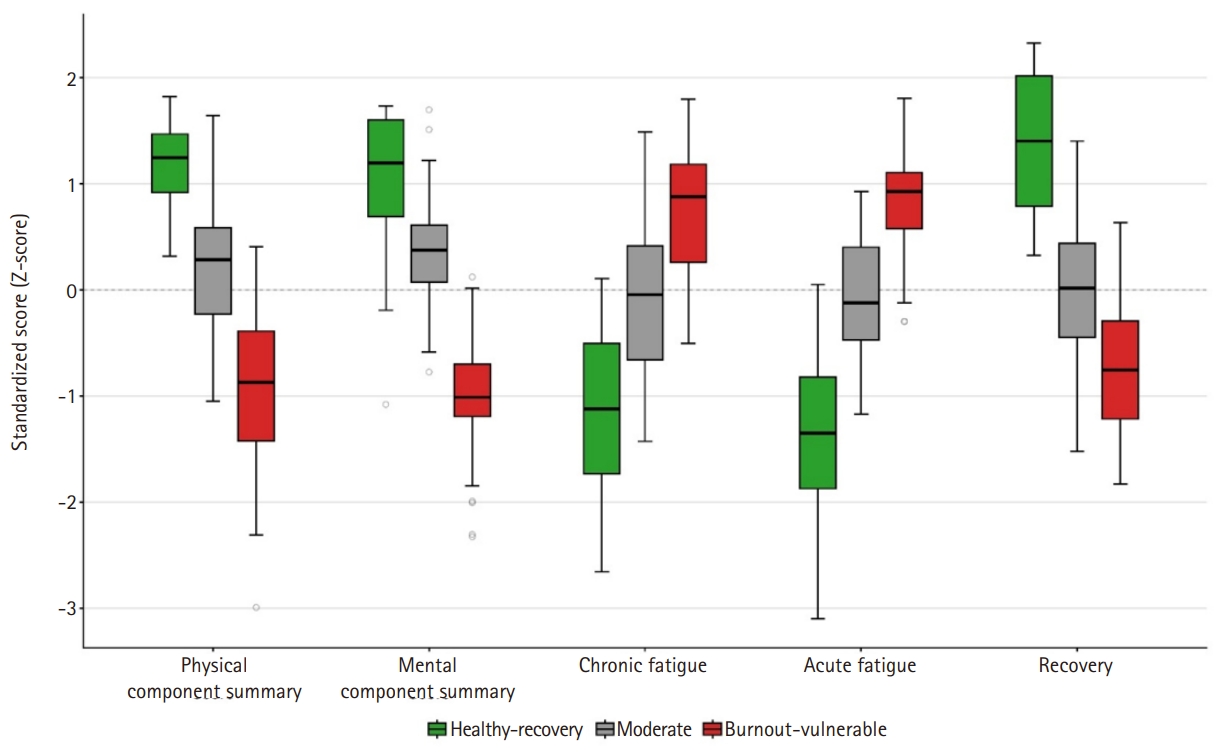
Three latent profiles were identified: Healthy-Recovery (20.8%), Moderate (41.7%), and Burnout-Vulnerable (37.5%). Significant differences among profiles were observed in sleep quality (F=37.37, p<.001), work-life balance (F=50.86, p<.001), job satisfaction (F=12.29, p<.001), and turnover intention (F=12.11, p<.001). A significant interaction between latent profile membership and pilot-project participation was observed for job satisfaction (F=4.77, p=.010, partial η²=.078). Pilot-project participation was associated with significantly higher job satisfaction only in the Healthy-Recovery profile (p=.005).
Conclusion
Associations between pilot-project participation and work-related outcomes differed according to nurses’ health, fatigue, and recovery profiles. These findings indicate that heterogeneity among shift-work nurses should be considered when interpreting work-related outcomes and designing tailored support strategies.
- 901 View
- 84 Download

Original Article
- Secondary Data Analysis on the Quality of Sleep and Related Factors of Novice and Experienced Shift Work Nurses
- Minjeong Yu, Choi-Kwon Smi
- J Korean Acad Nurs 2020;50(5):646-657. Published online October 31, 2020
- DOI: https://doi.org/10.4040/jkan.19238
-
Abstract
PDF
- Purpose
The purpose of this study was to identify the quality of sleep in novice and experienced shift work nurses and compare the factors associated with their quality of sleep.
Methods
We analyzed the data of 192 and 256 novice and experienced nurses, respectively. The quality of sleep, sleep hygiene, job stress, and fatigue were measured using Insomnia Severity Index, Sleep Hygiene Practice Scale, the Korean Occupational Stress Scale, and Fatigue Severity Scale. Data were analyzed using SPSS 25.0 to calculate descriptive statistics and logistic regression.
Results
Sleep quality was lower in experienced nurses (12.55 ± 5.71) than in novice nurses (11.18 ± 5.78). Fatigue was more severe in experienced nurses (4.47 ± 1.13) than in novice nurses (4.23 ± 1.12). In the logistic regression, factors related to sleep quality in novice nurses were sleep hygiene (odds ratio; OR = 1.06, p < .001) and fatigue (OR = 2.49, p < .001). Factors related to sleep quality in the experienced nurses were also sleep hygiene (OR = 1.04, p = .001) and fatigue (OR = 1.53, p = .012).
Conclusion
Sleep quality of experienced nurses is lower than those of novice nurses. Factors associated with sleep quality in novice and experienced nurses are equally identified as sleep hygiene and fatigue. Therefore, personal efforts to improve sleep hygiene, such as providing comfortable sleep environment, are needed. Furthermore, organized efforts to decrease fatigue, such as constructing a working environment with a bright light at night and providing a fatigue-decreasing program that includes meditation, are required. -
Citations
Citations to this article as recorded by
- Navigating night shifts: a qualitative study of exploring sleep experiences and coping strategies among nurses
Hyeonbin Lim, Su Hyun Kim
BMC Nursing.2025;[Epub] CrossRef - Improving sleep health in paramedics through an app-based intervention: a randomised waitlist control pilot trial
Alexandra E. Shriane, Grace E. Vincent, Sally A. Ferguson, Amanda Rebar, Tracy Kolbe-Alexander, Gabrielle Rigney
BMC Public Health.2024;[Epub] CrossRef - Prevalence of sleepiness and associated factors among healthcare staff: a cross-sectional study in a university hospital in Palestine
Loai M. Zabin
Palestinian Medical and Pharmaceutical Journal.2024; 9(3): 279. CrossRef - Factors Influencing Sleep Disturbance of Novice Nurses: Focusing on Sleep Hygiene and Physical Activity - Longitudinal Study of Secondary Data
Minjeong Yu, Smi Choi-Kwon, Jison Ki, Kyeongsug Kim
Journal of Korean Academy of Nursing Administration.2023; 29(3): 278. CrossRef - Dietary behavior and its influencing factors among experienced shiftwork nurses: a secondary analysis
Soyeon Kim, Jison Ki, Ji Yun Choi, Woan Heui Choi, Smi Choi-Kwon
Korean Journal of Women Health Nursing.2023; 29(1): 32. CrossRef - Mediating effects of fatigue on the relationship between sleep quality and the quality of life of shift-working nurses
Jeongwon Yeom, Insun Yeom
Chronobiology International.2023; 40(4): 450. CrossRef - Factors Associated with Gastrointestinal Symptoms among Rotating Shift Nurses in South Korea: A Cross-Sectional Study
Sun-Kyung Hwang, Yun-Ji Lee, Min-Eun Cho, Bo-Kyoung Kim, Yea-In Yoon
International Journal of Environmental Research and Public Health.2022; 19(16): 9795. CrossRef - Health-Related Factors Influencing Nurse Turnover by Clinical Career: A Secondary Data Analysis of Clinical Nurses in South Korea
Jiwon Kang, Youngjin Lee
International Journal of Environmental Research and Public Health.2022; 19(22): 15222. CrossRef - Low Back Pain and Its Influencing Factors among Intensive Care Unit Nurses: A Cross-sectional Study
Hyun Ju Uhm, Hye-Ja Park
Journal of Health Informatics and Statistics.2022; 47(2): 95. CrossRef - Sleep quality and its predictors among hospital-based nurses: a cross-sectional study
Khader A. Almhdawi, Hassan Alrabbaie, Donia S. Obeidat, Saddam F. Kanaan, Moh’d Rami Alahmar, Zaid Modhi Mansour, Alaa O. Oteir
Sleep and Breathing.2021; 25(4): 2269. CrossRef - Nurses' Voices: Autumn 2020
Jeung-Im Kim
Journal of Korean Academy of Nursing.2020; 50(5): 644. CrossRef
- Navigating night shifts: a qualitative study of exploring sleep experiences and coping strategies among nurses
- 3,997 View
- 128 Download
- 7 Web of Science
- 11 Crossref
Research Paper
- Secondary Data Analysis on the Factors Influencing Premenstrual Symptoms of Shift Work Nurses: Focused on the Sleep and Occupational Stress
- Jihyun Baek, Smi Choi-Kwon
- J Korean Acad Nurs 2020;50(4):631-640. Published online August 31, 2020
- DOI: https://doi.org/10.4040/jkan.19230
-
Abstract
PDF
- Purpose
This study aimed to examine premenstrual symptoms (PMS) of shift nurses and identify the association between PMS, sleep, and occupational stress.
Methods
This study was conducted with a secondary data analysis that used data from the Shift Work Nurse’s Health and Turnover study. The participants were 258 nurses who were working in shifts including night shifts. PMS, sleep patterns (sleep time and sleep time variability), sleep quality, and the occupational stress of each participant were measured using the Moos Menstrual Distress Questionnaire, a sleep diary, an actigraph, the Insomnia Severity Index, and the Korean Occupational Stress Scale, respectively. Data were analyzed using SPSS 23 and STATA 15.1 to obtain descriptive statistics, Pearson’s correlation coefficients, multiple linear regression with generalized estimating equations (GEE) and Baron and Kenny’s mediating analysis.
Results
The average PMS score, average sleep time, average sleep time variability, average sleep quality score, and average occupational stress score of the participants was 53.95 ± 40.45, 7.52 ± 0.89 hours, 32.84 ± 8.43%, 12.34 ± 5.95, and 49.89 ± 8.98, respectively. A multiple linear regression analysis with GEE indicated that sleep time variability (B = 0.86, p = .001), and sleep quality (B = 2.36, p < .001) had negative effects on nurses’ PMS. We also found that sleep quality had a complete mediating effect in the relationship between occupational stress and PMS.
Conclusion
These findings indicate that both sleep time variability and sleep quality are important factors associated with PMS among shift work nurses. To improve shift nurses’ PMS status, strategies are urgently needed to decrease sleep time variability and increase sleep quality. -
Citations
Citations to this article as recorded by- Hospital Nurses’ Professional Quality of Life Model: A Cross‐Sectional Study Based on the Expanded Job Demands‐Resources Model
Younghee Kim, Mi Yu, Jacopo Fiorini
Journal of Nursing Management.2025;[Epub] CrossRef - Premenstrual Symptoms Risk Factors Among Newly Graduated Nurses in Shift Work: A Prospective Longitudinal Study
Iksoo Huh, Smi Choi-Kwon, Jison Ki, Soyeon Kim, Jihyun Baek
Asian Nursing Research.2024; 18(5): 501. CrossRef - Premenstrual Syndrome’s Impact on Work-Related Quality of Life Among Jordanian Nurses
Yamamah Al-Hmaid, Othman Beni Yonis, Mais Alkhalili, Khalid Kheirallah
Cureus.2024;[Epub] CrossRef - Investigating influencing factors on premenstrual syndrome (PMS) among female college students
Su Jeong Yi, Miok Kim, Ina Park
BMC Women's Health.2023;[Epub] CrossRef - Development and validation of risk prediction model for premenstrual syndrome in nurses: results from the nurses-based the TARGET cohort study
Li Li, Xiaoyan Lv, Yuxin Li, Xinyue Zhang, Mengli Li, Yingjuan Cao
Frontiers in Public Health.2023;[Epub] CrossRef - Shift nurses’ social jetlag, anxiety, and premenstrual symptoms: A cross-sectional study
Taeyeon Kim, Sun Joo Jang
Collegian.2022; 29(4): 477. CrossRef - Depressive symptoms and menstrual distress according to the menstrual phase in nurses: the Korea Nurses’ Health Study
Oksoo Kim, Sue Kim, Hae Ok Jeon, Ahrin Kim, Chiyoung Cha, Bohye Kim
Journal of Psychosomatic Obstetrics & Gynecology.2022; 43(4): 541. CrossRef - Secondary Data Analysis on the Quality of Sleep and Related Factors of Novice and Experienced Shift Work Nurses
Minjeong Yu, Smi Choi-Kwon
Journal of Korean Academy of Nursing.2020; 50(5): 646. CrossRef
- Hospital Nurses’ Professional Quality of Life Model: A Cross‐Sectional Study Based on the Expanded Job Demands‐Resources Model
- 3,177 View
- 133 Download
- 10 Web of Science
- 8 Crossref
Original Articles
- Structural Equation Model for Sleep Quality of Female Shift Work Nurses
- Ji Yeong Jeong, Mee Ock Gu
- J Korean Acad Nurs 2018;48(5):622-635. Published online October 31, 2018
- DOI: https://doi.org/10.4040/jkan.2018.48.5.622
-
Abstract
PDF
Purpose This study aimed to develop and test a structural model for sleep quality in female shift work nurses. The hypothetical model was constructed on the basis of Spielman's 3P model of insomnia and previous research related to the sleep quality of shift nurses.
Methods This cross-sectional study used structural equation modeling and recruited 285 female shift work nurses from four general and university hospitals with over 300 beds located in C and J cities in Gyeongsangnamdo. Data were collected from September 27 to October 20, 2016, and then analyzed using descriptive statistics, Pearson's correlation, and structural equation modeling. The study used SPSS/Win 18.0 and AMOS 18.0 in processing the data.
Results The final model showed good fit to the empirical data: χ2/df=2.19, SRMR=.07, RMSEA=.07, AGFI=.85, TLI=.91, GFI=.93, GFI=.89, NFI=.87. The factors that influenced sleep quality were sleep hygiene (β=.32), perceived shift work status (β=−.16), stress response (β=.16), shift work experience (β=.15), perceived health status (β=−.14), and circadian rhythm (β=−.13) explaining 36.0% of the variance.
Conclusion The model of sleep quality of the shift work nurses constructed in this study is recommended as a model to understand and predict the sleep quality of shift work nurses. The results suggest that strategies for improving the sleep quality of shift work nurses should focus on sleep hygiene, perceived health status, stress response, circadian rhythm, perceived shift work status, and shift work experience.
-
Citations
Citations to this article as recorded by- Resilience Serves as a Protection Against Depression and Sleep Problems among Hemodialysis Nurses in Indonesia
Tri Hapsari Retno Agustiyowati , Linlin Lindayani, Susi Kusniasih
Journal of Health Sciences and Medical Development .2026; 5(01): 12. CrossRef - Relationship Between Occupational Characteristics and Telomere Length in Female Nurses Aged 20–39 Years: A Cross-Sectional Study
Jeonghye Yun, Hyunjung Lee
Healthcare.2026; 14(12): 1657. CrossRef - Exploring Pathways Linking Work and Nonwork Factors to Sleep, Fatigue, and Health in Night Shift Nurses: A Structural Equation Modeling Analysis
Bo Min Jeon, Su Hyun Kim, Juan Gómez-Salgado
Journal of Nursing Management.2025;[Epub] CrossRef - The influence of COVID-19-related resilience on depression, job stress, sleep quality, and burnout among intensive care unit nurses
Sojin Hwang, Jungmin Lee
Frontiers in Psychology.2023;[Epub] CrossRef - Holistic sleep improvement strategies for frontline nurses served during a public health emergency (COVID‐19) in Wuhan, China: A quasi‐experimental study
Yanli Zhang, Manli Tang, Yanrong Zhou
Nursing Open.2023; 10(3): 1471. CrossRef - Associations between the Timing and Nutritional Characteristics of Bedtime Meals and Sleep Quality for Nurses after a Rotating Night Shift: A Cross-Sectional Analysis
Jung Hoon Park, Hyuntae Park, Seongryu Bae, Jiyeon Kang
International Journal of Environmental Research and Public Health.2023; 20(2): 1489. CrossRef - Predictors of dropout in university students participating in an 8-week e-mail-based cognitive-behavioral therapy for insomnia intervention
Hyojin Nam, Jinyoung Chang, Mickey Trockel, Isa Okajima, Chien-Ming Yang, Ngan Yin Chan, Shirley Li, Sooyeon Suh
Sleep and Breathing.2023; 27(1): 345. CrossRef - Factors Associated with Gastrointestinal Symptoms among Rotating Shift Nurses in South Korea: A Cross-Sectional Study
Sun-Kyung Hwang, Yun-Ji Lee, Min-Eun Cho, Bo-Kyoung Kim, Yea-In Yoon
International Journal of Environmental Research and Public Health.2022; 19(16): 9795. CrossRef - Psychosocial factors affecting sleep quality of pre-employed firefighters: a cross-sectional study
MyeongSeob Lim, Solam Lee, Kwanghyun Seo, Hyun-Jeong Oh, Ji-Su Shin, Sung-Kyung Kim, Hee-Tae Kang, Kyeong-Sook Jeong, Sung-Soo Oh, Sang-Baek Koh, Yeon-Soon Ahn
Annals of Occupational and Environmental Medicine.2020;[Epub] CrossRef - Secondary Data Analysis on the Quality of Sleep and Related Factors of Novice and Experienced Shift Work Nurses
Minjeong Yu, Smi Choi-Kwon
Journal of Korean Academy of Nursing.2020; 50(5): 646. CrossRef - Sleep quality among shift-work nurses: A systematic review and meta-analysis
Jiwon Kang, Wonjung Noh, Youngjin Lee
Applied Nursing Research.2020; 52: 151227. CrossRef - Work-related Characteristics and Sleep Quality of Nurses in Comprehensive Nursing Care Units of Small-medium Sized Hospitals
Sujin Shin, Inyoung Lee, Jeonghyun Kim, Sung-Heui Bae
Journal of Korean Academy of Fundamentals of Nursing.2019; 26(4): 260. CrossRef
- Resilience Serves as a Protection Against Depression and Sleep Problems among Hemodialysis Nurses in Indonesia
- 3,367 View
- 69 Download
- 9 Web of Science
- 12 Crossref
- Effect of Rapid Rotating Shift Work on the Urinary Na+, K+, and Cl-
- Soon Min, Dae Soo Moon, Wook Bin Im
- Journal of Korean Academy of Nursing 1998;28(4):869-880. Published online March 29, 2017
- DOI: https://doi.org/10.4040/jkan.1998.28.4.869
-
Abstract
PDF
In order to investigate of the effects of rapid rotating shift work on physiological stress, the activities of urinary Na+, K+, Cl- were measured in 14 rotational shift nurses, during day shifts(8AM-4PM, n=4), evening shifts(4PM-12MN, n=5), and night shifts(12MN-8AM, n=5) in hospital twenty students attending nursing college a used as control group. Urine specimens were collected in 30 minutes before and after work on the second day of shift work. In day shift nurses, Na+ activity was 137mM at 8AM and increased to 206mM at 4PM, whereas K+ activity was 42mM at 8AM and no significant change at 4PM. Cl- activity was changed from 234mM to 344mM at 4PM at 8AM. In the evening shift, Na+ activity was 117mM at 4PM and 140mM at 12MN, K+ activity was 22mM and 32mM, respectively. Cl- activity was 169mM and changed to 270mM. During the night shift, Na+ activity was 128mM at 12MN and changed to 161mM at 8AM, K+ activity was 42mM at 12MN and 8AM, and Cl- activity was from 303mM and changed to 355mM. In general, the urinary ion activities seemed to increase after work, however there were no significant changes in ion activities except the Na+ increase in day shift. The mean of the activities of K+ and Cl- before and after work during the day and night shift were significantly higher than those in control group(P<0.05). K+ activities were also higher than that of evening shift(P<0.05). However, there was no difference in Na+ activity among the control group and three shifts. There was a significant relationship among urinary Na+, Cl- and K+ in the control group and rotating shift nurses except between Na+ and K+ in shift. The relationship between Na+ and Cl- was low in shift work and there was no significant relationship between Na+ and K+ in shift, suggesting that the active regulation K+ and/or Na+ in response to stress upon the shift work disrupted the ratio of urinary Na+ to K+ and also lowered the relationship between K+ and Cl-. These results suggest that nurses working the day shift were overloaded and under stress, and the night shift interfered with the physiological rhythm of the nurses.
-
Citations
Citations to this article as recorded by- Sleep Patterns and Circadian Types of Nursing Students during Shift Schedules
Hyun Sook Kim, Mi-Ran Eom, Eun-Kyung Kim
Journal of Korean Academy of Nursing.2010; 40(1): 43. CrossRef
- Sleep Patterns and Circadian Types of Nursing Students during Shift Schedules
- 1,261 View
- 0 Download
- 1 Crossref
- Inhalation Effects of Aroma Essential Oil on Quality of Sleep for Shift Nurses after Night Work
- WonJong Kim, Myung-Haeng Hur
- J Korean Acad Nurs 2016;46(6):769-779. Published online December 30, 2016
- DOI: https://doi.org/10.4040/jkan.2016.46.6.769
-
Abstract
PDF
Purpose This study was an experimental study to compare the inhalation effects of aroma essential oil on the quality of sleep (QOS) for shift nurses after working nights.
Methods The participants were 60 healthy adults who didn't have any disease. As an experimental treatment, the participants in the experimental group were asked to inhale essential oil for 3 minutes at a distance of approximately 10 cm fromt heir nose and then they were asked to sleep with the aroma stone beside their head (within a 30 cm distance). QOS were measured four times on Pretest, Day 1, Day 2, and Day 3 after they slept. To measure QOS, Perceived QOS (Numeric Rating Scale), the Verran & Synder-Halpern (VSH) Sleep Scale were used, and number of awakenings (NoA) was measured by Actigraph.
Results There were no significant differences in the homogeneity tests for general characteristics and dependent variables prior to the experiments, except for VSH of subjective sleep quality. Also, there was no significant interaction between group and time. The VSH of the experimental group was higher than the control group (F=6.39,
p =.002). The NoA between the experimental group and the control group was significantly different after experimental treatment 3rd day (F=13.35,p =.001).Conclusion The findings show that the inhalation of aroma essential oil had effects to increase the quality of sleep. Therefore, the inhalation of aroma essential oil could be applied to general nursing interventions to improve the quality of sleep.
-
Citations
Citations to this article as recorded by- Aromatherapy Experiences of Intensive Care Nurses Regarding Sleep and Fatigue: A Phenomenological Study
Fatma Gönül Burkev, Sultan Taşci
Nursing in Critical Care.2026;[Epub] CrossRef - The effects of aroma inhalation on the quality of sleep, professional quality of life, and near-misses in medication errors among emergency room nurses on night duty in Korea: a randomized controlled trial
Jungha Son, Chul-Gyu Kim
Journal of Korean Biological Nursing Science.2025; 27(1): 25. CrossRef - Effective Interventions for Reducing the Negative Effects of Night Shifts on Doctors’ and Nurses’ Health and Well-Being: A Systematic Review
Michael Shakhloul, Ahmed Amer, Mina Zekry, Mohamed Elgewely, Abanoub Saleeb, Shenoda Ghobrial, Mario Zaghar A Shehata, Ibrahim Abouelkhir, Muhammad O Kamal, Bishoy Manqaryos, Mahmoud Abdulfattah, Ahmed Syed, David Shakhloul, Mina Kamel
Cureus.2025;[Epub] CrossRef - The effect of Aromatherapy with Pelargonium graveolens (P. graveolens) on the fatigue and sleep quality of critical care nurses during the Covid-19 pandemic: A randomized controlled trial
Nasrin Karimi, Shirin Hasanvand, Afsaneh Beiranvand, Mohammad Gholami, Mehdi Birjandi
EXPLORE.2024; 20(1): 82. CrossRef - Meta-analysis of the Effect Size of Lavender Essential Oil and Lavender Blended Essential Oils on Psychological Factors in Adults
Mi-Na Yu, Ae-Jung Kim
Asian Journal of Beauty and Cosmetology.2024; 22(3): 477. CrossRef - Effectiveness of sleep interventions for rotating night shift workers: a systematic review and meta-analysis
Bo Min Jeon, Su Hyun Kim, Seung Hwa Shin
Frontiers in Public Health.2023;[Epub] CrossRef - Polymeric nanoparticles for enhanced delivery and improved bioactivity of essential oils
Sherif Babatunde Adeyemi, Aishat Mojisola Akere, Joshua Iseoluwa Orege, Onome Ejeromeghene, Odunola Blessing Orege, Jubril Olayinka Akolade
Heliyon.2023; 9(6): e16543. CrossRef - The Effects of Aroma Essential Oil Inhalation on Stress, Pain, and Sleep Quality in Laparoscopic Cholecystectomy Patients: A Randomized Controlled Trial
JiA Lee, Myung-Haeng Hur
Asian Nursing Research.2022; 16(1): 1. CrossRef - Effectiveness of aromatherapy inhalation on anxiety and haemodynamic variables for patients with cardiovascular disease: A systematic review and meta‐analysis
Selma Turan Kavradim, Şefika Tuğba Yangöz, Zeynep Ozer
International Journal of Clinical Practice.2021;[Epub] CrossRef - Effects of aromatherapy with essential oil massage on the sleep quality of critical care nurses: A randomized controlled trial
Hsiu-Chin Hsu, Mei-Hsiang Lin, Hsiu-Fang Lee, Chiu-Yen Wu, Chih-Ting Chou, Shu-Fen Lin
Complementary Therapies in Clinical Practice.2021; 43: 101358. CrossRef - The effect of rosemary essential oil inhalation on sleepiness and alertness of shift-working nurses: A randomized, controlled field trial
Ahmad Nasiri, Masoomeh Mo'tamed Boroomand
Complementary Therapies in Clinical Practice.2021; 43: 101326. CrossRef - Sleep quality among shift-work nurses: A systematic review and meta-analysis
Jiwon Kang, Wonjung Noh, Youngjin Lee
Applied Nursing Research.2020; 52: 151227. CrossRef - Effects of Aromatherapy on Sleep Quality: A Systematic Review and Meta-Analysis
Mi-Eun Kim, Ji Hee Jun, Muyng-Haeng Hur
Journal of Korean Academy of Nursing.2019; 49(6): 655. CrossRef - Effect of aromatherapy on cancer complications: A systematic review
Mansoureh Ashghali Farahani, Roghaiyeh Afsargharehbagh, Fatemeh Marandi, Mojgan Moradi, Seyed-Mehdi Hashemi, Mahdieh Poodineh Moghadam, Abbas Balouchi
Complementary Therapies in Medicine.2019; 47: 102169. CrossRef - The Effects of Aromatherapy Massage on Sleep Quality of Nurses on Monthly Rotating Night Shifts
Ying-Ying Chang, Chao-Ling Lin, Li-Yin Chang, Vincenzo De Feo
Evidence-Based Complementary and Alternative Medicine.2017;[Epub] CrossRef - Essential Oils and Their Constituents: An Alternative Source for Novel Antidepressants
Damião De Sousa, Rayanne Silva, Epifanio Silva, Elaine Gavioli
Molecules.2017; 22(8): 1290. CrossRef
- Aromatherapy Experiences of Intensive Care Nurses Regarding Sleep and Fatigue: A Phenomenological Study
- 3,435 View
- 83 Download
- 16 Crossref
 First
First Prev
Prev


