
 Submit an article

Search
- Page Path
- HOME > Search
Research Papers
- Work system analysis of health management for individuals with disabilities in supportive housing: a focus group study using the SEIPS framework
- Haesun Lee, Hye Jin Nam, Bohye Kim, Ju Young Yoon
- J Korean Acad Nurs 2025;55(3):454-467. Published online August 4, 2025
- DOI: https://doi.org/10.4040/jkan.25018
-
 Abstract
 PDF
PDF ePub
ePub - Purpose
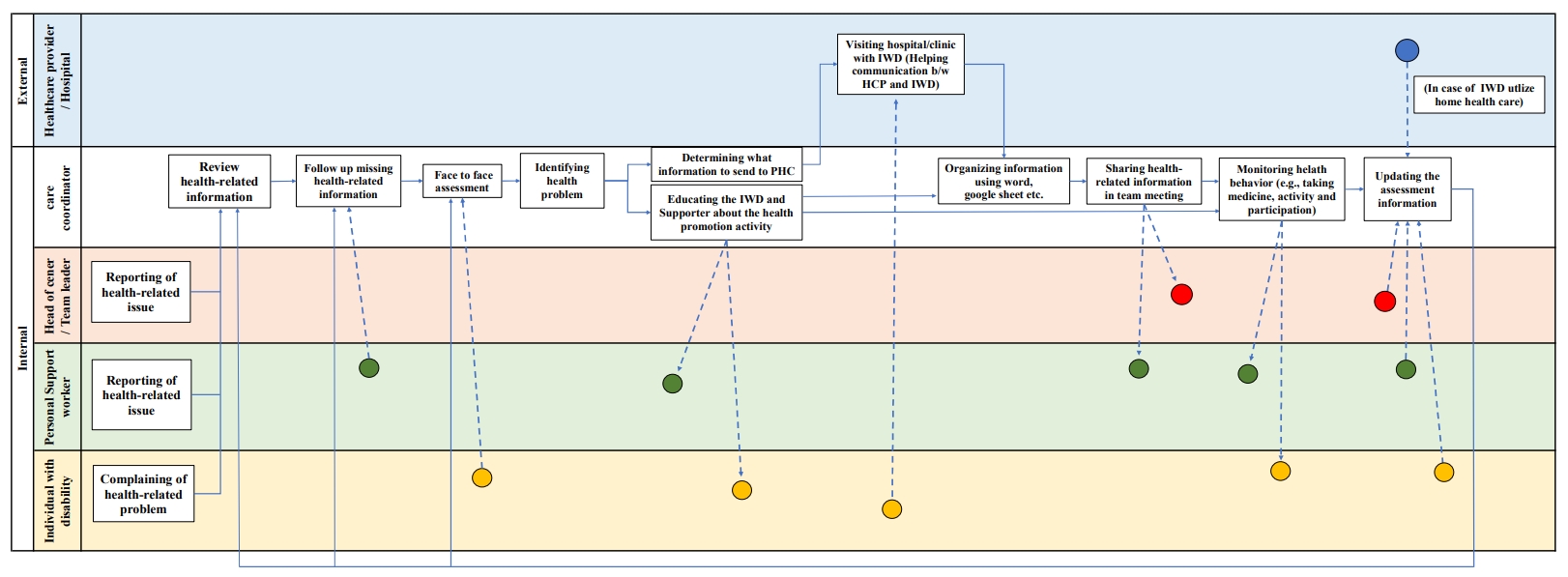
This study conducted a work-system analysis using the Systems Engineering Initiative for Patient Safety (SEIPS) framework to assess the flow of health-related information, and the current status of health management tasks for individuals with disabilities (IWD) in supportive housing.
Methods
This qualitative study utilized focus groups. Participants included a head of supportive housing, a team leader, a care coordinator and three personal support workers for IWD. Semi-structured interviews were guided by the SEIPS framework to explore the components of persons, tasks, tools and technology, organization, and environments.
Results
This study identified five key themes within the five SEIPS components: (1) disparities in role identity and health literacy among staff, (2) challenges in health care support reflecting a person-centered approach, (3) barriers in health-related information exchange and communication tools, (4) needs for organizational strategies or information communication, and (5) needs for integrating health-related information across external healthcare institutions. Additionally, 10 sub-themes were identified.
Conclusions
These findings provide a comprehensive system-wide perspective and offer insights into the systematic approaches needed to improve healthcare processes and structures within disability supportive housing. Specifically, healthcare providers and effective tools for integrating health-related information are identified as critical components. -
Citations
Citations to this article as recorded by
- Personal Assistant Service Patterns and Health Behaviors Among Adults with Disabilities: A Latent Class Analysis
Min Ji Kang, Ju Young Yoon
Research in Community and Public Health Nursing.2026; 37: 358. CrossRef
- Personal Assistant Service Patterns and Health Behaviors Among Adults with Disabilities: A Latent Class Analysis
- 2,841 View
- 143 Download
- 1 Crossref

- Effectiveness of a mobile application for tracking symptoms and enhancing symptom management among breast cancer patients receiving chemotherapy in Bangkok, Thailand: a non-randomized controlled trial
- Duangrat Kaveenuntachai, Supawan Jaiboon, Bualuang Sumdaengrit, Chureeporn Silaguntsuti, Arveewan Vittayatigonnasak, Pornchan Sailamai
- J Korean Acad Nurs 2025;55(2):178-190. Published online May 27, 2025
- DOI: https://doi.org/10.4040/jkan.25011
-
Abstract
PDFePub
- Purpose
This study evaluated the effectiveness of a mobile application in tracking symptoms and improving symptom management and quality of life (QoL) among breast cancer patients undergoing chemotherapy in Thailand.
Methods
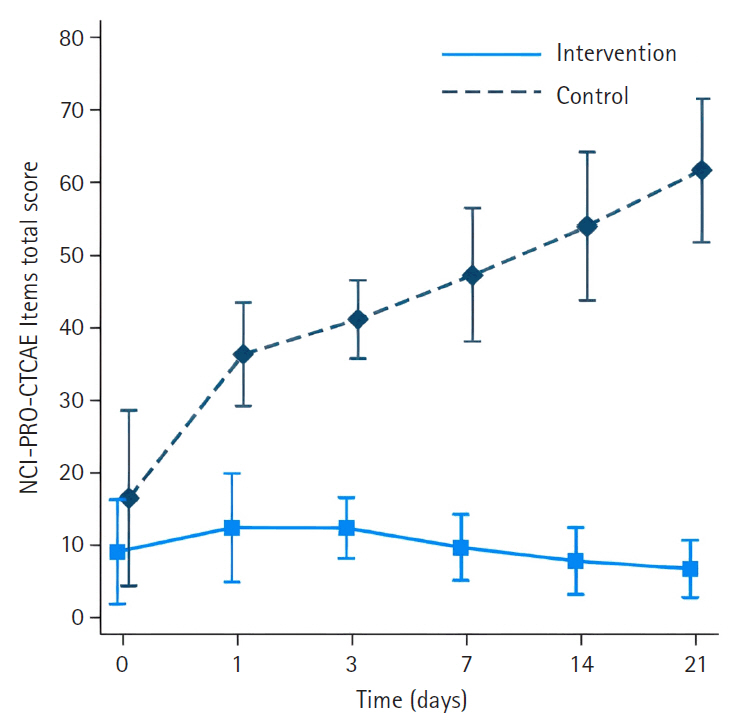
A non-randomized controlled trial was used, with 25 participants in the intervention group and 25 in the control group. Research instruments included a demographic data form, the NCI-PRO-CTCAE Items-Thai-Thailand version 1.0, and the European Organization for Research and Treatment of Cancer Quality of Life Core Questionnaire and Breast Cancer-Specific Module.
Results
The intervention group had significantly less severe side effects than the control group, with mean differences of –23.33 (95% confidence interval [CI], –27.82 to –18.83) on day 1, –28.18 (95% CI, –33.22 to –23.14) on day 3, –34.63 (95% CI, –40.18 to –29.08) on day 7, –42.56 (95% CI, –48.72 to –36.40) on day 14, and –51.31 (95% CI, –58.13 to –44.48) on day 21 (p<.001 for all). On day 21, participants in the intervention group reported significantly higher scores in the Global Health QoL and Functional Scales compared to the control group (p<.001). Additionally, intervention group participants reported lower scores on the Symptom Scales and higher scores on the Functional Scales than those in the control group (p<.001).
Conclusion
The ChemoPro application helped manage chemotherapy-related symptoms and was associated with improved symptom monitoring and QoL. Nonetheless, the study was limited by a small sample size and restriction to Android users. Future research with larger and more diverse populations is recommended before broader implementation in clinical practice. -
Citations
Citations to this article as recorded by- Effectiveness of a digital health intervention on the supportive care needs and quality of life in Mexican patients with breast cancer: a randomized clinical trial
Saúl Eduardo Contreras-Sánchez, Svetlana V. Doubova, Rocío Grajales-Álvarez, Ricardo Villalobos-Valencia, Abdel Karim Dip-Borunda, José Gustavo Nuñez-Cerrillo, Alma Diana Huerta-López, Álvaro José Montiel-Jarquín, Arturo García-Galicia, Enrique Isay Talam
BMC Cancer.2026;[Epub] CrossRef - Systematic review of patient-reported outcome item libraries in cancer research: an EORTC Quality of Life Group study
Rosemary Peacock, Christopher Bedding, Bonnie Pacheco, Hayat Hamzeh, Claire Piccinin, Alexandra Gilbert
JNCI: Journal of the National Cancer Institute.2026; 118(6): 971. CrossRef - Digital PRO collection methods during chemotherapy: A scoping review of tools, platforms, and psychometric properties
G. Hari Prakash, Tejaswini BD, Sony Sequeira, Mohammed Mujaheed Hussain, Anush Nayak
Measurement and Evaluations in Cancer Care.2026; 4: 100036. CrossRef - Response pathways and clinical workflow integration of digital symptom management platforms for breast cancer: A scoping review
Jing Yu, Shouze Jin, Yuening Liu, Rui Chen, Yuxin Liu, Hong Ji, Lijuan Wang
Asia-Pacific Journal of Oncology Nursing.2026; : 101029. CrossRef
- Effectiveness of a digital health intervention on the supportive care needs and quality of life in Mexican patients with breast cancer: a randomized clinical trial
- 6,292 View
- 335 Download
- 3 Web of Science
- 4 Crossref
- A non-face-to-face diabetes self-management program based on self-efficacy theory and health literacy: a non-randomized controlled trial
- Jung Hee Lee, Soo Jin Lee
- J Korean Acad Nurs 2025;55(2):165-177. Published online May 23, 2025
- DOI: https://doi.org/10.4040/jkan.25009

-
Abstract
PDFePub
- Purpose
This study aimed to assess the impact of a non-face-to-face diabetes self-management program based on self-efficacy theory and focusing on health literacy.
Methods
A quasi-experimental, nonequivalent control group pre–post design was used. Participants from a community health promotion center were included if they (1) were 30–70 years of age, (2) had type 2 diabetes with glycated hemoglobin (HbA1c) ≥6.5%, and (3) had internet access via computers or mobile devices. The 8-week program was developed based on self-efficacy theory, and it included virtual education using an online platform, telephone counseling, videos, and social networking site activities considering health literacy. Fasting blood glucose levels, HbA1c levels, diabetes self-efficacy, social support, depression, and self-management behaviors were assessed. Data were analyzed using the independent t-test, paired t-test, and others.
Results
Post-test results showed that the intervention group had significantly lower fasting blood glucose levels and improved diabetes self-efficacy, social support, and self-management behaviors compared with the control group. An analysis of the pre-to-post changes in scores indicated that the intervention group had significantly greater improvements in fasting blood glucose levels, diabetes self-efficacy, and overall diabetes self-management behaviors than those observed in the control group.
Conclusion
Non-face-to-face programs based on self-efficacy theory that consider health literacy can provide effective diabetes management support to patients when in-person diabetes management at community health centers is challenging. -
Citations
Citations to this article as recorded by- Knowledge, attitude, and practice of foot care and associated factors among high-risk diabetic foot patients: A cross-sectional study in Shanghai, China
Hu Yan-ni, Cai Hong, Zhang Wei, Ma Li-li, Zhuang Hui-ren
Journal of Tissue Viability.2026; 35(4): 101044. CrossRef
- Knowledge, attitude, and practice of foot care and associated factors among high-risk diabetic foot patients: A cross-sectional study in Shanghai, China
- 5,607 View
- 388 Download
- 1 Web of Science
- 1 Crossref
- Analysis of the Adequacy of Nurse Staffing Level through the Estimation of Nursing Activity Hours and Implementation of Focus Group Interviews in a Tertiary Hospital: Using a Mixed-Method Design
- Hyun-Joo Kim, Sun-Hee Lee, Jai-Jung Lee, Sun-Suk Seong, Hee Yang, Hyang-Yuol Lee
- J Korean Acad Nurs 2024;54(2):237-249. Published online May 31, 2024
- DOI: https://doi.org/10.4040/jkan.22142
-
Abstract
PDF
- Purpose
This study aimed to examine the adequacy of current nurse staffing levels by identifying nursing activities and workload.
Methods
The study used a mixed-method design. A nursing activity survey was conducted using the work sampling method over 2 working days with 119 general ward nurses. A focus group interview was conducted with 12 nurses. Quantitative and qualitative data were analyzed using SPSS 20.0 and content analysis, respectively.
Results
The most amount of time was spent on medication (in direct nursing) and electronic medical record documentation (in indirect nursing). The appropriate nurse-to-patient ratio is 1:7.7 for the day shift, 1:9.0 for the evening shift, and 1:11.9 for the night shift. However, the current nurse-to-patient ratio is 1:9.4, 1:11.0, and 1:13.8 for the day, evening, and night shifts, respectively. Therefore, the current nurse staffing level is insufficient for the workload. In the focus group interview, the main reasons cited for being unable to complete tasks within working hours were communication and coordination, and the nursing electronic medical record. The essential nursing activities of basic nursing and emotional support were overlooked owing to a heavy workload. Therefore, an adequate nurse staffing level should be higher than the measured quantitative workload.
Conclusion
These results suggest the general wards of tertiary hospitals should evaluate the adequacy of their current nurse staffing and allocate sufficient nurses to improve patient safety and nursing care quality. -
Citations
Citations to this article as recorded by- Impacts of Hematologic Cancer Ward Nurses' Professional Autonomy, Role Conflict and Nursing Work Environment on Clinical Decision-Making Ability
Min Jung Kim, Hye Sook Min
Asian Oncology Nursing.2026; 26(1): 41. CrossRef - Experiences of Surgical Ward Nurses During a Healthcare Service Disruption in Korea: A Qualitative Study
Sehyeon Im, Haeng-Mi Son
Asian Nursing Research.2026; 20(3): 337. CrossRef - Nurses' Experience Working with Substitute Nurses
Hye Mi Kim, Yeon Hee Kim, Jeong Hye Kim
Journal of Korean Association for Qualitative Research.2025; 10(3): 208. CrossRef - Development and Preliminary Evaluation of a Generative AI-Based Adaptive Aptitude Assessment Agent for Nursing Students
Eunmin Hong, Sujin Shin, Jaehwa Choi, Miji Lee, Minjae Lee, Subin Yu, Jinseon Ko
Journal of Korea Society for Simulation in Nursing.2025; 13(2): 81. CrossRef
- Impacts of Hematologic Cancer Ward Nurses' Professional Autonomy, Role Conflict and Nursing Work Environment on Clinical Decision-Making Ability
- 4,769 View
- 368 Download
- 2 Web of Science
- 4 Crossref
- Psychometric Properties of the Korean Version of Self-Efficacy for HIV Disease Management Skills
- Gwang Suk Kim, Layoung Kim, Mi-So Shim, Seoyoung Baek, Namhee Kim, Min Kyung Park, Youngjin Lee
- J Korean Acad Nurs 2023;53(3):295-308. Published online June 30, 2023
- DOI: https://doi.org/10.4040/jkan.23016
-
Abstract
PDF
- Purpose
This study evaluated the validity and reliability of Shively and colleagues’ self-efficacy for HIV disease management skills (HIVSE) among Korean participants.
Methods
The original HIV-SE questionnaire, comprising 34 items, was translated into Korean using a translation and back-translation process. To enhance clarity and eliminate redundancy, the author and expert committee engaged in multiple discussions and integrated two items with similar meanings into a single item. Further, four HIV nurse experts tested content validity. Survey data were collected from 227 individuals diagnosed with HIV from five Korean hospitals. Construct validity was verified through confirmatory factor analysis. Criterion validity was evaluated using Pearson’s correlation coefficients with the new general self-efficacy scale. Internal consistency reliability and test-retest were examined for reliability.
Results
The Korean version of HIV-SE (K-HIV-SE) comprises 33 items across six domains: “managing depression/mood,” “managing medications,” “managing symptoms,” “communicating with a healthcare provider,” “getting support/help,” and “managing fatigue.” The fitness of the modified model was acceptable (minimum value of the discrepancy function/degree of freedom = 2.49, root mean square error of approximation = .08, goodnessof-fit index = .76, adjusted goodness-of-fit index = .71, Tucker-Lewis index = .84, and comparative fit index = .86). The internal consistency reliability (Cronbach’s α = .91) and test-retest reliability (intraclass correlation coefficient = .73) were good. The criterion validity of the K-HIV-SE was .59 (p < .001).
Conclusion
This study suggests that the K-HIV-SE is useful for efficiently assessing self-efficacy for HIV disease management. -
Citations
Citations to this article as recorded by- Providing 2 Types of mHealth Interventions to Support Self-Management Among People Living With HIV: Randomized Clinical Trial
Gwang Suk Kim, Layoung Kim, Seoyoung Baek, Sooyoung Kwon, Ji Min Kim, Jun Yong Choi, Jae-Phil Choi
JMIR mHealth and uHealth.2025; 13: e60905. CrossRef - Factors associated with health-related quality of life among people living with HIV in South Korea: Tobit regression analysis
Gwang Suk Kim, Layoung Kim, SangA Lee, Mi-So Shim, Youngjin Lee, Seoyoung Baek, Claus Kadelka
PLOS ONE.2024; 19(5): e0303568. CrossRef - Three cycles of mobile app design to improve HIV self-management: A development and evaluation study
Gwang Suk Kim, Layoung Kim, Seoyoung Baek, Mi-So Shim, SangA Lee, Ji Min Kim, Jong Yae Yoon, Jin Kim, JunYong Choi, Jae-Phil Choi
DIGITAL HEALTH.2024;[Epub] CrossRef
- Providing 2 Types of mHealth Interventions to Support Self-Management Among People Living With HIV: Randomized Clinical Trial
- 4,090 View
- 82 Download
- 3 Web of Science
- 3 Crossref
- The Development of Automated Personalized Self-Care (APSC) Program for Patients with Type 2 Diabetes Mellitus
- Gaeun Park, Haejung Lee, Ah Reum Khang
- J Korean Acad Nurs 2022;52(5):535-549. Published online October 31, 2022
- DOI: https://doi.org/10.4040/jkan.22046
-
Abstract
PDF
- Purpose
The study aimed to design and develop an automated personalized self-care (APSC) program for patients with type 2 diabetes mellitus. The secondary aim was to present a clinical protocol as a mixed-method research to test the program effects.
Methods
The APSC program was developed in the order of analysis, design, implementation, and evaluation according to the software development life cycle, and was guided by the self-regulatory theory. The content validity, heuristics, and usability of the program were verified by experts and patients with type 2 diabetes mellitus.
Results
The APSC program was developed based on goal setting, education, monitoring, and feedback components corresponding to the phases of forethought, performance/volitional control, and self-reflection of self-regulatory theory. Using the mobile application, the participants are able to learn from educational materials, monitor their health behaviors, receive weekly-automated personalized goals and feedback messages, and use an automated conversation system to solve the problems related to self-care. The ongoing two-year study utilizes a mixed method design, with 180 patients having type 2 diabetes mellitus randomized to receive either the intervention or usual care. The participants will be reviewed for self-care self-efficacy, health behaviors, and health outcomes at 6, 12, 18, and 24 months. Participants in the intervention group will be interviewed about their experiences.
Conclusion
The APSC program can serve as an effective tool for facilitating diabetes health behaviors by improving patients’ self-care self-efficacy and self-regulation for self-care. However, the clinical effectiveness of this program requires further investigation. -
Citations
Citations to this article as recorded by- Natural language processing-based chatbots for chronic disease self-management: A systematic review of implementation and health outcomes
Ga In Han, Hi Jae Lee, Youn-Jung Son
DIGITAL HEALTH.2026;[Epub] CrossRef - Effectiveness of mHealth-Based Self-Management Interventions on Self-Efficacy in Patients With Type 2 Diabetes: A Systematic Review and Meta-Analysis
Junhee Ahn, Youngran Yang, Ji Young Kim, Jihyon Pahn, Yura Jang
The Science of Diabetes Self-Management and Care.2025; 51(5): 517. CrossRef - Impact of Mobile App-Based Self-Monitoring Engagement on Self-Care Self-Efficacy, Health Behaviors, and Hemoglobin A1c Among Patients With Type 2 Diabetes Mellitus: A Secondary Analysis of a Randomized Controlled Trial
Gaeun Park, Haejung Lee, Min Jin Lee, Ahreum Khang
Western Journal of Nursing Research.2025; 47(12): 1180. CrossRef - A systematic review of pulmonary rehabilitation nursing interventions for patients with chronic obstructive pulmonary disease
Da-Jung Kim
Journal of Exercise Rehabilitation.2025; 21(5): 234. CrossRef - Adherence-based experiences with a personalized self-care program for type 2 diabetes in South Korea: a mixed-methods study
Haejung Lee, DaeEun Lee, Mihwan Kim
Journal of Korean Biological Nursing Science.2025; 27(4): 706. CrossRef - Participation experience in self-care program for type 2 diabetes: A mixed-methods study
Mihwan Kim, Haejung Lee, Gaeun Park, Ah Reum Khang
Journal of Korean Gerontological Nursing.2024; 26(1): 31. CrossRef - Long‐Term Effects of an Automated Personalized Self‐Care Program for Patients With Type 2 Diabetes
Haejung Lee, Gaeun Park, DaeEun Lee, Ah Reum Khang, Min Jin Lee
Nursing & Health Sciences.2024;[Epub] CrossRef - Automated Personalized Self-care Program for Patients With Type 2 Diabetes Mellitus: A Pilot Trial
Gaeun Park, Haejung Lee, Yoonju Lee, Myoung Soo Kim, Sunyoung Jung, Ah Reum Khang, Dongwon Yi
Asian Nursing Research.2024; 18(2): 114. CrossRef - Healthcare coaching program for youth with type 1 diabetes in South Korea: a pilot study
Dae Eun Lee, Haejung Lee, Chong Kun Cheon, Ju Young Yoon
Child Health Nursing Research.2024; 30(1): 17. CrossRef - The Association between the Low-density Lipoprotein-Cholesterol to High-density Lipoprotein-Cholesterol Ratio and the Incidence of Type 2 Diabetes Mellitus in Korean Adults: A Secondary Data Analysis Using a Community-based Cohort Study in Korea
Bo-Kyoung Cha
Journal of Korean Academy of Fundamentals of Nursing.2023; 30(1): 66. CrossRef
- Natural language processing-based chatbots for chronic disease self-management: A systematic review of implementation and health outcomes
- 5,255 View
- 166 Download
- 7 Web of Science
- 10 Crossref
- Validity and Reliability of Korean Version of the Self-Efficacy for Managing Chronic Disease 6-Item Scale
- Sook-Nam Kim, Hyun-Ju Lee, So-Young Kim, Nayoon Lee
- J Korean Acad Nurs 2021;51(5):617-629. Published online October 31, 2021
- DOI: https://doi.org/10.4040/jkan.21069
-
Abstract
PDF
- Purpose
The aim of this study was to examine the validity and reliability of the Korean version of the self-efficacy for managing chronic disease 6-item scale (SECD-6-K).
Methods
The English version of the Self-Efficacy for Managing Chronic Disease 6-item Scale first underwent forward and backward translation procedures. The SECD-6-K was then used to collect data from 350 adults diagnosed with chronic diseases. Content, construct, convergent, discriminant, and criterion validity were all evaluated. Reliability was assessed using Cronbach’s α. SPSS 25.0 and the data were analyzed using AMOS 26.0 software.
Results
The SECD-6-K consists of six items in two domains: disease management and health behavior. The results for construct, convergent, and discriminant validity were good. Exploratory factor analysis produced eigen values between 2.27 and 3.28, with factors total explained cumulative variance of 91.1%. Confirmatory factor analysis supported goodness of fit and reliability for the modified SECD-6-K model. The criterion validity also showed significant correlation with both the Patient Health Questionnaire and 12-item Short-Form Health Survey version 2. Finally, reliability was found to be excellent.
Conclusion
This study identified the high reliability and validity of SECD-6-K. The SECD-6-K is an appropriate tool for determining Korean patients’ self-efficacy in managing their chronic conditions. Therefore, this scale may be used in clinical settings as well as in educational and research settings. -
Citations
Citations to this article as recorded by- Generic instruments for assessing self-management abilities and behaviors in patients with chronic diseases: a COnsensus-based standards for the selection of health measurement INstruments (COSMIN)-based systematic review
Ke Liu, Guangyan Meng, Caixia Li, Shuyi Wang, Xianwen Fan, Qirong Chen
Quality of Life Research.2026;[Epub] CrossRef - Predictors of Functional Improvement in Patients with Chronic Stroke Participating in Group-Based Telerehabilitation: A Post-hoc Analysis of a Randomized Controlled Trial
Hyo-Lyun Ro, HyoSun Lee, Kyeongbong Lee
NeuroRehabilitation.2026; 59(1): 149. CrossRef - Structural model of health-promoting behavior in middle-aged Korean women with hypertension based on the Information–Motivation–Behavioral Skills model: a cross sectional study
Eunju Mun, Jinhwa Park
Women's Health Nursing.2026; 32(2): 139. CrossRef - Factors Influencing Quality of Life in Pancreatic Cancer Patients Undergoing Home-Based Chemotherapy via Disposable Infusion Pumps
hyesun Kim, Inju Hwang, Miyeong Kim, Eunha Bae, Nayeon Lee, Minji Jung, minkyeong Jo
Journal of Fundamental Nursing Science.2026; 33(3): 334. CrossRef - Sociodemographic, Self-Efficacy, and Health-Related Factors According to the Stages of Change in Physical Activity and Dietary Management Among Patients with Metabolic Syndrome: A Secondary Analysis of a Cross-Sectional Study
Haejung Lee, DaeEun Lee
Nursing Reports.2026; 16(10): 347. CrossRef - Path Analysis of Factors Influencing Health-Related Quality of Life for Community-Dwelling Vulnerable Older Adults with Chronic Diseases in Korea
Hyun-Ju Lee
Research in Community and Public Health Nursing.2025; 36: 315. CrossRef - Development of a self-care scale for women with polycystic ovary syndrome: a methodological approach
Miok Kim
Frontiers in Public Health.2025;[Epub] CrossRef - Development and Validation of the Short Form of Core Competencies Scale of Nursing Care for Cancer Patients Undergoing Chemotherapy
Sung Hae Kim, Seyong Lee, Sang Hee Kim, Jung Ok Choi, Gie Ok Noh
Asian Oncology Nursing.2024; 24(4): 184. CrossRef - Factors influencing self-management behaviors in older people with multiple chronic conditions based on the individual and family self-management theory: A cross-sectional study
Youngji Seo, Sunyoung Jung
Journal of Korean Gerontological Nursing.2024; 26(3): 332. CrossRef - Psychometric property of the Japanese version of self-efficacy for managing chronic disease scale in individuals with chronic diseases
Megumi Hazumi, Mayumi Kataoka, Ayako Nakashita, Kentaro Usuda, Michi Miyake, Chiaki Kamikawa, Daisuke Nishi, Naoaki Kuroda
Heliyon.2024; 10(22): e40218. CrossRef - Psychometric properties of the self-efficacy scale for chronic disease management (SEMCD-S) in older Colombian adults
Lorena Cudris-Torres, Stefano Vinaccia Alpi, Álvaro Barrios-Núñez, Natali Gaviria Arrieta, Martha Luz Gómez Campuzano, Giselle Olivella-López, Juan Hernández-Lalinde, Valmore Bermúdez, Olaiza Lobato Pérez, Jorge Armando Niño-Vega, Jorge Navarro-Obeid, Rom
BMC Psychology.2023;[Epub] CrossRef - Effect of Ambulatory Chemotherapy (Portable Infusion Pump Use) Video Education on Knowledge, Self-efficacy and Anxiety of Colorectal Cancer Patients
Eun Hee Choi, Eun Young Park, Young A Park, You Hee Son, Myung Jin Jang
Asian Oncology Nursing.2022; 22(3): 193. CrossRef
- Generic instruments for assessing self-management abilities and behaviors in patients with chronic diseases: a COnsensus-based standards for the selection of health measurement INstruments (COSMIN)-based systematic review
- 6,208 View
- 290 Download
- 8 Web of Science
- 12 Crossref
- Diabetes Self-Management Experience of Patients with Diabetes: Focused on the Visually Impaired
- Sun Ju Chang, Kyoung-eun Lee, Eunjin Yang, Hee Jung Kim
- J Korean Acad Nurs 2021;51(1):92-104. Published online February 28, 2021
- DOI: https://doi.org/10.4040/jkan.20231
-
Abstract
PDF
- Purpose
This study aimed to understand and describe the diabetes self-management experience of visually impaired people with diabetes.
Methods
Ten participants were recruited through a website used by the visually impaired from February to March 2020. Data were collected through two focus group interviews conducted in June 2020; each group consisted of five participants. All interviews were recorded with the consent of the participants and transcribed verbatim. The transcribed data were analyzed using qualitative content analysis.
Results
Seven categories were as follows; a two-faced, lifelong companion, an unprepared encounter, struggle to live, love-hate relationship with family, strategies to adapt, lessening attention to self-management, the desire to learn properly.
Conclusion
It can be concluded that the visually impaired have fewer opportunities for receiving diabetes self-management education than general diabetic patients. Consequently, plans to improve the education available to such patients are required. Additionally, psychological counseling and diabetes education for patients’ families are necessary, and improving the perception of medical workers regarding the visually impaired will be prove useful. -
Citations
Citations to this article as recorded by- Diabetes care for people experiencing homelessness in the UK: insights from a national survey of frontline professionals and the development of an integrated care model
Daniela Oehring, Martha Paisi, Mona Nasser, Theo Jackson, Ryan Young, Lynne Wooff, Helen Partridge, Jacqueline Conaty, Samantha Dorney-Smith
Frontiers in Public Health.2025;[Epub] CrossRef - Widening disparities in the national prevalence of diabetes mellitus for people with disabilities in South Korea
I. Hwang, S.Y. Kim, Y.Y. Kim, J.H. Park
Public Health.2024; 226: 173. CrossRef - A Tailored Intervention for Improving Diabetes Self-care Among Adults With Visual Impairment: A Pilot Study
Hee Jung Kim, Kyoung-eun Lee, Eunjin Yang, Sun Ju Chang
Canadian Journal of Diabetes.2024; 48(6): 394. CrossRef - The Impact of Visual Impairment on Healthcare Use among Four Medical Institution Types: A Nationwide Retrospective Cohort Study in Korea
Boyoung Jeon, Heejo Koo, Hee Kyoung Choi, Euna Han
Yonsei Medical Journal.2023; 64(7): 455. CrossRef - Association between Visual Impairment and Nutritional Risk among Older Adults with Diabetes: A Population-Based Cross-Sectional Study
Eunjin Yang, Kyung Hee Lee
Journal of Korean Academy of Nursing.2023; 53(2): 167. CrossRef - Who are the most vulnerable populations for primary care? Avoidable hospitalizations across individuals with different types of disabilities in South Korea
S. Kim, B. Jeon
Public Health.2023; 217: 138. CrossRef - Factors Associated With Diabetes Self-Care Behaviors of People With Visual Impairment: A Cross-Sectional Study
Sun Ju Chang, Hee Jung Kim, Kyoung-eun Lee, Eunjin Yang
The Science of Diabetes Self-Management and Care.2022; 48(5): 324. CrossRef
- Diabetes care for people experiencing homelessness in the UK: insights from a national survey of frontline professionals and the development of an integrated care model
- 3,819 View
- 81 Download
- 7 Web of Science
- 7 Crossref
Original Articles
- The Disease Management Experience of Patients with Asthma: Grounded Theory Approach
- Bohye Kim, Oksoo Kim
- J Korean Acad Nurs 2020;50(5):714-727. Published online October 31, 2020
- DOI: https://doi.org/10.4040/jkan.20139
-
Abstract
PDF
- Purpose
The aim of this study was to develop a situation-specific theory to explain the disease management experience of patients with asthma.
Methods
Twenty participants with asthma were selected using the theoretical sampling method. The data were acquired through in-depth interviews conducted from June to October 2018 and analyzed using the grounded theory approach of Strauss and Corbin.
Results
In total, 69 concepts, 30 subcategories, and 13 categories were generated to explain the disease management experience of patients with asthma. The core category of the disease management experience of patients with asthma was ‘management of the disease to prevent aggravation of symptoms over the lifetime’. The disease management process of asthma patients included three steps: the ‘cognition phase’, the ‘adjustment phase’, and the ‘maintenance phase’. However, some patients remained in the ‘stagnation phase’ of disease management, which represents the result of the continual pursuit of risky health behavior. There were three types of disease management experiences among patients with asthma: ‘self-managing’, ‘partially self-managing’, and ‘avoidant’.
Conclusion
This study shows that patients with asthma must lead their disease management process to prevent exacerbation of their symptoms. It is imperative to develop nursing strategies and establish policies for effective disease management of patients with asthma based on their individual disease management processes and types. -
Citations
Citations to this article as recorded by- Updates of the Status Quo of Situation‐Specific Theories (2015–2025)
Dongmi Kim, Eun‐Ok Im
Journal of Nursing Scholarship.2026;[Epub] CrossRef - Qualitative Research in Healthcare: Data Analysis
Dasom Im, Jeehye Pyo, Haneul Lee, Hyeran Jung, Minsu Ock
Journal of Preventive Medicine and Public Health.2023; 56(2): 100. CrossRef
- Updates of the Status Quo of Situation‐Specific Theories (2015–2025)
- 2,782 View
- 65 Download
- 2 Web of Science
- 2 Crossref
- Qualitative Study on the Experience of Patients with Meniere Disease
- Woo Joung Joung
- J Korean Acad Nurs 2020;50(5):699-713. Published online October 31, 2020
- DOI: https://doi.org/10.4040/jkan.20115
-
Abstract
PDF
- Purpose
The purpose of this study was to understand and describe the experiences of patients with Meniere disease.
Methods
Data were collected from February 19, 2019, to February 5, 2020, through individual in-depth interviews with 13 Meniere patients. Verbatim transcripts were analyzed using Colaizzi’s phenomenological analysis.
Results
The experiences of patients with Meniere disease were clustered into the following four themes from 22 meaning units: 1) Complex unfamiliar symptoms that shatter both balance of the body and peace of the heart; 2) A disease that medical treatment and health professionals cannot cure; 3) Suffering hardships that cannot be understood by non-Meniere sufferers; and 4) Making daily efforts to become healthier. Symptoms of Meniere disease are life-shattering and depressing because they are neither visible nor easily curable. Over time, as they accepted the reality of living with the disease, the participants would shift their focus from complete symptomatic cure to leading a healthy and more balanced life.
Conclusion
This study shows that Meniere disease has a pervasive impact on all aspects of the patients’ lives. Patients are prone to experiencing restrictions in their social functioning and activities. They also experience psychosocial problems due to the unseen nature of their symptoms. This study elucidates the experiences of Meniere patients and the need for nursing intervention to help improve their quality of life and ability to self-manage. Lastly, this study shows the need for a coordinated interdisciplinary approach to raising public awareness of the disease.
- 4,721 View
- 49 Download
- Identification of Knowledge Structure of Pain Management Nursing Research Applying Text Network Analysis
- Chan Sook Park, Eun-Jun Park
- J Korean Acad Nurs 2019;49(5):538-549. Published online January 15, 2019
- DOI: https://doi.org/10.4040/jkan.2019.49.5.538
-
Abstract
PDF
Abstract Purpose This study aimed to explore and compare the knowledge structure of pain management nursing research, between Korea and other countries, applying a text network analysis.
Methods 321 Korean and 6,685 international study abstracts of pain management, published from 2004 to 2017, were collected. Keywords and meaningful morphemes from the abstracts were analyzed and refined, and their co-occurrence matrix was generated. Two networks of 140 and 424 keywords, respectively, of domestic and international studies were analyzed using NetMiner 4.3 software for degree centrality, closeness centrality, betweenness centrality, and eigenvector community analysis.
Results In both Korean and international studies, the most important, core-keywords were “pain,” “patient,” “pain management,” “registered nurses,” “care,” “cancer,” “need,” “analgesia,” “assessment,” and “surgery.” While some keywords like “education,” “knowledge,” and “patient-controlled analgesia” found to be important in Korean studies; “treatment,” “hospice palliative care,” and “children” were critical keywords in international studies. Three common sub-topic groups found in Korean and international studies were “pain and accompanying symptoms,” “target groups of pain management,” and “RNs’ performance of pain management.” It is only in recent years (2016~17), that keywords such as “performance,” “attitude,” “depression,” and “sleep” have become more important in Korean studies than, while keywords such as “assessment,” “intervention,” “analgesia,” and “chronic pain” have become important in international studies.
Conclusion It is suggested that Korean pain-management researchers should expand their concerns to children and adolescents, the elderly, patients with chronic pain, patients in diverse healthcare settings, and patients’ use of opioid analgesia. Moreover, researchers need to approach pain-management with a quality of life perspective rather than a mere focus on individual symptoms.
-
Citations
Citations to this article as recorded by- Pediatric Pain Education Research: Text Network Analysis and Topic Modeling
Jinkyung Park, Anna Lee, Namsu Kim, Kyounghae Kim
Pain Management Nursing.2026; 27(3): e304. CrossRef - Exploring the Knowledge Structure of Research for Nurse Preceptor Training Programs Using Text Network Analysis and Topic Modeling
Sun Hee Seon, Hye Won Jeong, Ja Yun Choi
CIN: Computers, Informatics, Nursing.2025;[Epub] CrossRef - Analysis of clinical nurse educators’ mentoring feedback on new nurse journals at a tertiary hospital in South Korea: utilizing text network analysis
Shinhye Ahn, Hye Won Jeong
BMC Nursing.2025;[Epub] CrossRef - Temporal Exploration of New Nurses’ Field Adaptation Using Text Network Analysis
Shin Hye Ahn, Hye Won Jeong, Seong Gyeong Yang, Ue Seok Jung, Myoung Lee Choi, Heui Seon Kim
Journal of Korean Academy of Nursing.2024; 54(3): 358. CrossRef - Content Analysis of Patient Safety Incident Reports Using Text Mining: A Secondary Data Analysis
On-Jeon Baek, Ho Jin Moon, Hyosun Kim, Sun-Hwa Shin
Korean Journal of Adult Nursing.2024; 36(4): 298. CrossRef - Text Network Analysis of Research Topics and Trends on Simulations Using Virtual Patients in Nursing Education
Miok Song, Jeong Eun Moon, Aeri Jang
CIN: Computers, Informatics, Nursing.2023; 41(9): 639. CrossRef - National Petition Analysis Related to Nursing: Text Network Analysis and Topic Modeling
HyunJung Ko, Seok Hee Jeong, Eun Jee Lee, Hee Sun Kim
Journal of Korean Academy of Nursing.2023; 53(6): 635. CrossRef - Research trends over 10 years (2010-2021) in infant and toddler rearing behavior by family caregivers in South Korea: text network and topic modeling
In-Hye Song, Kyung-Ah Kang
Child Health Nursing Research.2023; 29(3): 182. CrossRef - Content Analysis of Feedback Journals for New Nurses From Preceptor Nurses Using Text Network Analysis
Shin Hye Ahn, Hye Won Jeong
CIN: Computers, Informatics, Nursing.2023; 41(10): 780. CrossRef - Capturing New Nurses' Experiences and Supporting Critical Thinking
Sun Hee Seon, Hye Won Jeong, Deok Ju, Jung A. Lee, Shin Hye Ahn
CIN: Computers, Informatics, Nursing.2023; 41(6): 434. CrossRef - Images of Nurses Appeared in Media Reports Before and After Outbreak of COVID-19: Text Network Analysis and Topic Modeling
Min Young Park, Seok Hee Jeong, Hee Sun Kim, Eun Jee Lee
Journal of Korean Academy of Nursing.2022; 52(3): 291. CrossRef - Factors Affecting Nurses’ Performance of Cancer Pain Management in a Tertiary Hospital
Minhwa Kang, Minjeong Seo
The Korean Journal of Hospice and Palliative Care.2022; 25(3): 99. CrossRef - Knowledge Structure of Chronic Obstructive Pulmonary Disease Health Information on Health-Related Websites and Patients’ Needs in the Literature Using Text Network Analysis
Ja Yun Choi, Su Yeon Lim, So Young Yun
Journal of Korean Academy of Nursing.2021; 51(6): 720. CrossRef - Trends of Nursing Research on Accidental Falls: A Topic Modeling Analysis
Yeji Seo, Kyunghee Kim, Ji-Su Kim
International Journal of Environmental Research and Public Health.2021; 18(8): 3963. CrossRef - An Identification of the Knowledge Structure on the Resilience of Caregivers of People with Dementia using a Text Network Analysis
Eun Young Kim, Sung Ok Chang
Journal of Korean Gerontological Nursing.2021; 23(1): 66. CrossRef - Identification of the Knowledge Structure of Cancer Survivors’ Return to Work and Quality of Life: A Text Network Analysis
Kisook Kim, Ki-Seong Lee
International Journal of Environmental Research and Public Health.2020; 17(24): 9368. CrossRef - Effect of Knowledge and Attitudes of Cancer Pain Management and Patient-Centered Care on Performance of Cancer Pain Management among Nurses at an Oncology Unit
Mikyung Kim, Yun Mi Lee
Korean Journal of Adult Nursing.2020; 32(1): 57. CrossRef - Knowledge Structure of Nursing Studies on Heart Failure Patients in South Korea through Text Network Analysis
Seang Ryu, Hyunyoung Park, Yun-Hee Kim
Korean Journal of Adult Nursing.2020; 32(4): 409. CrossRef
- Pediatric Pain Education Research: Text Network Analysis and Topic Modeling
- 4,584 View
- 53 Download
- 12 Web of Science
- 18 Crossref
- The Development and Evaluation of a Health Literacy-Adapted Self-Management Intervention for Elderly Cancer Patients Undergoing Chemotherapy
- Yoon Sun Kim, Young Sook Tae, Kwuy-Im Jung
- J Korean Acad Nurs 2019;49(4):472-485. Published online January 15, 2019
- DOI: https://doi.org/10.4040/jkan.2019.49.4.472
-
Abstract
PDF
Abstract Purpose This study aimed to develop and evaluate the effectiveness of an adapted health literacy self-management intervention for elderly cancer patients undergoing chemotherapy.
Methods The intervention in this study was systematically developed through the six stages of Intervention Mapping Protocol and was based on Fransen et al's causal pathway model. A quasi-experimental trial was conducted on a total of 52 elderly patients (26 in an experimental group and 26 in a control group) undergoing chemotherapy in Korea. The intervention consisted of seven sessions over 5 weeks. The experimental tool for this study was an adapted health literacy self-management intervention, which was designed to promote a reduction in the symptom experience and distress of elderly cancer patients through the promotion of self-management behavior. To develop efficient educational materials, the participants’ health literacy was measured. To educate participants, clear communication and the teach-back method were used. In addition, for the improvement of self-efficacy, four sources were utilized. For the promotion of self-management behavior, five self-management skills were strengthened. Data were collected before and after the intervention from June 4 to September 14, 2018. The data were analyzed with SPSS/WIN 21.0.
Results Following the intervention, self-management knowledge and behavior and, self-efficacy significantly improved in experimental group. Symptom experience and distress decreased in the experimental group compared to the control group.
Conclusion The self-management intervention presented in this study was found to be effective in increasing self-management knowledge and behavior and, self-efficacy, and ultimately in reducing symptom experience and distress for elderly patients undergoing chemotherapy.
-
Citations
Citations to this article as recorded by- Self-efficacy as a mediator between digital health literacy and self-care behaviors in older adults with cancer undergoing chemotherapy
Ji Hee Seo, Su Jung Lee
Asia-Pacific Journal of Oncology Nursing.2026; 13: 100971. CrossRef - Effectiveness of Self‐Management Education for Deaf Individuals With Hypertension: A Quasi‐Experimental Study
Gi Won Choi, Hee Jung Kim, Yujin Park, Ha Na Jeong, Sun Ju Chang
Research in Nursing & Health.2025; 48(6): 724. CrossRef - The Effect of Group Education Reflecting Unmet Needs on Knowledge of Chemotherapy for Patients and Their Families Undergoing Chemotherapy: A One Group Pre-Post Design
Seyoung Lee, Hoyoung Kim, Nayeon Kim, Misun Yi, Ayoung Lee, Seonmi Cho, Minsun Nam, Juhee Cho
Asian Oncology Nursing.2024; 24(1): 42. CrossRef - Health Information Seeking Pathways and Factors Influencing Health Literacy Among Cancer Patients: Based on Data from the 2nd Korean Health Panel 2021
Yun-La Hur, Eun-Jeong Hong
Asian Oncology Nursing.2024; 24(3): 155. CrossRef - The Effects of Chemotherapy Education Reflecting Educational Needs on Self-Care Knowledge and Performance in Female Cancer Patients: A Non-Equivalent Control Group Pretest-Posttest Design
Jin Hee Jun, Se-Na Lee
Asian Oncology Nursing.2024; 24(3): 103. CrossRef - Effectiveness of teach‐back for chronic kidney disease patient education: A systematic review
Hemamali M. H. Jagodage, Amanda McGuire, Charrlotte Seib, Ann Bonner
Journal of Renal Care.2024; 50(2): 92. CrossRef - Effects of Telephone-based Self-care Intervention for Gynecologic Cancer Patients Receiving Chemotherapy: A Quasi-Experimental Study
Boyeon Lee, Hyojung Park
Journal of Korean Academy of Fundamentals of Nursing.2023; 30(2): 216. CrossRef - Analysis of Telephone Counseling of Patients in Chemotherapy Using Text Mining Technique
Seoyeon Kim, Jihyun Jung, Heiyoung Kang, Jeehye Bae, Kayoung Sim, Miyoung Yoo, Eunyoung, E. Suh
Asian Oncology Nursing.2022; 22(1): 46. CrossRef - Evaluating a theory-based intervention for improving eHealth literacy in older adults: a single group, pretest–posttest design
Sun Ju Chang, Kyoung-eun Lee, Eunjin Yang, Hyunju Ryu
BMC Geriatrics.2022;[Epub] CrossRef - Effects of the teach-back method among cancer patients: a systematic review of the literature
Seonhwa Choi, Jahyun Choi
Supportive Care in Cancer.2021; 29(12): 7259. CrossRef
- Self-efficacy as a mediator between digital health literacy and self-care behaviors in older adults with cancer undergoing chemotherapy
- 4,256 View
- 157 Download
- 9 Web of Science
- 10 Crossref
- Mediation Effect of Self-Efficacy on the Relationship between Perceived Self-Management Support and Health-Related Quality of Life among Cancer Survivors
- Bo Gyeong Lee, Tae Sook Lee, Soo Hyun Kim
- J Korean Acad Nurs 2019;49(3):298-306. Published online January 15, 2019
- DOI: https://doi.org/10.4040/jkan.2019.49.3.298
-
Abstract
PDF
Abstract Purpose This study aimed to examine the levels of perceived self-management support, self-efficacy for self-management, and health-related quality of life (HRQoL) in cancer survivors, and to identify the mediating effect of self-efficacy in the relationship between perceived self-management support and HRQoL.
Methods This study used a descriptive correlational design. Two hundred and four cancer survivors who had completed treatment participated in the study. Measurements included the Patient Assessment of Chronic Illness Care Scale, the Korean version of the Cancer Survivors’ Self-Efficacy Scale, and the Medical Outcomes Study Short Form-36. Data were analyzed using descriptive statistics, Pearson's correlation coefficient analysis, and multiple regression analysis using Baron and Kenny's method for mediation.
Results The mean score for perceived self-management support was 3.35 out of 5 points, self-efficacy was 7.26 out of 10 points, and HRQoL was 65.90 out of 100 points. Perceived self-management support was significantly positively correlated with self-efficacy (r=.29,
p <.001) and HRQoL (r=.27,p <.001). Self-efficacy was also significantly correlated with HRQoL (r=.59,p <.001). Furthermore, self-efficacy (β=.55,p <.001) had a complete mediating effect on the relationship between perceived self-management support and HRQoL (Z=3.88,p <.001).Conclusion The impact of perceived self-management support on HRQoL in cancer survivors was mediated by self-efficacy for self-management. This suggests that strategies for enhancing self-efficacy in cancer survivors should be considered when developing self-management interventions for improving their HRQoL.
-
Citations
Citations to this article as recorded by- Effect of the advanced-practice-nurse–led postoperative self-management enhancement programme on self-efficacy, self-management, and pain after lung cancer resection: A randomised controlled trial
Ji Eun Han, Kwhanmien Kim, Sunjoo Boo, Sun Hyoung Bae, Minkyung Kang, Jin-Hee Park
European Journal of Oncology Nursing.2026; 84: 103318. CrossRef - Factors Influencing Quality of Life in Pancreatic Cancer Patients Undergoing Home-Based Chemotherapy via Disposable Infusion Pumps
hyesun Kim, Inju Hwang, Miyeong Kim, Eunha Bae, Nayeon Lee, Minji Jung, minkyeong Jo
Journal of Fundamental Nursing Science.2026; 33(3): 334. CrossRef - Factors Associated With Quality of Life Among Posttreatment Cancer Survivors in Korea
Soo Hyun Kim, Yu Hyeon Choe, Jingyeong Choi, Ji Young Park, Eun Yi
Cancer Nursing.2025; 48(1): E47. CrossRef - Effects of Symptom Burden, Self-Efficacy, and Stigma on Cancer Coping in Patients with primary Non-Small Cell Lung Cancer Undergoing Chemotherapy
Ah-Reum Han, Euna Park
Asian Oncology Nursing.2025; 25(3): 158. CrossRef - Mediating Effect of Self-Efficacy on the Relationship between Symptom Experience and Health-Related Quality of Life in Patients with Chronic Obstructive Pulmonary Disease
Enhee Jo, Ju-Young Park, Young Jun Jang
Journal of Korean Academy of Fundamentals of Nursing.2024; 31(3): 315. CrossRef - An Integrated Review of Health Care in Child and Adolescent Cancer Survivors Based on Roy’s Adaptation Model
Hye Jin Kim, Eunjoo Lee
Asian Oncology Nursing.2024; 24(2): 82. CrossRef - Trajectories of quality of life in breast cancer survivors during the first year after treatment: a longitudinal study
Jin-Hee Park, Yong Sik Jung, Ji Young Kim, Sun Hyoung Bae
BMC Women's Health.2023;[Epub] CrossRef - Effect of perceived chronic illness management support, health literacy, and social support on the care burden of families caring for older people with multiple chronic conditions at home: A cross-sectional study
Eun Sil Lee, Mi Young Kim
Journal of Korean Gerontological Nursing.2023; 25(1): 76. CrossRef - Effects of Uncertainty, Appraisal of Uncertainty, and Self-Efficacy on the Quality of Life of Elderly Patients with Lung Cancer Receiving Chemotherapy: Based on Mishel’s Theory of Uncertainty
Min-Kyung Hwang, Hee-Kyung Kim, Ki-Hyeong Lee
Medicina.2023; 59(6): 1051. CrossRef - Between Personality Traits and Postpartum Depression: The Mediated Role of Maternal Self-Efficacy
Lingli Han, Ji Zhang, Jingxuan Yang, Xiaoyu Yang, Hua Bai
Neuropsychiatric Disease and Treatment.2022; Volume 18: 597. CrossRef - A Structural Model of Quality of Life in Patients after Colorectal Cancer Surgery
Jeong Won Yeom, Yeon Ok Suh
International Journal of Environmental Research and Public Health.2022; 19(5): 2564. CrossRef - The influence of Digital Informatization Level, Self-efficacy, and Social Support on Digital Health Literacy in the Elderly with Cancer
Hye Su Kim, Ji Hyun Sung
Asian Oncology Nursing.2022; 22(4): 255. CrossRef - The Correlation Between Quality of Life and Positive Psychological Resources in Cancer Patients: A Meta-Analysis
Xinxin Zhao, Siqi Tong, Ye Yang
Frontiers in Psychology.2022;[Epub] CrossRef - Integrated, cross-sectoral psycho-oncology (isPO): a new form of care for newly diagnosed cancer patients in Germany
Michael Kusch, Hildegard Labouvie, Vera Schiewer, Natalie Talalaev, Jan C. Cwik, Sonja Bussmann, Lusine Vaganian, Alexander L. Gerlach, Antje Dresen, Natalia Cecon, Sandra Salm, Theresia Krieger, Holger Pfaff, Clarissa Lemmen, Lisa Derendorf, Stephanie St
BMC Health Services Research.2022;[Epub] CrossRef - Self-efficacy, post-traumatic growth, and quality of life of pediatric cancer survivors: A cross-sectional study
Yeunhee Kwak, Yoonjung Kim, Eun Seok Choi, Ho Joon Im
European Journal of Oncology Nursing.2021; 54: 102019. CrossRef - Determinants of quality of life in women immediately following the completion of primary treatment of breast cancer: A cross-sectional study
Jin-Hee Park, Yong Sik Jung, Ji Young Kim, Sun Hyoung Bae, Ka Ming Chow
PLOS ONE.2021; 16(10): e0258447. CrossRef - Psychometric evaluation of patient assessment of chronic illness care among Korean cancer survivors
Soo Hyun Kim, Bo Gyeong Lee, Yu Hyeon Choe, Francesca Chiesi
PLOS ONE.2021; 16(8): e0256119. CrossRef - Mediating and Moderating Factors of Adherence to Nutrition and Physical Activity Guidelines, Breastfeeding Experience, and Spousal Support on the Relationship between Stress and Quality of Life in Breast Cancer Survivors
Nam Mi Kang, Won-Ho Hahn, Suyeon Park, Jung Eun Lee, Young Bum Yoo, Chung Ja Ryoo
International Journal of Environmental Research and Public Health.2020; 17(20): 7532. CrossRef
- Effect of the advanced-practice-nurse–led postoperative self-management enhancement programme on self-efficacy, self-management, and pain after lung cancer resection: A randomised controlled trial
- 3,297 View
- 67 Download
- 16 Web of Science
- 18 Crossref
- Psychoeducational Approach to Distress Management of Newly Diagnosed Patients with Breast Cancer
- Jin-Hee Park, Mison Chun, Yong Sik Jung, Sun Hyoung Bae, Young-Mi Jung
- J Korean Acad Nurs 2018;48(6):669-678. Published online January 15, 2018
- DOI: https://doi.org/10.4040/jkan.2018.48.6.669
-
Abstract
PDF
Abstract Purpose The purpose of this study was to examine the effects of integrated psychoeducational program for distress management of newly diagnosed patients with breast cancer.
Methods A quasi-experimental trial was conducted. The participants consisted of 47 female patients with breast cancer assigned to an intervention group (n=25) and control group (n=22). The intervention group participated in integrated psychoeducational program, consisting of individual face-to-face education and telephone-delivered health-coaching sessions. Data were collected at three time points: pre-intervention (T1), post-intervention (T2), and 6-month follow-up (T3). Study instruments were Distress thermometer, Supportive Care Needs Survey Short Form 34 and Functional Assessment of Cancer Therapy-Breast.
Results Compared with the control group, breast cancer patients in the intervention group reported lower distress and supportive care needs than the control group. The intervention group reported higher quality of life (QOL) overall and higher emotional well-being than the control group.
Conclusion These findings indicate that the integrated psychoeducational program is an effective intervention for reducing distress and supportive care needs and increasing QOL of newly diagnosed patients with breast cancer. Oncology nurses need to provide psychoeducational intervention to support patients with breast cancer in managing their distress and helping them adjust to their life.
-
Citations
Citations to this article as recorded by- Nurse Coaching in Oncology Care to Reduce Stress: A Systematic Review and Meta-Analysis
Elsa Vitale, Lorenza Maistrello, Karen Avino, Giuseppe Colonna, Ivan Rubbi, Roberto Lupo
Healthcare.2026; 14(7): 840. CrossRef - Breast Cancer Nursing Competencies for General Nurses Caring For Breast Cancer Patients: A Delphi Study
Young-Hee Je, Hee-Jung Kang
Asian Oncology Nursing.2026; 26(1): 1. CrossRef - Analysis of Breast Cancer Nursing Education Content and Educational needs for Breast Cancer Patient Nursing Perceived by Nurses
Young-Hee Je, Kyoung-Ah Kang
Asian Oncology Nursing.2025; 25(1): 1. CrossRef - Effectiveness of a Tailored Psychoeducational Intervention for Patients With Advanced Cancer in Indonesia: A Randomized Controlled Trial
Nurul Huda, Made Satya Nugraha Gautama, Wan Nishfa Dewi, Agung Waluyo, Hsiu Ju Chang, Malissa Kay Shaw
Journal of Nursing Scholarship.2025; 57(5): 848. CrossRef - Evidence on the benefits of mind-body Qigong exercise in women with breast cancer
Michel Marcos Dalmedico, Jackson Adriano Canavarro Ribeiro, Juliana Londero Silva Avila, Prisley Pereira de Oliveira, Paula Karina Hembecker, Sergio Ossamu Ioshii
Fisioterapia em Movimento.2025;[Epub] CrossRef - Psychological Distress and Influencing Factors in Newly Diagnosed Patients with Breast Cancer: A Cross-Sectional Study
Jin-Hee Park, Yong Sik Jung, Min Hee Hur, Yu Jin Jeong
Korean Journal of Adult Nursing.2024; 36(4): 311. CrossRef - Effects of Psychosocial Interventions for Patients with Breast Cancer: A Meta-analysis
Kyu-Sic Hwang, Kuy-Haeng Lee, Chan-Mo Yang, Hye-Jin Lee, Sang-Yeol Lee
Clinical Psychopharmacology and Neuroscience.2023; 21(1): 118. CrossRef - The development of a lifestyle modification mobile application, “Health for You” for overweight and obese breast cancer survivors in Korea
Su-Jin Seo, Ju-Hee Nho, Youngsam Park
Korean Journal of Women Health Nursing.2021; 27(3): 243. CrossRef - Development and Effect of the Integrated Health Promotion Program for Cancer Survivors Living at Home
Hee Sang Yoon, Eun A Hwang
Journal of Korean Academy of Community Health Nursing.2021; 32(1): 51. CrossRef - Adjustment to life with metastatic cancer through psychodrama group therapy: A qualitative study in Turkey
Songül Kamışlı, Bahar Gökler
Perspectives in Psychiatric Care.2021; 57(2): 488. CrossRef - Integration of longitudinal psychoeducation programmes during the phases of diagnosis, management and survivorship of breast cancer patients: A narrative review
Athena Michaelides, Constantina Constantinou
Journal of Cancer Policy.2020; 23: 100214. CrossRef - Quality of Life in Patients Undergoing Mastectomy for Breast Cancer
Kavitha Konnakkaparambil Ramakrishnan, Sreekumar Damodaran
Journal of Evidence Based Medicine and Healthcare.2020; 7(28): 1368. CrossRef - Mediating and Moderating Factors of Adherence to Nutrition and Physical Activity Guidelines, Breastfeeding Experience, and Spousal Support on the Relationship between Stress and Quality of Life in Breast Cancer Survivors
Nam Mi Kang, Won-Ho Hahn, Suyeon Park, Jung Eun Lee, Young Bum Yoo, Chung Ja Ryoo
International Journal of Environmental Research and Public Health.2020; 17(20): 7532. CrossRef - Uncertainty and unmet care needs before and after surgery in patients with gastric cancer: A survey study
Ji Yea Lee, Yeonsoo Jang, Sanghee Kim, Woo Jin Hyung
Nursing & Health Sciences.2020; 22(2): 427. CrossRef - Effects of Different Exercise Interventions on Quality of Life in Breast Cancer Patients: A Randomized Controlled Trial
Tetiana Odynets, Yuriy Briskin, Valentina Todorova
Integrative Cancer Therapies.2019;[Epub] CrossRef
- Nurse Coaching in Oncology Care to Reduce Stress: A Systematic Review and Meta-Analysis
- 2,869 View
- 58 Download
- 15 Crossref
- Self-Management Experiences of the Adolescents with Chronic Kidney Disease
- Sug Young Lee, Heesun Shin
- J Korean Acad Nurs 2018;48(3):266-278. Published online January 15, 2018
- DOI: https://doi.org/10.4040/jkan.2018.48.3.266
-
Abstract
PDF
Abstract Purpose The aim of this study was to develop a substantive theory on self-management conducted by the adolescents with chronic kidney disease from their lived experience.
Methods Data was collected through in-depth interviews from May to December in 2015 with thirteen adolescents with chronic kidney disease. The data collected were analyzed on the basis of Strauss and Corbin's grounded theory.
Results The core of the category found in this study was “overcoming the unstable sense of self- control and integrating disease experience into their life”. The causal conditions triggering the central phenomenon were “restriction in daily life” and “manifestation and aggravation of symptom”. The central phenomenon in the experience of self-management within the adolescents with chronic kidney disease was “unstable sense of self control”. The intervening condition for unstable self control were “micro system support” and “motivational resources”. This study found that the adolescents with chronic kidney disease followed a series of strategies when they faced the central phenomenon, including; passive coping, reappraisal of illness, active coping, compliance with treatment, controlling physical activity, and adjusting school life. With these strategic approaches, the adolescents with chronic kidney disease could maintain their active lifestyles and achieve their health behaviors. The process of self-management by these adolescents passed through four phases; limited experience caused by diseases, effort for normalization, reorganizing their daily lives, and integration with daily lives and self-management.
Conclusion This Study explored the process and experience of self-management of adolescents with chronic kidney disease. These findings can be used for basis for developing substantive theory and nursing intervention strategy for adolescents with chronic kidney diseases.
-
Citations
Citations to this article as recorded by- Patient and Caregiver Perspectives on Diet and Nutrition for Children With CKD: A Systematic Review of Qualitative Studies
Ao Zhang, Anita van Zwieten, Anastasia Hughes, Siah Kim, Kelly Lambert, Luca G. Torrisi, Allison Jaure, Chandana Guha
American Journal of Kidney Diseases.2026; 87(3): 345. CrossRef - Physical activity among children and young people with chronic kidney diseases: a scoping review
Rui Zhao, Minghui Yu, Richard J. M. Coward, Nick Townsend, Lucy Plumb
Pediatric Nephrology.2026; 41(11): 3713. CrossRef - Factors associated with healthcare transition readiness for adolescents with chronic conditions: A cross-sectional study
Hye Seung Hong, YeoJin Im
Journal of Child Health Care.2025; 29(3): 658. CrossRef - Concept Analysis of Self-management in Children with Chronic Kidney Diseases through Walker and Avant’s Method
Sug Young Lee
Journal of Korean Academy of Fundamentals of Nursing.2025; 32(1): 105. CrossRef - A Phenomenological Study of the Lived Illness Experience of Adolescents with Chronic Glomerular Disease
Sug Young Lee
Children.2025; 12(12): 1671. CrossRef - Validity and reliability of the Korean caregiver contribution to self-care chronic illness inventory
Juhee Lee, Eunyoung Kim, Misook Chung, Insun Yeom
Scientific Reports.2023;[Epub] CrossRef - Health Behavior and Social-Emotional Health Status of School-Aged Children According to their Experience with Atopic Dermatitis Diagnosis: Based on the 12th (2019) Panel Study on Korean Children
Da-Jeong Kum, Kyung-Sook Bang
Children.2023; 10(2): 288. CrossRef - Illness Experiences of Adolescents with Type 1 Diabetes
Ji Eun Kim, Ilaria Campesi
Journal of Diabetes Research.2022; 2022: 1. CrossRef - Physical activity and the ‘pediatric inactivity triad’ in children living with chronic kidney disease: a narrative review
Thomas J. Wilkinson, Lauren L. O’Mahoney, Patrick Highton, Joao L. Viana, Heitor S. Ribeiro, Courtney J. Lightfoot, Ffion Curtis, Kamlesh Khunti
Therapeutic Advances in Chronic Disease.2022;[Epub] CrossRef - Factor analysis of the Korean version of the Illness Cognition Questionnaire for adolescents with chronic illness
Dasuel Lee, Dae‐Chul Jeong, Nack‐Gyun Chung, Sunhee Lee
International Journal of Nursing Practice.2021;[Epub] CrossRef
- Patient and Caregiver Perspectives on Diet and Nutrition for Children With CKD: A Systematic Review of Qualitative Studies
- 3,986 View
- 29 Download
- 10 Crossref
- Correlational Study on Management of Menopause, Marital Satisfaction, and Quality of Life in Middle-aged Women
- Jung Hee Yeo
- Journal of Korean Academy of Nursing 2004;34(2):261-269. Published online April 6, 2017
- DOI: https://doi.org/10.4040/jkan.2004.34.2.261
-
Abstract
PDF
Purpose This study was to examine the correlations among management of menopause, marital satisfaction, and quality of life in middle-aged women.
Method The sample was 158 middle-aged women who were 40-64 years. Data were collected from June 14 to July 10, 2003 using questionnaires and were analyzed by using the SPSS 10.0 PC+ program.
Result The level of marital satisfaction was related positively to the level of quality of life(r=.504, p<.01) and management of menopause(r=.315, p<.01). In addition, there were significant correlations between the level of quality of life and management of menopause(r=.251, <.01). In stepwise multiple regression analysis, 25.9% of the variance in quality of life was explained by marital satisfaction.
Conclusion Marital satisfaction and management of menopause serve to improve the quality of life of middle-aged women. It is necessary to develop an effective intervention program to improve marital satisfaction and management of menopause.
-
Citations
Citations to this article as recorded by- Determinants of Quality of Life (QoL) in Female Caregivers in Elderly Care Facilities in Korea
Hee-Kyung Kim, Hye-Suk Oh
Behavioral Sciences.2024; 14(1): 53. CrossRef - The Effects of Personal Psychological Variables, Family Variables, and Job Satisfaction on the Psychological Well-being of Middle-aged Men
Seon Hye Woo, Jung Min Kim, Han Sol Jo
Journal of Korean Home Management Association.2016; 34(6): 15. CrossRef - Structural Equation Modeling on Healthy Menopausal Transition
Eunyoung Hong, Young Sil Kang
Journal of Korean Academy of Nursing.2015; 45(1): 64. CrossRef - Effects of Sanhujori and Menopausal Adaptation on Health-related QOL in Middle-aged Women
Moon-Jeong Kim, Kyung-Ja Kang
Korean Journal of Women Health Nursing.2014; 20(1): 62. CrossRef - Women Religious and Married Women's Attitudes toward Menopause and Menopausal Symptoms
Myung-Sook Yoo
Korean Journal of Women Health Nursing.2010; 16(2): 186. CrossRef - Lifestyle, Depression, and Health Related Quality of Life among Women in Jeju Province
Young Rye Park, Hwee Wee, Soo Jin Kim
Journal of Korean Academy of Community Health Nursing.2010; 21(2): 148. CrossRef
- Determinants of Quality of Life (QoL) in Female Caregivers in Elderly Care Facilities in Korea
- 1,260 View
- 7 Download
- 6 Crossref
- Effect of an Integrated Stress Management program on the Stress Symptoms on the Stress Symptoms, Progressive Muscle Relaxation Method
- Kuem Sun Han
- Journal of Nurses Academic Society 1997;27(2):289-302. Published online March 30, 2017
- DOI: https://doi.org/10.4040/jnas.1997.27.2.289
-
Abstract
PDF
The main purpose of this study was to identify the effects of integrated stress management program on the stress symptoms of psychophysiological patients, especially patients with peptic ulcer. The study employed a quasi -experimental design using two different experiential groups. The samples in the integrated stress management program participated in autogenic training with biofeedback, discussions on effective coping method, cognitive, behavioral, and emotional management. They were also provided with an educational booklet on stress management and an tape on progressive muscle relaxation. Exch session lasted one hour and the program consisted of seven sessions over four weeks. The other group was only given an tape on progressive muscle relaxation. The data were collected from May 20 to september 25, 1996 A total 47 patients from ore university hospital located in Seoul participated, experiment group 1 (integrated stress management training) had 23 subjects and experiment group 2(progressive muscle relaxation training) had 24 subjects. The effects of these programs were measured by the stress symptom scale developed by Kogan(1991) which was translated by Lee(1892) and the healing status of the ulcer evaluated by a physician The data were analyzed using Chi-square test, t-test, ANOVA, repeated measure ANOVA. The result are as follows : 1. The integrated stress management group reported a significantly lower stress symptom score than the group given the progressive muscle relaxation only. 2. The integrated stress management group showed a significantly improved ulcer status as compared to the group given a progressive muscle relaxation only. In conclusion, it was found that the integrated stress management program was more effective in decreasing self-reported stress and physiological symptoms among patients with peptic ulcer as compared to the progressive muscle relaxation group. Based on this finding, the following suggestions can be made. 1. It is necessary to broaden the scope of nursing Practice for psychophysiological patients so nurses can include stress management as part of Patient care. 2. It is necessary to develop stress management Program for other patients whose symptoms are know to be related to stress. 3. It is necessary to replicated this study with a larger sample in different settings.
- 845 View
- 4 Download
- The Effectiveness of Nursing Organization(I)
- Young Joo Park, Sook Ja Lee, Jin Kyu Lee, Sung Ok Jang
- Journal of Nurses Academic Society 1997;27(1):189-200. Published online March 30, 2017
- DOI: https://doi.org/10.4040/jnas.1997.27.1.189
-
Abstract
PDF
This study was designed to test relationship between effectiveness of nursing organizations and structural and managerial variables of nursing organizations that are described in the Robbins Organizational theory model. The data were collected through self reported questionnaires from 605 nurses working in, and 782 patients hospitalized in, five tertiary hospitals in seoul. Results showed that according to MANOVA there was a significant difference in nurses job satisfaction and patient satisfaction among the five hospitals. According to cluster analysis of the structural and managerial variables of nursing organizations, the five hospitals were divided into two clusters and there was no significant difference in nurses job satisfaction or patient satisfaction between the two clusters. According to canonical correlation analysis the formalization and centralization of structural variables were shown to be predicting variables for nurses job satisfaction, and the managing job design and managing change of managerial variables were shown to be predicting variables for nurses job satisfaction.
- 771 View
- 1 Download
- The Nursing Minimum Data Set (NMDS) and Its Relationship with the Nursing Management Minimum Data Set (NMMDS): significance, development, and future of nursing profession
- Eunjoo Lee
- Journal of Korean Academy of Nursing 2001;31(3):401-416. Published online March 29, 2017
- DOI: https://doi.org/10.4040/jkan.2001.31.3.401
-
Abstract
PDF
No Abstract available.
-
Citations
Citations to this article as recorded by- A Review of Practical Use and Research Trends on Nursing Management Minimum Data Sets (NMMDS)
Myun Sook Jung, Jung In Park, Connie W. Delaney, Bonnie L. Westra
Journal of Korean Academy of Nursing Administration.2014; 20(4): 405. CrossRef - Role of Self-Leadership in the Relationship between Organizational Culture and Informatics Competency
Myoung Soo Kim
Journal of Korean Academy of Nursing.2009; 39(5): 731. CrossRef
- A Review of Practical Use and Research Trends on Nursing Management Minimum Data Sets (NMMDS)
- 1,376 View
- 0 Download
- 2 Crossref
- Grief, Family Hardiness and Family Resource for Management after Bereavement of Family Member
- Mi Young Chon
- Journal of Korean Academy of Nursing 2000;30(6):1569-1579. Published online March 29, 2017
- DOI: https://doi.org/10.4040/jkan.2000.30.6.1569
-
Abstract
PDF
The purpose of this study was to identify the level of grief experience, family hardiness and family resource for management after bereavement of a family member. The subjects of this study were 100 family members who had lost a family member from cancer within the past two years. The data was analyzed using the SPSS program for descriptive statistics, t-test, ANOVA, Duncan test, and Pearson correlation. The results were as follows. 1. The mean score for the level of grief was 2.84 +/- 0.66. The mean score for the a family hardiness was 3.08 +/- 0.39. The mean score for the level of family resource management was 2.70 +/- 0.35. 2. The level of grief experience differed according to respondent's age was F=2.95, p=.02, and type of bereavement was t=2.01, p=.04. 3. The level of family hardiness was not significantly different according to respondent's and familial characteristics. 4. The level of family resource management differed according to monthly income of the family (F=3.98, p=.01). 5. There were negative correlations between grief experience and family hardiness (r= -.551, p<.001), grief experience and family resource for management (r=-.351, p<.001). Family hardiness was positively related with family resource for management (r=.709, p<.001). In conclusion, family hardiness and family resource management were identified as important variables that contributed to reduce the grief experience. Therefore, it is important to develop nursing intervention that enhances family hardiness and family resource for management for bereaved family.
-
Citations
Citations to this article as recorded by- Personality hardiness moderates grief responses following sudden death
Paul Bartone, Chantel Dooley, Ashley Leal, Jacob Brinneman
Mortality.2026; 31(2): 403. CrossRef - The End-of-Life Experiences of Cancer Patients’ Families in a Tertiary Hospital Providing Palliative Care Consultation During the COVID-19 Pandemic
Hyoung Suk Han, Mi Young Kim
Journal of Hospice and Palliative Care.2025; 28(2): 40. CrossRef - A Qualitative Study on Adult Children's Experiences of Parental Bereavement
Su-Youn Kong, Sung-Eun Yang
Korean Journal of Human Ecology.2011; 20(5): 885. CrossRef
- Personality hardiness moderates grief responses following sudden death
- 1,302 View
- 9 Download
- 3 Crossref
- Theoretical Bases and Technical Application of Breathing Therapy in Stress Management
- Pyoung Sook Lee
- Journal of Korean Academy of Nursing 1999;29(6):1304-1313. Published online March 29, 2017
- DOI: https://doi.org/10.4040/jkan.1999.29.6.1304
-
Abstract
PDF
Breathing is essential for life and at the same time takes a role as a antidote for stress. In the Orient, it was recognized early that respiration, mind, and body have a relation that is inseparable and therefore proper breathing is so important. However, since the mechanism of therapeutic effect by breathing have not been verified, the treatment has been continued till recent years. From that which originated in the Orient, several techniques in the west have been developed to regulate breathing, and have been applying to the clinical situation and to studies, however scientific studies are still lacking. Recently, relaxed breathing has been used as an efficient strategy for breathing therapy as it has an effect on reducing physiological tension and arousal, and, therefore can be used as a basic technique to control or manage stress. In this study, in order to provide basic information and guidelines for clinical application, which will aid in the application of the theoretical basics of breathing therapy and its technique, a review of the literative was conducted. The findings are as follows: 1. Since proper breathing not only has, physically, the important function in supplying oxygen to the body but also gives a good emotional, or pleasant state of mind, it is the first step in controlling physical and mental health. 2. The basic types of breathing can be classified into two types; 'diaphragmatic breathing(relaxed breathing)' and 'chest breathing(stress breathing)'. In yoga type breathing, there are four kinds of breathing, 'upper breathing', 'mid breathing', 'down breathing', and 'complete breathing'. 3. The theoretical explanation of the positive thera peutic effect of breathing therapy techniques exemplifies good brain function, sufficient air flow through the nasal passages, diaphragmatic movement, light vagal stimulation, CO2 changes and cognitive diversion but in most studies, the hypothesis of CO2 is supported. 4. The technique of breathing is designated with many names according to the muscles and techniques used for breathing, and for control of stress, diaphragmatic breathing(relaxed breathing) is explained as a basic technique best used to manage of stress. 5. The relaxed-breathing includes slow diaphragmatic breathing, breath meditation, nasal breathing, yogic abdominal breathing, Benson's relaxed response, and quiet response.
-
Citations
Citations to this article as recorded by- Improvement of Thoracic Spine-Originated Dyspnea and Chest Tightness Through Acupotomy and Breathing Therapy: A Case Report
Jiwon Park, Jungtae Leem, Gawon Choe, Hanbit Jin
Korean Journal of Acupuncture.2025; 42(1): 32. CrossRef - Immersive Innovations: Exploring the Diverse Applications of Virtual Reality (VR) in Healthcare
Chaitanya Kumar Javvaji, Harshitha Reddy, Jayant D Vagha, Amar Taksande, Anirudh Kommareddy, Naramreddy sudheesh Reddy
Cureus.2024;[Epub] CrossRef - The Comparison of Changes in Pulmonary Function and Respiratory Muscle Strength in Young Adults According to the Abdominal Breathing Exercise Methods
Min-Su Kim, Sam-Ho Park, Myung-Mo Lee
Annals of Applied Sport Science.2023;[Epub] CrossRef - Virtual Reality for Pulmonary Rehabilitation: Comprehensive Review
Melpo Pittara, Maria Matsangidou, Constantinos S Pattichis
JMIR Rehabilitation and Assistive Technologies.2023; 10: e47114. CrossRef - Association of Nose Size and Shapes with Self-rated Health and Mibyeong
Ilkoo Ahn, Kwang-Ho Bae, Hee-Jeong Jin, Siwoo Lee
Journal of Physiology & Pathology in Korean Medicine.2021; 35(6): 267. CrossRef - A Study on the Assistant Device for the Treatment of Hypertension by Breathing Exercise
Baek-Ki Kim
JOURNAL OF ADVANCED INFORMATION TECHNOLOGY AND CONVERGENCE.2019; 9(1): 47. CrossRef - A Study on Breathing Method of Healing as a Health-Oriented Leisure Activity
Ji-Sun Kim
Journal of the Korea Academia-Industrial cooperation Society.2016; 17(8): 140. CrossRef - The effects of relaxation breathing on procedural pain and anxiety during burn care
Eunok Park, Hyunjin Oh, Taeim Kim
Burns.2013; 39(6): 1101. CrossRef - Effects of Abdominal Breathing on Anxiety, Blood Pressure, Peripheral Skin Temperature and Saturation Oxygen of Pregnant Women in Preterm Labor
Soon-Bok Chang, Hee-Sook Kim, Yun-Hee Ko, Choon-Hee Bae, Sung-Eun An
Korean Journal of Women Health Nursing.2009; 15(1): 32. CrossRef
- Improvement of Thoracic Spine-Originated Dyspnea and Chest Tightness Through Acupotomy and Breathing Therapy: A Case Report
- 1,620 View
- 7 Download
- 9 Crossref
- The Effects of a Community Psychiatric Nursing Program on the Rehabilitation of Home-based Long-term Psychiatric Patients
- Sook Lee
- Journal of Korean Academy of Nursing 1999;29(5):1103-1112. Published online March 29, 2017
- DOI: https://doi.org/10.4040/jkan.1999.29.5.1103
-
Abstract
PDF
In the last few years, psychiatric nurse practitioners have shown a growing an interest in community psychosocial rehabiliation, caring for chronic psychiatric patients as case manager in South Korea. The purpose of this study was to evaluate the effectiveness of a community psychiatric rehabilitation nursing program on self-care actively and quality of life and to suggest this program as an effective nursing intervention in a group of chronic home-based psychiatric patients in a poor town. A nonequivalent control group, pretest-posttest design was used . Of the twenty women that started the program, sixteen finished it. The data were analyzed by the Wilcoxon Rank Sum Test. The program included the process of case management which consisted of four phases: the first was an active case finding and pre-test, the second was home visiting and contracted by phone, the third was group activity therapy of 12 sessions, and the fourth phase was terminal and post-test. The effects of the program were assessed by quality of life and self-care activity. The quality of life and the self-care activity, especially, area of nutrition, elimination, dressing, leisure activity, and follow-up clinic visiting showed greater improvement than those of the control group. The results of this study suggest that this program was effective in improving the quality of life of chronic home-based psychiatric patients.
- 835 View
- 1 Download
- A Study on the Effect of Self-Management and Relaxation Training through Biofeedback on Influencing the Stress Response and Immune Functions
- Soowoo Lee, Keum Soon Kim, Sung Hoi Park
- Journal of Korean Academy of Nursing 1999;29(4):855-869. Published online March 29, 2017
- DOI: https://doi.org/10.4040/jkan.1999.29.4.855
-
Abstract
PDF
The purpose of this study was to test the effectiveness of self-management relaxation training through biofeedback and progressive muscle relaxation methods. The effectiveness of the experimental methods was tested by measuring the degree of symptoms of stress(SOS), the McNair's profile of Mood STates(POMS), the levels of ephinephrine, norepinephrine, pulse rate, blood pressure and natural killer cells. The subjects of this study were sixty six nursing students divided into four groups two groups were the biofeedback and progressive muscle relaxation groups, the other two groups served as control groups. One was a group of sophomores with no experience at all, the other a junior group without self-management or relaxation training. This study was condicted for eight weeks of clinical practice from April, 26th 1998 to June, 20th 1998. Biofeedback training was done with software developed by J&J company(1-410 form for abdominal respiration training). Progressive muscle relaxation training was done with an audiotape recorded according to Jacobson's Theory. The data were analyzed with frequencies, means, and analysis of cobariance using the SPSS program and the significance level of statistics was 5%. The results of the study are : 1) The importance of clinical practice stress reduction is shown in that the level of symptoms of stress in the experimental groups in clinical practice was higher than in the group receiving only a lecture. 2) The relaxation training methods of biofeeback and progressive muscle relaxation were effective in reducing the symptoms of stress under the clinical practice stress conditions. 3) The effectiveness of the biofeedback training relaxation method to reduce symptoms of stress was higher than that of progressive muscle relaxation. 4) The relaxation training methods of biofeedback and progressive muscle relaxation were effective in reducing stressful mood states. 5) The relaxation training methods of bioffedback and progressive muscle relaxation were not effective in reducing epinephrine and norepinephrine levels. 6) The relaxation training methods of biofeedback and progressive muscle relaxation were effective in increasing the number of natural killer cells. 7) The relaxation training methods of biofeedback and progressive muscle relaxation were effective in decreasing high systolic and diastolic values of blood pressure and high pulse rates. In summary, the relaxation methods of biofeedback and progressive muscle relaxation in reducing clinical practice stress were effective in lowering the level of symptoms of stress and the profile of stressful mood states. They were also effective in lowering high blood pressure and pulse rates. The relaxation methods were effective in increasing the number of natural killer cells as part of the immune function. However, relaxation methods were not effective symptoms of stress was more effective than the progressive muscle relaxation method.
- 966 View
- 1 Download
- The Effects of a Epilepsy Education Program on Self Efficacy and Self Management in Patients with Epilepsy
- Yeong Sook Park
- Journal of Korean Academy of Nursing 1999;29(2):405-417. Published online March 29, 2017
- DOI: https://doi.org/10.4040/jkan.1999.29.2.405
-
Abstract
PDF
The purpose of this study was to test the effects of a epilepsy education program as a nursing intervention for patients with epilepsy. A quasi treatment research (non equivalent control group pretest-posttest design) was used in this study. The subjects were 40 epilepsy patients visiting an outpatient department of a general hospital in Daegu city(treatment group : 20 patients, control group : 20 patients). The study was carried out from June, 19998 to September, 1998. Data was collected before the education program(pretest), immediately after(posttest 1) and 4 weeks later(posttest 2) and were analyzed with repeated measures ANOVA, t-test, Chi-square test and Pearson correlation coefficient. The results are as follows : There was a significant difference in epilepsy self efficacy between two groups(F=26.27, p=.000). There was a significant difference according to pretest, posttest 1 and posttest 2(F=111.20, p=.000), and interaction effect between treatment and time(F=109.42, p=.000). There was a significant difference in epilepsy self management between two groups(F=78.02, p=.000). There was a significant difference according to pretest, posttest 1 and posttest 2 test(F=94.02, p=.000), and interaction effect between treatment and time(F=88.14, p=.000). There was a significant correlation(r=.76, p=.000) between epilepsy self efficacy and epilepsy self management. These results suggest that a epilepsy education program is effective in promoting self efficacy and self management of the patient with epilepsy. Thus this program can be recommended as an effective nursing intervention for the epilepsy patients.
-
Citations
Citations to this article as recorded by- Gender differences in factors associated with resilience for health-related quality of life in persons with epilepsy
Sang-Ahm Lee, Soo Jeong Kim, Noh Eul Han, Sun-Mi Lee, Young-Joo No
Epilepsy & Behavior.2021; 115: 107710. CrossRef - Self-efficacy in seizure management differentially correlated with quality of life in persons with epilepsy depending on seizure recurrence and felt stigma
Sang-Ahm Lee, Soo Jeong Kim
Seizure.2020; 81: 91. CrossRef - Development and Evaluation of the Empowering A Self-Efficacy (EASE) Program for Children with Epilepsy
Hana Yoo, Hee-Soon Kim
Journal of Korean Academy of Nursing.2015; 45(1): 54. CrossRef - Association of knowledge about epilepsy with mood and self-efficacy in Korean people with epilepsy
Sang-Ahm Lee, Byung-In Lee
Epilepsy & Behavior.2015; 52: 149. CrossRef
- Gender differences in factors associated with resilience for health-related quality of life in persons with epilepsy
- 1,204 View
- 4 Download
- 4 Crossref
- Development of a Home-Based Multimedia Tutoring System for Postpartum Depression Management
- Jeung Iee Bai
- Journal of Korean Academy of Nursing 1999;29(1):9-20. Published online March 29, 2017
- DOI: https://doi.org/10.4040/jkan.1999.29.1.9
-
Abstract
PDF
Postpartu depression is one of the most serious problems in maternal health because it affects not only the mother but also her family. Postpartum depression disturbs maternal-infant interaction and attachment. However, most postpartum depression patients ignore this problem and do not seek treatment. Thus this study in conducted to development of a Home-Based Multimedia Tutoring System for postpartum depression management. With this computerized system, mothers in the postpartum periods can check the level of postpartum depression using a personal computer. This system will go through each mother's data and screen those who have abnormal values. In addition this system includes intervention programs-education for nutrition, hygiene care, sleep, postpartum exercise, methods of relaxation, deep breathing, visualization, music therapy and family therapy-to relieve postpartum depression. Using this system, a mother who has a minor level of depression can manage it by herself. Computer language used in this study were html 3.2 OS used was Microsoftware Ni Server 4.0, the graphic tool was Adobe Photoshop 4.0, and the Webpage tool was Notepade. The results of this study are show at internet "URL : Http://203.241.225.42/". Finally, the author suggests that this system could be adequately applied to assessing postpartum depression and as a intervention strategy for mothers during the postpartum period. Further this study contributes to designing an appropriate postpartum depression prevention strategy.
-
Citations
Citations to this article as recorded by- The Effects of Music Therapy on Postpartum Blues and Maternal Attachment of Puerperal Women
Sun Mi Lee
Journal of Korean Academy of Nursing.2010; 40(1): 60. CrossRef
- The Effects of Music Therapy on Postpartum Blues and Maternal Attachment of Puerperal Women
- 1,260 View
- 1 Download
- 1 Crossref
- Development of and Educational Program for the Management of Menopause and It's Effect
- Ae Ri Song
- Journal of Korean Academy of Nursing 1998;28(2):280-290. Published online March 29, 2017
- DOI: https://doi.org/10.4040/jkan.1998.28.2.280
-
Abstract
PDF
The two objectives of this study were 1) to develop an educational program based on the Self-Efficacy Theory(SET) of Bandura, and 2) to investigate the effects of the educational program on the management of menopause. The investigation process of this study was done in two phases. The first phase was to development an educational program through video tape. A telephone coaching program served as a follow-up to the educational video program and provided encouragement and support to the subjects. The second phase was the experimental stage. This experimentation was conducted to determine whether an educational program based on theory of Bandura would increase self-efficacy and management of menopause. RESULTS: The developed video consisted of 2 parts. Part one discussed symptoms and management of menopause. Part two reflected the vicarious step-by-step success of middle-aged women's of menopause through the effective use of the 5 factors mentioned above. Telephone coaching program served as a followed to the educational video program and provided encouragement and support to the subjects. Total length of video is 32 minutes. Hypothesis stated in phase two were supported by the following result. Experimental group increased general-self-efficacy scores. Experimental group increased concrete-self-efficacy scores. Experimental group increased objective and subjective management of menopause scale.
-
Citations
Citations to this article as recorded by- A menopausal transition model based on transition theory
Jisoon Kim, Sukhee Ahn
Korean Journal of Women Health Nursing.2022; 28(3): 210. CrossRef - Psychological well-being of midlife women: a structural equation modeling approach
Jiwon Lee, Jong-Eun Lee
Menopause.2022; 29(4): 440. CrossRef - Structural Equation Modeling on Healthy Menopausal Transition
Eunyoung Hong, Young Sil Kang
Journal of Korean Academy of Nursing.2015; 45(1): 64. CrossRef - Effects of a Cardiocerebrovascular Disease Prevention Education Program for Postmenopausal Middle-aged Women
Soo Kyung Choi, In Sook Kim
Journal of Korean Academy of Nursing.2015; 45(1): 25. CrossRef - Menopause Knowledge, Attitude, Symptom and Management among Midlife Employed Women
Eun Kyung Kwak, Hyun Soon Park, Nam Mi Kang
Journal of Menopausal Medicine.2014; 20(3): 118. CrossRef - Characteristics of the Health Factors in 45~60 Year Old Korean Women related to Menopausal Stages - Based on 2008~2009 Korean National Health and Nutrition Examination Survey -
Hye-Jin Lee, Kwang-Hyun Cho, Kyung-Hea Lee
Korean Journal of Community Nutrition.2012; 17(4): 450. CrossRef
- A menopausal transition model based on transition theory
- 1,185 View
- 10 Download
- 6 Crossref
- A Curriculum Development on the Disaster Management
- Yoon Sook Kang, Og Cheol Lee, Ki Bok Lee
- Journal of Korean Academy of Nursing 1998;28(1):210-220. Published online March 29, 2017
- DOI: https://doi.org/10.4040/jkan.1998.28.1.210
-
Abstract
PDF
The various and serious types of disaster occur everyday and everywhere on the earth. There is no doubt that it is very timely to discuss about the effectiveness and preparedness of disaster. The purpose of this study is to develop a curriculum on the disaster management through reviewing disaster concepts and the disaster management system. For the empirical relevance of the study, researchers participated in a couple or more disaster training program, reviewed references, and consulted to the experts working on action parts in the area. As a result, the 'Integrated Disaster Management System Model(IDMSM)' was designed, in which four dimensions were explained. Then the 'Disaster Curriculum Model(DCM)' was explored with its theoretical framework based on the system model. The developed curriculum is composed of four levels ; the introductory course, the fundamental course, the advanced course, and the expert course. From this DCM, basically the course-outlines of two subjects in the introductory course, 18 subjects in the fundamental course(5 of direct services, 13 of indirect services) were developed. Also each course-outline was explored by its course objective, learning objectives, contents, and its length. Finally to make the most of the results, suggestions are proposed. The governmental considerations on the policy should support the systematic and integrated educational program to practice, appointing [Disaster School] or [Disaster Training Center] of relevance and accountabilities. The further study should explore the higher levels of the DCM through interdisciplinary efforts, and develop the text materials. The further study should explore the higher levels of the DCM through interdisciplinary efforts, and develop the text materials.
-
Citations
Citations to this article as recorded by- Relationship Between Nursing Students’ Awareness of Disaster, Preparedness for Disaster, Willingness to Participate in Disaster Response, and Disaster Nursing Competency
Ji-Suk Kang, Hyejin Lee, Ji Min Seo
Disaster Medicine and Public Health Preparedness.2023;[Epub] CrossRef - Trends of Nursing Research on Disasters in Korea
Ogcheol Lee
Journal of Korean Public Health Nursing.2014; 28(3): 432. CrossRef - An Analytical Review of Disaster Nursing Competencies in Korea: 1995-2013
Ogcheol Lee
Journal of Korean Society of Hazard Mitigation.2014; 14(6): 221. CrossRef - Inauguration of the first Psychological Support Center for Disaster Victims in Korea
Jeongyee Bae, Key‐Yong Kim, Rosel L. Panuncio, Namhee Choi, Sook‐Bin Im
Nursing & Health Sciences.2009; 11(4): 351. CrossRef
- Relationship Between Nursing Students’ Awareness of Disaster, Preparedness for Disaster, Willingness to Participate in Disaster Response, and Disaster Nursing Competency
- 1,140 View
- 3 Download
- 4 Crossref
- Development of a Critical Pathway for Patients with Coronary Artery Bypass Graft
- Gi Yon Kim
- Journal of Korean Academy of Nursing 1998;28(1):117-131. Published online March 29, 2017
- DOI: https://doi.org/10.4040/jkan.1998.28.1.117
-
Abstract
PDF
The purpose of this study was to develop a critical pathway for case management for patients who have received Coronary Artery Bypass Graft(CABG) because of Ischemic Heart Disease(IHD) which is a factor of rising medical expenses. For this study, a conceptual framework was developed through a review of the literature including six critical pathways which are currently being used in USA. In order to identify the overall service contents required by these patients and to draw up a preliminary critical pathway, 30 cases of medical records of patients who had CABG because of IHD between January, 1995 to June, 1996 at the Cardiovascular Center of Yonsei Medical Center in Seoul were analyzed. An expert validity test was done for the preliminary critical pathway and clinical validity test was also done using seven IHD patients with CABG between November 11 and 23, 1996. After these processes, the final critical pathway was developed. The results of this study are summarized as follows : 1. The vertical axis of the critical pathway includes the following eight items, nutrition medications, consultations, activity, assessments, treatments, education discharge planning and the horizontal axis includes the time from the start of hospitalization to discharge. 2. Analysis of the 30 medical records indicated that the average length of stay was 20.2 days with the average length of stay from hospitalization day to operation day being 6.2 days, and the average length of stay from operation day to discharge day was 13.9 days. Analysis of the service contents showed that the horizontal axis of the preliminary critical pathway was set from hospitalization to the 14th post operation day and the vertical axis was set to include eight items, the contents which ought to have occurred, according to the time frames of the horizontal axis. 3. As a result of the experts validity, it was found the among the total of 571 items, there was over 83% agreement for 482 items, less than 83% for 89 items, which were then deleted and a revision of the critical pathway was done. 4. A clinical validity test was done using seven, IHD patients with CABG. During the process, three patients were deleted because they were out of the criteria the investigator set. Finally, four patients were used. The result of study indicated that only one patient was discharged on the tenth post operation day. which was one day later than the expected day. Three patients were discharged later than the expected day from three days to nine days. All the cases progressed on schedule until the operation day and the first post operation day. but from the second post operation days, there were differences between the critical pathway and the actual practice. The differences came from tests, assessments, and treatments. 5. On the basis of the results of the clinical validity test, the following revisions in the final critical pathway were made : the transfer from ICU to step down ward would be the second post operation day, and the transfer to a general ward, the fifth post operation day, for patients who complained of lack of sleep from the fifth post operation day to discharge, a sleeping pill would be prescribed, skin observations would be performed routinely from immediately after the operation until the third post operation day, and would continue if there was a sign of skin injury on the fourth post operation day, and assessment of chest pain would be done from the third post operation day, and the "stairs climbing" item, expected to be done on the ninth post operation day would be deleted. In conclusion, this critical pathway is partially applicable to the care of patients with CABG but there are some parts needed to be further investigated.
-
Citations
Citations to this article as recorded by- Reduction of Length of Stay in Emergency Room by Using Critical Pathway for Stroke Patients
Yeo Ok Yun, Min Young Kim, Woo Jeong Kim, Young Joon Kang, Ju Ok Park, Kyung Hye Park
Journal of Korean Academy of Nursing Administration.2011; 17(1): 66. CrossRef - The Development of Nursing Standards for Coronary Artery Disease Patients Who Received Medical Treatment
Won Jung Noh
Journal of Korean Academy of Nursing Administration.2010; 16(3): 326. CrossRef - The Development and Effects of an Integrated Symptom Management Program for Prevention of Recurrent Cardiac Events after Percutaneous Coronary Intervention
Youn-Jung Son
Journal of Korean Academy of Nursing.2008; 38(2): 217. CrossRef
- Reduction of Length of Stay in Emergency Room by Using Critical Pathway for Stroke Patients
- 1,352 View
- 3 Download
- 3 Crossref
- The Development and Effects of a Self-management Program for Patients with Parkinson's Disease
- Kyeong Yae Sohng, Jung Soon Moon, Kwang Soo Lee, Dong Won Choi
- Journal of Korean Academy of Nursing 2007;37(6):891-901. Published online March 28, 2017
- DOI: https://doi.org/10.4040/jkan.2007.37.6.891
-
Abstract
PDF
PURPOSE: This study was done to develop and examine the effects of a self-management program (SMP) on physical, psychological functions, and symptoms in patients with Parkinson's disease(PD). METHODS: In a two-group pre-and post-test design, a total of 40 patients were assigned to the experimental group(21) or the control group (19). The experimental group received eight weekly 2-hour sessions for 10-15 literate adults of all ages, while the control group did not receive any intervention. RESULTS: The experimental group showed significant improvements in muscle strength, balance, self-efficacy, depression, quality of life(QL), quality of sleep, and discomfort of constipation. It also reduced the number of participants using assistive walking devices. There were no significant changes in fear of falling and duration of sleep. CONCLUSION: The eight week SMP in patients with PD was found to be significantly effective in enhancing muscle strength, balance, self-efficacy, QL, and quality of sleep. It also decreased depression, discomfort of constipation, and assistive walking devices. These results suggest that a SMP can have effects on physical, psychological functions and symptoms in patients with PD. Further research with a larger sample and for a longer follow up period is needed to expand our understanding of the effects of a SMP for patients with PD.
-
Citations
Citations to this article as recorded by- Effect of mobile health intervention for self-management on self-efficacy, motor and non-motor symptoms, self-management, and quality of life in people with Parkinson's disease: Randomized controlled trial
Yusun Park, Sung Reul Kim, Hui Young So, Sungyang Jo, Seung Hyun Lee, Yun su Hwang, Mi Sun Kim, Sun Ju Chung
Geriatric Nursing.2022; 46: 90. CrossRef - Effects of Environmental Enrichment on Neurotrophins in an MPTP-Induced Parkinson’s Disease Animal Model: A Randomized Trial
Hyeyoung Cho, Kyoungah Kang
Biological Research For Nursing.2020; 22(4): 506. CrossRef - Clinical effectiveness of acupuncture on Parkinson disease
Sook-Hyun Lee, Sabina Lim
Medicine.2017; 96(3): e5836. CrossRef - A Meta-Analysis of Nonpharmacological Interventions for People With Parkinson’s Disease
JuHee Lee, MoonKi Choi, Yonju Yoo
Clinical Nursing Research.2017; 26(5): 608. CrossRef - Factors associated with Lower Urinary Tract Symptoms for Patients with Parkinson's Disease
Hyo Jeong Song, Ji Hoon Kang, Eun Joo Lee, Jung-Sik Huh, Young-Joo Kim, Chul Soo Kim, Myung Ja Kim, Seung Kyo Chaung, Hye Ja Park, Hyung Chang Kang, Keun Heau Oh
Journal of Korean Academy of Nursing.2009; 39(1): 116. CrossRef
- Effect of mobile health intervention for self-management on self-efficacy, motor and non-motor symptoms, self-management, and quality of life in people with Parkinson's disease: Randomized controlled trial
- 1,692 View
- 30 Download
- 5 Crossref
- A Meta-Analysis of Effects of Job Stress Management Interventions(SMIs)
- Jeong Hee Kim
- Journal of Korean Academy of Nursing 2007;37(4):529-539. Published online March 28, 2017
- DOI: https://doi.org/10.4040/jkan.2007.37.4.529
-
Abstract
PDF
Purpose This quantitative meta analysis sought to determine the effectiveness of SMIs.
Method Forty-six experimental studies with a randomized or nonequivalent control group pre-post test design were included in the analysis. The selected studies were classified according to the sample characteristics, the types and methods of the interventions, and the types of outcome variables. Six intervention types were distinguished: cognitive-behavioral intervention(CBT), relaxation techniques(RT), exercise(EX), multimodal programs 1 and 2(MT1, 2), and organizationfocused interventions(OTs). Effect sizes were calculated for the 4 outcome categories across intervention types: psycho-social outcome, behavioral-personal resources, physiologic, and organizational outcome.
Results Individual worker-focused interventions(ITs) were more effective than OTs. A small but significant overall effect was found. A moderate effect was found for RT, and small effects were found for other ITs. The effect size for OTs was the smallest. The interventions involving CBT and RT appeared to be the preferred means of reducing worker's psycho-social and organizational outcomes. With regard to physiologic outcomes, RT appeared to be most effective. CBT appeared to be most effective in reducing psycho-social outcomes. The effects of OT were non-significant, except for the psycho-social outcomes.
Conclusions SMIs are effective. Interventions involving RT and CBT are more effective than other types.
-
Citations
Citations to this article as recorded by- Reshaping occupational psychological health of railway construction project management practitioners: team reflexivity and family supportive supervisor behaviors interventions
Xiaodong Li, Qianhui Lou, Nipeng Zhang, Fan Yang
Engineering, Construction and Architectural Management.2026; 33(9): 6865. CrossRef - Enhancing Sleep and Reducing Occupational Stress Through Forest Therapy: A Comparative Study Across Job Groups
Juhye Kweon, Yunsoo Kim, Heeyong Choi, Wooyoung Im, Hyeyun Kim
Psychiatry Investigation.2024; 21(10): 1120. CrossRef - Examining Academics’ Strategies for Coping With Stress and Emotions: A Review of Research
Raheleh Salimzadeh, Nathan C. Hall, Alenoush Saroyan
Frontiers in Education.2021;[Epub] CrossRef - Importance of Non-pharmacological Approaches for Treating Irritable Bowel Syndrome: Mechanisms and Clinical Relevance
Albert Orock, Tian Yuan, Beverley Greenwood-Van Meerveld
Frontiers in Pain Research.2021;[Epub] CrossRef - Effect of Aggression Management Training on Perceived Stress Levels of Nurses Working in Mental Health Care Settings in Jordan
Rami Masa'Deh, Omayma Masadeh, Samiha Jarrah, Manar AlAzzam, Fadwa Alhalaiqa
Journal of Psychosocial Nursing and Mental Health Services.2020; 58(10): 32. CrossRef - Effectiveness of Workplace Yoga Interventions to Reduce Perceived Stress in Employees: A Systematic Review and Meta-Analysis
Elisabetta Della Valle, Stefano Palermi, Irene Aloe, Roberto Marcantonio, Rocco Spera, Stefania Montagnani, Felice Sirico
Journal of Functional Morphology and Kinesiology.2020; 5(2): 33. CrossRef - The Effect of Cognitive-Behavioral Therapy on Depression, Anxiety, and Stress Levels in Iranian Males With Addiction
Ghorban Hemati Alamdarloo, Soheila Moradzadeh Khorasani, Mahmoud Najafi, Fatemeh Soosan Jabbari, Setareh Shojaee
Sage Open.2019;[Epub] CrossRef - Effects of Group Rational Emotive Behavior Therapy on the Nurses' Job Stress, Burnout, Job Satisfaction, Organizational Commitment and Turnover Intention
Hye-Lyun Kim, Sook-Hee Yoon
Journal of Korean Academy of Nursing.2018; 48(4): 432. CrossRef - Mediating Role of Psychological Capital in Relationship between Occupational Stress and Turnover Intention among Nurses at Veterans Administration Hospitals in Korea
Hee-Yun Yim, Hyun-Ju Seo, Yoonhyung Cho, JinHee Kim
Asian Nursing Research.2017; 11(1): 6. CrossRef - Ecological Correlates of Cardiovascular Disease Risk in Korean Blue-collar Workers: A Multi-level Study
Won Ju Hwang, Yunhee Park
Journal of Korean Academy of Nursing.2015; 45(6): 857. CrossRef - Effectiveness of a Comprehensive Stress Management Program to Reduce Work-Related Stress in a Medium-Sized Enterprise
Shin-Ae Kim, Chunhui Suh, Mi-Hee Park, Kunhyung Kim, Chae-Kwan Lee, Byung-Chul Son, Jeong-Ho Kim, Jong-Tae Lee, Kuck-Hyun Woo, Kabsoon Kang, Hyunjin Jung
Annals of Occupational and Environmental Medicine.2014;[Epub] CrossRef - Effects of a Stress Management Program Providing Cognitive Behavior Therapy on Problem-focused Coping, Job Stress, and Depression in Firefighters
Chun Youn Nam, Hee Sook Kim, So Hee Kwon
Journal of Korean Academy of Psychiatric and Mental Health Nursing.2013; 22(1): 12. CrossRef
- Reshaping occupational psychological health of railway construction project management practitioners: team reflexivity and family supportive supervisor behaviors interventions
- 1,781 View
- 24 Download
- 12 Crossref
- Effects of the Weight Management Program Based Self-Efficacy for Body Composition, Blood Lipid Profile, Weight Self-Efficacy Lifestyles, Depression in Middle-Aged Obese Women
- Nam Hee Park, Hye Gyung An
- Journal of Korean Academy of Nursing 2006;36(8):1359-1366. Published online March 28, 2017
- DOI: https://doi.org/10.4040/jkan.2006.36.8.1359
-
Abstract
PDF
Purpose This study was done to determine the effects of weight management program using self-efficacy in middle-aged obese women. The study also attempted to measure the effects of the program on the weight efficacy lifestyle, body composition, and depression.
Method The research design of this study was a nonequivalent control group pretest-posttest design. The experimental group consisted of 21 middle-aged obese women and another 21 middle-aged obese women in the control group. The women in the experimental group participated in the weight management program for 12 weeks using self-efficacy. The weight management program using self-efficacy included education on effects of exercise for weight control, aerobic exercise program, muscle training and counseling through the telephone.
Results After 12 weeks of participation in the program, BMI (p<.0001), body fat % (p<.0001), abdominal fat (p<.0001), in the experimental group were significantly decreased compared to the control group. Weight self-efficacy lifestyle (p<.0001) and depression (p=.006) in the experimental group were significantly improved after the program compared to the control group. According to these findings, weight management program self-efficacy for middle-aged obese women could increase weight efficacy lifestyle, and decrease depression, BMI, body fat, and abdominal fat.
Conclusion The result also suggested that the increasing weight efficacy and lifestyle help the obese women to perform and continue exercise. This program could be used in the community such as public health center for weight care and mental health promotion of middle-aged obese women.
-
Citations
Citations to this article as recorded by- Effect of diurnal aerobic intervention on indicators of body composition of young women
Pavol Pivovarniček, Dominika Kondrátová, Ľudmila Jančoková, Tomáš Malý, Mikuláš Hank, Pavel Hrásky, Lucia Malá, František Zahálka
Biological Rhythm Research.2021; 52(1): 81. CrossRef - Influence of a community‐based stretching intervention on the health outcomes among Korean‐Chinese female migrant workers in South Korea: A randomized prospective trial
Hyeonkyeong Lee, Duckhee Chae, Sunghye Cho, Junghee Kim, Ri Yoo
Japan Journal of Nursing Science.2017; 14(4): 277. CrossRef - Effects of a 12 week self‐managed stretching program among Korean–Chinese female migrant workers in Korea: A randomized trial
Hyeonkyeong Lee, Duckhee Chae, JoEllen Wilbur, Arlene Miller, Kyongeun Lee, Hwaeun Jin
Japan Journal of Nursing Science.2014; 11(2): 121. CrossRef - Effects of Weight Management Program for Middle Aged Women with Metabolic Syndrome Risk Factors
Si Hwa Kim, Ok Kyeong Yu, Moon Sun Byun, Youn Soo Cha, Tae Sun Park
The Korean Journal of Obesity.2014; 23(2): 106. CrossRef - Trajectories of self-efficacy in persons with chronic illness: An explorative longitudinal study
Tore Bonsaksen, May Solveig Fagermoen, Anners Lerdal
Psychology & Health.2014; 29(3): 350. CrossRef - Effects of Lifestyle Modification Program on Body Composition, Metabolic Syndrome Markers, and Depression in Obese Postmenopausal Women
Nam Hee Park
Journal of Korean Public Health Nursing.2013; 27(2): 313. CrossRef
- Effect of diurnal aerobic intervention on indicators of body composition of young women
- 1,477 View
- 12 Download
- 6 Crossref
- A Structural Model for Symptom Management of the Patients with Chronic Fatigue
- Kuem Sun Han
- Journal of Korean Academy of Nursing 2004;34(2):333-343. Published online March 28, 2017
- DOI: https://doi.org/10.4040/jkan.2004.34.2.333
-
Abstract
PDF
Purpose This study was designed to construct a structural model for symptom management of life of the patients with chronic fatigue. The hypothetical model was developed based on the literature review and Self-regulating Model.
Method Data were collected by questionnaires from 252 patients with chronic fatigue in the 8 community from December 2002 to April 2003 in Seoul. Data analysis was done with SAS for descriptive statistics and PC-LISREL Program for Covariance structural analysis.
Result The fit of the hypothetical model to the data was moderate, thus it was modified by excluding 4 path and including free parameters and 3 path to it. The modified model with path showed a good fitness to the empirical data(χ2=318.11, p=0.0, GFI= .98, AGFI= .98, NNFI= .95, RMSR= .03, RMSEA= .05). The symptoms of stress, self-efficacy, and present fatigue level were found to have significant direct effect on symptom management of the patients with chronic fatigue. The ways of coping, perceived stress, and fatigue symptom were found to have indirect effects on symptom management of the patients with chronic fatigue.
Conclusion The derived model is considered appropriate in explaining and predicting symptom management of the patients with chronic fatigue. Therefore, it can effectively be used as a reference model for further studies and suggested direction in nursing practice.
- 1,070 View
- 1 Download
- The Effects of Medication and Symptom Management Education Program Based on Self Efficacy Theory for the Psychiatric Patients
- Kyung Hee Shon
- Journal of Korean Academy of Nursing 2003;33(8):1145-1152. Published online March 28, 2017
- DOI: https://doi.org/10.4040/jkan.2003.33.8.1145
-
Abstract
PDF
Purpose An effective rehabilitation program had been developed for psychiatric patients' self management of medication and symptoms in Korea. The rehabilitation program was designed to allow the patients to understand their illness, cope with their medical regimen, and prevent a relapse by recognizing any of the symptoms when they recur.
Methods The developed program utilizes the self efficacy method reported by Bandura, it includes manuals and videotapes focusing on real life situations, small group discussions, and telephone coaching. This study investigated the effects of this program with respect to various predictable variables in psychiatric rehabilitation. Thirty eight patients were selected for this study, 18 in the experimental program and 20 as controls.
Results The results showed that the subjects who attended this educational program reported significantly more improvement in attitude toward medication compliance (
p =0.033), and significantly less relapse warning symptom scores (p =0.000) than the controls.Conclusion This program may be a useful psychoeducational resource for professionals in the field of clinical practice in psychiatry.
-
Citations
Citations to this article as recorded by- Validation of the Korean Version of the Depression Coping Self-Efficacy Scale (DCSES-K)
Young Mi Lim, Suzanne Perraud
Archives of Psychiatric Nursing.2016; 30(4): 463. CrossRef
- Validation of the Korean Version of the Depression Coping Self-Efficacy Scale (DCSES-K)
- 1,382 View
- 4 Download
- 1 Crossref
- Perceptions of Obesity and Management Behaviors of Obese Adolescents and Their Families in Korea
- Eun Sook Park, Yeo Jin Im, Hye Sang Im
- Journal of Korean Academy of Nursing 2003;33(7):1028-1037. Published online March 28, 2017
- DOI: https://doi.org/10.4040/jkan.2003.33.7.1028
-
Abstract
PDF
Purpose The purpose of this study is to explore the perceptions of obesity and management behaviors of obese adolescents and their families in Korea.
Method Nine adolescents with moderate-degree obesity and of four their mothers of them were investigated using semi-structured interviews.
Result The perceptions of obesity was classified into four domains and obesity management behaviors was classified into three domains. The domains regarding the perceptions of obesity include definitions of obesity(a danger signal of health status, deviation status, symbols of growth), causes of obesity(out of balance), opinions about their obesity(contempt, negative preconception, superiority) and changes on thought and attitudes owing to obesity(shrinkage, repulsion, sustaining losses, decreased activity, decreased self-confidence, defensive behaviors). The domains regarding obesity management behaviors include attitude about the management of obesity(not having priority, optimistic view, ardent wish), management behaviors for correcting obesity(encouraging physical activity, control of diet, gathering information, trial of diet control), attitudes about performing the management behaviors for correcting obesity(inconsistency, non-autonomy, conflict).
Conclusion This study helps to enhance the understanding of the perception of obesity and management behaviors of obese adolescents and their families. Futhermore, based on this understanding, effective and appropriate heath management programs can be planned and conducted.
-
Citations
Citations to this article as recorded by- Maternal Perception of Children's Weight, Maternal Body Shape Satisfaction, and Maternal Feeding Styles in Preschool-Aged Children
Hyun Jung Yun, Jin Suk Ra, Mina Jang
Journal of Korean Biological Nursing Science.2015; 17(3): 262. CrossRef - The Effects of Weight Reduction Programme for Obese Primary School Students on Serum Lipid Level
Mi-Hee Jung, Sang-Sook Han, So-Hee Lim
Journal of the Korea Academia-Industrial cooperation Society.2015; 16(12): 8437. CrossRef - Weight Perception and Dieting Behavior Among Korean Adolescents
Gyuyoung Lee, Yeongmi Ha, Julie Jacobson Vann, Eunsook Choi
The Journal of School Nursing.2009; 25(6): 427. CrossRef - Body Dissatisfaction, Self-Esteem, and Depression in Obese Korean Children
Na Young Shin, Min Sup Shin
The Journal of Pediatrics.2008; 152(4): 502. CrossRef
- Maternal Perception of Children's Weight, Maternal Body Shape Satisfaction, and Maternal Feeding Styles in Preschool-Aged Children
- 1,344 View
- 3 Download
- 4 Crossref
- A Study on the Classification of Nursing Management Competencies and Development of related Behavioral Indicators in Hospitals
- Seong Yeol Kim, Jong Kyung Kim
- J Korean Acad Nurs 2016;46(3):375-389. Published online June 30, 2016
- DOI: https://doi.org/10.4040/jkan.2016.46.3.375
-
Abstract
PDF
Purpose The aim of this study was to classify nursing management competencies and develop behavioral indicators for nurse managers in hospitals. Also, levels of importance and performance based on developed criteria were to be identified and compared.
Methods Using expert survey we classified nursing management competencies and behavioral indicators with data from 34 nurse managers and professors. Subsequently, data from a survey of 216 nurse managers in 7 cities was used to analyze the importance-performance comparison of the classified nursing management competencies and behavioral indicators.
Results Forty-two nursing management competencies were identified together with 181 behavioral indicators. The mean score for importance of nursing management competency was higher than the mean score for performance. According to the importance-performance analysis, 5 of the 42 nursing management competencies require further development: vision-building, analysis, change management, human resource development, and self-management competency.
Conclusion The classification of nursing management competencies and behavioral indicators for nurse managers in hospitals provides basic data for the development and evaluation of programs designed to increase the competency of nurse managers in hospitals
-
Citations
Citations to this article as recorded by- Nursing management competencies among nurses in national specialized hospitals in Korea: a mixed-methods study
Jiyoung Choi, Jee-In Hwang
Journal of Korean Academy of Nursing.2026; 56(2): 190. CrossRef - Building managerial competence in nurse unit managers: insights from a qualitative study
Jiae Lee, Miyoung Kim
BMC Nursing.2026;[Epub] CrossRef - Influence of Emotional Intelligence of Experienced Nurses on Nursing Managerial Competence: Focusing on the Mediating Effect of Communication Competence
Yunji Kang, Jeong-Hee Kim
Journal of Korean Academy of Nursing Administration.2024; 30(1): 79. CrossRef - Need analysis for managerial competencies of nurse managers in general hospitals
Hee-Kyoung Jeong, Seongmi Moon
The Journal of Korean Academic Society of Nursing Education.2024; 30(1): 82. CrossRef - Hospital nurse managers' perspectives of the Magnet Recognition Program using an importance‐performance analysis: A quantitative cross‐sectional study
Eunha Ryoo, Seok Hee Jeong, Na Yeon Shin, Soyoung Yu
Nursing Open.2024;[Epub] CrossRef - Educational needs for nursing manager competency in Korean hospitals: multi-center cross-sectional study
Seung-Min Lee, Beob-Wang Ahn, Mi Yu
BMC Nursing.2024;[Epub] CrossRef - Training Priority for Managerial Competence of Nurse Managers in Small and Medium-Sized Hospitals: Focusing on the Management Level
MunHee Jun, Wonjung Noh
SAGE Open Nursing.2023;[Epub] CrossRef - Priority Need Analysis for Career Level-Based Nursing Management Competency Development of Advanced General Hospital Nurses
Bo Hyun Yu, Keum Seong Jang
Journal of Korean Academy of Nursing Administration.2022; 28(4): 417. CrossRef - Competences of Graduates of Higher Education Business Studies in Labor Market I (Results of Pilot Cross-Border Research Project in Poland and Slovakia)
Magdalena M. Stuss, Katarzyna Szczepańska-Woszczyna, Zbigniew J. Makieła
Sustainability.2019; 11(18): 4988. CrossRef - Factors Influencing Managerial Competence of Frontline Nurse Managers
Ran Lee, Miyoung Kim, Sujin Choi, Hee Yeon Shin
Journal of Korean Academy of Nursing Administration.2018; 24(5): 435. CrossRef - Clinical Nurses' Perception on the Importance and Performance of Nursing Managerial Competencies
Gyeongja Kang, Jeong Hee Kim
Journal of Korean Academic Society of Nursing Education.2017; 23(3): 252. CrossRef
- Nursing management competencies among nurses in national specialized hospitals in Korea: a mixed-methods study
- 2,308 View
- 43 Download
- 11 Crossref
- Symptom Management to Predict Quality of Life in Patients with Heart Failure: A Structural Equation Modeling Approach
- Ja Ok Lee, Rhayun Song
- J Korean Acad Nurs 2015;45(6):846-856. Published online December 15, 2015
- DOI: https://doi.org/10.4040/jkan.2015.45.6.846
-
Abstract
PDF
Abstract Purpose The focus of this study was on symptom management to predict quality of life among individuals with heart failure. The theoretical model was constructed based on situation-specific theory of heart failure self-care and literature review.
Methods For participants, 241 outpatients at a university hospital were invited to the study from May 19 to July 30, 2014. Data were collected with structured questionnaires and analyzed using SPSSWIN and AMOS 20.0.
Results The goodness of fit index for the hypothetical model was .93, incremental fit index, .90, and comparative fit index, .90. As the outcomes satisfied the recommended level, the hypothetical model appeared to fit the data. Seven of the eight hypotheses selected for the hypothetical model were statistically significant. The predictors of symptom management, symptom management confidence and social support together explained 32% of the variance in quality of life. The 28% of variance in symptom management was explained by symptom recognition, heart failure knowledge and symptom management confidence. The 4% of variance in symptom management confidence was explained by social support.
Conclusion The hypothetical model of this study was confirmed to be adequate in explaining and predicting quality of life among patients with heart failure through symptom management. Effective strategies to improve quality of life among patients with heart failure should focus on symptom management. Symptom management can be enhanced by providing educational programs, encouraging social support and confidence, consequently improving quality of life among this population.
-
Citations
Citations to this article as recorded by- Challenges in the home-based symptom management journey of patients with heart failure: A qualitative mapping study
Qingyun Lv, Hairong Chang, Yue Wang, Yaqi Wang, Jingwen Liu, Yuan He, Xiaonan Zhang, Xiaoying Zang
Geriatric Nursing.2026; 72: 104198. CrossRef - Correlation between symptom status, health perception, and spiritual well‐being in heart failure patients: A structural equation modeling approach
Hacer Eroglu, Zehra Gok Metin
Journal of Nursing Scholarship.2024; 56(4): 490. CrossRef - Factors associated with self-care behaviours among Koreans with heart failure
Choung Ryou, Seok-Min Kang, Yeonsoo Jang
European Journal of Cardiovascular Nursing.2021; 20(1): 64. CrossRef - Association Between Symptoms of Patients With Heart Failure and Patient Outcomes Based on Electronic Nursing Records
Seung Yeon Baik, Gi Wook Ryu, Hyangkyu Lee, Siwook Lee, Mona Choi
CIN: Computers, Informatics, Nursing.2021; 39(12): 1027. CrossRef - Factors associated with health-related quality of life in Chinese patients with heart failure: a cross-sectional study
Guangpeng Wang, Qingmin Yang
Collegian.2020; 27(5): 512. CrossRef - Symptom clusters and quality of life in Chinese patients with heart failure
Guangpeng Wang, Xueyan Liu, Qingmin Yang
Collegian.2020; 27(5): 521. CrossRef - Prediction of Heart Failure Symptoms and Health-Related Quality of Life at 12 Months From Baseline Modifiable Factors in Patients With Heart Failure
Seongkum Heo, Debra K. Moser, Terry A. Lennie, Mary Fischer, JinShil Kim, Mary N. Walsh, Songthip Ounpraseuth, Stephanie Turrise
Journal of Cardiovascular Nursing.2020; 35(2): 116. CrossRef - Gene expression and levels of IL-6 and TNFα in PBMCs correlate with severity and functional class in patients with chronic heart failure
V. Eskandari, A. A. Amirzargar, M. J. Mahmoudi, Z. Rahnemoon, F. Rahmani, S. Sadati, Z. Rahmati, F. Gorzin, M. Hedayat, N. Rezaei
Irish Journal of Medical Science (1971 -).2018; 187(2): 359. CrossRef
- Challenges in the home-based symptom management journey of patients with heart failure: A qualitative mapping study
- 2,005 View
- 16 Download
- 8 Crossref
- Effects of Self-management Program applying Dongsasub Training on Self-efficacy, Self-esteem, Self-management Behavior and Blood Pressure in Older Adults with Hypertension
- Myoungsuk Kim, Misoon Song
- J Korean Acad Nurs 2015;45(4):576-586. Published online August 31, 2015
- DOI: https://doi.org/10.4040/jkan.2015.45.4.576
-
Abstract
PDF
Purpose The purpose of this study was to develop a self-management program applying Dongsasub training based on self-efficacy theory, and to verify the program effectiveness on self-esteem as well as self-efficacy, self-management behaviors, and blood pressure.
Methods The study design was a non-equivalent, pre-post controlled quasi-experiment study. Thirty-eight patients aged 65 and older from a senior welfare center in Seoul participated in this study (20 patients in the experimental group and 18 patients in the control group). The self-management program applying Dongsasub training consisted of eight sessions. After development was complete the program was used with the experimental group. Outcome variables included self-efficacy, self-esteem, self-management behaviors measured by questionnaires, and blood pressure measured by electronic manometer.
Results Self-efficacy (t=2.42,
p =.021), self-esteem (t=2.57,p =.014) and self-management behaviors (t=2.21,p =.034) were significantly higher and systolic blood pressure (t=-2.14,p =.040) was significantly lower in the experimental group compared to the control group. However, diastolic blood pressure (t=-.85,p =.400) was not significantly different between the two groups.Conclusion The results indicate that the self-management program applying Dongsasub training can be used as a nursing intervention in community settings for improving self-management behaviors for older adults with hypertension.
-
Citations
Citations to this article as recorded by- The Effects of Health Care Empowerment Program for Vulnerable Elderly Women with Hypertension
Yunkyoung Jung
Research in Community and Public Health Nursing.2025; 36: 281. CrossRef - The Effectiveness of a Mobile Phone Education Method Based on Self-efficacy and DASH Diet Among Patients with High Blood Pressure: A Randomized Controlled Trial
Zahra Darabi, Marzieh Araban, Amirabbas Azizi, Kambiz Ahmadi Angali, Fatemeh Borazjani
Jundishapur Journal of Chronic Disease Care.2023;[Epub] CrossRef - The impact of stress management training on stress-related coping strategies and self-efficacy in hemodialysis patients: a randomized controlled clinical trial
Zohreh Ghasemi Bahraseman, Parvin Mangolian Shahrbabaki, Esmat Nouhi
BMC Psychology.2021;[Epub] CrossRef - Factors Influencing the Self-management Behaviors of the Elderly with Hypertension in the Local Community
Jeongju Hong
Journal of Korean Academy of Community Health Nursing.2021; 32(3): 303. CrossRef - Linking Health Literacy to Self-Care in Hypertensive Patients with Physical Disabilities: A Path Analysis Using a Multi-Mediation Model
Hye Jin Nam, Ju Young Yoon
International Journal of Environmental Research and Public Health.2021; 18(7): 3363. CrossRef - Interventions for improving medication-taking ability and adherence in older adults prescribed multiple medications
Amanda J Cross, Rohan A Elliott, Kate Petrie, Lisha Kuruvilla, Johnson George
Cochrane Database of Systematic Reviews.2020;[Epub] CrossRef - Effects of a Sleep Improvement Program Combined with Aroma-Necklace on Sleep, Depression, Anxiety and Blood Pressure in Elderly Women
Nami Chun, Myoungsuk Kim, Gie ok Noh
Journal of Korean Academy of Nursing.2017; 47(5): 651. CrossRef - Development and Effects of Assertiveness Training applying Dongsasub Training for Nursing Students in Clinical Practice
Myoungsuk Kim
Journal of Korean Academy of Nursing.2016; 46(4): 490. CrossRef - Effects of Dongsasub Training for Family Caregivers of Patients with Dementia on their Burden, Depression, and Self-esteem
Myoungsuk Kim, Kyung-Choon Lim
Journal of muscle and joint health.2016; 23(1): 9. CrossRef
- The Effects of Health Care Empowerment Program for Vulnerable Elderly Women with Hypertension
- 2,463 View
- 25 Download
- 9 Crossref
- Development and Application of a Self-management Program based on Prothrombin INR Monitoring for Patients with Cardiac Valve Replacement
- Hyun Rye Jeon, Jeong Sook Park
- J Korean Acad Nurs 2015;45(4):554-564. Published online August 31, 2015
- DOI: https://doi.org/10.4040/jkan.2015.45.4.554
-
Abstract
PDF
Purpose The purpose of this study was to develop and evaluate a self-management program based on INR monitoring for patients with cardiac valve replacement.
Methods This program was comprised of five weekly sessions based on Sousa's Enhance-Behavior Performance Model. The first session included individual teaching, and the other four sessions included Prothrombin Time International Normalized Ratios (PT INR) self-monitoring, telephone counseling and self-management checklist recording. Participants were patients who had cardiac valve replacement. They were randomly assigned to the experimental or control group. Sixteen in the experimental group participated in the self-management program and seventeen in the control group participated in general care. Self-management knowledge, self-efficacy, self-management behavior and PT INR were measured as dependent variables. Data were analyzed using Mann Whitney U-test, t-test and ANCOVA.
Results The experimental group showed significantly higher post-test scores in self-management knowledge (t=5.86,
p <.001), self-efficacy (F=18.32,p <.001), and self-management behavior (t=3.44,p =.002) compared to the control group. Also, the experimental group showed significantly higher frequency in maintaining the treatment range of PT INR compared to the control group (χ2=4.80,p =.028).Conclusion The results of the research on the self-management program based on PT INR monitoring showed that it is effective in improving self-management knowledge, self-efficacy, and self-management behavior as well as maintaining treatment range of PT INR of patients with cardiac valve replacement.
-
Citations
Citations to this article as recorded by- Factors Influencing Health-Related Quality of Life in Patients With Atrial Fibrillation: A Path Analytic Model
Hyeon-Ok Lee, Ji-Yeong Seo
Journal of Cardiovascular Nursing.2026; 41(3): 201. CrossRef - Self-care Behavior Based on Integrated Behavioral Model in Patients With Atrial Fibrillation: A Structural Equation Modeling Approach
Juhyun Song, Seung Yong Shin, Kyunghee Kim, Youn-Jung Son, Jisu Kim, Insil Jang
Western Journal of Nursing Research.2024; 46(2): 114. CrossRef - The Impact of Self-Management Behaviors, Self-Efficacy, and Grit on Health-related Quality of Life in Patients with Atrial Fibrillation: A Cross-Sectional Descriptive Study
Ji-Yeong Seo, Hyeon-Ok Lee
Korean Journal of Adult Nursing.2023; 35(2): 158. CrossRef - Effects of eHealth Interventions on Quality of Life and Psychological Outcomes in Cardiac Surgery Patients: Systematic Review and Meta-analysis
Ruping Ni, Maobai Liu, Shunmin Huang, Jing Yang
Journal of Medical Internet Research.2022; 24(8): e40090. CrossRef - Combining portable coagulometers with the Internet: A new model of warfarin anticoagulation in patients following mechanical heart valve replacement
Yu Huang, Lei Huang, Zhen Han
Frontiers in Surgery.2022;[Epub] CrossRef - Individualized education focusing on self‐management improved the knowledge and self‐management behaviour of elderly people with atrial fibrillation: A randomized controlled trial
Yun Hee Oh, Seon Young Hwang
International Journal of Nursing Practice.2021;[Epub] CrossRef - Effects of Insambaekhab-tang on International Normalized Ratio Levels in a Cardioembolic Stroke Patient Taking Warfarin
Cheol-hyun Kim, Kwangho Kim, Young-ung Lee, Sunny Kang
Journal of Korean Medical Society of Soft Tissue.2021; 5(1): 96. CrossRef - Effect of Self-Management Program on Self-efficacy and Medication Adherence in Patients with Mechanical Heart Valve: a Randomized Clinical Trial
Leila Javan, Aanoshirvan Kazemnejad, Mahin Nomali, Maasumeh Zakerimoghadam
Journal of Caring Sciences.2019; 8(4): 207. CrossRef
- Factors Influencing Health-Related Quality of Life in Patients With Atrial Fibrillation: A Path Analytic Model
- 1,999 View
- 12 Download
- 8 Crossref
- Psychometric Properties of the Korean Version of the HIV Self-Management Scale in Patients with HIV
- Gwang Suk Kim, Sang Hui Chu, Yunhee Park, Jun Yong Choi, Jeong In Lee, Chang Gi Park, Linda L. McCreary
- J Korean Acad Nurs 2015;45(3):439-448. Published online June 30, 2015
- DOI: https://doi.org/10.4040/jkan.2015.45.3.439
-
Abstract
PDF
Purpose The purpose of this study was to examine validity and reliability of Webel and colleagues' HIV Self-Management Scale when used with a Korean sample.
Methods The original 20-item HIV Self-Management Scale was translated into Korean using translation and back-translation. Nine HIV nurse experts tested content validity. Principal component analysis (PCA) and confirmatory factor analysis (CFA) of data from 203 patients was used to test construct validity. Concurrent validity was evaluated using correlation with patients' self-rating as a "smart patient" measured using a visual analogue scale. Internal consistency was tested by Cronbach's alpha coefficients.
Results All items were rated as having satisfactory content validity. Based on PCA and consideration of conceptual meaning, a three-factor solution was selected, explaining 48.76% of the variance. CFA demonstrated the adequacy of the three-domain structure of the construct HIV self-management: daily self-management health practices, social support and HIV self-management, and chronic nature of HIV self-management. Goodness-of-fit indices showed an acceptable fit overall with the full model (χ2/ df(164)=1.66, RMSEA=0.06, SRMR=0.05, TLI=0.91, and CFI=0.92). The Korean version of the HIV Self-Management Scale (KHSMS) was significantly correlated with patients' self-rated smart patient (r=.41). The subscale Cronbach's alpha coefficients ranged from .78 to .81; alpha for the total scale was .89.
Conclusion The KHSMS provides a valid and reliable measure of self-management in Korean patients with HIV. Continued psychometric testing is recommended to provide further evidence of validity with this population.
-
Citations
Citations to this article as recorded by- Effectiveness of HASMEP‐Thai on CD4 Count and Health Outcomes in Thai MSM Living With HIV: A Randomized Controlled Trial
Natawan Khumsaen, Anongluk Vongtree, Oradee Choksawat, Pissamai Wongsanga, Anchalee Thitasan, Kedsaraporn Kenbubpha, Samrej Tienthong
Research in Nursing & Health.2026; 49(2): 126. CrossRef - The impact of perceived stress on self-management behaviors among men who have sex with men living with HIV in China: the mediating role of self-regulatory fatigue
Yuhan Wu, Wenwen Yang, Rui Huang, Mengya Wang, Yan Song
AIDS Research and Therapy.2026;[Epub] CrossRef - Development and psychometric evaluation of the parent-administered metered-dose inhaler skills scale for children with asthma (PAMDIS)
Esra Nur Kocaaslan Mutlu, İsmail Çetintaş, Esra Cumur Başkır, Melahat Akgün Kostak
Journal of Pediatric Nursing.2026; 88: 169. CrossRef - Primary Care–Integrated mHealth Intervention for HIV Self-management Among Thai Men Who Have Sex With Men Living With HIV: A Mixed-Methods Feasibility Study
Natawan Khumsaen, Buppha Jaimun, Wimonpan Sungsakul
Journal of the Association of Nurses in AIDS Care.2026;[Epub] CrossRef - HIV self-management and associated factors among people living with HIV in Hunan, China: a nine-year longitudinal study
Lannan Peng, Yeping Wang, Xi Chen, Zhi Xie, Jie Li, Dan Luo
AIDS Care.2025; 37(2): 253. CrossRef - The Impact of Stigma on Self-Management Behavior Among People with HIV in China: The Role of Social Support and Self-Esteem
Haitao Huang, Liao Zhang, Ling Tu, Xiaona Zhang, Hua Zhong, Qianwen Liu, Ying Liu, Hong Chen
AIDS Patient Care and STDs.2024; 38(9): 453. CrossRef - Self‐Management and Its Associated Factors Among People Living With HIV at University of Gondar Comprehensive Specialized Hospital: A Cross‐Sectional Study
Abdisa Gemedi Jara, Masho Tigabe Tekle, Faisel Dula Sema, Banchamlak Teferi Mekonen, Asrat Elias Ergena, Amensisa Hailu Tesfaye, Saron Naji Gebremariam, Rahel Belete Abebe, Eyayaw Ashete Belachew, Abenezer Melaku Tafese, Eden Abetu Mehari, Ali Imran
BioMed Research International.2024;[Epub] CrossRef - Social support, self-efficacy, self-esteem, and self-management behaviors among people living with HIV/AIDS in China: a structural equation modeling analysis
Haitao Huang, Ling Tu, Xiaona Zhang, Liao Zhang, Jianxiong Zhang, Qin Liu, Qianwen Liu, Ying Liu, Hong Chen
BMC Public Health.2024;[Epub] CrossRef - Multidimensional Frailty, Quality of Life and Self-Management in Aging Hispanics Living With HIV
Evelyn Iriarte, Rosina Cianelli, Joseph P. De Santis, Arsham Alamian, Jose G. Castro, Yui Matsuda, Alejandra-X. Araya
Journal of Applied Gerontology.2024; 43(7): 899. CrossRef - Factor structure of the HIV-SM LMIC self-management questionnaire for people living with HIV in low- and middle-income countries
Tegene Legese Dadi, Girmay Medhin, Mark Spigt
AIDS Research and Therapy.2024;[Epub] CrossRef - Exploring the relationship between illness perception, self‐management and quality of life among HIV‐positive men who have sex with men
Xu Wang, He Xu, Yao Zhang, Jing Zeng, Cong Liu, Rui Luo, Haidan Zhong, Weiping Cai, Linghua Li, Jing Gu
Journal of Advanced Nursing.2024; 80(12): 4963. CrossRef - A Study on AIDS Self-Management Status and Its Influencing Factors
Dong-Xia Wu, Jing-Xian Hu, Jian-Hong Ma, Ke-Yi Chang, Yun Zhang, Xiao-Li Quan, Jia-Ning Han, Hai-Jing Long, Chen Chen, Wei Zhai, Huan-Huan Guo, Li-Li Zhang, Xiao-Lan Wang
Journal of Multidisciplinary Healthcare.2024; Volume 17: 4373. CrossRef - The relationship between HIV-related stigma and HIV self-management among men who have sex with men: The chain mediating role of social support and self-efficacy
Yan Tao, Xueling Xiao, Jun Ma, Honghong Wang
Frontiers in Psychology.2022;[Epub] CrossRef - Psychometric properties of the Turkish version of the Diabetes Family Impact Scale
Ismail Cetintas, Melahat Akgün Kostak
Journal for Specialists in Pediatric Nursing.2021;[Epub] CrossRef - Identification of Self-Management Behavior Clusters Among People Living with HIV in China: A Latent Class Profile Analysis
Hong Zhang, Yao Yin, Huan Wang, Ying Han, Xia Wang, Yi Liu, Hong Chen
Patient Preference and Adherence.2021; Volume 15: 1427. CrossRef - Factors influencing self-management of adults living with HIV on antiretroviral therapy in Northwest Ethiopia: a cross-sectional study
Habtamu Areri, Amy Marshall, Gillian Harvey
BMC Infectious Diseases.2020;[Epub] CrossRef - Testing a Question Prompt Intervention to Improve Communication between Patients with HIV and Healthcare Providers: A Pilot Study
Gwang Suk Kim, Mi-So Shim, Jun Yong Choi, Jeong In Lee, Ji Min Kim
Journal of Community Health Nursing.2020; 37(3): 153. CrossRef - Development of a Question Prompt List for Patients Living With HIV and Assessment of Their Information Needs
Gwang Suk Kim, Jae-Phil Choi, Jeong Min Yi, Mi-So Shim
Journal of the Association of Nurses in AIDS Care.2019; 30(5): 575. CrossRef - Mediators and Moderators of Health-Related Quality of Life in People Living with HIV
Gwang Suk Kim, Suhee Kim, Jun Yong Choi, Jeong In Lee, Chang Gi Park, Linda L. McCreary
Journal of the Association of Nurses in AIDS Care.2018; 29(4): 580. CrossRef - Psychometric Properties of Turkish Version of the Dutch Objective Burden Inventory
Canan Demir Barutcu, Hatice Mert, Murat Bektaş
Asian Nursing Research.2015; 9(3): 207. CrossRef
- Effectiveness of HASMEP‐Thai on CD4 Count and Health Outcomes in Thai MSM Living With HIV: A Randomized Controlled Trial
- 2,214 View
- 17 Download
- 20 Crossref
- Effects of a Multi-disciplinary Approached, Empowerment Theory Based Self-management Intervention in Older Adults with Chronic Illness
- Chorong Park, Misoon Song, Belong Cho, Jaeyoung Lim, Wook Song, HeeKyung Chang, Yeon-Hwan Park
- J Korean Acad Nurs 2015;45(2):192-201. Published online April 30, 2015
- DOI: https://doi.org/10.4040/jkan.2015.45.2.192
-
Abstract
PDF
Purpose The purpose of this study was to develop a multi-disciplinary self-management intervention based on empowerment theory and to evaluate the effectiveness of the intervention for older adults with chronic illness.
Methods A randomized controlled trial design was used with 43 Korean older adults with chronic illness (Experimental group=22, Control group=21). The intervention consisted of two phases: (1) 8-week multi-disciplinary, team guided, group-based health education, exercise session, and individual empowerment counseling, (2) 16-week self-help group activities including weekly exercise and group discussion to maintain acquired self-management skills and problem-solving skills. Baseline, 8-week, and 24-week assessments measured health empowerment, exercise self-efficacy, physical activity, and physical function.
Results Health empowerment, physical activity, and physical function in the experimental group increased significantly compared to the control group over time. Exercise self-efficacy significantly increased in experimental group over time but there was no significant difference between the two groups.
Conclusion The self-management program based on empowerment theory improved health empowerment, physical activity, and physical function in older adults. The study finding suggests that a health empowerment strategy may be an effective approach for older adults with multiple chronic illnesses in terms of achieving a sense of control over their chronic illness and actively engaging self-management.
-
Citations
Citations to this article as recorded by- Co‐development of frailty and functional ability in older adults: A parallel‐process latent growth curve model
Jiaqi Yu, Linhan Wang, Ziyi Wang, Shuyu Chen, Yanyan Li, Wendie Zhou, Cuili Wang
Geriatrics & Gerontology International.2025; 25(9): 1223. CrossRef - Guidance and psychological counseling needs as the predictor of health empowerment in community-dwelling older adults: A cross-sectional design
Hülya Kulakçı Altıntaş, Nilay Ercan-Şahin
Educational Gerontology.2025; : 1. CrossRef - Application of nano-insoles on functional recovery in early postoperative period in intertrochanteric femur fractures
Xuexue Xu, Chongxue Zhu, Ya Zhu, Yumei Chen, Liya Jin
Materials Express.2024; 14(6): 968. CrossRef - Validation of the Chinese version of the ‘caring ability of family caregivers of patients with cancer scale (CAFCPCS)’ in family caregivers of elderly patients with cancer: A study protocol
Dongmei Zhuang, Yan Wang, Qin Chen, Ting Wang, Peng Zhou, Furong Zhu, Shaohua Hu
Nursing Open.2024;[Epub] CrossRef - The application effect of a pulmonary rehabilitation program based on empowerment theory for patients with COPD combined with heart failure
Yue Zhang, Chunfang Gu, Lin Sun, Huang Hai
Medicine.2024; 103(41): e40067. CrossRef - A Comprehensive Digital Self-care Support System for Older Adults With Multiple Chronic Conditions: Development, Feasibility, and Usability Testing of myHESTIA
Priya Nambisan, Kurt C. Stange, Kalle Lyytinen, Eva Kahana, Edmund Duthie, Michael Potnek
Journal of Applied Gerontology.2023; 42(2): 170. CrossRef - Outcomes of problem-based learning in nurse education: A systematic review and meta-analysis
Sapna Sharma, Ita Daryanti Saragih, Dame Elysabeth Tuty Arna Uly Tarihoran, Fan-Hao Chou
Nurse Education Today.2023; 120: 105631. CrossRef - Multimodal Diabetes Empowerment for Older Adults with Diabetes
Keumok Park, Youngshin Song
International Journal of Environmental Research and Public Health.2022; 19(18): 11299. CrossRef - Reliability and Validity of the Korean Version of the Health Care Empowerment Questionnaire (K-HCEQ)
Semi Lim, Kyungmi Lee
Journal of Korean Academy of Fundamentals of Nursing.2022; 29(2): 131. CrossRef - The effects of health empowerment and social support on health promotion behavior in older adults: A cross-sectional study
Kyungmi Lee, Semi Lim
Journal of Korean Gerontological Nursing.2022; 24(4): 433. CrossRef - Influence of Nursing Intervention Based on Risk Assessment Model on Self-Efficacy and Postoperative Rehabilitation of Surgical Patients
Yanfang Yang, Peng Chen, Cuili Jiao, Deepak Kumar Jain
Journal of Healthcare Engineering.2022; 2022: 1. CrossRef - Developing Domains and Items about Self-Management among Elderly People with Chronic Disease
Gain Shin, Hae Yean Park
Healthcare.2021; 10(1): 54. CrossRef - Validity and Reliability of the Korean Version of the Partners In Health Scale (PIH-K)
Mi-Kyeong Jeon, Jung-Won Ahn, Yeon-Hwan Park, Mi-Kyoung Lee
Journal of Korean Critical Care Nursing.2019; 12(2): 1. CrossRef - Effects of a Health Promotion Empowerment Program Using a Resident Volunteer as a Lay Health Leader on Frail Elders' Health and Empowerment
Jeong Sook Park, Yun Jung Oh
Journal of Korean Academy of Community Health Nursing.2018; 29(3): 335. CrossRef - The Influence of Self-care Behaviors, Empowerment and Social Support on Glycosylated Hemoglobin in Patients with Type 2 Diabetes
Hwa Kyung Oh, Eun Ju Lee
Journal of Korean Academy of Community Health Nursing.2017; 28(2): 216. CrossRef - Health Empowerment of Older Adults with High-risk of Cardio-cerebrovascular Diseases
HyoJin Son, Gwang Suk Kim
Journal of Korean Academy of Community Health Nursing.2017; 28(4): 410. CrossRef - Patient Education Competence Scale for Registered Nurses in Taiwan: Scale development and psychometric validation
Li‐Ying Lin, Ruey‐Hsia Wang
Japan Journal of Nursing Science.2017; 14(2): 117. CrossRef - A Review on the Use of Effect Size in Nursing Research
Hyuncheol Kang, Kyupil Yeon, Sang-Tae Han
Journal of Korean Academy of Nursing.2015; 45(5): 641. CrossRef
- Co‐development of frailty and functional ability in older adults: A parallel‐process latent growth curve model
- 3,160 View
- 48 Download
- 18 Crossref
- A Development and Evaluation of Nursing KMS using QFD in Outpatient Departments
- Han Na Lee, Eun Kyoung Yun
- J Korean Acad Nurs 2014;44(1):64-74. Published online February 28, 2014
- DOI: https://doi.org/10.4040/jkan.2014.44.1.64
-
Abstract
PDF
Purpose This study was done to develop and implement the Nursing KMS (knowledge management system) in order to improve knowledge sharing and creation among clinical nurses in outpatient departments.
Methods This study was a methodological research using the 'System Development Life Cycle': consisting of planning, analyzing, design, implementation, and evaluation. Quality Function Deployment (QFD) was applied to establish nurse requirements and to identify important design requirements. Participants were 32 nurses and for evaluation data were collected pre and post intervention at K Hospital in Seoul, a tertiary hospital with over 1,000 beds.
Results The Nursing KMS was built using a Linux-based operating system, Oracle DBMS, and Java 1.6 web programming tools. The system was implemented as a sub-system of the hospital information system. There was statistically significant differences in the sharing of knowledge but creating of knowledge was no statistically meaningful difference observed. In terms of satisfaction with the system, system efficiency ranked first followed by system convenience, information suitability and information usefulness.
Conclusion The results indicate that the use of Nursing KMS increases nurses' knowledge sharing and can contribute to increased quality of nursing knowledge and provide more opportunities for nurses to gain expertise from knowledge shared among nurses.
-
Citations
Citations to this article as recorded by- Evaluation Method of Mobile Commerce
Hae-Sool Yang, Sang-Won Kang
Journal of Digital Convergence.2015; 13(2): 141. CrossRef
- Evaluation Method of Mobile Commerce
- 1,687 View
- 10 Download
- 1 Crossref
- Structural Equation Modeling on Case Management Outcomes and Factors Influencing Outcomes in the Community-dwelling Vulnerable Elders
- Hyunjung Moon, In-Sook Lee
- J Korean Acad Nurs 2013;43(6):791-800. Published online December 31, 2013
- DOI: https://doi.org/10.4040/jkan.2013.43.6.791
-
Abstract
PDF
Purpose This study was done to test a structural equation modeling of case management outcomes in order to identify parameters affecting case management outcomes for the community-dwelling vulnerable elders.
Methods Data were collected from 309 nurses (case managers) and community-dwelling vulnerable elders (clients) from public health centers. For data analysis, descriptive statistics, Pearson correlation analysis, factor analysis, and covariance structure analysis were performed using SPSS Version 18.0 for Windows and Amos 16.0.
Results The hypothetical model had an acceptable fit: GFI=.97, CFI=.95, RMSEA=.02, SRMR=.05. The factor "case managers' singularity" had the greatest impact on case management outcomes in this model. In addition, the factor "case management practice" influenced case management outcomes; however, client characteristics did not. Case managers' singularity affected case management outcomes directly and indirectly, with case management practice mediating the latter effect.
Conclusion These results suggest that the causal relationship between case management outcomes and factors influencing these outcomes should be clarified through longitudinal research including a variety of client characteristics. In addition, in future studies, analysis of the effects of programs to improve manpower quality and examine the relationships among case management outcomes should be done.
-
Citations
Citations to this article as recorded by- Perceived Barriers to Rural Elderly Women’s Health-Promoting Behaviors: An Ecological Perspective
Hyunjung Moon, Sunkyung Cha, Eunyoung Park
International Journal of Environmental Research and Public Health.2020; 17(17): 6107. CrossRef
- Perceived Barriers to Rural Elderly Women’s Health-Promoting Behaviors: An Ecological Perspective
- 1,725 View
- 7 Download
- 1 Crossref
- Effects of Gout Web based Self-management Program on Knowledge Related to Disease, Medication Adherence, and Self-management
- Hyun Soo Oh, Won Park, Seong Ryul Kwon, Mie Jin Lim, Yeon Ok Suh, Wha Sook Seo, Jong Suk Park
- J Korean Acad Nurs 2013;43(4):547-556. Published online August 30, 2013
- DOI: https://doi.org/10.4040/jkan.2013.43.4.547
-
Abstract
PDF
Purpose This study was conducted to examine the changing patterns of knowledge related to disease, medication adherence, and self-management and to determine if outcomes were more favorable in the experimental group than in the comparison group through 6 months after providing a web-based self-management intervention.
Methods A non-equivalent control group quasi-experimental design was used and 65 patients with gout, 34 in experimental group and 31 in comparison group, were selected from the rheumatic clinics of two university hospitals. Data were collected four times, at baseline, at 1 month, 3 months, and 6 months after the intervention.
Results According to the study results, the changing patterns of knowledge and self-management were more positive in the experimental group than in the control group, whereas difference in the changing pattern of medication adherence between two groups was not significant.
Conclusion The results indicate that the web-based self-management program has significant effect on improving knowledge and self-management for middle aged male patients with gout. However, in order to enhance medication adherence, the web-based intervention might not be sufficient and other strategies need to be added.
-
Citations
Citations to this article as recorded by- MoCA Domain-Specific Pattern of Cognitive Impairment in Stroke Patients Attending Intensive Inpatient Rehabilitation: A Prospective Study
Benedetta Basagni, Serena Malloggi, Cristina Polito, Leonardo Pellicciari, Silvia Campagnini, Silvia Pancani, Andrea Mannini, Paola Gemignani, Emilia Salvadori, Sara Marignani, Fabio Giovannelli, Maria Pia Viggiano, Bahia Hakiki, Antonello Grippo, Claudio
Behavioral Sciences.2024; 14(1): 42. CrossRef - The Impact of mHealth-Based Continuous Care on Disease Knowledge, Treatment Compliance, and Serum Uric Acid Levels in Chinese Patients With Gout: Randomized Controlled Trial
Ying Wang, Yanling Chen, Yuqing Song, Hong Chen, Xin Guo, Ling Ma, Huan Liu
JMIR mHealth and uHealth.2024; 12: e47012. CrossRef - Development and evaluation of a self‐management application for patients with gout
Seung Gum Kang, Eun Nam Lee
Japan Journal of Nursing Science.2020;[Epub] CrossRef - A 2‐year prospective follow‐up study of temporal changes associated with post‐stroke cognitive impairment
HyunSoo Oh, JongSuk Park, WhaSook Seo
International Journal of Nursing Practice.2018;[Epub] CrossRef
- MoCA Domain-Specific Pattern of Cognitive Impairment in Stroke Patients Attending Intensive Inpatient Rehabilitation: A Prospective Study
- 1,953 View
- 18 Download
- 4 Crossref
- Evaluation of a Medication Self-management Education Program for Elders with Hypertension Living in the Community
- Jong Kyung Lee
- J Korean Acad Nurs 2013;43(2):267-275. Published online April 30, 2013
- DOI: https://doi.org/10.4040/jkan.2013.43.2.267
-
Abstract
PDF
Purpose The purpose of this study was to examine the effect of a medication self-management education program on medication awareness, communication with health care provider, medication misuse behavior, and blood pressure in elders with hypertension.
Methods The research design for this study was a non-equivalent control group quasi-experimental design. Participants were 23 elders for the control group, and 26 elders for the experimental group. The experimental group participated in the medication self-management education program which included the following, verbal education, 1:1 consultation, practice in medication self-management, and discussion over 5 sessions. Data were analyzed using the SPSS 18.0 program.
Results There were statistically significant differences between the experimental and control group for medication awareness, medication misuse behavior, and communication with health care providers. However, no significant difference was found between the two groups for blood pressure.
Conclusion The results indicate that the education program is effective in improving medication awareness and communication with health care providers and in decreasing medication misuse behavior. Therefore, it is recommended that this education program be used as an effective intervention for improving medication self-management for elders with hypertension.
-
Citations
Citations to this article as recorded by- Development and effectiveness of an integrated medication management program centered on senior welfare centers for older adults with hypertension: A cross-sectional study
Heuijeong Moon, Dukyoo Jung
Journal of Korean Gerontological Nursing.2023; 25(3): 297. CrossRef - A Knowledge, Attitude, and Practice Survey on Medication Safety in Korean Older Adults: An Analysis of an Ageing Society
Mijin Lee, Kyungim Kim, Kiyon Rhew, Kyung-Hee Choi
Healthcare.2021; 9(10): 1365. CrossRef - Development and Evaluation of an Antiviral Agent Medication Adherence Education Program for Patients with Chronic Hepatitis C
Hoo Jeung Cho, Euna Park
International Journal of Environmental Research and Public Health.2020; 17(18): 6518. CrossRef - Evaluation of a group-based hypertension self-management education programme among hypertensive community dwellers
Hanisah Mohd Yatim, Yuet Yen Wong, Seng Hock Lim, Mohamad Azmi Hassali, Yet Hoi Hong, Ahmad Fauzi Dali, Chin Fen Neoh
European Journal of Integrative Medicine.2018; 24: 79. CrossRef - Testing a Middle-Range Theory of Self-Care of Chronic Illness: A Validation for Korean Adult Patients with Severe Hypertension
Eunha Gil, Heeyoung Oh
Journal of Korean Academy of Nursing.2018; 48(5): 521. CrossRef - Medication Status and the Effects of a Medication Management Education Program for the Elderly in a Community
Young-Im Park, Kang-Yi Lee, Dong-Oak Kim, Dong Choon Uhm, Ji-Hyun Kim
Journal of Korean Academy of Community Health Nursing.2014; 25(3): 170. CrossRef - The Effects of Long term Osteoporosis Management Education on BMD Level and Medication Compliance in Postmenopausal Women
Dong-Hee Kim, Young-Sil Bae, Sang-Hwa Lee
Journal of Korean Public Health Nursing.2014; 28(1): 102. CrossRef - Effects of an Integrated Case Management Program on Medication Adherence, Pain, Physical Function and Depression among Korean Medical Aid Beneficiaries with Osteoarthritis
Yang Heui Ahn
Journal of Korean Public Health Nursing.2014; 28(1): 32. CrossRef - Effects of an Extreme Heat Adaptation Program in Hypertensive Patients
Seong Hee Jeong, Nam Soon Kim, Sumi Chae, Eun Ju Lee
Journal of Korean Biological Nursing Science.2014; 16(3): 164. CrossRef - Factors Influencing Medication Adherence in Patients with Hypertension: Based on the 2008 Korean National Health and Nutrition Examination Survey
Eunhee Cho, Chung Yul Lee, Insook Kim, Taewha Lee, Gwang Suk Kim, Hyeonkyeong Lee, Jisook Ko, Kyongeun Lee
Journal of Korean Academy of Community Health Nursing.2013; 24(4): 419. CrossRef - Factors Affecting the Healing of Pressure Ulcers in a Korean Acute Care Hospital
Young Hee Sung, Kyung Hee Park
Journal of Wound, Ostomy & Continence Nursing.2011; 38(1): 38. CrossRef
- Development and effectiveness of an integrated medication management program centered on senior welfare centers for older adults with hypertension: A cross-sectional study
- 2,184 View
- 12 Download
- 11 Crossref
- Effects of an Integrated Self-Management Program on Self-Management, Glycemic Control, and Maternal Identity in Women with Gestational Diabetes Mellitus
- HeeSook Kim, Sue Kim
- J Korean Acad Nurs 2013;43(1):69-80. Published online February 28, 2013
- DOI: https://doi.org/10.4040/jkan.2013.43.1.69
-
Abstract
PDF
Purpose The purpose of the study was to investigate the effects of an integrated self-management program on self-management, glycemic control, and maternal identity in women with gestational diabetes mellitus (GDM).
Methods A non-equivalent control group non-synchronized quasi-experimental design was used. A total of 55 women with GDM were recruited from Cheil General Hospital, Seoul, Korea and were assigned to an experimental (n=28) or control group (n=27). The participants were 24-30 weeks pregnant women who had been diagnosed with GDM as of July 30, 2010. The program was conducted as a 1 hour small group meeting 3 out of 5 times and by telephone-counseling 2 out of 5 times. The integrated self-management program was verified by an expert panel.
Results Although there was no significant reduction in HbA1c (U= -1.17,
p =.238), there were statistically significant increases in self-management (U= -3.80,p <.001) and maternal identity (U= -4.48,p <.001), and decreased 2-h postprandial glucose levels (U= -2.43,p <.015) in the experimental group compared to the control group.Conclusion These findings suggest that an integrated self-management program for women with GDM improves self-management, maternal identity, and glycemic control. Further studies are needed to identify the effects of an integrated self-management program on pregnancy and neonatal outcomes.
-
Citations
Citations to this article as recorded by- Effect of Self Management to Quality of Life for Pregnant Woman with Gestational Diabetes Mellitus by Family Strength
Seo Jin Park
Journal of Health Informatics and Statistics.2023; 48(4): 398. CrossRef - Self-management and self-efficacy of women with gestational diabetes mellitus: a systematic review
Savvato Karavasileiadou, Wafa Almegewly, Anwar Alanazi, Hanan Alyami, Sofia Chatzimichailidou
Global Health Action.2022;[Epub] CrossRef - Why Is Blood Glucose Control Important to Self-Care of Pregnant Women with Gestational Diabetes Mellitus?
Mi-Joon Lee, Bum Jeun Seo, Yeon Sook Kim
Sustainability.2022; 14(16): 9946. CrossRef - Psychosocial support interventions for women with gestational diabetes mellitus: a systematic review
Seulgi Jung, Yoojin Kim, Jeongok Park, Miyoung Choi, Sue Kim
Korean Journal of Women Health Nursing.2021; 27(2): 75. CrossRef - The effect of self care counseling on health practices of 35 years or more aged pregnant women referring to Hamadan health care centers, in 2018
Soodabeh Aghababaei, Fereshteh Omidifard, Ghodratollah Roshanaei, Parisa Parsa
Avicenna Journal of Nursing and Midwifery Care.2020; 28(1): 67. CrossRef - Effects of stress, depression, and spousal and familial support on maternal identity in pregnant women
Hye-Jung Seo, Ju-Eun Song, Youngjin Lee, Jeong-Ah Ahn
Korean Journal of Women Health Nursing.2020; 26(1): 84. CrossRef - The effects of health care programs for gestational diabetes mellitus in South Korea: a systematic review
Seo Jin Park, Jina Lee
Korean Journal of Women Health Nursing.2020; 26(4): 274. CrossRef - Effects of a supportive program on uncertainty, anxiety, and maternal-fetal attachment in women with high-risk pregnancy
Hyun Jin Kim, Nami Chun
Korean Journal of Women Health Nursing.2020; 26(2): 180. CrossRef - Theoretical evaluation of Cox’s interaction model of client health behavior for health promotion in adult
women
Youlim Kim, Hyeonkyeong Lee, Gi Wook Ryu
Korean Journal of Women Health Nursing.2020; 26(2): 120. CrossRef - Relationship among Emotional Clarity, Maternal Identity, and Fetal Attachment in Pregnant Women with Gestational Diabetes Mellitus
Su Min Lee, Hye-Ja Park
Korean Journal of Women Health Nursing.2017; 23(2): 99. CrossRef - Evaluation of information retention and adherence to treatment in patients with gestational diabetes mellitus after multidisciplinary group
Ana Maria da Silva Sousa, Daine Fiuza, Fernanda Cristina Ferreira Mikami, Karen Cristine Abrão, Rossana Pulcineli Vieira Francisco, Marcelo Zugaib
Revista da Associação Médica Brasileira.2016; 62(3): 212. CrossRef - Analysis of Reported Study on Intervention Programs for Patients with Diabetes Mellitus
Gab-Sun Song, Ho-Jin Kim, Jum-Yi Jun
Journal of Digital Convergence.2015; 13(9): 541. CrossRef - Development and Application of a Self-management Program based on Prothrombin INR Monitoring for Patients with Cardiac Valve Replacement
Hyun Rye Jeon, Jeong Sook Park
Journal of Korean Academy of Nursing.2015; 45(4): 554. CrossRef - Development of Web-based u-Health Self-nutrition Management Program for Diabetic Patients
Yun Ahn, Jeahurn Bae, Hee-Seon Kim
Korean Journal of Community Nutrition.2014; 19(4): 372. CrossRef - The Design of the Self-diagnosis Algorithm for the Efficient Control of Sudden Cancer Pain
Eun-Young Jung, Sung-Jong Eun, Byoung-Hui Jeong, Yong-Joon Lee, Dong-Kyun Park
The Journal of the Korea Contents Association.2014; 14(5): 458. CrossRef - Effects of a Coaching Program on Comprehensive Lifestyle Modification for Women with Gestational Diabetes Mellitus
Jung Mi Ko, Jong Kyung Lee
Journal of Korean Academy of Nursing.2014; 44(6): 672. CrossRef - Effects of an Integrated Case Management Program on Medication Adherence, Pain, Physical Function and Depression among Korean Medical Aid Beneficiaries with Osteoarthritis
Yang Heui Ahn
Journal of Korean Public Health Nursing.2014; 28(1): 32. CrossRef - Role of Diabetes Educators and Effectiveness of Diabetes Education
HeeSook Kim
The Journal of Korean Diabetes.2013; 14(4): 194. CrossRef
- Effect of Self Management to Quality of Life for Pregnant Woman with Gestational Diabetes Mellitus by Family Strength
- 2,327 View
- 40 Download
- 18 Crossref
- Validity and Reliability of Korean Version of the Family Management Measure (Korean FaMM) for Families with Children having Chronic Illness
- Dong Hee Kim, Yeo Jin Im
- J Korean Acad Nurs 2013;43(1):123-132. Published online February 28, 2013
- DOI: https://doi.org/10.4040/jkan.2013.43.1.123
-
Abstract
PDF
Purpose To develop and test the validity and reliability of the Korean version of the Family Management Measure (Korean FaMM) to assess applicability for families with children having chronic illnesses.
Methods The Korean FaMM was articulated through forward-backward translation methods. Internal consistency reliability, construct and criterion validity were calculated using PASW WIN (19.0) and AMOS (20.0). Survey data were collected from 341 mothers of children suffering from chronic disease enrolled in a university hospital in Seoul, South Korea.
Results The Korean version of FaMM showed reliable internal consistency with Cronbach's alpha for the total scale of .69-.91. Factor loadings of the 53 items on the six sub-scales ranged from 0.28-0.84. The model of six subscales for the Korean FaMM was validated by expiratory and confirmatory factor analysis (χ2<.001, RMR<.05, GFI, AGFI, NFI, NNFI>.08). Criterion validity compared to the Parental Stress Index (PSI) showed significant correlation.
Conclusion The findings of this study demonstrate that the Korean FaMM showed satisfactory construct and criterion validity and reliability. It is useful to measure Korean family's management style with their children who have a chronic illness.
-
Citations
Citations to this article as recorded by- Mediating Effects of Parental Family Adaptation on the Quality of Life of Children With Down Syndrome: A Study of Father–Mother Dyads
Seung Hyeon Yang, Chang Gi Park, Eun Kyoung Choi
Journal of Advanced Nursing.2026; 82(5): 4955. CrossRef - Family management styles of families of children and adolescents with developmental disabilities during the COVID-19 pandemic: a cross-sectional study
Anna Lee, Eun Ju Park, Yeeun Kim
Scientific Reports.2025;[Epub] CrossRef - Family responses and influencing factors in raising children with developmental disabilities: A cross-sectional study in South Korea
Anna Lee, Won-Oak Oh, Eun Ju Park
Scientific Reports.2025;[Epub] CrossRef - Family management structural model for children with atopic dermatitis
Sunyeob Choi, Hyewon Shin
Journal of Pediatric Nursing.2024; 77: e401. CrossRef - Perception of precocious puberty among school-aged children in South Korea with the experience of treatment for precocious puberty: a Q methodological approach
Sun Jung Park, Hye Ri Nam, Eun Ju Choi
Child Health Nursing Research.2023; 29(3): 195. CrossRef - Nursing Interventions for Children with Atopic Dermatitis and Their Families
Bomi Kim, Sunyeob Choi
MCN: The American Journal of Maternal/Child Nursing.2023; 48(6): 312. CrossRef - Developing a culturally appropriate version of family management measure in Taiwan: a cognitive interviewing study
Chia-Hsuan Lin, Fan-Hao Chou
Journal of Family Studies.2023; 29(1): 28. CrossRef - Family Management Style and Psychosocial Health of Children with Chronic Conditions
YeoJin Im, Dong Hee Kim
Journal of Child and Family Studies.2021; 30(2): 483. CrossRef - Actor and partner effects of parenting stress and co-parenting on marital conflict among parents of children with atopic dermatitis
Jeong Won Han, Hanna Lee
BMC Pediatrics.2020;[Epub] CrossRef - Family functioning according to clusters of family management styles in Korean families of children with chronic atopic disease: A cross-sectional study
YeoJin Im, Sunyoung Jung
International Journal of Nursing Studies.2020; 109: 103674. CrossRef - Mothers' Experiences of Caring for Children with Precocious Puberty: A Q-Methodological Approach
Hye Jin Lee, Mi-Ae You
Journal of Korean Academy of Nursing.2020; 50(2): 255. CrossRef - mHealth Family Adaptation Intervention for Families of Young Children with Down Syndrome: A Feasibility Study
Hyunkyung Choi, Marcia Van Riper
Journal of Pediatric Nursing.2020; 50: e69. CrossRef - The Family Management of Childhood Chronic Conditions: Measurement in a Turkish Sample
Ayse Ergun, Fatma Nevin Sisman, Saime Erol, Kamer Gur, Nurcan Kolac, Hasibe Kadioglu
Journal of Pediatric Nursing.2019; 47: e16. CrossRef - Family Management Style as a Mediator between Parenting Stress and Quality of Life of Children with Epilepsy
YeoJin Im, YoungIl Cho, DongHee Kim
Journal of Pediatric Nursing.2019; 45: e73. CrossRef - Adapting the Family Management Styles Framework to Include Children
Barbara L. Beacham, Janet A. Deatrick
Journal of Pediatric Nursing.2019; 45: 26. CrossRef - Effects of the Mother-Medical Staff Partnership on Mothers’ Condition Management Ability for Children with Chronic Allergic Diseases
Hae Kyoung Son, Hyo Bin Song, Dong Hee Kim
Child Health Nursing Research.2018; 24(1): 101. CrossRef - Family management of childhood atopic dermatitis
Hae Kyoung Son, Dong Hee Kim, Hyejung Lee, Heejung Kim, Kyongmee Chung, Hee‐Soon Kim
Journal of Advanced Nursing.2018; 74(6): 1371. CrossRef - Self-Management Experiences of the Adolescents with Chronic Kidney Disease
Sug Young Lee, Heesun Shin
Journal of Korean Academy of Nursing.2018; 48(3): 266. CrossRef - Validation of Family Management Measure for the Brazilian culture
Regina Szylit Bousso, Carolliny Rossi de Faria Ichikawa, Maira Deguer Misko, Maiara Rodrigues dos Santos, Michelle Freire Baliza, Ana Márcia Chiaradia Mendes-Castillo, Estela Regina Ferraz Bianchi
Revista Brasileira de Enfermagem.2017; 70(6): 1151. CrossRef - A Comparative Study of Family Management Style According to Severity of Childhood Atopic Dermatitis
Hae Kyoung Son, Hee-Soon Kim
Child Health Nursing Research.2016; 22(4): 309. CrossRef - Educational Programs for the Management of Childhood Atopic Dermatitis: An Integrative Review
Yunmi Lee, Jina Oh
Asian Nursing Research.2015; 9(3): 185. CrossRef - The influence of family management style on psychosocial problems of childhood cancer survivors in Korea
Dong Hee Kim, Yeo Jin Im
European Journal of Oncology Nursing.2015; 19(2): 107. CrossRef
- Mediating Effects of Parental Family Adaptation on the Quality of Life of Children With Down Syndrome: A Study of Father–Mother Dyads
- 2,092 View
- 26 Download
- 22 Crossref
- Effects of a Face-to-face Self-management Program on Knowledge, Self-care Practice and Kidney Function in Patients with Chronic Kidney Disease before the Renal Replacement Therapy
- Eun Sung Choi, Jia Lee
- J Korean Acad Nurs 2012;42(7):1070-1078. Published online December 31, 2012
- DOI: https://doi.org/10.4040/jkan.2012.42.7.1070
-
Abstract
PDF
Purpose The purpose of this study was to examine the effects of a face-to-face self-management educational program on knowledge, self-care practice and kidney function in patients with chronic kidney disease (CKD) before kidney replacement therapy.
Methods This study employed a nonequivalent control group, non-synchronized design. Data were collected from 61 patients with CKD visiting an outpatient department of nephrology in a university hospital in Seoul, South Korea. The experimental group (n=31) took the pre-test, then after 3 weeks, face-to-face education and individualized consultation (1st intervention), after a week of self-practice, the 1st post-test, followed by re-enforcement education and consultation (2nd intervention), and 4 weeks later, the 2nd post-test. The control group (n=30) took the pre-test and post-tests at 4 and 8 weeks.
Results Scores for knowledge of CKD and self-care practice over time improved significantly in the experimental group compared to the control group. Kidney function did not improve significantly in the experimental group.
Conclusion Health care providers can identify various and individualized needs, and provide effective education and consultation through face to face self-management for patients with chronic irreversible illnesses. Nurses can coordinate for these program by designing and providing systematic and effective education.
-
Citations
Citations to this article as recorded by- Rationale, design and baseline characteristics of a randomised controlled trial of Interventions to support Patient Activation for adults on hemoDialysis: the IPAD study protocol
Edward Zimbudzi, Denise Fraginal-Hitchcock, Qiumian Wang, Lelise Gute, Asha Blessan, Shari Ziganay, Kevan R. Polkinghorne
BMC Nephrology.2026;[Epub] CrossRef - The impact of a partnership care model on self-efficacy and self-care in hemodialysis patients: A quasi-experimental study
Khodayar Oshvandi, Hossein Moradi, Salman Khazaei, Azim Azizi
Contemporary Clinical Trials Communications.2025; 44: 101459. CrossRef - Assessing physicians’ experiences with a clinical decision support system in patient blood management programme: a cross-sectional observational study
Eda Macit Aydın, Şener Balas, Nigar Ertuğrul Örüç, Funda Atar, Burcu Parlak, Büşra Tezcan
BMC Health Services Research.2025;[Epub] CrossRef - Systematic Review and Network Meta‐Analysis of the Comparative Effectiveness of Self‐Management Support Strategies for Patients With Chronic Kidney Disease
Bin Ma, Haixia Wang, Yuanmin Jia, Yingying Cai, Xiaohe Ren, Yue Hou, Mengyuan Zhang, Ou Chen
Worldviews on Evidence-Based Nursing.2025;[Epub] CrossRef - Hemodialysis Patients' Needs for Self‐Care Structured Teaching Programs: A Pre‐ and Post‐Test Study
Radhe Shyam, Himanshu Verma, Daisy Thomas, Harindarjeet Goyal, Sourabh Sharma
Seminars in Dialysis.2025; 38(5-6): 347. CrossRef - Developing a Tailored eHealth Self-Management Intervention for Patients With Chronic Kidney Disease in China: Intervention Mapping Approach
Hongxia Shen, Rianne van der Kleij, Paul J M van der Boog, Niels H Chavannes
JMIR Formative Research.2024; 8: e48605. CrossRef - Knowledge, attitude, practice, needs, and implementation status of intensive care unit staff toward continuous renal replacement therapy: a survey of 66 hospitals in central and South China
Xiaoyan Yu, Lin Ouyang, Jinxiu Li, Ying Peng, Dingming Zhong, Huan Yang, Yanyan Zhou
BMC Nursing.2024;[Epub] CrossRef - A comparison of the effects of patient-centered and family-centered education on treatment adherence in kidney transplant patients: a quasi-experimental study
Yarmohammadi A, khaleghparast Sh, Shabani F, Bakhshandeh H
Journal of Torbat Heydariyeh University of Medical Sciences.2024; 12(3): 1. CrossRef - The effect of a training program on the self‐care efficacy of hemodialysis patients with mineral and bone disorders: A quasi‐experimental study
Sedigheh Tashakor, Behnaz Bagherian, Zahra Salmanpour, Roghayeh Mehdipour‐Rabori
Health Science Reports.2023;[Epub] CrossRef - Effect of Health Literacy Intervention on Glycemic Control and Renal Function Among Thai Older Adults at Risk of Type 2 Diabetes Mellitus
Katekaew Seangpraw, Parichat Ong-Artborirak, Sorawit Boonyathee, Sasivimol Bootsikeaw, Supakan Kantow, Pitakpong Panta, Prakaipetch Winaiprasert
Clinical Interventions in Aging.2023; Volume 18: 1465. CrossRef - Reducing salt intake: a systematic review and meta-analysis of behavior change interventions in adults
Saman Khalesi, Edwina Williams, Christopher Irwin, David W Johnson, Jacqui Webster, Danielle McCartney, Arash Jamshidi, Corneel Vandelanotte
Nutrition Reviews.2022; 80(4): 723. CrossRef - Authentic Conversations about Self-Care with Fourth-Year Veterinary Medical Students
Adryanna S. Drake, McArthur Hafen, Elizabeth G. Davis, Bonnie R. Rush
Journal of Veterinary Medical Education.2022; 49(6): 679. CrossRef - Interventions for improving health literacy in people with chronic kidney disease
Zoe C Campbell, Jessica K Dawson, Suzanne M Kirkendall, Kirsten J McCaffery, Jesse Jansen, Katrina L Campbell, Vincent WS Lee, Angela C Webster
Cochrane Database of Systematic Reviews.2022;[Epub] CrossRef - The ABCs of Kidney Disease: Knowledge Retention and Healthcare Involvement
Daphne H. Knicely, Kristina Rinaldi, Shani Snow, Carmen Elena Cervantes, Michael J. Choi, Bernard G. Jaar, Sumeska Thavarajah
Journal of Patient Experience.2021;[Epub] CrossRef - Effectiveness of a self‐management program in enhancing quality of life, self‐care, and self‐efficacy in patients with hemodialysis: A quasi‐experimental design
Mei‐Chen Lee, Shu‐Fang Vivienne Wu, Kuo‐Cheng Lu, Chieh‐Yu Liu, Shu‐Yuan Liang, Yeu‐Hui Chuang
Seminars in Dialysis.2021; 34(4): 292. CrossRef - Patients’ and healthcare professionals’ beliefs, perceptions and needs towards chronic kidney disease self-management in China: a qualitative study
Hongxia Shen, Rianne M J J van der Kleij, Paul J M van der Boog, Wenjiao Wang, Xiaoyue Song, Zhengyan Li, Xiaoping Lou, Niels Chavannes
BMJ Open.2021; 11(3): e044059. CrossRef - Effect of patient‐centred self‐management programme on mental health, self‐efficacy and self‐management of patients with hypertensive nephropathy: A randomised controlled trial
Mei‐Chen Lee, Shu‐Fang Vivienne Wu, Kuo‐Cheng Lu, Wen‐Hug Wang, Yen‐Yen Chen, Hui‐Mei Chen
Journal of Clinical Nursing.2021; 30(21-22): 3205. CrossRef - Estudio de la competencia para el autocuidado de las personas en tratamiento renal sustitutivo con diálisis
Claudia Patricia Cantillo-Medina, Brigitte Vanessa Castro-Morea, Yury Hasbleydi Mosquera
Enfermería Nefrológica.2021; 24(4): 398. CrossRef - The effect of a self‐management program on renal function control in patients with hemodialysis in Taiwan: A longitudinal randomized controlled trial
Mei‐Chen Lee, Shu‐Fang V. Wu, Kuo‐Cheng Lu, Chief‐Yu Liu, Wen‐I Liu, Ju‐Han Liu
Japan Journal of Nursing Science.2020;[Epub] CrossRef - The effects of self‐performance management video program on patients receiving hemodialysis
Hyeyoung Cho, Sunghee Park
Japan Journal of Nursing Science.2020;[Epub] CrossRef - Effect of Internal Knowledge Sourcing on MNEs Subsidiaries’ Service Innovation Performance. The Role of Exploitative Learning and Entrepreneurial Orientation
Charles Oduro Acheampong Otoo, Wenyuan Li, Wisdom Wise Kwabla Pomegbe, Bylon Abeeku Bamfo, Courage Simon Kofi Dogbe
Journal of Information & Knowledge Management.2020; 19(04): 2050035. CrossRef - Effectiveness of pharmacist intervention model for chronic kidney disease patients; a prospective comparative study
Aisha Khokhar, Yusra Habib Khan, Tauqeer Hussain Mallhi, Humaira Majeed Khan, Nasser Hadal Alotaibi, Abdulaziz Ibrahim Alzarea, Nida Bokharee
International Journal of Clinical Pharmacy.2020; 42(2): 625. CrossRef - Patient-Centered Self-Management in Patients with Chronic Kidney Disease: Challenges and Implications
Chiu-Chu Lin, Shang-Jyh Hwang
International Journal of Environmental Research and Public Health.2020; 17(24): 9443. CrossRef - Self‐care management importance in kidney illness: a comprehensive and systematic literature review
Yalong Wu, Ling Tang, Gangqiu Li, Hao Zhang, Zhihui Jiang, Saghar Samimi Sedeh
Network Modeling Analysis in Health Informatics and Bioinformatics.2020;[Epub] CrossRef - The Effects of Self-Management Interventions on the Health Outcomes of Individuals With Chronic Kidney Disease After Critical Illness: An Integrative Review
Claudia Leung Ho Yau, Janita Chau Pak Chun
Connect: The World of Critical Care Nursing.2019;[Epub] CrossRef - Comparing Health Condition Between Wanted and Unwanted Pregnancy of Women in Hamadan City
Fatemeh Shobeiri, Parastoo Ahang Poor, Parisa Parsa, Saeid Yazdi-Ravandi
Avicenna Journal of Nursing and Midwifery Care.2019; 27(2): 82. CrossRef - Self-management interventions for adults with chronic kidney disease: a scoping review
Maoliosa Donald, Bhavneet Kaur Kahlon, Heather Beanlands, Sharon Straus, Paul Ronksley, Gwen Herrington, Allison Tong, Allan Grill, Blair Waldvogel, Chantel A Large, Claire L Large, Lori Harwood, Marta Novak, Matthew T James, Meghan Elliott, Nicolas Ferna
BMJ Open.2018; 8(3): e019814. CrossRef - A realist review: what do nurse‐led self‐management interventions achieve for outpatients with a chronic condition?
Susanne M. van Hooft, Janet M.J. Been‐Dahmen, Erwin Ista, AnneLoes van Staa, Hennie R. Boeije
Journal of Advanced Nursing.2017; 73(6): 1255. CrossRef - Effectiveness of an educational intervention (the Encourage Autonomous Self-Enrichment Program) in patients with chronic kidney disease: A randomized controlled trial
Hiroko Joboshi, Michiyo Oka
International Journal of Nursing Studies.2017; 67: 51. CrossRef - Person-centred care in chronic kidney disease: a cross-sectional study of patients’ desires for self-management support
Kathryn Havas, Clint Douglas, Ann Bonner
BMC Nephrology.2017;[Epub] CrossRef - Self-management of dietary intake using mindful eating to improve dietary intake for individuals with early stage chronic kidney disease
Gayle M. Timmerman, Muna J. Tahir, Richard M. Lewis, Deborah Samoson, Holli Temple, Michele R. Forman
Journal of Behavioral Medicine.2017; 40(5): 702. CrossRef - Self-Management Programs on eGFR, Depression, and Quality of Life among Patients with Chronic Kidney Disease: A Meta-Analysis
Mei-Chen Lee, Shu-Fang Vivienne Wu, Nan-Chen Hsieh, Juin-Ming Tsai
Asian Nursing Research.2016; 10(4): 255. CrossRef - Educational Interventions for Patients With CKD: A Systematic Review
Pamela A. Lopez-Vargas, Allison Tong, Martin Howell, Jonathan C. Craig
American Journal of Kidney Diseases.2016; 68(3): 353. CrossRef - Fragmented care and whole-person illness: Decision-making for people with chronic end-stage kidney disease
Dawn Allen, Valerie Badro, Laurie Denyer-Willis, Mary Ellen Macdonald, Anthony Paré, Tom Hutchinson, Paul Barré, Roch Beauchemin, Helen Bocti, Alison Broadbent, S Robin Cohen
Chronic Illness.2015; 11(1): 44. CrossRef - Self-Management in Chronic Disease: Clear Benefits for Blood Pressure Control in CKD
Timothy W.R. Doulton, Christopher K.T. Farmer, Paul E. Stevens
American Journal of Kidney Diseases.2015; 66(1): 12. CrossRef - Self-Management Interventions in Stages 1 to 4 Chronic Kidney Disease
Janet L. Welch, Michelle Johnson, Lani Zimmerman, Cynthia L. Russell, Susan M. Perkins, Brian S. Decker
Western Journal of Nursing Research.2015; 37(5): 652. CrossRef - SELF‐MANAGEMENT PROGRAMMES IN STAGES 1–4 CHRONIC KIDNEY DISEASE: A LITERATURE REVIEW
Ann Bonner, Kathryn Havas, Clint Douglas, Thiwawan Thepha, Paul Bennett, Robyn Clark
Journal of Renal Care.2014; 40(3): 194. CrossRef
- Rationale, design and baseline characteristics of a randomised controlled trial of Interventions to support Patient Activation for adults on hemoDialysis: the IPAD study protocol
- 2,709 View
- 43 Download
- 37 Crossref
- Multilevel Analysis of Health Care Service Utilization among Medical Aid Beneficiaries in Korea
- Yang Heui Ahn, Ok Kyung Ham, Soo Hyun Kim, Chang Gi Park
- J Korean Acad Nurs 2012;42(7):928-935. Published online December 12, 2012
- DOI: https://doi.org/10.4040/jkan.2012.42.7.928
-
Abstract
PDF
Abstract Purpose The current study was done to identify individual- and group-level factors associated with health care service utilization among Korean medical aid beneficiaries by applying multilevel modeling.
Methods Secondary data analysis was performed using data on health care service reimbursement and medical aid case management progress from 15,948 beneficiaries, and data from 229 regions were included in the analysis.
Results Results of multilevel analysis showed an estimated intraclass correlation coefficient (ICC) of 18.1%, indicating that the group level accounted for 18.1% of the total variance in health care service utilization, and that beneficiaries within the region are more likely to share common features with regard to health care service utilization. At the individual level, existence of disability and types of medical aid beneficiaries showed a significant association, while, at the group level, social deprivation index, and the number of beneficiaries and case managers within the region showed a significant association with health care service utilization.
Conclusion The significant influence of group level variables in health care service utilization found in this study indicate a need for group level approaches, such as policy change and/ or promotion of community awareness.
-
Citations
Citations to this article as recorded by- Medical need or moral hazard? Public insurance transitions and healthcare utilization in South Korea
Changyon Han, Hyunsub Kum
Social Science & Medicine.2026; : 119899. CrossRef - Exploring the role of social representations in micro-health insurance scheme enrolment and retainment in sub-Saharan Africa: a scoping review
Albino Kalolo, Lara Gautier, Manuela De Allegri
Health Policy and Planning.2022; 37(7): 915. CrossRef - Factors Influencing Emergency Department Nurses’ Compliance with Standard Precautions Using Multilevel Analysis
Su Jung Kim, Eun Ju Lee
International Journal of Environmental Research and Public Health.2021; 18(11): 6149. CrossRef - Factors Affecting Emotional · Behavioral Problems in Early Adolescence: A Multilevel Model Study
Hee Young Park, Yeon Hee Choi
Journal of Korean Academy of Community Health Nursing.2017; 28(4): 482. CrossRef - Equity of access under Korean national long-term care insurance: implications for long-term care reform
Ju Moon Park
International Journal for Equity in Health.2015;[Epub] CrossRef - Ecological Correlates of Cardiovascular Disease Risk in Korean Blue-collar Workers: A Multi-level Study
Won Ju Hwang, Yunhee Park
Journal of Korean Academy of Nursing.2015; 45(6): 857. CrossRef - Prevalence and Predictors of Polypharmacy among Korean Elderly
Hong-Ah Kim, Ju-Young Shin, Mi-Hee Kim, Byung-Joo Park, Terence J. Quinn
PLoS ONE.2014; 9(6): e98043. CrossRef
- Medical need or moral hazard? Public insurance transitions and healthcare utilization in South Korea
- 1,892 View
- 15 Download
- 7 Crossref
- Validation of a Needs Assessment Tool for Case Management in Korean Medical Aid Beneficiaries
- Yang Heui Ahn, Eui Sook Kim, Ok Kyung Ham, Soo Hyun Kim, Soon Ok Kim, Myung Kyung Song
- J Korean Acad Nurs 2012;42(4):549-558. Published online August 31, 2012
- DOI: https://doi.org/10.4040/jkan.2012.42.4.549
-
Abstract
PDF
Purpose The purpose of this study was to validate the Needs Assessment Tool for Case Management (NATCM) for use with Korean medical aid beneficiaries.
Methods Psychometric testing was performed with a sample of 645 Korean medical aid beneficiaries, which included 41 beneficiaries who were selected using proportional sampling method, to examine intraclass correlation coefficients (ICC). Data were evaluated using item analyses, exploratory factor analysis (EFA), confirmatory factor analysis (CFA), Cronbach's alpha, and ICC.
Results Through psychometric testing the final version of NATCM was found to consist of two subscales: 1) Appropriateness of Health Care Utilization (5 items) and 2) Self Care Ability (6 items). The two subscale model was validated by CFA (RMSEA=.08, GFI=.97, and CFI=.93). Internal consistency measured by Cronbach's alpha was .82, and subscale reliability ranged from .79 to .84. The ICC of the NATCM between case managers was .73 and between case managers and health care professionals. .82.
Conclusion This study suggests that the final version of NATCM is a brief, reliable, and valid instrument to measure needs of Korean medical aid beneficiaries. Therefore, the NATCM can be effectively utilized as an important needs assessment as well as outcome evaluation tool for case management programs in Korea.
-
Citations
Citations to this article as recorded by- Trends of Research on the Case Management of Medicaid Beneficiaries in Korea
Soon Ock Kim, Jeonghyun Cho
Journal of Korean Public Health Nursing.2015; 29(3): 412. CrossRef - Comparing the Needs of Case Management between Medical Aid Beneficiaries with Simple and Multiple Chronic Diseases
Yang Heui Ahn, Yeonok Suh, Ok Kyung Ham, Hee Kyung Kim
The Korean Journal of Rehabilitation Nursing.2015; 18(2): 98. CrossRef
- Trends of Research on the Case Management of Medicaid Beneficiaries in Korea
- 1,676 View
- 6 Download
- 2 Crossref
- Medication Error Management Climate and Perception for System Use according to Construction of Medication Error Prevention System
- Myoung Soo Kim
- J Korean Acad Nurs 2012;42(4):568-578. Published online August 12, 2012
- DOI: https://doi.org/10.4040/jkan.2012.42.4.568
-
Abstract
PDF
Abstract Purpose The purpose of this cross-sectional study was to examine current status of IT-based medication error prevention system construction and the relationships among system construction, medication error management climate and perception for system use.
Methods The participants were 124 patient safety chief managers working for 124 hospitals with over 300 beds in Korea. The characteristics of the participants, construction status and perception of systems (electric pharmacopoeia, electric drug dosage calculation system, computer-based patient safety reporting and bar-code system) and medication error management climate were measured in this study. The data were collected between June and August 2011. Descriptive statistics, partial Pearson correlation and MANCOVA were used for data analysis.
Results Electric pharmacopoeia were constructed in 67.7% of participating hospitals, computer-based patient safety reporting systems were constructed in 50.8%, electric drug dosage calculation systems were in use in 32.3%. Bar-code systems showed up the lowest construction rate at 16.1% of Korean hospitals. Higher rates of construction of IT-based medication error prevention systems resulted in greater safety and a more positive error management climate prevailed.
Conclusion The supportive strategies for improving perception for use of IT-based systems would add to system construction, and positive error management climate would be more easily promoted.
-
Citations
Citations to this article as recorded by- Development and Validation of the Medication Safety Competence Scale for Nurses
JinKyung Park, GyeongAe Seomun
Western Journal of Nursing Research.2021; 43(7): 686. CrossRef - Mediating role of the perceived benefits of using a medication safety system in the relationship between transformational leadership and the medication-error management climate
Myoung Soo Kim, Ji Hye Seok, Bo Min Kim
Journal of Research in Nursing.2020; 25(1): 22. CrossRef - Perception of Patient Safety Risk Factors and Performance Level of Safety Care Activities among Hospital Nurses
Young Shin Son, Young Whee Lee, Young Shin Kim, Eun Jeong Song, Hye Ryun Lee, Ju Hee Lee
Journal of Korean Academic Society of Nursing Education.2018; 24(2): 190. CrossRef - Impact of Safety Climate Perception and Barriers to Adverse Drug Reaction Reporting on Clinical Nurses' Monitoring Practice for Adverse Drug Reactions
Hyun Jin Kim, Seon Young Hwang
Korean Journal of Adult Nursing.2018; 30(2): 115. CrossRef - Preventing Medication Error Based on Knowledge Management Against Adverse Event
Apriyani Puji Hastuti, Nursalam Nursalam, Mira Triharini
Jurnal Ners.2017; 12(1): 133. CrossRef - Reporting of medication administration errors by nurses in South Korean hospitals
Eunjoo Lee
International Journal for Quality in Health Care.2017; 29(5): 728. CrossRef - Provider risk factors for medication administration error alerts: analyses of a large‐scale closed‐loop medication administration system using RFID and barcode
Yeonsoo Hwang, Dukyong Yoon, Eun Kyoung Ahn, Hee Hwang, Rae Woong Park
Pharmacoepidemiology and Drug Safety.2016; 25(12): 1387. CrossRef - Discriminating Power of Organization Related Variables on Intention to Medication Error Reporting
Myoung Soo Kim
Journal of Health Informatics and Statistics.2016; 41(2): 155. CrossRef - The Mediating and Moderating Roles of Safety-specific Transformational Leadership on the Relationship between Barrier to and Intention of Reporting Medication Errors
Myoung Soo Kim
Korean Journal of Adult Nursing.2015; 27(6): 673. CrossRef - Development of a Medication Error Prevention System and Its Influence on Patient Safety Culture and Initiatives
Myoung-Soo Kim, Hyun-Hee Kim
Korean Journal of Adult Nursing.2015; 27(1): 1. CrossRef - Reducing the waiting time of parkinson's patients in outpatient pharmacy by improving EMR and workflow
Dan-Hee Choi, Ji-Yoon Yim, Yong-Hwa Lee
Quality Improvement in Health Care.2014; 20(1): 28. CrossRef - Development and Effectiveness of Smartphone Application for the Medication Confirmation of High-alert Medications
Myoung Soo Kim
Korean Journal of Adult Nursing.2014; 26(3): 253. CrossRef - Role of Transformational-leadership in the Relationship between Medication Error Management Climate and Error Reporting Intention of Nurse
Myoung Soo Kim
Korean Journal of Adult Nursing.2013; 25(6): 633. CrossRef - Role of Transformational-leadership in the Relationship between Medication Error Management Climate and Error Reporting Intention of Nurse
Myoung Soo Kim
Korean Journal of Adult Nursing.2013; 25(6): 633. CrossRef - Canonical Correlation between Drug Dosage Calculation Error Prevention Competence of Nurses and Medication Safety Organizational Climate
Myoung Soo Kim
Korean Journal of Adult Nursing.2012; 24(6): 569. CrossRef
- Development and Validation of the Medication Safety Competence Scale for Nurses
- 2,922 View
- 27 Download
- 15 Crossref
 First
First Prev
Prev


