
 Submit an article

Articles
- Page Path
- HOME > J Korean Acad Nurs > Volume 56(2); 2026 > Article
-
Research Paper
중학생의 기후적응 실천역량 증진을 위한 보건교육프로그램 개발 및 효과평가 -
현지유
 , 김주희
, 김주희 - Development and evaluation of a health education program to enhance middle school students’ climate adaptation competencies: a nonequivalent control group pretest–posttest study in Korea
-
Jiyu Hyun, Ju Hee Kim
-
Journal of Korean Academy of Nursing 2026;56(2):179-189.
DOI: https://doi.org/10.4040/jkan.25139
Published online: May 22, 2026
경희대학교 간호과학대학
College of Nursing Science, Kyung Hee University, Seoul, South Korea
- Corresponding author: Ju Hee Kim College of Nursing Science, Kyung Hee University, Space 21, 26 Kyungheedae-ro, Dongdaemun-gu, Seoul 02447, South Korea E-mail: juheekim@khu.ac.kr
- †This manuscript is a revision of the first author’s master’s thesis from Kyung Hee University, 2025.
• Received: October 13, 2025 • Revised: February 7, 2026 • Accepted: February 7, 2026
© 2026 Korean Society of Nursing Science
This is an Open Access article distributed under the terms of the Creative Commons Attribution NoDerivs License (http://creativecommons.org/licenses/by-nd/4.0) If the original work is properly cited and retained without any modification or reproduction, it can be used and re-distributed in any format and medium.
- 1,548 Views
- 200 Download


Abstract
-
Purpose
- This study aimed to develop and evaluate the Climate and Health Action Mitigation Program (CHAMP), a health education intervention designed to enhance middle school students’ competencies for practicing climate adaptation behaviors in response to the health impacts of climate change.
-
Methods
- A quasi-experimental pretest-posttest nonequivalent control group design was employed. Data were collected from October to December 2024. A total of 3rd-year middle school students; 9th grade equivalent, aged 14-15 students were assigned to either an experimental group that received the CHAMP intervention or a control group that received conventional health education. The CHAMP curriculum comprised six sessions developed using the ADDIE (Analysis, Design, Development, Implementation, and Evaluation) instructional design model and was aligned with the 2022 revised national health curriculum and the instructional hours stipulated in the School Health Act. Climate adaptation competency and its seven subdomains—climate-change knowledge, climate sensitivity, reflective thinking, integrative thinking, communication skills, decision-making ability, and willingness to act—were assessed before and after the intervention.
-
Results
- Compared with the control group, the experimental group demonstrated statistically significant improvements (p<.01) in overall climate adaptation competency as well as in all seven subdomains. The largest improvements were observed in willingness to act, climate sensitivity, and climate-change knowledge. The CHAMP intervention was associated with meaningful improvements in students’ climate adaptation competencies, encompassing cognitive, behavioral, and attitudinal domains.
-
Conclusion
- These findings support the feasibility and educational value of integrating climate–health content into the national curriculum. Future research should examine the scalability of CHAMP and evaluate its long-term sustainability and effects across diverse educational settings.
서론
방법
결과
고찰
결론
-
Conflicts of Interest
Ju Hee Kim serves as an Editorial Board member of the Journal of Korean Academy of Nursing but had no role in the decision to publish this article. Except for that, no potential conflict of interest relevant to this article was reported.
-
Acknowledgements
None.
-
Funding
This research received no external funding.
-
Data Sharing Statement
Please contact the corresponding author for data availability.
-
Author Contributions
Conceptualization: JH, JHK. Methodology: JH, JHK. Software: JH, JHK. Validation: JH, JHK. Formal analysis: JH. Investigation: JH. Resources: JH, JHK. Data curation: JH. Visualization: JH. Supervision: JH, JHK. Project administration: JH, JHK. Funding acquisition: none. Writing–original draft: JH, JHK. Writing–review & editing: JH, JHK. Final approval of the manuscript: all authors.
Article Information
Figure 1.Flowchart of the research design. CHAMP, Climate and Health Action Mitigation Program; C1, control group (pretest); C2, control group (posttest); E1, experimental group (pretest); E2, experimental group (posttest).
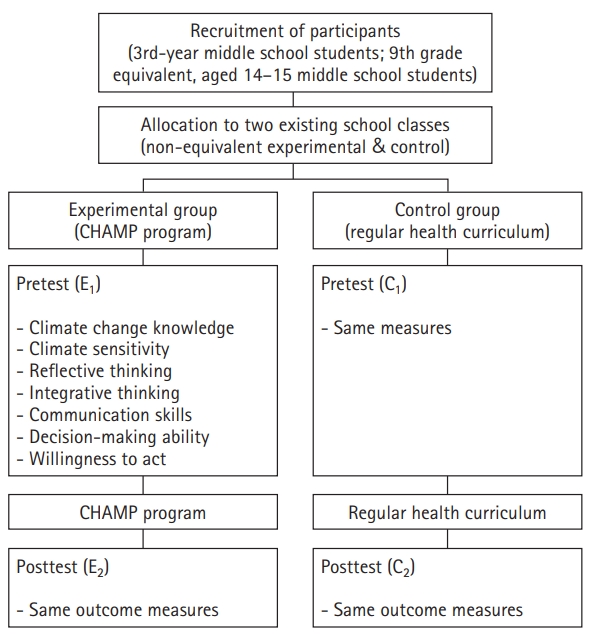
Table 1.Learning plan of the CHAMP
Table 2.Homogeneity test of general characteristics and dependent variables between groups (N=128)
Table 3.Comparison of posttest–pretest change scores in climate adaptation practice competency and its subcomponents (N=128)
- 1. Park HK. Development and application of climate change program for cultivation climate literacy of elementary and middle school students [dissertation]. Daegu: Daegu University; 2013.
- 2. Intergovernmental Panel on Climate Change (IPCC). Climate change 2023: synthesis report. IPCC; 2023. https://doi.org/10.59327/IPCC/AR6-9789291691647
- 3. World Meteorological Organization (WMO). State of global climate 2023. WMO; 2023.
- 4. Hong SJ, Seo JH. Climate change and human health. J Korean Med Assoc. 2011;54(2):149-155. https://doi.org/10.5124/jkma.2011.54.2.149Article
- 5. Ha JS. Analysis of climate change adaptation researches related to health in South Korea. J Clim Change Res. 2014;5(2):139-151. https://doi.org/10.15531/KSCCR.2014.5.2.139Article
- 6. Campbell-Lendrum D, Neville T, Schweizer C, Neira M. Climate change and health: three grand challenges. Nat Med. 2023;29(7):1631-1638. https://doi.org/10.1038/s41591-023-02438-wArticlePubMed
- 7. World Health Organization (WHO). Climate change and health [Internet]. WHO; 2023 [cited 2026 Jan 29]. Available from: http://www.who.int/news-room/fact-sheets/detail/climate-change-and-health
- 8. Korea Disease Control and Prevention Agency (KDCA). 2023 Summer heat-related illness surveillance report [Internet]. KDCA; 2024 [cited 2026 Jan 29]. Available from: https://www.kdca.go.kr/contents.es?mid=a20308040106
- 9. Korea Meteorological Administration (KMA). Annual report on extreme weather events in Korea 2023 [Internet]. KMA; 2024 [cited 2026 Jan 29]. Available from: https://www.korea.kr/archive/expDocView.do?docId=40905
- 10. Muhabat S, Haziq MJ, Mohammadzai S, Akbari N. The effects of climate change on human health: a review. Nangarhar Univ Int J Biosci. 2024;3(2):40-43. https://doi.org/10.70436/nuijb.v3i02.162Article
- 11. Ministry of Education. 2022 revised curriculum commentary: general introduction of middle school curriculum. Ministry of Education; 2022.
- 12. Pinchoff J, Etetun EO, Babatunde D, Blomstrom E, Ainul S, Akomolafe TO, et al. Exploring the perceived health effects of climate change among adolescents and youth in Bangladesh, Guatemala and Nigeria. BMJ Glob Health. 2025;10:e016788. https://doi.org/10.1136/bmjgh-2024-016788ArticlePubMedPMC
- 13. Proulx K, Daelmans B, Baltag V, Banati P. Climate change impacts on child and adolescent health and well-being: a narrative review. J Glob Health. 2024;14:04061. https://doi.org/10.7189/jogh.14.04061ArticlePubMedPMC
- 14. Lee JE. Design and application of team-based learning in middle school health subject [dissertation]. Masan: Kyungnam University; 2025.
- 15. Song KH, Kang HS. Analysis on direction and characteristics of 2015 revised health curriculum. Asia Pac J Multimed Serv Converg Art Humanit Sociol. 2016;6(4):329-339. https://doi.org/10.35873/ajmahs.2016.6.4.034Article
- 16. Ministry of Education. 2022 Revised curriculum: middle school health curriculum [supplement 18]. Ministry of Education; 2022.
- 17. Jang MH, Hong SB, Lee SM, Yoon HW, Min JY. Development and implementation of climate change education program for middle school students: “climate, where are you going!” In: Korean Society for Environmental Education, editor. Proceedings of the Korean Society for Environmental Education Conference. Korean Society for Environmental Education; 2013. p. 186-190. https://www.dbpia.co.kr/journal/articleDetail?nodeId=NODE02362764
- 18. Han S, Lee DH. A study on middle school students’ perceptions of natural disasters caused by climate change. J Energy Clim Chang Educ. 2019;9(2):161-171. https://doi.org/10.22368/ksecce.2019.9.2.161Article
- 19. Ministry of Education. 2022 Revised national curriculum commentary: general guidelines for middle school. Ministry of Education; 2022. Publication No.: MOE-2022-33.
- 20. Shin W, Shin D. A study on climate change attitudes, inquiry, and knowledge of elementary and middle school students. J Energy Clim Change Educ. 2021;11(2):95-107. https://doi.org/10.22368/ksecce.2021.11.2.95Article
- 21. Lee B, Lee S, Jho H. Analysis of primary and secondary students’ perceptions and attitudes toward climate change. J Energy Clim Change Educ. 2022;12(2):153-163. https://doi.org/10.22368/ksecce.2022.12.2.153Article
- 22. Hwang S, Kang KK. An analysis of youth’s perception and action related to climate change: focused on the implications on primary and secondary school education. Korean J Environ Educ. 2024;37(1):181-201. https://doi.org/10.17965/kjee.2024.37.1.181Article
- 23. Kundariatia M, Ibrohima I, Rohmana F, Hayuanaa SN, Putra ZA. Exploring students’ climate change perception: the key factor of climate change mitigation and adaptation. J Pendidikan Biol Indones. 2024;10(1):185-194. https://doi.org/10.22219/jpbi.v10i1.32655Article
- 24. Plutzer E, Branch G, Townley AL. Climate change education in U.S. middle schools: changes over five pivotal years. J Microbiol Biol Educ. 2024;25(2):e0001524. https://doi.org/10.1128/jmbe.00015-24ArticlePubMedPMC
- 25. Baek SH, Shin HJ, Kim CJ. Development of an instrument for measuring action competence on climate change within high school students. J Korean Assoc Res Sci Educ. 2021;41(6):533-542. https://doi.org/10.14697/jkase.2021.41.6.533Article
- 26. Yoo JS. A diagnostic study on middle school students’ health hazard behaviors and influential variables: based on the PRECEDE model. J Korean Soc Sch Health [Internet]. 2002 [cited 2026 Jan 29];15(1):31-48. Available from: https://koreascience.kr/article/JAKO200218645702091.pdf
- 27. Woo JA, Nam YS. Development and application of climate change education program in middle school science. J Korea Assoc Res Sci Educ. 2012;32(5):938-953. https://doi.org/10.14697/jkase.2012.32.5.938Article
- 28. Lynn MR. Determination and quantification of content validity. Nurs Res. 1986;35(6):382-385. https://doi.org/10.1097/00006199-198611000-00017ArticlePubMed
- 29. Kang SY, Kang KH. Effects of environmental reading education activities for enhancing climate change responding capability on middle school students’ environmental sensitivity and environmental action literacy. J Korean Assoc Biol Educ. 2023;51(4):621-633. https://doi.org/10.15717/bioedu.2023.51.4.621
- 30. Lee H, Lim M. Exploring the middle school students’ experiences in a practice-oriented climate change education program: a focus on agency. Korean J Environ Educ. 2024;37(4):468-491. https://doi.org/10.17965/kjee.2024.37.4.468Article
- 31. Lee HM. Development and effects of gifted education program to strengthen climate change response competency [master’s thesis]. Yongin: Dankook University; 2023.
- 32. Kim R, Kim H. Improving school health education for students’ health behavior practices: Implications from comparative analysis of systems and practices in Germany, England and South Korea. Korean J Health Educ Promot. 2021;38(3):65-76. https://doi.org/10.14367/kjhep.2021.38.3.65Article
References
Figure & Data
REFERENCES
Citations
Citations to this article as recorded by 
 ePub Link
 Cite
Cite XML Download
- Figure
-
- We recommend
- Related articles
-
- Development and evaluation of the Trauma-nursing Education and Skill Support program to enhance trauma nursing competencies: a quasi-experimental study
- Development and effects of a media-based reproductive health promotion program for male high school students at male high school: a quasi-experimental study
Development and evaluation of a health education program to enhance middle school students’ climate adaptation competencies: a nonequivalent control group pretest–posttest study in Korea
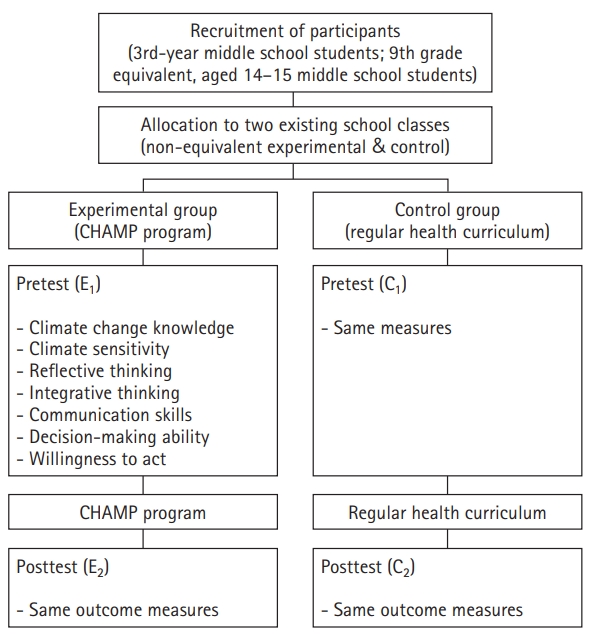
Figure 1. Flowchart of the research design. CHAMP, Climate and Health Action Mitigation Program; C1, control group (pretest); C2, control group (posttest); E1, experimental group (pretest); E2, experimental group (posttest).
Figure 1.
Development and evaluation of a health education program to enhance middle school students’ climate adaptation competencies: a nonequivalent control group pretest–posttest study in Korea
| Lesson | Topic | Learning content | Time (min) | Teaching and learning methods |
|---|---|---|---|---|
| 1 | Understanding the concept and impacts of climate change | • To understand the concept of climate change and its impacts. | 45 | Lecture-based learning |
| • To analyze case examples of damages caused by climate change. | ||||
| 2 | Exploring the relationship between the climate crisis and health | • To identify the health impacts of the climate crisis. | 45 | Lecture-based learning |
| 3 | Exploring the relationship between the climate crisis and health | • To connect the phenomena and causes of the climate crisis and discuss individual and social measures to address it. | 45 | Discussion-based learning |
| 4 | Exploring health advocacy activities for a sustainable society | • To examine international agreements and domestic/global policies related to the climate crisis. | 45 | Project-based learning |
| • To explore individual health advocacy practices that can be implemented in daily life. | ||||
| 5 | Practicing health advocacy activities for a sustainable society | • To plan and present campaign ideas for health advocacy activities. | 45 | Project-based learning |
| 6 | Practicing health advocacy activities for a sustainable society | • To plan and present campaign ideas for health advocacy activities. | 45 | Project-based learning |
| Characteristic | Exp. (n=64) | Con. (n=64) | χ2 or t | p |
|---|---|---|---|---|
| Sex | ||||
| Male | 28 (43.8) | 27 (42.2) | 0.03 | .858 |
| Female | 36 (56.3) | 37 (57.8) | ||
| Climate-adaptation practice competency | 118.23±18.99 | 124.72±21.49 | –1.81 | .073 |
| Climate-change knowledge | 17.27±2.51 | 18.14±2.92 | –1.82 | .071 |
| Climate sensitivity | 17.22±3.29 | 18.39±4.05 | –1.80 | .075 |
| Reflective thinking | 16.84±3.52 | 17.97±3.70 | –1.76 | .080 |
| Integrative thinking | 15.98±3.97 | 16.72±3.99 | –1.04 | .299 |
| Communication skills | 16.20±3.34 | 17.42±4.13 | –1.84 | .069 |
| Decision-making ability | 17.41±3.48 | 18.05±3.66 | –1.02 | .312 |
| Willingness to act | 17.31±3.53 | 18.03±3.99 | –1.08 | .282 |
| Variable | Pretest | Posttest | Posttest–pretest | t | p |
|---|---|---|---|---|---|
| Climate-adaptation practice competency | 4.79 | <.001 | |||
| Exp. (n=64) | 118.23±18.99 | 138.80±18.33 | 20.56±23.87 | ||
| Con. (n=64) | 124.72±21.49 | 127.53±20.04 | 2.81±17.58 | ||
| Climate-change knowledge | 3.60 | <.001 | |||
| Exp. (n=64) | 17.27±2.51 | 20.66±3.10 | 3.39±3.78 | ||
| Con. (n=64) | 18.14±2.92 | 19.47±3.22 | 1.33±2.59 | ||
| Climate sensitivity | 3.40 | 0.001 | |||
| Exp. (n=64) | 17.22±3.29 | 19.95±3.16 | 2.73±4.64 | ||
| Con. (n=64) | 18.39±4.05 | 18.70±3.21 | 0.31±3.31 | ||
| Reflective thinking | 3.80 | <.001 | |||
| Exp. (n=64) | 16.84±3.52 | 19.73±3.18 | 2.89±4.26 | ||
| Con. (n=64) | 17.97±3.70 | 18.16±3.49 | 0.19±3.77 | ||
| Integrative thinking | 3.43 | .001 | |||
| Exp. (n=64) | 15.98±3.97 | 19.59±3.37 | 3.61±5.00 | ||
| Con. (n=64) | 16.72±3.99 | 17.67±3.39 | 0.95±3.66 | ||
| Communication skills | 4.43 | <.001 | |||
| Exp. (n=64) | 16.20±3.34 | 19.22±3.01 | 3.02±4.27 | ||
| Con. (n=64) | 17.42±4.13 | 17.20±3.90 | –0.22±3.99 | ||
| Decision-making ability | 2.94 | .004 | |||
| Exp. (n=64) | 17.41±3.48 | 19.88±3.04 | 2.47±4.06 | ||
| Con. (n=64) | 18.05±3.66 | 18.53±3.41 | 0.48±3.55 | ||
| Willingness to act | 4.18 | <.001 | |||
| Exp. (n=64) | 17.31±3.53 | 19.77±2.92 | 2.45±3.81 | ||
| Con. (n=64) | 18.03±3.99 | 17.80±3.90 | –0.23±3.45 |
Table 1. Learning plan of the CHAMP
CHAMP, Climate and Health Action Mitigation Program.
Table 2. Homogeneity test of general characteristics and dependent variables between groups (N=128)
Values are presented as number (%) or mean±standard deviation unless otherwise stated. Con., control group; Exp., experimental group.
Table 3. Comparison of posttest–pretest change scores in climate adaptation practice competency and its subcomponents (N=128)
Values are presented as mean±standard deviation unless otherwise stated. Con., control group; Exp., experimental group.


