
 Submit an article

Search
- Page Path
- HOME > Search
Review Paper
- Migrant health research in South Korea, 2010–2021: a scoping review
- Soo Jin Kang, Bok-Nam Seo
- J Korean Acad Nurs 2026;56(2):126-147. Published online May 19, 2026
- DOI: https://doi.org/10.4040/jkan.25152
-
 Abstract
 PDF
PDF ePub
ePub - Purpose
This scoping review mapped research trends in migrant health in Korea and evaluated their alignment with global priorities.
Methods
We conducted a scoping review using the Arksey and O’Malley framework. We searched PubMed, CINAHL, Scopus, KoreaMed, ScienceON, RISS, and KISS for articles published between 2010 and 2021, which defined the review period. The inclusion criteria were studies of adult migrants residing in Korea, primary empirical research, and academic journal articles with full text available in Korean or English. Two reviewers performed inductive coding and assigned each study to one primary subject area for frequency counts.
Results
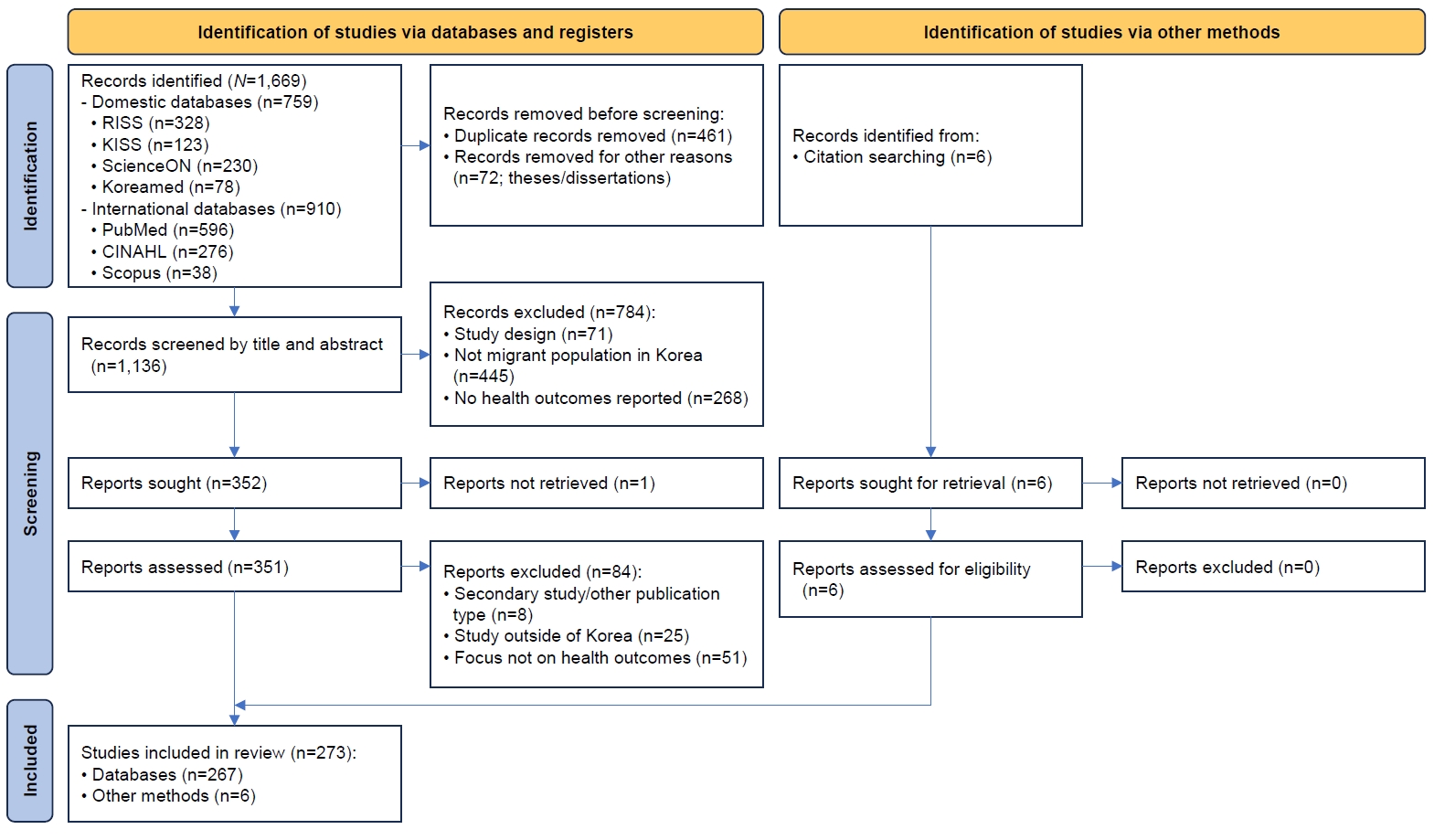
Of 1,669 records, 273 studies met the inclusion criteria. Marriage-migrant women were the most frequently studied group (56.4%), followed by migrant workers (20.5%) and international students (7.0%). Ten subject areas were identified. Mental health (56/273; 20.5%) and health status and quality of life (47/273; 17.2%) were the most common, whereas infection was the least common (6/273; 2.2%). According to World Health Organization priority areas, P4 (tackling the social determinants of health) was the most common (132/273; 48.4%), followed by P1 (promoting health through public health interventions) (73/273; 26.7%). P3 (mainstreaming health policies and fostering partnerships) and P5 (strengthening health monitoring and information systems) were minimally represented (6/273; 2.2% and 11/273; 4.0%, respectively).
Conclusion
Migrant health research in Korea is heavily concentrated on individual-level topics and marriage-migrant populations, with limited evidence on policies, monitoring systems, and underserved groups (e.g., refugees and diverse populations). Future studies should diversify the populations examined, standardize national monitoring and linked data infrastructure, strengthen the P3 and P5 priority areas, and include more longitudinal, interventional, and policy evaluation research.
- 2,471 View
- 235 Download

Research Paper
- Structural Equation Modeling of Health Promotion Behavior on Migrant Workers: A Multi-Group Analysis Based on the Period of Residence
- Hanna Jeong, Youngsuk Kim
- J Korean Acad Nurs 2024;54(1):73-92. Published online February 29, 2024
- DOI: https://doi.org/10.4040/jkan.23101
-
Abstract
PDF
- Purpose
This study developed and tested a hypothetical model of health promotion behavior on migrant workers based on the Health Promotion Model and the Health Literacy Skills Framework.
Methods
Data were collected from 298 migrant workers in 9 regions across the country from December 2020 to March 2021. The exogenous variables were e-health literacy, occupational stress, acculturation, and social support. The endogenous variables were perceived benefits of action, self-efficacy, and health promotion behavior. Data were analyzed using SPSS/WIN 25.0, AMOS 20.0, and R-4.0.3 program.
Results
The model fit was appropriate. Social support had the most significant direct impact on the health promotion behavior of migrant workers. Perceived benefits of action and self-efficacy played a mediating role in the relationship among e-health literacy, social support, and health promotion behavior. Based on multi-group analysis, the migrant worker group with less than 5 years of residency had a more statistically significant effect on the relationship between perceived benefits of action and health promotion behavior than those with over 5 years.
Conclusion
Providing social support as a critical administrative strategy to enhance the health promotion behavior of migrant workers is necessary. Furthermore, when developing an intervention program utilizing the internal mechanism between social support and health promotion behavior, a self-efficacy-enhancing strategy is considered to be more effective. Additionally, educating migrant workers with short-term residence of less than 5 years about the benefits of health behaviors is essential. -
Citations
Citations to this article as recorded by
- Influence of Health Literacy and Psychological Well-being on Health Promotion Behavior in Military Personnel
Dong Jun Lee, Eun Sun So
Research in Community and Public Health Nursing.2026; 37: 90. CrossRef - Factors influencing cardiovascular health behaviors among Korean-Chinese migrant workers with metabolic syndrome using mixed methods
Yu Zhu Zhang, Seon Young Hwang
Scientific Reports.2025;[Epub] CrossRef - Factors Associated With Physical Activity in Home‐Based Rehabilitation Patients With Ankylosing Spondylitis: A Prospective Longitudinal Study
Heng‐Ying Fang, Ying‐Hua Pan, Yi‐Heng Zhang, Yu‐Hua Deng, Xiao‐Wen Li, Lei Huang, Hui‐Ting Gu, Yue Ding, Xin‐Xin Hu, Mu Liu, Rui‐Chong Wang, MeiFen Zhang
Musculoskeletal Care.2025;[Epub] CrossRef
- Influence of Health Literacy and Psychological Well-being on Health Promotion Behavior in Military Personnel
- 4,459 View
- 148 Download
- 3 Web of Science
- 3 Crossref
 First
First Prev
Prev


