
 Submit an article

Search
- Page Path
- HOME > Search
Review Paper
- Effectiveness of mobile health interventions to improve medication adherence for patients with cardiovascular disease: a systematic review and meta-analysis
- Yeoungsuk Song, Seurk Park, Yuyoung Lee, Sohye Lee
- J Korean Acad Nurs 2026;56(2):148-165. Published online May 22, 2026
- DOI: https://doi.org/10.4040/jkan.26016
-
 Abstract
 PDF
PDF ePub
ePub - Purpose
This study systematically reviewed and synthesized the evidence on the effectiveness of mobile health (mHealth) interventions in improving medication adherence among patients with cardiovascular disease.
Methods
This systematic review included randomized controlled trials that evaluated the effects of mHealth interventions on medication adherence among patients with cardiovascular disease. PubMed, the Cochrane Library, CINAHL, and Embase were searched for peer-reviewed studies and grey literature published in English between January 1, 2013, and July 31, 2025. The Cochrane Risk of Bias 2 (RoB 2) tool was used to assess the risk of bias in the included studies. R software ver. 4.5.2 was used to perform the meta-analysis.
Results
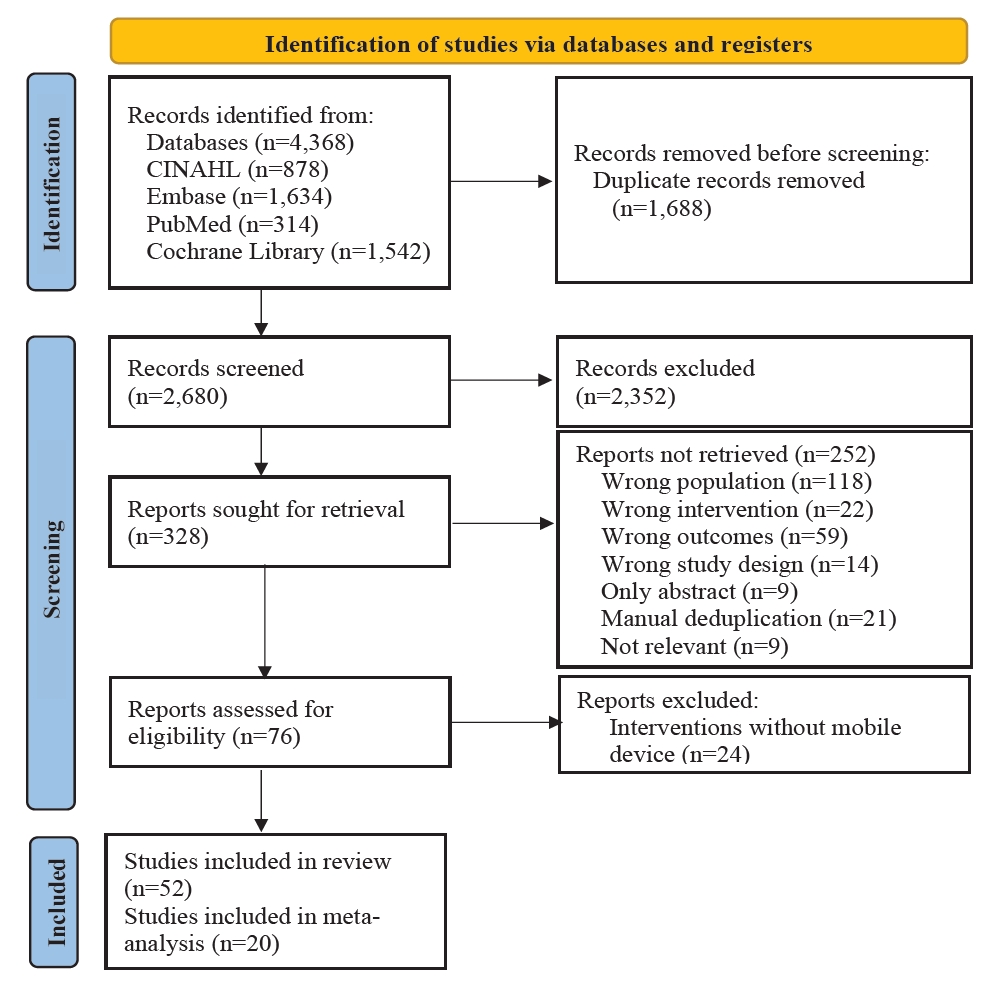
Fifty-two studies were included in the systematic review, of which 20 were included in the meta-analysis. The pooled analysis demonstrated a significant improvement in medication adherence among patients with cardiovascular disease receiving mHealth interventions, with a moderate to large effect size (Hedges’ g=0.72; 95% confidence interval, 0.20–1.25; p<.001), despite substantial heterogeneity (I2=97%). However, a considerable proportion of the included studies were assessed as having a high risk of bias, which may limit the internal validity of the findings. Subgroup analyses indicated that the effects of mHealth interventions on medication adherence did not differ significantly according to intervention type, duration, or outcome measurement tools.
Conclusion
mHealth interventions appear to be effective in improving medication adherence among patients with cardiovascular disease. However, these findings should be interpreted with caution because of the high risk of bias and substantial heterogeneity among the included studies. Future research should explore the use of emerging technologies, such as artificial intelligence and virtual reality, to address medication non-adherence (PROSPERO registration number: CRD42023450502).
- 2,983 View
- 211 Download

 First
First Prev
Prev


