
 Submit an article

Search
- Page Path
- HOME > Search
Research Papers
- Psychometric testing of the Korean version of the Undergraduate Nursing Student Academic Satisfaction Scale: a methodological study
- Da-In Park, Joohee Shim
- J Korean Acad Nurs 2026;56(1):51-66. Published online February 9, 2026
- DOI: https://doi.org/10.4040/jkan.25125
- Correction in: J Korean Acad Nurs 2026;56(2):289
-
 Abstract
 PDF
PDF ePub
ePub - Purpose
This study aimed to translate, cross-culturally adapt, and evaluate the psychometric properties of the Korean version of the Undergraduate Nursing Student Academic Satisfaction Scale (K-UNSASS).
Methods
The K-UNSASS was developed using Brislin’s team-based translation–back-translation approach, with semantic and conceptual equivalence examined. Face validity was assessed, and a pilot test was conducted in November 2022. Content validity was evaluated by an expert panel. Formal data collection was conducted from December 2022 to January 2023. Structural validity was examined using exploratory and confirmatory factor analyses. Reliability was assessed using Cronbach’s alpha and McDonald’s omega coefficients.
Results
A total of 482 full-time nursing students, most of whom were in the fourth year of their nursing program, were included in the psychometric testing. Construct validity supported a four-factor structure accounting for 65.9% of the total variance. After removal of three items with unsatisfactory factor loadings, a 45-item K-UNSASS was established. Confirmatory factor analysis of the 45-item K-UNSASS demonstrated an acceptable model fit, and both Cronbach’s alpha and McDonald’s omega coefficients were .97.
Conclusion
The K-UNSASS demonstrates acceptable reliability and validity for assessing academic satisfaction among Korean nursing students. As a culturally relevant instrument, it supports educational improvement through targeted strategies and program evaluation. -
Citations
Citations to this article as recorded by
- Corrigendum: Psychometric testing of the Korean version of the Undergraduate Nursing Student Academic Satisfaction Scale: a methodological study
Da-In Park, Joohee Shim
Journal of Korean Academy of Nursing.2026; 56(2): 289. CrossRef
- Corrigendum: Psychometric testing of the Korean version of the Undergraduate Nursing Student Academic Satisfaction Scale: a methodological study
- 3,081 View
- 215 Download
- 1 Web of Science
- 1 Crossref

- Effects of presenteeism on turnover intention in clinical nurses through the serial mediating roles of missed nursing care and job satisfaction: a cross-sectional predictive correlational study
- Hyeonseon Cheon, Seok Hee Jeong, Hyun Kyung Kim, Hyoung Eun Chang
- J Korean Acad Nurs 2025;55(4):584-597. Published online November 10, 2025
- DOI: https://doi.org/10.4040/jkan.25015
-
Abstract
PDFePub
- Purpose
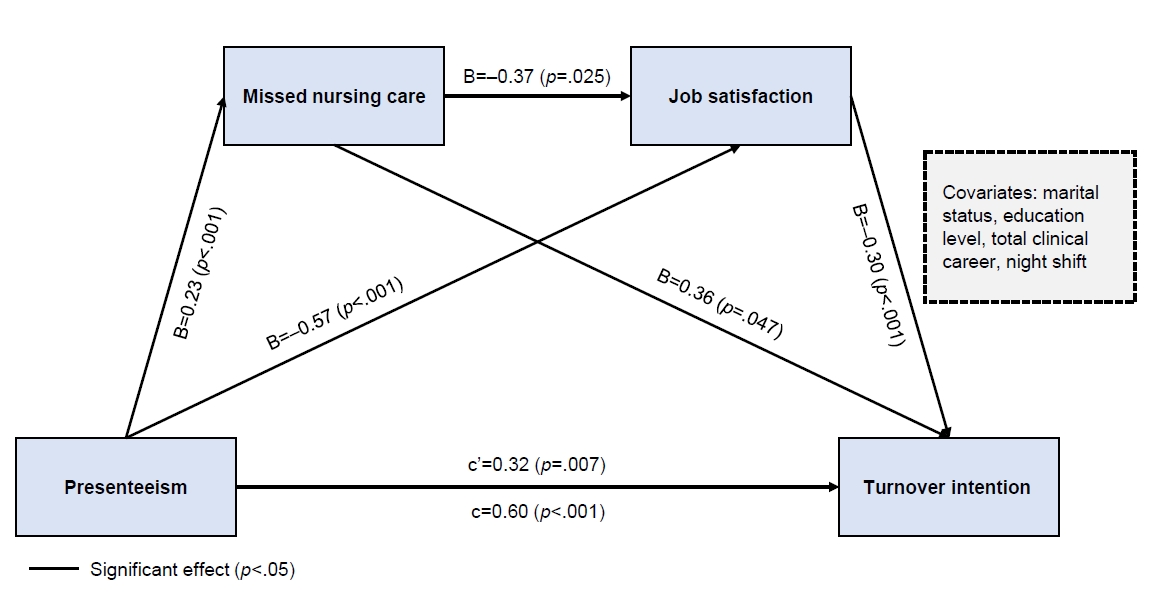
This study aimed to investigate the two-mediator serial mediation effect of missed nursing care and job satisfaction on the relationship between presenteeism and turnover intention in clinical nurses.
Methods
A cross-sectional predictive correlational study was conducted, and the participants were 208 clinical nurses working in advanced general hospitals in South Korea. Data were collected from October 6 to November 7, 2023 using self-reported questionnaires, including general characteristics, presenteeism, missed nursing care, job satisfaction, and turnover intention. Data were analyzed using IBM SPSS/WIN ver. 29.0 and PROCESS macro ver. 4.2.
Results
Missed nursing care and job satisfaction exhibited a double mediating effect on the relationship between presenteeism and clinical nurses’ turnover intention. In addition, missed nursing care showed a mediating effect on the relationship between presenteeism and clinical nurses’ turnover intention. Job satisfaction had a mediating effect on the relationship between presenteeism and clinical nurses’ turnover intention. Presenteeism had a direct effect on missed nursing care, job satisfaction, and turnover intention. Missed nursing care exerted a direct effect on job satisfaction and turnover intention among clinical nurses. Job satisfaction had a direct effect on turnover intention.
Conclusion
To reduce nurses’ turnover intention, it is essential to develop and implement programs focused on preventing presenteeism. Additionally, organizational initiatives should prioritize active support for nurses’ health management, alleviating the shortage of nursing staff, augmenting job satisfaction, and improving the overall working environment. -
Citations
Citations to this article as recorded by- The Effects of Perceived Time Pressure, Presenteeism, and Patient Safety Culture of General Hospital Nurses on Patient Safety Management Activities
Young Suk Yoo, Ju Young Park
Journal of Korean Public Health Nursing.2026; 40(1): 63. CrossRef - The Effects of Nurses' Job Stress and Presenteeism on Turnover Intention: Moderated Mediating Effect of Nursing Work Environment
Yu Seung Ban, Youngran Yang, Seok Hee Jeong, Hyoung Eun Chang
Journal of Korean Academy of Nursing Administration.2026; 32(3): 187. CrossRef - Post-Traumatic Stress Symptoms, Occupational Stress, Emotional Exhaustion, and Quiet Quitting in Workplace-Violence-Exposed Turkish Prehospital Emergency Workers: A Cross-Sectional Study
Mehmet Tatlı, Ramazan Güven, Habip Balsak, Mehmet Özel, İsmail Altıntop
Healthcare.2026; 14(15): 2244. CrossRef - Portuguese Version of the MISSCARE Survey-Patient: A Cross-Cultural Validation Study
Paulo Cruchinho, Gisela Teixeira, Pedro Lucas, Filomena Gaspar, María Dolores López-Franco
Nursing Reports.2026; 16(9): 312. CrossRef
- The Effects of Perceived Time Pressure, Presenteeism, and Patient Safety Culture of General Hospital Nurses on Patient Safety Management Activities
- 3,720 View
- 441 Download
- 2 Web of Science
- 4 Crossref
- Effect of the Spinning Babies Program on Birth Outcomes and Satisfaction during Labor: A Non-Randomized Controlled Trial
- Mi-Yeon Jeong, Hyang Mi Jung
- J Korean Acad Nurs 2024;54(4):607-619. Published online November 20, 2024
- DOI: https://doi.org/10.4040/jkan.24097
-
Abstract
PDFePub
Purpose This study evaluated the effects of the Spinning Babies program applied during labor on birth outcomes and satisfaction among pregnant women.
Methods This non-equivalent control group, non-synchronized post-test only design study included 42 participants (22 in the experimental group and 20 in the control group). The Spinning Babies program was conducted four times in the experimental group during the first and second stages of delivery for 50 min per session. The program comprised performing pelvic circles on a birth ball, followed by wide squatting and adopting of open knee-chest and side-lying positions.
Results Compared with those in the control group, pregnant women in the experimental group had a significantly shorter labor time (t = - 6.64,
p < .001), a higher success rate for normal vaginal delivery (χ 2 = 4.86,p = .043), improved Apgar scores of newborns (z 2 = - 2.18,p = .029), differences in neonatal oxygen therapy use (χ 2 = 4.86,p = .043), and improved birth satisfaction (t = 11.99,p < .001).Conclusion The Spinning Babies program improves the birth environment by increasing the normal vaginal delivery success rate, as well as pregnant women’s birth satisfaction, and promotes neonatal health.
-
Citations
Citations to this article as recorded by- A systematic review of pulmonary rehabilitation nursing interventions for patients with chronic obstructive pulmonary disease
Da-Jung Kim
Journal of Exercise Rehabilitation.2025; 21(5): 234. CrossRef
- A systematic review of pulmonary rehabilitation nursing interventions for patients with chronic obstructive pulmonary disease
- 11,086 View
- 497 Download
- 1 Web of Science
- 1 Crossref
- Effects of Emotional Intelligence on Job Satisfaction of Pediatric Nurses: The Mediating Effect of Communication Skills and Pediatric Nurse-Parent Partnership
- Da Gyeon Lee, Mi-Young Choi
- J Korean Acad Nurs 2023;53(5):514-524. Published online October 31, 2023
- DOI: https://doi.org/10.4040/jkan.23044
-
Abstract
PDF
- Purpose
This study aimed to identify the mediating effects of communication skills and pediatric nurse-parent partnership on the relationship between emotional intelligence and job satisfaction among pediatric nurses.
Methods
A survey was administered to 205 pediatric nurses working in children’s, general, and tertiary hospitals situated in Chungcheong province and Seoul. Data were collected in August and September 2022. The collected data were analyzed using SPSS Statistics version 26.0 along with the PROCESS macro program.
Results
Emotional intelligence had a significant effect, and was a critical factor affecting the job satisfaction of pediatric nurses. Furthermore, communication skills and nurse-parent partnership had a serial double mediating effect.
Conclusion
These findings underscore the significance of conducting job satisfaction improvement programs, including strategies for augmenting emotional intelligence, bolstering communication skills, and fostering nurse-parent partnership. -
Citations
Citations to this article as recorded by- Psychosocial Predictors of Developmentally Supportive Care Competency Among NICU Nurses in South Korea: Self-Leadership, Emotional Intelligence, and Nursing Professionalism
So Jin Lee, Haeryun Cho
Advances in Neonatal Care.2026;[Epub] CrossRef - Nurse–Parent Partnership in Pediatric Settings: A Scoping Review
Hye-yoon Bae, Haeryun Cho
Journal of Korean Maternal and Child Health.2026; 30(3): 121. CrossRef - Factors influencing partnerships between care workers and families in nursing homes in South Korea
Eun-Yeong Jung, Hye-Young Jang
Scientific Reports.2025;[Epub] CrossRef
- Psychosocial Predictors of Developmentally Supportive Care Competency Among NICU Nurses in South Korea: Self-Leadership, Emotional Intelligence, and Nursing Professionalism
- 4,004 View
- 195 Download
- 2 Web of Science
- 3 Crossref
- Validity and Reliability of the Korean Version of the Couple Satisfaction Index
- Suk-Sun Kim, Minji Gil, Daeun Kim, Sunhai Kim, Dayeon Heo, Nan Young Moon
- J Korean Acad Nurs 2022;52(2):228-227. Published online April 30, 2022
- DOI: https://doi.org/10.4040/jkan.21177
-
Abstract
PDF
- Purpose
The study aimed to translate the Couple Satisfaction Index (CSI 32) into Korean, to evaluate the reliability and validity of CSI 32 and short-form (CSI 16, 4) in the Korean context, and to determine a cut-off score for Korean couples.
Methods
Korean Versions of the Couple Satisfaction Index (K-CSI) 32 was translated, back-translated, and reviewed by five bilingual experts. Confirmatory factor analysis (CFA) was conducted with data from a sample of 218 couples (N = 436) to test construct validity. Validity and reliability were evaluated. The receiver’s operating characteristics curve analysis was used to obtain the cut-off score.
Results
The construct validities of K-CSI 32, 16, and 4 were verified using one-factor structures. The results of CFA showed a slightly better fit for K-CSI 16 and 4 than for K-CSI 32. Convergent validity was supported by significant positive correlations of K-CSI with Kansas Marital Satisfaction Scale, Dyadic Adjustment Scale, and Family Relationship Assessment Scale. Moreover, the significant differences in K-CSI between normal and depressive group demonstrated known-group validity. Cut-off scores of 105.5 on K-CSI 32, 50.25 on K-CSI 16, and 13.25 on K-CSI 4 were validated to identify distressed couple relationships.
Conclusion
For clinical practice, the reliable and valid K-CSI 32 has the potential to measure changes in couple satisfaction after couple therapy or interventions. Applying K-CSI 32 may facilitate research on couple and family relationships in nursing and contribute to the discussion on the role of couple satisfaction in mental health. -
Citations
Citations to this article as recorded by- Mediating Effects of Parental Family Adaptation on the Quality of Life of Children With Down Syndrome: A Study of Father–Mother Dyads
Seung Hyeon Yang, Chang Gi Park, Eun Kyoung Choi
Journal of Advanced Nursing.2026; 82(5): 4955. CrossRef - Feasibility of an Online Resilience Program for Mothers With Adverse Childhood Experiences
Hyeseon Yun, Eun Kyoung Choi
Research in Nursing & Health.2026; 49(5): 612. CrossRef - Turkish Adaptation and Psychometric Evaluation of the Family Relationship Assessment Scale (FRAS)
Hanne Nur Özçelik, Yıldız Bilge
Marriage & Family Review.2026; : 1. CrossRef - Adult attachment and hypersexuality: links to couple and sexual satisfaction in a Mexican sample
Diana Mejía-Cruz, Laurent Avila-Chauvet, Luis Villalobos-Gallegos
Frontiers in Psychology.2026;[Epub] CrossRef - Online coaching blended couple‐oriented intervention for preventing depression among Korean middle adulthood: A feasibility study
Minji Gil, Suk‐Sun Kim, Daeun Kim, Sunhai Kim
Family Process.2023; 62(4): 1478. CrossRef
- Mediating Effects of Parental Family Adaptation on the Quality of Life of Children With Down Syndrome: A Study of Father–Mother Dyads
- 7,279 View
- 278 Download
- 4 Web of Science
- 5 Crossref
- Relationships among Non-Nursing Tasks, Nursing Care Left Undone, Nurse Outcomes and Medical Errors in Integrated Nursing Care Wards in Small and Medium-Sized General Hospitals
- Ju-Young Park, Jee-In Hwang
- J Korean Acad Nurs 2021;51(1):27-39. Published online February 28, 2021
- DOI: https://doi.org/10.4040/jkan.20201
-
Abstract
PDF
- Purpose
This study aimed to identify the degree of non-nursing tasks and nursing care left undone in integrated nursing care wards, and examine their relationships with nurses’ burnout, job satisfaction, turnover intentions, and medical errors.
Methods
A cross-sectional questionnaire survey was conducted. Data were collected using self-report questionnaires from 346 nurses working in 20 wards of seven small and medium-sized general hospitals, and analyzed using multiple regression and multiple logistic regression analysis with the SPSS WIN 25.0 program.
Results
The mean score for non-nursing tasks was 7.32±1.71, and that for nursing care left undone was 4.42 ± 3.67. An increase in non-nursing tasks (β = .12, p = .021) and nursing care left undone (β = .18, p < .001) led to an increase in nurses’ burnout (F = 6.26, p < .001). As nursing care left undone (β = .13, p = .018) increased, their turnover intentions also (F = 3.96, p < .001) increased, and more medical errors occurred (odds ratio 1.08, 95% confidence interval 1.02~1.15).
Conclusion
Non-nursing tasks and nursing care left undone are positively associated with nurses’ burnout, turnover intentions, and the occurrence of medical errors. Therefore, it is important to reduce non-nursing tasks and nursing care left undone in order to deliver high quality nursing care and in turn increase patient safety. -
Citations
Citations to this article as recorded by- Associations of Compassion Competence, Nursing Work Environment, Organizational Communication Satisfaction, and Missed Nursing Care on Patient Safety Among Nurses in Comprehensive Nursing Care Service Wards: A Path Analysis
SookHee Yoon
Healthcare.2026; 14(17): 2698. CrossRef - First Integration of a Service Robot and a Communication Application into a Nursing Isolation Setting – An Observational Study Evaluating Walking Distances, Stress and Radiation Doses
Angelika Warmbein, Laura Sehn, Ivanka Rathgeber, Janesca Seif, Christoph Ohneberg, Nicole Stöbich, Astrid Delker, Christian Zach, Inge Eberl, Uli Fischer
International Journal of Social Robotics.2025; 17(9): 1809. CrossRef - Effects of a mobile simulation program for nursing delegation: A randomised controlled trial
Haena Lim, Yeojin Yi
Nurse Education in Practice.2025; 83: 104283. CrossRef - Study of Nurses' Malpractice Tendencies and Burnout Levels
Leman Şenturan, Gizem Kaya, Tuba Emirtaş
Research in Nursing & Health.2025; 48(3): 385. CrossRef - The relationship between job stress and the perception of patient safety culture among Palestinian hospital nurses
Loai M. Zabin, Jamal Qaddumi, Sajed Faisal Ghawadra
BMC Nursing.2025;[Epub] CrossRef - Impact of Grit, Teamwork, Organizational Communication Competence, Perception of Patient Safety Culture on Patient Safety Nursing Activities in Integrated Nursing Care Units
Jeeseon Kim, Haejung Lee
Journal of Korean Academy of Nursing Administration.2025; 31(3): 237. CrossRef - Non-Value-Added Activities and Non-Nursing Tasks Affecting Nursing Task Efficiency: A Scoping Review
Mi Ha Chung, Yongah Kim, Na Yeong Kim, Min Ju Kim, Hyeon Jin Kim, Ju Hee Park, Ji In Park, Su Yeon Bae, Heajin Bae, Eunjeong Lee, Min Young Jeon, Suyoung Choi
Journal of Korean Academy of Nursing Administration.2025; 31(4): 405. CrossRef - Relationships bewteen Non-nursing Tasks, Missed Nursing Care, Patient Safety Nursing Activities, and Medical Errors in Nurses
Tae-Ryun Lee, Jee-In Hwang
Quality Improvement in Health Care.2025; 31(2): 2. CrossRef - Factors Influencing Nursing Care Left Undone by Cancer Ward Nurses
Chung Hee Woo, Yeon Joo Kim
Journal of Korean Academy of Nursing Administration.2025; 31(5): 594. CrossRef - A phenomenological study of the experiences of nurses working in integrated nursing care wards in Korea
Young-mi Cho, Sun-hui Kim
BMC Nursing.2024;[Epub] CrossRef - Relationships among Nursing Skill Mix, Missed Nursing Care, and Adverse Events in Small and Medium-Sized Hospital Comprehensive Nursing Care Wards
Yoon Sook Cho, Hyoung Eun Chang, Hyunjung Lee
Journal of Korean Academy of Nursing Administration.2024; 30(2): 163. CrossRef - Exploring the causes and consequences of non-nursing tasks among nurses in Jordan: An in-depth qualitative investigation
Ayman Abed Aldarawsheh, Ahmad Rajeh Saifan, Murad Adnan Sawalha, Enas A. Assaf, Intima Alrimawi, Rami A. Elshatarat, Zyad T. Saleh, Wesam T. Almagharbeh, Nermen A. Mohamed, Mudathir M. Eltayeb
Applied Nursing Research.2024; 77: 151791. CrossRef - Influence of Work Environment, Missed Nursing Care, and Non-Nursing Tasks of Hospital Nurses on Job Stress
Ji Yeong Park, Kyoung Ja Kim
Journal of Korean Academy of Nursing Administration.2024; 30(3): 246. CrossRef - A comparative analysis of nurses' reported number of patients and perceived appropriate number of patients in integrated nursing care services
Hyunjeong Kwon, Jinhyun Kim
Nursing & Health Sciences.2024;[Epub] CrossRef - Effectiveness of a virtual reality application‐based education programme on patient safety management for nursing students: A pre‐test–post‐test study
Jae Woo Oh, Ji Eun Kim
Nursing Open.2023; 10(12): 7622. CrossRef - The Effect of Missed Nursing Care on Adverse Event Experiences, Patient Safety Management Activity, Job Satisfaction and Turnover Intention in Nurses: A Nationwide Survey using Proportional Quota Sampling
Myung Jin Choi, Seok Hee Jeong
Journal of Korean Academy of Nursing Administration.2023; 29(4): 490. CrossRef - Pathway Analysis on the Effects of Nursing Informatics Competency, Nursing Care Left Undone, and Nurse Reported Quality of Care on Nursing Productivity among Clinical Nurses
Mi Yu, Se Young Kim, Ji Min Ryu
Journal of Korean Academy of Nursing.2023; 53(2): 236. CrossRef - Competency Survey of Caregivers in Medical Tourism Special Zone and Other Regions
Dong-Yeop Lee, Sang-Bong Lee, Yeong-Im Park, Jin-Geun Lee, Yoon Hee Park, So Young Lee, Dong-Yoon Kang
Journal of Health Informatics and Statistics.2023; 48(2): 140. CrossRef - Influence of the Team Effectiveness of Nursing Units on Nursing Care Left Undone and Nurse-Reported Quality of Care
Se Young Kim, Young Ko
Healthcare.2023; 11(10): 1380. CrossRef - The Impact of Performance of Non-Nursing Tasks on the Attitudes of Nursing Students toward Nursing Profession
Ibrahim Rawhi Ayasreh, Ferial Hayajneh, Rana Al Awamleh
Nurse Media Journal of Nursing.2022; 12(2): 151. CrossRef - Clinical Application Value of Group‐Sharing Nursing Management Based on Case Analysis
Jing Mei, Yifan Wu, Jie Hu, Min Li, Mohammad Farukh Hashmi
Contrast Media & Molecular Imaging.2022;[Epub] CrossRef - The Effect of Burnout on Quality of Care Using Donabedian’s Framework
Kathleen M. White, Dorothy Dulko, Bonnie DiPietro
Nursing Clinics of North America.2022; 57(1): 115. CrossRef - Emotional Labor, Burnout, Medical Error, and Turnover Intention among South Korean Nursing Staff in a University Hospital Setting
Chan-Young Kwon, Boram Lee, O-Jin Kwon, Myo-Sung Kim, Kyo-Lin Sim, Yung-Hyun Choi
International Journal of Environmental Research and Public Health.2021; 18(19): 10111. CrossRef - Integrated and Person-Centered Nursing in the Era of the 4th Industrial Revolution
Hyoung Suk Kim, Sun Joo Jang, Jeung-Im Kim
Journal of Korean Academy of Nursing.2021; 51(3): 261. CrossRef - Analysis of Nurses' Work Experience in Comprehensive Nursing Care Units of Small and Medium-sized Hospitals
Mi Ryeong Song, Su Hyang Ryu
Journal of Korean Academy of Nursing Administration.2020; 26(4): 419. CrossRef
- Associations of Compassion Competence, Nursing Work Environment, Organizational Communication Satisfaction, and Missed Nursing Care on Patient Safety Among Nurses in Comprehensive Nursing Care Service Wards: A Path Analysis
- 6,051 View
- 324 Download
- 16 Web of Science
- 25 Crossref
- Development and Validation of the Nurse Needs Satisfaction Scale Based on Maslow’s Hierarchy of Needs Theory
- Hwa Jin Kim, Sun Hwa Shin
- J Korean Acad Nurs 2020;50(6):848-862. Published online December 31, 2020
- DOI: https://doi.org/10.4040/jkan.20195
-
Abstract
PDF
- Purpose
The purpose of this study was to develop an instrument to evaluate the needs satisfaction of nurses and examine its validity and reliability.
Methods
The initial items for the instrument were developed through a literature review and interviews, using the conceptual framework of Maslow’s hierarchy of needs theory. The initial items were evaluated for content validity by 14 experts. Four hundred and eighty-six clinical nurses participated in this study through offline and online surveys to test the reliability and validity of the instrument. The first evaluation (n = 256) was used for item analysis and exploratory factor analysis, and the second evaluation (n = 230) was used to conduct a confirmatory factor analysis and to assess the criterion-related validity and internal consistency of the instrument. Test-retest reliability was analyzed using data from 30 nurses.
Results
The final instrument consisted of 30 items with two sub-factors for five needs that were identified through the confirmatory factor analysis. The criterion-related validity was established using the five need satisfaction measures (r = .56). Cronbach’s a for total items was .90, and test-retest reliability was .89.
Conclusion
The findings from this study indicate that this instrument has sufficient validity and reliability. This instrument can be used for the development of nursing interventions to improve the needs satisfaction of clinical nurses. -
Citations
Citations to this article as recorded by- The Effect of Needs Satisfaction, Job Crafting, and Nursing Practice Environment on Retention Intention in Advanced Beginner-Stage Nurses
Sunghyun Baek, Kyoung Ja Moon
Journal of Korean Academy of Nursing Administration.2026; 32(2): 93. CrossRef - Quality of the Healthy Work Environment and Retention Intention among Nurses in Tertiary Hospitals: Mediating Roles of Need Satisfaction and Work-Life Balance
Da-Young Lee, Hyeon-Young Kim
Journal of Fundamental Nursing Science.2026; 33(3): 406. CrossRef - Latent profile analysis of missed nursing care and their predictors among neuro-oncology nurses: a multicenter cross-sectional study
Li Ying, Duan Yuyu, Zou Daili, Su Yangmei, Xiang Qing, Zhou Zhihuan
BMC Nursing.2025;[Epub] CrossRef - Influence of COVID-19–Induced Anxiety on Job Turnover Intention among Emergency Room Nurses during the COVID-19 Pandemic, the Mediating Effect of Needs Satisfaction: A Cross-Sectional Study
YuJin Seo, Myung Kyung Lee
Korean Journal of Adult Nursing.2025; 37(2): 104. CrossRef - Psychometric properties of disease‐specific health‐related quality of life instruments for food allergy: A COnsensus‐based Standards for the selection of health Measurement INstruments‐based systematic review
Ke Liu, Shuyi Wang, Zeen Li, Yuting Xia, Qirong Chen
Pediatric Allergy and Immunology.2024;[Epub] CrossRef - Effects of Nursing Work Environment, Need Satisfaction, and Depression on Turnover Intention in Korea
Sun-Hwa Shin, On-Jeon Baek, Eun-Hye Lee
Healthcare.2023; 11(12): 1698. CrossRef - Analysis of influencing factors of job demands of healthcare workers working in mobile cabin hospitals in China
Hongmei Yi, Sha Wei, Jingyan Song, Mingzhao Xiao, Huanhuan Huang, Di Luo, Qinghua Zhao
Nursing Open.2023; 10(11): 7368. CrossRef - Consumption Structure Optimization Strategy for Scenic Spots Using the Deep Learning Model under Digital Economy
Yi Wang, Na Li, Xiaoe Qu, Vijay Kumar
Computational Intelligence and Neuroscience.2022; 2022: 1. CrossRef - Self-Care in Nurses
Susan G. Williams, Sharon Fruh, Jennifer L. Barinas, Rebecca J. Graves
Journal of Radiology Nursing.2022; 41(1): 22. CrossRef - Clinical Application Value of Group‐Sharing Nursing Management Based on Case Analysis
Jing Mei, Yifan Wu, Jie Hu, Min Li, Mohammad Farukh Hashmi
Contrast Media & Molecular Imaging.2022;[Epub] CrossRef - Effect of nursing intervention based on Maslow's hierarchy of needs in patients with coronary heart disease interventional surgery
Ji-Xue Xu, Lin-Xue Wu, Wei Jiang, Gui-Hong Fan
World Journal of Clinical Cases.2021; 9(33): 10189. CrossRef
- The Effect of Needs Satisfaction, Job Crafting, and Nursing Practice Environment on Retention Intention in Advanced Beginner-Stage Nurses
- 3,880 View
- 147 Download
- 8 Web of Science
- 11 Crossref
Original Articles
- Prediction Model for Nursing Work Outcome of Nurses - Focused on Positive Psychological Capital
- Soon Neum Lee, Jung A Kim
- J Korean Acad Nurs 2020;50(1):1-13. Published online January 31, 2020
- DOI: https://doi.org/10.4040/jkan.2020.50.1.1
-
Abstract
PDF
Abstract Purpose: The purpose of this study was to construct and test a structural equation model on nursing work outcomes based on Youssef and Luthans’ positive psychological capital and integrated conceptual framework of work performance.
Methods: This study used a structured questionnaire administered to 340 nurses. Data were analyzed using structural equation modeling.
Results: Positive psychological capital showed indirect and direct effects on job satisfaction, retention intention, organizational citizenship behavior, and nursing performance. While, the nursing work environment had direct and indirect effects on job satisfaction and nursing performance, it only had indirect effects on intention to work and organizational citizenship behavior. Additionally, a mediating effect on retention intention and organizational citizenship behavior was found between job satisfaction and nursing performance variables.
Conclusion: The nursing organization needs to build a supportive work environment and reinforce positive psychological capital to improve nursing performance. Additionally, it needs to actively manage the necessary parameters involved in the stages of job satisfaction, retention intention, nursing performance, and organizational citizenship behavior of nurses. The findings propose the continuous management of nursing personnel based on nurses’ attitude outcome, behavioral intention, behavioral outcome, and stage of role performance.
-
Citations
Citations to this article as recorded by- Development of Positive Psychological Capital Improvement Program for Nurses working in a Long-term Care Hospital
Miran Lim, Hyeyoung Kim
The Open Nursing Journal.2026;[Epub] CrossRef - A Pathway from Job Autonomy to Citizenship Behaviour of Selected Banks in Kaduna State: The Role of Employee Hope as a Mediator
Richifa Abdulmumini Suleiman, Yazeed Muhammad, Abdullahi Hauwa Mustapha, O Blessing Shaibu
UMYU Journal of Business Administration and Management.2026; 1(1 & 2): 30. CrossRef - Impact of the Empowering Leadership of Nurse Unit Managers on Patient Safety Nursing Activities: Double Mediating Effects of Positive Psychological Capital and Work Engagement
Jin-Young Park, Eungyung Kim
Journal of Korean Academy of Nursing Administration.2025; 31(5): 516. CrossRef - Social Support and Psychological Capital Mediate the Effect of Personalities on the Mental Health of Professional Staff in China During COVID-19 Pandemic
Yongcheng Yao, Jie Tang, Zhenzhen Li, Shuyan Chen, Haixia Du, Lingeng Lu
Psychology Research and Behavior Management.2024; Volume 17: 3443. CrossRef - Individual‐level positive psychological capital that enhances managers' transformational leadership effectiveness on nurse career success
Sujin Jung, Kihye Han, Kyeongsug Kim
International Nursing Review.2024; 71(4): 977. CrossRef - Effect of Transition Shock on Intention to Stay in Newly Graduated Nurses : The Mediating Effect of Positive Psychological Capital
Hyuna Kam, Chanhee Kim, Yeonok Yoon, Heeyoung Shin, Junghwa Lee, Myoungohk Kim
Journal of Korean Critical Care Nursing.2024; 17(3): 25. CrossRef - Factors Influencing Nursing Performance of Intensive Care Unit Nurses: Role of Clinical Reasoning Competence, Positive Psychological Capital, and Nursing Work Environment
MiRim Heo, Haena Jang
Journal of Korean Critical Care Nursing.2024; 17(2): 83. CrossRef - Effect of positive psychological capital on burnout in public hospital nurses: Mediating effect of compassion fatigue is greater than compassion satisfaction
Sin Ah Kim, Sung Reul Kim, Hye Young Kim
Japan Journal of Nursing Science.2024;[Epub] CrossRef - Psychological capital and organizational citizenship behavior among nurses during the COVID-19 epidemic: mediation of organizational commitment
Li Zeng, Fen Feng, Man Jin, Wanqing Xie, Xin Li, Lan Li, Yihang Peng, Jialin Wang
BMC Nursing.2023;[Epub] CrossRef - The Influence of Nurses’ Workplace Bullying, Social Interaction Anxiety and Positive Psychological Capital on Nursing Performance
Hyang Mi Kim, Sun Hee Jang
Journal of Korean Academy of Nursing Administration.2023; 29(3): 331. CrossRef - BİLİNÇLİ FARKINDALIK VE ÇALIŞAN İYİ OLUŞU ARASINDAKİ İLİŞKİDE PSİKOLOJİK SERMAYENİN ARACILIK ROLÜ: HEMŞİRELER ÜZERİNE BİR İNCELEME
Emrehan KÜÇÜK, Selin METİN CAMGÖZ
Mehmet Akif Ersoy Üniversitesi İktisadi ve İdari Bilimler Fakültesi Dergisi.2023;[Epub] CrossRef - The Moderating Effect of Organizational Justice on the Relationship between Self-Efficacy and Nursing Performance in Clinical Nurses
Ju-Ra Kim, Yukyung Ko, Youngjin Lee, Chun-Ja Kim
Journal of Korean Academy of Nursing.2022; 52(5): 511. CrossRef - Effects of Positive Psychological Capital, Job Crafting and Job Satisfaction on Intention of Retention in Hospital Nurses
Eun-Ah Lee, Yeongmi Ha
Journal of Korean Academy of Nursing Administration.2022; 28(5): 586. CrossRef - Investigation of the relationship between psychological resilience and job performance in Turkish nurses during the Covid‐19 pandemic in terms of descriptive characteristics
Haydar Hoşgör, Mevlüt Yaman
Journal of Nursing Management.2022; 30(1): 44. CrossRef - How Nurses Perceived Their Work-Environments and Its Related Nursing Management Perspectives during the COVID-19 Pandemic: An Investigatory Study
Elsa Vitale
Psych.2022; 4(4): 747. CrossRef - Influence of gender role conflict, resilience, and nursing organizational culture on nursing work performance among clinical nurses
Ji Eon Han, Nam Hee Park, Jeonghyun Cho
The Journal of Korean Academic Society of Nursing Education.2020; 26(3): 248. CrossRef - Influences of Type D Personality, Positive Psychological Capital, and Emotional Labor on the Burnout of Psychiatric Nurses
Seung Mi Park, Myung Ha Lee, Ji Young Kim
Journal of Korean Academy of psychiatric and Mental Health Nursing.2020; 29(2): 133. CrossRef
- Development of Positive Psychological Capital Improvement Program for Nurses working in a Long-term Care Hospital
- 4,093 View
- 125 Download
- 7 Web of Science
- 17 Crossref
- Psychosocial Well-Being of Clinical Nurses Performing Emotional Labor: A Path Analytic Model Approach
- Yoonjeong Lee, Hyunli Kim
- J Korean Acad Nurs 2019;49(3):307-316. Published online January 15, 2019
- DOI: https://doi.org/10.4040/jkan.2019.49.3.307
-
Abstract
PDF
Abstract Purpose This study was conducted to investigate the influence of emotional expressivity, emotional intelligence, affectivity, job autonomy, social support, and emotional labor on clinical nurses’ individual well-being and to provide guidelines for interventions and strategies for its improvement.
Methods The sample consisted of 207 nurses recruited from a general hospital in Korea. The participants completed a structured self-report questionnaire comprising measures of emotional expressivity, emotional intelligence, positive affectivity, negative affectivity, job autonomy, supervisor support, coworker support, deep acting, surface acting, emotional exhaustion, and job satisfaction. Data were analyzed using SPSS statistics 22.0 and AMOS 22.0.
Results The final model was a good fit for the data based on the model fit indices. In the path analysis, surface acting, negative affectivity, supervisor support, and coworker support had statistically significant effects on emotional exhaustion, explaining 29.0% of the variance. Deep acting, emotional exhaustion, positive affectivity, and emotional intelligence had statistically significant effects on job satisfaction, explaining 43.0% of the variance.
Conclusion Effective strategies to improve clinical nurses’ individual well-being should focus on surface acting, deep acting, affectivity, social support, and emotional intelligence. The results of this study can be utilized as base data to manage emotional labor and improve clinical nurses’ individual well-being.
-
Citations
Citations to this article as recorded by- Validity and Reliability of the Korean version of the Wong and Law Emotional Intelligence Scale for Nurses
Hye-Ja Park, Soyoung Yu
Sage Open.2021;[Epub] CrossRef
- Validity and Reliability of the Korean version of the Wong and Law Emotional Intelligence Scale for Nurses
- 1,786 View
- 23 Download
- 1 Web of Science
- 1 Crossref
- Prediction Modeling on Family Life Satisfaction of Old Adults Living at Home
- Young Mi Huh, Sohyune Sok
- J Korean Acad Nurs 2018;48(5):534-544. Published online October 31, 2018
- DOI: https://doi.org/10.4040/jkan.2018.48.5.534
-
Abstract
PDF
Purpose This study was conducted to construct and test a structural model on family life satisfaction of aged individuals living at home. The conceptual model was based on Bandura's self-efficacy and social cognitive theories (1977; 1986) and Bowen's (1976) family systems theory.
Methods From January 25 to March 5, 2016, 227 older adults living at home completed a structured questionnaire. Data were analyzed to calculate the direct and indirect effects of factors affecting family life satisfaction. SPSS WIN 20.0 and AMOS 20.0 were used.
Results The hypothetical model was a good fit for the data. The model fit indices were χ2=78.05, χ2/df=1.35, RMSR=.02, GFI=.98, AGFI=.96, NFI=.94, CFI=.98, and RMSEA=. 05. Family life satisfaction was positively affected by perceived collective family efficacy, status of physical health, family communication, and family support. Depression resulted in a significant negative effect. Family differentiation had a significant indirect effect on family life satisfaction. The model explained 76% of variance in family life satisfaction.
Conclusion Perceived collective family efficacy, status of physical health, depression, family differentiation, family communication, and family support were significant factors explaining family life satisfaction among older adults staying at home. Further research should be conducted to seek intervention strategies to improve family life satisfaction among older adults living at home by focusing on the respective contributing factors.
-
Citations
Citations to this article as recorded by- The relationship between family support and life satisfaction in hypertensive patients: the multiple mediating roles of self-esteem and self-care
Han Wu, Haijun Zhang, Congzhi Wang, Tian Pan, Yue Zhao, Xiang Chen, Lin Zhang
Geriatric Nursing.2026; 69: 103799. CrossRef - The Effect of Pain Catastrophizing on Depression among Older Korean Adults with Chronic Pain: The Mediating Role of Chronic Pain Interference and Sleep Quality
Kyoung-eun Lee, Hyunju Ryu, Sun Ju Chang
International Journal of Environmental Research and Public Health.2020; 17(23): 8716. CrossRef
- The relationship between family support and life satisfaction in hypertensive patients: the multiple mediating roles of self-esteem and self-care
- 1,828 View
- 18 Download
- 2 Crossref
- Effects of Group Rational Emotive Behavior Therapy on the Nurses’ Job Stress, Burnout, Job Satisfaction, Organizational Commitment and Turnover Intention
- Hye-Lyun Kim, Sook-Hee Yoon
- J Korean Acad Nurs 2018;48(4):432-442. Published online January 15, 2018
- DOI: https://doi.org/10.4040/jkan.2018.48.4.432
-
Abstract
PDF
Abstract Purpose This study aimed to develop a Group REBT program with group counseling for nurses and test the effect of group counseling on their job stress, burnout, job satisfaction, organizational commitment, and turnover intention.
Methods A quasi-experimental study with nonequivalent control group design was employed to identify the effect of the Group REBT program on nurses’ job stress, burnout, job satisfaction, organizational commitment, and turnover intention. Data were collected from 47 participants from two hospitals. The data from the experimental (n=23) and control (n=24) groups were analyzed from January 5 to April 3, 2015. The Group REBT program was conducted eight tmes in all, once a week, with each session lasting 180 minutes. The effect of experimental intervention was measured for each group using a series of structured questionnaires at each of the phases: Pre-intervention, post-intervention (immediately after intervention), and post-intervention (four weeks after intervention). Following this, the significance of the changes in the scores was tested.
Results The scores of the experimental group, which received the Group REBT program, were compared with those of the control group; the hypotheses were supported in terms of job stress (F=8.85,
p <.001), burnout (F=5.62,p =.022), job satisfaction (F=2.70,p =.042), organizational commitment (F=2.97,p =.048), and turnover intention (F=4.60,p =.012).Conclusion The Group REBT program was shown to be an effective intervention that could reduce nurses’ job stress and burnout and increase job satisfaction and organizational commitment. Therefore, the Group REBT program can be adopted by nursing organizations to strategically decrease nurses’ turnover intention.
-
Citations
Citations to this article as recorded by- Factors Influencing Organizational Socialization in New Nurses: A Focus on Job Stress, Resilience, and Nursing Performance
Kyungok Park, Yeoungsuk Song
Journal of Korean Academy of Fundamentals of Nursing.2025; 32(1): 118. CrossRef - Finding the paths between job demand–resources and turnover intention of community mental health nurses in Korea
Eunmi Hwang, Yeojin Yi
International Nursing Review.2025;[Epub] CrossRef - Analysis of the potential dimensions and influencing factors of nurses’ sense of professional achievement in “Internet + Nursing Services”
Jing Wu, Zhixia Zhang, Juanjuan Li, Heng Li, Niannian Zhang, Lili Gao, Congcong He, Xuan Wang
Frontiers in Public Health.2025;[Epub] CrossRef - Mental health interventions affecting university faculty: a systematic review and meta-analysis
Dalal Hammoudi Halat, Waqas Sami, Abderrezzaq Soltani, Ahmed Malki
BMC Public Health.2024;[Epub] CrossRef - The moderating effects of positive thinking on the relationship between job stress and turnover intention
Khahan Na-Nan
Evidence-based HRM: a Global Forum for Empirical Scholarship.2024; 12(3): 531. CrossRef - Interventions to reduce burnout among clinical nurses: systematic review and meta-analysis
Miran Lee, Chiyoung Cha
Scientific Reports.2023;[Epub] CrossRef - A systematic mapping review on the use of Rational Emotive Behavior Therapy (REBT) with athletes
Anna Jordana, Martin J. Turner, Yago Ramis, Miquel Torregrossa
International Review of Sport and Exercise Psychology.2023; 16(1): 231. CrossRef - Psychological capital, work stress and burnout among Chinese clinical nurses
Ganjun Song, Lida C Landicho
International Journal of Research Studies in Psychology.2023;[Epub] CrossRef - Psychological Resilience and Career Success of Female Nurses in Central China: The Mediating Role of Craftsmanship
Huiyuan Xue, Xiaona Si, He Wang, Xiaoren Song, Keke Zhu, Xiaoli Liu, Fen Zhang
Frontiers in Psychology.2022;[Epub] CrossRef - The impact of the second victim's experience and support on the career success of psychiatric nurses: The mediating effect of psychological resilience
Hua Xu, Xiang Cao, Quan‐Xiang Jin, Rui‐Shi Wang, Yan‐Hong Zhang, Zhao‐Hong Chen
Journal of Nursing Management.2022; 30(6): 1559. CrossRef - The effect of a psychoeducation program based on the rational emotional behavioral approach in individuals with multiple sclerosis diagnosis: A randomized controlled trial
Emel Şahin, Serap Güleç Keskin, Murat Terzi
Perspectives in Psychiatric Care.2022; 58(4): 1449. CrossRef - The Effect of Nurse Support Programs on Job Satisfaction and Organizational Behaviors among Hospital Nurses: A Meta-Analysis
Se Young Kim, Mi-Kyoung Cho
International Journal of Environmental Research and Public Health.2022; 19(24): 17061. CrossRef - Effects of the Anger Management Program for Nurses
Kyoungsun Yun, Yang-Sook Yoo
Asian Nursing Research.2021; 15(4): 247. CrossRef - Nursing management challenges: Effect of quality of work life on depersonalization
P. Yukthamarani Permarupan, Abdullah Al Mamun, Naeem Hayat, Roselina Ahmad Saufi, Naresh Kumar Samy
International Journal of Healthcare Management.2021; 14(4): 1040. CrossRef - Clinical benefits of rational-emotive stress management therapy for job burnout and dysfunctional distress of special education teachers
Liziana N Onuigbo, Charity N Onyishi, Chiedu Eseadi
World Journal of Clinical Cases.2020; 8(12): 2438. CrossRef - Predicting Nurses Burnout through Quality of Work Life and Psychological Empowerment: A Study Towards Sustainable Healthcare Services in Malaysia
P Yukthamarani Permarupan, Abdullah Al Mamun, Naresh Kumar Samy, Roselina Ahmad Saufi, Naeem Hayat
Sustainability.2020; 12(1): 388. CrossRef - Cognitive behavioral therapy for occupational stress among the intensive care unit nurses
MohammadHosein Fadaei, Mahya Torkaman, Naval Heydari, Maryam Kamali, Fariba Ghodsbin
Indian Journal of Occupational and Environmental Medicine.2020; 24(3): 178. CrossRef - Effects of Hospital-Based Violence-Prevention and Coping Programs on Nurses' Violence Experience, Violence Responses, Self-Efficacy, and Organizational Commitment
Yu Jeong Yang, Jeong-Hee Kim
Journal of Korean Academy of Nursing Administration.2020; 26(5): 550. CrossRef - Intervention for burnout among postgraduate chemistry education students
Florence Obiageli Ezeudu, Florence Oboochi Attah, Anthonia Ebere Onah, Tochukwu Longinus Nwangwu, Ekwutosi Monica Nnadi
Journal of International Medical Research.2020;[Epub] CrossRef - Impact of WeChat‐based 'three good things' on turnover intention and coping style in burnout nurses
Yu‐Fang Guo, Virginia Plummer, Wendy Cross, Louisa Lam, Jing‐Ping Zhang
Journal of Nursing Management.2020; 28(7): 1570. CrossRef - Mediating Effect of Organizational Commitment in the Relationship between Professional Identity and Job Satisfaction
Seonghyun Yoo, Myoung Soo Kim, Hyoung Sook Park
Journal of Health Informatics and Statistics.2019; 44(4): 339. CrossRef - Burnout Precursors in Oncology Nurses: A Preliminary Cross-Sectional Study with a Systemic Organizational Analysis
Loris Bonetti, Angela Tolotti, Dario Valcarenghi, Carla Pedrazzani, Serena Barello, Greta Ghizzardi, Guendalina Graffigna, Davide Sari, Monica Bianchi
Sustainability.2019; 11(5): 1246. CrossRef
- Factors Influencing Organizational Socialization in New Nurses: A Focus on Job Stress, Resilience, and Nursing Performance
- 4,270 View
- 102 Download
- 22 Crossref
- Effect of Breathing Exercise Using Panflutes on the Postoperative Compliance, Pulmonary Infections and Life Satisfaction in Elderly Patients Undergoing Spinal Surgery
- Hyun Mi Jo, Hyunsook Shin
- J Korean Acad Nurs 2018;48(3):279-288. Published online January 15, 2018
- DOI: https://doi.org/10.4040/jkan.2018.48.3.279
-
Abstract
PDF
Abstract Purpose The purpose of this study was to examine the effects of breathing exercises performed using panflutes in elderly patients undergoing spinal surgery.
Methods The study design was a nonequivalent control group non-synchronized pre-post test. The study included 24 patients in both the experimental group and the control group. The experimental group completed a daily breathing exercise regimen using panflutes for 30minutes after meals, whereas the control group was provided standard preoperative education, including breathing exercises using incentive spirometers. After the exercise regimen, breathing exercise compliance, pulmonary infections, and life satisfaction were measured in both groups, and the data were analyzed using the SPSS/WIN program.
Results The compliance rate of breathing exercises was significantly higher in the experimental group. The experimental group presented no pulmonary infections in the later period, whereas the control group presented higher pulmonary infection rates in the same period. In addition, the life satisfaction score in the experimental group significantly increased.
Conclusion The breathing exercise program using panflutes for elderly patients undergoing spinal surgery enhanced their breathing exercise compliance and their daily life satisfaction in addition to reducing their pulmonary infection rates.
-
Citations
Citations to this article as recorded by- Pranayama and Breathing Exercises - Types and Its Role in Disease Prevention & Rehabilitation
Naresh Kumar Satyanarayan Dhaniwala, Venkatesh Dasari, Mukunda Naresh Dhaniwala
Journal of Evolution of Medical and Dental Sciences.2020; 9(44): 3325. CrossRef
- Pranayama and Breathing Exercises - Types and Its Role in Disease Prevention & Rehabilitation
- 1,716 View
- 17 Download
- 1 Crossref
- Development of Job Satisfaction Scale for Clinical Nurses
- Byoung-Sook Lee, Yong-Sook Eo, Mi-Aie Lee
- J Korean Acad Nurs 2018;48(1):12-25. Published online January 15, 2018
- DOI: https://doi.org/10.4040/jkan.2018.48.1.12
-
Abstract
PDF
Abstract Purpose This study was performed to develop the Job Satisfaction Scale for Clinical Nurses (JSS-CN) and verify its validity and reliability.
Methods A preliminary 42-item version of the JSS-CN was developed through literature reviews and in-depth interviews. The draft scale was developed using thirty-seven items selected following content validity evaluation. Finally, thirty-three items with response options on a 5-point Likert scale were selected based on internal consistency reliability and construct validity. Subsequently, the test-retest reliability and convergent validity of the JSS-CN were verified.
Results Six factors, namely, recognition from the organization and professional achievement, personal maturation through the nursing profession, interpersonal interaction with respect and recognition, accomplishment of accountability as a nurse, display of professional competency, and stability and job worth, were identified, which explained 59.7% of the total variance. The JSS-CN's Cronbach's a for the total scale was .95, and the intra-class correlation coefficient was .90. The correlation coefficient between the scores of the JSS-CN and Slavitt's scale was .75, and that between the JSS-CN and job performance was .53.
Conclusion Results showed that the JSS-CN has good reliability and validity. Therefore, it is concluded that the JSS-CN could be a useful tool for the measurement of the job satisfaction of clinical nurses in Korea.
-
Citations
Citations to this article as recorded by- Beyond Individual Resilience: A Social–Ecological Perspective on Sustaining the NICU Nursing Workforce
Ji Suk Ryu, So Ra Kang
Healthcare.2026; 14(11): 1441. CrossRef - The influence of job stress, sleep, physical activity, professional identity, and peer support on job satisfaction among emergency department nurses: a descriptive cross-sectional study based on Roy's adaptation model
Min Young Kim, Hyun Jin Chung, Minhee Suh
Journal of Korean Biological Nursing Science.2026; 28(2): 341. CrossRef - Examination of the relationship between job satisfaction and intercultural competence levels of nurses working in the neonatal intensive care unit
Adnan Batuhan Coşkun, Medine Alici Çi̇çek, Erhan Elmaoğlu
Journal of Neonatal Nursing.2026; 32(5): 101932. CrossRef - The Independent Associations of Professional Autonomy, the Work Environment, and Role Ambiguity with Job Satisfaction Among Korean Nurses in Physician-Support Roles: A Cross-Sectional Study
Ju Young Kim, Yoon Jeong Choi
Healthcare.2026; 14(18): 3037. CrossRef - Associations of Role Conflict and Self-efficacy with Job Satisfaction among Physician Assistant Nurses in Tertiary Hospitals in South Korea: A Descriptive Correlational Study
Hyunjung Yoo, Heeok Park, Eun Kyung Kim
Journal of Korean Academy of Nursing Administration.2026; 32(4): 302. CrossRef - Job Satisfaction among Transferred Nurses: Associations with Work Environment, Peer Support, and Grit
Ji Wan Choi, Ji Yea Lee
Journal of Korean Academy of Nursing Administration.2026; 32(4): 292. CrossRef - Factors Influencing Turnover Intention among Hemodialysis Nurses: A Path Analysis
Hye Ryoung Jeon, Bo Gyeong Lee
Journal of Korean Academy of Nursing Administration.2026; 32(4): 244. CrossRef - Nurses’ Experiences of Physician Assistant Roles during the 2024 Residents’ Strike in Korea before the Enactment of the Nursing Act: A Phenomenological Study
Ji Won Ryu, Su Mi Kim
Journal of Korean Academy of Nursing Administration.2026; 32(4): 232. CrossRef - Job Satisfaction Among Blood Center Nurses Based on the Job Crafting Model: A Mixed Methods Study
Da-Won Yeo, Yeongmi Ha
Asian Nursing Research.2025; 19(1): 96. CrossRef - The Mediating Effects of COVID‐19 Infection Control Fatigue on Quiet Quitting: Focusing on Organisational Justice, Role Ambiguity and Job Satisfaction
Jaejin Kang, Wonseok Jeong, Seungju Kim
Journal of Advanced Nursing.2025; 81(7): 3952. CrossRef - Development and Validation of the Patient-Centered Communication Competency Scale for Dental Hygienists
Da-Eun Kim, Jong-Hwa Jang
Healthcare.2025; 13(11): 1241. CrossRef - The association of professional self-concept and teamwork on job satisfaction in Korean emergency department nurses: a cross-sectional study
Jeong Yeon Hwang, Sunjoo Boo, Sun Hyoung Bae, Eun Ji Seo
Journal of Korean Biological Nursing Science.2025; 27(2): 275. CrossRef - Investigation of Perceptions of Nurses Working in Surgical Units on Crab Basket Syndrome: A Descriptive Study
Seda Cansu Yeniğün Akbulut, Bahar Aksoy, Züleyha Ögür
Genel Tıp Dergisi.2025; 35(4): 574. CrossRef - Job Satisfaction, Quality of Life, and Turnover Intention Among Nurses: A Comparative Study of Pattern-Based and Rotating Shift Schedules
Yu Jin Jung, Haejin Kim
Healthcare.2025; 13(20): 2551. CrossRef - Relationships Between Generation Z Nurses’ Agility, Nursing Competence, and Job Satisfaction: A Cross‐Sectional Study
Wonjung Noh, Anna Lee, Sinhye Kim, Jeongeun Song
International Nursing Review.2025;[Epub] CrossRef - End-of-Life Care Stress, Attitudes Toward End-of-Life Care, and End-of-Life Care Performance as Predictors of Job Satisfaction Among Nurses Working in Hospitals in South Korea
Jooyoung Cheon
Healthcare.2025; 13(23): 3179. CrossRef - A Structural Equation Model of Nurses' Happiness
Soo Ji Lee, Mi-Jung Kang
Journal of Korean Academy of psychiatric and Mental Health Nursing.2025; 34(4): 515. CrossRef - Influences of communication ability, organizational intimacy, and trust among colleagues on job satisfaction of nurses in comprehensive nursing care service units
Sue Young Hahm, Minkyung Gu, Sohyune Sok
Frontiers in Public Health.2024;[Epub] CrossRef - The Influence of Nursing Competency and Professional Self-concept of Outpatient Nurses Caring for Cancer Patients on Job Satisfaction
Young Hwa Won, Hee Sun Lee, Kyeom Bi Kim, Jee Yoon Kim, Jeong Hye Kim
Asian Oncology Nursing.2024; 24(4): 165. CrossRef - Influence of the Nursing Work Environment on Job Satisfaction in Male Nurses: The Mediating Effect of Social Support
DongHyun KIM, Hyunjin OH
Journal of Nursing Research.2024; 32(6): e356. CrossRef - Nursing practice readiness improvement program tailored for newly graduated registered nurses: A quasi-experimental study
Eun A Kim, Ji Sun Lee, Young Sook Bong, Eun Hee Jang, Yang Hwa Lim, Jung Ah Kim, Nan Song
Nurse Education Today.2024; 133: 106077. CrossRef - Development of a Reward Scale for Hospital Nurses
Sun Hee Kim, Eun-Young Kim
Journal of Korean Academy of Nursing.2023; 53(5): 525. CrossRef - Revealing the COVID-19 Fear, Job Satisfaction and Intolerance of Uncertainty in Clinician Nurses During the Pandemic
İlknur DEMİRHAN, Esra ARSLAN GÜRCÜOĞLU
International Journal of Health Management and Tourism.2023;[Epub] CrossRef - Differences in occupational values, communication types, job satisfaction, and organisational commitment among clinical nurses across generations
Seul A. Lee, Jungmin Lee
Frontiers in Psychology.2023;[Epub] CrossRef - Development and Psychometric Evaluation of the Job Satisfaction Scale for Thai Nurses in Primary Care Units
Karn Chaladthanyagid, Noppawan Piaseu, Sunee Lagampan, Suwanna Junprasert, Sang-arun Isaramalai
Pacific Rim International Journal of Nursing Research.2023; 28(1): 132. CrossRef - Mediating Effects of Job Satisfaction between Nurses’ Perceptions of Patient Safety Culture and Their Safety Nursing Activities
I Jung Han, Young Ran Han
Journal of Korean Academy of Fundamentals of Nursing.2023; 30(1): 46. CrossRef - The influence of grit on nurse job satisfaction: Mediating effects of perceived stress and moderating effects of optimism
Cui Yang, Lu Yang, Dongmei Wu
Frontiers in Psychology.2023;[Epub] CrossRef - Influence of Teamwork, Role Conflict, and Delegation Preparedness on Job Satisfaction among Nurses Working in Integrated Nursing Care Wards
Deokhyun Lee, Yoonju Lee, Haejung Lee, Sunyoung Jung
Journal of Korean Academy of Nursing Administration.2023; 29(4): 478. CrossRef - The Influence of Gender Equity in Nursing Education Programs on Nurse Job Satisfaction
Joohee Shim, Da-In Park
Healthcare.2023; 11(9): 1318. CrossRef - Mediating Effect of Job Satisfaction on the Relationship between Nursing Practice Environment and Turnover Intention of Nurses in a National Forensic Psychiatic Hospital
Moonhee Gang, Donghyeon Gwak
Journal of Korean Academy of psychiatric and Mental Health Nursing.2023; 32(3): 307. CrossRef - Moderating Role of Communication Competence in the Association between Professionalism and Job Satisfaction in Korean Millennial and Generation Z Nurses: A Cross-Sectional Study
Young Jin Lee, Hyunjin Lee, Eun-Hi Choi
Healthcare.2023; 11(18): 2547. CrossRef - The development of a social support scale for nursing students in clinical practice
Kawon Park, Sunghee Park
The Journal of Korean Academic Society of Nursing Education.2023; 29(1): 5. CrossRef - Effect of the Nursing Work Environment on Turnover Intention: Serial Mediation Effects of Career Motivation and Job Satisfaction
Young Deok Park, Sun Ju You
Journal of Korean Academy of Nursing Administration.2023; 29(5): 529. CrossRef - Effects of Nursing Competence on Job Satisfaction across Career Stages
Eun Young Oh, Mi Won Kim, Heon Ju Yoo, Seung Hee Choi, Sa Rang Lee, Chung Sook Kim
Journal of Korean Academy of Nursing Administration.2023; 29(3): 258. CrossRef - Effect of Nurses’ Grit on Nursing Job Performance and the Double Mediating Effect of Job Satisfaction and Organizational Commitment
Hyun-Kuk Cho, Boyoung Kim
Healthcare.2022; 10(2): 396. CrossRef - Effects of Positive Psychological Capital, Job Crafting and Job Satisfaction on Intention of Retention in Hospital Nurses
Eun-Ah Lee, Yeongmi Ha
Journal of Korean Academy of Nursing Administration.2022; 28(5): 586. CrossRef - Development of an Instrument to Assess the Nursing Professional Pride
JaeHee Jeon, EunHee Lee, EunJoo Kim
Journal of Korean Academy of Nursing.2020; 50(2): 228. CrossRef - Development of Job-Esteem Scale for Korean Nurses
Hyun Ju Choi, Kwuy Im Jung
Journal of Korean Academy of Nursing.2020; 50(3): 444. CrossRef - A study on the intent to leave and stay among hospital nurses in Korea: A cross‐sectional survey
Mi‐Aie Lee, Young‐Hee Ju, So‐Hee Lim
Journal of Nursing Management.2020; 28(2): 332. CrossRef - Influence of Communication Competency and Nursing Work Environment on Job Satisfaction in Hospital Nurses
Bongjeong Kim, Soon Young Lee, Gyeong Ju An, Guna Lee, Hyun Jung Yun
Journal of Health Informatics and Statistics.2019; 44(2): 189. CrossRef - Concept Analysis of Hospital Nurses' Job-esteem
Hyun Ju Choi, Kwuy Im Jung
Journal of Korean Academy of Nursing Administration.2019; 25(4): 302. CrossRef
- Beyond Individual Resilience: A Social–Ecological Perspective on Sustaining the NICU Nursing Workforce
- 6,066 View
- 381 Download
- 41 Crossref
- Correlational Study on Management of Menopause, Marital Satisfaction, and Quality of Life in Middle-aged Women
- Jung Hee Yeo
- Journal of Korean Academy of Nursing 2004;34(2):261-269. Published online April 6, 2017
- DOI: https://doi.org/10.4040/jkan.2004.34.2.261
-
Abstract
PDF
Purpose This study was to examine the correlations among management of menopause, marital satisfaction, and quality of life in middle-aged women.
Method The sample was 158 middle-aged women who were 40-64 years. Data were collected from June 14 to July 10, 2003 using questionnaires and were analyzed by using the SPSS 10.0 PC+ program.
Result The level of marital satisfaction was related positively to the level of quality of life(r=.504, p<.01) and management of menopause(r=.315, p<.01). In addition, there were significant correlations between the level of quality of life and management of menopause(r=.251, <.01). In stepwise multiple regression analysis, 25.9% of the variance in quality of life was explained by marital satisfaction.
Conclusion Marital satisfaction and management of menopause serve to improve the quality of life of middle-aged women. It is necessary to develop an effective intervention program to improve marital satisfaction and management of menopause.
-
Citations
Citations to this article as recorded by- Determinants of Quality of Life (QoL) in Female Caregivers in Elderly Care Facilities in Korea
Hee-Kyung Kim, Hye-Suk Oh
Behavioral Sciences.2024; 14(1): 53. CrossRef - The Effects of Personal Psychological Variables, Family Variables, and Job Satisfaction on the Psychological Well-being of Middle-aged Men
Seon Hye Woo, Jung Min Kim, Han Sol Jo
Journal of Korean Home Management Association.2016; 34(6): 15. CrossRef - Structural Equation Modeling on Healthy Menopausal Transition
Eunyoung Hong, Young Sil Kang
Journal of Korean Academy of Nursing.2015; 45(1): 64. CrossRef - Effects of Sanhujori and Menopausal Adaptation on Health-related QOL in Middle-aged Women
Moon-Jeong Kim, Kyung-Ja Kang
Korean Journal of Women Health Nursing.2014; 20(1): 62. CrossRef - Women Religious and Married Women's Attitudes toward Menopause and Menopausal Symptoms
Myung-Sook Yoo
Korean Journal of Women Health Nursing.2010; 16(2): 186. CrossRef - Lifestyle, Depression, and Health Related Quality of Life among Women in Jeju Province
Young Rye Park, Hwee Wee, Soo Jin Kim
Journal of Korean Academy of Community Health Nursing.2010; 21(2): 148. CrossRef
- Determinants of Quality of Life (QoL) in Female Caregivers in Elderly Care Facilities in Korea
- 1,268 View
- 7 Download
- 6 Crossref
- Development of Sexual Satisfaction Measurement Tool
- Sook Nam Kim, Soon Bok Chang, Hee Sun Kang
- Journal of Nurses Academic Society 1997;27(4):753-764. Published online March 30, 2017
- DOI: https://doi.org/10.4040/jnas.1997.27.4.753
-
Abstract
PDF
This study was conducted to develop a sexual satisfaction tool for married women in Korea. The data was collected from July 19 to Aug 18, 1997 by means of questionnaires developed by researchers. The subject were 417 married women living in Seoul and Pusan. The process of this study was as follows : 1) The concept of sexual satisfaction was defined. 2) A conceptual framework was identified based on the extensive review of relevant literature and interviews with married women. 3) The preliminary question items containing the attributes and elements of the concept of sexual satisfaction were listed. 4) The preliminary items were revised after a pilot study. 5) The Index of Content Validity(CVI) was calculated from the content specialists' rating. 6) The reliability and validity of the sexual satisfaction measurement tool were tested. As a result of the item and factor analysis, 17 out of 30 items were found to be valid, consequently could be used to measure sexual satisfaction for married women. These final 17 items were divided into two factors. These factors were labeled as "situation factor"(10 items) and "response factor"(7 items) according to the attributes of the clustered items. The reliability of the final 17 items was .9118. Further research in needed to confirm the reliability and validity of the tool by applying it to a group of healthy married women and to a group of married women having health-related problem.
-
Citations
Citations to this article as recorded by- Effect of Sexual Function Improvement Program for Breast Cancer Survivors on Sexual Distress, Sexual Satisfaction and Marital Intimacy
Duck Hee Moon
Korean Journal of Women Health Nursing.2016; 22(1): 30. CrossRef
- Effect of Sexual Function Improvement Program for Breast Cancer Survivors on Sexual Distress, Sexual Satisfaction and Marital Intimacy
- 1,115 View
- 4 Download
- 1 Crossref
- Transformational and Transactional Leadership Styles of The Nurse Administrators and Job Satisfaction, Organizational Commitment in Nursing Service
- Hyun Tae Park
- Journal of Nurses Academic Society 1997;27(1):228-241. Published online March 30, 2017
- DOI: https://doi.org/10.4040/jnas.1997.27.1.228
-
Abstract
PDF
Today's healthcare environment is changing driven by demographic, environmental, social, political and technological forces. These rapidly changing healthcare environment and increasingly professional nursing practice indicate that identifying leadership characteristic of nursing leaders and executives is a vital importance in today's time and also mandate innovative leadership for nursing service. Therefore, the purpose of this study is to examined the transformational, transactional leadership styles of the Nurse Administrators. Also described are the relationships between these leadership style and the job satisfaction, the organizational commitment of their subordinates. The sample consisted of sixteen mid-level nurse administrators, fifty head nurses and one hundred and fifty-three staff nurses of 4 public and private University Hospitals and 1 General Hospital. Data for this study was collected from Sep. 20 to Oct. 5by Questionnaire(Bass' MLQ, Job Satisfaction scale developed by Poter et al(1978). Organizational Commitment scale by Poter at al(1070). The data was analyzed by frequency, percentage, one-way ANOVA, Pearson's Correlation Coefficient with SPSS PC+ program. Major findings are as follows : Appropriate one-way ANOVA tests revealed that the difference for transformation and transactional leadership styles of nurse executives, mid-level nurse administrators, head nurses as perceived by their immediate subordinates were statistically significant(P<.05). The scores of transformational and contingent reward behaviors were declined of the mid-level nurse administrators, nurse executives. The transactional scores of nurse administrators were lower than transformational ones, which is desirable findings. The result of the highest transformational leader by their subordinates, and second was the mid-level nurse administrators. The nurse executives received the lowest transformational leadership scores from their subordinates. These results were opposit to the previous studies. And significant positive correlations were founded between transformational leadership including charisma, intellectual stimulation, individual consideration and contingent reward of nurse administrators and the job satisfaction, the organizational commitment of their subordinates. From the data, it can be concluded that transformational leadership style of nurse administrators promotes the job stratification, the organizational commitment of their staff nurses. Therefore leader looks for potential motives in subordinates, seeks to satisfy higher need, and engages the full person of the subordinate resulting in a relationship of mutual stimulation and elevation.
-
Citations
Citations to this article as recorded by- Examining Work Engagement in Integrated Nursing‐Care Service Wards: Insights from Structural Equation Modeling
Ok Yeon Cho, Seon-Heui Lee, Soyoung Yu, Majd Mrayyan
Journal of Nursing Management.2024;[Epub] CrossRef - Job satisfaction and moral distress of nurses working as physician assistants: focusing on moderating role of moral distress in effects of professional identity and work environment on job satisfaction
Minsub Kim, Younjae Oh, Joo Yun Lee, Eunhee Lee
BMC Nursing.2023;[Epub] CrossRef - Effects of Nursing Unit Managers’ Authentic Leadership, Transformational Leadership, and Transactional Leadership on Turnover Intention in Advanced Beginner Nurses: Mediation Effects of Positive Psychological Capital
Eun Jeong Kim, Eungyung Kim, Son Ja Lee
Journal of Korean Academy of Nursing Administration.2023; 29(4): 409. CrossRef - Transformational leadership, knowledge sharing and reflection, and work teams’ performance: A structural equation modelling analysis
Veronika Anselmann, Regina H. Mulder
Journal of Nursing Management.2020; 28(7): 1627. CrossRef - Comparison of professionalism and job satisfaction between Korean midwives in birthing centers and midwives in hospitals
Buyoun Kim, Sook Jung Kang
Korean Journal of Women Health Nursing.2020; 26(3): 222. CrossRef - The Effect of Human Resource Practice, Perceived Organizational Support and Work-Life Balance in Enhancing Employee’s Affective Commitment
Bachruddin Saleh Luturlean, Arif Partono Prasetio, Romat Saragih
GATR Journal of Management and Marketing Review.2019; 4(4): 242. CrossRef - Transformational Leadership, Creative Self-Efficacy, Trust in Supervisor, Uncertainty Avoidance, and Innovative Work Behavior of Nurses
Bilal Afsar, Mariam Masood
The Journal of Applied Behavioral Science.2018; 54(1): 36. CrossRef - Effects of Group Rational Emotive Behavior Therapy on the Nurses' Job Stress, Burnout, Job Satisfaction, Organizational Commitment and Turnover Intention
Hye-Lyun Kim, Sook-Hee Yoon
Journal of Korean Academy of Nursing.2018; 48(4): 432. CrossRef - The Effect of the PyeongChang Organizing Committee for the 2018 Olympic & Paralympic Games(POCOG) Employee’s Transformational and Transactional Leadership on Organizational Innovation Behavior
Sun Ki Kim, Tae Sung Lim
The Korean Journal of Physical Education.2018; 57(2): 473. CrossRef - Transformational leadership and innovative work behavior among nursing staff
Mariam Masood, Bilal Afsar
Nursing Inquiry.2017;[Epub] CrossRef - A Study on Evaluation System for Nursing Bachelor Degree Program Outcomes: Focus on Improvement in Nursing Leadership Ability
Keum Seong Jang, Bok Nam Kim, Seok Hee Jeong, Yun Min Kim, Jung Sook Kim
Journal of Korean Academy of Nursing Administration.2016; 22(5): 540. CrossRef - Reliability and Validity of the Korean Version of Nurses' Attitudes and Preparedness towards Delegation
Miyoung Kim, Jinhwa Park, Miran Choi
Journal of Korean Academy of Nursing Administration.2016; 22(1): 11. CrossRef - Effects of Nurses' Transformational Leadership on Job Attitude : The mediating Effects Psychological Capital
Jeong-Min Jeon, Kang-Sung Lee, Chul-Ju Park, Hee-Yeong Woo
Journal of the Korea Academia-Industrial cooperation Society.2016; 17(7): 228. CrossRef - Impact of DISC Behavioral Styles on Job Satisfaction and Clinical Competencies among Newly Hired Nurses
Mi Yeong Mun, Seon Young Hwang
Journal of Korean Academy of Nursing Administration.2015; 21(1): 43. CrossRef - Relationship of Followership to Organizational Commitment, Job Satisfaction, Turnover Intention, and Customer Orientation in Nurses
Young Sook Lee, Myun Sook Jung
Journal of Korean Academy of Nursing Administration.2013; 19(2): 187. CrossRef - The Effects of Preceptor Nurses' Self-leadership on Role Recognition and Job Satisfaction
Mi Hwa Jung, Myung Suk Koh
Journal of Korean Academy of Nursing Administration.2012; 18(2): 146. CrossRef - Influence of Head Nurses' Transformational Leadership on Staff Nurse's Psychological Well-being, Stress and Somatization - Focused on the Mediating Effect of Positive Psychological Capital -
Mi Young Lee, Kyeha Kim
Journal of Korean Academy of Nursing Administration.2012; 18(2): 166. CrossRef - Mediation Effect of Job Satisfaction between Internal Marketing and Organizational Commitment of Nurses in Small and Medium-sized Hospitals
Hyo Jin Choi, Eunjoo Lee
Journal of Korean Academy of Nursing Administration.2012; 18(3): 329. CrossRef - A Survey of the Subjective Quality of Life of Clinical Physical Therapists and Factors Affecting Their Work Satisfaction Factors
In Hee Lee, Sang Young Park, Suk Tae Seo, Yoon Nyun Kim
Journal of Physical Therapy Science.2011; 23(3): 503. CrossRef - Relationship between Perception for Appraisal of Perioperative Nurses and Performance and Organizational Commitment
Kyoung Hee Kang, Sung Ae Park
Journal of Korean Academy of Nursing Administration.2011; 17(2): 189. CrossRef - Relationship between Critical Thinking Disposition, Clinical Decision Making and Job Satisfaction of Cancer Center Nurses
Sam Chul Jung, Dukyoo Jung
Journal of Korean Academy of Nursing Administration.2011; 17(4): 443. CrossRef - Influence of Clinical Nurse Specialists' Emotional Intelligence on Their Organizational Commitment and Turnover Intention
Young Hee Sung, Moon Sook Hwang, Kyeong Sug Kim, Na Mi Chun
Journal of Korean Academy of Nursing Administration.2010; 16(3): 259. CrossRef - A Study on the Job Satisfaction and Organizational Commitment among Perioperative Nurses
Kesook Yoon
Journal of Korean Academy of Nursing Administration.2010; 16(1): 86. CrossRef
- Examining Work Engagement in Integrated Nursing‐Care Service Wards: Insights from Structural Equation Modeling
- 2,617 View
- 58 Download
- 23 Crossref
- A Preliminary Study on Development and Evaluation of Home Health Care Nurse Clinical Practice Program: Focused on Postoperative Orthopedic Patients
- Young Sook Suh
- Journal of Nurses Academic Society 1996;26(1):15-32. Published online March 30, 2017
- DOI: https://doi.org/10.4040/jnas.1996.26.1.15
-
Abstract
PDF
The clinical practice program for home care nurses was implemented in June 1994, to help to set up a hospital-based home care system in the Kwangju City area as a collaborative work between the Department of Orthopedic Surgery at Chunnam University Hospital and Chunnam University School of Nursing. Under the developed clinical practice strategy, the eight week training was given to five licensed home care nurses who had completed Part I and II of the home health care nursing practicum from June 1994. The purpose of this descriptive evaluation study was to identify the effectiveness of the clinical practice program for home care nurses specialized in the area of patient care for people with musculoskeletal function impairment. As a method in data analysis, data triangulation was used in the five home care nurse case evaluations. The variety of data analyzed included confidence score by home care nurse self-evaluation, patient and family member satisfaction scores, and competency score by preceptor evaluation. The study findings revealed that an increase rate in nursing performance didrate necessarily coincide with an increase not in competency score and also, not with the patient/family member satisfaction scores. And an order derived from the clinical performance scores of five home care nurses corresponded to those from three measurements-competency score, patient satisfaction score, and family member satisfaction score. However, it differed from the order associated with the confidence score. Consistency derived from the three objective evaluation methods may lead to the possibility that the level of competency measured by educator can be further explained by the levels of patient/family member satisfaction. The salient finding of this study was that, in case of nurse A who had had little clinical experience in the orthopedic patient care, there was a significant increase in the level of confidence and competency in subscale of professional skill with the home care clinical practice. Therefore, the effect of the clinical practice program would be successful for nurses who have had little experience in the area of specialization. The study results suggest that there might be some time difference in the development of cognitive sense (confidence) in performance and actual clinical performance (competency). In future research, relationships between the confidence and competency score, and between the confidence score and the patient satisfaction score should to be measured in different time frame to achieve a better explanation power of the study outcome.
- 753 View
- 0 Download
- Pre-post changes of sexual satisfaction and spouse support of women who have had a hysterectomy
- Soon Bok Chang, Seung Eun Jeong
- Journal of Nurses Academic Society 1995;25(1):173-183. Published online March 30, 2017
- DOI: https://doi.org/10.4040/jnas.1995.25.1.173
-
Abstract
PDF
The research questions of this study were: Will the level of sexual satisfaction of women who have had a hysterectomy 4 months before be decreased compare to the level of sexsual satisfaction before the hysterectomy?, Will the level of perceived spouse support of women who have had a hysterectomy 4 months before be decreased compare to the level before the hysterectomy?, and What is the relationship between sexual satisfaction and spouse support? This is a perspective descriptive correlational study. The number of subjects was 44. The subjects were limited to Korean women who had an abdominal or vaginal hysterectomy for non-malignant diseases, were married (living with their husbands), mentally healthy, and premenopause at the time of operation. The instrument was consisted of 4 items of demographic characteristics, 13 items of spouse support, and 10 items of sexual satisfaction. The instrument of sexual satisfaction was a component of the Derogatis Sexual Function Inventory. Data analysis was done by paired t-test to see the differences between the pre- post scores of sexual satisfaction and spouse support. The Pearson Correlation Coefficiency was calculated to see the relationship between the scores of sexual satisfaction and spouse spport of pre-post hysterectomy. Results were summerized as follow: The mean age of the subjects was 43.5 years; 72. 1% of the subjects were above middle school graduates: their mean income level was 1,453,000 Korean won and 86.4% of the subjects have had bilateral oophrectomy. 1. The scores of sexual satisfaction of women at 4 months after hysterectomy was decreased significantly compare to the score before hysterectomy (paired t=. 274, p=.009). 2. The scores of spouse support of the women at 4 months after hysterectomy was not decreased significantly compare to the score before hys-terectomy(paired t=.19, p=.847). 3. The scores of sexual satisfaction and spouse support before hysterectomy was significantly related(r=.5186, p=.000). 4. The scores of sexual satisfaction and spouse support at 4 months after hysterectomy was significantly related (r=.4110, p=.005) It can be concluded that the sexual satistaction level could be decreased 4 months after the hysterectomy, but the spouse support level may not be decreased at 4 months after hysterectomy. Further studies have to be done to identify the factors related to the decrease of sexual satisfaction and spouse support after hysterectomy.
- 813 View
- 0 Download
- Factors Discriminating Nurses' Depression among Personal and Environmental Characteristics
- Hae Jung Lee, Yong Sook Eo, Nam Hee Park, Gil Za Lee
- Journal of Korean Academy of Nursing 2002;32(6):867-877. Published online March 29, 2017
- DOI: https://doi.org/10.4040/jkan.2002.32.6.867
-
Abstract
PDF
PURPOSE: The purpose of this study was to examine the levels of depression experienced by Korean hospital nurses (N=198) and to identify discriminating factors of their depression experience among personal and environmental characteristics. METHOD: A cross-sectional survey design was used to answer the research questions. A sample consisted of 198 hospital nurses in Korea. The data were collected from May 1999 to March 2000. Descriptive and discriminant analyses were utilized. RESULT: Korean nurses experienced low levels of depression. Twenty nine percent of nurses in the study experienced depression based on the cut-point suggested by Radloff. Role ambiguity, working in the tertiary hospital, work satisfaction in autonomy, professional status and interaction within nurses were significant discriminating factors for nurses' depression. These factors correctly discriminated 71% of the sample (Hit ratio= .71). CONCLUSION: Based on the findings of this study, developing managemental intervention programs and examining the effects of the program for nurses to reduce their depression experience are suggested.
-
Citations
Citations to this article as recorded by- Effects of a mobile simulation program for nursing delegation: A randomised controlled trial
Haena Lim, Yeojin Yi
Nurse Education in Practice.2025; 83: 104283. CrossRef - Factors Associated with Depression among Workers by Socio-economic Factors, Health Behaviors, and Characteristics of Work Environment
Hyunkyung Lee, Minsung Sohn, Mankyu Choi
Korean Journal of Health Education and Promotion.2013; 30(5): 125. CrossRef - A Study on the Uncertainty and Depression in Mothers of Hospitalized Children
Kyung Hee Yoo
The Journal of Korean Academic Society of Nursing Education.2013; 19(2): 265. CrossRef - The Relationships between Emotional Labour and Depressive Symptoms Among Nurses in University Hospitals
Kyung-Ok Kim, Young-Chae Cho
Journal of the Korea Academia-Industrial cooperation Society.2013; 14(8): 3794. CrossRef
- Effects of a mobile simulation program for nursing delegation: A randomised controlled trial
- 1,268 View
- 3 Download
- 4 Crossref
- The Relationship Among Leadership Styles of Nurse Managers, Job Satisfaction, Organizational Commitment, and Turnover Intention
- Na Sun Ha, Jung Choi
- Journal of Korean Academy of Nursing 2002;32(6):812-822. Published online March 29, 2017
- DOI: https://doi.org/10.4040/jkan.2002.32.6.812
-
Abstract
PDF
PURPOSE: The Purpose of this study was to identify the relationship among leadership style of nurse managers, job satisfaction, organizational commitment, and turnover intention. METHOD: The subjects were 468 nurses and 19 head nurses who were working at the 3 general hospitals in seoul. The data were collected from July 6 to September 14, 2001 by the structured questionnaires. For data analysis, descriptive statistics, ANOVA, Pearson correlation coefficient, and stepwise multiple regression with SAS package were used. RESULT: 1) The score of the nurse managers' transformational leadership perceived by surbodinates' were higher than that of the nurse managers' transactional leadership. Among 5 subdimensions of the leadership styles perceived by surbodinates', the scores of 'charisma' and 'intellectual stimulation' were highest and 'management by exception' were lowest. 2) 'Charisma', 'intellectual stimulation', 'individual consideration' and 'contingent reward' were positively related to all of variables except 'turnover intention'. 'Management by exception' was negatively related to all of variables and was positively related to 'turnover intention'. 3) 'Job satisfaction' was positively related to 'organizational commitment' and 'Job satisfaction', 'organizational commitment' were negatively related to 'turnover intention'. 4) As a result of stepwise multiple regression analysis, the key determinants of 'turnover intention' were 'organizational commitment' and this explained 44.4% of the total variance of it.
-
Citations
Citations to this article as recorded by- The relationship between nurse managers' leadership style and patients' perception of the quality of the care provided by nurses: Cross sectional survey
F. Zaghini, J. Fiorini, M. Piredda, R. Fida, A. Sili
International Journal of Nursing Studies.2020; 101: 103446. CrossRef - Perception of Healthcare Accreditation System on Patient Safety Management Activities and Nursing Performance of Regional Public Hospital Nurses
Myung Ju Kang, Kyung Hee Chung
Journal of Korean Academy of Nursing Administration.2017; 23(4): 416. CrossRef - Leadership Experience of Clinical Nurses: Applying Focus Group Interviews
Byoung-Sook Lee, Yong-Sook Eo, Mi-Aie Lee
Journal of Korean Academy of Nursing.2015; 45(5): 671. CrossRef - The Effects of Positive Psychological Capital, Organizational Commitment, Customer Orientation in Clinical Nurses
In Suk Kim, Ryu Bin Seo, Bok Nam Kim, A Ri Min
Journal of Korean Academy of Nursing Administration.2015; 21(1): 10. CrossRef - The relationship between South Korean clinical nurses' attitudes toward organizations and voluntary turnover intention: A path analysis
Jong Kyung Kim, Sun Ju Chang
International Journal of Nursing Practice.2015; 21(4): 383. CrossRef - The Effects of the Organizational Socialization Education Program on Job Satisfaction, Organizational Commitment and Turnover Intention of New Nurses
Gum-Hee Choi
The Korean Journal of Health Service Management.2014; 8(3): 89. CrossRef - A Phenomenological Study on Oncology Adaptation Experiences of New Nurses
Hye Ran Kim, In Soo Kwon
Asian Oncology Nursing.2014; 14(2): 127. CrossRef - Assessing the Influence of Managerial Coaching on Employee Outcomes
Sewon Kim
Human Resource Development Quarterly.2014; 25(1): 59. CrossRef - Structural Equation Modeling on Nursing Productivity of Nurses in Korea
Se Young Kim, Eun-Kyung Kim, Heon Man Lim, Mi Young Lee, Kwang-Ok Park, Kyoung A Lee
Journal of Korean Academy of Nursing.2013; 43(1): 20. CrossRef - Effects of Nurses' Perception of Servant Leadership on Leader Effectiveness, Satisfaction and Additional Effort: Focused on the Mediating Effects of Leader Trust and Value Congruence
Sang Sook Han, Nam Eun Kim
Journal of Korean Academy of Nursing.2012; 42(1): 85. CrossRef - A Model on Turnover Intention of Chief Nurse Officers
Kwang-Ok Park, Jong Kyung Kim, Se Young Kim, Sunju Chang
Journal of Korean Academy of Nursing.2012; 42(1): 9. CrossRef - Relationship Between Organizational Communication Satisfaction and Organizational Commitment among Hospital Nurses
Kyeong Hwa Kang, Yong Hee Han, Soo Jin Kang
Journal of Korean Academy of Nursing Administration.2012; 18(1): 13. CrossRef - Influence of Decentralization, Participation in Decision Making, Job Satisfaction on Nurse Managers' Organizational Commitment
Mi Yu, Kyungsook Kim
Journal of Korean Academy of Nursing Administration.2011; 17(3): 357. CrossRef - Role of internal marketing, organizational commitment, and job stress in discerning the turnover intention of Korean nurses
Haejung LEE, Myoung‐Soo KIM, Jung‐A YOON
Japan Journal of Nursing Science.2011; 8(1): 87. CrossRef - Relationship between Critical Thinking Disposition, Clinical Decision Making and Job Satisfaction of Cancer Center Nurses
Sam Chul Jung, Dukyoo Jung
Journal of Korean Academy of Nursing Administration.2011; 17(4): 443. CrossRef - Influence of Clinical Nurse Specialists' Emotional Intelligence on Their Organizational Commitment and Turnover Intention
Young Hee Sung, Moon Sook Hwang, Kyeong Sug Kim, Na Mi Chun
Journal of Korean Academy of Nursing Administration.2010; 16(3): 259. CrossRef - New Nurse Turnover Intention and Influencing Factors
Sang Sook Han, In Soon Sohn, Nam Eun Kim
Journal of Korean Academy of Nursing.2009; 39(6): 878. CrossRef - The Mediating Role of Organizational Citizenship Behavior between Organizational Justice and Organizational Effectiveness in Nursing Organizations
Wall-Yun Park, Sook-Hee Yoon
Journal of Korean Academy of Nursing.2009; 39(2): 229. CrossRef
- The relationship between nurse managers' leadership style and patients' perception of the quality of the care provided by nurses: Cross sectional survey
- 1,837 View
- 23 Download
- 18 Crossref
- The Job Stress, Job Satisfaction, and Health of Women Who Work in the Professional Job: Nurses and Teachers
- Kyung Ja Hong, Young Ran Tak, Hyun Sook Kang, Keum Soom Kim, Ho Ran Park, Wed Hee Kwag, Jeong Eun Kim, Jung Rye Choi
- Journal of Korean Academy of Nursing 2002;32(4):570-579. Published online March 29, 2017
- DOI: https://doi.org/10.4040/jkan.2002.32.4.570
-
Abstract
PDF
PURPOSE: This research study explores the job stress, job satisfaction, and health of women who works in the professional work place and identify the influence of the job stress and job satisfaction on the mental health status focused on the social and psychological structure of the workplace. METHOD: 535 participants of registered nurses and teachers from 10 General Hospitals and 15 Middle and High School located in Seoul, Korea were completed the modified version of the short form Work-family stress inventory of questionnaire as used for job stress and mental health problems and perceived overall health status and job satisfaction. RESULT: Job stress was significantly correlated with job satisfaction, overall health, and mental health. There were also significant group differences in job stress and job satisfaction between nurses and teachers. Multiple regression only moderately supported the effect of job stress and job satisfaction on the mental health of professional working women. Also marital status demonstrated a significant factor of group differences in job stress, work-family stress, job satisfaction, and mental health problem. CONCLUSION: These results suggest that job stress in the work place has profound impact on job satisfaction and health of women who work in the professional job. This study also identified major sources and types of work-related stress on women's health which should be considered in a management for health promotion.
-
Citations
Citations to this article as recorded by- The mediating effects of self-acceptance on the relationship between empathy and interpersonal competence in nursing students
Hong Soon Kim, Yeoungsuk Song
The Journal of Korean Academic Society of Nursing Education.2025; 31(3): 260. CrossRef - Factors Affecting Occupational Health of Shift Nurses: Focusing on Job Stress, Health Promotion Behavior, Resilience, and Sleep Disturbance
Da-Som Choi, Sang-Hee Kim
Safety and Health at Work.2022; 13(1): 3. CrossRef - Development of Caring as a Human Science: 50 Years of History of the Korean Society of Nursing Science
Jeung-Im Kim, Eunyoung E Suh, Ju-Eun Song, YeoJin Im, Jin-Hee Park, Soyoung Yu, Sun Joo Jang, Da-Hee Kim
Journal of Korean Academy of Nursing.2020; 50(3): 313. CrossRef - The Effect of Work-Life Balance on Job Satisfaction and Turnover Intention of Hospital Nurses: Compared to Female Wage Workers
Dong Min Son, Young-Il Jung
Stress.2019; 27(3): 268. CrossRef - An Exploratory Study on the Factors Affecting Personal Life & Work Life Satisfaction of Female Workers
Chung Do Bum, 김병일
The Women's Studies.2018; 99(4): 65. CrossRef - Mediating Effects of Job Satisfaction in daily stress on depression : Difference of married working women’s academic background
Eunjoo Choi, Kim,Choon-Kyung
The Women's Studies.2017; 92(1): 85. CrossRef - The Effects of Nursing Work Environment and Job Stress on Health Problems of Hospital Nurses
Young Eun Bang, Bohyun Park
Korean Journal of Occupational Health Nursing.2016; 25(3): 227. CrossRef - The Effects of Employed Women’s Non-adoptive Cognitive Emotion Regulation on Job Satisfaction: Moderating Effects of Self-Expression
손강숙, Jeong, So mi
The Korean Journal of Woman Psychology.2016; 21(2): 275. CrossRef - The Effects of Communication Skills, Compassion Satisfaction, Compassion Fatigue on Burnout among Staff of Long-term Care Insurance for the Elderly in National Health Insurance Services in Korea
Hyoungshim Choi, Kyongeun Lee, Eunhee Cho
Korean Journal of Occupational Health Nursing.2016; 25(1): 19. CrossRef - The Impact of Coworker Relationship of Employees on Quality of Work Life in Contract Foodservice
Kyung Soo Han, Jung Tak Lee
Journal of The Korean Society of Food Culture.2016; 31(2): 161. CrossRef - Relationship Between Job stress and Job Satisfaction Among Nurses in General Hospitals
Hyun-Joo Lee, Young-Chae Cho
Journal of the Korea Academia-Industrial cooperation Society.2015; 16(8): 5314. CrossRef - The Influence of Occupational Stress and Negative Affect on Somatization among Female Office Workers: The Mediation Effectiveness of Focusing Manners
강지연, Eunsun Joo
The Korean Journal of Woman Psychology.2014; 19(1): 31. CrossRef - Role of internal marketing, organizational commitment, and job stress in discerning the turnover intention of Korean nurses
Haejung LEE, Myoung‐Soo KIM, Jung‐A YOON
Japan Journal of Nursing Science.2011; 8(1): 87. CrossRef - Comparison of Anger Expression, Assertive Behavior, and Self-esteem between a Nursing Student Group and an Educational Student Group
Ki-Wol Sung, Oh-Gye Kwag, Won-Hee Lee
Journal of Korean Academy of Community Health Nursing.2010; 21(1): 1. CrossRef - Work-related Stress and Risk Factors among Korean Employees
Eun Sook Choi, Yeongmi Ha
Journal of Korean Academy of Nursing.2009; 39(4): 549. CrossRef - The Relationship of Work Stress and Family Stress to the Self‐Rated Health of Women Employed in the Industrial Sector in Korea
Gwang Suk Kim, Won Jung Cho, Chung Yul Lee, Lucy N. Marion, Mi Ja Kim
Public Health Nursing.2005; 22(5): 389. CrossRef
- The mediating effects of self-acceptance on the relationship between empathy and interpersonal competence in nursing students
- 1,551 View
- 5 Download
- 16 Crossref
- A Comparative Study on Main Role, Professional Self Concept and Job Satisfaction of Public Health Nurses and Clinical Nurses
- Ki Wol Sung
- Journal of Korean Academy of Nursing 2002;32(2):219-230. Published online March 29, 2017
- DOI: https://doi.org/10.4040/jkan.2002.32.2.219
-
Abstract
PDF
PURPOSE: This study was aimed at comparing and evaluating one main role, the professional self concept and job satisfaction of public health nurses and clinical nurses. METHOD: The data was collected from 72 nurses in 8 health centers and 86 nurses in 5 hospitals in Daegu city and Kyungpook province from May 5th to June 5th, 2001. This study was interviewed by trained social workers. The origin of questionnaires used in this study were PSCNI(Professional Self-Concept of Nurses Instrument) to measure the professional self concept of nurses and JDI(Job Descriptive Index) to measure the job satisfaction of nurses. The data was analyzed by SAS(version 6.12) and statistical methods used were Chi-square test, t-test, ANOVA(analysis of variables) and ANCOVA(analysis of covariate). RESULT: The findings of this study were as follows: 1. The most important domain in the main role of public health nurses were as counsellors, managers, mediators and evaluators. In clinical nurses, their main roles were, directors of nursing, researchers, spokesmans, and informers. 2. Public health nurses showed lower scores in the professional self concept of nurses than clinical nurses, what statistically significant tool was used to suggest this finding. 3. Public health nurses showed higher scores in job satisfaction than clinical nurses, but again, explain the tool used in these findings for give a rationals. 4. For public health nurses, general characteristics which affected professional self concept were age, educational level, and duration of job. In clinical nurses, the general characteristics which affected professional self concept were age, religion, marital status, and duration of job. 5. For public health nurses, there was no general characteristic which affected job satisfaction. In clinical nurses, the general characteristics which affected job satisfaction were age, religion, and duration of job. CONCLUSION: Nursing profession should give a training to competent nurses who can deliver high quality care to meet the needs of health consumers. The role of nurses has been expended and specialized as health conception has been changed in Korea.
-
Citations
Citations to this article as recorded by- Community-Based Oncology Nursing: Status and Prospects
Jeong Sook Park
Asian Oncology Nursing.2022; 22(4): 203. CrossRef - Public Health Nurse's Perception of their Roles & Duties
Young Ran Han, Bong Suk Lee, Bongjeong Kim
Journal of Korean Public Health Nursing.2016; 30(3): 526. CrossRef - Professional Job Perception and Job Satisfaction, and Its Related Factors Among Medical Recorders Engaged in General Hospitals
Taek-Soo Shin, Young-Chae Cho
Journal of the Korea Academia-Industrial cooperation Society.2014; 15(7): 4258. CrossRef - The Correlation between Nursing Professional Values and Job Satisfaction Depending on the Types of Visiting Nurses' Personality
Hae In Park, Kyung Min Park, Kyung Hee Lee
Korean Journal of Occupational Health Nursing.2012; 21(2): 77. CrossRef - The Process of Nurses' Experience in Public Health Program Performance
Jeong-Soo Kim
Journal of Korean Academy of Community Health Nursing.2010; 21(4): 468. CrossRef
- Community-Based Oncology Nursing: Status and Prospects
- 1,543 View
- 2 Download
- 5 Crossref
- Self-Esteem, Health Status and Life Satisfaction in Elderly Women According to the Spouse's Perspective
- Hye Sook Shin
- Journal of Korean Academy of Nursing 2001;31(6):1119-1119. Published online March 29, 2017
- DOI: https://doi.org/10.4040/jkan.2001.31.6.1119
-
Abstract
PDF
PURPOSE: This study was designed to identify degrees of self-esteem, health status, and life satisfaction in elderly women and investigate the relationship between these factors. The results will contribute to effective nursing intervention for promoting the quality of life for elderly women.
METHOD
The subjects of this study included 129 elderly women. The data was collected through personal interviews using questionnaires from Nov. to Dec. of 2000. The measurement tools were the self-esteem scale developed by Rosenberg and translated by Byong-Je Jong (1974), the health status scale developed by Young Ja Lee (1989), and the life satisfaction scale developed by Jin Youn (1982). The data was analyzed by the SPSS computer program, and it included descriptive statistics, x2-test, t-test and the pearson correlation coefficient.
RESULT
The conclusions of this study are summarized as follows: 1. There was a significant difference in age (x2=12.952, p=.000), religion (x2=6.140, p=.000), spending money (x2=.7.511, p= .000), living expenses load (x2=16.189, p= .000), and the major support provider (x2=6.539, p=.000), according to general characteristics in the existence elderly women. 2. There was a significant difference in self-esteem (t=7.05, P=.000), Health status (t=-10.09, P=.000), and life satisfaction (t=6.62, P=.000) between the two groups. 3. There was a significant positive correlation between self-esteem and health status (r=.406, P=.000), self-esteem and life satisfaction (r=.524, P=.000), and health status and life satisfaction (r=.504, P= .0000) in elderly women.-
Citations
Citations to this article as recorded by- Factors Affecting Activities of Daily Living, Depression and Life Satisfaction among Aged Women
Journal of East-West Nursing Research.2015; 21(2): 119. CrossRef - Factors Influencing Quality of Sleep of Disturbance Factors Sleep by Inpatients
Mi-Ryon Lee, Mun-Hee Nam
Journal of Korean Clinical Health Science.2014; 2(3): 176. CrossRef - A Q-methodological Study of Students' Attitudes toward Remarriage by the Elderly
Yeong Sug Yi, Kyung Rhan Park
Korean Journal of Human Ecology.2012; 21(5): 849. CrossRef - A comparison of the factors influencing life satisfaction between Korean older people living with family and living alone
S.H. Shin, S.R. Sok
International Nursing Review.2012; 59(2): 252. CrossRef - Effects of an Elder Health Promotion Program using the Strategy of Elder Health Leader Training in Senior Citizen Halls
Mee Ock Gu, Young Eun, Eun Sim Kim, Hwang Ran Ahn, In Soo Kwon, Hyun Sook Oh, Young-Sil Kang, Myun Sook Jung, So Young Choi, Kyung Mi Sung, Hye Yeon Kang
Journal of Korean Academy of Nursing.2012; 42(1): 125. CrossRef - Factors Influencing Life Satisfaction of Korean Older Adults Living with Family
Sohyune R. Sok
Journal of Gerontological Nursing.2010; 36(3): 32. CrossRef - Factors Influencing Sleep of Elderly Women
Sohyune R. Sok, Jin Yi Choi
Journal of Korean Academy of Nursing.2010; 40(1): 119. CrossRef - Comparison in Care Burden, Fatigue, and Life Contentment of Caregivers by Gender Relationship with Demented Elders
Young Whee Lee, In Sook Cho, Hwa Soon Kim
Korean Journal of Women Health Nursing.2009; 15(3): 196. CrossRef - Life Satisfaction, Self-Esteem, and Perceived Health Status Among Elder Korean Women: Focus on Living Arrangements
Ji-Young An, Kyungeh An, Linda O'Connor, Sharon Wexler
Journal of Transcultural Nursing.2008; 19(2): 151. CrossRef
- Factors Affecting Activities of Daily Living, Depression and Life Satisfaction among Aged Women
- 1,259 View
- 2 Download
- 9 Crossref
- Predictors of Job Performance, Work Satisfaction, and Productivity among Korean Hospital Nurses
- Hae Jung Lee
- Journal of Korean Academy of Nursing 2001;31(4):571-583. Published online March 29, 2017
- DOI: https://doi.org/10.4040/jkan.2001.31.4.571
-
Abstract
PDF
PURPOSE: The purpose of this study was to examine the levels of burnout experienced by Korean hospital nurses (N=198), and to identify predictors of their nursing outcomes such as job performance, work satisfaction, and productivity. METHOD: Hierarchical multiple regression was used to identify predictors of each nursing outcomes. Included predictors were nurses' general characteristics, work- related characteristics (role stress and perceived control), and burnout. Results: Korean nurses experienced higher levels of burnout compared to the cutoffs suggested by Maslach and Jackson (1986) and to those in the USA. For each nursing outcome, predictor variables explained 39% of the variance in role performance, 30% of the variance in work satisfaction, and 38% of variance in productivity. Higher personal accomplishment, lower role ambiguity, being staff nurses, and lower emotional exhaustion were related to higher job performance, and higher productivity. Lower role conflict and role ambiguity were also related to higher work satisfaction. CONCLUSION: Based on the findings of this study, managemental interventions for nurses to reduce their burnout experience are needed. Further study in this area is warranted.
-
Citations
Citations to this article as recorded by- Sleep hygiene practices and excessive fatigue among nurses working at comprehensive specialized hospitals in Northwest, Ethiopia
Tesfaye Segon, Getasew Kibralew, Mekidem Aderaw, Girum Nakie, Biazin Yenealem, Endris Seid, Habtamu Kerebih
Sleep Medicine: X.2026; 11: 100182. CrossRef - Pathway Analysis on the Effects of Nursing Informatics Competency, Nursing Care Left Undone, and Nurse Reported Quality of Care on Nursing Productivity among Clinical Nurses
Mi Yu, Se Young Kim, Ji Min Ryu
Journal of Korean Academy of Nursing.2023; 53(2): 236. CrossRef - Influence of Emotional Intelligence, Communication, and Organizational Commitment on Nursing Productivity among Korean Nurses
Hyo Geun Geun, Eunok Park
Journal of Korean Academy of Community Health Nursing.2019; 30(2): 226. CrossRef - Association between sleep quality and nurse productivity among Korean clinical nurses
Eunok Park, Hyo Young Lee, Claire Su-Yeon Park
Journal of Nursing Management.2018; 26(8): 1051. CrossRef - The effects of emotional labor and nursing organizational culture on the empowerment among psychological nurses
Myoungjin Kwon, Younghee Kim
Journal of the Korea Academia-Industrial cooperation Society.2015; 16(3): 2038. CrossRef - Mediation and Moderation Effects of Job Embeddedness between Nursing Performance and Turnover Intention of Nurses
Eun Hee Kim, Eunjoo Lee
Journal of the Korea Academia-Industrial cooperation Society.2014; 15(8): 5042. CrossRef - Factors Associated with Customer Orientation and Nursing Productivity
A-Ram Yeo, Haejung Lee, Hyekyung Jin
Journal of Korean Academy of Nursing Administration.2014; 20(2): 167. CrossRef - Structural Equation Modeling on Nursing Productivity of Nurses in Korea
Se Young Kim, Eun-Kyung Kim, Heon Man Lim, Mi Young Lee, Kwang-Ok Park, Kyoung A Lee
Journal of Korean Academy of Nursing.2013; 43(1): 20. CrossRef - A Study on the Relationships between Occupational Therapists' Burn-out, Professional Self-concept, and Self-efficacy
Sang-Hui Hwang
Journal of the Korea Academia-Industrial cooperation Society.2012; 13(4): 1728. CrossRef - Do types of organizational culture matter in nurse job satisfaction and turnover intention?
Jae San Park, Tae Hyun Kim
Leadership in Health Services.2009; 22(1): 20. CrossRef - A Study on the Experiences of Nurse Coroners
Jin Sook Han, In Sook Park
Journal of Korean Academy of Nursing.2008; 38(2): 310. CrossRef - Predictors of life satisfaction of Korean nurses
Haejung Lee, Sunkyung Hwang, Jeongsoon Kim, Barbara Daly
Journal of Advanced Nursing.2004; 48(6): 632. CrossRef
- Sleep hygiene practices and excessive fatigue among nurses working at comprehensive specialized hospitals in Northwest, Ethiopia
- 1,524 View
- 15 Download
- 12 Crossref
- A Comparative Study on Life Satisfaction between Older Population in Institutions and Homes
- Ki Wol Sung
- Journal of Korean Academy of Nursing 2000;30(7):1709-1717. Published online March 29, 2017
- DOI: https://doi.org/10.4040/jkan.2000.30.7.1709
-
Abstract
PDF
This research was performed to compare life satisfaction of the elderly in institutions and homes. The scores of life satisfaction were collected from 74 elders in 5 institutions and 71 elders at their homes in Daegu and Gyungbuk province during October 1st to December 1st, 1999. The results were summarized as follows: 1. The elders in institutions revealed lower scores in life satisfaction than the elders at homes, but not statistically significant. 2. In institutions, the general characteristics which affected life satisfaction was health status and monthly income. For elderly at home, the general characteristics which affected life satisfaction scores were educational level and health status. According to the result of this research, the health-care and economic support must be considered as main factors in the nursing strategy for the elders. The results should be considered carefully when applied to the entire older population because it was conducted on a segment of the elderly population in Korea. And various social activities and nursing programs for the aged are required.
- 813 View
- 0 Download
- Predictors of Nurse Turnover: Model Development and Testing
- Richard Redman, Sung Hyun Cho, Shake Ketefian, Oi Saeng Hong
- Journal of Korean Academy of Nursing 2000;30(7):1667-1678. Published online March 29, 2017
- DOI: https://doi.org/10.4040/jkan.2000.30.7.1667
-
Abstract
PDF
BACKGROUND: The phenomenon of nursing turnover has been explained by organizational commitment, job satisfaction, or intent to stay in previous studies; yet the combined contribution of these factors to nurse turnover has not been examined. OBJECTIVES: The purpose of this study was to develop and test a turnover model which included professionalism, job-related variables, job satisfaction, organizational commitment, and intent to stay.
METHOD
A total of 424 registered nurses in a university hospital completed a self-administered questionnaire including Professionalism Scale, Job Diagnostic Survey, Nurse Assessment Survey, and intention to stay. Nurses were classified as to whether they remained in or had left the organization 18 months after the survey. Multiple regression and logistic regression analyses were conducted to test the model.
RESULTS
Overall job satisfaction and intent to stay were the most important determinants of nursing turnover. Organizational commitment positively affected intent to stay and indirectly decreased turnover through intent to stay. Satisfaction with coworkers and supervisor were the most important factors in explaining overall job satisfaction. Satisfaction with pay, autonomy, and feedback from job also positively affected overall job satisfaction.
CONCLUSION
Using the results of the tested model nurse managers and administrators could predict turnover by monitoring its determinants, and ultimately reduce the turnover rate through early intervention.
- 958 View
- 9 Download
- Pregnant Women's Attitude and Satisfaction for Sexuality
- Young Pyo Lee, Shin Jeong Kim, Geum Hee Jeong
- Journal of Korean Academy of Nursing 2000;30(5):1292-1302. Published online March 29, 2017
- DOI: https://doi.org/10.4040/jkan.2000.30.5.1292
-
Abstract
PDF
The relationship between the attitude and satisfaction for sexuality of pregnant women was observed to provide rationales of nursing intervention to help promote healthy sexual lifestyles. Questionnaires were collected from 211 obstetric outpatients of H university hospital in C city, Korea from February to May 1999. The research tools were D.S.F.I (Derogatis Sexual Function Inventory in Korean, Chronbach's alpha= 0.710) and Sexuality Satisfaction Method (Kim, 1997, Chronbach's alpha =0.864). Data was analyzed for frequency, mean, standard deviation, Pearson correlation, t-test and ANOVA by Windows SAS. The results of this study were as follows: Mean age of the subjects were 29.8; the average score of attitude to sex was moderate (27.60), and that of satisfaction sex was high (54.11); the positive relationship was shown between attitude and satisfaction for sexuality (r=0.51, p=.000); the higher educational and income levels of pregnant women and their husbands, were the better the attitude and satisfaction for was; professional women had better attitude than housewives. According to the results, it is suggested that the study is necessary to develop an effective nursing intervention related with the sexuality of pregnant women.
-
Citations
Citations to this article as recorded by- Influence of pregnant couples’ attitudes towards sex during pregnancy on sexual function
Moon Jeong Kim
Korean Journal of Women Health Nursing.2020; 26(2): 161. CrossRef - Factors Affecting the Sexual Function of Pregnant Women
Eun Jung Oh, Moon Jeong Kim
Korean Journal of Women Health Nursing.2019; 25(1): 73. CrossRef - Impact of Sexual Attitude and Marital Intimacy on Sexual Satisfaction in Pregnant Couples: An Application of the Actor-Partner Interdependence Model
Hee Eun Kim, Jung Hee Yeo
Korean Journal of Women Health Nursing.2017; 23(3): 201. CrossRef - Factors Related to Female Sexual Dysfunction of North Korean Women Defectors
Young Sun Rhee, Hye Wan Ku, In Young Han
Korean Journal of Health Education and Promotion.2013; 30(2): 55. CrossRef
- Influence of pregnant couples’ attitudes towards sex during pregnancy on sexual function
- 1,415 View
- 0 Download
- 4 Crossref
- The Relationship between the Nurse's Followership, Job Satisfaction and Organizational Commitment
- Ok Hee Koo, Ok Soon Choi
- Journal of Korean Academy of Nursing 2000;30(5):1254-1264. Published online March 29, 2017
- DOI: https://doi.org/10.4040/jkan.2000.30.5.1254
-
Abstract
PDF
This study investigated the relationship between the nurse's followership, job satisfaction and organizational commitment. The sample consisted of 173 nurses of 2 private university hospitals. The instruments used in this study were the followership scale (Kelly, 1994), the job satisfaction scale (Slavitts et al., 1978), the organizational commitment questionnaire (Mowday et al., 1979) and the demographic questionnaire. SPSS/WIN program was used for descriptive statistics, ANOVA, and Pearson correlation analysis of data. The results were as follows: 1) The styles of followership were classified as pragmatist followers (73.4%), exemplary followers (19.7%), passive followers (4.6%), and alienated followers (2.3%). 2) The mean of independent/ critical thinking was 3.32 (M=3.0), and active involvement was 3.04 (M=3.0). As a whole, the mean of followership was 3.18 (M=3.0), job satisfaction was 2.82 (M=2.5), and organizational commitment was 3.97 (M=3.5). 3) Significant differences were found in the degree of clinical nurses' perception of followership according to the demographic characteristics such as age, education, position, and career. 4) Significant differences were found in the degree of clinical nurses' perception of followership according to followership styles. 5) The followership was significantly related to job satisfaction and organizational commitment. In conclusion, the nurse's followership is considered as an important concept and this suggested that the concept could be used as a major variable in measuring effectiveness of nursing organization.
-
Citations
Citations to this article as recorded by- The effect of a 10‐week field‐oriented transition programme for new graduate registered nurses in critical care
Hana Kim, Eunhye Kim, Jamin Noh, Eunkyung Bang, Sunghee H. Tak
Nursing in Critical Care.2025;[Epub] CrossRef - Followership in health care clinicians: a scoping review
Sulaiman Alanazi, Richard Wiechula, David Foley
JBI Evidence Synthesis.2023; 21(9): 1764. CrossRef - The Influence of Relational Bonds, Followership, and Occupational Stress on Nurses' Organizational Commitment
Gipeum Choi, Hyojung Park
Journal of Korean Academy of Fundamentals of Nursing.2023; 30(1): 56. CrossRef - Relationship of Followership to Organizational Commitment, Job Satisfaction, Turnover Intention, and Customer Orientation in Nurses
Young Sook Lee, Myun Sook Jung
Journal of Korean Academy of Nursing Administration.2013; 19(2): 187. CrossRef - The Mediator Effect of Empowerment in Relationship between Transformational Leadership and Organizational Commitment
Yun-Mi Lee, Bok-Mi Kim
Journal of Korean Academy of Nursing.2008; 38(4): 603. CrossRef
- The effect of a 10‐week field‐oriented transition programme for new graduate registered nurses in critical care
- 1,472 View
- 4 Download
- 5 Crossref
- A Study on the Influence of Job Characteristics Perceived by Nurses on Their Job Satisfaction and Organizational Commitment: Focusing on Moderating Effect of Individual Personality Characteristics
- Myoung Sook Kim, Young Bae Park
- Journal of Korean Academy of Nursing 1999;29(6):1434-1444. Published online March 29, 2017
- DOI: https://doi.org/10.4040/jkan.1999.29.6.1434
-
Abstract
PDF
The purpose of this study was to investigate the influence of job characteristics on the nurses' the moderating effect of locus of control on the job satisfaction and organizational commitment and relationship between job characteristics and attitude. The sample for this study consisted of 594 nurses from 8 university hospitals. Factor analysis, Cronbach's alpha analysis, multiple regression analysis and hierarchical multiple regression analysis were used for the statistical methods. The results of this study were found that (1) autonomy among 5 core job characteristics showed positive influence on job satisfaction, (2) task significance and autonomy among 5 core job characteristics had positive influence on organizational commitment, (3) the internals of locus of control moderated the effect of job characteristics on nurses' job satisfaction, and (4) internals and externals of locus of control moderated the effect of job characteristics on nurses' organizational commitment.
-
Citations
Citations to this article as recorded by- The Effect of Job Characteristics and Professional Self-concept on Competency of Forensic Nursing among Perioperative Nurses
Yeo-Jin Jeon, Bu Kyung Park
Journal of Korean Academy of Nursing Administration.2025; 31(3): 302. CrossRef - Mediating effect of work engagement between job characteristics and nursing performance among general hospital nurses
Eun-Kyung Lee, Sun-Hee Kim, Jin-Hwa Park
Frontiers of Nursing.2021; 8(3): 241. CrossRef - The Study on DISC with Direct and Indirect Social Support of Dental Hygienists
Ji-Hee Kim, Hye-Jin Kim, Jong-Hwa Yum
The Korean Journal of Health Service Management.2014; 8(2): 127. CrossRef - Perception of Recovery, Self-esteem, Role Performance, and Job Satisfaction in Psychiatric Mental Heath Nurse
Se-Ang Ryu, So-Hyun Moon, Jeongsuk Choi, Boohee Kim
Journal of Korean Academy of Nursing Administration.2012; 18(4): 434. CrossRef - The Effects of DISC Behavior Styles of Office Workers on Job Satisfaction, Organizational Commitment and Job Performance
Yun-Young Kim, Young-Hwa Baek, Ki-Hyun Park, Jong-Hyang Yoo, Eun-Su Jang
Korean Journal of Occupational Health Nursing.2012; 21(2): 98. CrossRef - The Effects of Organizational Justice and Dispositional Affectivity on Job Satisfaction and Intent to Leave among Nurses
Young Hee Yom
Journal of Korean Academy of Nursing Administration.2010; 16(3): 276. CrossRef - The Determinants of Job Satisfaction of Nurses: Focused on Work Rewards
Young-Hee Yom, Sung-Bok Kwon, Yoon-Young Lee, Eun-Kyung Kwon, Jong-Wook Ko
Journal of Korean Academy of Nursing.2009; 39(3): 329. CrossRef
- The Effect of Job Characteristics and Professional Self-concept on Competency of Forensic Nursing among Perioperative Nurses
- 1,507 View
- 11 Download
- 7 Crossref
- The Predictive Model of Adolescent Women's Depression
- Young Joo Park, Hee Kyung Kim, Jung Nam Sohn, Suk Hee Cheon, Hyun Jung Shin, Young Nam Chung
- Journal of Korean Academy of Nursing 1999;29(4):829-840. Published online March 29, 2017
- DOI: https://doi.org/10.4040/jkan.1999.29.4.829
-
Abstract
PDF
This study was condicted to construct a hypothetical model of depression in Korean adolescent women and validate the fit of the model to the empiricla data. The data were collected from 345 high school girls in Seoul, from May 1 to June 30, 1998. The instruments were the Body Mass Index, Physical Satisfaction Scale, Family Adaptatibility and Cohesion Evaluation Scale III, Family Satisfaction Scale, CES-D and School Adaptation Scale. The data were analyzed using descriptive statistics with the pc-SAS program. The Linear Structural Relationship(LISREL) modeling process was used to find the best fit model which would predict the causal relationships among the variables. The overall fit of the hypothetical model to the data was moderate [X2=69.6(df=17, p=.000), GFI=0.95, AGFI=0.90, RMR=0.087, NNFI=0.86, NFI=0.90]. The predictable variables, especially menstrual symptoms, physical symptoms and family function, had a significant direct effect on depression, but school life adaptation did not have a significant direct effect. These variables explained 18.1% of the total variance.
- 953 View
- 0 Download
- Job Satisfaction among ICU nurses according to the Preference and Perception of Work Characteristics
- Rha Yun Song, Yeon Ok Suh
- Journal of Korean Academy of Nursing 1998;28(2):431-440. Published online March 29, 2017
- DOI: https://doi.org/10.4040/jkan.1998.28.2.431
-
Abstract
The purposes of this study were to determine the factors that influence job satisfaction for ICU nurses and to analyze group differences in job satisfaction based on the nurses' preference and perception of the work environment with an enhanced professional role. A total of 231 nurses who had been working in Intensive Care Units at least for 6 months at selected university hospitals participated in the study while head nurses or those with administrative positions were excluded. The study participants had an average of 33 months of clinical experience with an age range of 23 to 40 years. The data were analyzed by utilizing SPSSWIN and the results are as follows. 1) Hierarchical multiple regression analysis showed that work characteristics defined by Job characteristics theory and nurses' preference/ perception of ideal work environment together explained 33% of variance in job satisfaction. Skill variety, task identity and autonomy as well as individual perception of work environment were significant variables for explaining job satisfaction. Job satisfaction was not significantly related to age, marital status, education, and clinical experience. 2) The groups classified by nurses' preference and perception of work environment were significantly different in their job satisfaction. Nurses with high preference and high perception showed significantly higher general and specific job satisfaction than other nurses. The nurses who showed high preference but perceived their work environment as not reflecting ideal job characteristics reported the lowest job satisfaction among the groups. In conclusion, the role of individual preference and perception of the work environment in explaining the relationship between the redesign of work environment and job satisfaction was supported by the study. The preferences of nurses to the innovative work characteristics should be considered in the process of enhancing job characteristics to lead job satisfaction and low turn over and ultimately to improve quality of care.
-
Citations
Citations to this article as recorded by- KoreanWorkEnvironmentScales forClinicalNurses
Jong‐Kyung Kim, Se‐Young Kim, Mi Yu, Myung Ja Kim, Kyoung‐A Lee
Japan Journal of Nursing Science.2015; 12(1): 54. CrossRef - Predictors of life satisfaction of Korean nurses
Haejung Lee, Sunkyung Hwang, Jeongsoon Kim, Barbara Daly
Journal of Advanced Nursing.2004; 48(6): 632. CrossRef
- KoreanWorkEnvironmentScales forClinicalNurses
- 1,181 View
- 0 Download
- 2 Crossref
- The Sexual Satisfaction in Married Women
- Sook Bok Chang, Hee Sun Kang, Sook Nam Kim
- Journal of Korean Academy of Nursing 1998;28(1):201-209. Published online March 29, 2017
- DOI: https://doi.org/10.4040/jkan.1998.28.1.201
-
Abstract
PDF
This study was conducted to explore the level of sexual satisfaction in married women. This is a descriptive study. The data was collected from July 19 to Aug 10, 1997 utilizing a questionnaire developed by researchers. Sexual satisfaction(alpha=.926) was measured by the Sexual satisfaction scale(Kim at el, 1997) which is consisted of 17-items. And data was analysed using SPSS/PC+ 7.5. The following is a summary of the study. 1. The study surveyed a total of 400 married women from Seoul, Kyungki do, and Pusan. The mean age of the subjects was 38.61 years with the range from 22 to 69 years. A large proportion of the subjects(69.3%) had received a high school education or further education. In terms of the marital satisfaction, 68.6% of subjects were moderately or highly satisfied; 6.8% were dissatisfied. 2. The mean score and standard deviation of the sexual satisfaction was 42.74+/-10.42 with the range from 17 to 68 score. 3. The variables influencing on sexual satisfaction were age, education level, income, job, stress, and perceived marital satisfaction.
-
Citations
Citations to this article as recorded by- Factors Related to Female Sexual Dysfunction of North Korean Women Defectors
Young Sun Rhee, Hye Wan Ku, In Young Han
Korean Journal of Health Education and Promotion.2013; 30(2): 55. CrossRef - Factors Influencing the Sexual Function of Women with Urinary Incontinence
Miok Kim
Korean Journal of Women Health Nursing.2013; 19(2): 108. CrossRef - The Effect of a Sexual Life Reframing Program on Marital Intimacy, Body Image, and Sexual Function among Breast Cancer Survivors
Eun-Young Jun, Sue Kim, Soon-Bok Chang, Kasil Oh, Hee Sun Kang, Sung Soo Kang
Cancer Nursing.2011; 34(2): 142. CrossRef
- Factors Related to Female Sexual Dysfunction of North Korean Women Defectors
- 1,814 View
- 0 Download
- 3 Crossref
- A Study on Self-Esteem, IADL, and Life Satisfaction in the Elderly
- Jeoung Sun Kim
- Journal of Korean Academy of Nursing 1998;28(1):148-158. Published online March 29, 2017
- DOI: https://doi.org/10.4040/jkan.1998.28.1.148
-
Abstract
PDF
This study was designed to identify degrees of self-esteem, instrumental activities of daily living and life satisfaction in the elderly and to investigate the relationship between these factors thus contributing to effective nursing interventions to promote quality of life for both noninstitutionalized and institutionalized elderly. The subjects for this study included 130 noninstitutionalized and institutionalized elderly. The data were collected through personal interviews using a questionnaire, the time being from August 25 to September 7, 1997. The measurement tools were the Self-esteem Scale Developed by Rosenberg and translated by Jon, Byong Je(1974), the IADL scale developed by Lawton and Brody(1968). and the Life Satisfaction developed by Youn, Jin(1982). The data were analyzed by the S.P.S.S computer program and included descriptive statistics, t-test, One was ANOVA and Pearson correlation coefficient. The conclusions of this study are summarized as follows ; 1. There was a significant difference in Self-Esteem(t=7.05, P=.000). IADL(t=4.36, P=.000). and Life Satisfaction(t=6.63, P=.000) between the noninstitutionalized elderly and the institutionalized elderly. 2. There was a significant positive correlation between self-esteem and IADL(gamma=.4028). self-esteem and life satisfaction(gamma=.6415). and IADL and life satisfaction(gamma=.3884) in the noninstitutionalized elderly(P<.001). and between self-esteem and life satisfaction(gamma=.3883, P<.001). IADL and life satisfaction(gamma=.2501, P<.05) in the institutionalized elderly. 3. According to the general characteristics of the noninstitutionalized and institutionalized elderly : Self-Esteem of the noninstitutionalized elderly was significantly different, according to educational level(F=4.491, P=.031). job(F=2.53, P=.014). living expense load(F=2.861, P=.044). and self-esteem, and of the institutionalized elderly, it was significantly different according to educational level only(F=4.480, P=.006). IADL of the noninstitutionalized elderly was significantly different according to age(F=3.018, P=.021). living expense load(F=3.084, P=.033). pocket money(F=3.606, P=.010). and for the institutionalized elderly, it was significantly different according to age(F=2.899, P=.042), and religion(F=2.847, P=.044). Life Satisfaction of the noninstitutionalized elderly(F=2.718, P=.037) and institutionalized elderly(F=3.165, P=.030) was significantly different according to pocket money.
-
Citations
Citations to this article as recorded by- Life satisfaction among older adults in urban China: does gender interact with pensions, social support and self-care ability?
Mengni Chen, Yuanyuan Fu, Qingsong Chang
Ageing and Society.2022; 42(9): 2026. CrossRef - Home Return After Surgery in Patients Aged over 85 Years is Associated with Preoperative Albumin Levels, the Type of Surgery, and APACHE II Score
Bora Lee, Sungwon Na, Miran Park, Sungyeon Ham, Jeongmin Kim
World Journal of Surgery.2017; 41(4): 919. CrossRef - Physical Function(ADL, IADL) and Related Factors in the Elderly People Institutionalized in Long-term Care Facilities
Kwon-Suk Ahn, Sung-Kyeong Park, Young-Chae Cho
Journal of the Korea Academia-Industrial cooperation Society.2016; 17(3): 480. CrossRef - Effects of Silver-Care-Robot Program on Cognitive Function, Depression, and Activities of Daily Living for Institutionalized Elderly People
Jin-Hwan Oh, Yeo-Jin Yi, Chul-Jin Shin, Cheonshu Park, Sangseung Kang, Jaehong Kim, In-Sook Kim
Journal of Korean Academy of Nursing.2015; 45(3): 388. CrossRef - The Factors Affecting on Elderly' Life Satisfaction in the Residential Environments
Jae Hoon Jeong
Architectural research.2014; 16(4): 149. CrossRef - Testing the Validity and Reliability of Korean Version of the Expectations Regarding Aging (ERA-12) Instrument among Middle-aged and Elderly Women
Min Hee Park, Yoorim Kweon
Journal of Korean Public Health Nursing.2014; 28(3): 460. CrossRef - Physical Functioning and Related Factors in the Elderly People Admitted Long-term Home Care Insurance
Seok-Han Yoon, Kwang-Sung Lee, Young-Chae Cho
Journal of the Korea Academia-Industrial cooperation Society.2013; 14(5): 2338. CrossRef - Development and Evaluation of Functional Group Activity Program on Institutionalized Aged
Yo-Soon Bang, Hee-Young Kim
Journal of muscle and joint health.2011; 18(1): 83. CrossRef - Relationship Between Status of Physical and Mental Function and Quality of Life Among the Elderly People Admitted from Long-Term Care Insurance
Hyeong-Seon Kim, Nam-Kyou Bae, In-Sun Kwon, Young-Chae Cho
Journal of Preventive Medicine and Public Health.2010; 43(4): 319. CrossRef - The effect of modified jazz dance on balance, cognition, and mood in older adults
Patricia T Alpert, Sally K Miller, Harvey Wallmann, Richard Havey, Chad Cross, Theresa Chevalia, Carrie B Gillis, Keshavan Kodandapari
Journal of the American Academy of Nurse Practitioners.2009; 21(2): 108. CrossRef - Quality of Life and its Associated Factors among Some Elderly Residents Using a Hall for the Aged in a Community
Jin-young Lim, Jong Park, Myeong Geun Kang, So Yeon Ryu
Journal of Preventive Medicine and Public Health.2007; 40(5): 337. CrossRef - Comparisons of Motivation, Health Behaviors, and Functional Status Among Elders in Residential Homes in Korea
Rhayun Song, Kyung Ja June, Chun Gill Kim, Mi Yang Jeon
Public Health Nursing.2004; 21(4): 361. CrossRef - Effects of a health-promotion program on cardiovascular risk factors, health behaviors, and life satisfaction in institutionalized elderly women
Chun-Gill Kim, Kyung-Ja June, Rhayun Song
International Journal of Nursing Studies.2003; 40(4): 375. CrossRef
- Life satisfaction among older adults in urban China: does gender interact with pensions, social support and self-care ability?
- 1,409 View
- 11 Download
- 13 Crossref
- Trends in Patient Satisfaction from 1989-2003: Adjusted for Patient Characteristics
- Sung Hyun Cho, Chang yup Kim
- Journal of Korean Academy of Nursing 2007;37(2):171-178. Published online March 28, 2017
- DOI: https://doi.org/10.4040/jkan.2007.37.2.171
-
Abstract
PDF
Purpose To identify trends in patient satisfaction adjusted for sociodemographic factors and health status from 1989-2003.
Methods Five repeated cross-sectional surveys were used. The study sample included 290,534 household members 20 years of age and over from the five survey periods of 1989, 1992, 1995, 1999, and 2003. Satisfaction was measured using a five-point scale, ranging from “very satisfied” to “very dissatisfied.” Crude satisfaction rates, representing the proportion of patients satisfied (very satisfied or satisfied), were calculated for each survey period. Satisfaction rates adjusted for age, sex, marital status, education, and selfrated health status were calculated for each of the five years.
Results Crude satisfaction rates increased from 15.4% in 1989 to 40.5% in 2003. The proportions of satisfaction and dissatisfaction were reversed after 15 years had passed. However, the satisfaction trend was not linear throughout the different years, with 1992 being the year with the lowest satisfaction rate (9.7%). These trends in crude rates did not change even after adjusting for patient characteristics. The odds of satisfaction in 1992 were 38% lower (odds ratio 0.62, 95% CI 0.60 to 0.64) than the odds in 1989. In 2003, the odds of satisfaction were 4.01 times (95% CI 3.89 to 4.13) the odds for 1989. Older, female, married, and less-educated people were more likely to be satisfied. Patients who rated their health as “very good” had the highest satisfaction rate, and those with “neutral” health ratings had the lowest. General hospitals achieved substantial improvement whereas pharmacies became the lowest-rated of all institutions.
Conclusions The Korean health system has achieved better patient satisfaction rates over the past 15 years. Increased health expenditure, resources, and quality improvement efforts may have contributed to this progress.
-
Citations
Citations to this article as recorded by- Evaluation of Patient Satisfaction with Cardiology Services
Tengiz Verulava, Revaz Jorbenadze, Leila Karimi, Beka Dangadze, Temur Barkalaia
The Open Public Health Journal.2018; 11(1): 201. CrossRef - Changes in inpatients’ experiences of hospital care in England over a 12-year period: a secondary analysis of national survey data
Rachel Reeves, Elizabeth West
Journal of Health Services Research & Policy.2015; 20(3): 131. CrossRef
- Evaluation of Patient Satisfaction with Cardiology Services
- 1,301 View
- 1 Download
- 2 Crossref
- Effects of a Bereavement Intervention Program on Depression and Life Satisfaction in Middle Aged Widows in Korea
- Yang Sook Yoo, Hee Young Kang
- Journal of Korean Academy of Nursing 2006;36(8):1367-1373. Published online March 28, 2017
- DOI: https://doi.org/10.4040/jkan.2006.36.8.1367
-
Abstract
PDF
Purpose This study was designed to examine the effects of a bereavement intervention program on levels of depression and life satisfaction in middle aged widows in Korea.
Methods A quasi-experimental design with non-equivalent control-group pretest-posttest was used. The subjects (control group, n = 10; intervention group, n = 17) were bereaved less than 6 months in G City and J Province, Korea. The bereavement intervention program consisted of Dan-jeon breathing, self-help group activities and a health examination. The experimental group attended 10 sessions of a bereavement intervention program. The control group had a health examination without the intervention program. For both groups, the level of depression and life satisfaction levels were measured before and after the experiment.
Results The decrement of depression level in the experimental group was significantly greater than in the control group (p<.001). The increment in life satisfaction in the experimental group was significantly greater than in the control group (p<.001).
Conclusion The results suggested that the bereavement intervention program was effective in decreasing level of depression and in increasing the life satisfaction of widows. Accordingly, a bereavement intervention program can be applied as an intervention to help widows.
-
Citations
Citations to this article as recorded by- The Efficacy of Bereavement Interventions: A Systematic Umbrella Review
Kate A. Avis, Marjolein Missler, Denise van Deursen, Lonneke I.M. Lenferink, Margaret Stroebe, Henk Schut
Harvard Review of Psychiatry.2025; 33(3): 127. CrossRef - Componentes nucleares y efectividad de los grupos de ayuda mutua: Una revisión sistemática
Andrés Felipe Agudelo Hernandez, Rodrigo Rojas Andrade, Marcela Guapacha Montoya, Ana Belén Giraldo Álvarez
Tesis Psicológica.2024;[Epub] CrossRef - What roles does physical activity play following the death of a parent as a young person? A qualitative investigation
Jane Williams, Neil Howlett, Gillian W. Shorter, Julia K. Zakrzewski-Fruer, Angel Marie Chater
BMC Public Health.2023;[Epub] CrossRef - Prevalence of and Factors Associated with Negative Psychological Symptoms among Elderly Widows Living Alone in a Chinese Remote Sample: A Cross-Sectional Study
Hui You, Yao Wang, Lily Dongxia Xiao, Li Liu
International Journal of Environmental Research and Public Health.2022; 20(1): 264. CrossRef - Can Physical Activity Support Grief Outcomes in Individuals Who Have Been Bereaved? A Systematic Review
Jane Williams, Gillian W. Shorter, Neil Howlett, Julia Zakrzewski-Fruer, Angel M. Chater
Sports Medicine - Open.2021;[Epub] CrossRef - An Integrative Review of Depression Related to Intervention Studies for Women in Korea Journals
Eun Young Choi, Eun Hee Lee, Hye Jin Hyun, Mi Kyeong Byeon
Korean Journal of Women Health Nursing.2015; 21(4): 284. CrossRef - Interventions for Spousal Bereavement in the Older Adult: An Evidence Review
Stacey Nseir, Linda K. Larkey
Death Studies.2013; 37(6): 495. CrossRef - Non-specialist health worker interventions for the care of mental, neurological and substance-abuse disorders in low- and middle-income countries
Nadja van Ginneken, Prathap Tharyan, Simon Lewin, Girish N Rao, SM Meera, Jessica Pian, Sudha Chandrashekar, Vikram Patel
Cochrane Database of Systematic Reviews.2013;[Epub] CrossRef
- The Efficacy of Bereavement Interventions: A Systematic Umbrella Review
- 1,802 View
- 13 Download
- 8 Crossref
- The Substitution Effect of Leadership Substitutes for Transformational Leadership in Nursing Organization
- Jeong Hee Kim
- Journal of Korean Academy of Nursing 2006;36(2):361-372. Published online March 28, 2017
- DOI: https://doi.org/10.4040/jkan.2006.36.2.361
-
Abstract
PDF
Purpose This paper was conducted to examine the effects of transformational leadership behaviors, within the substitutes for leadership model (Kerr and Jermier, 1978).
Method Data was collected from 181 staff nurses in 3 general hospitals, with self-reporting questionnaires (MLQ developed by Bass, rd-SLS developed by Podsakoff, et al., and MSQ developed by Weiss, et al.). Descriptive statistics, factor analysis, Cronbach's alpha and moderated regression analysis were used.
Result 1) The transformational leader behaviors and substitutes for leadership each had correlations with job satisfaction. 2) The total amount of variance accounted for by the substitutes for leadership was substantially greater than by the transformational leadership behaviors. 3) Few of the substitutes variables moderated the relationships between the transformational leader behaviors and job satisfaction in a manner consistent with that specified by Howell, Dorfman, and Kerr (1986).
Conclusion The finding of this study suggest that leaders need to have a better understanding of those contextual variables that influence job satisfaction. Thus future research should focus attention on the moderating effects of substitutes, as well as the things that leaders can do to influence them. In addition, it may be good to examine the effects of substitutes on other criterion variables.
-
Citations
Citations to this article as recorded by- Influence of Nurse Managers' Authentic Leadership on Nurses' Organizational Commitment and Job Satisfaction: Focused on the Mediating Effects of Empowerment
Han-Gyo Choi, Sung Hee Ahn
Journal of Korean Academy of Nursing.2016; 46(1): 100. CrossRef
- Influence of Nurse Managers' Authentic Leadership on Nurses' Organizational Commitment and Job Satisfaction: Focused on the Mediating Effects of Empowerment
- 1,523 View
- 6 Download
- 1 Crossref
- Impact of Clinical Nurses' Power and Empowerment on Job Satisfaction and Organizational Commitment
- Hyeon Hui Park, Kyung Sook Park, Young Hee Yom, Kyung Hee Kim
- Journal of Korean Academy of Nursing 2006;36(2):244-254. Published online March 28, 2017
- DOI: https://doi.org/10.4040/jkan.2006.36.2.244
-
Abstract
PDF
Purpose This study was performed to analyze effects of the power and empowerment on job satisfaction and organizational commitment. This study was based on the Kanter's theory of organizational empowerment.
Method A predictive, non-experimental design was used to test the model in a sample of 688 nurses working in 7 university hospitals that have over 500 beds in Seoul, Kyunggi and Kangwon provinces. The data were collected from December, 2003 to January, 2004. It was analyzed with descriptive statistics and Pearson correlation of SPSS and with path analysis of LISREL.
Result The formal and informal power had direct effects on empowerment. Formal power also had direct effects on informal power. Empowerment had direct effects on job satisfaction and organizational commitment. Organizational commitment had direct effects on job satisfaction. There was positive effects in all of the variables.
Conclusion The positive changes show on personal behaviors and attitudes when the nurses who have formal and informal power are empowered. These findings would be important resource to nurse administrators for clinical implication.
-
Citations
Citations to this article as recorded by- The cultural difference between empowerment and job satisfaction among nurses: An umbrella review
Shih-Yu Chang, Shu-Zhuan Wang, Huan-Fang Lee
Applied Nursing Research.2025; 82: 151912. CrossRef - Organizational commitment of nursing staff: Definition of the concept and specifics of measurement (review of foreign publications)
K. V. Kuzmin, L. E. Petrova, V. S. Kharchenko
Kuban Scientific Medical Bulletin.2025; 32(5): 96. CrossRef - Relationship between a University Hospital Nurses’ Structural Empowerment and Quality of Nursing Work Life: Mediating Effect of Psychological Empowerment
Eun Bee Baek, Sun Hyoung Bae
Journal of Health Informatics and Statistics.2022; 47(2): 159. CrossRef - Physical Therapy Status and Job Satisfaction of Physical Therapist in Residential Facilities for the Disabled
Hyo-Lyun Roh
Journal of The Korean Society of Physical Medicine.2022; 17(2): 63. CrossRef - Effect of Head Nurses' Authentic Leadership on Nurses' Job Satisfaction and Nursing Performance: Focusing on the Mediating Effects of Empowerment
Mi-Jeong Kim, Ji-Young Han
Journal of Korean Academy of Nursing Administration.2019; 25(1): 25. CrossRef - Effects of the organizational culture type, job satisfaction, and job stress on nurses’ happiness: A cross‐sectional study of the long‐term care hospitals of South Korea
Eunhee Hwang
Japan Journal of Nursing Science.2019; 16(3): 263. CrossRef - Influence of Nurse Managers' Authentic Leadership on Nurses' Organizational Commitment and Job Satisfaction: Focused on the Mediating Effects of Empowerment
Han-Gyo Choi, Sung Hee Ahn
Journal of Korean Academy of Nursing.2016; 46(1): 100. CrossRef - Structural equation modeling on nurses' emotional labor including antecedents and consequences
Miyeon Kim, Heejung Choi
Journal of the Korean Data and Information Science Society.2016; 27(1): 143. CrossRef - Mediating Effect of Social capital between Transformational leadership and Organizational Commitment of Nurses in Hospitals
Soon-gu Kim, Young-sook Seo
Journal of the Korea Academia-Industrial cooperation Society.2016; 17(2): 282. CrossRef - Relationships of Nursing Professionalism, Self-Leadership and Empowerment of Nursing Students
Eun-Hee Kim
Journal of Korean Clinical Health Science.2016; 4(1): 532. CrossRef - The effects of emotional labor and nursing organizational culture on the empowerment among psychological nurses
Myoungjin Kwon, Younghee Kim
Journal of the Korea Academia-Industrial cooperation Society.2015; 16(3): 2038. CrossRef - A Meta analysis of variables related to Burnout of nurse in korea
Sin-Hayng Kim, Yoon-Seo Yang
Journal of Digital Convergence.2015; 13(8): 387. CrossRef - Mediation Effect of Nursing Competency between Transformational Leadership and Organizational Commitment of Nurses in Hospitals
Young-Sook Seo, Yu-Lim Son, Chu-Young Jung
Journal of Korean Clinical Health Science.2015; 3(3): 419. CrossRef - The Effects of Positive Psychological Capital, Organizational Commitment, Customer Orientation in Clinical Nurses
In Suk Kim, Ryu Bin Seo, Bok Nam Kim, A Ri Min
Journal of Korean Academy of Nursing Administration.2015; 21(1): 10. CrossRef - Effects of Empowerment and Job Satisfaction on Nursing Performance of Clinical Nurses
Ji-Yeon Choi, Eun-Kyung Kim, Se Young Kim
Journal of Korean Academy of Nursing Administration.2014; 20(4): 426. CrossRef - Job Stress, Job Satisfaction, and Organizational Commitment according to Life Organization (LIFO) Behavior Type of Novice Nurses
Hye Jin Yang, Sun Im Im, Eun Young Choi
Journal of Korean Academy of Nursing Administration.2013; 19(5): 636. CrossRef - The Relationship between Role Conflict, Job Satisfaction, and Organizational Commitment among Community Healthcare Workers of the Seoul Preventive Project for Metabolic Syndrome
Hosihn Ryu, Jeonghyun Cho
Journal of Korean Public Health Nursing.2013; 27(1): 16. CrossRef - Empowerment and Job Satisfaction among Clinical Nurses in South Korea: Systematic Review
Eun-Young Jeong
Journal of Korean Academy of Nursing Administration.2013; 19(5): 599. CrossRef - Path Analysis for Workplace Incivility, Empowerment, Burnout, and Organizational Commitment of Hospital Nurses
Se Young Kim, Jong Kyung Kim, Kwang-Ok Park
Journal of Korean Academy of Nursing Administration.2013; 19(5): 555. CrossRef - The Effects of Leader's Emotional Intelligence and Nurse's own Emotional Intelligence on Organizational Commitment and Organizational Citizenship Behavior
Yun-Su Joo, Sang-Sook Han
The Journal of Korean Academic Society of Nursing Education.2013; 19(2): 194. CrossRef - Mediation Effect of Job Satisfaction between Internal Marketing and Organizational Commitment of Nurses in Small and Medium-sized Hospitals
Hyo Jin Choi, Eunjoo Lee
Journal of Korean Academy of Nursing Administration.2012; 18(3): 329. CrossRef - The Effect of Empowerment on Nursing Performance, Job Satisfaction, Organizational Commitment, and Turnover Intention in Hospital Nurses
Eun Hee Oh, Bok Yae Chung
Journal of Korean Academy of Nursing Administration.2011; 17(4): 391. CrossRef - Relationships among Nurses' Internal Marketing, Occupational Satisfaction and Organizational Commitment
Suk-Hee Oh, Seung-Tae Moon, Hee-Sun Kang
Korean Journal of Occupational Health Nursing.2011; 20(1): 65. CrossRef - Effects of the Mentoring Program as a Strategy for Retention of Clinical Nurses
Byoung Sook Lee, Jeong Sook Park, Jeong Hee Lee, Sun Nam Hong
Journal of Korean Academy of Nursing Administration.2010; 16(1): 48. CrossRef - Influence of Clinical Nurse Specialists' Emotional Intelligence on Their Organizational Commitment and Turnover Intention
Young Hee Sung, Moon Sook Hwang, Kyeong Sug Kim, Na Mi Chun
Journal of Korean Academy of Nursing Administration.2010; 16(3): 259. CrossRef - The Mediator Effect of Empowerment in Relationship between Transformational Leadership and Organizational Commitment
Yun-Mi Lee, Bok-Mi Kim
Journal of Korean Academy of Nursing.2008; 38(4): 603. CrossRef
- The cultural difference between empowerment and job satisfaction among nurses: An umbrella review
- 1,814 View
- 9 Download
- 26 Crossref
- The Effects of Aromatherapy on Pain, Depression, and Life Satisfaction of Arthritis Patients
- Myung Ja Kim, Eun Sook Nam, Seun In Paik
- Journal of Korean Academy of Nursing 2005;35(1):186-194. Published online March 28, 2017
- DOI: https://doi.org/10.4040/jkan.2005.35.1.186
-
Abstract
PDF
Purpose The purpose of this study was to investigate the effect of aromatherapy on pain, depression, and feelings of satisfaction in life of arthritis patients.
Method This study used a quasi-experimental design with a non-equivalent control group, pre-and post-test. The sample consisted of 40 patients, enrolled in the Rheumatics Center, Kangnam St. Mary's Hospital, South Korea. The essential oils used were lavender, marjoram, eucalyptus, rosemary, and peppermint blended in proportions of 2:1:2:1:1. They were mixed with a carrier oil composed of almond (45%), apricot(45%), and jojoba oil(10%) and they were diluted to 1.5% after blending. The data were analyzed using an 2-test, Fisher's exact test, t-test and paired t-test.
Result Aromatherapy significantly decreased both the pain score and the depression score of the experimental group compared with the control group. However, aromatherapy didn't increase the feeling of satisfaction in life of the experimental group compared with the control group.
Conclusion The result of this study clearly shows that aromatherapy has major effects on decreasing pain and depression levels. Based on our experiment's findings, we suggest that aromatherapy can be a useful nursing intervention for arthritis patients.
-
Citations
Citations to this article as recorded by- The effect of socioeconomic status, depression, and diabetes symptoms severity on diabetes patient’s life satisfaction in India
Shubham Ranjan, Ramna Thakur
Scientific Reports.2024;[Epub] CrossRef - Effect of Manual Therapy combining Aromatherapy and Music Therapy on Autonomic Nervous System, Muscle Tone, Muscle Stiffness, and Pain in Young Male Adults with Chronic Neck Pain
Mingyun Ko, Jinho Yu
Physical Therapy Rehabilitation Science.2024; 13(4): 553. CrossRef - The Effect of Inhaler Aromatherapy on Pain and Anxiety in Patients undergoing Shock Wave Lithotripsy
Barış SAYLAM, Ozan EFESOY, Erdem AKBAY, Erim ERDEM
Düzce Tıp Fakültesi Dergisi.2021; 23(3): 318. CrossRef - Effectiveness of neurobic exercise program on memory and depression among elderly residing at old age home
Divya Raj, Subramaniam Santhi, G. J. Sara Sapharina
Journal of Complementary and Integrative Medicine.2021;[Epub] CrossRef - Combination of 3-Dimensional Virtual Reality and Hands-On Aromatherapy in Improving Institutionalized Older Adults’ Psychological Health: Quasi-Experimental Study
Vivian Ya-Wen Cheng, Chiu-Mieh Huang, Jung-Yu Liao, Hsiao-Pei Hsu, Shih-Wen Wang, Su-Fei Huang, Jong-Long Guo
Journal of Medical Internet Research.2020; 22(7): e17096. CrossRef - The Effect of Aromatherapy with Lavender Essence on Depression and Headache Disability in Migraine Patients: A Randomized Clinical Trial
A Jafari-Koulaee, F Khenarinezhad, A Sharifi Razavi, M Bagheri-Nesami
Journal of Medicinal Plants.2019; 2(70): 162. CrossRef - Effect of aromatherapy on post-partum complications: A systematic review
Khadije Rezaie-Keikhaie, Marie Hastings-Tolsma, Salehoddin Bouya, Fahime Shojaei Shad, Mahdieh Sari, Maryam Shoorvazi, Zeinab Younes Barani, Abbas Balouchi
Complementary Therapies in Clinical Practice.2019; 35: 290. CrossRef - Evaluation of the effect of aromatherapy in management of knee osteoarthritis patients
Emad N Zikri
International Journal of Complementary & Alternative Medicine.2018;[Epub] CrossRef - Inhalation of Roman chamomile essential oil attenuates depressive-like behaviors in Wistar Kyoto rats
Yingying Kong, Ting Wang, Rong Wang, Yichuan Ma, Shanshan Song, Juan Liu, Weiwei Hu, Shengtian Li
Science China Life Sciences.2017; 60(6): 647. CrossRef - Aromatherapy Nursing Intervention for Pain Relief A Systematic Review and Meta Analysis
Rin Kang, GyeongAe Seomun
Journal of Digital Convergence.2016; 14(6): 271. CrossRef - Effectiveness of Hand Massage Combined with Analgesics on Pain Control in Patients with Terminal Cancer
Yunmi Lee, Hosoon Yoon, Sungwoon Lee, Young Mi Kim
The Korean Journal of Hospice and Palliative Care.2016; 19(4): 296. CrossRef - The Effect of Self-Aromatherapy Massage on Depression and Satisfaction with Life in Depressed College Students
Hye-Kyung Lee
Korean Journal of Health Education and Promotion.2014; 31(3): 63. CrossRef - The Effects of Aroma Inhalation Method with Roll-on in Occupation Stress, Depression and Sleep in Female Manufacture Shift Workers
Hyun-Mi Oh, Geum-Sook Jung, Ja Ok Kim
Journal of the Korea Academia-Industrial cooperation Society.2014; 15(5): 2903. CrossRef - The Effects of Aroma Foot Reflex Massage on Mood States and Brain Waves in Women Elderly with Osteoarthritis
In Sook Kim, Hee Jeong Yang, Eun Seon Im, Hee Young Kang
Korean Journal of Adult Nursing.2013; 25(6): 644. CrossRef - Effects of Thermotherapy Combined with Aromatherapy on Pain, Flexibility, Sleep, and Depression in Elderly Women with Osteoarthritis
Jin-Hee Hwang, Sun-Ok Lee, Yeong-Kyeong Kim
Journal of muscle and joint health.2011; 18(2): 192. CrossRef - Effect of Jang-Gu Program and Self-help Management Program on Depression, Stress, Pain and Body Discomfort in Women with Osteoarthritis
Yeong-Hee Jeong, Jong-Im Kim, Sun-Ae Kim, Keum-Ok Lim
Journal of muscle and joint health.2010; 17(2): 212. CrossRef - Depression, Powerlessness, Social Support, and Socioeconomic Status in Middle Aged Community Residents
Mi-Kyoung Choi, Young Hee Lee
Journal of Korean Academy of Psychiatric and Mental Health Nursing.2010; 19(2): 196. CrossRef - Effects of Aromatherapy on Pain and Inflammatory Responses in Patients with Rheumatoid Arthritis
Seon-Hee Han, Eun-Sook Nam, Dong-Choon Uhm, Keum-Soon Kim, Seung-In Paik, Sung-Hwan Park
Journal of muscle and joint health.2010; 17(1): 25. CrossRef - Effects of Aroma Hand Massage on Pain, State Anxiety and Depression in Hospice Patients with Terminal Cancer
So Young Chang
Journal of Korean Academy of Nursing.2008; 38(4): 493. CrossRef
- The effect of socioeconomic status, depression, and diabetes symptoms severity on diabetes patient’s life satisfaction in India
- 2,437 View
- 73 Download
- 19 Crossref
- The Differences in Quality Perceptions, Expectations, Evaluation, and Satisfaction for Nursing Service between Patients and Nurses: Small-medium Sized General Hospitals
- Jeong Hee Kim, In Sook Lee
- Journal of Korean Academy of Nursing 2004;34(7):1243-1254. Published online March 28, 2017
- DOI: https://doi.org/10.4040/jkan.2004.34.7.1243
-
Abstract
PDF
Purpose This study was performed to give direction to quality improvement strategies of nursing services by comparing the differences in quality perceptions and satisfaction for nursing services between patients and nurses in small-medium sized general hospitals with 200 beds.
Method The subjects, who were 150 inpatients and 162 nurses of 4 general hospitals in a community, answered a self-report questionnaire with a SERVQUAL scale.
Result There were differences between patients' and nurses' expectations and perceptions of nursing service and satisfaction. In the service expectation, the highest factor was ‘the responsiveness’, and in the perceived performance, the highest was the ‘assurance’. In addition, overall patients' perceptions on nursing services showed higher than nurses'. There were positive correlations among the expectations and perceptions on nursing service, and satisfaction. The correlation between perception and satisfaction was higher than the correlation between expectations and satisfaction.
Conclusion To improve the nursing service quality at small-medium hospitals, strengthening the ‘assurance’ factor and improving the nursing service support system is needed. Also, this study on nurses' perceived nursing service at small-medium sized hospitals should be duplicated.
-
Citations
Citations to this article as recorded by- Developing a multimedia encyclopedia for little people and their families
Sherry Y. Chen, Boren You
Universal Access in the Information Society.2017; 16(4): 977. CrossRef - Structural Equation Modeling for Public Hospital Quality of Care, Image, Role Performance, Satisfaction, Intent to (Re)visit, and Intent to Recommend Hospital as Perceived by Community Residents
Eun Jeong Hwang, In Ok Sim
Journal of Korean Academy of Nursing.2016; 46(1): 118. CrossRef - Person-centered Care and Nursing Service Quality of Nurses in Long-term Care Hospitals
Hae Sagong, Ga Eon Lee
Journal of Korean Academy of Community Health Nursing.2016; 27(4): 309. CrossRef - Comparing Satisfaction with Nursing Care and Factors Relevant to Hospital Revisit Intent among Hospitalized Patients in Comprehensive Nursing Care Units and General Care Units
Sa-Rang Shin, Kyung-Yeon Park
Journal of Korean Academy of Nursing Administration.2015; 21(5): 469. CrossRef - The Effects of Quality of Care, Image, Role Performance Perceived by Community Residents on Medical Service Satisfaction to Public Hospitals
Eun Jeong Hwang, Jungjoo Moon, In Ok Sim
Health Policy and Management.2014; 24(2): 153. CrossRef - Perceived nursing service quality in a tertiary care hospital, Maldives
Mariyam Nashrath, Thitinut Akkadechanunt, Ratanawadee Chontawan
Nursing & Health Sciences.2011; 13(4): 495. CrossRef - A Study on Family Satisfaction with Community Mental Health Center Services in Gyeonggi Province by Families of People with Mental Illness
Hee Jung Kim
Journal of Korean Academy of Nursing.2009; 39(1): 124. CrossRef
- Developing a multimedia encyclopedia for little people and their families
- 1,401 View
- 11 Download
- 7 Crossref
- Influencing Variables on Life Satisfaction of Korean Elders in Institutions
- Ki Wol Sung
- Journal of Korean Academy of Nursing 2003;33(8):1093-1100. Published online March 28, 2017
- DOI: https://doi.org/10.4040/jkan.2003.33.8.1093
-
Abstract
PDF
Purpose The number of elders in institutions has increased as family supporting systems have changed in Korea. The purpose of this study were to understand the life satisfaction among elders in institutions and to identify the factors influencing on life satisfaction.
Methods The instruments used were Yun(1982)'s scale modified Memorial University of Newfoundland Scale for Happiness(MUNSH) in life satisfaction, ADL and IADL in activity level, Self-rating Depression Scale(SDS) in depression and Norbeck Social Support Questionnaire(NSSQ) scale in social support. Also, Perceived health status was measured by Visual Graphic Rating Scale. The subject of this study is 107 cognitively intact and ambulatory elders in 7 institutions in Daegu city and Kyungpook province. The data have been collected from May 1 to June 30, 2001. For the analysis of collected data, frequency analysis, mean, standard deviation, Pearson's correlation and stepwise multiple regression analysis were used for statistical analysis by SPSSwin(version 9.0) program.
Results Life satisfaction for the elders in institutions showed negative correlation with SDS, and positive correlation with activity level. The regression form of the stepwise multiple regression analysis to investigate the influencing factors of life satisfaction for the elders in institutions was expressed by y = 90.988-0.733x1-0.188x2-0.069x3-0.565x4 (x1: SDS x2: Social support x3: Activity level x4: Monthly pocket Money) and 57.9% of varience in life satisfaction was explained by the model.
Conclusion The factors influencing on life satisfaction among the elders in institutions were SDS, social support, activity level and monthly pocket money. According to the results of this study, depression, social support and activity level are considered the prime causal factors for life satisfaction.
-
Citations
Citations to this article as recorded by- The Effect of Teachers' Person-Organization Fit on Work-Family Conflict and Life Satisfaction
Ali Akkuş, Mustafa Kaya, Arife Çelik
Disiplinlerarası Eğitim Araştırmaları Dergisi.2025; 9(20): 204. CrossRef - SİVİL HAVACILIK SEKTÖRÜNDE ÇALIŞANLARIN İŞ MEMNUNİYET DÜZEYLERİNİN YAŞAM DOYUMUNA ETKİSİNİN İNCELENMESİ
Özgül YÜKSEKBİLGİLİ
Dokuz Eylül Üniversitesi Sosyal Bilimler Enstitüsü Dergisi.2022; 24(4): 1822. CrossRef - Correlating Post-disaster Support Network Density with Reciprocal Support Relation Satisfaction: An Elderly Cohort Within One Year of the 2011 Japan Disasters
Adam Jon Lebowitz, Shinji Sato, Miyuki Aiba
Population Research and Policy Review.2018; 37(6): 923. CrossRef - Relational Satisfaction from Providing and Receiving Support is Associated with Reduced Post-Disaster Depression: Data From Within One Year of the 2011 Japan Triple Disaster
Adam Jon Lebowitz
Community Mental Health Journal.2017; 53(2): 202. CrossRef - The Effect of the Preparation for Old Aged of the Past on the Life Satisfaction of the Elderly -Focused on the Mediating Effect of the Social Support and the Depression-
Jeong, Il Young
Locality and Globality: Korean Journal of Social Sciences.2015; 39(3): 161. CrossRef
- The Effect of Teachers' Person-Organization Fit on Work-Family Conflict and Life Satisfaction
- 1,322 View
- 1 Download
- 5 Crossref
- The Role of Social Support in the Relationship between Job Stress and Job Satisfaction/Organizational Commitment among Hospital Nurses
- Jong Wook Ko, Young Hee Yom
- Journal of Korean Academy of Nursing 2003;33(2):265-274. Published online March 28, 2017
- DOI: https://doi.org/10.4040/jkan.2003.33.2.265
-
Abstract
PDF
Purpose The purpose of this study is to investigate the role of social support in the experience of job stress among hospital nurses.
Method This study was carefully designed to overcome methodological shortcomings found in past research, and examined two organizational effectiveness variables(job satisfaction and organizational commitment) as outcome variables. The sample used in this study consisted of 602 nurses from 5 general hospitals. Data were collected with self-administered questionnaires and analyzed using hierarchical regression and LISREL technique.
Result It was found that: (a) three job stress variables(workload, role conflict and conflict with other medical staff) have negative effects on job satisfaction and organizational commitment; (b) social support have positive main effects on the two output variables; (c) the negative effects of job stress variables on job satisfaction and organizational commitment are not buffered by social support, and (d) social support mediates the effects of job stress on job satisfaction and organizational commitment, and the size of the mediating effects is small.
Conclusion Further research needs to be done to further refine this study.
-
Citations
Citations to this article as recorded by- İŞ DÜNYASININ SESSİZ KARARLARI: SESSİZ İŞTEN ÇIKARMA İLE İŞTEN AYRILMA NİYETİ İLİŞKİSİNDE İLİŞKİ AĞI KURMA YETENEĞİNİN ROLÜ
Gözde Morgül
Nişantaşı Üniversitesi Sosyal Bilimler Dergisi.2025; 13(1): 235. CrossRef - Occupational stress in dental hygienists: A systematic review
Yi-Seul Kim, Seul-Gi Kim, Soon-Ryun Lim, Su-Jung Cho
Journal of Korean Society of Dental Hygiene.2023; 23(6): 411. CrossRef - A Study on the Factors Influencing Farmers’ Work-Life Balance and Social Support on Job Stress
Jung Shin Choi, Choi Yoon Ji, Chae Hye Sung, Kim Ga Hee
The Korean Journal of Community Living Science.2022; 33(4): 717. CrossRef - The Moderating Effect of Supervisor's Support in Relation to Violence Experience between Co-workers and Organizational Commitment of Nurses Working in Special Departments of a Hospital
Kyung Min Kim, Eun Nam Lee, Moon Ja Kim
Journal of Korean Academy of Nursing Administration.2020; 26(4): 400. CrossRef - The Mediating Effect of Workplace Spirituality on the Relation between Job Stress and Job Satisfaction of Cancer Survivors Returning to Work
Ju-Hyun Jin, Eun-Ju Lee
International Journal of Environmental Research and Public Health.2019; 16(19): 3510. CrossRef - An Integrative Review of Job Stress and Mental Health Intervention Programs for Experienced Nurses
Jinhae Lee, Heejung Kim, Sarah Lim
Journal of Korean Academy of Psychiatric and Mental Health Nursing.2019; 28(2): 190. CrossRef - Factors Influencing Resilience in Long-term Care Hospital Nurses
Ju Hui Moon, Sook Hee Yoon
Journal of Korean Academy of Nursing Administration.2019; 25(5): 373. CrossRef - Determinant Factors of Service Orientation for Human Resources of Long Term Care Facility
Seong-Duck Lee, Yong-Cheol Hwang
Journal of Industrial Distribution & Business.2018; 9(10): 39. CrossRef - Influencing Factors on Mid-Life Crisis
Hae Kyung Chang
Korean Journal of Adult Nursing.2018; 30(1): 98. CrossRef - Comparison of Working Conditions among Non-regular Visiting Nurses in Public Health Centers based on Their Employment Types
Hee Girl Kim, Ryoun-Sook Lee, Soong-Nang Jang, Kwang Byung Kim, Young Ran Chin
Journal of Korean Academy of Community Health Nursing.2018; 29(3): 267. CrossRef - The Effect of Emotional Labor, Social Support and Anger Expression on Nurses’ Organizational Commitment
Ji Eun Kim, Sung Hee Shin, Suk Jeong Ko
Korean Journal of Stress Research.2018; 26(1): 1. CrossRef - The Influence of Job Stress and Calling on the Organizational Commitment of Nurses: Focused on Clinical Nurses at University Hospitals in Busan
Moon-Jeong Kim, Yu-Mi Lee
The Korean Journal of Health Service Management.2016; 10(3): 27. CrossRef - The Role of Job Satisfaction in the Relationship between Job Stress and Organizational Commitment among Nurses in Small-sized General Hospitals
Hyun-Ju Choi
The Korean Journal of Health Service Management.2016; 10(2): 35. CrossRef - The Influence of Job Characteristics and Job Stress on Children's Hospital Nurses' Turnover Intention
Se-Young Kim, Seong-Hee Back
The Journal of the Korea Contents Association.2016; 16(4): 100. CrossRef - Effects of Work Intensity and Physical Discomfort on Job Satisfaction in Clinical Nurses
Hyojin Kim, Soonjoo Park
Journal of Korean Academy of Nursing Administration.2016; 22(4): 362. CrossRef - Relationship between Psychosocial Factors, Job Stress Contents, Fatigue Symptoms and Quality of Nursing Services among General Hospital Nurses
Myung-Jun Lee, Seok-Han Yoon, Young-Chae Cho
Journal of the Korea Academia-Industrial cooperation Society.2016; 17(8): 569. CrossRef - A Study on Satisfaction, Job Stress, Burnout, Organizational Citizenship and Productivity of Hospital Nurses
Hyun-min Ko, Shinyoung Gwak, Kyung Chang
Journal of the Korea Safety Management and Science.2015; 17(4): 181. CrossRef - Nurses' Perception of Organizational Commitment, Nursing Work Environment, and Social Support in a General Hospital
Sook Bin Im, Mi Young Lee, Se Young Kim
Journal of Korean Academy of Nursing Administration.2015; 21(1): 1. CrossRef - Relationship Between Job stress and Job Satisfaction Among Nurses in General Hospitals
Hyun-Joo Lee, Young-Chae Cho
Journal of the Korea Academia-Industrial cooperation Society.2015; 16(8): 5314. CrossRef - Analysis of the Job of Nurses Working on Oriental Medicine Wards
Myung Ja Kim, Mi Hwan Kim, Hee Sug Jeong, Yun Seo Kim
Journal of Korean Academy of Nursing Administration.2015; 21(4): 341. CrossRef - Influencing factors of turnover intention in the clinical dental hygienists
Hee-Hong Min, ji-Hyun Jeon, Young-Suk Kim
Journal of Korean society of Dental Hygiene.2015; 15(5): 831. CrossRef - The Effect of the Beauty salon worker's emotional labor, job stress, job burnout and social support on turnover intention
Eun-Ju Yoo, Sun-Nyu Shim, Soon-Ku Kim
Journal of Digital Convergence.2014; 12(12): 427. CrossRef - The Relation between Dental Technician's Social Support and Individual Competency
Min-Soo Han, Ju-Yeon Lee
Journal of the Korea Academia-Industrial cooperation Society.2014; 15(7): 4449. CrossRef - The relationships between dietary behavior and health related factors according to shift work in nurses
Ji-Myung Kim, Bok-Hee Kang
Journal of Nutrition and Health.2014; 47(6): 416. CrossRef - Effects of Emotional Labor, Nursing Organizational Culture on Self-efficacy in Clinical Nurses
Myoung-Jin Kwon, Keum-Sook Kim, Sung-Yun Ahn
Journal of the Korea Academia-Industrial cooperation Society.2014; 15(4): 2225. CrossRef - The Influence of the Job Stress, Job Satisfaction and Social Support of Clinical Nurse's Burnout
Kyung Jin Choi, Sang Sook Han
Journal of East-West Nursing Research.2013; 19(1): 55. CrossRef - Factors Related to Psychosocial Stress and Fatigue Symptom Among Nurses Working at Ward and Operating Room in University Hospitals
An-Sook Park, Mi-Kyung Son, Young-Chae Cho
Journal of the Korea Academia-Industrial cooperation Society.2013; 14(4): 1781. CrossRef - Effects of Work Stress, Compassion Fatigue, and Compassion Satisfaction on Burnout in Clinical Nurses
Jung-Min Lee, Young-Hee Yom
Journal of Korean Academy of Nursing Administration.2013; 19(5): 689. CrossRef - Factors Influencing Job Involvement among Korean Female Office Workers by Marital Status
Hae Ok Jeon, Min Hee Park
Journal of the Korea Academia-Industrial cooperation Society.2013; 14(10): 4953. CrossRef - Path Analysis for Workplace Incivility, Empowerment, Burnout, and Organizational Commitment of Hospital Nurses
Se Young Kim, Jong Kyung Kim, Kwang-Ok Park
Journal of Korean Academy of Nursing Administration.2013; 19(5): 555. CrossRef - Factors affecting Quality of Life according to BMI of Women College Students
Young-Hee Yom, Hae Kyung Chang
Journal of Korean Academy of Fundamentals of Nursing.2013; 20(2): 168. CrossRef - The Influence of the Resilience on the Organizational Commitment of Kindergarten and Childcare Teachers : Social Support as a Mediating Variable
Jae-Young Lee, Syeong-Ja Cho, Ha-Yeoung Min
Journal of Korean Home Management Association.2012; 30(3): 59. CrossRef - Effects of Compassion Satisfaction and Social Support in the Relationship between Compassion Fatigue and Burnout in Hospital Nurses
Young-Hee Yom, Hyun-Jung Kim
Journal of Korean Academy of Nursing.2012; 42(6): 870. CrossRef - The Effect of Job Stress on Employees' Job and Organizational Commitment
Il-Moon Son, Hyo-Yean Kwak
Journal of the Korea Safety Management and Science.2012; 14(2): 91. CrossRef - Effects of Social Support and Emotional Intelligence in the Relationship between Emotional Labor and Burnout among Clinical Nurses
Da Won Baik, Young-Hee Yom
Journal of Korean Academy of Nursing Administration.2012; 18(3): 271. CrossRef - Effects of Social Support and Ego-resilience on Nursing Performance of Hospital Nurses
An Saeng Lee, Chi-Keun Yoon, Jin Kyu Park
Korean Journal of Occupational Health Nursing.2012; 21(3): 283. CrossRef - Relationship Between Job Stress and Fatigue Symptoms Among Nurses in a University Hospital
Soon-Young Kim, In-Sun Kwon, Young-Chae Cho
Journal of the Korea Academia-Industrial cooperation Society.2012; 13(4): 1759. CrossRef - Relationships Between Job Stress and Psychosocial Stress Among Nurses in a University Hospital
Sung-Kyeong Park, Jong-Oh Kim, Young-Chae Cho
Journal of the Korea Academia-Industrial cooperation Society.2011; 12(9): 3887. CrossRef - The Effect of the Long-Term Care Worker's Empowerment on Job Satisfaction, Organizational Commitment and Turnover Intention
Young-Sik Kang
Journal of the Korea Academia-Industrial cooperation Society.2011; 12(9): 3904. CrossRef - Relationships Between Quality of Sleep and Job Stress Among Nurses in a University Hospital
Kwang-Sung Lee, In-Sun Kwon, Young-Chae Cho
Journal of the Korea Academia-Industrial cooperation Society.2011; 12(8): 3523. CrossRef - Perceived Hurts and Forgiveness in Clinical Nurses - The Status and Influencing Variables -
Ki-Wol Sung, Kae-Hwa Jo
Journal of Korean Academy of Nursing Administration.2010; 16(4): 428. CrossRef - The Work Related Psychosocial Factor and Disease among Health Professional
Sang Baek Koh
Journal of the Korean Medical Association.2010; 53(6): 467. CrossRef - Contingent Nurses' Burnout and Influencing Factors
Won Ock Kim, Sook Ja Moon, Sang Sook Han
Journal of Korean Academy of Nursing.2010; 40(6): 882. CrossRef - The Determinants of Job Satisfaction of Nurses: Focused on Work Rewards
Young-Hee Yom, Sung-Bok Kwon, Yoon-Young Lee, Eun-Kyung Kwon, Jong-Wook Ko
Journal of Korean Academy of Nursing.2009; 39(3): 329. CrossRef - A Study on the Experiences of Nurse Coroners
Jin Sook Han, In Sook Park
Journal of Korean Academy of Nursing.2008; 38(2): 310. CrossRef - A Phenomenological Study on the Experience of Hurt and Forgiveness of Clinical Nurses in Korea after Loss of Employment
Kae-Hwa Jo, Ki-Wol Sung, Yeong-Kyeong Kim
Journal of Korean Academy of Nursing.2008; 38(4): 561. CrossRef - Relationship between Job Stress Contents, Psychosocial Factors and Mental Health Status among University Hospital Nurses in Korea
Hyun-Suk Yoon, Young-Chae Cho
Journal of Preventive Medicine and Public Health.2007; 40(5): 351. CrossRef
- İŞ DÜNYASININ SESSİZ KARARLARI: SESSİZ İŞTEN ÇIKARMA İLE İŞTEN AYRILMA NİYETİ İLİŞKİSİNDE İLİŞKİ AĞI KURMA YETENEĞİNİN ROLÜ
- 2,109 View
- 38 Download
- 47 Crossref
- Association between Emotional Labor, Emotional Dissonance, Burnout and Turnover Intention in Clinical Nurses: A Multiple-Group Path Analysis across Job Satisfaction
- Chi-Yun Back, Dae-Sung Hyun, Sei-Jin Chang
- J Korean Acad Nurs 2017;47(6):770-780. Published online January 15, 2017
- DOI: https://doi.org/10.4040/jkan.2017.47.6.770
-
Abstract
PDF
Abstract Purpose This study was conducted to investigate the influence of emotional labor, emotional dissonance, and burnout on nurse's turnover intention and examine the effect of job satisfaction on the relationships among emotional labor, emotional dissonance, burnout, and turnover intention.
Methods The sample consisted of 350 nurses recruited from 6 general hospitals in 2 cities in Korea. A multiple-group analysis was utilized. Data were analyzed using SPSS statistics 23 and AMOS 20.
Results In the path analysis, turnover intention was directly related to burnout in clinical nurses who had a high job satisfaction (b=.24,
p =.003), while it was indirectly related to emotional dissonance (b=.13,p =.002). In the multiple-group path analysis, turnover intention was directly related to emotional dissonance (b=.18,p =.033) and burnout (b=.26,p =.002) for nurses with low job satisfaction.Conclusion These results indicate that manuals and guidelines to alleviate the negative effects of emotional labor, emotional dissonance, and burnout, and to increase job satisfaction are strongly required to reduce turnover intention in nurses at the organizational level as well as at the individual level.
-
Citations
Citations to this article as recorded by- The impact of work–family conflict on teachers’ turnover intention: the mediating role of emotional labor
Yang yang Zhou, Man Jiang
Cogent Education.2026;[Epub] CrossRef - Effects of the nursing practice environment, slow nursing, and living a calling on geriatric nursing stress among general hospital nurses in South Korea: a cross-sectional descriptive study
Chung Hee Woo
Journal of Korean Biological Nursing Science.2026; 28(1): 157. CrossRef - The Influence of Role Conflict, Emotional Labor, and Resilience on Burnout in Nurses: A Descriptive Correlational Study
Ahsil Lee, Kuem Sun Han, Soo Kyung Park, Sung Reul Kim, Soo Yeon Lee, Nari Lee, Siyoung Koak
STRESS.2026; 34(1): 25. CrossRef - Unveiling the Multilevel Drivers of Presenteeism in Emergency Nursing: A Qualitative Inquiry Into Health, Work, and Organizational Dynamics
Zhuojing Yang, Li Niu, Yuyan Zhao, Xiaoyi Cao, Lili Wang, Qian Zhao, Juzi Wang, Justin Fontenot
Journal of Nursing Management.2026;[Epub] CrossRef - Alexithymia in nurses: a context-specific concept analysis using rodgers’s evolutionary methodology
Wu Feng, Lv Yiting, Sun Yanwen, Jin Yinji
BMC Psychology.2026;[Epub] CrossRef - Humanistic Behavior Skills and Emotional Labor Behaviors in Patient Care of Intensive Care Nurses
Ezgi Yıldız
Turkish Journal of Science and Health.2026; 7(3): 193. CrossRef - Mediating Effect of Resilience on the Relationship Between Job Stress and the Professional Quality of Life of Hospice and Palliative Care Nurses: A Multicenter Cross-sectional Study
Eunhee Jo, Soon-Jung Hwang, Hyang-Suk Kwon
Korean Journal of Adult Nursing.2024; 36(3): 241. CrossRef - Emotional dissonance and burnout among child welfare workers: The moderating role of social support from colleagues, supervisors, and organization
Morten Birkeland Nielsen, Håkon A. Johannessen, Jan Olav Christensen, Live Bakke Finne
Journal of Social Work.2023; 23(4): 615. CrossRef - Emotional labor and job satisfaction among nurses: The mediating effect of nurse–patient relationship
Yi-wei Xu, Ling Fan
Frontiers in Psychology.2023;[Epub] CrossRef - Professional Quality of Life, Work-Related Stress, and Job Satisfaction among Nurses in Saudi Arabia: A Structural Equation Modelling Approach
Emad Shdaifat, Noha Al-Shdayfat, Najla Al-Ansari, Jonathan Haughton
Journal of Environmental and Public Health.2023; 2023: 1. CrossRef - A structural equation model of organizational commitment by hospital nurses: The moderating effect of each generation through multi-group analysis
Jeong Hye Chae, Young Suk Kim
The Journal of Korean Academic Society of Nursing Education.2022; 28(3): 305. CrossRef - Emotional Labor, Burnout, Medical Error, and Turnover Intention among South Korean Nursing Staff in a University Hospital Setting
Chan-Young Kwon, Boram Lee, O-Jin Kwon, Myo-Sung Kim, Kyo-Lin Sim, Yung-Hyun Choi
International Journal of Environmental Research and Public Health.2021; 18(19): 10111. CrossRef - The Experience of Emotional Labor and Its Related Factors among Nurses in General Hospital Settings in Republic of Korea: A Systematic Review and Meta-Analysis
Da-Jung Ha, Jung-Hyun Park, Su-Eun Jung, Boram Lee, Myo-Sung Kim, Kyo-Lin Sim, Yung-Hyun Choi, Chan-Young Kwon
Sustainability.2021; 13(21): 11634. CrossRef - Health-Related Symptoms and Working Conditions on Vulnerability to Presenteeism Among Nurses in South Korea
Jee-Seon Yi, Eungyung Kim, Hyeoneui Kim
Asia Pacific Journal of Public Health.2021; 33(8): 880. CrossRef - Effects of Hospital Characteristics on Employment Rate, Working Period and Retirement of Ward Nurses in Korea: A Retrospective Cohort Study Based on HIRAS Data
Hee-Jung Seo, Gi Yon Kim, Sei-Jin Chang
Journal of Korean Academy of Nursing.2020; 50(6): 837. CrossRef - The Influence of Mistreatment by Patients on Job Satisfaction and Turnover Intention among Chinese Nurses: A Three-Wave Survey
Lei Qi, Xin Wei, Yuhan Li, Bing Liu, Zikun Xu
International Journal of Environmental Research and Public Health.2020; 17(4): 1256. CrossRef - Emotional Labor Strategies, Stress, and Burnout Among Hospital Nurses: A Path Analysis
Ji‐Soo Kim
Journal of Nursing Scholarship.2020; 52(1): 105. CrossRef - Nursing stress factors affecting turnover intention among hospital nurses
Eun‐Kyoung Lee, Ji‐Soo Kim
International Journal of Nursing Practice.2020;[Epub] CrossRef - Psychometric Properties of the Korean Version of the Tromsø Social Intelligence Scale
Sook Kyoung Park, Ya Ki Yang, Eunju Song
Journal of Korean Academy of Psychiatric and Mental Health Nursing.2019; 28(2): 165. CrossRef - Nurses' organizational communication satisfaction, emotional labor, and prosocial service behavior: A cross‐sectional study
Youngsoo Kim, Sun Joo Jang
Nursing & Health Sciences.2019; 21(2): 223. CrossRef - The Mediating Effect of Mindfulness in the Relationship between Self-Esteem and Burnout among Clinical Nurses
Hanju Bea, Heekyung Chang, Young Eun
Stress.2018; 26(3): 243. CrossRef
- The impact of work–family conflict on teachers’ turnover intention: the mediating role of emotional labor
- 2,509 View
- 56 Download
- 21 Crossref
- Effects of Bullying Experience on Psychological Well-Being Mediated by Conflict Management Styles and Psychological Empowerment among Nursing Students in Clinical Placement: A Structural Equation Modeling Approach
- Liping Ren, Hyunli Kim
- J Korean Acad Nurs 2017;47(5):700-711. Published online January 15, 2017
- DOI: https://doi.org/10.4040/jkan.2017.47.5.700
-
Abstract
PDF
Abstract Purpose This study aimed to test a proposed structural equation model in which bullying experience, conflict management styles and psychological empowerment predict psychological well-being among Chinese nursing students in clinical placement.
Methods Three hundred and sixty-six nursing students recruited from five hospitals in J city and Y city were assessed with self-report questionnaires on bullying experience, conflict management styles, psychological empowerment and psychological well-being including depression, self-esteem, and academic major satisfaction. Data were analyzed using SPSS version 20.0 and AMOS version 22.0.
Results The evaluation parameters included the comparative fit index at .90, the goodness of fit index at .93, the root mean square error of approximation at .07, and c2/df ratio at 2.66, indicating that the proposed structural equation model provided a good fit to the data. Experience of being bullied during clinical placement, conflict management styles and psychological empowerment explained 93.0% of the variance and had significant effects on psychological well-being, with conflict management styles and psychological empowerment mediating the association between bullying and psychological well-being.
Conclusion The findings indicated that mediation by conflict management styles and psychological empowerment alleviated the negative influence of bullying on psychological well-being. To limit bullying and its negative effects, development of effective guidelines to deal with bullying will be a critical tool for both Chinese nursing students and their instructors. Further research should incorporate conflict management styles and psychological empowerment into the specific intervention strategies for handling bullying behaviors among nursing students and staff nurses and promoting nursing students’ psychological well-being.
-
Citations
Citations to this article as recorded by- Bullying among nursing university students: Prevalence, characteristics, and public health implications
Fatema Alajaimi, Mohammed Al-Badi, Hoor Alhabsi, Maria AL Azri, Shahd Al-Ghawi, Maryam Alwahaibi, Sanjay Jaju, Nasar Alwahaibi, Somayeh Hessam
PLOS Global Public Health.2026; 6(1): e0005814. CrossRef - Prevalence of bullying and lateral violence against nursing students by clinical teachers: A scoping review
Flavio Gheri, Leonardo Ceccanti, Fabio Donnarumma, Domenica Petta
Teaching and Learning in Nursing.2026; 21(2): e885. CrossRef - Task-oriented incivility and its impact on nursing students' safety behaviors in intensive care units: A qualitative study
Suwen Li, Fenghua Zhu, Chenxin Ye, Xing Xin, Luyin Cheng, Yuting Wu, Gendi Lu
Nurse Education Today.2026; 166: 107178. CrossRef - Interrelationships among educational bullying, resilience, thriving at work, medical curiosity, work adaptability, and intention to stay among nursing interns: A network analysis
Rongli Pan, Xu Liu, Chaonan Sun, Weihua Li
Nurse Education Today.2026; 167: 107243. CrossRef - Social Anxiety Among Bullying Victims: A Case Study on the Role of Assertive Behavior and Self Regulation
Susi Adiawaty
Sinergi International Journal of Psychology.2025; 3(2): 97. CrossRef - Serial Multiple Mediation of Depressive Symptoms, Thwarted Belongingness, and Perceived Burdensomeness in the Relationship Between Personality Traits and Suicidal Ideation Among Nursing Students: A Cross-sectional Questionnaire Survey
Liping Ren, Sukhee Ahn
Asian Nursing Research.2025; 19(3): 247. CrossRef - Association Between Organizational Bullying, Moral Distress, and Disengagement Among Emergency Department Nurses in Ilam Hospitals: A Cross Sectional Study
Laya Besharaty, Alun C. Jackson, Zahra Rahmaty, Mohammad Namazi Nia, Fatemeh Bahramnezhad, Younjae Oh
Journal of Nursing Management.2025;[Epub] CrossRef - The Relation Between Psychological Empowerment and Academic Performance Among AL Ahsa Nursing Students
Marwa Abd Elfatah Ahmed Zewiel, Yasmin Ragab Saber Ahmed, Jehan Alrashed, Raghad AlKhalifah, Fatimah Alkhamis, Ghayda Alomran, Shahad Alali, Muzen Alsubaie, Basma Mahmoud Abd Elhamid Dawood, Shashank Kaushik
Nursing Forum.2025;[Epub] CrossRef - The effects of bullying behaviours among nursing students in Sierra Leone: a qualitative exploratory study
Jedidah Olayinka Johnson, Suzanna Anwagwa, Francess Yaata Kamara
BMC Nursing.2024;[Epub] CrossRef - Investigation of self-confidence, academic achievement, intention to leave school and conflict management styles of nursing students
Hande Yeşilbaş, Filiz Kantek, Tangül Aytur Özen
Süleyman Demirel Üniversitesi Sağlık Bilimleri Dergisi.2024; 15(3): 350. CrossRef - Latent Profile Analysis of AI Literacy and Trust in Mathematics Teachers and Their Relations with AI Dependency and 21st-Century Skills
Tommy Tanu Wijaya, Qingchun Yu, Yiming Cao, Yahan He, Frederick K. S. Leung
Behavioral Sciences.2024; 14(11): 1008. CrossRef - Bullying in Nursing Students: A Cross-Sectional Study
Lidia Fernández-Gutiérrez, Maria-Pilar Mosteiro-Díaz, Elisabete Borges, Sara Franco-Correia
International Journal of Environmental Research and Public Health.2024; 21(11): 1431. CrossRef - Global prevalence of bullying and associated factors among nursing students during clinical practice: A systematic review and meta-analysis
Jing Zhou, Yuqiang Wang, Qinglin Zeng, Yanli Zeng, Qin Liu, Shiliang Tan, Haiju Gang
Nurse Education Today.2024; 133: 106090. CrossRef - Co-worker incivility and task performance: The mediating effect of psychological empowerment
Emmanuel Ejiroghene Aruoren, Mohammed Igemohia, Fidelia Igemohia
Corporate Governance and Organizational Behavior Review.2024; 8(2, special): 285. CrossRef - The mediating role of academic support perception in the relationship between emotional intelligence and bullying behaviours in clinical practice: A cross-sectional study
Yi Huang, Dan Chen, Chaofeng Li, Yingying Fan, Yuwei Wu
Nurse Education Today.2024; 135: 106129. CrossRef - Prevalence, associated factors, and nursing practice-related outcomes of workplace violence towards nursing students in clinical practice: A systematic review and meta-analysis
Xianying Lu, Chaoming Hou, Dingxi Bai, Jing Yang, Jiali He, Xiaoyan Gong, Mingjin Cai, Wei Wang, Jing Gao
Nurse Education Today.2024; 133: 106074. CrossRef - The Prevalence and Gender Differences of Bullying and Cyberbullying Victimization Among University Students in Jordan
Ayat Awawdeh, Jehad A. Rababah, Mohammed Munther Al-Hammouri, Ahlam Al-Natour, Shaher H. Hamaideh
Violence and Gender.2023; 10(3): 159. CrossRef - Serial multiple mediation of psychological empowerment and job burnout in the relationship between workplace bullying and turnover intention among Chinese novice nurses
Liping Ren, Hyunli Kim
Nursing Open.2023; 10(6): 3687. CrossRef - Nursing students’ experiences of unprofessional behaviours and associations with guideline compliance: A multicenter survey
Ilana Livshiz-Riven, Nancy Hurvitz, Keren Grinberg, Ofra Halperin, Ahuva Spitz, Michal Itzhaki, Orli Grinstein Cohen, Ayala Blau, Tomer Ziv-Baran, Johanna Westbrook, Rachel Urwin, Ling Li, Sivia Barnoy, Sima Reicher
Nurse Education in Practice.2023; 71: 103739. CrossRef - Student nurses' experiences of workplace violence: A mixed methods systematic review and meta-analysis
Nutmeg Hallett, Alison Gayton, Rachel Dickenson, Maria Franckel, Geoffrey L. Dickens
Nurse Education Today.2023; 128: 105845. CrossRef - Incivility experiences and mental health among college nursing students: The moderating role of rumination
Shaoping Qiu, Jie Fan, Naizhu Huang
Journal of Psychology in Africa.2022; 32(5): 514. CrossRef - Postgraduate and undergraduate student nurses' well-being: A scoping review
I. Gede Juanamasta, Yupin Aungsuroch, Joko Gunawan, Mary L. Fisher
Journal of Professional Nursing.2022; 40: 57. CrossRef - Construction and Evaluation of College Students’ Psychological Quality Evaluation Model Based on Analytic Hierarchy Process
Wei Shi, Yanqiong Li
Journal of Sensors.2022; 2022: 1. CrossRef - Structural and psychological empowerment and its influencing factors among nursing students in Oman
Arcalyd Rose R. Cayaban, Glenn Ford D. Valdez, Michael L. Leocadio, Jonas P. Cruz, Cyruz P. Tuppal, Leodoro J. Labrague, Jestoni Maniago, Frincy Francis
Journal of Professional Nursing.2022; 39: 76. CrossRef - The impact of bullying on the mental health and academic achievement of nursing students
Enas M. Abdelaziz, Hana M. Abu‐Snieneh
Perspectives in Psychiatric Care.2022; 58(2): 623. CrossRef - Nursing students' experiences of violence and aggression: A mixed-methods study
Nutmeg Hallett, Chris Wagstaff, Tony Barlow
Nurse Education Today.2021; 105: 105024. CrossRef - Bullying in nursing students: A integrative literature review
Lidia Fernández‐Gutiérrez, Maria‐Pilar Mosteiro‐Díaz
International Journal of Mental Health Nursing.2021; 30(4): 821. CrossRef - Workplace bullying, personality traits and health among hospital nurses: The mediating effect of social support
Li Fang, Li‐Ping Hsiao, Shu‐Hui Fang, Bao‐Chen Chen
Journal of Clinical Nursing.2021; 30(23-24): 3590. CrossRef - Speaking Up Against Hierarchy: A Simulation Geared Towards Nursing Students
Celina Da Silva, Eva Peisachovich, Charles K Anyinam, Sue Coffey, Leslie Graham, Farideh Tavangar
Cureus.2020;[Epub] CrossRef - Student nurses' bullying, social support and their health status during clinical practicum programmes
Li Fang, Ching‐Lin Fang, Shu‐Hui Fang
International Journal of Nursing Practice.2020;[Epub] CrossRef - Understanding roles in health care through interprofessional educational experiences
Susan Furr, Susan Hayes Lane, Dana Martin, Dana E Brackney
British Journal of Nursing.2020; 29(6): 364. CrossRef - Impact of Psychological Empowerment on Workplace Bullying and Intent to Leave
Debra Hampton, Mary Kay Rayens
JONA: The Journal of Nursing Administration.2019; 49(4): 179. CrossRef - Nursing Professional Development Anti-Bullying Project
Sonia Maria Balevre, Park S. Balevre, David J. Chesire
Journal for Nurses in Professional Development.2018; 34(5): 277. CrossRef
- Bullying among nursing university students: Prevalence, characteristics, and public health implications
- 2,853 View
- 47 Download
- 33 Crossref
- A Model for Predicting Career Satisfaction of Nurses Experiencing Rotation
- Sook Shin, Mi Yu
- J Korean Acad Nurs 2017;47(4):551-561. Published online January 15, 2017
- DOI: https://doi.org/10.4040/jkan.2017.47.4.551
-
Abstract
PDF
Abstract Purpose This study aimed to present and test a structural model for describing and predicting the factors affecting subjective career satisfaction of nurses experiencing rotation and to develop human resources management strategies for promoting their career satisfaction related to rotation.
Methods In this cross-sectional study, we recruited 233 nurses by convenience sampling who had over 1 year of career experience and who had experienced rotation at least once at G university hospital. Data were collected from August to September in 2016 using self-reported questionnaires. The exogenous variables consisted of rotation perception and rotation stress. Endogenous variables consisted of career growth opportunity, work engagement, and subjective career satisfaction. A hypothetical model was tested by asymptotically distribution-free estimates, and model goodness of fit was examined using absolute fit, incremental fit measures.
Results The final model was approved and had suitable fit. We found that subjective career satisfaction was directly affected by rotation stress (b=.20,
p =.019) and work engagement (b=.58,p <.001), indirectly affected by rotation perception (b=.43,p <.001) through career growth opportunity and work engagement. However, there was no total effect of rotation stress on subjective career satisfaction (b=-.09,p =.270). Career growth opportunity directly and indirectly affected subjective career satisfaction (b=.29,p <.001; b=.28,p <.001). These variables accounted for 65% of subjective career satisfaction.Conclusion The results of this study suggest that it is necessary to establish systematic and planned criteria for rotation so that nurses can grow and develop through sustained work and become satisfied with their career.
-
Citations
Citations to this article as recorded by- Job rotation among Moroccan radiographers: A qualitative study
Maroine Tahiri, Mina Azeddou, Mounir Benmessaoud, Mounir Mkimel, Hassan khajmi
Journal of Medical Imaging and Radiation Sciences.2026; 57(2): 102168. CrossRef - Job Satisfaction among Transferred Nurses: Associations with Work Environment, Peer Support, and Grit
Ji Wan Choi, Ji Yea Lee
Journal of Korean Academy of Nursing Administration.2026; 32(4): 292. CrossRef - Experiences With a Substitution System for Clinical Nurses' Leave of Absence: A Qualitative Study
Ae R. Kim, Jeong H. Hong, Seieun Oh, Sangwoon Cho, Hye J. Baek
Research in Nursing & Health.2025; 48(1): 63. CrossRef - Effects of social support on organizational commitment among experienced nurses experiencing department rotation: the mediating effect of organizational socialization
Young Jun Jang, Jeong A Jeong, Yu Seung Ban, Seon Hwa Park, Eun Jee Lee
Journal of Korean Academy of Nursing.2025; 55(3): 364. CrossRef - The Impact of Difficulties in End-of-Life Care and Emotional Intelligence on Burnout among Intensive Care Unit Nurses
Suk Hee Kim, Myoung-Ju Jo
Journal of Korean Critical Care Nursing.2025; 18(3): 51. CrossRef - Effects of Attitude Toward Interdepartmental Transfer, Career Growth Opportunity, and Role Breadth Self-Efficacy on Job Crafting among Nurses with Transfer Experience
Yu Jin Lee, Chung Hee Woo
Journal of Korean Academy of Fundamentals of Nursing.2025; 32(4): 497. CrossRef - The Influence of Attitude toward Job Rotation, Professional Self-concept and Organizational Commitment on Patient Safety Nursing Activities: A Cross-Sectional Study
Minji Park, Hyojung Park
Journal of Korean Academy of Fundamentals of Nursing.2023; 30(3): 303. CrossRef - Impact of Job Rotation Stress on Nursing Work Performance among Clinical Nurses: Mediating Effects of Job Embeddedness and Moderated Mediating Effects of Resilience
Jeong A Jeong, Seok Hee Jeong, Hyun Kyung Kim, Hee Sun Kim
Journal of Korean Academy of Nursing Administration.2023; 29(5): 503. CrossRef - Effects of Job Crafting and Job Engagement on Career Management Behavior among Public Institution Nurses: Mediating Effect of Job Engagement
Seohyun Kwon, Taewha Lee
Journal of Korean Academy of Nursing Administration.2022; 28(3): 261. CrossRef - Factors Affecting Psychological Burnout in Nurses Caring for Terminal Cancer Patients
Na-Ri Seo, Hyun-E Yeom
The Korean Journal of Hospice and Palliative Care.2022; 25(4): 159. CrossRef - Effects of Career Management and Organizational Justice on Job Rotation Attitude among Hospital Nurses
Eunkyung Kim, Taewha Lee
Journal of Korean Academy of Nursing Administration.2021; 27(5): 390. CrossRef - A predictive model on the hospital nurses' psychological well‐being
Jung Min Kim, Jeong‐Won Han
Japan Journal of Nursing Science.2020;[Epub] CrossRef
- Job rotation among Moroccan radiographers: A qualitative study
- 2,318 View
- 44 Download
- 12 Crossref
- A Prediction Model for Unmet Needs of Elders with Dementia and Caregiving Experiences of Family Caregivers
- Sora Choi, Myonghwa Park
- J Korean Acad Nurs 2016;46(5):663-674. Published online October 31, 2016
- DOI: https://doi.org/10.4040/jkan.2016.46.5.663
-
Abstract
PDF
Purpose The purposes of this study were to develop and test a prediction model for caregiving experiences including caregiving satisfaction and burden in dementia family caregivers.
Methods The stress process model and a two factor model were used as the conceptual frameworks. Secondary data analysis was done with 320 family caregivers who were selected from the Seoul Dementia Management Survey (2014) data set. In the hypothesis model, the exogenous variable was patient symptomatology which included cognitive impairment, behavioral problems, dependency in activity of daily living and in instrumental activity of daily living. Endogenous variables were caregiver's perception of dementia patient's unmet needs, caregiving satisfaction and caregiving burden. Data were analysed using SPSS/WINdows and AMOS program.
Results Caregiving burden was explained by patient symptomatology and caregiving satisfaction indicating significant direct effects and significant indirect effect from unmet needs. The proposed model explained 37.8% of the variance. Caregiving satisfaction was explained by patient symptomatology and unmet needs. Mediating effect of unmet needs was significant in the relationship between patient symptomatology and caregiving satisfaction.
Conclusion Results indicate that interventions focusing on relieving caregiving burden and enhancing caregiver satisfaction should be provided to caregivers with high levels of dementia patients' unmet needs and low level of caregiving satisfaction.
-
Citations
Citations to this article as recorded by- Experiences of Family Caregivers Utilizing Care Support of Dementia Center
Chun-Gill Kim, Myung Soon Kwon, Young Hee Lee
Korean Journal of Adult Nursing.2018; 30(3): 314. CrossRef
- Experiences of Family Caregivers Utilizing Care Support of Dementia Center
- 1,784 View
- 11 Download
- 1 Crossref
- Effects of Self-directed Feedback Practice using Smartphone Videos on Basic Nursing Skills, Confidence in Performance and Learning Satisfaction
- Seul Gi Lee, Yun Hee Shin
- J Korean Acad Nurs 2016;46(2):283-292. Published online April 29, 2016
- DOI: https://doi.org/10.4040/jkan.2016.46.2.283
-
Abstract
PDF
Purpose This study was done to verify effects of a self-directed feedback practice using smartphone videos on nursing students' basic nursing skills, confidence in performance and learning satisfaction.
Methods In this study an experimental study with a post-test only control group design was used. Twenty-nine students were assigned to the experimental group and 29 to the control group. Experimental treatment was exchanging feedback on deficiencies through smartphone recorded videos of nursing practice process taken by peers during self-directed practice.
Results Basic nursing skills scores were higher for all items in the experimental group compared to the control group, and differences were statistically significant ["Measuring vital signs" (t=-2.10,
p =.039); "Wearing protective equipment when entering and exiting the quarantine room and the management of waste materials" (t=-4.74,p <.001) "Gavage tube feeding" (t=-2.70,p =.009)]. Confidence in performance was higher in the experimental group compared to the control group, but the differences were not statistically significant. However, after the complete practice, there was a statistically significant difference in overall performance confidence (t=-3.07.p =.003). Learning satisfaction was higher in the experimental group compared to the control group, but the difference was not statistically significant (t=-1.67,p =.100).Conclusion Results of this study indicate that self-directed feedback practice using smartphone videos can improve basic nursing skills. The significance is that it can help nursing students gain confidence in their nursing skills for the future through improvement of basic nursing skills and performance of quality care, thus providing patients with safer care.
-
Citations
Citations to this article as recorded by- Challenges in educating nursing students on mechanical ventilation: the case for interactive mobile learning tools – a randomized controlled trial
Alireza Samimi Sarangi, Kolsoum Deldar, Ahmad Bagheri Moghaddam, Razieh Froutan
BMC Nursing.2026;[Epub] CrossRef - Correlación entre retroalimentación y mejora en el desempeño en escenarios de simulación: estudio observacional
Moisés Natanael De los Santos-Rodríguez, Saúl Alejandro Barboza-Soria, Giovana Patricia Sierra-Morales, Carlos Fernando Solís-Gutiérrez, Leonardo Fabrizzio Torres-Terán, Astrid del Rosario Coronado-Álvarez
Revista Latinoamericana de Simulación Clínica.2026; 8(1): 25. CrossRef - Development and Effects of a Chatbot to Support Health Assessment Practicum
Soo Jung Choi, Geunhee Lee, Yun Hee Shin
Journal of Fundamental Nursing Science.2026; 33(3): 418. CrossRef - Expanding virtual reality simulation with reflective learning to improve mental health nursing skills of undergraduate nursing students
Sun Kyung Kim, Mihyun Lee, Youngho Lee, Younghye Go, Mi Hyeon Park
Education and Information Technologies.2025; 30(7): 8541. CrossRef - The impact of training using six thinking hats versus video training on nursing students’ insulin administration skills: a mixed-methods study
Ayşe Soylu, Ahmet Seven, Dilek Soylu
BMC Nursing.2025;[Epub] CrossRef - The effects of flipped learning and mobile learning methods on nursing students’ knowledge, skills and self-efficacy in urinary catheterization: A randomized controlled trial
Ozan Konateke, Hakime Aslan
Nurse Education in Practice.2025; 89: 104593. CrossRef - Effect of a Hybrid Simulation-based Patient Safety Education Program on Patient Safety Knowledge, Attitudes, Performance Confidence and Decision-Making Abilities in Undergraduate Nursing Students
Hyun-Sook Jeong, Mi Yang Jeon
Journal of Korean Academy of Fundamentals of Nursing.2025; 32(4): 432. CrossRef - Development and Evaluation of Nursing Clinical Practice Education Using M-Learning
Sungeun Kim, Mihae Im
Healthcare.2024; 12(2): 206. CrossRef - Development and Effects of Metaverse-Based Intradermal Injection Content for Nursing Students
Min-Kweon Ahn
Journal of Digital Contents Society.2024; 25(9): 2543. CrossRef - Dental hygienists' knowledge, performance confidence and awareness of importance of assessing oral cancer risk factors
Boguen Lee, Sojung Mun
International Journal of Dental Hygiene.2024; 22(4): 998. CrossRef - The Development and Effects of Metaverse-based Core Nursing Skill Contents (CNSC) for Nursing Students: Drainage Management
Min Kweon Ahn, Min Jeong Chae
Journal of Korean Academy of Fundamentals of Nursing.2024; 31(4): 447. CrossRef - Akıllı Telefon Bağımlılığı ve Ruh Hali Düzenlemenin Akış Deneyimi Aracılığı ile Çevrimiçi Anlık Satın Alma Davranışındaki Rolü
Özsev Berk, Remzi Altunışık, Nilgün Sarıkaya
Abant Sosyal Bilimler Dergisi.2024; 24(2): 780. CrossRef - Effectiveness of a virtual reality application‐based education programme on patient safety management for nursing students: A pre‐test–post‐test study
Jae Woo Oh, Ji Eun Kim
Nursing Open.2023; 10(12): 7622. CrossRef - Clinical Practice Experience of Nursing Students in the Context of the COVID-19 Pandemic
Hyeon-Young Kim, Eun-Hye Lee
Journal of Korean Academy of Fundamentals of Nursing.2022; 29(1): 45. CrossRef - The development and effects of metaverse-based core nursing skill contents of vital signs measurements and subcutaneous injections for nursing students
Min Kweon Ahn
The Journal of Korean Academic Society of Nursing Education.2022; 28(4): 378. CrossRef - Development and application of a mobile-based multimedia nursing competency evaluation system for nursing students: A mixed-method randomized controlled study
Soyoung Jang, Eunyoung E. Suh
Nurse Education in Practice.2022; 64: 103458. CrossRef - Effects of a Self-Directed Clinical Practicum on Self-Confidence and Satisfaction with Clinical Practicum among South Korean Nursing Students: A Mixed-Methods Study
Hyangjin Park, Haeryun Cho
International Journal of Environmental Research and Public Health.2022; 19(9): 5231. CrossRef - Effects of mobile learning for nursing students in clinical education: A meta-analysis
Bin Chen, Yan Wang, Lei Xiao, Changxia Xu, Yuan Shen, Qin Qin, Cheng Li, Fengqin Chen, Yufei Leng, Ting Yang, Zhiling Sun
Nurse Education Today.2021; 97: 104706. CrossRef - Interactive and non-interactive e-learning in prenatal care
Mehrnaz Geranmayeh, Zinat Keshtkar Bareghany, Mitra Zolfghari, Farahnaz Azizi
British Journal of Midwifery.2021; 29(10): 564. CrossRef - The Effects of Video Instruction on Neuroscience Intensive Care Unit Nursing Skills in Case Presentations and Neurological Examinations
K. H. Vincent Lau, Emily Hamlyn, Thomas James Williams, M. Mustafa Qureshi, Kimberly Mak, Asim Mian, Anna Cervantes-Arslanian, Shuhan Zhu, Courtney Takahashi
Journal of Neuroscience Nursing.2021; 53(3): 129. CrossRef - Development, Application, and Effectiveness of a Smart Device-based Nursing Competency Evaluation Test
Soyoung Jang, Eunyoung E. Suh
CIN: Computers, Informatics, Nursing.2021; 39(11): 634. CrossRef - Effects of Education on the Use of Personal Protective Equipment for Reduction of Contamination: A Randomized Trial
Jeong Hwa Yeon, Yong Soon Shin
SAGE Open Nursing.2020;[Epub] CrossRef - Impact of video feedback system on medical students’ perception of their clinical performance assessment
Bee Sung Kam, So Jung Yune, Sang Yeoup Lee, Sun Ju Im, Sun Yong Baek
BMC Medical Education.2019;[Epub] CrossRef - Nursing Students' Peer Feedback Types and Emotional Response, Quality of Feedback, and Self-efficacy for Learning from Peer Feedback in Skill Training
Young A Park, Eun Jung Kim
Journal of Korean Academic Society of Nursing Education.2019; 25(2): 186. CrossRef - Effects of Smartphone-Based Mobile Learning in Nursing Education: A Systematic Review and Meta-analysis
Ju Hee Kim, Hanjong Park
Asian Nursing Research.2019; 13(1): 20. CrossRef - Nursing students' experiences of using a smart phone application for a physical assessment course: A qualitative study
Li‐Ling Hsu, Hsiu‐Chuan Hsiang, Yi‐Hua Tseng, Siang‐Yun Huang, Suh‐Ing Hsieh
Japan Journal of Nursing Science.2019; 16(2): 115. CrossRef - Effect of Learning Core Fundamental Nursing Skill with Social Network Service (SNS) for Nursing Students in South Korea
HyeSun Jeong, Hyuksoo Kwon, Jeonghwa Kum
EURASIA Journal of Mathematics, Science and Technology Education.2018;[Epub] CrossRef - The Effects of an Interactive Nursing Skills Mobile Application on Nursing Students' Knowledge, Self-efficacy, and Skills Performance: A Randomized Controlled Trial
Hyunsun Kim, Eunyoung E. Suh
Asian Nursing Research.2018; 12(1): 17. CrossRef - Trends and research issues of mobile learning studies in nursing education: A review of academic publications from 1971 to 2016
Ching-Yi Chang, Chiu-Lin Lai, Gwo-Jen Hwang
Computers & Education.2018; 116: 28. CrossRef - Effectiveness of Education Program Using Video Recording and Feedback on Skill Competency for Students of Majors in Health Care: A Meta-Analysis
Yun Hee Shin, Sun Kyung Kim, Hyunjoo Kim
Journal of Korean Academy of Fundamentals of Nursing.2018; 25(2): 120. CrossRef - Effectiveness of Self-directed Learning on Competency in Physical Assessment, Academic Self-confidence and Learning Satisfaction of Nursing Students
Yun Hee Shin, Jihea Choi, Margaret J. Storey, Seul Gi Lee
Journal of Korean Academy of Fundamentals of Nursing.2017; 24(3): 181. CrossRef - The Effect of Smartphone Video Educational Program on Educational Satisfaction of Patients in Rehabilitation Units at a University Hospital
Kyeong- Man Jung, Min-Cheol Joo, Yu-Jin Jung, Hee-Han Kim, Kyeong-Hwa Lee, Dong-Sun Lee, Jun-Wan Choi
Quality Improvement in Health Care.2017; 23(1): 43. CrossRef - A Study on Nursing Students’ Knowledge, Attitude, Confidence in Performance and Behavior of Patient Safety
Suk-Hyun SON, Jeong Sook PARK
JOURNAL OF FISHRIES AND MARINE SCIENCES EDUCATION.2017; 29(4): 1043. CrossRef
- Challenges in educating nursing students on mechanical ventilation: the case for interactive mobile learning tools – a randomized controlled trial
- 2,469 View
- 41 Download
- 33 Crossref
- Structural Equation Modeling for Public Hospital Quality of Care, Image, Role Performance, Satisfaction, Intent to (Re)visit, and Intent to Recommend Hospital as Perceived by Community Residents
- Eun Jeong Hwang, In Ok Sim
- J Korean Acad Nurs 2016;46(1):118-127. Published online February 29, 2016
- DOI: https://doi.org/10.4040/jkan.2016.46.1.118
-
Abstract
PDF
Purpose The study purposes were to construct and test structural equation modeling on the causal relationship of community residents' perceived quality of care, image, and role performance with satisfaction, intention to (re)visit and intention to recommend hospital.
Methods A cross-sectional survey was conducted with 3,900 community residents from 39 district public hospitals. The questionnaire was designed to collected information on personal characteristics and community awareness of public hospitals. Community awareness consisted of 6 factors and 18 items. The data were collected utilizing call-interview by a survey company. Research data were collected via questionnaires and analyzed using SPSS version 20.0 and AMOS version 20.0.
Results Model fit indices for the hypothetical model were suitable for the recommended level: χ2=796.40 (df=79,
p <.001), GFI=.93, AGFI=.90, RMSR=.08, NFI=.94. Quality of care, image, and role performance explained 68.1% of variance in community awareness. Total effect of quality of care process factors on satisfaction (path coefficients=3.67), intention to (re)visit (path coefficients=2.67) and intention to recommend hospital (coefficients=2.45) were higher than other factors.Conclusion Findings show that public hospitals have to make an effort to improve community image through the provision of quality care, and excellent role performance. Support for these activities is available from both Central and Local Governments.
-
Citations
Citations to this article as recorded by- The Influence of Social Responsibility on Patient Loyalty: A Case Study of An Phuoc General Hospital, Vietnam
Ho Dinh Phi, Vien Nguyen Xuan, Anh Le Van, Dat Phan, Minh Bui Quang
Journal of Business Strategy Finance and Management.2026; 2(07): 123. CrossRef - Exploring to improve patient satisfaction through organizational factors consolidation of sharia-based nursing care
Muh. Abdurrouf, Nursalam Nursalam, Ahsan Ahsan, Iwan Ardian, Intan Rismatul Azizah
Healthcare in Low-resource Settings.2024;[Epub] CrossRef - Influence of word of mouth (WOM) in physician selection by the patients in Bangladesh
Md. Noor Un Nabi, Fatema Tuj Zohora, Farzana Akther
International Journal of Pharmaceutical and Healthcare Marketing.2022; 16(4): 542. CrossRef - Medical service quality, patient satisfaction and intent to revisit: Case study of public hub hospitals in the Republic of Korea
Selin Woo, Mankyu Choi, M. Mahmud Khan
PLOS ONE.2021; 16(6): e0252241. CrossRef - The Mediating Role of Patient Distrust in the Impact of Corporate Image on Recommendation Intention
Mahmut AKBOLAT, Ayhan DURMUŞ
Balıkesır Health Sciences Journal.2021;[Epub] CrossRef - Voluntourism sustainability: a case of Malaysian east coast island destinations
Abdul Hafaz Ngah, Abdul Halim Mohd Rahimi, Serge Gabarre, Nor Ida Fatihah Che Saifulizam, Norzalita Abdul Aziz, Heesup Han
Asia Pacific Journal of Tourism Research.2021; 26(12): 1364. CrossRef - Current status of quality of care for public hospitals in Korea : Comprehensive comparison with private hospitals
Hey Jin Ko, Eunji Yun, Boryung Ahn, Won Mo Jang, Jin Yong Lee
Public Health Affairs.2021; 5(1): e10. CrossRef - Canal boat tourism: Application of complexity theory
Javaneh Mehran, Hossein GT. Olya
Journal of Retailing and Consumer Services.2020; 53: 101954. CrossRef - Patients’ intent to revisit with trust as the mediating role: lessons from Penang Malaysia
Salmi Mohd Isa, Grace Sze Sze Lim, Phaik Nie Chin
International Journal of Pharmaceutical and Healthcare Marketing.2019; 13(2): 140. CrossRef - The Effect of Intentional Nursing Rounds Based on the Care Model on Patients' Perceived Nursing Quality and their Satisfaction with Nursing Services
Nayeon Shin, Jummi Park
Asian Nursing Research.2018; 12(3): 203. CrossRef - Perception of Healthcare Accreditation System on Patient Safety Management Activities and Nursing Performance of Regional Public Hospital Nurses
Myung Ju Kang, Kyung Hee Chung
Journal of Korean Academy of Nursing Administration.2017; 23(4): 416. CrossRef
- The Influence of Social Responsibility on Patient Loyalty: A Case Study of An Phuoc General Hospital, Vietnam
- 1,917 View
- 17 Download
- 11 Crossref
- Influence of Nurse Managers' Authentic Leadership on Nurses' Organizational Commitment and Job Satisfaction: Focused on the Mediating Effects of Empowerment
- Han-Gyo Choi, Sung Hee Ahn
- J Korean Acad Nurs 2016;46(1):100-108. Published online February 29, 2016
- DOI: https://doi.org/10.4040/jkan.2016.46.1.100
-
Abstract
PDF
Purpose The aim of this study was to examine the mediating effect of empowerment in the relationship of nurse managers' authentic leadership, with nurses' organizational commitment and job satisfaction.
Methods The participants in this study were 273 registered nurses working in five University hospitals located in Seoul and Gyeonggi Province. The measurements included the Authentic Leadership Questionnaire, Condition of Work Effectiveness Questionnaire-II, Organizational Commitment Questionnaire and Korea-Minnesota Satisfaction Questionnaire. Data were analyzed using t-test, ANOVA, Scheffé test, Pearson correlation coefficients, simple and multiple regression techniques with the SPSS 18.0 program. Mediation analysis was performed according to the Baron and Kenny method and Sobel test.
Results There were significant correlations among authentic leadership, empowerment, organizational commitment and job satisfaction. Empowerment showed perfect mediating effects in the relationship between authentic leadership and organizational commitment. It had partial mediating effects in the relationship between authentic leadership and job satisfaction.
Conclusion In this study, nurse managers' authentic leadership had significant influences on nurses organizational commitment and job satisfaction via empowerment. Therefore, to enhance nurses' organizational commitment and job satisfaction, it is necessary to build effective strategies to enhance nurse manager's authentic leadership and to develop empowering education programs for nurses.
-
Citations
Citations to this article as recorded by- Effect of Nursing Managers’ Ethical Leadership on Clinical Nurse Empowerment, Performance, and Organizational Commitment
Jihun Kim, Seok Hee Jeong, Hee Sun Kim, Myung Ha Lee
Journal of Nursing Research.2025; 33(4): e400. CrossRef - Authentic leadership, work-family enrichment and nurses’ life satisfaction
Omar Faroque
International Journal of Organizational Analysis.2025;[Epub] CrossRef - Cross cultural adaptation and psychometric validation of the Persian version of the integral nursing leadership scale
Amir Jalali, Keivan Moradi, Azam Sharifi, Keivan Babaei, Mostafa Bafandeh Zendeh, Amirhossein Naghibzadeh, khalil Moradi
Scientific Reports.2025;[Epub] CrossRef - Factors Influencing Burnout of Nurses in Comprehensive Nursing Care Service Wards: Focusing on Positive Psychological Capital, Role Conflict, and Authentic Leadership
Jung Wha Park, Kyoung Ja Kim, Ji Young Im, Ji Young Kim
Journal of Korean Academy of Nursing Administration.2025; 31(4): 345. CrossRef - Organizational commitment of nursing staff: Definition of the concept and specifics of measurement (review of foreign publications)
K. V. Kuzmin, L. E. Petrova, V. S. Kharchenko
Kuban Scientific Medical Bulletin.2025; 32(5): 96. CrossRef - Perceived Academic Team Leaders’ Authentic Leadership and Team Members’ Psychological Safety: A Cross‐Sectional Online Survey
Majd T. Mrayyan, Younjae Oh
Journal of Nursing Management.2024;[Epub] CrossRef - Authentic Leadership in Nursing From 2006 to 2022: A Bibliometric Analysis and Visualization Analysis
Jing Gao, Tingting Huang, Yao Xu, Tao Li
American Journal of Health Behavior.2024; 48(1): 167. CrossRef - A General Overview of Studies on Authentic Leadership (1978-2022): A Bibliometric Analysis
Mehmet Sabir Çevik
Bartın University Journal of Faculty of Education.2024; 13(4): 1083. CrossRef - The Leadership Experience of Advanced Practice Nurses in a Tertiary Hospital Setting : Focus Group Interview
Eun Sook Kim, Nayeon Kim, Su Jung Choi, Nari Kim, Young Hee Kim, Jung Yoon Lee, Eun-Hye Kim
Journal of Korean Critical Care Nursing.2023; 16(3): 48. CrossRef - Effects of Nursing Unit Managers’ Authentic Leadership, Transformational Leadership, and Transactional Leadership on Turnover Intention in Advanced Beginner Nurses: Mediation Effects of Positive Psychological Capital
Eun Jeong Kim, Eungyung Kim, Son Ja Lee
Journal of Korean Academy of Nursing Administration.2023; 29(4): 409. CrossRef - How does authentic leadership influence the safety climate in nursing?
Majd T Mrayyan, Nijmeh AL-Atiyyat, Sami Al-Rawashdeh, Abdullah Algunmeeyn, Hamzeh Y Abunab, Wafa'a W Othman, Mohammad N Sayaheen
BMJ Leader.2023; 7(3): 189. CrossRef - Nurses’ authentic leadership and their perceptions of safety climate: differences across areas of work and hospitals
Majd T. Mrayyan, Nijmeh Al-Atiyyat, Sami Al-Rawashdeh, Abdullah Algunmeeyn, Hamzeh Y. Abunab
Leadership in Health Services.2022; 35(3): 372. CrossRef - The relationship between organizational commitment and work engagement among clinical nurses in China: A cross‐sectional study
Ping Tang, Xiangeng Zhang, Fen Feng, Junwen Li, Li Zeng, Wanqing Xie, Man Jin, Jialin Wang
Journal of Nursing Management.2022; 30(8): 4354. CrossRef - Nursing leaders' perceptions of the state of nursing leadership and the need for nursing leadership education reform: A qualitative content analysis from South Korea
Hae‐Ok Kim, Insook Lee, Byoung‐Sook Lee
Journal of Nursing Management.2022; 30(7): 2216. CrossRef - Development and Evaluation of the “High-Up” Program for Enhancing the Nursing-Management Competency of Mid-Career Hospital Nurses: A Quasi-Experimental Study
Seulki Kim, Ji-Young Lim
International Journal of Environmental Research and Public Health.2022; 19(7): 4392. CrossRef - Factors Affecting Patient Safety Culture of Clinical Nurses: Focusing on Authentic Leadership and Team effectiveness
Tae Wha Lee, Phill Ja Kim, Hye Young Lee, Hae Kyung Shin, Hyun Sim Lee, Yoona Choi
Journal of Korean Academy of Nursing Administration.2021; 27(1): 34. CrossRef - Effects of Positive Psychological Capital, Social Support and Head Nurses' Authentic Leadership on Organizational Commitment of Nurses at the Advanced Beginner Stage
Hye Sook Kwon, Yeongmi Ha
Journal of Korean Academy of Nursing Administration.2020; 26(3): 284. CrossRef - Structural empowerment is a strong predictor of organizational commitment in nurses: A systematic review and meta‐analysis
Konstantinos C. Fragkos, Pinelopi Makrykosta, Christos C. Frangos
Journal of Advanced Nursing.2020; 76(4): 939. CrossRef - Mediator Effect of Perceived Organizational Support in the Relationship between Authentic Leadership and Organizational Commitment
Elif BAYKAL
MANAS Sosyal Araştırmalar Dergisi.2020; 9(3): 1674. CrossRef - Positive aspects of authentic leadership in nursing work: integrative review
Vanessa Gomes Maziero, Andrea Bernardes, Eline Aparecida Vendas Righetti, Wilza Carla Spiri, Carmen Silvia Gabriel
Revista Brasileira de Enfermagem.2020;[Epub] CrossRef - A Meta-Analytic Path Analysis on the Outcome Variables of Nursing Unit Managers' Transformational Leadership: Systemic Review and Meta-Analysis
Sunmi Kim, Seok Hee Jeong
Journal of Korean Academy of Nursing.2020; 50(6): 757. CrossRef - The impact of person‐centred care on job productivity, job satisfaction and organisational commitment among employees in long‐term care facilities
Ching‐Yuan Huang, Rhay‐Hung Weng, Tsung‐Chin Wu, Ching‐Tai Hsu, Chiu‐Hsia Hung, Yu‐Chen Tsai
Journal of Clinical Nursing.2020; 29(15-16): 2967. CrossRef - Authentic leadership outcomes in detail-oriented occupations: Commitment, role-stress, and intentions to leave
Elad Kalay, Yael Brender-Ilan, Jeffrey Kantor
Journal of Management & Organization.2020; 26(5): 832. CrossRef - The mediating role of organizational commitment between calling and work engagement of nurses: A cross-sectional study
Yudi Cao, Jingying Liu, Kejia Liu, Mengyu Yang, Yanhui Liu
International Journal of Nursing Sciences.2019; 6(3): 309. CrossRef - Effect of Head Nurses' Authentic Leadership on Nurses' Job Satisfaction and Nursing Performance: Focusing on the Mediating Effects of Empowerment
Mi-Jeong Kim, Ji-Young Han
Journal of Korean Academy of Nursing Administration.2019; 25(1): 25. CrossRef - The antecedents and consequences of psychological capital: a meta-analytic approach
Wann-Yih Wu, Khanh-Van Ho Nguyen
Leadership & Organization Development Journal.2019; 40(4): 435. CrossRef - Structural empowerment and nurses’ patient identification behaviors: a cross-sectional study
Young Mee Kim, Se Young Kim
International Journal of Health Care Quality Assurance.2019; 32(5): 832. CrossRef - The Effects of Corporate Social Responsibility on Job Performance: Moderating Effects of Authentic Leadership and Meaningfulness of Work
Hoe-Chang Yang, Young-Ei Kim
The Journal of Asian Finance, Economics and Business.2018; 5(3): 121. CrossRef - RETRACTED: The Mediating Effect of Social Capital on the Relationship Between Public Health Managers' Transformational Leadership and Public Health Nurses' Organizational Empowerment in Korea Public Health
Soo Young Jun
Asian Nursing Research.2017; 11(4): 246. CrossRef - Effects of Relational Bonds and Professional Authority in the Organizational Commitment of Intensive Care Unit Nurses
Naeyoung Lee, Young Soon Kim
Journal of Korean Academy of Nursing Administration.2017; 23(2): 151. CrossRef - Mediating Effect of Psychological Empowerment on the Relationship of Middle Managers’ Authentic Leadership with the Staff’s Organizational Commitment and Job Satisfaction at the Local Medical Center
Hye-Jin Kim, Seong-Ae Hong
The Korean Journal of Health Service Management.2017; 11(4): 1. CrossRef - Person-Organization Value Congruence between Authentic Leadership of Head Nurses and Organizational Citizenship Behavior in Clinical Nurses
Joung Ok Kim, Se Young Kim
Journal of Korean Academy of Nursing Administration.2017; 23(5): 515. CrossRef - Impact of Self-leadership and Organizational Commitment on the Intention of Psychiatric Mental Health Nurses to Remain in the Profession
Hyun Sook Park
Journal of Korean Academy of Psychiatric and Mental Health Nursing.2016; 25(4): 409. CrossRef
- Effect of Nursing Managers’ Ethical Leadership on Clinical Nurse Empowerment, Performance, and Organizational Commitment
- 2,917 View
- 96 Download
- 33 Crossref
- Identifying Usability Level and Factors Affecting Electronic Nursing Record Systems: A Multi-institutional Time-motion Approach
- Insook Cho, Won-Ja Choi, WoanHeui Choi, Misuk Hyun, Yeonok Park, Yoona Lee, Euiyoung Cho, Okhee Hwang
- J Korean Acad Nurs 2015;45(4):523-532. Published online August 31, 2015
- DOI: https://doi.org/10.4040/jkan.2015.45.4.523
-
Abstract
PDF
Purpose The usability, user satisfaction, and impact of electronic nursing record (ENR) systems were investigated.
Methods This mixed-method research was performed as a time-motion (TM) study and a survey which were carried out at six hospitals between August and November 2013. The TM study involved 108 nurses from medical, surgical, and intensive care units at each hospital, plus an additional 48 nurses who served as nonparticipating observers. In the survey, 1879 volunteer nurses completed the Impact of ENR Systems Scale, the System Usability Scale, and a global satisfaction scale. Qualitative and quantitative analyses were performed.
Results The mean scores for the ENR impact, system usability, and satisfaction were 4.28 (out of 6), 58.62 (out of 100), and 74.31 (out of 100), respectively, and they differed significantly between hospitals (F=43.43,
p <.001, F=53.08 andp <.001, and F=29.13 andp <.001, respectively). A workflow fragmentation assessment revealed different patterns of ENR system use among the included hospitals. Three user characteristics-educational background, practice period, and experience of using paper records-significantly affected the system usability and satisfaction scores.Conclusion The system quality varied widely among the ENR systems. The generally low-to-moderate levels of system usability and user satisfaction suggest many opportunities for improvement.
-
Citations
Citations to this article as recorded by- Usability and understandability of a web-based medical communication aid for patients with ankylosing spondylitis in South Korea: A mixed-methods study
Sang-Hoon Lee, YoungJu Park, Chan-Bum Choi, Yong-Gil Kim, Jung-Ae Kim, Hoon-Suk Cha
Medicine.2023; 102(14): e33430. CrossRef - Mobile health platform based on user-centered design to promote exercise for patients with peripheral artery disease
Mihui Kim, Yesol Kim, Mona Choi
BMC Medical Informatics and Decision Making.2022;[Epub] CrossRef - Comparing usability testing outcomes and functions of six electronic nursing record systems
Insook Cho, Eunman Kim, Woan Heui Choi, Nancy Staggers
International Journal of Medical Informatics.2016; 88: 78. CrossRef
- Usability and understandability of a web-based medical communication aid for patients with ankylosing spondylitis in South Korea: A mixed-methods study
- 2,867 View
- 53 Download
- 3 Crossref
- A Comparison Study using Mixed Methods on Foreign Residents' Satisfaction with Korean Health Care Services
- Keum Soon Kim, Jung Won Ahn, Jin A Kim, Hee Jung Kim
- J Korean Acad Nurs 2014;44(1):86-96. Published online February 28, 2014
- DOI: https://doi.org/10.4040/jkan.2014.44.1.86
-
Abstract
PDF
Purpose This study was conducted to examine and compare satisfaction with Korean health care services for Americans, Chinese and Russians who resided in Korea.
Methods A questionnaire was distributed to 252 participants (81 Americans, 89 Chinese, 82 Russians). Three focus group interviews were subsequently conducted in order to obtain a greater understanding of participants' experience and perspectives.
Results The average satisfaction score was 3.09, with Americans and Russians showing significantly higher scores than Chinese. Overall, participants reported higher satisfaction in 'Facility', 'Quality of care' and 'Nursing services' as opposed to 'Information/education'. 'Care with cultural respect' as well as communication related services. Data from the focus group interviews were categorized into 12 sub-categories, 7 categories and 2 themes. The two themes were common experience and contrasting experience. Common experience included 4 categories, 'Quality of care', 'Hospital facility and health care system', 'Language barrier' and 'Information and education'. Contrasting experience included 3 categories, 'Medical cost', 'Health care personnel' and 'Accessibility'.
Conclusion Results of this study provide basic knowledge on foreign residents' satisfaction and experience with Korean health care services. Further research is needed with foreigners from different cultural backgrounds. Administrative and educational efforts are required to improve communication skills and cultural competency.
-
Citations
Citations to this article as recorded by- How Do We Approach Quality Care for Patients from Middle Eastern Countries? A Phenomenological Study of Korean Nurses’ Experiences
Dael Jang, Seonhwa Choi, Gahui Hwang, Sanghee Kim
Journal of Korean Academy of Nursing.2024; 54(3): 372. CrossRef - An Exploratory Quantitative Study of Factors Associated with Dissatisfaction with Japanese Healthcare among Highly Skilled Foreign Professionals Living in Japan
Tomoari Mori, Yoko Deasy, Katsumi Mori, Eisuke Nakazawa, Akira Akabayashi
BioMed.2022; 2(4): 431. CrossRef - Public Health Center Service Experiences and Needs among Immigrant Women in South Korea
Duckhee Chae, Hyunlye Kim, Minjeong Seo, Keiko Asami, Ardith Doorenbos
Journal of Korean Academy of Community Health Nursing.2022; 33(4): 385. CrossRef - A Survey of Nurses' Need for Care Robots in Children's Hospitals
Meiling Jin, Jeongeun Kim
CIN: Computers, Informatics, Nursing.2020; 38(7): 349. CrossRef - Perceived cultural differences in healthcare for foreign patients visiting South Korea: tool development and measurement
Sumi Sung, Hyeoun-Ae Park
BMC Health Services Research.2019;[Epub] CrossRef - The Effects of Korean Medical Service Quality and Satisfaction on Revisit Intention of the United Arab Emirates Government Sponsored Patients
Seoyoung Lee, Eun-Kyung Kim
Asian Nursing Research.2017; 11(2): 142. CrossRef - Structural Equation Modeling of Cultural Competence of Nurses Caring for Foreign Patients
Jung-Won Ahn
Asian Nursing Research.2017; 11(1): 65. CrossRef - Effects on Critical Thinking Disposition and Empathy on Cultural Competency in Nursing Students
Eun Ju Song, Ya Ki Yang, Sook Kyoung Park
Journal of Korean Academy of Psychiatric and Mental Health Nursing.2016; 25(4): 347. CrossRef - Caring Experiences of the Nurses Caring for Foreign Inpatients of non-English Speaking
Hye-Young Jang, Eun Lee
Journal of the Korea Academia-Industrial cooperation Society.2016; 17(12): 415. CrossRef - The Impacts of Socio-Economic Characteristics on the Services User's Perception by the Change of Social Condition in Healthcare Services
Young Soon Choi
Journal of the Korea Academia-Industrial cooperation Society.2015; 16(5): 3276. CrossRef - Factors on Healthcare Utilization by Asian Immigrants in the United States
Aeyoung So, Jennie C. De Gagne, Jina Oh
Journal of Korean Public Health Nursing.2015; 29(1): 53. CrossRef
- How Do We Approach Quality Care for Patients from Middle Eastern Countries? A Phenomenological Study of Korean Nurses’ Experiences
- 1,950 View
- 17 Download
- 11 Crossref
 First
First Prev
Prev


