
 Submit an article

Search
- Page Path
- HOME > Search
Research Paper
- A structural equation model of respiratory infection prevention behaviors among elementary school teachers in South Korea: a cross-sectional study
- Yoon-Ji Lee, JONG-EUN LEE
- J Korean Acad Nurs 2026;56(2):262-275. Published online May 21, 2026
- DOI: https://doi.org/10.4040/jkan.26010
-
 Abstract
 PDF
PDF ePub
ePub - Purpose
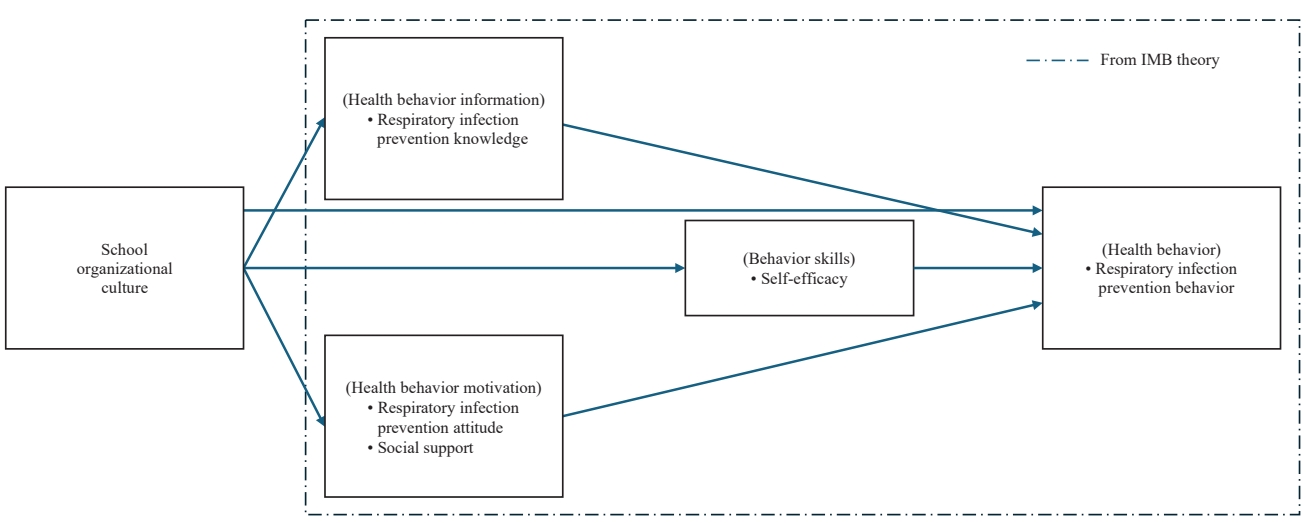
This study aimed to develop and test a structural equation model of respiratory infection prevention behaviors among elementary school teachers based on the Information–Motivation–Behavioral Skills model.
Methods
This study included 250 teachers who were currently working in elementary schools and had experience as homeroom teachers. Data were collected from December 18 to December 31, 2023 using self-reported questionnaires. The proposed model included school organizational culture as the exogenous variable and respiratory infection prevention knowledge, respiratory infection prevention attitude, social support, self-efficacy, and respiratory infection prevention behavior as endogenous variables. Data were analyzed using IBM SPSS for Windows ver. 24.0 and Smart PLS ver. 4.1.
Results
Of the 19 hypothesized paths in the research model, five were statistically significant. School organizational culture had a significant direct effect on respiratory infection prevention knowledge (β=.20, p=.041), social support had a significant direct effect on self-efficacy (β=.33, p=.001), and self-efficacy had a significant direct effect on respiratory infection prevention behaviors (β=.22, p=.021). Respiratory infection prevention attitude (direct: β=.23, p=.029; total: β=.26, p=.008) and school organizational culture (direct: β=.22, p=.017; total: β=.30, p=.002) had significant direct and total effects on respiratory infection prevention behaviors.
Conclusion
To enhance respiratory infection prevention behaviors among elementary school teachers, interventions should focus on strengthening positive attitudes toward infection prevention and improving self-efficacy. Organizational-level strategies, including establishing supportive school organizational cultures, promoting peer support among teachers, and sharing infection prevention practices within schools, are also needed to facilitate and sustain preventive behaviors.
- 1,157 View
- 119 Download

 First
First Prev
Prev


