
 Submit an article

Search
- Page Path
- HOME > Search
Research Papers
- Experiences of nurses working as physician assistants under the expanded scope-of-practice policy following the 2024 resignation of medical residents in South Korea: a phenomenological study
- Tae Yeong Yang, Myung Jin Jang, NaHyun Lee
- J Korean Acad Nurs 2026;56(2):220-232. Published online May 14, 2026
- DOI: https://doi.org/10.4040/jkan.26001
-
 Abstract
 PDF
PDF ePub
ePub - Purpose
This study aimed to explore the lived experiences of clinical support nurses under the expanded scope-of-practice policy implemented after the mass resignation of medical residents in Korea in 2024. In Korea, these nurses are often referred to as physician assistant (PA) nurses, although they differ from licensed physician assistants or nurse practitioners in the United States. The study sought to understand how the policy was perceived, implemented, and interpreted by nurses who played a key role in maintaining clinical services during a healthcare workforce crisis.
Methods
A qualitative phenomenological design based on Colaizzi’s method was used. Fourteen clinical support nurses from a tertiary hospital in Seoul participated in in-depth, semi-structured interviews conducted between August and December 2025. The interviews were transcribed verbatim and analyzed through iterative reading, extraction of significant statements, formulation of meanings, and thematic integration. Trustworthiness was established using the criteria of credibility, dependability, transferability, and confirmability.
Results
Four essential themes were identified: (1) multifaceted perceptions of the 98-item expanded scope-of-practice policy; (2) gaps in the current education system and demands for structured training; (3) ambivalent experiences during policy implementation; and (4) conditional acceptance of the policy’s sustainability and calls for improvement. Participants reported increased professional recognition and autonomy while also experiencing ambiguity in role boundaries, concerns about legal accountability, and emotional burden related to insufficient preparation and protection.
Conclusion
The expanded scope-of-practice policy both strengthens professional competence and creates role instability among clinical support nurses. Its sustainable implementation requires clear legal protection, standardized education and certification systems, appropriate compensation, and the active involvement of frontline nurses in policy development. -
Citations
Citations to this article as recorded by
- The Tertiary Hospital Restructuring Project in South Korea: A Reflexive Thematic Analysis of Hospital Directors’ Perspectives on Barriers and Policy Recommendations
Hooyeon Lee, Ji Eun Kim, Kyungin Lee, Dong Jun Kim, Kwangmo Yang, Kyounga Lee, Myung-Il Hahm
Healthcare.2026; 14(16): 2469. CrossRef
- The Tertiary Hospital Restructuring Project in South Korea: A Reflexive Thematic Analysis of Hospital Directors’ Perspectives on Barriers and Policy Recommendations
- 1,796 View
- 204 Download
- 1 Web of Science
- 1 Crossref

- Experiences of work performance among physician assistant nurses during the period of healthcare disruption in South Korea: a qualitative content analysis
- Juyoung Ha, Minji Kim
- J Korean Acad Nurs 2026;56(1):98-107. Published online February 24, 2026
- DOI: https://doi.org/10.4040/jkan.25133
-
Abstract
PDFePub
- Purpose
This study aimed to explore the work experiences of physician assistant (dedicated nurses in Korea) during the medical service gap caused by physician–government conflicts.
Methods
A qualitative design employing individual in-depth interviews was used. Data were collected from July 18 to August 13, 2025. Fifteen nurses who worked as physician assistant 5 during the healthcare service gap participated in the study. Participants were categorized as follows: (1) nurses in the role before the period of healthcare disruption, (2) those who voluntarily applied after the period of healthcare disruption, and (3) those involuntarily assigned during the period of healthcare disruption. Data were analyzed using conventional content analysis.
Results
Three categories with six subcategories were identified: (1) reconstructing inner experience within an expanded role (unprepared responsibility and burden, inner fulfillment discovered through continuity of care); (2) reconfiguring relationships from a boundary position (feeling distant as “the same yet different” nurses, expansion of mutual understanding in a crisis context); and (3) precarious positioning within an unestablished system (uncertain standing after residents’ return, episodic implementation of non-standardized training).
Conclusion
This study showed that physician assistant who filled residents’ gaps in an incomplete system experienced heavier role burdens, blurred job identity, unequal conditions, and unstable affiliation, while some also found renewed meaning and fulfillment through continuity of care and closer collaboration. With structured education, clearly defined scopes of practice after residents’ return, and stable legal and organizational support, these nurses can function as more than temporary substitutes and help sustain continuity and quality of patient care. -
Citations
Citations to this article as recorded by- The Tertiary Hospital Restructuring Project in South Korea: A Reflexive Thematic Analysis of Hospital Directors’ Perspectives on Barriers and Policy Recommendations
Hooyeon Lee, Ji Eun Kim, Kyungin Lee, Dong Jun Kim, Kwangmo Yang, Kyounga Lee, Myung-Il Hahm
Healthcare.2026; 14(16): 2469. CrossRef
- The Tertiary Hospital Restructuring Project in South Korea: A Reflexive Thematic Analysis of Hospital Directors’ Perspectives on Barriers and Policy Recommendations
- 2,625 View
- 367 Download
- 1 Web of Science
- 1 Crossref
- The Mediating Role of Psychological Resilience in Chinese Nursing Students’ Professional Identity and Learning Burnout
- Liu Zhang, Qin Zhang, ShuWen Li, YuHong Li, GuoCui Wu, Ying Chen, YunNa Zhou
- J Korean Acad Nurs 2024;54(4):509-518. Published online November 25, 2024
- DOI: https://doi.org/10.4040/jkan.24044
-
Abstract
PDFePub
Purpose This study investigated whether professional identity predicts learning burnout among Chinese nursing students, and whether resilience moderates this relationship.
Methods This cross-sectional study recruited 635 students from a nursing college at a medical university in Hefei, China. Data were collected using the professional identity questionnaire, learning burnout scale for college students, and 10-item Connor-Davidson Resilience Scale. Pearson’s correlation analysis was used to investigate the relationships between variables. The mediation effect was evaluated using linear regression and the bootstrap method in SPSS.
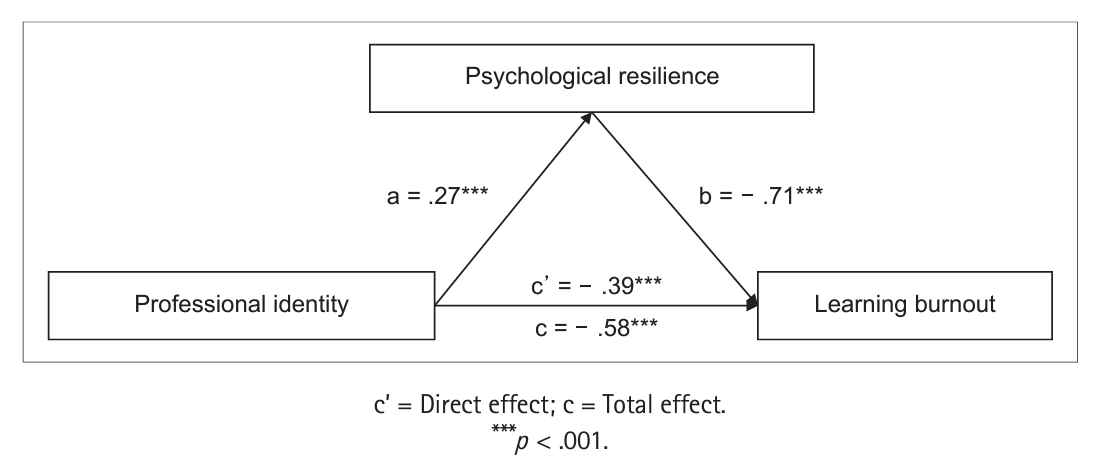
Results Nursing students exhibited intermediate learning burnout levels (score: 54.95 ± 10.42). Professional identity was positively correlated with psychological resilience (r = .42,
p < . 001), whereas learning burnout was negatively correlated with professional identity (r = - .54,p < . 001) and psychological resilience (r = - .57,p < . 001). Psychological resilience mediated the relationship between professional identity and learning burntout to the tune of 32.8%.Conclusion Psychological resilience mediates the relationship between professional identity and learning burnout. Thus, nursing educators can mitigate student burnout by developing their students' professional identities and psychological resilience.
-
Citations
Citations to this article as recorded by- The mediating role of sleep quality in the relationship between professional identity and anxiety symptoms among emergency nurses: a cross-sectional study
Siyu Cao, Hong Li, Tao Cheng
Frontiers in Public Health.2026;[Epub] CrossRef - How can I face death? Exploring the role of resilience in shaping nursing students’ meaning in life, professional identity and coping skills
Xuancheng Chen, Linan Cheng, Xiaoyan Guo, Yuhua Xie, Yangyi Cheng
Journal of Health Psychology.2026;[Epub] CrossRef - A phenomenological study on psychological resilience among medical vocational college freshmen
Zhefu Zhang, Chunxiao Xu, Lipin Ye, Yue Yang, Ying Mao, Wan Cheng, Qiyuan Huang
Frontiers in Psychiatry.2026;[Epub] CrossRef - Psychological resilience, metacognition, post-traumatic growth, and rumination among undergraduate nursing interns: A cross-sectional study
Hui Jiang, Xiangqi Xu, Yushang Li, Jingwen Zhang, Baojian Wei
International Journal of Nursing Studies Advances.2026; 10: 100561. CrossRef - Professional Identity and Career Planning of Nursing Students in the First Year: The Mediating Role of Willing Acceptance and Striving Based on Social Cognitive Career Theory
Rong Wu, Linyu Zhou, Nianfei Tang, Fangyi Li, Huiru Zeng, Ao Tang, Biao He, Xiaoju Chen, Harleen Khatra
Nursing Forum.2026;[Epub] CrossRef - The impact of creative anxiety on professional identity among master’s nursing students: a chain mediation effect of psychological resilience and achievement motivation
Yao Ding, Xiaolan Guo, Ruifeng Wang, Lu Xu, Shajie Hou, Fengjiao Chang
BMC Nursing.2025;[Epub] CrossRef - Sense of Coherence and Perceived Academic Stress Among Nursing Students: A Multicenter Cross-Sectional Study
David Ballester-Ferrando, Esther Cáceres-Malagelada, Carolina Rascón-Hernán, Teresa Botigué, Ana Lavedán, Olga Masot, Dolors Burjalés, Luis González-Osorio, Ximena Osorio-Spuler, Eva Serrat-Graboleda, Concepció Fuentes-Pumarola
Nursing Reports.2025; 15(8): 288. CrossRef
- The mediating role of sleep quality in the relationship between professional identity and anxiety symptoms among emergency nurses: a cross-sectional study
- 7,865 View
- 247 Download
- 7 Web of Science
- 7 Crossref
Original Article
- Role Transition from Clinical Nurse to Case Manager for Medical-aid Beneficiaries: Taking Root in a Barren Land
- Eun-Jun Park, Chunmi Kim, Seung Joo Lim
- J Korean Acad Nurs 2012;42(2):149-160. Published online April 30, 2012
- DOI: https://doi.org/10.4040/jkan.2012.42.2.149
-
Abstract
PDF
Purpose The purpose of this study was to explain the role transition process to nurse case managers (NCMs) for Medical-aid beneficiaries in Korea.
Methods Fourteen NCMs were interviewed regarding their experiences of becoming proficient in the new role of case manger. Data were analyzed through the application of grounded theory.
Results 'Taking root in a barren land' was the core category explaining the role transition process of NCMs. They engaged in four stages: launching, trial and error, proficiency, and wait-and-see stages. NCMs showed not only fear but also passion for case management practice. Despite their passion and effort, NCMs went through a period of trial and error. After becoming skilled, NCMs went through a stage of wait-and-see often because of job insecurity related to temporary position or few opportunities for promotion. Factors influencing NCMs' role transition process included their understanding of client characteristics, belief in case management, and support from their colleagues and families.
Conclusion NCMs experience many challenges in the process of becoming proficient NCMs. To help with their role transition, there is a need for education programs, preceptorship programs, research on their roles and functions, and regulation for securing NCMs' employment and career stability.
-
Citations
Citations to this article as recorded by- Experience of Clinical Adaptation among Nurses in Intensive Care Unit
Jin Young Hong, Sue Kyung Sohn
Journal of Korean Critical Care Nursing.2024; 17(1): 1. CrossRef - Perceived barriers to implementing case management for medical‐aid beneficiaries in South Korea
Jeonghyun Cho, Chongwon Park, Jinah Lee, Jiyoung Park
Health & Social Care in the Community.2022; 30(1): 372. CrossRef - Effects of Medicaid Case Manager's Communication Competence and Stress on Their Job Satisfaction
Seung Joo Lim
Journal of Korean Academy of Community Health Nursing.2019; 30(2): 195. CrossRef - Case management effectiveness for managing chronic illnesses in Korea: a systematic review
J.Y. Joo, M.F. Liu
International Nursing Review.2019; 66(1): 30. CrossRef - Experience of Hospital Administrative Nurses' Work Adjustment
Hyun-Ju Lee, Jae-Hyun Ha, Yun-Seo Jung, Jungmi Yun
Journal of Korean Academy of Nursing Administration.2019; 25(5): 424. CrossRef - The Coping Experience of Nursing Students in Clinical Practice: Trying to be a Meaningful Presence
Doo Nam Oh, Young-Rhan Um, Chunmi Kim, Sejin Ju, Jung Hyun Choi, Myung Sook Park
The Journal of Korean Academic Society of Nursing Education.2016; 22(4): 430. CrossRef
- Experience of Clinical Adaptation among Nurses in Intensive Care Unit
- 1,703 View
- 2 Download
- 6 Crossref
 First
First Prev
Prev


