
 Submit an article

Search
- Page Path
- HOME > Search
Research Paper
- Usefulness of Charlson comorbidity index-adjusted mortality prediction tools and factors influencing mortality in intensive care unit patients: a retrospective medical record review–based study
- Jai Jung Lee, Dong Yeon Kim, Min Ji Lee, Ji Young Kim
- J Korean Acad Nurs 2026;56(1):27-38. Published online February 11, 2026
- DOI: https://doi.org/10.4040/jkan.25094
-
 Abstract
 PDF
PDF ePub
ePub - Purpose
This study aimed to estimate the mortality rate in adult intensive care units (ICUs) using the Charlson comorbidity index (CCI)-adjusted Acute Physiology and Chronic Health Evaluation (APACHE) II and Simplified Acute Physiology Score (SAPS) III models, and to identify factors influencing mortality.
Methods
This retrospective cohort study included adult patients admitted to the ICU at a tertiary hospital between June 1 and August 31, 2022. Among the 1,098 screened patients, those younger than 18 years, those discharged within 48 hours, and those with missing medical records were excluded. In total, 482 patients were analyzed using the chi-square test, independent t-test, and multivariate logistic regression. Model performance was evaluated using the c-statistic and the Hosmer-Lemeshow goodness-of-fit test.
Results
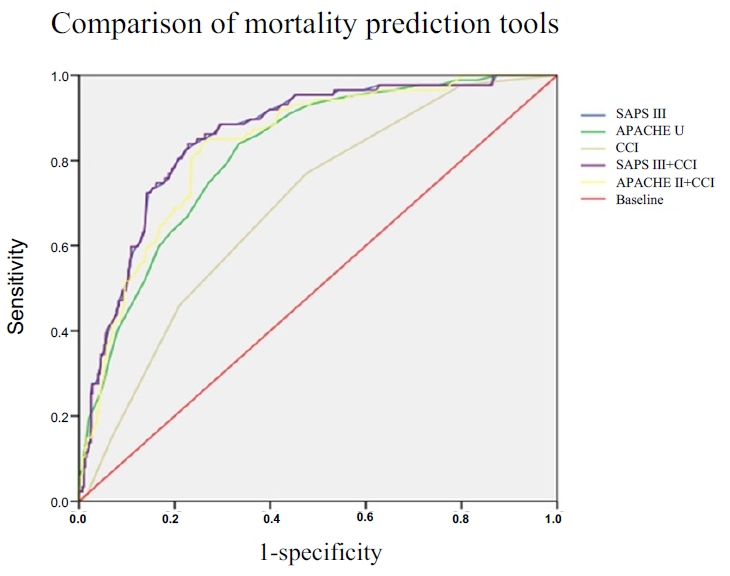
The predictive accuracy of the mortality models was shown by c-statistic values of 0.817 for APACHE II, 0.857 for SAPS III, 0.697 for CCI, and 0.834 for CCI-adjusted APACHE II (0.834). Mechanical ventilation, cardiopulmonary cerebral resuscitation, continuous renal replacement therapy, and the presence of leukemia or lymphoma were significant predictors of mortality in adult ICU patients. Among the evaluated models, SAPS III and CCI-adjusted APACHE II demonstrated the highest predictive power.
Conclusion
The findings indicate that incorporating comorbidity indices such as the CCI with acute physiological parameters improves the accuracy of mortality prediction in ICU patients. Understanding mortality prediction models is essential for nurses to provide individualized, evidence-based, and high-quality care in adult ICUs.
- 3,546 View
- 277 Download

Original Article
- An Analysis of Requisite Knowledge Body of Physiology for Clinical Nursing Practices
- Wha Sook Seo, Young Whee Lee
- Journal of Korean Academy of Nursing 1999;29(3):711-720. Published online March 29, 2017
- DOI: https://doi.org/10.4040/jkan.1999.29.3.711
-
Abstract
PDF
The purpose of this study was to define the content of physiological knowledge needed for clinical nursing practices. Subjects of physiology were classified into 15 areas, and each area was further classified into subareas, resulting in a total of 194 subareas. The degree of importance of each subarea was measured with a 4-point scale. The subjects of this study were 179 nurses of two university hospitals located in Seoul and Inchon. The results were as follows: 1. The areas of physiology necessary for clinical nursing practice as a basic knowledge in the order of importance were : blood, respiratory system and renal physiology , function of the immune system, body fluid and cardiovascular system, body temperature, endocrine physiology and gastrointestinal physiology. However, the degree of importance for reproductive physiology, neurophysiology, energy and metabolism, cell and cell membrane physiology, muscular physiology and special sense was relatively low. 2. The most important content of physiology for all clinical areas in nursing was blood physiology. However, the degree of importance for each physiology area was different depending on clinical areas. 3. Subareas of physiology as a basic knowledge for clinical practice and education in nursing were blood transfusion, blood type, function of red blood cell, white blood cell and platelet, characteristics and function of hemoglobin, composition and function of hemoglobin, composition and function of plasma protein, and mechanism and function of plasma protein, and mechanism of blood coagulation and anticoagulation. In conclusion, areas of physiology necessary for clinical nursing practice were blood, respiratory system and renal physiology, function of immune, body fluid and cardiovascular system, body temperature, endocrine physiology and gastrointestinal physiology. However, the degree of importance for each physiology area was different depending on clinical areas in nursing.
-
Citations
Citations to this article as recorded by
- A Coorientation Analysis of Perception on Bionursing between Clinical Nurses and Nursing Professors
Myoung-Ae Choe, Gyeong-Ju An, Jae-Sim Jeong
Journal of Korean Biological Nursing Science.2012; 14(3): 212. CrossRef
- A Coorientation Analysis of Perception on Bionursing between Clinical Nurses and Nursing Professors
- 1,297 View
- 1 Download
- 1 Crossref
 First
First Prev
Prev


