
 Submit an article

Search
- Page Path
- HOME > Search
Research Papers
- Illness experience of head and neck cancer patients: an interpretative phenomenological analysis
- Min Ryu, Suhye Kwon
- J Korean Acad Nurs 2026;56(3):408-420. Published online August 18, 2026
- DOI: https://doi.org/10.4040/jkan.26027
-
 Abstract
 PDF
PDF ePub
ePub - Purpose
Head and neck cancer is frequently diagnosed at an advanced stage and is associated with substantial mortality. Patients also experience major physical limitations and psychosocial distress. This study explored the subjective meaning of illness experiences among patients with head and neck cancer using interpretative phenomenological analysis (IPA).
Methods
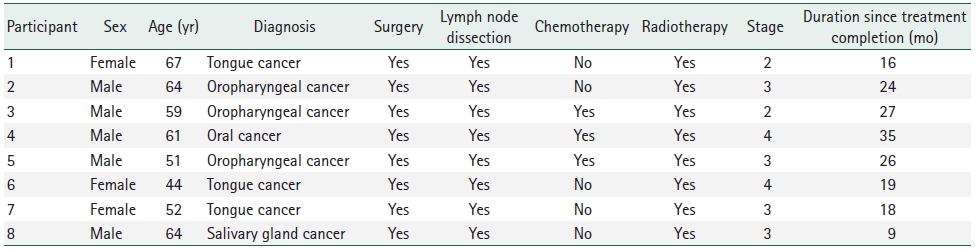
This qualitative study used IPA to examine the experiences of eight adults with stage II–IV head and neck cancer recruited from two university hospitals. All participants had undergone surgery followed by radiotherapy or chemoradiotherapy at least 6 months before data collection. Data were collected through in-depth interviews conducted from February to June 2022 and were analyzed using the cyclical IPA procedure.
Results
Four superordinate themes were identified: (1) being overwhelmed by lamentation and fear when confronting a late-diagnosed illness; (2) confronting human limitations during treatment undertaken for survival; (3) losing daily life and selfhood while living in a body that had not recovered; and (4) reconstructing life beyond the fear of recurrence. Participants experienced diagnosis and treatment as traumatic and described persistent functional impairments and painful sequelae.
Conclusion
These findings provide an in-depth understanding of the illness experiences of patients with head and neck cancer and offer evidence to inform nursing interventions that support adaptation and quality of life.
- 722 View
- 39 Download

- Factors Affecting the Intention to Use Smartmonitor-Based Mobile Health in Middle-Aged in Patients Applying the Technology Acceptance Model II
- Ol Eum Joo, Yi Kyung Ha
- J Korean Acad Nurs 2024;54(4):620-632. Published online November 13, 2024
- DOI: https://doi.org/10.4040/jkan.24091
-
Abstract
PDFePub
Purpose This study aimed to identify factors that influence the intention to use smart monitor-based mobile health (SBM) technology among middle-aged inpatients, based on the technology acceptance model II (TAM II).
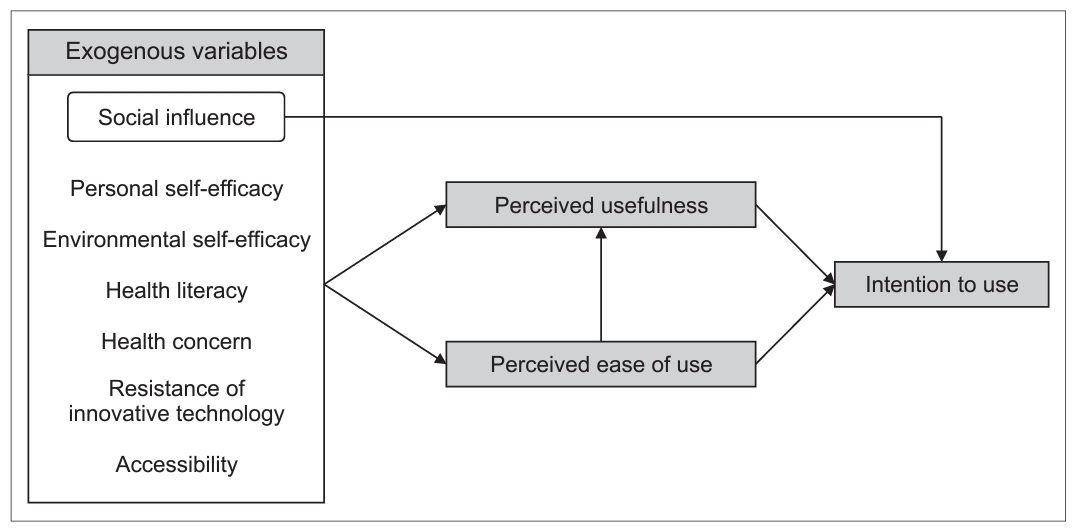
Methods A total of 222 participants were surveyed. Data were analyzed using SPSS Statistics 23.0 and IBM SPSS Amos 23. Seven exogenous variables–social influence (SI), personal self-efficacy, (PSE), environmental self-efficacy (ESE), health literacy, health concerns, resistance to innovative technology (RIT), accessibility (AC)– and three endogenous variables–perceived ease of use (PEOU), perceived usability (PU), and intention to use (ITU)–were investigated.
Results The hypothesized path model demonstrated a good fit for the data. SI (β = .13,
p = .042), PU (β = .46,p < .001), and PEOU (β = .16,p = .008) had significant direct effects on the ITU, which explained 39.5% of the variance. Additionally, SI (β = .27,p < .001), ESE (β = .16,p = .010), RIT (β = - .12,p = .026), AC (β = .28,p < .001), and PEOU (β = .20,p = .001) indirectly affected ITU through PU, which explained 50.7% of the variance. Furthermore, PSE (β = .38,p < .001) indirectly influenced ITU via PEOU, which explained 38.4% of the variance.Conclusion This study demonstrates that the TAM II can be used to effectively predict ITU in SBMs among middle-aged inpatients. To expand the intention to use SBMs, it is necessary to develop SBMs that include content and programs that promote PU, SI, and PEOU.
-
Citations
Citations to this article as recorded by
- Research on the implementation path of digital-intelligent healthcare based on the TAM model from the perspective of high-quality development
Zijue Qi, Huize Han, Yidayetula Abuduaini, Aikeda Litipu, Jun Li
BMC Health Services Research.2026;[Epub] CrossRef
- Research on the implementation path of digital-intelligent healthcare based on the TAM model from the perspective of high-quality development
- 2,938 View
- 122 Download
- 1 Web of Science
- 1 Crossref
- The Effects of a Self-Efficacy Theory-Based Exercise Program for Patients Undergoing with Total Knee Arthroplasty
- Kyung-Hye Park, Hee-Young Kang
- J Korean Acad Nurs 2024;54(4):547-562. Published online October 22, 2024
- DOI: https://doi.org/10.4040/jkan.24027
-
Abstract
PDF
 Supplementary MaterialePub
 Purpose This study was performed to develop a self-efficacy theory-based exercise program for total knee arthroplasty (TKA) and to test the program’s efficacy in ameliorating knee pain and restoring function as measured by lower extremity muscle strength, 3 meter walking time, Korean Western Ontario McMaster Index (WOMAC), exercise self-efficacy, and length of hospital stay for TKA patients.
Methods This quasi-experimental study incorporating a non-equivalent control group and pretest-posttest non-synchronized design non-synchronous design was applied to assess self-efficacy reinforcement strategies based on self-efficacy theory. The exercise program consisted of the following steps: TKA, education to prevent postoperative complications, and muscle strength exercises. Respective exercise and control groups included 29 and 27 participants. The experimental group received eight sessions of the program from three weeks before TKA to four weeks after TKA. Collected data were analyzed using the chi-square test, Mann–Whitney U test, and ranked ANCOVA and t-tests using IBM SPSS Statistics 23.
Results Experimental group showed significant improvement in lower extremity muscle strength (F = 8.63,
p = .005), 3 meter walking time (z = - 5.02,p < .001), WOMAC index (z = - 2.22,p = .027), self-efficacy for exercise (z = - 3.29,p = .001), and length of hospital stay (t = - 2.11,p = .040) compared to the control group. No significant differences in knee pain and range of motion were observed.Conclusion These findings indicate that a self-efficacy theory-based exercise program can be an effective exercise strategy that patients undergoing TKA can easily follow at home without assistance. It is thus recommended as an exercise intervention for TKA patients.
-
Citations
Citations to this article as recorded by- Self-efficacy and implementation intentions in home rehabilitation of stroke patients: the parallel mediating role of recurrence risk perception and outcome expectations
Xiaowen Jiang, Qiuxue Sun, Rong Tang, Shuxian Liu, Xi Chen, Yumei Lv
Frontiers in Psychology.2025;[Epub] CrossRef - Factors Influencing Decision-Making and Rehabilitation Among Older Women Who Underwent Total Knee Replacement: A Qualitative Study in Taiwan
Ching Han Huang, Yun Yee Chen, Shu Wen Chen, Chen Ti Wang, Mei Hsiang Lin
Patient Preference and Adherence.2025; Volume 19: 3931. CrossRef
- Self-efficacy and implementation intentions in home rehabilitation of stroke patients: the parallel mediating role of recurrence risk perception and outcome expectations
- 5,449 View
- 399 Download
- 2 Web of Science
- 2 Crossref
- Psychometric Properties of the Fall Risk Perception Questionnaire-Short Version for Inpatients in Acute Care Hospitals
- Jeeeun Choi, Sujin Lee, Eunjin Park, Sangha Ku, Sunhwa Kim, Wonhye Yu, Eunmi Jeong, Sukhee Park, Yusun Park, Hye Young Kim, Sung Reul Kim
- J Korean Acad Nurs 2024;54(2):151-161. Published online May 31, 2024
- DOI: https://doi.org/10.4040/jkan.23127
-
Abstract
PDF
- Purpose
Patients’ perception of fall risk is a promising new indicator for fall prevention. Therefore, a fall risk perception questionnaire that can be used rapidly and repeatedly in acute care settings is required. This study aimed to develop a short version of the fall risk perception questionnaire (Short-FRPQ) for inpatients.
Methods
For the psychometric measurements, 246 inpatients were recruited from an acute care hospital. The construct (using confirmatory factor analysis and discriminant validity of each item), convergent, and known-group validities were tested to determine the validity of the Short-FRPQ. McDonald’s omega coefficient was used to examine the internal consistency of reliability.
Results
In the confirmatory factor analysis, the fit indices of the Short-FRPQ, comprising 14 items and three factors, appeared to be satisfactory. The Short-FRPQ had a significantly positive correlation with the original scale, the Korean Falls Efficacy Scale-International, and the Morse Fall Scale. The risk of falls group, assessed using the Morse Fall Scale, had a higher score on the Short-FRPQ. McDonald’s omega coefficient was .90.
Conclusion
The Short-FRPQ presents good reliability and validity. As patient participation is essential in fall interventions, evaluating the fall risk perception of inpatients quickly and repeatedly using scales of acceptable validity and reliability is necessary. -
Citations
Citations to this article as recorded by- Gyógytornász-fizioterapeuták időskori eleséssel kapcsolatos tudásának, attitűdjének és gyakorlatának felmérésére szolgáló kérdőív kifejlesztése és validálása
András Simon, Anna Zsófia Kubik, Edit Boros, Richárdné Mayer, Éva Kovács
Orvosi Hetilap.2026; 167(21): 811. CrossRef
- Gyógytornász-fizioterapeuták időskori eleséssel kapcsolatos tudásának, attitűdjének és gyakorlatának felmérésére szolgáló kérdőív kifejlesztése és validálása
- 5,246 View
- 209 Download
- 1 Web of Science
- 1 Crossref
- The Development of a Tool for Assessment of Spiritual Distress in Cancer Patients
- Jin Sook Kim, Il-Sun Ko, Su Jin Koh
- J Korean Acad Nurs 2022;52(1):52-65. Published online February 28, 2022
- DOI: https://doi.org/10.4040/jkan.21120
-
Abstract
PDF
- Purpose
This study was conducted to develop a scale to measure spiritual distress in cancer patients.
Methods
A total of 69 preliminary items for the spiritaul distress assessment tool (SDAT) were compiled, based on a literature review, selection of empirically relevant items through concept analysis of hybrid models, confirmation of content validity by experts, cognitive interviews, and a pretest. Self-administered questionnaires were collected between April 1 and July 31, 2018, from 225 cancer patients at four medical institutions and one nursing home. The data were analyzed using item analysis, exploratory factor analysis, convergent and discriminant validity, and Pearson correlation for criterion validity. Reliability was tested by Cronbash’s α coefficient.
Results
The final version of the SDAT consisted of 20 items. Five-factors, loss of peace, burden of family, avoidance of confronting death, guilt and remorse, regret for not being able to apololgize and forgive were extracted, and showed 62.8% of total variance. The factors were confirmed through convergent and discriminant validity. Criterion validity was confirmed by functional assessment chronic illness therapy spiritual well-being scale 12 (FACIT-Sp12). The overall Cronbach’s α was .91, and the coefficients of each subscale ranged from .78~.83.
Conclusion
The SDAT for cancer patients is valid and reliable. It is suggested that the tool can be used to measure spiritual distress in cancer patients. -
Citations
Citations to this article as recorded by- Instruments for Assessing Spirituality in Patients with Chronic or Advanced Illnesses: A Systematic Review of the Last 15 Years
María Ángeles Portillo-Gil, Giancarlo Lucchetti, Rocío De Diego-Cordero
Healthcare.2026; 14(8): 1013. CrossRef - Development of a measurement of doctor-patient communication quality scale
Jiayi Shao, Minhui Wen, Yuqing Zhang, Liping Zhang, Jiangjie Sun
Frontiers in Public Health.2025;[Epub] CrossRef - Validity and reliability of the integrated palliative care outcome scale (IPOS) in Korea: a multicenter study of terminally ill cancer patients
So-Jung Park, Yujin Park, Mira Han, Sun-Hyun Kim, In Cheol Hwang, Go-un Woo, Yoo Jeong Lee, Young Sung Kim, Hyun Jung Jho, Yoon Jung Chang
BMC Palliative Care.2024;[Epub] CrossRef - Family caregivers’ perceived value of caring for older patient: A hybrid model of concept analysis
Seon-Hye Heo, Hye-Ryoung Kim
Journal of Korean Gerontological Nursing.2023; 25(2): 152. CrossRef - Spiritual Distress in Patients with Dyspnea: A Review of Measurement Tools
Leah McCann Klug
Illness, Crisis & Loss.2023; 31(4): 736. CrossRef
- Instruments for Assessing Spirituality in Patients with Chronic or Advanced Illnesses: A Systematic Review of the Last 15 Years
- 3,473 View
- 104 Download
- 3 Web of Science
- 5 Crossref
- Untact Visit Service Development Based on an Application Reflecting the Circumstances during COVID-19: Focusing on Utilization in the Pediatric Intensive Care Units
- Dahae Woo, Hanui Yu, Hyo Jin Kim, Minyoung Choi, Dong Hee Kim
- J Korean Acad Nurs 2021;51(5):573-584. Published online October 31, 2021
- DOI: https://doi.org/10.4040/jkan.21143
-
Abstract
PDF
- Purpose
This study aimed to develop an untact visit service based on an application that can be utilized in the pediatric intensive care unit (PICU) during COVID-19.
Methods
This study adopted the double diamond process of service design comprising the discovery, defining, and development stages.
Results
We developed an untact visit service based on an application that considered the child’s status, schedule, photo, and video messages, and so on. Moreover, we derived a service flow regarding the required roles and the type of flow shown between each stakeholder.
Conclusion
Considering the ongoing pandemic, the untact visit service is designed to increase rapport and participation of parents, share the child’s information in real-time, and provide one-stop service without increasing healthcare providers’ work. It will be a useful visit service that can be applied and evaluated in various hospital settings and the PICU. -
Citations
Citations to this article as recorded by- Effects of Video Visitation on Pain, Anxiety, Comfort, and Family Caregivers’ Anxiety in Intensive Care Unit Patients after Pulmonary Resection
Jimyeong Kim, Minyoung Kim
Journal of Korean Critical Care Nursing.2026; 19(1): 36. CrossRef - Factors affecting pediatric nurses’ development of partnerships with parents of hospitalized children: An evaluation based on the stress-coping adaptation model
In Young Cho, So Hyoung Hong, Ji Yeong Yun
Journal of Child Health Care.2025; 29(1): 53. CrossRef - Correlation between oral health knowledge, demand for remote education tools, and self-efficacy among parents of children and adolescents
Min-Ji Park, Herry Novrinda, Jae-Young Lee
Journal of Korean Society of Dental Hygiene.2025; 25(1): 69. CrossRef - Development and Effects of a Family-centered Care Application for Intensive Care Unit Families Based on the Facilitated Sensemaking Model : Focusing on Family Satisfaction, Family Stress, and Self-Efficacy
Yun Ha Oak, Eun Ha Kim
Journal of Korean Critical Care Nursing.2025; 18(2): 1. CrossRef - Experiences of Family Members With Visitation Prohibition for Critically Ill Patients
Sunjung Kim, Sunghee H. Tak
Western Journal of Nursing Research.2024; 46(11): 854. CrossRef - Factors influencing neonatal intensive care unit nurses' parent partnership development
Eun Kyoung Kim, In Young Cho, Ji Yeong Yun, Bobae Park
Journal of Pediatric Nursing.2023; 68: e27. CrossRef - National Petition Analysis Related to Nursing: Text Network Analysis and Topic Modeling
HyunJung Ko, Seok Hee Jeong, Eun Jee Lee, Hee Sun Kim
Journal of Korean Academy of Nursing.2023; 53(6): 635. CrossRef - Relationship between parental stress and post‐traumatic stress disorder: The moderating effect of visitation restrictions in paediatric intensive care units during COVID‐19
Young Il Cho, Hyo Jin Kim, Dong Hee Kim
Nursing in Critical Care.2023; 28(5): 808. CrossRef - Need for Information and Communication Technology during COVID-19: An Exploratory Study Using Nurses’ Activity Diaries
Hyeongsuk Lee, Dongmin Lee, Seungmin Lee
Healthcare Informatics Research.2023; 29(3): 256. CrossRef - Effects of a Noncontact Visit Program in the NICU for the Prevention of COVID-19
Hye Young Ahn, Hee Jee Jo, Hyun Jeong Ko
Healthcare.2023; 11(15): 2152. CrossRef - The Development of Automated Personalized Self-Care (APSC) Program for Patients with Type 2 Diabetes Mellitus
Gaeun Park, Haejung Lee, Ah Reum Khang
Journal of Korean Academy of Nursing.2022; 52(5): 535. CrossRef
- Effects of Video Visitation on Pain, Anxiety, Comfort, and Family Caregivers’ Anxiety in Intensive Care Unit Patients after Pulmonary Resection
- 2,506 View
- 39 Download
- 8 Web of Science
- 11 Crossref
- A Concept Analysis of Quality Nursing Care
- I Gede Juanamasta, Yupin Aungsuroch, Joko Gunawan
- J Korean Acad Nurs 2021;51(4):430-441. Published online August 31, 2021
- DOI: https://doi.org/10.4040/jkan.21075
-
Abstract
PDF
- Purpose
This study aimed to perform a concept analysis of quality nursing care.
Methods
Walker and Avant’s concept analysis method was used to carry out this study.
Results
The defining attributes identified were as follows: caring, the nurse-patient relationship, and patient needs. Antecedents included patient characteristics, individual factors (age, education, knowledge, competence, and experience), job position, and environmental factors. The consequences of quality nursing care have significant influence on both patients and nurses.
Conclusion
The findings can aid researchers in obtaining a better understanding of quality nursing care, and stakeholders can consider the factors related to quality nursing care and its consequences to improve the nursing process. -
Citations
Citations to this article as recorded by- A QR code-based intervention to improve nursing documentation quality: a quasi-experimental study
Sajjad Shokri, Sepideh Mohammadi, Mojtaba Qanbari Qalehsari
BMC Nursing.2026;[Epub] CrossRef - A Cross-Cultural Adaptation and Psychometric Validation Study of the Good Nursing Care Scale for Nurses Among Indonesian Nurses
I. Gede Juanamasta, Rapin Polsook, Yupin Aungsuroch, Mary L. Fisher, Abdulkareem S. Iblasi, Bootan Ahmed, Joko Gunawan
Sage Open Nursing.2026;[Epub] CrossRef - The Relationship Between Nurses’ Perception of Family-Centered Care and the Quality of Nursing Care for Hospitalized Children
Sana Khalilzadeh Zia, Masoumeh Aghamohammadi, Nazila Vosoghi
Journal of Kerman University of Medical Sciences.2026; 33: 4212. CrossRef - CPD focus: importance of listening in developing therapeutic relationships
Sophie Louise Waters
Mental Health Practice.2025; 28(3): 37. CrossRef - Psychometric properties of the Chinese version of the quality of nursing care scale among hospital nurses: a bifactor exploratory structural equation modeling analysis
Chiu-Shu Fang, Cheng-Hsien Li, Shu-Ching Ma, Fang-Ming Hwang, Maria Manuela Martins, Fan-Hao Chou
BMC Nursing.2025;[Epub] CrossRef - Effects of high-quality nursing on surgical site wound infections after colostomy in patients with colorectal cancer
Yu Cheng, Yuan-Xing Chen
World Journal of Gastrointestinal Surgery.2024; 16(12): 3835. CrossRef - Emergency room nurses' caring ability and its relationship with patient safety outcomes: A cross-sectional study
Leodoro J. Labrague
International Emergency Nursing.2024; 72: 101389. CrossRef - Prevalence of burnout and its determinants among Indonesian nurses: a multicentre study
I. Gede Juanamasta, Yupin Aungsuroch, Joko Gunawan, Michael Joseph Dino, Rapin Polsook
Scientific Reports.2024;[Epub] CrossRef - Current trends and issues in quality care and patient safety: A discussion with ChatGPT
Joko Gunawan
Journal of Healthcare Administration.2023; 2(1): 1. CrossRef - The ethical principles and caring behavior of Indonesian nurses
Ilkafah Ilkafah, Anestasia Pangestu Mei Tyas, Rini Rachmawaty
Healthcare in Low-resource Settings.2023;[Epub] CrossRef - L’expérience des soins des personnes qui vivent une transplantation hépatique. Recherche phénoménologique descriptive au sein d’un hôpital académique belge
Ivo Manuel Mateus Alves, Chantal Cara, Thierry Gustot, Hélène Lefebvre, Dan Lecocq
Recherche en soins infirmiers.2023; N° 152(1): 42. CrossRef - Strategies and challenges in addressing ethical issues in the hospital context: A phenomenological study of nurse team leaders
Ni Made Nopita Wati, I Gede Juanamasta, Jutharat Thongsalab, Jintana Yunibhand
Belitung Nursing Journal.2023; 9(2): 139. CrossRef - Causal Modelling of Factors Influencing Quality of Nursing Care in China
Xiaolu Xue, Wipada Kunaviktikul, Kulwadee Abhicharttibutra, Orn-Anong Wichaikhum
Pacific Rim International Journal of Nursing Research.2023; 27(3): 417. CrossRef - Reliability and Validity of the Indonesian Version of the McCloskey/Mueller Satisfaction Scale
I. Gede Juanamasta, Yupin Aungsuroch, Mary L. Fisher, Nursalam, Jose Luis Santos
Journal of Nursing Management.2023; 2023: 1. CrossRef - The Therapeutic Nurse–Patient Relationship in Hemodialysis: A Pilot Mixed-Method Study on the Perceived Quality of Nurses’ Attitudes and Caring Behaviors
Claudia Camedda, Gloria Bici, Camilla Elena Magi, Alice Guzzon, Yari Longobucco
Nursing Reports.2023; 13(3): 990. CrossRef - Translation and validation study of the Indonesian version of the practice environment scale of the nursing work index
I Gede Juanamasta, Yupin Aungsuroch, Mary L. Fisher, Siluh Nyoman Alit Nuryani, Ni Nyoman Ayuningsih
International Journal of Nursing Sciences.2023; 10(4): 511. CrossRef - La qualità dell’assistenza infermieristica in ambito oncologico: protocollo di validazione dello strumento Quality of Oncology Nursing Care Scale (QONCS)
Ilaria Marcomini, Francesca Riboni, Maria Mallio, Mattia Bozzetti, Roberta Pendoni, Laura Milani
Dissertation Nursing.2023; 2(2): 138. CrossRef
- A QR code-based intervention to improve nursing documentation quality: a quasi-experimental study
- 12,457 View
- 496 Download
- 15 Web of Science
- 17 Crossref
- Motives for Empathy among Clinical Nurses in China: A Qualitative Study
- Yu Zhu, Ming-Mei He, Ji-Min Zhu, Li Huang, Bai-Kun Li
- J Korean Acad Nurs 2020;50(6):778-786. Published online December 31, 2020
- DOI: https://doi.org/10.4040/jkan.20123
-
Abstract
PDF
- Purpose
This study aimed to explore the motives of clinical nurses for experiencing empathy with patients and their families based on a self-determination theory framework.
Methods
Semi-structured face-to-face interviews with twenty-one nurses at four tertiary hospitals in Anhui, China, were conducted, recorded and transcribed. A content analysis with a directed approach was performed.
Results
An analysis of the interview transcripts revealed three categories of empathy motivation: autonomous motivation, controlled motivation and a lack of empathy motivation. Autonomous motivation included personal interests, enjoyment and a sense of value, pure altruism, assimilation, and recognition of the importance of empathy. Controlled motivation highlighted pressures from oneself and others, the possibility of tangible or intangible rewards, and avoidance of adverse effects. Finally, a lack of empathy motivation referred to a lack of intention for empathy and denial of the value of empathy.
Conclusion
This study provides a deep understanding of the motives underlying empathy in nurses. The results reveal the reasons for empathy and may support the development of effective strategies to foster and promote empathy in nurses. -
Citations
Citations to this article as recorded by- From the goodness of our hearts: a scoping review of qualitative literature on altruism as a reward mechanism for nursing
Jacqueline Christianson, Madaline McCarthy, Bonnie Sommers-Olson, Emily Horner, Norah Johnson
BMC Nursing.2026;[Epub] CrossRef - Reframing Burnout: Measuring “Altruistic Execution” to Understand Nurse Burnout
Jacqueline Christianson, Abir Bekhet, Jill Guttormson, Maharaj Singh, Norah L. Johnson
Western Journal of Nursing Research.2024; 46(11): 941. CrossRef - Perception and experience of altruism in graduate nursing students
Xinyu Gu, Yanxia Yang, Hao Gong, Luojing Zhou
Nursing Ethics.2023; 30(7-8): 1125. CrossRef
- From the goodness of our hearts: a scoping review of qualitative literature on altruism as a reward mechanism for nursing
- 2,410 View
- 19 Download
- 3 Web of Science
- 3 Crossref
Original Articles
- Effects of Oral Gargling with Aroma Solution in Psychiatric Inpatients: A Non-Randomized Controlled Trial
- Yun Ah Jung, Hee Sook Kim
- J Korean Acad Nurs 2020;50(2):200-209. Published online April 30, 2020
- DOI: https://doi.org/10.4040/jkan.2020.50.2.200
-
Abstract
PDF
- Purpose
The purpose of this study was to examine the effects of oral gargling with an aromatic solution on xerostomia, objective oral status, and oral health-related quality of life in psychiatric inpatients.
Methods
A nonequivalent control group with a non-synchronized design was used in this study. The experimental group (n=34) received oral gargling with an aroma solution, while the control group (n=33) gargled with 0.9% normal saline. Dependent variables were measured at pre-, post-, and follow-up test. Data were analyzed using an c2-test, Fisher’s exact probability test, t-tests, and repeated measures ANOVA using SPSS/WIN v.21.0.
Results
After the intervention, significant differences were revealed in xerostomia (F=15.30, p <.001), objective oral status (F=38.44, p <.001), and oral health-related quality of life (F=62.70, p <.001) with an interaction effect between group and time.
Conclusion
These findings indicate that gargling with an aroma solution is more effective than 0.9% normal saline for the oral health of psychiatric inpatients. Therefore gargling with an aroma can be safely recommended as a brief, economical, and positive intervention in clinical settings. -
Citations
Citations to this article as recorded by- Application of sugar-free cola solution based on the ICOCFAS score in oral care of non-artificial airway patients with severe neurological conditions
Qingmei Wang, Yuanyuan Fan, Mei Chen, Ping Chen
Frontiers in Medicine.2025;[Epub] CrossRef - The impact of aromatherapy-based oral care on oral conditions, salivary pH, and halitosis in older adults with dementia: Pilot study
Ae Kyung Chang, Bo kyoung Kim, Ah Young Kim
Geriatric Nursing.2023; 53: 109. CrossRef
- Application of sugar-free cola solution based on the ICOCFAS score in oral care of non-artificial airway patients with severe neurological conditions
- 2,223 View
- 24 Download
- 2 Web of Science
- 2 Crossref
- Development and Effect of a Fall Prevention Program Based on the King's Goal Attainment Theory for Fall High-Risk Elderly Patients in Long-Term Care Hospital
- Bom Mi Park, Ho Sihn Ryu, Kyeung Eun Kwon, Chun Young Lee
- J Korean Acad Nurs 2019;49(2):203-214. Published online April 30, 2019
- DOI: https://doi.org/10.4040/jkan.2019.49.2.203
-
Abstract
PDF
Purpose The purpose of this study to develop a fringed fall prevention program based on King's goal attainment theory and education. This study is applied to the personal, interpersonal, and social systems of fall high-risk patients to test its effects.
Methods This study was a nonequivalent control group pre- and post-test design. There were 52 fall high-risk patients in the experimental group and 45 in the control group. The experimental group received six sessions, with the group sessions lasting 60 minutes and the individual sessions lasting 20~30 minutes. Data were analyzed using descriptive statistics, an χ2-test, a paired sample t-test, and a Wilcoxon signed-ranks test utilizing IBM SPSS software.
Results For the 3-month intervention period, the fall prevention program was found to be particularly effective for patients in the experimental group (from 3.38 to 1.69 per 1000 patient days;
p =.044), as opposed to the control group (from 1.94 to 1.49 per 1000 patient days;p =.300). For the 6-month follow up period, the fall prevention program was again found to be effective for patients in the experimental group (from 3.26 to 0.76 per 1000 patient days;p =.049) compared to the control group (from 1.98 to 1.01 per 1000 patient days;p =.368).Conclusion These results indicate that the fringed fall prevention program is very effective in reducing falls, not only during the intervention period, but also after the intervention period has ended. We can therefore recommend this program for use concerning fall high-risk patients in long-term care hospitals.
-
Citations
Citations to this article as recorded by- THE ADOPTION RESEARCH OF TWO-STREAM CONVOLUTIONAL NEURAL NETWORK IN THE RECOGNITION OF FALLS IN THE ELDERLY HEALTHY
SHUANGSHUANG CHEN
Journal of Mechanics in Medicine and Biology.2026;[Epub] CrossRef - Development of an immersive fall management program for nursing students: A usability study
Mi Ok Song, So Young Yun, Domna Banakou
PLOS One.2026; 21(8): e0357026. CrossRef - Recent advances in the identification of related factors and preventive strategies of hip fracture
Yaohui Yu, Yudan Wang, Xiaoli Hou, Faming Tian
Frontiers in Public Health.2023;[Epub] CrossRef - Falls in Patients of Medical Institutions in South Korea: A Literature Review
Jongwon Choi, Woochol Joseph Choi
Physical Therapy Korea.2023; 30(1): 1. CrossRef - Effects of a Fall Prevention Program Based on Goal Attainment Theory for Homebound Older Adults With Osteoarthritis of the Lower Extremities
Chunhee Lee, Heeok Park
Orthopaedic Nursing.2022; 41(6): 414. CrossRef - Effects of Nurse-Led Intervention Programs Based on Goal Attainment Theory: A Systematic Review and Meta-Analysis
Bom-Mi Park
Healthcare.2021; 9(6): 699. CrossRef - EFFECTIVENESS OF EDUCATIONAL INTERVENTIONS FOR FALL PREVENTION: A SYSTEMATIC REVIEW
Maria Aline Moreira Ximenes, Maria Girlane Sousa Albuquerque Brandão, Thiago Moura de Araújo, Nelson Miguel Galindo Neto, Lívia Moreira Barros, Joselany Áfio Caetano
Texto & Contexto - Enfermagem.2021;[Epub] CrossRef - Application Value of Rehabilitation Nursing in Patients with Stroke Based on the Theory of Interactive Standard: A Randomized Controlled Study
Ningning Li, Jun Wang, Mei Zheng, Qunying Ge, Mozaniel Oliveira
Evidence-Based Complementary and Alternative Medicine.2021; 2021: 1. CrossRef - A prospective cohort study of the risk factors for new falls and fragility fractures in self-caring elderly patients aged 80 years and over
Jian Zhou, Bo Liu, Ming-Zhao Qin, Jin-Ping Liu
BMC Geriatrics.2021;[Epub] CrossRef - Development and Effect of a Fall Prevention Program Based on King’s Theory of Goal Attainment in Long-Term Care Hospitals: An Experimental Study
Bom-Mi Park
Healthcare.2021; 9(6): 715. CrossRef - Development of Fall Inducement System based on Pedestrian Biological Data for Fall Reproduction
Jong-il Lee, Jong-Boo Han, Jae Wan Koo, Seokjae Lee, Dong-Seop Sohn, Kap-Ho Seo
Journal of Korea Robotics Society.2020; 15(3): 286. CrossRef
- THE ADOPTION RESEARCH OF TWO-STREAM CONVOLUTIONAL NEURAL NETWORK IN THE RECOGNITION OF FALLS IN THE ELDERLY HEALTHY
- 4,568 View
- 176 Download
- 8 Web of Science
- 11 Crossref
- Development of the Patient Caring Communication Scale
- Myoung Lyun Heo, Sook Bin Im
- J Korean Acad Nurs 2019;49(1):80-91. Published online February 28, 2019
- DOI: https://doi.org/10.4040/jkan.2019.49.1.80
-
Abstract
PDF
Purpose This study attempted to develop a scale that measures the level of patients' recognition of the nurses' care, based on Watson's caring theory, and confirmed its reliability and validity.
Methods The items were developed through a literature review and an expert content validity test. The questionnaires were administered to 285 inpatients of internal medicine and surgical units at two general hospitals. Construct validity was tested using exploratory and confirmatory factor analysis, and reliability was tested using Cronbach's alpha.
Results This process resulted in a preliminary scale composed of 34 items; We used item analysis and five exploratory factor analyses, and consequently selected 14 items composed of three factors (respect, genuineness, and relationality). The confirmatory factor analysis verified the model fit and convergent and discriminant validity of the final items; criterion validity was confirmed with the positive correlation with the measurement scale of the patient-perceived quality of nursing . The overall scale reliability had a Cronbach's alpha of .92, which indicated internal consistency and reliability.
Conclusion The developed scale showed content, construct, and criterion validity, and reliability, as well as convergent validity for each item and discriminant validity between the factors. This makes it suitable for use in a diverse range of future studies on nurse communication using structural equation models.
-
Citations
Citations to this article as recorded by- Digital Leadership Scale for Clinical Nurses: Development and Validation of an Instrument
Ji-Hyeon Lee, Sun-Young Jung
JMIR Nursing.2026; 9: e82101. CrossRef - Development of the Caring Competence Scale for Family Caregivers of Persons With Mental Disorders
Won Hee Jun
Journal of Psychiatric and Mental Health Nursing.2025; 32(5): 1248. CrossRef - Development and Validation of the Therapeutic Communication Scale in Nursing Students
Soolgi Han, Jinhee Yoo, Kyonghwa Kang
Healthcare.2024; 12(3): 394. CrossRef - A structural model of nursing students’ performing communication skills
Cho Rong Gil, Kyung Mi Sung
The Journal of Korean Academic Society of Nursing Education.2023; 29(2): 148. CrossRef - Nurse’s Evaluation on Health Education in Portuguese Pediatric Hospitals and Primary Care for Children/Young and Parents
Anabela Fonseca Pereira, Joaquim Escola, Vitor Rodrigues, Carlos Almeida
Children.2022; 9(4): 486. CrossRef - Psychometric properties of the Korean version of ComOn coaching for oncology nurses
Myoung Soo Kim, Eun-Jung Bae, Ju-Yeon Uhm
Asia-Pacific Journal of Oncology Nursing.2022; 9(4): 210. CrossRef - Validity and Reliability of Korean Version of the Self-Efficacy for Managing Chronic Disease 6-Item Scale
Sook-Nam Kim, Hyun-Ju Lee, So-Young Kim, Nayoon Lee
Journal of Korean Academy of Nursing.2021; 51(5): 617. CrossRef - Development of the Nursing Start-up Attitude Scale for Student Nurses
Ji Young Lim, Geun Myun Kim, Eun Joo Kim
Journal of Korean Academy of Nursing Administration.2020; 26(4): 388. CrossRef - Validity and Reliability of the Korean Version of the Watson Caritas Patient Score
SookBin IM, MiKyoung CHO, MyoungLyun HEO
Journal of Nursing Research.2020; 28(2): e80. CrossRef
- Digital Leadership Scale for Clinical Nurses: Development and Validation of an Instrument
- 4,225 View
- 168 Download
- 8 Web of Science
- 9 Crossref
- Chronically Ill Patients' Perception of Hospital Nurses
- Byoung-Sook Lee, Mi-Aie Lee, Yong-Sook Eo
- J Korean Acad Nurs 2018;48(3):311-322. Published online June 30, 2018
- DOI: https://doi.org/10.4040/jkan.2018.48.3.311
-
Abstract
PDF
Purpose The purpose of this qualitative research was to investigate chronically ill patients' perception of hospital nurses.
Methods Individual in-depth interviews and qualitative content analysis were used for data collection and analysis respectively. Participants were 13 chronically ill hospitalized patients or outpatients in three universities hospitals. All interviews were recorded and transcribed verbatim. Data were analyzed using the qualitative content analysis suggested by Graneheim and Lundman (2004).
Results Three themes emerged from the 10 sub-themes, which were categorized from the 21 condensed meaning units by interpreting the underlying meanings. The three themes were “person giving comfort and support by caring”, “person facilitating the process of healing”, and “person taking the initiative in power relations”. Two themes involved positive experiences of patients and the other included negative ones.
Conclusion The results showed that the participants perceived the hospital nurses as devoted to caring for patients and facilitating treatments, but authoritative in performing their duty. Based on these results, it is recommended that hospital nurses improve their nursing knowledge, skills and humanistic attitude.
-
Citations
Citations to this article as recorded by- Significado de la cronicidad para el cuidador y la persona cuidada: una revisión integrativa
Claudia Andrea Ramírez-Perdomo, Claudia Patricia Cantillo-Medina, Alix Yaneth Perdomo-Romero , María Elena Rodríguez-Vélez, Lili Andrea Buitrago Malaver, Ana Ligia Escobar Tobón
Avances en Enfermería.2023;[Epub] CrossRef - Person-Centered Care Experience of Nursing Home Workers: A Qualitative Meta-Synthesis Study
Eun Young Kim, Sung Ok Chang
Journal of Korean Gerontological Nursing.2022; 24(1): 33. CrossRef - The Effect of Nursing Competence on Patient-Centered Care among Nurses Caring for Patients with Chronic Disease: The Mediating Effect of Burnout and the Moderating Effect of Nursing Work Environment
Jin-Yeong Ahn, Young Eun
Korean Journal of Adult Nursing.2021; 33(2): 134. CrossRef - Perceptions Related to Nursing and Nursing Staff in Long-Term Care Settings during the COVID-19 Pandemic Era: Using Social Networking Service
Juhhyun Shin, Sunok Jung, Hyeonyoung Park, Yaena Lee, Yukyeong Son
International Journal of Environmental Research and Public Health.2021; 18(14): 7398. CrossRef
- Significado de la cronicidad para el cuidador y la persona cuidada: una revisión integrativa
- 2,374 View
- 22 Download
- 4 Crossref
- An Effect of Nursing-Logotherapy on Purpose in Life and Finding Meaning, and Hope of the patients of Mental Illness
- Jong Ji Lee
- Journal of Nurses Academic Society 1997;27(4):727-739. Published online March 30, 2017
- DOI: https://doi.org/10.4040/jnas.1997.27.4.727
-
Abstract
PDF
The purpose of this study was to present an effective nursing intervention for helping the patients of mental illness by determining the effect of nursing-logotherapy on purpose in life and finding meaning, and hope of the patients of mental illness by developing and applicating program of nursing-logotherapy. The data was collected from March to September in 1995, and its subjects were the patients of mental illness who was appropriate to the standard of this study among the patients of mental illness who hospitalized into Neuro-Psychiatric ward of M. and B. hospital located in Pusan area. They were all 60 subjects, thirty of them for an experimental group and the rest for a control group. The research design was an equivalent control group pre-test and post-test design as an quasiexpe-rimental research and the conceptual framework was an interpersonal model. The data analysis was computerized by using SP-SS/PC+ and hypothesis testing was done with 2-way ANCOVA and simple correlation. Results were summarized as follows : 1. There were significant changes of purpose in life and finding meaning in an experimental group before and after treatment and a control group before and after. 2. There were significant changes of hope in an experimental group before and after treatment and a control group before and after. 3. The positive correlation between purpose in life and finding meaning and hope of the patients of mental illness were observed. Consequently, nursing-logotherapy could significantly increase the purpose in life and finding meaning, and of hope, so it could be said an effective nursing intervention for helping the healing of the patients of mental illness.
-
Citations
Citations to this article as recorded by- The Meaning in Life and Setting the Life Goals in the Youths 18–24 Years Who Were Diagnosed With Psychoactive Substance Use Disorder: A Cross‐Sectional Study
Abdullah Küçük, Saliha Hallaç, Juan Diego Ramos-Pichardo
Perspectives in Psychiatric Care.2026;[Epub] CrossRef - The Effectiveness of Nurse‐Delivered Logotherapy‐Based Interventions: A Systematic Review and Meta‐Analysis
Kyung‐Young Hong, Mi‐Jung Kang
Journal of Psychiatric and Mental Health Nursing.2026; 33(3): 528. CrossRef - Effects of Meaning in Life and Social Support on Posttraumatic Growth in Pancreatic Cancer Survivors
Youjin Kim, Boyoung Hwang
Journal of Korean Academy of psychiatric and Mental Health Nursing.2021; 30(4): 330. CrossRef
- The Meaning in Life and Setting the Life Goals in the Youths 18–24 Years Who Were Diagnosed With Psychoactive Substance Use Disorder: A Cross‐Sectional Study
- 1,309 View
- 4 Download
- 3 Crossref
- Development of Concrete Sensory Information for Patients Undergoing Catheterization
- Cho Ja Kim, Hwa Soon Kim
- Journal of Nurses Academic Society 1997;27(2):433-443. Published online March 30, 2017
- DOI: https://doi.org/10.4040/jnas.1997.27.2.433
-
Abstract
PDF
Cardiac catheterization is a diagnostic procedure which is intrusive and anxiety provoking. Patient education and information offer have been suggested as effective nursing interventions to reduce patients' anxiety and stress. Main objectives of this study are : 1) to develop concrete objectives information for patients undergoing cardiac catheterization ; 2) to analyze the types of information included in the newly developed concrete objective information. The subjects of this study are 11 patients who were admitted to the CCU of a general hospital in Seoul. The subjects were provided with preparatory information about cardiac catheterization by using interview and a booklet. After the procedure, the subjects were asked to describe additional information which they suggest to be added into the booklet and the physical sensations felt during the procedure. The results of the study are summarized as follows : Most subjects were satisfied with the preparatory information that was provided by interview and the booklet before the procedure. But patients suggested several problems related to the content of the booklet. First, they reported difficulty to differentiate the terms-coronary angio gram and cardiac catheterization. Also, some patients expressed that they feared after reading the information about the incision of inguinal area. Subjects responded that the information about the direct process of the test did not reduce their anxiety and the information was not detail enough. Next, most subjects would want to know about the monitor and the sound from monitor. They said that they could not hear instructions from doctor of nurse during the procedure due to tension. Considering above response results, the need for more effective way to provide information, like visual and auditory information through video tape for giving information is suggested. Sensations related to the procedure were the smell coming from sterilization of inguinal area, stinging pain in groin when the doctor inserts a needle into artery, and the sensation of pressure and moving of vessels surrounding neck when the catheter was inserted and visualized on fluoroscopy. Besides, subject reported hot sensation and burning feeling in face and chest area, and nausea when dye is injected by hand. In the analysis of information content, there was 79% agreement on the actual units of analysis that were coded. In the analysis of type of information, procedural information was 60.4%. Concrete objective information was 28.1%, and other information was 11.5%. Agreement of the coders in categorizing the units of information was determined by using Cohen's kappa which corrects for chance agreement. Cohen's kappa was .84.
- 839 View
- 2 Download
- Lived Experience of the Family Members of Gastric Cancer Patients
- Myung Sun Yi
- Journal of Nurses Academic Society 1997;27(2):275-288. Published online March 30, 2017
- DOI: https://doi.org/10.4040/jnas.1997.27.2.275
-
Abstract
PDF
The purpose of the study is to explore and describe the lived experience of family members with gastric cancer patients using the grounded theory methodology. The participants were ten spouses of gastric cancer patients who had some kind of treatment at the hospital. They were asked open-ended and descriptive questions in order for them to talk about their experiences in their owl terms. As the interview progressed the questions became more specific to discuss themes and working hypotheses that emerged from the analysis of previous interviews. All interviews were tape-recorded and transcribed for the analysis. Constant the core category that was emerged from the comparative analysis is "magmaggam" which can be described as a psychological distress due to a high level of uncertainty regarding the health of the patient and the future of the caregivers. Psychological distress includes several emotional feelings such as frustration, anxiety, fear, guilty, and self depreciation. Subcategories or strategies related to the core category are 1) managing illness, 2) using folk medicine, 3) giving the patient a reason to live, 4) being patient, 5) losing reality, 6) anticipatory experience on the patient's death and parting, and 7) changing interpersonal relationships. The results of this study would help clinical nurses to develop nursing intervention to help spouses of gastric cancer patients establish efficient coping strategies in dealing with the problems they face.
- 786 View
- 5 Download
- The Effect of Structured Patient Education on Knowledge and Behavior about Selfcare in Hemodialysis Patients
- Young Ran Jeong
- Journal of Nurses Academic Society 1997;27(1):120-127. Published online March 30, 2017
- DOI: https://doi.org/10.4040/jnas.1997.27.1.120
-
Abstract
PDF
The purpose of this study was to identify the effect of structured patient education on knowledge and behavior about selfcare in hemodialysis patients, and to find the strategy to promote their selfcare behavior. In conclusion, structured patient education in hemodialysis patients was improved the level of knowledge and behavior about selfcare. But there was a little relationship between the knowledge and behavior about selfcare. That is ; structured patient education is the effective nursing intervention to improve their selfcare knowledge and behavior, but further research is needed to find the factor to increase selfcare behavior in hemodialysis patients.
- 760 View
- 2 Download
- A Study of the Experience of Patients with Terminal Cancer Who are in an Independent Hospice Center
- Boon Han Kim, Young Ran Tak, Mi Young Chon
- Journal of Nurses Academic Society 1996;26(3):668-677. Published online March 30, 2017
- DOI: https://doi.org/10.4040/jnas.1996.26.3.668
-
Abstract
PDF
This study is a phenomenological study done to promote understanding of the dying process in patients with terminal cancer who were in an independent hospice center. The purpose of study was to explore and understand indepth information on the dying process in order to provide data for holistic hospice care in nursing and to give insights in to practical applications in the nursing care. In ?depth interviewing was done from may, through November, 1995 with 11 patient with cancer who were being cared for at K Hospice Care Center. Experiences in the dying process were discussed as they expressed feelings about death including (a) feeling of isolation because family members try to hide the diagnosis of cancer, (b) hopelessness, (c) guilt, anger, and hostility, (d) suffering from pain, (e) fear of death. However, subjects did not deny death itself and were developing peace of mind and acceptance of death through religion.
-
Citations
Citations to this article as recorded by- Experience of Home-Based Hospice Care of Terminal-Cancer Patients
Boon Han Kim, Hwa Jung Kang
The Korean Journal of Hospice and Palliative Care.2014; 17(4): 223. CrossRef - Life Experience of Inpatients with Recurrent Breast Cancer
Young Ju Kim
Journal of Korean Academy of Nursing.2011; 41(2): 214. CrossRef
- Experience of Home-Based Hospice Care of Terminal-Cancer Patients
- 1,251 View
- 1 Download
- 2 Crossref
- An Analytical Review on Fatigue of Cancer Patients
- Yun Jung Lee, Dal Sook Kim
- Journal of Korean Academy of Nursing 2002;32(6):897-905. Published online March 29, 2017
- DOI: https://doi.org/10.4040/jkan.2002.32.6.897
-
Abstract
PDF
PURPOSE: The purpose of this study was to discuss and address the state of the knowledge development and the nature of knowledge regarding fatigue. METHOD: This study analyzed the 63 fatigue related articles published from 1990 to 2001. The analysis schema was 'Alternative linkages among philosophy, theory, and method for nursing science' (Kim, 1993). RESULT: The 63 articles had been studied only within 5 types among all 96 types of linkages. Most of the articles (59 among 63 articles) had been studied within scientific realism and deductive logic. Fifty-three articles among 59 articles were the type of explanatory and predictive theory, grasping reality by the etic method on the controlled setting. CONCLUSION: This study suggests more development of knowledge regarding fatigue with various logics, especially with discovery logic such as inductive and retroductive or methods in multiple designs on various subjects under various philosophy needed for nursing practice.
-
Citations
Citations to this article as recorded by- Trends in Research on Caregivers Hospitalized Children in Korea-Focus on Knowledge Type
In-soo Kwon, Yeong-mi Seo, Ji-youn Kim
Journal of Korean Academy of Child Health Nursing.2012; 18(3): 101. CrossRef - Trends of Doctoral Dissertations in Nursing Science: Focused on Studies Submitted Since 2000
Hyunsook Shin, Kyung-Mi Sung, Seok Hee Jeong, Dae-Ran Kim
Journal of Korean Academy of Nursing.2008; 38(1): 74. CrossRef
- Trends in Research on Caregivers Hospitalized Children in Korea-Focus on Knowledge Type
- 1,327 View
- 0 Download
- 2 Crossref
- The Trajectory of Fatigue and Quality of Life in Stomach Cancer Patients Receiving Chemotherapy
- Young Hee Yang
- Journal of Korean Academy of Nursing 2002;32(4):482-491. Published online March 29, 2017
- DOI: https://doi.org/10.4040/jkan.2002.32.4.482
-
Abstract
PDF
PURPOSE: This study aimed to identify the change patterns of fatigue and quality of life during consecutive chemotherapies and to determine the relationship of these two variables. METHOD: Stomach cancer patients receiving chemotherapy were recruited from a university hospital in Seoul. Each chemotherapy, subjects were asked to respond to the questionnaires regarding their fatigue and quality of life. The number of subjects who completed 4 cycles and over was 11. Fatigue was measured with Lee's tool(1999). Quality of life was measured with a tool revised by the author based on Padilla et al(1983). RESULT: Most patients were in 1st stage(5 patients) or 3rd stage(5 patients). Fatigue was revealed at its highest level in the 3rd or 4th chemotherapy and at its lowest level in the 1st or 6th chemotherapy. A quality of life appeared at its highest level in the 5th or 6th chemotherapy and the lowest level in 3rd or 4th chemotherapy. CONCLUSION: Among 6 cycles of chemotherapy, in 3-4th chemotherapy the fatigue was the highest and the quality of life were the lowest. Many patients decided to stop treatment at the same period. Therefore we can recognize cancer patients receiving chemo- therapy are in the highest risk at the time of the 3-4 th chemotherapy.
-
Citations
Citations to this article as recorded by- The “Ick” Factor: An Unrecognized Affective Predictor of Physical Symptoms During Chemotherapy
Vinayak Dev, Nathan S Consedine, Lisa M Reynolds
Annals of Behavioral Medicine.2021; 55(4): 345. CrossRef - Are coping styles better predictors of quality of life amongst patients undergoing chemotherapy than psychological distress?
Vinayak Dev, Nathan S. Consedine, Lisa M. Reynolds
Psycho-Oncology.2019; 28(4): 934. CrossRef - A Longitudinal Path Analysis of Symptom, Fatigue and Quality of life in Patients with Colorectal Cancer during Chemotherapy
Eun Hee Kim, Soon Rim Suh
Journal of Health Informatics and Statistics.2018; 43(3): 200. CrossRef - The Effects of Integrated Intervention Program for Community Dwelling Cancer Patients' Quality of Life, Depression and Self Care Agency
Young Sil Kang, In Soo Kwon, Eunyoung Hong
Journal of Korean Public Health Nursing.2016; 30(3): 445. CrossRef - Factors affecting the Fatigue of Hospitalized Women Cancer Patients Receiving Chemotherapy
Kyunghee Kim, MyoSuk Lee, Yeunhee Kwak, Ji-Su Kim
Asian Oncology Nursing.2014; 14(3): 182. CrossRef - Causal relationships among factors associated with cancer-related fatigue
YoungMin Seo, HyunSoo Oh, WhaSook Seo
European Journal of Oncology Nursing.2010; 14(5): 380. CrossRef - Factors Influencing Quality of Life in Patients with Gastrointestinal Neoplasms
Eun Ok Lee, Aeyong Eom, Rhayun Song, Young Ran Chae, Paul Lam
Journal of Korean Academy of Nursing.2008; 38(5): 649. CrossRef
- The “Ick” Factor: An Unrecognized Affective Predictor of Physical Symptoms During Chemotherapy
- 1,423 View
- 2 Download
- 7 Crossref
- Analysis of Services and Cost in CVA Patients by Severity in Hospital-based Home Health Care
- In Sun Jang, Na Mi Hwang
- Journal of Korean Academy of Nursing 2001;31(4):619-630. Published online March 29, 2017
- DOI: https://doi.org/10.4040/jkan.2001.31.4.619
-
Abstract
PDF
PURPOSE: The purpose of this study was to analyze the differences in terms of services and cost between CVA without typical diseases (Group I), and CVA with typical diseases (Group II), in their Hospital-based home health care. METHOD: The subjects of this study were 308 CVA patients who used home care nursing during the second phase demonstration project of their hospital-based home health care. Results: The results of the study was as follows 1. Group II had more home visit (15.3/12.7) (p>0.05), and cases of death when home care (16.8/11.4) (p<0.05). 2. Group II needed more services than Group I such as bladder irrigation, skin care, bed sore care, glycerin enema, finger enema, lung care, urine sugar test, monitoring and surveillance of fluid infusion and R.O.M exercise (p<0.05). 3. The variables that showed statistical significance in the regression analysis were family style, OPD visit, level of consciousness, patient's state on termination of home care, and some extend of home health care services (R2=0.373, 0.205). CONCLUSION: Home nursing care needs to be planned by severity in Hospital-based home health care for CVA patients.
-
Citations
Citations to this article as recorded by- Introducing Economic Evaluation as a Policy Tool in Korea: Will Decision Makers get Quality Information?
Kun-Sei Lee, Werner B F Brouwer, Sang-Il Lee, Hye-Won Koo
PharmacoEconomics.2005; 23(7): 709. CrossRef
- Introducing Economic Evaluation as a Policy Tool in Korea: Will Decision Makers get Quality Information?
- 1,309 View
- 0 Download
- 1 Crossref
- A Study on the Triage and Statitical Data of Patients in the Emergency Room, PNU
- Young Hae Kim, Hwa Ja Lee, Seok Ju Cho
- Journal of Korean Academy of Nursing 2001;31(1):68-80. Published online March 29, 2017
- DOI: https://doi.org/10.4040/jkan.2001.31.1.68
-
Abstract
PDF
The purpose of this study is to analyze ER patient's Triage and other statistical data. The subjects were 12,618 patients who visited the ER during the year 1998. The study showed the following results; 1. The male vs female ratio was 1.3 : 1.0, the male were in the majority (56.6%), and the age range of 20-29 old was the majority (15.3). The patients who visited ER at 8-10 pm were the majority (11.5%). On Sunday the number of patients who visited the ER were 2,189, and the majority were 17.4%. On Saturday the number of patients was visited the ER were 1,944 patients the second majority (15.4%). Their traffic means : the general passenger cars (75.5%), 119 or hospital ambulance (11.3%). 2. The reasons of visiting ER were : diseases (59.2%), injuries (23.7%). The disease vs injury ratio was 100 : 69. 3. Triage : urgent 40.7%, non-urgent 38.2%, acute 17.8%, and critical 3.2%. 4. The time of waiting and staying in the ER by the Triaget: the average time was 572 minutes (9.53 hrs.). The majority of critical patients (20.5%), acute patients (24.7%) and urgent patients (21.2%) stayed 12-24 hrs., but the majority of non-emergent (27.8%) stayed not longer than one hour. 5. Treatments by the Triage : the 42.9% of critical patients, and 61.3% of acute patients, 57.5% of urgent patients were admitted. But 91.8% of the non-emergents were discharged and 4.7% was admitted. Mortality of total ER visiter were 1.7%. DAA portion was 0.86%. 26.6% of the critical patients were DAA. DAA vs DOA ratio was 1.3 : 1.0. 6. Visiting time, monthly and seasonal distribution by the Triage : the majority of critical patients (12.2%), visited 10-12 am. The majority of acute (12.9%) and urgent (11.7%) visited 4-6 pm, but the majority of non-emergents (15.1%) visited during 8-10 pm. Autumn visiter were the majority (27.6%). The percentage of non-emergent visited in Spring was 41.4% and Autumn was 41.3%. The percentage of urgents who visited in the Summer was 45.3% and the Winter was 40.4%. By clinical departments: the 48.0% of critical patients was NS. The 45.5% of acute and the 33.6% of urgent patients were IM. But the majority of non-emergent patients was PS (21.2%), and the second majority of non-emergent patients was oral Surgery (12.8%).
-
Citations
Citations to this article as recorded by- A Study of Patients Who Visited the Emergency Department at a Korean Medical Hospital: A Retrospective Chart Review
Hae-rang Ryu, Yoon-jung Kim, Young-kyun Kim, Kyoung-min Kim
The Journal of Internal Korean Medicine.2018; 39(3): 350. CrossRef
- A Study of Patients Who Visited the Emergency Department at a Korean Medical Hospital: A Retrospective Chart Review
- 1,217 View
- 2 Download
- 1 Crossref
- The Development and Test of Self-Efficacy Promotion Program on Self-care of Hemodialysis Patients
- Mi Ryeong Song
- Journal of Korean Academy of Nursing 2000;30(4):1066-1077. Published online March 29, 2017
- DOI: https://doi.org/10.4040/jkan.2000.30.4.1066
-
Abstract
PDF
The purpose of this study is to develop self-efficacy promotion program and to test its effects on self-efficacy, self-care, physiologic index of hemodialysis patients after applying this program to them. Preliminary study was carried out to identify the levels and types of self-care, self-efficacy of hemodialysis patients. To develop self-efficacy promoting program, several discussions with nursing professors and nurse specialists on hemodialysis patients were made after in-depth literature review on the area. Through these processes, the self-efficacy promoting program including 20 minutes long videotape and other counciling documents were completed. This videotape consisted of specific self-care techniques for hemodialysis patients including management of fistula, measurement of blood presure and body weight, special diets, medications, exercise and rest, management of physical problems and social adjustment. Two group equivalent pre and post test quasai-experimental research design was used in this study. The total subjects were 34 hemodialysis patients who received hemodialysis three time per week at 1 university hospital. Seventeen experimental group subjects were matched with control group subjects in sex and age. Data were analysed with the SPSS window program. Homogeniety between experimental and control group pretest data was tested by 2 and t-test. There were no significanct differences in general characteristics, illness history, specific self-efficacy and self-care between the two groups. The differences of general self-efficacy of two groups were tested with the Repeated Measure ANCOVA because of significant differences of pretest data of general self efficacy between two groups. The differences of self-efficacy and self-care of two groups were tested with Repeated Measure ANOVA and the differences of physiologic indecies including blood potassium level and blood phosphorus level and interdialytic weight gain were tested by t-test. The results were as follows: 1. There was no significant difference in general self-efficacy between the two groups over four different time, and no interaction by groups and by time. 2. There was significant difference in specific self-efficacy between the two groups over four different time, and interaction by groups and by time. 3. There was significant difference in self-care between the two groups over four different time, and interaction by groups and by time. 4. There were no significant differences of blood potassium level and blood phosphorus level, but there was significant difference of interdialytic weight gain between the two groups. From the results above, it can be concluded that the self-efficacy promotion program for hemodialysis patients was effective to improve degree of specific self-efficacy and self-care and to decrease interdialytic weight gain. Considering results, the followings are recommended: 1) Repeated studies are needed for another hemodialysis patients. 2) This program can be used for improving degree of self-efficacy and self-care of hemodialysis patients by nurse practitioner and nurse educator.
-
Citations
Citations to this article as recorded by- Development and Effectiveness of Dietary Self-care Promotion Program Using Online Community for Hemodialysis Patients: A Pilot Randomized Controlled Trial
Hana Kim, Mi-Kyoung Cho
Asian Nursing Research.2025; 19(2): 126. CrossRef - Factors Affecting Cypriot Nurses’ Roles in the Care and Education of Patients with CKD: An Interpretive Phenomenological Study
Evangelos Latzourakis, Panayiotis Angelides, Marianna Diomidous, Monica Nikitara, Costas S. Constantinou
Healthcare.2025; 13(13): 1601. CrossRef - Health‐Related Quality of Life of Patients Undergoing Haemodialysis: A Structural Equation Modelling Approach
Moonja Kang, Younhee Jeong, Hyungran Lee
Nursing Open.2025;[Epub] CrossRef - Stigma and Self-Management in Patients Undergoing Hemodialysis: A Cross-Sectional Study
Seulgi Ryu, Yeon-Hwan Park
Korean Journal of Adult Nursing.2025; 37(4): 425. CrossRef - Effects of a mobile application on improving self‐management of adult patients receiving peritoneal dialysis: A randomized controlled trial
Yoon Jung Chae, Hee Sun Kim
Japan Journal of Nursing Science.2024;[Epub] CrossRef - The Effects of Spiritual Well-being on Self-care Practices in People Undergoing Hemodialysis: The Mediating Effect of Hope
Bu Kyung Kim, Pok-Ja Oh
Korean Journal of Adult Nursing.2022; 34(6): 592. CrossRef - The Effect of Uncertainty on the Physiological Indexes of Hemodialysis Patients: Serial Mediating Effects of Uncertainty Appraisal and Self-care Behavior
Mi Kyung Kim, Eun Hee Jang
Korean Journal of Adult Nursing.2022; 34(1): 51. CrossRef - The Effects of Tailored Dietary Education among Role Failure Hemodialysis Patients on Self-care Compliance, Self-efficacy and Physiologic Indices
Sangsuk Kim, Youngsil Choi
The Korean Journal of Rehabilitation Nursing.2021; 24(1): 46. CrossRef - Factors Influencing Self-Care Behavior and Treatment Adherence in Hemodialysis Patients
Hana Kim, Mi-Kyoung Cho
International Journal of Environmental Research and Public Health.2021; 18(24): 12934. CrossRef - Effects of a Mobile-App-Based Self-Management Support Program For Elderly Hemodialysis Patients
Youngsoon Min, Myonghwa Park
Healthcare Informatics Research.2020; 26(2): 93. CrossRef - Effects of a Repeated Hemodialysis Diet Education Program for Older Adults
Sangsuk Kim, Youngsil Choi
Korean Journal of Adult Nursing.2020; 32(5): 515. CrossRef - Factors Influencing Self-Care Behaviors of Renal Dialysis Patients
Yoonjung Kim, Sanggeon Park
STRESS.2019; 27(4): 320. CrossRef - Development and effect of a rational‐emotive‐behaviour‐therapy‐based self‐management programme for early renal dialysis patients
Eun Sook Kim
Journal of Clinical Nursing.2018; 27(21-22): 4179. CrossRef - Psychometric Evaluation of Self-management Scale for Hemodialysis Patients with Arteriovenous Fistula
Kyungmi Lee, Semi Lim, Younhee Kang
Korean Journal of Adult Nursing.2017; 29(6): 637. CrossRef - Effect of health contract intervention on renal dialysis patients in Korea
Mi‐Kyoung Cho
Nursing & Health Sciences.2013; 15(1): 86. CrossRef - Effects of a Face-to-face Self-management Program on Knowledge, Self-care Practice and Kidney Function in Patients with Chronic Kidney Disease before the Renal Replacement Therapy
Eun Sung Choi, Jia Lee
Journal of Korean Academy of Nursing.2012; 42(7): 1070. CrossRef
- Development and Effectiveness of Dietary Self-care Promotion Program Using Online Community for Hemodialysis Patients: A Pilot Randomized Controlled Trial
- 1,725 View
- 55 Download
- 16 Crossref
- A Grounded Theory Approach to the Comfort Experience of Hospitalized Patients
- Kyung Hee Kim, Keum Soon Kim, Kyu Sook Kang, Hyun Sook Kang, Won Ock Kim, Hoon Jung Paik, Jong Soon Won, Nan Young Lim, Ihn Sook Jeong, Hye Jin Kwon
- Journal of Korean Academy of Nursing 2000;30(3):750-763. Published online March 29, 2017
- DOI: https://doi.org/10.4040/jkan.2000.30.3.750
-
Abstract
PDF
This study is based on grounded theory methodology by Strauss & Corbin(1998). Ten hospitalized subjects were interviewed for data collection. In the process of data analysis, 'acceptance' is found to be the causal condition, while 'health professionals' skillfulness', 'ward environment', 'history of hospitalization', and 'general conditions' were identified as context, 'felling of relief' as the core phenomenon, 'self-efficacy', 'support of others', and 'life style' as the intermediate situation, 'passive reaction', 'alternative reaction' and 'active reaction' as the strategy and 'stabilization', 'satisfaction', 'hope' and 'carrying out' as consequences. 'Feeling of relief' is found to go through the three stages of recognition-generation-maintenance after the five different patterns. 1) In case the health professionals are skillful, the ward environment is favorable, the general conditions of the patients improved and as a result the feeling of relief is strong, during the first hospitalization, the self-efficacy of the subjects tends to be strong. They proceed toward the goal set for themselves with a renewed hope and active or alternative reaction toward the feeling of relief. 2) The subjects tend to proceed toward the goal set for themselves with a renewed hope and active and alternative reaction toward the feeling of relief in case health professionals are skillful, the ward environment is favorable the general conditions of the subjects improved, self-efficacy is strong, and lifestyle is autonomous, during the second hospitalization even though support of others is merely superficial. 3) The subjects tend to stabilize, and satisfy themselves with the given situation with passive and alternative reaction to the feeling of relief in case health professionals are skillful and the ward environment is favorable but the general conditions worsened and accordingly the feeling of relief, is weak and life style is dependent during the second hospitalization although the subjects' self-efficacy is strong and support of others is specific. 4) The subjects tend to stabilize and satisfy themselves with the given situation with passive and alternative reaction to the feeling of relief in case health professionals are unskillful the ward environment is unfavorable, the general conditions improved, support of others is specific but life style is dependent and self-efficacy is weak during the first hospitalization. 5) The subjects tend to stabilize and satisfy themselves with the given situation in case health professionals are unskillful the ward environment is unfavorable but the general conditions improved support of others is specific and as a result self-efficacy is strong but life style is dependent.
-
Citations
Citations to this article as recorded by- Identifying the Factors Affecting Comfort and the Comfort Levels of Patients Hospitalized in the Coronary Care Unit
Nesrin Nural, Semiha Alkan
Holistic Nursing Practice.2018; 32(1): 35. CrossRef - Comfort and Quality of Life of Cancer Patients
Keum-Soon Kim, So-Hi Kwon
Asian Nursing Research.2007; 1(2): 125. CrossRef
- Identifying the Factors Affecting Comfort and the Comfort Levels of Patients Hospitalized in the Coronary Care Unit
- 1,332 View
- 1 Download
- 2 Crossref
- A Survey on the Delay Time Before Seeking Treatment and Clinical Symptoms in Patients with Acute Myocardial Infarction
- Oh Jang Park, Cho Ja Kim, Hyang Yeon Lee, Hae Ok Lee
- Journal of Korean Academy of Nursing 2000;30(3):659-669. Published online March 29, 2017
- DOI: https://doi.org/10.4040/jkan.2000.30.3.659
-
Abstract
PDF
Many patients of acute myocardial infarction showed delay time before seeking treatment although they needed immediate thrombolytic therapy once they perceived their symptoms. The objectives of this study were to identify the relationship between clinical symptoms and the delay, and to find the time spent before seeking the treatment. This study was a retrospective research. The delay time for the treatment consisted of the length of delay from symptom onset to patients' decision (T1), from patients' decision making to finding transportation (T2), and from taking transportation to the first hospital arrival(T3). The subjects were 89 patients who were admitted in the ICU and Cardiac Ward at Chonnam University Hospital with the first attack of acute myocardial infarction. The data was collected for three months from March 1st to May 31st of 1998 through questionnaires and reviewing patients' charts: The chart information was suppled by two nurses working at the ICU and Cardiac Ward. The data was analyzed by using frequency, mean and ANOVA through the SAS program. The results of study summarized as follows: 1. Sixty two patients (69.7%) were male and twenty seven patients (30.3%) were female, the ratio of male to female was 2.3 : 1. 2. In daily life, the 70.8% of the patients felt chest pain and discomfort fatigue in 67.4%, dyspnea in 57.3%, and pain in arm, neck, and jaw in 52.8%. During the attack, 97.8% of the patients felt chest pain and discomfort dyspnea in 82.1%, pain in arm, neck, jaw in 67.4% and perspiration in 51.7%. 3. The length of time a patient spent seeking time for treatment (T1+T2+T3) was 94.6 minutes, in which the time for patients' decision making for treatment (T1) was 70.3 minutes, time for finding transportation (T2) was 8.2 minutes, and time for the transportation of the patient to the first hospital (T3) was 16.1 minutes. Time for patients' decision making to go to a hospital(T1) was 74.2% of the total time sought for treatment.
-
Citations
Citations to this article as recorded by- Decision Tree Model of the Treatment-Seeking Behaviors Among Korean Cancer Patients
Hyo-Sook Oh, Hyeoun-Ae Park
Cancer Nursing.2004; 27(4): 259. CrossRef
- Decision Tree Model of the Treatment-Seeking Behaviors Among Korean Cancer Patients
- 1,358 View
- 2 Download
- 1 Crossref
- Correlation Between Knowledge and Educational Needs Related to Recurrent in Coronary Artery bypass graft patients
- Hee Seung Kim, Min Jeong Park
- Journal of Korean Academy of Nursing 2000;30(3):549-559. Published online March 29, 2017
- DOI: https://doi.org/10.4040/jkan.2000.30.3.549
-
Abstract
PDF
The purpose of this study was to investigate the correlation between the knowledge and educational needs related to recurrent in coronary artery bypass graft patients as a basis to provide an individual nursing education for the population. The subjects consisted of 110 patients who had coronary artery bypass graft(CABG) at Asan Medical Center in Seoul and Sechong hospital in Buchon. Data was obtained from a knowledge questionnaire and a learning needs questionnaire between November 1998 and February 1999. Data were analyzed using SAS program for Wilcoxon rank sum test and Spearman correlation coefficient. The results were as follows : 1. With regard to the 18 items to measure knowledge, the mean (median) of items 'don't know' was 4.9(4) items. The mean (median) of items answered wrong was 3.2(3) items. The number of items answered 'don't know' tend to show higher in those who had less education, blue color jobs and myocardiac infarction history than in their counter parts. 2. With regard to the level of knowledge by questionnaire about CABG, The most "I dont know" (59.1%) highly response was 'He has to be treated with anticoagulant drug to prevent revasculized vessel from obstructing.' The seond highest response (56.4%) was 'If you were hypotensive, the coronary attack would collapse. 'During the hospitalized day, the patient has complete bedrest.' The highest error probability was cholesterol has not to intake.', 'After surgery, the sexual life is need controlled for 1 year. 3. The mean of educational needs was 3.38. With regard to the level of learning needs by sentence about CABG, 'Food that benefit heart disease', 'Recurrence possibility of heart disease', 'Management
method
of operation site', 'Risk symptom that visit hospital or report immediately' were higher than other sentenses. With regard to the level of learning needs by factor 'food(5 items)', 'disease(9 items)' and 'exercise(3 items)' showed the highest than other factors. The educational needs by patients characteristics tend to show higher in males, under the age of 49, middle or high school degree, previous experience of admission with coronary artery disease, history of myocardial infarction, expierience of PTCA, history of cerebro-vascular accident, previous expierience of smoking than in their counter parts. 4. The number of items answered 'don't know', wrong and correct weren't correlated with the level educational needs. As the results, the number of items answered 'don't know' tend to show higher in those who had less educated, blue color jobs and myocardiac infarction history than in their counter parts. There were higher frequency of items answered 'don't know' in those who had no hypertension . There were higher frequency of items answered 'don't know' on anti-thrombolitic theraphy, hypotension and pain relief. Also there were higher frequency of items answered wrong on bed rest period, cholesterol intake, and sexual life. Educational needs were higher in young age group, had previous experience of procesure and history of other disease. And when we educate CABG patients, education for diet, recurrence possibility of disease, management methods of operation site and risk symptom should be emphasized. There were higher frequency of items answered 'don't know' in those who had no hypertension.-
Citations
Citations to this article as recorded by- The Development and Effects of an Integrated Symptom Management Program for Prevention of Recurrent Cardiac Events after Percutaneous Coronary Intervention
Youn-Jung Son
Journal of Korean Academy of Nursing.2008; 38(2): 217. CrossRef
- The Development and Effects of an Integrated Symptom Management Program for Prevention of Recurrent Cardiac Events after Percutaneous Coronary Intervention
- 1,312 View
- 3 Download
- 1 Crossref
- Effects of Group Art Therapy Program on Self-Esteem and Mental Health Status in Chronic Schizophrenic Inpatients
- Kil Soo Chung
- Journal of Korean Academy of Nursing 1999;29(6):1314-1323. Published online March 29, 2017
- DOI: https://doi.org/10.4040/jkan.1999.29.6.1314
-
Abstract
PDF
The purpose of the study was to determine the effects of the 8-week, 15-session group art therapy program on self-esteem and mental health status in chronic schizophrenic inpatients. The sample consisted of two groups of chronic schizophrenic inpatients: 10 patients with an average of total disease duration of 8.90 years who participated in a 8-week group art therapy program, and 8 comparison subjects with an average of total disease duration of 8.25 years who did not participate in the program. A pretest-posttest quasiexperimental design was used to assess self-esteem and mental health status at the beginning and at the end of the 8-week, 15-session group art therapy program. The time points for obtaining data were matched for both groups. The effectiveness of the 8-week group art therapy program was assessed by Rosenberg's Self-esteem Scale(Rosenberg, 1965) and SCL-90- R(Derogatis et al., 1973). SPSSWIN 8.0 was utilized for data entry and analysis employing Mann-Whitney U test. The findings of the study indicated the followings: (a) No significant differences were found between two groups in self-esteem and (b) The experimental group showed significantly lower scores in obsessive-compulsive symptom dimension and interpersonal sensitivity symptom dimension on the SCL-90-R than the comparison group after participating in the group art therapy program. In conclusion, the findings showed the possibility of applying group art therapy as an effective nursing intervention for patients with lack of verbal communication skills and social interaction to improve their interpersonal relationship.
-
Citations
Citations to this article as recorded by- The Effects of an Integrated Health Care Program on the Physical, Psychosocial, and Spiritual Health of People with Mental Disorder in Community
Gwang Ha Jung, Young Ran Chin
Journal of Korean Academy of Community Health Nursing.2015; 26(2): 69. CrossRef
- The Effects of an Integrated Health Care Program on the Physical, Psychosocial, and Spiritual Health of People with Mental Disorder in Community
- 1,522 View
- 10 Download
- 1 Crossref
- The Comparison of the coping Patterns of Cancer Patients and Their Caregivers According to the Phases of Illness
- Young Hee Yang
- Journal of Korean Academy of Nursing 1998;28(4):970-979. Published online March 29, 2017
- DOI: https://doi.org/10.4040/jkan.1998.28.4.970
-
Abstract
PDF
Cancer has been considered a life-threatening disease and coping patterns could have a string impact the physical and psychological health of patients and their family. The purpose of this study was to identify the change of coping patterns according to the phases of illness in the patients with cancer and their family caregivers and to compare the coping patterns of patients with those of their caregivers. The phases of illness consisted of 1st(initial) stage, 2nd(metastatic or recurred) stage and 3rd(terminal) stage based on literature. The coping methods were measured using the modified Ways of Coping Questionnaire by Lazarus and Folkman(1984). Seventy-nine patients(35 in stage 1,31 in stage 2, and 13 in stage 3) and ninety-two caregivers(38 in stage 1,30 in stage 2 and 24) agreed to participate from two general hospitals in Seoul and Choongnam. No significant changes were found in the coping patterns according to the phases of illness in both groups. Patients in stage 2 and caregivers in stages 2 and 3 problem-focused coping methods were significantly used more than emotion-focused coping methods. Patients in stage 1 significantly used two coping strategies that were cognitive reconstruction and emotion expression more than caregivers. Patents in stage 2 significantly used emotion-focused coping methods including minimizing threat, blame, and emotion expression excepting wishful thinking more than caregivers. We need more research to identify the relationship between the coping methods and their efficiencies through long-term observation and attempt to develop the nursing interventions that could have an improvement on positive coping methods and provide guidance on the problems the patients experience.
-
Citations
Citations to this article as recorded by- Factors influencing resilience among breast cancer survivors: Implications for evidence‐based practice
Myeongshin Kim, Sohyune Sok
Worldviews on Evidence-Based Nursing.2024; 21(1): 87. CrossRef - Factors related to self‐care behaviours among patients with diabetic foot ulcers
Eun Jo Kim, Kuem‐Sun Han
Journal of Clinical Nursing.2020; 29(9-10): 1712. CrossRef - Factors Influencing Turnover Intention in Clinical Nurses: Compassion Fatigue, Coping, Social Support, and Job Satisfaction
Young Hee Yang, Jong Kyung Kim
Journal of Korean Academy of Nursing Administration.2016; 22(5): 562. CrossRef - A Study on the Development and Effectiveness Verification of a Program Designed to Strengthen Family Resilience of Inpatients with Cancer and Their Families
Moo-Hee Yang, Gyung-Ja Yoon
Journal of the Korean Home Economics Association.2012; 50(1): 121. CrossRef - A Study on the Relationship among Family Support, Stress and Quality of Life on according to the Phases of Illness in Breast Cancer Patients
Sang Sun Cheon, So Young Choi
Korean Journal of Women Health Nursing.2010; 16(1): 10. CrossRef - Stress and Coping Strategies of Patients With Cancer
Hee-Seung Kim, Hye-A Yeom, Young-Sun Seo, Nam-Cho Kim, Yang-Suk Yoo
Cancer Nursing.2002; 25(6): 425. CrossRef
- Factors influencing resilience among breast cancer survivors: Implications for evidence‐based practice
- 1,235 View
- 9 Download
- 6 Crossref
- A Study on Spiritual Well-being of Hemodialysis Patients
- Chung Nam Kim, Woi Hyun Hong
- Journal of Korean Academy of Nursing 1998;28(4):1036-1046. Published online March 29, 2017
- DOI: https://doi.org/10.4040/jkan.1998.28.4.1036
-
Abstract
PDF
The purpose of this study was to investigate the spiritual well-being of hemodialysis patients and the correlation between spiritual well-being and demographic characteristics and disease related characteristics. The subjects for this study were 98 patients who were diagnosed as having chronic renal failure and were being treated at the hemodialysis units of three hospitals located in Seoul, Pusan and Taegu, Korea. Data were collected from October 27, 1997 to November 15, 1997 by an investigator interviewing with a structured questionnaire. Palautizion and Ellison(1982)'s spiritual well-being scale was used after some modification. The results of this study are as follows; To analyze the differences between demographic characteristics, spiritual well-being, and disease characteristics and the spiritual well-being, T-test and ANOVA were used. 1. There were statistically significant differences in spiritual well-being for the demographic characteristics of age(p=0.0145) religious affiliation(p=0.0001) and level of education(p=0.04). 2. There were statistically significant differences in spiritual well-being for the disease characteristics perceived health status(p=0.0014) and vigor(p=0.01). 3. The mean score for spiritual well-being in hemodialysis patients was 57.10of a possible range 22-88. Among the components of spiritual well-being, the mean score for religious well-being was 27.01 of a possible range 11-44, and for existential well-being 30.09 of a possible range of 11-44. 4. Correlation between general characteristics and spiritual well-being showed that there were significantly positive correlations for level f education(p=0.0036), perceived health status(p=0.0001), vigor(p=0.0036), perceived health status(p=0.0001), vigor(p=0.0036) and religion (p=0.0004).
- 803 View
- 2 Download
- Actual Physical Symptom and Stress in Caregivers of Patients with Cerebrovascular Disease
- Hee Seoung Kim, Hyeoun Ae Park, Mi Jeong Oh
- Journal of Korean Academy of Nursing 1998;28(3):695-704. Published online March 29, 2017
- DOI: https://doi.org/10.4040/jkan.1998.28.3.695
-
Abstract
PDF
This study amis for examines the actual physical symptom and stress in caregivers of patients with cerebrovascular disease. The data were collected by a survey conducted from August to September, 1997 which included 65 caregivers of cerebrovascular disease patient in 4 hospitals located in Seoul. The caregiver's stress was measured by Choi(1992)'s instrument and the actual physical symptoms were investigated. The data were analyzed using ANOV, Scheffe test, pearson correlation coefficient and stepwise multiple regression. The results were as follows : 1. The mean number of caregiver's physical symptom was 3.5. There were significantly higher number of physical symptom in women, those of who have a religious affiliation, those of two perceive their own health status perceived s bad, and those of two perceived their patients disease condition as serious than in their counterparts. Also, the number of caregiver's physical symptom was significantly higher in caregivers whose patients have a paralysis symptom and the disease onset as spontaneous. 2. The average of caregiver's stress was 57.9. The caregiver's stress was the highest in between the ages of 50 and 59. There were also significantly higher level of stress in women, those of two perceived the disease condition of their patient as serious than in counterparts. 3. The most common caregiver's physical symptom was fatigue(87.7%). This was followed by insomnia(58.5%) and muscle (47.4%). 4. Caregiver's physical symptom was positively correlated with caregiver's stress and negatively correlated with patient's activity of daily life. 5. The most important variable affecting the caregiver's physical symptom was patient's activity of daily life which accounted for 12.7% of the total variance in stepwise multiple regression analysis. The most important variable affecting the caregiver's stress was the patient disease condition perceived by the caregiver that accounted for 12.1% of the total variance.
-
Citations
Citations to this article as recorded by- Relationship between Stress and Quality of Life of Family Caregivers of Patient with Lung Cancer
Ju-Young Park
Journal of Korean Oncology Nursing.2010; 10(2): 129. CrossRef
- Relationship between Stress and Quality of Life of Family Caregivers of Patient with Lung Cancer
- 1,218 View
- 1 Download
- 1 Crossref
- A Study of CVA patients' Experience of the Illness
- Sun Young Nam
- Journal of Korean Academy of Nursing 1998;28(2):479-489. Published online March 29, 2017
- DOI: https://doi.org/10.4040/jkan.1998.28.2.479
-
Abstract
PDF
This work was done for 9 patients having experience of a herb medical treatment after being diagnosed as CVA during a year from January, 1996 to December, 1996 by using an ethnographic research method. The summarized result of this research are following. I. The Experience of The Illness. First, the falling-ill phase is the time that they have the first stork of paralysis and the decision pattern of medical institution' comes out. The emotional experience in the period is something like 'frustration', 'anxiety', 'despair', and 'expectation'. Second, the active-treatment phase is the time that the patients as well as their family or care giver not only show the positive attitude and actively participate in the illness treatment but also show a lot of interest in medical institutions and activities of health recovery. There is a primary factor of the continuation of treatment as an experience of treatment and being crushed and sensitivity as an experience of the illness. Third, the rehabilitation phase is the time that the patients or their family become tired and insensitive to the treatment and recuperation, and then reduce the treatment activity. There is a primary in fluence factor of the discontinuance of treatment as an experience of treatment and physical experience and emotional experience as an experience as an experience of the illness. The physical experience is divided into 'personal-hygiene care', and 'the sphere of activity'. The emotional experiences are 'blaming someone', 'contempt' and 'despair' as a negative experience and 'hope' as a positive experience. II. Coping Strategy. There are a physical coping, an emotional and mental coping, a coping, a social coping, and a spiritual coping as a coping strategy used for the patients to overcome their illness and adjust themselves to their altered life. First, the physical coping comes out as 8 categories, 'using and auxiliary tool', 'doing exercise', 'protecting', 'improving their diet', 'taking care of something', 'using subsidiary medicines', 'trying a folk remedy', and 'having interest in their health'. Second, for the emotional and mental coping, there are 'accepting' and 'trying' as a positive coping and a failure of control as a negative coping. Third, the social coping is appeared as 'being supported'. Fourth, the spiritual coping is recognized as 'recourse to God' and 'preparation of death'. After all, the elderly CVA patients in a agricultural area choose the act of treatment based on the traditional belief and the relationship with a caretaker. A personal health can be maintained by taking care of themselves and controling their mind, and the overcome of the illness is decided on the basis of traditional concepts and cultural principles in which the patients as well as the family, neighbors and take care should work out together and cooperate with each other in order to achieve that.
-
Citations
Citations to this article as recorded by- Hemiplegic Experience after Stroke among Middle Aged Man
Soo-Yong Oh, Jeong-Seop Lee
Journal of the Korea Academia-Industrial cooperation Society.2016; 17(5): 582. CrossRef
- Hemiplegic Experience after Stroke among Middle Aged Man
- 1,161 View
- 6 Download
- 1 Crossref
- The Experiences of Patients in Intensive Care Units(ICU)
- Young Hae Kim, Mi Jee Koo, So Hee Kim, Young Mi Kim, Nae Young Lee, Koung Oh Chang
- Journal of Korean Academy of Nursing 2007;37(6):924-931. Published online March 28, 2017
- DOI: https://doi.org/10.4040/jkan.2007.37.6.924
-
Abstract
PDF
PURPOSE: The purpose of this study was to describe the essence of the experiences of patients in an ICU, and to understand them from the patients' point of view. METHODS: Participants in this study were six patients in P hospital. Data collection consisted of in-depth interviews and an observation method done from January to April in 2005. The method was analysis using the phenomenological method proposed by Colaizzi(1978). RESULTS: The themes were classified into eight theme clusters. The eight theme clusters were finally grouped into four categories, 'shock', 'pain', 'gratefulness' and 'pleasure of revival'. CONCLUSION: The ICU patients had negative experiences in physical.mental critical situations, but also positive experiences in consolation and nurses and families' encouragement. Therefore, ICU nurses must support patients and their families to minimize the negative experiences and maximize the positive experiences.
-
Citations
Citations to this article as recorded by- A Study on Nurses' Communication Experiences with Intubation Patients
Ye Rim Kim, Hye Ree Park, Mee Kyung Shin
The Korean Journal of Rehabilitation Nursing.2023; 26(1): 28. CrossRef - Item analysis of the Korean version of the Intensive Care Experience Questionnaire: Using the Rasch Model based on Item Response Theory
Jiyeon Kang, Minhui Kim
Journal of Korean Critical Care Nursing.2022; 15(3): 37. CrossRef - Delirium Experience of the Intensive Care Unit Patients
Jaeyeon Jung, Sujin Jang, Seonmi Jo, Sunhee Lee
Journal of Korean Academy of Nursing.2022; 52(2): 134. CrossRef - Validation of a Korean Translated Version of the Critical Care Pain Observation Tool (CPOT) for ICU Patients
Eun-Mi Kwak, Heeyoung Oh
Journal of Korean Academy of Nursing.2012; 42(1): 76. CrossRef - Factors Predicting Patient Discomfort after Coronary Angiography
Ae Ran Park, Ja Yun Choi
Journal of Korean Academy of Nursing.2009; 39(6): 860. CrossRef - Concept Analysis of Relocation Stress - Focusing on Patients Transferred from Intensive Care Unit to General Ward -
Youn-Jung Son, Sung-Kyung Hong, Eun Young Jun
Journal of Korean Academy of Nursing.2008; 38(3): 353. CrossRef
- A Study on Nurses' Communication Experiences with Intubation Patients
- 1,708 View
- 6 Download
- 6 Crossref
- Effects of Music Therapy on Pain, Discomfort, and Depression for Patients with Leg Fractures
- In Sook Kwon, Jungnam Kim, Kyung Min Park
- Journal of Korean Academy of Nursing 2006;36(4):630-636. Published online March 28, 2017
- DOI: https://doi.org/10.4040/jkan.2006.36.4.630
-
Abstract
PDF
Purpose To determine the effects of music therapy on pain, discomfort, and depression for patients with leg fractures.
Methods Data were collected from 40 patients admitted in an orthopedic surgery care unit. The subjects included 20 intervention group members and 20 control group members. Music therapy was offered to intervention group members once a day for 3 days for 30-60 minutes per day. Pain was measured with a numeric rating scale and by measuring vital signs. Discomfort and depression were measured with self-administered questionnaires.
Results Patients who received music therapy had a lower degree of pain than patients who did not receive music therapy as measured by the numeric pain score (p<0.001), systolic blood pressure (p<0.01), diastolic blood pressure (p<0.001), pulse rate (p<0.001) and respiration (p<0.001). Patients who were provided with music therapy also had a lower degree of discomfort than patients who were not provided with this therapy (p<0.01).
Conclusions These results demonstrate that music therapy is an effective method for decreasing pain and dis-comfort for patients with leg fractures.
-
Citations
Citations to this article as recorded by- Music-based environmental therapy and training programme: a qualitative evaluation study, Norway
Kari Bjerke Batt-Rawden, Geir Vegard Berg, Anders-Petter Andersson
Health Promotion International.2023;[Epub] CrossRef - Comparison of Binaural Tone Music vs Patient Choice Music vs Midazolam on Perioperative Anxiety in Patients Posted for Surgery Under Spinal Anaesthesia: a Randomized Control Trial
Markandey Prasad, Priyanka Sethi, Kamlesh Kumari, Ankur Sharma, Manbir Kaur, Pawan K Dixit, Pradeep Bhatia, Deepanshu Dang, Shipra Roy, Nisha MP
Cureus.2023;[Epub] CrossRef - The Role of Music-Based Interventions in Orthopaedic Surgery
Benjamin Chiang, Caillin Marquardt, Jeffery C Martin, Alisa Malyavko, Sean Tabaie
Cureus.2022;[Epub] CrossRef - Effect of Music Therapy on Pain, Anxiety, and Use of Opioids Among Patients Underwent Orthopedic Surgery: A Systematic Review and Meta-Analysis
Nidhi Patiyal, Vasantha Kalyani, Rakhi Mishra, Neetu Kataria, Suresh Sharma, Anil Parashar, Poonam Kumari
Cureus.2021;[Epub] CrossRef - Comment on “Analgesic effect of music during wound care among patients with diaphyseal tibial fractures: Randomized controlled trial”
Haiyan Jin, Ting Li, Meiduo He, Ping Xu, Guozhen Lin
European Journal of Pain.2021; 25(7): 1623. CrossRef - Sensory environment on health-related outcomes of hospital patients
Amy Drahota, Derek Ward, Heather Mackenzie, Rebecca Stores, Bernie Higgins, Diane Gal, Taraneh P Dean
Cochrane Database of Systematic Reviews.2012;[Epub] CrossRef - Kinésithérapie et dépression
Gilles Guetemme
Kinésithérapie, la Revue.2009; 9(85-86): 7. CrossRef - Psychosocial interventions for the prevention of disability following traumatic physical injury
Mary De Silva, Malcolm MacLachlan, Declan Devane, Deirdre Desmond, Pamela Gallagher, Ulrich Schnyder, Muireann Brennan, Vikram Patel
Cochrane Database of Systematic Reviews.2009;[Epub] CrossRef
- Music-based environmental therapy and training programme: a qualitative evaluation study, Norway
- 1,694 View
- 21 Download
- 8 Crossref
- A Paradigm Analysis Related to Spiritual Experiences Focused on Christian of Patients with Terminal Cancer
- Hiun Ju Lee
- Journal of Korean Academy of Nursing 2006;36(2):299-309. Published online March 28, 2017
- DOI: https://doi.org/10.4040/jkan.2006.36.2.299
-
Abstract
PDF
Purpose The main purpose of this study was to develop a substantive theory on the process of the spiritual experience in Christian terminal cancer patients in the context of Korean society and culture. The question for the study was ‘ What is the spiritual process in Christian terminal cancer patients?’.
Method The research method used was the Grounded Theory Method developed by Strauss and Corbin (1998). Participants for this study in total were 9 Christian terminal cancer patients. Data was collected using in-depth interviews during April 2003 to March. 2004. Data collection and analysis were carried out at the same time.
Result From the analysis 58 concepts and 20 categories emerged. The categories were presented into a paradigm, which consisted of condition-actions/ interactions-consequences. The theoretical scheme was described by organizing categories. In total, 4 stages were developed from the condition-actions/ interactions-consequences. Throughout these stages, the ‘ overcoming process of unbalanced interconnectedness’ was the core category discovered.
Conclusion This study provides a framework for the development of individualized care interventions in the ‘ overcoming process of unbalanced interconnectedness’ for Christian terminal cancer patients.
- 913 View
- 2 Download
- A Comparative Study of how Subjects' Characteristics and Nursing Service Quality Influence on Hospital Revisiting Intent between Patients and Nurses
- Mi Aie Lee
- Journal of Korean Academy of Nursing 2005;35(7):1210-1220. Published online March 28, 2017
- DOI: https://doi.org/10.4040/jkan.2005.35.7.1210
-
Abstract
PDF
Purpose This study was aimed to examine how subjects' characteristics and nursing service quality influence hospital revisiting intent, to compare perceptions of patients with those of nurses.
Methods The questionnaire was developed and distributed to 300 patients and nurses at six general hospitals in a provincial city, Korea. For data analysis, the SPSS/PC program was used.
Results The nursing service quality's scores of patients is 3.61, that of nurses is 3.77, and there is a significant difference. The hospital revisiting intent's score of patients is 4.84, that of nurses is 4.61, and there are no significant differences. In subjects' characteristics, patients perceive that the hospital is the only different factor, and place hospital revisiting intent at 3.6%. Nurses perceive that education level and position are different factors, and place hospital revisiting intent at 3.3%. In nursing service quality, patients perceive that 2 attributes explain hospital revisiting intent at 17.8% and 2 factors explain it at 16.5%; whereas, nurses perceive that 2 attributes explain hospital revisiting intent at 15.3% and 3 factors explain it at 12.2%.
Conclusions There are perception gaps between consumers and providers. So nursing and hospital managers must recognize these facts and provide various marketing strategies to overcome them.
-
Citations
Citations to this article as recorded by- The Influence of Role Conflict and Organizational Justice on Nursing Service Quality: A Cross-Sectional Survey on Nurses’ Perceptions
Jeon Seung Ahn, Jeong Eun Moon
The Korean Journal of Health Service Management.2026; 20(1): 75. CrossRef - Effects of Group Rehabilitation Gymnastics for Stroke Patients
Sun-Houng Kim, Nam-Eun Moon, Mi-Yang Jeon, Hyeon-Cheol Jeong
Physical Therapy Rehabilitation Science.2022; 11(2): 207. CrossRef - Effects of Job Crafting on the Quality of Nursing Services among Clinical Nurses: The Mediating Effect of Work Engagement
Hyesun Kim
Journal of Korean Academy of Nursing Administration.2021; 27(5): 423. CrossRef - Impact of Job Engagement on the Quality of Nursing Services: The Effect of Person-Centered Nursing in South Korean Nurses
Hyesun Kim, Kawoun Seo
Healthcare.2021; 9(7): 826. CrossRef - Effects of Nurses' Patient Safety Management Importance, Patient Safety Culture and Nursing Service Quality on Patient Safety Management Activities in Tertiary Hospitals
Jung Ha Park
Journal of Korean Academy of Nursing Administration.2020; 26(3): 181. CrossRef - A Comparison of Patients' Nursing Service Satisfaction, Hospital Commitment and Revisit Intention between General Care Unit and Comprehensive Nursing Care Unit
Yun A Jung, Kyung Mi Sung
Journal of Korean Academy of Nursing Administration.2018; 24(1): 30. CrossRef - Influences of Interpersonal Problems and Character of Nurses on Quality of Nursing Service
Eun-Yi Yeom, Kawoun Seo
Journal of Korean Academy of Nursing Administration.2018; 24(5): 445. CrossRef - Influences of Hospital Nurses' perceived reciprocity and Emotional Labor on Quality of Nursing Service and Intent to Leave
Mi-Aie Lee, Eunjeong Kim
Journal of Korean Academy of Nursing.2016; 46(3): 364. CrossRef - The effect of social capital on job satisfaction and quality of care among hospital nurses in South Korea
Ji In Shin, Eunjoo Lee
Journal of Nursing Management.2016; 24(7): 934. CrossRef - Structural Equation Modeling for Public Hospital Quality of Care, Image, Role Performance, Satisfaction, Intent to (Re)visit, and Intent to Recommend Hospital as Perceived by Community Residents
Eun Jeong Hwang, In Ok Sim
Journal of Korean Academy of Nursing.2016; 46(1): 118. CrossRef - Predictors of Patient Satisfaction with Tertiary Hospitals in Korea
Hye-Sook Ham, Eun Hee Peck, Hee Soo Moon, Hye-A Yeom
Nursing Research and Practice.2015; 2015: 1. CrossRef - Comparing Satisfaction with Nursing Care and Factors Relevant to Hospital Revisit Intent among Hospitalized Patients in Comprehensive Nursing Care Units and General Care Units
Sa-Rang Shin, Kyung-Yeon Park
Journal of Korean Academy of Nursing Administration.2015; 21(5): 469. CrossRef - Effect of Creative Behavior on Passion about One’s Job for Hospital Administrative Staff Members
Jung-Do Lim, Hong-Gil Jeong
The Korean Journal of Health Service Management.2015; 9(1): 31. CrossRef - Influence of Occupational Stress and Burnout on Turnover Intention of Caregivers in Geriatric Hospitals
Mi Ra Lee
Korean Journal of Occupational Health Nursing.2012; 21(3): 290. CrossRef - Relationship among Nursing Service Quality, Medical Service Satisfaction, and Hospital Revisit Intent
Mi-Aie Lee, Soung-Wha Gong, Su-Jung Cho
Journal of Korean Academy of Nursing Administration.2012; 18(1): 96. CrossRef - Comparison of Emotional Labor and Job Stress of Hospital Nursing Staff
Suk-Jung Han, Oh-Soon Yoon, Myung-Soon Kwon, Myung-Sun Song
Korean Journal of Occupational Health Nursing.2011; 20(1): 55. CrossRef - The Impact of Patient Satisfaction With Nursing Care Services, Switching Costs and Perceived Risk on Intention of Reuse in the Emergency Medical Center
Hyun Jeong Kim, Young-Hee Yom
Journal of Korean Academy of Nursing Administration.2011; 17(4): 432. CrossRef - Influences of Job Stress and Burnout on Turnover Intention of Nurses
Geum-Suk Yoon, Souk Young Kim
Journal of Korean Academy of Nursing Administration.2010; 16(4): 507. CrossRef - Qualitative Research Investigating Patterns of Health Care Behavior among Korean Patients with Chronic Hepatitis B
Jin-Hyang Yang, Myung-Ok Cho, Hae-Ok Lee
Journal of Korean Academy of Nursing.2009; 39(6): 805. CrossRef
- The Influence of Role Conflict and Organizational Justice on Nursing Service Quality: A Cross-Sectional Survey on Nurses’ Perceptions
- 1,701 View
- 18 Download
- 19 Crossref
- Factors Influencing the Development of Pressure Ulcers in Surgical Patients
- Hyoung Sook Park, Kyung Yeon Park, Sung Mi Yu
- Journal of Korean Academy of Nursing 2005;35(1):125-134. Published online March 28, 2017
- DOI: https://doi.org/10.4040/jkan.2005.35.1.125
-
Abstract
PDF
Purpose The purpose of this study was to identify the influencing factors on the development of pressure ulcers in patients undergoing surgery which lasted more than two hours.
Method One hundred nineteen surgical adult patients were included in the study. Data was measured on each participant from December 2003 to February 2004. It was collected using a structured researcher-administered sheet and analyzed by descriptive statistics, t-test, chi-square test and logistic regression analysis.
Result The prevalence of a perioperative pressure ulcer was 26.1%. The level of moisture, friction and shear, length of surgery, and perioperative irrigation were significantly higher in the pressure ulcer group than those in the non-pressure ulcer group. The level of activity and level of consciousness were significantly lower in the pressure ulcer group than those in the non-pressure ulcer group. Significant influencing factors on the development of pressure ulcer were ‘ moisture’ and 'irrigation' and those variables explained 23.1% of varience in the development of a pressure ulcer during surgery.
Conclusion It is necessary to develop a strategy to prevent pressure ulcer by taking ‘ moisture' and 'irrigation' into account during the preoperative, perioperative and postoperative period.
-
Citations
Citations to this article as recorded by- Risk factors for pressure ulcer development among adults undergoing surgery: a systematic review
Sadie Badrie, Pinar Avsar, Sherly George, Shijimol Kurian, Zena Moore, Hannah Wilson
Journal of Wound Care.2026; 35(9): 722. CrossRef - Risk Factors Associated With Pressure Injuries in Surgical Patients
Jung Yoon Kim, Hyun Hee Lee
Journal of Wound, Ostomy & Continence Nursing.2022; 49(6): 511. CrossRef - Pressure Ulcer Prevalence and Risk Factors at the Time of Intensive Care Unit Admission
Hye Ran Kwak, Jiyeon Kang
Korean Journal of Adult Nursing.2015; 27(3): 347. CrossRef - Factors Affecting Attitudes and Preventive Practice of Pressure Ulcer among Nurses
Seungmi Park, Nam Young Yang, Jeong Sil Choi
Journal of muscle and joint health.2013; 20(1): 43. CrossRef - Predictive Bayesian Network Model Using Electronic Patient Records for Prevention of Hospital-Acquired Pressure Ulcers
In Sook Cho, Eunja Chung
Journal of Korean Academy of Nursing.2011; 41(3): 423. CrossRef
- Risk factors for pressure ulcer development among adults undergoing surgery: a systematic review
- 1,382 View
- 7 Download
- 5 Crossref
- The Effects of Solution-focused Group Counseling Program for the Families with Schizophrenic Patients
- Soon Ah Chung, Soo Yang
- Journal of Korean Academy of Nursing 2004;34(7):1155-1163. Published online March 28, 2017
- DOI: https://doi.org/10.4040/jkan.2004.34.7.1155
-
Abstract
PDF
Purpose This study was designed to examine the effects of a solution-focused group counseling program on the family burden, active coping, expressed emotion, and family support in schizophrenic patients and their families.
Method The subjects consisted of 48 schizophrenic patients and 56 families. Twenty-four schizophrenic patients and 28 families were assigned to both the experimental and control groups. The solution-focused group counseling program was conducted for the families of the experimental group, but not for the control group or the patients of the experimental group.
Result There was a significant greater decrease in scores of family burden and expressed emotion in the experimental groups than the control groups. There was a larger increase in active coping scores in the experimental groups than the control groups, but it was not significant. There was no significant difference between the two groups in family support scores.
Conclusion This program may be an effective nursing intervention program for families with schizophrenic members.
-
Citations
Citations to this article as recorded by- Can Person-Centred, Strength Based Programmes Impact on Parents’ Engagement in Education?
Suzanne Wilson
International Journal of Applied Positive Psychology.2022; 7(1): 51. CrossRef - The effect of a solution-oriented therapy on the depression levels and the perceived social support of depressive patients
Duygu Ayar, Selma Sabancioğullari
Archives of Psychiatric Nursing.2022; 36: 62. CrossRef - The Effectiveness of Solution-Focused Brief Couple Therapy on Marital Satisfaction Among Married Prisoners and Their Wives
Farzad Jalali, SeyedehFatemeh Hashemi, SeyedAli Kimiaei, Alireza Hasani, Manijeh Jalali
International Journal of Offender Therapy and Comparative Criminology.2018; 62(10): 3023. CrossRef - Solution-Focused Brief Therapy in China: A Meta-Analysis
Johnny S. Kim, Cynthia Franklin, Yingping Zhang, Xuanwen Liu, Yuanzhou Qu, Hong Chen
Journal of Ethnic & Cultural Diversity in Social Work.2015; 24(3): 187. CrossRef - Effectiveness of Solution-Focused Brief Therapy
Wallace J. Gingerich, Lance T. Peterson
Research on Social Work Practice.2013; 23(3): 266. CrossRef - Effects of the Family Resilience Enhancement Program for Families of Patients with Chronic Schizophrenia
HeeSu Lim, KuemSun Han
Journal of Korean Academy of Nursing.2013; 43(1): 133. CrossRef
- Can Person-Centred, Strength Based Programmes Impact on Parents’ Engagement in Education?
- 1,667 View
- 5 Download
- 6 Crossref
- The Experiences of Perioperative Patients with Cancer
- Young Hae Kim, Kyung Yeon Park, Mi Young Kim, Mi Ok Kim
- Journal of Korean Academy of Nursing 2004;34(6):945-953. Published online March 28, 2017
- DOI: https://doi.org/10.4040/jkan.2004.34.6.945
-
Abstract
PDF
Purpose This study was to explore the experiences of perioperative patients with cancer. The purpose of this inquiry was to describe the essence of such experiences, and to understand them from the patients'point of view.
Method Participants in this study were 9 cancer patients with ages ranging from 31 to 70 years old, living in B city, who experienced cancer operations. Data collection consisted of in-depth interviews and an observation method done from October to December in 2003. In analysing data, Colaizzi's(1978) phenomenological research method was adopted.
Results Five categories emerged from ten theme clusters. The five categories were: ‘ shock’, ‘ expectations & wishes’, ‘ despair’, ‘ feelings of burden’, ‘ continual pain’.
Conclusion The results of this study showthat oncology nurses need to pay more attention to the psychosocial aspect of nursing to empathize and support the cancer patients who suffer and its treatment, and operations.
-
Citations
Citations to this article as recorded by- Operation Experiences of Women with Breast Cancer
Hyeon-Young Kim, Sun Hwa Shin
Journal of Korean Academy of Fundamentals of Nursing.2020; 27(2): 129. CrossRef - Hermeneutic Phenomenological Study on the Lived Experience of Illness among Older Females with Cancer in South Korea
Miseon Bang, Suhye Kwon, Seonnyeo Kim, Haeyun Shin, Eunyoung Seo
Asian Oncology Nursing.2020; 20(2): 110. CrossRef - Experience of Cancer Patients Receiving Spiritual Nursing Care in one Christian General Hospital
Eun Youngi Seo, Suhye Kwon, Youngkyoung Kim, ALeum Han
Asian Oncology Nursing.2019; 19(3): 179. CrossRef - The Actual Experiences of the Living World among Cancer Patients
Jin-Hyang Yang
Journal of Korean Academy of Nursing.2008; 38(1): 140. CrossRef
- Operation Experiences of Women with Breast Cancer
- 1,323 View
- 1 Download
- 4 Crossref
- Effects of a Constipation Intervention Program on Inpatients' Defecation
- Ja Yun Choi
- Journal of Korean Academy of Nursing 2004;34(1):72-80. Published online March 28, 2017
- DOI: https://doi.org/10.4040/jkan.2004.34.1.72
-
Abstract
PDF
Purpose The purpose of this study was to evaluate the effect of a constipation reduction program for inpatients.
Method Subjects were selected in one medical ward of C University Hospital from May, 2001 to November, 2001. Twenty-nine subjects were assigned to an experimental group and 32 subjects to a control group. Data related to the frequency of defecation and to the length and amount of laxative drugs used was collected by a medical record review and data on the degree of constipation was obtained by a self-report using a constipation assessment scale.
Result More than 90% of the subjects admitted in the department of neurology and one third of total subjects presented with activity limitation and about one fourth of the subjects were fed with a nasogastric tube. There was a significant difference in the degree of constipation, frequency of defecation, and the length and amount of laxative drug use between the two groups.
Conclusion This program is effective in inpatient's constipation reduction. Further studies need to apply this program in various clinical environments and properly use this program in different clinical settings.
-
Citations
Citations to this article as recorded by- Constipation in Patients following Orthopedic Surgery: Incidence and Influencing Factors
Jeong Hee Park, Sun Ok Yun, Sun Hwa Kim, Mi Gyeong Yu, Eun Jin Ham
Korean Journal of Adult Nursing.2016; 28(6): 637. CrossRef - Effects of Hands Moxibustion Therapy and Hand Press Pellet on Decreasing Constipation among Homebound Elders
Youn-Hye An, Yeong-Kyeong Kim
Korean Journal of Adult Nursing.2012; 24(2): 109. CrossRef - Effects of Carbonated Water Intake on Constipation in Elderly Patients Following a Cerebrovascular Accident
Jae-Hee Mun, Seong Sook Jun
Journal of Korean Academy of Nursing.2011; 41(2): 269. CrossRef - Effects of Routine Haecho Bibimbab Consumption on the Improvement of Bowel Habits during Short Period
Kyung-Dong Cho, Eun Jin Kim, Mi Young Kim, Ok-Hee Baek, Changsun Choi, Chan-Kyu Han, Bog-Hieu Lee
The Korean Journal of Nutrition.2010; 43(1): 34. CrossRef
- Constipation in Patients following Orthopedic Surgery: Incidence and Influencing Factors
- 1,407 View
- 8 Download
- 4 Crossref
- Trajectory of Fatigue, Quality of Life and Physical Symptoms in Cancer Patients Receiving Radiotherapy
- Young Hee Yang
- Journal of Korean Academy of Nursing 2003;33(5):562-569. Published online March 28, 2017
- DOI: https://doi.org/10.4040/jkan.2003.33.5.562
-
Abstract
PDF
Purpose The purpose of this longitudinal prospective study was to assess changes in fatigue and quality of life for a 6-week course of radiotherapy.
Method A descriptive and longitudinal design was used to this study. Twenty-three subjects receiving radiotherapy from a radiotherapy clinic of a general hospital completed the questionnaires. Fatigue was measured using Lee's scale(1999) and quality of life using Yang's scale(2002) weekly for 6 weeks.
Result Fatigue significantly increased(F=6.043, p=.000), and quality of life significantly decreased(F=3.938, p=.003) and physical symptoms also significantly increased(F=2.432, p=.039) during a 6-week radiotherapy. Multiple regression analysis revealed that fatigue at the first week and physical symptoms at the 6th week were the significant affecting variables(60.1% of the variance) on fatigue. And 63.2% of the variance in quality of life was explained by quality of life and fatigue at the first week and body weight change for 6 weeks radiotherapy.
Conclusion Based on these results, the fatigue and quality of life at the beginning time of radiotherapy have a lasting impact throughout the course of treatment. It suggests that nurses provide patients with information about the occurrence of fatigue during radiotherapy and the practical methods of intervening physical symptoms.
-
Citations
Citations to this article as recorded by- Factors Affecting Palliative Care Needs Among Individuals With Head and Neck, Lung and Oesophageal Cancers Undergoing Radiotherapy
Jaein Kim, Naixue Cui, Dongryul Oh, Hyejin Kim
Journal of Clinical Nursing.2026;[Epub] CrossRef - A Longitudinal Path Analysis of Symptom, Fatigue and Quality of life in Patients with Colorectal Cancer during Chemotherapy
Eun Hee Kim, Soon Rim Suh
Journal of Health Informatics and Statistics.2018; 43(3): 200. CrossRef - Service improving the subjective happiness in Cancer Patient receiving Radiation Therapy
Mi Soon Song, Hyun Li Kim
Journal of Service Research and Studies.2016; 6(2): 51. CrossRef - A Model on Fatigue of Airline Flight Crew: Focus to Working Condition, Intensity of work, Compensation for Satisfaction, and Organizational Commitment
Yo-Sup Noh
Korean Comparative Government Review.2015; 19(3): 125. CrossRef - Quality of Life of Older Cancer Patients in Comparison with Older Chronic Disease Patients and Middle-Aged Cancer Patients
임연옥, Hyunsook Yoon, KIM, YOJIN
Korean Journal of Social Welfare.2013; 65(4): 367. CrossRef - Effects of a Nurse-Led Cognitive-Behavior Therapy on Fatigue and Quality of Life of Patients With Breast Cancer Undergoing Radiotherapy
Haejung Lee, Yeonjung Lim, Myung-Sook Yoo, Yongsuk Kim
Cancer Nursing.2011; 34(6): E22. CrossRef - Effects of Self-Efficacy Promotion Program on Self-Efficacy, Self-Care Behavior, and Quality of Life in Breast Cancer Patients Receiving Radiotherapy
Hea-Kyoung Ko, Geum Ja Park
Journal of Korean Oncology Nursing.2011; 11(2): 136. CrossRef - Fatigue and Quality of Life of Korean Cancer Inpatients
Hye Sun Byun, Gyung Duck Kim, Bok Yae Chung, Kyung Hye Kim
The Korean Journal of Hospice and Palliative Care.2010; 13(2): 98. CrossRef - Transition of Symptoms and Quality of Life in Cancer Patients on Chemotherapy
Min Young Kim
Journal of Korean Academy of Nursing.2009; 39(3): 433. CrossRef - Effects of a Cognitive-Behavioral Nursing Intervention on Anxiety and Depression in Women with Breast Cancer undergoing Radiotherapy
Myung-Sook Yoo, Haejung Lee, Jung-A Yoon
Journal of Korean Academy of Nursing.2009; 39(2): 157. CrossRef - Validation Study of the Korean Version of the M. D. Anderson Symptom Inventory
Young Ho Yun, Tito R. Mendoza, Im Ok Kang, Chang Hoon You, Ju Won Roh, Chang Geol Lee, Won Sup Lee, Keun Seok Lee, Soo-Mee Bang, Sang Min Park, Charles S. Cleeland, Xin Shelley Wang
Journal of Pain and Symptom Management.2006; 31(4): 345. CrossRef
- Factors Affecting Palliative Care Needs Among Individuals With Head and Neck, Lung and Oesophageal Cancers Undergoing Radiotherapy
- 1,425 View
- 2 Download
- 11 Crossref
- Difficulties in Caring for Psychiatric Patient as Experienced by Non-Psychiatric Nurses
- Jaewon Joung, Mi Young Jang, Jihyun Shim, Yoonhi Ko, Sung Hee Shin
- J Korean Acad Nurs 2017;47(1):49-59. Published online February 28, 2017
- DOI: https://doi.org/10.4040/jkan.2017.47.1.49
-
Abstract
PDF
Purpose The purpose of this study was to identify non-psychiatric nurses' difficulties in caring for patients with mental illness.
Methods Data were collected from eighteen general medical-surgical nurses working at a university hospital in Seoul, Korea. This study involved two focus group discussions and three in-depth individual interviews. All interviews were recorded and transcribed as they were spoken, and data were analyzed using qualitative content analysis.
Results General medical-surgical nurses experienced difficulties in 3 categories, 9 subcategories, 27 codes. The three categories were ‘nurse’ related factors, ‘patient’ related factors, ‘resource’ related factors. The nine categories were ‘unpreparedness’, ‘nursing barriers due to stigma’, ‘undervaluing and avoidance of psychiatric nursing’, ‘eroding into the trap of a vicious cycle’, ‘facing unapproachable patients’, ‘dealing with unhelpful family members’, ‘burdening already overburdened staff’, ‘obstructive environment’, and ‘isolation of staff with heavy responsibilities’.
Conclusion The results of this study indicate the need to develop psychiatric mental health education programs for non-psychiatric nurses. Education about psychiatric mental health and support from institutions for non-psychiatric nurses can reduce their negative attitude toward psychiatric patients and difficulties in caring for psychiatric patients.
-
Citations
Citations to this article as recorded by- Factors Influencing Psychiatric Nursing Competency among Emergency Nurses: The Mediating Effect of Psychological Safety in a Cross-Sectional Study
Yu Jin Lee, Chung Hee Woo
Journal of Korean Academy of psychiatric and Mental Health Nursing.2026; 35(1): 53. CrossRef - Psychiatric nurses’ work experiences in non-psychiatric wards in light of their specialized competencies: a qualitative content analysis
Fatemeh Taheri, Seyyed Abolfazl Vagharseyyedin
BMC Nursing.2026;[Epub] CrossRef - Managing Psychiatric Emergencies in General Clinical Practice: A Focus Group Study With Nonpsychiatric Nurses
Junggeun Ahn, Youngeun Park, Jiu Kim, Haemin Jeong, Anuja Salgaonkar
Perspectives in Psychiatric Care.2026;[Epub] CrossRef - Auditory hallucinations simulation in mental health nursing education: a scoping review
Mauro Parozzi, Mattia Bozzetti, Paolo Ferrara, Stefano Mancin, Anne Destrebecq, Marco Sguanci, Andrea Gazzelloni, Claudia Fantuzzi, Maura Lusignani, Stefano Terzoni
Teaching and Learning in Nursing.2025; 20(1): e175. CrossRef - Effects of a Narrative Therapy Training Program Utilizing MetaverseZEP for Psychiatric Mental Health Nurses
Jina Shin, Hee Sook Kim
Journal of Korean Academy of psychiatric and Mental Health Nursing.2025; 34(1): 79. CrossRef - “It felt real”: Nursing students’ experiences of mental health simulation utilizing service users as standardized patients
Jiyoung Kim, Suyoun Ahn, Jaewon Joung
Clinical Simulation in Nursing.2025; 107: 101794. CrossRef - Daily experiences of non‐psychiatric nurses in acute psychiatric wards
Mphedziseni Esther Rangwaneni, Ndidzulafhi Selina Raliphaswa, Mary Maluleke, Thingahangwi Cecilia Masutha
Nursing Open.2024;[Epub] CrossRef - A model for the involvement of service users as instructors into the psychiatric nursing curriculum in Korea: A qualitative study on participation experience
Suyoun Ahn, Soyoung Shin, Jaewon Joung
International Journal of Mental Health Nursing.2024; 33(4): 917. CrossRef - ‘We are working in specialty units’—An exploratory qualitative study
Mphedziseni Esther Rangwaneni, Ndidzulafhi Selina Raliphaswa, Mary Maluleke, Vusiwana Patricia Letlalo, Thingahangwi Cecilia Masutha, Duppy Manyuma, Langanani Makhado, Tinyiko Nelly Rikhotso
Nursing Open.2024;[Epub] CrossRef - Educational Needs for Psychiatric Nursing Competencies among Non-Psychiatric Nurses
Min-Ki Son, Suk-Sun Kim
Journal of Korean Academy of psychiatric and Mental Health Nursing.2023; 32(2): 146. CrossRef - The Process of Home-Visiting Nurses Supporting People with Mental Disorders
Fumi Ohtake, Maiko Noguchi-Watanabe, Kumiko Morita
International Journal of Environmental Research and Public Health.2023; 20(21): 6965. CrossRef - Investigation of the Relationship Between Psychiatry Visit and Suicide After Deliberate Self-harm: Longitudinal National Cohort Study
Hye Hyeon Kim, Chanyoung Ko, Ji Ae Park, In Han Song, Yu Rang Park
JMIR Public Health and Surveillance.2023; 9: e41261. CrossRef - Effects of a mental health nursing simulation for general ward nurses: A pilot study
Min‐Yeong Lee, Yun‐Jung Choi
Nursing Open.2023; 10(5): 3432. CrossRef - Validity and Reliability of the Depression Attitude Questionnaire: Korean Version
Kyung Mi Park
Journal of Korean Academy of psychiatric and Mental Health Nursing.2022; 31(3): 318. CrossRef - Affecting Factors on Discriminatory Behavior toward Mentally Disabled in the Nursing Students
Jeong-Eon PARK
JOURNAL OF FISHRIES AND MARINE SCIENCES EDUCATION.2021; 33(4): 969. CrossRef - Experiences of Psychiatric Nurses Who Care for Patients with Physical and Psychological Violence: A Phenomenological Study
In Ok Sim, Kyoung Min Ahn, Eun Jeong Hwang
International Journal of Environmental Research and Public Health.2020; 17(14): 5159. CrossRef - Validity and reliability of Korean version Competency Assessment Tool-Mental Health
Hyun Mee Cho, Jeong Won Han, Eun Joung Choi, Hyo Eun Jeong, Bo Ram Hong, Eun Yong Kim
Frontiers of Nursing.2020; 7(2): 143. CrossRef - Influence of Symptom Awareness and Nursing Competency on the Burden of Nursing Care for Patients with Mental Illness by General Ward Nurses
Seung Hee Kim, Kuem Sun Han
Journal of Korean Academy of psychiatric and Mental Health Nursing.2020; 29(3): 264. CrossRef - A constructivist grounded theory of generalist health professionals and their mental health work
Scott Brunero, Lucie M. Ramjan, Yenna Salamonson, Daniel Nicholls
International Journal of Mental Health Nursing.2018; 27(6): 1816. CrossRef - Care Burden for Mental Illness Patients, Attitude toward Mental Illness and Psychiatric Nursing Competency in Non-psychiatric Nurses
Mi Young Jang, Sung Hee Shin
Journal of Korean Academy of Psychiatric and Mental Health Nursing.2017; 26(1): 55. CrossRef - Development of Health Assessment Tool for Middle-aged Adults in Long-term Care Settings
Yoon-Jin Park, Nam Cho Kim
The Korean Journal of Rehabilitation Nursing.2017; 20(1): 1. CrossRef
- Factors Influencing Psychiatric Nursing Competency among Emergency Nurses: The Mediating Effect of Psychological Safety in a Cross-Sectional Study
- 3,564 View
- 69 Download
- 21 Crossref
- Characteristics and Risk Factors for Falls in Tertiary Hospital Inpatients
- Eun-Ju Choi, Young-Shin Lee, Eun-Jung Yang, Ji-Hui Kim, Yeon-Hee Kim, Hyeoun-Ae Park
- J Korean Acad Nurs 2017;47(3):420-430. Published online January 15, 2017
- DOI: https://doi.org/10.4040/jkan.2017.47.3.420
-
Abstract
PDF
Abstract Purpose The aim of this study was to explore characteristics of and risk factors for accidental inpatient falls.
Methods Participants were classified as fallers or non-fallers based on the fall history of inpatients in a tertiary hospital in Seoul between June 2014 and May 2015. Data on falls were obtained from the fall report forms and data on risk factors were obtained from the electronic nursing records. Characteristics of fallers and non-fallers were analyzed using descriptive statistics. Risk factors for falls were identified using univariate analyses and logistic regression analysis.
Results Average length of stay prior to the fall was 21.52 days and average age of fallers was 61.37 years. Most falls occurred during the night shifts and in the bedroom and were due to sudden leg weakness during ambulation. It was found that gender, BMI, physical problems such elimination, gait, vision and hearing and medications such as sleeping pills, antiarrhythmics, vasodilators, and muscle relaxant were statistically significant factors affecting falls.
Conclusion The findings show that there are significant risk factors such as BMI and history of surgery which are not part of fall assessment tools. There are also items on fall assessment tools which are not found to be significant such as mental status, emotional unstability, dizziness, and impairment of urination. Therefore, these various risk factors should be examined in the fall risk assessments and these risk factors should be considered in the development of fall assessment tools.
-
Citations
Citations to this article as recorded by- Perceptions and practices of rehabilitation specialist nurses in fall management: a qualitative study
Heli Zhang, Jianfen Luo, Xiaotian Zhang, Yuting Jiang, Xiaoyu Sun, Qi Tang, Xin Wang, Baohua Li
Frontiers in Public Health.2026;[Epub] CrossRef - Evaluation of intrinsic and extrinsic fall risk factors in hospitals, long-term facilities, and homes: A narrative review
A.C. Dondi, K.G. Davis
Human Factors in Healthcare.2026; 9: 100125. CrossRef - Trends and risk factors of patient falls in Korean hospitals: A five-year national reporting data analysis
Jieun Shin, Yeon-Ju Baek, Nam-Yi Kim, Vasuki Rajaguru
PLOS One.2026; 21(6): e0352198. CrossRef - Machine-learning-based Fall-prediction Model for Inpatients in Military Hospitals
YunJung Choi, WooJin Lee, Juyeon Baek
CIN: Computers, Informatics, Nursing.2026;[Epub] CrossRef - Development of an immersive fall management program for nursing students: A usability study
Mi Ok Song, So Young Yun, Domna Banakou
PLOS One.2026; 21(8): e0357026. CrossRef - Prevalence of bed falls among inpatients in Iranian hospitals: A meta-analysis
Parvaneh Isfahani, Mohammad Sarani, Mina Salajegheh, Somayeh Samani, Aliyeh Bazi, Mahdieh Poodineh Moghadam, Fatemeh Boulagh, Mahnaz Afshari
Human Factors in Healthcare.2025; 7: 100093. CrossRef - Evaluation of Risk Factors for Fall Incidence Based on Statistical Analysis
Da Hye Moon, Tae-Hoon Kim, Myoung-Nam Lim, Seon-Sook Han
International Journal of Environmental Research and Public Health.2025; 22(5): 748. CrossRef - Experiences of nurse managers in preventing and managing inpatient falls: a qualitative descriptive study
Erge Jia, Yan Kang, Runv Zhou, Weiying Zhang, Xueyan Li
BMJ Open.2025; 15(12): e106509. CrossRef - Sensitivity of Fall Risk Perception and Associated Factors in Hospitalized Patients with Mental Disorders
Ji Young Kim, Sung Reul Kim, Yusun Park, Jin Kyeong Ko, Eunmi Ra
Asian Nursing Research.2024; 18(5): 443. CrossRef - Psychometric Properties of the Fall Risk Perception Questionnaire-Short Version for Inpatients in Acute Care Hospitals
Jeeeun Choi, Sujin Lee, Eunjin Park, Sangha Ku, Sunhwa Kim, Wonhye Yu, Eunmi Jeong, Sukhee Park, Yusun Park, Hye Young Kim, Sung Reul Kim
Journal of Korean Academy of Nursing.2024; 54(2): 151. CrossRef - The Impact of Physical Performance and Fear of Falling on Fall Risk in Hemodialysis Patients: A Cross-Sectional Study
Jiwon Choi, Sun-Kyung Hwang
Korean Journal of Adult Nursing.2024; 36(1): 63. CrossRef - The Impact of Possible Sarcopenia and Obesity on the Risk of Falls in Hospitalized Older Patients
Kahyun Kim, Dukyoo Jung
The Korean Journal of Rehabilitation Nursing.2023; 26(1): 18. CrossRef - Analysis of Data on Accidental Falls from the Hospital Incident Reporting in a General Hospital
Yu-ri Jang, Jeong Yun Park
Quality Improvement in Health Care.2023; 29(1): 15. CrossRef - Predication of Falls in Hospitalized Cancer Patients
Jun-Nyun Kim, Sun-Hwa Beak, Bo-Seop Lee, Mi-Ra Han
Asian Oncology Nursing.2023; 23(2): 56. CrossRef - Nurses’ Burden of Elimination Care: Sequential Explanatory Mixed-Methods Design
Se Young Jung, Hui-Woun Moon, Da Som Me Park, Sumi Sung, Hyesil Jung
International Journal of General Medicine.2023; Volume 16: 4067. CrossRef - Clinical study of falls among inpatients with hematological diseases and exploration of risk prediction models
Jing Wang, Bin Chen, Fang Xu, Qin Chen, Jing Yue, Jingjing Wen, Fang Zhao, Min Gou, Ya Zhang
Frontiers in Public Health.2023;[Epub] CrossRef - A Clinical Data Warehouse Analysis of Risk Factors for Inpatient Falls in a Tertiary Hospital: A Case-Control Study
Eunok Kwon, Sun Ju Chang, Mikyung Kwon
Journal of Patient Safety.2023; 19(8): 501. CrossRef - Z-drugs and falls in nursing home patients: data from the INCUR study
Sarah Damanti, Moreno Tresoldi, Philipe de Souto Barreto, Yves Rolland, Matteo Cesari
Aging Clinical and Experimental Research.2022; 34(12): 3145. CrossRef - The Fall Risk Screening Scale Is Suitable for Evaluating Adult Patient Fall
Li-Chen Chen, Yung-Chao Shen, Lun-Hui Ho, Whei-Mei Shih
Healthcare.2022; 10(3): 510. CrossRef - Comparisons of Fall Prevention Activities Using Electronic Nursing Records: A Case-Control Study
Hyesil Jung, Hyeoun-Ae Park, Ho-Young Lee
Journal of Patient Safety.2022; 18(3): 145. CrossRef - Risk Factors according to Fall Risk Level in General Hospital Inpatients
Yeon Hwa Lee, Myo Sung Kim
Journal of Korean Academy of Fundamentals of Nursing.2022; 29(1): 35. CrossRef - Development and validation of the fall risk perception questionnaire for patients in acute care hospitals
Jieun Choi, Se Min Choi, Jeong Sin Lee, Soon Seok Seo, Ja Yeon Kim, Hye Young Kim, Sung Reul Kim
Journal of Clinical Nursing.2021; 30(3-4): 406. CrossRef - Factors Affecting the Degree of Harm from Fall Incidents in Hospitals
Shinae Ahn, Da Eun Kim
Journal of Korean Academy of Nursing Administration.2021; 27(5): 334. CrossRef - A Machine Learning–Based Fall Risk Assessment Model for Inpatients
Chia-Hui Liu, Ya-Han Hu, Yu-Hsiu Lin
CIN: Computers, Informatics, Nursing.2021; 39(8): 450. CrossRef - Factors Influencing Falls in High- and Low-Risk Patients in a Tertiary Hospital in Korea
Young-Shin Lee, Eun-Ju Choi, Yeon-Hee Kim, Hyeoun-Ae Park
Journal of Patient Safety.2020; 16(4): e376. CrossRef - Impact of Hearing Loss on Patient Falls in the Inpatient Setting
Victoria L. Tiase, Kui Tang, David K. Vawdrey, Rosanne Raso, Jason S. Adelman, Shao Ping Yu, Jo R. Applebaum, Anil K. Lalwani
American Journal of Preventive Medicine.2020; 58(6): 839. CrossRef - Improving Prediction of Fall Risk Using Electronic Health Record Data With Various Types and Sources at Multiple Times
Hyesil Jung, Hyeoun-Ae Park, Hee Hwang
CIN: Computers, Informatics, Nursing.2020; 38(3): 157. CrossRef - Triggers and Outcomes of Falls in Hematology Patients: Analysis of Electronic Health Records
Min Kyung Jung, Sun-Mi Lee
Journal of Korean Academy of Fundamentals of Nursing.2019; 26(1): 1. CrossRef - Incidence of Falls and Risk Factors of Falls in Inpatients
Soo-Jin Yoon, Chun-Kyon Lee, In-Sun Jin, Jung-Gu Kang
Quality Improvement in Health Care.2018; 24(2): 2. CrossRef
- Perceptions and practices of rehabilitation specialist nurses in fall management: a qualitative study
- 3,966 View
- 67 Download
- 29 Crossref
Review Article
- Effects of Nursing Interventions for Fall Prevention in Hospitalized Patients: A Meta-analysis
- Yoon Lee Kim, Seok Hee Jeong
- J Korean Acad Nurs 2015;45(4):469-482. Published online August 31, 2015
- DOI: https://doi.org/10.4040/jkan.2015.45.4.469
-
Abstract
PDF
Purpose The purpose of this study was to identify which nursing interventions are the most effective in fall prevention for hospitalized patients.
Methods From 3,675 papers searched, 34 were selected for inclusion in the meta-analysis. Number of fallers, falls, falls per 1,000 hospital-days, and injurious falls, fall protection activity, knowledge related to falls, and self-efficacy about falls were evaluated as outcome variables. Data were analyzed using the Comprehensive Meta Analysis (CMA) 2.2 Version program and the effect sizes were shown as the Odd Ratio (OR) and Hedges's g.
Results Overall effect size of nursing interventions for fall prevention was OR=0.64 (95% CI: 0.57~0.73,
p <.05) and Hedges's g= - 0.24. The effect sizes (OR) of each intervention ranged from 0.34 to 0.93, and the most effective nursing intervention was the education & environment intervention (OR=0.34, 95% CI: 0.28~0.42,p <.001), followed by education intervention (OR=0.57, 95% CI: 0.50~0.67,p =.001). Subgroup analyses showed that multifaceted interventions (OR=0.76, 95% CI: 0.73~0.79,p <.001) were more effective than unifactorial interventions, and that activities for prevention of falls (OR=0.08, 95% CI: 0.05~0.15,p <.001) showed the largest effect size among outcome variables.Conclusion Falls in hospitalized patients can be effectively prevented using the nursing interventions identified in this study. These findings provide scientific evidence for developing and using effective nursing interventions to improve the safety of hospitalized patients.
-
Citations
Citations to this article as recorded by- Characteristics and Effects of Fall Prevention Interventions among the Korean Older Adults: A Systematic Review
Jeong Ha Park, Hee Ju Kim
Journal of Korean Gerontological Nursing.2022; 24(1): 65. CrossRef - Internet-Delivered Cognitive Behavioral Therapy in Patients With Irritable Bowel Syndrome: Systematic Review and Meta-Analysis
Hyunjung Kim, Younjae Oh, Sun Ju Chang
Journal of Medical Internet Research.2022; 24(6): e35260. CrossRef - Validity and Reliability of Turkish Version of the Self- Awareness of Falls in Elderly Scale Among Elderly Inpatients
Fatma Birgili, Seda Kılınç, Nezihe Bulut Uğurlu
Cyprus Journal of Medical Sciences.2022; 7(7): 69. CrossRef - Validity of the Morse Fall Scale and the Johns Hopkins Fall Risk Assessment Tool for fall risk assessment in an acute care setting
Young Ju Kim, Kyoung‐Ok Choi, Suk Hyun Cho, Seok Jung Kim
Journal of Clinical Nursing.2022; 31(23-24): 3584. CrossRef - An Educational Intervention to Improve Staff Collaboration and Enhance Knowledge of Fall Risk Factors and Prevention Guidelines
Kimberly A. DiGerolamo, Mei Lin Chen-Lim
Journal of Pediatric Nursing.2021; 57: 43. CrossRef - Trends of Nursing Research on Accidental Falls: A Topic Modeling Analysis
Yeji Seo, Kyunghee Kim, Ji-Su Kim
International Journal of Environmental Research and Public Health.2021; 18(8): 3963. CrossRef - Analysis of Fall Incident Rate among Hospitalized Korean Children Using Big Data
Eun Joo Kim, Anna Lee
Journal of Pediatric Nursing.2021; 61: 136. CrossRef - Development and Effect of a Fall Prevention Program Based on the King's Goal Attainment Theory for Fall High-Risk Elderly Patients in Long-Term Care Hospital
Bom Mi Park, Ho Sihn Ryu, Kyeung Eun Kwon, Chun Young Lee
Journal of Korean Academy of Nursing.2019; 49(2): 203. CrossRef - Use of the Nursing Outcomes Classification for Falls and Fall Prevention by Nurses in South Korea
Eunjoo Lee
International Journal of Nursing Knowledge.2019; 30(1): 28. CrossRef - Development and Validation of the Self-Awareness of Falls in Elderly Scale Among Elderly Inpatients
Meei-Ling Shyu, Hui-Chuan Huang, Mei-Jung Wu, Hsiu-Ju Chang
Clinical Nursing Research.2018; 27(1): 105. CrossRef - The effectiveness of intervention programs for preventing patients from falls
Jana Horová, Iva Brabcová, Jitka Krocová
Kontakt.2017; 19(2): e105. CrossRef - Effect of Strength Exercise on Patient Fall Prevention Program: Focusing on the Fall High Risk Group Elderly Patients
Hyun-Ok Lee, Byung-Hwa Lee, Chang-Hee Lee
Journal of Health Informatics and Statistics.2017; 42(4): 338. CrossRef - The Effect of Pediatric Inpatient Fall Prevention Education on Caregivers' Fall-related Knowledge and Preventive Behaviors
So Yeon Park, Hyeon Ok Ju
Journal of Korean Academic Society of Nursing Education.2017; 23(4): 398. CrossRef
- Characteristics and Effects of Fall Prevention Interventions among the Korean Older Adults: A Systematic Review
- 5,918 View
- 191 Download
- 13 Crossref
Original Articles
- A Development and Evaluation of Nursing KMS using QFD in Outpatient Departments
- Han Na Lee, Eun Kyoung Yun
- J Korean Acad Nurs 2014;44(1):64-74. Published online February 28, 2014
- DOI: https://doi.org/10.4040/jkan.2014.44.1.64
-
Abstract
PDF
Purpose This study was done to develop and implement the Nursing KMS (knowledge management system) in order to improve knowledge sharing and creation among clinical nurses in outpatient departments.
Methods This study was a methodological research using the 'System Development Life Cycle': consisting of planning, analyzing, design, implementation, and evaluation. Quality Function Deployment (QFD) was applied to establish nurse requirements and to identify important design requirements. Participants were 32 nurses and for evaluation data were collected pre and post intervention at K Hospital in Seoul, a tertiary hospital with over 1,000 beds.
Results The Nursing KMS was built using a Linux-based operating system, Oracle DBMS, and Java 1.6 web programming tools. The system was implemented as a sub-system of the hospital information system. There was statistically significant differences in the sharing of knowledge but creating of knowledge was no statistically meaningful difference observed. In terms of satisfaction with the system, system efficiency ranked first followed by system convenience, information suitability and information usefulness.
Conclusion The results indicate that the use of Nursing KMS increases nurses' knowledge sharing and can contribute to increased quality of nursing knowledge and provide more opportunities for nurses to gain expertise from knowledge shared among nurses.
-
Citations
Citations to this article as recorded by- Evaluation Method of Mobile Commerce
Hae-Sool Yang, Sang-Won Kang
Journal of Digital Convergence.2015; 13(2): 141. CrossRef
- Evaluation Method of Mobile Commerce
- 1,695 View
- 10 Download
- 1 Crossref
- Risk Factors for Pediatric Inpatient Falls
- Myung Sook Cho, Mi Ra Song, Sun Kyung Cha
- J Korean Acad Nurs 2013;43(5):595-604. Published online October 15, 2013
- DOI: https://doi.org/10.4040/jkan.2013.43.5.595
-
Abstract
PDF
Abstract Purpose The purpose of this study was to identify risk factors for pediatric inpatients falls.
Methods The study was a matched case-control design. The participants were 279 patients under the age of 6 who were admitted between January 1, 2004 and December 31, 2009. Through chart reviews, 93 pediatric patients who fell and 186 ones who did not fall were paired by gender, age, diagnosis, and length of stay. Five experts evaluated the 38 fall risk factors selected by the researchers.
Results In a general hospital, pediatric patients with secondary diagnosis, tests that need the patient to be moved, intravenous lines, hyperactivity, anxiolytics, sedatives and hypnotics, and general anesthetics showed significance for falls on adjusted-odds ratios. Conditional logistic regression analysis was performed to elucidate the factors that influence pediatric inpatient falls. The probability of falls increased with hyperactivity and general weakness. Patients who didn't have tests that required them to be moved and intravenous line had a higher risk of falls.
Conclusion These findings provide information that is relevant in developing fall risk assessment tools and prevention programs for pediatric inpatient falls.
-
Citations
Citations to this article as recorded by- Risk factors for falls among children aged 0–18 years: a systematic review
Lan Wang, Mao-Lin Qian, Xiao Shan, Xiao-Qin Liu
World Journal of Pediatrics.2022; 18(10): 647. CrossRef - Analysis of Fall Incident Rate among Hospitalized Korean Children Using Big Data
Eun Joo Kim, Anna Lee
Journal of Pediatric Nursing.2021; 61: 136. CrossRef - A Systematic Review and Meta-Analysis of Fall Prevention Programs for Pediatric Inpatients
Eun-Joo Kim, Geun-Myun Kim, Ji-Young Lim
International Journal of Environmental Research and Public Health.2021; 18(11): 5853. CrossRef - An electronic medical record-based fall risk assessment tool for pediatric inpatients in South Korea: Improved sensitivity and specificity
Eun Joo Kim, Ji Young Lim, Geun Myun Kim, Junghyun Min
Child Health Nursing Research.2021; 27(2): 137. CrossRef - Reliability and Validity of a Pediatric Fall Risk Assessment Scale for Hospitalized Patients in Taiwan
Ching-Mei Chang, Cheng-Fan Wen, Hsien-Feng Lin
Quality Management in Health Care.2021; 30(2): 121. CrossRef - Development and Effects of a Mobile Application for Safety Incident Prevention among Hospitalized Korean Children: A pilot Study of Feasibility and Acceptability
Jihee Han, Won-Oak Oh, Il Tae Park, Anna Lee
Journal of Pediatric Nursing.2020; 51: e69. CrossRef - Risk factors of falls among inpatients with cancer
M.D. Jun, K.M. Lee, S.A. Park
International Nursing Review.2018; 65(2): 254. CrossRef - Predictive Factors for Inpatient Falls among Children with Cerebral Palsy
Ebru Alemdaroğlu, Sibel Demir Özbudak, Sibel Mandiroğlu, Seda Alakoç Biçer, Neşe Özgirgin, Halil Uçan
Journal of Pediatric Nursing.2017; 32: 25. CrossRef - The Effect of Pediatric Inpatient Fall Prevention Education on Caregivers' Fall-related Knowledge and Preventive Behaviors
So Yeon Park, Hyeon Ok Ju
Journal of Korean Academic Society of Nursing Education.2017; 23(4): 398. CrossRef - A Pediatric Fall-Risk Assessment Tool for Hospitalized Children.
Hyeon Ju Shin, Young Nam Kim, Ju Hee Kim, In Sook Son, Kyung Sook Bang
Child Health Nursing Research.2014; 20(3): 215. CrossRef
- Risk factors for falls among children aged 0–18 years: a systematic review
- 2,571 View
- 55 Download
- 10 Crossref
- Impact of level of physical activity on healthcare utilization among Korean adults
- Jiyun Kim, Seungmi Park
- J Korean Acad Nurs 2012;42(2):199-206. Published online April 30, 2012
- DOI: https://doi.org/10.4040/jkan.2012.42.2.199
-
Abstract
PDF
Purpose This study was done to identify the impact of physical activity on healthcare utilization among Korean adults.
Methods Drawing from the 2008 Korean National Health and Nutrition Examination Survey (NHANES IV-2), data from 6,521 adults who completed the Health Interview and Health Behavior Surveys were analyzed. Association between physical activity and healthcare utilization was tested using the χ2-test. Multiple logistic regression analysis was used to calculate the odds ratios of using outpatient and inpatient healthcare for different levels of physical activity after adjusting for predisposing, enabling, and need factors. A generalized linear model applying a negative binomial distribution was used to determine how the level of physical activity was related to use of outpatient and inpatient healthcare.
Results Physically active participants were 16% less likely to use outpatient healthcare (OR, 0.84; 95% CI, 0.74-0.97) and 23% less likely to use inpatient healthcare (OR, 0.77; 95% CI, 0.63-0.93) than physically inactive participants. Levels of outpatient and inpatient healthcare use decreased as levels of physical activity increased, after adjusting for relevant factors.
Conclusion An independent association between being physically active and lower healthcare utilization was ascertained among Korean adults indicating a need to develop nursing intervention programs that encourage regular physical activity.
-
Citations
Citations to this article as recorded by- Joint associations of diet quality and physical activity with healthcare utilization among adults in South Korea: a cross-sectional study, 2014–2021
SoYoung Kim, KyaeHyung Kim, Minseon Park
Preventive Medicine Reports.2026; 70: 103621. CrossRef - Mediating Effects of Health-Promotion Behaviors on the Correlation between Self-Perceived Health and Medical Care Utilization among Older Adults
Kyu-Min Kim, Han-Kyoul Kim, Hyun-Sill Rhee
The Korean Journal of Health Service Management.2019; 13(4): 179. CrossRef - Influencing Factors for and Medical Expenditures of Metabolic Syndrome among Public Officials
Ahrin Kim, Chanyeong Kwak, Eun Shil Yim
Korean Journal of Occupational Health Nursing.2012; 21(3): 209. CrossRef - The Comparison between Physical Activity and Health Related Factors of the Korean Male Adult
Jisu Kim, Gyeongnam Lee
Journal of Korean Biological Nursing Science.2012; 14(3): 166. CrossRef
- Joint associations of diet quality and physical activity with healthcare utilization among adults in South Korea: a cross-sectional study, 2014–2021
- 2,010 View
- 23 Download
- 4 Crossref
- Analysis of Cost and Efficiency of a Medical Nursing Unit Using Time-Driven Activity-Based Costing
- Ji Young Lim, Mi Ja Kim, Chang Gi Park
- J Korean Acad Nurs 2011;41(4):500-509. Published online August 31, 2011
- DOI: https://doi.org/10.4040/jkan.2011.41.4.500
-
Abstract
PDF
Purpose Time-driven activity-based costing was applied to analyze the nursing activity cost and efficiency of a medical unit.
Methods Data were collected at a medical unit of a general hospital. Nursing activities were measured using a nursing activities inventory and classified as 6 domains using Easley-Storfjell Instrument. Descriptive statistics were used to identify general characteristics of the unit, nursing activities and activity time, and stochastic frontier model was adopted to estimate true activity time.
Results The average efficiency of the medical unit using theoretical resource capacity was 77%, however the efficiency using practical resource capacity was 96%. According to these results, the portion of non-added value time was estimated 23% and 4% each. The sums of total nursing activity costs were estimated 109,860,977 won in traditional activity-based costing and 84,427,126 won in time-driven activity-based costing. The difference in the two cost calculating methods was 25,433,851 won.
Conclusion These results indicate that the time-driven activity-based costing provides useful and more realistic information about the efficiency of unit operation compared to traditional activity-based costing. So time-driven activity-based costing is recommended as a performance evaluation framework for nursing departments based on cost management.
-
Citations
Citations to this article as recorded by- Cost estimation of preventive dental hygiene care using Time-Driven Activity-Based Costing (TDABC)
Yun-Sook Jung, Bo-Kyoung Oh, Yun-Jung Jang, Sun-Hee Hwang, Seo-Young Yoon, Seong-Eun Baek, Min-Young Kim
Journal of Korean Society of Dental Hygiene.2024; 24(5): 489. CrossRef - Estimated Time to Complete Direct Nursing Interventions Using the Nursing Interventions Classification (NIC) at Eight Hospitals in South Korea
Eunjoo Lee, Hyejin Park
International Journal of Nursing Knowledge.2018; 29(2): 104. CrossRef - Economic Analysis of USN-Based Data Acquisition Systems in Tall Building Construction
Hyunsu Lim, Jin Lee, Taehoon Kim, Kyuman Cho, Hunhee Cho
Sustainability.2017; 9(8): 1360. CrossRef - A Methodological Quality Evaluation of Nursing Cost Analysis Research based on Activity-based Costing in Korea
Ji-Young Lim, Wonjung Noh, Jin-A Mo
The Journal of the Korea Contents Association.2016; 16(7): 279. CrossRef - Financial Ratio Analysis for Developing Nursing Management Strategies in University Hospitals
Ji Young Lim, Wonjung Noh, Seung Eun Oh, Ok Gum Kim
Journal of Korean Academy of Nursing Administration.2013; 19(1): 7. CrossRef - Activity-Based Costing Analysis of Nursing Activities in General Hospital Wards
Ho-Soon Yoon, Jinhyun Kim
Journal of Korean Academy of Nursing Administration.2013; 19(4): 449. CrossRef
- Cost estimation of preventive dental hygiene care using Time-Driven Activity-Based Costing (TDABC)
- 1,900 View
- 11 Download
- 6 Crossref
- Concept Analysis of Patient Safety
- Mi Ran Kim
- J Korean Acad Nurs 2011;41(1):1-8. Published online February 28, 2011
- DOI: https://doi.org/10.4040/jkan.2011.41.1.1
-
Abstract
PDF
Purpose This study was conducted to investigate the clear concept of patient safety and obtain theoretical evidences.
Methods Research was conducted using Walker & Avant's conceptual analysis process.
Results Patient safety was defined as an activity that minimizes and removes possible errors and injuries to patients. It includes a basic desire to secure the patient's right to safety, and the legal regulations and duties of medical teams. The results of the establishment of a safety culture are patient-centered medical treatment and caring. Antecedents were found to be open and clear communications, continuous education and training for health care personnel, sufficient allocation of qualified personnel, cooperation among departments, improvements in the recognition of patient safety. Consequences were found to be the provision of high quality medical care and treatment, and increase in patient satisfaction.
Conclusion Patient safety as defined by the results of this study will contribute to the foundation of institutionalization of the pursuit of patient safety and creation of a hospital culture focusing on patient safety as a first priority.
-
Citations
Citations to this article as recorded by- Patient and Staff Safety Incidents in Korean Dental Practice: Implications for Quality of Care and Safer Healthcare Delivery
Kyeol Koh, Se Hoon Kahm
Healthcare.2026; 14(13): 1895. CrossRef - Structuring for Patient Safety: SNOMED CT–based Standardized Terminology Mapping of ICU Nursing Records
Youngeun Kim, Ji Hye Choi, Eui Kyu Chie, Young-Gon Kim, Jisan Lee
Quality Improvement in Health Care.2026; 32(1): 17. CrossRef - Modelling the strategic pathways from AI transformation capability to healthcare sustainability through continuous improvement systems in Indonesia
Arman Hakim Nasution, Lissa Rosdiana Noer, Muhammad Alfarizi, Zain Budi Syulthoni
Discover Sustainability.2026;[Epub] CrossRef - A review of the relationship between patient safety culture and safety activities: A systematic review focusing on the Korean version of the Hospital Survey on Patient Safety Culture 1.0
Hana Kim, Mijeong Park, Jeongeun Kim, Jisan Lee
The Journal of Korean Academic Society of Nursing Education.2025; 31(1): 65. CrossRef - A concept analysis of vicarious resilience in mental health nursing
Nora Ghalib AlOtaibi
International Journal of Nursing Sciences.2024; 11(4): 485. CrossRef - Patient Safety Competence Nursing Experience of Nurse : A meta-synthesis Study
Jin Lee, SunHwa Park, Mi-Seon Kim
Journal of Korea Society for Simulation in Nursing.2024; 12(1): 17. CrossRef - Development of a Patient Safety Simulation Program for New Nurses in the Intensive Care Unit
Su Jin Jung, Jin-Hee Park
Journal of Korean Academy of Fundamentals of Nursing.2024; 31(1): 100. CrossRef - Factors Related to the Severity of Patient Safety Incidents in Operating Rooms in South Korea
Minjung Ryu, Jun Su Park, Bomgyeol Kim, Suk-Yong Jang, Sang Gyu Lee, Tae Hyun Kim
Health Insurance Review & Assessment Service Research.2024; 4(2): 149. CrossRef - Influence of Nursing Students’ Competencies Who Participated in Simulation Training on Competency with Evidence-based Practice
Yeon Jeong Su
Journal of Korea Society for Simulation in Nursing.2024; 12(1): 33. CrossRef - Association between Nurses’ Perceptions of Patient Safety Culture, Willingness to Report Near Misses, Critical Thinking Disposition, and Nursing Care Activities for Patient Safety
Da Eun Lee, Bo Gyeong Lee
Journal of Korean Academy of Nursing Administration.2024; 30(3): 283. CrossRef - Effects of Nurses' Incident Reporting Attitude, Perception of Importance on Patient Safety Management, and Patient Safety Culture on the Reporting of Patient Safety Events
Eun Suk Ko, Kyung Ja Kang
Journal of Korean Academy of Nursing Administration.2023; 29(3): 309. CrossRef - The Effect of Patient Safety Experience on Patient Satisfaction of Patients Using Outpatient Health Services in Hospitals/Clinics
Soojin Chung, Bomi An
Journal of Health Informatics and Statistics.2023; 48(3): 252. CrossRef - Measures to Strengthen Patient Safety Management Competencies for Patient Safety Coordinators: A Qualitative Research
Hee-Jin Kim, Mi-Young Kim
Quality Improvement in Health Care.2023; 29(2): 2. CrossRef - Effectiveness of a virtual reality application‐based education programme on patient safety management for nursing students: A pre‐test–post‐test study
Jae Woo Oh, Ji Eun Kim
Nursing Open.2023; 10(12): 7622. CrossRef - Mediating Effects of Job Satisfaction between Nurses’ Perceptions of Patient Safety Culture and Their Safety Nursing Activities
I Jung Han, Young Ran Han
Journal of Korean Academy of Fundamentals of Nursing.2023; 30(1): 46. CrossRef - Patient safety interprofessional education program using medical error scenarios for undergraduate nursing and medical students in Korea
Hea Kung Hur, Ki Kyong Kim, Young Mi Lim, Junghee Kim, Kyung Hye Park, Yon Chul Park
Journal of Interprofessional Care.2023; 37(6): 944. CrossRef - Patient Understanding of Patient Safety: Based on Results from Focus Group Discussion
Jeehye Im, Minsu Ock
Quality Improvement in Health Care.2022; 28(2): 50. CrossRef - Relationship between Clinical Nurses' Job Stress and Medication Safety Performance: Mediating Effect of Fatigue
Se Yeong Park, Hea Kung Hur
Korean Journal of Adult Nursing.2021; 33(3): 283. CrossRef - A Study on Factors Affecting Near Misses by Nurses in Small-Medium Sized Hospitals
San-Na Lee, Seon-Ha Kim
Journal of Korean Academy of Nursing Administration.2021; 27(2): 75. CrossRef - Development of a patient safety care activity scale for clinical nurses in Korea
Ya Ki Yang
Archives of Public Health.2021;[Epub] CrossRef - Factors affecting patient safety culture in terms of compliance with preventing bloodborne pathogens among general hospital nurses
Na Young Kim, Kyoung Ja Moon
BMC Nursing.2021;[Epub] CrossRef - A comparative study on patient safety attitude between nurses and doctors in operating rooms
Eunok Kwon, Young Woo Kim, Seo Won Kim, Sujeong Jeon, Eunsook Lee, Hye-Young Kang, Seungnam Nam, Mihyeong Kim
Journal of International Medical Research.2020;[Epub] CrossRef - Development and Effects of a Mobile Application for Safety Incident Prevention among Hospitalized Korean Children: A pilot Study of Feasibility and Acceptability
Jihee Han, Won-Oak Oh, Il Tae Park, Anna Lee
Journal of Pediatric Nursing.2020; 51: e69. CrossRef - Comparison of Shift Satisfaction, Sleep, Fatigue, Quality of Life, and Patient Safety Incidents Between Two-Shift and Three-Shift Intensive Care Unit Nurses
Min Jin Chae, Su Jung Choi
Journal of Korean Critical Care Nursing.2020; 13(2): 1. CrossRef - Analysis of Subgroups with Lower Level of Patient Safety Perceptions Using Decision-Tree Analysis
Sun Hwa Shin
Journal of Korean Academy of Nursing.2020; 50(5): 686. CrossRef - Factors Affecting the Patient Safety Management Activity of Nursing Students: A Quantile Regression Approach
Myungsuk Kang, Yeonsoo Jang, Ui Rim Song
Journal of Korean Academy of Nursing Administration.2020; 26(3): 230. CrossRef - Relationships between dental hygienists’ work environment and patient safety culture
Eun-Mi Choi, So-Jung Mun, Won-Gyun Chung, Hie-Jin Noh
BMC Health Services Research.2019;[Epub] CrossRef - The Causal Relationships among Staff Nurses' Job Stress Factors, Patient Safety Culture Perception and Patient Safety Nursing Activities in a University Hospital
Mi-Kyung Kim, Sang-Mi Lee
Journal of Korean Academy of Nursing Administration.2019; 25(4): 340. CrossRef - Factors Influencing Safety Care Activities of Hospital Nurses
Ya Ki Yang
Journal of Korean Academy of Fundamentals of Nursing.2019; 26(3): 188. CrossRef - Analysis of Factors Affecting Dental Hygiene Students’ Attitudes toward Patient Safety and Performing Confidence
Kyung-Yi Chung
Journal of Dental Hygiene Science.2018; 18(5): 288. CrossRef - Patient Safety Care Activity in Small-Medium Sized Hospital Nurses Patient Safety Care Activity among Nurses in Small-Medium Sized General Hospitals
Yuna Paik, Youngji Kim
The Korean Journal of Rehabilitation Nursing.2018; 21(1): 51. CrossRef - Perception of Importance of Patient Safety Management, Patient Safety Culture and Safety Performance in Hospital Managerial Performance of Hospital Nurses
Mi Yeon Park, Eun A Kim
Journal of Korean Academy of Nursing Administration.2018; 24(1): 40. CrossRef - Development and Validation of the Patient Safety Perception Scale for hospitalized Patients
Kyung Ja Kim, Eun Hee Lee, Sun Hwa Shin
Korean Journal of Adult Nursing.2018; 30(4): 404. CrossRef - Effect of Hospital Nurses' Perceptions of Organizational Health and Patient Safety Culture on Patient Safety Nursing Activities
Mi-Young Han, Myun-Sook Jung
Journal of Korean Academy of Nursing Administration.2017; 23(2): 127. CrossRef - The Effects of Smartphone Application to Educate Patient on Patient Safety in Hospitalized Surgical Patients
Hyo Jin Choi, Eunjoo Lee
Korean Journal of Adult Nursing.2017; 29(2): 154. CrossRef - Perception of Healthcare Accreditation System on Patient Safety Management Activities and Nursing Performance of Regional Public Hospital Nurses
Myung Ju Kang, Kyung Hee Chung
Journal of Korean Academy of Nursing Administration.2017; 23(4): 416. CrossRef - Development of Hospital Nurses' Job Description based on DACUM Method: Focusing on General Ward and Intensive Care Unit
Sun Mi Lee, Yeon Hee Kim, Yu Mi Shim, Jin Sun Choi, Mi Yu
Journal of Korean Academy of Nursing Administration.2017; 23(5): 535. CrossRef - Effects of Psychiatric Nurses' Perception of the Healthcare Accreditation System and Safety Climate on Patient Safety Management Activities
Junghee Jang, Sung Hee Shin
Journal of Korean Academy of Psychiatric and Mental Health Nursing.2016; 25(4): 375. CrossRef - The Impact of Safety Climate and Fatigue on Safety Performance of Operating Room Nurses
U-Eun Choi, Hyun-Young Kim
Journal of Korean Academy of Nursing Administration.2016; 22(5): 471. CrossRef - Perception and Work Performance of Patient Safety among Nurses Working in Long-term Care Hospitals
Ok Nyun Moon, Young Im Kim, Hyo Geun Geun
Korean Journal of Occupational Health Nursing.2016; 25(2): 118. CrossRef - Factors Affecting Nursing Students' Practice of Patient Safety Management in Clinical Practicum
Seung Hye Choi, Haeyoung Lee
Journal of Korean Academy of Nursing Administration.2015; 21(2): 184. CrossRef - The Attitude of Patient Safety and Patient Safety Management Activity in Nursing Students
Seong-Soo Huh, Hee-Young Kang
Journal of the Korea Academia-Industrial cooperation Society.2015; 16(8): 5458. CrossRef - Defining attributes of patient safety through a concept analysis
Linda Kim, Courtney H. Lyder, Donna McNeese‐Smith, Linda Searle Leach, Jack Needleman
Journal of Advanced Nursing.2015; 71(11): 2490. CrossRef - Analysis of Effects of Chemotherapy using Failure Mode and Effect Analysis (FMEA) on Patient Safety and Safe Nursing
Nam Young Yang, Mi Hyang Lee
Journal of Korean Academy of Nursing Administration.2015; 21(3): 254. CrossRef - Influence of Safety Culture Perception, Safety Control and Safety Management Activities as Perceived for Nurses in Nursing Home
Young-Sook Seo, Eun-Su Do
Journal of Digital Convergence.2015; 13(9): 303. CrossRef - Operating Room Nurses' Experiences of Securing for Patient Safety
Kwang-Ok Park, Jong Kyung Kim, Myoung-Sook Kim
Journal of Korean Academy of Nursing.2015; 45(5): 761. CrossRef - A Comparative Study on Perception of Patient Safety Culture and Safety Care Activities: Comparing University Hospital Nurses and Small Hospital Nurses
Bo Kyoung Cha, Jung Choi
Journal of Korean Academy of Nursing Administration.2015; 21(4): 405. CrossRef - Accuracy and Satisfaction with IVIC300 (Intravenous infusion controller)
Jung Hee Park, Nam Young Yang, Moon Jun Na, Young Jin Go, Ki Suk Kim, Young Aue Kim
Journal of Korean Public Health Nursing.2014; 28(1): 114. CrossRef - Knowledge, Attitude, and Confidence on Patient Safety of Undergraduate Nursing Students
Jeonghye Park, Myonghwa Park
The Journal of Korean Academic Society of Nursing Education.2014; 20(1): 5. CrossRef - A Pediatric Fall-Risk Assessment Tool for Hospitalized Children.
Hyeon Ju Shin, Young Nam Kim, Ju Hee Kim, In Sook Son, Kyung Sook Bang
Child Health Nursing Research.2014; 20(3): 215. CrossRef - A Survey on Perception Level of the Radiological Technologist's about Culture of Patient Safety
Min-Cheol Jeon, Young-Il Kim, Jae-Uk Jang, Man-Seok Han, Sun-Youl Seo
Journal of Digital Convergence.2014; 12(2): 423. CrossRef - Perception of Patient Safety Culture and Safety Care Activity of Entry-level Nurses
Seong-Suk Cho, Moon Hee Gang
Korean Journal of Occupational Health Nursing.2013; 22(1): 24. CrossRef - Application of the hospital survey on patient safety culture (HSOPSC) to dentistry
Eun Suk An, Ho Sung Shin
Journal of Korean Academy of Oral Health.2013; 37(4): 216. CrossRef - Development of a Perception of Importance on Patient Safety Management Scale (PI-PSM)for Hospital Employee
Mi Jeong Park, In Sook Kim, Young Lim Ham
The Journal of the Korea Contents Association.2013; 13(5): 332. CrossRef - Impact of Nurses' Job Satisfaction and Organizational Commitment on Patient Safety Management Activities in Tertiary Hospitals
Hyun Hee Gong, Youn-Jung Son
Journal of Korean Academy of Fundamentals of Nursing.2012; 19(4): 453. CrossRef - Comparative studies in Perception of Patient safety culture of Nurses and Dental hygienist
Mi-Young Kim, Young-Mi Kim
Journal of the Korea Academia-Industrial cooperation Society.2012; 13(11): 5196. CrossRef
- Patient and Staff Safety Incidents in Korean Dental Practice: Implications for Quality of Care and Safer Healthcare Delivery
- 4,506 View
- 128 Download
- 56 Crossref
- Study on the Changes in Limb Circumferences and Muscle Areas of Critically Ill Patients using Ventilators
- Young-Hui Hwang, Myoung-Ae Choe
- J Korean Acad Nurs 2008;38(6):874-880. Published online December 31, 2008
- DOI: https://doi.org/10.4040/jkan.2008.38.6.874
-
Abstract
PDF
Purpose The purpose of this study was to identify muscle atrophy in critically ill patients on ventilators. A comparison was made between limb circumferences and muscle areas on the day of admission to an intensive care unit (ICU) and on the 8th day after admission.
Methods The data were collected from 30 critically ill patients using ventilators at S hospital ICU in Seoul during the period from October 2005 to April 2006. Limb circumferences and skinfold thickness were measured on the day of admission and on the 8th day after admission to the ICU. Limb circumferences and skinfold thickness were measured on the right mid-arm, right mid-thigh, and right mid-calf using a measuring tape and a skinfold calipers. Limb muscle areas were calculated by an equation after measuring limb circumferences and skinfold thickness. The data were analyzed by paired t-test and independent t-test.
Results 1) Mid-arm circumference, mid-thigh circumference and mid-calf circumference on the 8th day after admission to the ICU were significantly less than those on the day of admission to the ICU, 2) Mid-arm muscle area, mid-thigh muscle area and mid-calf muscle area on the 8th day after admission to the ICU were significantly less than those on the day of admission to the ICU, 3) Steroid and vecuronium medication didn't affect changes in limb circumferences (mid-arm, mid-thigh, mid-calf) and muscle areas (mid-arm, mid-thigh, mid-calf) on the 8th day after admission to the ICU compared to the day of admission.
Conclusion Limb muscle atrophy may occur on the 8th day after admission to the ICU in critically ill patients using ventilator.
-
Citations
Citations to this article as recorded by- Effects of functional training on strength, function level, and quality of life of persons in intensive care units
Byul Seo, Won-Seob Shin
Physical Therapy Rehabilitation Science.2019; 8(3): 134. CrossRef - Measurement of Muscle Mass as a Nutritional Assessment Tool in Critically Ill Patients
최나예, 조영재, 이은숙, 최수안, 이정화
Journal of Korean Society of Health-System Pharmacists.2013; 30(2): 119. CrossRef - Validation of a Korean Translated Version of the Critical Care Pain Observation Tool (CPOT) for ICU Patients
Eun-Mi Kwak, Heeyoung Oh
Journal of Korean Academy of Nursing.2012; 42(1): 76. CrossRef
- Effects of functional training on strength, function level, and quality of life of persons in intensive care units
- 1,569 View
- 6 Download
- 3 Crossref
- Falls Risk Factors of Inpatients
- Eun-Kyung Kim, Jae Chang Lee, Mi-Ran Eom
- J Korean Acad Nurs 2008;38(5):676-684. Published online October 30, 2008
- DOI: https://doi.org/10.4040/jkan.2008.38.5.676
-
Abstract
PDF
Purpose The purpose of this study was to identify the risk factors for falls and to suggest data for developing a program for preventing falls.
Methods This was a case-control study in five university hospitals and a general hospital. In total, 216 patients over the age of 18 yr admitted from January 1 to December 31, 2007 participated. One hundred eight patients with experience of falling were matched by gender, age level, diagnosis, and length of stay with 108 patents with no experience of falling admitted on the same unit. A quality assurance coordinator nurse in each hospital examined 35 fall risk factors developed by researchers.
Results In acute hospitals, history of falls, orientation ability, dizziness or vertigo, general weakness, urination problems, transfer/mobility difficulty, walking dependency, impatience, benzodiazepines, diuretics, and vasodilators showed significance on adjusted-odds ratios for fall. Logistic regression analysis was performed to elucidate the factors that influence falls. The probability of falls was increased by dizziness/vertigo, general weakness, and impatience/agitation.
Conclusion This finding can be used as a useful resource in developing nursing intervention programs to predict and prevent the falls of inpatients.
-
Citations
Citations to this article as recorded by- Evaluation of intrinsic and extrinsic fall risk factors in hospitals, long-term facilities, and homes: A narrative review
A.C. Dondi, K.G. Davis
Human Factors in Healthcare.2026; 9: 100125. CrossRef - The Impact of Physical Performance and Fear of Falling on Fall Risk in Hemodialysis Patients: A Cross-Sectional Study
Jiwon Choi, Sun-Kyung Hwang
Korean Journal of Adult Nursing.2024; 36(1): 63. CrossRef - A Clinical Data Warehouse Analysis of Risk Factors for Inpatient Falls in a Tertiary Hospital: A Case-Control Study
Eunok Kwon, Sun Ju Chang, Mikyung Kwon
Journal of Patient Safety.2023; 19(8): 501. CrossRef - Association of medication use with increased fall risk in inpatients: a single-center matched study
Hae-Jin Jeon, Eun-Joo Choi, Min-Jung Kim, Ae-Hee Jung, Sun-Hoi Jung, Hyo-Nam Woo, Kyu-Nam Heo, Ju-Yeun Lee, Hyung-Min Kwon
Journal of Geriatric Neurology.2023; 2(2): 64. CrossRef - Prediction of Falls Risk Using Toe Strength and Force Steadiness based on Deep Learning: A Preliminary Study
Jin Seon Kim, Seong Un Choi, Chang Yeop Keum, Jaehee Lee, Woong Ki Jang, Kwang Suk Lim, Hyungseok Lee, Byeong Hee Kim, Tejin Yoon
Journal of the Korean Society for Precision Engineering.2023; 40(7): 519. CrossRef - The Perceived Knowledge of Fall Prevention in Nurses Working in Acute Care Hospitals in China and the United States
Lin Wang, Li Zhang, Elizabeth Roe, Sally Decker, Gwen Howard, Angela Luth, Kristine Marks, Brenda Whitman
Journal of Patient Safety.2022; 18(2): e580. CrossRef - Development and Effect of a Fall Prevention Program Based on King’s Theory of Goal Attainment in Long-Term Care Hospitals: An Experimental Study
Bom-Mi Park
Healthcare.2021; 9(6): 715. CrossRef - Comparison of the predictive validity of three fall risk assessment tools and analysis of fall‐risk factors at a tertiary teaching hospital
Eun Hee Cho, Yun Jung Woo, Arum Han, Yoon Chung Chung, Yeon Hee Kim, Hyeoun‐Ae Park
Journal of Clinical Nursing.2020; 29(17-18): 3482. CrossRef - Improving Prediction of Fall Risk Using Electronic Health Record Data With Various Types and Sources at Multiple Times
Hyesil Jung, Hyeoun-Ae Park, Hee Hwang
CIN: Computers, Informatics, Nursing.2020; 38(3): 157. CrossRef - Triggers and Outcomes of Falls in Hematology Patients: Analysis of Electronic Health Records
Min Kyung Jung, Sun-Mi Lee
Journal of Korean Academy of Fundamentals of Nursing.2019; 26(1): 1. CrossRef - A risk-factor analysis of medical litigation judgments related to fall injuries in Korea
Insook Kim, Seonae Won, Mijin Lee, Won Lee
Medicine, Science and the Law.2018; 58(1): 16. CrossRef - Root Cause Analysis of Falls Occurred and Presenting Fall Prevention Strategies Using Nominal Group Technique
Zhila Najafpour, Ali Movafegh, Arash Rashidian, Mohamadreza Jafari, Ali Akbari Sari, Mohammad Arab
Health Scope.2018;[Epub] CrossRef - Structural Analysis of Variables related to Fall Prevention Behavior of Registered Nurses in Small-to-Medium Sized Hospitals
Ji Hyun Park, Jung Tae Son
Journal of Korean Academy of Fundamentals of Nursing.2018; 25(4): 269. CrossRef - Risk factors of falls among inpatients with cancer
M.D. Jun, K.M. Lee, S.A. Park
International Nursing Review.2018; 65(2): 254. CrossRef - Characteristics and Risk Factors for Falls in Tertiary Hospital Inpatients
Eun-Ju Choi, Young-Shin Lee, Eun-Jung Yang, Ji-Hui Kim, Yeon-Hee Kim, Hyeoun-Ae Park
Journal of Korean Academy of Nursing.2017; 47(3): 420. CrossRef - Identifying Characteristics of Fall Episodes and Fall-related Risks of Hospitalized Patients
Young Ok Kang, Rhayun Song
Journal of muscle and joint health.2015; 22(3): 149. CrossRef - Fall Risk Factors and Characteristics of an Acute Hospital Setting across Clinical Departments
In-Sil Jang, Sun-Gyo Lee
Journal of Korean Academy of Fundamentals of Nursing.2014; 21(3): 264. CrossRef - Evaluation of falls by inpatients in an acute care hospital in Korea using the Morse Fall Scale
Yung Hee Sung, Myung Sook Cho, In Gak Kwon, Yoen Yi Jung, Mi Ra Song, Kyunghee Kim, Sungho Won
International Journal of Nursing Practice.2014; 20(5): 510. CrossRef - Fall Risk related Factors in Postmenopausal Women
Jung-Han Lee, Hee Seung Kim
Korean Journal of Adult Nursing.2014; 26(5): 533. CrossRef - Effects of Health Belief on Fall Prevention Activities of Emergency Room Nurses
Min Kyoung Park, Hyun-Young Kim
Journal of Korean Academy of Nursing Administration.2014; 20(2): 176. CrossRef - Validation of the Short Form Bobath Memorial Hospital Fall Risk Assessment Scale at a Specialized Geriatric Hospital in Korea
Kyeong-Yae Sohng, Mi Hwa Park, Seung Kyo Chaung, Hye Ja Park
Journal of Korean Public Health Nursing.2014; 28(3): 495. CrossRef - Fall Risk Factors and Fall Risk Assessment of Inpatients
Yoon Sook Kim, Smi Choi-Kwon
Korean Journal of Adult Nursing.2013; 25(1): 74. CrossRef - Risk Factors for Pediatric Inpatient Falls
Myung Sook Cho, Mi Ra Song, Sun Kyung Cha
Journal of Korean Academy of Nursing.2013; 43(5): 595. CrossRef - Safety Consciousness of the Elderly Living Alone
Youngsil Kang, Sun Jae Jung
Journal of muscle and joint health.2013; 20(3): 180. CrossRef - The Effects of Fall Prevention Education on the Fall-related Knowledge and Prevention activity of the Elderly Hospitalized in Internal Medicine Department
Myung Sill Chung
Journal of muscle and joint health.2013; 20(2): 102. CrossRef - Predictive Effects of Previous Fall History on Accuracy of Fall Risk Assessment Tool in Acute Care Settings
Ihn Sook Park
Journal of Korean Academy of Fundamentals of Nursing.2012; 19(4): 444. CrossRef - Development and Evaluation of Patient Safety Reporting Promoting Education Program
Myoung-Soo Kim, Yun-Hee Kim
Journal of the Korea Academia-Industrial cooperation Society.2012; 13(1): 284. CrossRef - Factors Affecting Fear of Falling in Stroke Patients
Hee-Sook Jeong, Eun-Nam Lee, Sam-Sook Kim
Journal of muscle and joint health.2011; 18(2): 215. CrossRef - Current Approaches to Fall Risk Assessment in Nursing Homes
Laura M. Wagner, Vicky Scott, Mara Silver
Geriatric Nursing.2011; 32(4): 238. CrossRef - A Comparative Study on the Validity of Fall Risk Assessment Scales in Korean Hospitals
Keum Soon Kim, Jin A Kim, Yun-Kyoung Choi, Yu Jeong Kim, Mi Hwa Park, Hyun-Young Kim, Mal Soon Song
Asian Nursing Research.2011; 5(1): 28. CrossRef - Evaluation of a Fall Risk Assessment Tool to Establish Continuous Quality Improvement Process for Inpatients' Falls
Ihn Sook Park, InSook Cho, Eun Man Kim, Min Kyung Kim
Journal of Korean Academy of Nursing Administration.2011; 17(4): 484. CrossRef - Defining Reported Errors on Web-based Reporting System Using ICPS From Nine Units in a Korean University Hospital
Chul-Hoon Kim, Myoungsoo Kim
Asian Nursing Research.2009; 3(4): 167. CrossRef
- Evaluation of intrinsic and extrinsic fall risk factors in hospitals, long-term facilities, and homes: A narrative review
- 2,788 View
- 26 Download
- 32 Crossref
- Effects of Weight Control Program on Body Weight and the Sense of Efficacy for Control of Dietary Behavior of Psychiatric Inpatients
- Mi Na Hong, Geum Sun Baek, Yong Hee Han, Myung Soon Kwon
- J Korean Acad Nurs 2008;38(4):533-540. Published online August 31, 2008
- DOI: https://doi.org/10.4040/jkan.2008.38.4.533
-
Abstract
PDF
Purpose This study was designed to examine the effects of a weight control program on body weight and the sense of efficacy for control of dietary behavior in psychiatric inpatients.
Methods A quasi-experimental design was used. Data were collected from March 1 to September 30, 2007. Female mentally ill patients in closing psychiatry ward of H University Hospital participated in the study (16 persons in the experimental group and 13 in the control group).
Results The weight control program including diet therapy, exercise, education and behavior modification therapy decreased the rate of weight gain in female mentally ill patients taking atypical antipsychotics, and effectively increased a sense of efficacy for control of dietary behavior.
Conclusion Weight control program had a positive effect as a nursing intervention to decrease obesity and to increase the sense of efficacy for control of dietary behavior of psychiatric inpatients in psychiatric inpatients.
-
Citations
Citations to this article as recorded by- Obesity and Related-factors in Patients with Chronic Mental Illness Registered to Community Mental Health Welfare Centers
Eun-Suk Park, Eun-Hyun Lee
Journal of Korean Academy of Community Health Nursing.2018; 29(1): 76. CrossRef - Effects of Weight Reduction Program on Body Weight, Self Esteem and Self Efficacy of Chronic Mentally Ill Persons
Su Yeon Kim, Soo Jin Kim
Journal of Korean Public Health Nursing.2015; 29(3): 594. CrossRef - The Effect of a Wellness Program on Knowledge of Obesity and Weight Loss in Women Schizophrenia Inpatients
Myung Sill Chung
The Journal of Korean Academic Society of Nursing Education.2013; 19(1): 60. CrossRef
- Obesity and Related-factors in Patients with Chronic Mental Illness Registered to Community Mental Health Welfare Centers
- 1,525 View
- 9 Download
- 3 Crossref
 First
First Prev
Prev


