
 Submit an article

Search
- Page Path
- HOME > Search
Research Papers
- Illness experience of head and neck cancer patients: an interpretative phenomenological analysis
- Min Ryu, Suhye Kwon
- J Korean Acad Nurs 2026;56(3):408-420. Published online August 18, 2026
- DOI: https://doi.org/10.4040/jkan.26027
-
 Abstract
 PDF
PDF ePub
ePub - Purpose
Head and neck cancer is frequently diagnosed at an advanced stage and is associated with substantial mortality. Patients also experience major physical limitations and psychosocial distress. This study explored the subjective meaning of illness experiences among patients with head and neck cancer using interpretative phenomenological analysis (IPA).
Methods
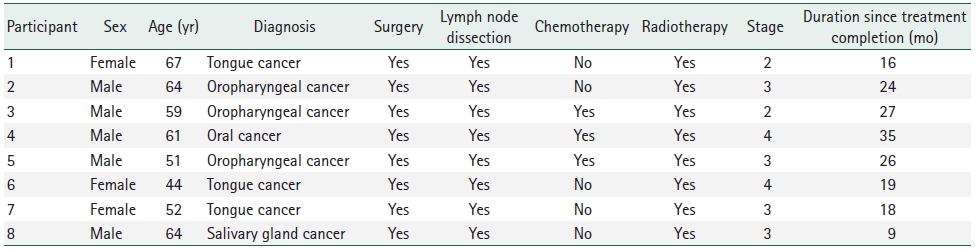
This qualitative study used IPA to examine the experiences of eight adults with stage II–IV head and neck cancer recruited from two university hospitals. All participants had undergone surgery followed by radiotherapy or chemoradiotherapy at least 6 months before data collection. Data were collected through in-depth interviews conducted from February to June 2022 and were analyzed using the cyclical IPA procedure.
Results
Four superordinate themes were identified: (1) being overwhelmed by lamentation and fear when confronting a late-diagnosed illness; (2) confronting human limitations during treatment undertaken for survival; (3) losing daily life and selfhood while living in a body that had not recovered; and (4) reconstructing life beyond the fear of recurrence. Participants experienced diagnosis and treatment as traumatic and described persistent functional impairments and painful sequelae.
Conclusion
These findings provide an in-depth understanding of the illness experiences of patients with head and neck cancer and offer evidence to inform nursing interventions that support adaptation and quality of life.
- 693 View
- 36 Download

- Pathway Analysis on the Effects of Nursing Informatics Competency, Nursing Care Left Undone, and Nurse Reported Quality of Care on Nursing Productivity among Clinical Nurses
- Mi Yu, Se Young Kim, Ji Min Ryu
- J Korean Acad Nurs 2023;53(2):236-248. Published online April 30, 2023
- DOI: https://doi.org/10.4040/jkan.22110
-
Abstract
PDF
- Purpose
Nursing informatics competency is used to manage and improve the delivery of safe, high-quality, and efficient healthcare services in accordance with best practices and professional and regulatory standards. This study examined the relationship between nursing informatics competency (NIC), nursing care left undone, and nurse reported quality of care (NQoC) and nursing productivity. A path model for their effects on nursing productivity among clinical nurses was also established.
Methods
Data were collected using structured questionnaires answered by 192 nurses working in a tertiary hospital located in J city, Korea, and analyzed using SPSS/WIN 23.0 and AMOS 21.0 program.
Results
The fit indices of the alternative path model satisfied recommended levels χ2 = .11 (p= .741), normed χ2 (χ2/df) = .11, SRMR = .01, RMSEA = .00, GFI = 1.00, NFI = 1.00, AIC = 18.11. Among the variables, NIC (β = .44, p < .001), NQoC (β = .35, p < .001) had a direct effect on nursing productivity. Due to the mediating effect of NQoC on the relationship between NIC and nursing productivity, the effect size was .14 (95% CI .08~.24). Meanwhile, nursing care left undone through NQoC in the relationship between NIC and nursing productivity, has a significant mediation effect (estimate .01, 95% CI .00~.03). The explanatory power of variables was 44.0%.
Conclusion
Education and training for enhancing NIC should be provided to improve nursing productivity, quality of care and to reduce missed nursing care. Furthermore, monitoring the quality of nursing care and using it as a productivity index is essential. -
Citations
Citations to this article as recorded by
- Influences of the Nursing Informatics Competency and Clinical Decision-Making Ability of Clinical Nurses on Patient Safety Competency
Han Na Kim, Jung Ok Lee
Journal of Fundamental Nursing Science.2026; 33(1): 83. CrossRef - A Systematic Review and Meta-Analysis of Information Literacy Competencies and Associated Variables among Korean Nursing Students
Shin Hyang Kim, Jong Mi Lim
Journal of Korean Academy of Nursing Administration.2025; 31(4): 358. CrossRef - The impact of nursing informatics competency, social influence, and medical information culture on nurses’ intention to use new medical technology in general hospitals
Jeong Ho Ji, Kyungja Kang
The Journal of Korean Academic Society of Nursing Education.2025; 31(4): 484. CrossRef - Effects of digital literacy and nursing informatics competency as job resources on nurses’ burnout and work engagement: a cross-sectional study
Jeehae Chung, Hyesil Jung, Sang Mi Park, Kyeongmin Lee
BMC Nursing.2025;[Epub] CrossRef - Factors Influencing Nursing Care Left Undone by Cancer Ward Nurses
Chung Hee Woo, Yeon Joo Kim
Journal of Korean Academy of Nursing Administration.2025; 31(5): 594. CrossRef
- Influences of the Nursing Informatics Competency and Clinical Decision-Making Ability of Clinical Nurses on Patient Safety Competency
- 4,944 View
- 217 Download
- 1 Web of Science
- 5 Crossref
- Young Adult Donor’s Experiences of Living Donor Liver Transplantation
- Miseon Bang, Haeyun Shin, Min Ryu, Suhye Kwon
- J Korean Acad Nurs 2021;51(1):105-118. Published online February 28, 2021
- DOI: https://doi.org/10.4040/jkan.20235
-
Abstract
PDF
- Purpose
This study aimed to explore young adult donors’ experiences of living donor liver transplantation.
Methods
A phenomenological research method was used. The participants were two women and six men. Data were collected through individual in-depth interviews from November 25th, 2019 to June 10th, 2020 and analyzed using Colaizzi’s phenomenological method.
Results
Five theme clusters extracted from the young adult donors’ experiences were painful decision of a liver donation, the agony of both mind and body that overpowers youth, the bitter and bare face of reality that a young donor encounters, feeling the power of love that fills up the space of the organ removed, and liver donation becoming priming water for maturity.
Conclusion
The results of this study provide a deeper understanding of the lives of young adult donors who have experienced unexpected difficulties as well as self growth from the donation. It is expected that the results can be of use for developing and applying customized nursing interventions for management before and after liver donation among young adult donors. -
Citations
Citations to this article as recorded by- Adaptation of living donors after liver transplantation in South Korea: an integrative review
Gyeong-Ju An
Journal of Korean Biological Nursing Science.2026; 28(2): 231. CrossRef - Giving as repaying: towards an embodied ethics of living donor liver transplantation
Ya-Ping Lin, Huei-Ya Chen
Medicine, Health Care and Philosophy.2025; 28(3): 517. CrossRef - Research Trends on Living Donors for Liver Transplantation: A Text Network Analysis and Topic Modeling
Seongmi Choi, Mihui Kim, Won Jin Seo
Journal of Korean Academy of Fundamentals of Nursing.2024; 31(2): 157. CrossRef - Living well or not? Quality of life of parental living liver donors: A cross‐sectional study
Xiaxin Wu, Jing Chen, Yaru Fan, Yuexian Shi, Wei Gao
Journal of Clinical Nursing.2023; 32(15-16): 5113. CrossRef - The Caring Experience of Family Caregivers for Patients of Living Donor Liver Transplantation from the Family Members
Miseon Bang, Suhye Kwon
Journal of Korean Academy of Nursing.2022; 52(4): 435. CrossRef - The life experiences of living liver donors: A qualitative meta‐synthesis
Hye‐Young Jang, Hyei Yeon Im, Hye Jin Nam
Research in Nursing & Health.2022; 45(6): 693. CrossRef
- Adaptation of living donors after liver transplantation in South Korea: an integrative review
- 2,956 View
- 29 Download
- 6 Web of Science
- 6 Crossref
 First
First Prev
Prev


