
 Submit an article

Search
- Page Path
- HOME > Search
Research Papers
- Nurse retention discourse in YouTube comments: a structural topic modeling analysis
- Taewha Lee, JooHyun Lee
- J Korean Acad Nurs 2026;56(2):206-219. Published online May 18, 2026
- DOI: https://doi.org/10.4040/jkan.25172
-
 Abstract
 PDF
PDF ePub
ePub - Purpose
This study analyzed public discourse on nurse retention through YouTube comments posted between 2018 and 2024 to examine how retention issues are collectively framed in online public spheres, thereby extending individual-level retention research to societal-level discourse analysis.
Methods
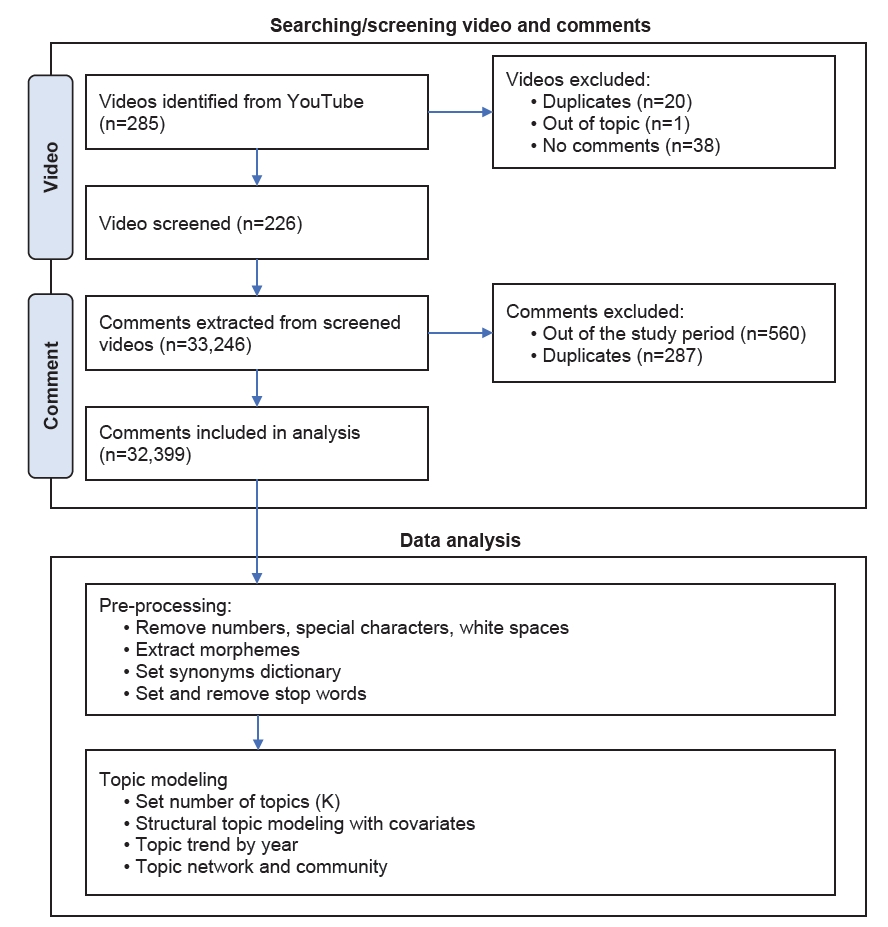
Comments were collected from 226 YouTube videos uploaded between January 2015 and December 2024, identified using search terms that combined “nurse” with retention-related keywords. After duplicates and comments posted outside the study period were removed, 32,399 comments were analyzed using structural topic modeling with year and number of likes as covariates. Topic correlation network analysis with community detection was used to identify discourse coalitions.
Results
Fourteen substantive topics and one noninterpretive topic emerged, spanning individual coping strategies, organizational workplace issues, and systemic policy structures. “International nursing migration and career pathways” (12.8%) and “Disputes regarding the scope of practice among professionals” (11.4%) were the most prevalent topics. Temporal analysis revealed discourse shifts consistent with focusing events theory: COVID-19 (coronavirus disease 2019) activated structural critique frames while suppressing career mobility discourse; the 2022 Nursing Law followed an issue-attention cycle pattern; and the 2024 medical school quota expansion embedded retention discourse within broader healthcare policy debates. Network analysis identified two discourse communities, professional identity and structural exploitation, with international migration serving as a bridging frame across both.
Conclusion
Public discourse framed nurse retention as a systemic and structural issue rather than as an expression of individual professional rejection. These collective framing patterns complement traditional survey-based research and may inform policy design by identifying which frames achieve public resonance and where discourse fragmentation may challenge policy implementation.
- 1,415 View
- 127 Download

- Development of a machine learning-based prediction model for early hospital readmission after kidney transplantation: a retrospective study
- Hye Jin Chong, Ji-hyun Yeom
- J Korean Acad Nurs 2025;55(4):528-542. Published online November 21, 2025
- DOI: https://doi.org/10.4040/jkan.25030
-
Abstract
PDFePub
- Purpose
This study aimed to develop and validate a machine learning-based prediction model for early hospital readmission (EHR) post-kidney transplantation.
Methods
The study was conducted at the organ transplantation center of a university hospital, utilizing data from 470 kidney transplant recipients. We built and trained four machine learning models and tested them to identify the strongest EHR predictors. Predictive performance was evaluated using confusion matrices and the area under the receiver operating characteristic curve (ROC AUC).
Results
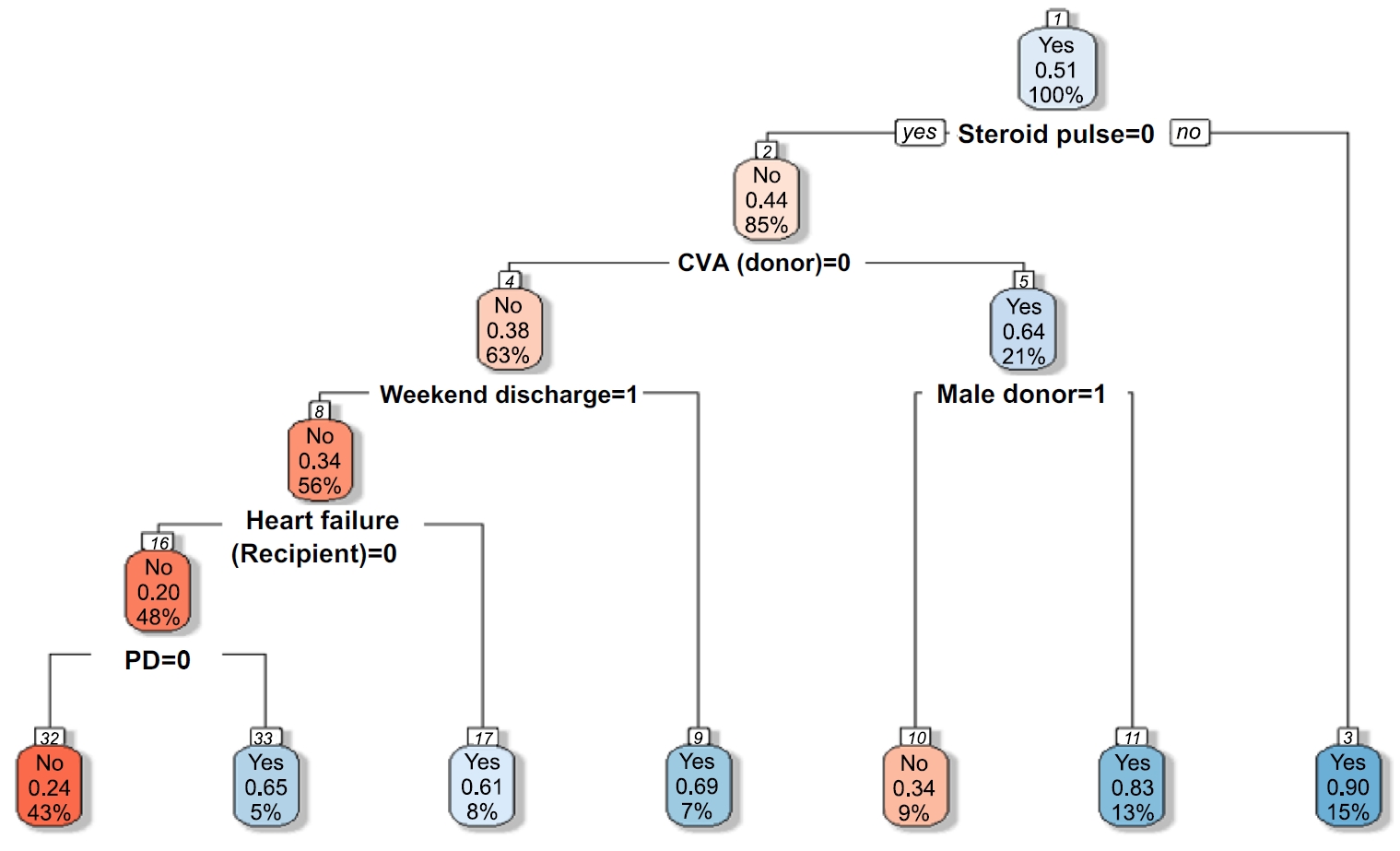
Among the 470 kidney transplant recipients with a mean age of 46.1 ± 12.02 years, 322 (68.5%) were males, and 74 (15.7%) were readmitted within 30 days after kidney transplantation. In total, 241 (51.2%) recipients were found to have experienced EHR after applying the random over-sampling examples method. The random forest model achieved the best performance, with an ROC AUC of .87 (validation set) and .82 (test set). The 15 most important features were steroid pulse therapy (recipient), cerebrovascular accident (recipient), heart failure (recipient), male sex (donor), cardiovascular disease (recipient), weekend discharge (recipient), peritoneal dialysis (recipient) cerebrovascular accident as the cause of brain death (donor), current smoker (recipient), cardiac arrest (donor), previous kidney transplantation (recipient), age (donor), hypertension (donor), male sex (recipient), and dialysis duration (recipient).
Conclusion
Our framework demonstrated strong predictive interpretability. It can support appropriate and effective clinical decision-making by assisting transplant professionals in stratifying recipients based on their risk of EHR. prioritizing post-discharge care and follow-up for high-risk individuals, and allocating targeted interventions such as closer monitoring or education.
- 2,505 View
- 227 Download
- Development of a predictive model for exclusive breastfeeding at 3 months using machine learning : a secondary analysis of a cross-sectional survey
- Hyun Kyoung Kim
- J Korean Acad Nurs 2025;55(4):519-527. Published online October 28, 2025
- DOI: https://doi.org/10.4040/jkan.25086
-
Abstract
PDFePub
- Purpose
This study aimed to develop a machine learning model to predict exclusive breastfeeding during the first 3 months after birth and to explore factors affecting breastfeeding outcomes.
Methods
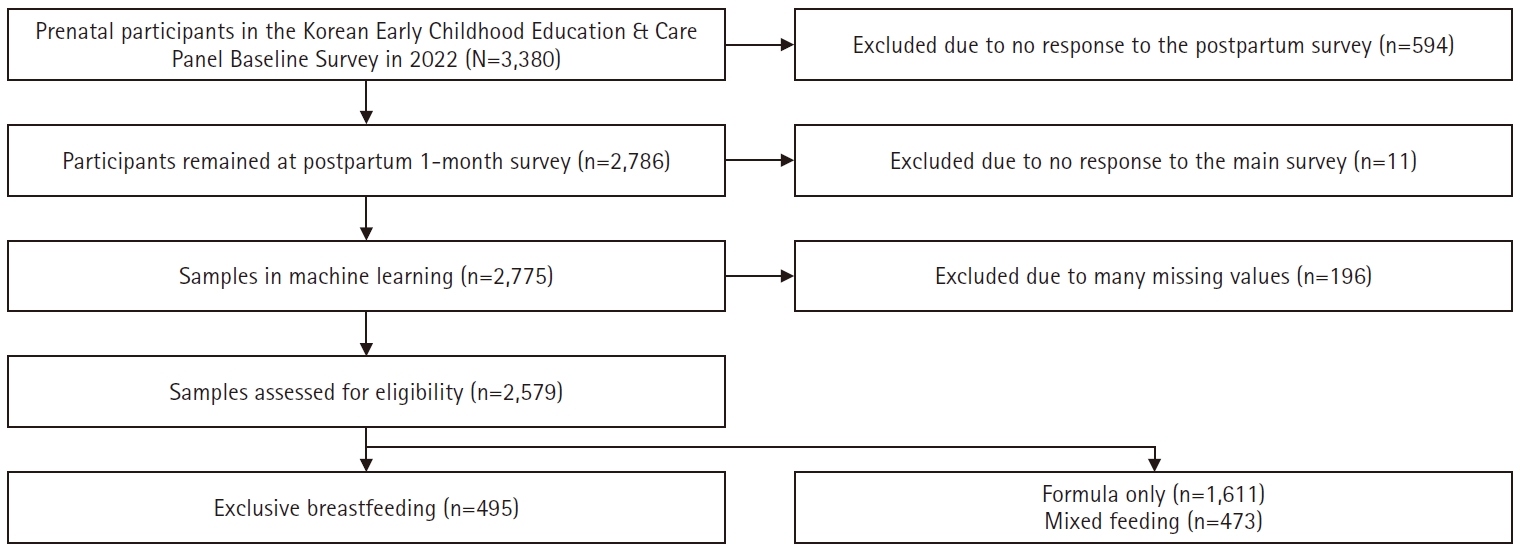
Data from 2,579 participants in the Korean Early Childhood Education & Care Panel between March 1 and June 3, 2025 were analyzed using Python version 3.12.8 and Colab. The dataset was split into training and testing sets at an 80:20 ratio, and five classifiers (random forest, logistic regression, decision tree, AdaBoost, and XGBoost) were trained and evaluated using multiple performance metrics and feature importance analysis.
Results
The confusion matrix of the random forest classifier model demonstrated strong performance, with a precision of 86.6%, accuracy of 84.8%, recall of 96.8%, F1-score of 91.9%, and an area under the curve of 86.0%. Twenty-one features were analyzed, from which feeding plan, breastfeeding at 1 month, marriage period, maternal prenatal weight, self-respect, alcohol consumption, grit, value placed on children, maternal age, and depression emerged as important predictors of exclusive breastfeeding in the first 3 months.
Discussion
A robust model was developed to predict exclusive breastfeeding that identified feeding planning and breastfeeding at 1 month as the most influential predictors. The model could be implemented in clinical and community settings to guide tailored breastfeeding support strategies, coupled with the integration of maternal self-respect, grit, and the value placed on children in counseling programs to promote exclusive breastfeeding. -
Citations
Citations to this article as recorded by
- Effects of Digital Health Interventions on Breastfeeding Rates, Self-Efficacy, and Knowledge: Systematic Review and Meta-Analysis
Jiahe Sun, Yu Wang, Shuang Hu, Yajie Ding, Congshan Pu, Danni Song, Jiaai Xia, Chunjian Shan
Journal of Medical Internet Research.2026; 28: e92184. CrossRef
- Effects of Digital Health Interventions on Breastfeeding Rates, Self-Efficacy, and Knowledge: Systematic Review and Meta-Analysis
- 3,301 View
- 232 Download
- 1 Web of Science
- 1 Crossref
 First
First Prev
Prev


