
 Submit an article

Search
- Page Path
- HOME > Search
Research Paper
- Development and evaluation of a health education program to enhance middle school students’ climate adaptation competencies: a nonequivalent control group pretest–posttest study in Korea
- Jiyu Hyun, Ju Hee Kim
- J Korean Acad Nurs 2026;56(2):179-189. Published online May 22, 2026
- DOI: https://doi.org/10.4040/jkan.25139
-
 Abstract
 PDF
PDF ePub
ePub - Purpose
This study aimed to develop and evaluate the Climate and Health Action Mitigation Program (CHAMP), a health education intervention designed to enhance middle school students’ competencies for practicing climate adaptation behaviors in response to the health impacts of climate change.
Methods
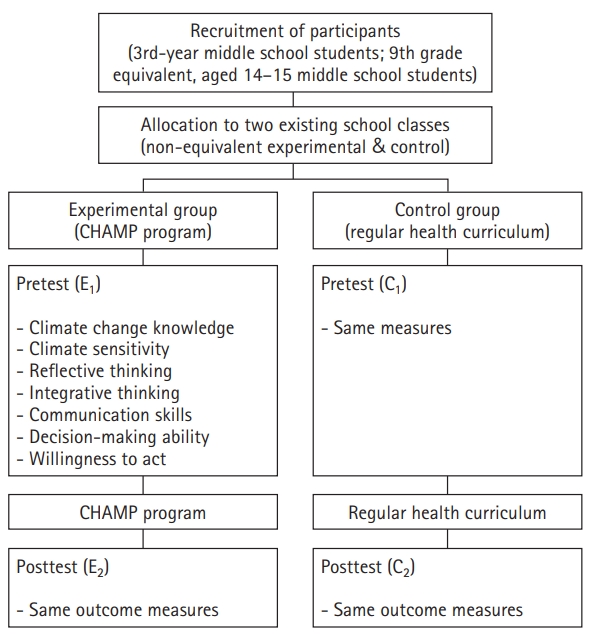
A quasi-experimental pretest-posttest nonequivalent control group design was employed. Data were collected from October to December 2024. A total of 3rd-year middle school students; 9th grade equivalent, aged 14-15 students were assigned to either an experimental group that received the CHAMP intervention or a control group that received conventional health education. The CHAMP curriculum comprised six sessions developed using the ADDIE (Analysis, Design, Development, Implementation, and Evaluation) instructional design model and was aligned with the 2022 revised national health curriculum and the instructional hours stipulated in the School Health Act. Climate adaptation competency and its seven subdomains—climate-change knowledge, climate sensitivity, reflective thinking, integrative thinking, communication skills, decision-making ability, and willingness to act—were assessed before and after the intervention.
Results
Compared with the control group, the experimental group demonstrated statistically significant improvements (p<.01) in overall climate adaptation competency as well as in all seven subdomains. The largest improvements were observed in willingness to act, climate sensitivity, and climate-change knowledge. The CHAMP intervention was associated with meaningful improvements in students’ climate adaptation competencies, encompassing cognitive, behavioral, and attitudinal domains.
Conclusion
These findings support the feasibility and educational value of integrating climate–health content into the national curriculum. Future research should examine the scalability of CHAMP and evaluate its long-term sustainability and effects across diverse educational settings.
- 1,549 View
- 200 Download

 First
First Prev
Prev


