
 Submit an article

Search
- Page Path
- HOME > Search
Research Paper
- Illness experience of head and neck cancer patients: an interpretative phenomenological analysis
- Min Ryu, Suhye Kwon
- J Korean Acad Nurs 2026;56(3):408-420. Published online August 18, 2026
- DOI: https://doi.org/10.4040/jkan.26027
-
 Abstract
 PDF
PDF ePub
ePub - Purpose
Head and neck cancer is frequently diagnosed at an advanced stage and is associated with substantial mortality. Patients also experience major physical limitations and psychosocial distress. This study explored the subjective meaning of illness experiences among patients with head and neck cancer using interpretative phenomenological analysis (IPA).
Methods
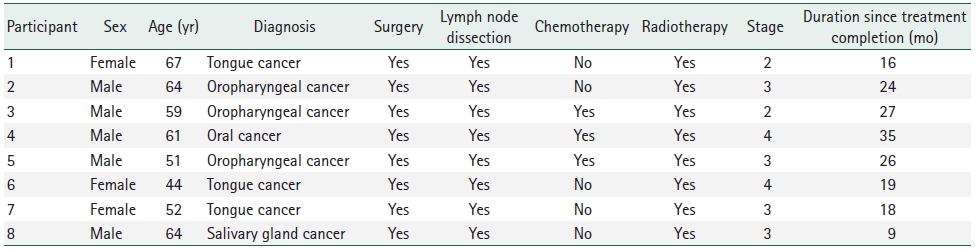
This qualitative study used IPA to examine the experiences of eight adults with stage II–IV head and neck cancer recruited from two university hospitals. All participants had undergone surgery followed by radiotherapy or chemoradiotherapy at least 6 months before data collection. Data were collected through in-depth interviews conducted from February to June 2022 and were analyzed using the cyclical IPA procedure.
Results
Four superordinate themes were identified: (1) being overwhelmed by lamentation and fear when confronting a late-diagnosed illness; (2) confronting human limitations during treatment undertaken for survival; (3) losing daily life and selfhood while living in a body that had not recovered; and (4) reconstructing life beyond the fear of recurrence. Participants experienced diagnosis and treatment as traumatic and described persistent functional impairments and painful sequelae.
Conclusion
These findings provide an in-depth understanding of the illness experiences of patients with head and neck cancer and offer evidence to inform nursing interventions that support adaptation and quality of life.
- 693 View
- 36 Download

 First
First Prev
Prev


