
 Submit an article

Search
- Page Path
- HOME > Search
Research Papers
- Development of a nurses’ situation awareness scale for clinical deterioration: a methodological study
- Hye Jin Kang, Yi Kyung Ha
- J Korean Acad Nurs 2026;56(3):370-381. Published online August 5, 2026
- DOI: https://doi.org/10.4040/jkan.26039
-
 Abstract
 PDF
PDF ePub
ePub - Purpose
This study aimed to develop a scale for assessing nurses’ situation awareness of clinical deterioration and to evaluate its validity and reliability.
Methods
This methodological study followed the scale-development guidelines of DeVellis and Thorpe. Item generation began with 44 items derived from 17 attributes identified through a hybrid-model concept analysis, which included a literature review and focus group interviews with 13 nursing experts. After content validity was evaluated by seven experts, 30 items were retained. A pilot test was then conducted with 20 hospital nurses to assess item comprehensibility. From August 30 to October 6, 2025, a total of 446 hospital nurses participated in the survey, and data from 440 respondents were analyzed. Construct validity was examined using exploratory and confirmatory factor analyses, along with convergent and discriminant validity testing. Internal consistency was evaluated using Cronbach’s α and McDonald’s ω.
Results
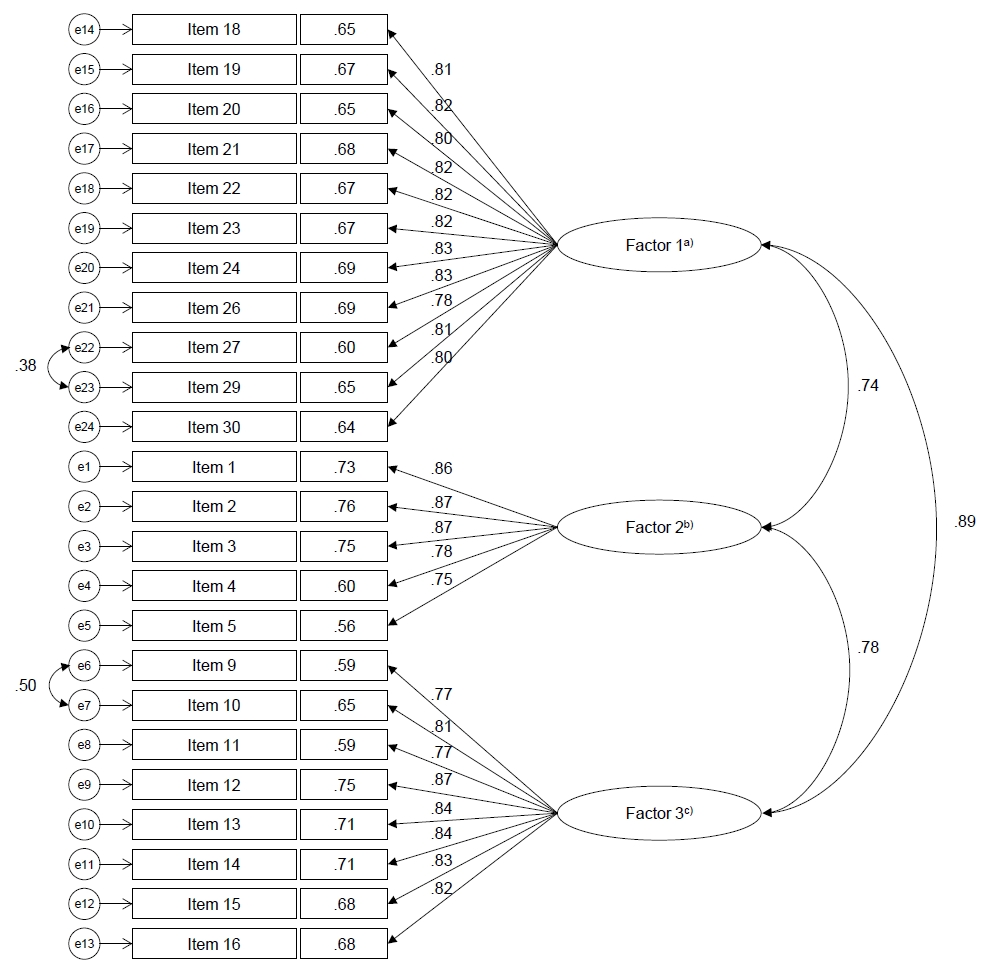
Exploratory factor analysis yielded a three-factor model, which showed acceptable fit in confirmatory factor analysis. The final instrument comprised 24 items across three factors, was scored on a 5-point Likert scale, and was named the Nurses’ Situation Awareness Scale for Clinical Deterioration (NSAS-CD). The scale showed high internal consistency, with Cronbach’s α of .98 and McDonald’s ω of .98.
Conclusion
The NSAS-CD demonstrated acceptable validity and reliability for assessing nurses’ situation awareness of clinical deterioration. Further research is needed to evaluate its generalizability across diverse clinical settings and to establish standardized criteria for clinical deterioration.
- 987 View
- 116 Download

- Concept mapping study of positive patient experiences among family members of nursing home residents in South Korea
- Hyoungshim Choi, InJa Choi, Jui Kim
- J Korean Acad Nurs 2026;56(3):318-330. Published online July 29, 2026
- DOI: https://doi.org/10.4040/jkan.26021
-
Abstract
PDFePub
- Purpose
This study focused on identifying key components and dimensions of positive patient experiences perceived by family members of nursing home residents in South Korea, which may inform strength-based quality improvement in nursing home care.
Methods
Data were collected from May 8, 2023, to July 18, 2023, through interviews with 19 family members of nursing home residents aged 65 years or older who had lived in the facility for at least 30 days. Interview data were used to develop empirical statements on the nature of residents’ experiences as perceived by family members. These data were then analyzed using concept mapping to identify components of positive patient experiences from the perspectives of family members of nursing home residents in Korea.
Results
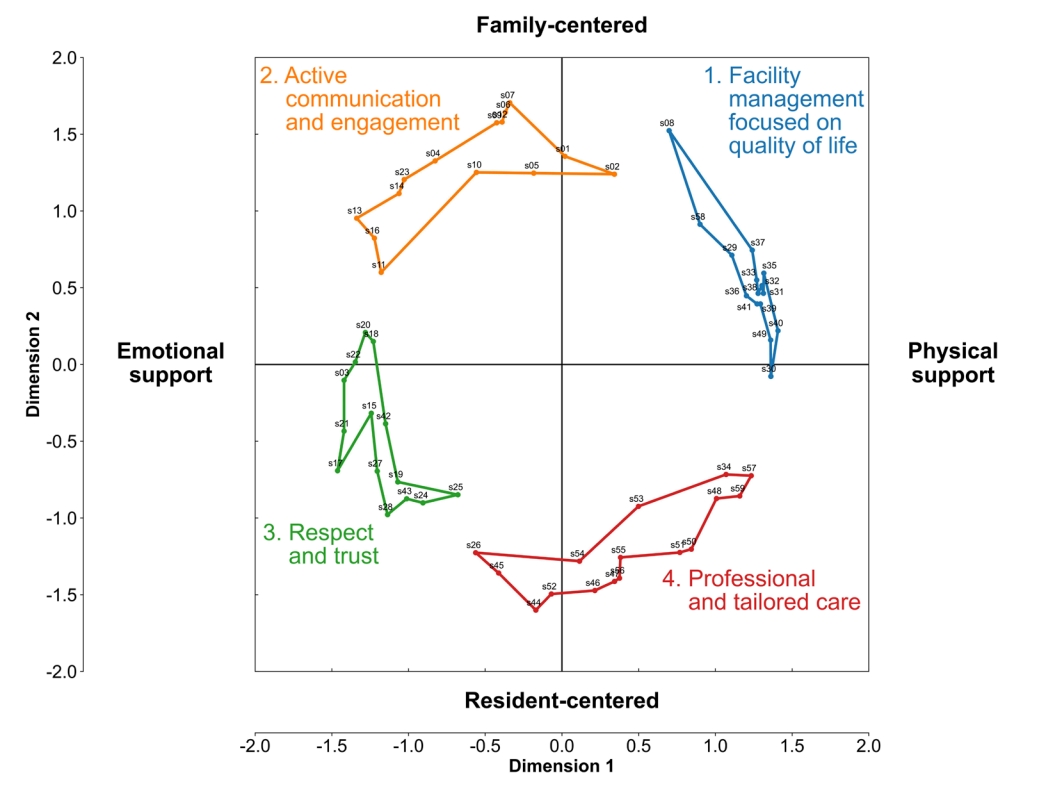
Multidimensional scaling and hierarchical cluster analysis yielded 59 core statements, two dimensions, and four clusters of positive patient experiences. The two dimensions were type of support (physical vs. emotional) and centrality of care (resident-centered vs. family-centered). The four clusters of positive patient experiences were “facility management focused on quality of life,” “active communication and engagement,” “respect and trust,” and “professional and personalized care.”
Conclusion
These findings provide insight into the experiences valued by family members of older adults in nursing homes. The concept map may inform development of a patient experience index tailored to family members of nursing home residents.
- 835 View
- 50 Download
- Psychometric testing of the Korean version of the Undergraduate Nursing Student Academic Satisfaction Scale: a methodological study
- Da-In Park, Joohee Shim
- J Korean Acad Nurs 2026;56(1):51-66. Published online February 9, 2026
- DOI: https://doi.org/10.4040/jkan.25125
- Correction in: J Korean Acad Nurs 2026;56(2):289
-
Abstract
PDFePub
- Purpose
This study aimed to translate, cross-culturally adapt, and evaluate the psychometric properties of the Korean version of the Undergraduate Nursing Student Academic Satisfaction Scale (K-UNSASS).
Methods
The K-UNSASS was developed using Brislin’s team-based translation–back-translation approach, with semantic and conceptual equivalence examined. Face validity was assessed, and a pilot test was conducted in November 2022. Content validity was evaluated by an expert panel. Formal data collection was conducted from December 2022 to January 2023. Structural validity was examined using exploratory and confirmatory factor analyses. Reliability was assessed using Cronbach’s alpha and McDonald’s omega coefficients.
Results
A total of 482 full-time nursing students, most of whom were in the fourth year of their nursing program, were included in the psychometric testing. Construct validity supported a four-factor structure accounting for 65.9% of the total variance. After removal of three items with unsatisfactory factor loadings, a 45-item K-UNSASS was established. Confirmatory factor analysis of the 45-item K-UNSASS demonstrated an acceptable model fit, and both Cronbach’s alpha and McDonald’s omega coefficients were .97.
Conclusion
The K-UNSASS demonstrates acceptable reliability and validity for assessing academic satisfaction among Korean nursing students. As a culturally relevant instrument, it supports educational improvement through targeted strategies and program evaluation. -
Citations
Citations to this article as recorded by
- Corrigendum: Psychometric testing of the Korean version of the Undergraduate Nursing Student Academic Satisfaction Scale: a methodological study
Da-In Park, Joohee Shim
Journal of Korean Academy of Nursing.2026; 56(2): 289. CrossRef
- Corrigendum: Psychometric testing of the Korean version of the Undergraduate Nursing Student Academic Satisfaction Scale: a methodological study
- 3,035 View
- 214 Download
- 1 Web of Science
- 1 Crossref
- Development of a scale to measure fear of falling in older adults: a psychometric validation study
- Dayeon Lee, Sunghee H Tak
- J Korean Acad Nurs 2025;55(3):413-424. Published online August 21, 2025
- DOI: https://doi.org/10.4040/jkan.25036
-
Abstract
PDFePub
- Purpose
This study aimed to develop a scale to measure fear of falling in older adults and to validate its reliability and validity.
Methods
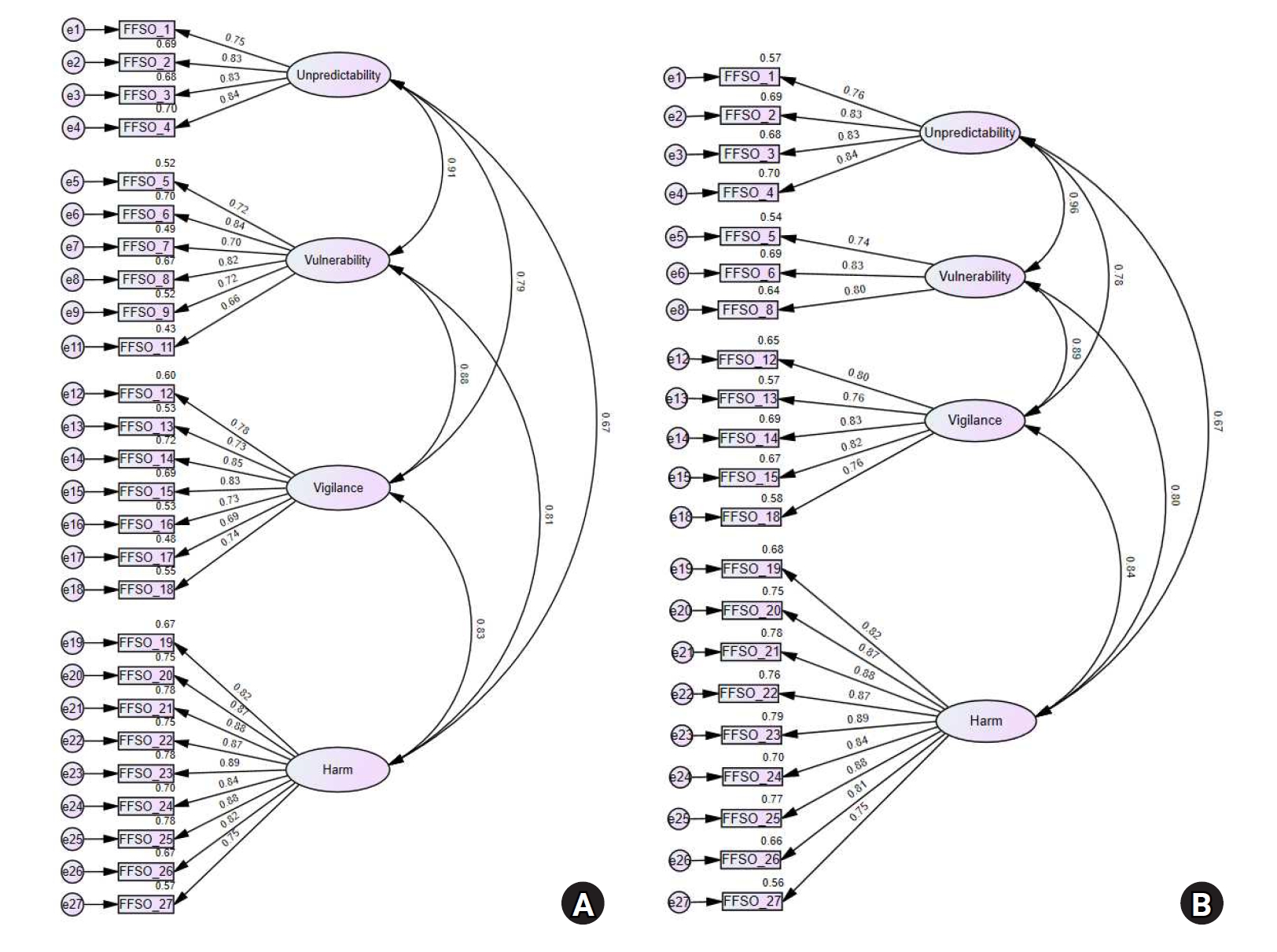
In total, 31 initial items were developed by referring to expressions from previous studies and items from existing instruments. After verifying content validity through expert evaluation, the remaining 27 items were used to construct a survey. Data from 252 participants recruited at three senior welfare centers in the metropolitan area were analyzed to examine item analysis, construct validity, convergent validity, discriminant validity, and reliability. Confirmatory factor analysis (CFA) was conducted to test construct validity. The correlation with the Korean version of the Falls Efficacy Scale-International (KFES-I) was used to assess convergent validity. Cronbach’s alpha was calculated to determine reliability.
Results
The final instrument consisted of 21 items. CFA confirmed acceptable model fit. Convergent validity was also acceptable and discriminant validity was partially supported. Correlations with the KFES-I ranged from .54 to .63. The Cronbach’s alpha coefficients for the total score and all factors ranged from .84 to .97.
Conclusion
The Fear of Falling Scale for Older Adults developed in this study is a validated tool capable of measuring various dimensions of fear of falling. It provides a foundation for accurately assessing fear of falling in older adults and addressing its specific aspects.
- 2,446 View
- 233 Download
- Development of a communication self-efficacy scale for nurses: a psychometric validation study
- Kuem Sun Han, Jihye Shin, Soo Yeon Lee
- J Korean Acad Nurs 2025;55(2):269-284. Published online May 27, 2025
- DOI: https://doi.org/10.4040/jkan.24129
-
Abstract
PDFePub
- Purpose
This methodological study was conducted to develop a scale to measure communication self-efficacy in nurses and examine its validity and reliability.
Methods
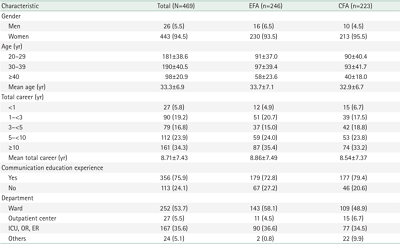
We selected 54 initial items from literature reviews and interviews with 10 clinical nurses. Thirty-two preliminary items were derived from consultations with 10 experts. To verify the scale’s factor structure, we conducted exploratory factor analysis (EFA), and confirmatory factor analysis (CFA) among 469 nurses. Data were analyzed using item analysis, EFA, CFA, discriminant validity, convergent validity, and internal consistency using IBM SPSS Statistics ver. 29.0 (IBM Corp.) and IBM SPSS AMOS ver. 20.0 (IBM Corp.).
Results
The scale consisted of 18 items with three factors (ability to apply therapeutic communication skills, crisis management capabilities, and communication competence), which explained 46.1% of the total variance. Convergent validity and discriminant validity were confirmed for the factors. CFA supported the fit of the measurement model comprising three factors (standardized root mean square residual=.04, root mean square error of approximation=.03, goodness of fit index=.92, Tucker-Lewis index=.97, comparative fit index=.98, normed fit index=.89, critical N=216). Internal consistency was confirmed by a Cronbach’s α coefficient of .91.
Conclusion
The communication self-efficacy scale for nurses is expected to measure communication self-efficacy among nurses. It will be useful for improving nurses’ professional communication abilities. -
Citations
Citations to this article as recorded by- Factors Influencing Psychiatric Nursing Competency among Emergency Nurses: The Mediating Effect of Psychological Safety in a Cross-Sectional Study
Yu Jin Lee, Chung Hee Woo
Journal of Korean Academy of psychiatric and Mental Health Nursing.2026; 35(1): 53. CrossRef - Development and Validation of a Multidimensional Nursing Empowerment Scale (NES)
Fatma Cerit Soydan, Ayşe Nefise Bahçecik
Journal of Nursing Management.2026;[Epub] CrossRef
- Factors Influencing Psychiatric Nursing Competency among Emergency Nurses: The Mediating Effect of Psychological Safety in a Cross-Sectional Study
- 5,751 View
- 442 Download
- 1 Web of Science
- 2 Crossref
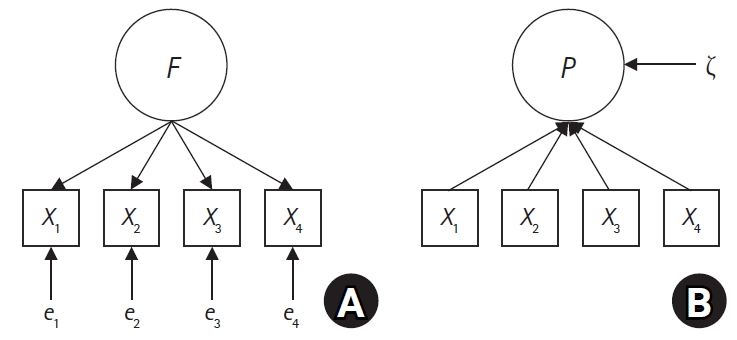
- Formative versus reflective measurement models in nursing research: a secondary data analysis of a cross-sectional study in Korea
- Eun Seo Park, Young Il Cho, Hyo Jin Kim, YeoJin Im, Dong Hee Kim
- J Korean Acad Nurs 2025;55(1):107-118. Published online February 19, 2025
- DOI: https://doi.org/10.4040/jkan.24095
-
Abstract
PDFePub
- Purpose
This study aimed to empirically verify the impact of measurement model selection on research outcomes and their interpretation through an analysis of children’s emotional and social problems measured by the Pediatric Symptom Checklist (PSC) using both reflective and formative measurement models. These models were represented by covariance-based structural equation modeling (CB-SEM) and partial least squares SEM (PLS-SEM), respectively.
Methods
This secondary data analysis evaluated children’s emotional and social problems as both reflective and formative constructs. Reflective models were analyzed using CB-SEM, while formative models were assessed using PLS-SEM. Comparisons between these two approaches were based on model fit and parameter estimates.
Results
In the CB-SEM analysis, which assumed a reflective measurement model, a model was not identified due to inadequate fit indices and a Heywood case, indicating improper model specification. In contrast, the PLS-SEM analysis, assuming a formative measurement model, demonstrated adequate reliability and validity with significant path coefficients, supporting the appropriateness of the formative model for the PSC.
Conclusion
The findings indicate that the PSC is more appropriately analyzed as a formative measurement model using PLS-SEM, rather than as a reflective model using CB-SEM. This study highlights the necessity of selecting an appropriate measurement model based on the theoretical and empirical characteristics of constructs in nursing research. Future research should ensure that the nature of measurement variables is accurately reflected in the choice of statistical models to improve the validity of research outcomes. -
Citations
Citations to this article as recorded by- The strategic role of proactivity and socioemotional wealth in family firm success
Felipe Hernández-Perlines, Luis Araya-Castillo, Mercedes Castro-Nuño
Journal of Innovation & Knowledge.2026; 18: 101097. CrossRef - What Makes the Structural Equation Model (SEM) Challenging? A Review of Methodological, Statistical, and Practical Challenges
Loso Judijanto, Sri Nurhayati
WSEAS TRANSACTIONS ON INFORMATION SCIENCE AND APPLICATIONS.2026; 23: 447. CrossRef
- The strategic role of proactivity and socioemotional wealth in family firm success
- 3,866 View
- 206 Download
- 1 Web of Science
- 2 Crossref
- Validity and Reliability of the Korean Version of the Occupational Coping Self-Efficacy Scale for Nurses
- Youngrye Park, Sunah Park, Hee Ran Kang
- J Korean Acad Nurs 2024;54(4):633-644. Published online November 30, 2024
- DOI: https://doi.org/10.4040/jkan.24094
-
Abstract
PDFePub
Purpose This study aimed to evaluate the validity and reliability of the Korean version of the occupational coping self-efficacy for nurses (K-OCSE-N) scale.
Methods The English version of the OCSE-N scale was translated into Korean using a translation and back-translation process. Data were gathered from 213 nurses employed in a general hospital in South Korea. The content validity was assessed using the content validity index. The construct validity was verified through exploratory and confirmatory factor analyses. Criterion validity was assessed using Pearson’s correlation coefficients with the job stress coping and general self-efficacy scales. Reliability was examined using item-total score correlation and Cronbach’s α coefficient for internal consistency.
Results The exploratory factor analysis identified two factors that explained 61.8% of the cumulative variance: occupational burden and relational difficulty. In confirmatory factor analysis, the model exhibited adequate fit (
χ 2/df = 2.07, GFI = .95, SRMR = .04, RMSEA = .07, CFI = .97, and TLI = .95), with both convergent and discriminant validity deemed acceptable. The criterion validity presented a positive correlation of the K-OCSE-N with both job stress coping (r = .72,p < .001) and general self-efficacy (r = .72,p < .001). The internal consistency of the scale using Cronbach’s α for the total items was .89.Conclusion The K-OCSE-N scale is a valid and reliable tool for measuring nurses’ occupational coping self-efficacy. This study suggests that various intervention studies can use the scale to assess and strengthen nurses’ occupational coping self-efficacy in nursing practice.
-
Citations
Citations to this article as recorded by- Patient Safety and Quality Improvement in Nursing Practice: Associations Among Workload, Occupational Coping Self-Efficacy and Medical Device-Related Pressure Injury Prevention
Hyun Suk Gwag, Jin Ah Kim
Healthcare.2026; 14(2): 270. CrossRef - Effects of the Nursing Work Environment, Patient-Centered Communication, Occupational Coping Self-Efficacy, and Professional Identity on Missed Nursing Care among General Hospital Nurses
Yuju Kim, Ju-Yeon Uhm
Journal of Fundamental Nursing Science.2026; 33(2): 277. CrossRef
- Patient Safety and Quality Improvement in Nursing Practice: Associations Among Workload, Occupational Coping Self-Efficacy and Medical Device-Related Pressure Injury Prevention
- 10,589 View
- 543 Download
- 1 Web of Science
- 2 Crossref
- Development of the Hospital Nurses’ Silence Behavior Scale
- Soojin Chung, Jee-In Hwang
- J Korean Acad Nurs 2024;54(2):279-295. Published online May 31, 2024
- DOI: https://doi.org/10.4040/jkan.23138
-
Abstract
PDF
- Purpose
This study aimed to develop a scale to measure hospital nurses’ silence behavior and examine its validity and reliability.
Methods
A total of 52 preliminary items on hospital nurses’ silence behavior were selected using a content validity test by seven experts on 53 candidate items derived from a literature review and in-depth interviews with 14 nurses. A total of 405 hospital nurses participated in a psychometric testing. Data analysis comprised item analysis, exploratory and confirmatory factor analyses, and convergent and discriminant validity tests. Pearson’s correlation coefficient was used for assessing concurrent validity, and Cronbach’s alpha was used for the reliability test.
Results
The final scale consisted of nine factors with 31 items, exhibiting acceptable model fit indices, convergent validity, and discriminant validity. The score of the entire scale was positively correlated with the ‘Organizational Silence Scale (OSS)-the issues on which nurses remain silent’ (r = .60, p < .001) and ‘OSS-the reasons why nurses remain silent’ (r = .68, p < .001). Cronbach’s α of the scale was .92, and α of each subscale ranged from .71 to .90.
Conclusion
The Hospital Nurses’ Silence Behavior Scale is a useful tool for assessing multifaceted silence behavior among nurses. It can provide basic data for developing better communication strategies among nurses and other hospital staff. -
Citations
Citations to this article as recorded by- Mediating Effect of Emotional Labour on the Role Pressure and Silence Behaviour of Nurses
Lianci He, Jianhua Liu, Rong Sun, Yuan Deng, Ling Tang, Shaochuan Chen
Evaluation & the Health Professions.2026; 49(1): 3. CrossRef - The Relationship Between Clinical Nurses’ Perceptions of the Power Used by Nursing Managers and Professional Silence Behaviors: An Example From Türkiye
Şirin Çelikkanat, Ayşe Eminoğlu Güven, Zeynep Güngörmüş, Lori M. Schirle
Journal of Nursing Management.2026;[Epub] CrossRef - Communication skills and organizational silence as predictors of perioperative competence in operating room nurses: a cross-sectional study
Hee Eun Kim, Sangjin Ko
BMC Nursing.2026;[Epub] CrossRef - Mediating effect of grit on the influence of nurses’ silence behavior on medication safety competence: a cross-sectional study
Haengsuk Kim, Wanju Park
Journal of Korean Academy of Nursing.2025; 55(1): 81. CrossRef - Influence of Clinical Nurses’ Organizational Silence on Organizational Citizenship Behavior: Mediating Effect of Organizational Commitment Moderated by Organizational Justice
Shin Ae Hwang, Haeyoung Min
Journal of Korean Academy of Nursing Administration.2024; 30(4): 416. CrossRef - Psychometric evaluation and translation of the Persian version of the Organizational Silence Behavior Scale (OSBS-P) for clinical nurses
Alireza Mirzaei, Mobina Jamshidinia, Mehrzad Aghabarari, Pouya Dolat Abadi, Reza Nemati-Vakilabad, Ehsan Namaziandost
PLOS ONE.2024; 19(12): e0314155. CrossRef
- Mediating Effect of Emotional Labour on the Role Pressure and Silence Behaviour of Nurses
- 7,716 View
- 396 Download
- 5 Web of Science
- 6 Crossref
- Psychometric Properties of the Fall Risk Perception Questionnaire-Short Version for Inpatients in Acute Care Hospitals
- Jeeeun Choi, Sujin Lee, Eunjin Park, Sangha Ku, Sunhwa Kim, Wonhye Yu, Eunmi Jeong, Sukhee Park, Yusun Park, Hye Young Kim, Sung Reul Kim
- J Korean Acad Nurs 2024;54(2):151-161. Published online May 31, 2024
- DOI: https://doi.org/10.4040/jkan.23127
-
Abstract
PDF
- Purpose
Patients’ perception of fall risk is a promising new indicator for fall prevention. Therefore, a fall risk perception questionnaire that can be used rapidly and repeatedly in acute care settings is required. This study aimed to develop a short version of the fall risk perception questionnaire (Short-FRPQ) for inpatients.
Methods
For the psychometric measurements, 246 inpatients were recruited from an acute care hospital. The construct (using confirmatory factor analysis and discriminant validity of each item), convergent, and known-group validities were tested to determine the validity of the Short-FRPQ. McDonald’s omega coefficient was used to examine the internal consistency of reliability.
Results
In the confirmatory factor analysis, the fit indices of the Short-FRPQ, comprising 14 items and three factors, appeared to be satisfactory. The Short-FRPQ had a significantly positive correlation with the original scale, the Korean Falls Efficacy Scale-International, and the Morse Fall Scale. The risk of falls group, assessed using the Morse Fall Scale, had a higher score on the Short-FRPQ. McDonald’s omega coefficient was .90.
Conclusion
The Short-FRPQ presents good reliability and validity. As patient participation is essential in fall interventions, evaluating the fall risk perception of inpatients quickly and repeatedly using scales of acceptable validity and reliability is necessary. -
Citations
Citations to this article as recorded by- Gyógytornász-fizioterapeuták időskori eleséssel kapcsolatos tudásának, attitűdjének és gyakorlatának felmérésére szolgáló kérdőív kifejlesztése és validálása
András Simon, Anna Zsófia Kubik, Edit Boros, Richárdné Mayer, Éva Kovács
Orvosi Hetilap.2026; 167(21): 811. CrossRef
- Gyógytornász-fizioterapeuták időskori eleséssel kapcsolatos tudásának, attitűdjének és gyakorlatának felmérésére szolgáló kérdőív kifejlesztése és validálása
- 5,222 View
- 209 Download
- 1 Web of Science
- 1 Crossref
- Development of a Reward Scale for Hospital Nurses
- Sun Hee Kim, Eun-Young Kim
- J Korean Acad Nurs 2023;53(5):525-537. Published online October 31, 2023
- DOI: https://doi.org/10.4040/jkan.23057
-
Abstract
PDF
- Purpose
This study aimed to develop and test a reward scale for hospital nurses.
Methods
The initial items were identified through a literature review and focus group interviews with ten hospital nurses. The content validity of the items was evaluated by ten experts. Fifty-one items were derived from the pilot survey. Four hundred eighty-eight nurses participated in the study: 248 for exploratory factor analysis (EFA) and 240 confirmatory factor analysis (CFA). Data were analyzed using item analysis, EFA, CFA, convergent validity, known-group validity, and internal consistency using IBM SPSS Statistics 29.0 and IBM SPSS AMOS 29.0.
Results
The final scale consisted of 31 items and eight factors (decent wage, opportunity to grow and develop, support for special situations, various benefits, flexibility of work, job-related achievement, reflecting career and performance, and recognition), which explained 67.3% of the total variance. The eight-subscale model was validated by CFA. Convergent validity was evaluated by analyzing correlation with intention to leave (r = - .63, p < .001) and job satisfaction (r = .54, p < .001). The known-group validity was evaluated by comparing the reward scales according to age, clinical career, income level and hospital type. The scale was found to be reliable with a Cronbach’s α of .89.
Conclusion
Both the validity and reliability of the reward scale for hospital nurses are verified, which can enhance the understanding of the range of rewards and may assist nurse managers in establishing an effective reward system. -
Citations
Citations to this article as recorded by- KEBIJAKAN WORK-LIFE BALANCE DAN DAMPAKNYA TERHADAP BURNOUT SERTA KINERJA PERAWAT DI RUMAH SAKIT
Sania Nur Azizah, Nur Sabrina Azzahrah, Aep Saefullah
Cakrawala : Jurnal Penelitian Mahasiswa.2026; 1(2): 154. CrossRef - Optimized nursing management in the Central Sterile Supply Department and Gastroenterology Department: a retrospective controlled study
Dali Wang
American Journal of Translational Research.2024; 16(12): 7480. CrossRef - The Impact of Fixed Shift Work of Fixed Night Shift Nurses on Job Engagement and Satisfaction
Jeong-A Bang, HyunSuk Joung, DonHee Lee
Journal of Korean Society for Quality Management.2024; 52(4): 745. CrossRef
- KEBIJAKAN WORK-LIFE BALANCE DAN DAMPAKNYA TERHADAP BURNOUT SERTA KINERJA PERAWAT DI RUMAH SAKIT
- 5,707 View
- 219 Download
- 1 Web of Science
- 3 Crossref
- Internal Structure of the Health-Related Quality of Life Instrument with 8-Items in a Nationally Representative Population
- Eun-Hyun Lee
- J Korean Acad Nurs 2023;53(3):359-369. Published online June 30, 2023
- DOI: https://doi.org/10.4040/jkan.23007
-
Abstract
PDF
- Purpose
This study evaluated the internal structure (structural validity, internal consistency, and measurement invariance) of the Health-Related Quality of Life Instrument with Eight Items (HINT-8), developed to measure Korean people’s health-related quality of life.
Methods
A secondary analysis was conducted using data from the Korea National Health and Nutrition Examination Survey, involving 6,167 adults aged over 18 years. The structural validity of the HINT-8 was assessed using exploratory graph analysis and confirmatory factor analysis. Internal consistency and measurement invariance were analyzed using McDonald’s omega (ω) and multigroup confirmatory factor analysis, respectively.
Results
The HINT-8 had a single dimension and good internal consistency (ω = .804). The one-dimension HINT-8 ex-hibited matric invariance but not scalar invariance across sociodemographic groups (sex, age, education, and marital status). Further, it exhibited scalar or partial scalar invariance across medical condition groups (hypertension, diabetes, depressive symptoms, and cancer).
Conclusion
The study finds that the HINT-8 demonstrated satisfactory structural validity and internal consistency, indicating its suitability for practice and research. However, the HINT-8 scores cannot be compared across different groups regarding sex, age, education, and marital status, as the interpretation varies within each sociodemographic category. Conversely, interpretation of the HINT-8 is consistent for individuals with and without hypertension, diabetes, depressive symptom, and cancer. -
Citations
Citations to this article as recorded by- Association between obstructive sleep Apnea–Related factors and HINT-8 utility scores in adults: a secondary analysis of the 2023 Korea National health and nutrition examination survey (KNHANES)
Mima Park, Seon-Ha Kim
Quality of Life Research.2026;[Epub] CrossRef - Risk Factors and Quality of Life in Patients With Geographic Atrophy, a Late Stage of Age-Related Macular Degeneration: Findings From the Korea National Health and Nutrition Examination Survey
Yeji Kim, Yun Tae Kim, Mingui Kong, Jae Hui Kim
Journal of Korean Medical Science.2026;[Epub] CrossRef - Psychometric properties of the health-related quality of life instrument with 8 items: a systematic review and meta-analysis
Tai-Kyung Lee, So-Young Lee, Eun Cho
Health and Quality of Life Outcomes.2026;[Epub] CrossRef - Physical activity levels and HINT-8 health-related quality of life in Korean adults with diabetes: analysis of KNHANES 2019–2021
Sung Hoon Jeong, You-Jung Choi, Gain Shin, Ja-Ho Leigh
Quality of Life Research.2026;[Epub] CrossRef - Association between Cataracts and Health-Related Quality of Life among Korean Adults Aged 40-69 Years Using the HINT-8
Seyong Kim, Hyojin Kim
Journal of Korean Ophthalmic Optics Society.2026; 31(2): 183. CrossRef - The Predictors of Dietary Supplement Use Among Women With Musculoskeletal Disease: A Population-Based Complex Sample Designed Study
Myoungjin Kwon, Sun Ae Kim, Youngshin Song
INQUIRY: The Journal of Health Care Organization, Provision, and Financing.2025;[Epub] CrossRef - A Network Analysis of Quality of Life Among Older Adults With Arthritis
Dahee Wi, Chang G. Park, Jiae Lee, Eunjin Kim, Yoonjung Kim
International Journal of Older People Nursing.2025;[Epub] CrossRef - Network analysis of quality of life among young and middle-aged Korean cancer survivors
Yoonjung Kim, Dahee Wi, Eunjin Kim, Jiae Lee
Asia-Pacific Journal of Oncology Nursing.2025; 12: 100684. CrossRef - Quality of Life Based on the Experience of Psychological Counseling in Adults with Depressive Symptoms
Jihyeon Seo, Jihye Lim
Journal of Health Informatics and Statistics.2025; 50(1): 39. CrossRef - Validation of the health-related quality of life instrument with 8 items for assessing health-related quality of life in patients with oropharyngeal cancer: a comparison with the EQ-5D-5L
Gyeong-U Hong, Bon Seok Koo, Min-Ju Kim, Woo-Jeong Sim, Ah-Yeon Lee, Ji-Eun An, Su-Yeon Yu, Sei Young Lee, Soo Hyun Lee
Health and Quality of Life Outcomes.2025;[Epub] CrossRef - Comparative effectiveness and safety of herbal medicine therapy for low back pain and radiculopathy caused by lumbar intervertebral disc herniation: a study protocol for a pragmatic randomized controlled trial
Jung-Hyun Kim, Yoon Jae Lee, In-Hyuk Ha, Won-Suk Sung, Eun-Jung Kim, Yeoncheol Park, Yonghyeon Baek, Sang-Soo Nam, Byung-Kwan Seo
Frontiers in Neurology.2025;[Epub] CrossRef - Comparison of the health behavior and nutrition status of young-old women according to the vitality in their quality of life: based on the 2019, 2021 Korea National Health and Nutrition Examination Survey
Jiyoung Jeong, Yoon Jung Yang
Journal of Nutrition and Health.2023; 56(5): 496. CrossRef
- Association between obstructive sleep Apnea–Related factors and HINT-8 utility scores in adults: a secondary analysis of the 2023 Korea National health and nutrition examination survey (KNHANES)
- 6,233 View
- 166 Download
- 9 Web of Science
- 12 Crossref
- Development and Psychometric Evaluation of the Ischemic Stroke Distress Scale (ISDS)
- Jaejin Kang, Yang-Sook Yoo
- J Korean Acad Nurs 2023;53(1):12-27. Published online February 28, 2023
- DOI: https://doi.org/10.4040/jkan.22090
-
Abstract
PDF
- Purpose
This study aimed to develop a scale to measure distress in patients with ischemic stroke and verify its validity and reliability.
Methods
Preliminary items were developed from literature review and in-depth interviews. The final preliminary scale was confirmed through a content validity test of eight experts and a preliminary survey of 10 stroke patients. The participants for psychometric testing were 305 stroke patients in the outpatient clinic. Validity and reliability analyses included item analysis, exploratory and confirmatory factor analysis, convergent validity, known-group validity, and internal consistency of the scale.
Results
The final scale consisted of 17 items and 3 factors. The three distinct factors were ‘self-deprecation, worry about future health, and withdrawal from society’ and this structure was validated using a confirmatory factor analysis. Convergent validity was supported by comparison with the Center for Epidemiologic Studies Depression Scale (r = .54, p < .001) and Brief Illness Perception Questionnaire (r = .67, p < .001). Known-groups validity was verified by dividing groups according to ‘duration since diagnosis’ (t = 2.65, p = .009), ‘presence of sequela’ (t = 10.16, p < .001), and ‘awareness of distress’ (t = 12.09, p < .001). The internal consistency of the scale using Cronbach’s α for the total items was .93.
Conclusion
The Ischemic Stroke Distress Scale is a valid and reliable tool that reflects stroke distress effectively. It is expected to be used as a basic tool to develop various intervention strategies to reduce distress in ischemic stroke patients.
- 2,563 View
- 100 Download
- Validity and Reliability of the Korean Version of Assessment of Health Literacy in Breast and Cervical Cancer Screening
- Hye Sook Shin, Eunlim Chi, Hae-Ra Han
- J Korean Acad Nurs 2021;51(6):769-781. Published online December 31, 2021
- DOI: https://doi.org/10.4040/jkan.21108
-
Abstract
PDF
- Purpose
Health literacy is a significant determinant of health and health behaviors such as cancer screening. Despite its significance, there are limited instruments available to assess health literacy targeting Koreans. The purpose of this study was to test the psychometric properties of Korean translation of a validated health literacy instrument in cancer screening—Korean version of assessment of health literacy in breast and cervical cancer screening (K-AHL-C).
Methods
A total of 555 women aged 20~65 participated in the online survey study. Of 52 items addressing five domains included in the original version, we focused on 36 items addressing three key domains closely associated with cancer screening: familiarity, health navigation, and comprehension.
Results
During content validation, two items from the health navigation domain were removed, yielding 34 items. Using Rasch analysis and confirmatory factor analysis, we found the evidence of construct validity of K-AHL-C. The Korean version was also significantly correlated with measures of Functional Health Literacy scale, cancer prevention behaviors, and subjective health status, suggesting convergent validities respectively. Finally, K-AHL-C had acceptable reliability coefficients (α) ranging from 0.71 to 0.92 for each domain and the total scale.
Conclusion
These psychometric properties support the K-AHL-C is a valid and reliable instrument for measuring Koreans’ health literacy in cancer screening. Also it is expected to use the instrument to detect breast and cervical cancer early and improve the screening rate, and ultimately to contribute to the promotion of women's health and women's health nursing practice. -
Citations
Citations to this article as recorded by- Web-Based Delivery of an Effective Church-Based Intervention Program to Promote Cancer Screening (Community-based Health litEracy-focused intervention for breast and cervical Cancer Control) Among Korean Immigrant Women in the United States: Randomized Co
Hae-Ra Han, Yoon-Jae Lee, Deborah Min, Joyline Chepkorir, DaSol Amy Hwang, Steve Chae
JMIR Human Factors.2025; 12: e66092. CrossRef - Associations and gender differences between OHI-seeking behaviors and eHealth literacy among Chinese university students
Jie Chen, Hua Tian
Revista da Escola de Enfermagem da USP.2024;[Epub] CrossRef - Health Information Seeking Pathways and Factors Influencing Health Literacy Among Cancer Patients: Based on Data from the 2nd Korean Health Panel 2021
Yun-La Hur, Eun-Jeong Hong
Asian Oncology Nursing.2024; 24(3): 155. CrossRef - A Psychometric Validation of the Korean Version of Disaster Response Self-Efficacy Scale for Nursing Students
Sung Hae Kim
International Journal of Environmental Research and Public Health.2023; 20(4): 2804. CrossRef - Health literacy measures in South Korea: A scoping review
Heeran Chun, Su Hyun Kim, Eunja Park
Korean Journal of Health Education and Promotion.2022; 39(4): 39. CrossRef - Validity and Reliability of the Korean Version of the Climate, Health, and Nursing Tool
Da Woon Jeong, Gwang Suk Kim, Min Kyung Park
Journal of Korean Academy of Nursing.2022; 52(2): 173. CrossRef
- Web-Based Delivery of an Effective Church-Based Intervention Program to Promote Cancer Screening (Community-based Health litEracy-focused intervention for breast and cervical Cancer Control) Among Korean Immigrant Women in the United States: Randomized Co
- 4,185 View
- 70 Download
- 4 Web of Science
- 6 Crossref
- Development and Effects of Head-Mounted Display-Based Home-Visits Virtual Reality Simulation Program for Nursing Students
- Min Kweon Ahn, Chong Mi Lee
- J Korean Acad Nurs 2021;51(4):465-477. Published online August 31, 2021
- DOI: https://doi.org/10.4040/jkan.21051
-
Abstract
PDF
- Purpose
This study aimed to evaluate the effects of head monted display based home-visits virtual reality simulation (HVRS) program developed for undergraduate nursing students.
Methods
A nonequivalent control group with a non-synchronized design was utilized and 84 participants (experimental group, 44; control group, 40) were recruited from August 31, 2020 to November 8, 2020 in Gwangju metropolitan city. The HVRS program consisted of scenarios of three nursing cases, hypertension, diabetes mellitus, and stroke. Data were analyzed SPSS version 25.0 for Windows.
Results
At the completion of HVRS, significant differences were found between groups in knowledge of home-visits (t = 4.73, p < .001), self-confidence (t = 6.63, p < .001), self-efficacy (t = 3.13, p = .002), and clinical competency (t = 4.13, p < .001). No significant difference was shown between groups in nursing knowledge about strokes, a subcategory of knowledge pertaining to home visits.
Conclusion
The HVRS program developed for undergraduate nursing students is effective in improving knowledge of home-visits, self-confidence, self-efficacy, and clinical competency for nursing students. -
Citations
Citations to this article as recorded by- Icarus new rising? A narrative review on virtual reality-based motor interventions in older adults
André Ramalho, Pedro Duarte-Mendes, Rui Paulo, João Serrano, João Petrica
Human Movement.2026;[Epub] CrossRef - Effects of a Standardized Patient-Based Home Nursing Simulation on Learning Self-Efficacy, Problem-Solving Process, and Practicum Satisfaction in Nursing Students
Young Hee Kim, Minjae Lee
Journal of Korea Society for Simulation in Nursing.2026; 14(1): 77. CrossRef - Room of errors simulation for improving patient safety knowledge, attitudes, and performance confidence among nursing students: a quasi-experimental study
Sunmi Jeon, Minyoung Kim
Frontiers in Medicine.2026;[Epub] CrossRef - The Effectiveness of Simulation‐Based Versus Patient‐Based Clinical Education in Nursing: A Systematic Review and Meta‐Analysis
Louise Prothero, Naim Abdulmohdi, Siân Shaw, Mary Edmonds, Catherine Meads
Nursing Open.2026;[Epub] CrossRef - Comparison between virtual reality and traditional lecture methods in educating respiratory therapy on pediatric airway diseases
Wen-Jing Hsu, Yi-Hsuan Tang, Wei-Chih Chen, Yu-Sheng Lee, Pei-Chen Tsao, Wei-Yu Chen, Ying-Ying Yang, Hsin-Kuo Ko, Sheng-Wei Pan, Yu-Fen Ting, Shih-Hsing Yang, Mei-Jy Jeng
Journal of the Chinese Medical Association.2025; 88(3): 205. CrossRef - Effects of Community Nursing Simulation Education on Nursing Core Competencies, Clinical Judgment, and Clinical Performance of Nursing College Students
Hoo-Jeung Cho, Kyong-Sun Chong
European Journal of Investigation in Health, Psychology and Education.2025; 15(6): 92. CrossRef - Effectiveness of the IPE-Sim based dementia management (IPE-SDM) program on community-dwelling elders for nursing and medical students
Sooyoung Jun
Clinical Simulation in Nursing.2025; 106: 101790. CrossRef - Immersive virtual reality in nursing education: A scoping review of components, outcome variables, and interaction modes
Sunghwa Na, Jihyung Son, Hyun Joo Lee
Nurse Education Today.2025; 155: 106877. CrossRef - Effects of virtual reality-based disaster simulation education on nursing students
Kyeng-Jin Kim, Moon-Ji Choi, MinJi Kim, Yong-Hong Kuo
PLOS One.2025; 20(10): e0329563. CrossRef - A VR-Based Trauma Nursing Education Program for Clinical Nurses: Integrating Jeffries’ Model and the 5E Learning Cycle
Heeyeon Kim, Gyuli Baek, Eunju Lee
Healthcare.2025; 13(19): 2542. CrossRef - Effects of Diabetes Home-Visiting Healthcare Simulation Education on Nursing Students Using Virtual Reality
Young-Sun Ha, Yong-Kyung Park, Hye-Sun Byun, Kyeng-Jin Kim, Moon-Ji Choi
Journal of Digital Contents Society.2025; 26(9): 2501. CrossRef - Exploring the effects of extended reality head-mounted display nervous system assessment training for nursing students: A pilot feasibility study
Jiyoung Kim, Hyunjung Shin
Nurse Education Today.2024; 133: 106089. CrossRef - Are virtual reality intravenous injection training programs effective for nurses and nursing students? A systematic review
Jin Young Kim, Juri Kim, Mikyoung Lee
Nurse Education Today.2024; 139: 106208. CrossRef - Enhancing nursing competency through virtual reality simulation among nursing students: a systematic review and meta-analysis
Mi-Kyoung Cho, Mi Young Kim
Frontiers in Medicine.2024;[Epub] CrossRef - Effects of Immersive Technology–Based Education for Undergraduate Nursing Students: Systematic Review and Meta-Analysis Using the Grading of Recommendations, Assessment, Development, and Evaluation (GRADE) Approach
Subin Park, Hui Ju Shin, Hyoeun Kwak, Hyun Joo Lee
Journal of Medical Internet Research.2024; 26: e57566. CrossRef - Development and Effects of Metaverse-Based Intradermal Injection Content for Nursing Students
Min-Kweon Ahn
Journal of Digital Contents Society.2024; 25(9): 2543. CrossRef - Pressure Ulcer Management Virtual Reality Simulation (PU-VRSim) for Novice Nurses: Mixed Methods Study
Soo Youn Jung, Kyoung Ja Moon
JMIR Serious Games.2024; 12: e53165. CrossRef - Effect of virtual reality head-mounted display on academic motivation and skills of millennial nursing students in teaching infection prevention and control
Andri Nugraha, Iin Patimah, Engkus Kusnadi, Wikky Fawwaz Al Maki
Journal of Research Development in Nursing and Midwifery.2024; 21(3): 3. CrossRef - Effect of Augmented Reality Smart Glasses-based Nursing Skills Training for Nursing Students’ Medication Administration Safety Competency: A Quasi-experimental Study
Jiyoung Kim, Narae Heo
Journal of Korean Academy of Fundamentals of Nursing.2023; 30(4): 449. CrossRef - Instructor's Experience of Extended Reality Applied to Nursing Education
Jiyoung Kim, Hyeoncheol Jeong
Clinical Simulation in Nursing.2023; 84: 101450. CrossRef - Validity and reliability of positive attitudes toward and perceived importance of wearable display technology as an effective learning tool among nursing students
Jiyoung Kim, Narae Heo, Hyuncheol Kang
Nurse Education in Practice.2023; 73: 103812. CrossRef - A Study on the Feasibility of Introducing XR in Nursing Education Core Fundamental Nursing Skills
Yunja Hwang, Jaeyeon Jeong, Yoo Mi Jeong
Journal of Digital Contents Society.2023; 24(4): 775. CrossRef - Virtual Reality Simulation for Advanced Infection Control Education in Neonatal Intensive Care Units: Focusing on the Prevention of Central Line-Associated Bloodstream Infections and Ventilator-Associated Infections
Jimin Ryu, Mi Yu
Healthcare.2023; 11(16): 2296. CrossRef - A Delphi study on the Needs for the Development of a Customized Program based on Augmented Reality for Preterm infants and their Families in the Neonatal Intensive Care Unit
Jae Eun Sin, Ah Rim Kim
Journal of Digital Contents Society.2022; 23(3): 455. CrossRef - The development and effects of metaverse-based core nursing skill contents of vital signs measurements and subcutaneous injections for nursing students
Min Kweon Ahn
The Journal of Korean Academic Society of Nursing Education.2022; 28(4): 378. CrossRef - Nurses’ behavioral intention in using virtual clinical simulation training: By structural equation modeling
Hyein Choi, Sunghee H. Tak
Nurse Education in Practice.2022; 65: 103492. CrossRef
- Icarus new rising? A narrative review on virtual reality-based motor interventions in older adults
- 3,757 View
- 180 Download
- 17 Web of Science
- 26 Crossref
Original Articles
- Development and Validation of the Self-Care for Aspiration Pneumonia Prevention Scale in the Community Dwelling Elderly with Risk of Dysphasia
- Eun Young Yang, Shin-Young Lee
- J Korean Acad Nurs 2020;50(3):474-486. Published online June 30, 2020
- DOI: https://doi.org/10.4040/jkan.20041
-
Abstract
PDF
- Purpose
The purpose of this study was to develop and validate a Korean version of the Self-Care for Aspiration Pneumonia Prevention(SCAPP-K) scale in older adults at risk of dysphasia.
Methods
The Hertz and Baas model of scale development and validation was used. Inthe development stage, items were generated via literature review and interviews with medical experts, older adults, and caregivers. Tenexperts assessed the items for content validity. Subsequently, 12 older adults participated in a pilot test to determine the comprehensibilityand appropriateness of the SCAPP-K scale. The validation stage involved a cross-sectional survey with 203 older adults for exploratoryfactor analysis (EFA) and 200 older adults for confirmatory factor analysis (CFA) and to determine convergent and discriminant validity. Totest the validity and reliability of the scale, EFA using principal component analysis with varimax rotation and CFA were conducted, andconvergent and discriminant validity as well as internal consistency reliability were determined.
Results
As a result of EFA, three self-carefactors (knowledge, resources, behaviors) with 21 items were validated. The CFA and convergent and discriminant validity indicated theapplicability of the three-factor self-care scale. The reliability of the SCAPP-K scale was acceptable, with Cronbach’s a=.87~.91.
Conclusion
The SCAPP-K scale has acceptable validity and reliability and can contribute to clinical practice, research, and education to improveself-care for the prevention of aspiration pneumonia in older adults at risk of dysphasia. -
Citations
Citations to this article as recorded by- Cause-specific mortality in Korea during the first year of the COVID-19 pandemic
Jinwook Bahk, Kyunghee Jung-Choi
Epidemiology and Health.2022; 44: e2022110. CrossRef - Translation of the Chinese version of the Self‐Care for Aspiration Pneumonia Prevention Scale and its validation among Chinese community dwelling elderly with risk of dysphasia
Zhen Yang, Fengmin Chen, Yibo Zhang, Sien Pan, Yingying Lu, Huijun Zhang
Nursing Open.2022; 9(3): 1902. CrossRef - Development and validation of a self-care scale for older adults undergoing hip fracture surgery: the HFS-SC
Eun-Jeong Jeon, Kyeong-Yae Sohng, Hye-Ah Yeom
BMC Nursing.2022;[Epub] CrossRef - Study on the characterization, biocompatibility and efficacy of sponge brush products for oral care
Song-Yi Yang, Ji-Won Choi, Sang-Hwan Oh
Korean Journal of Dental Materials.2021; 48(1): 27. CrossRef
- Cause-specific mortality in Korea during the first year of the COVID-19 pandemic
- 3,264 View
- 101 Download
- 3 Web of Science
- 4 Crossref
- Development and Evaluation of Suicide Prevention Nursing Competency Programs for Visiting Nurses
- Jung Eun Kim, Suk-Sun Kim
- J Korean Acad Nurs 2020;50(1):14-25. Published online January 31, 2020
- DOI: https://doi.org/10.4040/jkan.2020.50.1.14
-
Abstract
PDF
Abstract Purpose: The purpose of this study was to develop a suicide prevention nursing competency program for visiting nurses, and to examine the effect of this program on suicide prevention-related knowledge, attitudes, and behaviors.
Methods: A total of 66 visiting nurses were recruited from 10 public health centers and divided equally into the experimental and control group. For the experimental group, the suicide prevention nursing competency program was provided twice a week for 120 minutes across 3 weeks. Participants were asked questions related to suicide prevention knowledge, attitudes, and behaviors at pre, post, and 1 month after the intervention. Data were analyzed using descriptive statistics, a t-test, repeated measure ANOVA, and Friedman test.
Results: There were significant differences in knowledge and behaviors at the measured time periods, and significant differences in attitudes and behaviors between the two groups. There were also significant interactions between groups and times in attitudes and behaviors. These results suggest that the effects of the program were persistent until the 1-month follow-up.
Conclusion The developed suicide prevention nursing competency program is effective in evidence-based education for visiting nurses to increase suicide prevention-related knowledge, attitudes, and behaviors.
-
Citations
Citations to this article as recorded by- Effectiveness of Chungcheongnam-do Suicide Prevention Gatekeeper Training Program
Hyun Woo Jung, Ok Kim, Seungjin Lee, Sujin Lee, Ji young Jung, Sangeun Lee, Mijin Lee, Eunhye Gil, Jung Jae Lee
Journal of Korean Neuropsychiatric Association.2026; 65(2): 84. CrossRef - Effects of a health literacy program on COVID-19 awareness and preventive behaviors among older adults in Bangkok, Thailand: a quasi-experimental study
Walaya Tupanich, Sasawan Attaworakun, Suteekarn Chaiyalap, Nattanan Wattanawikan
Journal of Korean Academy of Nursing.2026; 56(3): 306. CrossRef - Development and Effectiveness of a School-Based Gatekeeper Training Program for Suicide Prevention in Elementary School Students
Su Won Song, Min Ji Kim, Mi Hwa Kim, Mi Nam Bae, Woo Hwi Ahn, Ju Hee Park, Seung-Gul Kang
Korean Journal of Child Studies.2026; 47(3): 39. CrossRef - Effects of an online suicide crisis nursing education program on suicide prevention information literacy, attitudes toward suicide, and suicide prevention behaviors among general ward nurses in general hospitals
Ji Yeon Park, Hee Sook Kim
The Journal of Korean Academic Society of Nursing Education.2026; 32(3): 382. CrossRef - Gatekeeper competencies for suicide prevention among Korean social work students: a path model of the relationship between education and gatekeeper intention
Jungyai Ko
Frontiers in Public Health.2025;[Epub] CrossRef - Evaluating the Longitudinal Efficacy of Suicide CARE (a Korean Standard Gatekeeper Training Program) in a General Community Sample: A Randomized Controlled Trial
Jinmi Seol, Hwa-Young Lee, Sang Min Lee, Seon Wan Ki, Sung Joon Cho, Kang Seob Oh, Jong-Woo Paik
Psychiatry Investigation.2024; 21(12): 1329. CrossRef - Factors Related to Nursing Practices of General Visiting Nurses for Clients With Suicidal Ideation in Japan
Tomoko Chijiiwa, Kayoko Ishimura, Mutsuo Deguchi
Journal of Psychosocial Nursing and Mental Health Services.2023; 61(1): 47. CrossRef - Effectiveness of Gatekeeper Training for Families of People With Mental Disorders in Korea: A Randomized Controlled Trial
Deuk-Kweon You, Jeoung-Mo Son, Tae-Yeon Hwang
Psychiatry Investigation.2023; 20(12): 1185. CrossRef - Effectiveness of an Educational Intervention on Clinical Competency among Mental Health Nurses Working at a Government Mental Health Hospital: A Quasi-experimental Study
Manal S.J. Alzahrani, Loujain S. Sharif
The Open Nursing Journal.2023;[Epub] CrossRef - Relationships among Knowledge and Skills about Suicide Prevention, Attitudes toward Suicide, and Burnout of Suicide Prevention Work of Nurses at Mental Health Welfare Centers: A Mixed Methods Study
Hee-Ra Dong, Ji Min Seo
Journal of Korean Academy of Nursing.2022; 52(1): 92. CrossRef - How Should We Approach Nurse Suicide in Korea: With the Aspect of Prevention-Intervention-Postvention Management
Hyoung Suk Kim, Hyun Ji Bae, Kyeong Hwa Kang
Journal of Korean Academy of Nursing.2021; 51(4): 408. CrossRef
- Effectiveness of Chungcheongnam-do Suicide Prevention Gatekeeper Training Program
- 3,994 View
- 117 Download
- 8 Web of Science
- 11 Crossref
- Factors Relating to the Quality of Care for Nursing Home Residents in Korea: Using the Delphi Method
- Juh Hyun Shin, Eun Mee Kim, Ji Yeon Lee
- J Korean Acad Nurs 2019;49(6):783-794. Published online December 30, 2019
- DOI: https://doi.org/10.4040/jkan.2019.49.6.783
-
Abstract
PDF
Purpose This study identified factors related to the quality of care in nursing homes, and elicited consensus opinions from experts on nursing homes.
Methods A Delphi questionnaire was developed based on a review of the literature using the keywords “nursing homes,” “workforce,” and “quality of care.” A total of two Delphi surveys were conducted with 14 experts. The important and urgent factors related to the quality of care for nursing home residents emerged.
Results A consensus was achieved on the important and urgent factors relating to the quality of care. The related factors were grouped into four sections: Organizational Characteristics, Staffing Characteristics, the Long-Term Care Market and Legal and Policy Issues, and Nursing Processes. In total, 23 items were important factors and 26 items were urgent factors relating to the quality of care. In addition, the unanimous advocacy by the experts for increased hours per resident day for registered nurses (RNs, 41 minutes 59 seconds) was much higher than the current hours per resident day of RNs in Korea.
Conclusion To provide optimal care for residents in nursing homes in Korea, the mandatory and essential placement of RNs with professional knowledge and skills is paramount.
-
Citations
Citations to this article as recorded by- The effects of special nursing units in nursing homes on healthcare utilization and cost: A case-control study using propensity score matching
Eunhee Cho, Eun-Young Kim, Kyung Hee Lee, Hye-Ryoung Kim, Seonhwa Choi, Yea Seul Yoon, EunKyo Kim, Seok-Jae Heo, Se Young Jung, Jiyoon Jang
International Journal of Nursing Studies.2023; 147: 104587. CrossRef - Effects of registered nurse staffing levels, work environment, and education levels on adverse events in nursing homes
Seonhwa Choi, Eunhee Cho, Eunkyo Kim, Kyongeun Lee, Soo Jung Chang
Scientific Reports.2021;[Epub] CrossRef - Cost of Care and Pattern of Medical Care Use in the Last Year of Life among Long-Term Care Insurance Beneficiaries in South Korea: Using National Claims Data
Sunjoo Boo, Jungah Lee, Hyunjin Oh
International Journal of Environmental Research and Public Health.2020; 17(23): 9078. CrossRef - Impact of Nurse Staffing, Skill Mix and Stability on Resident Health Outcomes in Korean Nursing Homes
Juh Hyun Shin, Gui Yun Choi, Jiyeon Lee
Journal of Korean Gerontological Nursing.2020; 22(4): 291. CrossRef - The Effects of Long-term Care Hospitals' Nurse Staffing Level on Patient Outcomes: Differences according to Region
Kyung Jin Hong
Journal of Korean Academy of Nursing Administration.2020; 26(4): 354. CrossRef
- The effects of special nursing units in nursing homes on healthcare utilization and cost: A case-control study using propensity score matching
- 2,954 View
- 15 Download
- 3 Web of Science
- 5 Crossref
- Development and Application of Cost Management Program for Visiting Nursing Centers Using Time-Driven Activity-Based Costing
- Juhang Kim, Ji Young Lim
- J Korean Acad Nurs 2019;49(5):586-600. Published online October 30, 2019
- DOI: https://doi.org/10.4040/jkan.2019.49.5.586
-
Abstract
PDF
Purpose This study aimed to develop a web-based cost management program for visiting nursing centers (CMP-VNC), using time-driven activity-based costing (TD-ABC), and to analyze effects of the program.
Methods The CMP-VNC was developed using the combined prototyping approach and system developing life cycle method following four stages: need analysis with comprehensive literature reviews and focus group interviews, design and development of program algorithm, evaluation of the developed program validity using experts and users group, and application and effects analysis. The non-equivalent control group pretest-posttest design was used to analyze the effects of the program. The program demonstration was conducted for four weeks with 60 visiting nurses in 35 visiting centers.
Results The web-based program was developed. It has five interfaces with basic and special functions using TD-ABC, namely, input, visiting nursing activity, visiting nursing activity cost, cost efficiency, and cost calculation report. The experimental group showed significantly higher cost perception and cost confidence than control group.
Conclusion We found that the CMP-VNC can be an effective tool to increase visiting nurses’ competency of costing and enhance efficiencies of visiting nursing centers.
-
Citations
Citations to this article as recorded by- Reimbursement rate determination for home-visit oral health care services using Time-Driven Activity-Based Costing
Bo-Ram Shin, Se-Rim Jo, Jong-Hwa Jang
Journal of Korean Academy of Oral Health.2026; 50(1): 39. CrossRef
- Reimbursement rate determination for home-visit oral health care services using Time-Driven Activity-Based Costing
- 2,732 View
- 25 Download
- 1 Crossref
- Public Reporting on the Quality Ratings of Nursing Homes in the Republic of Korea
- Hyang Yuol Lee, Juh Hyun Shin
- J Korean Acad Nurs 2019;49(2):161-170. Published online April 30, 2019
- DOI: https://doi.org/10.4040/jkan.2019.49.2.161
-
Abstract
PDF
Background Quality ratings could provide vital information to help people in choosing a nursing home.
Purpose This study investigated factors aligned with quality ratings of nursing homes.
Methods We employed a cross-sectional descriptive design to assess publicly available data on 1,354 nursing homes with 30 or more beds in the Republic of Korea. After excluding 289 nursing homes with no reported quality-evaluation ratings, we analyzed the 2015 data of 1,065 nursing homes. To prevent multicollinearity among independent variables, we carefully selected the final set of variables based on clinical and theoretical meaningfulness to direct nursing care. Quality, the ordinal outcome, was scored from 1 to 5 with a higher score indicating higher quality of the organization. We constructed a multivariate ordered logistic regression model.
Results Higher quality ratings of nursing homes was significantly related to the number of unoccupied beds (OR=0.99,
p =.024), registered nurses (RNs) (OR=1.30,p =.003), qualified care workers (OR=1.03,p =.011), cognitive-improvement programs (OR=1.05,p =.024), and other programs for residents' activities (OR=1.09,p <.001).Conclusion The number of RNs had the strongest influence on the publicly reported quality rating, while the rating of qualified care workers demonstrated little effect and that of nursing assistants had no effect. The number of RNs could be used as a crucial indicator for high-quality homes; more resident-engaging programs also demonstrated better quality of nursing home care.
-
Citations
Citations to this article as recorded by- Performance indicators on long-term care for older people in 43 high- and middle-income countries: literature review, web search and expert consultation
Mircha Poldrugovac, Joost D. Wammes, Véronique L. L. C. Bos, Erica Barbazza, Damir Ivanković, Hanneke Merten, Janet L. MacNeil Vroomen, Niek S. Klazinga, Dionne S. Kringos
BMC Health Services Research.2025;[Epub] CrossRef - Efficiency and equity of elderly care service resource allocation in China, 2014–2022
Min Bao, Rongji Ma, Jianqian Chao
Health Policy and Technology.2025; 14(3): 101016. CrossRef - Institutional and individual factors influencing urinary tract infections and pressure injuries in Korean nursing home residents: A multilevel analysis of National Health Insurance Service Data
Hee Seung Lee, Jung Suk Lee
Journal of Korean Gerontological Nursing.2025; 27(4): 349. CrossRef - Nurse staffing and adverse events in residential aged care: Retrospective multi-site analysis
Dorika Nhongo, Annie Holt, Tracy Flenady, Amanda Rebar, Kasia Bail
Collegian.2023; 30(2): 343. CrossRef - Nursing Management-Associated Factors Associated with Urinary Tract Infection in Residents from Nursing Home Based on LTCfocus Database
Wei Wang, Hui Wang
Urologia Internationalis.2022; 106(7): 744. CrossRef - Effects of registered nurse staffing levels, work environment, and education levels on adverse events in nursing homes
Seonhwa Choi, Eunhee Cho, Eunkyo Kim, Kyongeun Lee, Soo Jung Chang
Scientific Reports.2021;[Epub] CrossRef - Increasing Registered Nurse Hours Per Resident Day for Improved Nursing Home Residents’ Outcomes Using a Longitudinal Study
Juh Hyun Shin, Rosemary Anne Renaut, Mark Reiser, Ji Yeon Lee, Ty Yi Tang
International Journal of Environmental Research and Public Health.2021; 18(2): 402. CrossRef
- Performance indicators on long-term care for older people in 43 high- and middle-income countries: literature review, web search and expert consultation
- 3,353 View
- 15 Download
- 7 Web of Science
- 7 Crossref
- HOME NURSING CARE NEEDS IN PUPAL KOREA
- Sung Sill Kim
- Journal of Nurses Academic Society 1988;18(1):44-69. Published online March 31, 2017
- DOI: https://doi.org/10.4040/jnas.1988.18.1.44
- 797 View
- 1 Download
- Need Assessment for Home Nursing of Stroke patients
- Hyun Sook Kang
- Journal of Nurses Academic Society 1997;27(3):550-562. Published online March 30, 2017
- DOI: https://doi.org/10.4040/jnas.1997.27.3.550
-
Abstract
PDF
Since patients with strokes occupy a high priority among patients for home nursing, the development of guidelines for such nursing is required and the need of these patients should be reflected in the guidelines. Therefore, this study was done to identify the content and levels of home nursing for patients with strokes and to utilize the data in developing the most effective home nursing guidelines for these patients. The level of A.D.L. and the ability to control upper extremities were measured, and through a questionnaire. the needs for home nursing and related variables were also evaluated. The subjects for the study were 121 patients, 58 inpatients and 63 home care patients who had a Stroke. Data collection was done from September 1996 to January 1997. The collected data were analyzed utilizing SPSS/PC, and the results are as follows : 1. Home nursing need of inpatients The priority order of home nursing need for inpatients was : "Training in emergency treatments and how to cope with a stroke"(2.28+1.06), next "Explanation of diets as limited or recommended", and last, "Nursing care for sleeping problems". 2. Home nursing need home of patients The priority order of home nursing needs for home patients was ; "Care for the paralyzed side"(2.89+.34), next, "Maintenance of right posture and how to change position"(2.87+.34), and last, "Counseling on sex". 3. Comparison of the levels of home nursing needs between inpatients and home patients The results of analyses of home nursing needs according to causes were grouped into seven categories ; and t-tests of the seven categories showed significant differences between the two groups in all categories, that is, the level of home nursing needs were significantly higher for home patients than inpatients in all categories of home nursing. 4. Level of home nursing needs by characteristic The variables that have affected the level of home nursing needs for these patients were sex, profession, level of education, accompanying diseases, paralyzed position, A.D.L. levels and ability levels in coordinating upper extremities. There variables, displayed a reverse correlation with the level of home nursing needs, and the degree of correlation was high. In conclusion, the above results, show there were differences in the priority order of home nursing needs between inpatients and home patients : but the content of home nursing needs wanted by these patients was similar. Meanwhile, the levels of demand for home nursing was exceptionally higher on the part of home patients than inpatients, Although it is realized that nursing guidelines for home nursing needs in all items need to be developed, there is also a necessity to guidelines in accordance with priority orders, and with consideration of the factors that affect the level of home nursing needs.
- 783 View
- 4 Download
- Demonstration Project on Utilization of Telephone Consulting and Telemedicine System for Home Health Care of the Elderly
- Jeong Eun Kim, Hyeoun Ae Park
- Journal of Nurses Academic Society 1996;26(3):576-590. Published online March 30, 2017
- DOI: https://doi.org/10.4040/jnas.1996.26.3.576
-
Abstract
PDF
Advanced countries such as the USA and Japan are eagerly seeking ways to improve health and welfare of the elderly. One of the services is home health care service using the telephone. Various types of services using the telephone have been developed, improved and are being utilized ranging from the basic consulting to emergency response systems in the area of health care for the elderly. A demonstration project was launched to study the feasibility of a consulting system and telemedicine for the elderly using the public phone system in Korea. For this project, a gathering site for the elderly was selected and those who visited this place were interviewed to find out what kinds of services they wanted and what kind of system they needed to provide the required services. Based on the users' requests and the surrounding environment, a telephone consulting facility was established at the Research Institute of Nursing Science at Seoul National University and consulting personnel was recruited, trained and posted at the center. An Application program for home health care nurses to use when they visited the patients at their homes was developed. This system operates on a notebook Computer and allows nurses to communicate with a doctor at a local hospital through a modem and telecommunication line. These systems were implemented for three months and problems which developed during operation of the systems were identified and progressively modified. Through system evaluation, it was found that a consulting system using phone service will be an invaluable system for the welfare of the elderly in the future. But in order to meet the elderly's need, more services than mere consultation are needed. That is, communication with physicians and hospitals are needed. Thus, when there is any need for physicians' attention, physicians or hospitals should be contacted directly. Similarly for telemedicine, when the home health care nurse visits elderly patients she can assess the patient's problem and provide nursing care, access a physician or hospital to refer her patient to or consult directly using the telecommunication the system. The above mentioned system is a basic form of futuristic telemedicine for the elderly and those who have chronic disease problems. This kind of system will be of great value when it is used on the national information super-high ways in the future. In order to get to that stage, of course, this project needs great improvement in the technical, academic, and legal aspects.
-
Citations
Citations to this article as recorded by- Customized Home Visiting Nurses' Experiences in Telephone Visiting
Young Sil Kang, Yeongmi Ha, Young Eun
Journal of Korean Academy of Community Health Nursing.2011; 22(3): 223. CrossRef
- Customized Home Visiting Nurses' Experiences in Telephone Visiting
- 1,215 View
- 2 Download
- 1 Crossref
- Discussion on Expansion and Establishment of Home Nursing Care
- Jeong Ho Park, Soon Young Yun, Mae Ja Kim, Kyoung Ja Han, Kyoung Ja Hong, Seong Ae Park, Na Mi Whang, Jeong Soon Heo
- Journal of Korean Academy of Nursing 2002;32(6):855-866. Published online March 29, 2017
- DOI: https://doi.org/10.4040/jkan.2002.32.6.855
-
Abstract
PDF
PURPOSE: The purpose of study is to develop a home nursing care project model suitable for Korea's heath care system and policy directions for expansion and establishment of home nursing care. METHOD: The first, status of home nursing care program in medical institution and public health center was evaluated respectively in view of structure, process and performance. And then, issues of the program were analyzed in view of accessibility, safety, and sufficient supply. The second, demand projection of home nursing care according to income level and technical level of service that is needed to the subject was tried. In addition, the level of supply for home nursing care at present was estimated. The third, home nursing care program in advanced countries (Japan and U.S.A.) was examined. RESULT AND CONCLUSION: Community-based home nursing care program is developed into public-operation model and private-operation model from above the sub-subject result. Functional network for referral system among related institutions is built up to meet various needs, regardless of accessibility to distance and economy. And prior settlements and policy directions for expansion and establishment of home nursing care are suggested.
-
Citations
Citations to this article as recorded by- An analysis on performance of visiting health care services by general characteristics of visiting nurse in public health center
Jeong Sook Park, Yun Jung Oh
Journal of Digital Convergence.2014; 12(12): 381. CrossRef - An Economic Evaluation of the Home Nursing Care Services: Public Health Center Versus Private Hospital
Jinhyun Kim, In Sook Lee, Mee Kyoung Joo
Journal of Korean Academy of Nursing Administration.2010; 16(4): 409. CrossRef - Developing an Electronic Nursing Record System for Clinical Care and Nursing Effectiveness Research in a Korean Home Healthcare Setting
EUN JOO LEE, MIKYOUNG LEE, SUE MOORHEAD
CIN: Computers, Informatics, Nursing.2009; 27(4): 234. CrossRef
- An analysis on performance of visiting health care services by general characteristics of visiting nurse in public health center
- 1,353 View
- 0 Download
- 3 Crossref
- A Grounded Theory Approach to the Adjustment Process of the Institutionalized Elderly: The Control of Reluctance
- Ga Eon Lee
- Journal of Korean Academy of Nursing 2002;32(5):624-632. Published online March 29, 2017
- DOI: https://doi.org/10.4040/jkan.2002.32.5.624
-
Abstract
PDF
PURPOSE: The number of residents in elderly institution has been increasing due to the change of the family support system. This study was focused on understanding the process of adjustment of the institutionalized elderly using the Grounded Theory approach. METHOD: There were seven participants, 4 men and 3 women living in 3 different elderly facilities. The data was collected through in-depth interviews and participant observation from June 20, 1999 to January 10, 2000 and analyzed by the Strauss and Corbin's analysis method. RESULT: 125 concepts were found and grouped into 30 sub-categories and then grouped into 13 categories. These categories are <humiliation>, <fear>, <reluctance>, <difficulty of economic status>, <health problem>, <process of entrance>, <loss of family support>, <facility support>, <personality disposition>, <positive self mind-control>, <negative self mind-control>, <adjustment> and <maladjustment>, which were synthesized into the process of adjustment. <The Control of Reluctance (to live in facility)> being the core category. The adjustment process of the facility elderly consisted of: 1. expressive phase of 'reluctance' 2. control phase of 'reluctance' 3. latent phase of 'reluctance' CONCLUSION: This study offers better understandings on the adjustment process of the institutionalized elderly and provides more appropriate nursing care to the New Comers of these facilities.
-
Citations
Citations to this article as recorded byFeasibility of a Mobile Meal Assistance Program for Direct Care Workers in Long-Term Care Facilities in South Korea
Dukyoo Jung, Jennie C De Gagne, Minkyung Lee, Hyesoon Lee, Kyuri Lee, Eunju Choi, Juyoun Chung
Clinical Interventions in Aging.2020; Volume 15: 2019. CrossRef- Influence of Nursing Satisfaction, Self-Esteem and Depression on Adjustment of the Elderly in Long-term Care Hospital
Kyoung-Mi Lee, Eun-Joo Jo
Journal of the Korea Academia-Industrial cooperation Society.2016; 17(5): 441. CrossRef - Factors influencing the adaptation to skilled nursing facilities among older Korean adults
Jin Yi Choi, Sohyune R Sok
International Journal of Nursing Practice.2015; 21(2): 184. CrossRef - Effect of the Facility Satisfaction, Anxiety, Self-esteem, Stress, and Depression of the Elderly in Care Facilities on Their Life Satisfaction
Young-Haw Sa, Sung-Je Cho
Journal of the Korea Academia-Industrial cooperation Society.2014; 15(12): 6998. CrossRef - Effects of Upper Meridian Massage on Cerebral Blood flow, Emotions, and Sleep of the Institutionalized Elderly
Dong Choon Uhm, Mi Jung Nam
Korean Journal of Adult Nursing.2014; 26(2): 171. CrossRef - The Experiences of Family Caregivers under the Long-term Care Insurance
Eun-Young Kim, Ga Eon Lee, Sam-Sook Kim, Chun Yee Lee
Journal of Korean Academy of Community Health Nursing.2012; 23(4): 347. CrossRef - Predictors of adjustment to nursing home life of elderly residents: A cross-sectional survey
Ga Eon Lee
International Journal of Nursing Studies.2010; 47(8): 957. CrossRef - Effects of Aroma Hand Massage On Sleep, Depression and Quality of Life in the Institutionalized Elderly Women
Soon Yi Seo, So Young Chang
Korean Journal of Women Health Nursing.2009; 15(4): 372. CrossRef - Predictors of Facility Adaptation in Nursing Home Residents
Hyekyung Lee, Hyang-Yeon Lee, Jia Lee
Journal of Korean Academy of Nursing.2009; 39(2): 177. CrossRef
- 1,338 View
- 8 Download
- 9 Crossref
- Comparison of the Home Care System for the Elderly in Japan and Korea: Towards an Advanced Home Care System
- Jeung Im Kim, Sachiyo Murashima
- Journal of Korean Academy of Nursing 2001;31(7):1166-1173. Published online March 29, 2017
- DOI: https://doi.org/10.4040/jkan.2001.31.7.1166
-
Abstract
PDF
The purpose of this study is to provide the directions for the further development of the home care services in Korea, through comparison of the home care system and visiting nursing activities for the elderly in Japan and with those of Korea. The results of this study were summarised as follows: The major difference between the two countries was that Japan emphasised the development of home services by visiting nurse service stations (VNSS), especially in the community. In contrast, Korea has emphasised providing hospital based home care services and assuring the quality of services through the preparation of home care nurses before beginning services. And many elderly in Korea have used a public health center when they have health problems. According to the result, the establishment of a VNSS system and activation of a public health center in the community must be considered as the direction to advance home care systems for the elderly.
- 1,282 View
- 10 Download
- The Effects on Home Visiting Nursing Service for Community Based Disabled Persons
- Ho Sihn Ryu
- Journal of Korean Academy of Nursing 2001;31(6):1098-1108. Published online March 29, 2017
- DOI: https://doi.org/10.4040/jkan.2001.31.6.1098
-
Abstract
PDF
PURPOSE: To evaluate the effects of planned visiting nursing services for homebound disabled persons in the community who have had a cerebrovascular accident
METHODS
One group pre-test and post-test research deign was applied to 61 disabled persons who were undergoing rehabilitation with visiting nursing services to evaluate the effects on the health status (SF-36) and activity daily living (ADL/IADL) from March to August, 2001.
RESULTS
The health status score by SF-36 of homebound disabled people was significantly improved; the average score was 28.56+/-21.24 before service, 34.29+/-22.30 at 3 months after, and 40.84+/-=27.41 at 6 months after. The activity daily living score by OASIS II was also significantly increased (z= -6.09, p=.000; z= -6.04, p= .000) at 3 months and 6 months after home visiting nursing services.
CONCLUSION
The strategy plan for developing a visiting nursing service in health centers should be prepared to develop community based rehabilitation (CBR) programs as well as to improve the level of health status and ADL/IADL for homebound disabled people in the community.-
Citations
Citations to this article as recorded by- Contract Employment Experiences of Visiting Nurses at Public Health Centers in the Metropolitan Area: Focused on Employment Type and Treatment
Hee-Gerl Kim, Soong-Nang Jang, Young Ran Chin, Jungyi Hur, Ryoun-Sook Lee
Journal of Korean Academy of Community Health Nursing.2022; 33(2): 175. CrossRef - Evaluation of Efficiency of Community Visiting Health Service Units - A Demonstration of Using Data Envelopment Analysis (DEA) -
Ji Young Lim, Mi Ja Kim, Chang Gi Park, Jung Yun Kim
Journal of Korean Academy of Nursing Administration.2011; 17(1): 54. CrossRef - A Cost Benefit Analysis of Individual Home Visiting Health Care
Jinhyun Kim, Taejin Lee, Jinhee Lee, Sangjin Shin, Eunhee Lee
Journal of Korean Academy of Community Health Nursing.2010; 21(3): 362. CrossRef
- Contract Employment Experiences of Visiting Nurses at Public Health Centers in the Metropolitan Area: Focused on Employment Type and Treatment
- 1,420 View
- 4 Download
- 3 Crossref
- A Comparison between Home Care Nursing Interventions for Hospice and General Patients
- Jin Sun Yong, You Ja Ro, Sung Suk Han, Myung Ja Kim
- Journal of Korean Academy of Nursing 2001;31(5):897-911. Published online March 29, 2017
- DOI: https://doi.org/10.4040/jkan.2001.31.5.897
-
Abstract
PDF
PURPOSE: The purpose of the study was to compare home care nursing intervention activities analyzed by the Nursing Intervention Classification (NIC) system for hospice and general patients.
METHOD
For the descriptive survey study, data was collected by reviewing charts of 151 hospice patients and 421 general patients who registered in the department of home health care nursing at K Hospital.
RESULTS
According to the NIC system application, there were 2380 total nursing interventions used for the hospice patients and 8725 for the general home care patients. For both sets of patients (hospice vs. general), the most frequently used nursing intervention in level 1 was the Physiological: Complex domain (40.13 vs. 31.06 percent), followed by the Safety domain; in level 2, the Risk Management class (28.4 vs. 27.70 percent), followed by Tissue Perfusion Management; and in level 3, Vital Sign Monitoring (6.18 vs. 4.84 percent), followed by Health Screening.
CONCLUSION
The study showed that there was a lack of specialized hospice nursing interventions such as emotional, family and spiritual support, and care for dying hospice patients.-
Citations
Citations to this article as recorded by- Nurses’ perceptions of spiritual care and attitudes toward the principles of dying with dignity: A sample from Turkey
Eylem Pasli Gurdogan, Duygu Kurt, Berna Aksoy, Ezgi Kınıcı, Ayla Şen
Death Studies.2017; 41(3): 180. CrossRef - Home-Based Hospice Care Provided by a Free-Standing Hospice Center: Patients’ Characteristics and Service Conditions
Hyoung Suk Kim, Kyung Ja June, Young Sun Son
The Korean Journal of Hospice and Palliative Care.2016; 19(2): 145. CrossRef - Korean hospice nursing interventions using the Nursing Interventions Classification system: A comparison with the USA
Sung‐Jung Hong, Eunjoo Lee
Nursing & Health Sciences.2014; 16(4): 434. CrossRef - Current and Future of Hospice and Palliative Care in South Korea
Boon Han Kim
The Korean Journal of Hospice and Palliative Care.2011; 14(4): 191. CrossRef - Nursing interventions to promote dignified dying in South Korea
Kae-Hwa Jo, Ki-Wol Sung, Ardith Z Doorenbos, Elizabeth Hong, Tessa Rue, Amy Coenen
International Journal of Palliative Nursing.2011; 17(8): 392. CrossRef - Cognition and Needs for Hospice Care among Parents of Children with Cancer
Hyun Young Koo, Sun Hee Choi, Ho Ran Park
Journal of Korean Academy of Child Health Nursing.2009; 15(3): 325. CrossRef - Hospice and Hospice Care in Korea: Evolution, Current Status, and Challenges
Bok Yae Chung, Yu Xu, Chanyeong Kwak
Home Health Care Management & Practice.2005; 18(1): 73. CrossRef - Development of a Clinical Protocol for Home Hospice Care for Koreans
Won-Hee Lee, Chang-geol Lee
Yonsei Medical Journal.2005; 46(1): 8. CrossRef
- Nurses’ perceptions of spiritual care and attitudes toward the principles of dying with dignity: A sample from Turkey
- 1,511 View
- 3 Download
- 8 Crossref
- Analysis of Services and Cost in CVA Patients by Severity in Hospital-based Home Health Care
- In Sun Jang, Na Mi Hwang
- Journal of Korean Academy of Nursing 2001;31(4):619-630. Published online March 29, 2017
- DOI: https://doi.org/10.4040/jkan.2001.31.4.619
-
Abstract
PDF
PURPOSE: The purpose of this study was to analyze the differences in terms of services and cost between CVA without typical diseases (Group I), and CVA with typical diseases (Group II), in their Hospital-based home health care. METHOD: The subjects of this study were 308 CVA patients who used home care nursing during the second phase demonstration project of their hospital-based home health care. Results: The results of the study was as follows 1. Group II had more home visit (15.3/12.7) (p>0.05), and cases of death when home care (16.8/11.4) (p<0.05). 2. Group II needed more services than Group I such as bladder irrigation, skin care, bed sore care, glycerin enema, finger enema, lung care, urine sugar test, monitoring and surveillance of fluid infusion and R.O.M exercise (p<0.05). 3. The variables that showed statistical significance in the regression analysis were family style, OPD visit, level of consciousness, patient's state on termination of home care, and some extend of home health care services (R2=0.373, 0.205). CONCLUSION: Home nursing care needs to be planned by severity in Hospital-based home health care for CVA patients.
-
Citations
Citations to this article as recorded by- Introducing Economic Evaluation as a Policy Tool in Korea: Will Decision Makers get Quality Information?
Kun-Sei Lee, Werner B F Brouwer, Sang-Il Lee, Hye-Won Koo
PharmacoEconomics.2005; 23(7): 709. CrossRef
- Introducing Economic Evaluation as a Policy Tool in Korea: Will Decision Makers get Quality Information?
- 1,306 View
- 0 Download
- 1 Crossref
- The Study on the Development and Effectiveness of Parent Role Education Program
- Kyung Ja Han, Kyung Sook Bang, Mi Kyung Kwon, Jung Soo Kim
- Journal of Korean Academy of Nursing 2001;31(3):417-431. Published online March 29, 2017
- DOI: https://doi.org/10.4040/jkan.2001.31.3.417
-
Abstract
PDF
PURPOSE: This study was conducted to evaluate the effectiveness of the maternal role education program for primiparas in mother-infant interaction, childrearing environ- ment, and infant development. METHOD: A Non-equivalent control group time-series design was used. For the intervention group, programmed parenting education focusing on mother-infant interaction, home environment for infant development, and parent counseling and support was provided via home visits or telephone for twelve months.
RESULT
Significant differences were found in the mother-infant interaction feeding scale at one and three months, but no differences were found in the teaching scale at six and twelve months between the intervention and control groups. Also, the difference in childrearing environment (HOME) between the two groups was significant at three, six, twelve months. In addition, the intervention group showed higher GQ in the Griffiths mental development scale at three and six months. In multiple regression analysis, 22.6% to 43.6% of infant development was explained by HOME, mother-infant interaction, and previous development. CONCLUSION: The maternal role education program proved to be effective in promoting mother-infant interaction, organizing the childrearing environment, and fostering infant development.-
Citations
Citations to this article as recorded by- Effects of an Early Nursing Intervention Program for Infants' Development and Mother's Child Rearing in Poverty
Kyung-Sook Bang
Journal of Korean Academy of Nursing.2009; 39(6): 796. CrossRef
- Effects of an Early Nursing Intervention Program for Infants' Development and Mother's Child Rearing in Poverty
- 1,270 View
- 3 Download
- 1 Crossref
- An Analysis of Interrupting Factors in Collaboration between Medical Professionals in Home Health Service
- Seon Hye Woo
- Journal of Korean Academy of Nursing 2000;30(7):1729-1742. Published online March 29, 2017
- DOI: https://doi.org/10.4040/jkan.2000.30.7.1729
-
Abstract
PDF
The propose of this study is to give a theoretical basis for better home health service by looking at the subjective structure the collaboration between the home health nurse and doctor and at how collaboration can be improved. There are at least three types of recognition that can help the collaboration. The first type is to put more weight on the relationship between doctors and home health care nurses. This means that doctors and home health care nurses should make an effort to improve, their collaboration. The second type is to put more weight on the reward for doctors' participation. Reward will help collaboration. The third type is to put more weight on organization support. Organization support will bring about trust between doctors and home health care nurses The following conclusion were reached: 1) Trust should exist between doctors and home health care nurses. 2)Doctors should maintain an equal relationship with home health care nurses and accept them as professionals. 3) Appropriate reward should be given to doctors for their participation. 4)Home health care nurses should reinforce their skills through education, training, and professionalization. 5) Home health care nurses should cooperate with doctors by building a system that centers on patients. 6) Collaboration between doctors and home health care nurses is important because it is useful to recognize patients and their families in a broader light. 7) Doctors and home health care nurses need to be more concerned about patients. 8)More active support of hospital administrators and systems is needed to enhance collaboration between doctors and home health care nurses. 9) The present legal system for collaboration between doctors and home health care nurses can be a factor. The nine nursing strategies above will help doctors and home health care nurses build more positive relations and get closer to their patient, more effective home healthcare will get closer to people who want quality medical service.
- 792 View
- 0 Download
- The Prevalence of Chronic Diseases among Nursing Home Residents: Using the Minimum Data Set (MDS) of Missouri in the US
- Eunjoo Lee
- Journal of Korean Academy of Nursing 2000;30(7):1679-1688. Published online March 29, 2017
- DOI: https://doi.org/10.4040/jkan.2000.30.7.1679
-
Abstract
PDF
Due to great concern about quality of care in nursing home, legislative in the US mandated development of LTC MDS. MDS, a standardized assessment database for nursing home residents, provides comprehensive, holistic assessment data for nurses and make it possible to identify nursing needs of residents. The purpose of this study is to assess the health status of nursing home residents in Missouri, America, and to stimulate international comparative research assessing the health status of the elderly. This study presented the age-specific prevalence of diseases, sex differences, and the relative prevalence of chronic diseases among nursing home residents using the Minimum Data Set in Missouri. In addition, the possibility of racial and regional differences in chronic diseases and its relationship to demographic factors were analyzed. The prevalence of diseases was, in general, higher in female elderly then males and increased with age in both sexes. The average number of diseases in the elderly, among 31 chronic diseases, was 3.43 in women and 3.25 in men. The most prevalent 5 diseases were hypertension (29.1%), congestive heart failure (26.1%), dementia (23.6%), arthritis (20.6%), and diabetes mellitus (17.7%). Sixty-eight percent of nursing home residents had at least one of the heart/circulation related diseases and 58. 4% had neurology related diseases. In conclusion, the usefulness and implication of LTC MDS to nursing can't be overemphasized. Korean nurses should prepare themselves for using it for nursing research and to answer nursing questions.
- 962 View
- 2 Download
- Workload Measurement of Home Health Care Nurses' Services using Relative Value Units
- Tae Wha Lee, Jung Sook Park, In Sook Kim
- Journal of Korean Academy of Nursing 2000;30(6):1543-1555. Published online March 29, 2017
- DOI: https://doi.org/10.4040/jkan.2000.30.6.1543
-
Abstract
PDF
Home health care is moving into a set of new realities. An era of competition and cost containment has arrived. Before nurses are able to contain costs or describe the relationship between nursing activities, cost must be accurately measured based on the nurse's workload. Nurses in home health care usually desire to measure expenses for one of three reasons : reimbursement, management, or research. The purpose of the study was to investigate the work input by Registered Nurse in each of the home health care activities by relative value units and identify the factors affecting the nurses' total work input in health care services. To measure the work input by nurses, work was defined by four dimensions: time, physical effort, mental effort, and stress. This study used a descriptive-correlational design. Data collection consisted of two phases. In phase I, data on home health activities performed by nurses were collected. In phase II, data on nurses' time, physical effort, mental effort, and stress in each of home health care activities discovered phase I were collected. In this method, the respondent was asked to rate a service in relation to a reference service using a ratio scale. The sample included 39 home health care nurses. The results of the study indicated that home health care activities performed by the nurses were in 10 categories and 69 items. Measuring the relative work inputs in each of home health care activities, and foley catheterization was selected as the reference to service. In terms of time and physical effort dimensions, full bath service was rated as the most strenuous among 69 activities by the respondents, and intramuscular injection was rated as least. It was found that emergency treatment required the highest mental effort and the highest stress, while blood sugar tests required the lowest mental effort. Approximately 91.3% of the variance in total work input was accounted for by the linear combination of time, physical effort, mental effort judgement, and stress. Examining the regression coefficients of those variables, physical effort, time, and stress were found as the predictors which were significantly associated with the total work of nurses in home health care. Professional nursing's next step in the conundrum of economic volatility is to develop a tool to reflect the interaction of functional deficiency and direct professional nursing care. And this will be a more accurate predictor of nursing resource use and ultimately a great forcaeter cost.
-
Citations
Citations to this article as recorded by- Effects of the Introduction of NIMS on Pharmacy Workflow and Proposal of Reimbursement Adjustment
Im Soon Choi, Tae Hyub Kwon, Kyung Hee Jin, Eun Ju Kim, Eu Jin Chung, Iyn-Hyang Lee
Journal of Korean Society of Health-System Pharmacists.2023; 40(3): 306. CrossRef - Korean and United States: Comparison of Costs of Nursing Interventions
Sung-Jung Hong, Eun-Joo Lee
Korean Journal of Adult Nursing.2012; 24(4): 358. CrossRef - Comparison of Nursing Activity Costs of Chronic Otitis Media Surgery Patients among Time, RBRVS, and CP
Mi Sun Kim, Ji Young Lim
Journal of Korean Academy of Nursing Administration.2010; 16(4): 399. CrossRef - Measuring Workload of Home Visit Care Activities Using Relative Values
Seong-Ok Han, Eun-Cheol Park, Dae-Ryong Kang, Im-Ok Kang
Journal of Preventive Medicine and Public Health.2008; 41(5): 331. CrossRef
- Effects of the Introduction of NIMS on Pharmacy Workflow and Proposal of Reimbursement Adjustment
- 1,422 View
- 9 Download
- 4 Crossref
- A Preliminary Study for Evaluating on Demonstration Project of Community-based Home Health Care Nursing Services by the Seoul Nurses Association
- Ho Sihn Ryu, So Woo Lee, Hee Ja Moon, Na Mee Whang, Sung Ae Park, Jung Sook Park, Hang Jei Choi, Kee Soon Jung, Sang Ae Han, Ji Young Lim
- Journal of Korean Academy of Nursing 2000;30(6):1488-1502. Published online March 29, 2017
- DOI: https://doi.org/10.4040/jkan.2000.30.6.1488
-
Abstract
PDF
This study, based on current home nursing services, aims at promoting measures for establishing a community-based home nursing system derived from the pilot home nursing demonstration project conducted by the Seoul Nurses Association. The study was based on an analysis of home nursing records from march 1993 to December 1999. The following is a summary analysis, based on individual characteristics of the patients, the organization, which recommended the service for their patients and personnel services. 1. The service has been used by many elderly people 60years of age or older(66.4%). and married people(60.9%). The average number of visits by service personnel for patients of city government was 23.5. This is 2.5 times as many visits by general patients. General patients(20.2%) had only one visit from service personnel, while 65.5% of patients of city government had 10 or more visits. Particularly, for government recommended patients, 72.7% of the patients were recommended by nurses, while only 21.9% where referred to the services by doctors. The main focus of a home nursing service was to maintain present health status (53.4%), and hospice(11.6%). Also to increase hospital-based home nursing services focused on recovery(55.9%) and maintain present health conditions (19.0%). 2. For general patients, 42.0% of patients were suffering from problems related to CVA, 11.3% from high blood pressure, and for patients referred from city, 21.2% from skeletal muscular disease. Results of home nursing services 29.4% of patients were able to recover or maintain their health status, but 48.9% of the patients died. Another main point of community-based home nursing services is medication(6.7%), other basic nursing services(6.1%), special treatment, instructions on how to use medical devices(5.9%), change of physical posture(4.6%), and training on changing physical positions(4.7%). As mentioned above there were some differences between the characteristics of patients who used the pilot home nursing service conducted by the Seoul Nurses Association and those hospital-based service users. The results are believed to be useful to support a community-based home nursing service model. Particularly, patients under medical supervision and patients recommended by government-run health clinics show a higher frequency and longer use of home nursing services compared to general patients or hospital-based home nursing service users. According to the study, nurses accounted for a large number of recommendations for home nursing services. Many patients with CVA, high blood pressure, skeletal muscular disease and bedsores used community-based home nursing services, while others used the service for minor treatments or maintaining their current health status. Based on the study, the researchers make several suggestions to establish a community- based home nursing service system. First, different ways of setting up a community-based home nursing system have to be mapped out based on the evaluation of the pilot home nursing service conducted by the Seoul Nurses Association. Secondly, a new, community-based, home health care nursing service model, and reimbursement payment system have to be developed. This is based on the outcome of the analysis, and implemented policy. Accordingly, efforts are needed to develop a community- based home nursing system with an intermediary role to promote the visiting nursing services of government-run health centers.
-
Citations
Citations to this article as recorded by- Examining Characteristics and Service Utilization of South Korean Home Health Care Patients: Secondary Analysis of 10-Year Data From a Tertiary Hospital
Hana Lee, Aeri Kim, Hyunsook Heo, Jisoo Lee, Kyungmi Woo
Home Health Care Management & Practice.2023; 35(1): 21. CrossRef - A Study on the Operating Status of Community-based Home Health Care Centers
Eunhee Lee, Sungae Park
Journal of Korean Academy of Nursing Administration.2011; 17(2): 180. CrossRef - Estimation of Nursing Costs Based on Nurse Visit Time for Long-Term Care Services
Eun-Kyung Kim, Yun Mi Kim, Myung Ae Kim
Journal of Korean Academy of Nursing.2010; 40(3): 349. CrossRef - Developing an Electronic Nursing Record System for Clinical Care and Nursing Effectiveness Research in a Korean Home Healthcare Setting
EUN JOO LEE, MIKYOUNG LEE, SUE MOORHEAD
CIN: Computers, Informatics, Nursing.2009; 27(4): 234. CrossRef - Home health nursing care agenda based on health policy in Korea
Hosihn Ryu, Jiyoung An, Mia Koabyashi
Nursing & Health Sciences.2005; 7(2): 92. CrossRef
- Examining Characteristics and Service Utilization of South Korean Home Health Care Patients: Secondary Analysis of 10-Year Data From a Tertiary Hospital
- 1,342 View
- 1 Download
- 5 Crossref
- Development and Analysis of Community Based Independent Home Care Nursing Service
- Jung Ho Park, Mae Ja Kim, Kyung Ja Hong, Kyung Ja Han, Sung Ae Park, Soon Nyoung Yun, In Sook Lee, Hyun Cho, Kyung Sook Bang
- Journal of Korean Academy of Nursing 2000;30(6):1455-1466. Published online March 29, 2017
- DOI: https://doi.org/10.4040/jkan.2000.30.6.1455
-
Abstract
PDF
The purpose of this study was to develop the framework of community-based home care nursing delivery system, and to demonstrate and evaluate the efficiency of it. The study was carned out over a period of 3years from September 1996 to August 1999. The researchers developed Standards for operations, this was all aimed toward a home care recording system, and an assessment intervention algorithm for various diseases quality control and standardization. In the center, 185 patients enrolled, and of the enrollments cerebrovascular disorder and cancer were the most prevailment diseases. Also, a home care nursing activity classification was developed in six domains. Those domains were assessment, medication, treatment, education and consultation, emotional care, and referral or follow-up care. Ten sub-domains were divided according to the systematic needs. Among these nursing activities, treatment, assessment, and education and consultation were frequently performed. In sub-domain classification, skin integrity, respiration, circulation, and immobility related care were provided most frequently. The cost of home care nursing per visit was also suggested. The cost include direct and indirect nursing care, management, and transportation cost. Also, the researchers tried to overcome the limitations of hospital-based home care to provide more accessible, efficient, safe, and stable home care nursing. Therefore, clients were referred from other patients, families, public health care centers, industries, and even hospitals. As a result of this study, several limitations of operation were found. First, it was difficult to manage and communicate with doctor in the emergency situations. Second, there was too much time spent for transportation. This was because they are only five nurses, who cover all of the areas of Seoul and nearby cities. Third, preparation for special care of home care nurses was lacking. Fourth, criteria for the termination of care and the frequency of home visits were ambiguous. Finally, interconnection with home care machinery company was so yely needed. New paragraphs' strategies for solving these problems were suggested. This study will be the basis of community-based home care nursing, and the computerized information delivery system for home care nursing in Korea.
-
Citations
Citations to this article as recorded by- A Study on the Operating Status of Community-based Home Health Care Centers
Eunhee Lee, Sungae Park
Journal of Korean Academy of Nursing Administration.2011; 17(2): 180. CrossRef - Developing an Electronic Nursing Record System for Clinical Care and Nursing Effectiveness Research in a Korean Home Healthcare Setting
EUN JOO LEE, MIKYOUNG LEE, SUE MOORHEAD
CIN: Computers, Informatics, Nursing.2009; 27(4): 234. CrossRef
- A Study on the Operating Status of Community-based Home Health Care Centers
- 1,402 View
- 1 Download
- 2 Crossref
- Effect of Walk Training on Physical Fitness for Prevention in A home Bound Elderly
- Myoung Ae Choe, Mi Yang Jeon, Jung An Choi
- Journal of Korean Academy of Nursing 2000;30(5):1318-1332. Published online March 29, 2017
- DOI: https://doi.org/10.4040/jkan.2000.30.5.1318
-
Abstract
PDF
The purpose of this study was to determine the effect of walk training on leg strength, flexibility, postural stability, balance and gait in home bound elderly women. Eighteen elderly women of the experimental group aged between 70 and 90 years image who have normal vision, hearing and Romberg test. They participated in the 12 week walk training. The subjects of the experimental group practiced walk training 3 times a week for during 12 weeks. During the 40 minute workout, the subjects practiced 5 minutes of warming-up exercises, 30 minutes of conditioning exercises and 10 minutes of a cool-down exercise. The intensity for the conditioning phase was determined by subject' heart rates, which ranged from 60% to 70% of age-adjusted maximum heart rates. The body composition, leg strength, flexibility, postural stability, balance and gait were measured prior to and after the experimental treatment. The body fat, lean body mass, leg strength (ankle dorsiflexor, plantarflexor, inversor and eversir, knee flexor, extensior), flexibility (range of motion of ankle dorsiflexion, plantarflexion, inversion and eversion), and postural stability of the experimental group were significantly greater than those of the control group. Duration of standing on the right foot and that of standing on the left foot of the experimental group was greater than that of the control group. Total balance scores of the experimental group were significantly higher than those of the control group. Among 13 items for balance, the scores of experimental group in balance with eyes closes, turning balance, sternal nudge, neck turning, one leg standing balance and back extension were higher than those of the control group. Total scores of gait of the experimental group were significantly higher than those of the control group following the walking training. Scores of experimental group in step height, step length and walk stance while walking among 9 items for gait were significantly higher than those of the control group. The results suggest that walk training can improve physical fitness for prevention in home bound elderly women.
-
Citations
Citations to this article as recorded by- Physical and Cognitive Changes After a Gamified Dual-Task Program in Older Adults
Jin-Sol Kim, Jin-Ho Yim
Applied Sciences.2026; 16(7): 3133. CrossRef - Characteristics and Effects of Fall Prevention Interventions among the Korean Older Adults: A Systematic Review
Jeong Ha Park, Hee Ju Kim
Journal of Korean Gerontological Nursing.2022; 24(1): 65. CrossRef - The Impact of Lower Extremity Strengthening Exercise with Step Box and Elastic Band on Balance Ability and Lower Extremity Muscular Strength in Community-living Elderly Individuals
Du-suop Kim, Im-soon Choi, Suhn-yeop Kim
Journal of the Korean Society of Physical Medicine.2016; 11(1): 11. CrossRef - Strategies on fall prevention for older people living in the community: A report from a round-table meeting in IAGG 2013
Eun Joo Kim, Hidenori Arai, Piu Chan, Liang-Kung Chen, Keith D. Hill, Bernard Kong, Philip Poi, Maw Pin Tan, Hyung Joon Yoo, Chang Won Won
Journal of Clinical Gerontology and Geriatrics.2015; 6(2): 39. CrossRef - Effects of Community-based Comprehensive Fall Prevention Program on Muscle Strength, Postural Balance and Fall Efficacy in Elderly People
Jeongyee Bae, Seong-il Cho
Journal of Korean Academy of Nursing.2014; 44(6): 697. CrossRef - The Comparison of Gait Analysis in Elderly Patients Before and After Total Knee Arthroplasty
Woon-Su Cho, Sang-Yeong Kim, Tae-Yeon Hwang
Journal of the Korean Academy of Clinical Electrophysiology.2012; 10(2): 31. CrossRef - Effects of Taekwondo and Walking Exercises on the Double-Leg Balance Control of Elderly Females
Chang-Hong Youm, Joong-Sook Lee, Kook-Eun Seo
Korean Journal of Sport Biomechanics.2011; 21(2): 123. CrossRef - The Effects of a Fall Prevention Program on the Low-Income Elderly at Risk of Falls
Il Seon Hyeon, Myonghwa Park, Kyong Min Park, Chung Nam Kim
Journal of Korean Academy of Community Health Nursing.2010; 21(2): 200. CrossRef - The Association of Balance Confidence with Physical Performance and Strength in Community-Dwelling Elderly Persons
Won‐Beom Park, Jae‐Young Lim
Journal of the Korean Geriatrics Society.2009; 13(4): 222. CrossRef
- Physical and Cognitive Changes After a Gamified Dual-Task Program in Older Adults
- 1,376 View
- 2 Download
- 9 Crossref
- Home Care Nursing Needs of Welfare Solitude Elderly Person in Pusan City
- Ki Ryeon Kim
- Journal of Korean Academy of Nursing 2000;30(2):425-436. Published online March 29, 2017
- DOI: https://doi.org/10.4040/jkan.2000.30.2.425
-
Abstract
PDF
This study was carried out to assess home health care needs for welfare of solitude elderly person. The subjects of this study were 90 welfare solitude elderly person in Pusan City. Data were obtained by interview and observation using a structured questionnaire. The collected data were analyzed by t-test, ANOVA with SAS program. The results are as follows. 1. Among the home care nursing needs, environmental nursing needs topped the list, followed by spiritual, physical, psychological, communication & health knowledge and ADL nursing needs. 2. Home care nursing needs showed a significant differences by the general characteristic of the respondents. -In the age, there were significant differences in physical and communication & health knowledge nursing needs. -In the religion, there were significant differences in spiritual nursing needs. -In the marital status, there were significant differences in environmental nursing needs. -In the nursing provider, there were singificant differences in ADL, environmental and communication & health knowledge nursing needs. -In the medical benefit, there were significant differences in ADL, environmental, physical and communication & health knowledge nursing needs. -In the disease, there were significant differences in ADL nursing needs. -In the household maintenance, there were significant differences in environmental nursing needs.
- 826 View
- 0 Download
- A Study on the Lived Experiences of Homecare Nurses
- Moon Ja Suh, So Sun Kim, Kyung Rim Shin, Hyun Sook Kang, Keum Soon Kim, Ho Ran Park, Hae Sook Kim
- Journal of Korean Academy of Nursing 2000;30(1):84-97. Published online March 29, 2017
- DOI: https://doi.org/10.4040/jkan.2000.30.1.84
-
Abstract
PDF
THE NECESSITY AND PURPOSE OF THE STUDY: Recently the number of patients with chronic diseases and the aged patients is increasing steadily. Furthermore, due to the expansion of health insurance system, the number of patients hospitalized in the general hospital is increasing at a surprising speed. However, hospitals urge the early discharge of the patients for the efficiencies of hospital administration, and therefore, the number of patients who must be taken care of in their home is also increasing. Homecare nursing is one of the health care service for the patients at home who require continual attention and care, and now increasing attentions are given to it as one of the professional nursing fields. However, it was almost impossible to find a study on the actual experiences of the homecare nurses written by their own language in Korea, that it also posed a great difficulty in understanding their diverse experience. Considering these situation, this study will help understanding of them, and provide the fundamental data on their experiences for making policies to develop homecare nursing.
METHODS
OF RESEARCH: Phenomenological research method was employed to analyze the lived experiences of homecare nurses fundamentally. DATA COLLECTION: Data were collected from August 1998 to December 1998 from ten homecare nurses who worked for patients under the homecare nursing setting as model cases designated by Seoul Nurses Association and who agreed to the purpose of this study after listening to and understanding the explanation completely. The in-depth interview was carried at the time which was convenient both for the researcher and participants for one or two hours, and recovered with the approval participants. The first interview covered diverse and broad areas like the situation of homecare nursing, and their feelings and thoughts over it, and in the second and third interviews, more specific questions are asked. DATA ANALYSIS: For the phenomenological analysis, contents analysis was employed. The data collected from the participants were analyzed into the following procedures according to Van Manen 's phenomenological analysis. 1) Reserve the preconception of the researcher by restricting it inside parenthesis. 2) Make a thorough observation of the lived experiences by insight process. 3) Analyze the contents (Find out the repetitive factors) 4) Interpret the essence found. 5) State the meaning of the interpretation.
RESULTS
AND DISCUSSION: 1. Fear and expectation for the first visit. (unfamiliarity, awkwardness, anxiety, shivering) 2. Mingle with the family (feeling friendly with the family, becoming like a family member) 3. Being proud of her own know-how (learning the know-how, organizing alternatives, building up confidence) 4. Pity for the poor. (criticizing the current government, feeling ashamed, feeling anger) 5. Difficulty of constructing cooperative system with physicians (strenuousness, frustration) 6. Helplessness due to the lack of support system (difficulty to get supplies, annoyance, embarrassment by institutional restraints) 7. Anxiousness for heavy traffic and parking (annoyance, hastiness) 8. Ethical conflicts (pity for the patients and family, skepticism about lengthening life maintenance) 9. Burden for the possible accident (pressure, anxiety, conflict, physical exhaustion) 10. Establishment of identity as a professional (fulfillment, worth, joy) 11. Being distressed at other's ignorance-
Citations
Citations to this article as recorded by- Communication Competence, Nursing Professionalism and Job Performance among Home Healthcare Nurses
Eunha Jeong, Sujeong Han
Journal of Korean Academy of Nursing Administration.2020; 26(4): 409. CrossRef - Difficulties and Coping Experienced by Advanced Practice Nurses in Home Health Nursing Field
Moon-Sook Hwang, Hak Young Park, Soo Jung Chang
Journal of Korean Academy of Community Health Nursing.2020; 31(2): 143. CrossRef - Self Role Perception of Health Teachers in Elementary Schools
Jeong Hee Lee, Byoung Sook Lee
Journal of Korean Academy of Community Health Nursing.2010; 21(4): 398. CrossRef - A Study on Participation in Clinical Decision Making by Home Healthcare Nurses
Se Young Kim
Journal of Korean Academy of Nursing.2010; 40(6): 892. CrossRef - Developing an Electronic Nursing Record System for Clinical Care and Nursing Effectiveness Research in a Korean Home Healthcare Setting
EUN JOO LEE, MIKYOUNG LEE, SUE MOORHEAD
CIN: Computers, Informatics, Nursing.2009; 27(4): 234. CrossRef
- Communication Competence, Nursing Professionalism and Job Performance among Home Healthcare Nurses
- 1,351 View
- 5 Download
- 5 Crossref
- The Homecare Needs of Cancer Patients
- In Soo Kwon, Young Eun
- Journal of Korean Academy of Nursing 1999;29(4):743-754. Published online March 29, 2017
- DOI: https://doi.org/10.4040/jkan.1999.29.4.743
-
Abstract
PDF
The purpose of this descriptive study was to identify the homecare needs of patients with cancer and to provide a basis of interventions. One hundred and two patients at one general hospital in Gyeongnam responded to a questionnaire developed on the basis of care needs perceived by nurse caring for hospitalized patients with cancer. The questionnaire was a Likert type 5 point scale with 56 items on five need categories ; 1) informational 2) physical care 3) emotional care 4) socioeconomic care and 5) special care needs. Internal consistency of this questionnaire was Cronbach's alpha=.9101 for total items. The data was collected from March 1st to May 31th, 1998, by tow graduate nurses. In the data analysis, mean & standard deviation were calculated to identify the degree of care need of each item, and the t-test & ANOVA were done to determine the effects of patients' demographic background on their care needs. The findings are summarized as follows ; 1) The mean score of total of need items was 3.048. Of the four need categories the highest score was informational at 3.4, followed by emotional care, 3.063, physical care, 2.623, and socioeconomic care, 2.599. 2) In the informational and category there were four subcategories with 19 items. Medication and pain control had the highest score, 3.755 ; second was diet and exercise, 3.613 ; third was disease and treatment process, 3.337 ; and last was personal hygiene and infection prevention at 2.687. 3) In the physical care need category there was nine items, IV infusion for nutrition and management of treatment complication was above 3.2 points and the remaining items were in the 2.847-2.070 score ranges. 4) In the emotional care need category there were seven items. The highest need was in support for relationships with health personnel, 3.673. The need for support of religions beliefs and support fir having a religion were low at about 2 points. 5) In the socioeconomic care need category there were six items. Support for medical insurance expansion and financial support were above 3 points. Legal support and support for caring of children were low in the care needs. 6) In the special care need category the there were 15 items. Informational need about immunization and informational need about effects of disease on growth and development were high, above 4.1 points. Need for decubitus care and prevention, sitz bath and incontinence care were low, below 2 points. 7) There were significant differences in degree of care need according to admission rate, education level, marital status, religion and caregiver's religion. In conclusion, homecare needs perceived by hospitalized patient's with cancer was moderate, but informational need was higher than direct care needs, leading to the conclusion that the provision of sufficient information to patients with cancer at discharge is needed. Nursing interventions should be developed considering the patient's background.
-
Citations
Citations to this article as recorded by- Development of Items for Transitional Care Service and Outcome Indicators of Discharged Patients for Improvement in Quality of Care
Su Kyoung Kim, Yu Seong Hwang, Minsu Ock, Heui Sug Jo
Journal of Korean Medical Science.2023;[Epub] CrossRef - The relation between comprehensive health needs of cancer patient and the quality of life
Hyung-Won Baik, Myung Kim
Journal of Digital Convergence.2014; 12(12): 477. CrossRef - Physical and Psychospiritual Care Need by End-of-life Stages among Non-cancer Patient at Home: Based on the Importance and Difficulty of Care Need
Jong-Eun Lee, Soon-Lae Kim
Journal of Korean Academy of Community Health Nursing.2012; 23(2): 127. CrossRef
- Development of Items for Transitional Care Service and Outcome Indicators of Discharged Patients for Improvement in Quality of Care
- 1,329 View
- 3 Download
- 3 Crossref
- Home Care Needs of Parturient Women and Neonates-Retrospective Study
- Soon Bok Park, Yun Soon Choi, So Mi Park, Jeong Sook Park, Eun Sook Kim
- Journal of Korean Academy of Nursing 1999;29(3):507-517. Published online March 29, 2017
- DOI: https://doi.org/10.4040/jkan.1999.29.3.507
-
Abstract
PDF
The purpose of this study is to understand home care needs for parturient women and neonates up to the postpartum period. MEHTODS: The design of this study is a cross-sectional survey study. The subjects of this study are 88 postpartum mothers who delivered a first baby during the period from December 1996 to July 1997. Data collection was done with a structured questionnaire by mailing. Data were collected at the point of six months after delivery. A structured questionnaire composed of items related to home care needs. Data analysis was done with descriptive statistics. The study results are as follows: 1) The highest need was personal hygiene(93.2%) for the parturient women, and the peak period was the two week period after delivery. 2) The most frequent maternal needs regarding neonates were cord care(72.4%) during the first week, elimination(67.9%) during the first two weeks, baby crying(88.3%) and sleeping pattern(71.5%) at one month after delivery, and baby temperament(30.4%) at sixth months after delivery. 3)The mothers requested home care methods such as written material for self health care(35%) and counseling(34%) and direct home visits(5%) for neonate care. CONCLUSION: The most important period for home health care needs was one week after delivery, and the health care needs for neonate temperament, behavior and sleeping pattern rose rapidly at the period of 6 months after delivery. Therefore it could be concluded that the postpartum home care should be done by those, written material should be enhanced for parturient women care, and counseling enhanced for neonate care.
- 758 View
- 0 Download
- Development of a Home-Based Multimedia Tutoring System for Postpartum Depression Management
- Jeung Iee Bai
- Journal of Korean Academy of Nursing 1999;29(1):9-20. Published online March 29, 2017
- DOI: https://doi.org/10.4040/jkan.1999.29.1.9
-
Abstract
PDF
Postpartu depression is one of the most serious problems in maternal health because it affects not only the mother but also her family. Postpartum depression disturbs maternal-infant interaction and attachment. However, most postpartum depression patients ignore this problem and do not seek treatment. Thus this study in conducted to development of a Home-Based Multimedia Tutoring System for postpartum depression management. With this computerized system, mothers in the postpartum periods can check the level of postpartum depression using a personal computer. This system will go through each mother's data and screen those who have abnormal values. In addition this system includes intervention programs-education for nutrition, hygiene care, sleep, postpartum exercise, methods of relaxation, deep breathing, visualization, music therapy and family therapy-to relieve postpartum depression. Using this system, a mother who has a minor level of depression can manage it by herself. Computer language used in this study were html 3.2 OS used was Microsoftware Ni Server 4.0, the graphic tool was Adobe Photoshop 4.0, and the Webpage tool was Notepade. The results of this study are show at internet "URL : Http://203.241.225.42/". Finally, the author suggests that this system could be adequately applied to assessing postpartum depression and as a intervention strategy for mothers during the postpartum period. Further this study contributes to designing an appropriate postpartum depression prevention strategy.
-
Citations
Citations to this article as recorded by- The Effects of Music Therapy on Postpartum Blues and Maternal Attachment of Puerperal Women
Sun Mi Lee
Journal of Korean Academy of Nursing.2010; 40(1): 60. CrossRef
- The Effects of Music Therapy on Postpartum Blues and Maternal Attachment of Puerperal Women
- 1,260 View
- 1 Download
- 1 Crossref
- Nurse's Perception in the Homecare Needs of Cancer Patient
- In Soo Kwon, Young Eun
- Journal of Korean Academy of Nursing 1998;28(3):602-615. Published online March 29, 2017
- DOI: https://doi.org/10.4040/jkan.1998.28.3.602
-
Abstract
PDF
The purpose of this descriptive study was to identify th homecare needs of the discharged patient with cancer as perceived by nurses caring hospitalized cancer patients. At two hospitals in Gyeognam, 74 nurse responded to an open-ended questionnaire consisting of four need categories; 1) educational and information need, 2) physical need, 3) emotional need, 4) social need. Respondents were asked to list above ten needs of cancer patient in each category. Two researchers analyzed the data by content analysis method. The finds are summarized as follows; 1) A total of 1,417 need items were generated by nurses. The largest number of needs were in the educational and information need category(475 items, 36.3%). Physical (414 items, 31.6%), emotional (237 items ,18.1%) need were the second, third largest, and social(184 items, 14.0%) need made up the smallest category. 2) In the educational and informational need category, there were seven subcategories of prognosis, diet and exercise, medication and pain, wound care, folk remedy, personal hygiene, comfort. The need items related to prognosis of cancer accounted for almost a half(48.2%) of the total. 3) In the physical need category, there were ten subcategories of personal hygiene, skin and tissue, nutrition, side effect on treatment, exercise, pain, elimination, equipment, comfort and safety, others. The largest number of needs were in subcategory of the personal hygiene982 items, 19.8%). 4) In the emotional need category, there were four subcategories of emotional support related to disease, emotional support related to routine life, spiritual support, maintenance of relationship with nurse and doctor. The largest number of need were in subcategory of the emotional support related to disease(96 item, 40.5%). 5) In the social need category, there were five subcategories of support for social life, household management, legal support, the use of volunteer service, financial support. The largest number of needs were in support for social life subcategory(58 item, 31.5%).
-
Citations
Citations to this article as recorded by- Physical and Psychospiritual Care Need by End-of-life Stages among Non-cancer Patient at Home: Based on the Importance and Difficulty of Care Need
Jong-Eun Lee, Soon-Lae Kim
Journal of Korean Academy of Community Health Nursing.2012; 23(2): 127. CrossRef
- Physical and Psychospiritual Care Need by End-of-life Stages among Non-cancer Patient at Home: Based on the Importance and Difficulty of Care Need
- 1,257 View
- 1 Download
- 1 Crossref
- Scale Development of Free Nursing Home-Adjustment for the Elderly
- Ga Eon Lee
- Journal of Korean Academy of Nursing 2007;37(5):736-743. Published online March 28, 2017
- DOI: https://doi.org/10.4040/jkan.2007.37.5.736
-
Abstract
PDF
Purpose The purpose of this study was to develop a scale of free nursing home adjustment for the elderly in Korea.
Method The developmental processes were construction of a conceptual framework, development of preliminary items, verification of content validity, twice data gathering, verification of construct validity, and reliability of final items. The first 53 preliminary items were obtained through review of literatures about nursing home adjustment and in depth interviews with 5 staffs of nursing home. These items were reviewed by five specialists for content validity and 39 items were chosen. The first data was collected from 107 elderly residing in 3 nursing homes and the second survey was from 147 residents who were living in five nursing homes. Finally this data was analyzed for construct validity and reliability.
Result There were 23 final items which were sorted into 5 factors. The factors were identified as ‘Relocation distress symptom’(8items), ‘Making friends’(4items), ‘Acceptance of new residence’ (6items), ‘Difficulty in group life’(3items), and ‘Having self-worth’(2items). The cumulative percent of variance was 53.466%. The reliability of the scale, Cronbach's alpha was .837.
Conclusion The result of this study could be used for measuring nursing home adjustment of the elderly. However, for further validity and reliability, repeated researches are needed.
-
Citations
Citations to this article as recorded by- The role of hearing loss in adaptation to aging and adjustment to nursing home life
Burcu Deniz, Halide Çetin Kara, Aysel Bengi Yerlikaya
Geriatric Nursing.2026; 69: 103894. CrossRef - Psychometric properties of the Turkish version of the nursing home adjustment scale
Nilay Ercan-Şahin, Ceren Yılmaz
Geriatric Nursing.2025; 63: 267. CrossRef - The Impact of Social Support on Sleep Quality in Elderly Care Institutions in Northeast China: the Chain-Mediating Effect of Psychological Adjustment and Coping Style
Wen Jing Sun, Yu Jin Liu
Patient Preference and Adherence.2024; Volume 18: 1119. CrossRef - The effect of a resourcefulness-based instrumental reminiscence program for nursing home residents: A pilot study
Yanyan Zhang, Qiyuan Huang, Huimin Xiao
Geriatric Nursing.2024; 56: 108. CrossRef - Validity and Reliability of the Nursing Home Adjustment Scale for Older Adults in Japan: A Cross-Sectional Study
Haruka Yoshimaru, Kazuaki Tanabe, Hiroyuki Sawatari, Chie Teramoto
Sage Open.2024;[Epub] CrossRef - Assessing social connection for long‐term care home residents: Systematic review using COnsensus‐based Standards for the selection of health Measurement INstruments guidelines
Neha Dewan, Andrew Sommerlad, Hannah Chapman, Sube Banerjee, Kirsten Corazzini, David Edvardsson, Madalena P. Liougas, Gill Livingston, Katherine S. McGilton, Hannah M. O'Rourke, Jennifer Bethell
Alzheimer's & Dementia: Translational Research & Clinical Interventions.2024;[Epub] CrossRef - Nursing home adjustment in China: mediating and moderating effects
Binbin Yong, Yanyan Zhang, Huimin Xiao
BMC Geriatrics.2023;[Epub] CrossRef - Factors associated with adaptation level in the older adult residential care facilities: a path analysis
Di Zhao, Meilan Niu, Shanfeng Zhang, Yan Shi, Lin Zhou, Yuxia Song, Rui Ma, Peng Wang
Frontiers in Public Health.2023;[Epub] CrossRef - Turkish validity and reliability study of the nursing home adjustment scale
Ceren Varer Akpinar, Tahir Belice, Selman Bolukbasi, Aliye Mandiracioglu
BMC Geriatrics.2023;[Epub] CrossRef - The delivery of intergenerational programmes in the nursing home setting and impact on adolescents and older adults: A mixed studies systematic review
Bridget Laging, Grace Slocombe, Peiyuan Liu, Katrina Radford, Alexandra Gorelik
International Journal of Nursing Studies.2022; 133: 104281. CrossRef - Factors related to Older Adults’ Adjustment While Staying in Long-Term Care Hospitals
Su Mi Seo, Heeok Park
Journal of Korean Gerontological Nursing.2021; 23(2): 154. CrossRef - Entry and Passage Variables Associated with Nursing Home Adjustment in Older Adults with Dementia
Susan Wareing, Kristen A. Sethares, Elizabeth Chin, Brian Ayotte
Geriatric Nursing.2021; 42(5): 1084. CrossRef - Instruments to measure quality of life in institutionalised older adults: Systematic review
Nicia del Rocío Santana-Berlanga, Ana María Porcel-Gálvez, Alicia Botello-Hermosa, Sergio Barrientos-Trigo
Geriatric Nursing.2020; 41(4): 445. CrossRef - Documented Outcomes for Older Adults in Intergenerational Programming: A Scoping Review
Kathy Lee, Shannon E. Jarrott, Lisa A. Juckett
Journal of Intergenerational Relationships.2020; 18(2): 113. CrossRef - Relation Modeling of Factors Influencing Life Satisfaction and Adaptation of Korean Older Adults in Long-Term Care Facilities
Soonyoung Park, Sohyune R. Sok
International Journal of Environmental Research and Public Health.2020; 17(1): 317. CrossRef - Development and Effects of a Physical Activity Promotion Programs for Elderly Patients Hospitalized in Long-term Care Hospital
Se In Ryu, Aekyung Kim
Journal of Korean Academy of Fundamentals of Nursing.2020; 27(4): 400. CrossRef - A psychometric evaluation of the Chinese version of the Nursing Home Adjustment Scale
Huimin Xiao, Binbin Yong, Xiaopeng Liu, Yan Lin
Quality of Life Research.2019; 28(9): 2535. CrossRef - Intergenerational Program for Nursing Home Residents and Adolescents in Korea
Jaehyeon Kim, Jia Lee
Journal of Gerontological Nursing.2018; 44(1): 32. CrossRef - How do levels of nursing home adjustment differ by length of stay?
Zhiyuan Yu, Ju Young Yoon, Bruce Grau
International Journal of Nursing Practice.2016; 22(5): 470. CrossRef - Relation between Communication Skills and Self-Esteem of the Institutionalized Elderly -Focusing on the Free Institutionalized Elderly in Gangwon-do Area-
HaeRyong Lyou
The Journal of the Korea Contents Association.2016; 16(6): 680. CrossRef - Factors influencing the adaptation to skilled nursing facilities among older Korean adults
Jin Yi Choi, Sohyune R Sok
International Journal of Nursing Practice.2015; 21(2): 184. CrossRef - Factors Associated Quality of Life of Elderly in Non-paid or Paid Assisted Living Facilities
So-Hyune R. Sok, Jin-Yi Choi
Korean Journal of Adult Nursing.2012; 24(2): 99. CrossRef - Factors Affecting Adaptation for Elders in Long-term Care Facilities
Kyung-Hwa Jung, Hyun-Sook Jo
The Journal of the Korea Contents Association.2012; 12(11): 215. CrossRef - Effects of an Empowerment Program on the Adjustment of Older Adults to Nursing Home Life
Aekyung Chang, Yeon-Hwan Park
Journal of Korean Academy of Nursing.2012; 42(4): 559. CrossRef - Predictors of adjustment to nursing home life of elderly residents: A cross-sectional survey
Ga Eon Lee
International Journal of Nursing Studies.2010; 47(8): 957. CrossRef - Predictors of Facility Adaptation in Nursing Home Residents
Hyekyung Lee, Hyang-Yeon Lee, Jia Lee
Journal of Korean Academy of Nursing.2009; 39(2): 177. CrossRef
- The role of hearing loss in adaptation to aging and adjustment to nursing home life
- 1,759 View
- 33 Download
- 26 Crossref
- Family Caregivers' Experiences Utilizing a Nursing Home for Their Elderly Family Members
- Sun Woo Hong, Haeng Mi Son
- Journal of Korean Academy of Nursing 2007;37(5):724-735. Published online March 28, 2017
- DOI: https://doi.org/10.4040/jkan.2007.37.5.724
-
Abstract
PDF
Purpose The purpose of this study was to explore and describe the experiences of the family caregivers using a nursing home for their elderly family members.
Method Participants for this study were 1 man and 9 women caregivers. Data was collected through in-depth interviews from October, 2005 to April, 2006 and analyzed using Strauss and Corbin's grounded theory methodology.
Results “Finding a way to live together” emerged as a core category and it reflected expanding consciousness allowing them to see each other in a more positive view. The basic social process of “finding a way to live together” includes 3 phases: 1) recognizing the problems, 2) finding solutions to the problems, and 3) accepting the changes in their surrounding. Lack of privacy, family troubles, extreme distress, and unavailable caregivers are reflected in the process of recognizing the problems. The process of finding solutions was making a decision, obtaining family agreement, choosing the best nursing home, and enduring the financial burden. Possible outcomes of the last phase include recovering peace of mind and continuing conflict.
Conclusion Findings from this study offer suggestions for developing a strategy to help not only the elderly but also the family caregivers.
-
Citations
Citations to this article as recorded by- Development of the Care Burden Scale for Family of Elderly in Nursing Facilities
Eun Jeong Kim, Kyung Mi Sung
Journal of Korean Academy of psychiatric and Mental Health Nursing.2024; 33(1): 80. CrossRef - Useful lessons for the provision of services in long-term care facilities in South Korea: operators’ experiences illuminate the phenomenon of working with the elderly in the field
Young Ran Tak, Hae Young Woo, Lee Han Yi, Ah Rim Kim
International Journal of Qualitative Studies on Health and Well-being.2019;[Epub] CrossRef - Hospice care education needs of nursing home staff in South Korea: a cross-sectional study
Mihyun Park, Hye-Ah Yeom, Sr Jinsun Yong
BMC Palliative Care.2019;[Epub] CrossRef - Prise en charge d’un proche âgé dépendant à domicile en Corée du Sud : recherche sur les aidantes principales de la génération du baby-boom
Yoonji Oh
Enfances, Familles, Générations.2017;[Epub] CrossRef - The Barriers and Solution of Providing Long-term Care Services at Home for the Beneficiaries with Mild Dementia: A Focus Group Interview
Mi Sook Song, Kyung Sook Lim
Journal of Korean Public Health Nursing.2016; 30(2): 259. CrossRef - Assessment of Long-Term Care Service Needs in the Baby Boom Generation
Song Yi Han
Journal of Korean Academy of Community Health Nursing.2016; 27(1): 21. CrossRef - Feelings of Guilt and Depression in Family Caregivers after Nursing Home Placement of Older Adults
Sun Young You, Young Ran Tak
Journal of Korean Gerontological Nursing.2014; 16(3): 276. CrossRef - Grounded Theory Approach on the Adaptation Process in Facility of Long-Term Care Elderly
신용석, Jung-Woo Kim, 김수정
Korean Journal of Social Welfare.2013; 65(3): 155. CrossRef - A Study on the conflict among Siblings Regarding the Long-term Care of Older Parents
Yoo,Hi-Jung
Korean Journal of Family Social Work.2013; null(40): 63. CrossRef - A Study of Determinants of Caregivers’ Attitudes towards Utilization of Residential Care in the UK: Focused on Scottish Family Caregiver in Edinburgh City
이현숙
Health and Social Welfare Review.2013; 33(1): 260. CrossRef - Knowledge regarding Advance Directives among Community-dwelling Elderly
Sun Woo Hong, Shin Mi Kim
The Journal of Korean Academic Society of Nursing Education.2013; 19(3): 330. CrossRef - Nursing Home Placement: The Process of Decision Making and Adaptation among Adult Children Caregivers of Demented Parents in Korea
Su-Hye Kwon, Young-Sook Tae
Asian Nursing Research.2012; 6(4): 143. CrossRef - The Study on commodification of filial piety through Long term care service
홍세영, 서종희
Korean Journal of Gerontological Social Welfare.2012; null(57): 51. CrossRef - Validity and Reliability of the Korean Version of the Observable Indicators of Nursing Home Care Quality Evaluation Instrument
Jia Lee
Journal of Korean Academy of Nursing.2008; 38(3): 474. CrossRef
- Development of the Care Burden Scale for Family of Elderly in Nursing Facilities
- 1,416 View
- 6 Download
- 14 Crossref
- Needs for Home Care Nursing in the Vulnerable Elderly
- Ji Hyun Lee, Younhee Jeong, Geum Ja Park, Sook Hee Kwon
- Journal of Korean Academy of Nursing 2007;37(2):201-207. Published online March 28, 2017
- DOI: https://doi.org/10.4040/jkan.2007.37.2.201
-
Abstract
PDF
Purpose The purpose of this study was to determine the subjects' health status according to the needs of visiting health and the function of the family in home care nursing.
Sample and Method The data collection period was from 07/01/04 to 10/31/04 and the subjects were 488 of those above 60 years of age staying at home or living alone who registered at a visiting health service of public health center at an urban area in Korea. This survey was carried out by visiting health nurses and participation was agreed on by the elderly people.
Results The extent of the subjects' total health status to the general characteristics had differences according to the age, sex, monthly income, perceived health status, known functional disorder, and yes-or-no for disease. At all health status domains, visiting health need care in the group I was very lower than one in II, III, or IV groups. Also the severe dysfunctional family was lower than lightly dysfunctional family and normal functional family in all health status domains.
Conclusion Nurses must provide their characteristics considered nursing intervention for the elderly who have high visiting health needs and severe dysfunctional family with vulnerable health care.
- 1,032 View
- 12 Download
- A Study on Fluid Intake among Nursing Home Residents
- Heeyoung Oh, Myung Haeng Hur, Jin Sun Kim
- Journal of Korean Academy of Nursing 2006;36(6):959-967. Published online March 28, 2017
- DOI: https://doi.org/10.4040/jkan.2006.36.6.959
-
Abstract
PDF
Purpose The purposes of this study were to examine the amount of daily fluid intake among nursing home residents and to explore the caregiver's perceived barriers to elderly's fluid intake.
Method Data was collected from 111 nursing home residents and 64 caregiver's in 4 nursing homes. A random, non-consecutive three days of 24 hour fluid intake was measured and recorded. The caregiver's perceived barriers to elderly's fluid intake was assessed using a structured questionnaire.
Results The average amount of daily fluid intake was 1,035(SD=359)ml with the range of 210ml to 2,050ml. About 52% (n=58) of the subjects had a less than adequate fluid intake. The amount of daily fluid intake was significantly associated with age, mental status, physical functioning, and the number of oral medications ordered. The most frequently mentioned caregiver's perceived barrier was elderly's concern about incontinence with increased fluid intake.
Conclusion Inadequate fluid intake among nursing home residents is prevalent. To enhance adequate hydration of nursing home residents, an institution wide nursing intervention is necessary.
-
Citations
Citations to this article as recorded by- Impact of an Interaction-Oriented, Information and Communication Technology-Based Community Care Service on Nutritional Status and Dietary Behavior of Community-Dwelling Older Adults: A Quasi-Experimental Study
Seojin Yun, Seulgi Lee, Eun Young Lee, Kirang Kim
Preventive Nutrition and Food Science.2026;[Epub] CrossRef - Development of 3D Printed Snack-dish for the Elderly with Dementia
Ji-Yeon Lee, Cheol-Ho Kim, Kug-Weon Kim, Kyong-Ae Lee, Kwangoh Koh, Hee-Seon Kim
Korean Journal of Community Nutrition.2021; 26(5): 327. CrossRef - Correlations between Xerostomia, Oral Health Quality of Life and Knowledge about Water Intake among Community-dwelling Older Adults
Hye Young Joung, Sang Bok Lee
The Korean Journal of Rehabilitation Nursing.2017; 20(2): 164. CrossRef - Effects of Fluid Therapy Education Program for Aged Stroke Patients
Jee Sun Lim, Hyun Sook Jo
Journal of Korean Biological Nursing Science.2015; 17(3): 277. CrossRef - The Effects of a Fluid Intake Intervention for Elders in Long-term Care Hospitals
Sun-Hee Kim, Myung-Ha Lee, Jeong-Hee Kang, Seok-Hee Jeong
Journal of Korean Biological Nursing Science.2012; 14(2): 139. CrossRef
- Impact of an Interaction-Oriented, Information and Communication Technology-Based Community Care Service on Nutritional Status and Dietary Behavior of Community-Dwelling Older Adults: A Quasi-Experimental Study
- 1,596 View
- 3 Download
- 5 Crossref
- Evaluation of Visiting Nursing Care Using Geographical Information System(GIS) Technology
- Suk Jeong Lee, Jeong Mo Park
- Journal of Korean Academy of Nursing 2006;36(6):1042-1054. Published online March 28, 2017
- DOI: https://doi.org/10.4040/jkan.2006.36.6.1042
-
Abstract
PDF
Purpose Previous evaluation studies of the visiting nursing program explained an average change of the participants' health status, without considering socio-ecological characteristics and their impacts. However, these factors must affect individual health problems and lifestyles. For effective and appropriate community based programs, the Geographical Information System(GIS) can be utilized. GIS is a computer-based tool for mapping and analyzing things that happen on earth, and integrates statistical analysis with unique visualization. The purpose of this study was to evaluate visiting nursing care and to advocate the usefulness of planning and evaluating visiting nursing programs using Exploratory Spatial Data Analysis(ESDA) with GIS technology.
Methods One hundred eighty-four elderly participants with cerebrovascular risk factors who lived in 13 areas of one community received visiting nursing care. The data analyzed characteristics of pre-post change and autocorrelation by ESDA using GIS technology.
Results Visiting nursing care showed an improvement in the participants' lifestyle habits, and family management ability and stress level, while the improvements were different depending on the regions. The change of family management ability and stress level correlated with neighborhoods (Morgan's I= 0.1841, 0.1675).
Conclusions Community health providers need to consider the individual participant's health status as well as socio-ecological factors. Analysis using GIS technology will contribute to the effective monitoring, evaluation and design of a visiting nursing program.
-
Citations
Citations to this article as recorded by- Geographical thinking in nursing inquiry, part one: locations, contents, meanings
Gavin J. Andrews
Nursing Philosophy.2016; 17(4): 262. CrossRef
- Geographical thinking in nursing inquiry, part one: locations, contents, meanings
- 1,506 View
- 11 Download
- 1 Crossref
- Working Conditions in Home Health Care Nursing: A Survey of Home Care Nurses in Hospitals in Korea
- Hosihn Ryu, Heasook Jo, Yoonok Kim, Youngmi Yoon, Jongrae Song, Ji Young Lim, Soonyong Khim, In A Kim
- Journal of Korean Academy of Nursing 2005;35(7):1229-1237. Published online March 28, 2017
- DOI: https://doi.org/10.4040/jkan.2005.35.7.1229
-
Abstract
PDF
Purpose The purpose of this research was to address the working conditions of home health nurses through a nationwide home health agency survey conducted at hospitals.
Methods The mail surveys were sent to 303 home health nurses nation wide and returned with a response rate of 71.8%.
Results (a) Seventy-five percent of home health agencies were established within the past5 years and half of home health nurses are over 40 years old. (b) Working conditions were considered as follows: Seventy-one percent of respondents were full-time employees, sixty-sixpercent of home health nurses had unscheduled visits on a regular day of duty and forty-eight percent were on vacation. Fifty-one percent of home health nurses have experienced traffic accidents and paid penalties (65.9%). Self-reported monthly income level per year was an average of 28,364,000 won. (c) Rates were significantly higher for shoulder pain (61.5%), lower back pain (54.1%), knee pain (39.4%), and gastrointestinal problems (33.0%).
Conclusion These baseline results show the importance of improving home health nursing working conditions, a comprehensive prevention system and safeguards from physical discomfort.
-
Citations
Citations to this article as recorded by- Difficulties and Coping Experienced by Advanced Practice Nurses in Home Health Nursing Field
Moon-Sook Hwang, Hak Young Park, Soo Jung Chang
Journal of Korean Academy of Community Health Nursing.2020; 31(2): 143. CrossRef - Comparison of Job Tasks and Task Elements of Korean Nurse Anesthetists by Type of Medical Institution: Hospital, General Hospital and Higher General Hospital
Chungsim Bai, Haesang Yoon
Journal of Korean Academy of Nursing Administration.2013; 19(2): 239. CrossRef - Awareness and Demand for Pediatric Home-Based Physical Therapy in Korea
Sun-Young Choi, Jang-Whon Yoon
Physical Therapy Korea.2013; 20(3): 62. CrossRef - A Study on the Operating Status of Community-based Home Health Care Centers
Eunhee Lee, Sungae Park
Journal of Korean Academy of Nursing Administration.2011; 17(2): 180. CrossRef - Developing an Electronic Nursing Record System for Clinical Care and Nursing Effectiveness Research in a Korean Home Healthcare Setting
EUN JOO LEE, MIKYOUNG LEE, SUE MOORHEAD
CIN: Computers, Informatics, Nursing.2009; 27(4): 234. CrossRef
- Difficulties and Coping Experienced by Advanced Practice Nurses in Home Health Nursing Field
- 1,502 View
- 6 Download
- 5 Crossref
- Home Health Resource Utilization Measures Using a Case-Mix Adjustor Model
- Sun Ju You, Hyun Sook Chang
- Journal of Korean Academy of Nursing 2005;35(5):774-786. Published online March 28, 2017
- DOI: https://doi.org/10.4040/jkan.2005.35.5.774
-
Abstract
PDF
Purpose The purpose of this study was to measure home health resource utilization using a Case-Mix Adjustor Model developed in the U.S.
Method The subjects of this study were 484 patients who had received home health care more than 4 visits during a 60-day episode at 31 home health care institutions. Data on the 484 patients had to be merged onto a 60-day payment segment. Based on the results, the researcher classified home health resource groups (HHRG).
Result The subjects were classified into 34 HHRGs in Korea. Home health resource utilization according to clinical severity was in order of Minimum (C0) < ‘ Low (C1) < ‘ Moderate (C2) < ‘ High (C3), according to dependency in daily activities was in order of Minimum (F0) < ‘ High (F3) < ”Medium (F2) < ”Low (F1) < ”Maximum (F4). Resource utilization by HHRGs was the highest 564,735 won in group C0F0S2 (clinical severity minimum, dependency in daily activity minimum, service utilization moderate), and the lowest 97,000 won in group C2F3S1, so the former was 5.82 times higher than the latter.
Conclusion Resource utilization in home health care has become an issue of concern due to rising costs for home health care. The results suggest the need for more analytical attention on the utilization and expenditures for home care using a Case-Mix Adjustor Model.
- 941 View
- 0 Download
- A Study on Aggressive Behavior Among Nursing Home Residents with Cognitive Impairment
- Heeyoung Oh, Miran Eom, Yunjung Kwon
- Journal of Korean Academy of Nursing 2004;34(8):1451-1459. Published online March 28, 2017
- DOI: https://doi.org/10.4040/jkan.2004.34.8.1451
-
Abstract
PDF
Purpose With a sample of cognitively impaired nursing home residents and nursing staff, the following were examined 1) the proportion and nature of aggressive behavior, 2) the frequency and types of aggressive behavior, 3) the difference between the residents who demonstrate aggressive behavior and those who do not demonstrate aggressive behavior (age, mental status, functional status, and pain, length of nursing home stay), and 4) nursing staff responses to aggressive behavior by residents.
Methods A cross-sectional descriptive study design was used. Data were collected from cognitively impaired nursing home residents (N=205) and nursing staff (N=60) at two nursing homes using Ryden Aggression Scale I and II, Mini-Mental State Exam, Modified Barthel Index, Verbal Descriptor Scale, and aggressive behavior management questionnaire. Data were analyzed using descriptive statistics including t-test.
Results About 62.9% residents were found to be aggressive and 38.5% were both physically and verbally aggressive. Pushing, making threatening gestures, hitting, slapping, cursing/obscene/vulgar languages, making verbal threats were occurred frequently. Aggressive residents were significantly older, had more cognitive impairment, had more pain, and stayed longer in the nursing home when compared with non-aggressive residents. Considerable proportion of nursing staff responded to aggressive behaviors inadequately.
Conclusion Aggressive behavior among cognitively impaired nursing home residents is prevalent thus needs to be prevented and reduced. Along with environmental modification, educational programs for nursing staff and family caregivers need to be developed and implemented so that they can have extensive knowledge and skills to manage aggressive behaviors.
-
Citations
Citations to this article as recorded by- Impact of Psychological Aggression at the Workplace on Employees’ Health: A Systematic Review of Personal Outcomes and Prevention Strategies
Emelda C. R. L. Pacheco, Ana Bártolo, Fabiana Rodrigues, Anabela Pereira, João C. Duarte, Carlos F. Silva
Psychological Reports.2021; 124(3): 929. CrossRef - Care workers health in Swiss nursing homes and its association with psychosocial work environment: A cross-sectional study
Suzanne R. Dhaini, Franziska Zúñiga, Dietmar Ausserhofer, Michael Simon, Regina Kunz, Sabina De Geest, Rene Schwendimann
International Journal of Nursing Studies.2016; 53: 105. CrossRef - Do Sound Levels and Space Contribute to Agitation in Nursing Home Residents with Dementia?
Laura L. Joosse
Research in Gerontological Nursing.2012; 5(3): 174. CrossRef - Patterns of Antecedents of Catastrophic Reactions in Nursing Home Residents With Dementia in the United States
Hye-A Yeom, Nancy M. Watson
Asian Nursing Research.2009; 3(3): 99. CrossRef
- Impact of Psychological Aggression at the Workplace on Employees’ Health: A Systematic Review of Personal Outcomes and Prevention Strategies
- 1,420 View
- 5 Download
- 4 Crossref
- Cost Analysis of Home Care with Activity-Based Costing(ABC)
- Su Jeong Lee
- Journal of Korean Academy of Nursing 2004;34(6):1117-1128. Published online March 28, 2017
- DOI: https://doi.org/10.4040/jkan.2004.34.6.1117
-
Abstract
PDF
Purpose This study was carried out to substantiate the application process of activity-based costing on the current cost of hospital home care (HHC) service. The study materials were documents, 120 client charts, health insurance demand bills, salary of 215 HHC nurses, operating expense, 6 HHC agencies, and 31 HHC nurses.
Method The research was carried out by analyzing the HHC activities and then collecting labor and operating expenses. For resource drivers, HHC activity performance time and workload were studied. For activity drivers, the number of HHC activity performances and the activity number of visits were studied.
Result The HHC activities were classified into 70 activities. In resource, the labor cost was 245\per minute, operating cost was 9,570\ per visit and traffic expense was an average of 12,750\. In resource drivers, education and training had the longest time of 67 minutes. Average length of performance for activities was 13.7 minutes. The workload was applied as a relative value. The average cost of HHC was 62,741\ and the cost ranged from 55,560\ to 74,016\.
Conclusion The fixed base rate for a visit in the current HHC medical fee should be increased. Exclusion from the current fee structure or flexible operation of traveling expenses should be reviewed.
-
Citations
Citations to this article as recorded by- A Methodological Quality Evaluation of Nursing Cost Analysis Research based on Activity-based Costing in Korea
Ji-Young Lim, Wonjung Noh, Jin-A Mo
The Journal of the Korea Contents Association.2016; 16(7): 279. CrossRef - Activity-Based Costing Analysis of Nursing Activities in General Hospital Wards
Ho-Soon Yoon, Jinhyun Kim
Journal of Korean Academy of Nursing Administration.2013; 19(4): 449. CrossRef - Statistical Methods to Control Response Bias in Nursing Activity Surveys
Ji Young Lim, Chang Gi Park
Journal of Korean Academy of Nursing.2012; 42(1): 48. CrossRef - Comparison of Nursing Activity Costs of Chronic Otitis Media Surgery Patients among Time, RBRVS, and CP
Mi Sun Kim, Ji Young Lim
Journal of Korean Academy of Nursing Administration.2010; 16(4): 399. CrossRef - An Analysis of Cost and Profit of a Nursing Unit using Performance-Based Costing: Case of a General Surgical Ward in a General Hospital
Ji Young Lim
Journal of Korean Academy of Nursing.2008; 38(1): 161. CrossRef
- A Methodological Quality Evaluation of Nursing Cost Analysis Research based on Activity-based Costing in Korea
- 1,583 View
- 9 Download
- 5 Crossref
 First
First Prev
Prev


