
 Submit an article


Search
- Page Path
- HOME > Search
Research Papers
- Effects of a one-to-one midwife counseling intervention on fear of childbirth, childbirth readiness, and maternal birth outcomes: a nonrandomized study
- Uri Bang, Hyun Kyoung Kim
- Received February 12, 2026 Accepted October 21, 2026 Published online November 13, 2026
- DOI: https://doi.org/10.4040/jkan.26022 [Epub ahead of print]
-
 Abstract
 PDF
 ePub
- Purpose
This study examined the effects of one-to-one midwife-led counseling on fear of childbirth, childbirth readiness, and maternal birth outcomes.
Methods
A quasi-experimental, nonequivalent control-group pretest–posttest design was used to evaluate the intervention. A total of 54 pregnant women were allocated to the two groups, and 52 were included in the final analysis. Between August 2024 and August 2025, 52 pregnant women were recruited from a birth center and a public health center in South Korea. The experimental group (n=25) received four individualized midwife-led counseling sessions, and the control group (n=27) attended routine childbirth education. Outcomes were compared between groups using analysis of covariance (ANCOVA) and the chi-square test.
Results
After adjustment for baseline childbirth readiness, ANCOVA showed a significant group effect on fear of childbirth (F=18.14, p<.001, partial η2=.29). The adjusted posttest mean score on the Wijma Delivery Expectancy/Experience Questionnaire, version A, was significantly lower in the experimental group than in the control group. Childbirth readiness did not differ significantly between groups (F=1.04, p=.314). The experimental group had a significantly lower cesarean section rate (4.0% vs. 48.2%) and less frequent use of epidural analgesia, together with higher rates of rooming-in and breastfeeding (all p<.05).
Conclusion
One-to-one midwife-led counseling is associated with lower fear of childbirth and with selected maternal birth outcomes. These findings suggest that individualized midwife counseling may be considered as part of antenatal care to support positive birth experiences. The study was registered with the Clinical Research Information Service, Republic of Korea (registration number: KCT0007006).
- 97 View
- 0 Download

- Development of a scale to measure fear of falling in older adults: a psychometric validation study
- Dayeon Lee, Sunghee H Tak
- J Korean Acad Nurs 2025;55(3):413-424. Published online August 21, 2025
- DOI: https://doi.org/10.4040/jkan.25036
-
Abstract
PDFePub
- Purpose
This study aimed to develop a scale to measure fear of falling in older adults and to validate its reliability and validity.
Methods
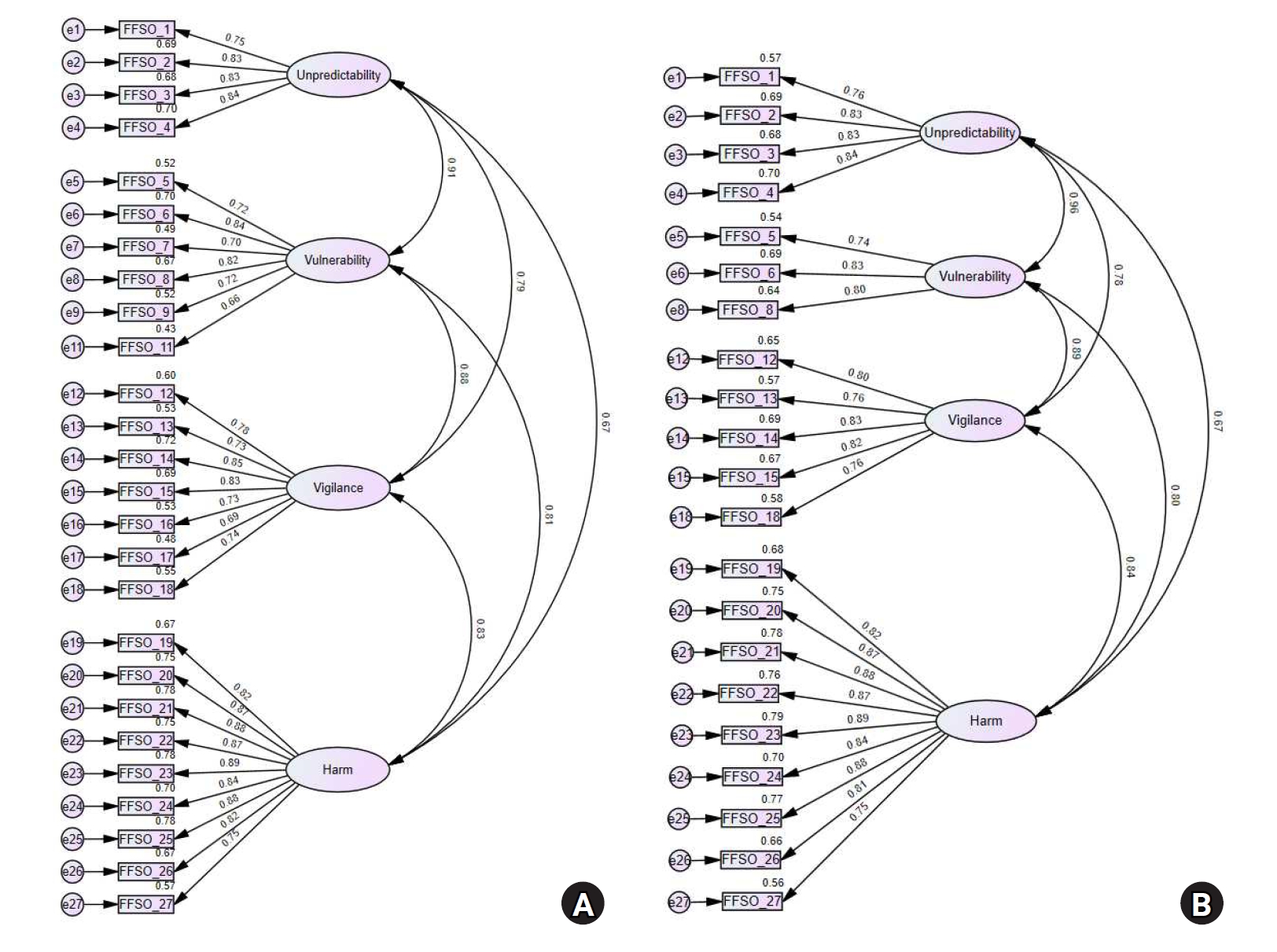
In total, 31 initial items were developed by referring to expressions from previous studies and items from existing instruments. After verifying content validity through expert evaluation, the remaining 27 items were used to construct a survey. Data from 252 participants recruited at three senior welfare centers in the metropolitan area were analyzed to examine item analysis, construct validity, convergent validity, discriminant validity, and reliability. Confirmatory factor analysis (CFA) was conducted to test construct validity. The correlation with the Korean version of the Falls Efficacy Scale-International (KFES-I) was used to assess convergent validity. Cronbach’s alpha was calculated to determine reliability.
Results
The final instrument consisted of 21 items. CFA confirmed acceptable model fit. Convergent validity was also acceptable and discriminant validity was partially supported. Correlations with the KFES-I ranged from .54 to .63. The Cronbach’s alpha coefficients for the total score and all factors ranged from .84 to .97.
Conclusion
The Fear of Falling Scale for Older Adults developed in this study is a validated tool capable of measuring various dimensions of fear of falling. It provides a foundation for accurately assessing fear of falling in older adults and addressing its specific aspects.
- 2,809 View
- 247 Download
- Effects of Fear of Coronavirus Disease 2019 and Social Distancing on Women’s Suicidal Ideation: Mediating Effect of Depression
- Hyo Yeon Kim, Hanjong Park
- J Korean Acad Nurs 2022;52(4):464-475. Published online August 31, 2022
- DOI: https://doi.org/10.4040/jkan.22078
-
Abstract
PDF
- Purpose
This study aimed to identify the mediating effects of depression amid the influence of fear and social distancing arising from Coronavirus disease 2019 (COVID-19) in Korean women’s suicidal ideation.
Methods
A descriptive correlation study was conducted. Study participants, recruited by Hankook Research from March 2 to March 5, 2021, included 300 women aged 19 to 49 living in South Korea, and 100 people were randomly allocated and enlisted for each age group out of 700,000 Hankook Research Panels recruited in advance from 17 cities and provinces nationwide. Data were collected through a self-reported questionnaire and analyzed using Pearson’s correlation coefficient and Hayes’ Process Macro Model 4 with 95% bias-corrected bootstrap confidence interval via SPSS statistics 27.0.
Results
Suicidal ideation was significantly correlated with fear of COVID-19 (r = .16, p = .006) and depression (r = .65, p < .001). The mediation effect of depression in the relationship between the fear of COVID-19 and suicidal ideation was found to be significant (B = 0.40, boot 95% CI: 0.21~0.61). However, social distancing did not significantly affect suicidal ideation via depression (B = - 0.79, boot 95% CI: - 1.94~0.26).
Conclusion
It is necessary to develop and apply interventions to prevent depression and suicidal behaviors by continuously observing and reducing the negative psychological responses caused by COVID-19. -
Citations
Citations to this article as recorded by
- Secular trend of self-injurious behaviors in PTSD and the impact of the COVID-19 pandemic: A quasi-experimental study
Kwanghyun Kim
Journal of Affective Disorders.2026; 401: 121316. CrossRef
- Secular trend of self-injurious behaviors in PTSD and the impact of the COVID-19 pandemic: A quasi-experimental study
- 2,214 View
- 48 Download
- 1 Web of Science
- 1 Crossref
Original Article
- Influencing Factors for Fear of Falling in Degenerative Arthritis Patients
- Jeong Sun Kim
- Journal of Korean Academy of Nursing 2007;37(7):1184-1192. Published online December 31, 2007
- DOI: https://doi.org/10.4040/jkan.2007.37.7.1184
-
Abstract
PDF
Purpose The purpose of this study was to examine the relationship among fear of falling, pain, anxiety and depression, and to identify influencing factors in elderly women patients with degenerative arthritis living in the community.
Method The subjects of this study were 297 elderly women patients with degenerative arthritis. Data was collected by personal interviews using questionnaires. Data was analyzed by the SPSS(version 12.0) computer program, and it included descriptive statistics, one-way ANOVA, Pearson correlation coefficient, and Stepwise multiple regression.
Results There was a significant difference (p= .000) in fear of falling according to the level of pain, anxiety, and depression. There was a significant positive correlation among fear of falling, pain, anxiety and depression. Depression, pain, number of medication, age, and anxiety showed significant predictors (43.5%) for fear of falling.
Conclusion This study suggested that thoroughly assessing predictors making an impact on fear of falling in the initial nursing assessment is the most important for falls prevention of elderly women patients with degenerative arthritis in the community.
-
Citations
Citations to this article as recorded by- Fear of falling and associated factors among patients with peripheral vestibular hypofunction
Hee Seung Song, Hyun Jung Lee
Journal of Exercise Rehabilitation.2020; 16(2): 162. CrossRef - The Effects of the Urinary Incontinence and Quality of Sleep on Fall Efficacy of the Community Dwelling Elderly
Eun-Suk Yun
Journal of the Korea Academia-Industrial cooperation Society.2014; 15(4): 2142. CrossRef - Relation of the Physical Performance and Fear of Falls of the Elderly
Eun-Suk Yun, Jisook An
Journal of the Korea Academia-Industrial cooperation Society.2014; 15(10): 6242. CrossRef - Fear of Falling and Related Factors in Elderly Living Alone Based on Fall Experience
Myungsuk Lee, Yunbok Lee
Journal of agricultural medicine and community health.2013; 38(4): 243. CrossRef - Prevalence and correlates of fear of falling in Korean community-dwelling elderly subjects
Seonho Kim, Wi-Young So
Experimental Gerontology.2013; 48(11): 1323. CrossRef - Effects of a Health Diary Program on Fall-Related Outcomes in Low-Income Elderly Women with Osteoarthritis
Myung-Suk Lee
Journal of agricultural medicine and community health.2011; 36(3): 167. CrossRef - Factors Influencing Fear of Falling in Postmenopausal Women
Sukhee Ahn, Huynli Kim, Heeyoung So, Rhayun Song
Korean Journal of Women Health Nursing.2009; 15(4): 344. CrossRef
- Fear of falling and associated factors among patients with peripheral vestibular hypofunction
- 1,520 View
- 3 Download
- 7 Crossref
 First
 Prev



