
 Submit an article

Search
- Page Path
- HOME > Search
Research Paper
- Transforming nursing education to enhance integrated nursing competency: a Delphi-based methodological study on symptom-based clinical reasoning
- Jeung-Im Kim, Soyoung Yu, Jin-Hee Park, Ju-Eun Song, Eunjung Ryu, JuHee Lee, YeoJin Im
- J Korean Acad Nurs 2026;56(1):39-50. Published online February 5, 2026
- DOI: https://doi.org/10.4040/jkan.25151
-
 Abstract
 PDF
PDF ePub
ePub - Purpose
This study aimed to address the shift toward competency-based education and the planned 2028 “Integrated Nursing” National Licensing Examination (NLE), this study aimed to establish structural alignment among NLE domains, the seven integrated nursing competencies (INCs), and curriculum goals, with a particular focus on implementing symptom-based clinical reasoning (SBCR).
Methods
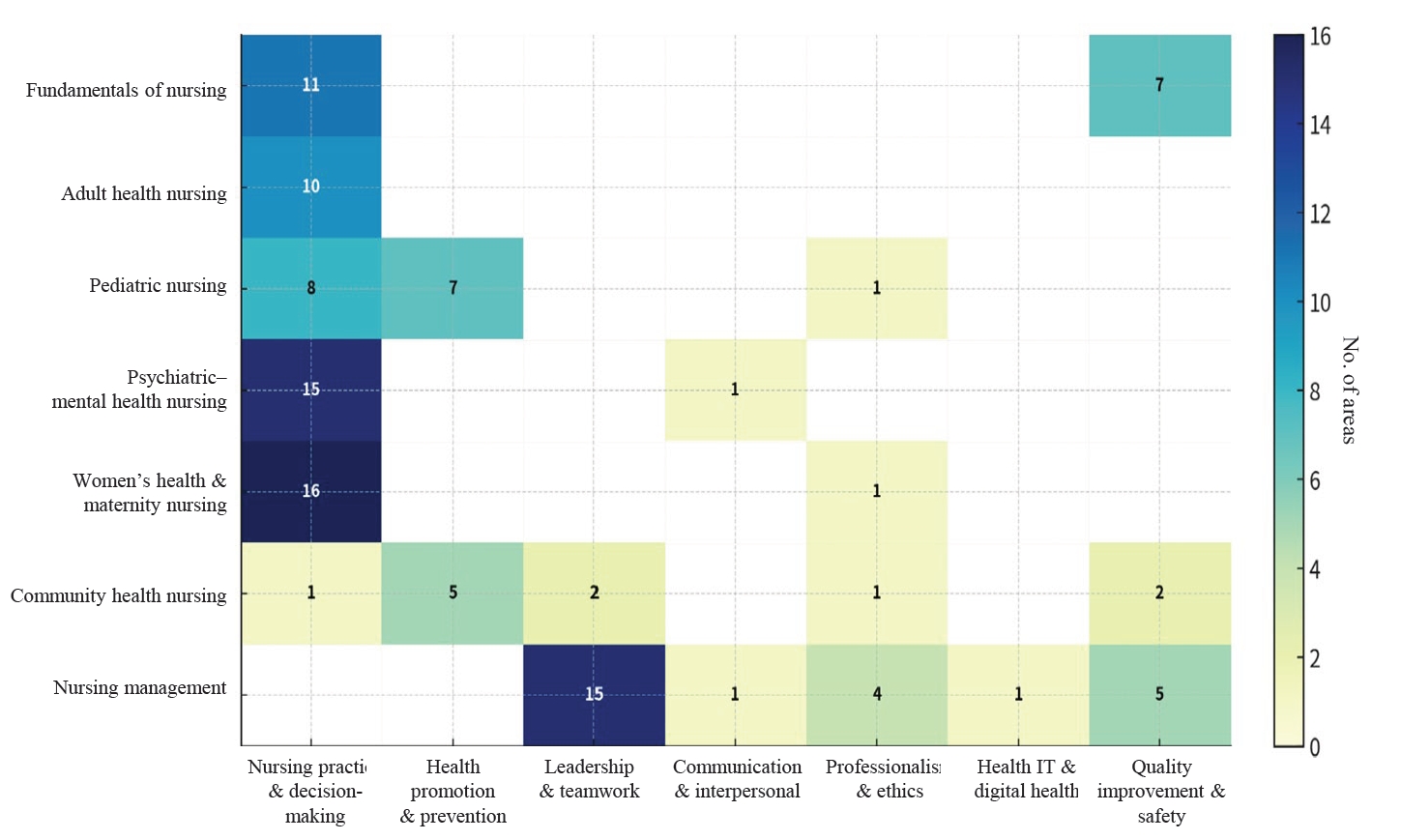
This Delphi-based methodological study included seven content experts for content validity index (CVI) assessment and 24 nursing education experts who participated in a consensus workshop. The item-level CVI and the scale-level CVI/average were calculated to confirm the linkage between INCs and NLE domains. In addition, qualitative analysis of workshop materials and meeting records was conducted to derive 10 integrated learning topics and to develop an SBCR educational model for the key symptom of headache, grounded in Miller’s Clinical Competence Pyramid (levels 2–4).
Results
The analysis confirmed the validity of integrating the INCs within the overall curriculum structure. The resulting framework delineates staged learning objectives and core clinical questions designed to systematically enhance clinical reasoning, promote safe nursing practice, and support professional reflection within a unified curriculum.
Conclusion
This study provides a practical foundation for nursing curriculum redesign by facilitating a transition from fragmented, subject-based instruction to a holistic, patient-centered SBCR model. This approach aligns with the requirements of the integrated NLE and is expected to contribute to meaningful improvements in actual clinical competency.
- 3,217 View
- 320 Download

Original Articles
- Development of Objectives in Nursing Clinical Education based on the Nursing Core Competencies
- Miwon Kim
- Journal of Korean Academy of Nursing 2006;36(2):389-402. Published online March 28, 2017
- DOI: https://doi.org/10.4040/jkan.2006.36.2.389
-
Abstract
PDF
Purpose The purpose of this study was to set up a Nursing Core Competencies required for staff nurses and to set up Objectives for Nursing Clinical Education based on the Nursing Core Competencies. The objectives in this study are to be achieved ultimately through clinical practice because it is a common avenue of work and the basic objective regardless of the education system and curriculum.
Method A nursing Core Competencies were established by literature review and verified by 15 experts. Nursing Clinical Education Objectives were established by literature review and analysis, and a survey for validity using a five point Likert scale was given to 257 nursing professors, 503 head-nurses, 509 staff nurses who had less than 3 years clinical experience in 34 general hospitals and 738 senior student nurses from 81 nursing colleges.
Result Nine nursing core competencies were set up. In addition 39 Objectives for each of the nursing clinical core competencies were set up.
Conclusion In conclusion, this study will contribute to professional nursing education to provide comprehensive nursing care by applying knowledge to nursing practice to achieve the Nursing Core Competency as a professional nurse.
-
Citations
Citations to this article as recorded by
- Development and effects of a labor nursing education program using a high-fidelity simulator for nursing students
Seo-A Park, Hye Young Kim
Korean Journal of Women Health Nursing.2020; 26(3): 240. CrossRef - Core nursing competency assessment tool for graduates of outcome‐based nursing education in South Korea: A validation study
YuKyung Ko, Soyoung Yu
Japan Journal of Nursing Science.2019; 16(2): 155. CrossRef - Development and Evaluation of Korean Nurses’ Core Competency Scale (KNCCS)
Won-Hee Lee, Sanghee Kim, Jihyoun An
Open Journal of Nursing.2017; 07(05): 599. CrossRef - A Study on Industry and Learner's Demand-Based Curriculum Development on Nursing Education : A Case of P University
Hwa-Jin Shin
Journal of Korean Clinical Health Science.2016; 4(4): 769. CrossRef - Clinical Competence and Organizational Socialization according to Communication Style of Preceptors as Perceived by New Nurses*
Young Choon Park, Hyoung Sook Park
Journal of Korean Academy of Fundamentals of Nursing.2016; 23(1): 42. CrossRef - Development and Application of Simulation-based Nursing Education Program for Post-myomectomy Care in Nursing Students
Hee Sook Kim, Gie Ok Noh
Journal of East-West Nursing Research.2016; 22(1): 60. CrossRef - Strategy for Improving Core Nursing Competency-based Education
Jeong-Mo Park, Chung-Sook Kim, Jae-Hee Kim, Ji-Yeon An, Eun-Young Pyo
The Journal of Korean Academic Society of Nursing Education.2015; 21(3): 426. CrossRef - Factors influencing the confidence in core clinical skills among hospital nurses
Young Ok Yang, Minju Kim, Kyung‐Yeon Park, Jin‐Hyang Yang
International Journal of Nursing Practice.2015; 21(6): 831. CrossRef - Curriculum Integration of Communication Simulation to Community Health Nursing Course for Nursing Students: Pilot Study
Yi-Kyung Ha
Journal of the Korea Academia-Industrial cooperation Society.2015; 16(4): 2329. CrossRef - Development of Nursing Competence Scale for Graduating Nursing Students
Ga Eul Joo, Kyeong-Yae Sohng
Journal of Korean Public Health Nursing.2014; 28(3): 590. CrossRef - A Study on Learning Experiences and Self-Confidence of Core Nursing Skills in Nursing Practicum among Final Year Nursing Students
Aekyung Han, Dong Sook Cho, Jongsoon Won
Journal of Korean Academy of Fundamentals of Nursing.2014; 21(2): 162. CrossRef - Effects of Family Nursing Practicum Using Role Play on Emotional Intelligence, Communication Ability, and Family Nursing Performance of Nursing Students
Eunok Park
The Journal of Korean Academic Society of Nursing Education.2013; 19(4): 656. CrossRef - Ego-Resilience and the Clinical Competence of Nursing Students
Eun Kyung Lee, Jin Ah Park
Journal of Korean Public Health Nursing.2013; 27(2): 293. CrossRef - Critical Thinking Disposition, Professional Self-Concept and Clinical Competence in Nursing Students
In-Soon Park, Ran Kim
The Korean Journal of Health Service Management.2013; 7(4): 105. CrossRef - The Mediating Effect of Professionalism in the Relationship between Clinical Competence and Field Adaptation in Newly Graduated Nurses
Young-Soon Kim, Kyung-Yeon Park
Journal of Korean Academy of Nursing Administration.2013; 19(4): 536. CrossRef - Professional Self-Concept, Critical Thinking Disposition and Clinical Competence in Nursing Students
Kyung-Ah Shin, Bok-Hee Cho
Journal of Korean Academy of Fundamentals of Nursing.2012; 19(1): 46. CrossRef - The Current Use of Human Patient Simulators in Nursing Schools in Korea
Yoon Ju Lee, Mi Won Kim, Eui Geum Oh
Korean Medical Education Review.2011; 13(2): 47. CrossRef
- Development and effects of a labor nursing education program using a high-fidelity simulator for nursing students
- 1,867 View
- 34 Download
- 17 Crossref
- Outcomes-based Curriculum Development and Student Evaluation in Nursing Education
- Hesook Suzie Kim
- J Korean Acad Nurs 2012;42(7):917-927. Published online December 12, 2012
- DOI: https://doi.org/10.4040/jkan.2012.42.7.917
-
Abstract
PDF
Abstract Purpose A curriculum development model is presented to examine the processes necessary to develop new programs or evaluate existing programs within the philosophy of outcomes-based education in nursing, especially in the context of accreditation. The philosophy of outcomes-based education is to produce individuals who can demonstrate the evidence of competencies in designated areas of education. For nursing education, this means competencies in performing the role of professional nursing as defined by the profession and social needs at the beginning level upon completing a nursing program.
Methods A curriculum development model has been developed analytically based on the literature and experiences.
Results A 10-step process framework incorporating the tenets of outcomes-based nursing education is illustrated.
Conclusion This curriculum development framework can be applied in developing new educational programs in nursing or to evaluate and revise existing programs in anticipation of the accreditation process that is moving with a full force in such countries as Korea.
-
Citations
Citations to this article as recorded by- Investigating knowledge, attitude, and practices toward nephrology nurse care among student nurses in the higher institute of nurse professions and health technicals of Fez in Morocco on 2023: A descriptive study
Mohammed Bouzid, Tarik Sqalli Houssaini
Journal of Education and Health Promotion.2026;[Epub] CrossRef - Evaluating undergraduate nursing education and student competencies: a mixed-methods study using the input- process- output framework
Menevse Yildirim, Melek Sahin
BMC Nursing.2025;[Epub] CrossRef - Keeping Up with the Outcomes-Based Education Trends in Nursing Education and Practice Among Professionals in the National Capital Regiona Dissertation Conferred in January 2024
Joan O. Ranada, Lily Famadico
International Journal of Multidisciplinary Applied Business and Education Research.2025; 6(7): 3661. CrossRef - Flipped Classroom Based on Outcomes-Based Education Improves Student Engagement and Clinical Analysis Competence in Undergraduates Ophthalmology Clerkship
Qing Liu, Xiao-Jiao Tang, Xin-Ke Chen, Lin Chen
Advances in Medical Education and Practice.2024; Volume 15: 599. CrossRef - Hemşirelik Eğitim Programlarında “Kara Kutu”nun Açılması: Logic Model Örneği
Gülsüm Çonoğlu, Fatma Orgun
Avrasya Sağlık Bilimleri Dergisi.2024; 7(3): 251. CrossRef - The effect of outcome-based education on clinical performance and perception of pediatric care of the third-year nursing students in Mongolia
Khishigdelger Lkhagvaa, Basbish Tsogbadrakh, Gankhuyag Gochoosuren, Oyungoo Badamdorj, Azadeh Stark, Omar Mohammad Ali Khraisat
PLOS ONE.2024; 19(6): e0305298. CrossRef - Development and implementation of a high-fidelity simulation training course for medical and nursing collaboration based on the Fink integrated course design model
Meng-Han Jiang, Li-Wen Dou, Bo Dong, Man Zhang, Yue-Ping Li, Cui-Xia Lin
Frontiers in Medicine.2024;[Epub] CrossRef - Experiences and attitudes of clinical and academic nurses about infection prevention and control nursing curriculum and duties - a qualitative study
Zahra Gorjian, Marziyeh Asadizaker, Kourosh Zarea, Alireza Irajpour, Fatemeh Ahmadi, Dariush Rokhafroz
BMC Medical Education.2024;[Epub] CrossRef - Nursing Education and Public Health Campaigns in Reducing Communicable Disease Transmission
Dhuha Hassan Alanazi, Aljawharah Muflih Dughaylib Almutairi, Eman Khalaf Ghannam Alanazi, Latifah Mohammed Subh Alhazmi, Dalal Sager Bedaiwi Altarfawi, Alya Ahmed Aljabbab, Hanin Saleh M Alsulimi, Muhannad Abdulhameed Alraddadi, Baraa Baderaldeen
International Journal of Computational and Experimental Science and Engineering.2024;[Epub] CrossRef - Transcultural adaptation and validity of the nurse professional competence scale Korean version for graduating nursing students: An explanatory factor analysis
Su Jung Lee, Hyun‐Ju Seo, Kye Ha Kim, Jinhee Kim, Hyunlye Kim, Jeong‐Min Park
Nursing Open.2023; 10(2): 579. CrossRef - Oral health education in the undergraduate nursing curriculum of Australian and Malaysian institutions
Mas S. Ahmad, Menaka A. Abuzar, Ishak A. Razak, Sabariah A. Rahman, Gelsomina L. Borromeo
European Journal of Dental Education.2021; 25(2): 350. CrossRef - Effects of a Simulation With Team-Based Learning on Knowledge, Team Performance, and Teamwork for Nursing Students
Young Sook Roh, Sang Suk Kim, Sunah Park, Jung-Won Ahn
CIN: Computers, Informatics, Nursing.2020; 38(7): 367. CrossRef - Understanding gaps and needs in the undergratue nursing curriculum in Iran: A prelude to design a competency-based curriculum model
Sepand Riazi, Nahid Dehghannayeri, Ali Hosseinikhah, Majid Aliasgari
Health Monitor Journal of the Iranian Institute for Health Sciences Research.2020; 19(2): 145. CrossRef - A study to determine the educational objectives and outcomes for pre-registration Diploma nursing program: A modified Delphi
Katherine Tan, Mei Chan Chong, Li Ping Wong
Nurse Education in Practice.2019; 39: 80. CrossRef - Effect of a Situational Module Learning Course on Critical Thinking Disposition and Metacognition in Nursing Students: A Quasi-experimental Study
Kwang Ok Park, Mi Yu
Journal of Korean Academic Society of Nursing Education.2019; 25(2): 251. CrossRef - Preliminary study of outcome‐based clinical practicum for undergraduate nursing students
Kyunghwa Lee, Sanghee Kim, You Lee Yang
Japan Journal of Nursing Science.2019; 16(2): 145. CrossRef - Investigating Factors Affecting Pharmaceutical Care Learning in Clinical Education in the View of Nursing Students in 2016 - 2017
Ellnaz Yazdan Parast, Bahare Rezvani Dehaghani, Sahar Nadimi, Seyed Hassan Ghorbani, Malihe Davoudi
Modern Care Journal.2018;[Epub] CrossRef - The effectiveness of outcome based education on the competencies of nursing students: A systematic review
Katherine Tan, Mei Chan Chong, Pathmawathy Subramaniam, Li Ping Wong
Nurse Education Today.2018; 64: 180. CrossRef - Development and application of course-embedded assessment system for program outcome evaluation in the Korean nursing education: A pilot study
Jee Won Park, Eun Ji Seo, Mi-Ae You, Ju-Eun Song
Nurse Education Today.2016; 38: 48. CrossRef - Developing Course Outcome to Achieve Exit Outcome: Applying Hauenstein's theory
Yoon Young Hwang, Sun Hee Kim, Min Sun Chu
The Journal of Korean Academic Society of Nursing Education.2015; 21(2): 155. CrossRef - The development of a web-based database system for managing program learning outcomes in a nursing school
Mikyung Moon, Soo-Kyoung Lee
Journal of the Korea Academia-Industrial cooperation Society.2015; 16(4): 2665. CrossRef - Development of Clinical Research Management: Enhancement of Nursing Students' Clinical Competency in Handling Clinical Trials
Sang Hui Chu, Yeonsoo Jang, Ki-Sun Yeo, Ji Hyeon Ahn, Doo Ree Kim
Journal of Korean Biological Nursing Science.2014; 16(3): 192. CrossRef - A Review Literature on Communication in Nurses
유미, 박성희, 박광옥
Health Communication, the Official Journal of Korean Academy on Communication in Healthcare.2014; 9(2): 99. CrossRef - Importance and Satisfaction on Nursing Core Competency of Nurses & Nurse Managers in a Community Hospitals
Sang-Dol Kim
Journal of the Korea Academia-Industrial cooperation Society.2013; 14(6): 2844. CrossRef
- Investigating knowledge, attitude, and practices toward nephrology nurse care among student nurses in the higher institute of nurse professions and health technicals of Fez in Morocco on 2023: A descriptive study
- 2,931 View
- 51 Download
- 24 Crossref
 First
First Prev
Prev


