
 Submit an article

Search
- Page Path
- HOME > Search
Research Papers
- Development and evaluation of a health education program to enhance middle school students’ climate adaptation competencies: a nonequivalent control group pretest–posttest study in Korea
- Jiyu Hyun, Ju Hee Kim
- J Korean Acad Nurs 2026;56(2):179-189. Published online May 22, 2026
- DOI: https://doi.org/10.4040/jkan.25139
-
 Abstract
 PDF
PDF ePub
ePub - Purpose
This study aimed to develop and evaluate the Climate and Health Action Mitigation Program (CHAMP), a health education intervention designed to enhance middle school students’ competencies for practicing climate adaptation behaviors in response to the health impacts of climate change.
Methods
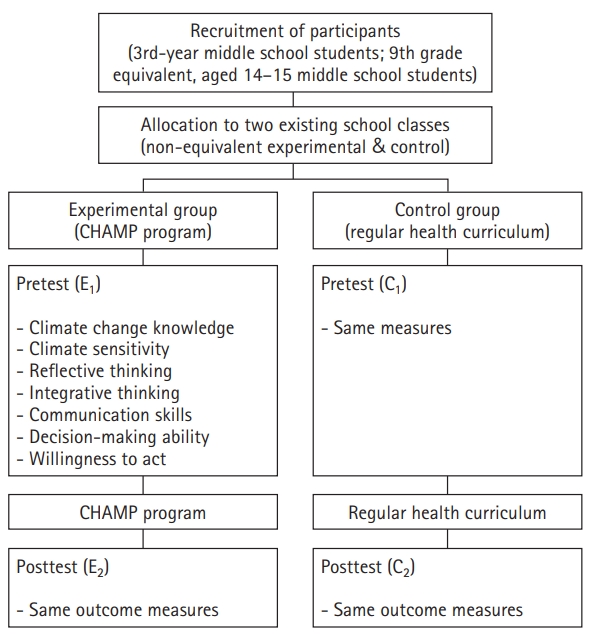
A quasi-experimental pretest-posttest nonequivalent control group design was employed. Data were collected from October to December 2024. A total of 3rd-year middle school students; 9th grade equivalent, aged 14-15 students were assigned to either an experimental group that received the CHAMP intervention or a control group that received conventional health education. The CHAMP curriculum comprised six sessions developed using the ADDIE (Analysis, Design, Development, Implementation, and Evaluation) instructional design model and was aligned with the 2022 revised national health curriculum and the instructional hours stipulated in the School Health Act. Climate adaptation competency and its seven subdomains—climate-change knowledge, climate sensitivity, reflective thinking, integrative thinking, communication skills, decision-making ability, and willingness to act—were assessed before and after the intervention.
Results
Compared with the control group, the experimental group demonstrated statistically significant improvements (p<.01) in overall climate adaptation competency as well as in all seven subdomains. The largest improvements were observed in willingness to act, climate sensitivity, and climate-change knowledge. The CHAMP intervention was associated with meaningful improvements in students’ climate adaptation competencies, encompassing cognitive, behavioral, and attitudinal domains.
Conclusion
These findings support the feasibility and educational value of integrating climate–health content into the national curriculum. Future research should examine the scalability of CHAMP and evaluate its long-term sustainability and effects across diverse educational settings.
- 1,523 View
- 199 Download

- Validity and Reliability of the Korean Version of the Climate, Health, and Nursing Tool
- Da Woon Jeong, Gwang Suk Kim, Min Kyung Park
- J Korean Acad Nurs 2022;52(2):173-186. Published online April 30, 2022
- DOI: https://doi.org/10.4040/jkan.21211
-
Abstract
PDF
- Purpose
Climate change has various negative effects on human health, which has resulted in increased burden on the health care system. Nurses contribute significantly to assessing climate-related health risks and creating a healthy environment. This study aimed to evaluate the reliability and validity of the Korean version of the Climate, Health, and Nursing Tool (K-CHANT) to measure nurses’ awareness, motivation, concern, and behaviors at work and at home regarding climate change and health.
Methods
The 22 items of English CHANT were translated into Korean with forward-backward translation techniques. Internal consistency reliability, test-retest reliability, and construct validity using confirmatory factor analysis were performed using SPSS WIN (25.0) and AMOS (26.0). Survey data were collected from 220 master’s, doctoral, and post-doctoral nursing students.
Results
The K-CHANT consists of 20 items across 5 domains.Two items of the original CHANT were excluded because of low content validity index and standardized regression weights. The internal consistency reliability of the K-CHANT, assessed by Cronbach’s αá was .81, with an intraclass correlation coefficient of .66~.90. The five subscales model was validated by confirmatory factor analysis (SRMR < .08, RMSEA < .08, AGFI > .70, CFI > .70).
Conclusion
The K-CHANT has satisfactory construct validity and reliability to measure nurses’ awareness, motivation, concern, and behaviors at work and at home regarding climate change and health. Future research should examine nurses’ perceptions and behaviors related to the health effects of climate change and develop an action plan to improve it. -
Citations
Citations to this article as recorded by
- Factors affecting environmental sustainability attitudes among nurses – Focusing on climate change cognition and behaviours: A cross‐sectional study
Sophia J. Chung, Haeyoung Lee, Sun Joo Jang
Journal of Advanced Nursing.2026; 82(4): 2863. CrossRef - Psychometric Properties of the Turkish Version of the Climate and Health Tool (CHAT) for Health Professionals: A Validity and Reliability Study
Arzu Bulut, Hande Demirtaş
Evaluation & the Health Professions.2026; 49(3): 341. CrossRef - Climate change-related behaviors among hospital nurses in South Korea: a latent profile analysis
Dukhyun Back, Kihye Han, Hyang Baek
BMC Nursing.2026;[Epub] CrossRef - Nurses’ Perceptions and Behaviors Regarding Climate Change and Health: A Correlational Study Aligned With Saudi Vision 2030
Yasir S Alsalamah, Lisa Babkair, Monerh A Alfalaij, Abeer Mohamed Abdelkader, Mona Gamal Mohamed, Mirna Fawaz, Ashraf Jehad Abuejheisheh, Thamer Alslamah, Azza Abdeldayem Ata, Manal Saleh Moustafa Saleh
Public Health Nursing.2026;[Epub] CrossRef - The Effects of Environmental Health Literacy and Climate Change‐Health Perception on Climate Change‐Health Nursing Practice Among Korean Community Health Practitioners: A Descriptive Correlational Study
Ra‐mi Choi, YounKyoung Jang
Public Health Nursing.2026;[Epub] CrossRef - Effects of an Online Education Program on the Competency of Korean Nurses in Responding to Climate Change: A Quasi-Experimental Study
Minkyung Park, Su Mi Chae, Hyejung Lee, Ari Min, Chang Gi Park, Gwang Suk Kim
The Journal of Continuing Education in Nursing.2026; : 1. CrossRef - Nurses' Perceptions and Behaviours Regarding Climate Change and Health: A Quantile Regression Analysis
Min Kyung Park, Seoyoung Baek, Da Woon Jeong, Gwang Suk Kim
Journal of Advanced Nursing.2025; 81(12): 8218. CrossRef - Exploring influences of environmental information, beliefs and self‐efficacy on nurses' climate health behaviours and their relationships
Jeongmin Yi, Yeojin Yi
Journal of Advanced Nursing.2025; 81(12): 8160. CrossRef - Climate change perceptions and behaviors among Korean nurses: The role of organizational initiatives
Dukhyun Back, Kihye Han, Jieun Kim, Hyang Baek
Nursing Outlook.2025; 73(3): 102383. CrossRef - Preparedness of nurses for climate change: questionnaire development and preliminary validation
Pui Hing Chau, Tiffany L.T. Yu, Yan Hu, Yasna K. Palmeiro Silva, Eileen Gilder, Michelle Cole, Roinah Ngunyulu, Chia-Chin Lin
International Journal of Nursing Studies Advances.2025; 8: 100337. CrossRef - Nurses' educational needs regarding climate change and health by type of institutions: A descriptive cross-sectional study
Min Kyung Park, Gwang Suk Kim, Da Woon Jeong, Seoyoung Baek
Nurse Education in Practice.2025; 87: 104473. CrossRef - İklim, Sağlık ve Hemşirelik Ölçeğinin Türkçeye Uyarlanması, Geçerlik ve Güvenirliğinin İncelenmesi
Özden Buse Yalçin, Betül Aktaş
Hemşirelik Bilimi Dergisi.2025; 8(2): 231. CrossRef - Evidencia de validez y fiabilidad de la Climate and Health Tool (CHANT): versión en español adaptada a la zona tropical latinoamericana
Ericka Carolina Murillo-Rodríguez, Diego Leal-Chaves
Revista Facultad Nacional de Salud Pública.2025;[Epub] CrossRef - Climate change and nursing research: a scoping review
Claire A Richards, Ann Dyer, Melissa Vera, Julie Postma
Environmental Research: Health.2025; 3(4): 042001. CrossRef - Measuring Nurses’ Knowledge and Awareness of Climate Change and Climate-Associated Diseases: Systematic Review of Existing Instruments
Omar Portela Dos Santos, Élodie Perruchoud, Filipa Pereira, Paulo Alves, Henk Verloo
Nursing Reports.2024; 14(4): 2850. CrossRef - Validation of the Sustainability Attitudes in Nursing Survey-2 for nurses: A cross-sectional study
Sophia J. Chung, Sun Joo Jang, Haeyoung Lee
Nurse Education in Practice.2024; 75: 103898. CrossRef - Factors related to perceptions of climate health impact and climate action: Focusing on the Health Belief Model
Hansol Lee, Jaehee Kim, Yuri Lee
Korean Journal of Health Education and Promotion.2024; 41(2): 31. CrossRef - Climate Change and Nursing
Yoomi Jung
Journal of Korean Academy of Nursing.2024; 54(4): 475. CrossRef - Development and Validation of a Dignity in Care Scale of Terminally Ill Patients for Nurses
Yun Sil Ahn, Pok Ja Oh
Journal of Korean Academy of Nursing.2023; 53(3): 340. CrossRef - Climate, Health, and Nursing Tool (CHANT): A confirmatory factor analysis
Anna Winquist, Elizabeth C. Schenk, Cara Cook, Shanda Demorest, Ekaterina Burduli
Public Health Nursing.2023; 40(2): 306. CrossRef - Factors Influencing Nursing Graduate Students’ Perception and Behavior Related to Climate Change and Health: A Secondary Data Analysis
Min Kyung Park, Seoyoung Baek, Da Woon Jeong, Gwang Suk Kim
Korean Journal of Adult Nursing.2023; 35(1): 71. CrossRef
- Factors affecting environmental sustainability attitudes among nurses – Focusing on climate change cognition and behaviours: A cross‐sectional study
- 4,030 View
- 258 Download
- 17 Web of Science
- 21 Crossref
 First
First Prev
Prev


