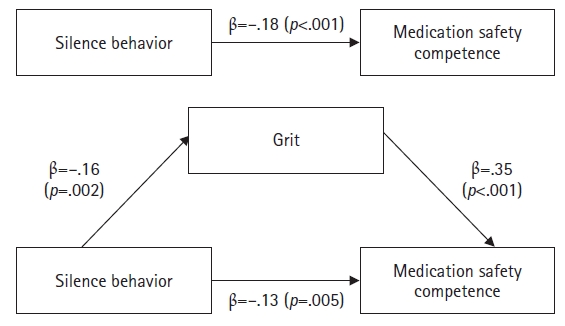
-
Mediating effect of grit on the influence of nurses’ silence behavior on medication safety competence: a cross-sectional study
-
Haengsuk Kim, Wanju Park
-
J Korean Acad Nurs 2025;55(1):81-92. Published online February 20, 2025
-
DOI: https://doi.org/10.4040/jkan.24088
-
-
 Abstract Abstract
 PDF PDF ePub ePub
- Purpose
This study investigated the mediating effect of grit in the relationship between silence behavior and medication safety competence among nurses.
Methods
The study included 166 nurses from four university hospitals and general hospitals in Seoul and Gyeonggi-do, South Korea. Data were collected from March 1 to 10, 2024, using self-report questionnaires. Data were analyzed using the t-test, analysis of variance, Scheffé’s test, and Pearson’s correlation coefficients with IBM SPSS Statistics ver. 23.0 (IBM Corp.). A mediation analysis was performed using Hayes’s PROCESS macro model 4 and the bootstrapping method.
Results
Medication safety competence showed significant correlations with silence behavior (r=–.21, p=.008) and grit (r=.43, p<.001). Furthermore, grit partially mediated the relationship between silence behavior and medication safety competence.
Conclusion
This study indicates that grit is a significant mediator in the relationship between silence behavior and medication safety competence. Therefore, an integrated approach that reduces silence behavior and promotes grit is essential for strengthening nurses’ medication safety competence. Ultimately, these strategies will help ensure patient safety by improving medication safety competence.
-
The Effects of the Combined Biofeedback and Brief Emotion Regulation Nursing Intervention Based on the Gross Model for Sexually Abused Adolescents
-
Jieun Kim, Wanju Park
-
J Korean Acad Nurs 2022;52(6):608-623. Published online December 31, 2022
-
DOI: https://doi.org/10.4040/jkan.22088
-
-
Abstract
PDF
- Purpose
This study aimed to evaluate the effects of a combined biofeedback and brief emotion regulation (C-BABER) program for sexually abused adolescents.
Methods
This study employed a non-equivalent control group pretest-posttest design. The participants included 26 sexually abused adolescents from eight Sunflower Centers of South Korea–with 13 in the experimental group and 13 in the control group. The experimental group received four sessions of the individual C-BABER program, each lasting 60 minutes.
Results
Compared with the control group, sexually abused adolescents in the experimental group exhibited significant score differences in traumatic symptoms, including depression (Z = - 2.24, p = .025), dissociation (Z = - 2.21, p = .027), anxiety (Z = - 2.02, p = .044), and posttraumatic stress (Z = - 2.01 p = .045); and impulsivity, including positive urgency (Z = - 3.35, p = .001) and negative urgency (Z = - 2.28, v = .023). Additionally, the experimental group exhibited significant score differences in meta-mood, including emotional attention (Z = - 2.45, p = .014), emotional clarity (Z = - 2.30, p = .021), and emotional repair (Z = - 2.28, p = .022); and emotional regulation modes, including emotional suppression (Z = - 2.65,p = .008) and cognitive reappraisal (Z = - 1.98, p = .047). Regarding bio-attention, significant changes were identified in the experimental group for the bio-attention rate and attention maintenance time in the posttest compared to the pretest (p = .001).
Conclusion
The C-BABER program for sexually abused adolescents is effective in decreasing traumatic symptoms and impulsivity, and in improving meta-mood, emotional regulation mode, and bio-attention. Therefore, we recommend providing sexually abused adolescents the C-BABER program to help them regulate their emotions and effectively adapt to their lives.
-
Citations
Citations to this article as recorded by  - Associations of school and sexual violence victimization with status delinquency among Korean adolescents
Han Na Hong, So Yeon Ryu, Mi Ah Han, Chungah Kim
Korean Journal of Health Education and Promotion.2026; 43(2): 29. CrossRef - The Effect of Biofeedback Training on Attention, Affect Balance, Academic Delay Behavior, and Problem-Solving Ability of Korean College Students
Jungmin Lee, Youngkyoung Kim, Wanju Park
Journal of Korean Public Health Nursing.2024; 38(2): 150. CrossRef
-
3,508
View
-
91
Download
-
2
Crossref
-
Effects of Electroencephalogram Biofeedback on Emotion Regulation and Brain Homeostasis of Late Adolescents in the COVID-19 Pandemic
-
Wanju Park, Mina Cho, Shinjeong Park
-
J Korean Acad Nurs 2022;52(1):36-51. Published online February 28, 2022
-
DOI: https://doi.org/10.4040/jkan.21155
-
-
Abstract
PDF
- Purpose
The purpose of this study was to examine the effects of electroencephalogram (EEG) biofeedback training for emotion regulation and brain homeostasis on anxiety about COVID-19 infection, impulsivity, anger rumination, meta-mood, and self-regulation ability of late adolescents in the prolonged COVID-19 pandemic situation.
Methods
A non-equivalent control group pretest-posttest design was used. The participants included 55 late adolescents in the experimental and control groups. The variables were evaluated using quantitative EEG at pre-post time points in the experimental group. The experimental groups received 10 sessions using the three-band protocol for five weeks. The collected data were analyzed using the Shapiro-Wilk test, Wilcoxon rank sum test, Wilcoxon signed-rank test, t-test and paired t-test using the SAS 9.3 program. The collected EEG data used a frequency series power spectrum analysis method through fast Fourier transform.
Results
Significant differences in emotion regulation between the two groups were observed in the anxiety about COVID-19 infection (W = 585.50, p = .002), mood repair of meta-mood (W = 889.50, p = .024), self-regulation ability (t = - 5.02, p < .001), self-regulation mode (t = - 4.74, p < .001), and volitional inhibition mode (t = - 2.61, p = .012). Neurofeedback training for brain homeostasis was effected on enhanced sensory-motor rhythm (S = 177.00, p < .001) and inhibited theta (S = - 166.00, p < .001).
Conclusion
The results demonstrate the potential of EEG biofeedback training as an independent nursing intervention that can markedly improve anxiety, mood-repair, and self-regulation ability for emotional distress during the COVID-19 pandemic.
-
Citations
Citations to this article as recorded by - From Neural Networks to Emotional Networks: A Systematic Review of EEG-Based Emotion Recognition in Cognitive Neuroscience and Real-World Applications
Evgenia Gkintoni, Anthimos Aroutzidis, Hera Antonopoulou, Constantinos Halkiopoulos
Brain Sciences.2025; 15(3): 220. CrossRef - Neuroimaging Insights into the Public Health Burden of Neuropsychiatric Disorders: A Systematic Review of Electroencephalography-Based Cognitive Biomarkers
Evgenia Gkintoni, Apostolos Vantarakis, Philippos Gourzis
Medicina.2025; 61(6): 1003. CrossRef - The interaction between emotion dynamics and opinion changes in the era of generative AI
Shangqian Li, Shaoyang Fan, Gianluca Demartini
Computers in Human Behavior Reports.2025; 19: 100722. CrossRef - Augmenting self-guided virtual-reality exposure therapy for social anxiety with biofeedback: a randomised controlled trial
Preethi Premkumar, Nadja Heym, James A. C. Myers, Phoebe Formby, Steven Battersby, Alexander Luke Sumich, David Joseph Brown
Frontiers in Psychiatry.2024;[Epub] CrossRef - Infection Anxiety and Coping Strategies Among Individuals With Schizophrenia During the COVID-19 Pandemic: Mediating Effects of Protection Motivation
Jeawon Joung, Dug Ja Choi
Journal of Psychosocial Nursing and Mental Health Services.2023; 61(11): 43. CrossRef - The Effects of Integrated Neurofeedback and Salutogenesis Nursing Intervention to Relieve Post-COVID-19 Symptoms in Late Adolescents
Youngkyung Cho, Wanju Park
Journal of Korean Academy of psychiatric and Mental Health Nursing.2023; 32(4): 402. CrossRef - Effects of Brain Attention Biofeedback Self-regulation Training Nursing Intervention on Attention, Multidimensional Impulsivity, Emotional Response Intensity, and Self-regulated Learning Ability of School-aged Children in the COVID-19 Pandemic Situation
Youngkyung Cho, Wanju Park
Journal of Korean Academy of psychiatric and Mental Health Nursing.2022; 31(2): 111. CrossRef - Comparison of QEEG Findings before and after Onset of Post-COVID-19 Brain Fog Symptoms
Marta Kopańska, Danuta Ochojska, Renata Muchacka, Agnieszka Dejnowicz-Velitchkov, Agnieszka Banaś-Ząbczyk, Jacek Szczygielski
Sensors.2022; 22(17): 6606. CrossRef
-
3,198
View
-
43
Download
-
6
Web of Science
-
8
Crossref
-
Effects of Mobile Navigation Program in Colorectal Cancer Patients based on Uncertainty Theory
-
Kyengjin Kim, Wanju Park
-
J Korean Acad Nurs 2019;49(3):274-285. Published online January 15, 2019
-
DOI: https://doi.org/10.4040/jkan.2019.49.3.274
-
-
Abstract
PDF
- Abstract
Purpose
This study aimed to examine the effects of a mobile navigation program on uncertainty, resilience, and growth through uncertainty in colorectal cancer patients.
Methods
To verify the effectiveness of the mobile navigation program, 61 participants diagnosed with colorectal cancer undergoing surgery were selected. A nonequivalent control group nonsynchronized design was used to evaluate the program. Uncertainty was measured using the Korean version of the Uncertainty in Illness Scale, resilience was measured using the Korean version of the Connor-Davidson Resilience Scale, and growth through uncertainty was measured using the Growth through Uncertainty Scale.
Results
Compared with the control group, patients in the mobile navigation program group showed significant differences in scores for uncertainty (F=7.22, p=.009) and resilience (F=4.31, p=.042), but not for growth through uncertainty (F=2.76, p=.102).
Conclusion
These results suggest that the mobile navigation program has positive effects on decreasing uncertainty and increasing resilience among colorectal cancer patients. The mobile navigation program could play a significant role in assisting colorectal cancer patients in regard to the continuity and usability of the program.
-
Citations
Citations to this article as recorded by - Developing and Evaluating a Mobile Application Self-management Program for Patients with Implantable Cardioverter-Defibrillators
Eunhee Jo, Rahyeon Hwang, Jeong-Lim Ryu, Chunja Yoo
CIN: Computers, Informatics, Nursing.2026;[Epub] CrossRef - Design and Validity of a Patient Navigation Program for Adults with Cancer Undergoing Chemotherapy
Gloria Mabel Carrillo González, Jorge Esteban García, Lina Marcela Zuluaga
Aquichan.2026; 25(4): 1. CrossRef - Providing 2 Types of mHealth Interventions to Support Self-Management Among People Living With HIV: Randomized Clinical Trial
Gwang Suk Kim, Layoung Kim, Seoyoung Baek, Sooyoung Kwon, Ji Min Kim, Jun Yong Choi, Jae-Phil Choi
JMIR mHealth and uHealth.2025; 13: e60905. CrossRef - Feasibility and Acceptability of a Mobile App Intervention to Promote Self‐Efficacy and Resilience Among Breast Cancer Patients Undergoing Chemotherapy: A Pilot Randomized Controlled Trial
Hsin‐Tien Hsu, Chih‐Ning Yu, Wan‐Na Sun, Tyng‐Yeu Liang, Shih‐Feng Weng, Erica Yu, Yi‐Fen Hsu
Psycho-Oncology.2025;[Epub] CrossRef - Effects of a Video-based Education Program for Cerebral Angiography on Patients’ Outcomes: A Randomized Controlled Trial
Sung-Hyun Tark, Jee-In Hwang
Quality Improvement in Health Care.2024; 30(1): 76. CrossRef - Influence of Illness Uncertainty on Health Behavior in Individuals with Coronary Artery Disease: A Path Analysis
Hyesun Jeong, Yesul Lee, Jin Sup Park, Yoonju Lee
Journal of Korean Academy of Nursing.2024; 54(2): 162. CrossRef - The Influence of Uncertainty in Illness and Coping on Quality of Life in Colorectal Cancer Patients Receiving Chemotherapy
Jin Ah Kim, Juyoun Yu
Asian Oncology Nursing.2024; 24(2): 63. CrossRef - Development of a nurse navigation program for cancer pain
Miyoung Yoo, Eunyoung E. Suh, Mi Jang, Sunsil Kang
Asia-Pacific Journal of Oncology Nursing.2024; 11(7): 100528. CrossRef - Mobile App for Gynecologic Cancer Support for Patients With Gynecologic Cancer Receiving Chemotherapy in China: Multicenter Randomized Controlled Trial
Huicong Lin, Mingzhu Ye, Yanjuan Lin, Fuhong Chen, Sally Chan, Hongxia Cai, Jiemin Zhu
Journal of Medical Internet Research.2023; 25: e49939. CrossRef - Effects of an interactive coaching intervention on quality of life and psychological factors for colorectal cancer survivors: A single group pre and posttest design
Jaehee Yoon, HyunHae Lee, Heesook Son
European Journal of Oncology Nursing.2023; 66: 102413. CrossRef - The Development of a Mobile Application for Older Adults for Rehabilitation Instructions After Hip Fracture Surgery
YoungJi Ko, Jong-Moon Hwang, Seung-Hoon Baek
Geriatric Orthopaedic Surgery & Rehabilitation.2021;[Epub] CrossRef - Essential Role of Theory in Nursing Research for Advancement of Nursing Science
Soyoung Yu, Ju-Eun Song
Journal of Korean Academy of Nursing.2021; 51(4): 391. CrossRef - A multi‐centre randomized controlled trial of mobile gynaecological cancer support program for patients with gynaecological cancer undergoing chemotherapy: Study protocol
Huicong Lin, Sally Wai‐chi Chan, Mingzhu Ye, Yanlong Wang, Hongli Liu, Min Li, Shengjie Liu, Jiemin Zhu
Journal of Advanced Nursing.2021; 77(5): 2539. CrossRef - The Relationships among Social Support, Bowel Function Symptoms and Uncertainty in Rectal Cancer Patients
Kyungmi Lee, Semi Lim
Journal of Korean Academy of Fundamentals of Nursing.2021; 28(4): 421. CrossRef
-
2,704
View
-
61
Download
-
12
Web of Science
-
14
Crossref
|

 Submit an article