-
Migrant health research in South Korea, 2010–2021: a scoping review
-
Soo Jin Kang, Bok-Nam Seo
-
J Korean Acad Nurs 2026;56(2):126-147. Published online May 19, 2026
-
DOI: https://doi.org/10.4040/jkan.25152
-
-
 Abstract Abstract
 PDF PDF ePub ePub
- Purpose
This scoping review mapped research trends in migrant health in Korea and evaluated their alignment with global priorities.
Methods
We conducted a scoping review using the Arksey and O’Malley framework. We searched PubMed, CINAHL, Scopus, KoreaMed, ScienceON, RISS, and KISS for articles published between 2010 and 2021, which defined the review period. The inclusion criteria were studies of adult migrants residing in Korea, primary empirical research, and academic journal articles with full text available in Korean or English. Two reviewers performed inductive coding and assigned each study to one primary subject area for frequency counts.
Results
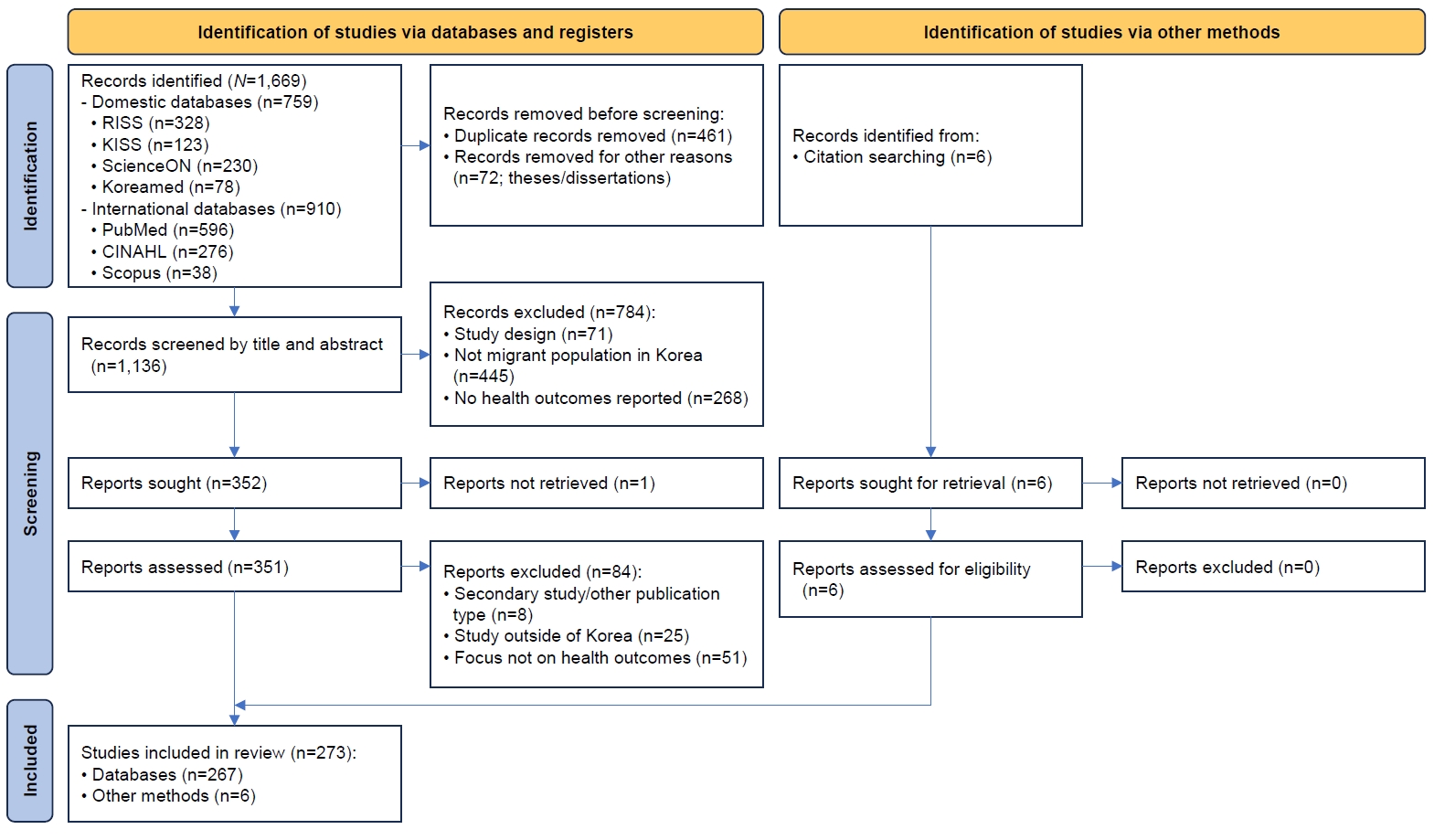
Of 1,669 records, 273 studies met the inclusion criteria. Marriage-migrant women were the most frequently studied group (56.4%), followed by migrant workers (20.5%) and international students (7.0%). Ten subject areas were identified. Mental health (56/273; 20.5%) and health status and quality of life (47/273; 17.2%) were the most common, whereas infection was the least common (6/273; 2.2%). According to World Health Organization priority areas, P4 (tackling the social determinants of health) was the most common (132/273; 48.4%), followed by P1 (promoting health through public health interventions) (73/273; 26.7%). P3 (mainstreaming health policies and fostering partnerships) and P5 (strengthening health monitoring and information systems) were minimally represented (6/273; 2.2% and 11/273; 4.0%, respectively).
Conclusion
Migrant health research in Korea is heavily concentrated on individual-level topics and marriage-migrant populations, with limited evidence on policies, monitoring systems, and underserved groups (e.g., refugees and diverse populations). Future studies should diversify the populations examined, standardize national monitoring and linked data infrastructure, strengthen the P3 and P5 priority areas, and include more longitudinal, interventional, and policy evaluation research.
-
Suitability and Readability Assessment of Printed Educational Materials on Hypertension
-
Tae Wha Lee, Soo Jin Kang, Hye Hyun Kim, So Ra Woo, Sinhye Kim
-
J Korean Acad Nurs 2011;41(3):333-343. Published online June 13, 2011
-
DOI: https://doi.org/10.4040/jkan.2011.41.3.333
-
-
Abstract
PDF
-
Purpose
The aim of this study was to assess the suitability and readability of printed educational materials for patients with hypertension in Korea.
Methods
A total of 33 written educational materials related to hypertension were collected from public health centers, hospitals, and internet web site. Among them, we analyzed 19 materials which fit the inclusion criteria: leaflets (n=9), booklets (n=3), and guide book (n=7). Two trained nurses evaluate the materials using suitability assessment tool (SAM; Doak, Doak, & Root, 1996a) and graded lexical items for teaching Korean (Kim, 2003).
Results
Overall, 14 (73.7%) of 19 materials scored adequate, and 5 (26.3%) scored inadequate. On the average, the education materials contained 36.1% to 50.5% of 1st grade reading level words and 12.9% to 21.6% of 4th grade level and over.
Conclusion
The reading level of the materials was higher than a 6th grade reading level. It is proposed that the written educational materials should be developed by health professionals according to suitability and quality by taking the target group's literacy capacity into consideration.
-
Citations
Citations to this article as recorded by  - Readability of Korean-Language COVID-19 Information from the South Korean National COVID-19 Portal Intended for the General Public: Cross-sectional Infodemiology Study
Hana Moon, Geon Ho Lee, Yoon Jeong Cho
JMIR Formative Research.2022; 6(3): e30085. CrossRef - Factors Associated with the Health Literacy on Social Determinants of Health: A Focus on Socioeconomic Position and Work Environment
Mikyeong Cho, Young-Me Lee, Seung joo Lim, Hyeonkyeong Lee
International Journal of Environmental Research and Public Health.2020; 17(18): 6663. CrossRef - Assessing of the audiovisual patient educational materials on diabetes care with PEMAT
Soo Jin Kang, Mi Sook Lee
Public Health Nursing.2019; 36(3): 379. CrossRef - Assessing and Validating an Educational Resource Package for Health Professionals to Improve Smoking Cessation Care in Aboriginal and Torres Strait Islander Pregnant Women
Yael Bar-Zeev, Michelle Bovill, Billie Bonevski, Maree Gruppetta, Jennifer Reath, Gillian Gould
International Journal of Environmental Research and Public Health.2017; 14(10): 1148. CrossRef - Evaluation of the Readability and Suitability of Printed Educational Materials on Metabolic Syndrome
Jung Eun Kim, Sook Ja Yang
Journal of Korean Public Health Nursing.2016; 30(1): 149. CrossRef - Evidence-based health literacy improvements: trends on health literacy studies in Korea
Soo Jin Kang, Mi Sook Lee
Korean Journal of Health Education and Promotion.2015; 32(4): 93. CrossRef - Readability and Suitability Evaluation of Educational Materials on Diabetes Mellitus
Young-Ran Chin, Kyung-Won Choi
The Korean Journal of Health Service Management.2014; 8(2): 161. CrossRef
-
1,588
View
-
9
Download
-
7
Crossref
|
 KSNS
KSNS
 Submit an article