-
Usefulness of Charlson comorbidity index-adjusted mortality prediction tools and factors influencing mortality in intensive care unit patients: a retrospective medical record review–based study
-
Jai Jung Lee, Dong Yeon Kim, Min Ji Lee, Ji Young Kim
-
J Korean Acad Nurs 2026;56(1):27-38. Published online February 11, 2026
-
DOI: https://doi.org/10.4040/jkan.25094
-
-
 Abstract Abstract
 PDF PDF ePub ePub
- Purpose
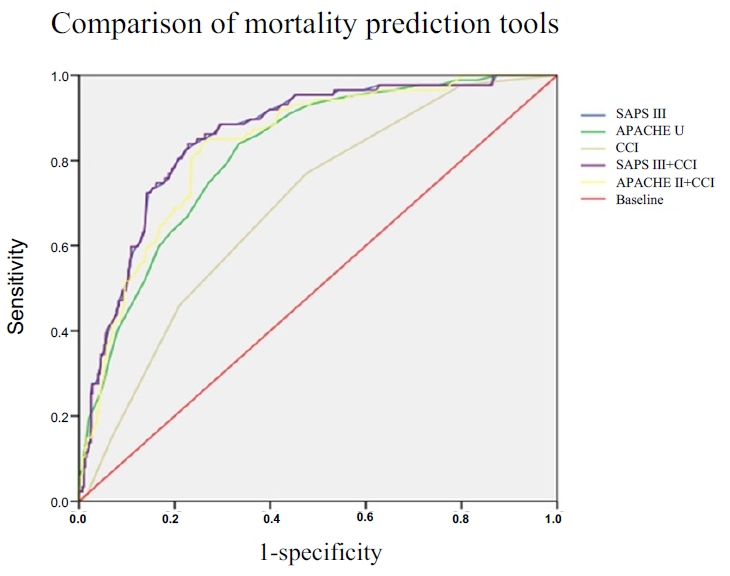
This study aimed to estimate the mortality rate in adult intensive care units (ICUs) using the Charlson comorbidity index (CCI)-adjusted Acute Physiology and Chronic Health Evaluation (APACHE) II and Simplified Acute Physiology Score (SAPS) III models, and to identify factors influencing mortality.
Methods
This retrospective cohort study included adult patients admitted to the ICU at a tertiary hospital between June 1 and August 31, 2022. Among the 1,098 screened patients, those younger than 18 years, those discharged within 48 hours, and those with missing medical records were excluded. In total, 482 patients were analyzed using the chi-square test, independent t-test, and multivariate logistic regression. Model performance was evaluated using the c-statistic and the Hosmer-Lemeshow goodness-of-fit test.
Results
The predictive accuracy of the mortality models was shown by c-statistic values of 0.817 for APACHE II, 0.857 for SAPS III, 0.697 for CCI, and 0.834 for CCI-adjusted APACHE II (0.834). Mechanical ventilation, cardiopulmonary cerebral resuscitation, continuous renal replacement therapy, and the presence of leukemia or lymphoma were significant predictors of mortality in adult ICU patients. Among the evaluated models, SAPS III and CCI-adjusted APACHE II demonstrated the highest predictive power.
Conclusion
The findings indicate that incorporating comorbidity indices such as the CCI with acute physiological parameters improves the accuracy of mortality prediction in ICU patients. Understanding mortality prediction models is essential for nurses to provide individualized, evidence-based, and high-quality care in adult ICUs.
-
Analysis of ROX Index, ROX-HR Index, and SpO 2 /FIO 2 Ratio in Patients Who Received HighFlow Nasal Cannula Oxygen Therapy in Pediatric Intensive Care Unit
-
Sun Hee Choi, Dong Yeon Kim, Byung Yun Song, Yang Sook Yoo
-
J Korean Acad Nurs 2023;53(4):468-479. Published online August 31, 2023
-
DOI: https://doi.org/10.4040/jkan.22152
-
-
Abstract
PDF
- Purpose
This study aimed to evaluate the use of the respiratory rate oxygenation (ROX) index, ROX-heart rate (ROX-HR) index, and saturation of percutaneous oxygen/fraction of inspired oxygen ratio (SF ratio) to predict weaning from high-flow nasal cannula (HFNC) in patients with respiratory distress in a pediatric intensive care unit.
Methods
A total of 107 children admitted to the pediatric intensive care unit were enrolled in the study between January 1, 2017, and December 31, 2021. Data on clinical and personal information, ROX index, ROX-HR index, and SF ratio were collected from nursing records. The data were analyzed using an independent t-test, χ2 test, Mann–Whitney U test, and area under the curve (AUC).
Results
Seventy-five (70.1%) patients were successfully weaned from HFNC, while 32 (29.9%) failed. Considering specificity and sensitivity, the optimal cut off points for predicting treatment success and failure of HFNC oxygen therapy were 6.88 and 10.16 (ROX index), 5.23 and 8.61 (ROX-HR index), and 198.75 and 353.15 (SF ratio), respectively. The measurement of time showed that the most significant AUC was 1 hour before HFNC interruption.
Conclusion
The ROX index, ROX-HR index, and SF ratio appear to be promising tools for the early prediction of treatment success or failure in patients initiated on HFNC for acute hypoxemic respiratory failure. Nurses caring for critically ill pediatric patients should closely observe and periodically check their breathing patterns. It is important to continuously monitor three indexes to ensure that ventilation assistance therapy is started at the right time.
-
Citations
Citations to this article as recorded by  - Admission Respiratory Rate-Oxygenation Index and Outcome of Acute Respiratory Illness in a Pediatric Intensive Care Unit
Vijendra Singh, Umesh Pandwar, Navindana ., Manjusha Goel
Cureus.2026;[Epub] CrossRef - Non-invasive SpO2/FiO2 ratio (SFR) as surrogate for PaO2/FiO2 ratio (PFR): A scoping review
Madhura Reddy, Malavika Kulkarni, Sushma Thimmaiah Kanakalakshmi, Laxmi Shenoy, Rama Rani KrishnaBhat
The Journal of Critical Care Medicine.2025; 11(3): 221. CrossRef - Can the ROX index predict high‐flow nasal cannula failure in children under 2 with lower respiratory tract infection?
Pablo Vasquez‐Hoyos, Alvaro L. Jacome‐Orozco, Andrea P. Rodriguez‐Mayorga, Leidy E. Sepulveda‐Forero, Diana P. Escobar‐Serna, Juan S. Barajas, Evelyn Obando‐Belalcazar, Claudia M. Salinas‐Jaimes, Juan J. Peralta‐Palmezano, Alexandra Jimenez‐Chavez, Rafael
Pediatric Pulmonology.2024; 59(5): 1246. CrossRef - Impact of Surgical Mask Placement Over High-Flow Nasal Cannula on Oxygenation Parameters in COVID-19 Patients Experiencing Hypoxemic Respiratory Failure
Aadila Coatwala, Mayank Dhir, Sagar Sinha, Dattatray Bhusare
Cureus.2024;[Epub] CrossRef
-
7,571
View
-
206
Download
-
2
Web of Science
-
4
Crossref
|
 KSNS
KSNS
 Submit an article