
 Submit an article

Articles
- Page Path
- HOME > J Korean Acad Nurs > Volume 56(3); 2026 > Article
-
Research Paper
난임 부부의 난임 스트레스와 주관적 행복감의 자기-상대방 상호의존 매개모형: 공동대처의 매개효과 -
김은진1
 , 노주희2
 - The actor-partner interdependence mediation model of infertility-related stress and subjective happiness in infertile couples: the mediating role of dyadic coping
-
Eun Jin Kim1, Ju-Hee Nho2
-
Journal of Korean Academy of Nursing 2026;56(3):421-433.
DOI: https://doi.org/10.4040/jkan.26047
Published online: August 11, 2026
1우석대학교 간호대학
2전북대학교 간호대학ㆍ간호과학연구소
1College of Nursing, Woosuk University, Wanju, South Korea
2College of NursingㆍResearch Institute of Nursing Science, Jeonbuk National University, Jeonju, South Korea
- Corresponding author: Ju-Hee Nho College of NursingㆍResearch Institute of Nursing Science, Jeonbuk National University, 567 Baekje-daero, Deokjin-gu, Jeonju 54896, Korea E-mail: jhnho@jbnu.ac.kr
- †This manuscript is a condensed form of the first author’s doctoral dissertation from Jeonbuk National University in 2023.
• Received: March 31, 2026 • Revised: May 17, 2026 • Accepted: July 6, 2026
© 2026 Korean Society of Nursing Science
This is an Open Access article distributed under the terms of the Creative Commons Attribution NoDerivs License (http://creativecommons.org/licenses/by-nd/4.0) If the original work is properly cited and retained without any modification or reproduction, it can be used and re-distributed in any format and medium.
- 777 Views
- 54 Download


Abstract
-
Purpose
- This study aimed to identify the mediating effect of dyadic coping and the actor–partner effects of infertility-related stress, dyadic coping, and subjective happiness among infertile couples by applying the actor–partner interdependence mediation model.
-
Methods
- A total of 115 infertile couples, comprising women diagnosed with primary infertility and their spouses, participated in an online survey. Data were collected between November 17, 2022 and January 9, 2023, and analyzed using IBM SPSS Statistics version 25.0 and SmartPLS version 4.0.9.2 with the path weighting scheme. Bootstrapping with 5,000 resamples was performed to estimate 95% confidence intervals.
-
Results
- Significant correlations were observed between infertile women and their spouses in infertility-related stress, dyadic coping, and subjective happiness, indicating mutual psychological influence within couples. Infertility-related stress in both women and spouses had actor effects on their own dyadic coping and subjective happiness. Women’s dyadic coping had an actor effect on their own subjective happiness, whereas spouses’ dyadic coping had a partner effect on women’s subjective happiness. Among women with infertility, dyadic coping significantly mediated the association between infertility-related stress and subjective happiness. A significant partner-mediated effect was also observed for women’s subjective happiness, whereas no significant mediating effect was found for spouses’ own subjective happiness.
-
Conclusion
- Infertility-related stress was associated with subjective happiness through dyadic coping among women with infertility. In addition, spouses’ infertility-related stress was indirectly associated with women’s subjective happiness through spouses’ dyadic coping. These findings suggest that interventions designed to strengthen dyadic coping may help reduce infertility-related stress and improve subjective happiness among infertile couples.
서론
방법
1) 난임 스트레스
2) 공동대처
3) 주관적 행복감
4) 일반적 특성
결과
1) 측정 모형의 평가
(1) 외부 적재치
(2) 내적 일관성 신뢰도
(3) 판별타당도
(4) 집중타당도
2) 구조모형의 평가
(1) 다중공선성 평가
(2) 결정계수 평가
(3) 가설적 모형의 적합도 평가
(4) 효과크기 평가
고찰
결론
-
Conflicts of Interest
No potential conflict of interest relevant to this article was reported.
-
Acknowledgements
None.
-
Funding
This work was supported by a National Research Foundation of Korea (NRF) grant funded by the Korean government (No. NRF-2020R1F1A1050767).
-
Data Sharing Statement
Please contact the corresponding author for data availability.
-
Supplementary Data
Supplementary data to this article can be found online at https://doi.org/10.4040/jkan.26047.
Supplementary Material 1. Research hypothesis
-
Author Contributions
Conceptualization: EJK, JHN. Methodology: EJK, JHN. Software: EJK, JHN. Validation: EJK, JHN. Formal analysis: EJK. Investigation: EJK, JHN. Resources: EJK, JHN. Data curation: EJK. Visualization: EJK, JHN. Supervision: JHN. Project administration: JHN. Funding acquisition: JHN. Writing–original draft: EJK, JHN. Writing–review & editing: EJK, JHN. Final approval of the manuscript: all authors.
Article Information
Fig. 1.The hypothetical model of this study and path diagram for final model. (A) Hypothetical model of this study. (B) Path diagram for final model. Happy 1: relative happiness; Happy 2: comparitive happiness; Oneself: dyadic coping by oneself; Partners: dyadic coping by partners; Stress 1: social concern; Stress 2: sexual concern; Stress 3: relational concern; Stress 4: rejection of daily life without children; Stress 5: need to be parents. M: men; W: women.
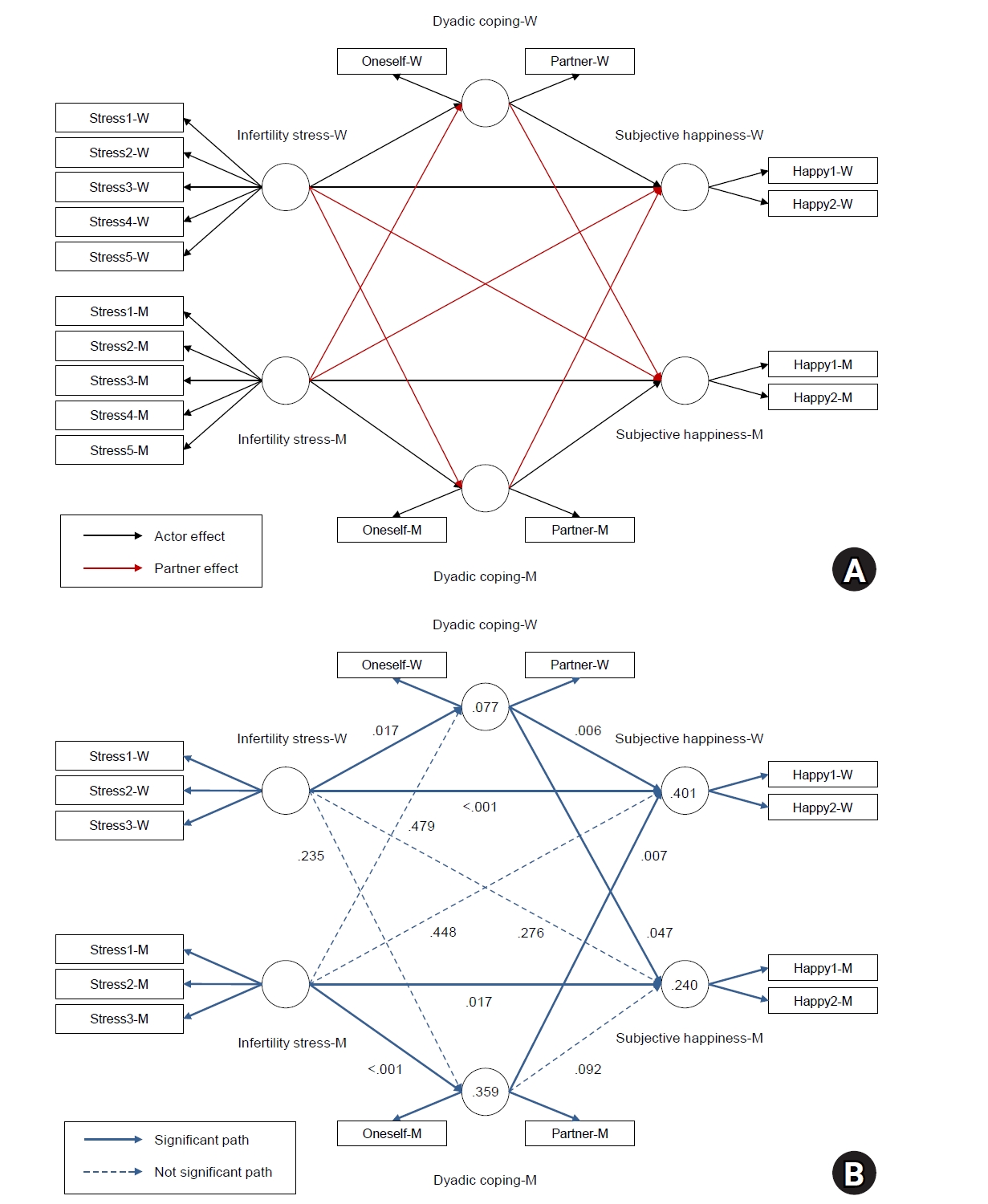
Table 1.General characteristics of participants (N=230)
Table 2.Descriptive statistics of research variables (N=230)
Table 3.Correlation of research variables (N=230)
Table 4.Evaluation of structural models and hypothesis test (N=230)
- 1. World Health Organization. Guideline for the prevention, diagnosis and treatment of infertility [Internet]. World Health Organization; 2025 [cited 2025 Nov 28]. Available from: https://www.ncbi.nlm.nih.gov/books/NBK620423
- 2. Park JS, Lim JY, Kim EJ, Byoun SJ, Lee SY, Chang IS, et al. 2021 National Survey on Fertility and Family Health and Welfare. Korea Institute for Health and Social Affairs; 2021. https://doi.org/10.23060/kihasa.a.2021.50
- 3. Practice Committee of the American Society for Reproductive Medicine. Definitions of infertility and recurrent pregnancy loss: a committee opinion. Fertil Steril. 2013;99(1):63. https://doi.org/10.1016/j.fertnstert.2012.09.023ArticlePubMed
- 4. Lan M, Zhou N, Chen B, Yu H. Analysis of couple communication patterns as a mediator of fertility-related stress and psychological capital in women with severe ovarian hyperstimulation syndrome after embryo transfer. Sci Rep. 2025;15(1):25223. https://doi.org/10.1038/s41598-025-10945-8ArticlePubMedPMC
- 5. Park JC. Assessment of anxiety, depression, and sexual dysfunction in women undergoing fertility treatment. Clin Exp Reprod Med. 2025;52(1):38-43. https://doi.org/10.5653/cerm.2024.07465ArticlePubMedPMC
- 6. Tang N, Pei M, Liu H, Chen J, Wang Y, Xie L, et al. Infertility-related stress, and dyadic coping as predictors of quality of life: gender differences among couples with infertility issues. Int J Womens Health. 2024;16:1265-1276. https://doi.org/10.2147/IJWH.S469513ArticlePubMedPMC
- 7. Woods BM, Patrician PA, Fazeli PL, Ladores S. Infertility-related stress: a concept analysis. Nurs Forum. 2022;57(3):437-445. https://doi.org/10.1111/nuf.12683ArticlePubMed
- 8. Shi LP, Geng YG, Mao ZW, Zhang Y, Sun SJ, Gu JJ. Infertility-related stress is associated with quality of life through negative emotions among infertile outpatients. Sci Rep. 2024;14(1):19690. https://doi.org/10.1038/s41598-024-70798-5ArticlePubMedPMC
- 9. Song X, Zhao J, Xiao Z, Ye H, Dong S, Hu L, et al. The actor-partner interdependence model of fertility stress and marital quality among couples undergoing in vitro fertilization and embryo transfer: the mediating role of dyadic coping. Stress Health. 2024;40(6):e3483. https://doi.org/10.1002/smi.3483ArticlePubMedPMC
- 10. Wang X, Yang M, Zhang Y, Zhang Y, Lin Y, Sun S, et al. How resilience mitigates depression after IVF-ET failure: a moderated mediation model of hope, social relations, and income in China. Int J Womens Health. 2025;17:3865-3879. https://doi.org/10.2147/IJWH.S549816ArticlePubMedPMC
- 11. Kim EJ, Nho JH, Kim HY. The mediating effect of health-promoting behaviors on the relationship between infertility stress and fertility-related quality of life of infertile women: a cross-sectional study. Womens Health Nurs. 2025;31(1):66-75. https://doi.org/10.4069/whn.2025.03.24ArticlePubMedPMC
- 12. Cook WL, Kenny DA. The actor-partner interdependence model: a model of bidirectional effects in developmental studies. Int J Behav Dev. 2005;29(2):101-109. https://doi.org/10.1080/01650250444000405Article
- 13. Ledermann T, Macho S, Kenny DA. Assessing mediation in dyadic data using the actor-partner interdependence model. Struct Equ Modeling. 2011;18(4):595-612. https://doi.org/10.1080/10705511.2011.607099Article
- 14. Won SK, Seol KO. Actor and partner effects of couple’s daily stress and dyadic coping on marital satisfaction. J Korean Acad Nurs. 2020;50(6):813-821. https://doi.org/10.4040/jkan.20162ArticlePubMed
- 15. Chen W, Li H, Cai JZ, Qin N. Association between dyadic coping and quality of life in breast cancer patients and their spouses: an actor-partner interdependence mediation model. Asian Nurs Res (Korean Soc Nurs Sci). 2024;18(1):44-50. https://doi.org/10.1016/j.anr.2024.01.007ArticlePubMed
- 16. Bodenmann G. Dyadic coping-a systematic-transactional view of stress and coping among couples: theory and empirical findings. Eur Rev Appl Psychol. 1997;47(2):137-140. Article
- 17. Landolt SA, Weitkamp K, Roth M, Sisson NM, Bodenmann G. Dyadic coping and mental health in couples: a systematic review. Clin Psychol Rev. 2023;106:102344. https://doi.org/10.1016/j.cpr.2023.102344ArticlePubMed
- 18. Bai J, Zheng J, Dong Y, Wang K, Cheng C, Jiang H. Psychological distress, dyadic coping, and quality of life in infertile clients undergoing assisted reproductive technology in China: a single-center, cross-sectional study. J Multidiscip Healthc. 2022;15:2715-2723. https://doi.org/10.2147/JMDH.S393438ArticlePubMedPMC
- 19. Bodenmann G. Dyadic coping and its significance for marital functioning. In: Revenson TA, Kayser K, Bodenmann G, editors. Couples Coping with Stress: Emerging Perspectives on Dyadic Coping. Washington (DC): American Psychological Association; 2005. p. 33-49.
- 20. Lazarus RS, Folkman S. Stress, appraisal, and coping. Springer Publishing Company; 1984. p. 181-225.
- 21. Bodenmann G. A systemic-transactional conceptualization of stress and coping in couples. Swiss J Psychol. 1995;54(1):34-49.
- 22. Bodenmann G, Randall AK, Falconier MK. Coping in couples: the Systemic Transactional Model (STM). In: Falconier MK, Randall AK, Bodenmann G, editors. Couples coping with stress: a cross-cultural perspective. Routledge; 2016. p. 5-22.
- 23. von Elm E, Altman DG, Egger M, Pocock SJ, Gøtzsche PC, Vandenbroucke JP, et al. The Strengthening the Reporting of Observational Studies in Epidemiology (STROBE) statement: guidelines for reporting observational studies. BMJ. 2007;335(7624):806-808. https://doi.org/10.1136/bmj.39335.541782.ADArticlePubMedPMC
- 24. Shi Z, Nie H, Geng L, Wang X, Chen G, Li S. Evaluating health-related quality of life and subjective wellbeing among infertility patients: a cross-sectional study in mainland China. Qual Life Res. 2023;32(5):1469-1480. https://doi.org/10.1007/s11136-022-03330-9ArticlePubMed
- 25. Wolf EJ, Harrington KM, Clark SL, Miller MW. Sample size requirements for structural equation models: an evaluation of power, bias, and solution propriety. Educ Psychol Meas. 2013;76(6):913-934. https://doi.org/10.1177/0013164413495237ArticlePubMedPMC
- 26. Newton CR, Sherrard W, Glavac I. The Fertility Problem Inventory: measuring perceived infertility-related stress. Fertil Steril. 1999;72(1):54-62. https://doi.org/10.1016/s0015-0282(99)00164-8ArticlePubMed
- 27. Kim JH, Shin HS. Validation of a Korean version of Fertility Problem Inventory. Asian Nurs Res. 2014;8(3):207-212. https://doi.org/10.1016/j.anr.2014.03.004Article
- 28. Bodenmann G. Dyadic coping inventory: test manual. Huber; 2008.
- 29. Lyubomirsky S, Lepper HS. A measure of subjective happiness: preliminary reliability and construct validation. Soc Indic Res. 1999;46(2):137-155. https://doi.org/10.1023/A:1006824100041Article
- 30. Im JS. Self-enhancement bias of old age, interpretation of life events and subjective well-being [master’s thesis]. Seoul: Ewha Womans University; 2004.
- 31. O’Connor BP, Crawford MR, Holder MD. An item response theory analysis of the subjective happiness scale. Soc Indic Res. 2015;124(1):249-258. https://doi.org/10.1007/s11205-014-0773-9Article
- 32. Lee HS, Boo S, Ahn JA, Song JE. Effects of uncertainty and spousal support on infertility-related quality of life in women undergoing assisted reproductive technologies. Korean J Women Health Nurs. 2020;26(1):72-83. https://doi.org/10.4069/kjwhn.2020.03.15ArticlePubMedPMC
- 33. Hari GS, Hari PS, Devakumar I, Padmam S. Assessment of socio-demographic factors associated with depression among couples attending a tertiary-care infertility clinic. Int J Community Med Public Health. 2024;11(8):3047-3056. https://doi.org/10.18203/2394-6040.ijcmph20241961Article
- 34. Hair JF Jr, Matthews LM, Matthews RL, Sarstedt M. PLS-SEM or CB-SEM: updated guidelines on which method to use. Int J Multivar Data Anal. 2017;1(2):107-123. https://doi.org/10.1504/IJMDA.2017.087624Article
- 35. Shin GK. SmartPLS 4.0 Structural equation modeling: for master’s/doctoral dissertations and scholarly papers. Cheongram Publishing Co.; 2023. 496 p.
- 36. Nunnally JC, Bernstein IH. Psychometric theory. 3rd ed. McGraw-Hill; 1994. 701 p.
- 37. Henseler J, Ringle CM, Sarstedt M. A new criterion for assessing discriminant validity in variance-based structural equation modeling. J Acad Mark Sci. 2015;43(1):115-135. https://doi.org/10.1007/s11747-014-0403-8Article
- 38. Fornell C, Larcker DF. Evaluating structural equation models with unobservable variables and measurement error. J Mark Res. 1981;18(1):39-50. https://doi.org/10.2307/3151312Article
- 39. Stone M. Cross‐validatory choice and assessment of statistical predictions. J R Stat Soc Series B Methodol. 1974;36(2):111-133. https://doi.org/10.1111/j.2517-6161.1974.tb00994.xArticle
- 40. Geisser S. The predictive sample reuse method with applications. J Am Stat Assoc. 1975;70(350):320-328. https://doi.org/10.1080/01621459.1975.10479865Article
- 41. Fornell C, Cha J. Partial least squares. In: Bagozzi RP, editor. Advanced methods of marketing research. Blackwell; 1994. p. 52-78.
- 42. Hair JF Jr, Hult GT, Ringle CM, Sarstedt M. A primer on partial least squares structural equation modeling (PLS-SEM). 2nd ed. SAGE; 2017. 211 p.
- 43. Xu J, Zhang XY, Zhouchen YB, Luo Y, Wang SY, Redding SR, et al. Relationship between resilience and fertility quality of life in infertile women: mediating roles of infertility self-efficacy and infertility coping. Healthcare (Basel). 2025;13(20):2589. https://doi.org/10.3390/healthcare13202589ArticlePubMedPMC
- 44. Lee KY, Kim SH. The mediating role of self-esteem between spousal support and infertility-related stress among infertile couples: actor effects and partner effects. Fam Environ Res. 2021;59(4):465-475. https://doi.org/10.6115/fer.2021.033Article
- 45. Wang G, Liu X, Lei J. Effects of mindfulness-based intervention for women with infertility: a systematic review and meta-analysis. Arch Womens Ment Health. 2023;26(2):245-258. https://doi.org/10.1007/s00737-023-01307-2ArticlePubMed
- 46. Kim M, Ban M. The reliability and validity of Korean version of the Infertility Stigma Scale (K-ISS). J Korean Acad Nurs. 2022;52(6):582-597. https://doi.org/10.4040/jkan.22068ArticlePubMed
- 47. Reisi M, Kazemi A. Design and psychometric evaluation of the collaborative coping with infertility questionnaire in candidate of assisted reproductive techniques. Sci Rep. 2024;14(1):10804. https://doi.org/10.1038/s41598-024-61607-0ArticlePubMedPMC
- 48. Weitkamp K, Feger F, Landolt SA, Roth M, Bodenmann G. Dyadic coping in couples facing chronic physical illness: a systematic review. Front Psychol. 2021;12:722740. https://doi.org/10.3389/fpsyg.2021.722740ArticlePubMedPMC
- 49. Shin Y, Nam SH. An integrative review of psychosocial intervention programs for infertile females. Korean J Stress Res. 2023;31(4):158-167. https://doi.org/10.17547/kjsr.2023.31.4.158Article
- 50. Van Ryckeghem L, Wallays A, Oelbrandt E, Buffel V. Fertile ground for social support?: understanding men’s use of online infertility support groups. Digit Health. 2026;12:20552076261430610. https://doi.org/10.1177/20552076261430610ArticlePubMedPMC
References
Figure & Data
REFERENCES
Citations
Citations to this article as recorded by 
 ePub Link
 Cite
Cite XML Download
The actor-partner interdependence mediation model of infertility-related stress and subjective happiness in infertile couples: the mediating role of dyadic coping
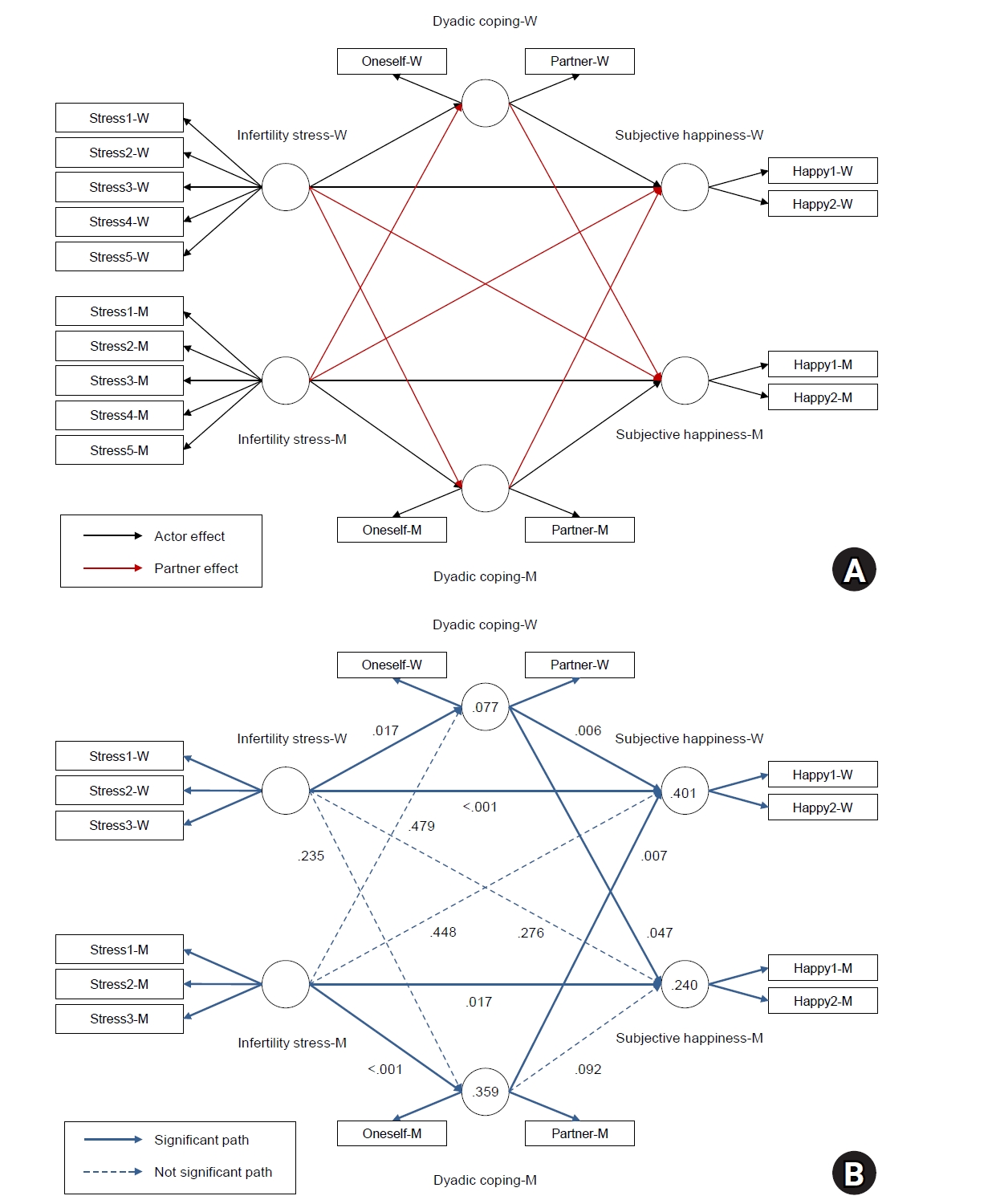
Fig. 1. The hypothetical model of this study and path diagram for final model. (A) Hypothetical model of this study. (B) Path diagram for final model. Happy 1: relative happiness; Happy 2: comparitive happiness; Oneself: dyadic coping by oneself; Partners: dyadic coping by partners; Stress 1: social concern; Stress 2: sexual concern; Stress 3: relational concern; Stress 4: rejection of daily life without children; Stress 5: need to be parents. M: men; W: women.
Fig. 1.
The actor-partner interdependence mediation model of infertility-related stress and subjective happiness in infertile couples: the mediating role of dyadic coping
| Characteristic | Infertile women (n=115) | Spouse (n=115) |
|---|---|---|
| Age (yr) | 36.1±4.12 (25–46) | 38.7±4.15 (31–56) |
| <35 | 39 (33.9) | 13 (11.3) |
| ≥35 | 76 (66.1) | 102 (88.7) |
| Occupation | ||
| Yes | 93 (80.9) | 114 (99.1) |
| No | 22 (19.1) | 1 (0.9) |
| Religion | ||
| Yes | 47 (40.9) | 53 (46.1) |
| No | 68 (59.1) | 62 (53.9) |
| Education level | ||
| ≤High school | 7 (6.1) | 11 (9.6) |
| College | 97 (84.3) | 84 (73.0) |
| ≥Master’s degree | 11 (9.6) | 20 (17.4) |
| Marital period (yr) | 3.16±0.83 | |
| <1 | 3 (2.6) | |
| 1–2.9 | 23 (20.0) | |
| 3–4.9 | 42 (36.5) | |
| ≥5 | 47 (40.9) | |
| Infertility treatment period (yr) | 1.97±0.78 | |
| <1 | 31 (27.0) | |
| 1–2.9 | 61 (53.0) | |
| 3–4.9 | 18 (15.7) | |
| ≥5 | 5 (4.3) | |
| Household income (1,000 Korean won) | ||
| <300 | 3 (2.7) | |
| 300–399 | 22 (19.1) | |
| 400–499 | 22 (19.1) | |
| ≥500 | 68 (59.1) | |
| Experienced infertility treatment methoda) | ||
| No | 5 (4.3) | |
| Ovulation induction | 89 (77.4) | |
| Intrauterine insemination | 63 (54.8) | |
| In vitro fertilization | 26 (22.6) | |
| Others | 34 (29.6) | |
| Experienced infertility treatment method within last 3 monthsa) | ||
| No | 13 (11.3) | |
| Ovulation induction | 63 (54.8) | |
| Intrauterine insemination | 43 (37.4) | |
| In vitro fertilization | 27 (23.5) | |
| Others | 19 (16.5) |
| Variable | Infertile women (n=115) | Spouse (n=115) | Range of scale | ||||
|---|---|---|---|---|---|---|---|
| Min–max | Median (IQR) | Mean±SD | Min–max | Median (IQR) | Mean±SD | ||
| Infertility stress | 1–6 | ||||||
| Total | 2.15–4.41 | 3.46 (3.08–3.65) | 3.35±0.44 | 1.63–4.28 | 3.15 (2.83–3.41) | 3.09±0.51 | |
| Social concern | 1.70–4.90 | 3.50 (3.10–3.70) | 3.38±0.60 | 1.00–4.40 | 3.20 (2.70–3.50) | 3.04±0.65 | |
| Sexual concern | 1.00–4.75 | 3.38 (2.88–3.88) | 3.27±0.78 | 1.00–4.38 | 3.00 (2.25–3.38) | 2.78±0.79 | |
| Relational concern | 1.50–4.90 | 3.40 (2.90–3.60) | 3.26±0.56 | 1.50–4.50 | 3.20 (2.90–3.60) | 3.19±0.62 | |
| Rejection of daily life without children | 1.13–4.25 | 2.50 (2.13–2.88) | 2.54±0.60 | 1.13–3.88 | 2.38 (2.00–2.88) | 2.38±0.65 | |
| Need to be parents | 2.10–6.00 | 4.20 (3.70–4.50) | 4.13±0.64 | 1.20–5.50 | 3.80 (3.50–4.20) | 3.86±0.68 | |
| Dyadic coping | 1–5 | ||||||
| Total | 2.16–4.62 | 3.67 (3.35–3.85) | 3.58±0.38 | 2.55–5.00 | 3.90 (3.39–4.12) | 3.85±0.54 | |
| Dyadic coping by oneself | 2.60–4.60 | 3.53 (3.20–3.71) | 3.48±0.35 | 2.53–5.00 | 3.93 (3.27–4.13) | 3.81±0.58 | |
| Dyadic coping by partner | 2.13–5.00 | 3.53 (3.27–3.67) | 3.49±0.38 | 2.60–5.00 | 3.93 (3.33–4.20) | 3.83±0.59 | |
| Subjective happiness | 1–7 | ||||||
| Total | 1.33–7.00 | 4.67 (4.33–5.67) | 4.88±0.93 | 1.33–7.00 | 5.00 (4.67–6.00) | 5.12±0.50 | |
| Relative happiness | 1.50–7.00 | 5.00 (4.50–5.50) | 5.00±0.97 | 1.50–7.00 | 5.50 (4.50–6.00) | 5.22±1.15 | |
| Comparative happiness | 1.00–7.00 | 5.00 (4.00–5.00) | 4.64±1.16 | 1.00–7.00 | 5.00 (4.00–6.00) | 4.93±1.33 | |
| Variable | Infertile women | Spouse | |||||
|---|---|---|---|---|---|---|---|
| 1 | 2 | 3 | 4 | 5 | 6 | ||
| Infertile women (n=115) | 1. Infertility stress | ||||||
| 2. Dyadic coping | –.21 (.011) | ||||||
| 3. Subjective happiness | –.38 (<.001) | .50 (<.001) | |||||
| Spouse (n=115) | 4. Infertility stress | .48 (<.001) | –.21 (.013) | –.30 (.001) | |||
| 5. Dyadic coping | –.37 (<.001) | .63 (<.001) | .48 (<.001) | –.48 (<.001) | |||
| 6. Subjective happiness | –.26 (.003) | .37 (<.001) | .55 (<.001) | –.44 (<.001) | .48 <.001) | ||
| Path | β | t | p | f2 | Adjusted R2 | Q2 | 95% CI | |
|---|---|---|---|---|---|---|---|---|
| Actor effect | Infertility stress (W) → Subjective happiness (W) | –.34 | 3.39 | <.001 | .12 | .40 | .36 | |
| Dyadic coping (W) → Subjective happiness (W) | .24 | 2.53 | .006 | .08 | ||||
| Partner effect | Dyadic coping (M) → Subjective happiness (W) | .24 | 2.46 | .007 | .03 | |||
| Infertility stress (M) → Subjective happiness (W) | –.01 | 0.13 | .448 | .01 | ||||
| Actor effect | Infertility stress (M) → Subjective happiness (M) | –.32 | 2.13 | .017 | .09 | .24 | .12 | |
| Dyadic coping (M) → Subjective happiness (M) | .19 | 1.33 | .092 | .01 | ||||
| Partner effect | Dyadic coping (W) → Subjective happiness (M) | .18 | 1.67 | .047 | .03 | |||
| Infertility stress (W) → Subjective happiness (M) | .09 | 0.60 | .276 | .01 | ||||
| Actor effect | Infertility stress (W) → Dyadic coping (F) | –.28 | 2.13 | .017 | .07 | .08 | .24 | |
| Infertility stress (M) → Dyadic coping (M) | –.56 | 6.75 | <.001 | .36 | .36 | .32 | ||
| Partner effect | Infertility stress (W) → Dyadic coping (M) | –.07 | 0.72 | .235 | .02 | |||
| Infertility stress (M) → Dyadic coping (W) | .01 | 0.05 | .479 | .00 | ||||
| Actor effect | Infertility stress (W) → Dyadic coping (W) → Subjective happiness (W) | –.07 | 1.69 | .046 | –0.13 – –0.00 | |||
| Infertility stress (M) → Dyadic coping (M) → Subjective happiness (M) | –.10 | 1.27 | .103 | –0.25–0.01 | ||||
| Partner effect | Infertility stress (M) → Dyadic coping (M) → Subjective happiness (W) | –.14 | 2.30 | .011 | –0.24 – –0.04 | |||
| Infertility stress (W) → Dyadic coping (M) → Subjective happiness (W) | –.02 | 0.66 | .255 | –0.06–0.02 | ||||
| Infertility stress (M) → Dyadic coping (W) → Subjective happiness (M) | .00 | 0.05 | .482 | –0.03–0.04 | ||||
| Infertility stress (W) → Dyadic coping (W) → Subjective happiness (M) | –.05 | 1.13 | .129 | –0.14–0.01 | ||||
| Infertility stress (W) → Dyadic coping (M) → Subjective happiness (M) | –.01 | 0.48 | .315 | –0.07–0.01 | ||||
| Infertility stress (M) → Dyadic coping (W) → Subjective happiness (W) | .00 | 0.05 | .481 | –0.06–0.04 | ||||
| SRMR | .07 | |||||||
Table 1. General characteristics of participants (N=230)
Values are presented as mean±standard deviation (range) or number (%) unless otherwise stated. a)Multiple response analysis.
Table 2. Descriptive statistics of research variables (N=230)
IQR, interquartile range (25th percentile to 75th percentile); SD, standard deviation.
Table 3. Correlation of research variables (N=230)
Values are presented as rho (
Table 4. Evaluation of structural models and hypothesis test (N=230)
CI, confidence interval; M, men; SRMR, standardized root mean square residual; W, women.


