
 Submit an article

Search
- Page Path
- HOME > Search
Research Paper
- Effects of social support on organizational commitment among experienced nurses experiencing department rotation: the mediating effect of organizational socialization
- Young Jun Jang, Jeong A Jeong, Yu Seung Ban, Seon Hwa Park, Eun Jee Lee
- J Korean Acad Nurs 2025;55(3):364-376. Published online August 18, 2025
- DOI: https://doi.org/10.4040/jkan.25042
-
 Abstract
 PDF
PDF ePub
ePub - Purpose
This study explored the mediating role of organizational socialization in the relationship between social support and organizational commitment among nurses in hospitals who had experienced department rotation.
Methods
A descriptive survey design was used with 202 nurses from a tertiary hospital who had experienced department rotation within the past 12 months. Data were collected via an online questionnaire from August 1 to August 30, 2024. Analyses included frequency analysis, descriptive statistics, Pearson correlation, and multiple regression. The mediating effect was tested using IBM SPSS WIN ver. 23.0 and the PROCESS macro (model 4) with 10,000 bootstrap resamples.
Results
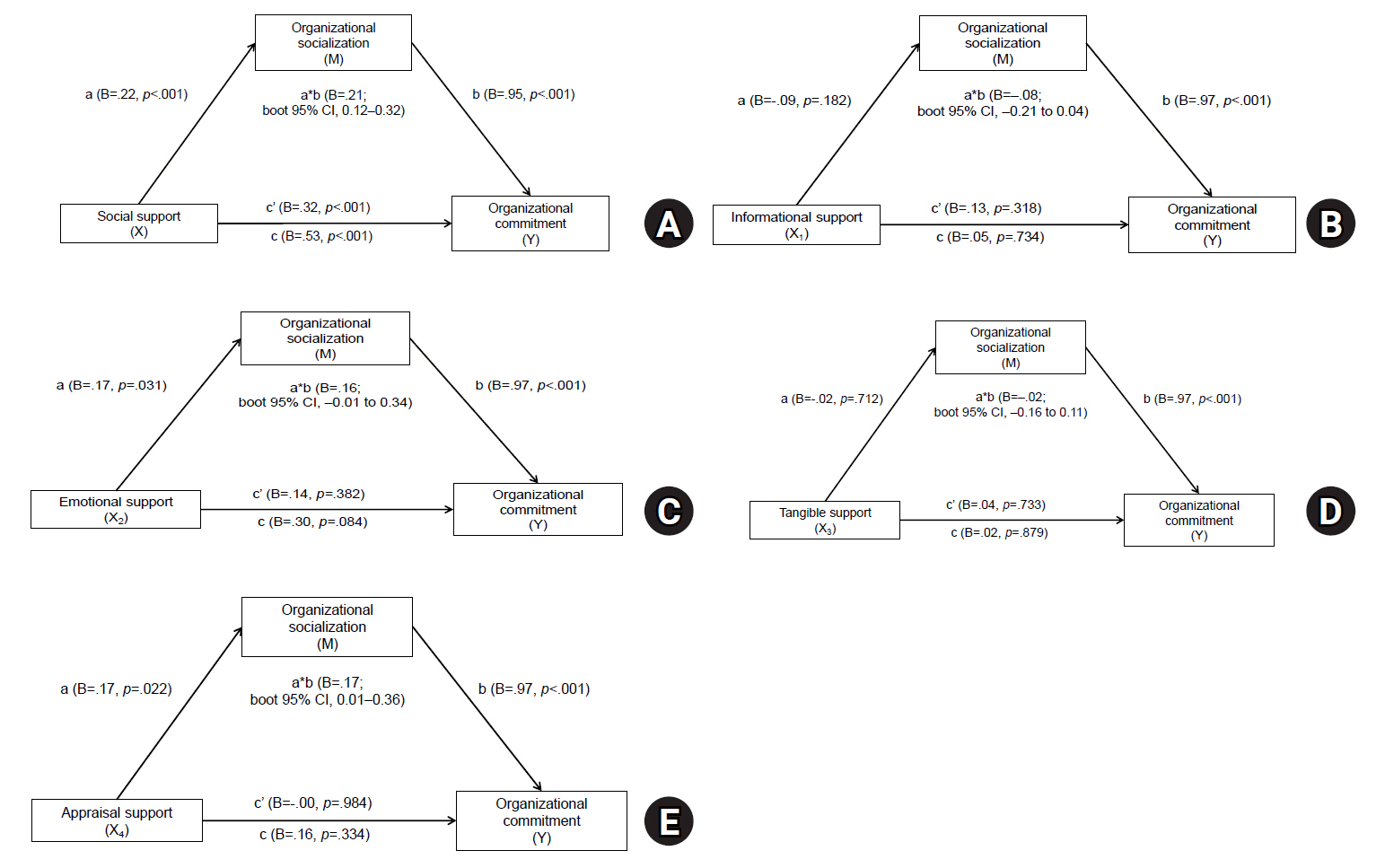
Organizational socialization partially mediated the relationship between social support and organizational commitment (B=.21; bootstrapped 95% confidence interval, 0.12–0.32).
Conclusion
The findings suggest that both social support and organizational socialization play essential roles in improving nurses’ organizational commitment following department rotation. Thus, practical programs, such as mentoring systems, should be implemented that both enhance social support and actively promote organizational socialization. These efforts have the potential to help nurses adjust more effectively to new units and ultimately improve retention and performance within healthcare organizations. -
Citations
Citations to this article as recorded by
- Why Self‐Leadership Alone Is Not Enough: How Professional Self‐Concept and Organizational Commitment Shape Male Nurses’ Intention to Stay
Donghyeok Lee, Mihwa Shim, Jungmin Lee, Matthew Vandermeulen
Journal of Nursing Management.2026;[Epub] CrossRef - Job Satisfaction among Transferred Nurses: Associations with Work Environment, Peer Support, and Grit
Ji Wan Choi, Ji Yea Lee
Journal of Korean Academy of Nursing Administration.2026; 32(4): 292. CrossRef - The Effects of Organizational Socialization and Nursing Competence on Organizational Commitment among Clinical Nurses
Sangyun Park, Seunghee Lee
Journal of Korean Academy of Nursing Administration.2026; 32(4): 254. CrossRef - The Effects of Nurses’ Dispatch Work Characteristics on Job Embeddedness, Organizational Commitment, and Turnover Intention
Eejee Jung, Gunjeong Lee
Journal of Korean Academy of Nursing Administration.2025; 31(5): 560. CrossRef - Nurses' Experience Working with Substitute Nurses
Hye Mi Kim, Yeon Hee Kim, Jeong Hye Kim
Journal of Korean Association for Qualitative Research.2025; 10(3): 208. CrossRef
- Why Self‐Leadership Alone Is Not Enough: How Professional Self‐Concept and Organizational Commitment Shape Male Nurses’ Intention to Stay
- 3,620 View
- 388 Download
- 1 Web of Science
- 5 Crossref

Original Articles
- A study on the Experience of Nurses' socialization Process in the Hospital Setting
- Bok Soon Kim, Eun Jung Ryu, Kyung Hee Kim, Hae Kyung Chung, Mi Seung Song, Kyung Sook Choi
- Journal of Korean Academy of Nursing 1999;29(2):393-404. Published online March 29, 2017
- DOI: https://doi.org/10.4040/jkan.1999.29.2.393
-
Abstract
PDF
Socialization is the process of moving from one social role to another by gaining knowledge, skills and behaviors to participate in a group. Nurses who graduate from nursing school, enter the work force, and develop a career undergo socialization as they become insiders in the hospital. This study was designed to identify experiences of the nurses' socialization process in the hospital setting. The subjects were 6 nurses. Data were collected by recording and transcribing interviews and analyzed in the framework of grounded theory as mapped out by Strauss and Corbin(1990). The core category in the analysis of the experiences of nurses' socialization process was "being beyond". In the process of data analysis, 22 categories were identified. These categories were again grouped into 13. Based upon these results, it is recommended that development of resocialization models to establish nursing identity are necessary.
-
Citations
Citations to this article as recorded by- Qualitative Research on Nurses Experiencing Taeoom
SunHwa Choeng, InSook Lee
Korean Journal of Occupational Health Nursing.2016; 25(3): 238. CrossRef - The Job Experience of Oncology Nurse Specialists
Young Sook Tae, Suhye Kwon, Young Sook Lee
Asian Oncology Nursing.2014; 14(4): 236. CrossRef - Process of Overcoming Turnover Intention in Career Nurses
Ha Yoon Cheong, Sun Hee Yun
Journal of Korean Academy of Nursing Administration.2013; 19(3): 414. CrossRef
- Qualitative Research on Nurses Experiencing Taeoom
- 1,270 View
- 0 Download
- 3 Crossref
- The Development of an Organizational Socialization Process Model for New Nurses using a System Dynamics Approach
- Soon Ook Choi
- Journal of Korean Academy of Nursing 2005;35(2):323-335. Published online March 28, 2017
- DOI: https://doi.org/10.4040/jkan.2005.35.2.323
-
Abstract
PDF
Purpose The purpose of this study was to examine the problems and relevant variables for effective Organizational Socialization of new nurses, to produce a causal map, to build up a simulation model and to test its validity.
Method The basic data was collected from Sep. 2002 to July 2003. The Organizational Socialization process of new nurses was analyzed through a model simulation. The VENSIM 5.0b DSS program was used to develop the study model.
Result This Model shows interrelation of these result variables: organizational commitment, job satisfaction, job performance, intention of leaving the work setting, decision making ability, and general results of Organizational Socialization. The model's factors are characteristic of organization and individual values, task-related knowledge and skills, and emotion and communication that affects new nurses' socialization process. These elements go through processes of anticipatory socialization, encounter, change and acquisition. The Model was devised to induce effective Organizational Socialization results within 24 months of its implementation. The basic model is the most efficient and will also contribute to the development of knowledge in the body of nursing.
Conclusion This study will provide proper direction for new Nurse's Organizational Socialization. Therefore, developing an Organizational Socialization Process Model is meaningful in a sense that it could provide a framework that could create effective Organizational Socialization for new nurses.
-
Citations
Citations to this article as recorded by- Organizational commitment of nursing staff: Definition of the concept and specifics of measurement (review of foreign publications)
K. V. Kuzmin, L. E. Petrova, V. S. Kharchenko
Kuban Scientific Medical Bulletin.2025; 32(5): 96. CrossRef - Effect of Self-efficacy, Resilience, and Nursing Work Environment on Intent to Stay among Newly Graduated Nurses in General Hospitals
Ju Na Jeon, Seung-Hee Lee
Journal of Korean Academy of Nursing Administration.2021; 27(4): 291. CrossRef - Influencing factors on happiness index in clinical dental hygienists
Hee-Hong Min
Journal of Korean society of Dental Hygiene.2015; 15(1): 1. CrossRef - Factors Influencing Happiness Index of Hospital Nurses
Moon Hee Nam, Young Chae Kwon
Journal of Korean Academy of Nursing Administration.2013; 19(3): 329. CrossRef - The Mediating Effect of Professionalism in the Relationship between Clinical Competence and Field Adaptation in Newly Graduated Nurses
Young-Soon Kim, Kyung-Yeon Park
Journal of Korean Academy of Nursing Administration.2013; 19(4): 536. CrossRef - Nursing Performance and Organizational Socialization of New Nurses according to Teaching Style of Preceptors and Personality of New Nurses
Jeong Sill Choi, Nam Young Yang
Journal of Korean Academy of Nursing Administration.2012; 18(3): 281. CrossRef
- Organizational commitment of nursing staff: Definition of the concept and specifics of measurement (review of foreign publications)
- 3,921 View
- 8 Download
- 6 Crossref
 First
First Prev
Prev


