
 Submit an article

Search
- Page Path
- HOME > Search
Research Paper
- Development of emergency nursing educational materials in Lao People's Democratic Republic: a methodological study
- Jina Oh, Eunsil Won, Seohyun Won, Sunmi Kim, Seryung Oh, Souksavanh Phanpaseuth, Anousone Sisoulath, Lamngeun Silavong
- J Korean Acad Nurs 2026;56(2):247-261. Published online May 21, 2026
- DOI: https://doi.org/10.4040/jkan.25174
-
 Abstract
 PDF
PDF ePub
ePub - Purpose
This study aimed to develop contextualized emergency nursing educational materials tailored to the Lao People’s Democratic Republic (Lao PDR). Emergency nurses in Lao PDR face challenges arising from the lack of standardized, culturally relevant learning resources. Existing materials are often adopted from other countries and do not adequately reflect local needs, contributing to inconsistencies in clinical practice. Developing locally tailored resources, supported by official development assistance, is therefore essential for improving emergency nursing education and practice.
Methods
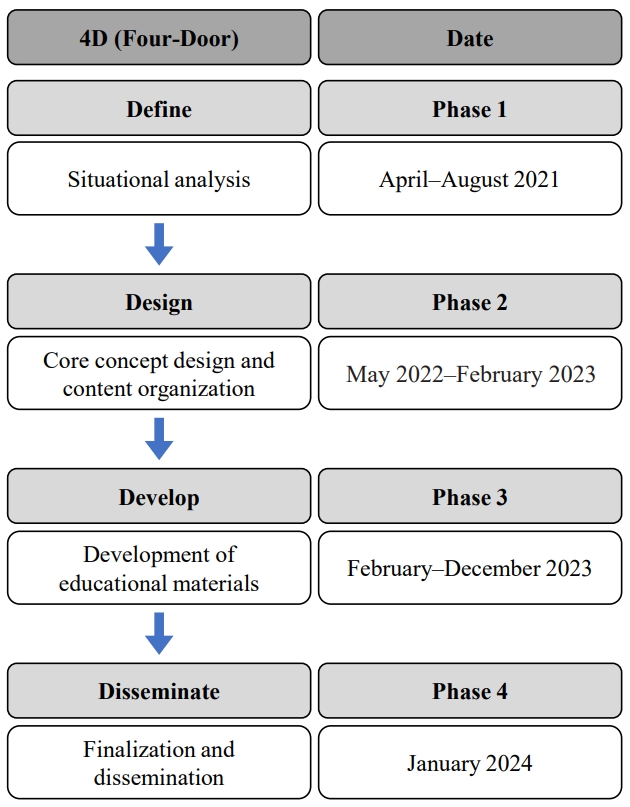
This study used a methodological design based on the Four-Door Model—Define, Design, Develop, and Disseminate—from 2021 to 2024. A situational analysis was conducted using a mixed-methods approach that included a quantitative survey of 70 nursing professionals and qualitative interviews with 52 stakeholders. Content validity and suitability were evaluated by a panel of six local experts using standardized validation forms and the Suitability Assessment of Materials (SAM).
Results
Ten emergency nursing domains were developed to address both universal principles, including triage protocols and life support interventions, and Lao PDR-specific challenges. Validity and suitability were supported by a SAM score of 77.3%, indicating clinical accuracy and cultural appropriateness. The 269-page coursebook was distributed to partner nursing colleges, three central hospitals, and international organizations.
Conclusion
This study developed the first comprehensive emergency nursing educational materials tailored to the Lao PDR context and written in the local language. These materials support continuing professional development and license renewal every 5 years. They also exemplify an international development paradigm that prioritizes recipient-country ownership and sustainable capacity building through collaborative knowledge creation.
- 1,214 View
- 114 Download

 First
First Prev
Prev


