
 Submit an article

Search
- Page Path
- HOME > Search
Research Papers
- Comparison of educational needs and priorities for work-related laws between hospital and community-based nurses
- Jeonghyun Kim, Min Kyoung Han, Minjae Lee, Sujin Shin
- J Korean Acad Nurs 2025;55(3):400-412. Published online August 21, 2025
- DOI: https://doi.org/10.4040/jkan.25049
-
 Abstract
 PDF
PDF ePub
ePub - Purpose
This study aimed to examine the practical utilization of work-related laws in nursing practice and to prioritize educational needs to provide foundational data for improving nurses’ legal competencies.
Methods
A descriptive survey was employed using an online self-reported questionnaire. Participants included 275 nurses with over 3 years of clinical experience, categorized into hospital and community-based. Convenience sampling was used, and data were collected between January 9 and February 3, 2025. Descriptive statistics and the paired t-test were conducted using IBM SPSS 26.0. Educational needs were analyzed using the Borich Needs Assessment and the Locus for Focus model.
Results
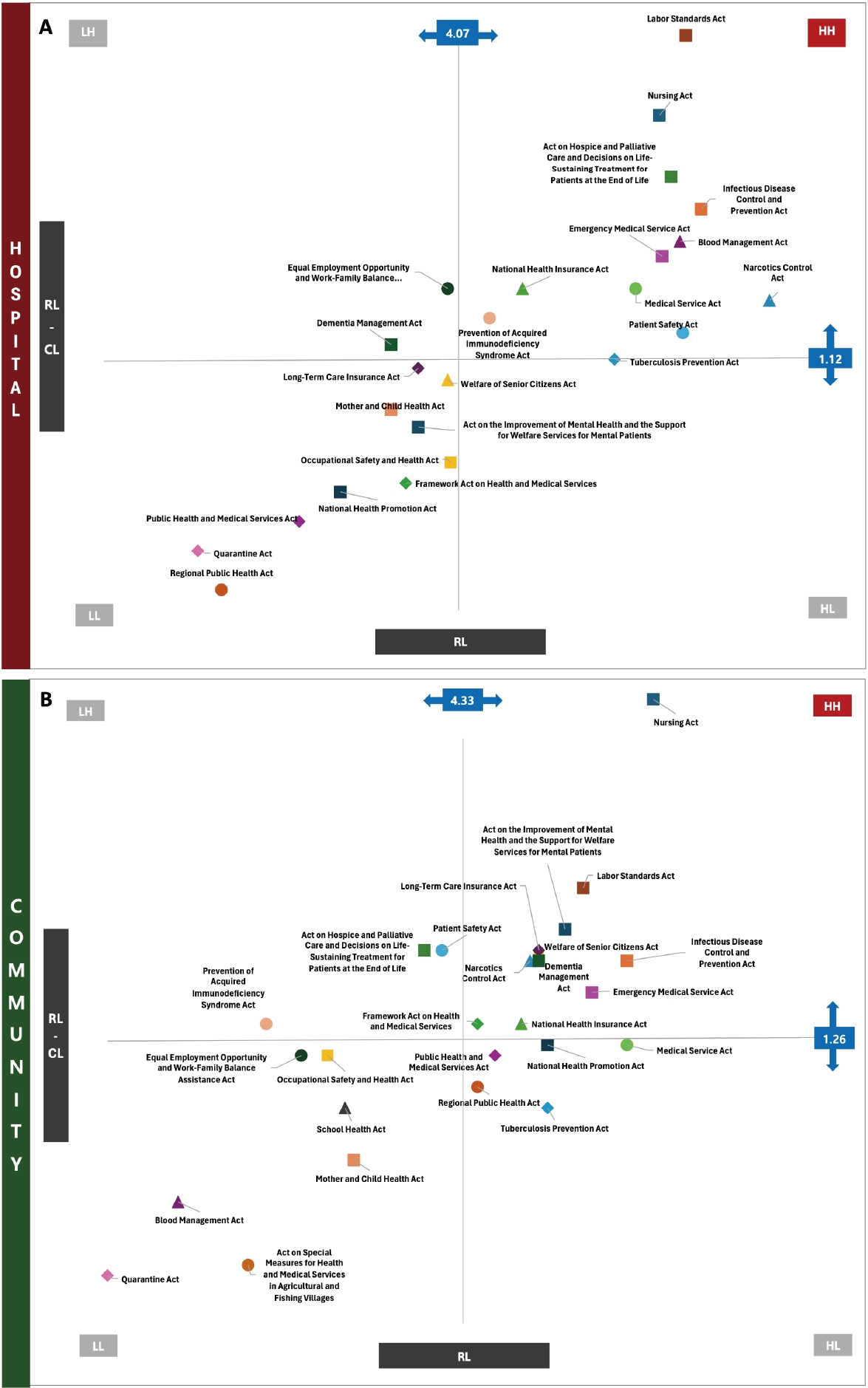
Among participants, 75.6% had received education on work-related laws, and 79.3% of those participants received related education during their undergraduate studies. However, 32.4% of nurses reported experiencing practice related difficulties due to insufficient legal knowledge, particularly related to unclear legal responsibilities and ambiguity in the scope of practice. High educational needs were identified for the Nursing Act and the Labor Standards Act across all workplaces. Hospital nurses emphasized the Hospice and Palliative Care Act and Emergency Medical Services Act, while community-based nurses prioritized the Mental Health Welfare Act, Elderly Welfare Act, and Dementia Management Act.
Conclusion
Nurses’ legal education needs are related to practical applications and their capability to respond appropriately to legal requirements, and these needs vary depending on their work environment and social changes. These findings underscore the necessity of restructuring legal education curricula to improve practical relevance and support nurses’ rights, providing a basis for developing workplace-specific legal education programs. -
Citations
Citations to this article as recorded by
- Legal Literacy in Clinical Nursing Practice: A Walker and Avant Concept Analysis
Yufei Xing, Xiaolong Wang, Enming Zhang, Jiajia Yu, Qiong Fang
Nursing Reports.2026; 16(6): 200. CrossRef
- Legal Literacy in Clinical Nursing Practice: A Walker and Avant Concept Analysis
- 3,151 View
- 207 Download
- 1 Web of Science
- 1 Crossref

- Analysis of Media Trends and Social Perceptions on Nursing Law Legislation
- Seung-Hee Lee, Min-Ho Joo
- J Korean Acad Nurs 2023;53(4):439-452. Published online August 31, 2023
- DOI: https://doi.org/10.4040/jkan.23030
-
Abstract
PDF
- Purpose
This study aimed to derive considerations for the enactment of nursing law by analyzing the trends and social perceptions of nursing law mentioned in major daily newspapers, cafes, and blogs.
Methods
Main texts and comments that included nursing law as a keyword were collected from major daily news and online postings from January 2021 to August 2022. The data collected through web crawling were analyzed using a TousFlux program used for big data analysis.
Results
During the period of study, the awareness level around nursing law enactment increased. In particular, public concern over nursing law enactment intensified due to the two political parties' policy pledges related to nursing law in January 2022 and the failure to introduce the nursing law to the national assembly judiciary committee in May 2022. Except in December 2021, public perception of nursing law enactment was generally favorable, with public opinion tilting more in favor of than against enactment.
Conclusion
Public opinion should be considered when drafting and implementing the nursing law to make it easier for the people to understand what the law constitutes. In addition, it is necessary to pay attention to and continuously promote the relationship between medical care and nursing in the nursing law system of developed nations. Lastly, nursing law enactment can enhance nurses' retention intention and provide a sense of efficacy to medical services. -
Citations
Citations to this article as recorded by- Nurse retention discourse in YouTube comments: a structural topic modeling analysis
Taewha Lee, JooHyun Lee
Journal of Korean Academy of Nursing.2026; 56(2): 206. CrossRef - The Legislative Trajectory of Korea’s Nursing Act: Insights From the Multiple Streams Framework
Donguk Lee, Justin Fontenot, Ph.D., RN, NEA-BC
Journal of Nursing Management.2026;[Epub] CrossRef - ‘Holding the line for patients’—Emergency nurses' experiences during a prolonged physician shortage crisis: A qualitative study
Mi Hyun Kim, Hye Jin Yoo
International Emergency Nursing.2026; 87: 101866. CrossRef - General Nurses’ Experience of Passing and Repealing the Nurses Act in Parliament
Yeon Hee Kim, Bo Kyung Kim, Su Jin Lee, Ha Young Lim, Hyang Ju Jung, Ju Song Cha
Journal of Korean Association for Qualitative Research.2024; 9(1): 65. CrossRef
- Nurse retention discourse in YouTube comments: a structural topic modeling analysis
- 4,720 View
- 135 Download
- 3 Web of Science
- 4 Crossref
Original Article
- The Scope of Practice for Registered Nurses in 64 South Korean Laws
- Sungkyoung Choi, Seung Gyeong Jang, Won Lee
- J Korean Acad Nurs 2019;49(6):760-770. Published online December 30, 2019
- DOI: https://doi.org/10.4040/jkan.2019.49.6.760
-
Abstract
PDF
Purpose The role of registered nurses is expanding in scope as the healthcare paradigm shifts from acute, hospital-based care to community and population-based care. Given this paradigm shift, this study explores the legal aspects of the role of a registered nurse.
Methods We used document analysis for extracting laws and legal orders related to nursing from the entirety of Korean law. Using textualism approach, we examined the contents utilizing a framework that was developed based on the role classification of community nurses by Clark in this study.
Results A total of 119 items related to nursing were derived from 64 laws. Of these, 71.4 % can be performed by people in multiple types of occupations including nurses. As a result of analyzing required qualifications, 45.4% of 119 items required additional qualifications besides registered nurse license. Analysis of workplace and activity type demonstrated that 26.1% of the 119 items were related to medical institutions, with nurses performing mostly “Client-oriented role.” More than half (68.9%) were non-medical institutions, with nurses performing mostly “Delivery-oriented role.” Some, however, did not stipulate the nurse's roles clearly.
Conclusion Therefore, to match the enhanced scope and responsibilities of registered nurses and to appropriately recognize, guide, and hold these nurses accountable, laws and policy must reflect these changes. In doing so, these updated laws and policies will ultimately serve as a basis for improving the quality and safety of nursing services.
-
Citations
Citations to this article as recorded by- Telecare legislation priorities: A Delphi study grounded in ethical challenges
Seongyu Han, Eun Kyoung Yun
Nursing Ethics.2026; 33(2): 488. CrossRef - Role of community health officers: opportunities and challenges
Namita Batra, Kamlesh K. Sharma
International Journal Of Community Medicine And Public Health.2025; 12(3): 1557. CrossRef - Priorities and barriers of dementia policy response and action in South Korea and China: SWOT-PESTLE-AHP model
Bo Zhao, Fanlei Kong, Hyoung-Sun Jeong, Young-Joo Won, Myung-Bae Park, Eun Woo Nam
Geriatric Nursing.2025; 65: 103512. CrossRef - Comparison of educational needs and priorities for work-related laws between hospital and community-based nurses
Jeonghyun Kim, Min Kyoung Han, Minjae Lee, Sujin Shin
Journal of Korean Academy of Nursing.2025; 55(3): 400. CrossRef - Analysis of issues related to nursing law: Examination of news articles using topic modeling
JooHyun Lee, Hyoung Eun Chang, Jaehyuk Cho, Seohyun Yoo, Joonseo Hyeon, Andrea Cioffi
PLOS ONE.2024; 19(8): e0308065. CrossRef - Relationships among basic psychological needs, organizational commitment, perceived authentic leadership and turnover intention in Korean nurses: A cross‐sectional study
Jina Hwang, Eun Kyeung Song, Sangjin Ko
Journal of Nursing Management.2022; 30(7): 2176. CrossRef - The Current Status of the Administrative Dispositions of Nurses: A Nationwide Survey in South Korea
Suyoung KIM, Sanghee KIM
Journal of Nursing Research.2021; 29(5): e170. CrossRef - Association of the Magnitude of Nurses With the Use of Health Information Exchanges: Analyzing the National Health Insurance Claim Data of Hospitals and Clinics in Korea
Young-Taek Park, Yeon Sook Kim, Yun-Jung Heo, Jae-Ho Lee, Hyejung Chang
INQUIRY: The Journal of Health Care Organization, Provision, and Financing.2021;[Epub] CrossRef - The conundrum of professionalising building surveying in Malaysia
Abdul-Rashid Abdul-Aziz, Subashini Suresh, Suresh Renukappa
International Journal of Building Pathology and Adaptation.2020; 38(5): 621. CrossRef
- Telecare legislation priorities: A Delphi study grounded in ethical challenges
- 6,585 View
- 65 Download
- 8 Web of Science
- 9 Crossref
 First
First Prev
Prev


