
 Submit an article

Search
- Page Path
- HOME > Search
Research Papers
- Ten-year trends in research designs and keywords: a bibliometric comparison of the Journal of Korean Academy of Nursing and leading international nursing journals
- Jin-Hee Park, Hyun Kyoung Kim, Gaeun Kim, Sun Hyoung Bae
- J Korean Acad Nurs 2025;55(4):557-567. Published online November 19, 2025
- DOI: https://doi.org/10.4040/jkan.25119
-
 Abstract
 PDF
PDF ePub
ePub - Purpose
This study compared trends in research designs and keywords by analyzing the abstracts of four major nursing journals over the past decade, focusing on the Journal of Korean Academy of Nursing (JKAN) in comparison with the International Journal of Nursing Studies (IJNS), Journal of Advanced Nursing (JAN), and Japan Journal of Nursing Science (JJNS).
Methods
A bibliometric analysis was conducted, encompassing 5,522 abstracts published between 2015 and 2024. Research designs were first classified as “quantitative,” “qualitative,” or “other,” and then further sub-classified based on international evidence-based frameworks. Text preprocessing was also conducted, and term frequency–inverse document frequency was applied to evaluate keyword importance. The 2015–2019 and 2020–2024 periods were compared to examine changes in both research designs and keyword importance.
Results
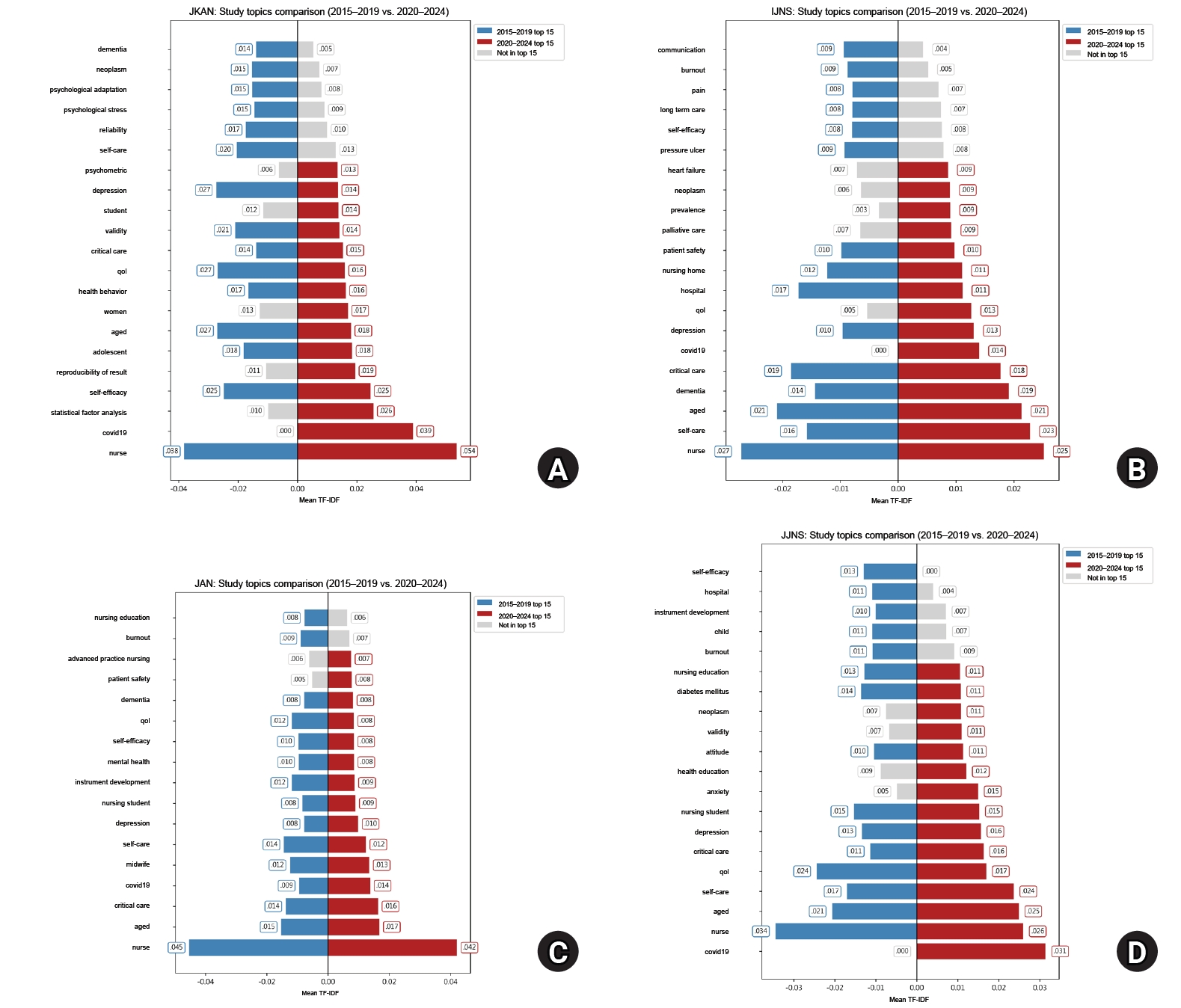
Compared to IJNS, JAN, and JJNS, JKAN published more instrument development and analytic studies but fewer randomized controlled trials and systematic reviews. Over time, the number of instrument development and mixed-methods studies in JKAN increased, while high-evidence designs remained scarce. Keyword analysis showed JKAN’s emphasis on psychosocial themes such as self-efficacy, quality of life, and depression, whereas the other journals more often highlighted policy- and institution-related topics. Across journals, COVID-19 and patient safety emerged as important themes after 2020.
Conclusion
JKAN demonstrates strengths in methodological diversity within quantitative research and in digital health–related analytics. However, high-evidence study designs and policy-oriented keywords are underrepresented in JKAN. Strategic expansion toward randomized controlled trials, systematic review, global and digital health, and policy-relevant research is recommended to strengthen JKAN’s international competitiveness. -
Citations
Citations to this article as recorded by
- Methodological and Thematic Trends in the Korean Journal of Adult Nursing (2015–2024)
Eunok Park, Jungsun Lee, Jeong Hee Kim, JinShil Kim, Haeng-Mi Son, Jeonghyun Cho, Bohyun Park
Korean Journal of Adult Nursing.2026; 38(2): 155. CrossRef
- Methodological and Thematic Trends in the Korean Journal of Adult Nursing (2015–2024)
- 2,752 View
- 170 Download
- 1 Crossref

- Effects of Health Education Using Virtual Reality for Adolescents: A Systematic Review and MetaAnalysis
- SoMi Park, ChaeWeon Chung, Gaeun Kim
- J Korean Acad Nurs 2023;53(2):177-190. Published online April 30, 2023
- DOI: https://doi.org/10.4040/jkan.23003
-
Abstract
PDF
- Purpose
This study aimed to evaluate the effects of health interventions using virtual reality (VR) on improving knowledge, attitudes, and skills; and inducing behavioral change among adolescents.
Methods
This study is a systematic review and meta-analysis following PRISMA guidelines. We searched Cochrane, MEDLINE, Embase, CINAHL, Scopus, Web of Science, and Korean databases between database inception and April 10, 2021. Based on heterogeneity, a random- or fixed-effects model was used, as appropriate, to calculate effect sizes in terms of the standardized mean difference (SMD) and odds ratio (OR). Studies were selected if they verified the effects of health education using VR on adolescents; there was an appropriate control group; and if the effects of education were reported in terms of changes in knowledge, attitudes, skills, or behaviors.
Results
This analysis included six studies (n = 1,086). The intervention groups showed greater responses in knowledge and attitudes (SMD = 0.57, 95% confidence interval (CI) [0.12 to 1.02]), skills related to health behavior (SMD = -0.45, 95% CI [-0.71 to -0.19]), and behavioral change after 12 months (OR = 2.36, 95% CI [1.03 to 5.41]).
Conclusion
The results confirm the effectiveness of health interventions using virtual reality (VR). Although the analysis include a small number of studies, a case can be made for health interventions using VR to be utilized as educational methods and strategies to prevent risky behaviors among adolescents. -
Citations
Citations to this article as recorded by- Comparing Visual Self‐Assessment and Virtual Reality Training for Improving Basic Life Support Competency in Nursing Students: An Educational Study
Mohsen Hamidian, Hamid Salehiniya, Anis Jor, Hakimeh Sabeghi
Health Science Reports.2026;[Epub] CrossRef - Implementation of a Childcare-Based Obesity Prevention Program for Vulnerable Families During the COVID-19 Pandemic: Lessons for School Nurses
Jiyoung Park, Gill ten Hoor, Seohyun Won, Gahui Hwang, Sein Hwang, Siew Tiang Lau
The Journal of School Nursing.2025; 41(5): 579. CrossRef - Development and Evaluation of a Virtual Reality Intervention for Reducing Exposure to Endocrine Disruptors in Female Adolescents: A Pilot Study
SoMi Park, Yun Jeong Hwang, ChaeWeon Chung
Journal for Specialists in Pediatric Nursing.2025;[Epub] CrossRef - Chinese nurses’ perspectives on child-friendly healthcare practice assessment: a qualitative study
Wei Xiao Huang, Mei Chan Chong, Li Yoong Tang, Xiao Xia Liu, Mei Fang, Yun Yun Shen, Xiao Li Guo
BMC Nursing.2025;[Epub] CrossRef - Enhancing anatomy education with virtual reality: integrating three-dimensional models for improved learning efficiency and student satisfaction
Shuliang Niu, Jinlong Zhang, Jiang Lin, Binbin Wang, Jie Yan
Frontiers in Medicine.2025;[Epub] CrossRef
- Comparing Visual Self‐Assessment and Virtual Reality Training for Improving Basic Life Support Competency in Nursing Students: An Educational Study
- 6,142 View
- 144 Download
- 5 Web of Science
- 5 Crossref
 First
First Prev
Prev


