-
Development of a nurses’ situation awareness scale for clinical deterioration: a methodological study
-
Hye Jin Kang, Yi Kyung Ha
-
J Korean Acad Nurs 2026;56(3):370-381. Published online August 5, 2026
-
DOI: https://doi.org/10.4040/jkan.26039
-
-
 Abstract Abstract
 PDF PDF ePub ePub
- Purpose
This study aimed to develop a scale for assessing nurses’ situation awareness of clinical deterioration and to evaluate its validity and reliability.
Methods
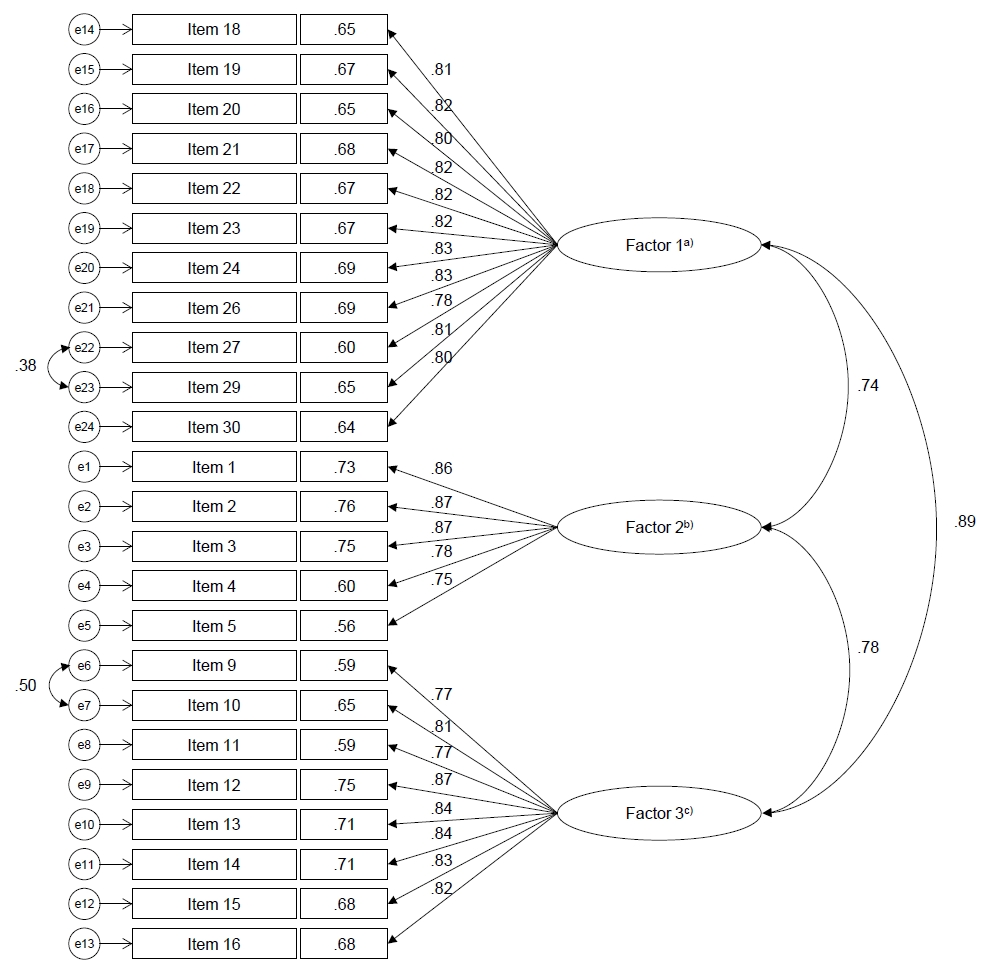
This methodological study followed the scale-development guidelines of DeVellis and Thorpe. Item generation began with 44 items derived from 17 attributes identified through a hybrid-model concept analysis, which included a literature review and focus group interviews with 13 nursing experts. After content validity was evaluated by seven experts, 30 items were retained. A pilot test was then conducted with 20 hospital nurses to assess item comprehensibility. From August 30 to October 6, 2025, a total of 446 hospital nurses participated in the survey, and data from 440 respondents were analyzed. Construct validity was examined using exploratory and confirmatory factor analyses, along with convergent and discriminant validity testing. Internal consistency was evaluated using Cronbach’s α and McDonald’s ω.
Results
Exploratory factor analysis yielded a three-factor model, which showed acceptable fit in confirmatory factor analysis. The final instrument comprised 24 items across three factors, was scored on a 5-point Likert scale, and was named the Nurses’ Situation Awareness Scale for Clinical Deterioration (NSAS-CD). The scale showed high internal consistency, with Cronbach’s α of .98 and McDonald’s ω of .98.
Conclusion
The NSAS-CD demonstrated acceptable validity and reliability for assessing nurses’ situation awareness of clinical deterioration. Further research is needed to evaluate its generalizability across diverse clinical settings and to establish standardized criteria for clinical deterioration.
-
Factors Affecting the Intention to Use Smartmonitor-Based Mobile Health in Middle-Aged in Patients Applying the Technology Acceptance Model II
-
Ol Eum Joo, Yi Kyung Ha
-
J Korean Acad Nurs 2024;54(4):620-632. Published online November 13, 2024
-
DOI: https://doi.org/10.4040/jkan.24091
-
-
Abstract
PDFePub
- Purpose
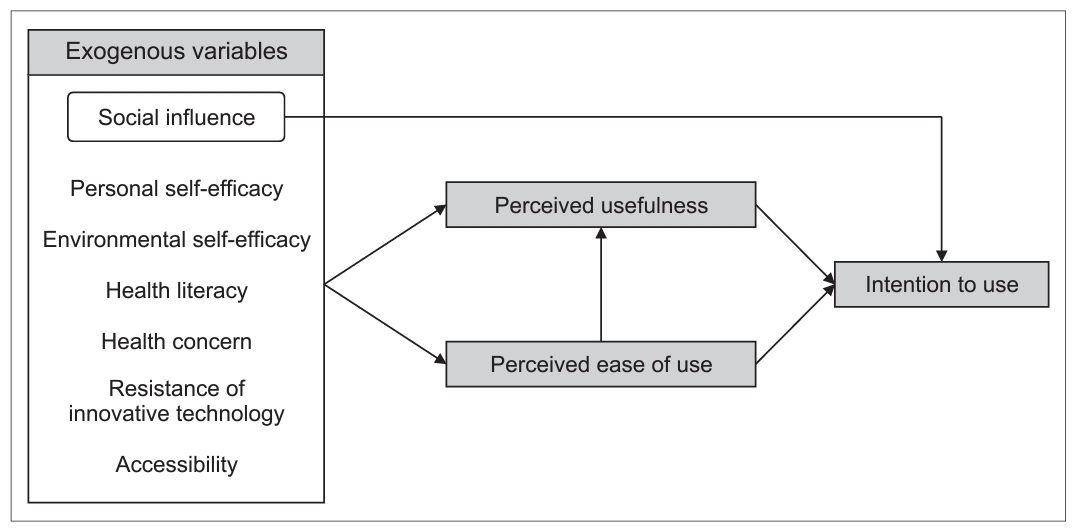
This study aimed to identify factors that influence the intention to use smart monitor-based mobile health (SBM) technology among middle-aged inpatients, based on the technology acceptance model II (TAM II).
Methods
A total of 222 participants were surveyed. Data were analyzed using SPSS Statistics 23.0 and IBM SPSS Amos 23. Seven exogenous variables–social influence (SI), personal self-efficacy, (PSE), environmental self-efficacy (ESE), health literacy, health concerns, resistance to innovative technology (RIT), accessibility (AC)– and three endogenous variables–perceived ease of use (PEOU), perceived usability (PU), and intention to use (ITU)–were investigated.
Results
The hypothesized path model demonstrated a good fit for the data. SI (β = .13, p = .042), PU (β = .46, p < .001), and PEOU (β = .16, p = .008) had significant direct effects on the ITU, which explained 39.5% of the variance. Additionally, SI (β = .27, p < .001), ESE (β = .16, p = .010), RIT (β = - .12, p = .026), AC (β = .28, p < .001), and PEOU (β = .20, p = .001) indirectly affected ITU through PU, which explained 50.7% of the variance. Furthermore, PSE (β = .38, p < .001) indirectly influenced ITU via PEOU, which explained 38.4% of the variance.
Conclusion
This study demonstrates that the TAM II can be used to effectively predict ITU in SBMs among middle-aged inpatients. To expand the intention to use SBMs, it is necessary to develop SBMs that include content and programs that promote PU, SI, and PEOU.
-
Citations
Citations to this article as recorded by  - Research on the implementation path of digital-intelligent healthcare based on the TAM model from the perspective of high-quality development
Zijue Qi, Huize Han, Yidayetula Abuduaini, Aikeda Litipu, Jun Li
BMC Health Services Research.2026;[Epub] CrossRef
-
2,950
View
-
123
Download
-
1
Web of Science
-
1
Crossref
|

 Submit an article